九州大学学術情報リポジトリ
Kyushu University Institutional Repository
関係計算を用いたグラフ変換
溝口, 佳寛
https://doi.org/10.11501/3063856
出版情報:Kyushu University, 1992, 博士(理学), 論文博士 バージョン:
権利関係:
Graph Transformations Using Relational Calculus
1992
Y oshihiro Mizoguchi
Abstract
Graph transformations are very common in many area of Computer Science and related fields, especially they are used in many different kinds of non-numeric computation.
Since the early beginnings of Computer Science graphical representations have played a fundamental role to explain complex situations on an intuitive level. On the other hand, many people believe that graphs are only of limited use for internal machine representation because classical graph theory offers only little help and more graph algorithms are highly inefficient in general.
Though most graph algorithms are globally defined the basic idea of graph trans
formations is of local nature. This means that the transformation from one graph into another one is based on local changes where only certain subgraphs are transformed and the complement remains unchanged. By these features, several researches about concurrent and distributed computation based on graph transformations have been developed. Algebraic specification techniques based on term rewriting should be ex
tended efficiently to graph transformations. So it can be applied to the area such as production systems, logical programming and analysis of programs. A general graph transformation system provides not only an efficient way to develop useful tools but also graph transformation approaches provide a new insight of algorithms about such as a decidability problem of graph properties. In this way, there are various applications of graph transformations.
This thesis is a collection of the theory about foundations of graph transformations.
The research goal of the foundations is a comparative study, unification of the concepts developed in the different approaches and finding out new insights for applications.
It is well-known the "algebraic categorical approach" to graph grammars devel-
oped by Ehrig as a first algebraic fundamental theory about graph transformations.
Recently, Raoult, Kennaway and Lowe proposed other graph structures and different but very closed formalizations of graph transformations. They proved the existence theorem of pushout which is a basic notation for transformations. In this thesis, we propose a categorical framework unifying several graph structures and analyz various properties about graph transformations. Further, we implement a graph transforma
tion system based on a symbolical object which is called a graph term and consider their applications.
In Chapter 2, we summarize a theory of relational calculus which is a theoreti
cal foundation in this thesis. Especially, the properties about partial functions and pushouts which play fundamental roles of graph transformations are investigated not only in the category of set and functions but also in the more general categories in
cluding toposes which are models of constructive logic.
In Chapter 3, we present a categorical framework to consider several graph struc
tures universally. We show an existence condition of pushouts in the categories. That is, graphs in which out-edges from a node is ordered, graphs in which out-edges from a node is not ordered, and graphs in which do not have multiple edges between the same nodes are treated uniformly and proved the conditions of existence of pushouts.
In Chapter 4, we developed a theory about the category of simple graphs in which pushouts always exist so it is an adequate category for a model of graph transforma
tions. We formalized the graph transformation and investigate the properties using re
lational calculus. A sufficient condition for two transformations to commute is shown.
Further, we show the critical pair lemma holds like term rewriting system when we restrict some rewriting rules and matchings.
In Chapter 5, we introduce a graph rewriting system based on a model introduced In Chapter 4, using a symbolical object called a graph term. We precisely defined parallel rewri tings for symbolical objects and show a sufficient condition for that a parallel rewriting is sequential simulatable. A problem finding out regular expressions of recognized languages from a graph expressing a finite automaton is solved using graph rewritings. Especially, we show those parallel rewritings which are not simulated
by sequential rewritings also lead a collect answer of the problem.
In Chapter 6, we propose a more general framework for graph transformations which is an extension of the theory discussed in Chapter 4. A hyper graph structure which has a label with arity for each hyper edge is included as an example. We extend our theory to the general framework and proved that pushouts always exist.
The thesis concludes with Chapter 7 in which the main results of the thesis, further related research topics, and remaining open problems are discussed.
Acknowledgments
I would like to express my sincere appreciation to Professor Yasuo Kawahara for his valuable advice, many constructive suggestions, and continual encouragement during the course of this study. I wishes to thank Professor Setsuo Arikawa for his helpful comments and encouragement.
I am grateful to Professor Toru Hitaka and Professor Nagata Furukawa for their valuable suggestions and criticisms.
I thank Professor Koichi Niijima for his kind support and encouragement. I also thank Professor Satoru Miyano, Hiroshi Ohtsuka, Masaya Nohmi, Satoru Kumamoto and Takayoshi Shoudai for their useful suggestions and helpful comments during dis- CUSSlOnS.
Finally, I am especially grateful to my parents and my wife Kyoko for their constant supports and encouragements.
Contents
1 Introduction 1
2 Relational calculus 9
2.1 Basic notations . . . 9
2.2 Category of partial functions . 11
2.3 Relational calculus in toposes 15
3 Graph structure over Pfn 23
3.1 Graphs over Pfn 23
3.2 0 bservations . . . 27
4 Relational graph rewritings 31
4.1 Rewritings for simple graphs 31
4.2 0 bservations . . . . . . . 38
4.3 Examples of graph rewritings 41
4.4 Rewritings for graphs with labeled edges 43
5 Graph rewriting system using graph terms 46
5.1 Symbolic graphs and graph terms 47
5.2 Graph terms and tree automata 52
5.3 Graph rewriting system . . . 60
5.4 Examples of graph reduction systems 63
5.5 Calculation of regular expressions 70
5.6 Examples of executions . . . . . . 74
6 Transformations of relational structures
6.1 Relational structures . . . . . 6.2 Partial morphisms of relational structures 6.3 A comparison theorem
7 Conclusion Bibliography
79 79 84 90
93 95
Chapter 1 Introduction
There are many researches [Cou86, CM91, EKL90, EKR90, Ken87, Ken90, LE90, Miz92b, OH91, Rao84] on graph transformations which have a lot of applications including software specification, data bases, analysis of concurrent systems, develop
mental biology and many others. In these one of the advantages of categorical graph rewritings is to produce a universal reduction despite how to execute algorithms for applying production rules.
At first, we introduce two illustrative examples of application of graph transforma
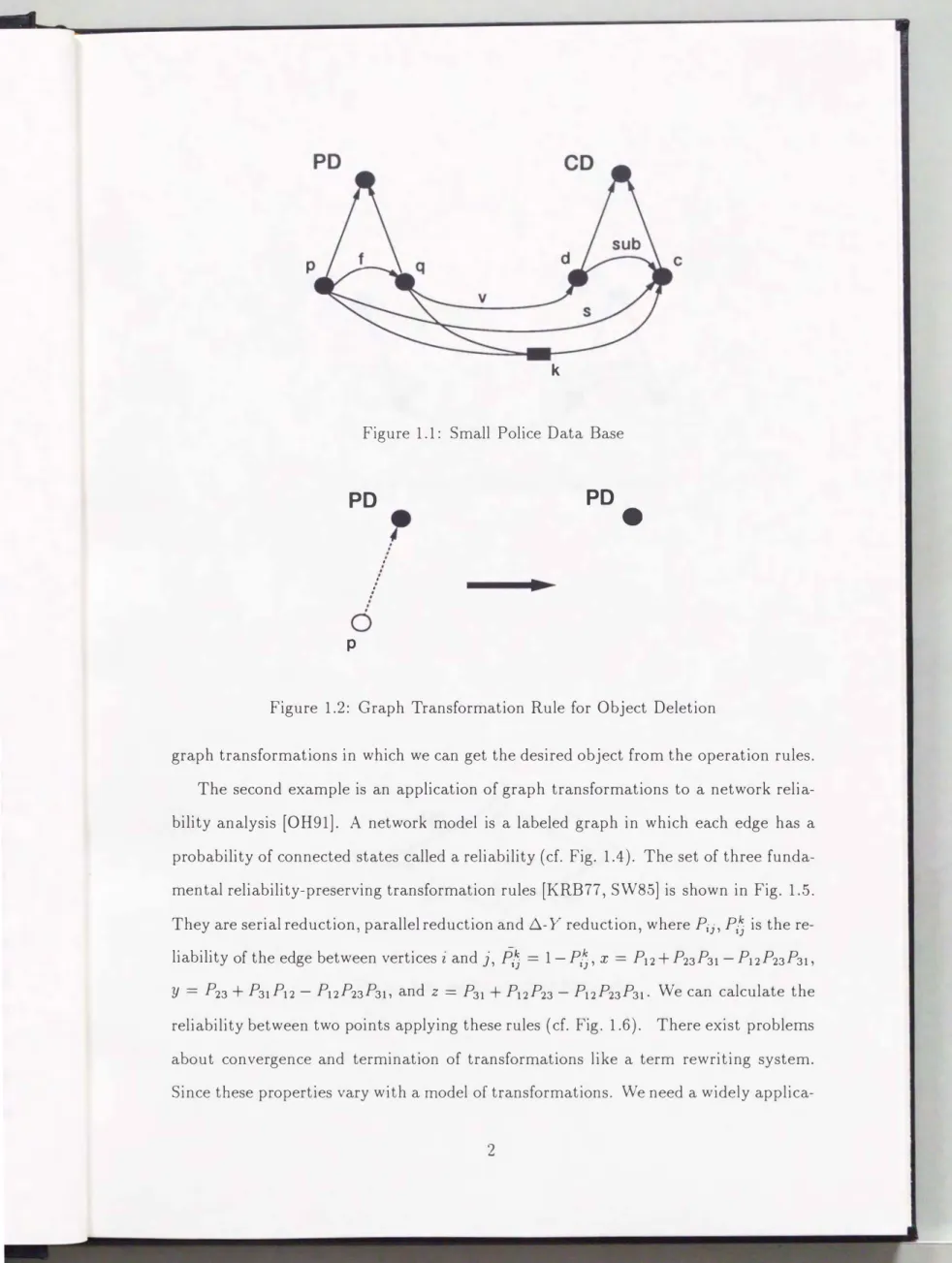
tions. The first example is a small relational data base of the information processing system of West Germany's police [Ger83, LE90]. A simple data base is expressed by a graph in Fig. 1.1. Nodes consists of special nodes PD(Person Data) and CD(Case Data), person's nodes which have an edge to PD and case's nodes which have an edge
to CD. Edges represent relations between persons and cases. For example, edges s means "Person p is suspected in case c". A situation related over three persons or cases expressed by a hyper edge. Operations of the data base, such as adding a per
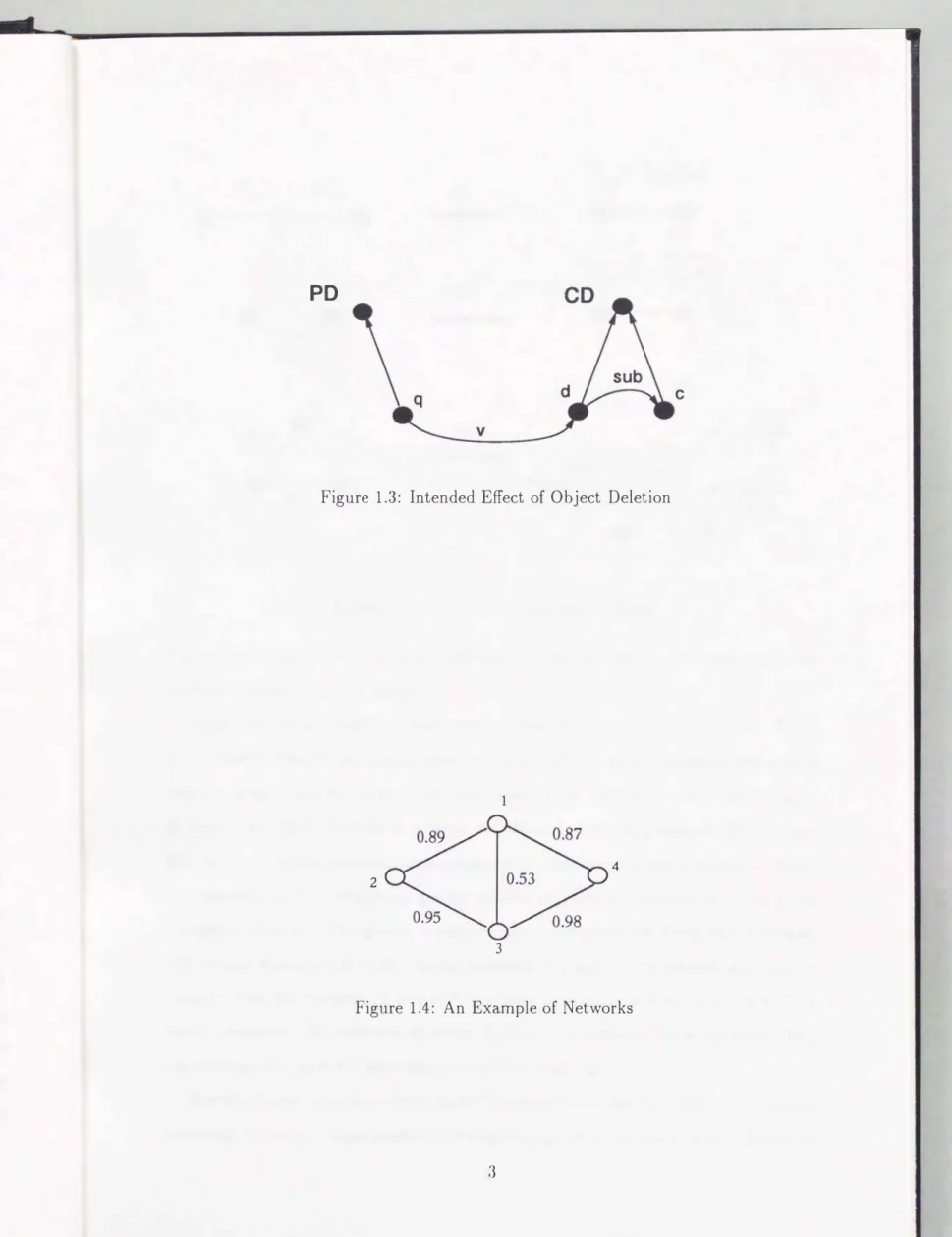
son( case), adding a relation of persons and cases, deleting a person(case) are given by graph transformation rules. For example, an operation deleting a person can be modeled by Fig. 1.2. The desired effect of object deletion is not only the removal of the object but also the elimination of all relations referring to this object ( cf. Fig. 1.3).
The graphical intuitional understanding is easy, but for discussing about properties about effects of a combination of operations we need a precise mathematical model of
k
Figure 1.1: Small Police Data Base
PD
.
p
0
.
. .
tt
•
PD -
Figure 1.2: Graph Transformation Rule for Object Deletion
graph transformations in which we can get the desired object from the operation rules.
The second example is an application of graph transformations to a network relia-
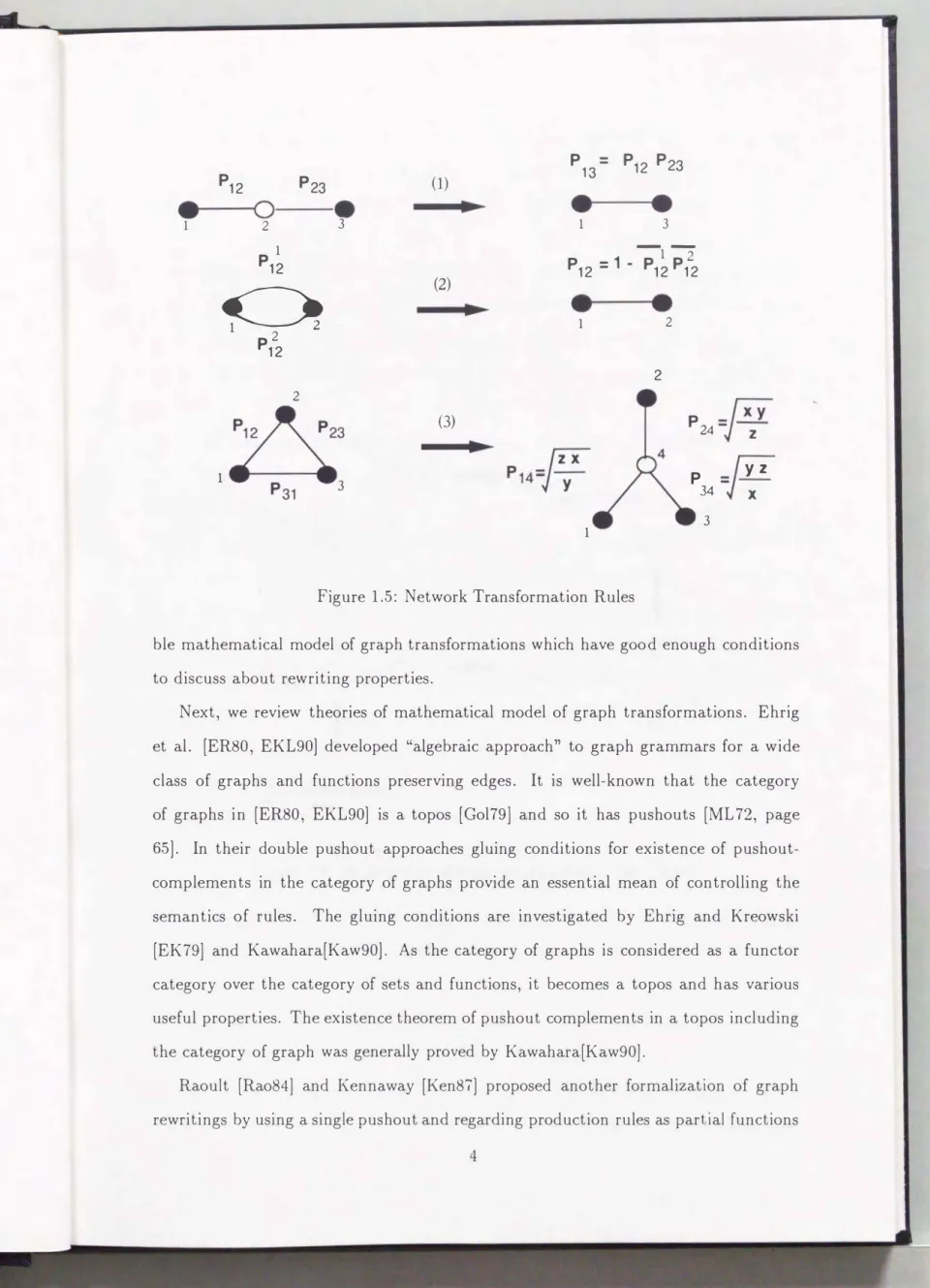
bility analysis [OH91]. A network model is a labeled graph in which each edge has a probability of connected states called a reliability ( cf. Fig. 1.4
)
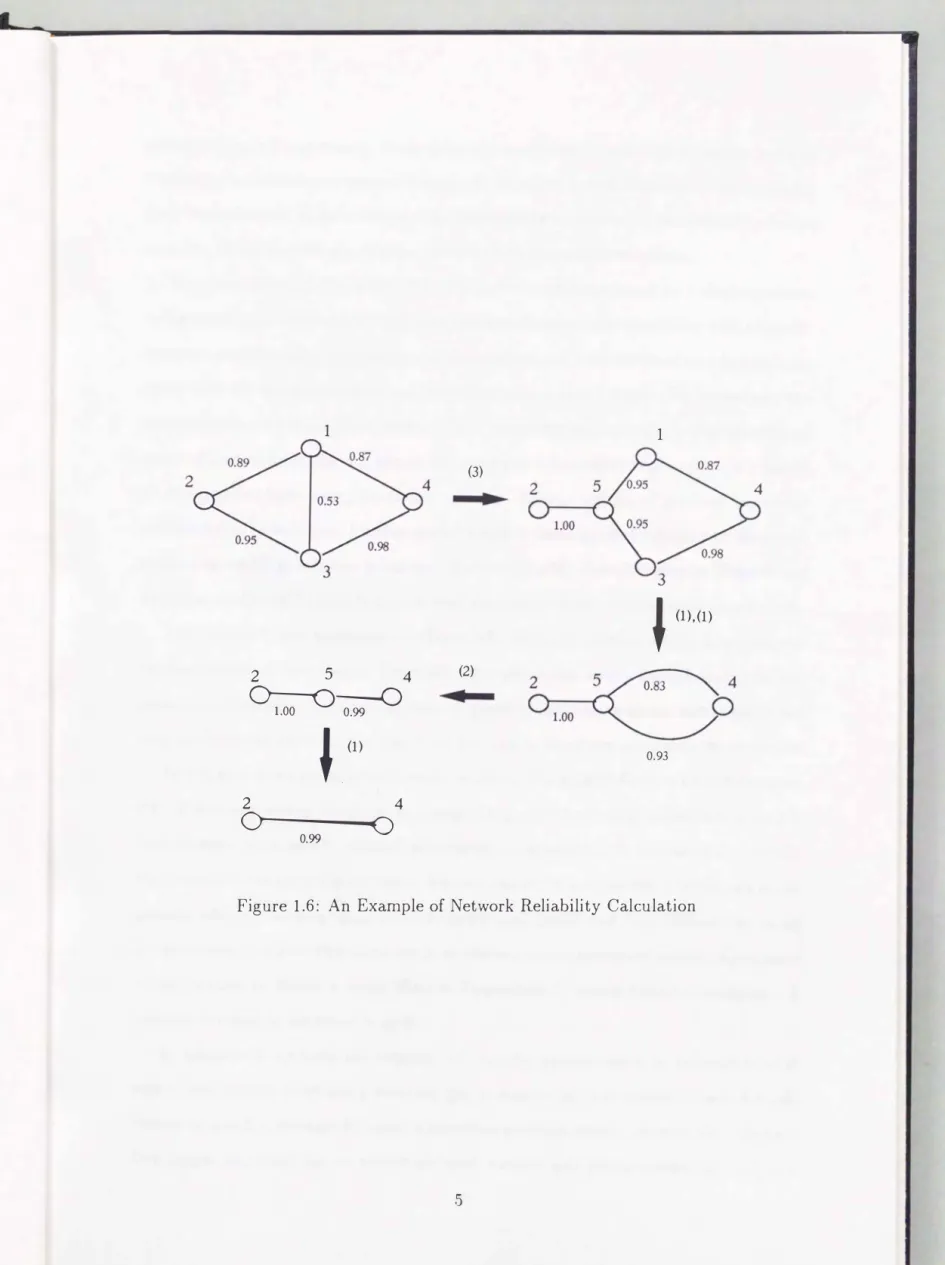
. The set of three fundamental reliability-preserving transformation rules [KRB77, SW85] is shown in Fig. 1.5.
They are serial reduction, parallel reduction and �- Y reduction, where Pij, Pi
j
is the reliability of the edge between vertices i and j,
A;=
1-Pij
, x=
P12+P23P31-P12P23P31, Y=
P23 + P31P12- P12P23P31, and z=
P31 + P12P23-P12P23P31· We can calculate the reliability between two points applying these rules ( cf. Fig. 1.6)
. There exist problems about convergence and termination of transformations like a term rewriting system.Since these properties vary with a model of transformations. We need a widely applica-
PD
c v
Figure
1.3:Intended Effect of Object Deletion
1
4 2
3
Figure
1.4:An Example of Networks
p12 p23 (1)
- 0 -
•1 2 3
p12 1
�
(2)
• p12 2
2
(3)
•
1 3
p = p12 p23 13
-
1
p12 = 1 -
-
1
:/¥
p 14=
1
-
3
-12
p12 p12-
2
2
P
=Jxy
24 z
p
=} y
z34 X
3
Figure
1.5:
Network Transformation Rulesble mathematical model of graph transformations which have good enough conditions to discuss about rewriting properties.
Next, we review theories of mathematical model of graph transformations. Ehrig et al.
[
ER80, EKL90J
developed "algebraic approach" to graph grammars for a wide class of graphs and functions preserving edges. It is well-known that the category of graphs in[
ER80, EKL90]
is a topos[
Gol79]
and so it has pushouts[
ML 72, page65].
In their double pushout approaches gluing conditions for existence of pushoutcomplements in the category of graphs provide an essential mean of controlling the semantics of rules. The gluing conditions are investigated by Ehrig and Kreowski
[
EK79]
and Kawahara[
Kaw90J
. As the category of graphs is considered as a functor category over the category of sets and functions, it becomes a topos and has varioususeful properties. The existence theorem of pushout complements in a topos including the category of graph was generally proved by Kawahara
[
Kaw90J
.Raoult
[
Rao84]
and Kennaway[
Ken87]
proposed another formalization of graph rewritings by using a single pushout and regarding production rules as partial functions1
2 5 4
Q--0--0
1.00 0.99
J .
(1)2 4
Qr---0
0.99
(3)
•
(2)
•
1
J
(1),(1)0.93
Figure 1.6: An Example of Network Reliability Calculation
preserving graph structures. They show the condition for existing pushouts in their models. We introduce a general framework of graph transformations which includes their formalization as an example. Our result of the condition for existing of pushouts contains theirs and we give another model which is pushout complete.
Recently Lowe [Low89, LE90, EKL90) studied rewritings bas d on a single pushout in Sig-algebras and proved pushout completeness for restricted signatures with monadic operator symbols only. His category of Sig-algebras can be considered as a functor cat
egory over the category of sets and functions, so it is also a topos. We investigate the properties of partial functions and pushout completeness not only in the category of sets and partial functions but also in the more general category topos which is a model of constructive logic using relational calculus. So our results of pushout complete
ness contains Lowe's one. Further we introduce a more general category of relational structures which generalizes relational algebras [Bar70], Raoult 's graphs (Rao84] and hypergraphs [Ken90) and a few properties such as pushout completeness are studied.
In Chapter 2, we summarize a theory of relational calculus which is a theoreti
cal foundation of this thesis. Especially, the properties about partial functions and pushouts which play fundamental roles of graph transformations are investigated not only in the category of set and functions but also in the more general category topos.
In Chapter 3, we generalizes Raoult 's method. For an endofunctor on the category Pfn of sets and partial functions we consider a graph structure as a function V ---+ TV from a vertex set V to TV, where Tis an endofunctor on Pfn. In the case TV = V* the structure is the same as Raoult's one. We prove an existence theorem of pushouts in our general settings avoiding many kind of conditional checks and case divisions by using the relational calculus. Our main result on the existence theorem of pushouts produces a modification of Raoult's result [Rao84, Proposition 5] which lacked a condition. A counter example to his result is given.
In Chapter 4 we treat the category of (simple) graphs (with or without labeled edges) and partial functions preserving graph structures, and present a new formal
ization of graph rewritings by using a primitive pushout construction in the category.
Our graph rewritings can be always executed without any gluing conditions, only if a
graph has a matching to a given rewriting rule. Moreover our formalization of graph rewritings generalizes Ehrig's graph derivations
[
EK79, EKR90]
and Raoult 's graph rewritings[
Rao84]
in a reasonable sense. For a pair of partial functions from a common set into graphs a primitive pushout square is constructed, which shows the cate
gory of graphs and partial morphisms has pushouts. Moreover we give a more gen ral sufficient condition for two graph rewritings to commute and a critical pair 1 mma of graph rewriting systems. We compare our approach with another approaches by Ehrig
[
EKL90]
, Lowe[
LE90]
, Kennaway[
Ken90]
and Okada[
OH91]
. Some examples related to graph rewritings are listed. In the last of the chapter, we state how to develop our formalization of graph rewritings for graphs with labelled edges which contains Raoult's graphs
[
Rao84]
.In Chapter 5, we introduce new notations for graphs and graph terms and the in
terpretation of graph terms are given. Using the notions, we define not only simple reduction but also a parallel reduction. The symbolical notation of graphs and reduc
tion rules is helpful to define a reading region and a writing region precisely. These facts contribute to clear the concept of sequentially simulatable parallel reductions. We have a sufficient condition that holds parallel reductions are sequentially simulatable.
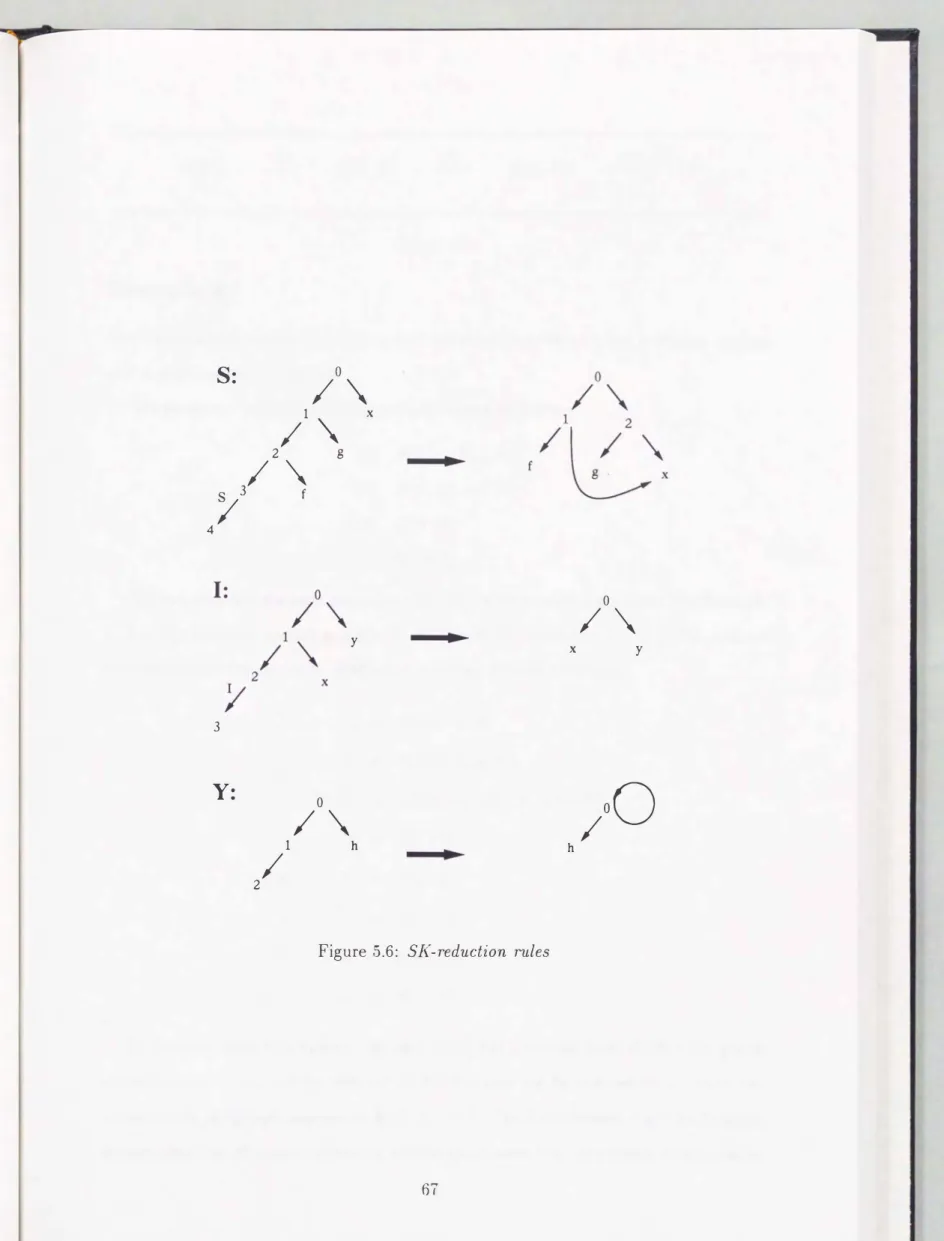
Some properties about sequentially simulatable reduction are discussed. Turner's SK
reduction machine
[
Tur79]
guarantees every parallel reduction induce a correct result.We define a graph rewriting rules corresponding to SK-reductions, we reconfirm the fact of parallel reductions in our framework. For a meaningful example of non sequen
tially simulatable reductions, we show a graph reduction system which solves equations of regular expressions. The reduction rules are not sequentially simulatable, but it is proved that every parallel reduction leads to the right solution of the equations.
In Chapter 6, we propose a more general framework for graph transformations which
contains the category defined in Chapter 4. A hyper graph structure which have a label with arity for each hyper edge is included as an example. We also showed in the general framework that pushouts always exist using the properties of partial functions. Finally, we compare our category of relational structures together with partial morphisms to a category of partial morphisms in the sense
[
RR88, Ken90]
and show that they areisomorphic choosing a certain admissible class of monomorphisms.
In Chapter 7, we concludes our researches and discuss about several problems for developing the research.
Chapter 2
Relational calculus
In this chapter we summarize a theory of relational calculus which is a theoretical foundation of this thesis. In Section 2.1, we state basic notations and fundamental properties of relation in the category of sets and functions. In the category of sets and partial functions, we give a simple proof of existence of pushouts using relational calculus and several properties of pushout squares are showed. In Section 2.2, we extend the notions for topos which is a model of constractive logic and investigate the properties of partial functions and pushouts which play fundamental roles of graph transformations.
2.1 Basic notations
A
relation a
of a set A into another set B is a subset of the cartesian product A x B and denoted bya
: A ___,. B. Theinverse relation att
: B ___,. A ofa
is a relation such that( b, a) E att
if and only if(a, b) E a.
hecomposite aj3
: A ___,. C ofa
: A ___,. B followed byj3
: B ___,. C is a relation such that(a, c) E a/3
if and only if there existsbE
B with(a, b) E a
and(b,c) E /3.
As a relation of a set A into a set B is a subset of A
x
B, the inclusion relation, union, intersection and difference of them are available as usual and denoted by �' U, n and -, respectively. Theidentity relation
idA : A ___,. A is a relation with idA ={(a, a) E Ax A I a E A}
(the diagonal set ofA).
The followings are the basic properties of relations and indicate that the totality of sets and relations forms a category
Reiwith involution (or shortly !-category).
Proposition 2.1.1 (!-category)
Let a, a' : A---.
B,{3, {3' :
B---.
Cand r :
C ---. Dbe relations. Then,
(1) (af3)r = a(f3r) (associative), (2) idAa =aidE =a (identity), (3) a��= a, (a{3)� = {3�a� (involutive),
( 4) If a
�a' and {3
�{3', then a{3
�a' {3' and a�
�a'� (monotone).
The distributive law for relations is trivial but indispensable in our relational cal
culus.
Proposition 2.1.2 (Distributive Law)
The distributive law a(U-\EA {3-\)l = U-\EA a.f3-\l holds for relations a : A---.
B,{3-\
: B---.
C(
).. EA) and
1:
C ---.D.Proposition 2.1.3 (Law of Puppe-Calenko)
If a :
A ---. B,{3 :
B _...,. Cand
1 : A---.
Care relations, then a{3
n 1 Ca({3
nati/).
A
partial function f of a set A into a set
Bis a relation f: A---.
Bwith f� f
�idB and it is denoted by f : A-t
B. A(total) function f of a set A into a set
Bis a relation f
: A---.
Bwith f� f
�idB and idA
�f f�, and it is also denoted by f :
A -t B.Clearly a function is a partial function.
Afunction f : A -t
Bis injective if f f� = idA and surjective if f� f = idB. Note that the identity relation idA of a set A is a function.
The readers easily understand our definitions of partial functions and (total) functions are coincide with ordinary ones.
A
singleton set { *} is denoted by 1 and the maximum relation from a set A into
1
by nA : A
---r1' that is, nA = { (a,*) Ia
EA}. For a partial function f : A -t
Ba
relation f�DA :
B -t 1and fDB : A-t
1corresponds to the image Im(f) and dom(f)
of f respectively.
Proposition 2.1.4
Let a, /3
: A� Bbe relations. Iff
: X ---+ Aand g
: Y ---+ Bare partial functions, then f( a
nf3)g�
=fag�
nf f3gb and f( a - f3)g�
=fag� - f f3g�.
•Given a relation a
: A _,. B,the domain d( a)
: A _,. Aof a is a relation defined by d( a)
=a a �
nidA.
Apartial function f
: A ---+ Bis a function if and only if d(f) = idA.
The following propositions are useful for manipulating domains of partial functions.
Lemma 2.1.5
Let f:
A---+ B,g:
A---+ B,h :
B---+ Cbe partial functions.
( 1) f is a total function if and only if fDB
=DA.
(2) Iff
Cg and fDB
=gDB then f
=g.
(3) If a
=:J/3, then f(a- /3) =fa- f/3, where a,/3 :
B _,.C.Proposition 2.1.6
Let a
: A _,. Band f3
: B _,. Cbe relations and f
: A ---+ Ba partial function. Then
(1) d( a)
Cd ( a') iff dom ( a)
cdom( a') iff a DB
Ca' DB.
(2) d(af3)d(a)
=d(a /3) (o� d(a /3)
�d(a)), (3) d(f/3)!
=fd(f3).
•
Proposition 2.1. 7
Let a :
A _,. A, () : B _,. Bbe relations and let f :
A ---+ Bbe a
partial function. If()
�f�af, then
() =f� JB f� f.
•2.2 Category of partial functions
We denote the category of sets and functions by Set and the category of sets and
partial functions by
Pfn.Both of Set and
Pfnhave all small limits and colimits, so
in particular, they have pushouts [ML72, Rao84, Ken87, Miz92b]. Nofe that
Pfnis
equivalent to the category of sets with a base point (a selected element) and base point
preserving functions.
Fact 2.2.1 The category Pfn has pushouts.
Let f
A ---+
B
C
---+ D kbe a pushout square in Pfn. For any functions X
: B
� s} y : c � s satisfying f x = gy} there exists a unique function t : D � S such that ht = x and ht = y} where t=h�xuk�y.There are many proofs of existence of pushouts in
Pfn[Rao84, Low89, Miz92b, KMb]. In this paper, we introduce a simple proof using relational calculus as follows.
Let B+C be the disjoint union of Band C and iB: B
�B+C and ic: C
�B+C inclusion functions, where i�iB
Ui�ic
=idB+C, iBi�
=<I> BC and ici�
=<I>cB. An injective function i : dom(
f)
ndom( g )
� Ais a function which satisfies i�i
=d(f)
nd(
g).
Let J
=ifiB, g
=igic,
() =J�g
Ugtt ], and
p = Un�oen.Since
p:B + C
�B + C is an equivalence relation (i.e. idB+C
C p, pH C pand
pp Cp), there exist a surjective function e: B +
c � Ewith eeH
= p.Let lo
= urwhere
r = {I: E � 1:JiBe/=
gicel }. There exists an injective function e0
: D � Ewith /o
=e�!lD. We define
h =
iEee� and
k =ieee� and prove that they make a pushout square in
Pfnusing following lemma.
dom(f)
ndom(g)
Lemma 2.2.2
(1) ]e
=ge.
i
---+
/j
A
�g
B
iB
1
B + C
ic
r
c
(2)
d(f h) cd(f)
nd(g)
andd(
gk)
cd(f)
nd(
g).
(3)
f h = gke eo
---+ E � D
( 4) If a partial function i: B
+ C --+ Ssatisfies ji = gt, then ee�i = i.
( 6) If partial functions x
:B
--+ Sand y :
C --+ Ssatisfies f x = gy, then there exists a unique partial function t :
D --+ Ssuch that ht = x and kt = y where t=h�xuk�y.
(8) (B- f(A))
C dom(h)and (C- g(A))
C dom(k).(Proof.) (1)
SinceJ
andg
are total functions andJ�g
Ug�J
Cee�,
we have]e
C
gg� ]e
Cgee�e
Cge.
Similary we havege
C]e
and so]e = ge.
(2) fiaelo = fiae(U'"tErl) = u'"tEr(fiael) = u'"tEr(gicel) = gice(U'"tErl) = gicelo·
SofhDv
=fiaee�nv = gicee�nv ghflv
and d( f h ) =
d(g k )
cd(f)
n d(g)
.(3)
Since d(f h ) =
d(gk) cd(f)
nd(g) = i�i, f h
=fiBee� = i�ifiaee� = i�igiaee�
=
gk.
( 4)
Sincej�gl = j� jl
c landg� jl
cl,
we haveel
cl.
Ifen-1[
cl
thenen[
ceen-1[
c
el
cl.
So we haveen[
cl
for any n= 1, 2,
· · ·, andl
cpt
cl.
( 5) h � h
Uk � k = e0 e � ( i k i a
Ui � i c) e e� = e0 e � e e� =
i d D .(6)
If there exist a partial functiont
: D --+ S withht = x
andkt = y,
thent = (h�h
Uk�k)t = h�x
Uk�y.
Letl = ikx U i�y.
It is easy to check lis a partial function.Since
jl = ifia( ikx
Ui�y) = if x = igy = igic( ikx
Ui�y) = g t
, we haveee�l = l
by( 4).
Sincet = e0e�l, t�t = illee�e0e�l = illee�i
=illl
C ids. Sot
is a partial function.Before we show
ht = x
andkt = y,
we check d(eUf)
C d(e�)
that ise�e0e�i = e�i.
Let
1 = e�ins.
Sincefiael = fiaee�ins = f i a t fls = gicins = giceeqns
=g i
ce
/,
we have
1
Clo,
d(eq)
C d(e�)
ande�e0e�i = e�l.
Finaly we haveht = h( h�x U k�y)
= iaee�(e0e�ikxueoe�i�y) = iaee�eoei = iaee�i = iai = ia(ikxui�y) = x
and similarykt = y.
(7)
Letll= nE-{e�ikJ�(Jfla-gflc)Ue�i�g�(gflc-frla)}.
Sincel
lne�ikJ�(fD
BgDc)
=¢;,
we havef iae11
n(frla - gflc) = ¢;
by Proposition2.1.3
andji8e11
CfDs
ngDc
=i�iDA.
Sofise11
=i�i fiae11.
Similarrygice11
=i�i gice11.
So we havefise11
=gice11
and11
Clo·
Let
1
: E ---., 1 be an arbitrary relation satisfyingfisel gzce1.
Th n1
ne�i�f�(fDs- gDc)
Ce�i�f�(fiael
n(fDs- gDc))
=e�i�f�(gicel
n(fDa- gDc))
C
e�i�f�(gDc
n(fDa- gDc))
= ¢and we obtain1
CDE - e�i�f�(fDB- gDc).
Similarry
1
CDE- e�i�g�(gDc- fDa).
So we have1
C11
andlo
CIt·(8)
Sincep(i�f�DA
Ui�g�DA)
c(i�f�DA
ui�g�DA),
we haveiap(i�f�DA
Ui�g�DA)
cf�DA·
Since
iseDE- ise{ e�i�f�(fDs - gflc)
Ue�i�g�(gDc - fDB)}
::J iseDE- isp{i�f�DA
Ui�g�DA}
::J DB - f�DA,
we obtain dom(h)
::J (B- f(A)).
Similarly we have dom(k)::J (C- g(A)).
Proposition 2.2.3
Let a square
A
---+ 1B
C
---+ Dk
•
be a pusho ut in
Pfnand let t
: X ---+C be a function. Then the composite tk
: X -t Dis a function if and only if
Im(t)
nIm(g)
� dam(k)
nI
m(g).
Proposition 2.2.4
Let a square
A
---+ 1 BC ---+ D
k
•
be a pusho ut in
Pfn.If g is a total injective function, then h zs a total injective
function.
•Lemma 2.2.5
Let
A,B, C and
Xbe sets with B
C Aand
B CC, i : B
--+ Aand j : B
--+C inclusion functions, g : A
-+ Xa function. If gg�flA
Cii�flA, X
n(C- B)=¢ and the square
A ---+ f
C
X ---+ y k
is a pushout in the category
Pfn,then Y
�(X- g(A))
Ug(B)
U( C- B), where f = i� j .
2.3 Relational calculus in toposes
•
In this section we state a part of the relational calculus in elementary toposes , that is ,
some basic properties on (binary) relations and partial functions . For the details of rela
tional calculus the reader is referred to
M.S.Calenko [Cal77, CGR84] andY. Kawahara [Kaw73, Kaw90].
Let
Ebe an elementary topos [Gol79, Joh77].
Amorphism f of
Eis denoted by f : X
--+Y when it has domain X and codomain Y. The composite of two morphisms f
:X
--+Y and g : Y
--+ Zof
Eis written as f g
:X
--+ Z. Aspan (J, g) in
Eis a pair of morphisms
x : Z --+X andy:
Z--+Y in
Ewith a common domain . Given a
span (J, g) in
Ethere exists a unique morphism h :
Z --+X
xY in
Esuch that hp = f and hq = g, where p : X
xY
--+X, q
:X
xY
--+Y are projections of a product X
xY. We denote such a unique h by
x Ty. By the basic property of to poses every morphism f : X
--+Y can be uniquely decomposed into a composite of an epimorphism e(f)
: X --+ Ifollowed by a monomorphism m(f )
: I --+Y up to isomorphisms. The subsequent arguments of this paper will be carried out in a fixed elementary topos
E .A
relation
afrom an object X to another object Yin
E,denoted by
a:X
-,Y, is
a subobject of the product
X xY. Every span (/,g) with f:
R--+X and g :
R--+Y
induces a relation [m(f
Tg )]
: X_,Y, which will be simply denoted by [f, g]. Recall
that the sub object [ m(J
Tg)] of
X xY presents an equivalence class of
amonomorphism
m(/T g). It is trivial that each relation a can be written as a= [/, g] with som span (J, g). We usually identify a morphism f :
X ---+ Ywith a relation [idx, J], where idx is the identity morphism of
X.Remark that f = [idx, f] = [idx T /] since idx T f is a monomorphism.
The composite a/3( = a
·/3) : A
� Cof a relation a : A
�B followed by a relation f3
: B-,.
Cis defined as follows: Assume that a = [/, g] and f3 = [ h, k]. Construct a pullback
h'
----+
B
h
and define a/3 = [ h' f, g' k]. Also the in verse a� : B
_,.A of a is defined by a� = [g, f] . These definitions of the composition and the inverse of relations are well-defined. It is easy to see that [f, g] = [f, id][id, g] = fng.
These definitions are natural extensions of composite of functions and relations in the category Set of sets and functions.
Example 2.3.1 A
relation a
:A
�B in Set is a subset of A x B. The inverse relation an
: B-,. A is a subset { ( b, a)
EB x A I (a, b)
Ea}. The composite a
·f3 : A
_,. Cof two relations a : A
�B and f3 : B
� Cis a subset {( a,
c) I (
a,b)
Ea and ( b, c)
Ef3 for some b
EB}.
Afunction f :
X ---+ Yis considered as a relation { (
x,y)
E Xx
YI y = f (
x) } from
Xto
Y.Since the set Rei( A, B) of all relations from A to B coincides with the set of all subobjects of Ax B, the ordering of relations in Rel(A, B) is the same as the ordering
�
of subobjects of A x B. Note that [f,g]
�[f', g'] if and only if there exist an epimorphism
eand a morphism
ssuch that e f = s f' and eg =
sg'.Let f :
X ---+ Ybe a morphism of
Eand xf = y f a pullback. Then fn f [/, f]
�[idy, idy] = idy since fT f = J(idy Tidy), and idx = [idx, idx]
�[
x,y]
[idy, f][idy, f] = f fn since there exists a unique morphism
zsuch that idx Tidx
z
(
xTy). We recall that a relation a :
X-..
Ysatisfies a� a
�idy and idx
�a an if and
only if there exists a unique morphism f :
X ---+ Ysuch that a = [idx, f] .
The terrrlinal object of E will be denoted by
1and its initial object by
0.The maximum relation 0xy
:X-, Yis [idxxY] and the minimum relation Oxy
:X-, Yis [ix xY ]( = [ix ,jy ]), where ix
: 0 ---+ Xis a unique morphism from initial object
0.In particular we write nx = e
Xl(i.e. nx = [idx' !x ]( =!x )
,where !x
: X ---+ 1is unique morphism into terminal object
1) .
We now state five fundamental properties of relations in an elementary topos with
out proof:
2.3.2 (!-category)
Let a, a' :
A -,B, /3, f3'
:B
_,C and
1 :C
-, Dbe relations.
Then
(a) (af3)! = a(J3!) (associative), (b) idA a = aidB = a (identity), (c) aU�= a, (af3)� = J3�a� (involutive),
(d) If
a�
a'and f3 � f3', then af3 � a' f3' and a� � a'� (monotone).
2.3.3 (Heyting Algebra) Rei( A,
B) is a Heyting algebra for all objects
Aand B.
That is, it is a lattice with the minimum element OA,B, the maximum element eA,B,
and pseudo-complements.
The infimum and the supremum of relations a, f3
: X -, Yare written as an J3 and aU /3, respectively. Also the pseudo-complement of a
: X _, Yrelative to J3
: X _,. Yis denoted by a
==>f3.
2.3.4 (Law of Puppe-Calenko)
If a
: A -,B, f3
: B _,.C and
1 A _,.C are relations, then af3 n
1� a(J3 n a�,) is valid.
2.3.5 (Rationality)
For each relation a :
A -,B there exists a pair of morphisms f
: X ---+ Aand g
: X ---+B such that a = f�g and f f � n gg� = idx.
2.3.6 (Distributive Law)
Let A be a set. IJE has coproducts of all A-indexed fam
ilies of objects, then the distributive law a(UAEAJ3,\) = UAEAaf3A holds for relations
a
: A _, Band f3
A:
B _,.C (-\
EA).
The following is an elementary result of relations deduced from the last fundam ntal properties.
Lemma 2.3. 7
Let a
: X _, Y,f3
: X _, Zbe relations in E
and V, Wobjects of E
.Then
(1) aOyv = Oxv . and Owxa = Owy.
(3) any
�f3nz if and only if a
�f3f3�a.
(5) If a� f3 = Oyz and any � {3nz, then a = Oxy.
(6) If any = Ox1, then a= Oxy.
Proof. (a) Let a= [f,g]. Since Eis a cartesian closed category with finite limits, the square
0 -t y
jy
is a pullback. Then aOyv =[if, idoi] = [ix,iv ] = Oxv .
(b) Let p
: X x Y -+ Xand q
: X x Y -+ Ybe projections. Then the square p!x = q!y is a pullback and so nxn�
=[p,q]
=[idxxY] = 0xy.
(c) Firstly assume a
�f3f3�a. Then any
�f3f3�afly
�f3rlz. Secondly assume any
�(3nz. Then we have a= an a0yy =an anxn� (by (b)) �an (3nzn� = an /30 ZY (by (b)) � f3(f3�a n 0 ZY) (by Law of Puppe-Calenko) = f3f3�a.
(d) is immediate from (c) since any = any.
(e) It follows from (c) that a
�f3f3�a. Thus the result is obvious.
(f) is a particular case of (b) when f3 = Oxy.
•A
relation f
: X ___,. Yin E is called a partial function if it satisfies f� f
�idy. We
denote the category of objects in E and partial functions in E by
Pfn(E).
Proposition 2.3.8
Let j, g :
X�
Ybe partial functions in
E. Then
(2)
If f� g and fDv = gDy} then f =g.
Proof.
(a) follows fromf � ff�f
(by 2.3.7(d))� f
sincef� f � idy.
(b) Assume
f � g
andfDv = gDy.
Then we haveg � f f�g
(by 2.3.7(c))� fg�g
(by
f �g)� f
(byg�g �
idy). •Let X be an object in E
.
A relationp :
X � X is called aguard function
on X if it satisfiesp �
idx. Let G(X) be the set of all guard functions of X , that is, G(X)= {p :
X � X Jp �
idx
}. It is clear that G(X) is a Heyting algebra as a subalgebra of Rel(X, X).Proposition 2.3. 9
Let p, q :
X � Xbe guard functions on an object
Xof
E .Then (1) pp = p} pq = qp
=p
nq and p� = p.
(2)
If pDx�qDx} then p�q.
(3)
If pDx = qDx
Jthen p = q.
(4) pDx
nqDx = (p n q)Dx.
Proof.
(a) simply follows from the following short computations:pp � p � pp�p � pp, pq � p nq = (p
nq)(p n q) � pq,
andp � pp�p � p�.
(b) Assume
pDx � qDx.
First note that a guard function is a partial function andp
Uq
is also a guard function. We have(p
Uq)Dx = pDx
UqDx
(by Distributive Law)= qDx
and henceq = p
Uq
follows from 2.3.8(b ).
(c) is a corollary of (b).
(d) follows from
(p
nq)Dx � pDx n qDx � p(Dx n p�qDx)
(by Law of Puppe-Calenko)
= pp�qDx = pqDx = (p
nq )Dx.
•Throughout this paper the negation operator will be used only for guard functions.
That is, for a guard function q on Y, •q denotes the negation of
q
in G(Y), i.e.•q = (
q =}Oyy)
n idv. For example, •idv= Oyy
and•Oyy =
idv.In the rest of the paper we will assume that all of the morphisms, relations, partial functions and guard functions are those in a fixed topos E .
Lemma 2.3.10
Let a
: X � Ybe a relation and q
: Y --+ Ya guard function. Then aq = Oxy if and only if a( •q) = a.
Proof.
Assumeaq =
0. Then we havea� an idy � •q
from(a� an
idy)n q � attaq =
0.Hence
a= ana� a(a�anidy) � a(•q) � a
and soa= a(•q).
Conversely assumea = a( •q).
Then it is immediate thataq = a( •q )q =
0. •For every relation
a
: X � Y, there exists a monomorphismi
: D --+ X in E such thati�nD = any ( = i�inx)
from Rationality. Such a monomorphismi
is called adomain monomorphism
ofa.
It is trivial thatitti
is a guard function on X, that is,itti �
idx. We define the kernelk( a)
ofa
to be a guard functionk( a) = •( itti)
on X and the domain
d( a)
ofa
to be a guard functiond( a) = •k( a)
on X. Note that the definitions of kernels and domains do not depend on the choice of domain monomorphisms, that is,itti = aatt n
idx.Proposition 2.3.11
Let a, (3 :
X� Ybe relat ions. Then (1) d(a) = •k(a), k(a) = -.d(a) and k(a)
nd(a) =
Oxx·(2)
k( idx) = Oxx, d( idx) = idx, k(Oxy) = idx and d(Oxy) = Oxx.
(3)
Ifp is a guard function on
X,then k(p) = •p and d(p) = ••p.
(4) If f:
X--+ Yis a morphism in
E,then k(J) = Oxx and d(J) = idx.
(5) If a � (3, then k((3) � k(a) and d(a) � d((3).
Proof.
The statements (a)- (d) are trivial.(e) Let
i
andj
be domain monomorphisms ofa
and(3,
respectively. Thenk( a) =
•(itti)
andk((3) = •(j�j).
The statement follows fromany � (3ny
*ittiny � jttjny
=}
itti � jttj
(by 2.3.9(c)) =?k((3) � k(a)
=?d(a) � d((3).
•Note that
k( a)
Ud( a) f.
idx in general, because of the basic properties of Heyting algebras.Lemma 2.3.12 Let
a:
X� Y be a relation andp:
X � --� a guard function. Then the following statements are equivalent:(1) pa = Oxy.
(2) ( •p )a = a.
(3) p
�k(a).
(4) ••p
�k(a).
(5) (••p)a=Oxy.
Proof.
Let i b e a domain monomorphism of a. Then a!ly = i�i!lx. The proof follows from the following equivalences: a = ( •p )a
<=>aH = aH ( •p) (by applying U and 2.3.9(a))
<=>aHp = 0 (by 2.3.10)
<=>(a) pa = 0
<=>piHif2x = pa!ly = 0 (by 2.3.7(c))
<=>p
ni Hi = pi Hi = 0
<=>(c) p
� -,( i Hi) = k (a)
{:}(d) --,--, p
� --,( i Hi) = k (a) (by
p � -,--,p)
<=>
( e ) (••p)a=O.
•Theorem 2.3.13 Let
a : X
� Y be a relation. Then(1) k( a )a = Oxy,
that is,k( a)
is the maximum element of a set{p
EG(X) I pa = Oxy }.
(2) d(a)a =a.
(3) k(a) = idx (ord(a) = Oxx)
if and only ifa= 0.
( 4)
For every relationT
: W � X,Ta = Owy
if and only ifT k( a) = T.
Proof.
(a) and (b) easily follow from 2.3.12.
(c) From 2.3.ll(b) it suffices to show that d(a) = 0 implies a= 0. But if d(a) = 0 then a= d(a)a (by (b))= 0.
(d) Let i b e a domain monomorphism of a. Then k(a) = •(iHi). Hence Tk(a) = T
<=>
T( iHi) = 0 (by 2.3.10 and k( a) = •( iHi))
{:}Tarly = T( itii)!lx = 0
{:}Ta = 0.
•Corollary 2.3.14 Let
a
: X � Y be a relation andp
: X � X, q : Y � Y guard functions. Then the following statements are equivalent:(1) pa(•q)
= Oxy.(2) (•p)a(•q)
=a(•q).
(3 ) pa( ••q)
=pa.
(4) (••p)a(•q)
= Oxy.( 5) (
''P)a( ••q)
= ( ''P)a.
(6) p
�k(a(•q)).
Proof.
From2.3.12
it is easy to see (a) {:} (b) {:} (d) {:} (f), and2.3.10
implies (a) {:}(c) and (d) {:} (e). •
Proposition 2.3.15 Let A, B be objects in Pfn(E), A + B the coproduct of A and B
in E, where iA :A� A+B and iB
:B � A+B are inclusions and i�iAUi�iB
=idA+B , i � iB
== eAB and i k iA
= eBA. Then, A+ B is also the coproduct of A and
Bin Pfn(E).
That is Pfn(E) has coproducts.
•We showed the pushout costruction in the category
Pfn(Set)
in Fact2.2.1.
Our method of Fact2.2.1
and Lemma pfn:lemma:po using relational calculus needs only a properties about relations, so it is considered in the categoryPfn(E).
Proposition 2.3.16 If E has the following properties:
( 1) the set Sub( A) of subobjects of an object A is a complete lattice by inclusion,
(2) the distributive law (cf. 2.1.2) of relations holds,
then Pfn(E) has coequalizers. That is Pfn(E) is cocomplete.
•Proof.
Letf
:A � B
andg
:A
---tB
be partial functions inE, i
: dom(f) ndom(g)
---tB
an inclusion. SinceE
is cocomplete there exist a coequalizer e: B �
E inE .
By condition (1) ,
there exist a union of subobjects D where the inclusion in:
D�
E satisfiesfi�
=g
i�
. Let D0 be the union and1
: D0 ---t E an inclusion. It is easy to showe1n
:B �
Do is a coequalizer of f and g using similar relational calculation inLemma
2.2.2.
•Chapter 3
Graph structure over Pfn
In this chapter we present a categorical framework unifying several graph structures.
For an endofunctor on the category Pfn we consider a graph structure as a function V -+ TV from a vertex set V to TV, where
T
is an endofunctor on Pfn. In the case TV = v· the structure is the same as Raoult's one [Rao84]. In section 3.1, we demonstrate many known graph structures are considered as examples and give the conditions for existence of pushouts in our general framework. The result on the existence theorem of pushouts produces a modification of Raoult's result [Rao84, Proposition 5] which lacked a condition. The amended proposition and a counter example to his result is given in section 3.2.3.1 Graphs over Pfn
In this section, we introduce an abstract definition of a category which represents graphs and graph homomorphisms. Graph rewritings are defined by using a single pushout in the category. We prove a necessary and sufficient condition for existence of pushouts. Some concrete categories of graphs including Raoult 's[Rao84] definition are shown.
Let
T
: Pfn -+ Pfn be an endofunctor. Agraph
constructed by T is a pair (A,a)
of a set
A
and a total functiona: A-+ T A.
Agraph morphism f: (A, a) -+ (B, b)
is a partial functionf : A
-+B
satisfying f b = d( J)aT f.
Thegraph category G(T)
is thecategory of graphs and graph morphisms associated with
T.
Lemma
3.1.1Let T
:Pfn
-tPfn be a functor, a : A
-tT A, b : B
-tT
Band c : C
-tTC total functions and f : A
-tB and g : B
-tC partial functions. If fb
=d(f)aT f and gc
=d(g)bTg then fgc
=d(fg)aT(fg). That is G(T) is in factj a category.
(Proof.)
It follows from a simple relational computation:fgc fd(g)bTg
d(fg)fbTg
(Lemma2.1.5)
d(fg)d(f)aT fTg (fb
=d(f)aT f) d(fg)aT(fg) (d(fg)d(f)
=d(fg)).
Choosing a suitable functor
T,
we consider the several kinds of graph structures.•
Example
3.1.2(Kleene functor)
We define the Kleene functor *: Pfn
-tPfn
as follows. LetA, B
be sets andf : A
-tB
a partial function. *A =A*
is the set of finite strings overA.
We define *f(
=f*) : A*
-tB*
as follows:f*(w)
f*(t:)
c.(where
w
=a1a2 ···an
E (dom(J))*), andAn object of
G(
*)
can be seen as a kind of directed graph and a morphism ofG(
*)
is a node-mapping which preserves out-edges but not in-edges. The category
G(
*)
is equivalent to what is considered by Raoult(Rao84].Example
3.1.3(Powerset functor)
We define the power set functorP : Pfn
-tPfn
as follows. LetA, B
be sets andf : A
-tB
a partial function.P( A)
is the set of all subsets of A andP f: P(A)
-tP(B)
is defined byP f(X)
=f(X),
for allX
CA.
An object of
G(P)
is a kind of directed graph in which the out-edges of a node are not orderd and there cannot be multiple edges between the same nodes.Example
3.1.4 A set NA
of functions fromA
to the set N ={
0, 1, . . . } of natural numbers is defined by NA ={ f: A---+ NIL:xEAf(a)
is finite.}. We define the functorW
:Set
---+Set
as follows. LetA, B
be sets andf
: A ---+B
a partial function.W(A)
= NA andW f:
NA---+ N8 is defined asWJ(a )(y)
=l:{a(x)lf(x)
=y, x
EA}, (a
E N A,y
EB).
An objects ofG(W)
are a type of edge-weighted directed graph.We can treat labeled graph structure choosing a functor like next two examples.
Example
3.1.5(L-labeled Kleene functor)
We fix a setL
of labels for edges. We define a functor( L
x -)* : Pfn
---+Pfn
as follows. For a setA, ( L
xA)*
is the set of finite strings of pairs of a label and an element ofA.
Other definition of the functor is similar to Example3.1.2.
An object ofG((L
x -)*)is similar to the closed term hypergraph of Kenna way (Ken90].Example
3.1.6( L-labeled powerset functor)
We similarly define a functorP( L
x-
) : Pfn
---+Pfn
like Example3.1.3
and Example3.1.5.
Theorem
3.1.7Letf: (A, a)---+ (B,b) andg: (A, a)---+ (C,c) be morphisms in G(T) . If the square
A
---+ fB
C
---+ Dk
is a pushout in Pfn, then there exists a unique partial function
such that hd
=d(h)bTh, kd
=d(k)cTk. When that is so, the square (2)
f
---+
(B, b) (A, a)
gl
(C, c) (2)
---+
k
lh
(D, 8)
is a pushout in G(T) if and only if 8
=(h�bTh)
U(k�cTk) and 8 is a total function.
(Proof.) We first show
fd(h)bTh
=gd(k)cTk.
fd(h)bTh
=d(Jh)JbTh
=
d(J h )d(J)aT JT h
=
d(Jh)aT JTh
=
d(gk)aTgTk
=
d(g k )d(g )aT gT k
=
d(gk)gcTk
=
gd(k)cPk
Since the square
( 1)
is a pushout in Pfn, there exist a unique partial functiond : D
�TD
such thathd
=d(h)bTh
andhd
=d(k)cTk,
whered
=(h�bTh) U (k�cTk),
by Fact2.2.1.
Assume the square(2)
is a pushout. Graph morphismsh and k
satisfys h8 =d(h)bTh
andh
8 =d(k)cTk.
Sincehttd(h)
=htt, kHd(k)
=kH and (htthukttk)
== idn, we have 8 ==(htthukHk)d
=(hHbTh)u(kHcTk).
Conversely, assume 8 ==(httbTh)U(kHcTk)
is a total function. Let (S,
s)
be an object inG(T),
andx
: B � S,y :
C � S morphisms inG(T)
satisfyingfx
=gy.
Since the square(1)
is a pushout in Pfn, there exist a unique partial functiont : D
� S such thatht
=x
andht
=y,
wheret
=httx U ktty,
by Fact2.2.1.
We only need to show thatt
is a graph morphism.Since
hHxfls
=httd(h)d(x)fla
=httd(x)hflv and kHyfl5
=kHd(y)kflv,
we haved(t)
=httd(x)h U kttd(y)k.
Sincehttd(x)h8Tt
=httd(x)h8Tt
=
httd(
X)d( h )bT hTt
=
httd( x )d( h )bTx
=
httd( h )d( x )bTx
=
httd( h )xs
=
httxs
and
kttd(y )k8Tt
=kttys,
we obtaind( t)8Tt
=httxs U kttys
=ts.
That ist
is a graph morphism. So the square(2)
is a pushout inG(T).
•
Corollary 3.1.8
Let f: (A,a)---+
(B,b)and
g: (A , a
) ---+ (C,c) bemorphisms in
G(T).If the square
A
----+ f BC ----+ D
k
is a pushout in Pfn} then the following conditions are equivalent:
(1)
d = (h�bTh) U (k�cTk)is a total function.
(2)
b(dom(h)) C dom(Th)and
c(dom(k)) C dom(Tk)(3)
dom(h) C dom(bTh)and
dom(k) C dom(cTk)(Proof.)
If b�hnD c ThDrD then hnD c bb�hnD c bThnrD· If hnD c bThnrD then b�hnD C b�bThDrD C ThDrD· We have ctlkfJD c TkDrD if and only if knD C cTkDrD· So we have shown that(2)
and(3)
are equivalent.Next we show the equivalence of
(3)
and(1).
Assume hnD C bThDrD and knDc cTknTD· Since h�h u k�k = idD by Lemma
2.2.2,
we have nD c (htlhfJD) u (ktlkfJD)C (h�bThDrD) U (kticTkDrD) C dDrD· This means dis a total function. Conversely, assumed is a total function. Since hd = d(h)bTh means d(h) = d(h) n d(bTh), we have d(h) C d(bTh). Similaly d(k) C d(cTk).
•
We note that if T =
P,
T = Wand T =P(L
x- )
, then Tf
: TA
---+ T B is atotal function for any partial function
f
:A
---+ B. This property is very convenient for existence of pushouts.Corollary 3.1.9
The categories G(P)} G(W) and
G(P
(L
x -))have pushouts.
3.2 Observations
In this section, we provide the proof of Raoult 's proposition 5 in a view point of our framework.