九州大学学術情報リポジトリ
Kyushu University Institutional Repository
ゲノムデータ解析への演繹データベースの応用に関 する研究
佐藤, 賢二
https://doi.org/10.11501/3110980
Chapter 4
Similarity Search in a Deductive Database
In the previous chapter, it was shown that a deductive database systen1 PACADE is fit to search for protein structures. Its users can describe flexibly their intended structure of proteins in the form of logical and declarativ e rules
[
l6, 25]
. The performance evaluation shows that the 1fagic Set method is effective in cutting clown the cost of searching in the actual cases.For protein structure analysis, the function that can only search for struc
tures described by users is not enough and the function to search for sin1ilar structures is needed. However, the definition of sin1ilarity is an1biguous and some users define it differently. lvloreover, the definition depends on what is to be searched.
Through practical searches, we found that in n1any cases, criteria of sin1i
larity are included in the binding values of variables occur in search rules. By memorizing the binding values of variables closely related to the structural features of the searched structure, one can combine then1 to the answers.
Similar structures can be searched for by accon1panying the binding values which represent the features of the structures with user-defined acceptable error range.
vVe describe herein the function added to PACADE to search for similar answers
[
26, 28]
.Protein D (too long or too short)
Protein C (too wide-angled or too narrow-angled)
Protein B
(too distant or too close)
Protein E
(similar to the structure found in protein A) Figure 4.1: Conceptual figure of a search for a si1nilar structure
4.1 Concept of Similar Structure Search
In general, when one searches for a structure in protein using PACADE, an
swers represent the instances of the structure. However, instances of structure are not always similar to each other. For close scrutinization, one needs a function which enables a search for only instances of the structure similar to the instances of the structure found in a protein which is aimed by a user
(
Figure4.1).
However, the definition of similarity is an1biguous and n1ay change , de
pending on what is being searched for. lvloreover, some users n1ay define it
differently. Through practical searches in
[16, 25],
we found that in many cases, criteria of sin1ilarity are included in the binding values of the variables in the search rules. For example, rules which search for n-stranded1neanders contain variables bound to the minimum distance between two secondary structures, the variables bound to the number of residues in secondary structures and variables bound to the angle between two secondary structures
[
2S]
.The values, to which the variables are bound in the process of inference, rep
resent features of the answers. By n1en1orizing the binding values of variables closely related to the structural features of the structure being searched for, one can search for sin1ilar structures in protein.
To put it concretely, suppose that the following rules for triangles and base facts for lines and angles are stored in a deductive database:
triangle(X, Y, Z):
line(X,Xthickness),line(Y,Ythickness),line(Z,Zthickness), angle(X,Y,XYangle),angle(Y,Z,YZangle),angle(Z,X,ZXangle).
line(line1a,10).
line(line1b,10.5).
line(line1c,10).
line(line1d,10.5).
line(line2a,10).
line(line2b,9.7).
line(line2c,10).
line(line2d,9.7).
line(line3a,10).
line(line3b,10.1).
line(line3c,20).
line(line3d,10.1).
angle(line1a,line2a,60).
angle(line3a,line1a,60).
angle(line2b,line3b,30).
angle(line1c,line2c,62).
angle(line3c,line1c,63).
angle(line2d,line3d,55).
angle(line2a,line3a,60).
angle(line1b,line2b,60).
angle(line3b,line1b,90).
angle(line2c,line3c,55).
angle(line1d,line2d,62).
angle(line3d,line1d,63).
\Nhen a query :- triangle (X, Y, Z) . is given to this database, deductive database system produces the following four answers:
[
answer a]
triangle(line1a,line2a,line3a).[
answerb]
triangle(line1b,line2b,line3b).[
answerc]
triangle(line1c,line2c,line3c).[
answerd]
triangle(line1d,line2d,line3d).These four answers are derived from the following four conjunctions of base facts, respectively:
[
answer a'] line(line1a, 10) ,line(line2a, 10) ,line(line3a, 10), angle(line1a,line2a,60),angle(line2a,line3a,60),
angle(line3a,line1a,60)
[
answerb'] line(line1b,10.5) ,line(line2b,9.7) ,line(line3b,10.1), angle(line1b,line2b,60),angle(line2b,line3b,30),
angle(line3b,line1b,90)
[
answerc'] line(line1c,10) ,line(line2c,10) ,line(line3c,20), angle(line1c,line2c,62),angle(line2c,line3c,55),
angle(line3c,line1c,63)
[
answerd'J line(line1d,10.5) ,line(line2d,9.7),line(line3d,10.1), angle(line1d,line2d,62),angle(line2d,line3d,55),
angle(line3d,line1d,63)
Suppose a user wants to characterize these answers by the angles and thickness of lines in them. He can say that only answer c is sin1ilar to an
swer a if he can accept error ranges ± 6 for the angles and ± 1 for thickness of lines. This example illustrates that we can check similarity relations be
tween answers through constants (binding values) in conjunctions of base facts which are equals to the answers.
4.2 Overview of a Search for Similar Struc
tures
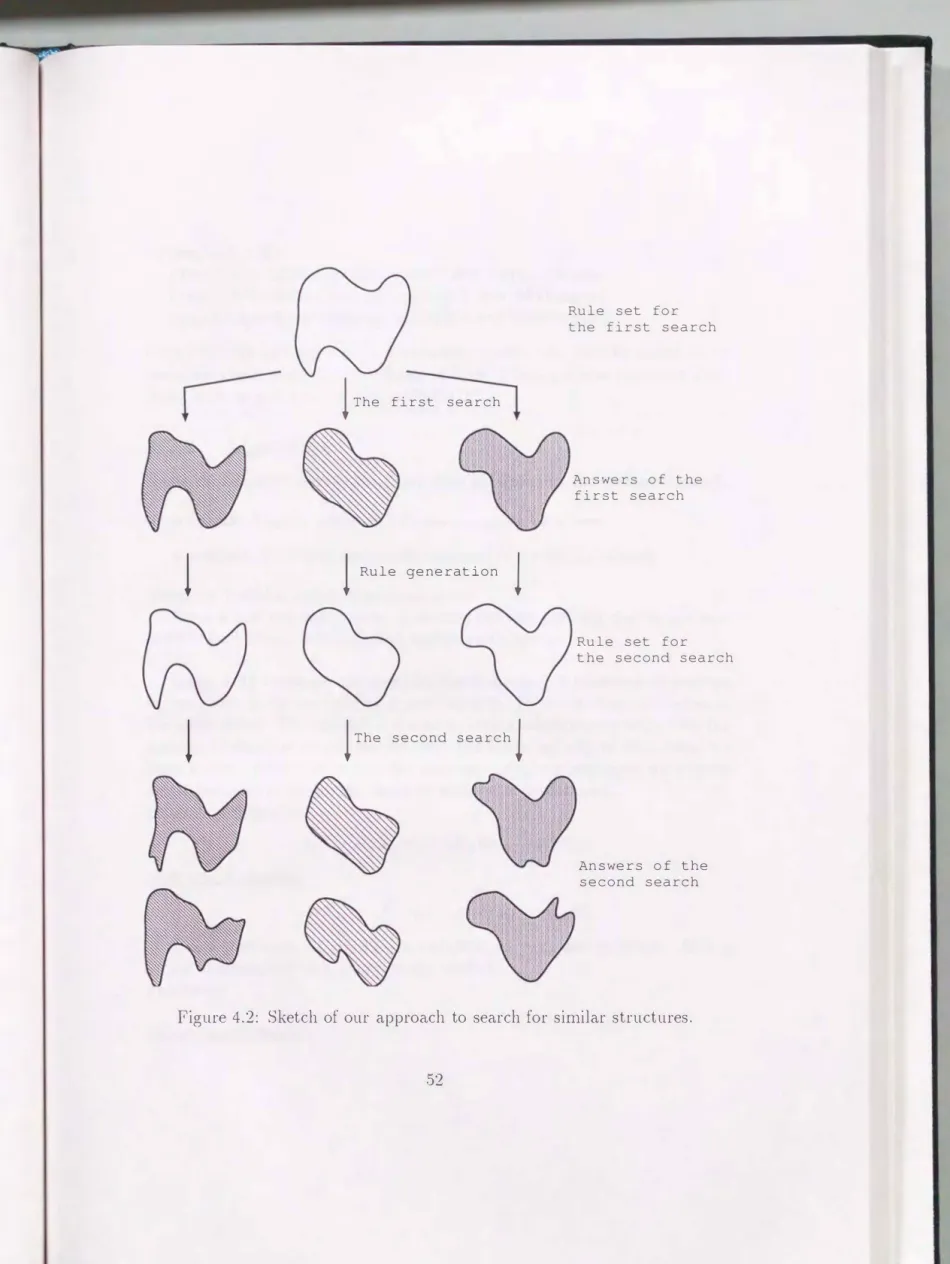
Figure 4.2 is a sketch of our approach to such a sin1ilarity search. Regard
ing rules as templates, and answers as instances which match template, the similarity search proceeds as follows:
1. Some instances ( = answers of
lhe first search)
are found which match the same template ( = rule set for the first search).2. By analyzing characteristics of the instances, new templates
(
= rulethe second earch)
3. The instances ( = answers of the second search) are found which n1atch new templates. They are si1nilar to the instances in the first search.
To realize such sin1ilarity search on a deductive database, we devised
( l
)an representation of similarity specification given by users, (2)an algorithm to search for si1nilar structures based on the si1nilarity specification, and (3)an in1ple1nentation of the algorithm on PACADE.4.2.1
Annotations in Rules and a Query
To search for the answers similar to an answer, a system has to allow a user to describe the following three information in addition to rules, query and base facts:
• values considered in the judgen1ent of similarity
(si·milarily criterion).
• the extent of acceptable error in the judgement of sin1ilarity
( e1ror range).
• the answers (objects) to which a user wants to search for the answers (objects) similar
(target do·main (objects)).
In the example in section 4.1, si1nilarity criteria were angle and thickness of lines in a triangle. Error ranges were ± 6 for the angles and ± 1 for thickness of lines. Target dmnain defined only one answer:
triangle(line1a,line2a,line3a).
which represents a specific object.
PACADE allows a user to describe such information in rules and query as annotations called
prefixes.
An example ofprefixed quer'y
is below::- triangle(©line1a,©line2a,©line3a).
where ©s are annotations called
query prefi:r:es
added to the constants line1a, line2a and line3a in the query. These prefixes are used to define target domain.An example of
prefixed rule
is below:!
The first searchl !
Rule generation1
l !
The second searchj
Rule set for the first search
Answers of the first search
Rule set for the second search
Answers of the second search
Figure 4.2: Sketch of our approach to search for similar structures.
triangle(X, Y, Z):
line(X,&+1-1&Xthickness),line(Y,&+1-1&Ythickness), line(Z,&+1-1&Zthickness),angle(X,Y,&+6-6&XYangle), angle(Y,Z,&+6-6&YZangle),angle(Z,X,&+6-6&ZXangle).
where
&+1-1&
and&+6-6&
are annotations calledrule prefixes
added to six variables about angles and thickness of lines. These prefixes point out similarity criteria and error ranges to PACADE.
4.2.2 Algorithm
Using the exan1ple in section 4.1, we show an algorithm for similarity search.
•
input:
A query and a set of rules are given by a user.•
output:
PACADE returns the answers of the second search.(step 1)
Transformation of prefixed queryFrom a prefixed query given by a user, two non-prefixed queries are gen
erated. Each query is for the first and second searches.
(step 1-1)
Generate the query for the first search by deleting all prefixes in the given query and adding a new variable( R)
which does not occur in the given query. The variable is bound to string values representing how the answers of the first search are derived. For the simplicity of discussion, we limit a query to the one which has only one predicate and does not require any arguments to be ground(
such as arithmetic predicates)
.before transformation
after transformation
h is a predicate. X1 '"'"'Xe are variables. c1 '"'"'c9 are constants. @ is a prefix to a constant in a query
(
query prefix)
.example)
before transformation
:-triangle(©line1a,©line2a,©line3a).
after transformation
:-triangle(line1a,line2a,line3a,R).
Search space of the first search is limited to target don1ain by the con
stants
line1a, line2a
andline3a.
(step 1-2)
Generate the query for the second search by replacing all prefixed constants in the given query by new variables which do not occur in the given query and differ fron1 each other. Since h does not require any arguments to be ground, prefixed constants can always be replaced by variables.before transformation
: - h
(.X
1, · · ·,
-"Ye, C 1, · · · , C J, @ C J + 1, · · · , @ Cg)
. after transfonnationexample)
before transformation
:- triangle(©line1a,©line2a,©line3a).
after transforn1ation
:- triangle(X,Y,Z).
By this replacen1ent, search space of the second search becon1e being not lin1ited to target domain.
(step 2)
Transformation of prefixed rule setFrom the prefixed rule set given by a user, a non-prefixed rule set for the first search is generated.
(step 2-1)
Analyze the prefixed rule set and check all predicates to detern1ine whether extensional database
(ED B)
predicates or intensional database(
IDB)
predicates.(step 2-2)
Transforn1 each rule in the prefixed rule set as follows:after transformation
h(X1,
. .. 'xk, [Ro, R/1'
. .. 'RI; ]) :-
b h
(V.h 1 ) ... ' mi1' mi1 +1) Vh Vh
• • .) nil ) c1 ) ... ) COI1' 11 ' Vh h h R )
b
(
uE1 17E1 uE1 17E1 E1 E1)
E v
) 1 '
. . . J • vmE
) ' vmE +
) 1'
. . . ' vn E
J' C 1 '
• . . 'Co E
J' rnake_string _rule(
[" h (X 1,
· · ·, X k) :
-b
h (Vh 1 ) ... ) Vh Vh m i1 ) mil +l' ... ' nil' c1 Vh I1
'... 'COil '
h)
b I is a ID B predicate, and bE is a ED B predicate.
v1)
. .) Vm
are prefixed variables bound to numeric values, andp1,
• ., Pm
are prefixes to variables 1n rules(
rule prefix)
. The general form of rule prefixp
is as follows:where n1 indicates upper lin1it of acceptable error range and n2 indicates lower lin1it. If both are on1itted, the prefix means an exact n1atch.
dex transfonned fron1 Pex Vex is as follows.
if Pex Vex is &&, dex is ", Vex =", Vex.
if Pex Vex is & + n 1 &
,
dex is " , v� > " , Vex, " , Vex < n 1 + ' , Vex.if Pex Vex is & -n2&, dex is ", Vex > -n2 + ", Vex, ", Vex < ",Vex.
if Pex Vex is &+n1 -n2&, dex is", Vex > -n2 +' , Vex, ", Vex < n1 +", Vex.
The built-in predicate make_string_rule requires that the first argun1ent is bound and the second argument is free. The first argun1ent n1ust be a list which is not nested. The elen1ents of the list must be strings or bound variabl s. vVhen ·make__string_rule is evaluated, the elements of the list are exan1ined. The values of variable elements are changed into strings. They are catenated with other string elen1ents and the second argument is bound to the catenated string.
exarnple)
before transforn1ation
triangle(X, Y, Z):
line(X,&+1-1&Xthickness),line(Y,&+1-1&Ythickness), line(Z,&+1-1&Zthickness),angle(X,Y,&+6-6&XYangle), angle(Y,Z,&+6-6&YZangle),angle(Z,X,&+6-6&ZXangle).
after transformation
triangle(X, Y, Z, [R]) :
line(X,Xthickness),line(Y,Ythickness),line(Z,Zthickness), angle(X,Y,XYangle),angle(Y,Z,YZangle),angle(Z,X,ZXangle), make_string_rule( [
'triangle(X,Y,Z):-
line(X, Xthickness), line(Y, Ythickness), line(Z Zthickness),angle(X,Y,XYangle) angle(Y, Z, YZangle), angle(Z, X, ZXangle )", ', Xthickness>-1+", Xthickness,
",X thickness< 1 +", Xthickness,
", Ythickness<1 +", Ythickness,
" Zthickness>-1+",Zthickness,
",Zthickness<1+",Zthickness,
", XYangle>-6+", XYangle, ", XYangle<6+' , XYangle,
",YZangle>-6+",YZangle,",YZangle<6+":YZangle,
", ZXangle>-6+' , ZXangle, ", ZXangle<6+", ZXangle,
"."], R).
For the sake of readability, string constants are underlined in this rule.
(step 3)
Evaluation of the query and the rule set for the first searchThe query generated in step 1-1 and the rule set generated in step 2 are evaluated by the bottom-up evaluator. Each of the last arguments of the an
swers to the query keeps the derivation processes of the answers in the form of a nested list. The element of the nested list is the string which represents the step of bottom-up evaluation in the fonn of single rule. In addition to the step of bottom-up evaluation, it represents the binding values of the prefixed variables in the first search and the values are used to define the permitted errors in the second search.
example)
The answer to the example query for the first search is as follows.
triangle(line1a,line2a,line3a, [ 'triangle(X, Y, Z):-
line(X, Xthickness), line(Y, Ythickness), line(Z,Zthickness),angle(X,Y,XYangle), angle(Y,Z,YZangle),angle(Z,X,ZXangle), Xthickness>-1+10,Xthickness<1+10, Ythickness>-1+10,Ythickness<1+10, Zthickness>-1+10,Zthickness<1+10, XYangle>-6+60,XYangle<6+60,
YZangle>-6+60,YZangle<6+60, ZXangle>-6+60, ZXangle<6+60.
"]).
The process of derivation is n1emorized in the last argument. In other words, ach of answers is characterized in tern1s of its process of derivation. There
fore the first search can be referred to as 'characterization search."
For the sake of readability, a string constant is underlined in this answer.
(step 4)
Generation of the rule set for the second searchThe derivation processes of answers are n1e1norized as the string values of last argu1nents. The rule set for the second search is generated by n1atching the heads of the rules in the last arguments with the bodies of then1. In the case of this exa1nple, it is straightforward because there is only one rule in the last argun1ent.
example)
triangle(X, Y, Z):-
line(X, Xthickness), line(Y, Ythickness), line(Z, Zthickness), angle(X, Y, XYangle), angle(Y,Z,YZangle),angle(Z,X,ZXangle), Xthickness > -1 + 10, Xthickness < 1 + 10, Ythickness > -1 + 10, Ythickness < 1 + 10, Zthickness > -1 + 10, Zthickness < 1 + 10, XYangle > -6 + 60, XYangle < 6 + 60,
YZangle > -6 + 60, YZangle < 6 + 60, ZXangle > -6 + 60, ZXangle < 6 + 60.
This rule is used so as to get answers similar to the answer of the first search.
(step 5)
valuation of the query and the rule set for the second search The query generated in step 1-2 and the rule set generated in step 4 are evaluated by the bottom-up evaluator. The answers of the second search are sin1ilar to those of the first search.example)
The two lines below show answers derived from the rule above. Each of the answers is similar to the answer of the first search in the angles and the thickness of lines in it.
triangle(line1a,line2a,line3a).
triangle(line1d,line2d,line3d).
4.3 Implementation
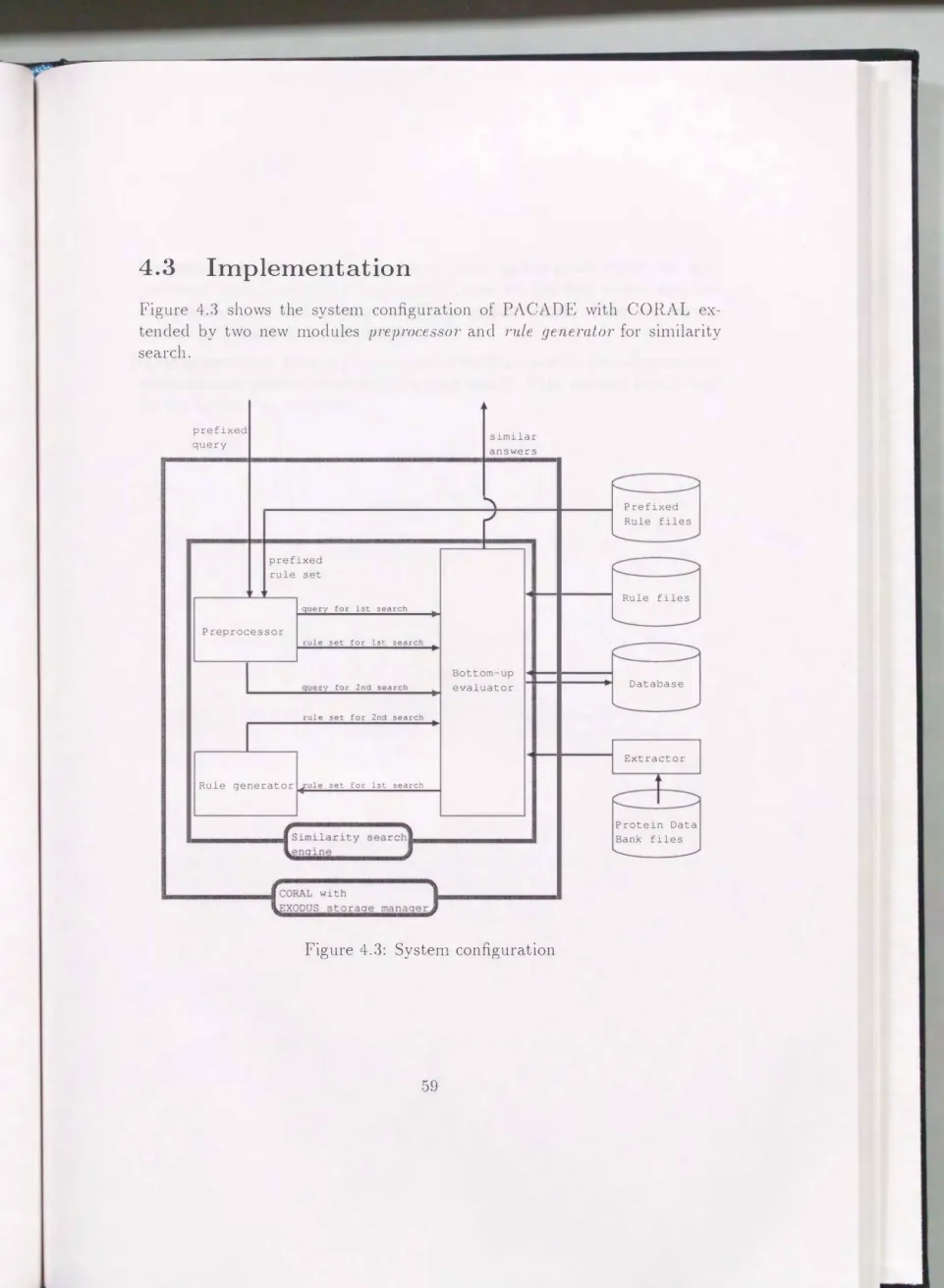
Figure 4.3 shows the system configuration of PACADE with CORAL ex
tended by two new n1odules preproce �sor· and rule generator for similarity search.
prefixed similar
query
answers
-...,
1'-- ___.-'
"'\
Prefixed(
Rule filesprefixed --...
rule set r-- ___.-'
Rule files query for 1st search
Preprocessor
rule set for 1st search
,-r--.. ___./
Bottom-up
query for 2nd search evaluator Database
rule set for 2nd search
Extractor
Rule generator Jule set for 1st search
1
r-
I
I'-- �
Protein Data rsimilarity search"l Bank files
l
engine�
___.-'(CORAL
withl
\.E
xoDus storaqe manaqerJ
Figure 4.3: Systen1 configuration
[Preprocessor]
From input(
a prefixed query and prefixed rules)
, the preprocessor module generates non-prefixed rules for the first search and two non-prefixed queries for the first and the second search. They are sent to and used by the botton1-up evaluator.
[Rule generator J
Fron1 input(
answers of the first search)
, the rule generator generates non-prefixed rules for the second search. They are sent to and used by the botton1-up evaluator.Chapter 5
Applicability of Similarity
Search Technique to Search for Similar Structures in Proteins
5.1 Examples of Searches for Similar Super
secondary Structures in Proteins
vVe applied the function to searches for sirnilar supersecondary structures in proteins. In the examples below, we used the 134 proteins shown in subsec
tion 3.3 .2 to search for sin1ilar structures.
5.1.1 Greek Key
The following prefixed query and prefixed rule set are used to search for Greek keys similar to those found in protein lsgt. The original (non-prefixed) version of the rule set is slightly modified from the rule set in subsection 3.2.5.
prefixed query
greek_key(A,B,C,Nurn,<Q"1sgt").
prefixed rule set
greek_key(A: B, C, Num, P):-greek_even_r(A: B, C: Num, P).
greek_key(A, B, C, Nurn, P):-greek_even_l(A, B, C, Num, P).
greek_key(A, B, C, Num P):-greek_odd(A, B, C, Nurn, P).
greek_even_r(A, L, D, 4, P):-
hairpin(B, C, P), hairpin(C, D, P), not_coils(A, B, P),
neighbour( A, D, P), double_anti_parallel(A, D, P), L = (B, C].
greek_even_r(A, L, D, Nurn1, P):
greek_odd(B,L1,D,Nurn,P),not_coils(A,B,P),neighbour(A,D,P), double_anti_parallel(A, D, P), append([B), L1, L), Nurn1 = Num + 1.
greek_even_l(A,L,D,4,P):-
hairpin(A, B, P), hairpin(B, C, P), not_coils(C, D, P),
neighbour( A, D, P), double_anti_parallel(A, D, P), L = (B, C].
greek_even_l(A, L, D, Nurn1, P):
greek_odd(A,L1,C,Num,P),not_coils(C,D,P),neighbour(A,D,P), double_anti_parallel(A, D, P), append(L1, [c]: L), Nurn1 = Nurn + 1.
greek_odd(A, L, D, Num1, P):
greek_even_r(A,L1,B,Num,P),greek_even_l(C,L2,D,Num,P), append(L1, [B), L), append([c], L2, L3), L = L3, Num1 = Nurn + 1.
hairpin( A, B, P):
not_coils(A,B,P),neighbour(A,B,P),double_anti_parallel(A,B,P).
not_coils(A, B, P):-not_coil(A, P), B =A+ 1, not_coil(B, P).
not_coils(A, B, P):-
not_coil(A, P), A1 =A+ 1, is_coil(A1, P), B = A1 + 1, not_coil(B, P).
is_coil(X, P):-secondary_structure(X, coil, &+3-3&Xnum, Cx, P).
not_coil(X, P):-secondary_structure(X, strand, &+10-10&Xnum, Cx, P).
not_coil(X P):-secondary_structure(X, helix, &+10-10&Xnum, Cx, P).
neighbour
(
X, Y, P)
:-min_distance
(
X,Cx,Y,Cy,&+1-1&Dxy,P)
,Cx = Cy,Dxy < 20.0.neighbour
(
X, Y, P)
:-min_distance
(
Y, Cy, X, Cx, &+1-1&Dxy, P)
, Cy = Cx, Dxy < 20.0.double_anti_parallel
(
X, Y, P)
:-anti_parallel(
X, Y, P)
.double_anti_parallel
(
X, Y, P)
:-anti_parallel(
Y, X, P)
.anti_parallel
(
X, Y, P)
:-angle
(
X,Cx,Y,Cy,&+10-10&Ang,P)
,Cx = Cy,120 < Ang,Ang < 180.The protein lsgt has four Greek keys 'vVe show the result of a similarity search of over 134 data on proteins listed in table 3.1 with the rule set above, in which the Greek keys in 1sgt are written as answer Gb (1
� i �4).
[answer G6J [answer G�J [answer G�J [answer G�J [answer G6J [answer G6J [answer GrJ [answer G6J
greek . ..key(8, [10, 12], 14,4, "1sgt").
greek_key(6, [8,10] ,12,4,"1est").
greek_key(8, [10, 12], 14,4, "1tgn").
greek_key(41, [43,45] ,47,4,"2cga").
greek_key(10, [12,14] ,16,4,"1sgt").
greek_key(4, [6,8] ,10,4,"1sgt").
greek_key(4, [6,8] ,10,4,"1ton").
greek_key(8, [10,12,14] ,16,5,"1sgt").
The answers Gj (j 2: 1) are similar to the answer Gb. The answer G� has no sin1ilar answer. Through a graphical viewer of proteins called BIORE
S
ARCH/3D, we confirmed that three dimensional shapes of these struc
tures are actually similar. For example, figure 5.1 shows 4-stranded Greek
keys represented by G6, Gi and G � , using the external graphical viewer.
BIORESEARCH/3D : 3-0 Structure Ana 1 ysi s Subsystem of Prate 1 ns
- ---
Figure 5.1 : The 4-stranclecl Greek keys in three proteins, lsgt, lest and 1 tgn.
5.1.2 n-stranded Meander
The following prefixed query and prefixed rule set are used to search for n-stranded n1eanders similar to those found in protein 2sbt. The original
(
non- prefixed)
version of the rule set is slightly modified from the rule set in subsection 3.2.5 ..
prefixed query
·- meander_n(A,B,Num,©"2sbt").
prefixed rule set
meander_n(A, L, 3, P):-hairpin(A, B, P), hairpin(B, C, P), L = [B, C].
meander _n(A, L1, Num1, P):-
hairpin(A, B, P), meander _n(B, L, Num, P), Num1 = Num + 1, L1 = [BjL].
hairpin( A, B, P):
not_coils(A,B,P),neighbour(A,B,P),double_anti_parallel(A,B:P).
not_coils(A, B, P):-not_coil(A, P), B =A+ 1, not_coil(B, P).
not_coils(A, B, P):-
not_coil(A, P), A1 =A+ 1, is_coil(A1, P), B = A1 + 1, not_coil(B, P).
is_coil(X, P):-secondary_structure(X, coil, &+3-3&Xnum, Cx, P).
not_coil(X, P):-secondary_structure(X, strand, &+10-10&Xnum, Cx, P).
not_coil(X, P):-secondary_structure(X, helix, &+10-10&Xnum, Cx, P).
neighbour(X, Y, P):-
min_distance(X,Cx,Y,Cy,&+1-1&Dxy,P),Cx = Cy,Dxy < 20.0.
neighbour(X, Y, P):-
min_distance(Y, Cy, X, Cx, &+1-1&Dxy, P), Cy = Cx, Dxy < 20.0.
double_anti_parallel(X, Y, P):-anti_parallel(X, Y, P).
double_anti_parallel(X, Y, P):-anti_parallel(Y, X, P).
anti_parallel(X, Y, P):-
angle(X,Cx,Y Cy,&+15-15&Ang,P),Cx
=Cy,120
<Ang,Ang
<180.
The protein 2sbt has 15 n1eanders. vVe show the result of a sin1ilarity search of over 134 data on proteins listed in table 3.1 with the rule set above, in which the meanders in 2sbt are written as answer
i\!Ib (1
� i � 15)
.we obtained the following answers:
[answer M6J meander_n(8, [10, 12], 3, "2sbt
')
.[answer M6J meander_n(10, [12, 14],3, "2sbt").
[answer MIJ meander_n(10, [12, 14],3, "1sbc").
[answer M�] meander _n( 10, [ 12, 14], 3, "1 st2").
[answer M§] meander_n(10, [12, 14),3, "1tec").
[answer Mg] meander_n(12, [14 16], 3, "2sbt").
[answer Mi] meander_n(14, [16, 18], 3, "2prk").
[answer M3J meander_n(14, [16, 18],3, "2sbt").
[answer Mg] meander_n(16, [18, 20), 3, n2sbt").
[answer Mf] meander_n( 16, [18, 20], 3, "1sbc").
[answer M�] meander _n( 16, [ 18, 20], 3, "1 st2").
[answer M8J meander_n(8, [10, 12, 14),4, "2sbt").
[answer M6J meander_n(10, [12, 14, 16], 4,' 2sbt").
[answer Mg] meander_n(12, [14, 16, 18], 4, "2sbt").
[answer M6J meander _n( 14, [ 16, 18, 20), 4, "2sbt" )
.[answer M6°Jmeander_n(8, [10, 12, 14, 16], 5, "2sbt").
[answer Mt1Jmeander_n(10, [12, 14, 16, 18], 5, "2sbt").
[answer M62Jmeander_n(12, [14, 16, 18, 20],
5,"2sbt").
[answer M63Jmeander_n(8, [10, 12, 14,16 18], 6, n2sbt").
[answer M64Jmeander_n(10, [12, 14, 16, 18, 20], 6, "2sbt").
[answer M65Jmeander_n(8, [10, 12, 14, 16, 18, 20],
7,"2sbt").
Answers
Y1j U 2:: 1)
are similar to answeri\11b
and answers1\116, .:VI�
andi\!Ig
�iVJ65
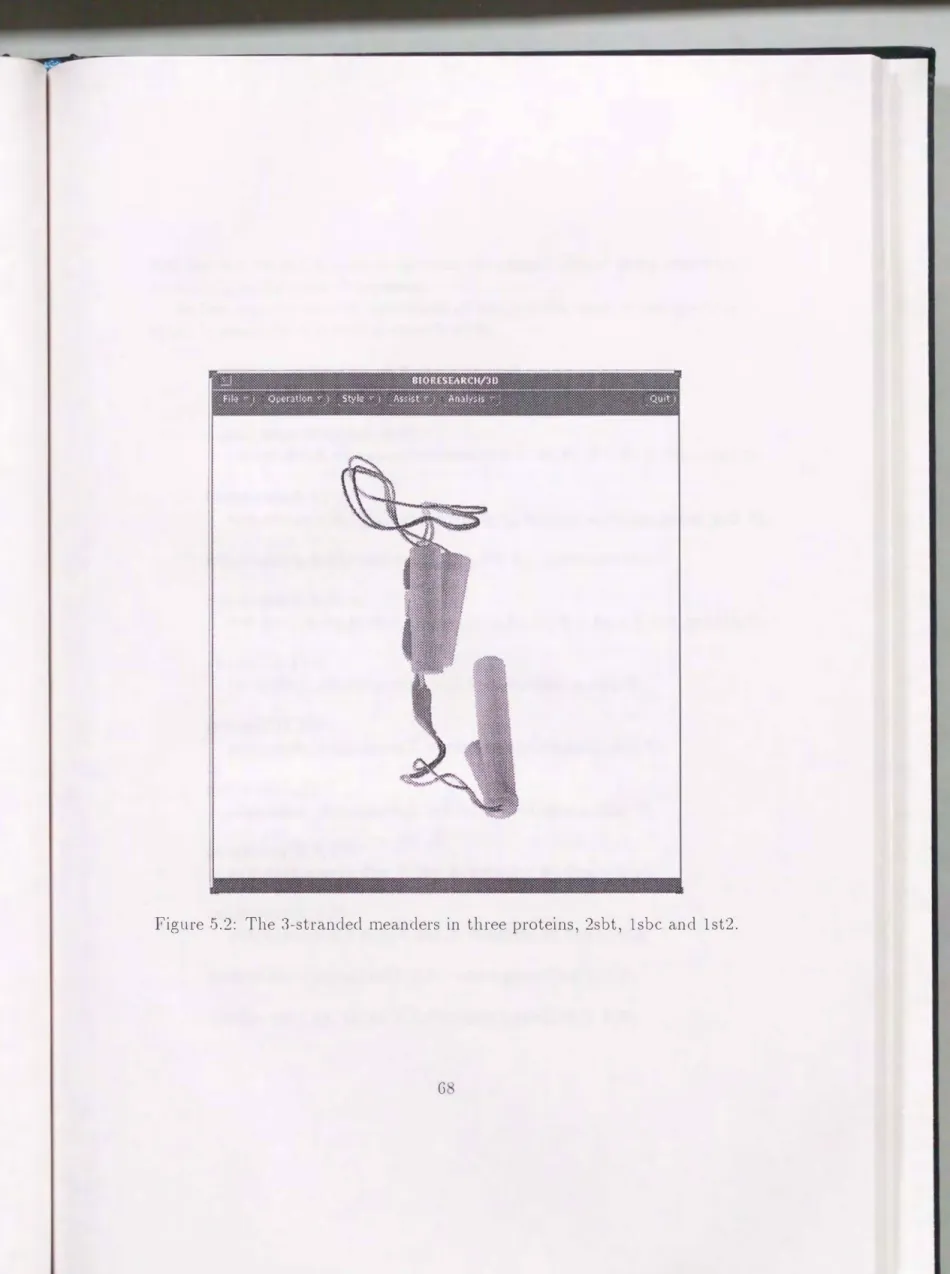
have no similar answers.Likewise the result on 4-stranded Greek keys, three dimensional shapes of these structures are actually similar. Figure 5.1 shows 4-stranded Greek key s represented by
.i\115, l\tli
andi\II�
, using the external graphical viewer.5.2 Similarity Search for Arbitrary Struc
ture
In the previous study, we used rule sets which represent the topologies of supersecondary structures (i.e. Greek key and n-stranded meander). These are useful to show that some iterative structures can be represented and searched in FACADE. However, they are of no benefit to a user who cannot represent the topology of a specific part of a protein as rules.
The rule set for n-stranded meander includes the following conditions to be tested, concerning two adjacent secondary structures, say, X and Y:
1.
The angle between X and Y n1ust range from120
to180
degrees.2.
The distance between X and Y must be smaller than20.0
angstron1s.3. Regarding a protein as sequences of secondary structures, X and Yare also adjacent in the sequence. One random coil may be put between then1.
Since almost every protein consists of secondary structures held together with random coils, the third condition is weak. Therefore, if we remove the
Figure 5.2: The 3-strandecl meanders in three proteins, 2sbt, lsbc and lst2.
first and the second conditions, the rule set accepts almost every structure continuous in the sense of sequence.
In this way, we relaxed restrictions of the rule set used in our previous study to search for n-stranded n1eanclers
[
27]
.super_secondary
(
A, L, N, P)
:-hairpin
(
A, B, P)
, hairpin(
B, C, P)
, L =[
B, C]
, N = 3.super _secondary
(
A, L, N, P)
:hairpin
(
A,B,P)
,super_secondary(
B,L,N1,P)
, N = N1 + 1,L =[
Bj
L1]
.hairpin
(
A, B, P)
:-not_coils
(
A,B,P)
,neighbour(
A,B,P)
, double_anti_parallel(
A,B,P)
. not_coils(
A, B, P)
:-not_coil(
A, P)
, B = A+ 1, not_coil(
B, P)
.not_coils
(
A, B, P)
:-not_coil
(
A, P)
, A1 =A+ 1, is_coil(
A1, P)
, B = A1 + 1, not_coil(
B, P)
.is_coil
(
X, P)
:secondary_structure
(
X,coil,&-15+15&Xnurn,Cnx,P)
.not_coil
(
X, P)
:secondary_structure
(
X,strand,&-15+15&Xnurn,Cnx,P)
.not_coil
(
X, P)
:secondary_structure
(
X,helix,&-15+15&Xnum,Cnx,P)
.neighbour
(
X, Y, P)
:min_distance
(
X,Cnx,Y,Cny,&-6+6&Dxy,P)
,Cnx = Cny.neighbour
(
X, Y, P)
:min_distance
(
Y,Cny,X,Cnx,&-6+6&Dxy,P)
,Cny = Cnx.double_anti_parallel
(
X, Y, P)
:-anti_parallel(
X, Y, P)
. double_anti_parallel(
X, Y, P)
:-anti_parallel(
Y, X, P)
.anti_parallel(X, Y, P):
angle(X,Cnx,Y,Cny,&-6+6&V3x,&-6+6&V3y,
&-45+45&Ang1,&-45+45&Ang2,P), Cnx = Cny.
Using the above rules, a user can perform a sinlilarity search for any supersecondary structure. In this case, error ranges on the length of helices, strands and randon1 coils are set to ± 1.5 residues, and on the distance of two adjacent strands or helices to ± 6 angstrom, and so on. A user can readily change these values of error ranges by modifying the rule set.
The query for the above rules n1ust be given with care. If a user gives a query with no constant bindings, the processing of the query will result in many answers because almost any structure of a protein would be accepted.
A user of the rules is recommended to write a query with few variables or no variables like the following example of prefixed query :
:- super_secondary(©16,©[18,20,22] ,4,©"1ifb").
This query shows that the user intends to search for structures sin1ilar to a specific structure, that is, a structure which consists of four helices or strands with sequential nun1bers 16, 18, 20 and 22, respectively, and they are in a specific protein whose n1nen1onic code is "1 ifb." By changing such prefixed constants in the query and the rule set, a user can search for structures sin1ilar to a specific structure to be exan1ined, with intended error ranges.
5.3 Discussion
5.3.1 Comparisons with Other Approaches
Our approach to searches for similar structures is novel, in the following points:
• it is based on techniques of deductive databases
• target (original) structure is specified indirectly using a rule set for the first search as template
• similarity criterion error range and target protein are specified subjec
The first point implies the flexibility of our approach. Rules are written in denotational style, and a rule prefix does not destroy the style because it can be added and transforn1ed, independently of other rules.
The second point n1ay differ the 1nost fro1n other techniques. For example, in approaches based on root n1ean square deviation
(
e.g.[2] ),
target structure is specified directly by pointing start and end point of an amino acid sequence which forn1s the target structure. Our approach has the following n1erits and den1erits:[
merits]
• low calculation cost because is needed no combinatorial calculation
• can search target structure which consists of discrete an1ino acids like a dipole moment
• a user can flexibly specify similarity criteria and error ranges
[
de1nerits]
• a user has to be able to represent searched structure in the fonn of rule
• it is hard to evaluate the degree of sinlilarity on the basis of a unified standard
• if a user wants to search for n1ore real
(
unabstracted)
structures, he has to write more con1plex rules and specify n1ore similarity criteria Since the two approaches have n1erits and de1nerits, they can coexist.Our indirect specification n1ethod is suitable for cases when a user has logical structures on which he is focusing. On the other hand, the approach based on root n1ean square deviation is suitable for cases when a user is focusing on structures which cannot be written in logical form and he needs a precise esti1nation of similarity.
5.3.2 Extensions of Descriptive Ability of Prefixes
The following extensions will be accomplished by the improvement of pre
processor.
1. Currently, the function does not allow to prefix variables bound to non
numerical values. Obviously, this lin1itation may be lessened for other types which can be totally ordered.
2. To li1nit the search space of the first search, a query must have at least one constant prefixed by "@". Extending descriptive ability of query prefix to allow && type prefixes, like rule prefixes, is useful.
5.3.3
Utilization of Waste (Discarded) Bindings
In the function described in the previous and this chapter, any variables in body atoms which have numerical binding values can be prefixed. A variable which occurs only once in a body atom of a rule and does not occur in the head of the rule can also be prefixed. If such variables are not prefixed, their binding values are not used to produce new intermediate facts and are discarded when rule set and query are evaluated in the bottom-up evaluator.
Through the function, such waste bindings can be utilized to characterize answers of the first search.
5.3.4
Reduction of Prefixes
A user may write redundant or meaningless rule prefixes in one rule such as anc
(
X, Y, N)
:-anc(
X, &+5-2&2, N)
, par(
&+2-5&Z, Y, Age, N)
.To elin1inate such prefixes, one way is to analyze and rewrite the prefixed rule set, and another is to analyze and rewrite the rule set for the second search. vVhen the first search returns many answers, the latter approach takes more time than the forn1er. On the other hand, it is easy to analyze and eliminate redundant prefixes in the latter approach as the bodies of rules for the second search are independent because of the lack of an IDB predicate.
Chapter 6
Computation of Closures of Similarity Relationships
To n1ake PACADE an even more useful sy stern for n1olecular biologists, we introduced a novel function which enables automatic searches for similar structures in proteins. In exan1inations on biological functions of proteins, it is in1portant to investigate structural sin1ilarity between structures of pro
teins. Through this function, a user can search for structures of proteins similar to the one being exan1ined. Fron1 experin1ental results on the appli
cation of this function to clustering proble1ns, it was shown that a user can discover clusters of structures which are sin1ilar. Biologists want to compare these clusters based on structural sin1ilarity with clusters mainly based on biological functions of proteins(28].
However, there are shortcon1ings in the application of this function to clustering problems, one of them is that to obtain a cluster (i.e. a closure of indirect similarity relationship), all structures in search space have to be examined concerning similarity. Since combinatorial con1putation is involved, the task would be too time consuming.
To compute a closure of structures which includes a specific structure of a protein it is insufficient and inefficient to use the similarity search function of PACAD E con1binatorially. In this chapter, we describe a function newly introduced into PACADE to solve the problems. This function enables a non-con1binatorial computation of a cluster of indirectly similar structures which includes a specific structure given by a user in the form of a query.
6.1 Closure of Similarity Relationships
6.1.1
Regarding Answers as Closed Queries
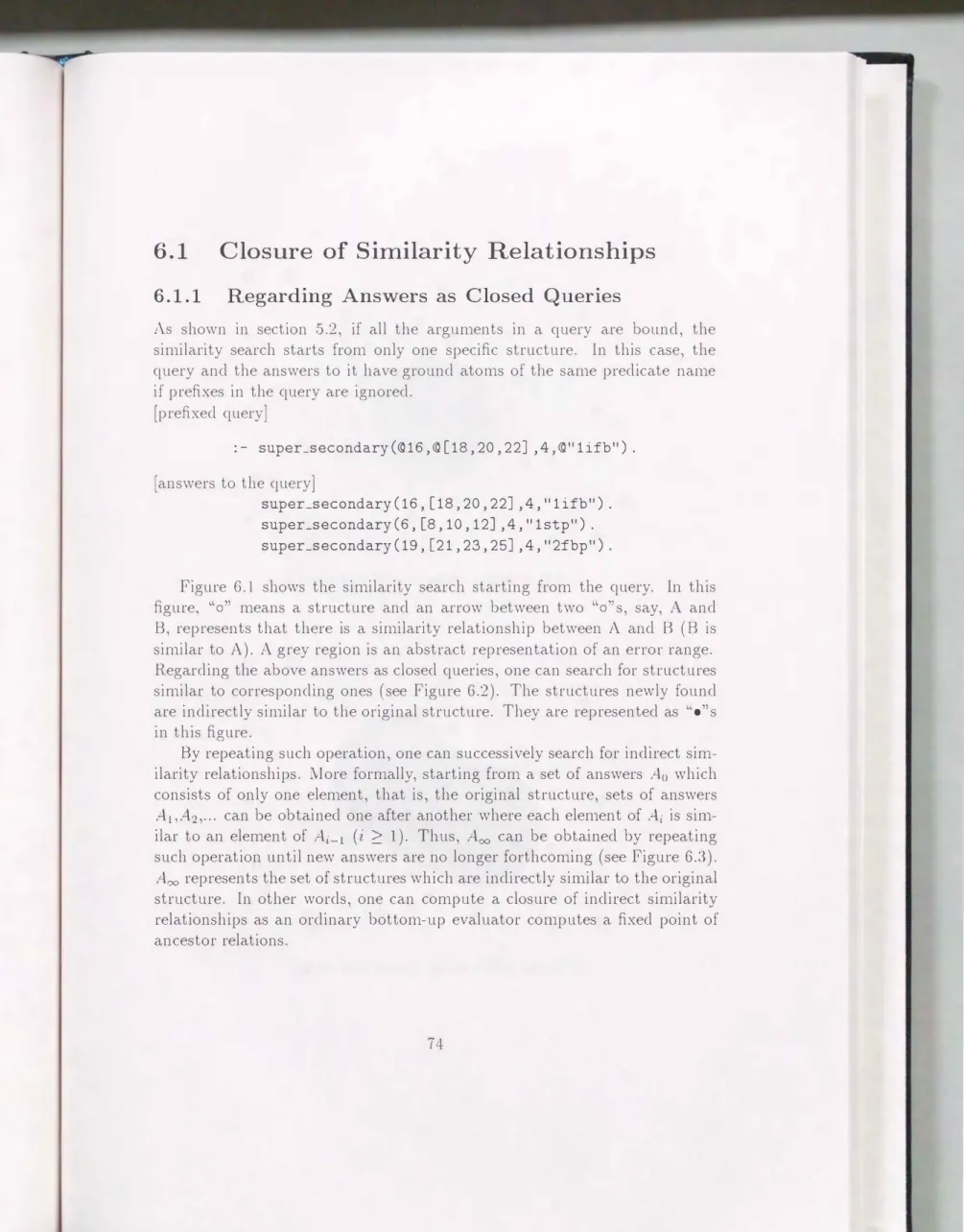
As shown in section 5.2, if all the argun1ents in a query are bound, the sin1ilarity search starts fron1 only one specific structure. In this case, the query and the answers to it have ground ato1ns of the san1e predicate nan1e if prefixes in the query are ignored.
[
prefixed query]
:- super_secondary(@16,@[18,20,22] ,4,@"1ifb").
[
answers to the query]
super_secondary(16,[18,20,22] ,4,"1ifb").
super_secondary(6,[8,10,12] ,4,"1stp").
super_secondary(19, [21,23,25] ,4,"2fbp").
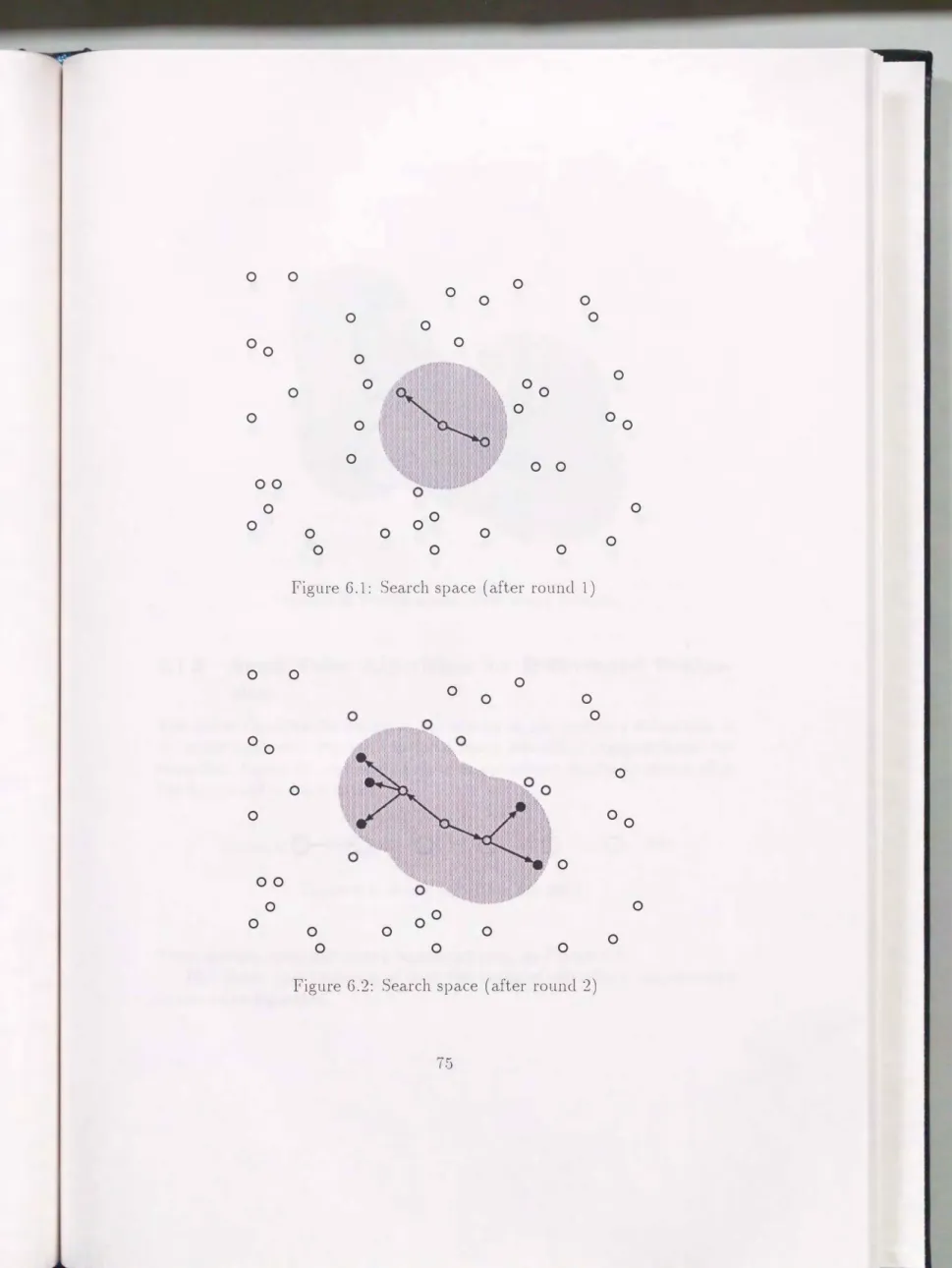
Figure 6.1 shows the similarity search starting from the query. In this figure, ('o" n1eans a structure and an arrow between two "o" s, say, 1 and B, represents that there is a sin1ilarity relationship between
A
andB (B
is sin1ilar toA).
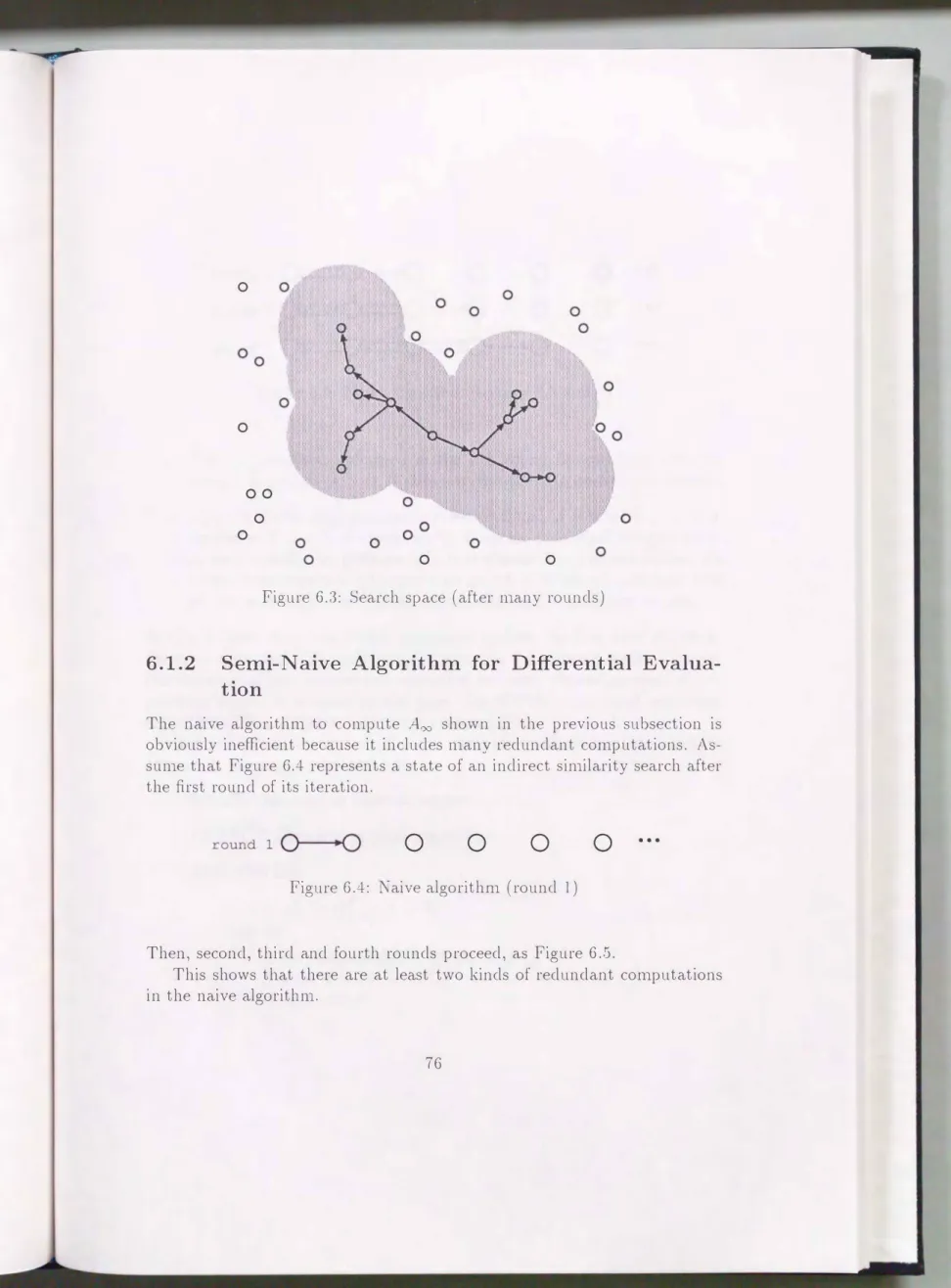
A grey region is an abstract representation of an error range.Regarding the above answers as closed queries, one can search for structures similar to corresponding ones
(
see Figure6.2).
The structures newly found are indirectly sin1ilar to the original structure. They are represented as ('•" s in this figure.By repeating such operation, one can successively search for indirect sim
ilarity relationships. i\!Iore formally, starting from a set of answers A0 which consists of only one element, that is, the original structure, sets of answers A1,A2, ... can be obtained one after another where each elen1ent of Ai is siln
ilar to an element of
Ai-l (i
2:1).
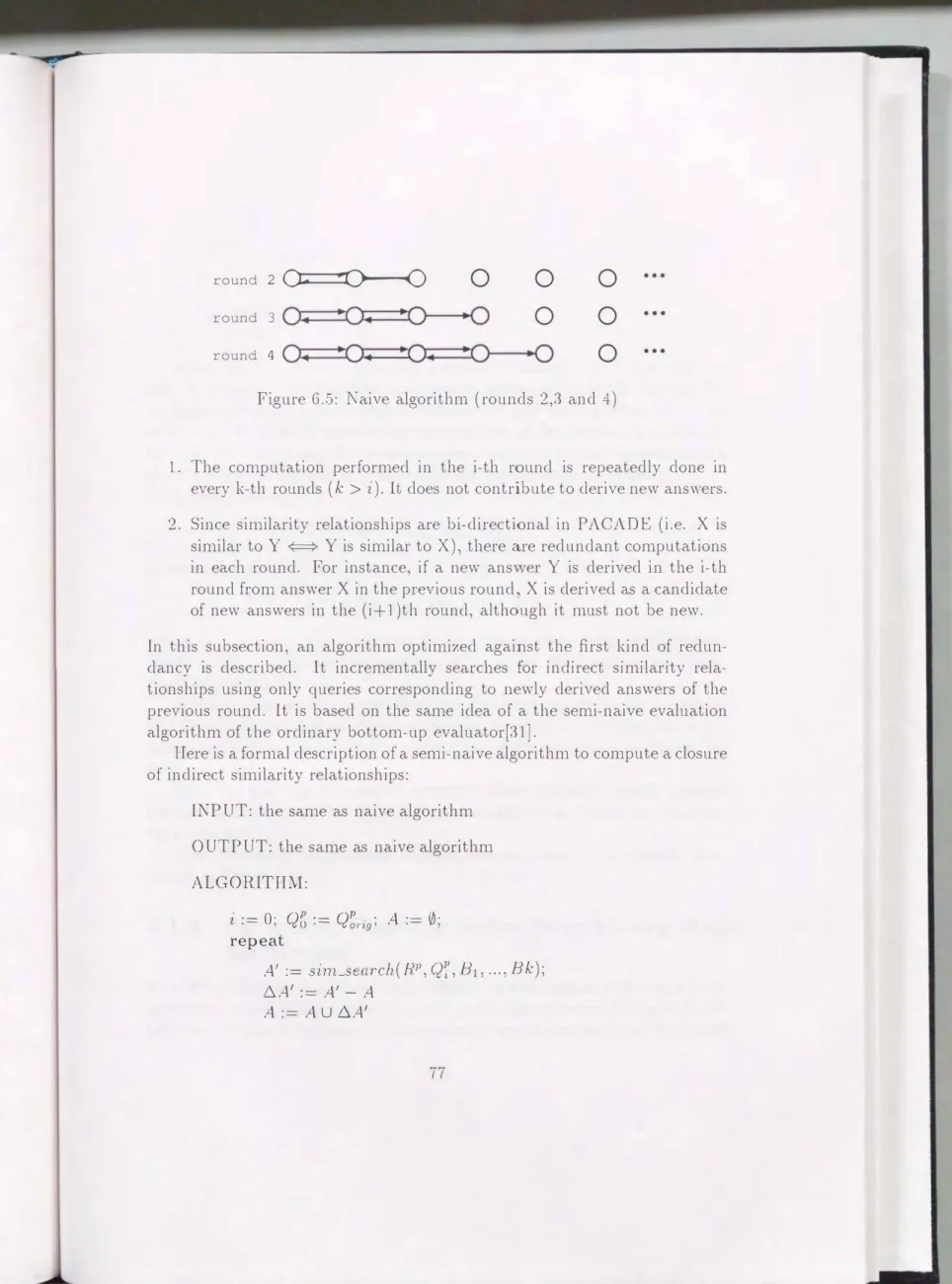
Thus,A00
can be obtained by repeating such operation until new answers are no longer forthcoming(
see Figure6.3).
Aoo represents the set of structures which are indirectly si1nilar to the original structure. In other words, one can compute a closure of indirect similarity relationships as an ordinary botton1-up evaluator cornputes a fixed point of ancestor relations.
0 0 0
0 0 0
0 0 0
00 0
0
0 00 0
0
0 0
0 00
0 0 0
00 0
00
0
0 0 0 0
0 0 0 0
Figure 6.1: Search space (after round 1)
0 0
0 0
0 0
0 00
0 0
0 00
0 00
0
00
0
0 0 0 0
0 0 0 0
Figure 6.2: Search space (after round 2)
6.1.2
0
0
00 0 0
0 0
Figure 6.3: Search space
(
after n1any rounds)
Semi-Naive Algorithm for Differential Evalua
tion
The naive algorithm to con1pute Aco shown in the previous subsection is obviously inefficient because it includes n1any redundant con1putations. As
sun1e that Figure 6.4 represents a state of an indirect sin1ilarity search after the first round of its iteration.
0 0 0
Figure 6.4: -aive algorithm
(
round1) 0
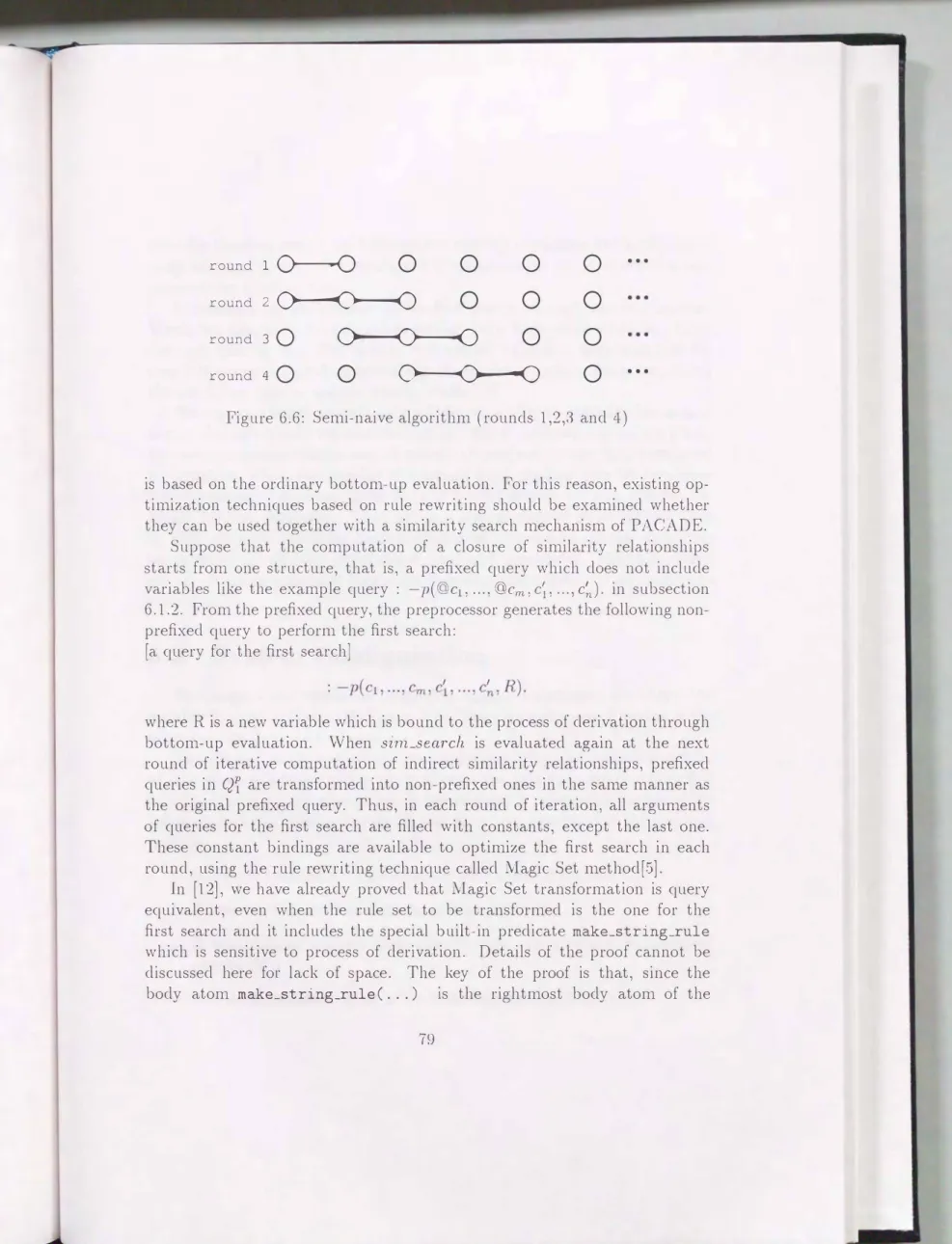
Then, second, third and fourth rounds proceed, as Figure 6.5.
•••
This shows that there are at least two kinds of redundant computations in the naive algorithn1.
round
2 � 0 0 0 ...
round 3
0 0
round 4
o ..
·o
.. ·o
..·o •0 0 ...
Figure 6.5: Naive algorithn1
(
rounds 2,3 and4)
1. The computation perforn1ed in the i-th round is repeatedly clone in every k-th rounds
( k
>i).
It does not contribute to derive new answers.2. Since similarity relationships are bi-directional in PACADE
(
i.e. X is similar toY� Y is similar toX),
there are redundant con1putations in each round. For instance, if a new ans rver Y is derived in the i-th round from answer X in the previous round" X is derived as a candidate of new answers in the(
i+l)
th round, although it n1ust not be new.In this subsection, an algorithn1 optimized against the first kind of redun
dancy is described. It incren1entally searches for indirect sin1ilarity rela
tionships using only queries corresponding to newly derived answers of the previous round. It is based on the same idea of a the semi-naive evaluation algorithn1 of the ordinary botton1-up evaluator
[
31]
.Here is a formal description of a semi-naive algorithm to compute a closure of indirect similarity relationships:
INPUT: the same as naive algorithm OUTPUT: the san1e as naive algorithm ALGORITHl\11:
Z. ·.-
- 0· QP
' 0 .·- - Qp
orig1 . A ·.=0·,
repeatA':=
.sim_.search(RP, Qf,
B1,..
., Bk);
.6.A' := A'- A A:= Au .6.A'
i:=i+l;
Qf
:= a_to_q(6.A');until 6.A' =
0;
output A
where
Qf
is a prefixed query for a sin1ilarity search. A, A' and 6.A' are sets of answers. The function sirn_search perforn1s similarity searches for each elen1ent inCJf,
using a prefixed rule set RP and base relations B1, ... , Bk stored in PACADE. lt returns the union of sets of the answers to queries inQf.
On the other hand, the function a_to_q converts a set of answers into a set of corresponding queries. Generally, the conversion is as follows:[
before conversion]
[
after conversion]
where c1, ... ,cm are the constants in arguments filled with prefixed con
stants in
Q�Ti!J'
while the arguments for<, .
..
, c� are filled with norn1al(
nonprefixed
)
constants.If the current set of answers does not contribute to derive new ans\vers, this algorithm tern1inates. The condition on termination of algorithn1 is the same one that the naive evaluation algorithn1 of the bottom-up evaluator
[31]
have.
Since the function sim_search performs direct similarity search through bottom-up evaluation, this algorithm can be regarded as "meta-level botton1- up evaluation."
The differential computation through this semi-naive algorithn1 is illus
trated in Figure 6.6.
6.1.3 Optimizing Characterization Search Using Magic Set Method
In addition to optimization through differential evaluations at the meta-level, optin1ization of a direct similarity search inside the sim_search should be ex
round 1
o---.a 0 0 0 0
...round 2
cr---0---+0 0 0 0
round
30 cr---0---+0 0 0
round
40 0 cr---0---+0 0
.. .Figure
6.6:
Sen1i-naive algorithn1(
rounds1,2,3
and4)
is based on the ordinary bottom-up evaluation. For this reason, existing op
tiinization techniques based on rule rewriting should be examined whether they can be used together with a similarity search mechanism of PACADE.
Suppose that the computation of a closure of similarity relationships starts from one structure, that is, a prefixed query which does not include variables like the example query:
-p( c1, ... , @cm,c� , ... ,c�).
in subsection6.1.2.
From the prefixed query, the preprocessor generates the following nonprefixed query to perforn1 the first search:
[
a query for the first search]
where R is a new variable which is bound to the process of derivation through botton1-up evaluation. vVhen
sim_search
is evaluated again at the next round of iterative computation of indirect similarity relationships, prefixed queries inQf
are transformed into non-prefixed ones in the san1e n1anner as the original prefixed query. Thus, in each round of iteration all arguments of queries for the first search are filled with constants, except the last one.These constant bindings are available to optimize the first search in each round, using the rule rewriting technique called i\t!agic Set n1ethod
[
.s]
.In
[12],
we have already proved that N!agic Set transformation is query equivalent, even when the rule set to be transformed is the one for the first search and it includes the special built-in predicate make_string_rule which is sensitive to process of derivation. Details of the proof cannot be discussed here for lack of space. The key of the proof is that, since the body atom make_string_rule(
... ) 1s the rightmost body atom of therules for the first search, all bindings are already computed before the atom make_string_rule ( ... ) is evaluated if evaluation of body atoms of a rule proceeds from left to right.
Concerning the performance of the first search, the optin1ization through i\!Iagic Set transformation is indispensable for a reasonable execution tirne.
For exan1ple, in case that similar n-stranclecl meanders were searched for over
134
proteins, the Supplen1entary i\tlagic Set transforn1ation cuts clown the execution tirne to approximately1/400 [12].
On the other hand, there is only a little possibility to optimize the second search through i\tlagic Set transformation. vVhen prefixed queries are trans
formed into queries for the second search, all prefixed constants are replaced by variables. Thus, the number of constant bindings available for optimiza
tion decreases. i\lloreover, rules for the second search are not suitable for i\tlagic Set transformation. They are in a special class of Horn clauses, that is, they all have the same head predicate as the one in queries and their body atoms are all base predicates or evaluable predicates. Therefore, there are no recursive rules and i\tlagic Set transformation does not contribute to optimization.
6.2 System Configuration
To con1pute the closure of indirectly similar structures, we added the iterator n1odule to PACADE
(
Figure6.7).
The sirnilarity search engine is the same module described in section4.3
The iterator module receives a prefixed query
Q�.,.ia
and returns a closure of structures which are indirectly similar to the original structure specified inQ�.,.ia.
During the con1putation of the closure, it repeatedly perfonns the following tasks to execute the semi-naive algorithm described in the previous section:1.
It calls the similarity search engine with a prefixed queryQf.
2.
It receives answers representing similar structures.3.
It accumulates answers and converts only new answers into prefixed. Qp
q uenes
i+l·
prefixed closure of
query similar answers
(Q:.,)
Iterator
similar ,- -
answers ..._ -
"'\
Prefixed(
Rule filesprefixed prefixed
query rule set ,...- -
....__ --
(Q�) (R')
Rule files ouerv r?r lsr: :Search
Preprocessor
rule ser. for l:>r. :>earc�• ,-..._ __, ...
I
ouerv for 2nd :Search Bottom-up evaluator Databaserule .;::;er� tor 2nd search
t
ExtractorRule generator _;:-u le ser: fer ls>:. search
1
� I --
Protein rsimilarity searchl Bank files Data
l
en_gine.J
_....,rCORAL with l
l
EXODUS storaqe manaqer.J
Figure 6.7: System configuration of PACADE
6.3 An Example of Indirect Similarity Search
An experimental result of computing a closure of indirectly sin1ilar structures is shown below. vVe used the following prefixed query and the prefixed rule set shown in section
.5.2:
[
prefixed query]
super_secondary(©3,©[5,7,9] ,4,©"3il8").
In the prefixed query, "3il8" is the nmen1onic code of a protein called inter
leukin. The prefixed query above specifies a structure of the protein, which consists of 4 secondary structures
(
fron1 3rd to 9th)
. Base relations in the rule set are the same ones in[28],
except angle has three more arguments to precisely express angular relations between two secondary structures.1abp 1ace 1acx 1ald 1atn 1atp 1azu 1bp2 1bph 1c2r 1cc5 1cd4 1cdt 1cms 1cn1 1coh 1col 1cox 1cpc 1cph 1crn 1cse 1cy3 1cyc 1dfn 1dph 1est 1fai 1fbp 1fc2 1fcb 1fdh 1fdl 1fxa 1fxi 1gcr 1gd1 1gp1 1gpd 1hho 1hhp 1hip 1hoe 1hrh 1ifb 1ige 1igi 1igj 1lap 1lpe 1lyd 1lym 1lzt 1mbd 1mbs 1mcw 1mee 1msb 1mvp 1nih 1nn2 1nxb 1ovo 1p01 1p2p 1pal 1pbx 1pcy 1pfk 1phh 1pmb 1pp2 1ppd 1ppt 1prc 1pyp 1q21 1rbb 1rei 1rhd 1rnh 1rns 1rop 1sar 1sbc 1sdh 1sgt 1sn3 1st2 1stp 1tab 1tgn 1tgs 1thb 1 tie 1tlp 1tnf 1ton 1tpk 1ula 1vsg 1wrp 1wsy 1xis 1ypi 2S6b 2abx 2act 2alp 2apr 2aza 2bjl 2cab 2ccy 2cdv 2cga 2cha 2ci2 2cna 2cpk 2cpp 2dhb 2dhf 2f19 2fb4 2fbj 2fbp 2fcr 2fgf 2had 2hfl 2hhb 2hla 2hmq 2ig2 2igf 2kai 2lhb 2ltn 2mcg 2m em 2mev 2mhb 2pab 2pfk 2pka 2plv 2prk 2r07 2rhe 2rm2 2rsS 2rsp 2rus 2sbt 2sdh 2sec 2sga 2sic 2sni 2sns 2sod 2ssi 2stv 2taa 2tec 2tgp 2tmn 2trx 2tsc 2utg 2zta 3app 3bcl 3c2c 3chy 3cna 3cyt 3dfr 3enl 3est 3fab 3gap 3gpd 3grs 3hfm 3il8 3pcy 3pgk 3pgm 3psg 3rlx 3rn3 3rp2 3sdp 3sgb 3tln 4ape 4ca2 4cna 4cts 4er4 4gpd 4hvp 4mdh 4pep 4ptp 4rhv 4rlx 4sgb 4tms 4tpi 4xia Sa en Scpa Sese Scyt Sfbp Sldh Spti 5rxn Stirn 6adh 6at1 6ebx 6fab 6q21 7at1 7rsa 7wga 7xia 9api 9lpr 9wga
1ccr 1ctx 1fnr 1hsa 1mcp 1paz 1r1a 1srn 1trc 2atc 2cyp 2hip 2mlt 2sar 2tbv 3cla 3ins 4blm 4sbv Srub 8cat
In a search of data on 2.55 proteins listed in Table 6.1, a closure of the following indirectly similar structures was obtained:
--- round 0 ---
(aO) super_secondary(3,[S,7,9] ,4,"3il8").
--- round 1 ---
(a1) super_secondary(21, [23,2S,27] ,4,''1ppd'').
--- round 2 ---
(a2) super_secondary(21,[23,2S,27] ,4,"1tlp").
(a3) super_secondary(2S,[27,29,31] ,4,"2act").
--- round 3 ---
(a4) super_secondary(20,[22,24,26] ,4,"2tmn").
(aS) super_secondary(21,[23,2S,27] ,4,"3tln").
where answer a1 is newly obtained in the first round of iteration, a2-a3 in the second round and a4-a5 in the third round. In each round, sin1ilarity relationships between these structures are derived as follows:
------- round 1 --- aO is similar to aO.
a1 is similar to aO.
--- round 2 ---- aO is similar to a1.
a1 is similar to a1.
a2 is similar to a1.
a3 is similar to a1.
---- round 3 ---- a1 is similar to a2.
a2 is similar to a2.
a4 is similar to a2.
aS is similar to a2.
a1 is similar to a3.
a3 is similar to a3.
---
round 4---
a2 is similar to a4.
a4 is similar to a4.
aS is similar to a4.
a2 is similar to aS.
aS is similar to aS.
a4 is similar to aS.
Figure
6.8
illustrates the similarity relationships. Trivial si1nilarity relationships, that is, "ai is similar to ai," are omitted in this figure. Note that the relationships between a4 and a5 are obtained in round 4, however, they do not contribute to obtain new structures. Since round 4 derives new sin1ilarity relationships but no new structures, the system stops iterative con1putation after the rouncl. The graphical representations of a0-a5 reflect the fact that a2, a4 and a5 are sin1ilar to each other
(
Figure6.9).
Figure
6.8:
Similarity relationships among a0-a5a3 (2act)
a1 (1 ppd)
(/ .·· : · !
7
�
•... ·�
'-·�
--�
- -.
�.,$-
a4 (2tmn)
a2 (1tlp)
\
a5 (3tln)
Figure 6.9: Indirectly similar structures