Support Reciprocity and Stress Responses among Children:
From the Viewpoint of Developmental Change in Friendships
1)Hirokazu TANIGUCHI
*, Koji TANAKA
**児童・生徒のサポートの互恵性とストレス反応
−友人関係の発達的変化からの検討−
谷 口 弘 一 田 中 宏 二
Abstract
This study focused on developmental changes in friendships, and examined the re- lationship of support reciprocity and stress responses, taking specific account of Austin and Walster’s (1974, 1975) concepts of person-specific equity and equity with the world.
The participants were 127 elementary, 216 junior high, and 262 high school students in Japan. They provided names of their three close friends and were asked about the ex- change of support with each friend, in addition to responding to a stress response scale.
The results indicated that the support reciprocity of the best friend and the second best friend, and the total support reciprocity of all the three close friends had a significant quadratic relationship to stress responses among the high school students.
Taniguchi and Ura (2002) examined the relationship between support reciprocity and mental health, using a sample of elementary school sixth-graders and high school tenth-graders. Their re- sults indicated a significant quadratic relationship between depression scores and reciprocity scores, derived from subtracting the amount of support given from the amount of support received, only among the high school students. That is, they found that depression was the lowest in reciprocal support exchanges among high school friends.
Such results can be understood as part of developmental changes within the concept of friend- ship, as discussed by Kusumi and Kano (1986). These authors maintain that during early adoles- cence, junior high school students develop greater awareness of the desire for support from friends.
Accompanying this development, reciprocal relations among friends become more important, and the adolescents come to see friendships as relationships in which the value of the relationship is demonstrated by both oneself and the other. In contrast to elementary school students, high school students place importance on the reciprocity of friendships. Therefore, a significant relationship be- tween reciprocal support and mental health is likely.
1)This work was supported by a Research Fellowship from the Japan Society for the Promotion of Science for Young Scientists.
*Faculty of Education, Nagasaki University.
**Okayama University.
長崎大学教育学部紀要−教育科学− 第74号 17〜23 (2010年3月)
Other explanations of such changes occurring with an increase in age include: changes in norms of reciprocity in friendships and a shift in friendships from those easily made in groups with several members, to deeper relationships with a single friend (Sugawara, 1985; Ochiai & Satoh, 1996).
Taniguchi and Tanaka (2005) drew attention to the importance of the exchange orientation, a variable dependent on individual differences, in order to explain developmental change in norms of reciprocity in friendships. People with a high exchange orientation, expect an immediate, compara- ble return when they offer something beneficial to another, and feel uncomfortable when they can- not immediately reciprocate when gaining something beneficial themselves (Clark, Ouellete, Powell,
& Milberg, 1987). Furthermore, researchers have found that exchange orientation includes effective- ness in regulating satisfaction or dissatisfaction with reciprocity (Buunk, Doosje, Jans, & Hopstaken, 1993; Buunk & VanYperen, 1991). For example, Buunk et al. (1993) found that employees with high exchange orientations are more likely to feel ill at ease when unable to reciprocate in relation- ships with superiors. Exchange orientation can be subdivided into the ‘under-benefiting’ exchange orientation and the ‘over-benefiting’ exchange orientation (Sprecher,1992). The former refers to the degree of concern expressed when one gains less in return than what one gives to another. The latter refers to the degree of concern expressed when one gains more in return than what one gives to an- other. Taniguchi and Tanaka (2005) examined the changes accompanying the development of under- benefiting and over-benefiting exchange orientations. Their results suggested that the under- benefiting exchange orientation could be strengthened along with development. This developmental change in exchange orientation can be considered as one factor in explaining the developmental change in the relationship between support reciprocity and mental health.
The present study focused on an additional explanatory factor mentioned above, namely, the change in friendship patterns. Sugawara (1985) examined developmental changes in friendship and analyzed changes in how junior high school students and high school students become friends. His results indicated that as the school grade level increased, frankness and not depending on others also increased. However, the tendency to get along with a group of friends rather than a single friend de- creased. Furthermore, Ochiai and Satoh (1996) investigated developmental changes in the friendship patterns of same-sex friends among junior high school and college students. They divided the man- ner of conducting friendship into four patterns along two dimensions: one dimension consisting of the attitude towards getting involved with others (“positive participation” and “defensive participa- tion”), and the other the extent to which one tries to involve others (“selective possibility” or “in- volving every possibility”). Thus, a four by four grid of the two dimensions is possible: shallow and wide friendships (defensive participation and involving every possibility), shallow and narrow friendships (defensive participation and selective possibility), deep and wide friendships (positive participation and involving every possibility), and deep and shallow friendships (positive participa- tion and selective possibility). The junior high school students claimed the greatest number of shal- low and wide relationships, but as age increased, the students tended to see relationships as becom- ing deeper and narrower.
Austin and Walster (1974, 1975) worked on traditional equity theory premise that equity within
18 長崎大学教育学部紀要−教育科学− 第74号
a specific relationship was produced, and inequity experienced within the relationships did not in- fluence behavior in other relationships. They term the equity limited to a specific relationship
“person-specific equity”. Furthermore, they pointed out the tendency towards maintaining equity in overall relationships. That is, people attempt to maintain the overall equity balance in their multiple relationships. They termed this “equity with the world”.
According to Austin and Walster (1974, 1975), People who have relationships with multiple friends are likely to take the total support reciprocity of all their other friendships into consideration as well as the support reciprocity of a specific friendship. For example, even when little gain is felt in a relationship with a close friend, an overall balance may be reached if there seem to be large benefits from the relationships with other close friends. Accordingly, it was expected that elemen- tary and junior high school students, who have many friendship groups, would have a weak connec- tion between support reciprocity of a specific friendship and mental health. On the other hand, be- cause high school students often have a deep friendship with a single friend, a strong quadratic rela- tionship was expected between support reciprocity of a specific friendship and mental health.
In this study, the exchange of support was examined in the friendships of elementary, junior high, and high school students who reported having close relationships with at least three friends.
The relationships of the support reciprocity of each of the three close friends and the total support reciprocity of all the three close friends to stress responses were also examined.
Method
Participants and Procedure
The participants in this study consisted of 127 sixth grade elementary school students (63 boys and 64 girls; M age = 11.94 years; SD = 0.28), 216 eighth grade students (104 boys and 112 girls;
M age = 13.97 years; SD = 0.17), and 262 tenth grade high school students (129 boys, 132 girls, and 1 unidentified by gender; M age = 15.94 years; SD = 0.25) in Japan. The survey was adminis- tered by the students’ homeroom teachers either during the homeroom period or after school.
Measures
On the survey face sheet, the participants were presented questions concerning individual at- tributes (age, sex). Before answering the questions, the participants were instructed to write down the names of three close friends and to list them in order of closeness, from one to three.
Support receiving. A six-item scale was used to assess support receiving in a friendship among elementary, junior high, and high school students. The items on this scale were adapted from the Scale of Expectancy for Social Support for Junior High School Students (SESS; Okayasu, Shimada,
& Sakano, 1993) which includes 16 items. The participants were asked to answer each question in relation to the degree to which they received support from each of the three close friends over the past few months. The answers were given on a scale of not at all (1) to very often (4). For each of the three close friends, Scores were added up across items. The alpha reliabilities for the best, the second best, and the third best friends were .78, .78, and .83, respectively, for elementary school stu- dents, .90, .91, and .90 for junior high school students, and .89, .91, and .92 for high school students.
Support Reciprocity and Stress Responses among Children: From the Viewpoint of Developmental Change in Friendships 19
Support giving. The support giving scale was created by rewording the items from support re- ceiving to support giving. For each of the three close friends, Scores were added up across items.
The alpha reliabilities for the best, the second best, and the third best friends were .78, .80, and .79, respectively, for elementary school students, .90, .89, and .89 for junior high school students, and .90, .91, and .91 for high school students.
Stress responses. The stress response scale was developed based on Miura, Fukuda, and Sakano’s (1995) 24-item Stress Response Scale for Junior High School students. Five items were chosen from the four lower-order scales (bad mood / angry, depression / anxiety, physical response, helplessness), yielding twenty items. The participants were asked to judge the degree to which the items fit themselves recently, and assess their own feelings or physical condition for every item. For assessment, they used a scale ranging from totally different (1) to just like that (4). Scores were summed up across items. Higher scores indicated greater stress responses. The alpha reliability was .90 for elementary school students, .92 for junior high school students, and .92 for high school stu- dents.
Results and Discussion
Support Receiving and Giving Scores Based on Degree of Intimacy
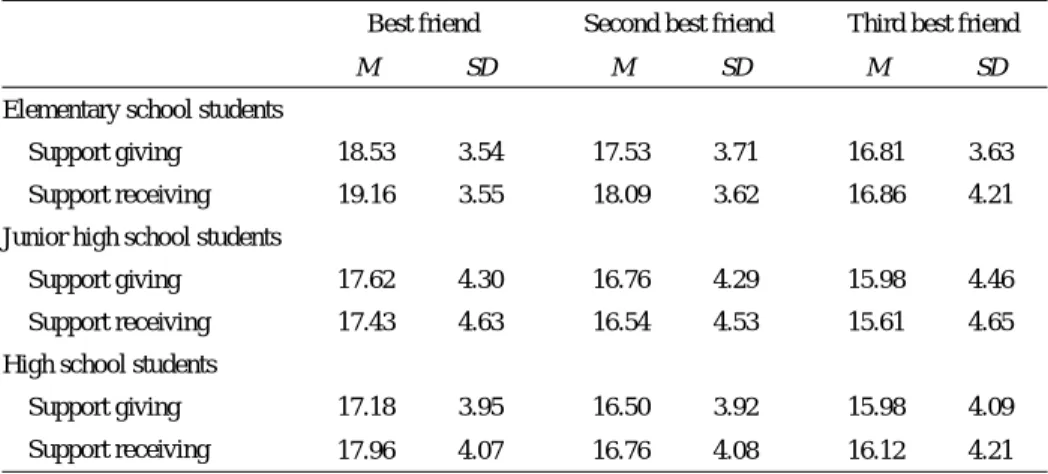
Table 1 displays the mean and standard deviation of the support receiving and support giving scores for each of the three close friends. The results of a two-way ANOVA on Intimacy (3) x School (3) indicated that the main effects for Intimacy and School were significant for support giv- ing scores, F (2, 1158) = 81.96, p < .01, and F (1, 579) = 10853.59, p < .01, respectively. Elemen- tary, junior high, and high school students all reported giving a great deal of support to their best friend. Furthermore, elementary school students reported giving more support to their three close friends than did the high school students.
The main effects for Intimacy and School were significant even for support receiving scores, F
Table 1 Means and Standard Deviations of Support Giving and Receiving
Best friend Second best friend Third best friend
M SD M SD M SD
Elementary school students
Support giving 18.53 3.54 17.53 3.71 16.81 3.63
Support receiving 19.16 3.55 18.09 3.62 16.86 4.21
Junior high school students
Support giving 17.62 4.30 16.76 4.29 15.98 4.46
Support receiving 17.43 4.63 16.54 4.53 15.61 4.65
High school students
Support giving 17.18 3.95 16.50 3.92 15.98 4.09
Support receiving 17.96 4.07 16.76 4.08 16.12 4.21
Note. Sample size was between 112 and 116 for elementary school students, between 203 and 209 for junior high school students, and between 254 and 257 for high school students.
20 長崎大学教育学部紀要−教育科学− 第74号
(2, 1132) = 113.05, p < .01, and F (1, 566) = 914.51, p < .01, respectively. Similarly, Elementary, junior high, and high school students all reported receiving the most support from their best friend.
Again, elementary school students reported receiving more support from their three close friends than did junior high and high school students.
Support Reciprocity and Stress Responses in Close Friend Relationships
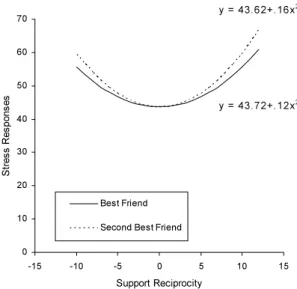
A bilineal curvilinear regression was carried out on each of the three close friends. The support reciprocity score (the support receiving score minus the support giving score) was used as the inde- pendent variable, and the stress response score as the dependent variable. The support reciprocity of each of the three close friends was not significantly related to stress responses among the elementary and junior high school students. However, among the high school students, the support reciprocity of the best friend and the second best friend were significantly associated with stress responses, F (1, 250) = 4.84, p < .05, and F (1, 252) = 7.69, p < .01, respectively. The support reciprocity and stress responses formed a U-shaped relationship (Figure 1).
With increasing age, friendship patterns shift from “shallow and wide” to “deep and narrow”
(Ochiai & Satoh, 1996). As high school students developed deep friendships with a single friend, the support reciprocity in that relationship was given more importance than that of other friends.
Thus, the support reciprocity in a close friendship was more significant to stress responses.
Support Reciprocity and Stress Responses in All Friendships
A bilineal curvilinear regression was carried out using the total support reciprocity score, which was created by summing the reciprocity scores of each of the three close friends, as the inde- pendent variable and the stress response score as the dependent variable. The total support reciproc- ity for elementary and junior high school students did not have a significant relationship to stress re- sponses. As elementary and junior high
school students did not seem to regard support reciprocity as very important (Kusumi & Kano, 1986), they were also likely to feel little motivation for balanc- ing out the gains and losses in their friend- ships overall. Even if such a motive was present, it would be extremely difficult for elementary and junior high school stu- dents to judge whether their total relation- ship with all friends was reciprocal. The total support reciprocity for high school students was significantly related to stress responses, F (1, 245) = 6.73, p < .01.
These results suggested that even if an im- balance is present in support exchange
Figure 1 Support reciprocity and stress responses among high school students.
Support Reciprocity and Stress Responses among Children: From the Viewpoint of Developmental Change in Friendships 21
with a close friend among high school students, support receiving and giving with other close friends can compensate for this imbalance.
References
Austin, W., & Walster, E. (1974). Participants’ reactions to “Equity with the world.” Journal of Ex- perimental Social Psychology, 10, 528-548.
Austin, W., & Walster, E. (1975). Equity with the world: The trans-relational effects of equity and inequity. Sociometry, 38, 474-496.
Buunk, B. P., Doosje, B. J., Jans, L. G. J. M., & Hopstaken, L. E. M. (1993). Perceived reciprocity, social support, and stress at work: The role of exchange and communal orientation. Journal of Personality and Social Psychology, 65, 801-811.
Buunk, B. P. & Van Yperen, N. W. (1991). Referential comparisons, relational comparisons and ex- change orientation: Their relation to marital satisfaction. Personality and Social Psychology Bul- letin, 17, 710-718.
Clark, M. S., Ouellette, R., Powell, M. C., & Milberg, S. (1987). Recipient’s mood, relationship type, and helping. Journal of Personality and Social Psychology, 53, 94-103.
Kusumi, S., & Kano, S. (1986). Seinenki ni okeru yujingainen hattatu no inshibunseki teki kenkyu [Developmental change in adolescent conceptions of friendship]. Research Bulletin of Educa- tional Psychology, the Faculty of Education, Kyushu University, 31, 97-104.
Miura, M., Fukuda, M., & Sakano, Y. (1995). Tyugakusei no gakkko sutoressa to sutoresuhanno no keijitekihenka [Successive changes of school stressors and stress responses in junior high school students]. Proceedings of the Annual Meeting of the Japanese Association of Educational Psy- chology, 36, 106-107.
Ochiai, Y., & Satoh, Y. (1996). Seinenki ni okeru tomodati tono tukiaikata no hattatuteki henka [The developmental change of friendship in adolescence]. Japanese Journal of Educational Psychol- ogy, 44, 55-65.
Okayasu, T., Shimada, H., & Sakano, Y. (1993). Tyugakusei ni okeru sosyaru sapoto no gakko sutoresu keigen koka [Alleviation effects of social support on school stress in junior high school students]. Japanese Journal of Educational Psychology, 41, 302-312.
Sprecher, S. (1992). How men and women expect to feel and behave in response to inequity in close relationships. Social Psychology Quarterly, 55, 57-69.
Sugawara, K. (1985). Seisyonen no yujinkankei no hattatsutekihenka to kouzou [Developmental changes and structures of friendships among adolescents]. In Bureau of Citizens and Cultural Af- fairs, Tokyo Metropolitan Government (Ed.), An examination of human relations among adoles- cents living in a large city: An analysis from the viewpoint of relevance to the attenuation of per- sonal relations (pp. 115-118). Tokyo: Bureau of Citizens and Cultural Affairs, Tokyo Metropoli- tan Government.
Taniguchi, H., & Tanka, K. (2005). Sapoto no gokeisei to seishintekikenko tono kanren ni taisuru kojinnaihattatsu no eikyo: Ritokufusokushikousei oyobi ritokukajyoushikousei no hattatsuteki- henka [The influence of intraindividual development on the relationship between support reci-
22 長崎大学教育学部紀要−教育科学− 第74号
procity and mental health: Developmental changes of underbenefitting and overbenefitting ex- change orientation]. Japanese Journal of Interpersonal and Social Psychology, 5, 7-13.
Taniguchi, H., & Ura, M. (2002). Support reciprocity and depression among elementary school and high school students. Japanese Psychological Research, 44, 247-253.
Support Reciprocity and Stress Responses among Children: From the Viewpoint of Developmental Change in Friendships 23