m Solar Flares H. Nakajima*
Laboratory for Astronomy and Solar Physics, NAS A Goddard S pace Flight Center T. Taj ima and F. Bnmel
Thpartment of Physics and I nstitute for Fusion Studies, University of Texas ] . S akai
Thpartment of Applied Mathematics . and Physics, Faculty of Engineering, T o y a m a U n iv e rs ity
ABS T RACT
Umble sub-peak structures in the quasi-periodic oscill ations found in the time profiles of two solar flares on 1980 ] une 7 and 1982 NOvember 26 are well expl ained in terms of the coa
lescence instability of two current loops. This interpretation is supported by the observations of two microwave sources and their interaction for the November 26 flare. The di fference of both sub-peak structures and time scales between the two flares are discussed from the vieWPOint of different plasma parameters in our computer simulations.
I . I NT RODU CT I ON
Recent observations of X-ray continuum emission, y-ray line, and continuum emission from solar flares with instruments on the Solar Maxirrum Mission ( SMM) and Hinotori satellites show that energetic ions and relativistic electrons are accelerated almost simultaneously with non -relativistic electrons during the impulsive phase of solar flares. These observational results make it necessary to revi se the widely accepted hypothesi s of particle acceleration that energetic ions and relativistic electrons are produced in the second phase a few minutes after the impulsive phase ( Wild et al . 1963; de ] ager 1969; Svestka 1976) . Although Bai and Ramaty ( 1979) , Bai ( 1982) , and Bai et al . ( 1983) revised the hypothesis as the second-'- step acceleration taking note of a small delay of y-ray line emission from hard X-ray emission, Kane et al . ( 1983) , and For
rest and Chupp ( 1983) pointed out that such a small delay can be explained simply by either the injection, propagation, or energy loss processes of particles which are accelerated in a single step.
Tajima et al . ( 1982, 1983) proposed a simultaneous acceleration mechanism of protons and electrons in solar flares by the nonlinear coalescence instability of two current loops, based on the results of computer simulation. Two adjacent , parallel current loops are unstable against the coalescence instability which involves the rapid ( sometimes explosive) conversion of magne
tic energy to kinetic energy of particles ( Tajima 1982) . The results of computer simulation reve-
*N AS A/ N R C resident reseach associate from Nobeyama Solar Radio Observatory of Tokyo Astronomical observatory.
Bulletin of Faculty of En®neering Toyama University 1985
aled that the time profiles of the proton and electron temperatures show quasi -periodic oscilla
tions with double suh--peak structtires.
Recently Nakajima et al . ( 1983) and Kiplinger et al ·� ( 1983) reported observations of quasi -periodic pulses with double sub-peak structure seen in hard X--ray, r-ray, and microwave emi
ssions in the two intense sol ar flares of 1980 June 7 ·and 1980 J une 21. We are interested in the close similarity between the observed time profiles and those obtained with the computer simulation by Tajima et al .
I n this letter, we present the resul ts of our analysis of the 1980 June 7 and 1982 Novem
ber 26 events, both of which show double sub-peak structures in quasi� periodic oscillations. Since these two events are widely different from each other in duration, source size, source height , etc. , they provide a stringent test for examining the validity of our model of particle accelera
tion in solar flares in terms· of the coalescence instability. Orr study shows that observational features of the two events are consistent with the results of our computer simulation.
II . S UM M ARY OF OBS ERVAT I ONS ( a) 1980 June 7 Event
The impulsive burst of the 1980 June 7 sol ar flare ( Figure 1 ) has been investigated by many authors (Forrest et al . 1981; Kane et al . 1983; Forrest and Chupp 1983; Nakajima et al . 1983; Kiplinger et al . 1984) . We summarize below some essential points from these obser
vations.
:a !E.
>
<-'
·u; c 0 Q)
><
rr: ::J
-o c
800
400
8 4000
(/) (!l
Ui <-'
c 6 2000 -
u
1 980 June 7
4 1 7 GHz
Uniltersal Time
Figure 1 : Time profiles of the 17 GHz microwa ve emission and the 150 - 260 keV X-ray emissions . ( from HXRBS) for · the 1980 ] une 7 event :
( 1 ) The burst is composed of seven successive pulses with a quasi -periodici ty of about 8 se
conds. Each of the pulses in hard X-rays, prompt r-ray l ines, and microwaves is almost syn
chronous and similar in shape.
( 2 ) The microwave pulses consist of double sub-peaks as seen especially in the second and fourth pulses in Figure 1 ( a) . The double sub-peak structure is also evident in the hard X-ray time profiles ( Figure 1( b) ) .
( 3 ) The starting times of hard X-rays, prompt y-ray lines, and microwaves coincide within ± 2 . 2 seconds.
( 4 ) The time scales of accelerations for both electrons ( up to energies above 1 MeV) and ions ( above 10 MeV/ nucleon) are less than 5 seconds. And the accelerations must occur almost simultaneously.
( 5 ) The height of the microwave source is estimated to be within 10 arc sec above the photo
sphere ( Ha flare; N12" , W 74" ) . The source has a small si ze of less than 5 arc sec in the east - �st direction and shows no motion.
The Ha photographs from the Peking Observatory ( H. Chow, private communication) add a new finding. The flaring region has two structures that appear to be in contact with each other , one stretchi ng in the east- west direction and the other in the north- south.
( b) 1982 Nwember 26 Event
We briefly outline the characteristics of the 1982 November 26 flare ( Figure 2 ) . This eve
nt is of much longer duration than the event on 1980 J une 7 , about 20 min compared to about 1 min.
(a)
6000
� -� 4000
0 m X �
u::
u
"'
2000
· ....
o ��--��--������L---������
1 .0 --- phase-1 -����-- phasa-3---
( b) Source He1ght
;: 0.5
i rn
o o o o o O o o o o o o o o o o o o o o o o o o o o o o o
0 '--...��...__l...
0220 0230 0240 0250
Universal Time
_j ______._.�_ ___ .._ __ _.____._._,_�
0300 03 1 0
Figure 2 : ( a) The time profile of the 17 GHz microwave emission and ( b) the time variation of the heights of two microw ave ( 17 GHz) sources for the 1982 November 26 flare.
Bulletinof Faculty of Engineering Toyama University 1985
The microwave observations were made with the 17 - GHz interferometer at Nobeyama, J apan, and the hard X-ray observation with the Hard X-Ray Burst Spectrometer (HXRBS) on SMM.
More details will be reported in a separate paper ( (Nakajima et al . 1984) .
( 1) The microwave burst is composed of three successive peaks with a quasi-periodicity of about 6 min as indicated by number 1 - 3 in Figute 2 (a) .
( 2) Each of the microwave peaks further consists of two sub--peaks. The hard X-ray time pro
files seems to coincide with the microwave sub--peaks. The SMM hard X-ray data are avai la
ble only for the first peak.
( 3) The microwave and hard X-ray emissions start almost simultaneously within 10 seconds.
( 4) The microwave source is composed of two sources, one at a height of � 104 km above the photosphere and the other at � 3 x10⁴ km. These values are derived on the assumption that the sources' are l ocated directly above the Ha flare ( S 10° , W 88° ) .
Figure 2 (b) shows the height of the two microwave sources as a function of time. I n the pre-burst phase (phase 1 : 0220-0228 UT), the upper source appears at a height of � 2 . 9 x10⁴ km above the photosphere and the lower one at � 0 . 7 x10⁴ km. I n phase 2 , the lower source rises at a velocity of � 30 km s-1 • The main phase (phase 3) started when the lower source reaches a height of � 1 . 5 x10⁴ km. I t is suggested that the two sources collide with each other at this time. I n fact . a small up- and-down motion of the lower source is observed in the main phase.
The oscillation period and peak- to-peak amplitude of the up-and-down motion are � 14 min and
� 2 x10³ km( significantly larger than the fluctuation level due to the signal to noise ratio), res
pectively. After the main phase, the lower source begins to go down towards its previous posi
tion. On the other hand, the upper source rises gradually, though it remains at almost the same height until the decay phase starts.
The observational facts summarized above, especially the collision of the two microwave sour
ces and the small up-and -down motion of the lower source in the 1982 Nwember 26 event , suggest that the current-loop coalescence takes place. The existence of two H a bright compon
ents in the 1980 June 7 event also supports this interpretation.
ill . I NT ERPRET AT I ON BY S I M UL AT I ONS
Two parallel current loops are unstable against the coalescence instability ( Pritchett and Wu 1979). They are attracted by and collide with each other and finally coalesce into one loop.
I ts nonlinear deve lopment can :release a lar ge amount of poloidal magnetic energy associated with the current loops into particle energies ( Tajima et al . 1982; Leboeuf et al . 1982). We in
vestigated thi s process, i . e. , the global plasma dynamics, heating and acceleration of particles, and so on, through computer simul ations. Here, we made two different types of simulations in order to experiment with a wide variety of plasma parameters: one is an MHD p article simul a
tion ( Brunel et al . 1981), arrl the other a collisionless full-electromagnetic particle simulation
( Tajima 1982), both of which are two-dimensional in space across the plane perpendicular to the current loops and three-dimenstinal in velocity space.
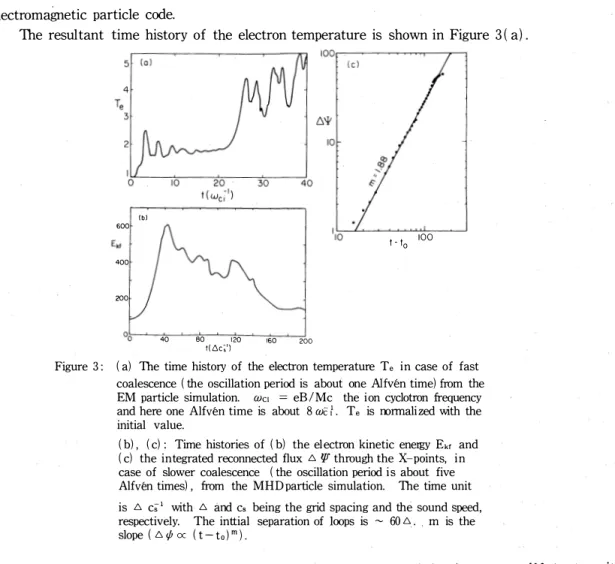
(a) Fast Omlescence--- 1980 J une 7 F1are
The case that two parallel loops have sufficient electric currents so that they attract each
other fast enough ( in about one Alfven transit time) was simulated using the colli sionless full
electrom�etic particle code.
The resultant time history of the electron temperature is shown in Figure 3 ( a).
600 (b)
400 200
40 80 120
H 6c�'l 160 200
t - to 100
Figure 3 : ( a) The time history of the electron temperature Te in case of fast coalescence ( the oscillation period is about one Alfven time) from the EM particle simulation. we, = eB/ Mc the ion cyclotron frequency and here one Alfven time is about 8 we I . Te is mrmalized with the initial value.
( b) , ( c) : Time histories of ( b) the electron kinetic ene�gy Ek, and ( c) the integrated reconnected flux 6 1Jf through the X-points, in case of slower coalescence ( the oscillation period is about five Alfven times) , from the MHD particle simulation. The time unit is 6 c;; ' with 6 and cs being the grid spacing and the sound speed respectively. The inttial separation of loops is - 60 6 . m is the ' slope ( 6 <P <X ( t - to ) m). . .
We can clearly see a quasi-periodic oscillation, the period of which is about one Alfven transit time ( 8 wcl1 ) . The cause of this oscillation i s as follows: after fast reconnection of poloi
dal magnetic fields takes place at the X-point between two approaching current loops, the two plasma blobs pass through each other and overshoot, resulting in the repetition of this process.
Figure 3 ( a) also shows that the electron temperature oscillation is characterized by promi
nent double sub-peak structure. The double sub-peaks occur just before and after each peak in the magnetic field intensity. J ust before a peak, the magnetic acceleration of the plasma by jx B becomes strongest so that the magnetic flux behind the colliding plasma blobs as well as the plasma blobs themselves are strongly compressed. This plasma compression causes the first sub -peak of the electron temperature. Then, the plasma particles acquire velocities close to the Al
fven speed along the colliding direction, so that they detach from the magnetic flux against which they have been compressed, resulting in an expansion and hence in an adiabatic cooling of the plasma as the magnetic fields obtain peak values. After the peak in the magnetic fields, the process reverses giving rise to the second sub-peak of the electron temperature.
Bulletin of Faculty of Engineering Toyama Universi ty 1985
A similar time history is obtained for the kinetic energy of high�energy tail el ectrons and protons as <"Well as for the proton temperature. The acceleration of the high energy�tail partic
les is due to a combination of localized electrostatic field acceleration across the poloidal magne
tic field and magnetic acceleration in the poloidal to toroidal directions ( Tajima et al . 1983) . Since these processes accompany the local plasma compression/ decompression just before and after coalescence, it is not surprising that the time profile of the microwave emissions caused by high� energy tail electrons ( Figure 1 ( a) ) resembles that of figure 3 ( a) .
The results of this simulation can also explain the observed period of the quasi�periodic osci
llation of the 1980 J une 7 event . The observed period ( - 8 seconds) of the June 7 flare is close to one Al:fven transit time ( - 4 sec) which is estimated with source size ( - 5 arc sec) , magnetic field ( - 200 Gauss: Kiplinger et a l . 1983) and emission measure ( - 1049 cm-3 ) from the GOES soft X� ray data ( Solar Geophysical Data) .
( b) Slow Coalescence��� 1982 N>vember 26 Flare.
When two parallel )oops have insufficient electric currents or are well separated and hence the attracting force of them is weaker than that of the previous case, reconnection of poloidal magnetic fields during loop coalsecence becomes slower. ( However, this reconnection rate is still faster than what would be predicted by a classical tearing theory ( Furth et al . 1963) ) . This case was also simulated using the MHD particle code. Figure 3 ( b) shows the temporal deve
lopment of plasma kinetic energy ( the electron pfessure energy) during the coalescence. Also shown in Figure 3 ( c) is the time history of the integrated reconnected magnetic flux through the X� point ( case shown in Figure 5 ( a) in Bhattacharjee, et al . 1983) . Note that a slight amount of oscillations of reconnected flux can be seen around the straight line. Again we can see the oscillatory behaviour with double sub-peak structure in both time histories, though it is less pro
minent compared with that of the fast coalescence case presented in the previous subsection.
The period of oscillation is about 5 times the Alfven transit time.
The obtained time history resulting from the simulation is explained as follows. I n the case of slower reconnection, the two plasma blobs do not pass through each other but are qushed back by the magnetic field compressed between the two loops. This motion is repeated resulting in the damping oscillation shown in Figure 3 ( b) . The amplitude of the oscillation in this case is less prominent compared with the previous case ( Figure 3 ( a) ) .
The observed plasma kinetic energy oscillations exhibit a structure quite similar to the mic
rowave time profile of the 1982 N>vember 26 flare as shown in Figure 2 ( a) . The source size of the N>vember 26 flare is about 10 times larger than that of the J une 7 flare. We therefore estimate the calculated period of the oscillation to be 5 x4 x10 = 200 sec, assuming that the AI fven velocity is about the same for both cases. This period is clo�e to the observed period of about 6 min. Note also that in this case the flow velocity is much belowthe Alfven velocity in agreement with the observational fact that the 30 km/ s colliding velocity of the lower loop 1s much smaller than the Alfven velocity of - 103 km/ s.
N. S UM M ARY AND C ONCLUS I ONS
The results obtained from computer simulations of the coalescence instability of two current
loops are in good agreement with observations of two widely di ffering flares.
The key characteristics which are well explained are the simultaneous accelerations of both electrons and ions, and the double sub-peak structure in quasi-periodic pulses. The double sub
peak structure is more pronounced when the currents in the two loops are sufficient for the fast coalescence to occcur. This case corresponds to the 1980 June 7 flare. When the currents are insufficient for the fast coalescence, the double sub-peak structure is less pronounced. Thi s case corresponds to the 19 82 Nwember 26 flare. I n addition, we have the observation sugges
ting the collision of the two microwave sources for the 1982 Nwember 26 event .
Therefore, we consider that this mechanism is a plausible process for the particle accelera
tion mechanism in solar flares.
A C KNOWL E D GMENT S
We are grateful to T. Kosugi , K. Kai , B. R. Dennis, and A. Kiplinger for useful discus
sions. This work was supported by the National Science Foundation Grant ATM 82- 14730 . Ole of us ( H. N. ) was supported by the Laboratory for Astronomy and Solar Physics at NA S A Gxldard Space Flight Center and the National Academy o f S ciences/ National Research Council.
REFERENCES
Bai , T. 198 1, in Gamma Ray Transients and Related Astrophysical Phenomena, ed.
R. E. Lingen felter, B. S . Hudson, and D. M. Worral ( New York: Al P) , P. 409 . Bai , T. , Hudson, H S . , Pelling, R. M. , Lin, R P. , S chwartz, R. A , and von Rosenvinge,
T. T. 1983, Ap. J . , 267 , 433 .
Bai , T. and Ramaty, R. 1979, Ap. J . , 227 , 1072.
Bhattacharjee, A. , Brunei , F. , Tajima, T. 1983, Phys. Fluids, 26, 3332 . Brunei , F. , Leboeuf, J . N. , Tajima, T. , Dawson, J . M. , Makino, M. , and
Kamimura, T. 198 1, J . Comput . Phys. , 43, 268 . Chow, Y. 1983, qrivate communication.
de J ager, C. 1969, in COSP AR S ymposiumon Solar Flares and Space S cience Research, ed. C. de J ager and Z. Svestka ( Amsterdam: North Holland) , p. 1 .
Forrgst , D. J . et al . 198 1 , 17th I nter. Cosmic Ray Conf. , 10, 5 . Forrest , D. J . and Chupp. E. L . 1983, Nature ( Letters) , 305 , 291 .
Furth, H. P . , Killeen, J . , and Rosenbluth, N. N. 1963, Phys. Fluids, 6 , 459 .
Kane, S . R. , Kai , K , Kosugi , T. , E nome, S . , Landecker, P. B. , and Mckenzie, D. L.
1983, Ap. J . ' 271 , 376 .
Kiplinger, A. L . , �nnis, B. R . , Erost , K J . , and Orwig, L. E. 1983, .Ap. J . , 273 , 783 . Leboeuf, J . N. , Tajima, T. , and Dawson, J . M. 1982, Phys. Fluids, 25, 784 .
Nakajima, H. , Kosugi , T. , Kai , K. , and Enome, S . 1983, Nature ( Letters) , 305 , 292 . Nakajima, H. , et al . 1985, in preparation.
Pritchett, P. and Wu, C. C. 1979, Phys. Fluids, 22, 2 140.
Tajima, T. 1982, in Fusion Energy- 1981 ( Trieste: I nternational Center for Theoretical Physics) p. 403 .
Taj ima, T. , Brunei , F. , bnd S akai , J . 1982, .Ap. J . , 258 , L45.
Bulletin of Faculty of Engineering Toyama Universi ty 1985
Tajima, T. , Brunel , F. , S akai , ]. , Vlahos, L. , and Kundu, M R. 1985, I AU Synposium No. 107 . P. 197.
Wild J . P, , S merd, S . F. , and Weiss, A A 1963, Ann. Rev. Astr. Ap. , 1 , 291 . This paper was presented on 1984 Plasma Astrophysics/ Course and Workshop held at Varenna, I taly. ( Aug. 28-Sep. 7 , 1984)
( Received October 31 1984)