Diagnostic Evaluation Study from the 1980s
Into the Gray Zone as Extension in Space and
Time From Lesson Study
著者
ARIMOTO Masahiro
journal or
publication title
Annual Bulletin, Graduate School of Education,
Tohoku University
volume
5
page range
55-74
year
2019-03-29
Abstract
The author focuses on school research themes through the combined lens of the Lesson Study (LS) and a new type of school management system that emerged in the 1980s. The author also utilizes the concept of “resources” necessary for curriculum development and has created checklists that can be used to diagnose the relationship between teachers and resources. The working hypothesis is that School Based Research (SRT) frequently uses tacit formative assessments administered either in a group or individually, for each subject and grade. (1) SRT of educational tendencies in schools reflects an amalgam of approaches including behaviorism, cognitivism, constructionism, and social culture in learning theory. (2) Integration of subjects’ extracurricular activities, and informal/ non-formal learning is supported by SRT. SRT is an enabling (cultural) tool used by Communities of Practice (CoP) to evaluate the learning process, based on a collective interest in nurturing the whole person. Japanese teachers maintain a social bond with their students, based on the theory that the stronger the bond, the more successfully young learners will become zenjinteki (well-rounded) in character and reproduce similar communities around them. Using informal and non-formal LS, we can reproduce multi-layered research perspectives (including personal and social processes, and relationships).
Key words: Lesson study, formative assessment, school research theme, multi-dimensional and multi-level feedback, Japanese organizational culture
1. Introduction
Of particular interest internationally, although less common in Europe, is the practice of lesson study (LS) or jugyo kenkyu. In Japan, beginning in the 1980s, locally-transformed jugyo kenkyu initiatives saw the emergence of innovative teacher-developed assessment tools. In making the collaborative (collective-student) culture of assessment a reality, LS is an approach “involving everyone in the system in expressing their aspirations, building their awareness, andReflections on a School-Based Research Diagnostic Evaluation
Study from the 1980s Into the Gray Zone as Extension in Space
and Time From Lesson Study
Masahiro ARIMOTO
(Professor, Graduate School of Education)developing their capabilities together” (Senge et al., 2000, p. 5). The lesson study format provides a platform for effective Professional Learning Communities (PLCs).
The author has already noted that in the 1980s there was an area of uncertainty or indeterminacy, a topic that was not clearly one thing or the other (a gray area). Among the traditional LS schools in Japan are schools that have practical, valuable wisdom with this spread and a multilayered perspective, and are also making use of current research.
2. Basic school research theme data from 1985
No Main theme of the research 1 Research on teaching that develops students as individuals and a group (cooperative teaching practices) 11 “Developing children’s capacity for learning with enthusiasm”—Use of TV programs to enhance learning during science class 16 How educational guidance should cultivate students’ attitudes towards identifying issues, learning problem-solving skills, engaging enthusiastically in learning, and extracting social implications while learning from broadcast programs 17 How lessons should be taught to elicit the best from each student in an arithmetic class 5 Research on educational guidance methods to develop self (-regulated) learning ability 8 Educational guidance to develop the capacity for self-regulate learning, acquire solid thinking ability, and more prolific creativity -Japanese language: Improving classwork to enable students acquire fundamentals/basics aimed at individualized teaching 10 Research on moral education aimed at developing students’ moral beliefs and motivating them to practice, based on creative ideas and curiosity encouraged through broadcast programs
13 How educational guidance should develop highly-motivated individuals to research
identified issues
23 Towards independent learning
30 Educational guidance to ensure each student’s development—(Subtitle) Teaching
arithmetic by drawing students’ actual experiences
102 Planning educational guidance methods for social sciences by effectively employing
assessments
109 Educational guidance to motivate students to learn by focusing on fundamentals/basics 120 Designing classwork by effectively utilizing educational technology methods
172 School management aimed at increasing the capacity for self (-regulated) learning—Focus
183 Pursuing effective lessons in light of fundamentals/basics—Japanese language, social sciences, arithmetic, and science 189 Instilling self-confidence and the joy of learning in students by introducing open-style education 194 Research on educational guidance methods to cultivate a positive attitude towards self (-regulated) learning 201 Group-based research and class study based on “learning to increase each student’s basic academic level and resolve individual problems”—Review evaluation details and modify hagemi (encouragement) examination 229 Encouraging self-awareness and independence in children—Effective use of AV equipment during class 233 Research on effective educational guidance methods assisted by broadcast programs 250 Improve teaching to develop self-expression and physical strength 255 Endeavor to improve and upgrade educational environment 258 Actively encouraging children who enjoy physical exercise and are eager to improve their physical strength 259 Teaching plans to help each individual student realize the joy of creating from his/her personal experience and to discover the joy of learning 283 1. Research on educational guidance to help children examine independently (Theme: “Semantic learning, with a focus on arithmetic including the use of PCs, to foster the desire to explore and understand the delight of knowing”); 2. Research on teaching to familiarize children with exercise and improve their physical strength and motility (Theme: Physical education to inculcate the joy of growing in children) 289 Teaching to increase willingness to learn independently and cultivate an independent attitude at school 337 How guidance should systematically promote learning how to use improvised expressions 375 Developing children who explore and devise various forms of expression—Focusing on drawing 380 Research on curriculum to nurture a vibrant spirit and foster children who are considerate and possess the ability to execute 390 Acquisition of basic academic skills 406 (Sub theme) Development of educational guidance methods to foster learning ability (85– 87)—(Main theme) Establishment of education to foster self-learners (83–90) 414 Encouraging children to think, and makes decisions, for themselves
432 Encouraging children to develop the capacity for self-awareness and self-assessment, and a strong sense of solidarity 434 Teaching methods to help each child discover the joy of learning from experiences— Learning to gain a sense of accomplishment based on excitement 444 Educational guidance that fosters the capacity for self (-regulated) learning 451 How AV teaching aids and educational equipment should be utilized to foster the capacity for self (-regulated) learning 457 Research on and creation of effective lessons to ensure children's understanding—Towards teaching children to enthusiastically participate in learning activities 469 Providing lessons to cultivate self (-regulated) learning 473 Learning social sciences to develop solid ways of observing and thinking 12 Research on learning methods that increase willingness to learn
14 Improvement of educational guidance methods to enhance basic academic skills—
Improving the learning process to promote active learning 29 Teaching methods to develop communication and presentation skills 42 Educational guidance to elicit the best from each individual child in a small-scale junior high school (Joint class and TT (Team Teaching) method) 54 Promotion of dynamic classroom management, understanding of students, and organization of student activities 56 Various teaching methods to ensure each student definitely learns primarily and deepens their learning through mass teaching 81 Individual guidance methods aimed at increasing motivation 111 [Welfare education] Development of welfare education programs to foster a sense of solidarity among students
112 Promotion of comprehensible lessons by advantageously employing a point-by-point
assessment 113 Educational guidance method based on the achievement level of personal experiences - Exercising our ingenuity in teaching by utilizing assessment 115 Improving educational guidance methods to increase each student’s willingness to learn and acquire learning ability 116 Cultivation of highly-motivated students—Planning comprehensive lessons 158 Creating lessons from the learner’s perspective—Questions, instructions, and advice to elicit the best from each student 184 Towards comprehensible, can-do, and dynamic classwork 270 Developing the learning skills needed to acquire solid academic abilities
342 〈See the attachment〉 344 Educational guidance to motivate (Teaching to ensure students acquire the fundamentals/ basics and its evaluation) 379 Implementation of educational guidance to motivate each student and ensure they acquire solid academic abilities (With the assistance of educational equipment) 428 Encouraging students to learn willingly and intentionally—Planning teaching methods to provide each student various opportunities to be involved in activities 439 Educational guidance to increase basic academic skills—Towards the development of students who engage in learning willingly 445 Designing the curriculum to take students’ varied academic and motivation levels into consideration—Focusing on teaching courses based on autonomous choice and instructions on living a good life 462 Research on teaching methods to motivate students to engage in learning 39 Improvement of classwork to develop each individual student's potential—Improving educational guidance methods through teachers’ collaboration 99 Towards improved learning to develop each student’s individuality and ability, with the assistance of a multi-purpose space 119 Research on educational guidance based on individual differences—Japanese language class 275 Lesson study for individualized education 285 Towards Nishikko (Nishi=school students) who can independently increase living skills (Special) 318 Teaching methods in a combined small-size class—Reading guidance to develop unique expressions 360 Research on educational guidance that effectively utilizes AV aids to create enjoyable, comprehensible lessons—Through implementation in social sciences class 441 Educational guidance based on individual differences 53 Research and development of the curriculum to develop thinking, self-aware students who can act and contribute charitably to society 92 Ingenious instructions based on degree of academic achievement 93 Lessons regarding individualized educational guidance in mass teaching 106 Research on educational guidance based on individual differences—Ingenious instructions that develop individuality and creativity 107 Encouraging students to respect human rights—Implementation of antidiscrimination education at every opportunity during school 159 Developing classwork that fosters learning ability
190 Practicing Nishichu (Nishi=Junior High School) education to develop individuals' independence—Increasing self-education abilities and creating “Nishichu student culture” 192 Student guidance to improve social nature (sociability) and behaviors while developing individuality 301 Student guidance with the intention of diversifying students 364 Creation of classwork that develops individuals’ positive qualities—Establishing a personal goal based on a positive outlook and assessment method 377 “Research on educational guidance to motivate students”—Creating classrooms that develop individuality 421 Research on classwork that generates motivation to learn 425 How lessons should be taught to elicit the best from each student and increase the desire to learn 447 Designing and implementing curricula to develop each student’s abilities and aptitudes— Development of educational activities for individualization 450 Educational guidance to elicit the best from each student
461 Teaching plans to ensure students engage in learning enthusiastically by utilizing
educational equipment effectively— (Development of a guidance plan and teaching method plan with the aid of educational equipment, Language Laboratory (LL) designated by MEXT for English class) 95 Curriculum as observed through interactive learning—Harmonized learning 153 How learning grounded in children’s daily living should appear 170 Developing children’s sensitivity and intelligence 243 Creation of comprehensive integrated learning and/or integrated classwork that covers more than one subject to ensure individual development 293 Structuring the entire curriculum after incorporating integrated study 307 Developing the curriculum for, along with the establishment of, an environment studies department 319 Striving for an image of children learning enthusiastically—1) Curriculum improvement and guidance focusing on relationships between subjects; 2) Implementation of integrated classwork that covers more than one subject in the lower grades 331 Education to help foster children’s vibrant humanity—Improved educational guidance to help children develop into independent and creative individuals 401 Creation of an integrated study-learning program within the community (Sub theme)— Raising Iburihashikko (Iburihashi=children) who undertake tasks vibrantly (Main theme)
418 What are the indications for a problem-solving forum to generate new value judgments among children through comprehensive integrated learning units and/or integrated units that covers more than one subject 49 Nothing special 142 Student activities to increase self-education ability—Hometown learning that students are willing to undertake and classwork development 232 Towards the developing creative intelligence 51 “Develop motivated children” is to develop the ability to identify and solve issues through broadcasting learning 117 Teaching methods that suit the ability and aptitude of individual children—Research on the CAI system in arithmetic 202 Classwork design that develops self-learners 247 Develop children who are willing to query through social sciences education—How to teach with the aid of AV educational material 256 Study teaching methods that increase the willingness to learn 257 Ensure students understand fundamentals/basics with the aid of educational equipment 346 Guidance to broaden and deepen learning and develop the capacity for self (-regulated) learning by effectively using broadcasting characteristics 347 Towards broadcasting education to help students learn in a motivated and constructive manner 404 Implementation of educational guidance to increase solid thinking skills with the aid of broadcast education material 405 Encouraging children to demonstrate individuality and to improve themselves as a group 31 How classroom guidance should increase children’s independence through special
activities—Increasing effectiveness of teaching with the help of AV teaching material
59 Regarding effective use of Language Laboratory (LL) learning and AV educational
equipment 68 Utilization of AV equipment to improve teaching methods (*regarding AV) 180 Aim to vitalize classwork by using AV educational material 230 Improve efficiency of educational guidance with the aid of educational equipment 240 Enabling students to experience more profound daily-living experiences and an increased self-guidance ability, by effectively using the characteristics of broadcast education
349 Devise clues to develop solid learning skills with effective use of broadcasting
402 Effectively utilize the characteristics of broadcast programs to develop positive attitudes and increase learning effects 458 Research the usage of educational equipment and teaching methods in terms of practical cases to ensure each student learns independently 48 Creation of self-education/learning focusing on hands-on experiences—Designing and implementing a Takehaya curriculum 271 “Developing their vibrant humanity”—Classwork development for proactive problem-solving through various thought-processes and their evaluation 284 Preparing children to generate several ideas and undertake tasks independently, with the aid of AV equipment 340 Creation of learning for self-realization 361 Teaching and material development of social sciences to enhance the capacity for self (-regulated) learning 371 Self (-regulated) learning that children engage in willingly 384 Improvement of education methods to develop independent children 389 Providing students with educational guidance to inculcate the capacity for self (-regulated) learning 408 Learning to think for oneself and to understand each other, with a focus on Japanese language and arithmetic 69 Organizing classes so as to help children who learn independently, develop (International special school - incl. 2 classes) 154 Children who can express themselves—How a social sciences class should be instructed to develop self-expression ability 156 Developing self (-regulated) learners 179 Teaching arithmetic to develop the capacity for critical thinking and self (-regulated) learning—Focusing on logical thinking 262 Improvement of educational guidance in the social sciences based on respect for humans— Educational guidance to increase each child’s curiosity 303 Classwork designed (organized) by children 312 Teaching and assessment to increase willingness to learn independently and to develop a self-regulatory approach to learning 374 Towards developing spiritually vibrant children—Pursuit of learning that children can engage in enthusiastically 383 Creation of classwork to enable children to learn by themselves 394 Striving for the joy of learning
411 Promoting effective use of broadcast education to develop an interest in self (-regulated)
learning
423 Educational guidance and promotion of various activities to better observe each child, elicit
the best from them, and develop their self-education ability
430 Improvement of educational guidance to enable each child to continue learning by
themselves 440 Planning and developing subjects and comprehensive activities to inculcate the capacity for self regulated learning 67 Fourth research on the development of vibrant humanity (11th year)—Developing children’ s abilities to learn by themselves and from each other 88 Creation of a new educational structure 144 How learning should develop each individual child’s inner strength 152 Developing learning ability
213 Teaching methods to help students develop the ability to set a goal and pursue it
enthusiastically, by creating a space where individuality can stand upfront and children can collaborate diligently
268 Developing children’s capacity for enthusiasm—Focusing on an “integrated class that
covers more than one subject” in the lower grades and on learning “Japanese language” and “social sciences” in the middle and upper grades
397 Developing children’s ability to overcome problems and pursue new challenges
independently
448 Educational guidance to foster children who improve themselves
453 How classwork should inspire increased motivation while ensuring that children
experience joy in learning independently—Arithmetic and moral class
459 Statistics education—To strengthen the impact of learning and develop the ability to
pursue ideas of one’s own volition
171 Employing a learning center to develop learning ability—Improvement through the
effective use of AV educational material
185 Development of the capacity for self (-regulated) learning 205 Fostering the development of self (-regulated) learners
241 Encouraging children who possess solid academic skills and aim to achieve
self-realization—In pursuit of diverse learning skills through broadcast education
25 “Developing education that increases the capacity for self-education” 50 Study and the development of learning abilities
118 Research on teaching methods to develop the capacity for critical thinking and self (-regulated) learning—Developing mathematical thought processes by learning numbers and figures, and doing calculations 121 Educational guidance through effective use of broadcast education—Continuous practices 162 Teaching children problem-solving skills 196 Classwork development to foster self (-regulated) learning 221 Educational guidance to develop an inquiring mind in each student 279 Helping children acquire the ability to learn on their own initiative (Japanese language education) 292 Establishing organic associations with other fields and developing the capacity to benefit from a moral education
308 Student guidance—Striving for candid communication based on classroom analysis
(Japanese and arithmetic) and educational consultations 321 Creating courses to help develop the capacity for self regulated learning—Developing the power of discernment 322 “Supporting children who engage in learning willingly”—Learning Japanese by using words carefully and understanding words from various perspectives 348 Educational guidance to develop self (-regulated) learners (through broadcast education) 415 Children who work towards a better life and apply lessons learned to their daily lives 426 Supporting children who work towards their goals—Towards the establishment of self-regulatory learning practices 3 Improvement and evaluation of the curriculum 9 Research on educational guidance methods to ensure that individual students receive a solid education 22 Research on the role of educational guidance in motivating students—Research on teaching methods taking individual differences into consideration 33 Development of the capacity for self (-regulated) learning 35 Giving students the ability to guide themselves—Teaching methods to increase the desire to engage in activities 38 Creation of learning methods that to allow for expressions of individuality 43 Teaching methods to develop each student’s learning abilities—Utilizing a collaborative approach 78 79 Encouraging students who aim to prepare the individual self, thinking, judging, and acting by themselves
83 84 How classwork should develop the capacity for self (-regulated) learning 124 Course instruction to develop self (-regulated) learners 139 Ingenious attempts at developing comprehensible lessons 148 Classwork to help students develop a favorable attitude towards self (-regulated) learning 163 Research on curriculum to develop independence—Applicability of indications/aids and framework of teaching material 168 Developing the capacity for self (-regulated) learning—Fostering the ability to handle problems 182 Creating course curricula that aim to develop a pro-learning mindset and the capacity to learn 188 Career guidance to improve self-guidance skills 191 Educational guidance to improve self (-regulated) learning abilities
201 Helping children develop a sense of purpose, a strong sense of belonging, and an
enthusiasm for working (learning) 203 Ingenious attempts at creating coursework that strengthens the capacity for self-education 204 Teaching that suits individual aptitudes and develops individual ability—Teaching and evaluation to improve perceptions and thoughts 208 Establishment of basic learning habits 209 Creation of a school that develops the capacity for self-education 239 Student guidance that elicits the best from each student 273 Developing the capacity for self-education 280 1) Class exercises to improve self-education skills; 2) Moral studies research and special activities that encourage sociality 281 Developing the desire to think and learn independently 294 Creating learning activities that enhance students’ critical thinking abilities and deepen their ability to comprehend each other 304 Developing learning skills (1st grade)—Planning classwork that strengthens learning abilities 330 Ensuring study time in class to promote individualized learning
350 Teaching that elicits the best from each student—Towards the development of the
capacity for self (-regulated) learning
352 Teaching that ensures that students acquire the capacity for self (-regulated) learning
through all educational activities
355 Providing educational guidance that suits the developmental stage, ability, and aptitude of
students—Producing students who know how to learn
366 Creating “learning activities that develop an aptitude for self-education”—Towards
classwork that develops motivation and power of execution 367 Encouraging students to act proactively and improve themselves 369 Researching teaching methods that inspire increased learning motivation in each student 370 Utilizing teaching methods that introduce students to the fundamentals/basics of self-education 387 Providing career guidance tips to help students develop the capacity to utilize their own individual capabilities properly
388 Providing educational guidance that ensures that students acquire the necessary
fundamentals/basics—Educational guidance to elicit the best from individuals
416 Organizing forums that give children the opportunity to identify subjects they wish to
learn, while taking their thinking process into consideration
420 Increasing each student’s awareness of issues, motivating them to be goal-oriented, to
learn independently, and experience the satisfaction of problem-solving
424 Developing students’ comprehension of how to learn and think, and their ability to
participate in learning activities enthusiastically
427 Developing children’s capacity for proactive, patient, and respectful yet candid
communication—Working on fitness training towards a personal goal 431 Devise processes that empower students to examine problems closely, think through them thoroughly, and to proactively engage in learning 449 Improvement of teaching methods that develop self-learners 26 Practical research on classwork taking tutoring into consideration 44 Teaching Japanese language, taking individual differences into consideration 45 Empirical research on evidence concerning learning problems and how to identify them 61 Scientific research on education that respects individuality 65 Encouraging the development of the capacity for self (-regulated) learning 82 Integrated classes that cover more than one subject for all the lower grades together and
module learning, for all mid and upper grades, to develop their learning abilities— Developing exemplary educational guidance based on individuality and ability
104 Research themes to be decided, but research may examine individualization and
110 Improving educational guidance according to lifelong learning principles such as the provision of educational guidance that suits the individuality and ability of each child— Focusing on classroom management, science class, and classroom discussions 146 Educational guidance that suits individuals’ abilities and aptitudes—Individualization of teaching and personalization of learning 157 Developing a tailored curriculum that responds to the unique needs of each individual 212 Educational guidance based on individual differences 223 Tailored classwork based on an understanding of each individual 228 Teaching methods that develop problem-solving abilities 300 Ingenious attempts at implementing a tutorial approach to mass teaching 315 Individualized learning incorporated into the entire system 356 Encouraging self (-regulated) learning in children who possess a great personality and creativity 363 Educational guidance that generates the joy of self-realization—Teaching that respects children’s individuality 365 Research on curriculum operation that respects individual personalities 391 Health education through the school dental health program 398 Learning that allows each student to engage independently—Pursuit of “learning that allows the expression of individuality” 399 Developing children’s ability to work independently while also working with each other, and helping each other improve—Tailored educational guidance 409 Development of an education system that allows for expressions of individuality—Learning by closely observing and helping each student develop 417 Teaching children to observe, discover, review, and explore themselves—Organizing learning processes that allow students to practice independently 422 Teaching methods that help each child work hard to develop their physical strength— Towards fitness training grounded in daily life 435 Educational guidance to ensure each child engages in activities enthusiastically and experiences a sense of achievement—Use of synchro-fax and improvement of indirect teaching 437 Educational guidance in response to individual differences 466 Research on educational guidance that respects individuality in mass teaching 22 Improvement and evaluation of the curriculum 34 Class study that captures students’ desires, elicits enthusiasm, and supports independent learning
36 Maximizing the abilities and special attributes of individual students 62 77 173 “Measures to increase academic abilities”; “Means of cooperation between head and sub teachers and HR management”; “Research and implementation of CAI” 217 Promotion of individualized education 224 Curriculum formation with the aim of creating a distinctive school 336 Attempt to conduct comprehensible classwork by focusing on understanding fundamental/ basic expressions through careful selection of teaching content
3. How to collect learning-based evidence from a school-wide perspective through
LS
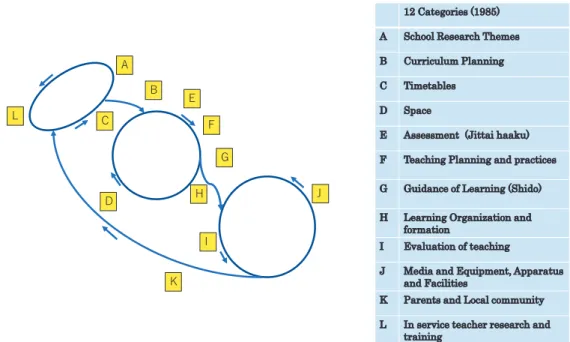
The twelve categories (A-L) that formed the basis of this school-based research and diagnostic evaluation study in the 1980s are as follows: A01 There is a way to incorporate new trends in the education world into the research theme A02 The research theme is set under the long-term plan A03 The research theme is set as a result of discussion by all teaching staff B01 Concrete steps have been taken towards creating a research topic-based curriculum. B02 Key units have been clearly identified in the teaching plan for the year. B03 The viewpoints and methods used for evaluating curricula are clear. B04 Teaching units related to school events, events in the local community or the activities of the school assembly are in place. B05 General units are in place for expressive activities centered on science and society. B06 Units centered on exploring the school and introducing friends to each other are in place. B07 Inter-subject units centered on learning quantities and language are in place. B09 General units (life, smoking, boys and girls etc.) are in place. B10 Domestic units dealing with familiar topics in everyday life are in place. B11 Units based on everyday experience, reflecting how children understand current issues are in place. B12 Units are designed to incorporate children’s opinions and proposals into lessons. B13 Units to proactively pursue surveys etc. of the region (local studies) are in place. B14 Units to introduce local traditions, culture and toys are in place. B15 Units centered on work experience like making rice, growing plants etc. are in place. C01 General learning units that make use of the free time allotted by the school are in place.
C02 Time has been allotted for extension and supplementary teaching. C03 Time has been allotted for kanji and arithmetic drills. C04 Time has been allotted for individual learning, free study. C05 Time has been allotted for browsing reading material. C06 A mechanism is available for correcting the weekly timetable. C07 A no-chime policy has been adopted. C08 Teachers are able to alter time periods. C09 Time has been allotted for original learning activities outside the free allotment time. C10 A modular system is in place. C11 Unit durations for lower year groups are separated. D01 A multi-purpose space is in place. D02 Open spaces in empty classrooms are being used. D03 Corridors, entrances, fields are being put to use. D04 The use of the classroom space is varied. D05 Learning venues outside the school are being developed. D06 Facilities and space outside the school are being used. D07 Another school is located on the same premises. D08 A playroom meant only for lower year groups is being used. D09 Floors for use by each year group are available. E01 A record and seating chart are being used. E02 Teachers exchange information about how different children are learning.
E03 Information about individual children in light of student counseling is being shared
between year groups. E04 A multi-faceted data enquiry system is in place for tracking each child’s growth. E05 There is teacher handmade questionnaire to capture the actual state/ condition of the children E06 Standardized assessment is used to tailor teaching to each individual child’s needs. F01 There is a common guidebook for lesson planning at the school. F02 Basic ideas and elements have been extracted for each unit, and structured. F03 Prerequisite knowledge and skills required for each unit have been made clear. F04 A distinction has been made between ensuring topics are taught, and encouraging free development. F05 Formats for lesson proposals are different for different subjects. F06 Evaluation methods and viewpoints are clearly stated during lessons. F07 A system is in place for developing lesson proposals together.
F08 A system is in place that allows team teaching. F09 A range of media e.g. graphics, print, real specimens are being combined and put to use in the lessons. F10 Learning is carried out in such a way that the children themselves can decide their own objectives and topics. F11 Objectives are in line with individual abilities. F12 Choice in learning (selecting topics, order, methods etc.) is available. F13 Chances are being provided to apply and use skills learned. F14 A teaching guide for teachers has been produced. G01 Children are taught to understand the significance and goals of units’ learning content. G02 Children are taught to treat the study topics and aims as personal goals. G03 Children are trained in how to give presentations, speak out, and take notes. G04 Communication skills are taught to children in a systematic way. G05 Training is provided on how to obtain information e.g. how to use a dictionary, how to look things up in a library etc. G06 Children are being taught how to resolve problems and adopt exploratory approaches. G07 Training to compile the summary while grasping the main points and subjects in classes that read lectures and printed materials (such as sentences) G08 Television and movies are used to grasp key topics and scenes. G09 Special training is given at the start of the academic year/term on how to take viewing notes (on cards). G10 Include activities to make and broadcast homebrew programs such as "Yutori time" G11 Opinions and comments are given for illustrations and writing.
G12 Training is provided for the technical skills required to operate the teaching tools,
equipment etc. G13 In small group teaching, facilitation of group discussions is also being taught. G14 Have the children set criteria and viewpoints for self-evaluation, viewpoints for self- evaluation are decided by the children. G15 A guidebook has been created for the students. H01 A common LS is in place for each year’s group. H02 A vertically stratified learning group made up of different year groups is in place. H03 Heterogeneous grouping is applied in the classroom. I01 A diagnostic evaluation has been carried out for the unit. I02 A formative evaluation has been carried out for the unit. I03 A summative evaluation to see the achievement level of the target for the unit
I04 A system is in place where lessons are evaluated by multiple teachers. I05 There are common features in the viewpoints from which lessons are evaluated in the school. I06 There are common features in how lessons are recorded in the school. I07 Records and evaluations of lessons are being collected and used. I08 Peer review and self-review are used in parallel. I09 Individual profiles are used for evaluation. I10 A self-evaluation chart has been used to carry out a self-evaluation of learning. I11 Children and teachers undergo joint reviews. I12 Affective elements like attitude, interest in the learning process are also being evaluated. I13 Report cards reflect both an evaluation of achievement and a relative assessment. J01 Collaborative development is carried out in subcommittees in teaching materials at the grade subcommittee, subject group meeting, etc J02 Material from organizations outside the school is being used in the classroom. J03 Local produce or materials are listed. J04 The children’s work and notes are being used in lessons. J05 Lesson proposals, test problems, information, multimedia material have been put into packages. J06 Equipment for individual learning is available. J07 Multiple teaching materials are available to answer different children’s needs. J08 Printing and copying machines have been enhanced and are constantly being utilized J09 Worksheets are being used for kanji and arithmetic drills J10 There is someone responsible for educational equipment. J11 There is no bias in which facilities or equipment are being used more frequently. J12 Time slots have been allotted for using educational equipment and facilities. J13 Special skills, abilities and interests of individual teachers are being applied. J14 Programs are being watched beforehand and analyzed. J15 Television programs for school are being used in a systematic and continuous manner. J16 Original video learning materials are being produced. J17 All types of media are openly available. J18 A library or archive is available for collecting and organizing material. J19 Effective implementation and use is made of PCs and word-processing skills. J20 A facility is in place for use as a teaching material center. K01 Special strategies are being employed to help caregivers understand the school’s policies. K02 Ask caregivers to proactively participate in the learning process.
K03 Team up with external experts and volunteers to carry out lessons.
L01 Other teachers’ free access to observe regular classes in addition to research lesson
L02 The time zone for teacher's research training is set in the timetable
L03 Teaching advice among teachers is done smoothly
L04 Read newspapers, magazines, books related to education as schools
L05 Actively participating in tours of advanced schools related to research subjects and participation of study groups
L06 Good relationships are being maintained with other schools with similar ways of thinking.
L07 An opportunity to report and examine the results of other study/tours visits and information obtained outside the school at school L08 The organized records of the research group can be used jointly L09 Bulletins of other schools are organized so that they can be used jointly L10 The principal, vice principal, research director etc. are interested in the trend of new educational practice research and are working on teachers L11 Actively receive guidance advice from the supervisor as planned L12 The operation of educational instruments (equipment, apparatus) is trained so that anyone can do it, not a specific teacher L13 The history of previous research has been transmitted and continued to the new staff who have been assigned to work L14 Tracking the transformation of children with the cooperation of other grade teachers participating L15 Non-teaching staff at school (school nurse teacher, cook, etc.) participate in research activities L16 An opportunity to acquire certain knowledge by calling experts from the outside L17 Teacher's discipline such as simulation is being trained on coping with children's learning scenes L18 In addition to the staff room, rooms are set up, especially where small groups are formed L19 Material is being sourced from regional education centers. L20 Cooperation is in place with schools nearby. L21 In the lesson study, the intention of the class participants is given priority in particular L22 Young teachers are paired with veterans in grade management L23 Teachers are asked for manuscripts from educational magazines at the individual level L24 Teachers are applying for topic research (subsidies such as Grant-in-Aid for Scientific Research) at the individual level
L25 Applying for various prize-winning articles (Foundation such as Sony and Matsushita) at the school level These should be located and reorganized in the loop process in multiple layers as follows in terms of modern innovative learning environments (see: Appendix).
4. Conclusion
The author has named this “ambiguous zone,” the gray zone (an area or stretch of territory that’s neither black nor white) from LS (referred to as “black box” in the UK, and “grass box white” in Japan).However, even Japanese educational researchers such as myself have yet to test our knowledge in school-based settings. The research questions regarding Japanese teachers and school culture are totally different from questions being asked in the West, in part because of the notion of a “collective consciousness” that stems from the Japanese language. The aim is to describe teachers’ “withitness” (kizuki) as a follow-up to the study on the teaching gap (Stiegler et al., 1999).
It is against this backdrop that a hypothesis tailored to the specifications of Japanese pedagogy and school culture has been produced. It has been said that indigenous Japanese forms of expression, such as visual images or metaphors, expressed in the language of ordinary people,
Figure 1 A School-Based Research Diagnostic Evaluation of the Gray Zone from the Lesson Study
12 Categories (1985) A School Research Themes B Curriculum Planning C Timetables D Space
E Assessment (Jittai haaku) F Teaching Planning and practices G Guidance of Learning (Shido) H Learning Organization and
formation
I Evaluation of teaching
J Media and Equipment, Apparatus and Facilities
K Parents and Local community L In service teacher research and
training $ % -/ . & ' , ) ( * +
rather than as abstract concepts from social science literature seem to be at the heart of Japanese culture (Hayhoe, 2000). Japanese managers, however, were able to plant imported management concepts in their own cultural soil and make them work (Drucker, 1990).
To conclude, the possibility of a kind of "triple loop learning" might be inferred from the inductive (seeking similarities) follow-up case studies, which have in common a desire to transform and change the learning ecosystem for twenty first century learning environments.
Appendix
Cards for building the diagram of a strategy’s “theory of action” in The OECD Handbook for Innovative Learning Environments (p.89) OECD 2017
Personalisa-tion pedagogy educators learning authorities learning outcomes learning learner voice use of time learners families teacher motivation accountability curriculum extra-curricular activities resources higher education learner motivation policy making 21st century
skills educator profile content cultural partners learner engagement funding learner voice
values team teaching networks, clusters companies Parent/guardian satisfaction feedback use of space digital resources communities of practice other learning environments learning evidence learning leadership professional
development regrouping learners international connection local community sustainability design assessment