GLOBAL SMOOTHING EFFECT OF INFINITE ENERGY
SOLUTIONS TO THE HOMOGENEOUS BOLTZMANN
EQUATION OF MAXWELLIAN MOLECULES
YOSHINORI MORIMOTO
GRADUATE SCHOOLOFHUMANANDENVIRONMENTALSTUDIES
KYOTO UNIVERSITY
京都大学 $\bullet$ 人間環境学研究科,森本芳則
ABSTRACT. The purpose of this note is to announce recent development of
researches aboutthe smoothing effect and the asymptotic behavior ofmeasure
valued solutions with infinite energy for the homogeneous non-cutoff Boltz-mann equation of Maxwellian molecules. The contents are based on joint
works [15, 16, 17, 18] with Tong Yang, Shuaikun Wang, City University of
Hong Kong, and Huijiang Zhao, Wuhan University.
1. INTRODUCTION
We consider the spatially homogeneous Boltzmann equation,
(1.1) $\partial_{t}f=Q(f, f)$,
where $f=f(t, v)$ is the density distribution function of particles with velocity
$v\in \mathbb{R}^{3}$ at time $t$
.
The right hand side of (1.1) is given by the Boltzmann bilinearcollision operator
$Q(g, f)(v)= \int_{\mathbb{R}^{3}}\int_{\mathbb{S}^{2}}B(v-v_{*}, \sigma)\{g(v_{*}’)f(v’)-g(v_{*})f(v)\}d\sigma dv_{*},$
where the conservation of momentum and energy implies that for $\sigma\in \mathbb{S}^{2}$
$v’= \frac{v+v}{2}*+\frac{|v-v_{*}|}{2}\sigma, v’=\frac{v+v}{2}*-\frac{|v-v_{*}|}{2}\sigma.$
The equation (1.1) is supplemented with an intial datum
(1.2) $f(0, v)=dF_{0}\geq 0,$
where $F_{0}$ is a probability measure.
The non-negative cross section $B$ usually takes the form
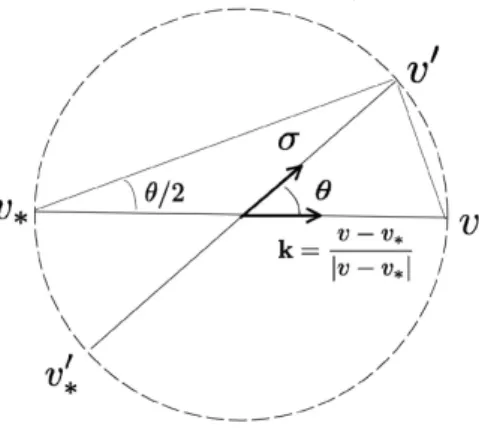
(1.3) $B= \Phi(|v-v_{*}|)b(\cos\theta) , \cos\theta=\frac{v-v}{|v-v_{*}|}* \sigma, 0\leq\theta\leq\frac{\pi}{2},$
where
$\Phi(|z|)=\Phi_{\gamma}(|z|)=$ 同$\gamma$
, for some $\gamma>-3,$
In fact, for the physical model, if the inter-molecule potential satisfies the inverse power law potential $U(\rho)=\rho^{-(q-1)},$$q>2($, where $\rho$ denotes the distance between two interacting molecules), then $s$ and $\gamma$
are
given by$0<\mathcal{S}=1/(q-1)<1, 1>\gamma=1-4s=(q-5)/(q-1)>-3$
As usual, the hard $(\gamma>0)$ and soft $(\gamma<0)$ potentials correspond to $q>5$ and $2<q<5$, respectively, and the Maxwellianpotential $(\gamma=0)$ correspondsto $q=5.$
Motivated by this physical model, throughout this note we
assume
that thenon-negative
cross
section $B$ takes the form (1.3) with the angular factor $b$ satisfying(1.4), and moreover, except for this introduction,
we
will only consider thecase
when
$\Phi(|v-v_{*}|)=1,$
that is, the Maxwellian molecule type
cross
section. In this case, the analysis reliesonthe good structure of theequationafter taking Fourier transform in $v$ variable by
means
of the Bobylev formula (see (2.8)), together with the precise characterizationof the Fourier image ofprobability
measures
with $\alpha$-order moment (see (2.7)).We remark that the angle $\theta$ is the deviation angle, that
is, the angle between post- and pre-collisional velocities. The range of$\theta$ can
be restricted to $[0, \pi/2]$, by
FIGURE 1. post- and pre-collisional velocities replacing $b(\cos\theta)$ by its (symmetrized” version
$[b(\cos\theta)+b(\cos(\pi-\theta))]1_{0\leq\theta\leq\pi/2},$
which is possible due to the invariance of the product $f(v’)f(v_{*}’)$ in the collision
operator $Q(f, f)$ under the change of variables $\sigmaarrow-\sigma.$
Before stating main results in Section 2,
we
recall the special feature of thenon-cutoffBoltzmann collision term $Q(f, f)$ which behaves the fractional power of $-\Delta.$
Indeed,
we
have the following lower and upper estimates for the collision integraloperator:
Theorem 1.1 ([1, 3], Coercivity Estimate). Assume that $f\geq 0,$$\not\equiv 0$ and $f\in$
$L_{\max\{2,|\gamma|\}}^{1}\cap L\log$L.
If
$\gamma>-2s$ then there exists a $C_{f}>0$, depending on$\Vert f\Vert_{L_{\max\{2,|\gamma|\}}^{1}\cap L\log L}$ and $1/\Vert f\Vert_{L^{1}}$ at
a
monotone increase, such thatfor
any smoothfunction
$h$ we havewhere
for
$p\geq 1$ and$\beta\in \mathbb{R}$$\Vert f\Vert_{L_{\beta}^{p}}=(\int_{\mathbb{R}^{3}}|\langle v\rangle^{\beta}f(v)|^{p}dv)^{1/p}$
$\Vert f\Vert_{L\log L}=\int_{\mathbb{R}^{3}}|f(v)|\log(1+|f(v)|)dv.$
If
$-3<\gamma\leq-2s$ then$\frac{1}{C_{f}}\Vert\langle D_{v}\rangle^{s}h\Vert_{L_{\gamma/2}^{2}}^{2}\leq-(Q(f, h), h)_{L^{2}}+C_{f}\Vert h\Vert_{L_{\gamma/2}^{2}}^{2}$
$+C_{1}\Vert f\Vert_{L_{-\gamma}^{3/(3+\gamma+2s’)}}\Vert\langle D_{v}\rangle^{s’}h\Vert_{L_{\gamma/2}^{2}}^{2},$
provided that $f$ belongs to $L_{-\gamma}^{3/(3+\gamma+2s’)}$
for
$s’\in(0, s)$.
Theorem 1.2 ([2]). Assume$\gamma>\max\{-3, -3/2-2s\}$
.
Thenfor
any$m\in(s-1,2s$] and $\beta\in \mathbb{R}$ we have$|(Q(f, 9), h)_{L^{2}}|<\sim(||f||_{L_{\beta+(\gamma+2s)}^{1}}+++\Vert f\Vert_{L^{2}})||g||_{H_{(\beta+\gamma+2s)}^{s+m}}||h||_{H_{-\beta}^{s-m}}+\cdot$
If
$\gamma+2s>0$ thenfor
any $m\in[-s, s]$ and$\beta\in[-\gamma-2s, 0]$$|(Q(f, g), h)_{L^{2}}|_{\sim}<||f||_{L_{\gamma+2s}^{1}}||g||_{H_{(\beta+\gamma+2s)}^{s+m}}||h||_{H_{-\beta}^{s-m}},$
where $a^{+}= \max(a, 0)$
for
$a\in \mathbb{R}$.
Here $A<B\sim$ means that $A\leq CB$for
a constant$C>0.$
It follows from both theorems that, when $\gamma>2s,$
$\frac{1}{C_{f}}\Vert h\Vert_{H_{\gamma/2}^{s}}^{2}\leq-(Q(f, h), h)_{L^{2}}+C_{f}\Vert h\Vert_{L_{\gamma/2}^{2}}^{2},$
$|(Q(f, h), h)_{L^{2}}|\leq C||f||_{L_{\gamma+2s}^{1}}||h||_{H_{\gamma/2+S}^{8}}^{2}$
Therefore, neglecting the weight $\langle v\rangle$, we may say
$-Q(f, f)\approx C_{f}’(-\Delta)^{s}f+1$ower order terms,
and the spatially homogeneous Boltzmann equation (1.1) might behave like the heat
equation $(\partial_{t}-\triangle_{v})f=0$ having the smoothing effect. After a pioneer work [9] by
Desvillettes-Wennberg, the smoothing effect of $L^{1}$
-weak solutions for the spatially
homogeneous Boltzmann equation has been almost completely solved as follows:
Theorem 1.3 ([3]). Let $B$ be
of
theform
(1.3) with $b$ satisfying (1.4).1) Suppose that $\gamma>\max\{-2s, -1\}$
.
Let $f$ be a $L^{1}$-weak solutionof
the Cauchyproblem $(1.1)-(1.2)$ with a density initial data $f_{0}\in L^{1}$
.
For $0\leq T_{0}<T_{1}$,if
$f$satisfies
(1.5) $|v|^{\ell}f\in L^{\infty}([T_{0}, T_{1}];L^{1}(\mathbb{R}^{3}))$
for
any $\ell\in \mathbb{N},$then $f\in L^{\infty}([t_{0}, T_{1}];\mathcal{S}(\mathbb{R}^{3}))$,
for
any $t_{0}\in(T_{0}, T_{1})$2) When $-1\geq\gamma>-2s$, the same conclusion as above holds
if
we
have thefollowing entropy dissipation estimate
where $D(f, f)=- \int Q(f, f)\log fdv\geq 0.$
It is known by Villani[22] that we have $L^{1}$
-weak solution in the following
sense:
Definition 1.4. Let $f_{0}\geq 0$ be a
function
defined
on $\mathbb{R}^{3}$with
finite
mass, energy and entropy, that is,$\int_{R^{3}}f_{0}(v)[1+|v|^{2}+\log(1+f_{0}(v))]dv<+\infty.$
$f$ is
a
weak solutionof
the Cauchy problem $(1.1)-(1.2)$,if
itsatisfies
the followingconditions:
$f\geq 0, f\in C(\mathbb{R}^{+};\mathcal{D}’(\mathbb{R}^{3}))\cap L^{1}([0, T];L_{2+\gamma^{+}}^{1}(\mathbb{R}^{3}))$,
$f(0, \cdot)=f_{0}(\cdot)$,
$\int_{\mathbb{R}^{3}}f(t, v)\psi(v)dv=\int_{R^{3}}f_{0}(v)\psi(v)dvfor\psi=1, v_{1}, v_{2}, v_{3}, |v|^{2}$;
$f(t, \cdot)\in L\log L, \int_{R^{3}}f(t, v)\log f(t, v)dv\leq\int_{\mathbb{R}^{3}}f_{0}\log f_{0}dv, \forall t\geq 0,$
$\int_{R^{3}}f(t, v)\varphi(t, v)dv-\int_{R^{3}}f_{0}(v)\varphi(0, v)dv$
$- \int_{0}^{t}d\tau\int_{R^{3}}f(\tau, v)\partial_{\tau}\varphi(\tau, v)dv=\int_{0}^{t}d\tau\int_{R^{3}}Q(f, f)(\tau, v)\varphi(\tau, v)dv$
where $\varphi\in C^{1}(\mathbb{R}^{+};C_{0}^{\infty}(\mathbb{R}^{3}))$
.
It should be noted that the weaksolutionsconstructed by [22] satisfy the moment
gain property (1.5) for any $T_{0}>0$ if$\gamma>0$, though it is known by [12] that the
uniqueness does not holds in the
case
$\gamma>0$ if the energy conservation law is removed from the definition of the weak solution. His weak solutions satisfy (1.6)if $\gamma\geq-2$. Without the condition (1.5)
we
have another smoothing effect of weaksolutions
$f\in L^{\infty}([t_{0}, \infty);H^{\infty}(\mathbb{R}^{3}))$,
for any $t_{0}>0$, if either $\gamma=0$ or $\gamma>0$ and $0<s<1/2$ (see [14] and Theorem
5.2 of [3]).
By Theorem 1.3, the smoothing effect for $L^{1}$-weak solutions
holds. However, if
one considers the measure-valued solutions, the smoothing effect does not always
occur, since the single Dirac
mass
is its stationary singular solution. TheBoltz-mann equation is non-linear and different from the heat equation. To end this
introduction, I would like to mention the following conjecture posed personally by
Cedric Villani [23], which is true for the Maxwellian molecule type
cross
section(see Theorem 2.1 below).
Conjecture 1.5. Any weak solution to the Cauchy problem $(1.1)-(1.2)$ with
mea-sure
initial datum except asingle Dirac mass acquires $c\infty$ regularity in the velocity2. MAIN RESULTS
We start withthereviewon ahistorical workgiven by the probabilistH.$Tanaka[20].$
Denote by $P_{\alpha}(\mathbb{R}^{d})$,$0<\alpha\leq 2$, the set of all probability
measures
$F$on$\mathbb{R}^{d}$suchthat,
(2.7) $\int_{R^{d}}|v|^{\alpha}dF(v)<\infty, \int_{\mathbb{R}^{d}}v_{j}dF(v)=0, j=1, \cdots, d, if\alpha>1.$
In $P_{2}(\mathbb{R}^{d})$ we define the Wasserstein distance
as
follows: For $F,$$G\in P_{2}(\mathbb{R}^{d})$,$W_{2}(F, G)=( \inf_{L\in\Pi(FG)},\int|v-w|^{2}dL(v, w))^{1/2}$
where $\Pi(F, G)$ denotes the set of all probability distributions $L$ in $P_{2}(\mathbb{R}^{d}\cross \mathbb{R}^{d})$
having $F$ and $G$ as marginal distributions.
Tanaka Theorem [Existence, Uniqueness and Asymptotic Behavior$|$
.
If
an initial datum $F_{0}\in P_{2}(\mathbb{R}^{3})$ then there exists a unique solution $F_{t}\in P_{2}(\mathbb{R}^{3})l0^{1}$the Cauchy problem $(1.1)-(1.2)$ and we have
$W_{2}(F_{t}, \omega)arrow 0, tarrow\infty,$
where $\omega(v)=(2\pi E)^{-3/2}e^{-|v|^{2}/2E}$
for
$3E= \int|v|^{2}dF_{0},$This result has been analytically treated by Toscani and his coauthors[8, 10, 19, 21], based on the Toscani metric
$\Vert\varphi-\tilde{\varphi}\Vert_{2}=\sup_{0\neq\xi\in \mathbb{R}^{3}}\frac{|\varphi(\xi)-\tilde{\varphi}(\xi)|}{|\xi|^{2}},$ $\varphi,$
$\tilde{\varphi}$ are Fourier images of $F,$$G\in P_{2}(\mathbb{R}^{d})$,
and the Fourier transform representation of the Boltzmann equation given by Bobylev [4];
Bobylev formula. If$\psi(t, \xi)$ and$\psi_{0}(\xi)$ are Fourier transforms of$f(t, v)$ and $f_{0}(v)$, respectively, then the Cauchy problem $(1.1)-(1.2)$ is reduced to
(2.8) $\{\begin{array}{l}\partial_{t}\psi(t, \xi)=\int_{S^{2}}b(\frac{\xi\cdot\sigma}{|\xi|})(\psi(t, \xi^{+})\psi(t, \xi^{-})-\psi(t, \xi)\psi(t, 0))d\sigma,\psi(0, \xi)=\psi_{0}(\xi) , where \xi^{\pm}=\frac{\xi}{2}\pm\frac{|\xi|}{2}\sigma.\end{array}$
It is known (seeTheorem 1 of[21]) that Wasserstein distance and Toscanimetric
are
equivalent on the subset of $P_{2}(\mathbb{R}^{d})$ with a fixed energy $( \int|v|^{2}dF(v)=Ed)$.
Recently
Cannone-Karch
[6] extended the existence and uniqueness of solution for the initial datum in $P_{\alpha}$ with $0<\alpha<2$, motivated by the self-similar solution(withinfinite energy) given by Bobylev-Cercignani[5]. Following [11, 6], we call the
Fourier transform ofa probability measure $F\in P_{0}(\mathbb{R}^{d})$, that is,
$\varphi(\xi)=\hat{f}(\xi)=\mathcal{F}(F)(\xi)=\int_{\mathbb{R}^{d}}e^{-iv\cdot\xi}dF(v)$,
a characteristic function. Denote the set of all characcteristic functions by $\mathcal{K}.$
Inspired by a series of works by Toscani and his co-authors, Cannone-Karch[6]
defined a subspace $\mathcal{K}^{\alpha}$
for $\alpha\geq 0$ as follows:
where
(2.10) $\Vert\varphi-1\Vert_{\alpha}=\sup_{\xi\in R^{d}}\frac{|\varphi(\xi)-1|}{|\xi|^{\alpha}}.$
The space $\mathcal{K}^{\alpha}$
endowed with the distance
(2.11) $\Vert\varphi-\tilde{\varphi}\Vert_{\alpha}=\sup_{\xi\in \mathbb{R}^{d}}\frac{|\varphi(\xi)-\tilde{\varphi}(\xi)|}{|\xi|^{\alpha}}$
is
a
complete metric space (see Proposition3.10
of [6]). It follows that $\mathcal{K}^{\alpha}=\{1\}$for all $\alpha>2$ and the following embeddings (Lemma 3.12 of [6]) hold
$\{1\}\subset \mathcal{K}^{\alpha}\subset \mathcal{K}^{\beta}\subset \mathcal{K}^{0}=\mathcal{K}$ for
a112
$\geq\alpha\geq\beta\geq 0.$However,
even
though the inclusion.$-\prime-(P_{\alpha}(\mathbb{R}^{d}))\subset \mathcal{K}^{\alpha}$ holds (see Lemma 3.15 of[6]), the space $\mathcal{K}^{\alpha}$ is strictly larger than $\mathcal{F}(P_{\alpha}(\mathbb{R}^{d}))$ for $\alpha\in(0, 2)$, in other word,
$\mathcal{F}^{-1}(\mathcal{K}^{\alpha})\supsetneq P_{\alpha}(\mathbb{R}^{d})$
.
Indeed, for each $\alpha\in(0,2)$, $\varphi_{\alpha}(\xi)=e^{-|\xi|^{\alpha}}$ belongs to $\mathcal{K}^{\alpha},$ which is the Fourier transform of the probability density $P_{\alpha}(v)$ of $\alpha$-stable L\’evy process. It is known (see Remark3.16 of [6]) that that $0<P_{\alpha}(v)\leq C(1+|v|)^{-(\alpha+d)}$and
moreover
$\frac{P_{\alpha}(v)}{|v|^{\alpha+d}}arrow c_{0}$ when $|v|arrow\infty,$
where $c_{0}= \alpha 2^{\alpha-1}\pi^{-(d+2)/2}\sin(\frac{\alpha\pi}{2})\Gamma(\frac{\alpha+d}{2})\Gamma(\frac{\alpha}{2})$
.
Onthe other hand, we remarkthat $\mathcal{F}(P_{2}(\mathbb{R}^{d}))=\mathcal{K}^{2}$
.
Indeed, thiscan
be provedby contradiction. If there exists a $\varphi(\xi)\in \mathcal{K}^{2}$ such that $F=\mathcal{F}^{-1}(\varphi)\not\in P_{2}$, then we
may
assume
there exist $\omega_{0}$ $\in \mathbb{S}^{d}$and $A>0$ such that
$\int_{\{|_{\Pi v}^{v}-\omega_{0}|<10^{-10}\}\cap\{|v|\leq A\}}|v|^{2}dF(v)\geq100\Vert 1-\varphi\Vert_{2},$
from which we have a contradiction because
$\Vert 1-\varphi\Vert_{2}\geq\sup_{\xi}\frac{{\rm Re}(1-\varphi(\xi))}{|\xi|^{2}}$
$\geq 2\int_{\{|_{\Pi v}^{v}-\omega_{0}|<10\}\cap\{|v|\leq A\}}-10\frac{\sin\frac{v}{|v|}.T^{\xi}\xi T)\}}{\xi 1^{2}}|v|^{2}dF(v)$ for
$\frac{\xi}{|\xi|}=\omega_{0},$ $| \xi|=\frac{\pi}{A}$
$\geq\frac{2}{\pi^{2}}\int_{t|_{\Pi v}^{v}-\omega_{0}|<10^{-10}}\}\cap\{|v|\leqA\}(\frac{v}{|v|}\cdot\omega_{0})^{2}|v|^{2}dF(v)>50\Vert 1-\varphi\Vert_{2},$
by using
$\sin z\geq\frac{2z}{\pi}$ when $0 \leq z\leq\frac{\pi}{2}.$
Since$\mathcal{K}^{\alpha}\supsetneq \mathcal{F}(P_{\alpha}(\mathbb{R}^{3}))$ for $\alpha\in(0,2)$, we introduce $\tilde{P}_{\alpha}=\mathcal{F}^{-1}(\mathcal{K}^{\alpha})$ endowed also
with distance (2.11). We are now ready to state our first result.
Theorem 2.1. Assume that $b(\cos\theta)$
satisfies
(1.4) with$0<s<1$
and let $\alpha\in$$(2s, 2]. If an$ initial $datum F_{0}\in P_{\alpha}(\mathbb{R}^{3})$ is not
a
single Diracmass
then there existsa unique solution $f(t, v)$ in $C([O, \infty), \tilde{P}_{\alpha}(\mathbb{R}^{3}))$ to the Cauchy problem $(1.1)-(1.2)$
such that
Remark 2.2. The existence and uniqueness
of
solutionfor
an initial datum in $\tilde{P}_{\alpha}(\mathbb{R}^{3})$was
studied by [6], in mild singularity
case $0<s<1/2$
, and extended by[13] to the strong singularity case $1/2\leq s<1$
.
The $H^{\infty}$ smoothingeffect
of
thesolutionwasproved in [17, 15]. Itwas shown in [15] that$f(t, v)\in C((O, \infty), L_{\alpha}^{1}(\mathbb{R}^{3}))$
in the case where $\alpha\in(0,1)\cup(1,2)$
.
The restrictionof
$\alpha=1$ has been removedrecently in [16].
The existence and smoothness are discussed for the Cauchy problem (2.8) in the Fourier space $\mathbb{R}_{\xi}^{3}$
.
To go back the base space $\mathbb{R}_{v}^{3}$, we need to fill the gap,$\mathcal{F}^{-1}(\mathcal{K}^{\alpha})\supsetneq P_{\alpha}(\mathbb{R}^{3})$. To this end, we introduce a new classification on the
charac-teristic functions as follows. Set
$\mathcal{M}^{\alpha}=\{\varphi\in \mathcal{K};\Vert\varphi-1\Vert_{\mathcal{M}^{\alpha}}<\infty\}, \alpha\in(0,2)$,
where
$\Vert\varphi-1\Vert_{\mathcal{M}^{\alpha}}=\int_{\mathbb{R}^{d}}\frac{|\varphi(\xi)-1|}{|\xi|^{d+\alpha}}d\xi.$
For $\varphi,$$\tilde{\varphi}\in \mathcal{M}^{\alpha}$, put
$\Vert\varphi-\tilde{\varphi}\Vert_{\mathcal{M}^{\alpha}}=\int_{\mathbb{R}^{d}}\frac{|\varphi(\xi)-\tilde{\varphi}(\xi)|}{|\xi|^{d+\alpha}}d\xi,$
and we introduce the distance
(2.12) $dis_{\alpha}(\varphi,\tilde{\varphi})=\Vert\varphi-\tilde{\varphi}\Vert_{\mathcal{M}^{\alpha}}+\Vert\varphi-\tilde{\varphi}\Vert_{\alpha}.$
Then we have the following complete characterization except for $\alpha=1$;
Proposition 2.3 ([15]).
If
$0<\alpha<2$, then$\mathcal{M}^{\alpha}$is a complete metric space endowed
with the distance $di_{\mathcal{S}_{\alpha}}(\varphi,\tilde{\varphi})$. Moreover, we have $\mathcal{K}^{\beta}\subset \mathcal{M}^{\alpha}$
if
$\alpha<\beta$ and $\alpha\in(0,2)$,$\mathcal{M}^{\alpha}\subset \mathcal{F}(P_{\alpha}(\mathbb{R}^{d}))(\subsetneq \mathcal{K}^{\alpha})$
for
$\alpha\in(0,2)$ ,$\mathcal{M}^{\alpha}=\mathcal{F}(P_{\alpha}(\mathbb{R}^{d}))$,
furthermore if
$\alpha\neq 1$Proposition 2.4 (Existence and Stability in Fourier space). Assume
(2.13) $\exists\alpha_{0}\in(0,2] s.t. \theta^{\alpha_{0}}b(\cos\theta)\sin\theta\in L^{1}((0, \pi/2])$.
If
the initial datum $\varphi_{0}$ belongs to $\mathcal{M}^{\alpha}(\alpha\in[\alpha_{0},2$ then there exists a unique classical solution $\varphi(t, \xi)\in C([0, \infty), \mathcal{M}^{\alpha})$ to the Cauchy problem (2.8) such that$dis_{\alpha}(\varphi(t, \varphi(s, \sim<|t-s|e^{\lambda_{\alpha}\max\{t,s\}}dis_{\alpha}(\varphi_{0},1)$
.
Here
(2.14) $\lambda_{\alpha}=2\pi\int_{0}^{\pi/2}b(\cos\theta)(\cos^{\alpha}\frac{\theta}{2}+\sin^{\alpha}\frac{\theta}{2}-1)\sin\theta d\theta>0.$
Furthermore,
if
$\psi(t, \xi)$,$\varphi(t, \xi)\in C([O, \infty), \mathcal{M}^{\alpha})$are
two solutions to the Cauchyproblem (2.8) with initial data $\psi_{0},$$\varphi_{0}\in \mathcal{M}^{\alpha}$, respectively, then
for
any $t>0$, thefollowing two stability estimates hold
$||\psi(t)-\varphi(t)||_{\mathcal{M}^{\alpha}}\leq e^{\lambda_{\alpha}t}||\psi_{0}-\varphi_{0}||_{\mathcal{M}^{\alpha}},$
The above assumption (2.13) holds for the function $b$satisfying (1.4) if$\alpha_{0}>2s.$
The existence and uniqueness parts in the proof of Theorem 2.1
can
be done bymeans
of above two propositions except for thecase
$\alpha=1$.
In order to overcomethe exceptional
case
$\alpha=1$ we need to introduce another space(2.16) $\tilde{\mathcal{M}}^{\alpha}=\{\varphi\in \mathcal{K};\Vert Re\varphi-1\Vert_{\mathcal{M}^{\alpha}}+||\varphi-1||_{\alpha}<\infty\}, \alpha\in(0,2)$ ,
where $Re\varphi$ stands for the real part of$\varphi(\xi)$
.
For$\varphi,$
$\tilde{\varphi}\in\overline{\mathcal{M}}^{\alpha}$ , put
$\Vert\varphi-\tilde{\varphi}\Vert_{\overline{\mathcal{M}}^{\alpha}}=\int_{R^{d}}\frac{|Re\varphi(\xi)-Re\tilde{\varphi}(\xi)|}{|\xi|^{d+\alpha}}d\xi,$
and, for any $0<\beta<\alpha<2,$$0<\epsilon<1$, we introduce the distance in $\tilde{\mathcal{M}}^{\alpha}$
as
(2.17) $di_{\mathcal{S}_{\alpha,\beta,\epsilon}}(\varphi,\tilde{\varphi})=\Vert\varphi-\tilde{\varphi}\Vert_{\overline{\mathcal{M}}^{\alpha}}+\Vert\varphi-\tilde{\varphi}\Vert_{\beta}+\Vert\varphi-\tilde{\varphi}||_{\beta}^{\epsilon}.$Then $\overline{\mathcal{M}}^{\alpha}$
is
a
complete $metri\underline{c}$space endowed with this distance andwe
have$\mathcal{M}^{1}\subsetneq\overline{\mathcal{M}}^{1}=\overline{ノ-}(P_{1}(\mathbb{R}^{d}))$
and $\mathcal{M}^{\alpha}=\mathcal{M}^{\alpha}$ if $\alpha\in(0,1)\cup(1,2)$ (see the detail in
[16]). The smoothing effect part in the proof of Theorem 2.1 essentially relies on
the following time degenerate coercivity estimate, instead of Theorem 1.1;
Lemma 2.5 (Time degenerate coercivity).
If
$\psi(t, \xi)$ is the Fouriertransform of
the solution $f(t, v)$ then there exist $T>0$ and $C>0$ such that
for
$t\in[O, T]$$t \int_{R^{3}}\langle\xi\rangle^{s}|h(\xi)|^{2}d\xi\leq C(\int_{R^{3}}(\int_{S^{2}}b(\frac{\xi}{|\xi|}\cdot\sigma)(1-|\psi(t, \xi^{-})|)d\sigma)|h(\xi)|^{2}d\xi$
$+ \int_{R^{3}}|h(\xi)|^{2}d\xi)$,
for
$\forall h\in L_{s}^{2}.$The key of its proof is to showthe following; $\exists R>1$ and $\exists C>0$ such that
$t| \xi|^{2s}\leq C\int_{S^{2}}b(\frac{\xi}{|\xi|}\cdot\sigma)(1-|\psi(t, \xi^{-})|)d\sigma$ if $|\xi|\geq R,$
which is derived, in the most crucial case, again from the fact that $\psi(t, \xi^{-})$ is the
solution to (2.8) (see
Section
2.2 of [17]).In order to state
our
second result,we
recall the self-similar solution given by Bobylev-Cercignani [5]. For $\alpha\in(2_{\mathcal{S}}, 2)$, denote $\mu_{\alpha}=\underline{\lambda}_{A,\alpha}$.
For each $K>0$ , there exists a radially symmetric nonnegative function(2.18) $\Psi_{\alpha,K}\in L_{\beta}^{1}(\mathbb{R}^{3})\cap H^{\infty}(\mathbb{R}^{3}), (\forall\beta<\alpha)$,
satisfying
$\hat{\Psi}_{\alpha,K}\in \mathcal{K}^{\alpha}, \lim_{|\xi|arrow 0}\frac{1-\hat{\Psi}_{\alpha,K}(\xi)}{|\xi|^{\alpha}}=K,$
such that
$f_{\alpha,K}(t, v)=e^{-3\mu_{\alpha}}t\Psi_{\alpha,K}(ve^{-\mu_{\alpha}t})$
is
a
solution of the Boltzmann equation. As pointed out in Cannone-Karch[7],Bobylev-Cercignani constructed their self-similar solution
as
a power series $\hat{\Psi}_{\alpha,K}(\xi)=1-K|\xi|^{\alpha}+a_{2}|\xi|^{2\alpha}+\cdots$in the Fourier space, and conjectured that it belongs to $L^{1}$ function of the base
space. Namely, (2.18) is a direct consequence ofTheorem 2.1 under the non-cutoff assumption (1.4).
As stated in TanakaTheorem, it isa
common sense
in the kineticpeoplethatthe solution to the Boltzmann equation tends to an equilibrium, that is, a Maxwellian when timetendstoinfinity. This hasbeenproved invarioussettingswhenthe initialenergy is finite. However, when the initial energy is infinite, the time asymptotic state is no longerdescribed by a Maxwellian, but aself-simiar solution $\Psi_{\alpha,K}$ under
suitable conditions.
Theorem 2.6 ([18]). For $\alpha\in(\max\{1,2s\}, 2)$,
if
an initial datum $f_{0}\in\tilde{P}_{\alpha}(\mathbb{R}^{3})$satisfies
$\int(f_{0}(v)-\Psi_{\alpha,K}(v))|v|^{2}dv=0,$
$\exists\delta>0;\int|f_{0}(v)-\Psi_{\alpha,K}(v)||v|^{2+\delta}dv<\infty,$
then there exists a$c_{0}>0$ such that
for
any $\beta\in \mathbb{Z}_{+}^{3}$$\sup_{v}|\partial_{v}^{\beta}(f(t, v)-e^{-3\mu_{\alpha}}t\Psi_{\alpha,K}(ve^{-\mu_{\alpha}t}))|<e^{-c_{0}t}\sim,$
$\int|f(t, v)-e^{-3\mu_{\alpha}}t\Psi_{\alpha,K}(ve^{-\mu_{a}t})|dv<e^{-c_{0}t}\sim,$ provided that
(2.19) $c_{0}>3\mu_{\alpha}.$
Remark 2.7. Since $\mu_{\alpha}arrow 0+as\alphaarrow 2-0$, the condition (2.19) holds when$\alpha$ is
close to 2.
REFERENCES
[1] R. Alexandre, L. Desvillettes, C. Villani and B. Wennberg, Entropy dissipation and
long-rangeinteractions, Arch. RationalMech. Anal. 152 (2000), 327-355.
[2] R. Alexandre, Y. Morimoto, S. Ukai, C.-J. Xu, T. Yang, The Boltzmann equation without
angular cutoff in the whole space: qualitative properties ofsolutions, Arch. Ration. Mech. Anal. 202 (2011), no. 2, 599-661
[3] R. Alexandre, Y. Morimoto, S. Ukai, C.-J. Xu and T. Yang, Smoothing effect of weak solutions for the spatially homogeneous Boltzmann equation without angular cutoff, Kyoto J. Math. 52 (2012), 433-463.
[4] A.V. Bobylev,Themethodof the Fouriertransform in the theory of the Boltzmann equation
for Maxwell molecules. (Russian) Dokl. Akad. NaukSSSR 225(1975), 1041-1044.
[5] A. V. Bobylev andC. Cercignani, Self-similar solutions of the Boltzmannequation and their applications, J. Statist. Phys.106(2002), 1039-1071.
[6] M. Cannone and G. Karch, Infiniteenergysolutions to the homogeneous Boltzmann equation,
Comm. Pure Appl. Math. 63 (2010), 747-778.
[7] M.CannoneandG.Karch, On self-similarsolutions to the homogeneous Boltzmann equation,
Kinetic and RelatedModels, 6 (2013), 801-808.
[8] E. A. Carlen, E. Gabetta and G. Toscani, Propagation of smoothness and the rate of
ex-ponential convergence to equilibrium for a spatially homogeneous Maxwellian gas, Comm.
Math. Phys., 199 (1999) 521-546.
[9] L. Desvillettes and B. Wennberg, Smoothness of the solution of the spatially homogeneous
Boltzmann equation without cutoff, Comm. Partial Differential Equations 29(2004), 133-155.
[10] E. Gabetta, G. Toscani and B. Wennberg, Metrics for probability distributions and the trend
toequilibrium forsolutions of the Boltzmann equation, J. Statist. Phys, 81, 901-934.
[11] N. Jacob, Pseudo-differential operators and Markov processes. Vol1: Fourier analysis and
[12] X. Lu and B. Wennberg, Solutions with increasing energy for the spatially homogeneous
Boltzmann equation, Nonlinear Anal. Real World Appl. 3 (2002), 243-258.
[13] Y.Morimoto,A remark on Cannone-Karchsolutions to the homogeneous Boltzmann equation for Maxwellian molecules, Kinetic and Related Models, 5 (2012), 551-561.
[14] Y. Morimoto, S. Ukai, C.-J. Xu and T. Yang, Regularity of solutions to the spatially $h(\succ$
mogeneous Boltzmannequationwithout angular cutoff, Discrete and $Continuot\underline{A}S$Dynamical
Systems -Series A 24 (2009), 187-212.
[15] y. Morimoto, S.Wang andT. Yang, Anewcharacterization and global regularityof infinite energy solutions to the homogeneousBoltzmann equation, J. Math. PuresAppl. 103 (2015),
809-829.
[16] Y. Morimoto, S. Wang and T. Yang, Moment classificationofinfinite energysolutionstothe homogeneous Boltzmann equation, preprint
[17] Y. Morimoto and T. Yang, Smoothing effect of the homogeneous Boltzmann equation with
measure valued initial datum, Ann. Inst. H. Poincar\’e Anal. Non Lin\’eaire, 32 (2015),
429-442.
[18] Y. Morimoto, T. Yang and H. Zhao, Convergenceto the self-similar solutions to the
homo-geneous Boltzmann equation, J. Eur. Math. Soc., toappear.
[19] A. Pulvirenti and G. Toscani, The theory of the nonlinear Boltzmann equation for Maxwell molecules in Fourier representation, Ann. Mat. Pura Appl. 171 (1996), 181-204.
[20] H. Tanaka, Probabilistic treatment of the Boltzmann equation of Maxwellian molecules,
Wahrsch. Verw. Geb., 46 (1978), 67-105.
[21] G. Toscani and C. Villani, Probability metrics and uniqueness of the solution to the Boltz-mannequations for Maxwell gas, J. Statist. Phys., 94 (1999), 619-637.
[22] C. Villani, On a new class of weak solutions to the spatially homogeneous Boltzmann and Landau equations, Arch. Rational Mech. Anal., 143 (1998), 273-307.
[23] C. Villani, private communication inAugust, 2008, Kyoto.
YOSHINORI MORIMOTO, GRADUATE SCHOOL OF HUMAN AND ENVIRONMENTAL STUDIES,
KYOTO UNIVERSITY, KYOTO, 606-8501, JAPAN