Japan Advanced Institute of Science and Technology
JAIST Repository
https://dspace.jaist.ac.jp/
Title Orthologicsの意味論的研究
Author(s) 宮崎, 裕
Citation
Issue Date 2000‑03
Type Thesis or Dissertation Text version author
URL http://hdl.handle.net/10119/903 Rights
Description Supervisor:小野 寛晰, 情報科学研究科, 博士
A semantical study of orthologics
Miyazaki Yutaka
A thesis submitted for the degree of Doctor of Philosophy
School of Information Science
Japan Advanced Institute of Science and Technology January 14, 2000
Copyright c
2000byYutakaMiyazaki
i
Acknowledgment
I was helped by a lot of people to grapple with my subjects and to prepare this dissertation. Here I would like to express my sincere gratitude to them.
I am indebted to my principal advisor Professor Hiroakira Ono for his con- stant encouragement and support throughout my preparing this dissertation.
My advisor Professor Hajime Ishihara has also helped me and given me in- valuable advice since I started my research on orthologics and orthomodular logics.
I would like to thank Dr. Tomazs Kowalski for reading early version of some manuscripts of my results and giving me helpful suggestions and comments.
I would like to thank Professor Yoshihito Toyama, Professor Milan Vlach, and Professor Yuichi Komori for giving me some comments and suggestions to improve this dissertation.
I wish to express my special thanks to Professor John Harding who gave me a several important information on the completion problem of orthomodular lattices and modular ortholattices and sent me some papers on this subject.
I am also grateful to Professor J. Michael Dunn and Professor J. van Ben- them for giving me some suggestions on the interpolation property of ortho- logics when I met them in Taiwan in June 1999.
Finally I would like to thank Professor Willem Blok for giving some advice and comments on the relation between the amalgamation property of a va- riety of algebras and the interpolation property of the algebraic logic which corresponds to that variety.
i
ii
Abstract
In this thesis, we investigate a type of non-classical logics from a seman- tical point of view. We deal with non-classical propositional logics around orthologics, and the minimum predicate extensions of some of them.
Every propositional logic we consider here is introduced so as to be char- acterized by a variety of algebras, and so there exists a variety of algebras that corresponds to each propositional logic. Therefore, some properties of a variety of algebras reects on some properties of its corresponding propo- sitional logic.
One of the topics we focus on in this thesis is the admissibility of completion of a class of algebras. There are mainly two ways of embedding an algebra into a complete one, that is, the Dedekind-MacNeille completion technique and the method via dual space construction. The rst can be used when we consider an algebraic semantics of the minimum predicate extension of propositional logics and we establish the completeness theorem with respect to that semantics, because the embedding map preserves all existing joins and meets in this technique. This argument goes through for a few members of our group of logics. Indeed, we can show that their corresponding varieties of algebras admit completion by Dedekind-MacNeille completion technique, which also enables us to discuss the minimum predicate extensions of these logics. On the other hand, the second method is employed when we construct a relational semantics of a propositional logic. In fact, for some of our logics, we will build their relational semantics by using this completion method, and we will show the completeness with respect to these semantics.
Furthermore, by modifying the above completion techniques a little bit, we can prove that some members of our varieties have an algebraic property, which implies that the propositional logics that correspond to them and their minimum predicate extensions have the Craig's interpolation property.
The other topic in this thesis is the construction of a semantics of ortho- modular logics. Since we can not take suitable dual spaces for orthomodular lattices, there does not exist a set-theoretic representation theorem for them which is convenient for semantics of orthomodular logics. Here we use a dierent representation theorem for orthomodular lattices, which is not set- theoretic, to construct Kripke-style semantics for orthomodular logics. This semantics consists of a non-empty set with some operations, instead of some relations. We show that any orthomodular logic is complete with respect to a semantics of this kind, and moreover, we discuss the innitary extension of orthomodular logics by using this semantics.
ii
CONTENTS iii
Contents
Acknowledgement i
Abstract ii
1 Introduction 1
1.1 Quantum mechanics and orthomodular lattices . . . 1
1.2 Orthologic and its relational semantics . . . 5
1.2.1 Syntax of orthologics . . . 5
1.2.2 Relational semantics of orthologics . . . 7
1.2.3 Extension to orthomodular logic and its limit . . . 10
1.3 Organization of this thesis . . . 12
2 Basic notions 14
2.1 Classes of algebras we discuss . . . 142.2 Some properties of our algebras . . . 16
2.3 Other algebraic concepts . . . 18
2.4 Logics . . . 19
2.5 Note . . . 23
3 Completion of algebras 24
3.1 Completion techniques . . . 243.2 Completion of OL and BA . . . 28
3.2.1 The varietyOL . . . 28
3.2.2 The varietyBA . . . 28
3.3 Semantics of
OL
(;) . . . 293.4 Note . . . 33
4 Predicate extensions of the orthologic OL and the semi- orthologic OL
(;)35
4.1 Syntax of the predicate semi-orthologic with equality . . . 354.2 Semantics for
P
(OL
(;)) and completeness . . . 374.3 The minimum predicate extension of
OL
. . . 414.4 Note . . . 41
5 Amalgamation and interpolation 42
5.1 Interpolation property and super amalgamation property . . . 425.2 Super amalgamation property of some varieties . . . 44
5.2.1 The varietyOL(;) . . . 44
5.2.2 The varietyOL . . . 45
5.3 Interpolation property of the
P
(OL
(;)) andP
(OL
) . . . 455.4 Note . . . 46
iii
CONTENTS iv 6 Kripke-style semantics of orthomodular logics 48
6.1 Semantics of orthomodular logics . . . 48
6.1.1 Frames and models . . . 48
6.1.2 Properties of orthomodular frames . . . 50
6.1.3 The soundness theorem . . . 55
6.2 Canonical model and completeness theorem . . . 57
6.2.1 Canonical model construction . . . 57
6.2.2 The completeness theorem . . . 61
6.3 General completeness . . . 62
6.4 The classical logic and commutativity of its frame . . . 64
6.4.1 Commutative orthomodular frames . . . 64
6.4.2 Completeness for
CL
. . . 656.5 Innitary orthomodular logics . . . 66
6.5.1 Syntax of innitary orthomodular logics . . . 66
6.5.2 An extension of orthomodular frames and soundness theorem . . . 67
6.5.3 Completeness for the logic
OML
inf . . . 686.6 Note . . . 68
7 Summary and future works 70
7.1 Summary . . . 707.2 The completion problem of orthomodular lattices . . . 71
Appendix 76
References 79
Publications 82
Index 83
iv
1
1 Introduction
In this thesis, we investigate a type of non-classical logics which are weaker than the classical logic, from an algebraic point of view. Here weaker means that some of the logical laws in the classical logic are missing in logics we consider. One of the most important laws our logics do not have is the distributive law. The lack of the distributive law leads to some signicant diculties in the usual methods of analyzing algebraic logics. In particu- lar, the distributive law is needed for taking dual spaces of original algebras, which are quite useful and tractable in analyzing the intuitionistic logic and modal logics. Because of these problems, this area of non-classical logics re- mains underdeveloped.
There are a few kinds of non-classical logics which do not have the dis- tributive law. Among them, there are orthologics, orthomodular logics and their neighbors. These we will deal with here. The origin of the study of this area of logics is the mathematical formulation of quantum mechanics and the discovery of algebraic structures, called orthomodular lattices. We will begin this introduction with a story about the relation between quantum mechanics and orthomodular lattices according to [43].
1.1 Quantum mechanics and orthomodular lattices
The mathematical foundation of quantum mechanics was laid by J. von Neumann in 1932. In his book \Die mathematische Grundlagen der Quan- tenmechanik" [47], von Neumann formulated physical concepts by means of the theory of Hilbert space.
A Hilbert space H on the complex eld C is a vector space over C which is equipped with an inner product h ; i, and it is complete with respect to the normkk that is dened from the inner product. Here, complete means that every Cauchy sequence in H converges in H.
In his book, von Neumann postulated that the basic notions in quantum mechanics are states and observables . A state of a physical system corre- sponds to the complete knowledge of the physical system, from which we can make predictions about its development in the future. In his formulation, a state of a quantum mechanical system is mathematically described by a unit vector in a Hilbert space H. This is inspired by Max Born's prob- abilistic interpretation of wave functions, that is, \the wave function in Schrodinger's wave mechanics can be interpreted as a probability amplitude, i.e., j j2 as the probability density of a particle in the conguration space".
The vector 2H withk k= 1 and the vectorei represent the same state, and the knowledge about a state enables us only to determine expectations of observables.
On the other hand, observables correspond to measurable physical quanti- ties, whose values are expressed by real numbers. In von Neumann's formu- lation, a self-adjoint operator is attached to every observable. In a Hilbert
1
1.1 Quantum mechanics and orthomodular lattices 2
space H, the adjoint operator T of a linear operator T is dened as the linear operator satisfying h ;T'i=hT ;'i. An operatorT is self-adjoint if T = T. All eigenvalues of a self-adjoint operator T are real and two eigenvectors ,'ofT whose eigenvalues are dierent are orthogonal to each other, that is h ;'i= 0. As a special self-adjoint operator, there is a kind of projection operators. P is a projection operator if it satises P = P =P2. To every projection operator P, there corresponds a unique closed subspace ofH, namely, fx2HjPx=xg. Conversely, for any closed subspaceCofH, we can consider a unique projection operator which is attached to C. Here a subspace C of H is closed if every Cauchy sequence in C converges in C.
The following spectral resolution theorem shows the relation between ob- servables and self-adjoint operators. The spectrum of an operator T is the set of all complex numbers such that the operator T ;I does not have a bounded inverse operator. (I is the identity operator.) The spectrum of a self-adjoint operator is a subset of real numbers R, in particular, the spec- trum of a projection operator is a subset of f0;1g.
Theorem 1.1
(See [43])For every self-adjoint operatorT, there exists a unique spectral resolution E on the spectrum of T such that
T =
Z
!E(d!) where the map B 7!E(B) satises the following:
(a) E(B1\B2) =E(B1)E(B2) (b) E(;B) =E(B)0 =I;E(B) (c) E(Si2NBi) =Pi2NE(Bi)
Here, ifB is a Borel subset of then E(B) gives a projection operator, and
fBigi2N is a sequence of mutually disjoint subsets of . 2 Consider a case where a quantum mechanical system is in a state and where we will make a measurement of an observable whose corresponding self-adjoint operator is T. Each spectral value!2 of T is interpreted as a possible value which may be obtained by the measurement of that observable.
Then, the probability that the measurement has as outcome a value lying in a Borel set B is given by
(B) =h ;E(B) i
where E is the spectral resolution of T. Furthermore, the expectation value of the observable T can be given by
(T) =
Z
! (d!) 2
1.1 Quantum mechanics and orthomodular lattices 3
The spectral resolution theorem of observables allows us to replace observ- ables by projection operators. Von Neumann suggested considering projec- tion operators as representing propositions. If a proposition is true (which is determined by a measurement), then we assign the numerical value 1 to it, and if the proposition is false, we assign the numerical value 0 to it. This is the starting point of the development of the quantum logic.
In 1936, von Neumann and G. Birkho published the rst article on the logic of quantum mechanics ([3]). Their main idea was that with each physical system, an orthocomplemented partially ordered set L is associated, where members of L correspond to propositions concerning the system which can be veried by experiments. The order in L corresponds to the operation of implication, and the orthocomplementation corresponds to negation. The operations meet \ and join [ in L correspond to conjunction (and) and disjunction (or), respectively. For each classical mechanical system, L is a Boolean algebra, whereas for each quantum mechanical system, L does not always fulll the distributive law;
a\(b[c) = (a\b)[(a\c):
In their article, von Neumann and G. Birkho proposedLto be considered as a modular lattice, in which the following modular law holds;
ab implies (a[c)\b =a[(c\b):
However, it is proved that the latticeC(H) of all closed subspace of a Hilbert space H (which is isomorphic to the lattice of all projection operators ofH) is modular if and only if H is nite dimensional. Therefore their postulate is not true for an innite-dimensional Hilbert space.
Much of von Neumann's subsequent works on continuous geometries and rings of operators was motivated by his desire of constructing logical calculi satisfying the modular law. It is K.Husimi who discovered in 1937 ([21]) the condition that is satised in the lattice C(H) for any Hilbert space H, i.e.,
ab implies a=b\(b0[a): This condition is now called orthomodular law.
In 1955, the orthomodular law was rediscovered independently by L.Loomis ([28])and S.Maeda ([31])in connection with their eorts to extend von Neu- mann's dimension theory for rings of operators. Structures studied by Loomis and Maeda are now called orthomodular lattices. The name orthomodular lat- tice was introduced by Kaplansky ([27]) in order to distinguish it from an orthocomplemented lattice which satises the modular law. The latter is now called a modular ortholattice. After 60s, intensive studies of orthomodular lattices have been made mainly in connection with mathematical analysis.
Before closing this section, we summarize the relation between the algebras 3
1.1 Quantum mechanics and orthomodular lattices 4
we consider and structures of all closed subspaces C(H) of a Hilbert space H.
Denition 1.2
(1) A =hA;\;[;0;0;1i is an ortholattice if it satises the following condi- tions:
(i) hA;\;[;0;1iis a bounded lattice with the least element 0 and the greatest element 1.
(ii) ()0 is a unary operation (ortho-complement) on A which satises the following: For any x;y 2A,
(a) x00 =x.
(b) x y impliesy0 x0. (c) x\x0 = 0
(2) An ortholatticeA is an orthomodular lattice if the following orthomod- ular law holds for any x;y 2A
xy implies x=y\(y0[x).
(3) An ortholatticeA is a modular ortholattice if the following modular law holds for any x;y;z 2A.
xy implies (x[z)\y=x[(z\y).
It can be shown that an ortholatticeA is a Boolean algebra if and only if it satises the distributive law.
We can construct a complete ortholattice of an inner product spaceV over a eldK in the following standard way. First, a binary relation?onV (called an orthogonality relation) is dened as: a?b if and only ifha;bi = 0, where
ha;bidenotes the inner product ofaand b. Second, for any subspace S ofV, dene S?:=fb2V ja?b for alla2Sg, and letR(V) :=fS V j(S?)?= Sg. Then it can be shown that the structure hR(V);T;S;()?;f0g;Vi is a complete ortholattice, where T is the intersection and S is dened by
SS = (T S?)?.
Note that for a Hilbert space H over the complex eldC, R(H) andC(H) ( all closed subspaces of H ) coincide. In this case, the following theorem holds.
Theorem 1.3
For any Hilbert space H over C, hC(H);T;S;()?;f0g;Hiis a complete orthomodular lattice. 2
In 1966, I. Amemiya and H. Araki ([1]) proved the following theorem which characterizes the orthomodular law for Hilbert spaces.
4
1.2 Orthologic and its relational semantics 5 Theorem 1.4
Let V be an inner product space over C. Then R(V) is orthomodular if and only if V is complete, that is, V is a Hilbert space. 2 As already mentioned above, the following theorem on the modular law holds.Theorem 1.5
A Hilbert space H overC is nite dimensional if and onlyif C(H) is modular. 2
As seen above, the orthomodular law and the modular law play very impor- tant roles in the theory of Hilbert spaces. The former characterizes Hilbert spaces in the set of inner product spaces and the latter represents niteness of the dimension of the space.
So far, we have presentaed some analytical background of our research.
However, our aim in this thesis is to discuss the universal-algebraic aspects of orthologics and orthomodular logics, so we will not go back to analysis or Hilbert space theory any more. Nor will we go into any topics about quan- tum logic or quantum physics as this would lead us even farther aeld.
The fundamental work on orthologic is the construction of relational seman- tics for this logic by R.I.Goldblatt, which is introduced in the next section.
1.2 Orthologic and its relational semantics
Goldblatt's paper in 1974 ([15]) deals with orthologics and orthomodular logics in a similar way as in modal logics. In that paper, he dened orthologics as binary logics, constructed a relational semantics for orthologics, proved its completeness and nite model property, and extended his semantics for orthomodular logics. We will follow his approach in investigating our logics, and hence, in this section, we will introduce his method briey, according to the paper [15].
1.2.1 Syntax of orthologics
The language consists of (i) a denumerable collectionfpiji < !gof propo- sitional variables, (ii) the connectives : and ^ of negation and conjunction, (iii) parentheses ( and ). The set of well-formed formulas is constructed from these symbols in the usual way. The disjunction connective _ can be introduced as an abbreviation _ := :(:^:). Note that there is no implication connective in the language, because it is not possible to introduce any suitable implication connectives in the system of orthologics in general ([25], [36]).
Usually, a logic is dened as a set of formulas which contains some axiom 5
1.2 Orthologic and its relational semantics 6
schemes and is closed under some inference rules. But in this case, an or- thologic is dened as a set of ordered pairs of formulas, because of the lack of implication symbol. Goldblatt called a logic which is dened as a set of pairs of formulas, a binary logic . For formulas ;, we denote `L to mean that the pair h;iis a member of the logic
L
. The formal system of orthologics is dened in the following way.Denition 1.6 (Orthologic)
An orthologicL
on the set of formulas is a subset of the product which includes the following axiom schemes and is closed under the following inference rules:Axiom schemes:
(Ax1)
`L (Ax2)
::`L (Ax3)
`L ::
(Ax4)
^`L (Ax5)
^ `L (Ax6)
^:`L
Inference Rules:
(R1) `L `L
`L
(R2) `L `L
`L^
(R3) `L
: `L :
The intersection of all orthologics on , that is, the smallest orthologic, is denoted by
O
.Of course, this formal system is formulated so as to satisfy the following algebraic characterization theorem. A valuation v from to an ortholattice
A is a function v : !A, which satises the conditions:
(1) v(^) =v()\v(). (2)v(:) = (v())0.
Theorem 1.7 (Characterization for O)
For any formulas and , the following two conditions are equivalent:
(1) h;i2
O
.(2) v()v() holds for any ortholattice A, and for any valuationv from
to A. 2
6
1.2 Orthologic and its relational semantics 7
Proof is very standard. (1) implies (2) is proved by showing that (2) holds for (Ax1),...,(Ax6) and is preserved by (R1), (R2), and (R3). Conversely, (2) implies (1) is proved by showing that the Lindenbaum algebra for
O
is anortholattice. The Lindenbaum Algebra for an orthologic
L
is the quotient algebra =L, where L if and only ifh;i2L
and h;i2L
.A few more syntactical notions and notations are introduced here. Let
L
bean orthologic. For a formula and a non-empty (possibly innite) subset ; of formulas, is
L
-derivable from ; (;`L ) if there exist 1;2;n 2; such that 1^^n `L . For a non-empty set ; of formulas, ; isL
-fullif it fullls the following conditions.
(1) For some 2, ;`L does not hold.
(2) If 2; and `L, then 2;.
(3) If ; 2;, then^2;.
The notion of
L
-full sets corresponds to that of proper lters of ortholattices in an algebraic sense. The notion will be used when the canonical model for an orthologicL
is constructed.1.2.2 Relational semantics of orthologics
In general, there are mainly two ways of constructing semantics for logics.
One is the way of algebraic semantics, an example of which we have seen above for the case of the smallest orthologic
O
, and the other is the way of relational semantics, or Kripke-style semantics, such as a non-empty set with some relations. The method of relational semantics has proved to be a great success particularly in modal logics, because it is easy to visualize and manipulate, and it is very simple to characterize models in this semantics for almost all important modal logics.Establishing the completeness theorem for a logic with respect to a rela- tional semantics is equivalent to proving a representation theorem of the algebra which corresponds to that logic, by way of taking its dual space. In the case of modal logics, Jonsson-Tarski's representation theorem for Boolean algebras with operators ([24]) is the foundation of relational semantics. Al- though an ortholattice is not a Boolean algebra, there exists a representa- tion theorem via dual space, which is the basic result for constructing rela- tional semantics for orthologics. This representation theorem was obtained by R.I.Goldblatt ([16]) in 1975.
An orthogonality space F = hX;?i consists of a non-empty set X and a binary relation ? on X which is irreexive and symmetric. For a subset Y X, dene, Y := fa 2 X ja?b for any b 2 Yg, and Y is ?-regular if Y = Y holds. The following theorem holds for orthogonality spaces and ortholattices.
7
1.2 Orthologic and its relational semantics 8 Theorem 1.8
(1) The class R(F) of all ?-regular subsets of F is a complete ortholattice where the order is set inclusion, the lattice meet is set intersection, and the orthocomplement is the operation of taking ().
(2) let A = hA;\;[;()0;0;1i be an ortholattice. Dene XA and ?A as follows: XA is the collection of all proper lters ofA, and forx;y 2XA, x?Ay if and only if there exists an element a2A such that a 2x and a0 2y. Then the pairFA=hXA;?Ai is an orthogonality space.
(3) Every ortholattice A can be embedded into a complete ortholattice
R(FA), where the embedding : A ! R(FA) is dened as: (a) :=
fx2XAja2xg. 2
Orthogonality spaces appeared already in the paper by Foulis and Ran- dall ([14]) and the above result (1) was well known long before Foulis and Randall, which is stated in Birkho's book ([4]). Goldblatt has showed a way to construct an orthogonality space of an ortholattice. Then he used the orthogonality space to establish a representation of any ortholattice. To obtain his full representation theorem, we need to restrict R(FA) by intro- ducing a topology so as to make the map isomorphic. But even the above theorem is enough for proving the completeness theorem of the logic
O
withrespect to its relational semantics, that is, the following frames and models for orthologics.
Denition 1.9
(1) F = hX;?i is an orthoframe if X is a non-empty set and ? is an irreexive symmetric binary relation.
(2) M=hX;?;Vi is an orthomodel on the framehX;?i if V is a function assigning to each propositional variable pi a ?-regular subset V(pi) of X.
The truth of a formula at a point x2X in M is dened recursively as follows: The symbolMj=x is read as \ a formula is true atxin a model M".
(a) Mj=x pi if and only if x2V(pi).
(b) Mj=x ^ if and only if Mj=x and Mj=x .
(c) Mj=x : if and only if for any y2X,Mj=y impliesx?y. Let ; be a non-empty set of formulas and a formula. ; implies in an orthomodel M (M : ;j= in symbol) if for any x 2X, either there exists a formula such that not Mj=x , or else Mj=x . For an orthoframe F,
8
1.2 Orthologic and its relational semantics 9
; F-implies (F : ; j= in symbol) if M : ; j= for all orthomodel M on F. For a class C of orthoframes, ; C-implies (C: ;j= in symbol) if
F : ;j= for all frames F in C.
Let be the class of all orthoframes. Under these setting of orthomodels and the notion of validity, the following holds.
Theorem 1.10 (Soundness for O)
If ;`O, then : ;j=. 2 This soundness result is essentially equivalent to (1) of Theorem 1.8. To prove the completeness, the canonical model for an orthologicL
has to beconstructed. The canonical orthomodel for
L
is dened in the following way.Denition 1.11
LetL
be an orthologic. Then the canonical model forL
is the structure ML =hXL;?L;VLi, where XL=fxjx is
L
-fullg.x?Ly if and only if there exists such that: 2xand 2y. VL(pi) =fx2XLjpi 2xg.
Clearly this construction is a translation of the dual space construction of an ortholattice in (2) of Theorem 1.8 into logical terms. It is easily seen that
M
L is indeed an orthomodel, and so, as in the theorem, the following holds.
Lemma 1.12
LetL
be an orthologic, ; a non-empty set of formulas, a formula.(1) For all x2XL, ML j=x if and only if 2x.
(2) ;`L if and only ifML : ;j=. 2
With the aid of the lemma above, the completeness theorem for the ortho- logic
O
is proved.Theorem 1.13 (Completeness for O)
If : ;j=, then ;`O . 2Furthermore, Goldblatt showed the following facts about the smallest or- thologic
O
by analyzing his orthomodel.(1) Any theorem of the orthologic
O
(i.e., any pair of formulas inO
) can be translated into a theorem of the Brouwerian modal logicB
(its modal- ity 2 corresponds to a reexive, symmetric binary relation on Kripke frames), which is formulated as a binary logic.9
1.2 Orthologic and its relational semantics 10
(2) Filtration method works for orthomodels in establishing that
O
has the nite model property. ThereforeO
is decidable, since it is nitely axiomatazable.(3) A semantics for the smallest calculus of orthomodular logic can be ob- tained by a renement of the semantics for orthologics.
We will discuss his approach to the smallest orthomodular logic ( (3) above) and its limits, in the remaining part of this section.
1.2.3 Extension to orthomodular logic and its limit
Denition 1.14 (Orthomodular logic)
An orthomodular logicL
is an orthologic which also includes the following axiom scheme.(Ax7) ^(:_(^))`L
The smallest orthomodular logic, or the quantum logic is denoted by
Q
.The axiom scheme (Ax7) represents the orthomodular law in a system of binary logic, and so, the algebraic characterization of
Q
by the class of orthomodular lattices holds as in the case of the orthologicO
in Theorem 1.7.To construct frames and models for orthomodular logics, the notion of?-regularity in orthofames has to be rened as follows: Let hX;?i be an orthoframe. For subset Y;Z of X with Y Z, Y is ?-regular in Z, if Y?? = Y, where ()? is a unary operation that depends on Z, dened by:
Y? :=fz 2Zjz?y for all y 2Yg.
Denition 1.15
F = hX;?;i is a quantum frame , if hX;?i is an or- thoframe and is a non-empty collection of ?-regular subsets of X which satises the following:(1) is closed under set intersection and the operation () dened by:
Y :=fz 2Xjx?y for all y2Yg.
(2) For Y;Z 2 with Y Z,Y is ?-regular in Z.
M = hX;?;;Vi is a quantum model, if hX;?;i is a quantum frame and V is a function assigning to eachpi a member of. The truth conditions are the same as in Denition 1.9.
The restriction of the range of the valuationV tomakes the axiom scheme (Ax7) true in quantum models. Let be the class of all quantum frames,
; a non-empty subset of formulas, and a formula. Due to our renement, the following soundness theorem holds.
10
1.2 Orthologic and its relational semantics 11 Theorem 1.16 (Soundness for Q)
If ;`Q, then : ;j=. 2 LetL
be an orthomodular logic. The canonical model forL
, this time, is dened as follows:Denition 1.17
The canonical quantum frame forL
is the structureGL=hXL;?L;Li, where XL and ?L are the same as in Denition 1.11, and L =fjjLj 2g. HerejjL=fx 2XLj 2xg. The canonical quantum model for
L
is NL=hXL;?L;L;VLi, where VL(pi) =jpij.As in the case of orthologics, the lemma similar to Lemma 1.12 holds for orthomodular logics, from which the completeness theorem for the logic
Q
follows.
Lemma 1.18
LetL
be an orthomodular logic, ; a non-empty set of formulas, a formula.(1) For all x2XL, NLj=x if and only if 2x.
(2) ;`L if and only ifGL : ;j=. 2
Note that Lemma 1.12 (2) holds for the canonical model for an orthologic, whereas in the lemma above, (2) holds for the canonical frame for an ortho- modular logic.
Theorem 1.19 (Completeness for Q)
If : ;j=, then ;`Q. 2 The above approach of Goldblatt is now widely known as a method of gen- eral frames(models), which works well in modal logics quite generally. What we should nd is a class of orthoframes that characterizes the orthomodular logicQ
. A few years later, however, he reached a negative answer to this problem. In [17], he showed the following theorem by demonstrating that an inner product space is an elementary substructure of its Hilbert space completion, with respect to orthogonality relation.Theorem 1.20
There is no rst-order condition on orthogonality relations that determines a subclass of the class of orthoframes that characterizes theorthomodular logic
Q
. 2Almost all important modal logics have their frames dened by rst-order conditions on the relation R. Usually, to show that a logic is characterized by a certain class of frames it is enough to prove that the class includes the frame of the canonical model. If the class can be dened by rst-order language, then the question boils down to showing that the canonical frame satises a certain rst-order condition or a set of such conditions. This is a
11
1.3 Organization of this thesis 12
standard approach for modal logics.
But the above theorem implies that the standard approach breaks down in the case of orthomodular logics. Indeed, there remains several fundamental questions still open about orthomodular logics. In order to tame orthomod- ular logics, we need some new idea in semantical analysis.
1.3 Organization of this thesis
This dissertation consists of 7 chapters and an appendix. In each chapter, we discuss the following subjects.
Chapter 1 was devoted to describing the background information of this re- search, especially the relation between the theory of quantum mechanics and the birth of orthomodular logics, and we explained one of the fundamental work on orthologics and orthomodular logics by Goldblatt.
In Chapter 2, we introduce propositional logics which are discussed in this thesis, and varieties of algebras corresponding to our logics. In this chapter, we also prepare several algebraic tools which are used in the following chap- ters, such as lters, complete algebras, some algebraic laws, and so forth, and we also show some algebraic propositions there, for future use.
One of the main topics, that is, completion of algebras is discussed in Chap- ter 3. There are two ways of completion of algebras in general. One is the Dedekind-MacNeille completion technique and the other is the method via dual spaces of algebras. Among our varieties of algebras, three accept both techniques, the variety of semi-ortholattices, the variety of ortholattices, and the variety of Boolean algebras. The application of these completion results to logic spreads over several directions. In this chapter, rst we construct relational semantics for the smallest semi-orthologics.
In Chapter 4, as the second application of completion technique, we discuss the minimum predicate extensions of the smallest orthologic and the smallest semi-orthologic. In this case, we have to use the Dedekind-MacNeille com- pletion technique, because all even innite existing meets and joins must be preserved by the embedding map in constructing semantics for the predicate extensions.
The third application of completion technique is discussed in Chapter 5.
We will see, by a simple observation, that for any of our varieties of algebras, the super amalgamation property of the variety is a sucient condition for its corresponding logic to have the Craig's interpolation property. We can prove that the variety of ortholattices and the variety of semi-ortholattices have the super amalgamation property by applying the Dedekind-MacNeille comple- tion technique in a slightly modied way. Thus we can conclude that both
12
1.3 Organization of this thesis 13
the smallest orthologic and the smallest semi-orthologic have the Craig's interpolation property. Moreover, with the help of results in the previous chapter, we can show that their minimum predicate extensions also have the interpolation property.
Chapter 6 is devoted to devising a Kripke-style semantics of orthomodu- lar logics. This type of semantics is based on the representation theorem by Foulis, which employs a certain type of semigroups. We can prove the general completeness of any orthomodular logic with respect to this type of semantics. We discuss the innitary extension of orthomodular logics using this semantics.
We summarize the thesis in Chapter 7, and discuss a few ways to tackle the completion problem of orthomodular lattices.
Finally, in Appendix we discuss syntactical research on the smallest or- thologic. A Gentzen type sequent calculus for the smallest orthologic by S.
Tamura is introduced there. This is a cut-free system, so we can obtain the Craig's interpolation property of the smallest orthologic by applying Mae- hara's method to this calculus.
13
14
2 Basic notions
In this section, we prepare some algebraic concepts and logics for our in- vestigation. Each logic we consider here is characterized by a certain class of algebras, that can be dened by a set of identities. In other words, each logic is formalized by a set of axiom schemes and inference rules which corresponds to its dening set of identities.
2.1 Classes of algebras we discuss
Every algebra we treat here has the signature hA;\;[;()0;0;1i of type
h2;2;1;0;0i. A class of algebras which can be dened by a set of identities is called a variety . All our classes of algebras are varieties. The rst is the largest class of all we consider. This class is called the variety of semi- ortholattices and denoted by OL(;) . To show this class forms a variety explicitly, we give its denition by the set of identities.
Denition 2.1 (Semi-ortholattice)
A semi-ortholattice is an algebraic structure A=hA;\;[; 0;0:1i, which satises the following identities:x\y=y\x x\(y\z) = (x\y)\z
x=x\(x[y)
x[y=y[x x[(y[z) = (x[y)[z
x=x[(x\y) x[1 = 1
x\x0 = 0 (x0)0\x=x x0\(x[y)0 = (x[y)0
In other words, a semi-ortholattice is a bounded lattice with a unary oper- ation ()0 which satises the following: for any x;y 2A,
(a) xx00. (b) x\x0 = 0.
(c) xy implies y0 x0.
In comparison with Denition 1.2, it is easily seen that the class OL of all ortholattices can be dened by the identities for OL(;) together with the double negation law .
14
2.1 Classes of algebras we discuss 15
x=x00 (double negation law)
As is stated in Denition 1.2 and below that, the class OML of all ortho- modular lattices, the class MOL of all modular ortholattices, and the class
BA of Boolean algebras are dened by adding the orthomodular law, the modular law, and the distributive law respectively, to the identities for OL, which can be rewritten down in forms of identity in the following way.
For OML x\f(x\y)[x0g=x\y (orthomodular law) For MOL x\f(x\y)[zg= (x\y)[(x\z) (modular law) For BA x\(y[z) = (x\y)[(x\z) (distributive law)
It is easily seen that the orthomodular law follows from the modular law, and that the modular law follows from the distributive law. Similarly, the class OML(;) of semi-orthomodular lattices , the class MOL(;) of semi- modular ortholattice , and the class BA(;) of semi-Boolean algebras are ob- tained by adding the above each identity respectively to the identities for
OL (;).
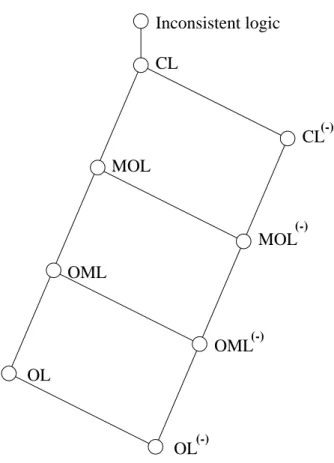
Obviously, all the classes we mentioned above are varieties which are sub- varieties ofOL(;), and the relation among these varieties are:
BA MOL OML OL
BA (;)
MOL (;)
OML (;)
OL (;)
There are, of course, many subvarieties of OL(;), other than those given here. The symbolV is used for a meta-variable for a variety of algebras of the signature hA;\;[; 0 ;0:1i, whereas the symbol C is used for a meta-variable for an arbitrary class of algebras of the same signature in general, and an algebra which is a member of C is sometimes calledC-algebra.
The varieties of algebras we have dened so far are used for interpreting formulas of propositional logics, whereas, in interpreting sentences of a pred- icate logic algebraically, we usually employ complete algebras of a suitable kind.
Let P = hP;i be a partially ordered set. For a subset S P, a 2 P is the greatest lower bound of S if a satises the following:
(1) ax for allx2S.
(2) For any u2P,ux for allx2S, thenua.
The greatest lower bound of a given subset is uniquely determined if it exists.
The least upper bound of a given subsetS is dened as the dual of the greatest 15
2.2 Some properties of our algebras 16
lower bound of S.
Denition 2.2
Let A =hA;\;[; 0 ;0:1i be an algebra in a class C. A is completeC-algebra if for anyS A, there exists the greatest lower bound of S (TS in symbol) in A.It is easily shown that, if A is a complete algebra, then there also exists the least upper bound of S (SS in symbol) for any subset S ofA. Complete
V-algebras may be employed when the minimum predicate extension of the smallest propositional logic which corresponds to V is considered. But this type of semantics for the predicate extension is successful only when the Lindenbaum algebra of this predicate logic can be embedded into a complete
V-algebra. The problem of completion of our algebras will be discussed in the next chapter.
2.2 Some properties of our algebras
Before introducing logics, we will give in this section a several properties of our algebras.
Proposition 2.3
Let A= hA;\;[; 0 ;0:1i be a semi-ortholattice. Then the following holds. For x;y 2A,(1) 00 = 1 and 10 = 0.
(2) x000 =x0.
(3) x0[y0 (x\y)0.
(4) (x[y)0 x0\y0. 2
The proof will be obtained by only simple calculations. Note that De Mor- gan's law (x0 [y0 = (x\y)0 and (x[y)0 = x0 \y0) does not hold in semi- ortholattices in general, but only the inequalities (3) and (4) hold. On the other hand, De Morgan's law holds in any ortholattice because of the double negation law. Therefore, in any ortholattice, the join x[y ofxand ycan be regarded to an abbreviation as (x0\y0)0, and so, the variety of ortholattices can be dened by equations which includes only 0;1;\; and ()0.
Consider the distributive law (x\(y[z) = (x\y)[(x\z)). Then it is easily seen that the dual form of this distributive law (x[(y\z) = (x[y)\(x[z)) can be derived from the original one and visa versa. For the modular law, which can be also expressed as:y x implies x\(y[z) = y[(x\z), its dual form is just the same as the original one. On the other hand, it is not the case for the orthomodular law.
The orthomodular law can be expressed equivalently in the following form:
16
2.2 Some properties of our algebras 17
(1) x\f(x\y)[x0g=x\y. (2) xy implies y=x\(x0[y).
(3) xy and x0[y= 1 imply x=y.
The equivalence of these three forms of orthomodular law can be shown trivially. Among these forms of orthomodular laws and their dual forms, the following relation holds.
Proposition 2.4
LetA=hA;\;[;0;0:1ibe a semi-orthomodular lattice.Then the following are equivalent. For x;y 2A, (1) x[x0 = 1.
(2) x00 =x.
(3) xy implies y=x[(x0\y).
Proof
: (1) ) (2): Since we have xx00,x=x00\(x000[x) =x00 holds.(2) )(3): Trivial.
(3) )(1): Since x1, and we have (3), 1 =x[(x0 \1) =x[x0 holds. 2 We point out one more fact. If we have the double negation law and the orthomodular law together, the distributive law can be expressed in a simpler form, that is, the following equivalence holds in orthomodular lattices.
Proposition 2.5
Let A = hA;\;[; 0 ;0:1i be an orthomodular lattice.Then the following are equivalent. For x;y;z 2A, (1) x\(y[z) = (x\y)[(x\z).
(2) x\(x0[y) =x\y.
Proof
: (1))(2): Trivial. (Take x0 for z.)(2))(1): First, note that (x\ y)[(x \z) x \(y[ z) is clear. So it is enough to show that x\(y [z) is the least upper bound of x\y and x\z. Take any u 2 A such that x\y u and x\z u. Then, since we have u\x\(y[ z) x\(y[ z), by the orthomodular law we have only to show that (x\(y[z))\fu\x\(y[z)g0 = 0. By the fact that x\y=x\y\ux\(y[z)\u, we havefx\(y[z)\ug0 (x\y)0 =x0[y0. Similarly we have fx \ (y [ z) \ ug0 x0 [ z0. Then, by (2), we have
fx\(y[z)\ug0\(x\(y[z))(x0[y0)\x\(y[z) =x\y0\(y[z) and
fx\(y[z)\ug0\(x\(y[z))x\z0\(y[z). Therefore we conclude that
fx\(y[z)\ug0\(x\(y[z))x\(y[z)\(y0\z0) =x\(y[z)\(y[z)0 = 0.
2
17
2.3 Other algebraic concepts 18
We call here the law of (2) the commutative law . It will be clear in Chapter 6 why this is called so. The next proposition will be also used in Chapter 6.
Proposition 2.6
Let A be an orthomodular lattice which satises the commutative law. Then for x;y;z 2A, the following holds:(1) x\(x0[y) = y\(y0[x)
(2) (((x[y0)\y)[z0)\z = (((x[z0)\z)[y0)\y 2 The proof will be given by simple calculations.
2.3 Other algebraic concepts
Several notions for subsets of an algebra are useful in semantical analysis, especially in constructing a dual space of that algebra. Here we introduce the notion of lters and show a simple fact on them. LetA=hA;\;[;0;0:1i be a semi-ortholattice.
Denition 2.7
A subset F A is a lter of A if it satises the following three conditions: For x;y 2A,(1) 12F.
(2) x2F and xy implyy2F. (3) x;y 2F impliesx\y2F.
A lterF ofAis proper if 062F. A proper lterF ofAis prime if it satises the following:
(4) x[y2F implies either x2F or elsey2F.
In general, a subset S A, which satises the condition (2) above is said to be upward-closed . A downward-closed subset is dened dually. As seen easily from above, the notion of lter can be dened on structures which has an order relation and a meet operation (\). For any non-empty subset S A, the lter generated by S (in symbol [S)) is dened by:
[S) :=fy2Aj9x1;x2;:::;xn 2S such that x1\\xn yg It is easily proved that [S) is the smallest lter which contains S.
The notion of proper lters is used for completion of ortholattices, as is shown in Chapter 1, and that of prime lters is used for Boolean algebras.
18
2.4 Logics 19
2.4 Logics
In this section, we introduce formal systems of propositional logics, each of which has algebras in the previous section as its algebraic semantics. We adopt a framework of binary logics by Goldblatt, which appeared in Chapter 1. First, we dene the system for a binary logic which corresponds to the variety OL(;), and then, we extend this system by introducing a several ax- iom schemes.
In propositional case, our language consists of the following primitive sym- bols: a collection of propositional variables p;q;r;p0;p1;::: etc., a proposi- tional constant ? (falsity), a unary connective :(negation), binary connec- tives ^ (conjunction) and _ (disjunction), and a pair of parentheses ( , ).
The set of all formulas of this language is dened by the following three formation rules:
(1) ? is a formula, and each propositional variable pi is a formula.
(2) If is a formula, then so is (:).
(3) If and are formulas, then so are (^) and (_).
As already seen in Chapter 1, a binary logic
L
is dened as a set of pairs of formulas in the following way. For formulas;, we denote `L to mean that the pair h;i is a member of the logicL
.Denition 2.8 (Semi-orthologic)
A semi-orthologicL
on the set of formulas is a subset of the product which includes the following axioms and is closed under the following inference rules:19