Japan Advanced Institute of Science and Technology
Title
TableCross: Exuding a Shared Space into Personal
Spaces to Encourage Its Voluntary Maintenance
Author(s)
Nishimoto, Kazushi; Ikenoue, Akari; Shimizu,
Koji; Tajima, Tomonori; Tanaka, Yuta; Baba,
Yutaka; Wang, Xihong
Citation
Proceedings of the 2011 annual conference
extended abstracts on Human factors in computing
systems (CHI EA '11): 1423-1428
Issue Date
2011
Type
Conference Paper
Text version
author
URL
http://hdl.handle.net/10119/10634
Rights
Copyright is held by the author/owner(s). Kazushi
Nishimoto, Akari Ikenoue, Koji Shimizu, Tomonori
Tajima, Yuta Tanaka, Yutaka Baba and Xihong Wang,
Proceedings of the 2011 annual conference
extended abstracts on Human factors in computing
systems (CHI EA '11), 2011, 1423-1428.
http://dx.doi.org/10.1145/1979742.1979785
Description
TableCross: Exuding a Shared Space
into Personal Spaces to Encourage Its
Voluntary Maintenance
Abstract
A shared space should be cooperatively maintained by all users. However, due to social loafing, often nobody maintains it and its condition worsens. We propose exudation of a shared space. Part of a shared space is exuded into personal workspaces so that office workers are forced to subjectively experience the atmosphere of the shared space, even while they remain at their personal workspaces. This paper illustrates the first prototype named “TableCross,” which reflects the degree of disorder of a table in a shared space to the desktop of each worker’s PC. We also report some results of our pilot user study.
Keywords
Shared spaces, personal PC desktop, connecting, exudation, disordered situations, social loafing, voluntary maintenance, subjective experience
ACM Classification Keywords
H5.3. Information interfaces and presentation (e.g., HCI): Group and Organization Interfaces.
General Terms
Human FactorsIntroduction
There are various public shared spaces in an office, e.g., conference rooms and informal communication spaces. Copyright is held by the author/owner(s).
CHI 2011, May 7–12, 2011, Vancouver, BC, Canada.
ACM 978-1-4503-0268-5/11/05. Kazushi Nishimoto
Japan Advanced Institute of Science and Technology (JAIST) 1-1 Nomi Asahida Ishikawa, Japan
[email protected] Akari Ikenoue JAIST
1-1 Nomi Asahida Ishikawa, Japan
[email protected] Koji Shimizu JAIST
1-1 Nomi Asahida Ishikawa, Japan
[email protected] Tomonori Tajima JAIST
1-1 Nomi Asahida Ishikawa, Japan
Yuta Tanaka JAIST
1-1 Nomi Asahida Ishikawa, Japan
[email protected] Yutaka Baba JAIST
1-1 Nomi Asahida Ishikawa, Japan
[email protected] Xihong Wang JAIST
1-1 Nomi Asahida Ishikawa, Japan
Such shared spaces should be cooperatively maintained by all users. However, often nobody voluntarily
maintains them due to “social loafing.” Reiter and Samuel pointed out that the most effective method of combating litter in public spaces is to periodically keep the spaces clean [1]. However, tidying up the shared spaces is often regarded as not so important. Therefore, “social compensation” [2] is hard to occur if some coworkers mess the shared spaces. Eventually, everybody is getting unmotivated to keep them clean. Another different method is required.
We focused on the physical setup of shared spaces. Shared spaces are usually isolated from office workers’ personal spaces by walls and partitions for preserving meeting confidentiality and allowing workers to concentrate on their own jobs.However, such isolation encourages workers to regard shared spaces as other than their own. Therefore, we hypothesized that it is effective to convince workers to regard such spaces as their own spaces.
A naive solution is to equip shared spaces with cameras so that the workers can view their situations anytime. However, this does not work as expected. It merely provides such objective experiences as looking at an irrelevant world through an observation window. In order to convince workers the shared spaces of theirs, they must subjectively experience the situations of the shared spaces as if they are there even when they are actually in their personal spaces.
We propose a concept called the “exudation of a shared space,” where part of the shared space exudes into personal spaces so that the workers must (or are forced to) subjectively experience the shared space’s
situations from their personal spaces. We encourage them to voluntarily maintain the shared space by making them realize that it is their own responsibility, not that of others.
We installed the first prototype system named
“TableCross” in an informal communication space of our laboratory. TableCross captures a table’s mess in the space and reflects it to the PC desktops of each laboratory member. Thus, it provides similar experiences of the informal communication space to personal spaces.
Related Works
There have been various attempts to provide situations inside of a shared space to the outside. However, to the best of our knowledge, no attempts have provided the situations in a manner that can be subjectively experienced.
AS-Gate [3] shows the situation inside of a room on a display installed outside of the room’s door to reveal its atmosphere to visitors. Attractiblog [4] is equipped with a function that discloses that informal communication is being held in the informal communication space of our laboratory to all of the laboratory members in their personal workspaces in an ambient manner for
vitalizing communications among them. These attempts provide an observation window to shared spaces. Although people can objectively observe what is happening in the shared spaces, they cannot subjectively experience them.
Meeting Pot [5] conveys that someone started to brew coffee in the office lounge to all PCs in personal workspaces. When this information is received by the
PC, an olfactory display attached to the PC emits a coffee smell, allowing people to subjectively experience it in the lounge from their personal workspaces. However, this system actually aims to convey
information on the conversation situations in the lounge, not the coffee smell.
System Setup
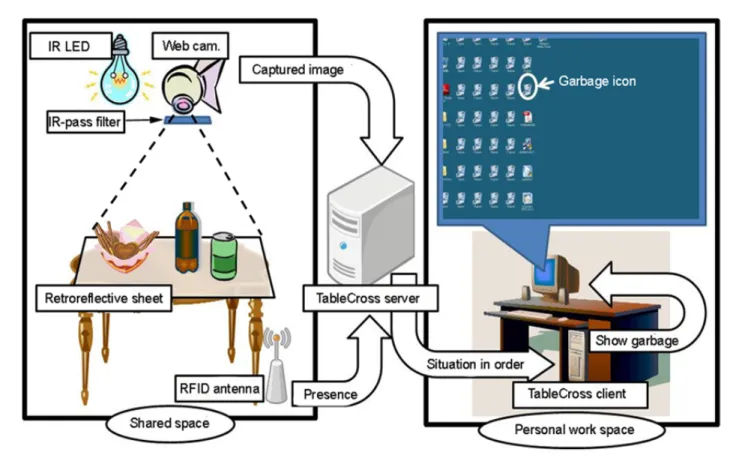
Figure 1 shows the overall setup of the TableCross system. The table in the shared informal
communication space is covered with a retroreflective sheet. Over the table, an infrared LED right and a web camera with an IR-pass filter are installed. The web camera receives an infrared ray reflected on the
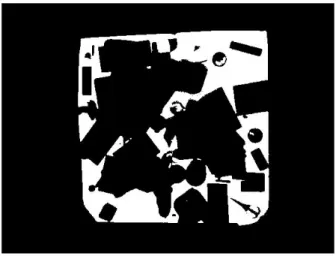
tabletop. As a result, objects put on the table are captured as shadows (Fig. 2). This well-known cinematography technique is utilized in various vision systems and the media arts (e.g., [6]). The captured image is sent to a TableCross server. Each laboratory member always wears an RFID tag. When someone visits the space, ID data emitted from RFID tags are received by the RFID antenna under the table to identify who and how many people are in the space. This information is also sent to the TableCross server. The TableCross server calculates a ratio between the area of the shadow and the total tabletop. We regard this ratio as the degree of the disorder of the table: the higher the ratio, the more disordered the tabletop situation. However, if some people are working at the table, they might put paper, pencils, and other things
on the table. To distinguish such a working situation from messy situations, the server does not renew the ratio even if it increases when the RFID data indicate someone at the table. However, it is renewed if the ratio decreases when someone is there: this situation reflects that he/she cleaned up the table.
A TableCross client was installed on all laboratory member PCs in their personal workspaces and always runs in the background. Each client polls the server every ten seconds and gets the degree of disorder. Depending on the obtained degree, the client scatters a number of "garbage icons” on the PC’s desktop. For example, if the obtained degree is 50%, which reflects that about half of the tabletop is messy, half of the PC’s desktop is also occupied with garbage icons. Thus, we can say that the primary display of the PC is used as an ambient display at the same time. Even if the PC user deletes the garbage icons, they are revived
immediately (within ten seconds) until the table in the shared space is tidied up. Thus, all laboratory members subjectively experience the disorder situations of the shared space from their personal spaces.
Figure 3. Layout of authors’ laboratory
Figure 2. Snapshot of captured image of tabletop.
Pilot User Study
Experimental SetupWe recently started to use TableCross in our laboratory. Since it usually takes quite a long time for people to change their daily behaviors, it is actually impossible to draw any firm conclusions about TableCross’s efficiency or the “exudation of the shared space” concept from our experiences. In this section, we enumerate several intuitive impressions obtained from interviews of the users, i.e., our laboratory members, to infer the effects of TableCross.
Fig. 3 shows the layout of our laboratory, which consists of two separate rooms, one of which has a shared informal communication space. The TableCross client is installed on nineteen PCs: one professor, fifteen male graduate students and three female graduate students in our laboratory. Among them, twelve students have personal workspaces in the same room where the shared informal communication space
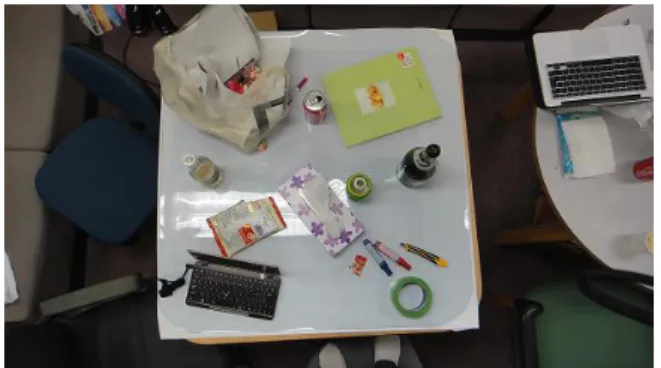
is set up. Therefore, they always see and experience the shared space’s situation even if they do not stay in it. In contrast, the other six students and the professor have personal workspaces in a different room. They only experience the shared space’s situation when they visit the room for a coffee break or to chat. Fig. 4 shows a snapshot of a client PC’s desktop where the table’s messy situation in the shared space shown in Fig. 5 is reflected. While using TableCross, we recorded and observed the members’ natural behaviors.
Results and Discussions
Before starting the experiment, the same three or four students often mess up the shared space’s table. Those who sometimes tidy up the shared space are usually the same two students (of course different from those who make the mess) whose personal spaces are in the room with the shared space. The other people generally discard their own garbage.
If the number of students who mess up the shared space decreases or the number of those who tidy up increases after introducing TableCross, we can conclude
figure 4. Snapshot of client PC’s desktop that
reflects a messy table in shared space shown in Fig. 5.
that our idea is correct. Unfortunately, we have not observed such a change of behavior yet. However, from interviews, eleven of eighteen users felt jarred by the garbage icons scattered on their PC’s desktops. In addition, one student whose personal workspace is in the room without the shared space and who does not often visit it proposed that all laboratory members routinely tidy it up. These results suggest that
TableCross and the concept of the exudation of shared space might affect laboratory member attitudes about a shared space.
Some members commented that all of the icons (not only garbage icons but also others) should be randomly arranged on the desktop to increase the messy feeling. Another comment suggested that the appearance of the garbage icons should be more confusing with the icons of necessary files to make them more intrusive. For example, if the garbage icon resembled the icon of an MS-Word document, users might be irritated when looking for a document to edit, which ultimately would convince them to keep the shared space clean.
Conclusions
We proposed the concept of the exudation of a shared space, where part of the shared space exudes into personal spaces so that the workers are forced to subjectively experience the shared space’s situations from their personal spaces, in order to encourage voluntary maintenance of the shared spaces. We implemented TableCross, the first prototype based on this concept, and installed it in our laboratory. Very preliminary conclusions suggest that TableCross and the concept have the potential to affect laboratory member attitudes about the shared informal
communication space of our laboratory and to influence them to voluntarily maintain it.
We plan to continuously use our system and investigate how it changes the laboratory member attitudes of the shared space and their behaviors. Furthermore, we plan to construct other applications based on our novel concept.
References
[1] Reiter, S. M. and Samuel, W., Littering as a Function of Prior Litter and The Presence or Absence of Prohibitive Signs, J. of Applied Social Psychology, Vol. 10, No. 1, pp. 45-55, 1980.
[2] Williams, K. D. and Karau, S. J., Social Loafing and Social Compensation: The Effects of Expectations of Co-Worker Performance, J. of Personality and Social Psychology, Vol. 61, No. 4, pp. 570-581, 1991. [3] Egi, H., Shigeno, H. and Okada, K. Grasping contextual awareness inside a workspace at the entrance to support group interaction. In Proc. Internet Technology and Secured Transactions 2009, pp. 1-8, 2009.
[4] Chiba, Y. and Nishimoto, K. An intrablog-based informal communication encouraging system that seamlessly links on-line communications to off-line ones, The IEICE Transactions on Information and Systems, Vol. E90-D, No. 10, pp. 1501-1508, 2007. [5] Siio, I. And Mima, N. Meeting Pot: Informal Communication Support by Ambient Display, In Proc. Interaction 2001, IPSJ symposium series, Vol. 2001, No. 5, pp. 163-164, 2001. (in Japanese)
[6] Igarashi, T. and Ogata, H. Another shadow, SIGGRAPH ASIA Art Gallery & Emerging Technologies 2009.