強磁場と相分離を利用した脱りんスラグの高度リサイクル法 研究代表者 東北大学大学院環境科学研究科 長坂徹也 1. 緒言 資源の乏しい我が国にとって、最近の資源価格の高騰、需給逼迫トレンドは憂慮すべき状 況にあり、その安定確保は以前に増して急務の課題となっている。数ある鉱物資源は需要量 に大きな差はあるものの、いずれも先進工業国である我が国にとって欠くことのできないも のばかりである。中でもマンガンおよびリンは、我が国および隣国の韓国にはその天然資源 が存在しない反面、両国の工業生産にとって需要量が大きく、重要な位置を占めている鉱物 資源である 1~3) 。マンガンは、その大部分が合金元素、脱硫材、脱酸材として鉄鋼産業で使 用されており、鉄鋼生産にとって欠くことのできない必須元素のひとつである。一方、リン は主に肥料原料として利用されており、世界的な食糧生産量の増加やバイオエタノールフィ ーバーに伴って、需給逼迫が懸念されている戦略物質である。その反面、リンは鉄鋼材料に とって最も有害な不純物成分のひとつであり、製鋼工程で徹底的な脱リンがなされている。 マンガンおよびリンは、鉄鋼製造原料である鉄鉱石、コークス、石灰石中に希薄に存在し4)、 両元素の化学的に卑な特性から、酸化精錬工程においてスラグ中に優先的に移行する。脱リ ンにとっては酸化しやすいリンの性質は好都合であるが、鋼中に残したいマンガンにとって は防ぐべき酸化ロスが生じることになる。このように、現状の鉄鋼製錬プロセスにおいては、 マンガンおよびリンは製鋼スラグ、特に溶銑脱リンスラグ中に高度に濃縮する。我が国及び 韓国の粗鋼生産量は両国の工業生産活動の中でも群を抜いて大きく、結果的に鉄鉱石等から スラグ中に移行するマンガン及びリンのトータル量も著しく大きなものとなる。 高純度マンガン鉱石、リン鉱石が枯渇傾向にあること、世界的に良質資源が偏在しており、 各国間の確保競争が激化傾向にあること、これら資源の採掘が環境に対して大きな負の影響 をもたらすこと、等の理由から、製鋼スラグ中に移行するマンガン及びリンを2次資源とし て回収する技術を開発することは、非常に意義あることであると考えられる。 しかしながら、スラグをセメント、路盤材等の土木資材や、環境浄化材等として再利用す る研究は活発に行われているものの、スラグ中に含まれる有価元素の回収を志向した研究は 極めて限定されているのが現状である5~8)。申請者らをはじめとする過去の研究によれば、溶 銑脱リンスラグ(以下脱リンスラグと略記)は、凝固後のミクロ組織は、酸化鉄成分をほと んど含まず、リンがかなり濃化したリン酸カルシウム固溶体(Ca3P2O5-Ca2SiO4)、リンをほと
んど含まない、マンガンをわずかに含む酸化鉄系マトリックス相(FeO-CaO-SiO2)のふたつ に大別できることが示されている。酸化鉄系マトリックス相中にはしばしばマンガン濃度が 高いマンガノウスタイト相の存在が認められている。これらのことから、申請者らは、各結 晶相の磁気的特性の違いを利用して、これらの結晶相を磁場勾配中で分離する方法を提案し た。本研究では、湿式磁気分離法を用いて、現場脱リンスラグからのマンガンとリンの分離 回収について検討した。
BOF/EAF Crude steel Ladle Blast furnace Pig iron Dust BF slag Ferrous resource
Unit: kt-Mn/year (South Korea & Japan)
Iron making Steel making Ferro-Mn Si-Mn Iron-Mn ore /Mn ore Scrap Steel making Slag (111.1 & 266.2) (15.9 & 55.4) (0.1 & 1.9) (95.1 & 208.9) (62.9 & 241.7) (158.0 & 450.6) (5.0 & 92.8) (243.0 & 577.6) (260.0 & 590.3) (146.0 & 530.7) BOF/EAF Crude steel Ladle Blast furnace Pig iron Dust BF slag Ferrous resource
Unit: kt-Mn/year (South Korea & Japan)
Iron making Steel making Ferro-Mn Si-Mn Iron-Mn ore /Mn ore Scrap Steel making Slag (111.1 & 266.2) (15.9 & 55.4) (0.1 & 1.9) (95.1 & 208.9) (62.9 & 241.7) (158.0 & 450.6) (5.0 & 92.8) (243.0 & 577.6) (260.0 & 590.3) (146.0 & 530.7)
Figure 1 Material flow of manganese in Japanese and South Korean steel industries (2005) 2. 日本と韓国における鉄鋼業を介したマンガンとリンの物質フロー リンは人間経済活動において極めて広い形態で利用されている。リンの主な利用製品形態 は化学肥料であり、石鹸、洗剤、ポリマー、表面処理剤等にも広く用いられている。特に肥 料としてのリンの利用は農業生産活動を維持するために必須であり、他方、大きな採掘負荷、 河川の富栄養化をもたらすことから、経済および環境の両面から需給方法の再考が求められ ている。その一方で、前述のようにリンは鉄鋼材料にとっては天敵とも言える典型的不純物 元素であり、特に我が国では溶銑予備処理段階で高度な脱リンがなされている。日本及び韓 国の粗鋼生産量は、2008 年ベースでそれぞれ約 1 億 1800 万トン、約 5800 万トンであり9~10)、 脱リン操作によってスラグ中に除去されるリンのトータル量も著しく大きいものと予想され る。申請者らは、両国におけるリンの物質フローを詳細に分析し 11~15)、日韓両国においてス ラグ中に分配除去されるリンの量は、それぞれリン換算で 96,400 トン(日本)、35,700 トン (韓国)に上り、両国におけるリン鉱石輸入量にほぼ匹敵する量であることを明らかにした。 申請者らが本研究の一環として明らかにした両国における鉄鋼業を介したマンガンフロー を Fig.1 に示す。両国において鉄鋼業以外を介したマンガンフローは全体の 10%にも満たな い。製銑工程においては、マンガンインプットは主に鉄鉱石であり、マンガン鉱石、スクラ ップ中のマンガンがわずかに計上される。製銑工程からのマンガンアウトプットは、主に銑 鉄(溶銑)及び高炉スラグであり、一部ダストにも移行する。溶銑および高炉スラグへのマ ンガンフロー量は、韓国の場合、それぞれマンガン純分換算で約95,100 トン、約 15,900 トン15) と推計され、日本の場合は高炉製銑規模の大きさに比例して、約208,900 トン、約 55,400 ト ン 14)と推計された。製鋼工程は、高炉法においては溶銑予備処理、転炉製鋼、2次製錬、電 炉法においては酸化精錬、還元精錬等に更に細分化されるが、Fig.1 では便宜上一括して表示
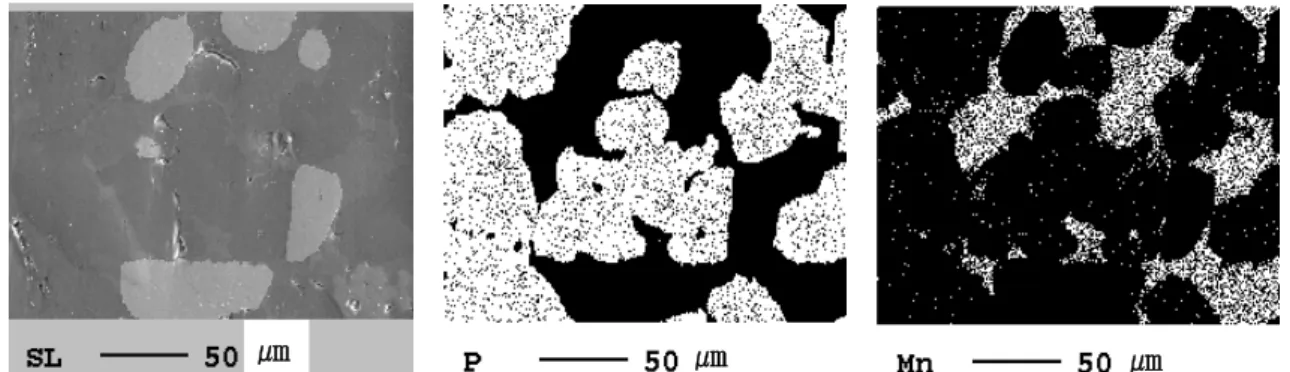
㎛ ㎛ ㎛ Figure 2 Examples of microstructures of dephosphorization slag C
した。製鋼スラグも、脱珪スラグ、脱リンスラグ、脱硫スラグ、脱炭スラグ、更には連鋳フ ラックスのように細かく分類することができ、実際のフロー分析ではこれらを細分化して計 算しているが、Fig.1 ではこれらも一括して製鋼スラグとして標記した。一方、マンガンやリ ンは溶銑脱リン工程で高度にスラグ中に分配除去されるため、本研究の主要ターゲットも脱 リンスラグである8)。製鋼工程へのマンガンインプットは、原料としての溶銑、スクラップ、 添加材としてのフェロマンガン、シリコマンガンである。マンガンアウトプットとしては、 韓国の場合、粗鋼中へ約26 万トン、スラグ中へ 146,000 トンと推計された。一方、日本にお いては、粗鋼へ約590,300 トン、スラグ中へ約 530,700 トンと見積もられた。注目すべきはス ラグ中への酸化ロス量であり、Fig.1 より明らかなように、製鋼工程におけるフェロマンガン 等の資源としてのマンガンインプット量とスラグへのロス量はほぼ等しい量に上っている。 すなわち、マンガンにせよリンにせよ、スラグ中に酸化ロスする量は、無視するにはあまり に大きな量であることが定量的に示された。従って、製鋼スラグからのこれら元素の回収が なされれば、両国のマンガン、リン需給に対して少なくない効果がもたらされることが容易 に想像できる。また、特にリンを分離回収できれば、残渣を精錬フラックスとして再利用で きると考えられ、製鋼スラグ発生量の削減にもつながるものと期待される。 3. 実験 3.1 現場脱リンスラグのミクロ構造分析 脱リンスラグの基本系は、FeO-CaO-SiO2-P2O5(-MgO-MnO) 系である。現場脱リンスラグの 凝固後のミクロ構造は、申請者をはじめ、幾つかの研究例が報告されている。申請者らによ る研究 16)では、凝固後の脱リンスラグは、(1)酸化鉄を含まず、リンを高度に濃縮したリン 酸カルシウムと珪酸カルシウムの固溶体よりなる相(以後リン濃縮相と略記)、(2)リンを含 まず、酸化鉄やCaO を基本成分とするその他の相よりなることが示されている。本研究では、 脱リンスラグからのマンガンとリンの回収法を開発するために、現場脱リンスラグのミクロ 構造を、より詳細に分析した。Fig.2 は分析を行ったスラグの EPMA マッピング画像の例であ る。その結果、前述の(2)の相は、更に FeO-CaO-MnO を基本成分とするマンガノウスタイ ト相(以後マンガン濃縮相と略記)とマンガンをわずかに含む FeO-CaO-SiO2 相(以後マト リックス相と略記)に分類できることがわかった。
H[Oe] M[emu/g] 1 2 3 -5000 -4000 -3000 -2000 -1000 0 1000 2000 3000 4000 5000 -0.03 -0.02 -0.01 0.00 0.01 0.02 0.03 5 40 55 3 15 30 55 2 20 25 55 1 MnO CaO FeO % 5 40 55 3 15 30 55 2 20 25 55 1 MnO CaO FeO %
Figure 3 The magnetization curves for FeO-CaO-MnO based slag
slag: 10g water: 200ml Remark 6 5 3 O O X X X X X Air pump O O 4 2 1 Run No. <32 <52 O C O B O A Size (μm) Slag slag: 10g water: 200ml Remark 6 5 3 O O X X X X X Air pump O O 4 2 1 Run No. <32 <52 O C O B O A Size (μm) Slag
Table 2 Experimental condition
15.48 0.69 4.04 4.74 64.54 manganese enriched phase
1.11 35.08 10.78 55.95 1.53 phosphorus enriched phase
16.98 0.01 0.07 0.26 76.68 manganese enriched phase
1.69 32.65 12.31 56.32 0.99 phosphorus enriched phase
9.00 0.01 0.04 2.33 63.75 manganese enriched phase
0.28 6.82 27.41 61.96 2.79 phosphorus enriched phase
average average average MnO P2O5 SiO2 CaO FeO 40.40 22.85 22.51 Composition (%) 24.20 32.30 42.36 12.70 21.80 11.05 7.85 6.85 2.24 6.05 9.90 3.49 C B A Slag 15.48 0.69 4.04 4.74 64.54 manganese enriched phase
1.11 35.08 10.78 55.95 1.53 phosphorus enriched phase
16.98 0.01 0.07 0.26 76.68 manganese enriched phase
1.69 32.65 12.31 56.32 0.99 phosphorus enriched phase
9.00 0.01 0.04 2.33 63.75 manganese enriched phase
0.28 6.82 27.41 61.96 2.79 phosphorus enriched phase
average average average MnO P2O5 SiO2 CaO FeO 40.40 22.85 22.51 Composition (%) 24.20 32.30 42.36 12.70 21.80 11.05 7.85 6.85 2.24 6.05 9.90 3.49 C B A Slag
Table 1 Chemical composition of the steelmaking slag
性状が安定している高炉スラグに比べ、脱リンスラグをはじめとする製鋼スラグは、製造 鋼種や操業条件、冷却方法によって、組成および凝固後のミクロ構造は大きく異なるのが一 般的である。しかしながら、構成結晶相はいずれの場合も前述の3種類に大別できることが わかった。Table 1 は、本実験で用いた現場スラグの組成を示したものである。EPMA で分析 した各相の組成も併記した。 リン濃縮相は反磁性を示し、マトリックス相から磁気的に分離できることが申請者ら 8)に よって明らかにされているので、本研究ではマンガン濃縮相の磁気分離の可能性を確認する ために、FeO-CaO-MnO 合成スラグの磁気特性を VSM を用いて測定した。VSM 測定用試料は、 化学試薬を Fig.3 中に示した目的組成になるように調合し、鉄るつぼ中で 1400℃にて溶解し て作成した。測定結果をFig.3 に示す。FeO-CaO-MnO 合成スラグの磁化曲線より、マンガン 濃縮相はフェロ磁性または常磁性を示すことがわかった。また、磁気的性質はマンガン濃度 によってかなり大きく変化し、検討の結果、リン濃縮相およびマトリックス相と個々に分離 できる可能性が示された。
10g slag + 200g water Feed 10g slag + 200g water Feed 0.03T 1st stage 0.03T 1st stage 0.10T 2nd stage 0.10T 2nd stage 0.30T 3rd stage 0.30T 3rd stage Trapped 1
Trapped 1 Untrapped 1Untrapped 1
Trapped 2
Trapped 2 Untrapped 2Untrapped 2
Trapped 3
Trapped 3 Untrapped 3Untrapped 3
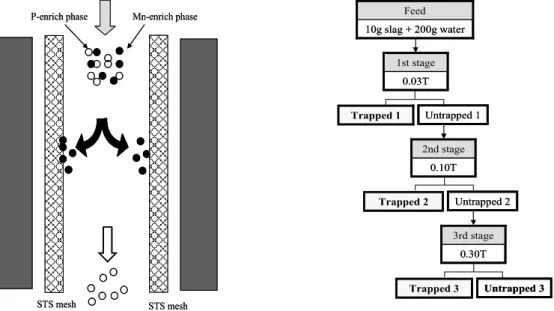
Figure 5 Magnetic separation steps 3.2 磁気分離実験 磁気分離実験には、湿式高磁場勾配分離装置(エリーズ社モデルL-4)を使用した。JFE ス チール社より提供されたTable 1 に示す3種類の現場脱リンスラグを実験に供した。スラグは 10 ミリ径のジルコニア球によるボールミルで粉砕し、32μm 以下および 52μm 以下の2種類の 粉砕スラグを用意した。実験条件をTable 2 に示す。 10g のスラグ試料を、凝集を防止するために約 200ml のイオン交換水中に懸濁・分散させ、 一定の表面磁場に制御した分離セル内に投入した。セル内には11 枚のステンレスメッシュが 挿入されており、メッシュ自身が磁化されて磁気分離媒体として作用する。Fig.4 に模式的に 示すように、磁場中で磁化された粒子は、フィルターおよびセル内壁に磁着され、セル内に 留まる。これに対して磁化されない粒子はセル内で磁着されることなく、セル下部のコック を開いて試料液を排出すると同時にセル内から出て捕集される。磁着した試料、磁着せずに 下部より捕集された非磁着試料は、それぞれICP にて組成分析を行った。Fig.5 に実験手順を 示すが、実験はまず表面磁場 0.03T よりはじめ、捕集された非磁着試料はより強い磁場に制 御された次の分離ステップに供した。この操作を最高表面磁場強度0.3T まで繰り返した。一 部の実験では、セル内にエアポンプで空気を吹き込み、攪拌を施して分散を促進する効果に ついて検討した。 4. 実験結果 Fig. 6 は実験1における磁気分離の結果を示したものである。非磁着物として捕集された試 料中のマンガン濃度は、磁場強度が大きくなるほど減少した。これとは対照的に、非磁着物 のリン濃度は磁場強度が大きくなるほど高くなった。これより、磁場強度と回収非磁着物の マンガンとリン濃度は相反の関係にあることがわかる。すなわち、マンガンとリンを個別に 分離できる可能性が示された。実験に用いたスラグのEPMA 分析によれば、ここで用いたス ラグではマンガン濃縮相とマトリックス相の顕著な偏析は認められず、マンガン濃縮相はマ P-enrich phase STS mesh STS mesh Mn-enrich phase P-enrich phase STS mesh STS mesh Mn-enrich phase
Figure 6 Magnetic concentration of slag A in Run No. 1 0 5 10 15 20 25 30 35 40 45 50 55 60 Trapped 1 Trapped 2 Fe O, CaO w t%
Magnetic separation steps
0 2 4 6 8 10 Mn O, P 2 O5 wt% FeO CaO MnO P2O5
Trapped 3 Untrapped 3 Trapped 1 Trapped 2 Trapped 3 Untrapped 3
Magnetic separation steps 0 5 10 15 20 25 30 35 40 45 50 55 60 Trapped 1 Trapped 2 Fe O, CaO w t%
Magnetic separation steps
0 2 4 6 8 10 Mn O, P 2 O5 wt% FeO CaO MnO P2O5
Trapped 3 Untrapped 3 Trapped 1 Trapped 2 Trapped 3 Untrapped 3
Magnetic separation steps
Figure 7 Magnetic concentration of slag B in Run No. 2&3
FeO, CaO w t% Mn O, P2 O5 wt %
FeO (Run No.2) CaO (Run No.2) FeO (Run No.3) CaO (Run No.3)
0 5 10 15 20 25 30 35 40 45 50 55 0 5 10 15 20 25 30
MnO (Run No.2) P2O5 (Run No.2) MnO (Run No.3) P2O5 (Run No.3)
Trapped 1 Trapped 2 Trapped 3 Untrapped 3 Trapped 1 Trapped 2 Trapped 3 Untrapped 3
Magnetic separation steps Magnetic separation steps
FeO, CaO w t% Mn O, P2 O5 wt %
FeO (Run No.2) CaO (Run No.2) FeO (Run No.3) CaO (Run No.3)
0 5 10 15 20 25 30 35 40 45 50 55 0 5 10 15 20 25 30
MnO (Run No.2) P2O5 (Run No.2) MnO (Run No.3) P2O5 (Run No.3)
Trapped 1 Trapped 2 Trapped 3 Untrapped 3 Trapped 1 Trapped 2 Trapped 3 Untrapped 3
Magnetic separation steps Magnetic separation steps
トリックス相に微細に分散していた。このことから、リン濃縮相とその他の相(マンガン濃 縮相とマトリックス相)の分離は大略達成できているものの、マンガン濃縮相のみの分離は 困難であり、マンガン濃縮相はマトリックス相とほぼ同じ磁気分離挙動を示したものと考え られた。非磁着物として0.3T の分離実験後に最終的に回収された「untrapped 3」 のリン濃度 は、実験スラグの初期平均リン濃度が小さい(2.24wt%)にも関わらず、約2倍に濃化され ていた。しかしながら、リン肥料原料として用いられるリン鉱石の平均リン濃度が 25~ 30wt%17)であることを考慮すると、リン鉱石代替物として利用するならば、より高度にリンを 濃縮させる必要がある。このような観点で見た場合、ここで用いたスラグA は、平均リン濃 度が低く、リン濃縮相の偏析も十分ではなかったため、更に他のスラグを用いて磁気分離実 験を行った。 Fig.7 は、スラグ B を用いた場合の磁気分離実験(実験 2 および 3)の結果を平均粉砕粒子 径の影響として比較して示したものである。スラグB の平均組成は、MnO が 9.9% 、 P2O5 が 6.9%であり、マンガン濃縮相の MnO 濃度及びリン濃縮相の P2O5 濃度は、Table 1 に示すよう
Figure 8 Magnetic concentration of slag C in Run No. 4&5 FeO , CaO w t% Mn O , P2 O5 wt % 0 5 10 15 20 25 30 35 0 5 10 15 20 25 30 35 40 45 50 55
FeO (Run No.4) CaO (Run No.4) FeO (Run No.5) CaO (Run No.5)
MnO (Run No.4) P2O5 (Run No.4) MnO (Run No.5) P2O5 (Run No.5)
Trapped 1 Trapped 2 Trapped 3 Untrapped 3 Trapped 1 Trapped 2 Trapped 3 Untrapped 3
Magnetic separation steps Magnetic separation steps
FeO , CaO w t% Mn O , P2 O5 wt % 0 5 10 15 20 25 30 35 0 5 10 15 20 25 30 35 40 45 50 55
FeO (Run No.4) CaO (Run No.4) FeO (Run No.5) CaO (Run No.5)
MnO (Run No.4) P2O5 (Run No.4) MnO (Run No.5) P2O5 (Run No.5)
Trapped 1 Trapped 2 Trapped 3 Untrapped 3 Trapped 1 Trapped 2 Trapped 3 Untrapped 3
Magnetic separation steps Magnetic separation steps
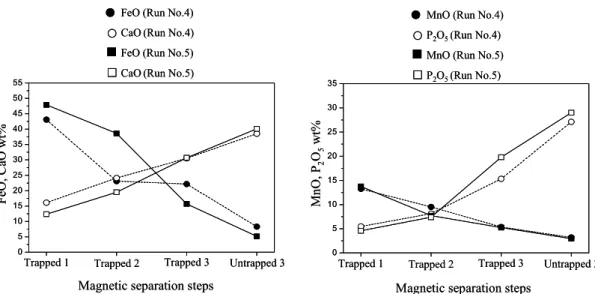
にそれぞれ 17.0、32.7%である。すなわち、スラグ A よりリン、マンガンの偏析度が大きい スラグであった。粒子径は実験2 では 53μm 以下、実験 3 では 32μm 以下のものを使用した。 マンガンおよびリンの分離回収率は、粒子径が小さいほど向上する傾向が認められる。これ は、粉砕粒子径が小さいほど、各結晶相の単分散状態に近くなり、ほぼマンガン濃縮相また はマトリックス相で構成される粒子が優先的に磁着したためと考えられる。しかしながら、 最適の粒子径は初期のスラグのミクロ構造に依存する。すなわち、初期結晶構造が微細であ ればあるほど粉砕粒子径は小さい必要があり、逆に粗大結晶で構成されていれば、粉砕粒径 は大きくても効率のよい分離が可能であると言える。スラグの初期結晶粒径は脱リンの操業 条件、特に払い出し後の冷却条件に強く依存するので、スラグからのリン回収を志向するな らば、スラグの冷却条件を制御する必要があろう。 スラグ C を用いた実験 4 及び 5 の結果を Fig.8 に示す。スラグ C の平均組成は、MnO が 6.1% 、 P2O5 が 7.9%であり、マンガン濃縮相の MnO 濃度及びリン濃縮相の P2O5 濃度は、 Table 1 に示すようにそれぞれ 15.5、35.1%である。リン濃縮相のリン濃度はスラグ B より高 く、スラグB より粗大な結晶相より構成されていた。粉砕後粒子径は実験 4 では 53μm 以下、 実験5 では 32μm 以下のものを使用した。Fig.8 より、やはりここでも粒子径が小さい場合の 方が回収物のリン濃度、マンガン濃度は向上した。そこで以下の実験では 32μm 以下の粉砕 スラグを使用した。 Fig.9 は、実験 5 の条件で、更に分離セル内に空気を 0.03L/min の流量で吹き込み、攪拌に よる懸濁粒子の分散を促進させた結果(実験 6)である。Fig.8 の結果と Fig.9 の結果を比較 すると明らかなように、同じスラグであっても、粉砕粒子径を細かくし、空気吹き込み等に よって粒子の分散を促進することにより、マンガンとリンの回収効率は大きく向上している。 Fig.9 より、「untrapped 3」として回収された非磁着物は、 31% P2O5 のリン濃度を持ち、「trapped 1」
Figure 9 Magnetic concentration of slag C in Run No. 6 Fe O, CaO w t% MnO , P 2 O5 wt % 0 5 10 15 20 25 30 35 40 45 50 55 0 5 10 15 20 25 30 35 FeO CaO MnO P2O5
Trapped 1 Trapped 2 Trapped 3 Untrapped 3 Trapped 1 Trapped 2 Trapped 3 Untrapped 3
Magnetic separation steps Magnetic separation steps
Fe O, CaO w t% MnO , P 2 O5 wt % 0 5 10 15 20 25 30 35 40 45 50 55 0 5 10 15 20 25 30 35 FeO CaO MnO P2O5
Trapped 1 Trapped 2 Trapped 3 Untrapped 3 Trapped 1 Trapped 2 Trapped 3 Untrapped 3
Magnetic separation steps Magnetic separation steps
Magnetic separation steps
Trapped 1 Rate of c on si ste d pha se w t% 0 10 20 30 40 50 60 70 80 90 100
Matrix and manganese enriched phase Phosphorus enriched phase
Trapped 2 Trapped 3 Untrapped 3
Magnetic separation steps
Trapped 1 Rate of c on si ste d pha se w t% 0 10 20 30 40 50 60 70 80 90 100
Matrix and manganese enriched phase Phosphorus enriched phase
Trapped 2 Trapped 3 Untrapped 3
Figure 10 Rate of phosphorus enriched phase and other phase
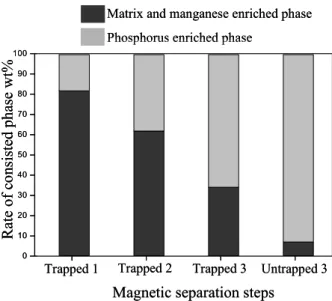
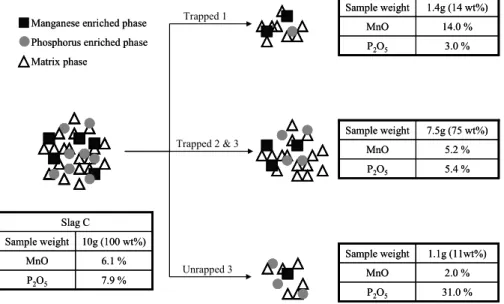
比較すると、マンガンは約2.3 倍、リンは約 3.9 倍に濃縮できていることになる。両者のマン ガンまたはリン濃度は、マンガン濃縮相またはリン濃縮相の組成に近く、各結晶相がほぼ単 独で回収されたことを意味している。各磁気分離ステップでの構成結晶相の割合を Fig.10 に 示すが、「untrapped 3」として回収された非磁着物はリン鉱石のリン濃度に匹敵し、マトリッ クス相の混入を更に低下できれば、十分リン鉱石代替物として利用できる可能性が高い。 本実験では、磁気分離操作によってリン濃縮相、マンガン濃縮相、マトリックス相をそれ ぞれ個別に分離回収することを目指したが、使用したスラグ中におけるマンガン濃縮相の偏 析が十分ではなかったため、マンガン濃縮相とマトリックス相の分離回収は十分な結果が得 られなかった。しかしながら、Fig.11 に示すように、マンガン、リン濃度に応じた3者の分 離はおおむね達成されており、特に「untrapped 3」として回収された非磁着物のリン濃度は 十分高く、初期スラグのミクロ構造さえ制御できていれば、より高効率の分離が十分行える ものと思われる。申請者らは、スラグをマンガン及びリンの2次資源として性状を積極的に コントロールする技術開発が必要であると考えている。
Manganese enriched phase Phosphorus enriched phase Matrix phase
Manganese enriched phase Phosphorus enriched phase Matrix phase 7.9 % P2O5 6.1 % MnO 10g (100 wt%) Sample weight Slag C 7.9 % P2O5 6.1 % MnO 10g (100 wt%) Sample weight Slag C 5.4 % P2O5 5.2 % MnO 7.5g (75 wt%) Sample weight 5.4 % P2O5 5.2 % MnO 7.5g (75 wt%) Sample weight 31.0 % P2O5 2.0 % MnO 1.1g (11wt%) Sample weight 31.0 % P2O5 2.0 % MnO 1.1g (11wt%) Sample weight 3.0 % P2O5 14.0 % MnO 1.4g (14 wt%) Sample weight 3.0 % P2O5 14.0 % MnO 1.4g (14 wt%) Sample weight Trapped 1 Trapped 2 & 3 Unrapped 3
Figure 11 Concentration and weight in recovered slag 5. 結論 マテリアルフロー分析により、日本、韓国の両国において、製鋼スラグからのマンガン、 リンの回収可能量を評価した。日本の場合、スラグに排出される製鉄原料起源のマンガン及 びリンは、それぞれ元素量換算で約53 万トン、約 10 万トン、韓国においてはそれぞれ約 15 万トン、約 3.6 万トンと推計された。いずれもフェロマンガン、リン鉱石等の資源としての 輸入量とほぼ同等量に上ることがわかった。このことから、スラグからの回収は、両国のマ ンガン、リン資源需給に対して少なからぬインパクトを与えることが示唆される。 このような背景から、本研究では溶銑脱リンスラグからのマンガンとリンの回収法につい て実験的に検討した。脱リンスラグは、操業条件によって幅はあるものの、一般的にリン濃 縮相とマンガン濃縮相が酸化鉄系マトリックス相中に分散している不均一な結晶構造を持つ ことが示された。本研究では、この3種類の相の磁気的特性が大きく異なることを利用し、 高磁場勾配を利用した磁気分離法によってそれぞれを分離・回収することを試みた。表面磁 場強度0.03~0.3T の範囲で、空気吹き込みによる攪拌条件下で段階的に湿式磁気分離実験を 行った結果、32μm 以下に粉砕した現場脱リンスラグを用い、P2O5濃度が31wt%に達するリン 濃化物を回収することができた。このリン濃化物中のマトリックス相およびマンガン濃縮相 の混入率は10%程度であった。他方、マンガン濃縮相の約 14%が 0.03T における最初の磁気 分離操作で回収され、この時のリン濃縮相の混入率は約20%以下であった。 分離効率は未だ十分高いとは言えないが、スラグは本来、高品質な鋼を精錬するために不 可避的に副成するものであり、後の利用を考慮してスラグの性状を制御しようというアクシ ョンは基本的に取られておらず、スラグをマンガン及びリンの2次資源として性状を積極的 にコントロールする技術開発が伴えば、回収率は格段に改善されると思われる。申請者らは、 製鋼スラグの2次資源としてのポテンシャルの大きさから、むしろ積極的にスラグを作り込 むことが必要だと考えおり、このような概念を「スラグメイキングテクノロジー」と呼んで
いる。鉄鋼業はスラグの処理に頭を悩ませているが、スラグは決して廃棄物ではなく、むし ろ希少元素を濃縮した重要な2次資源である。このようなパラダイムシフトを図るために、 今後は、「スラグメイキングテクノロジー」の方法論の確立を目指していきたい。 本研究はJFE21世紀財団より 2008 年、2009 年にわたって資金援助を受けた。付記して深 甚なる謝意を表します。 参考文献
1). KIGAM (Korea Institute of Geoscience and Mineral Resource). Mineral data book. Daejeon: Kigam Pub; 2005a
2). KIGAM (Korea Institute of Geoscience and Mineral Resource). Supply-demand statistics of mineral commodities. Daejeon: Kigam Pub; 2005a
3). KITA (Korea International Trade Assoiation). Web site, http://www.kita.net. 4). Yoon JK, Shim JD. Ferrous metallurgy for specialists. Seoul: Daewoong Pub; 2004
5). Ono H., Inagaki A., Masui T., Narita H., Mitsuo T., Nosaka S. and Gohda S., 1980. Removal of phosphorus from LD converter slag by floating of dicalcium silicate during solidification. Tetsu-to-Hagane, 66(9): 41–50.
6). Wang L., Sato D., and Fjjita T., 2007. Recovery of phosphorus from steelmaking slag by magnetic separation. The 9th Intern. Sympo. East Asian Resources Recycl. Tech. 139-142. 7). Xiong J., He Z., Mahmood Q., Liu D., Yang X. and Islam E., 2008. Phosphate removal from
solution using steel slag through magnetic separation. J. Hazard. Mater., 152: 211–215.
8). Yokoyama K., Kubo H., Mori K., Okada H., Takeuchi S. and Nagasaka T., 2007. Separation and recovery of phosphorus from steelmaking slags with the aid of a strong magnetic field. ISIJ Intern., 47(10): 1541–1548.
9). KOSA (Korea Iron Steel Association) Steel statistical yearbook: KOSA Pub; 2009 10). Handbook of Iron and Steel statistics, The iron and steel federation of Japan (2009).
11). Mishina F. and Shinpo T., 2003. Recovery of phosphorus from sewage sludge. Regeneration and Utilization, 26(98): 13–28 [in Japanese].
12). Mizutani J., 2003. Long-term sustainable nutrient material cycle, Environmental Science, 16(2): 87–96.
13). Kubo H, Yokoyama K, Nakajima K, Hashimoto S, Nagasaka T. The application of material stock and flow accounting to phosphorus in Japan. J Environ Eng Manage 2008; 18(1):47-53.
14). Nakajima K, Yokoyama K, Nagasaka T. Substance flow analysis of manganese associated with iron and steel flow in Japan. ISIJ Int 2008; 48(4):554-558
15). Jeong Y-S, Yokoyama K, Kubo H, Pak J-J, Nagasaka T. Substance flow analysis of phosphorus and manganese correlated with South Korean steel industry. Resources, Conservation and Recycling 2009; 36(3): 479-489
16). Futatsuka T., Shitogiden K., Miki T., Nagasaka T. and Hino M., 2004. Dissolution behavior of nutrition elements from steelmaking slag into seawater. ISIJ Intern., 44(4): 753–761.
Recovery of Manganese and Phosphorus from Dephosphorization Slag
with Wet Magnetic Separation
Yong-Soo Jeong, Kazuyo Matsubae-Yokoyama, Tetsuya Nagasaka
Graduate School of Environmental Studies, Tohoku University, Sendai 980-8579, Japan Key words: dephosphorization slag, magnetic separation, phosphorus, manganese
Abstract
The dephosphorization slag has a great potential as the secondary resources of manganese and phosphorus, while quite a large amount of slag is landfilled and simply reused such as cement. The objective of this study is to investigate the recovery of manganese and phosphorus by wet magnetic separation technique. The hot metal pretreatment slag (dephosphorization slag) generally contains a Ca3P2O8-Ca2SiO4 (phosphorus enriched phase) and FeO-MnO (manganese enriched phase) solid solutions
together with FeO-CaO-SiO2 matrix phase. Since the difference in their magnetic properties is significant,
it is possible to separate each phase with the aid of wet magnetic separation. By applying strong magnetic field to the crushed slag (<32μm), 31% of phosphorus enriched slag and 14% manganese enriched slag could be successfully recovered.
1. Introduction
Security of resources becomes more important than ever due to the recent trend in commodity prices for minerals and natural resources. Manganese and phosphorus are important resources for many advanced countries like Japan and South Korea. More importantly, they are not produced in the countries, although domestic use of each is increasing. 1~3) Manganese is an indispensable element in industrial and consumer
products, and phosphorus is in global demand, particularly for mainly fertilizer production. However, in the steel industry, phosphorus is typically recognized as a harmful element for high-quality steel, whereas manganese is considered to be an important alloying and deoxidizing element in the steelmaking process. Because of its ability of desulfurization and deoxidation for steel, manganese plays a key role in the steelmaking. Manganese and phosphorus exist in coal, iron ore, and limestone, 4) which are essential raw
materials for iron- and steel-making processes. Since manganese and phosphorus are less noble in chemical nature, they are easily oxidized and mostly distributed into the steelmaking slag, particularly hot metal pretreatment slag (dephosphorization slag). Because total amount of crude steel production in Japan and South Korea is huge, the amount of manganese and phosphorus transferred to steelmaking slag is also huge.
important for several reasons. First, reserves of high manganese and phosphorus content resources are very limited. Second, industrial processes for mining, producing, and distributing can cause environmental and uneconomical problems. Therefore, as a secondary resource, steelmaking slag could be an important alternative because of high manganese and phosphorus content.
Despite the economic and ecological importance, however, only a few researchers have paid attention to recovering valuable elements from slag. 5~8) In general, dephosphorization slag can be divided into three
major phases in its solidified micro-structure: a FeO-free phosphorus-rich phase (Ca3P2O5-Ca2SiO4), a
phosphorus-free manganese-enriched phase (mangano-wustite phase), and a phosphorus-free matrix phase (FeO-CaO-SiO2) containing minor part of manganese.Therefore, in principle, it is possible to recover
mangano-wustite using a weak first magnetic separation followed by a relatively strong second magnetic separation to recover phosphorus as calcium phosphate from residues. With such a background, the authors have developed a new process to recover manganese and phosphorus from steelmaking slag by wet magnetic separation.
2. Manganese and phosphorus material flows through steel industry
Different forms of phosphorus are widely used in industry and other human activities; common uses include fertilizers, soaps, detergents, and surface preparation agents. In these situations, phosphorus is viewed as an important but limited natural resource that should be used efficiently, economically, and in environmentally friendly ways. However, in the steel industry, phosphorus is known as a typical harmful element for high-quality steel products. Phosphorus is thus removed from hot metal (molten pig iron) to slag. Since the total crude steel production in Japan and South Korea is extremely huge (118 and 53 million tons in 2008 respectively) 9~10), the amount of phosphorus removed to steelmaking slag must also be large.
The authors have found by material flow analysis 11~15) that phosphorus removed to the steelmaking slag
shares a significant part of total phosphorus flow in Japan and South Korea. The amount of phosphorus transferred to steelmaking slag is estimated to be 96.4 and 35.7kt-P/year in Japan and South Korea, respectively.
Manganese material flow for the steel industry in both countries is shown in Fig. 1. In the ironmaking process, pig iron (hot metal) is produced as the main product and BF slag is generated from the blast furnace (BF) as a by-product. The input of manganese to the ironmaking process is iron ore, ferruginous manganese ore, and steel scrap. The manganese output to pig iron and ironmaking slag is evaluated to be 95.1 kt-Mn/year and 15.9 kt-Mn/year, respectively. 15) In the case of Japan, the manganese output to pig
iron and slag are estimated to be 208.9 kt-Mn/year and 55.4 kt-Mn/year. 14) In the steelmaking process,
crude steel is produced as the main product and steelmaking slag is generated as a by-product from the basic oxygen furnace (BOF) and electric arc furnace (EAF) processes. Steelmaking slag is generally classified into some categories depending on the refining processes such as desiliconization, dephosphorization, desulfurization, BOF and EAF slags while manganese flow in each slag has been summarized as a whole “steelmaking slag” in Fig. 1. It should be noted that, among these slags, our major target to recover manganese and phosphorus is the hot metal dephosphorization slag8) because manganese
BOF/EAF Crude steel Ladle Blast furnace Pig iron Dust BF slag Ferrous resource
Unit: kt-Mn/year (South Korea & Japan)
Iron making Steel making Ferro-Mn Si-Mn Iron-Mn ore /Mn ore Scrap Steel making Slag (111.1 & 266.2) (15.9 & 55.4) (0.1 & 1.9) (95.1 & 208.9) (62.9 & 241.7) (158.0 & 450.6) (5.0 & 92.8) (243.0 & 577.6) (260.0 & 590.3) (146.0 & 530.7) BOF/EAF Crude steel Ladle Blast furnace Pig iron Dust BF slag Ferrous resource
Unit: kt-Mn/year (South Korea & Japan)
Iron making Steel making Ferro-Mn Si-Mn Iron-Mn ore /Mn ore Scrap Steel making Slag (111.1 & 266.2) (15.9 & 55.4) (0.1 & 1.9) (95.1 & 208.9) (62.9 & 241.7) (158.0 & 450.6) (5.0 & 92.8) (243.0 & 577.6) (260.0 & 590.3) (146.0 & 530.7)
Figure 1 Material flow of manganese in Japanese and South Korean steel industries (2005)
process are hot metal, steel scrap, ferro-manganese, silico-manganese, and manganese metal. The manganese outputs from the steelmaking process were evaluated to be 260.0 kt-Mn/year in crude steel and 146.0 kt-Mn/year in slag in South Korea while in the case of Japan the manganese outputs are 590.3 kt-Mn/year in crude steel and 530.7 kt-Mn/year in slag, respectively. It should be noted that the amount of manganese loss into steelmaking slag is almost equivalent to that of manganese input into steelmaking process as ferro-manganese etc. in both countries. The results of material flow analysis suggest that a significant ripple effect can be expected if the recovery of manganese and phosphorus from iron- and steel-making slag becomes possible.
3. Experimental procedures
3.1 Morphology of dephosphorization slag
The FeO-CaO-SiO2-P2O5(-MgO-MnO) system is the typical dephosphorization slag. The morphology of
solidified dephosphorization slag has been discussed in a number of previous studies. According to the report of Futatsuka et al., 16) dephosphorization slag after solidification generally consists of (1) iron free
crystalline phase that contains phosphorus (herein-after “phosphorus enriched phase”) and (2) phosphorus free another phase that contains iron. The authors have made more detail analysis on the manganese and phosphorus morphology in the practical dephosphorization slag to develop a manganese and phosphorus recovery process from the slag. It was found that the above-mentioned phosphorus free another phase can be further divided into two kinds of phases; FeO-CaO-MnO based mangano-wustite phase (herein-after “manganese enriched phase”) and FeO-CaO-SiO2 phase which contains manganese as minor component
(herein-after “matrix phase”). Figure 2 shows the examples of element mapping image in the dephosphorization slag by EPMA.
H[Oe] M[emu/g] 1 2 3 -5000 -4000 -3000 -2000 -1000 0 1000 2000 3000 4000 5000 -0.03 -0.02 -0.01 0.00 0.01 0.02 0.03 5 40 55 3 15 30 55 2 20 25 55 1 MnO CaO FeO % 5 40 55 3 15 30 55 2 20 25 55 1 MnO CaO FeO %
Figure 3 The magnetization curves for FeO-CaO-MnO based slag
slag: 10g water: 200ml Remark 6 5 3 O O X X X X X Air pump O O 4 2 1 Run No. <32 <52 O C O B O A Size (μm) Slag slag: 10g water: 200ml Remark 6 5 3 O O X X X X X Air pump O O 4 2 1 Run No. <32 <52 O C O B O A Size (μm) Slag
Table 2 Experimental condition
15.48 0.69 4.04 4.74 64.54 manganese enriched phase
1.11 35.08 10.78 55.95 1.53 phosphorus enriched phase
16.98 0.01 0.07 0.26 76.68 manganese enriched phase
1.69 32.65 12.31 56.32 0.99 phosphorus enriched phase
9.00 0.01 0.04 2.33 63.75 manganese enriched phase
0.28 6.82 27.41 61.96 2.79 phosphorus enriched phase
average average average MnO P2O5 SiO2 CaO FeO 40.40 22.85 22.51 Composition (%) 24.20 32.30 42.36 12.70 21.80 11.05 7.85 6.85 2.24 6.05 9.90 3.49 C B A Slag 15.48 0.69 4.04 4.74 64.54 manganese enriched phase
1.11 35.08 10.78 55.95 1.53 phosphorus enriched phase
16.98 0.01 0.07 0.26 76.68 manganese enriched phase
1.69 32.65 12.31 56.32 0.99 phosphorus enriched phase
9.00 0.01 0.04 2.33 63.75 manganese enriched phase
0.28 6.82 27.41 61.96 2.79 phosphorus enriched phase
average average average MnO P2O5 SiO2 CaO FeO 40.40 22.85 22.51 Composition (%) 24.20 32.30 42.36 12.70 21.80 11.05 7.85 6.85 2.24 6.05 9.90 3.49 C B A Slag
Table 1 Chemical composition of the steelmaking slag
㎛ ㎛ ㎛
Figure 2 Examples of microstructures of dephosphorization slag C
Though the composition and morphology widely vary in general depending on the produced steel categories and operating conditions, most of dephosphorization slag approximately consists of three major phases as it was explained earlier. Table 1 gives the compositions of dephosphorization slag supplied for the present experimental runs. The authors measured the magnetic properties of FeO-CaO-MnO based slag with a vibrating sample magnetometer (VSM) as part of a quantitative investigation of the possibility of magnetic separation of manganese enriched phase from slag.
10g slag + 200g water Feed 10g slag + 200g water Feed 0.03T 1st stage 0.03T 1st stage 0.10T 2nd stage 0.10T 2nd stage 0.30T 3rd stage 0.30T 3rd stage Trapped 1
Trapped 1 Untrapped 1Untrapped 1
Trapped 2
Trapped 2 Untrapped 2Untrapped 2
Trapped 3
Trapped 3 Untrapped 3Untrapped 3
Figure 5 Magnetic separation steps The VSM sample was made by mixing and premelting reagent grade chemicals at desired ratios as shown in Fig. 3. A MoSi2 heater electric furnace was used for preparing VSM sample. The result is shown
in Fig. 3 in terms of magnetization as a function of the magnetic filed. The magnetization curves of FeO-CaO-MnO based phase, that is manganese enriched slag, seem to be ferromagnetism or paramagnetism depending on MnO composition. On the other hand, the magnetic property of phosphorus enriched phase has been found as an antimagnetism.8) Since the magnetic property of each phase has
found to be significantly different, the authors have tried wet magnetic separation process to recover manganese enriched phase and phosphorus enriched phase from the dephosphorization slag as a new manganese and phosphorus resource.
3.2 Magnetic separation
A magnetic separation experiment was carried out using a Wet High Intensity Magnetic Separators (Eriez Series L Model 4 Laboratory). Three kinds of dephosphorization slag as shown in Table 1 were prepared for the experiments. The hot metal dephosphorization slag specimen was provided from JFE steel. This slag was crushed in zirconia ball mills (ball size: 10mm diameter) under 32μm and 52μm. Table 2 gives the experimental condition.
10g of the sample was dispersed in approximately 200ml of ion exchanged water to avoid coagulation and poured the sample into constant surface magnetic field strength in a controlled separation cell. 11 pieces of stainless steel mesh filters which were magnetized were inserted in the cell, and these mesh filters themselves also contributed to separation. The magnetized particles in the charged samples were magnetically trapped by the filters, and then, the particles which were not magnetized were untrapped from the cell by opening the valve equipped at the lower part of the cell as shown in Fig. 4. Magnetically trapped and untrapped particles were respectively collected and analyzed their compositions by ICP. Figure 5 shows the magnetic separation process and applied magnetic intensity. At first, a sample was separated at magnetic field strength of 0.03T and, the magnetically trapped sample in the cell was collected. The
P-enrich phase STS mesh STS mesh Mn-enrich phase P-enrich phase STS mesh STS mesh Mn-enrich phase
Figure 6 Magnetic concentration of slag A in Run No. 1 0 5 10 15 20 25 30 35 40 45 50 55 60 Trapped 1 Trapped 2 Fe O, CaO w t%
Magnetic separation steps
0 2 4 6 8 10 Mn O, P 2 O5 wt% FeO CaO MnO P2O5
Trapped 3 Untrapped 3 Trapped 1 Trapped 2 Trapped 3 Untrapped 3
Magnetic separation steps 0 5 10 15 20 25 30 35 40 45 50 55 60 Trapped 1 Trapped 2 Fe O, CaO w t%
Magnetic separation steps
0 2 4 6 8 10 Mn O, P 2 O5 wt% FeO CaO MnO P2O5
Trapped 3 Untrapped 3 Trapped 1 Trapped 2 Trapped 3 Untrapped 3
Magnetic separation steps
untrapped sample from the cell without magnetization was supplied into a new cell with stronger magnetic field. This procedure was repeated for several times up to maximum 0.3T. In some experimental runs, air was injected into the cell by air pump to promote homogeneous dispersion of particles in the water.
4. Experimental results
Figure 6 shows the experimental result of the magnetic separation in Run No. 1. The manganese concentration in the recovered sample becomes smaller at higher intensity of the magnetic field. On the contrary, the phosphorus concentration in the recovered sample increased with higher magnetic field strength. In other words, because the concentration of manganese and phosphorus recovered has indicated opposite tendency, separating manganese and phosphorus individually by magnetic field from dephosphorization slag could be possible. According to the morphology study of dephosphorization slag and element mapping image by EPMA, manganese coexisted with FeO in most cases. That is, relatively small crystalline phase of manganese enriched phase dispersed on the matrix phase. Therefore, manganese tends to be collected at higher intensity of the magnetic field. Due to such reason, individual separation of manganese enriched phase and matrix phase was not well done in the present experimental condition. The phosphorus content at untrapped 3 of 0.30T becomes almost double of the average composition in spite of low phosphorus concentration of tested slag. However, it is not satisfactory for the usage of phosphate fertilizer. P2O5 content in natural phosphate ore for phosphate fertilizer is over 25~30wt%.17) Phosphorus
segregation in slag A was not remarkable and suitable. Therefore, other slag which had higher manganese and phosphorus segregations were used for magnetic separation.
Run No. 2 and 3 were carried out for magnetic separation with slag B. The average composition of this slag was MnO 9.9% and P2O5 6.9%, and MnO and P2O5 contents in manganese and phosphorus enriched
phases were respectively MnO 17.0 and %P2O5 32.7% as shown in Table 1. The particle size prepared was
32μm (Run No.3) and 53μm (Run No.2). Figure 7 shows the influence of the particle size to recovery efficiency of manganese and phosphorus. Manganese and phosphorus recovery efficiencies somewhat increased with smaller particle size, indicating that the population density of the isolated manganese and phosphors enriched phases would be increase in the charged slag powder if the particle size is smaller and
Figure 7 Magnetic concentration of slag B in Run No. 2&3 FeO, CaO w t% Mn O, P2 O5 wt %
FeO (Run No.2) CaO (Run No.2) FeO (Run No.3) CaO (Run No.3)
0 5 10 15 20 25 30 35 40 45 50 55 0 5 10 15 20 25 30
MnO (Run No.2) P2O5 (Run No.2) MnO (Run No.3) P2O5 (Run No.3)
Trapped 1 Trapped 2 Trapped 3 Untrapped 3 Trapped 1 Trapped 2 Trapped 3 Untrapped 3
Magnetic separation steps Magnetic separation steps
FeO, CaO w t% Mn O, P2 O5 wt %
FeO (Run No.2) CaO (Run No.2) FeO (Run No.3) CaO (Run No.3)
0 5 10 15 20 25 30 35 40 45 50 55 0 5 10 15 20 25 30
MnO (Run No.2) P2O5 (Run No.2) MnO (Run No.3) P2O5 (Run No.3)
Trapped 1 Trapped 2 Trapped 3 Untrapped 3 Trapped 1 Trapped 2 Trapped 3 Untrapped 3
Magnetic separation steps Magnetic separation steps
Figure 8 Magnetic concentration of slag C in Run No. 4&5
FeO , CaO w t% Mn O , P2 O5 wt % 0 5 10 15 20 25 30 35 0 5 10 15 20 25 30 35 40 45 50 55
FeO (Run No.4) CaO (Run No.4) FeO (Run No.5) CaO (Run No.5)
MnO (Run No.4) P2O5 (Run No.4) MnO (Run No.5) P2O5 (Run No.5)
Trapped 1 Trapped 2 Trapped 3 Untrapped 3 Trapped 1 Trapped 2 Trapped 3 Untrapped 3
Magnetic separation steps Magnetic separation steps
FeO , CaO w t% Mn O , P2 O5 wt % 0 5 10 15 20 25 30 35 0 5 10 15 20 25 30 35 40 45 50 55
FeO (Run No.4) CaO (Run No.4) FeO (Run No.5) CaO (Run No.5)
MnO (Run No.4) P2O5 (Run No.4) MnO (Run No.5) P2O5 (Run No.5)
Trapped 1 Trapped 2 Trapped 3 Untrapped 3 Trapped 1 Trapped 2 Trapped 3 Untrapped 3
Magnetic separation steps Magnetic separation steps
thus the recovery efficiency becomes higher. It should be noted that, however, the suitable particle size depends on the initial morphology of slag. That is, if the crystal sizes of manganese and phosphors enriched phases were initially large in the supplied slag, the relatively large particle size even after crushing would result in sufficient recovery. The morphology of slag strongly depends on the operating conditions, in particular, slag cooling conditions.
Run No. 4, 5 and 6 were carried out for the magnetic separation with slag C. The average composition of this slag was MnO 6.1% and P2O5 7.9%, and MnO and P2O5 contents in manganese and phosphorus
enriched phases were respectively MnO 15.5% and P2O5 35.1% as shown in Table 1. Figure 8 shows the
influence of the particle size after crushing on the recovery efficiency of manganese and phosphorus. On the basis of this result, the following experiment was made under 32μm.
Figure 9 Magnetic concentration of slag C in Run No. 6 Fe O, CaO w t% MnO , P 2 O5 wt % 0 5 10 15 20 25 30 35 40 45 50 55 0 5 10 15 20 25 30 35 FeO CaO MnO P2O5
Trapped 1 Trapped 2 Trapped 3 Untrapped 3 Trapped 1 Trapped 2 Trapped 3 Untrapped 3
Magnetic separation steps Magnetic separation steps
Fe O, CaO w t% MnO , P 2 O5 wt % 0 5 10 15 20 25 30 35 40 45 50 55 0 5 10 15 20 25 30 35 FeO CaO MnO P2O5
Trapped 1 Trapped 2 Trapped 3 Untrapped 3 Trapped 1 Trapped 2 Trapped 3 Untrapped 3
Magnetic separation steps Magnetic separation steps
Magnetic separation steps
Trapped 1 Rate of c on si ste d pha se w t% 0 10 20 30 40 50 60 70 80 90 100
Matrix and manganese enriched phase Phosphorus enriched phase
Trapped 2 Trapped 3 Untrapped 3
Magnetic separation steps
Trapped 1 Rate of c on si ste d pha se w t% 0 10 20 30 40 50 60 70 80 90 100
Matrix and manganese enriched phase Phosphorus enriched phase
Trapped 2 Trapped 3 Untrapped 3
Figure 10 Rate of phosphorus enriched phase and other phase
Run No. 6 was conducted for magnetic separation with physical agitation with slag C. The sample was sufficiently agitated by injecting air into the cell. The flow rate of air was controlled by the flow meter at 0.03L/min. Figure 9 shows the influence of air agitation. The results of Run No. 4, 5, and 6 indicated that the effect of the particle size and physical agitation could improve the recovery efficiency significantly. In the present experimental conditions, about 31% P2O5 could be recovered as “untrapped 3” of 0.30T, and
about 14% MnOcan be recovered as “trapped 1” of 0.03T where particle size was less than 32μm with air agitation, which was the best result. Figure 10 shows the rate of consisted phases in each recovery step. The higher magnetic field intensity resulted in the higher P2O5 recovery ratio. The P2O5 concentration of 31% at
untrapped 3 is good enough to use for phosphate fertilizer. In addition, it is possible to reduce other phase contamination under 5%. The results obtained in Run No.6 are also summarized in Fig. 11. Separation efficiency should be improved in the future work, but sufficiently high P2O5 content was achieved in
Manganese enriched phase Phosphorus enriched phase Matrix phase
Manganese enriched phase Phosphorus enriched phase Matrix phase 7.9 % P2O5 6.1 % MnO 10g (100 wt%) Sample weight Slag C 7.9 % P2O5 6.1 % MnO 10g (100 wt%) Sample weight Slag C 5.4 % P2O5 5.2 % MnO 7.5g (75 wt%) Sample weight 5.4 % P2O5 5.2 % MnO 7.5g (75 wt%) Sample weight 31.0 % P2O5 2.0 % MnO 1.1g (11wt%) Sample weight 31.0 % P2O5 2.0 % MnO 1.1g (11wt%) Sample weight 3.0 % P2O5 14.0 % MnO 1.4g (14 wt%) Sample weight 3.0 % P2O5 14.0 % MnO 1.4g (14 wt%) Sample weight Trapped 1 Trapped 2 & 3 Unrapped 3
Figure 11 Concentration and weight in recovered slag
5. Conclusion
The quantity of recyclable manganese and phosphorus form slag waste in Japanese and South Korean steel industries has been evaluated with the methodology of the material flow analysis. In the case of Japan, manganese and phosphorus contained in steelmaking slag was 530.7 kt-Mn/year and 96.4 kt-P/year respectively in 2005. The recovery of manganese and phosphorus from steelmaking slag could have a significant impact on a national mineral strategy and on the environment. In the case of South Korea, the amount of manganese and phosphorus contained in steelmaking slag was estimated to be 146.0 kt-Mn/year and 35.7 kt-P/year respectively in 2005.
Magnetic separation was applied to the recovery of manganese and phosphorus from dephosphorization slag. Dephosphorization slag consists of phosphorus enriched phase and manganese enriched phase together with matrix phase. The magnetic property of each phase has found to be significantly different. In the present experiment, about 31% of phosphorus enriched slag could be recovered with less than 10% of matrix and manganese enriched phase contamination at untrapped 3 of 0.30T and about 14% of manganese enriched slag could be recovered with less than 20% of phosphorus enriched phase contamination at trapped of 0.03T, particle size of less than 32μm with physical agitation. For better recovery of manganese and phosphorus, it is emphasized that compositions and morphology of slag should be controlled for easier magnetic separation for manganese and phosphorus recovery. The steelmaker should be encouraged to produce not only high quality steel but also good slag as the secondary resources of manganese and phosphorus, while they basically don’t care the slag quality in the view point of its recovery. However, the present authors believe that it is possible to convert “steelmaking slag” to “secondary resources of manganese and phosphorus” with additional small technologies like slow cooling and composition control. The present authors call such concept as “Slag-making technology”.
This research was supported by JFE 21st Century Foundation for FY 2008 and FY 2009, the authors wish to express their gratitude to the support.
References
1). KIGAM (Korea Institute of Geoscience and Mineral Resource). Mineral data book. Daejeon: Kigam Pub; 2005a
2). KIGAM (Korea Institute of Geoscience and Mineral Resource). Supply-demand statistics of mineral commodities. Daejeon: Kigam Pub; 2005a
3). KITA (Korea International Trade Assoiation). Web site, http://www.kita.net. 4). Yoon JK, Shim JD. Ferrous metallurgy for specialists. Seoul: Daewoong Pub; 2004
5). Ono H., Inagaki A., Masui T., Narita H., Mitsuo T., Nosaka S. and Gohda S., 1980. Removal of phosphorus from LD converter slag by floating of dicalcium silicate during solidification. Tetsu-to-Hagane, 66(9): 41–50.
6). Wang L., Sato D., and Fjjita T., 2007. Recovery of phosphorus from steelmaking slag by magnetic separation. The 9th International Symposium on East Asian Resources Recycling Technology pp. 139–142. Sendai, Japan: EARTH 2007
7). Xiong J., He Z., Mahmood Q., Liu D., Yang X. and Islam E., 2008. Phosphate removal from solution using steel slag through magnetic separation. Journal of Hazardous Materials., 152: 211–215.
8). Yokoyama K., Kubo H., Mori K., Okada H., Takeuchi S. and Nagasaka T., 2007. Separation and recovery of phosphorus from steelmaking slags with the aid of a strong magnetic field. ISIJ Intern., 47(10): 1541–1548.
9). KOSA (Korea Iron Steel Association) Steel statistical yearbook: KOSA Pub; 2009 10). Handbook of Iron and Steel statistics, The iron and steel federation of Japan (2009).
11). Mishina F. and Shinpo T., 2003. Recovery of phosphorus from sewage sludge. Regeneration and Utilization, 26(98): 13–28 [in Japanese].
12). Mizutani J., 2003. Long-term sustainable nutrient material cycle, Environmental Science, 16(2): 87–96 [in Japanese].
13). Kubo H, Yokoyama K, Nakajima K, Hashimoto S, Nagasaka T. The application of material stock and flow accounting to phosphorus in Japan. J Environ Eng Manage 2008; 18(1):47-53.
14). Nakajima K, Yokoyama K, Nagasaka T. Substance flow analysis of manganese associated with iron and steel flow in Japan. ISIJ Int 2008; 48(4):554-558
15). Jeong Y-S, Yokoyama K, Kubo H, Pak J-J, Nagasaka T. Substance flow analysis of phosphorus and manganese correlated with South Korean steel industry. Resources, Conservation and Recycling 2009; 36(3): 479-489
16). Futatsuka T., Shitogiden K., Miki T., Nagasaka T. and Hino M., 2004. Dissolution behavior of nutrition elements from steelmaking slag into seawater. ISIJ Intern., 44(4): 753–761.