Catalytic Asymmetric Cyclopropanations of Diazo Phosphonates and Designed Diazo Ketones
(
)
January, 2019
Doctor of Philosophy(Engineering) Le Thi Loan Chi
Toyohashi University of Technology
t ) ' xz
1FPBEMFNS
2NU ONMFNSBL BNE F D FNDFR
;PL DBNS R NBMF
STEFNT1 9TMCF
1BSF O RTCM RR ON MONSI EB
5 SLF O IFR R
2 45 .9045
0BSBL S D .R MMFS D D DLOP OPBNBS ONR O 1 B O PIORPIONBSFR BNE 1FR HNFE 1 B O
FSONFR
f hn agio d f hck s ebpmpl
wy
.PP OW O O ER
' ,) (
.CRS BDS 1ODSO
IF D DLOP OPBNF RTCTN S R P FRFNS N MBN C ' H DB'' MPOEBNS DOMPOTNER NETE NH SF PFNFR
;IF OMONFR BSS BD E MFSBCOL SFR BNE TNTRTBL BM NO BD ER BNE S RIO 9R B LB HF RPFDS TM O C ' H DBL
; OPF S FR NDLTE NH FNv MF NI C S ON BNE NRFDS D EBL BNS TNHBL IF C D EBL BNS M D OC BL BNS C OS D BNS CBDSF BL BNS STMO BNE BNS U BL BDS U S FR I R BDS IBR NRP FE DIFM RSR SO BNE NOUFL BNE E UF RF BPP OBDIFR SO SIF R NSIFR R BNE SIOTRBNER O D DLOP OPBNF DOMPOTNER IBUF CFFN P FPB FE 'N PB S DTLB NBST B'' ODDT NH D DLOP OPBNFR CFB NH R MPLF O DOMPLFW TNDS ONBL S FR B F DI BL DOMPOTNER- SITR SIF D DLOP OPBNF MOS IBR LONH CFFN FRSBCL RIFE BR B UBLTBCLF PLBS O M O SIF EFUFLOPMFNS O NF BR MMFS D SFDIN ' H FR .R MMFS D R NSIFR R DONRS STSFR SIF MB N RS BSFH SO HB N BDDFRR SO FNBNS OFN DIFE DOMPOTNER NUOLU NH SIF TRF O F SIF DI BL BTW L B FR O DBSBL RSR SIBS N STM DBN CF MFSBL DFNSF FE RMB O HBN D BR MMFS D MOLFDTLFR O FN MFR 9F BNE MO F F 0 FNS MFSIOER FMPLO NH B'' SIFRF MFSIOE ' H FR SO HB N FNB LS OMF DB'' FN DIFE D DLOP OPBNFR B F RS '' FUOLU NH
BNR S ON MFSBL DBSBL FE D DLOP OPBNBS ON NUOLU NH DB CFNF NSF MFE BSF R PO F TL BNE TRF TL MFSIOER O DONRS TDS NH MPO SBNS RTCRS T0u FR O SB HFSFE MOLFDTLFR BNE SIF F O F SIF IBUF CFFN FWSFNR UFL RSTE FE O SIF PBRS DOTPLF O EFDBEFR
.LSIOTHI TSIFN TM DOMPLFW R NF DOMF N SIF FLE O DBSBL S D D DLOP OPBNBS ON S IBR FMF HFE BR SIF SI E MPO SBNS DBSBL RS MFSBL O SIF 0 CFNO E DIFM RS O E B O DOMPOTNER CFR EFR DOPPF BNE
IOE TM IF F O F TST F EFUFLOPMFNSR RIOTLE S SO NE DBSBL RSR SIBS H UF TSIFN TM DB CFNF NSF MFE BSFR FLFDS OPI L D FNOTHI SO FBDS SI B EF BNHF O OLFBN D RTCRS BSFR BNE SIBS BS SIF RBMF S MF H UF I HI LFUFLR O E Br BNE FNBNS ORFLFDS U S I R P OMPSFE TR SO FWPLO F SIF BR MMFS D 0 DLOP OPBNBS ON O UB OTR E B O DOMPOTNER 9I DI B F POSFNS B'' CT LE NH CLODKR BNE FWPFDSBNS SO CF BPPL FE N PIB MBDFTS DBL BNE MFE D NBL BFLER
0IBPSF L 1FRD CFR SIF I RSO O SIF DB CFNF S BNR F FBDS ONR . C F FU F O SIF MORS TDDFRR TL MFSBL DB CFNF NSF FE BSFR N BR MMFS D D DLOP OPBNBS ONR OUF SIF PBRS SFN FB R B F
; OU EFE T SIF MO F SIF BPPL DBS ON O MFSBL DB CFNF DOMPLFWFR N SIF R NSIFR R O C ' H DB'' rBDS UF FB
TPF U RO R
Z ( ',
2 '' . .
.A . . 45/. 85
R N TUR L PRO UDTa( F DO POUN S RF LSO FNT ONF %
4I PTFR )% =FDFN OUR RFSF RDI HROUP RFPORTF TI TTIF DO PLF = ( aPIFO I S CFFN DO PLFTFL F D FNT N D RCFNF TR NS FR RF DT ONS P RT DUL RL TIF D DLOPROP N T ON O FTI L
O FTI LPIOSPION TFS TI R OUS FLFDTRONa F D FNT OLF NS SUDI S aUNS TUR TF D RCON L 4O POUN S OR N L D RC TFS N F DF((FNT FL S N ^: TI I HI FN NT OSFLFDT % IUS IFRF N NO FL 4 T L S S N OL NH PIOSPIONO FTI L T ON O :a FTI L N L NF N S FTR D D OPROP IOSPION T ON RF DT ONS O ::a FTI L N L NF FR T FS ^: TI O FTI LPIOSPION TFS RF RFPORTF % OPT D (( DT F RFDTL S NTIFS F RO O FTI IOSPION TFS N 4 DLOPROP IOSPION TF FR T FS FRF
::a FTI L N L NF FR T FS D T L F C , FTIO a= (5aPIFO DO PLF N ONF STFP N HOO FL S N I HI STFRFOSFLFDT T FS UP TO TR NS D S 23 //0(1 N FN NT OSFLFDT T FS UP T'// FF % 5 8 CFL NH FDI N ST D STU FS O PIOSPIONO FTI L T ON N D DLOPROP IOSPION T ON SUHHFSTF TI T N FN NF OR N U NTFR F TF ^: S HFNFR TF N TIF RF DT ON PRODFSS%
4I PTFR % DONT NUOUSL TIF , FTIO a= (( aPIFO aD T L F D DLOPROP N T ON O ST RFNF TI DDFPTOR O DO POUN S N T RFPO F N bF DORRFSPON NH D DLOPROP LPIOSPION TF PRO UDT N F DF((FNT FL UP T'/// ^' N HOO FN NT OSFLFDT T UP T'-. FF %
4I PTFR % 6 IFR ORF N NH D T L STS ^:I DI D N D DLOPROP N TF TI R OUS O DO POUN S TO FNR DI STFRFOSFLFDT T LSO I F CFFN F FLOPF UR NH TIF L ST FD FS%(N OUR PRF OUS RFSF RDIFS
= (5 PIFO D T L F S FTR D D DLOPROP N T ON O SUDD N L O DFT TF TI OLF NS N ((FNFS RFSULTF N I HI FL S N F DF((FNT FN NT OSFLFDT T FS N O aUNS TUR TF D RCON L DO POUN S TI DFTON L O DFT TF N UDI I HIFR STFRFOSFLFDT T FS STFRFOSFLFDT T 3//0( N FN NT OSFLFDT T P T'// % DONSF UFNTL IFRF N IF O FR T F O DFTON L DFT TF S USF UL C S D S FLFTON OR TIF
> NTIFS S O D DLOPROP L FTONFS%(IF NTFR OLFDUL R D DLOPROP N T ONS O O DFTO DFTONF TI LF NS RF DDO PL SIF C US NH NO FLPaN TROa= (( IFN LaPIFO D T L STTO H F TIF DORRFSPON NH PT D (( DT F D DLOPROP NF FR T FS N HOO FL S UP T' /, ^: TI F DF((FNT STFRFOSFLFDT T FS UP T'//0( N FN NT OSFLFDT T FS UP T'/. FF %
4I PTFR ,% 6 N (( TIF F PFR FNT L N (( L T D L T S TIF F FNDF OR DI PTFR ) T' RF
FSDR CF %
8N SU R TIF = (5 PIFO D T L F S FTR D D DLOPROP N T ON RF DT ON PRO F TO CF N F D FNT N STR HI OR R FTIO OR TIF PRFP R T ON O DI R L D OPROP LPIOSPION T ON DFPTOR 4 DLOPROP LPIOSPION TFS FTONF D DLOPROP NFS ^:I DI RF PORT NT NTFR F TFS N TIF S NTIFS S O
N C '('H D (( DT F DO POUN S%^:F CFL F F TI T = 5 PIFO FR T FS 4ONTR CUTF TO TIF
<ROHRFSS O NOT ONL S FTR D D DLOPROP N T ON CUT LSO OTIFR S FTR D D RCFNF TR NS FRRF DT ONS%
9 ST O PUCL D T ONS N F PFR FNT LSUPPO NH N OR T ON RF N U F N TIF PPFN DFS%
i
ACKNOWLEDGEMENTS
I would like to thank all the people who contributed in some way to the work described in this thesis. First and foremost, I would like to express my deeply thanks to my supervisor, Professor Dr. Iwasa Seiji, for accepting me into his group. “Sensei”, you have created the invaluable space for me to do this research and develop myself as a researcher in the best possible way. Furthermore, you contributed to a rewarding graduate school experience by giving me intellectual freedom in my work, supporting my attendance at various conferences, engaging me in new ideas, and demanding a high quality of work in all my endeavors. I truly hope that we will be given the opportunity to work even closer together in the future.
Additionally, I would like to express Prof. Dr. Kazutaka Shibatomi for his investing time and providing interesting and valuable feedback throughout my research period. He has been always ready to discuss and encourage me with his heart-warming support and at the same time made me realize that I am only a beginner in this exciting profession.
I would like to thank to my doctoral committee members, Prof. Dr. Shinichi Itsuno for his valuable suggestions. Every result described in this thesis was accomplished with the help and support of fellow lab-mates and collaborators. They not only helped the initial steps in using some apparatus such NMR, HPLC or Mass spectrography but also were always ready to solve any my problems which were generated by the language barrier. I also would like to acknowledge all the staff members of the international and educational affairs division at Toyohashi University of Technology for their support during the progress of my tenure.
With my appreciation and respect, this work would not have been possible without the financial support of the Japanese Government (Monbukagakusho: MEXT), they gave me and my family the chance to study in Japan. I also want to thank to NITTO and TATEMATSU foundation which supported me to participate in the international conferences in USA and Viet Nam. I really want to thank all the staffs of Pharmacy faculty, Hue University of medicine and pharmacy for their supports in the fulfilment of my PhD program. I am especially indebted to my master supervisor, Prof. Dr. Phan Dinh Tuan for his supports, suggestions and encouragement always.
The person with the greatest indirect contribution to this work is my mother, who has taught me love of “never stop learning”. I want to thank her, my father, as well as all my brothers and sisters for their constant encouragement. They always have been fighting together with me, behind and support. Special thanks are due to my husband, Mr. Hoang Dung, not only for his continuous support and understanding, but also for his tolerance and love forever, always take my hand to pass over all hindrances and difficulties in our life. He is really a good husband and wonderful daddy. The biggest and final thank to my son, Hoang Khang, who has been
ii always happy and healthy. His smiling is all. We always go forward together, the happiness will be there.
Thank you very much!
LE THI LOAN CHI
Department of Environmental and Life Science
Toyohashi University of Technology, 1-1 Tenpaku-cho, Toyohashi, Aichi 441-8580 (Japan)
E-mail: [email protected] or [email protected]
iii
ABSTRACT
Keywords: asymmetric synthesis, intermolecular cyclopropanation, Ru(II)-Pheox catalyst.
The cyclopropane subunit is present in many biologically important compounds including terpenes, pheromones, fatty acid metabolites, and unusual amino acids, and it shows a large spectrum of biological properties, including enzyme inhibition and insecticidal, antifungal, herbicidal, antimicrobial, antibiotic, antibacterial, antitumor, and antiviral activities. This fact has inspired chemists to find novel and diverse approaches to their synthesis, and thousands of cyclopropane compounds have been prepared. In particular, naturally occurring cyclopropanes bearing simple or complex functionalities are chiral compounds; thus, the cyclopropane motif has long been established as a valuable platform for the development of new asymmetric technologies. Asymmetric synthesis constitutes the main strategy to gain access to enantioenriched compounds, involving the use of either chiral auxiliaries or catalysts that in turn can be metal-centered, small organic asymmetric molecules or enzymes. New and more efficient methods employing all these methodologies to gain enantiomerically enriched cyclopropanes are still evolving. Transition metal-catalyzed cyclopropanation involving carbene intermediate is powerful and useful methods for constructing important substructures of targeted molecules, and therefore they have been extensively studied for the past couple of decades.
Although Ruthenium complex is newcomer in the field of catalytic cyclopropanation, it has emerged as the third important catalyst metal for the carbenoid chemistry of diazo compounds, besides copper and rhodium. Therefore, future developments should try to find catalysts that give ruthenium carbene intermediates electrophilic enough to react with a wide range of olefinic substrates and that at the same time give high levels of dia- and enantioselectivity. This prompted us to explore the asymmetric cyclopropanation of various diazo compounds which are potentially building blocks and expectant to be applied in pharmaceutical and medicinal fields.
Chapter 1. Describes the history of the carbene transfer reactions. A brief review of the most successful metal carbene intermediates in asymmetric cyclopropanations over the past ten years are provided. Furthermore, the application of metal carbene complexes in the synthesis of biologically-active or natural product-like compounds are also mentioned.
Chapter 2. Recently, our research group reported that the complex, Ru(II)-pheox, has been completely efficient in carbene transfer reactions, particularly the cyclopropanation of diethyl diazomethylphosphonates with various electron-deficient olefins such as -unsaturated carbonyl compounds or vinyl carbamates in excellent yields and with high enantioselectivity.
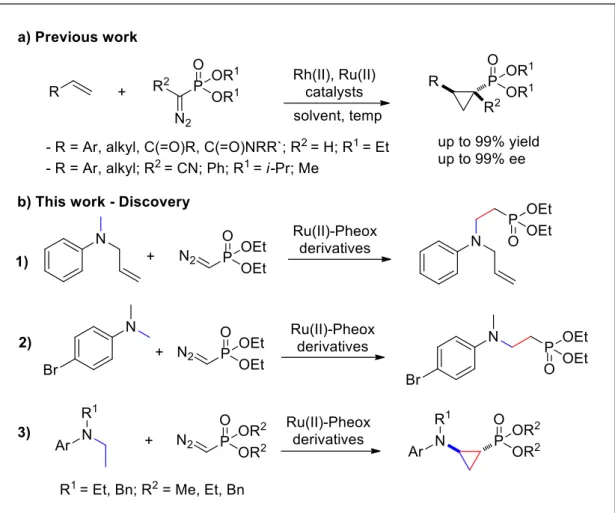
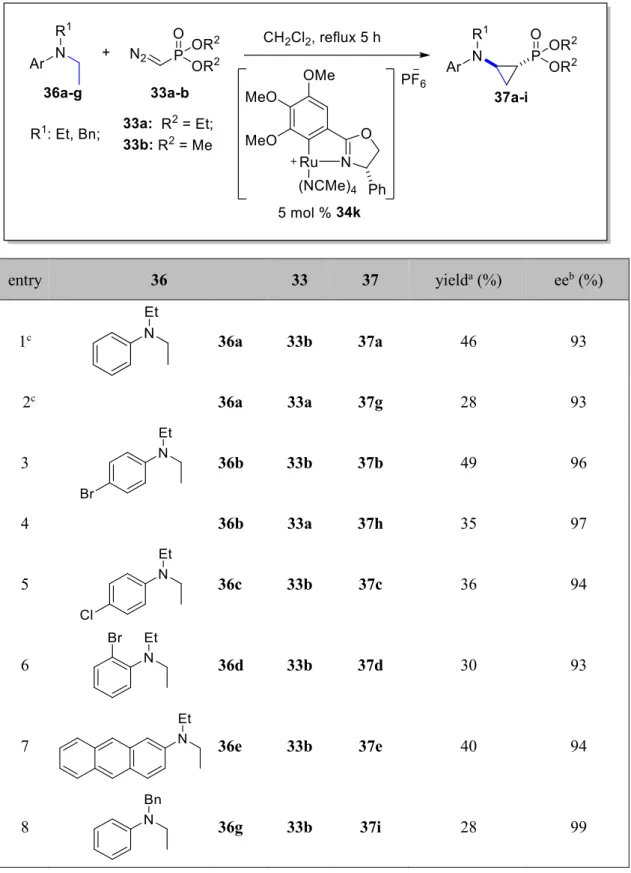
Thus, here in, novel catalysis involving phosphonomethylation of N-methylaniline and asymmetric cyclopropylphosphonation reactions of N,N-diethylaniline derivatives with diazomethylphosphonates are reported. Optically active cyclopropylphosphonate derivatives were directly synthesized from diazomethylphosphonates and N,N-diethylaniline derivatives
iv catalyzed by a 3,4,5 methoxy-Ru(II)-pheox complex in one step in good yields and high diastereoselectivities (up to trans/cis = > 99:1<) and enantioselectivities (up to 99% ee). D labeling mechanistic studies of phosphonomethylation and cyclopropylphosphonation suggested that an enamine or iminium intermediate was generated in the reaction process.
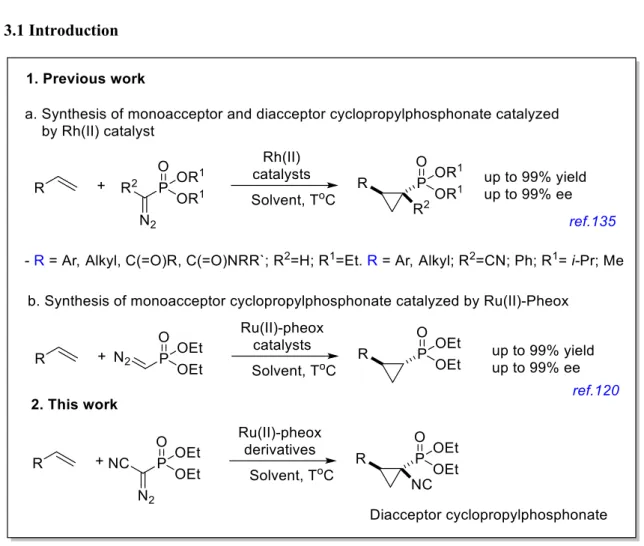
Chapter 3. Continuously, the 3,4,5 methoxy-Ru(II)-Pheox-catalyzed cyclopropanation of styrene with diacceptor diazo compound is initially reported in the corresponding cyclopropylphosphonate product in excellent yield (up to 99%) and good enantioselectivity (up to 68% ee).
Chapter 4. Furthermore, finding catalysts which can cyclopropanate with various diazo compounds to enrich stereoselectivity also have been developed during the last decades. In our previous researches, Ru(II)-pheox-catalyzed asymmetric cyclopropanation of succinimidyl diazoacetate with olefins and allenes resulted in high yields and excellent enantioselectivities and of -unsaturated carbonyl compounds with acetonyl diazoacetate in much higher stereoselectivities (diastereoselectivity >99:1 and enantioselectivity up to 99%). Consequently, herein, The diazo derivative of acetonyl acetate is a useful basic skeleton for the synthesis of cyclopropyl ketones. The intermolecular cyclopropanations of diazo acetoxy acetone with olefins are accomplished by using a novel p-nitro-Ru(II)-diphenyl-Pheox catalyst to give the corresponding optically active cyclopropane derivatives in good yields (up to 95%) with excellent diastereoselectivities (up to 99:1) and enantioselectivities (up to 98% ee).
Chapter 5. Finally, all the experimental and analytical data as the evidence for chapter 2 to 4 are described.
In summary, the Ru(II)−Pheox catalyzed asymmetric cyclopropanation reaction proved to be an efficient and straightforward method for the preparation of chiral cyclopropylphosphonation, diaceptor cyclopropylphosphonates, ketone cyclopropanes, which are important intermediates in the synthesis of many biologically active compounds. We believe that Ru(II)−Pheox derivatives will contribute to the progress of not only asymmetric cyclopropanation but also other asymmetric carbene transfer reactions.
v
Catalytic Asymmetric Cyclopropanations of Diazo Phosphonates and Designed Diazo Ketones
CONTENTS
CHAPTER 1: Introduction 1.1 Carbenes
1.1.1 History of carbene intermediates………...1
1.1.2 Transition metal carbene intermediates 1.1.2.1 Classification of carbene intermediates………...3
1.1.2.1.1 Fisher carbenes………...4
1.1.2.1.2 Schrock carbenes………...4
1.1.2.1.3 Carbene radicals………....5
1.1.2.2 Classification of carbenoid precursors………...5
1.2 Metal carbene intermediates in asymmetric cyclopropanation 1.2.1 Simmons–Smith cyclopropanation………...9
1.2.2 Transition–Metal–Catalyzed cyclopropanation………..10
1.2.2.1 Chiral Catalysts: Cobalt………...11
1.2.2.2 Chiral Catalysts: Copper………....13
1.2.2.3 Chiral Catalysts: Rhodium……….15
1.2.2.4 Chiral Catalysts: Ruthenium………..20
1.3 Synthetic application of metal carbene complexes for bioactive organic compounds………...26
1.4 Objectives………..27
CHAPTER 2: Direct Catalytic Asymmetric Cyclopropylphosphonation Reactions of N,N-Dialkyl Groups of Aniline Derivatives by Ru(II)-Pheox Complex 2.1 Introduction………..28
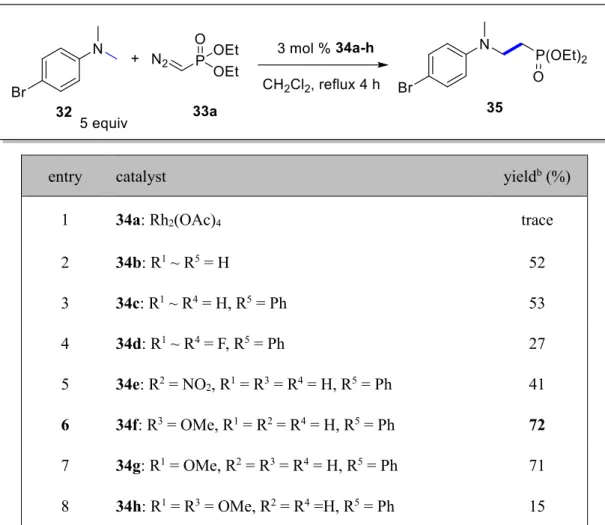
2.2 Results and discussions 2.2.1 Catalyst screenings for the phosphonomethylation reaction of N-methylaniline ………..29
2.2.2 Catalyst screenings for the cyclopropylphosphonation reactions of N,N-diethylaniline derivatives………...30
2.2.3 Substrate scopes………...31
2.2.4 Mechanistic studies 2.2.4.1 Determination of by-product………...33
2.2.4.2 Cyclopropylphosphonation reaction with hydrogen acceptors…………...33 2.2.4.3 Catalytic asymmetric cyclopropanation of N,N’-deuterated diethylaniline
vi
with diazophosphonate...35
2.2.4.4 Plausible mechanism...35
2.3 Conclusion………...37
CHAPTER 3: Asymmetric Synthesis of Diaceptor Cyclopropylphosphonates Catalyzed by Chiral Ruthenium(II)-Pheox Derivatives 3.1 Introduction………...38
3.2 Results and discussions 3.2.1 Catalyst screenings………...39
3.2.2 Optimization conditions………...41
3.3 Conclusion………...42
CHAPTER 4: Catalytic Asymmetric Intermolecular Cyclopropanations of Ketone Carbene Precursor by Novel Ru(II)-Pheox Complex 4.1 Introduction………...43
4.2 Results and discussions 4.2.1 Catalyst screenings………...44
4.2.2 Optimization conditions………...47
4.2.3 Asymmetric cyclopropanation of various olefins………...49
4.2.4 Asymmetric cyclopropanation of various diazo ketones………...50
4.3 Conclusion………...52
CHAPTER 5: Conclusion...53
CHAPTER 6: Experimental and Analytical Data 6.1 General considerations……….54
6.2 Experimental and analytical data for chapter 2 6.2.1 Synthesis of dialkyl diazomethylphosphonates………...55
6.2.2 Synthesis of N,N-diethylaniline derivatives………...55
6.2.3 Synthesis of Ru(II)-Pheox ligands 6.2.3.1 (S)-4-phenyl-2-(2,3,4,5-tetrafluorophenyl)-4,5-dihydrooxa-zole…...56
6.2.3.2 (S)-2-(4-nitrophenyl)-4-phenyl-4,5-dihydrooxazole………..56
6.2.3.3 (S)-2-(3-methoxyphenyl)-4-phenyl-4,5-dihydrooxazole………...57
6.2.3.4 (S)-2-(3,5-dimethoxyphenyl)-4-phenyl-4,5-dihydrooxazole…...59
6.2.3.5 (S)-4-isopropyl-2-(3,4,5-trimethoxyphenyl)-4,5-dihydrooxazole……..59
6.2.3.6 (S)-4-(tert-butyl)-2-(3,4,5-trimethoxyphenyl)-4,5-dihydrooxazole…...60
6.2.3.7 (S)-4-phenyl-2-(3,4,5-trimethoxyphenyl)-4,5-dihydrooxazole...61
6.2.4 Typical procedures for synthesis of Ru(II)-Pheox catalysts………...62
6.2.5 Analytical data for various Ru(II)-Pheox catalysts………...63
6.2.5.1 Tetrafluoro-Ru(II)-Pheox complex...63
vii
6.2.5.2 4-Nitro-Ru(II)-Pheox complex...63
6.2.5.3 o-methoxy and p-methoxy Ru(II)-Pheox 34f and 34g...64
6.2.5.4 3,5 - Methoxy Ru(II)-Pheox complexe 34h...64
6.2.5.5 Iso-propyl-3,4,5 methoxy-Ru(II)- Pheox 34j...65
6.2.5.6 Tert-butyl-3,4,5 methoxy-Ru(II)-Pheox 3i...65
6.2.4.7 3,4,5 methoxy Ru(II)-pheox complexe 34k...66
6.2.6 General procedure for catalytic asymmetric phosphonomethylation of N,N-dimethylaniline with diazomethylphosphonate………..67
6.2.7 Analytical data for catalytic asymmetric phosphonomethylation of N,N-dimethylaniline with diazomethylphosphonate………..67
6.2.8 General procedure for catalytic asymmetric cyclopropanation of ethylaniline derivatives with dialkyl diazomethylphosphonates………...68
6.2.9 Analytical data for catalytic asymmetric cyclopropanation of ethylaniline derivatives with dialkyl diazomethylphosphonates………..68
6.2.10 Cyclopropylphosphonation reaction with hydrogen acceptors………...74
6.2.11 Synthesis of N,N’-deuterated diethylaniline for mechanistic study………....74
6.2.12 General procedure for catalytic asymmetric cyclopropanation of N,N’-deuterated diethylaniline with diazophosphonate………..……..75
6.2.13 Analytical data for for Catalytic asymmetric cyclopropanation of N,N’-deuterated diethylaniline with diazophosphonate………75
6.3 Experimental and analytical data for chapter 3 6.3.1 Synthesis of dialkyl (cyano(diazo)methyl)phosphonates and diethyl (nitro(diazo)methyl)phosphonate………...76
6.3.2 General procedure for catalytic asymmetric cyclopropanation of olefin with diacceptor diazomethyl phosphonates………76
6.3.3 Analytical data for catalytic asymmetric cyclopropanation of olefin with diacceptor diazomethyl phosphonates………76
6.3.4 Analytical data for catalytic asymmetric cyclopropanation of olefin with diacceptor diazomethyl phosphonate 41………77
6.4 Experimental and analytical data for chapter 4 6.4.1 Synthesis of diazo ketones………78
6.4.2 Synthesis of Ru(II)-Pheox ligands 6.4.2.1 (4S, 5S)-2,4,5-triphenyl-4,5-dihydrooxazole………...80
6.4.2.2 (S)-2,4,5,5-tetraphenyl-4,5-dihydrooxazole………...80
6.4.2.3 (S)-2-(3-nitrophenyl)-4,5,5-triphenyl-4,5-dihydrooxazole…………....81
6.4.2.4 (S)-2-(3-methoxyphenyl)-4,5,5-triphenyl-4,5-dihydrooxazole………..82
viii
6.4.2.5 (S)-5,5-dimethyl-2,4-diphenyl-4,5-dihydrooxaz-ole…………...83
6.4.3 Typical procedures for synthesis of Ru(II)-Pheox catalysts………...84
6.4.4 Analytical data for Ru(II)-phenyl-Pheox catalyst and Ru(II)-dialkyl-Pheox catalysts 6.4.4.1 Ru(II)- phenyl -Pheox complex 34q...85
6.4.4.2 Ru(II)-diphenyl-Pheox complex 34r...86
6.4.4.3 p-Nitro Ru(II)-diphenyl -Pheox complex 34t...86
6.4.4.4 m-Methoxy Ru(II)-diphenyl-Pheox complex 34u...87
6.4.4.5 Ru(II)-dimethyl-Pheox complex 34s...87
6.4.5 Typical procedure for catalytic asymmetric cyclopropanation of olefins with diazo acetoxy acetone………88
6.4.6 Analytical data for catalytic asymmetric cyclopropanation reaction products……...88
6.4.7 Typical procedure for catalytic asymmetric cyclopropanation of styrene with various diazo ketones………93
6.4.8 Analytical data for catalytic asymmetric cyclopropanation reaction products ….…...94 IR spectra
NMR spectra HPLC
REFERENCES
LIST OF PUBLICATIONS
ix
LIST OF SCHEMES
Scheme 1 Generation of the first stable radical
Scheme 2 Synthesis of tropolone-derivatives via the insertion of a methylene intermediate.
Scheme 3 Alkene cyclopropanation via methylene intermediate.
Scheme 4 Metal-carbon bonding in Fisher carbene complexes Scheme 5 Metal-carbon bonding in Fisher carbene complexes Scheme 6 Possible mechanisms for the Simmons-Smith reaction
Scheme 7 Accepted catalytic cycle for the carbenoid cyclopropanation reaction Scheme 8 Mechanism of cobalt-porphyrin catalysts
Scheme 9 Cobalt-salen in enantioselective cyclopropanation reactions Scheme 10 Cobalt porphyrins in enantioselective cyclopropanation reactions.
Scheme 11 Copper-bisoxazoline-catalyzed cyclopropanation of some diazoalkanes
Scheme 12 Asymmetric cyclopropanation of -cyanodiazophosphonate and -cyanodiazoacetate
Scheme 13 Enantioselective preparation of cis- -azidocyclopropane esters.
Scheme 14 Enantioselective synthesis of cyclopropanecarboxylates with labile protecting groups on the ester
Scheme 15 Cyclopropanation of styryldiazoacetates
Scheme 16 Asymmetric synthesis of some cyclopropanes catalyzed by Rh2(S-PTAD)4. Scheme 17 Enantioselectivity synthesis of cis-cyclopropane -amino acid precursors.
Scheme 18 Enantioselective cyclopropanation with -diazopropionate Scheme 19 Enantioselective synthesis of spirocyopropyloxindoles
Scheme 20 Asymmetric synthesis of cyclopropylphosphonates catalyzed by Rh2(S-biTISP)2
Scheme 21 Asymmetric cyclopropanation with Rh2(NTTL)4
x Scheme 22 Asymmetric cyclopropanation of 1-tosyl-3-vinylindoles
Scheme 23 Asymmetric cyclopropanation catalyzed by ruthenium porphyrin Scheme 24 Reaction classes of metal-carbenoids
Scheme 25 Procedure for the synthesis of a series of Ru(II)-Pheox catalysts Scheme 26 By-product of cyclopropanation
Scheme 27 Preliminary mechanistic studies
Scheme 28 Plausible mechanism based on D-labeling experiment Scheme 29 Synthesis of Ru(II)-dialkyl-Pheox complexes
xi
LIST OF TABLES
Table 1 Copper(I)-box catalysts employed in enantioselective cyclopropanation reactions Table 2 Catalyst screening for the phosphonomethylation of N,N-dimethylaniline with
diazomethylphosphonate
Table 3 Ru(II)-Pheox catalyst screening of cyclopropanation Table 4 Substrate scope of cyclopropanation
Table 5 Cyclopropylphosphonation reaction with hydrogen acceptors Table 6 Catalyst screenings
Table 7 Optimization of Reaction Conditions Table 8 Initial catalyst screenings
Table 9 Screening of various Ru(II)-pheox type catalysts Table 10 Optimization of the reaction conditions
Table 11 Asymmetric cyclopropanation of various olefins Table 12 Asymmetric cyclopropanation of various diazo ketones.
xii
LIST OF FIGURES
Figure 1 The electronic structure of carbene
Figure 2 Bonding Scheme of Carbene Radical Complexes as compared to Schrock and Fischer-type carbene complexes
Figure 3 Classification of carbenoid precursors
Figure 4 Stability and reactivity of carbenoid precursors in catalytic decomposition
Figure 5 Selected cyclopropane-containing natural products and pharmaceutical compounds
Figure 6 Chiral dirhodium catalysts for asymmetric cyclopropanation Figure 7 Chiral ruthenium catalysts for asymmetric cyclopropanations Figure 8 Research background
Figure 9 Research background Figure 10 Research background
xiii
LIST OF ABBREVIATIONS
Ar aryl
atm atmosphere
Bn Benzoyl
Bu butyl
Calcd calculated Conc. concentrated
d doublet
dd doublet of doublet DFT density functional theory dr diastereomeric ratio dt doublet of triplet EDA ethyl diazo acetate ee enantiomeric excess EDG electron-donating group
EPR Electron paramagnetic resonance technique equiv. equivalent
ESI-MS electrospray ionization – mass spectrometry technique
Et ethyl
Et3N triethyl amine EtOAc ethyl acetate
EWG electron-withdrawing group
g gram
h hour
xiv HPLC high performance liquid chromatography
Hz hertz
iPr isopropyl
IR infrared
m multilplet
M molar
Me methyl
mg milligram
MHz megahertz
min minute
mL milliter
mmol millimole Mp melting point
NMR nuclear magnetic resonance
Ph phenyl
ppm parts per million
q quartet
Rf retention factor (in chromatography) rt room temperature
s singlet
t triplet
tBu tertiary butyl td triplet of douplet temp. temperature
xv tert tertiary
THF tetrahydrofuran
TLC thin layer chromatography TMS tetramethylsilane
tR retention time U.V ultra violet
NOTATIONS
alpha
[𝛂]𝐃 Specific rotation
1H NMR Proton nuclear magnetic resonance spectroscopy
13C NMR Carbon nuclear magnetic resonance spectroscopy
19F NMR Flourine nuclear magnetic resonance spectroscopy
31P NMR Phosphorus nuclear magnetic resonance spectroscopy
Å Ångström (10−10 m)
beta
% percentage
J coupling constant
[M + H]+ Protonated molecular ion (mass spectrometry) chemical shift
oC degree Celsius
1
CHAPTER 1 Introduction
1.1 Carbenes
Carbenes are highly reactive species in which the central carbon only has 6 electrons. The electrons are distributed around the carbon so that 4 electrons are in bonds and the remaining 2 are in a non-bonding orbital. The general formula is R-(C:)-R' or R=C: where the R represents substituents or hydrogen atoms. The term "carbene" may also refer to the specific compound H2C:, also called methylene, the parent hydride from which all other carbene compounds are formally derived. Carbenes are classified as either singlets or triplets, depending upon their electronic structure.
Singlet carbenes are spin-paired. In the language of valence bond theory, the molecule adopts an sp2 hybrid structure. Triplet carbenes have two unpaired electrons. Most carbenes have a nonlinear triplet ground state, except for those with nitrogen, oxygen, or sulfur atoms, and halides directly bonded to the divalent carbon.
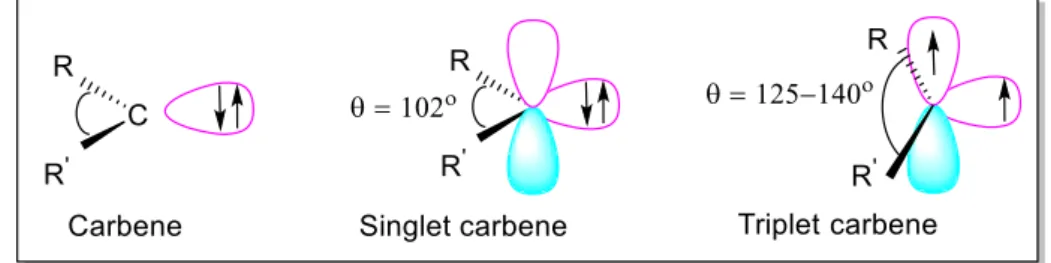
Carbenes are called singlet or triplet depending on the electronic spins they possess. Triplet carbenes are paramagnetic and may be observed by electron spin resonance spectroscopy if they persist long enough. The total spin of singlet carbenes is zero while that of triplet carbenes is one. Bond angles are 125–140° for triplet methylene and 102° for singlet methylene. Triplet carbenes are generally stable in the gaseous state, while singlet carbenes occur more often in aqueous media (Figure 1).
For simple hydrocarbons, triplet carbenes usually have energies 8 kcal/mol (33 kJ/mol) lower than singlet carbenes, thus, in general, triplet is the more stable state (the ground state) and singlet is the excited state species. Substituents that can donate electron pairs may stabilize the singlet state by delocalizing the pair into an empty p orbital. If the energy of the singlet state is sufficiently reduced it will actually become the ground state. No viable strategies exist for triplet stabilization.
Figure 1. The electronic structure of carbene.
1.1.1 History of carbene intermediates
Geuther and Hermann[1] reported the first assumption of a carbene species in 1855. They suggested that the alkaline hydrolysis of chloroform proceeds though the formation of a reaction
2 intermediate with a divalent carbon called dichlorocarbene. In 1897, Nef proposed the same reaction intermediate for the Reimer–Tiemann reaction and the transformation of pyrrol to -chloropyridine in chloroform[2]. They both showed a lot of intuition and courage for their postulations considering that most chemists did not even believe in the existence of free radicals at that time. Indeed, it was only 3 years later that Gomberg characterized the first example of a free radical, triphenylchloromethylene 2 (Scheme 1), through elemental analysis and chemical reactivity[3]. Its discovery was freshly welcomed by the scientific community[4]. Prior to the Great War, Staudinger and Kupfer contributed to the recognition of carbenic reaction intermediates by studying the formation of methylene derivatives[5] and diazomethane[6].
Throughout the 1920s and 1930s, the existence of free radicals was finally well recognized, and their use in organic chemistry as reaction intermediates was growing extremely rapidly[4]. In this context, carbene moieties were regarded as diradicals[7]. The methylene carbene was seen as a linear species, with two degenerate p-orbitals inevitably leading to a triplet state[8]. At the beginning of the 1950s, there was a resurgence of interest in the organic chemical reactions of carbenes[9]. In 1953, Doering and Knox disclosed an elegant synthesis of tropolones 3 via an addition of methylene to substituted benzene (Scheme 2)[10].
Scheme 1. Generation of the first stable radical
Scheme 2. Synthesis of tropolone-derivatives via the insertion of a methylene intermediate.
Scheme 3. Alkene cyclopropanation via methylene intermediate.
The most important contribution of Doering and his collaborators came a year later when
3 they proved the existence of a dibromomethylene intermediate 6, in the first cyclopropanation product 7 operating via the addition of bromoform 5 to an alkene 4 (Scheme 3)[11].
Then more organic synthesis involving the use of methylene were reported[12], prompting chemists and physicists to have a closer look at this carbenic intermediate.
1.1.2 Transition metal carbene intermediates
A transition metal carbene complex (or another name is carbenoid) is an organometallic compound featuring a divalent organic ligand. The divalent organic ligand coordinated to the metal center is called a carbene. Carbene complexes for almost all transition metals have been reported. The term carbene ligand is formalism since many are not derived from carbenes and almost none exhibit the reactivity characteristic of carbenes. Described often as M=CR2, they represent a class of organic ligands intermediate between alkyls (−CR3) and carbynes (≡CR).
They feature in some catalytic reactions, especially alkene metathesis, and are of value in the preparation of some fine chemicals.
1.1.2.1 Classification of carbene intermediates
Metal carbene complexes are often classified into two types. The Fischer carbenes named after Ernst Otto Fischer feature strong π-acceptors at the metal and being electrophilic at the carbene carbon atom. Schrock carbenes, named after Richard R. Schrock, are characterized by more nucleophilic carbene carbon centers; these species typically feature higher valent metals. N-Heterocyclic carbenes (NHCs) were popularized following Arduengo's isolation of a stable free carbene in 1991. Reflecting the growth of the area, carbene complexes are now known with a broad range of different reactivities and diverse substituents. Often it is not possible to classify a carbene complex with regards to its electrophilicity or nucleophilicity.
1.1.2.1.1 Fisher carbenes
Scheme 4. Metal-carbon bonding in Fisher carbene complexes
In the early 1960s, free carbenes were found to be stabilized by coordination to transition metals via formal metal–to–carbon double bond, and some of them could even be isolated as metal–carbene complexes. The donation of d–orbital electrons on the metal to the electron–
deficient carbene carbon makes the carbene more stable and easier to work with. When this d–
4 electron donation is moderate, as in the low oxidation state of middle and late d–series metals, the carbenoids still behave electrophonically, and are known as Fischer carbenes.
Well-stabilized heteroatom containing singlet carbenes, such aminocarbenes and alkoxycarbenes have a significant gap between their singlet and triplet ground states[13]. They form a metal–carbon bond constituted by mutual donor–acceptor interaction of two closed-shell (singlet) fragments. The dominant bonding arises from carbene–metal –donation and simultaneously from metal–carbene –back donation (Scheme 4)[14].
The –electrons are usually polarized toward the metal and the carbon–metal bond has a partial double bond character, which diminishes with the stabilization of the carbene by its groups[14,15]. For instance, in diaminocarbenes, including NHCs, the metal–carbon bond is seen as a simple bond; the –back donation is usually weak because the carbenic carbon is already well stabilized by –donation from its amino-groups[16,17]. Fischer carbene complexes are electrophilic at the carbon–metal bond and are prone to nucleophilic attack at the carbene center (OMe/NMe2 exchange for instance)[14,16,18]. They are associated with low oxidation state metals[14,16,17].
1.1.2.1.2 Schrock carbenes
When the electron donation from the metal to the carbene carbon is extreme, as in the early transition metals, the carbenes become nucleophilic in their reactivity and are known as Schrock carbenes.
Poorly stabilized carbenes such as dialkylcarbenes or alkylidenes have a small gap between their singlet and triplet ground state. They form a covalent metal–carbon bond in nature created by the coupling of two triplet fragments (Scheme 5)[18b,19]. The –electrons are nearly equally distributed between the carbon and the metal, and the metal–carbon bond is seen as a true double bond[14,19]. Schrock carbene complexes are nucleophilic at the carbon–metal bond and are susceptible to react at the carbene center with electrophiles as in a Wittig reaction involving an ylide instead of a carbene[16]. They are found exclusively among early transition metals with the highest oxidation state (d0)[14].
Scheme 5. Metal-carbon bonding in Fisher carbene complexes
5 1.1.2.1.3 carbene radicals
Carbene radicals[20] are long-lived reaction intermediates found with:[21,22,23]
➢ Low oxidation state metal center
➢ Middle and late transition metal, e.g. Co(II)
➢ σ-donor and π-acceptor ligand
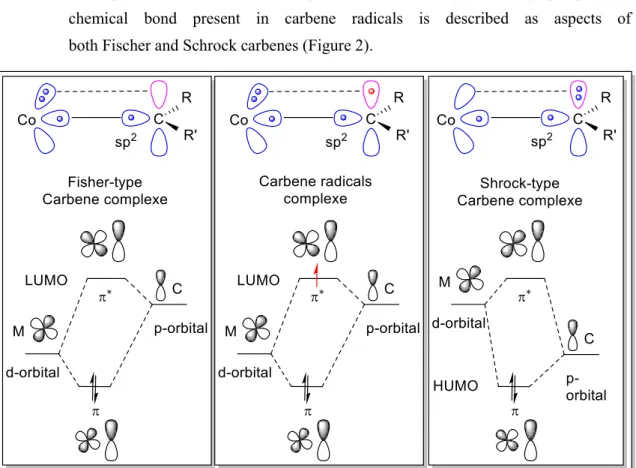
➢ π-acceptor substituents on the ligand such as carbonyl or sulfonyl groups. The chemical bond present in carbene radicals is described as aspects of both Fischer and Schrock carbenes (Figure 2).
Figure 2. Bonding Scheme of Carbene Radical Complexes as compared to Schrock and Fischer-type carbene complexes.
1.1.2.2 Classification of carbenoid precursors
Figure 3. Classification of carbenoid precursors.
6 The reactivity of transitory metal carbenoids is greatly influenced by the nature of the substituents on the carbenoid. Consequently, reviews of metal carbenoids often classify the carbenoids into three distinct groups, the acceptor carbenoids, the acceptor/acceptor carbenoids and the donor/acceptor carbenoids.[24] The terms “acceptor” and “donor” refer, respectively, to the withdrawal and donation of electron density by the functional groups flanking the carbenoid (Figure 3).
Generally, an acceptor substituent makes the carbenoid species more electrophilic and more reactive, whereas a donor group makes the carbenoid more stable and thus more selective in the reaction.[25] It should be noted that the transition metal catalyzed diazo decomposition is dependent not only on the Lewis acidity of the transition metal but also on the basicity of the diazo compounds. Among the diazocarbonyl precursors, those with more withdrawing groups tend to be more stable than those with fewer withdrawing groups since the formal negative charge on diazo carbon can be further delocalized into the additional groups (Figure 4).[26]
Figure 4. Stability and reactivity of carbenoid precursors in catalytic decomposition.
Thus, a larger amount of energy is required for its decomposition to generate a metal carbene.
In general, higher temperatures are required for the decomposition of an acceptor/acceptor diazocarbonyl than for acceptor/donor. Catalyst design remains a central issue in transition metal catalyzed reactions of diazo compounds. The reactivity profile of these transient metal-stabilized carbenoids is highly dependent on the structure of the carbenoid and the type of the metal. Professor Padwa noted this problem succinctly: ‘A survey of the literature dealing with the topic of catalytic diazo decomposition can be both enlightening and frustrating’.[25a]
1.2 Metal carbene intermediates in asymmetric cyclopropanation
Organic chemists have always been fascinated by the cyclopropane subunit.[27] Its strained structure, and interesting bonding characteristics have attracted the attention of the physical organic community.[28] The strain energy is the difference between the observed heat of formation of a strained molecule and that expected for a strain-free molecule with the same number of atoms. Due to the limited degrees of freedom, these conformationally constrained molecules have very pronounced steric, stereoelectronic, and directing effects, which make
7 them versatile probes for the study of regio-, diastereo-, and enantioselectivity.[29] On the other hand, the cyclopropane subunit is present in many biologically important compounds including terpenes, pheromones, fatty acid metabolites and unusual amino acids,[30] and it shows a large spectrum of biological properties, including enzyme inhibition and insecticidal, antifungal, herbicidal, antimicrobial, antibiotic, antibacterial, antitumor, and antiviral activities[31] (Figure 5).
Thus, the community of synthetic organic chemists is also interested in this structure, and thousands of cyclopropane compounds have been prepared.
Nearly all biological compounds are chiral and cyclopropanes are not exempt from this rule, thus synthetic methods to obtain them in enantiopure form have become a key goal and organic chemists have been challenged in this research in recent years. In 2003, the first review on enantioselective cyclopropanation reactions appeared.[32] Pellissier updated the research in this field in 2008.[33] However, new and more efficient methods for the preparation of these entities in enantiomerically pure form are still evolving. Indeed, the last four years have provided an impressive number of developments of asymmetric cyclopropanation, thus a further update is necessary, and this review will focus on the methods that have appeared in the literature from 2008 to mid-2013. Accounts on some aspects of these reactions have also appeared in the literature during recent years.[34]
8
9 Figure 5. Selected cyclopropane-containing natural products and pharmaceutical compounds.
10 1.2.1 Simmons–Smith cyclopropanation
Scheme 6. Possible mechanisms for the Simmons-Smith reaction.
In the late 1950s, Simmons and Smith discovered that the reaction of alkenes with diiodomethane in the presence of activated zinc afforded cyclopropanes in high yields[44]. The reactive intermediate is an organozinc species, and the preparation of such species, including RZnCH2I or IZnCH2I compounds and samarium derivatives, was developed in the following years[45]. The popularity of the Simmons–Smith reaction arose from the broad substrate generality, the tolerance of a variety of functional groups, the stereospecificity with respect to the alkene geometry, and the syn–directing and rate–enhancing effect observed with proximal oxygen atoms[46].
In spite of the practical importance of the asymmetric Simmons–Smith cyclopropanation, the reaction pathway is not completely clear yet[47]. Theoretically, the Simmons–Smith cyclopropanation can proceed via a concerted [2+1] methylene transfer (Scheme 6, path A), in which the pseudo–trigonal methylene group of a halomethylzinc halide adds to an alkene π–
bond and forms two new carbon–carbon bonds simultaneously, accompanying a 1,2–migration of the halide anion from the carbon to the zinc atom. Alternatively, a [2+2] carbometallation mechanism, in which the halomethyl group and the zinc halide add to both termini of the alkene π-bond followed by intramolecular nucleophilic substitution of the pseudo-carbanion, can be supposed (Scheme 6, path B). Experimental studies show that, using a zinc carbenoid, the cyclopropanation very likely proceeds by the [2+1] pathway, primarily because the carbon–
zinc bond is covalent and unpolarized. In 2003, Nakamura et al. studied the reaction pathways of cyclopropanation using the Simmons–Smith reagent by means of the B3LYP hybrid density functional method, confirming that the methylene-transfer pathway was the favored reaction course[47]. It took place through two stages, an SN2–like displacement of the leaving
11 group by the olefin, followed by a cleavage of the C–Zn bond to give the cyclopropane ring.
However, the alternative carbometallation and cyclization pathway was found to be preferred when the carbon–metal bond is more polarized, such as in lithium carbenoids, and this hypothesis has received experimental support[48].
Kinetic studies on the cyclopropanation of dihydropyrroles show an induction period that is consistent with a change in the structure of the carbenoid reagent during the course of the reaction. This mechanistic transition is associated with an underlying Schlenk equilibrium that favors the formation of monoalkylzinc carbenoid IZnCH2I relative to dialkylzinc carbenoid Zn(CH2I)2, which is responsible for the initiation of the cyclopropanation. Density functional theory (DFT) computational studies were also conducted to study the factors influencing reaction rates and diastereoselectivities[49].
1.2.2 Transition–Metal–Catalyzed cyclopropanation
Since the pioneering work of Nozaki et al. in 1966[50], the transition–metal catalyzed cyclopropanation of alkenes with diazo compounds has emerged as one of the most highly effective and stereocontrolled routes to functionalized cyclopropanes. The diastereocontrol in the cyclopropanation is often governed by the particular substituents on both the alkene and the diazo compounds, and thus, the catalyst must be cleverly designed in order to enhance selective formation of cis versus trans or syn versus anti–cyclopropanes. As already seen in the previous section, the most ancient attempts to achieve enantioenriched cyclopropanes used chiral auxiliaries. Since the 1990s, many chiral ligands surrounding the metal center of the catalyst have been introduced for obtaining the enantiocontrol. The accepted catalytic cycle of the carbenoid cyclopropanation reaction involves interaction of the catalyst with the diazo precursor to afford a metallo–carbene complex followed by transfer of the carbene species to the alkene (Scheme 7).
Scheme 7. Accepted catalytic cycle for the carbenoid cyclopropanation reaction.
12 The type of the reaction to be carried out (inter– vs intramolecular) plays a key role in the appropriate selection of the most efficient catalyst for a given transformation. In light of this, this section is divided into inter– and intramolecular cyclopropanation reactions, and in each subsection, chiral auxiliaries are described before and then chiral ligands are listed according to the involved metal ion.
1.2.2.1 Chiral Catalysts: Cobalt
Scheme 8. Mechanism of cobalt-porphyrin catalysts
Cobalt complexes have been shown to be reactive catalysts for the α-diazoester decomposition, leading to a metal carbene that could convert alkenes to cyclopropanes. In 2009, Doyle published a highlight article collecting what was known on this topic[51]. The mechanism of this reaction was examined by EPR and electrospray ionization–mass spectrometry (ESI-MS) techniques, especially when cobalt–porphyrin catalysts were used, and evidence for a two-step mechanism was uncovered (Scheme 8)[52].
The first step is an adduct formation that could exist as two isomers: the “terminal carbene”
8 and the “bridging carbene” 9. In the former, the “carbene” behaves as a redox noninnocent ligand having a d6 cobalt center and the unpaired electron resides on the “carbene” carbon atom. In the latter, the “carbene” is bound to the metal and one of the pyrrolic nitrogen atoms of the porphyrin. DFT calculations suggested that the formation of the carbene is the rate–
limiting step and that the cyclopropane ring formation proceeds by way of a stepwise radical process. Conclusive evidence for the existence of cobalt(III) carbene radicals has been
13 obtained[53]. In fact, in the absence of the alkene substrate, the “terminal carbene” arising from diazoacetate dimerizes to afford binuclear cobalt(III)–porphyrin complex, characterized by X-ray structural analysis. Calculation methods confirmed that the “terminal carbene” complex has a single bond from the metal to the carbon atom and radical character with localized spin density on the carbon. In addition, the carbon is nucleophilic in character and “tunable”
through the introduction of different R substituents in order to achieve the desired reactivity.
Based on these findings, rational design strategies to enhance catalytic activity can be proposed [54], highly increasing the low level of diastereo- and enantiocontrol of the early work in this area [55].
Scheme 9. Cobalt-salen in enantioselective cyclopropanation reactions.
Scheme 10. Cobalt porphyrins in enantioselective cyclopropanation reactions.
14 Colbalt-salens are the potential efficient catalysts for asymmetric cyclopropantions of tert-butyl diazoacetate 10 with olefins 11 in excellent yield and enantioselectivity (Scheme 9).
Other hands, their analogs, cobalt-porphyrins have been also found to be efficient catalysts for cyclopropanation of α–cyanodiazoacetates with alkenes as atypical dominant Z–isomers (Scheme 10)[56]. Conversely, rhodium-based chiral catalysts provided predominantly the E–
isomers (see Section 2.2.3)[57]. 1.2.2.2 Chiral Catalysts: Copper
Ligand R E/Z ee (%) References
D-Menthyl 86:14 98 (E)
96 (Z)
[165, 166]
BHT Et Et
94:6 77:23 72:28
99 (E) 99 (E) 98 (E)
[167]
[168]
[169]
Et 84:16 100 (E)
100 (Z)
[177]
Table 1. Copper(I)-box catalysts employed in enantioselective cyclopropanation reactions.
Chiral copper-based catalysts are the most effective catalysts for the preparation of the trans-isomer of cyclopropanes with the widest reaction scope. Among them, nonracemic C2-symmetric bidentate bisoxazoline (box) ligands have been used in cyclopropanation reactions with copper for more than 30 years[58]. Many investigations have shown that the ligand structure has a strong influence on the stereoselectivity of the cyclopropanation. Even very small structural changes often have drastic and sometimes unpredictable effects on the enantioselectivity, and the phenomenon comprehension is complicated by very low enthalpic barrier for the transition states leading to the R- and S-products. However, since 2001, using DFT calculations, Salvatella and coworkers rationalized the stereochemical prediction of the cyclopropanation. The calculated relative energies are in good agreement
15 with the experimental enantiomeric excesses as well as with the Z/E ratio[59]. In 2004, Mend et al. studied again this reaction by means of DFT, showing that it was exothermic and that the turnover-limiting step was the formation of metal catalyst–cyclopropyl carboxylate complexes[60]. Then, Maseras and coworkers found a barrier, which arises from the entropic term, in the Gibbs free-energy surface compatible with the experimentally observed enantioselectivity[61]. The data set included 30 chiral ligands belonging to four different oxazoline-based ligand families.
Some examples of chiral ligands for the copper-catalyzed cyclopropanation in excellent yield as well as stereoselectivity are listed in Table 1.
Scheme 11. Copper-bisoxazoline-catalyzed cyclopropanation of some diazoalkanes Some of these copper(I)-box catalyzed reaction were then employed in multistep synthesis of natural products[62]. For instance, cyclopropanation of furans was applied to the total syntheses of some key intermediates of natural products and drugs[63].
Alkenes that were more complex were also involved in copper–bisoxazolinecatalyzed cyclopropanation with diazoalkanes. The cyclopropanation of 2,5-dimethyl-2,4-hexadiene 15 with t-butyl diazoacetate 10 (Scheme 11, eq 1)[64]. Diazoalkanes other than alkyl diazoacetates have also been employed in copper–bisoxazoline-catalyzed cyclopropanations. For instance,
16 α-diazophosphonate diazomethanes 16-18 was used to obtain cyclopropylphosphonate derivatives under Cu-ent-box2 catalysis (Scheme 11, eq 2). However, Nishiyama’s ruthenium catalyst (see Section 1.2.2.4) gave better results and can be used with a wider range of substrates (88 : 12 to >98 : 2 E/Z ratio, 90–96% ee also with substituted styrenes, α-methylstyrene, and 1-phenylbuta-1,3-diene)[65]. Another example is the cyclopropanation of alkenes with ethyl phenyldiazoacetate 19 (Scheme 11, eq 3)[66].
1.2.2.3 Chiral Catalysts: Rhodium
Although many transition metal chiral complexes have been developed, dirhodium(II) complexes are among the most attractive catalysts, because of their activity and efficiency.
Dirhodium(II) catalysts with very high turnover numbers have been reported, and consequently, the cost and toxicity of rhodium can be greatly overshadowed by the ability to use tiny amounts of the catalyst to generate large quantities of value added products. The use of dirhodium(II) catalysts in inter- and intramolecular asymmetric cyclopropanation has been recently reviewed
[67], and readers are invited to read this review for other information.
Figure 6. Chiral dirhodium catalysts for asymmetric cyclopropanation.
Rhodium-based chiral complexes were synthesized and tested in both inter- and intramolecular cyclopropanations. In particular, the development of dirhodium(II) carboxylate and carboxamidate catalysts (Figure 6) has resulted in many highly chemo-, regio-, and
17 stereoselective reactions of α-diazocarbonyl compounds[68]. As a general guideline, the level of diasterocontrol with rhodium carbenes does not match that observed with copper, ruthenium, or cobalt carbenes, even when sterically hindered α-diazoesters are used. This drawback has minimized the use of rhodium catalysts in intermolecular processes involving simple α-diazoesters in the most ancient period of asymmetric synthesis.
Charette’s research group found Rh2(S-IBAZ)4 as an efficient catalyst for cyclopropanation of α-cyanodiazophosphonate 20 and α-cyanodiazoacetate 13 (Scheme 12)[69]. The particular electrophilicity of cyanocarbene intermediates permitted the use of allenes as substrates, affording the first catalytic asymmetric alkylidene cyclopropanation reaction using diazo compounds. In fact, α-cyanocarbenes are forced to stay in-plane, conversely from other electron-withdrawing groups, which adopt an out-of-plane conformation (see below). The in-plane conformation is highly energetic, thus leading to a more electron-deficient reactive carbene, allowing less nucleophilic π-systems such as allenes to react.
Scheme 12. Asymmetric cyclopropanation of -cyanodiazophosphonate and -cyanodiazoacetate.
Scheme 13. Enantioselective preparation of cis- -azidocyclopropane esters.
β-Aminocyclopropane carboxylic acids are widely used in peptide syntheses, but they cannot be efficiently prepared from asymmetric cyclopropanation of N-protected enamines[70]. However, azidoalkenes could be regarded as alternative precursors of cis-β-aminocyclopropane carboxylic acids, and Rh2(SDOSP)4 was found to be an efficient catalyst for the preparation of
18 (1R,2S)-isomers (Scheme 13)[71]. The reaction can be carried out on gram scale with the same yield but with slightly lower enantioselectivity and longer reaction time.
Finally, intermolecular asymmetric cyclopropanations of aryldiazoacetates with labile protecting groups on the ester and styrene derivatives can be catalyzed by chiral dirhodium(II) complexes Rh2(S-DOSP)4 and Rh2(R-BPCP)4. In particular, the trimethylsilylethyl aryldiazoacetates 21 gave the best results with Rh2(S-DOSP)4, while trichloroethyl aryldiazoacetates 22 with Rh2(R-BPCP)4 (Scheme 14)[72].
Scheme 14. Enantioselective synthesis of cyclopropanecarboxylates with labile protecting groups on the ester.
Similar dirhodium complex Rh2(R-BTPCP)4 was found to be an effective chiral catalyst for the enantioselective cyclopropanation of styryldiazoacetates (Scheme 15)[73]. DFT computational studies at the B3LYP and UFF levels suggested that when the carbenoid binds to the catalyst, two of the 4-bromophenyl groups rotate outward to make room for the carbenoid.
Then, the ester group aligns perpendicular to the carbene plane and blocks attack on its side.
Thus, the substrate approaches over the donor group, but it finds the Re-face blocked by the aryl ring of the ligand and only the Si-face open for the attack, in agreement with the observed absolute configuration of the product.
Scheme 15. Cyclopropanation of styryldiazoacetates.
The enantiomer Rh2(S-PTAD)4 catalyzed the stereocontrolled synthesis of nitrile-substituted
19 cyclopropanes from 2-diazo-2-phenylacetonitrile 24 and aryl alkenes (Scheme 16, eq 1)[74]. It is worth noting that the small cyano acceptor group would be unable to influence the selectivity.
In fact, as reported earlier, studies on the mechanism asserted that the bulkiness of the electron-withdrawing group drives the selectivity. This is true for alkylethenes (formed as 61 : 39 to 46 : 54 mixtures of diastereomers), but high diastereoselectivity was observed with styrenes. Therefore, the authors claimed an attractive π-stacking interaction between the aryl rings of styrene and phthalimide during the cyclopropanation that is absent in alkyl-substituted alkenes. Catalyst Rh2(S-PTAD)4 also catalyzed the reaction of aryl-α-diazo ketones 25 with activated alkenes (Scheme 16, eq 2)[75]. The enantioselectivity dropped when either the aryl group in R1 was substituted with a styryl group or bulky groups were close to the carbonyl and increased when the alkyl chain of the ketone group was lengthened. Vinyl acetate, dihydrofuran, and dienes were less enantioselective, while vinyl ether and inactivated alkenes were not effective substrates.
Scheme 16. Asymmetric synthesis of some cyclopropanes catalyzed by Rh2(S-PTAD)4.
Scheme 17. Enantioselectivity synthesis of cis-cyclopropane -amino acid precursors.
Similar results were obtained in the cyclopropanation of alkenes with diazoacetophenones under Rh2(S-TCPTTL)4 catalysis (Scheme 17)[76]. The reaction could be carried out on a multigram scale. Different substituted diazoacetophenones showed similar efficiency, except for
20 the 4-dimethylamino derivative that achieved only 38% yield. Unfortunately, alkyl-substituted alkenes did not provide the corresponding cyclopropanes in useful yields, and dienes afforded only Cope-rearranged achiral products.
Hashimoto described that the reaction of 1-aryl-substituted and related conjugated alkenes with tert-butyl α-diazopropionate 26 by catalysis with Rh2(S-TBPTTL)4 led to the corresponding (1R,2S)-cyclopropanes containing a quaternary stereogenic center (Scheme 18)[77].
Scheme 18. Enantioselective cyclopropanation with -diazopropionate.
Awata and Arai achieved the asymmetric cyclopropanation of diazooxindoles 27 with Rh2(S-PTTL)4 as the catalyst. Spirocyclopropyloxindoles, which constitute biologically important compounds, were obtained in good yield and diastereoselectivity (Scheme 19)[78]. Then the mechanism of this reaction was detailed by DFT calculations, which demonstrated that the origin of the trans-diastereoselectivity lies in the π–π interactions between the syn-indole ring in carbenoid ligand and the phenyl group in styrene. The enantioselectivity could be ascribed both to steric interaction between the phenyl ring in styrene and the phthalimide ligand and to stabilization of π–π and CH–π interactions in the transition states[79].
Scheme 19. Enantioselective synthesis of spirocyopropyloxindoles.
Rh2(S-biTISP)2 was able to catalyze the cyclopropanation of styrene with methyl phenyldiazoacetate with high turnover number (92 000) and turnover frequency (4000 h−1).
This is one of the rare examples of a large-scale reaction with rhodium catalysts; in fact, with a substrate/catalyst ratio of 100 000, 92% yield and 85% ee were obtained on a crude of 46 g. In addition, this catalyst, immobilized on highly cross-linked polystyrene resins with a pyridine attachment, provided up to 88% ee for this reaction[80]. Finally, the same catalyst was applied to the stereoselective synthesis of cyclopropylphosphonates containing quaternary stereocenters by
21 the reaction of dimethyl aryldiazomethylphosphonates 29 (Scheme 20)[81].
Scheme 20. Asymmetric synthesis of cyclopropylphosphonates catalyzed by Rh2(S-biTISP)2. The Rh2(NTTL)4 catalyst was the best-performing catalyst in the synthesis of cyclopropylphosphonate derivatives (Schemes 21)[82]. The selectivity is independent of the size of the phosphonate group and can be predicted by Hashimoto’s model. The use of Meldrum’s acid, methyl diazostyrylacetate 29e and methyl diazophenylacetate 29a instead of the phosphonate ester group dramatically deteriorated the asymmetric induction.
Scheme 21. Asymmetric cyclopropanation with Rh2(NTTL)4. 1.2.2.4 Chiral Catalysts: Ruthenium
The success of the rhodium complexes in catalyzing carbene-transfer reactions is tempered by the high price of this metal. Therefore, ruthenium, a direct neighbor of rhodium in the periodic table, has been more recently introduced in the field of catalytic cyclopropanation, because it costs roughly one-tenth the price of rhodium. Another reason for focusing attention on ruthenium catalysts is the greater diversity of complexes to be evaluated, due to the richer coordination chemistry, as compared to rhodium[83].
Thus, many highly active and selective homogeneous catalysts have been introduced for the asymmetric cyclopropanation of alkenes (Figure 7)[84].
22 Figure 7. Chiral ruthenium catalysts for asymmetric cyclopropanations.
23 Indeed, in a short time, ruthenium has emerged as the third important catalyst metal for the carbenoid chemistry of diazo compounds, besides copper and rhodium. However, a significant drawback of Ru catalysts is the rather low electrophilic character of the presumed ruthenium–
carbene intermediates, which often restricts the application to terminal activated alkenes and double bonds with a higher degree of alkyl substitution. Another limitation of some ruthenium complexes is the ability to catalyze other alkene reactions as well as cyclopropanation leading to many by-products. However, if ruthenium catalysts work successfully, they often rival rhodium catalysts in terms of effectiveness and relative, as well as absolute, stereochemistry.
Some methods of heterogenization of ruthenium catalysts, for instance, supporting them on polymer or porous silica supports, have been investigated. Their activity, selectivity, and recyclability have all been compared to those of the analogous homogeneous catalysts.
Nishiyama’s catalyst[85] has already been proven as better catalyst compared to Cu-ent-box5 catalyst in the synthesis of cyclopropylphosphonate derivatives[65]. In the reactions with pybox ligands, the geometry of the recovered products is consistent with a model, in which the phenyl group of styrene approaches the carbenoid species away from the ester and isopropyl groups.
Two interesting observations have been made.
i) A remote stereoelectronic effect exerted by the substituent in the 4-position of the pyridine ring has been reported[86]. Electron-donating substituents decrease (84% ee for the cyclopropanation of styrene if X = NMe2), and electronwithdrawing groups increase the enantiomeric excess significantly (X = CO2Me, 97% ee). The E/Z ratios were instead not affected by the substituents.
ii) Non-C2-symmetric ligands are also quite effective in this reaction. For example, Ru-Pybox4 afforded the cyclopropane not only with high enantioselectivity but also with an improved diastereoselectivity, very likely because the removal of one of the oxazoline substituents created more space for the ester group in the chiral pocket[87].
Later, Deshpande et al. used Nishiyama’s catalyst to catalyze the cyclopropanation of styrene with EDA, providing the corresponding trans-cyclopropane in 98% yield, with 96 : 4 dr, and 86% ee (trans)[88]. Moreover, 1-tosyl-3-vinylindoles were excellently cyclopropanated by Nishiyama’s catalyst with ethyl and t-butyl diazoacetate (30, 13) (Scheme 22)[89]. It should be noted that the E/Z diastereoselectivity was notably improved when using t-butyl diazoacetate.
Moreover, the utility of this method was demonstrated by the conversion of one of the resulting chiral cycloadducts into BMS-505130, a selective serotonin reuptake inhibitor.
Nishiyama also developed the water-soluble hydroxymethyl derivative (Ru-Pybox4). The reaction of styrene with different diazoacetates in aqueous media provided the corresponding cyclopropanes in 24–75% yields, with 92 : 8 to 97 : 3 E/Z ratio, 57–94% ee (1S,2S), and 26–
76% ee (1R,2S)[90].