RE-EXAMINATION OF PREVIOUS CORRELATION OF DISTAL KS5 TEPHRA AND PROXIMAL ODA PYROCLASTIC
FLOW DEPOSITS IN SOUTH KYUSHU, SW JAPAN
Fumikatsu NISHIZAWA and Takehiko SUZUKI
Abstract Two pyroclastic flow deposits named Nabekura (Nb) and Oda (Oda) Pyroclastic Flow Deposits in ascending order, in the southern Kyushu Island, SW Japan, are intercalated in the Kokubu Group distributed around the northern coastal area of the Kagoshima Bay. The purpose of this study is to reveal their differences in petrographic properties such as glass chemistry and refractive indices of volcanic glass shards, hornblende, and orthopyroxene. Nb and Oda are evidently distinguished by refractive indices of orthopyroxene and variation in the chemical composition of glass shards. We re-examined the proposed correlation of Oda with Ks5 (Boso Peninsula, Central Japan) by previous studies, comparing other two distal tephras petrographically similar to Ks5. It is concluded that Oda is not correlated to Ks5, OgA, and Hg-7.
Key words:tephra, correlation, Middle Pleistocene, Oda pyroclastic flow deposits, Ks5
1. Introduction
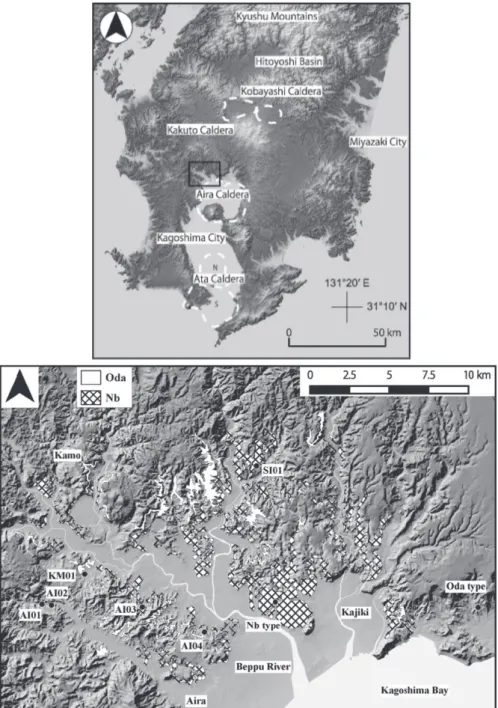
Ks5 Tephra (Ks5; Machida et al.1980; Tokuhashi and Endo 1984) in the Kasamori Formation of the Kazusa Group in the Boso Peninsula, Central Japan, was considered to be one of Middle Pleistocene widespread tephras that have been derived from a certain caldera in the Kyushu Island, SW Japan. Thus, Ks5 of which eruptive age is 450 ka (Machida 1999) was correlated to Oda Pyroclastic Flow Deposits (Oda; Otsuka and Nishiinoue 1980) distributed in the northwest area facing the Kagoshima Bay (Fig. 1), based on the glass chemistry (Mizuno 1997; Suzuki and Fujiwara 1998). The tephras correlated to Ks5 were also recognized in the Osaka Group (Minatojima I Tephra; Yoshikawa et al.2000), the Kobiwako Group (Ikadachi II Tephra; Satoguchi and Hattori 2008) and the Shibikawa Formation distributed in the Oga Peninsula (Wkm Tephra;
Machida and Arai 2003). However, these correlations are inconsistent with the stratigraphical relationship of Ks5 and another distal tephra in the Boso Peninsula as mentioned below. The Kokubu Group (KKG; Ida et al.1950) which containing tephras derived from mainly pre-Aira caldera is distributed around the coastal area of the northern Kagoshima Bay. Oda is intercalated in KKG with a petrographically similar ignimbrite (indiscernible by mineral assemblage) named Nabekura Pyroclastic Flow Deposits (Nb; Otsuka and Nishiinoue 1980). According to Sato et al.
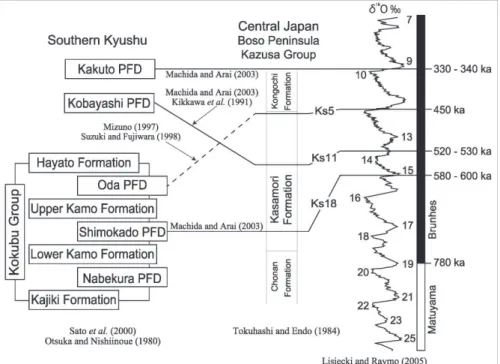
(2000), the KKG is overlain by the Kobayashi Pyroclastic Flow Deposits. Kikkawa et al. (1991) correlated the Kobayashi Pyroclastic Flow Deposits to Ks11 in the Kasamori Formation, defined Kb-Ks (520–530 ka; Machida and Arai 2003), one of the most important Middle Pleistocene marker tephras distributed from the southern Kyushu to eastern Honshu. However, Kb-Ks (Ks11) correlated
Fig. 1 Regional setting and the study area. The distribution of Nb and Oda are after Hase et al. (1987).
to the Kobayashi Pyroclastic Flow Deposits is positioning under Ks5 correlated to Oda in KKG.
The purpose of this study is to examine the correlation of Oda with Ks5, considering the petrographic properties of Nb and Oda, based on detailed petrographic properties of them, such as glass chemistry, refractive indices of volcanic glass shards, hornblende, and orthopyroxene.
2. Study Area and Stratigraphy
The 1000 km-long southern Kyushu-Ryukyu arc includes several large calderas such as the Kikai, Ata, Aira, Kakuto, and Kobayashi calderas from south to north. These are developed in the Kagoshima Graben which is the eastern margin of the volcano-tectonic depression. These calderas except the Kikai caldera provided huge ignimbrites by large caldera eruptions through the Middle to Late Pleistocene (Moriwaki et al.1991) (Fig.1).
Along the northwest coast of the Kagoshima Bay, the KKG was firstly described by Ida et al.
(1950) as a lacustrine sediment, and afterward redefinded by several authors (e.g. Otsuka and Nishiinoue 1980; Hase et al. 1987; Otsuka and Furukawa 1988; Sato et al. 2000). Otsuka and Furukawa (1988) argued that KKG has accumulated in shallow waters, consisting of massive silt, alternation of silt and sand layers, and tuff. Otsuka and Nishiinoue (1980) defined two pyroclastic flow deposits, Nb and Oda in ascending order. Nb and Oda are corresponded to the Komiyaji tuff breccia member and the Oda tuff member defined by Hase et al. (1987) in the KKG, respectively.
According to the recent research by Sato et al. (2000), KKG is subdivided into the six geologic units, including the Kuwanomaru pumiceous tuff member (Shimokado PFD; Oki and Hayasaka 1970) newly defined (Fig. 2). In this paper, we refer to the stratigraphy of KKG (Fig. 2) shown by Sato et al. (2000). Figure 2 shows the correlations of the distal tephras in the Kasamori Formation and proximal ignimbrites in the southern Kyushu by previous studies (Kikkawa et al. 1991; Mizuno 1997; Suzuki and Fujiwara 1998; Machida and Arai 2003). Zircon-FT ages of 0.96 ± 0.17 Ma, 0.97
± 0.22 Ma were obtained for Nb and Oda, respectively (Hase and Danhara 1985). Recently, an ITPFT age of 0.49 ± 0.06 Ma for Nb was obtained by Moriwaki et al. (2000).
Fig. 2 Correlation of the Middle Pleistocene ignimbrites distributed around the northwest area of the Kagoshima Bay and Ks-tephras in the Kasamori Formation.
The eruptive ages are after Machida (1999) and Machida and Arai (2003).
3. Method
The localities around the northern coastal area of the Kagoshima Bay are shown in Fig. 1.
Samples of Nb and Oda were collected at outcrops shown in the geologic map by Hase et al. (1987).
In the central Boso Peninsula, Ks5 was sampled at Uchihata in the Chiba prefecture (N35°27′38″, E140°14′02″with WGS84).
Each sample was washed several times. Pumice clast was crushed into coarse sand-sized grains.
The crushed samples were cleaned using an ultrasonic bath until the clay and silt had been removed.
After drying and sieving, the grains 0.25 to 0.063 mm in diameter were used for fingerprinting.
Refractive indices of volcanic glass shards, hornblende, and orthopyroxene were determined by the thermal immersion method (Danhara et al.1992) using the RIMS2000 Refractive Index Measuring System (Kyoto Fission-Track Co., Ltd.). Major element compositions of volcanic glass shards from pyroclastic flow deposits and ash fall deposits were determined by an energy dispersive X-ray spectrometer (EDAX GENESIS APEX2 and JEOL JSM-6390) according to the method shown by Suzuki et al. (2014).
4. Results and Discussion Description
In this section, we describe the lithological and petrolographic properties of three tephra layers, that is, two pyrocrastic deposits as Nb and Oda, and one volcanic ash fall deposit as Ks5.
Nabekura Pyroclastic Flow Deposits (Nb)
At the type locality (Fig. 1), the cliff of the Tenpukuji in the Aira city, Nb is exposed with a thickness of > 60 m, as non-welded pyroclastic flow deposit. Nb is unconformably underlain by the Kajiki Formation around the type locality (Otsuka and Nishiinoue 1980). The base of the pyroclastic flow deposit cannot be observed. This lithofacies is massive, light to dark gray colored deposit with no internal structures. The basal part of Nb is a tuff breccia dominated by 10–50 mm lapilli and blocks approximately 10 cm in diameter within a matrix of medium-coarse ash. Nb is poorly sorted, matrix-supported, and rich in white pumice clasts. The pumice clasts are moderately vesiculated, angular to subangular, mainly 1–5 cm, up to 20 cm in length. The accessory fragments of andesite are angular with diameters of several centimeters.
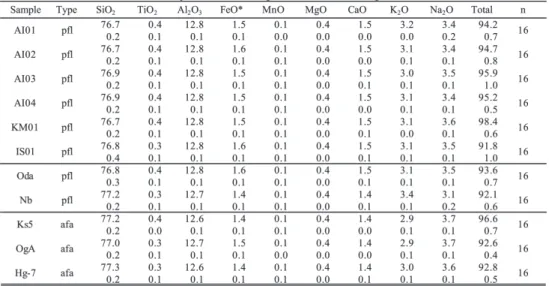
Nb contains abundant orthopyroxene, and small numbers of clinopyroxene and hornblende. The average grain size of phenocrysts is smaller than 1 mm. The refractive indices of orthopyroxene and hornblende are γ: 1.705–1.708 and n2: 1.669–1.686, respectively (Table 1). Nb is characterized by fiber type and sponge type of volcanic glass shards whose refractive index and chemical composition are n: 1.499–1.505 (1.502–1.503), SiO2: 76.2–77.6 wt.%, Al2O3: 12.6–12.8 wt.%, FeO*: 1.2–1.6 wt.%, CaO: 1.2–1.5 wt.%, K2O: 3.3–3.6wt.%, and Na2O: 2.7–3.4 wt.% (Tables 1 and 2).
Oda Pyroclastic Flow Deposits (Oda)
At the type locality of Oda, the Forestry Road in Odanishi, the north-west of the Hayato Town (Fig. 1), Oda with a thickness of > 70 m is exposed, as non-welded pyroclastic flow deposit. Oda is overlain by a greyish silt layer of the Hayato Formation. This lithofacies is composed of massive, light brown colored deposit with no internal structures. The basal part of Oda is a tuff breccia dominated by 10–30 mm lapilli within a matrix of coarse-fine ash. Oda is poorly sorted, matrix- supported, and including white pumice clasts. The pumice clasts are poorly to moderately
vesiculated, angular to subangular, mainly 3 cm, up to 15 cm in length. The accidental fragments are subangular, composed of andesite, up to 10 cm in length.
Oda contains abundant orthopyroxene, and relatively few hornblende and clinopyroxene. The average grain size of phenocrysts is smaller than 2 mm in diameter. The refractive indices of orthopyroxene and hornblende are γ: 1.708–1.712 and n2: 1.669–1.686, respectively (Table 1). Oda is characterized by abundant fiber type and stripe type of volcanic glass shards whose refractive index and chemical composition are n: 1.501–1.504 (1.503–1.504), SiO2: 76.3–76.9 wt.%, Al2O3: 12.7–12.9 wt.%, FeO*: 1.5–1.8 wt.%, CaO: 1.4–1.6 wt.%, K2O: 3.0–3.3 wt.%, and Na2O: 3.4–3.8 wt.% (Tables 1 and 2).
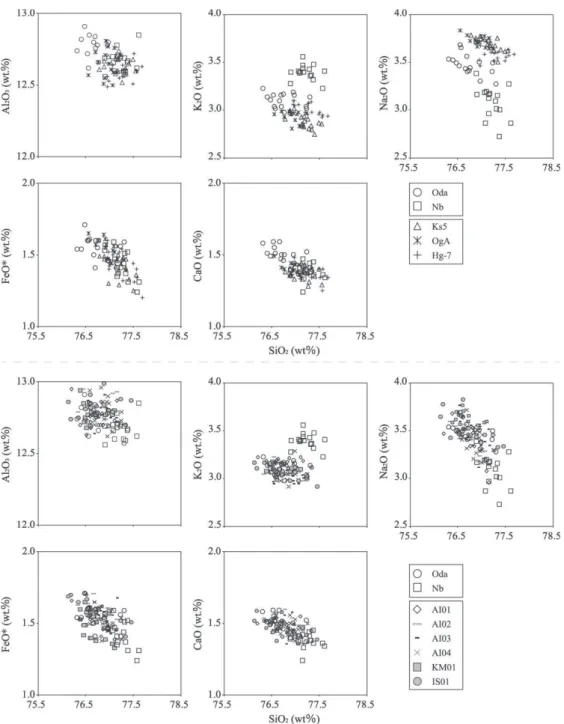
We recognized Oda at six localities (Fig. 1; AI01 to AI04, KM01, and IS01). The mode of refractive index and chemical composition of the volcanic glass shards in these pyroclastic flow deposits are n: 1.504–1.505, SiO2: 76.1–77.5 wt.%, Al2O3: 12.6–13.0 wt.%, FeO*: 1.3–1.7 wt.%, CaO: 1.4–1.6 wt.%, K2O: 2.9–3.3wt.%, and Na2O: 3.0–3.8 wt.% (Tables 1, 2 and Fig. 3).
Table 1 Petrographic properties of tephras
Table 2 Major element composition of volcanic glass shards
Fig. 3 Comparison of chemical composition of glass shards.
Ks5 Tephra
Ks5 is a whitish fine vitric ash layer with a thickness of 20 cm, exposed at Uchihata in Nagara Town (N35°27′38″, E140°14′02″). The sample for the analysis was collected from the basal part.
Ks5 is characterized by an abundant bubble-wall type glass shards and small amount of hornblende
and orthopyroxene. Refractive index and chemical composition of Ks5 glass shards are n: 1.505–
1.506 (1.505), SiO2: 76.8–77.6 wt.%, Al2O3: 12.5–12.7 wt.%, FeO*: 1.3–1.5 wt.%, CaO: 1.3–1.4 wt.%, K2O: 2.8–3.0 wt.%, and Na2O: 3.5–3.8 wt.% (Tables 1, 2 and Fig. 3).
Difference in petrographic properties between Nb and Oda
The mineral assemblage of mafic minerals in Nb is similar to that in Oda, both containing orthopyroxene and small amount of hornblende and clinopyroxene (Table 1). The range of refractive index of volcanic glass shards is also similar between Nb (n: 1.499–1.505) and Oda (n: 1.500–1.504), whereas that of orthopyroxene are evidently different. Oda bears orthopyroxene with higher refractive index (γ: 1.708–1.712) compared with that of Nb (γ: 1.705–1.708). The difference in glass chemistry between Nb and Oda is also obvious as shown in the SiO2-K2O, SiO2-CaO, and SiO2- Na2O diagrams particularly (Fig. 3). Nb glass shards have higher SiO2and K2O contents, and lower Al2O3, FeO, CaO, and Na2O contents than those of Oda glass (Table 2 and Fig. 3). Thus, Oda is clearly distinguished from Nb in each petrographic property.
Re-examination of the correlation of Oda and Ks5
We re-examined the correlation of Oda to Ks5 proposed by previous studies, considering other Middle Pleistocene distal vitric tephras petrographically similar to Ks5 such as Ogoyama Volcanic Ash (OgA; Nakazato et al.2005) in Northeast Kanto Plain, central Japan, and Hikage 7 Volcanic Ash (Hg-7; Takahashi and Hayakawa 1995) in the Nakanojo Basin, North Kanto. OgA and Hg-7 are correlated to BT72 tephra in the Osaka Group (Nakazato et al.2005). The estimated age of BT72 is 349 ka (Nagahashi et al.2004). The ranges of refractive indices of volcanic glass shards in OgA and Hg-7 are n: 1.503-1.504 and n: 1.502-1.505, respectively, shown by Nakazato et al. (2005) and Takahashi and Hayakawa (1995). The chemical compositions of volcanic glass shards in OgA and Hg-7 are SiO2: 76.6–77.6 wt.%, Al2O3: 12.5–12.8 wt.%, FeO*: 1.3–1.7 wt.%, CaO: 1.3–1.4 wt.%, K2O: 2.8–3.1 wt.%, and Na2O: 3.5–3.8 wt.% (Table 2 and Fig. 3).
In comparison of chemical compositions of volcanic glass shards, it was found that the compositions are very similar among Ks5, OgA, and Hg-7, however differ from Nb and Oda (Table 2 and Fig. 3). Oda glass shards have higher Al2O3, FeO and CaO contents, and lower SiO2contents than those of others (Table 2 and Fig. 3). The difference in glass chemistry between Oda and Ks5 is clear as shown in the SiO2-K2O and SiO2-Al2O3diagrams (Fig. 3). As shown in Table 2, Oda glass shards show 0.4 wt.% lower mean SiO2content (76.8 wt.%) than Ks5 glass (77.2 wt.%). Thus, the major oxide compositions of the Oda are different beyond analytical uncertainties from those of distal fallout ashes. Consequently, Oda is not correlated to Ks5. These results are inconsistent with previous correlation by Mizuno (1997) and Suzuki and Fujiwara (1998).
5. Conclusion
In this study, we discussed the petrographic differences between two pyroclastic flow deposits (Oda and Nb) intercalated in the Kokubu Group in the northwest area of the Kagoshima Bay, and re-examined the correlation of Oda with Ks5 intercalated in the Kasamori Formation of the Kazusa Group in the Boso Peninsula. As a result, Nb and Oda are clearly distinguished by refractive indices of orthopyroxene and variation in the chemical composition of volcanic glass shards. The previous correlation of Oda is denied not only with Ks5, but also with similar distal tephras such as OgA and Hg-7. This result solves the inconsistency caused by the correlation of Oda with Ks5 as its
widespread tephra. On the other hand, the similarity indicates that Ks5 is most likely originated from the volcano in the Kyushu Island. It means that the proximal tephra of Ks5 should be found.
Acknowledgements
Our deepest appreciation goes to Professor Haruo Yamazaki whose comments and suggestions were of inestimable value for our study. We are also indebted to Associate Professor Masaaki Shirai and other members of the Research Unit for their invaluable comments and warm encouragements.
References
Danhara, T., Yamashita, T., Iwano, H. and Kasuya, M. 1992. An improved system for measuring refractive index using thermal immersion method. Quaternary International 13–14: 89–91.
Hase, Y. and Danhara, T. 1985. Radiometric ages of the volcanic rocks of the Late Cenozoic in Southern Kyushu, Japan. Earth Science (Chikyu Kagaku)39: 136–155.**
Hase, Y., Yamawaki, S. and Hayasaka, Y. 1987. Reinvestigation of the Quaternary stratigraphy of the northwestern coastal area of Kagoshima Bay in Southern Kyushu, Japan. Monograph, Association for the Geological Collaboration in Japan. Association for the Geological Collaboration in Japan 33: 207–224.**
Ida, K., Shinoyama, S., Saito, K. and Kato, K. 1950. Natural Gas in Shikine Gas Field, Kagoshima Prefecture. Bulletin of the Geological Survey of Japan 1: 9–14.**
Kikkawa, K., Mizuno, K. and Sugiyama, Y. 1991. Correlation of the Early to Middle Pleistocene widespread tephra from the Kyushu to Kanto district. Chikyu Monthly (Gekkan Chikyu) 13:
228–234.*
Lisiecki, L.E. and Raymo, M.E. 2005. A Pliocene–Pleistocene stack of 57 globally distributed benthic d18O records. Paleoceanography 20: PA1003. doi:10.1029/2004PA001071.
Machida, H. 1999. Quaternary Widespread Tephra Catalog in and around Japan: Recent Progress.
The Quaternary Research (Daiyonki Kenkyu) 38: 194–201.
Machida, H. and Arai, F. 2003. Atlas of Tephra in and around Japan [revised edition]. Tokyo:
University Tokyo press.*
Machida, H., Arai, F. and Sugihara, S. 1980. Tephrochronological study on the middle Pleistocene deposits in the Kanto and Kinki districts, Japan.The Quaternary Research (Daiyonki Kenkyu) 19: 233–261.**
Mizuno, K. 1997. Correlation of some middle Pleistocene pyroclastic flow deposits in South Kyushu on the basis of their petrographic and chemical characteristics.Abstracts, 1997 Japan Earth and Planetary Science Joint Meeting: 636.*
Moriwaki, H., Arai, K. and Kobayashi, T. 1991. Quaternary Tephra Studies in the Kyushu District, Southern Japan -With Special Reference to Gigantic Pyroclastic Flow Deposits-. The Quaternary Research (Daiyonki Kenkyu) 30: 329–338. **
Moriwaki, H., Westgate, J., Sandhu, A. and Arai, F. 2000. ITP-fission track ages of middle Pleistocene tephras in Southern Kyushu, Japan, and implications for Quaternary science.
Abstracts, Japan Earth and Planetary Science Joint Meeting(CD-ROM): Qa-004. *
Nagahashi, Y., Yoshikawa, S., Miyakawa, C., Uchiyama, T. and Inouchi, Y. 2004. Stratigraphy and Chronology of Widespread Tephra Layers during the Past 430 ky in the Kinki District and the Yatsugatake Mountains: Major Element Composition of the Glass Shards Using EDS Analysis.
The Quaternary Research (Daiyonki Kenkyu) 43: 15–35.**
Nakazato, H., Suzuki, T., Mizuno, K., Ooi, S. and Yokoyama, Y. 2005. BT72 tephra taken from the Simosa Group in the middle part of Ibaraki Prefecture, Central Japan.Abstracts, Japan Japan Association for Quaternary Research 35: 4–5.*
Oki, K. and Hayasaka, S. 1970. Quaternary stratigraphy in the northern part of Kagoshima City.
Reports of the Faculty of Science of Kagoshima University (Earth Sciences and Biology) 3: 67–
92.**
Otsuka, H.andFurukawa, H.1988. Early and Middle Pleistocene Stratigraphy in Kyushu and Ryukyu, Japan.Memoirs of the Geological Society of Japan 30: 155–168.**
Otsuka, H. and Nishiinoue, T. 1980. Quaternary geology of the coastal area north of Kagoshima bay, south Kyushu, Japan. Reports of the Faculty of Science of Kagoshima University (Earth Sciences and Biology) 13: 35–76.**
Sato, A., Oki, K., Furusawa, A. and Hirose, A. 2000. Stratigraphy of the Upper Cenozoic in the coastal area on the northwestern part of Kagoshima Bay. Bulleitn of the Faculty of Science, Kagoshima University 33: 69–87.**
Satoguchi, Y. and Hattori, N. 2008. Correlation of volcanic ash beds of the upper Kobiwako Group with those of the upper Kazusa Group in the Middle Pleistocene, central Japan. The Quaternary Research (Daiyonki Kenkyu) 47: 15–27.**
Suzuki, T. and Fujiwara, O. 1998. Correlation of middle Pleistocene vitric tephras in Kazusa Group of Boso Peninsula and tephras in Tohoku region. Abstracts, 1998 Japan Earth and Planetary Science Joint Meeting: 196.*
Suzuki, T., Kasahara, A., Nishizawa, F. and Saito H. 2014. Chemical characterization of volcanic glass shards by energy dispersive X-ray spectrometry with EDAX Genesis APEX2 and JEOL JSM-6390.Geographical Reports of Tokyo Metropolitan University 49: 1–12.
Takahashi, M. and Hayakawa, Y. 1995. Plant Remains from the Nakanojo Lake Deposit in Gunma Prefecture, Central Japan.Science reports of the Faculty of Education, Gunma University 43:
71–86.*
Tokuhashi, S. and Endo, H. 1984. Geology of the Anesaki District.Quadrangle Series.1: 50,000.
Tsukuba: Geological Survey of Japan, AIST.
Yoshikawa, S., Mizuno, K., Kato, S., Satoguchi, Y., Miyakawa, C., Kinugasa, Y., Mitamura, M. and Nakagawa, K. 2000. Stratigraphy and Correlation of the Plio-Pleistocene Volcanic Ash Layers from a 1,700m Core Taken from Higashinada, Kobe City, Southwestern Japan.The Quaternary Research (Daiyonki Kenkyu) 39: 505–520.**
(*: in Japanese, **: in Japanese with English abstract)