The Influence of Latin on Word Order Variation in the Old English Orosius
journal or
publication title
Seigakuin University General Research Institute Bulletin
number No.62
page range 19‑43
year 2016‑11
URL http://doi.org/10.15052/00001997
The Influence of Latin on Word Order Variation in the Old English Orosius
Shigeyuki Kobayashi
〔抄録〕
ラテン語が初期英語の統語法に影響したという主張は英語散文の発達において 一般的に認められてきたが,検証が難しいと言われてきた。当論文は,古英語に対 するラテン語の影響という問題に,9世紀末にアルフレッド王のサークルの未詳の 訳者によってラテン語から翻訳された古英語版『オロシウス』におけるV2(Verb- second)語順の発達を通してアプローチする。古英語のこの言語がラテン語からど の程度異なっているかを古英語の主節において最も優勢な語順で,ゲルマン語の統 語的な特徴の一つであるV2語順の割合に基づいて分析する。当論文は,ラテン語 の原文がない古英語散文とラテン語原文から翻訳された古英語散文との間の相違を 語順の考察によって明らかにした。
0 Introduction
The claim that Latin influenced the syntax of early English is unques- tionable in the development of English prose because the earliest extant Old English (OE) prose literature was translated from Latin into OE by King Alfred’s circle in the late ninth century. Godden (1992) claims the following:
Whereas Anglo-Saxon poetry and the specialised language associated with it have their origins deep in the pre-literate past, sustained discourse in prose began essentially in the late ninth century with the reign of Alfred. From the period before then there are some legal records mainly preserved in later manuscripts... In the late ninth
century, however, a well-evidenced and continuous tradition begins with the works usually associated with King Alfred: the four works by Alfred himself (the Pastoral Care, the translation of Boethius’ Conso- lation of Philosophy, the Soliloquies and the prose part of the Paris Psalter), the anonymous translations of Orosius’ History of the World and Bede’s Ecclesiastical History, Waerferth’s translation of Gregory the Great’s Dialogues and the Anglo-Saxon Chronicle.
(Godden 1992: 513)
However, few syntactic studies of the Latin influence on OE have been conducted, even though the prose style of OE must have been developed under the influence of Latin. Vezzosi (2012) describes the current thinking on the relationship between Latin and OE syntax:
The influence of Latin on English syntax has constantly been neglected, even though there is no doubt that Old English prose ultimately derived from Latin originals and despite it being implicitly taken for granted that syntactic complexity in Early Modern English was a Latinate feature. With the exception of the recapitulatory work by Sørensen (1957), the extent of Latin influence on the area of syntax still awaits more detailed investigation.
Traugott (1992) describes how difficult this problem is to solve, and expresses her attitude towards it:
[I]n the case of Old English (OE), much of the prose is dependent on Latin (this is particularly true of the interlinear glosses). Where the OE is similar to Latin we do not always know whether this is a result of the Latin or of the OE; however, when the two are distinctly different, we may assume that we have fairly clear evidence of OE rather than of Latin structure.
(Traugott 1992: 168)
I adopt her criterion for measuring how different the language in OE is from Latin by the ratio of verb-second (V2) word order to non-V2 word order because V2 is the most common word order in main clause in OE.
This order can be attributed to OE’s Germanic historical development.
This paper approaches this hard problem through the development of V2 word order in the Old English Orosius, which was translated by an anonymous author in Alfred’s Circle in the late ninth century.
1 Old English Prose
Godden (1992) describes King Alfred’s attitude towards translation as follows:
Although most works in Old English prose were to one degree or another translations from Latin, there is surprisingly little contem- porary suggestion of any difficulty in rendering Latin thought in the vernacular. King Alfred discusses the principles and history of translation in his preface to the Pastoral Care, translating, he says, hwilum word be worde, hwilum andgit of andgiete (CP 7; ‘sometimes word for word, sometimes sense for sense’). There is perhaps a hint of linguistic barriers in the immediately following remark that he translated Gregory’s Latin swæ ic hie andgitfullicost areccean meahte (‘as meaningfully as 1 could render it’), but he does not suggest that the English language was in any way inadequate to express biblical or patristic thought, or that the nature of either the language or his readership required any kind of simplification.
(Godden 1992: 514—5) Godden also describes how Alfred translated Latin literature into OE, quoting a part of Boethius’ original Latin version in (1):
His attempts to capture all the meaning, explicit and implied, in Boethius’ elegant sentences and to add explanatory qualifications often produce sentences far more replete with subordinate clauses than the Latin, with results that are rather laboured. Thus Boethius’ statement of the difference between providence and fate neatly balances two main clauses, accompanied by two matching temporal clauses (with a brief relative clause depending on the second).
(1) Qui modus cum in ipsa divinae intellegentiae puritate conspicitur, providential nominatur; cum vero ad ea quae movet atque disponit refertur, fatum a veteribus appellatum est.
(Boethius, De consolatione philosophiae IV. vi. 27—30)
This manner, when it is viewed in the utter purity of the divine intel- ligence, is called providence; but when it is related to those things which it moves and orders, it was by the ancients called fate.
(Godden 1992: 525)
Godden describes the style Alfred adopted for his translation, quoting the corresponding part in the Old English version of Boethius (2):
Alfred’s version defines providence with a noun clause followed by a main clause followed in turn by three successive temporal clauses, while for fate he uses a temporal clause followed by a main clause:
(2) Ac ðæt ðætte we hatað Godes foreþonc and his foresceawung, þæt bið þa hwile þe hit ðær mid him bið on his mode, æréðæm þe hit gefremed weorðe, þa. hwile ðe hit geþoht bið; ac siððan hit fullfremed bið, þonne hatað we hit wyrd.
(Sedgefield 1899: 128. 10—13).
But that which we call God’s forethought and providence, that exists while it is there with him in his mind, before it is enacted, while it is considered; but after it is enacted, then we call it fate.
(Godden 1992: 525)
The part in bold in (2) is the main clause, which is arranged into V2 word order by Alfred’s translation from the original Latin into OE. V2 word order in Alfred’s translation was quite different from the word order in the original Latin literature. The ratio of V2 word order to non-V2 word order can be an indicator of how similar or dissimilar the OE prose is from Latin, which will be discussed in the later part of this paper.
2 Old English Word Order
2.1 V2 Word Order
V2 is the most typical word order in main clauses in Old English. The following examples are quoted from Roberts (2007: 58):
(3) a. Se Hæland wearæð þa gelomlice ætiwed his leornung-cnihitum.
the Lord was then frequently shown his disciples.
‘The Lord then frequently appeared to his disciples.’
(ÆCHom I, 15.220.21; Fischer et al. 2000: 106; Roberts 2007: 58) b. On twam þingum hæfde God þæs mannes sawles gegodod.
in two things had God this man’s soul endowed
‘With two things had God this man’s soul endowed’
(ÆCHom I, 15.20.1; Fischer et al. 2000: 107; Roberts 2007: 58) c. Þa astah se Hælend up on ane dune.
then rose the Lord up on a mountain
‘Then rose the Lord up on a mountain’
(ÆCHom I, 15.20.1; Fischer et al. 2000: 107; Roberts 2007: 58)
Notice that the subject precedes the finite auxiliary in (3a), which precedes an adverb; a PP precedes the auxiliary in (3b), which precedes the subject;
the adverb þa (‘then’) precedes the finite verb in (3c), which precedes the subject. These finite auxiliaries and verb are not in T as in present-day English.
The configuration of V2 construction is illustrated as follows:
(4) [CP [C Vf [IP ... ………V]]]
(Fischer et al. 2000: 107)
The first constituent is in spec-CP, the finite verb in C in (4).
OE is not a rigid V2 language like Modern German, because in cases where the first constituent is a non-subject, pronominal subjects precede the verb, as in (6)-(7); verb-subject order is dominant only when the subject is a full noun, as in (5):
(5) On twam þingum hæfde God þæs mannes sawle gegodod in two things had God the man’s soul endowed
‘With two things God had endowed man’s soul’
(ÆCHom I, 1.20.1; Fischer et al. 2000: 107)
(6) Forðon we sceolan mid ealle mod & mægene to Gode gecrrran therefore we must with all mind and power to God turn
‘Therefore we must turn to God with all our mind and power’
(HomU 19 (BlHom 8) 26; Fischer et al. 2000: 107)
(7) Be ðæm we magon suiðe swuytule oncnawan ðæt ...
by that we may very clearly perceive that ...
‘By that, we may perceive very clearly that ...’
(CP 26.181.16; Fischer et al. 2000: 107)
The word order pattern seen in (6) and (7) is often referred to as a kind of V3 word order specific to OE. However, it is actually a variant of V2 word order in OE because the pronominal subjects in (6) and (7) are regarded as subject clitics (see van Kemenade (1987)). Both V2 and V3 as a variant of V2 word order are non-Latinate elements in OE word order.
2.2 Verb First (V1) Word Order
V1 word order is typically observed in verse in OE:
(8) Hit wæs geara iu ðætte Golan eastan of Sciððia sceldas læddon,
þreate geþrungort þeodlond monig, setton suðweardes sigeþeoda twa.
(Metre 1, 1—4, Godden & Irvine 2009, vol. 1, 384)
‘It was a long time ago that the Goths brought shields from Scythia in the east, violently oppressed many a nation, two victo- rious nations setting out southwards.’
(Godden & Irvine 2009, vol. 2, 97—8)
(9) Stod þrage on ðam. Þeod wæs gewtnnen wintra mænigo, oðþæt wyrd gescraf þæt þe Deodrice þegnas and eorlas heran sceoldan. Wæs se heretema
(Metre 1, 28—31, Godden & Irvine 2009, vol. 1, 385)
‘It remained thus for a time; the nation was conquered for many years until fate ordained that thegns and noblemen should obey Theoderic.’
(Godden & Irvine 2009, vol. 2, 98)
Setton is in the initial position of the last clause in l. 4 in (8). This is the second clause of the compound sentence in the subordinate clause introduced by ðætte. It is translated into Modern English as a participial construction dependent on the main sentence, as shown by the translation
of (8). The subject of setton is not phonologically expressed; thus, it can be thought of as having been dropped. In (9), stod is in the initial position of the sentence. The following noun, þrage, is not the subject because it is not a nominative form. The expletive subject ‘it’ is phonologically expressed in this sentence.
It is inferred from context that these sentence-initial verbs are not stressed because they serve as a kind of parenthesis. The contextual requirement is fulfilled by metrical grammar by way of Kuhn’s Laws.(1)
V1 word order is not limited in verse in OE, as illustrated by the following examples, although it is observed less frequently in OE prose than in verse. Instances of V1 word order appearing in the second half of a line, or b-verse, are stressed by Kuhn’s Laws:
(10) heran sceoldan. Wæs se heretema Criste gecnoden, cyning selfa onfeng fulluht þeawum. Fægnodon ealle Romwara bearn and him recene to friðes wilnedon. He him fæste gehet þæt hy ealdrihta ælces mosten
wyrðe gewunigen on þære welegan byrig, ðenden God wuolde þæt he Gotena geweald agan moste
(Metre 1, 31—38, Godden & Irvine 2009, vol. 1, 385)
‘(thegns and noblemen) should obey Thedoderic. That ruler was committed to Christ; the king himself received baptism. All the offspring of Roman citizens rejoiced and immediately sought peace with him. He promised them firmly that they would be permitted to remain in possession of their ancient rights in that wealthy city, for as long as God wished that he might have power over the Goths.’
(Godden & Irvine 2009, vol. 2, 98)
(11) healdon þone hererinc. Wæs him hreoh sefa, ege from ðam eorle. He hine inne heht on carcernes cluster belucan.
Þa wæs modsefa miclum gedrefed Boetius. Breac longe ær
wlencea under wolcnum;
(Metre 1, 71—76, Godden & Irvine 2009, vol. 1, 386)
‘(he [(Theodoric)] commanded the lords of the people) to hold that warrior (firmly). His mind was troubled, in him was fear of that nobleman. He commanded him to be locked in a prison cell. Then Boethius’s mind was greatly troubled. For a long time he had enjoyed prosperity under the skies;’
(Godden & Irvine 2009, vol. 2, 98—99)
In the context of (10), ‘Fægnodon ealle Romwara bearn ...’ contrasts with the preceding sentence, ‘Wæs se heretema ...’. In (11), ‘Breac longe ær ...’
starts the passage describing Boethius’s prosperity in the past, contrasting it to his present situation. The function of V1 word order is to attract the readers’ attention.
Next, we examine V1 sentences in the prose version of Boethius in Early OE to compare the use of V1 word order in prose to that in verse.
Examples of V1 word order in prose are found in main clauses, as shown in (12) and (13):
(12) Sende þa digellice ærendgewritu to þam kasere to sent then secretary letter to the emperor to Constentinopolim,
Constentinople
(Chapter 1, 19—20, Godden & Irvine 2009, vol. 1, 244)
‘He then secretly sent letters to the emperor in Constantinople ...’
(Godden & Irvine 2009 II: 5)
(13) Bædon hine þæt ...
asked him that
(Chapter 1, 22, Godden & Irvine 2009, vol. 1, 244)
‘asking him ([the emperor]) to ...
(Godden & Irvine 2009 II: 5)
What occupies the subject position is obscure in the above examples because the subjects of the finite verbs are not explicit. The use of V1 word order in these sentences is independent of the alliteration requirement.
The frequency of V1 word order is lower in prose than in verse, as illustrated in the following table:
V2 (except
for SV) SV V1 Others
Prose (I) 5 4 2 2
Metre (I) 6 7 14 5
Sum 11 11 16 7
Table 1 Comparison of Word Order in Prose and Verse in Main Clauses in the Old English Version of Boethius
The fact that V1 order is more frequent in verse is considered to be a natural consequence of the fact that the use of V1 word order in verse is determined by metrical constraints.
We can assume that the use of V1 order in OE is strongly connected to Germanic prosody through alliteration, used frequently in the poetic style of Germanic languages. The use of V1 in prose in OE was probably introduced to prose style under the influence of verse style, as demon- strated by its relatively smaller frequency in the Old English Version of Boethius shown in Table 1. Thus, V1 word order can also be regarded as a non-Latinate element in OE word order.
3 Word Order in the Old English Orosius
3.1 Language in the Old English Orosius
Batery (1980) describes the sources of the Old English Orosius:
[The Old English]O[rosiu]’s main source is the Historiaruvi adversum Paganos Libri Septem of Paulus Orosius, written in the second decade of the fifth century at the suggestion of St. Augustine. This work achieved very great popularity in the Middle Ages (its author appears among the blessed in Dante’s heaven) and today over 250 manuscript copies of it are still in existence, as well as a number of early printed editions and translations.
(Batery 1980: Introduction lv) Godden (1992: 518) discusses the authorship of the Old English Orosius:
Within the anonymous translation of Orosius there is considerable variation, from section to section, in syntax and sentence structure, possibly reflecting the work of different
collaborators (cf. Liggins 1970).
(Godden 1992: 158)
Disagreeing with Godden, Bately (1980) suggests a single author of Old English Orosius:
The possibility of a single translator, gradually developing a style, taking up new expressions, and occasionally discarding old ones as the translation progresses, is not contradicted by the vocabulary of the work.
(Bately 1980: Introduction Ixxx)
Bately (1980) draws conclusions about the authorship problem:
Only at one point do we know precisely what he was doing—that is, in the geographical chapter, when he inserted an account of the reports of Ohthere and Wulfstan—and that is the one point where there is clear indication of differences of authorship. In the light of our present knowledge, the case for multiple authorship must be considered as unproved.
(Bately 1980: Introduction Ixxxi)
The Old English Orosius contains the reports of Ohthere and Wulftan, which were not originally translated from the Latin. Bately (1980) suggests that there is a difference in style between these reports and the rest of the Orosius, which consists of translations from Latin to Old English:
Perhaps because of the tendency to concentrate attention on the reports of Ohthere and Wulfstan as the most obvious pieces of ‘independent’ prose in the Old English Orosius, the stylistic achievement of the author has gone largely unrecognized.
(Bately 1980: Introduction c-ci)
It can be expected that there would be differences in style between the part translated from Latin and the part which is not in the Old English Orosius.(2)
This paper will investigate word orders used in the reports of Ohthere and Wulfstan, comparing the results with the word orders used in the part translated from the Latin original.
3.2 Word Orders in the reports of Ohthere and Wulfstan in Orosius We will investigate word orders in the part of Orosius containing the reports of Ohthere and Wulfstan (Bately 1980: 13.29—18.2), which does not correspond to the original Latin.
3.2.1 V2 Word Order
The following examples in (14) and (15) show the typical V2 word order, where the full nominal subject follows the finite verb:
(14) Þonne is an port on suðeweardum þæm lande þone man hæt then is a port in southern part of the land that one call Sciringesheal.
Skiringssalr
‘there was a port to the south of that land, which is called Skirinssalr’
(Orosius, 16/2)
(15) ðonne cymeð se man se þæt swift[ost]e hors hafað to þæm then comes the man that swiftest horse has to the ærestan dæle
first portion
‘then the man who has the swiftest horse comes to the first portion’
(Orosius, 17/22)
An port in (14) and se man se þæt ... in (15) are full nominals.
In examples (16) and (17), pronominal subjects follow a finite verb:
(16) Þa for he norþryhte be þæm lande;
then went he in northerly direction along the country
‘He then went due northalong the country’
(Orosius, 14/7)
(17) Þa wæs he swa feor norþ swa þa hwaslhuntan firrest faraþ.
then was he as far north as the whale-hunters the farthest go
‘He was as far north as the whale-hunters go at the farthest’
(Orosius, 14/9)
There are many examples like (14) to (17) that occur in this part of the Old English Orosius. V2 word order can be regarded as very characteristic to Germanic languages, not to Latinate word order. We will see examples of V3 word order with pronominal subjects in 4.2.3.
3.2.2 V1 Word Order
V1 word order is attested less often in OE prose than in verse:
(18) næfde he þeah ma ðonne twentig hryðera ℸ twentig sceaþa had not he there more than twenty cattle and twenty sheep ℸ twentig swyna,
and twenty swine
‘he had not more than twenty cattle, and twenty sheep, and twenty swine’
(Orosius, 15/12)
(19) Alecgað hit ðonne forhwæga on anre mile þone mæstan dæl lay it then somewhere at one mile the largest part fram þæm tune,
from the dwelling
‘Then they lay the largest part about a mile from the dwelling’
(Orosius, 17/15)
V1 word order functions to contrast the first element of the sentence to the same class of word; the example (18) follows the previous sentence, where it is stated that the man is very wealthy. The example (19) follows a sentence in which it is stated that they divide the dead person’s property.
V1 word order is characteristic of verse in OE, where it is used with contextual meaning. The use of it must be influenced by OE verse, rather than Latin literature.
3.2.3 V3 Word Order
The following example (20) is the only genuine V3 word order in the reports of Ohthere and Wulfstan.
(20) Þonne æfter Burgenda lande wæron us þas land þa synd Then after Borhholm land were us these land that are hatene ærest Blecingaeg ℸ Meore ℸ Eowland ℸ Gotland on called first Blekinge and Möre and Öland and Gotland on bæcbord ...
portside
‘Then after Borhholm, the lands were portside, which are first called Blekinge, Meore, Oland, and Gothland’
(Orosius, 16/26)
In some sentences, pronominal subjects can intervene between the first constituent and a finite verb:
(21) þara he sæde þæt he syxa sum ofsloge syxtig on twam of these he said that he of six one would kill sixty in two dagum.
days
‘of these he that he and five others had killed sixty in two days’
(Orosius, 15/5)
(22) Þa deor hi hatað hranas;
these animals they call reindeers
‘These deer they call reindeer’
(Orosius, 15/9)
Pronouns that intervene between the first constituent and a finite verb are not limited to subjects. Pronominal objects also intervene between the first constituent and a finite verb:
(23) Fela spella him sædon þa Beormas ægþer ge of hiera agnum many stories him told the Beormas both of their own lande ge
land
‘The Beormas told him many both of their own land, and of the lands lying around them’
(Orosius, 14/27)
In example (23), the pronoun him is fronted after the object fela spella and immediately followed by the finite verb sædon.
The V3 word order created by fronting pronouns, as in (21), (22), and (23), is characteristic to OE, compared to Modern German, which has a rigid V2 constraint. However, (20) can also be thought of as an exceptional example of V3 word order in OE, a word order influenced by Latin.(3)
3.2.4 SV Word Order
SV word order is also observed in the reports of Ohthere and Wulfstan:
(24) Ohthere sæde his hlaforde, Ælfrede cyninge, þæt he ealra Ohthere said his to lord Ælfred Kin that he all Norðmonna norðmest bude.
Norwegians’ northmost lived
‘Ohthere said his lord King Ælfred, that he dwelt north-most of all the Northmen.’
(Orosius, 13/29)
(25) He cwæð þæt he bude on þæm lande norþweardum wiþ þa he said that he lived in the land northen part of to Westsæ.
WesternSea
‘He said that he dwelt in the land to the northward, along the
West-Sea’
(Orosius, 13/30)
The pattern of SV word order illustrated in examples (24) and (25) does not show clear evidence of true V2 word order because it is unclear whether the position of finite verb, not preceding adverbial or negative elements, is in C or not. There is no such SV word order main clause that shows genuine V2 word order in the reports of Ohthere and Wulfstan in Orosius.
Fischer et al. (2000: 127) argue for the difference of position between full nominal subjects and pronominal subjects, which is illustrated as follows:
(26) a. Wh-element (or ne or þa)-Vf-Subject ...
b. Topic-Vf-Subject NP ...
c. Topic-Spronoun-Vf ...
(Fischer et al. 2000, 127 (74))
According to their analysis, the general position of finite verb (Vf) in V2 word order is in F, the projection of which they assume to be below CP and above NegP and TP, rather than C; it moves to C only for such case as (26a) and remains in F for other cases, such as (26b) and (26c). When finite verbs do not move to C, the subject pronoun’s position is Spec-FP.(4)
Examples that fall into the category (26a), where the finite verb is in C, are attested in Orosius:
(27) Ne mette he ær nan gebun land siþþan he from his agnum not met he before no dwelt land since he from his own ham for,
home went
‘He had not before met with any land that was inhabited since he came from his own home’
(Orosius, 14/20)
SV word order with a pronominal subject should be treated separately from V2 on the basis of the above analysis. Fischer et al. (2000: 127—9) also postulate that the position of a full nominal subject is Spec-TP, and that the finite verb in T moves to F rather than C. Although further verification of their analysis is needed, SV word order should be treated separately from other instances of topic-initial V2 word order.
3.3 Word Order in the text of Orosius translated from Latin
We will investigate word order in the sample text of Orosius, which follows the reports of Ohthere and Wulfstan (Bately 1980: 18.3—21.22) and corre- sponds to the original Latin OH I.ii.54—105.
3.3.1 V2 Word Order
Examples (28) and (29) show typical V2 word order, where the full nominal subject follows the finite verb:
(28) Þonne is sio eastemeste þeod haten Libia Cirimacia.
then is the easternmost nation called Libya Cyrenaica
‘the most eastern nation called Libya Garamantica’
(Orosius, 19/32)
(29) Þonne is Italia land westnorðlang ℸ eastsuðlang, ...
then is Italy land north-west and south-east
‘Then is Italy long to the north-west and south-east’
(Orosius, 18/19)
Sio eastemeste þeod in (28) and Italia land in (29) are full nominals.
In the following examples (30) and (31), pronominal subjects follow a finite verb:
(30) Nu wille we secgan be suðan Donua þære ea ymbe
will we say about to the south Danube the river about Creca land,
the Greeks’ land
‘Now we will speak concerning the south of the river Danube, about Greece’
(Orosius, 18/3)
(31) Nu hæbbe we gesæd ymbe ealle Euroþe landgemæro, now have we said about all Europe boundaries
‘Now have we said concerning all the boundaries of Europa’
(Orosius, 19/21)
Examples such as (28) to (31) occur in this part of the Old English Orosius. As stated in the previous section, V2 word order is very charac- teristic of Germanic languages, not of Latinate word order. We will see the pattern of V3 word order with pronominal subjects in 3.3.2, as well what we have already seen in 3.2.3.
V1 word order is also a style influenced by Germanic prosody, which is not attested in the sample text translated from Latin in Orosius. If not due to chance, this fact must reflect the influence of translation from Latin.
3.3.2 V3 Word Order
Example (32) below is the only genuine instance of V3 word order attested in the sample text of Orosius:
(32) Wyð eastan Constantinopolim Creca byrig is se sæ to the east Constantinople the Greeks’ city is the sea Proponditis,
Propontis
‘To the east of Constantinople, a Greek city, is the sea Propontis’
(Orosius, 18/4)
Example (33) shows a pronominal subject intervening between the first constituent and a finite verb and is attested in the sample text of trans- lation in Orosius:
(33) Æt þæm ende hit belicgað ða beorgas þe man hæt Alpis:
at the end it surrounds the mountains that one call Alps
‘At that end it is inclosed by the mountains called Alps’
(Orosius, 18/20)
Additionally, we have already discussed the problem of V3 word order with pronouns in 3.2.4.
3.3.3 SV Word Order
SV word order is also observed in the translated text in Orosius:
(34) Þas land syndon Creca leode.
these land are the Greeks’ nations
‘These countries are Greek nations’
(Orosius, 18/13)
(35) Ispania land is þryscyte ℸ eall mid fleote utan the Spaniards’ land is triangle and all with water outside ymbhæfd,
surrounded
‘The land of Spain is triangular, and all about surrounded with water’
(Orosius, 19/1)
The pattern of SV word order illustrated in examples (34) and (35) is generally assumed to be the same type of topic-initial V2 word order.
However, as we have reviewed the argument for the position F for the finite verb following a pronoun in 3.2.4, we postulated this for V3 word order with
a pronominal subject, as in (33), in 3.3.2.
4 Conclusion
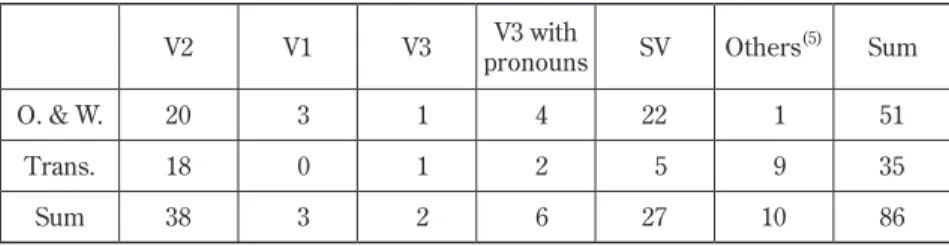
The results of the investigation into the reports of Ohthere and Wulfstan and the translation in Orosius are illustrated in the table below:
V2 V1 V3 V3 with
pronouns SV Others(5) Sum
O. & W. 20 3 1 4 22 1 51
Trans. 18 0 1 2 5 9 35
Sum 38 3 2 6 27 10 86
Table 2 Comparison of Word Order Patterns between the reports of Ohthere and Wulfstan and the sample translation text in Orosius
If we assume that V2 and SV word orders are patterns characteristic to OE, the ratio of those word orders will indicate how Latin has influenced a specific prose text in OE. The reports of Othere and Wulfstan in Orosius show a quite high ratio of those word orders, 42 out of 51 examples, about 82%, while the portion translated from Latin shows 23 out of 35 examples, about 66%.
This paper has illustrated the difference between OE prose without a Latin original and OE prose translated from an original Latin text with respect to their word orders. The high ratio of both of V2 and SV word orders in O. and W. plays a significant role in the result. Even though SV word order should be recognized as a variant of V2 word order, further study is needed on the development of SV word order in prose during the OE period.(6)
Notes
(1) Kuhn’s laws for Old English metre are well known. Terasawa (2011: 95) describes them as follows:
( i ) Kuhn’s First Law: Particles must be placed together in the first dip of a clause (i.e., either before or immediately after the first lift).
(ii) Kuhn’s Second Law: At the beginning of a clause, the dip must contain particles; in other words, proclitics alone cannot occupy the clause-initial dip.
According to Kuhn’s second law, finite verbs can move into the first position of a sentence as particles that are not rhythmically stressed.
(2) The part translated from Latin in the Old English Orosius is an abridged, rather than a literal version.
(3) Fischer et al. (2000: 119) illustrate the analysis of OE pronominal position by van Kemenade as follows:
( i ) [Spec, CP topic [C pron-Vfin [IP ... ]]]
(ii) [Spec, CP wh/neg/þa [C Vfin-pron [IP ... ]]]
Configuration (i) illustrates the V3 word order with a subject pronoun, which is derived by cliticisation. Configuration (ii) illustrates the word order in which cliti- cisation is blocked. However, this analysis has the defect that (ii), especially, is not sufficiently explained . Reconsideration of this defect leads to the analysis reviewed in 3.2.4 and note (3).
(4) Fischer et al. (2000: 126, (72)) illustrate the structure of a sentence with FP as Fig. 1 (on the next page).
(5) The sentences in the following example are classified into others types:
Seo us fyrre Ispania, hyre is be westan garsecg ℸ be norðan, That us further Spain her is by western ocean and by northern
‘That part of Spain, which is farthest from us, has to the west and to the east the ocean’
(Orosius, 19/7) Allen (2008: 226) analyses the use of genitive as the ‘left location’ and states that [the first constituent of the sentence] is mentioned to introduce the topic and then the possessive pronoun picks up the topic.
(6) Fischer et al. (2009: 128—9) refer to the investigation by Koopman (1998) as follows:
For topic-initial constructions with nominal subjects, the facts are more variable:
while inversion of the nominal subject is the norm in the works of Ælfric (the most substantial part of Koopman’s corpus, with percentages ranging from ninety-one
References
Allen, C. L. (2008). Genitives in Early English: Typology and Evidence. New York: Oxford University Press.
Baker, P. S. (2007). Introduction to Old English. Second Edition. Oxford: Blackwell CP
C´
C Vf
FP Spec
Specpronoun F
F Vf
NegP
Spec na
Neg´
Neg ne-vF
TP
Spec Subject
T
T...
Vf
VP Spec V´
...V...
Figure 1
to ninety-four per cent), the figures are equivocal for the two early texts, Cura Pastoralis and Orosius. There may be several reasons for this, not the least of which may be that both are early translated from Latin, which was not a Verb-Second language. Another, more tentative, suggestion that must await further research is that Verb-Second in topic-initials may be an innovation in progress in early Old English, the time when both texts were written.
Publishing.
Bately, J. (ed.) (1980). The Old English Orosius. EETS. SS6. The Early English Society.
Oxford: Oxford University Press.
Fischer, O. (1992). Syntax. In Blake, N. (ed.) The Cambridge History of the English Language. Volume II, 207—408. Cambridge: Cambridge University Press.
Fischer, O., A. van Kemenade, W. Koopman, and W. van der Wurff (2000). The Syntax of Early English. Cambridge: Cambridge University Press.
Godden, M. (1992). Literary Language. In Blake, N. (ed.) The Cambridge History of the English Language. Volume II, 495—535. Cambridge: Cambridge University Press.
Godden, M. and S. Irvine (eds.). (2009). The Old English Boethius: An Edition of the Old English Versions of Boethius’s De Consolatione Philosophiae. Vol. I, II. Oxford: Oxford University Press.
Kobayashi, S. (2015). “Verb-Initial Word Order and Its influence on Prose in Old English”. Seigakuin Ronso (The Journal of Seigakuin University). vol. 27—2.
Koopman, W. (1998). Inversion after Single and Multiple Topis in Old English. In Fisiak, J. and M. Krygier (eds.) Advances in English Historical Linguistics (1996). 135—50.
Berlin: Mouton de Gruyter.
Magennis, H. (2011). The Cambridge Introduction to Anglo-Saxon Literature. Cambridge:
Cambridge University Press.
Mictchell, B. and F. C. Robinson (2006). A Guide to Old English. Seventh Edition.
Oxford: Blackwell Publishing.
Ogawa, H. (2000). Studies in the History of Old English Prose, 235—262. Tokyo: NAN’
UN-DO Publishing Co. Ltd.
Ogawa, H. (2003). “Subject-Verb Inversion in the Late Old English Prose: A Phase of the Development of Old English Prose(「後期古英語散文における文頭の主語・動詞 の倒置——古英語散文史の一断面」,” in T. Ito (ed.) Syntactic Theory: Lexicon and Syntax. Tokyo: Tokyo University Press.(『文法理論:レキシコンと統語』.東京:
東京大学出版会.)
Rizzi, L. (2004) “On the Cartography of Syntactic Structure,” in L. Rizzi (ed.)(2004). 3— 16.
Rizzi, L. (ed.) (2004). The Structure of CP and IP: The Cartography of Syntactic Struc- tures, Volume 2. Oxford: Oxford University Press.
Roberts, I (2004). “The C-System in Brythonic Celtic Languages, V2, and the EPP,” in L.
Rizzi (ed.) (2004). 297—328.
Roberts, I. (2007). Diachronic Syntax, 58. Oxford: Oxford University Press.
Scragg, D. G. (ed.) (1992). The Vercelli Homilies and Related Texts. The Early English Text Society. Oxford: Oxford University Press.
Sedgefield, W. J. (1899). King Alfred’s Version of the Consolations of Boethius de Consola- tione Philosophiae. Oxford: Clarendon Press.
Sedgefield, W. J. (1900). King Alfred’s Version of the Consolations of Boethius: Done Into ModernEnglish. Oxford: Clarendon Press.
Terasawa, J. (2011). Old English Meter: An Introduction. Toronto: University of Toronto Press.
Traugott, E. (1992). Syntax. In Hogg, R. M. (ed.) The Cambridge History of English Language. Volume I, 168—289. Cambridge: Cambridge University Press.
Vezzosi, L. (2012). “English in Contact: Latin:” In Bergs, A. and L. J. Brinton (eds.).
English Historical Linguistics. Volume 2, 1703—19. Berlin/Boston:Walter de Gruyter GmbH & Co.
Secondary
Liggins, E. M. (1995). ‘The Expression of Causal Relationship in Old English Prose’.
Unpublished PhD. dissertation. London.: University of London.
Sørensen, Kund. (1957). “Latin influence on English Syntax”. Travaux du Cercle Linguis- tique du Copenhague. 11: 131—155.