1
――
The Merry Wives of Windsor, Much Ado about Nothing, Love ’ s Labour ’ s Lost, A Midsummer Night ’ s Dream, As You Like It
への書き込みの転写――住 本 規 子
はじめに
筆者は
2014
年にスコットランドのグラスゴーにあるグラスゴー大学図書 館を訪問し、同図書館所蔵のファースト・フォリオ(West 11
、所蔵館の請求番号は
Sp Coll BD8-b.1
)の閲覧調査にあたった。幸い許可を得てページ画像の撮影をし、帰国後は画像をもとに書き込みの転写を行ってきた。以前の 拙論にも書いたが、このコピーは欠損や破損のある複数の不完全なフォリ オからの葉を寄せ集めて一冊にした寄せ集めコピー
(made up copy
)であり、正確な詳細は不明だが、少なくとも
6
種類以上のコピーから取ってきた葉(帖 単位の場合もあれば一葉のみという場合もある)からなっていることは、ペー ジサイズのバラつきからあきらかである(住本2016 p.4
)。全頁中なんらかの書き込みが残されているページを含む作品タイトル を、実際に書き込みのあるページとともにあらためて挙げると以下のよう になる。
The Tempest
(書き込みがあるのは全頁すなわち、Sigs.A1-B4r
)、The Two Gentlemen of Verona
(全頁、Sigs. B4v-D1v
)、The Merry Wives of Windsor
(Sigs.D2-D5; E1-E3; E5-E6v
)、Much Ado about Nothing
(Sig. L1
)、Love ’ s Labour ’ s Lost
(Sigs.L1v-L2v; M5
)、A Midsummer Night ’ s Dream
(Sigs.
概要
拙論「読者から読者へ――書物のもうひとつの役割とグラスゴー大学所蔵ファース ト・フォリオの書き込み」および「グラスゴー・コピーの書き込みの特徴――
The
Two Gentlemen of Verona
への書き込みの転写とともに――」にひきつづき、グラスゴー・コピーと呼ばれるシェイクスピアのファースト・フォリオに残された書き込 みの転写を共有する。合わせて、本コピーについてこれまでの拙論で触れることの できなかった情報をまとめておく。
N3-N6; O2-3
)、As You Like It
(Sig.R6
)、King John (Sig.Aa6v; b4)
、Richard II (Sig.c2;d4v-d5)
、3 Henry VI (Sig.o6-o6v; q4)
、Richard III (Sigs. q5v; r4)
、Coriolanus (Sig.bb5v)
、Titus Andronicus (Sig.ee2)
、Romeo and Juliet (Sig.
ff4)
、Macbeth (Sigs.ll6; mm1-mm1v; mm2v; mm4v)
、Hamlet (Sigs.oo6; pp1)
それに、Antony & Cleopatra (Sig.yy5)
である。A Midsummer Night ’ s Dream
への書き込みには鉛筆が使用されているが、それ以外のこれらの書き込みは インク書きでおこなわれている。歴史劇や悲劇では、上記のページ(喜劇の 場合と同じサイズのページとは限らない)にインク書きでバツ印やドット、校訂、ト書きの追加などが書き加えられているのが散見されるものの、喜劇 の書き込みとは別人のものである可能性が高いように筆者には思われる。
したがって、ここでは、
Cary
家の一員、Emma Smith
によれば第2
代Faukland
子爵Lucius Cary
、によって書き込まれた可能性の高い、喜劇への書き込みですでに共有済である
The Tempest
とThe Two Gentlemen of Verona
以外の作品、すなわち、The Merry Wives of Windsor, Much Ado about Noth- ing, Love ’ s Labour ’ s Lost, A Midsummer Night ’ s Dream, As You Like It
に残さ れた書き込みを転写する。これらの作品を、書き込みをした読者が全36
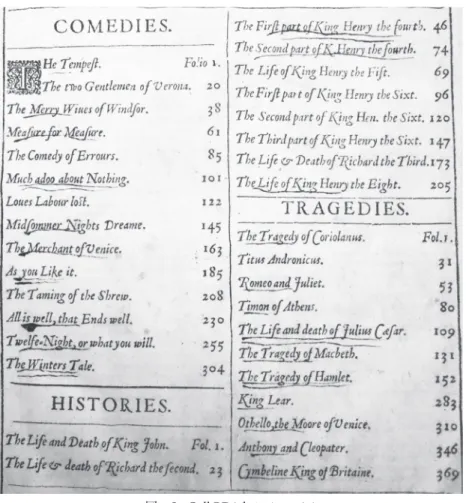
篇 のタイトルのなかでどのように位置付けていたかについては、フォリオの目 次にあたるページに残されたマーキングがひとつの参考になる。右の図を参 考にされたい。本稿で扱う作品では、The Merry Wives of Windsor
には一重 線、Much Ado about Nothing
には二重線、Love ’ s Labour ’ s Lost
には線は引か れておらず、A Midsummer Night ’ s Dream
には一重線、そして、As You Like It
には二重線が引かれている。このうち、筆記用具に鉛筆が使われた
A Midsummer Night ’ s Dream
へ の書き込みは、ペンとインクが使われた書き込みに比べて著しく不鮮明で 解読が困難である。Rasmussen and West (2012)
では、“ at this point [N3]
the annotator switches to pencil and the writing is very faded and difficult to make out. ” (p.41)
とのみ記しManuscript Annotations
を記録することを放棄 しているほどだ。グラスゴー・コピーの書き込みに言及する研究でも、たと えば、Emma Smith
(2016
)、後で触れることになるJean-Christophe Mayer
(
2018
)らではこの作品への書き込みには言及していない。本稿では、採取 した画像データで可能な限りその鉛筆による書き込みを解読し転写データとする。より解読の難しいデータには
“ [reading doubtful] ”
という標識をつけ つつも敢えて解読を試みる。書き込みの転写
The Merry Wives of Windsor, Much Ado about Nothing, Love ’ s Labour ’ s Lost, A Midsummer Night ’ s Dream, As You Like It
への書き込み図
Sp Coll BD8-b.1, sig.
πA6.
By permission of University of Glasgow Library, Archives & Special Collections
凡例
転写記録の各項は、まず、書き込みの場所(
Signature, column a or b
など 場所の詳細、Through Line Number
)、下線箇所の台詞話者(現代綴りで表記 する)を示し、そのあとで、下線を引かれたテクストを引用符(ダブル)で囲 んで引用する。下線が複数話者の台詞に跨り、かつひとかたまりのパッセー ジとして認識されていると判断される場合には、引用に発話者指示(speech
prefix
)を(フォリオの表記のまま)含める。韻文、散文を問わず、フォリオの改行箇所を斜線で示す。すこしでも下線が及んでいると判断する単語には 下線を施した。二重に下線を引いている箇所は、下線を二重線で記録する。
作品によっては下線と括弧を組み合わせて数行を半ば囲むようなマーキング も使われる。その場合にはテクストの引用の後に
“ Bracketed ”
という表示を 用いて示す。文字を使用した書き込み(ほとんどの場合outer margin
もしく はgutter
に書き込まれる)には引用符(シングル)をつけて記録する。‘ ap: ’
(I
approve
の意を表すラテン語の短縮形と考えられる)の場合はそれが指していると思われる下線の記録の最後に記録する。転写は読者の便宜のため幕場
([
1.1
]のように表示)ごとに区切って示すことにする。下線等のマーキング が全く施されていないコラムや葉には[none
]と表示する。The Merry Wives of Windsor [1.1]
D2 a. 22-23. Evans. “It is a familiar beast to / man, and signifies Loue:” ‘ap:’
D2 a. 30-32. Evans. “Yes per-lady: if he ha’s a quarter of your coat, / there is but three Skirts for your selfe, in my simple con- / iectures”.
D2b. [none]
D2va. 109. Falstoffe. “But not kiss’d your Keepers daughter?” ‘ap:’.
D2va.133. Mr Page. “We three to hear it, & end it between them.” ‘vs’: them emended to read us.
D2va.138. Pistol. “He heares with eares” ‘ap:’
D2va.149-52. Pistol. “Ha, thou mountaine Forreyner: Sir Iohn, and / Master
mine, I combat challenge of this Latine Bilboe:/ word of deniall in thy
labras here; word of denial; froth, /and scum thou liest.” ‘ap:’ (149).
D2vb.168-70. Slender. “if I be drunke, Ile / be drunke with those that haue the feare of God, and not / with drunken knaues.”
1D2vb. 171. Evance. “So got-udge me, that is a vertuous minde.”
D2vb. 183-86. Slender. “I had rather then forty shillings I had my booke / of Songs and Sonnets heere: How now Simple, where / haue you beene? I must wait on my selfe, must I? you / haue not the booke of Riddles about you, haue you?”
D2vb.200-202. Slender. “Nay, I will doe as my Cozen Shallow saies: I / pray you pardon me, he’s a Iustice of Peace in his Coun-/trie, simple though I stand here.”
D2vb. 220-21. Slender. “I will doe a greater thing then that, vpon your / request (Cosen) in any reason.”
D2vb. 225. Slender. “I will marry her (Sir) at your request;”
D3ra. 242. Evance. “Od’s plessed-wil: I wil not be absēce at the grace” ‘ap:’
D3ra. 249-50. Slender. “I keepe but three Men, and a / Boy yet, till my Mother be dead: but what though, yet”
D3ra. 284-85. Slender. “Ile rather be vnmannerly, then troublesome: you / doe your selfe wrong indeede-la.” ‘ap:’
[1.2]
D3ra. [none]
D3rb.
[1.3]
D3rb. 302-303. Host. “What saies my Bully Rooke? speake schollerly, / and wisely.” ‘ap:’.
D3rb. 316-17. Falstoffe. “an old Cloake, makes a new Ierkin: a wither’d Seruing- / man, a fresh Tapster: goe, adew”
D3rb. 319. Pistol. “O base hungarian wight: wilt y the spigot wield.” ‘ap:’
[Possibly meant to cover the above underlined speech as well]
D3rb. 338-41. Falstoffe. “shee discourses: shee / carues: she giues the leere of 1
As the picture of the gutter margin of D2v is not available, whether each entry from D2v column b is followed by ‘ ap: ’ cannot be recorded here.
u
inuitation: I can construe / the action of her familier stile, & the hardest voice of her / behauior (to be english'd rightly) is, I am Sir Iohn Falstafs.”
‘ap:’ (340)
D3rb. 342-43. Pistol. “He hath studied her will; and translated her will: / out of honesty, into English.” ‘ap:’ (340) seems to cover these lines as well.
D3rb. 350-51. Falstoffe. “who euen now gaue mee good eyes / too; examind my parts with most iudicious illiads:”
D3va. 354. Pistol. “Then did the Sun on dung-hill shine” ‘ap:’
D3va. 359-63. Falstoffe. “She is a Region / in Guiana: all gold, and bountie: I will be Cheaters to / them both, and they shall be Exchequers to mee:
they / shall be my East and West Indies, and I will trade to / them both:
Goe” ‘[a]t what / *nty y
e/ *iuare/ o/ ends ap/ u py of / noro of:[cropped and reading doubtful]’ in the outer margin.
D3va. 366-67. Pistol. “Shall I Sir Pandarus of Troy become, / And by my side weare Steele? then Lucifer take all.” ‘ap:’
D3va.378-79. Pistol. “Tester ile haue in pouch when thou shalt lacke, / Base Phrygian Turke.” ‘ap:’
D3va. 382-85. Pistol / Nim. “Pist. Wilt thou reuenge? / Ni. By Welkin, and her Star. / Pist. With wit, or Steele? / Ni. With both the humors, I:” ‘ap:’ (384) D3va. 395-96. Pistol. “Thou art the Mars of Malecontents: I second / thee:
troope on.” “ap:”
[1.4]
D3va. 403-04. Quickly. “here will be an old abusing of Gods pati- / ence, and the Kings English.”
D3va.410-12. Quickly. “his worst fault is, that he is giuen to prayer; hee is / something peeuish that way: but no body but has his / fault:”
D3vb. 451-53. Caius. “You are Iohn Rugby, aad you are Iacke Rugby: / Come, take-a-your Rapier, and come after my heele to / the Court.” ‘ap:’ on the centre rule.
D3vb. 464-65. Caius. “What shall de honest man do in my Closset: dere / is no
honest man dat shall come in my Closset.” ‘ap:’ on the centre rule.
D4ra. [none]
[2.1]
D4rb. 554-55. Mist. Page. “What, haue scap'd Loue-letters in the / holly-day- time of my beauty,” ‘I’ inserted between “haue” and “scap’d” to read
“haue [I] scap’d”.
D4rb. 560-61. Mist. Page. “you are merry, so am I: ha, ha, then there's more simpa- thie:/ you loue sacke, and so do I: would you desire better simpathie?” ‘ap:’
D4rb. 575-77. Mist. Page. “why Ile / Exhibit a Bill in the Parliament for the putting downe / of men:”
D4rb. 596. Mist. Page. “What thou liest? Sir Alice Ford?”
D4va. 606-09. Mist. Ford. “but they doe no more adhere and keep place / together, then the hundred Psalms to the tune of Green-/sleeues: What tempest (I troa) threw this Whale, (with / so many Tuns of oyle in his belly) a'shoare at Windsor?” ‘ap:’
D4va. 622-23. Mist. Page. “I had rather be a Giantesse, / and lye vnder Mount Pelion:”
D4va. 627-31.Mist. Page. “Ile entertaine / my selfe like one that I am not acquainted withall: for / sure vnlesse hee know some straine in mee, that I know / not my selfe, hee would neuer haue boorded me in this / furie.” ‘ap:’
D4va. 637-39. Mist. Page. “giue him a show of comfort in / his Suit, and lead him on with a fine baited delay, till hee / hath pawn'd his horses to mine Host of the Garter.” ‘ap: / my Co:/r: tricke/ the I:[ cropped and reading doubtful]’
D4va. 645-47. Mist. Page. “hee's as farre from iealousie, as I am from gi-/uing him cause, and that (I hope) is an vnmeasurable di-/stance.”
D4va. 652. Pistol. “Hope is a curtall-dog in some affaires:” ‘ap:’
D4va. 660-61. Pistol. “Or goe thou like Sir Acteon he, with / Ring-wood at thy heeles: O, odious is the name.” ‘ap:’
D4vb. 673-74. Nim. “My name is Corporall / Nim: I speak, and I auouch; 'tis
true: my name is Nim:” ‘ap:’ on the centre rule.
D4vb. 682-83. Page. “I will not beleeue such a Cataian, though the / Priest o'th'Towne commended him for a true man.” ‘ap:’ on the centre rule.
D5ra. 747-48. Host. “My hand, (Bully:) thou shalt haue egresse and / regresse, (said I well?) and thy name shall be Broome.” ‘ap:’
D5ra. 765-68. Ford. “Well, I wil looke / further into't, and I haue a disguise, to sound Falstaffe; if / I finde her honest, I loose not my labor: if she be other- / wise, 'tis labour well bestowed.” ‘a good iealous mans dilemma./’
under the line TLN768.
[2.2]
D5ra. 773-74. Pistol. “Why then the world's mine Oyster, which I, / with sword will open.”
D5ra. 778-83. Falstoffe. “or else you had look'd through / the grate, like a Geminy of Baboones: I am damn'd in / hell, for swearing to Gentlemen my friends, you were / good Souldiers, and tall-fellowes. And when Mistresse / Briget lost the handle of her Fan, I took't vpon mine ho- / nour thou hadst it not.” ‘ap:’
D5ra. 784-89. Pistol / Falstaffe. “Pist. Didst not thou share? hadst thou not fif- teene / pence? / Fal. Reason, you roague, reason: thinkst thou Ile en- / danger my soule, gratis? at a word, hang no more about / mee, I am no gibbet for you: goe, a short knife, and a / throng, to your Mannor of Pickt-hatch:” ‘ap:’
D5ra-b. 793-97. Falstaffe. “I, I, I my selfe sometimes, leauing the feare of heauen on / the left hand, and hiding mine honor in my necessity, am / faine to shufflle: to hedge, and to lurch, and yet, you / Rogue, will en-sconce your raggs; your Cat-a-Moun- / taine-lookes, your red-lat- tice phrases, and your bold- / beating-oathes, vnder the shelter of your honor? ” ‘ap:’
D5rb. 807-08. Quickly. “Ile be sworne, /As my mother was the first houre I was borne.” ‘ap:’
D5rb. 810-11. Quickly. “Shall I vouch-safe your worship a word, or / two?”
‘ap:’
D5rb. 829-33. Quickly. “you / haue brought her into such a Canaries, as 'tis wonder- / full: the best Courtier of them all (when the Court lay / at Windsor) could neuer haue brought her to such a Ca- / narie:” ‘ap:’
D5rb. 844-45. Quickly continued. “and yet there has / beene Earles: nay, (which is more) Pentioners, but I”
D5rb. 847- 48. Falstoffe. “But what saies shee to mee? be briefe my good / shee-Mercurie.”
D5rb. 854-55. Quickly. “I, forsooth: and then you may come and see the / pic- ture (she sayes) that you wot of:” ‘ap:’
D5va. 871-72. Falstoffe. “Not I, I assure thee; setting the attraction of my / good parts aside, I haue no other charmes.” ‘ap:’
D5vb. 945-49. Ford. “but (good Sir Iohn) as you haue one eye vp- / on my follies, as you heare them vnfolded, turne another / into the Register of your owne, that I may passe with a / reproofe the easier, sith you your selfe know how easie it / is to be such an offender.”
D5vb. 956-60. Ford. “ Ingross'd opportunities to meete her: fee’d e- / uery slight occasion that could but nigardly giue mee / sight of her: not only bought many presents to giue her, / but haue giuen largely to many, to know what shee / would haue giuen:”
D5vb. 967-68. Ford. “Loue like a shadow flies, when substance Loue pursues, /
“Pursuing that that flies, and flying what pursues.”
D5vb. 975-77. Ford. “Like a fair house, built on another mans ground, / so that I haue lost my edifice, by mistaking the place, / where I erected it.” ‘ap:’
D5vb. 989. Ford. “Beleeue it, for you know it: there is money,” ‘ap:’
[leaf D6 is a supplied leaf from other copy and therefore with no annotations.]
[2.3]
[3.1]
E1ra. 1245-53. Host. “Peace, I say: heare mine Host of the Garter, / Am I pol- iticke? Am I subtle? Am I a Machiuell? / Shall I loose my Doctor? No, hee giues me the Potions / and the Motions. Shall I loose my Parson?
my Priest? / my Sir Hugh? No, he giues me the Prouerbes, and the /
No-verbes. Giue me thy hand (Celestiall) so: Boyes of / Art, I haue deceiu’d you both: I haue directed you to / wrong places: your hearts are mighty, your skinnes are / whole, and let burn'd Sacke be the issue:”
‘ap:’
[3.2]
E1ra. 1296-1301. Ford. “why this boy will carrie a letter twentie mile as easie, as / a Canon will shoot point-blanke twelue score: hee pee- / ces out his wiues inclination: he giues her folly motion / and aduantage: and now she's going to my wife, & Fal- / staffes boy with her: A man may heare this showre sing / in the winde; and Falstaffes boy with her: ”
E1rb. 1307-10. Ford. “The clocke giues me my Qu, / and my assurance bids me search, there I shall finde Fal- / staffe: I shall be rather praisd for this, then mock'd, for / it is as possitiue, as the earth is firme,” ‘ap:’
E1rb. 1328-31. Host. “What say you to yong Mr Fenton? He capers, / he dances, he has eies of youth: he writes verses, hee / speakes holliday, he smels April and May, he wil carry’t, / he will carry’t, 'tis in his buttons, he will carry't.” ‘ap:’
E1rb. 1334-36. Page: “he is of too high a Region, he knows / too much: no, hee shall not knit a knot in his fortunes,/ with the finger of my substance:”
[3.3]
Elva. 1376-48. Robin. “and hath threatned to put me into euerla- / sting liberty, if I tell you of it: for he sweares he’ll turne / me away.”
E1va. 1385-90. Mist.Ford/Falstoffe. “Mist. Ford. Go-too then: we'l vse this vnwholsome / humidity, this grosse-watry Pumpion; we’ll teach him / to know Turtles from Iayes. / Fal. Haue I caught thee, my heauenly Iewell?
Why / now let me die, for I haue liu'd long enough: This is the / period of my ambition: O this blessed houre.” ‘ap:’
E1va. 1398-99. Falstoffe. “Let the Court of France shew me such another: / I see how thine eye would emulate the Diamond:”
E1va. 1413-18. Falstoffe. “Come, I / cannot cog, and say thou art this and
that, like a-manie / of these lisping-hauthorne buds, that come like
women / in mens apparrell, and smell like Bucklers-berry in sim- / ple time: I cannot, but I loue thee, none but thee; and / thou deseru'st it.” ‘ap:’
Elva. 1420-22. Falstoffe. “Thou mightst as well say, I loue to walke by the / Counter-gate, which is as hatefull to me, as the reeke of / a Lime-kill.”
E1vb. [none]
E2ra. 1507-09. Mist.Page/Mist.Ford. “Mist Page. Is there not a double excel- lency in this? / Mist. Ford. I know not which pleases me better, / That my husband is deceiued, or Sir Iohn.” ‘ap:’
E2ra. 1512-14. Mist.Ford. “I am halfe affraid he will haue neede of / washing: so throwing him into the water, will doe him / a benefit.”
E2ra. 1521-22. Mist.Page. “his dissolute disease / will scarse obey this medicine.”
E2ra. 1534. Mist.Ford. “Heauen make you better then your thoghts” [‘you’
deleted and ‘me’ added above in ink: an attempted emendation.]
E2ra. 1559-60. Evance/Caise. “Eu. If there is one, I shall make two in the Companie / Ca. If there be one, or two, I shall make-a-theturd.” ‘ap:’
[3.4]
E2rb. 1575-76. Fenton. “And that my state being gall'd with my expence, / I seeke to heale it onely by his wealth.”
E2rb. 1585-88. [Fenton.] “Yet wooing thee, I found thee of more valew / Then stampes in Gold, or summes in sealed bagges: / And 'tis the very riches of thy selfe, / That now I ayme at.” ‘ap:’
E2rb. 1601-03. Anne. “O what a world of vilde ill-fauour’d faults / Lookes hand- some in three hundred pounds a yeere?”
E2rb. 1606-09. Shallow/Slender. “Shal. O boy, thou hadst a father./ Slen. I had a father (M. An) my vncle can tel you good / iests of him: pray you Vncle, tel Mist. Anne the iest how / my Father stole two Geese out of a Pen, good Vnckle.” ‘ap:’
E2va. 1656-57. Anne. “Alas I had rather be set quick i'th earth, / And bowl’d to
death with Turnips.” ‘…ought / …ere from / …er: but / ..xll: ap:’[cropped
and reading doubtful]
E2va. 1674-76. Quickly. “I will do what I can / for them all three, for so I haue promisd, and Ile bee as / good as my word, but speciously for M.
Fenton.” ‘ap:’
[3.5]
E2va. 1684-85. Falstoffe. “Haue I liu’d to be carried in a Basket like a barrow of / butchers Offall? and to be throwne in the Thames?”
E2va-b. 1689-92. Falstoffe. “with as little remorse, as they would haue drown’de a blinde bitches Puppies, fifteene i'th litter: and you may / know by my size, that I haue a kinde of alacrity in sink- / ing: if the bottome were as deepe as hell, I shold down”
E2vb. 1696-97. Falstoffe continued. “I should haue beene a Mountaine of / Mummie.”
E2vb. 1700-01. Falstoffe. “for my bellies as cold as if I had swallow'd snow- / bals, for pilles to coole the reines. ”
E2vb. 1708-09. Falstoffe. “Ile no Pullet-Spersme in my / brewage.”
E2vb. 1716. Falstoffe. “So did I mine, to build vpon a foolish Womans / (prom- ise.” ‘ap:’
E2vb. 1722-24. Falstoffe. “Well, I will visit her, tell her so: and bidde her / thinke what a man is: Let her consider his frailety, and / then iudge of my merit.” ‘ap:’
E2vb. 1744-46. Falstoffe. “after we had / embrast, kist, protested, & (as it were) spoke the prologue / of our Comedy:” ‘ap:’
E3ra.1758-60. Falstoffe. “that (Master Broome) there was the rankest / com- pound of villanous smell, that euer offended no- / strill.” ‘ap:’
E3ra. 1773-74. Falstoffe. “well, on went hee, for / a search, and away went I for foule Cloathes:” ‘ap:’
E3ra. 1778-79. Falstoffe continued. “Next to be compass'd like a good Bilbo in the circum- / ference of a Pecke, hilt to point, heele to head.”
E3ra. 1785-89. Falstoffe continued. “And in the height of this Bath (when I / was more then halfe stew’d in grease (like a Dutch- / dish) to be throwne into the Thames, and / coold, glowing-hot, in that serge like a Horse- /shoo;
thinke of that; hissing hot:”
E3ra. 1795-96. Falstoffe. “Master Broome: I will be throwne into Etna, / as I haue beene into Thames, ere I will leaue her thus;” ‘ap:’
E3ra. 1810-17. Ford. “this / 'tis to be married; this 'tis to haue Lynnen, and Buck- / baskets: Well, I will proclaime my selfe what I am: / I will now take the Leacher: hee is at my house: hee / cannot scape me: 'tis impos- sible hee should: hee can-/ not creepe into a halfe-penny purse, nor into a Pepper- / Boxe: But least the Diuell that guides him, should / aide him, I will search impossible places:” ‘ap:’
[4.1]
E3rb. 1849-50. Evans. “You are a very simplicity o'man: I pray you / peace.” ‘ap:’
E3rb.1857-58. Evans. “That is a good William: what is he (William) that / do’s lend Articles.”
E3rb.1866. Quickly. “Hang-hog, is latten for Bacon, I warrant you.” ‘tr: [reading doubtful]’
E3rb. 1878-79. Quickly. “'Vengeance of Ginyes case; fie on her; neuer / name her (childe) if she be a whore.”
E3va. 1886-87. Evans. “Thou art as foolish Christian creatures, as I would / desires.” ‘ap:’
E3va. 1892-94. Evans. “It is Qui, que, quod; if you forget your Quies, / your Ques, and your Quods, you must be preeches:” ‘ap:’
[4.2]
E3va. 1920-21. Mist.Page. “so curses all Eues / daughters, of what complexion soeuer;” ‘ap:’
E3vb. 1949-50. Mist.Ford. “There they alwaies vse to discharge their / Birding-peeces:”
E3vb. 1953-55. Mist.Ford. “but he hath / an abstract for the remembrance of such places, and goes / to them by his Note:”
E3vb. 1979-80. Mist.Page. “Heauen guide him to thy husbands cud- / gell: and the diuell guide his cudgell afterwards.” ‘ap:’
E3vb. 1994-97. Mist.Page. “We’ll leaue a proofe by that which we will doo, /
Wiues may be merry, and yet honest too: / We do not acte that often,
iest, and laugh, / 'Tis old, but true, Still Swine eats all the draugh.”
‘ap:’
E3vb. 2002. 2 Ser. “Pray heauen it be not full of Knight againe.”
E3vb. 2009. Ford. “What wife I say: Come, come forth: behold what ho-”
E4r. [4.3] [4.4] [none]
E4v. [4.5] [none]
E5ra. 2267-70. Falstoffe/Sim. “Fal. 'Tis, 'tis his fortune. / Sim. What Sir? / Fal. To haue her, or no: goe; say the woman told / me so.”
E5ra. 2286-88. Bardolph. “and set spurres, and / away; like three Germane- diuels; three Doctor Fau- / stasses.” ‘ap:’
E5ra. 2297-99. Evans. “you are wise, and full / of gibes, and vlouting-stocks:
and 'tis not conuenient / you should be cozoned.” ‘ap:’
E5ra. 2301-02. Host. “Here (Master Doctor) in perplexitie, and doubt- / full delemma.”
E5ra. 2314-19. Falstoffe. “they would melt mee out of my fat drop by / drop, and liquor Fishermens-boots with me: I warrant / they would whip me with their fine wits, till I were as / crest-falne as a dride-peare: I neuer prosper'd, since I / forswore my selfe at Primero: well, if my winde were / but long enough; I would repent: Now?” ‘ap:’
E5rb. 2324-25. Falstoffe. “more then the villanous in- / constancy of mans dis- position is able to beare.” ‘ap:’
[4.6]
E5rb. 2359-66. Fenton. “The mirth whereof, so larded with my matter, / That neither (singly) can be manifested / Without the shew of both: fat Falstaffe / Hath a great Scene; the image of the iest / Ile show you here at large (harke good mine Host:) / To night at Hernes-Oke, iust 'twixt twelue and one, / Must my sweet Nan present the Faerie-Queene: / The purpose why, is here:” ‘ap:’
E5va. 2385-86. Fenton. “That quaint in greene, she shall be loose en-roab’d, / With Ribonds-pendant, flaring 'bout her head;” ‘ap:’
E5va. 2397-98. Host. “Well, husband your deuice; Ile to the Vicar, / Bring you
the Maid, you shall not lacke a Priest.” ‘ap:’
E5va. [5.1]
E5va. 2416-18. Falstoffe. “I went to her (Master Broome) as you see, like a / poore-old-man, but I came from her (Master Broome) / like a poore- old-woman;” ‘ap:’
E5va. 2421-27. Falstoffe. “(for in / the shape of Man (Master Broome) I feare not Goliah / with a Weauers beame, because I know also, life is a / Shuttle) I am in hast, go along with mee, Ile tell you all / (Master Broome:) since I pluckt Geese, plaide Trewant, / and whipt Top, I knew not what 'twas to be beaten, till / lately.” ‘ap:’
E5va. [5.2]
E5vb. [5.3]
E5vb. [5.4]
E5vb. [5.5]
E5vb. 2484-88. Falstoffe. “Now the hot-bloodied-Gods assist me: / Remember Ioue, thou was’t a Bull for thy Europa, Loue /set on thy hornes. O power- full Loue, that in some re- / spects makes a Beast a Man: in som other, a Man a beast. / You were also (Iupiter) a Swan, for the loue of Leda: O” ‘ap:’
E6ra. 2489-96. Falstoffe continued. “omnipotent Loue, how nere the God drew to the com- / plexion of a Goose: a fault done first in the forme of a / beast, (O Ioue, a beastly fault:) and then another fault, / in the sem- blance of a Fowle, thinke on't (Ioue) a fowle-fault./ When Gods haue hot backes, what shall poore / men do? For me, I am heere a Windsor Stagge, and the / fattest (I thinke) i'th Forrest. Send me a coole rut-time / (Ioue) or who can blame me to pisse my Tallow?” ‘to [2492: reading doubtful]’ ‘ap: [2494]’
E6ra. 2500-04. Falstoffe. “Let the skie / raine Potatoes: let it thunder, to the tune of Greene- / sleeues, haile-kissing Comfits, and snow Eringoes: Let / there come a tempest of prouocation, I will shelter mee / heere.” ‘ap’
E6ra. 2506. Falsoffe. “Diuide me like a brib'd-Bucke, each a Haunch:”
E6ra. 2510-11. Falstoffe continued. “Why, now is Cupid a child of conscience,
/ he makes restitution.”
E6ra. 2529. Pistol. “Our radiant Queene, hates Sluts, and Sluttery.” ‘ap:’
E6ra. 2542-43. Quickly. “In state as wholsome, as in state 'tis fit, / Worthy the Owner, and the Owner it.” ‘ap:’
E6rb. 2561-62. Evans. “And twenty glow-wormes shall our Lanthornes bee / To guide our Measure round about the Tree.” ‘ap:’
E6rb. 2570-71. Quickly. “but if he start, / It is the flesh of a corrupted hart.” ‘ap:’
E6rb. 2575. Quickly. “Corrupt, corrupt, and tainted in desire.” ‘ap:’
E6rb.2583-84. The Song. “Pinch him, and burne him, and turne him about, /Till Candles, & star-light, & Moone-shine be out.” ‘ap:’
E6rb. 2596-97. Ford. “And Master Broome, he hath enioyed nothing of Fords, / but his Buck-basket, his cudgell, and twenty pounds of [/ money]”
E6rb. 2610-13. Falstoffe. “in despight of the teeth of / all rime and reason, that they were Fairies. See now / how wit may be made a Iacke-a-Lent, when 'tis vpon ill / imployment.” ‘ap’
E6va. 2621-23. Falstoffe. “Haue I laid my braine in the Sun, and dri’de it, / that it wants matter to preuent so grosse ore-reaching as / this?” ‘ap:’
E6va. 2628-29. Falstoffe. “Haue I liu’d to stand at the / taunt of one that makes Fritters of English?”
E6va. 2641-43. Ford/Page. “Ford. And one that is as slanderous as Sathan? / Page. And as poore as Iob? / Ford. And as wicked as his wife?” ‘ap:’
E6va. 2660. Mist.Page. “Doctors doubt that;” ‘ap:’
E6va. 2670-72. Slender. “If it had not bene / i’th Church, I would haue swing'd him, or hee should / haue swing’d me.” ‘ap:’
E6vb. 2708-10. Fenton. “Th’offence is holy, that she hath committed, / And this deceit looses the name of craft, / Of disobedience, or vnduteous title,”
‘ap:’
E6vb. 2715-16. Ford. “In Loue, the heauens themselues do guide the state, / Money buyes Lands, and wiues are sold by fate.” ‘ap:’
E6vb. 2721-30. Falstoffe/Mist.Page./Ford. “Fal. When night-dogges run, all
sorts of Deere are / chac’d. / Mist. Page. Well, I will muse no further: M
rFenton, / Heauen giue you many, many merry dayes: / Good husband,
let vs euery one go home, / And laugh this sport ore by a Countrie fire, / Sir Iohn and all. / Ford. Let it be so (Sir Iohn:) / To Master Broome, you yet shall hold your word, / For he, to night, shall lye with Mistris Ford:”
‘ap:’
E6vb. ‘very good, Light’
E6vab. “FINIS”.
Much Ado about Nothing [5.4]
L1ra. 2571. Old man. “Which I will doe with confirm'd countenance.”
L1ra. 2577-80. Leonato/Benedick. “Leo. That eye my daughter lent her, 'tis most true. / Bene. And I doe with an eye of loue requite her. / Leo. The sight whereof I thinke you had from me, / From Claudio, and the Prince, but what’s your will?” ‘ap:’
L1ra. 2596-97. Prince. “That you haue such a Februarie face, / So full of frost, of storme, and clowdinesse.” ‘ap:’
L1ra.2599-2606. Claudio/Benedick. “Tush, feare not man, wee'll tip thy hornes with gold, / And all Europa shall reioyce at thee, / As once Europa did at lusty Ioue, / When he would play the noble beast in loue. / Ben. Bull Ioue sir, had an amiable low, / And some such strange bull leapt your fathers Cow, / A got a Calfe in that same noble feat, / Much like to you, for you haue iust his bleat.” ‘ap:’
L1ra. 2611. Claudio. “Why then she's mine, sweet let me see your face.”
L1ra. 2616. Hero. “And when I liu'd I was your other wife, / And when you lou'd, you were my other husband.” ‘ap:’
L1rb. 2622-23. Prince/Leonato. “Prin. The former Hero, Hero that is dead. / Leon. Shee died my Lord, but whiles her slander liu’d.” ‘ap:’
L1rb. 2651-55. Benedick/Beatrice. “Bene. A miracle, here's our owne hands
against our / hearts: come I will haue thee, but by this light I take / thee
for pittie. / Beat. I would not denie you, but by this good day, I / yeeld
vpon great perswasion, & partly to saue your life, / for I was told, you
were in a consumption.” ‘ap:’
L1rb. 2658-63. Prince/Benedick. “Prin. How dost thou Benedicke the married man? / Bene. Ile tell thee what Prince: a Colledge of witte-/ crackers cannot flout mee out of my humour, dost thou / think I care for a Satyre or an Epigram? no, if a man will / be beaten with braines, a shall weare nothing handsome / about him:” ‘ap:’
L1rb. 2666-69. Benedick continued. “for man is a giddy thing, and this is my con- / clusion: for thy part Claudio, I did thinke to haue beaten / thee, but in that thou art like to be my kinsman, liue vn- / bruis’d, and loue my cousin.” ‘ap:’
L1rb. 2678-80. Benedick. “Prince, / thou art sad, get thee a vvife, get thee a vvife, there is no / staff more reuerend then one tipt with horn.” ‘ap:’
L1rb. 2683-84. Benedick. “Thinke not on him till to morrow, ile deuise / thee braue punishments for him: strike vp Pipers”
L1rb. FINIS. ‘bon for bon: good’
Love’s Labour’s Lost [1.1]
L1va. 5-11. Ferdinand. “LEt Fame, that all hunt after in their liues, / Liue reg- istred vpon our brazen Tombes, / And then grace vs in the disgrace of death: / when spight of cormorant deuouring Time, / Th’endeuour of this present breath may buy: / That honour which shall bate his sythes keene edge, / And make vs heyres of all eternitie.” ‘ap:’
L1va. 23-27. Ferdinand continued. “Your oathes are past, and now sub- scribe your names: / That his owne hand may strike his honour downe, / That violates the smallest branch heerein: / If you are arm'd to doe, as sworne to do, / Subscribe to your deepe oathes, and keepe it to.” ‘ap:’
L1va. 30-31. Longavill. “and dainty bits, / Make rich the ribs, but bankerout the wits.” ‘ap:’
L1va. 35-36. Dumane. “To loue, to wealth, to pompe, I pine and die, / With all
these liuing in Philosophie” ‘ap: me [reading doubtful]’
L1vb. 51-52. Berowne. “O, these are barren taskes, too hard to keepe, / Not to see Ladies, study, fast, not sleepe” ‘ap:’
L1vb. 70-71. Berowne. “Or hauing sworne too hard a keeping oath, / Studie to breake it, and not breake my troth” ‘ap:’
L1vb. 77-86. Berowne. “Why? all delights are vaine, and that most vaine / Which with paine purchas’d, doth inherit paine, / As painefully to poare vpon a Booke, / To seeke the light of truth, while truth the while / Doth falsely blinde the eye-sight of his looke: / Light seeeking light, doth light of light beguile: / So ere you finde where light in darkenesse lies, / Your light growes darke by losing of your eyes. / Studie me how to please the eye indeede, / By fixing it vpon a fairer eye,” ‘ap:’
L1vb. 89-92. Berowne contitued. “Studie is like the heauens glorious Sunne, / That will not be deepe search’d with sawcy lookes: / Small haue contin- uall plodders euer wonne, / Saue base authoritie from others Bookes.”
‘ap:’
L1vb. 93-98. Berowne continued. “These earthly Godfathers of heauens lights, / That giue a name to euery fixed Starre, / Haue no more profit of their shining nights, / Then those that walke and wot not what they are. / Too much to know, is to know nought but fame: / And euery Godfather can giue a name.” ‘ap’
L2ra. 101-02. Longavill. “Hee weedes the corne, and still lets grow the / weeding.”
L2ra. 109-10. Ferdinand. “Berowne is like an enuious sneaping Frost, / That bites the first borne infants of the Spring” ‘ap:’
L2ra. 113-18. Berowne. “Why should I ioy in any abortiue birth? / At Christmas I no more desire a Rose, / Then wish a Snow in Mayes new fangled showes: / But like of each thing that in season growes. / So you to studie now it is too late, / That were to clymbe ore the house to vnlocke the gate” ‘ap:’
L2ra. 127. Ferdinand. “How well this yeelding rescues thee from shame” ‘ap:’
L2ra. 153-57. Berowne. “So Studie euermore is ouershot, / While it doth study
to haue what it would, / It doth forget to doe the thing it should: / And when it hath the thing it hunteth most, / 'Tis won as townes with fire, so won, so lost” ‘ap:’
L2ra. 160-05. Berowne. “Necessity will make vs all forsworne / Three thousand times within this three yeeres space: / For euery man with his affects is borne, / Not by might mastred, but by speciall grace. / If I breake faith, this word shall breake for me, / I am forsworne on meere necessitie” ‘ap:’
L2rb. 170-01. Berowne. “But I beleeue although I seeme so loth, / I am the last that will last keepe his oth.” ‘ap:’
L2rb. 176-80. Ferdinand. “That hath a mint of phrases in his braine: / One, who the musicke of his owne vaine tongue, / Doth rauish like inchanting har- monie: / A man of complements whom right and wrong / Haue chose as vmpire of their mutinie.”
L2rb. 183. Ferdinand continued. “In high-borne words the worth of many a Knight:” ‘ap: [meant to include the above?]’
L2rb. 188-89. Berowne. “Armado is a most illustrious wight, / A man of fire, new words, fashions owne Knight.” ‘ap:’
L2rb. 209-30. Longavill. “To heare meekely sir, and to laugh moderately, / or to forbeare both.” ‘ap:’
L2rb. 220-22. Clo.[Costard] “Now sir for the manner; It is the manner / of a man to speake to a woman, for the forme in some / forme.” ‘ap:’
L2rb. 228-29. Clo.[Costard] “Such is the simplicitie of man to harken after the / flesh.”
L2va. 239. Clo.[Costard] “Be to me, and euery man that dares not fight.” ‘ap:’
L2va. 241. Clow.[Costard] “Of other mens secrets I beseech you.”
L2va. 245-46. Ferdinand. “When beasts most grase, birds best pecke, and men / sit downe to that nonrishment which is called supper:”
L2va. 256-61. Ferdinand. “that base Minow of thy myrth, (Clown. Mee?) / that vnletered small knowing soule, (Clow Me?) that shallow / vassall (Clow.
Still mee?) which as I remember, hight Co- / stard,” ‘ap:’
L2va. 275-77. Berowne / Ferdinand “Ber. This is not so well as I looked for, but
the best / that euer I heard. / Fer. I the best, for the worst.” ‘ap:’
L2va. 281-84. Clo.[Costard] / Ferdinand. “Clo. I doe confesse much of the hear- ing it, but little / of the marking of it. / Fer. It was proclaimed a yeeres imprisoment to bee / taken with a Wench.” ‘ap:’
L2vb. 295-98. Kin [Ferdinand] / Clo.[Costard] “Kin. Sir I will pronounce your sentence: You shall / fast a Weeke with Branne and water. / Clo. I had rather pray a Moneth with Mutton and / Porridge.”
L2vb. 303-04. Berowne. “Ile lay my head to any good mans hat, / These oathes and lawes will proue an idle scorne.” ‘ap:’
L2vb. 307-10. Clo.[Costard] “and / therefore welcome the sowre cup of pros- peritie, afflicti- / on may one day smile againe, and vntill then sit downe / sorrow.” ‘ap:’
[1.2]
L2vb. 318-21. Brag[Armado] /Boy[Moth]. “Brag. How canst thou part sadnesse and melancholy / my tender Iuuenall? / Boy. By a familiar demonstra- tion of the working, my / tough signeur.” ‘but / how / tou: [meaning
‘tough’ but reading doubtful]’
L2vb. 337-39. Boy[Moth]/ Brag[Armado] “Boy. I will praise an Eele with the same praise. / Brag. What? that an Eele is ingenuous. / Boy. That an Eeele is quicke.” ‘ap:’
L2vb. 349-52. Brag [Armado]/ Boy[Moth]. “Bra. I am ill at reckning, it fits the spirit of a Tapster. / Boy. You are a gentleman and a gamester sir. / Brag.
I confesse both, they are both the varnish of a / compleat man.”
L2vb. 353-54. Boy [Moth]. “Then I am sure you know how much the grosse / summe of deus-ace amounts to.” ‘ap: (353) / go [reading doubtful (354)’
L2vb. 357-61. Boy [Moth]/ Brag [Armado]. “Boy. Which the base vulgar call three. / Br. True. Boy. Why sir is this such a peece of study? / Now here's three studied, ere you'll thrice wink, & how / easie it is to put yeres to the word three, and study three / yeeres in two words, the dancing horse will tell you.” ‘ap:’
L3-M4 [none]
[5.2]
M5ra. 2407-08. Berowne. “The Ladies did change Favours; and then we / Following the signes, woo’d but the signe of she.” Bracketed. ‘st. [or ‘ex’
reading doubtful]
M5ra.2438. Berowne. “By Ioue, I always tooke three threes for nine.” Bracketed. ‘ap’
M5ra.2455-57. Berowne. “We are shame-proofe my Lord: and ‘tis some / policie, to have one shew worse then the Kings and his / companie”
Bracketed. ‘st [or ex]’
M5ra.2460. Qu [Princess]. “That sport best pleases, that doth least know how.” ‘ap’
M5ra.2463-64. Qu [Princess] continued. “Their forme confounded, makes most forme in mirth, / When great things labouring perish in their birth.” Bracketed. ‘st [ex?]’
M5rb.2480-82. King [Ferdinand]. “And if these foure Wor-/ thies in their first shew thriue, these foure will change / habites, and present the other fiue.” Bracketed. ‘ap’
M5rb.2485. Ferdinand/Berowne. “Kin. You are deceiued, tis not so. / Ber.
The Pedant, the Braggart, the Hedge-Priest, the / Foole, and the Boy”
‘cr-‘[reading doubtful]
M5rb.2494. Boyet. “With Libbards head on knee.” Cross (X) marked.
M5rb.2509-10. Berowne. “My hat to a halfe-penie, Pompey prooues the / best Worthie.” Bracketed. ‘ex’
M5rb.2518-19. Berowne. “Your nose smels no, in this most tender smel-/ling Knight.” ‘cr [reading doubtful]’
M5rb.2528-30. Clo [Costard]. “O sir, you have overthrowne Alisander the con-/
queror: you will be scrap’t out of the painted cloth for / this” Bracketed. ‘st [ex?]’
M5va. 2530-32. Clo [Costard] continued. “your Lion that holds his Pollax, sit- ting on a close / stoole, will be given to Ajax. He will be the ninth wor-/
thie.” Bracketed. ‘ap’
M5va.2535-37. Clo [Costard] continued. “He is a maruellous good neighbour insooth, and a verie / good Bowler: but for Alisander, alas you see, how
‘tis a /little ore-parted.” Bracketed. ‘ex’
M5va.2552. Dumaine. “Iudas Machabeus clipt, is plaine Iudas.” ‘Crilde [reading doubtful]’’
M5va.2559. Berowne. “Well follow’d, Iudas was hang’d on an Elder.” ‘Cr-’ [read- ing doubtful]
M5va.2563-71. Boyet/Dumaine/Berowne/Longaville. “Boi. A Citterne head. / Dum. the head of a bodkin. / Ber. A deaths face in a ring. / Lon. The face of an old Roman coine, scarce seene. / Boi. The pummell of Caesars Faulchion. / Dum. The carv’d-bone face on a Flaske. / Ber. S. Georges halfe cheeke in a brooch. / Dum. I, and in a brooch of Lead. / Ber. I, and worne in the cap of a Tooth-drawer.” Bracketed. ‘St [ex]’[reading doubtful]
M5vb.2594. King. “I thinke Hecttor was not so cleane timber’d.” Bracketed. ‘ex’
M5vb.2600-05. Brag.[Armado]/Dumaine/Berowne/Longaville. “ Brag. The Armnipotent Mars, of Launces the almighty, / gave Hector a gift. / Dum.
A gilt Nutmegge. / Ber. A Lemmon. / Lon. Stucke with Cloves. / Dum.
No cloven.” Bracketed. ‘bri-’ [reading doubtful]
M5vb.2610-12. Brag [Armado]/Dumaine/Longaville. “Brag. I am that Flower. / Dum. That Mint. / Long. That Cullambine.” Bracketed. ‘ex’
M5vb.2624-25. Boyet/Dumainie. “Boy. Loues her by the foot. / Dum. He may not by the yard.” ‘bri-’ [for brilliant?]
M5vb.2028. Clo.[Costard]. “Fellow Hector, she is gone” ‘ex’
M5vb.2632-33. Clo[Costard]. “she’s quick, the child brags / in her belly alreadie”
M5vb.2641-42. Berowne. “Greater then great, great, great, great Pompey:/
Pompey the huge.” Bracketed. ‘ex-’
M5vb.2644-45. Berowne. “Pompey is moued, more Atees more Atees stirre / them, or stirre them on.” Bracketed.
M5vb.2649-50. Brag [Armado]/Clo [Costard]. “Brag. By the North-pole I do challenge thee. / Clo. I wil not fight with a pole like a Northern man.” ‘ex-’
A Midsummer Night’s Dream
N1-N2v [none]
[2.1]
N3ra. 473-75. Titania. “The nine mens Morris is fild vp with mud, / And the queint Mazes in the wanton greene, / For lacke of tread are vndistin- guishable.” Bracketed. ‘'final [?] det/ ap: and /Water game / . . . /D. Corle.
[reading doubtful]’.
N3ra. 481-86. Titania. “The seasons alter; hoared headed frosts / Fall in the fresh lap of the crimson Rose, / And on old Hyems chinne and Icie crowne, / An odorous Chaplet of sweet Sommer buds / Is as in mockry set.” Bracketed. ‘be.’ [reading doubtful] (484)’
N3ra. 500. Titania. “And in the spiced Indian aire”
N3ra. 507-10. Titania. “Following (her wombe then rich with my yong squire) / Would imitate, and saile vpon the Land, / To fetch me trifles, and returne againe, / As from a voyage, rich with merchandize.” ‘n.v (506) / H.G. (508)’ [reading doubtful]. ‘ap:’ (509).
N3ra. 525-30. Oberon. “Since once I sat vpon a promontory, / And heard a Meare-maide on a Dolphins backe, / Vttering such dulcet and harmo- nious breath, / That the rude sea grew ciuill at her song, / And cer- taine starres shot madly from their Spheares, / To heare the Sea-maids musicke.” Bracketed. ‘ap: (527)’
N3ra. 532. Oberon. “That very time I say (but thou couldst not)” ‘saw [reading doubtful](532)’
N3rb. 540-41. Oberon. “And the imperiall Votresse passed on, / In maiden meditation, fancy free.” Brackted. ‘st-’[reading doubtful]
N3rb. 564. Oberon. “But who comes heere? I am inuisible,” ‘and yet we see king [reading slightly doubtful] (564)’
N3rb. 593-95. Demetrius. “You doe impeach your modesty too much, / To leaue the Citty, and commit your selfe / Into the hands of one that loues you not” Bracketed.
N3rb. 596-98. Demetrius continued. “To trust the opportunity of night, / And the ill counsell of a desert place, / With the rich worth of your virginity.”
‘st: [?] (597)’
N3rb. 600-02. Helena. “It is not night when I doe see your face. / Therefore I thinke I am not in the night, / Nor doth this wood lacke worlds of com- pany,” Bracketed.
N3va. 603. Helena. “For you in my respect are nll[sic.] the world.” ‘ap/st [cropped and reading doubtful]’
N3va. 609-13. Helena. “Runne when you will, the story shall be chang'd: / Apollo flies and Daphne holds the chase; / The Doue pursues the Griffin, the milde Hinde / Makes speed to catch the Tyger. Bootlesse speede, / When cowardise pursues, and valour flies.” Bracketed. ‘st: (613)’
N3va. 636-37. Oberon. “And there the snake throwes her enammel'd skinne, / Weed wide enough to rap a Fairy in.” Bracketed.
N3va. 644-45. Oberon. “May be the Lady. Thou shalt know the man, / By the Athenian garments he hath on.” ‘obs[cure] [reading doubtful]...
[indecipherable]’
N3va. 647. Oberon. “More fond on her, then she vpon her loue;”
‘his’[emendation?]
[2.2]
N3vb. 693-94. Lysander. “One turfe shall serue as pillow for vs both, / One heart, one bed, two bosomes, and one troth.” Bracketed. ‘ap: (693)’
N4ra. 730. Puck. “Neere this lacke-loue, this kill-curtesie” ‘st:’ (730) [reading doubtful]
N4ra. 744. Helena. “The more my prayer, the lesser is my grace.” Bracketed.
N4ra. 761-62. Lysander. “Where is Demetrius? oh how fit a word / Is that vile name, to perish on my sword!” ‘cr: (762)’ [ex? Reading doubtful]
N4ra. 776-77. Lysander “And leades me to your eyes, where I orelooke / Loues stories, written in Loues richest booke.” Bracketed. ‘ex: (777)’
N4rb. 795-800. Lysander. “For as a surfeit of the sweetest things / The deepest loathing to the stomacke brings: / Or as the heresies that men do leaue, / Are hated most of those that did deceiue: / So thou, my surfeit, and my heresie, / Of all be hated; but the most of me;” ‘they [emending ‘that’]’
and other annotations indecipherable.
N4rb. 802. Hermia. “Aye me, for pitty; what a dreame was here?” Bracketed. ‘tg [reading doubtful]’
N4rb. 811. Hermea. “Either death or you Ile finde immediately.” ‘cr-[reading doubtful]’
[3.1]
N4rb. 820. Peter Quince. “What saist thou, bully Bottome?”
N4rb. 826-27. Starvelling. “I beleeue we must leaue the killing out, when / all is done.” ‘ex: [reading doubtful]’
N4va. 912-13. Peter Quince. “that yet; that you answere to Piramus: you speake all / your part at once, cues and all.”
N4vb. 951. Bottom. “For indeede, who would set his wit to so foolish a bird?”
N4vb. 959-61. Bottom. “Me-thinkes mistresse, you should haue little / reason for that: and yet to say the truth, reason and / loue keepe little company together, now-adayes.” Bracketed.
N4vb. 962-63. Bottom continued. “The more the pittie, that some honest neigh- bours will / not make them friends.” ‘ex [reading doubtful] (962)’
N4vb. 965. Titania. “Thou art as wise, as thou art beautifull.” round bracket at the end of the line.
N4vb. 972. Titania. “The Summer still doth tend vpon my state,” round bracket at the end of the line.
N5ra.1009. Pease-blossome. “Pease-blossome.” [meaning to delete?]
[3.2]
N5ra.1042-45. Puck. “As Wilde-geese, that the creeping Fowler eye, / Or ruffed- pated choughes, many in sort / (Rising and cawing at the guns report) / Sever themselves, and madly sweepe the skye:” Bracketed.
N5rb.1046. Puck [continued]. “So at his sight, away his fellowes flye,” bracketed.
N5rb.1048-52. Puck. “He murther cries, and helpe from Athens cals. / Their sense thus weake, lost with their fears thus strong, / Made senselesse things begin to do them wrong. / For briars and thornes at their appar- ell snatch, / Some sleeues, some hats, from yeelders all things catch,”
Bracketed.
N5rb.1071. Hermia. “Being ore shooes in bloud,” ‘...[indecipherable]’
N5rb.1097. Demetrius. “You spend your passion on a mispri'sd mood,” ‘...
[indecipherable]’
N5rb.1108. Demetrius. “For debt that bankrout slip doth sorrow owe,” ‘sleep’
N5va.1123-24. Robin. “I go, I go, looke how I goe, / Swifter then arrow from the Tartars bowe” Bracketed. ‘ap’
N5va.1154. Helena. “When truth kils truth, O diuelish holy fray!”
N5vb.1230-35. Helena. “We Hermia, like two Artificiall gods, / Haue with our needles, created both one flower, / Both on one sampler, sitting on one cushion, / Both warbling of one song, both in one key; / As if our hands, our sides, voices, and minds / Had beene incorporate.” Bracketed. ‘ap’
N6ra.1264-67. Helena. “I, doe, perseuer, counterfeit sad looks, / Make mouthes vpon me when I turne my backe, / Winke each at other, hold the sweete iest vp: / This sport well carried, shall be chronicled.” Bracketed.
N6ra.1277-78. Lysander. “Thou cast compel, no more then she entreate. / Thy threats haue no more strength then her weak praise.” Bracketed. ‘rs’
[reading doubtful]
N6rb.1349-51. Helena. “And now, so you will let me quiet go, / To Athens will I beare my folly backe, / And follow you no further.” Bracketed. ‘ap’
N6va.1421-23. Puck. “And yonder shines Auroras harbinger; / At whose approach Ghosts wandring here and there, / Troope home to Church- yards; damned spirits all, / That in crosse-waies and flouds haue burial, / Alreadie to their wormie beds are gone;” Bracketed.
N6va.1427. Puck continued. “They willfully themselues dxile from light”
Marking the compositor’s error.
N6vb.1450-52. Robin [Puck]. “Thou coward, art thou bragging to the stars, / Telling the bushes that thou look’st for wars, / And wilt not come?”
Bracketed.
N6vb.1483-84. Helena. “And sleepe that sometime shuts vp sorrowes eie, /
Steale me a while from mine owne companie.” Bracketed. ‘st [reading
doubtful]’
O1 [none].
[4.2]
O2ra.1759-60. Thisbe. “You must say, Paragon. A Paramour is (God / blesse vs) a thing of nought.”
O2ra.1767-68. Thisbe. “he could not haue scaped six-/pence a day.”
O2ra.1784. Bottom. “In any case let Thisby haue cleane linen”
[5.1]
O2ra.1806-09. Theseus. “And as imagination bodies forth the forms of things / Vnknowne; the Poets pen turns them to shapes, / And giues to aire noth- ing, a local habitation, / And a name.” Bracketed. ‘st [reading doubtful]’
O2rb.1812-13. Theseus continued. “Or in the night, imagining some feare, / How easie is a bush suppos’d a Beare?” Bracketed.
O2rb.1828-29. Theseus. “To weare away this long age of three hours, / Between our after supper, and bed-time?” Bracketed.
O2rb. 1831-32. Theseus continued. “Is there no play, / To ease the anguish of a torturing houre?” 5 lines of annotations indecipherable in the outer margin.
O2rb.1853-54. Lysander. “A tedious breefe Scene of yong Piramus, / And his loue Thisby; very tragicall mirth.” ‘st [reading doubtful]’
O2va.1875-78. Philostrate. “and it is nothing, nothing in the world; / Vnlesse you can finde sport in their intents, / Extremely stretcht, and cond with cruell paine, / To doe you seruice.” Bracketed.
O2va.1882-83. Hippolyta. “I loue not to see wretchednesse orecharged; / And duty in his seruice perishing.”
O2va.1889-902. Theseus. “Where I haue come, great Clearkes haue purposed
/ To greete me with premeditated welcomes; / Where I haue seene
them shiuer and looke pale , / Make periods in the midst of sentences,
/ Throttle their practiz’d accent in their feares, / And in conclusion,
dumbly haue broke off, / Not paying me a welcome. Trust me sweete,
/ Out of this silence yet, I pickt a welcome: / And in the modesty of
fearefull duty, / I read as much, as from the ratling tongue / Of fancy and
audacious eloquence. / Loue therefore, and tongue-tied simplicity, / In least, speake most, to my capacity.” Bracketed.
O2va.1906-1915. Prologue. “If we offend, it is with our good will. / That you should thinke, we come not to offend, / But with good will. To shew our simple skill, / That is the true beginning of our end. / Consider then, we come but in despight. / We do not come, as minding to content you, / Our true intent is. All for your delight, / We are not heere. That you should here repent you, / The Actors are at hand; and by their show, / You shall know all, that you are like to know.” Bracketed.
O2va.1917-19. Lysander. “He hath rid his Prologue, like a rough Colt : he / knowes not the stop. A good morall my Lord. It is not / enough to speake, but to speake true.” ‘st [reading doubtful]’
O2va.1922-23. Theseus. “His speech was like a tangled chaine: nothing / impaired, but all disordered.” ‘st’[reading doubtful]
O2va.1935-37. Prologue. “For if you will know, / By moone-shine did these Lovers thinke no scorne / To meet at Ninus toombe,there,there to wooe:” Bracketed. ‘ap’
O2vb. 1940. Prologue continued. “Did scarre away, or rather did affright:”
O2vb.1943-48. Prologue continued. “Anon comes Piramus, sweet youth and tall, / And findes his Thisbies Mantle slaine ; / Whereat, with blade, with bloody blamefull blade, / He bravely broacht his boiling bloudy breast, / And Thisby, tarrying in Mulberry shade, / His dagger drew, and died.”
Bracketed. ‘st’
O2vb.1948-50.“For all the rest, / Let Lyon, Moone-shine, Wall, and Louers twaine, / At large discourse, while here they doe remaine.” Bracketed. ‘st’
O2vb.1964-65. Wall. “And this the cranny is, right and sinister, / Through which the fearefull Lovers are to whisper.” Bracketed.
O2vb.1966-69. Theseus/Demetrius. “Thes. Would you desire Lime and Haire to speake / better? / Deme. It is the wittiest partition, that ever I heard / discourse, my Lord.” ‘st’
O2vb.1973. Piramus. “O night, which euer art, when day is not”
O2vb.1986-89. Piramus. “No in truth sir, he should not. Deceiving me, / Is Thisbies cue ; she is to enter, and I am to spy / Her through the wall. You shall see it will fall. / Enter Thisbie. / Pat as I told you” ‘ex’
O2vb.1999-2002. Piramus/Thisbe. “Pir. Thinke what thou wilt, I am thy Louers grace, / And like Limander am I trusty still. / This. And like Helen till the Fates me kill. / Pir. Not Shafalus to Procrus, was so true. / This. As Shafalus to Procrus, I to you.”
O3ra.2018-19. Wall. “Thus have I Wall, my part discharged so; / And being done, thus Wall away doth go” Bracketed.
O3ra.2010-11. Duke [Theseus]. “Now is the morall downe betweene the two / Neighbors.”
O3ra.2021-23. Lyon. “You Ladies, you (whose gentle harts do feare / The small- est monstrous mouse that creepes on floore) / May now perchance, both quake and tremble heere,” Bracketed.
O3ra.2028-29. Lyon continued. “For if I should as Lion come in strife / Into this place, ‘twere pittie of my life.” Bracketed
O3ra.2030. Duke [Theseus]. “A very gentle beast, and of a good conscience.”
Bracketed.
O3ra.2037-38. Duke [Theseus]. “It is well ; leave it to/ his discretion, and let us hearken to the Moone.” ‘joc-[reading doubtfll]’
O3ra.2046-48. Duke [Theseus]. “This is the greatest error of all the rest; the man / should be put into the Lanthorne. How is it els the man / i’th Moone?” Bracketed.
O3rb.2068-69. Dutchess [Hippolyta]. “Well shone Moone. / Truly the Moone shines with a good grace.” ‘ex’
O3rb.2074-77. Pyramus. “Sweet moone, I thank thee for thy sunny beames, / I thanke thee Moone, for shining now so bright:/ For by thy gracious, golden, glittering beames, / I trust to taste of truest Thisbies sight.”
Bracketed.
O3rb.2086-87. Duke [Theseus]. “This passion, and the death of a deare friend,
/ Would go neere to make a man looke sad.”
O3rb.2096-99. Pyramus. “Thus dye I, thus, thus, thus. / Now am I dead, now am I fled, my sould is in the sky, / Tongue lose thy light, Moone take thy flight, / Now dye, dye, dye, dye, dye.” Bracketed. ‘ex’
O3rb.2110-11. Dutchess [Hippolyta]. “. Me thinkes shee should not use a long one for / such a Piramus : I hope she will be breefe.” Bracketed. ‘ex-’
O3rb.2126-27. Thisbe. “Lay them in gore, since you haue shore / With sheeres, his thred of silke.” Bracketed. ‘ex’
O3va.2.2130-31. Thisbe continued. “And farwell friends, thus Thisbie ends;/
Adieu, adieu, adieu.” Bracketed.
O3va.2132-33. Duke [Theseus]/Demetrius. “Duk. Moon-shine & Lion are left to burie the dead. / Deme. I, and Wall too.”
O3va.2139-42. Duke [Theseus]. “Neuer excuse; for when the plaiers are all / dead, there need none to be be blamed. Marry, if hee that / writ it had plaid Piramus, and hung himselfe in Thisbies / garter, it would haue beene a fine Tragedy” Bracketed.
O3va.2149-50. Duke [Theseus] continued. “This palpable grosse play hath well beguil’d / The heauy gate of night.” Bracketed.
O3vb.2207-2212. Robin [Puck]. “If we shadowes haue offended, / Thinke but this (and all is mended) / That you haue but slumbred heere, / While these visions did appeare. / And this weak and idle theame, / No more yeelding but a dreame,” Bracketed. ‘st’
As You Like It Q3-R5 [none].
[4.3]
R6ra. 2231-32. Celia. “But at this howre, the house doth keepe it selfe, / There's none within.” Bracketed. ‘go-pe-[reading doubtful]’
R6ra. 2233-39. Oliver. “If that an eye may profit by a tongue, / Then should I
know you by description, / Such garments, and such yeeres: the boy is
faire, / Of femall fauour, and bestowes himself / Like a ripe sister: the
woman low / And browner then her brother: are not you / The owner of
the house I did enquire for?” Bracketed. ‘st-/ dero- [reading doubtful]’ ;
‘owner’ emended to read ‘owners’.
R6ra. 2240. Celia. “It is no boast, being ask'd, to say we are.” Bracketed. ‘boast’
emended to read ‘boist [reading doubtful]’.
R6ra. 2251-53. Oliver. “and pacing through the Forrest, / Chewing the food of sweet and bitter fancie, / Loe vvhat befell: ” ‘st-’ (2252).
R6ra. 2255-56. Oliver continued. “Vnder an old Oake, whose bows were moss'd with age / And high top, bald with drie antiquitie:” Bracketed.
R6ra. 2259-61. Oliver continued. “A greene and guilded snake had wreath’d it selfe, / Who with her head, nimble in threats approach’d / The opening of his mouth:” Bracketed.
R6ra. 2280-82. Oliver. “But kindnesse, nobler euer then reuenge, / And Nature stronger then his iust occasion, / Made him giue battell to the Lyonnesse:” Bracketed, ‘st’ (2281).
R6ra. 2283. Oliver [continued]. “Who quickly fell before him, in which hur- tling” ‘x’
R6ra. 2288. Oliver. “'Twas I: but 'tis not I:” ‘'nr-[reading doubtful]’
R6rb. 2296. Oliver. “I briefe, he led me to the gentle Duke,” ‘in -’ [‘I briefe’
emended to read ‘In briefe’]
R6rb. 2324-26. Oliver. “This was not counterfeit, there is too great te- / stimony in your complexion, that it was a passion of ear- / nest.” Bracketed, ‘ap -’ (2325).
[5.1]
R6rb. 2345-46. Audrey. “Faith the Priest was good enough, for all the / olde gentlemans saying.” Bracketed. ‘qo--’
R6rb. 2347-48. Touchstone. “A most wicked Sir Oliuer, Awdrie, a most vile / Mar-text. ” ‘ap-’
R6va. 2352-53. Touchstone. “my troth, we that haue good wits, haue much to answer / for: we shall be flouting: we cannot hold.” ‘ap’
R6va. 2365-66. Touchstone. “Thanke God: A good answer: / Art rich?” ‘st[read-
ing doubtful]’
R6va. 2370-71. Touchstone / William. “Art thou wise? / Will. I sir, I haue a prettie wit.” Bracketed.
R6va. 2374-77. Touchstone. “The Heathen Philoso- / pher, when he had a desire to eate a Grape, would open / his lips when he put it into his mouth, meaning there- / by, that Grapes were made to eate, and lippes to open.” Bracketed or boxed, ‘ap’
R6va. 2382-86. Touchstone. “Then learne this of me, To haue, is to haue. For / it is a figure in Rhetoricke, that drink being powr'd out / of a cup into a glasse, by filling the one, doth empty the / other. For all your Writers do consent, that ipse is hee: / now you are not ipse, for I am he.” Bracketed or boxed. ‘st [reading doubtful]’
R6va. 2388-99. Touchstone. “He sir, that must marrie this woman: Therefore / you Clowne, abandon: which is in the vulgar, leaue the / societie: which in the boorish, is companie, of this fe- / male: which in the common, is woman:
which toge- / ther, is, abandon the society of this Female, or Clowne / thou perishest: or to thy better vnderstanding, dyest; or / (to wit) I kill thee, make thee away, translate thy life in- / to death, thy libertie into bondage: I will deale in poy- / son with thee, or in bastinado, or in steele: I will bandy / with thee in faction, I will ore-run thee with police: I / will kill thee a hun- dred and fifty wayes, therefore trem- / ble and depart.” Bracketed. ‘ex- / st’
[5.2]
R6vb. 2429-30. Rosalind. “Oh my deere Orlando, how it greeues me to see / thee weare thy heart in a scarfe.” Bracketed. ‘st’
R6vb. 2434. Orlando. “Wounded it is, but with the eyes of a Lady.” Bracketed.
R6vb. 2439-45. Rosalind. “O, I know where you are : nay, tis true : there / was
neuer any thing so sodaine, but the sight of two / Rammes, and Cesars
Thrasonicall bragge of I came, saw, / and ouercome. For your brother,
and my sister, no soo- / ner met, but they look’d: no sooner look’d, but
they / lou’d; no sooner lou’d, but they sigh’d: no sooner sigh’d / but they
ask’d one another the reason: no sooner knew / the reason, but they
sought the remedie: and in these” Bracketed.
R6vb. 2446-50. Rosalind continued. “degrees, haue they made a paire of staires to marriage, / which they will climbe incontinent, or else bee inconti- / nent before marriage; they are in the verie wrath of / loue, and they will together. Clubbes cannot part / them.” ‘cr-/ st- (2448) 'st' before 'Clubbes'’
R6vb. 2452-53. Orlando. “But O, how bitter a thing / it is, to looke into happines through another mans eies:”
おわりに
まずは、この
2
年間で新たに発表された書き込みの研究のうち主なも のを確認しておく。グラスゴー・コピーへの直接の言及はないが、Claire M. L. Bourne (2017)
が、 こ の15
年 間 の 研 究 動 向 を ま と め た“ Marking
Shakespeare ”
を英国シェイクスピア協会の学会誌に載せている。用語として