LABOR SUPPLY AND DEMAND IN A COMPLEX SYSTEM : INTEGRATED AGRICULTURE‑AQUACULTURE IN THE
ZHUJIANG DELTA, CHINA
著者(英) Kenneth Ruddle
journal or
publication title
Bulletin of the National Museum of Ethnology
volume 10
number 3
page range 773‑819
year 1986‑02‑22
URL http://doi.org/10.15021/00004399
LABOR SUPPLY AND DEMAND IN A COMPLEX SYSTEM:
INTEGRATED AGRICULTURE-AQUACULTURE IN THE ZHUJIANG DELTA, CHINA
Kenneth RUDDLE*
INTRODUCTION
Since integrated systems of agriculture and aquaculture are still not well- known scientifically their structure, functions and management, although an ancient, widespread and enduring practise in many parts of South and East Asia, have been little appreciated outside the region until relatively recently. Such systems are based on livestock, fowl, and fish husbandry in combination with a range of seasonally rotated crops. Small numbers of pigs and ducks, together with the fish, provide the household with animal protein and often a small cash income, while aquatic macrophytes, crop residues and kitchen leftovers feed the livestock. The manure of the livestock, together with systematically collected human excrement, where culturally acceptable, is then used to fertilize the fish pond, and eventually the cultivated field. Such diversified and integrated systems have sustained small-scale farm households for centuries. In the more sophisticated variants nutrients and energy are continuously cycled, little is wasted, and an ecological balance is preserved.
Almost without exception the academic and applied evaluation of such traditional and sophisticated resource systems has been neglected.') As a conse- quence, few data are available on integrated systems, virtually nothing is known of the techniques and technologies used, and data on levels of productivity and farm economy are seriously deficient, if available at all.
Traditional Asian integrated systems of aquaculture and agriculture remain in large measure based on the empirical wisdom of many generations of local farmers, and for the most part the scientific bases for system integration remain
to be properly ascertained. Virtually all attempts to improve the scientific
* 5th Research Department , National Museum of Ethnology.
1) A resource system is a combination of human, biotic and abiotic elements that provides for the flow of human utilities. It consists of the entire chain of events via which a component of the
general environment is perceived as a resource and passes from its source through procurement,
prossessing and technological transformation to the creation and delivery of an end product that satisfies a perceived human need. For an elaboration see RUDDLE and GRANDSTAFF
[1978], GRANDSTAFF et al. [1980] and RUDDLE and RONDINELLI [1983].
国立民族学博物館研究報告 ユ0巻 3号
understanding of integrated agro-ecosystems have concentrated on extremely detailed micro-studies of various biological, physical, technological and economic aspects—such as the nature of the animal waste linkage between livestock and fish from the perspective of fertilizing the pond and feeding the fish—particularly as they concern polycultural pond systems. There has been little attempt to relate these detailed studies to the larger scale relationships such as those between the pond and the dike, or those between the pond-dike system and the general environment within which the integrated resource system functions.
As Furtado [1980] has observed, the constraints inhibiting a fuller scientific understanding of integrated agro-ecosystems lie as much in the social as in the natural sciences. The major factors that affect the performance of integrated systems—energy, materials, spatio-temporal considerations and information diversity—are not, as a whole, well-known, and the socio-economic aspects of such systems, which are complex and little understood, are in particularly urgent need
of detailed analysis.
This article thus has two straightforward objectives, one general and the other specific. The first is to provide a detailed analysis of the labor demand of one large-scale system of integrated agriculture and aquaculture, the dike-pond system of the Zhujiang Delta of South China, thereby contributing to the im-
provement of the understanding of a socio-economic aspect of such systems.
The second and more important and specific objective is to assess the labor absorption capacity of the system, since given the extreme rural population density of the region the system has been frequently characterized as having a high labor demand and therefore of being a critical generator of rural employ- ment [Luo et al. 1980; ZHONG 1979]. Although that might be the case, until now no supporting evidence has been produced, and casual observation at particular times of the year suggested that under-employment even among operators of the system was commonplace. The main object of this paper is therefore to define the seasonal rates of labor absorption by the dike-pond system at the aggregate level of the lowest administrative unit (the production team, a now historical unit, following the local government reforms of 1983), as well as to assess how these phenomena vary among households in one team as a conse- quence of the recently implemented household responsibility system.
THE INTEGRATED DIKE-POND SYSTEM OF THE ZHUJIANG DELTA Integrated farming is an ancient practise in China and one that has become more refined as a consequence of agricultural and rural development policies implemented since the foundation of the People's Republic, in 1949. Although based on solid economic and ecological principles, in the Chinese case the fundamental motives for the further development of integrated systems are the
774
need to maximize productivity per unit of land; the national policy of diversified self-reliance in food and basic raw materials production; and the philosophy that the by-product (waste) from one resource use must, wherever possible, become an input into another use of resources.
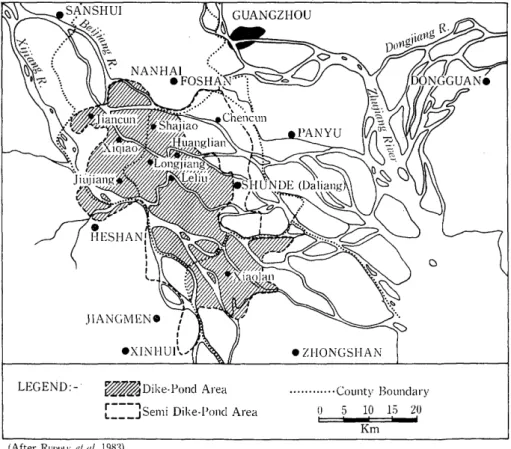
In the Zhujiang Delta an old established and elaborate integrated system of intensive agriculture and the polyculture of carps and other freshwater fishes, which has evolved over the last two millenia, is operated on a geographic and economic scale unmatched elsewhere in the world [RUDDLE et al. 1983; RUDDLE et al. n.d.] (Photo 1). This integrated system has been developed over an area of 800 km2 and supports an estimated population of 1.2 million persons. The system is best developed in the central part of the delta, where it focuses principally on Shunde County together with parts of neighboring Nanhai, Zhongshan, Xinhui and Heshan counties (Fig. 1).
The core of the system is composed of three essential components : fish ponds, mulberry dikes and sugarcane dikes. These three elements dominate the land use pattern where the system has developed best. Of a total of 80,520 ha of
Fig 1. Location of the Dike-Pond System in the Zhujiang Delta
国立民族学博物館研究報告 10巻 3号
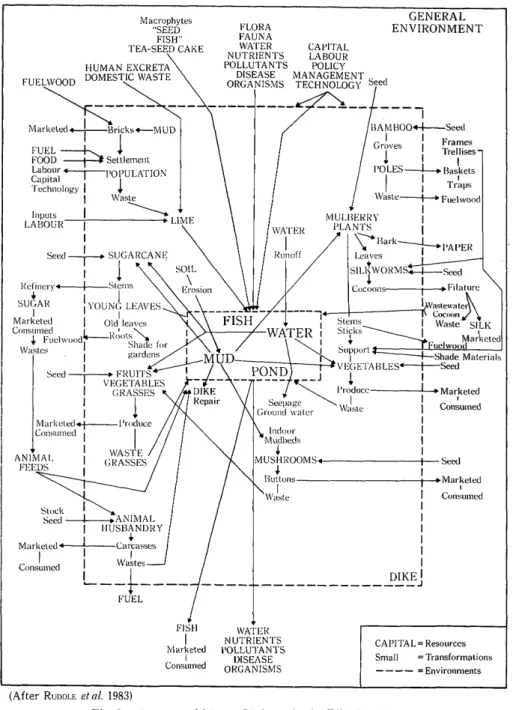
cultivated land in the dike-pond area, 73 percent, or 58,780 ha, are devoted to these three land uses : 28,116 ha (34.9 percent) in fish ponds, 9,900 ha (12.3 percent) under mulberry and 20,764 ha (25.6 percent) planted to sugar cane.2) The system contains at first sight an extremely complex range of matter and energy linkages among pond, dike, and the general environment (Fig. 2). In reality, however, these components are amenable to relatively easy integration.
At the heart of the system is the pond. To produce or maintain a fish pond, soil is excavated and used to build or repair the dikes that delimit it. Prior to being filled with water, the pond is prepared for fish cultivation by clearing, sanitizing and fertilizing. The required inputs are quicklime and tea-seed cake, which derive from the general environment, and organic manure, which is procured from the animal husbandry sub-system on the dike.
Under natural conditions, soil and organic materials gradually refill the pond through the processes of dike erosion. But this is interrupted 2-3 times a year when organically enriched mud is dug from the pond bottom and used to fertilize and build-up the upper surface of the dike. Pond mud is also used to make mud-beds for mushroom cultivation on the floor of the silkworm shed in winter, when silkworms cannot be raised.
The pond is then filled with river water, which bears nutrients, pollutants, fauna, flora and disease organisms. Water also enters directly as rain as well as through run-off from the dike. Water, enriched with additional nutrients and bearing pollutants, fauna, flora and disease organisms, leaves the pond in controlled discharges via the pond drainage outlet. Water is also lost through evaporation and transpiration, and via seepage into the dike, as well as being removed at regular intervals for the irrigation of crops planted on the dike.
Fish are then stocked in the pond. Apart from a few specialized instances of eel culture and initial experiments with Indian carps, together with the inclusion of Bream (Megalobrama amblycephala) and Tilapia (Oreochromis niloticus), all fish ponds in Shunde County are devoted to the culture of Cyprinids, the so-called Major or Chinese carps. These are the Grass carp (Ctenopharyngodon idellus), Silver carp (Hypophthalmichthys molitrix), Bighead carp (Aristichthys nobilis), Black or Snail carp (Mylopharyngodon piceus), Mud carp (Cirrhinus molitorella) and Com- mon carp (Cyprinus carpio). Each species has distinct feeding habits and each occupies a different level in the pond water column.
Some fish of marketable size are consumed locally but most enter the market;
70 percent of the fish produced in Shunde County, for example, are sold live, mostly to Guangzhou, Hong Kong and Macao (Photo 2). Fish sales contribute the largest source of income to the region's agricultural sector, the Zhujiang Delta yielding 90,000 t/yr of fish (1979), or 50 percent of the total production of Guangdong Province, and 80 percent of the nation's live fish exports [unpub.
2) Throughout this article all data have been converted from local units and extrapolated at the following rates: 1 mu= 0.066 ha; 1.97 yuan Rmb= 1 (U.S.) (Aug., 1983); 1 jin= 0.5 kg.
776
Fig 2. Energy and Matter Linkages in the Dike-Pond System
stats., Foshan Pref.].
A range of linked sub-systems functions on the dike. Mulberry (Morus atropurpurea) and sugar cane (Saccharum officinarum) are the main cropping sub-
777
国立民族学博物 館研究報告 10巻 3号
Photo 1. This tract of dikes and ponds developed several centuries ago in Xiqiao Commune , Nanhai County typifies the mature landscape of the old established dike-pond system.
systems. Mulberry is planted on the dikes and fertilized with pond mud and irrigated by hand with nutrient-rich pond water. The principal objective of mulberry cultivation is to produce leaves used as forage by silkworms (Bombyx mori). Mulberry bark is also harvested for making paper, and after pruning the
Photo 2. The bustling Fish Purchasing Station of Leliu Commune, Shunde County, is one point from which live fish from the region's ponds are sent to Guangzhou and exported
directly to Hong Kong and Macau.
branches are used as sticks to support climbing vegetables, or as fuelwood.
Inextricably bound-up with the mulberry sub-system is silkworm-rearing.
Silkworms are reared in special sheds in the settlement and sent to the filature in the nearby urban center for the production of yarn, much of which enters inter- national commerce. Waste water together with cocoon waste and dead larvae is returned from the filature and used to enrich the pond and feed the fish. Silk- worm excrement admixed with the remains of mulberry leaves is removed from the rearing sheds and used in the pond as fish feed.
During the off-season for silkworm-rearing mushrooms (Agaricus campestris) are cultivated on mud-beds, prepared from pond mud, on the floor of the silkworm rearing shed, using spores obtained from the general environment. Some mushrooms are consumed locally but most are marketed fresh, bottled or canned.
After the final crop has been harvested the nutrient-rich mud-bed on which the mushrooms are raised is used to fertilize those sections of the dike on which vege-
tables, fruit trees and grasses are cultivated.
Vegetable and grass production is a fundamental component of the dike-pond system, providing both essential food for the fish and vegetables for home con- sumption and marketing. These crops are also fertilized with pond mud and used mushroom mud-beds, and irrigated manually with pond water. In early spring,
before the mulberry shrubs come into leaf, mulberry dikes are interplanted with soy bean (Glycine max), mung bean (Phaseolus aureus), taro (Colocasia antiquorum),
peanut (Arachis hypogaea), and other vegetable crops. These are harvested in May and June. Along the edge of the dike bananas, plantains and fruit trees are cultivated. In summer and autumn, melons and gourds are planted at the very edge of the dike and trained on bamboo trellises that hang over the pond. In addition to making maximum use of the limited space available for cultivation this practise also shades the pond water and prevents excessively high temper- atures that would endanger the fish.
Each November, after the last harvest of mulberry leaves, the dikes are interplanted with an assortment of vegetables, mostly leafy greens, which provide two harvests. For feeding fish Elephant grass (Pennisetum purpureum) is planted on all available spare land, including the dike slopes, roadsides, around settlements and along watercourses, as are maize (Zea mays), sorghum (Sorghum spp.), and sweet potato (ipomoea batatas). To feed fish and pigs, aquatic plants such as duckweed, water lettuce (Pistia stratiotes) and water hyacinth (Eichhornia crassipes) are cultivated in canals, rivulets and associated water bodies. Small groves of bamboo are also a fundamental part of the system and provide poles for con- struction and materials used to fabricate baskets, traps, screens, trellises and frames which are the basic tools in other sub-systems. Bamboo waste is also used as fuel.
Sugar cane, some of which is either annually or biennially rotated with
mulberry, is also an essential sub-system in the dike-pond complex. The principal
product is refined sugar, but ancillary products are young leaves fed to the fish
国立民族学博物館研究報告 10巻 3号
and pigs, old leaves used to shade crops, for roofing thatch, and for fuel, and roots used as fuel. Refinery wastes are returned to the system in the form of animal and fish feed.
Pigs, raised mainly to provide manure but also for meat and ancillary products, are kept in sties constructed on the dike. Young stock are either obtained from the general environment or bred locally. External inputs to the sub-system consist principally of feedstuffs from the sugar refinery as well as occasional medicines and similar requirements. The concentrated feed require- ments of pigs are met by feeding weaned piglets a diet of greens, particularly aquatic macrophytes such as water hyacinth, sugar cane tops, and other vegetable waste. Pigs are regarded as "walking fertilizer factories" and their faeces and urine is the essential fertilizer of the fish pond. Water buffalo dung, mixed with coal dust and dried, is also used as fuel.
Apart from rice the basic food and shelter needs of the human settlements in the dike-pond district are met from the system itself. Local food sufficiency assures a balanced diet. Fuel needs are largely met from waste products; and bamboo, and dike mud, used to manufacture unglazed tiles and bricks, provide the principal materials for housing and furnishings. Other basic social and physical needs are satisfied within the commune. In addition to providing fundamental inputs into the dike-pond system in the form of capital, management skills, labor and technology—in conjunction with the higher order organized social units—human settlements provide excrement, urine, and other household wastes that form the principal organic inputs into the fish pond.
LABOR REQUIREMENTS OF THE SYSTEM
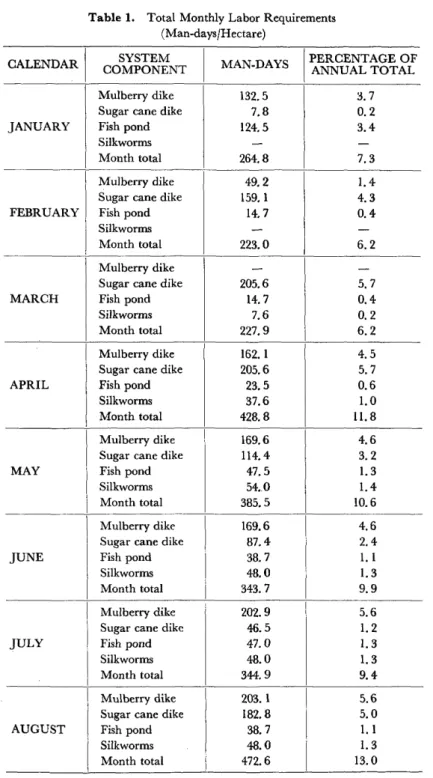
A total of 905.2 man-days/yr is required to operate a composite hectare composed of the four basic components of the dike-pond system.3) This is equivalent to the full-time annual labor input of 3 workers. By component, mulberry dike operations require 1510 man-days/ha/yr, or the input of 5 workers;
those for sugar cane need 1199 man-days/ha/yr, or the input of 4 workers; the pond requires 536 man-days/ha/yr, or the input equivalent of 1.7 workers; and silkworm-rearing requires 375 man-days/ha of mulberry/yr, or the input equiva- lent of 1.2 workers (Table 1).
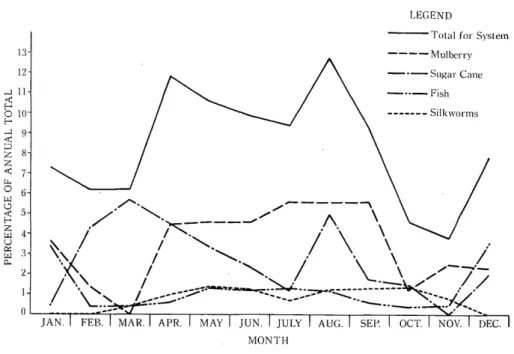
The total annual input of labor to the dike-pond system is depicted on a monthly basis in Fig. 3, by the percentage of the total annual input per crop.
The components are provided in Table 1 and by task complex in Table 2. Peak 3) The number of man-days is calculated on the basis of 305 days of full-time labor a year. For convenience, monthly labor demand has therefore been calculated based on 25.4 workdays
per month.
This composite figure is derived as follows: 0.25 (Mulberry [1510.2] +Sugar cane [1199.3] 4- Pond [536.0] +Silkworms [375.2]).
780
Fig 3. Annual Distribution by Crop of Labor Input to the Dike-Pond System (% of Man-day/Month/Crop)
labor demand occurs in the 6 summer and autumn months (according to lunar reckoning), from April until September. During this period 63.9 percent of the total labor requirement is input to the system. The months with highest demand are April and August, when 11.8 percent and 13 percent of total annual labor inputs are made, respectively. July and September, with 9.4 and 9.2 percent, respectively, have the lowest labor demand during the period.
The second major season of high labor demand occurs during the period December—March (i.e., lunar late-winter until the end of spring), in no month of which do requirements fall below 6 percent of the total annual input. Early-
winter is the relatively slack period, with only 4.6 and 3.9 percent of the total annual labor input being made in October and November, respectively. Peak labor demands vary by crop. This has an important temporal bearing on the recruitment of labor, as will be discussed below for each crop.
Labor Input to the Fish Pond
Labor input to the fish cultivation sub-system peaks markedly during the
period from mid-December to mid-January, when 47.3 percent of the total
annual input is made (Fig. 3). For the remainder of the year labor inputs remain
relatively low, except from May through August, when they reach 8.9, 7.2, 8.9
and 7.2 percent of the annual total, for the respective four months. In each of
国立民族学博物館研究報告 10巻 3号
Table 1. Total Monthly Labor Requirements (Man-days/Hectare)
CALENDAR
JANUARY
FEBRUARY
MARCH
APRIL
MAY
JUNE
JULY
AUGUST
SYSTEM COMPONENT Mulberry dike Sugar cane dike Fish pond Silkworms Month total Mulberry dike Sugar cane dike Fish pond Silkworms Month total Mulberry dike Sugar cane dike Fish pond Silkworms Month total Mulberry dike Sugar cane dike Fish pond
Silkworms Month total Mulberry dike Sugar cane dike Fish pond Silkworms Month total Mulberry dike Sugar cane dike Fish pond Silkworms Month total Mulberry dike Sugar cane dike Fish pond Silkworms Month total Mulberry dike Sugar cane dike Fish pond Silkworms Month total
MAN-DAYS 132.5 7.8 124.5
264.8 49.2 159. 1
14.7
223.0
205.6 14.7 7.6 227.9 162.1 205.6 23.5 37.6 428.8
169.6 114.4 47.5 54..0 385.5 169.6
87.4 38. 7 48.0 343. 7 202.9
46. 5 47.0 48.0 344. 9 203. 1 182.8
38. 7 48.0 472.6
PERCENTAGE OF
ANNUAL TOTAL
3.7 0. 2 3.4
7.3 1.4 4. 3 0.4
6.2
5. 7 0.4 0.2 6.2 4.5 5.7 0.6 1.0 11.8 4.6
3.2 1.3 1.4 10.6 4.6 2.4 1. 1 1.3 9.9 5.6 1.2 1.3 1.3 9.4 5.6
5.0
1. 1
1.3
13.0
CALENDAR
SEPT.
OCTOBER
NOV.
DEC.
TOTALS
SYSTEM COMPONENT Mulberry dike Sugar cane dike Fish pond Silkworms Month total Mulberry dike Sugar cane dike Fish pond Silkworms Month total Mulberry dike Sugar cane dike Fish pond Silkworms Month total Mulberry dike Sugar cane dike Fish pond Silkworms Month total Mulberry dike Sugar cane dike Fish pond Silkworms Annual total
MAN-DAYS 203.0 61.6 23.5 48.0 336. 1 44.0
52. 7 14.7 54.0 165.4 90.9 19. 1 30. 0 140.0 83.3
75.8 128.9
288.0 1510.2
1199.3 536.0
375. 2 3620. 7
PERCENTAGE C
ANNUAL TOTA
5.6 1.7 0.6 1.3 9.2 1.2 I.5 0.4 1.4 4.6 2.5
0.5 0.8 3.9 2.3 2.0 3.5
7.9 43.7
30.0 15.5 10.8 100.0
these four months extra labor is necessary for draining excess pond water during the rainy season, and in May, July and August for harvesting.
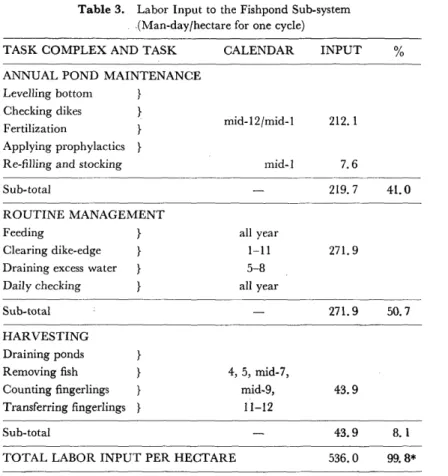
Males 20-39 years-of-age make a major heavy labor input into fish pond tasks during a 30-day period from mid-December to mid-January, when the annual maintenance of ponds is undertaken and when the ponds are re-filled with water and re-stocked with fingerlings. This task complex requires a labor input of almost 220 man-days/ha (Table 3).
Routine management of the ponds requires a total annual input of 271.9 man-days/ha during the 10-month period February through December. The average annual daily manpower input required for collecting fish feed, dumping it in the pond, checking water conditions and removing waste from around the perimeter of the pond is 0.9 man-days/ha. Since the tasks involved are relatively light they can be performed easily by teenagers or older persons of either sex, hence there is no labor constraint.
Draining excess water from the ponds after periods of especially heavy rainfall
is, however, done by the stronger males aged 20-39. Performance of this task
国立民族学博物 館研究報告 10巻 3号
Table 2. Composition by Task Complex of Monthly Labor Input (Man-days/Hectare)
CALENDAR
JANUARY
FEBRUARY
MARCH
APRIL
MAY
JUNE
JULY
SYSTEM
COMPONENT TASK COMPLEX AND LABOR INPUT
Mulberry dike Dike preparation (83.3), Planting (49.2)
Sugar cane dike Break ing clods (7.8)
Fish pond Feeding and Edge clearance
maintenance (109.8) (14.7), Annual
Mulberry dike Dike preparation (49.2)
Sugar cane dike Makin
(37.9),
g rows and drains (45.4),
Planting and harvesting Seed preparation (75.8)
Fish pond Feeding and Edge clearance (14.7)
Sugar cane dike Weeding (8.6), Slurry-spreading
and harvesting (151.5) (45.5), Planting
Fish pond Feeding and Edge clearance (14.7)
Silkworms Preparation (7.6)
Mulberry dike 1st Harvest (37.9), Weeding (121.2), Fertilizing (3.0)
Sugar cane dike Weeding (8.6), Slurry-spreading
harvesting (151.5) (45.5), Planting and
Fish pond Harvesting (8.8), Feeding and Edge clearance (14.7)
Silkworms Preparation (7.6), 1st Harvest (30.0)
Mulberry dike 2nd Harvest (45.4), Weed ing (121.2), Fertilizing (3.0) Sugar cane dike
Fish pond
Weeding (8.6), Planting and harvesting
Shoot removal (30.3) (75.8),
Draining excess water
Feeding and clearance (24), Harvesting (14
.7) (8.8),
Silkworms 1st Harvest (30), 2nd Harvest (24)
Mulberry dike 3rd Harvest (45.4), Weed ing (121.2), Fertilizing (3.0)
Sugar cane dike
Fish pond
Mud-spreading
(3.0) (75.8), Weeding (8.6), Fertilizing Draining excess water
(14.7) (24), Feeding and clearance
Silkworms 2nd Harvest (24), 3rd Harvest (24)
Mulberry dike 4th Harvest and bud-removal (45.4), Weeding (121.2), Fertilizing (6.1), Mud-spreading (30.3)
Sugar cane dike Weeding (8.6), Irrigation (7.6), Shoot-removal (30.3)
Fish pond Harvesting (8.8), Draining excess water
Feeding and Edge clearance (14.7) (24),
CALENDAR SYSTEM
COMPONENT TASK COMPLEX AND LABOR INPUT
Silk worms 3rd Harvest (24), 4th Harvest (24)
AUGUST
SEPT.
OCT.
NOV.
DECEMBER
Mu lberry dike 5th Harvest (75.7), Weeding (121.2), Fertilizing (6.1)
Sugar cane dike
Fish pond
Weeding (8.6), Shoot removal (30.3), Irrigation (22.7), Soil-heaping (45.4), Mud-spreading (75.8) Draining excess water (24), Feeding and edge clearance (14.7)
Silk worms 4th Harvest (24), 5th Harvest (24)
Mu lberry dike
Sugar cane dike
6th Harvest (45.4), Weeding (121.2), Fertilizing (6.1), Mud-spreading (30.3)
Weeding (8.6), Irrigation (22.7), Shoot removal (30.3)
Fish pond Harvesting (8.8), Feeding and edge clearance (14.7)
Silk worms 5th Harvest (24), 6th Harvest (24)
Mulbe rry dike 7th Harvest (37.9), Fertilizing (6.1) Sugar cane dike Shoot removal (30.3), Irrigation (22.7)
Fish pond Feeding and edge clearance (14.7)
Silkworms 6th Harvest (24), 7th Harvest (30)
Mu lberry dike Mud-spreading (30.3), Preparation for over-wintering (60.6)
Fish pond Harvesting (4.4), Feeding and edge clearance (14.7)
Silkworms 7th Harvest (30)
Mu lberry dike Dike preparation (83.3)
Sugar cane dike Tillage (75.8)
Fish pond Harvesting (4.4), Feeding (14.7), Annual maintenance (109.8)
requires an average per annum of 7 percent of the labor input into this task complex, or some 40 man-days/ha/yr, concentrated in the May—August rainy season and
during the passage of typhoons.
A total of 43.9 man-days/ha is required to perform the heavy tasks involved in harvesting fish. This labor input is required five times a year and each harvest requires an input of 9 man-days/ha. This labor has to be recruited once each in April, May, mid-July, mid-September and November—December (Photo 3).
Since the entire pond area was not harvested on one single day, but rather spread
over 10-15 days at each period, the provision of labor presented no problem.
国立民族学博物館研究報告 10巻 3号
Table 3. Labor Input to the Fishpond Sub-system (Man-day/hectare for one cycle)
TASK COMPLEX AND TASK CALENDAR INPUT °A
ANNUAL POND MAINTENANCE
Levelling bottom Checking dikes Fertilization
Applying prophylactics Re-filling and stocking
mid-12 /mid-1
mid-1
212. 1
7.6
Sub-total 219. 7 41.0
ROUTINE MANAGEMENT
Feeding
Clearing dike-edge Draining excess water Daily checking
all year 1-11 5-8 all year
271.9
Sub-total 271.9 50.7
HARVESTING Draining ponds Removing fish Counting fingerlings Transferring fingerlings
4, 5, mid-7, mid-9, 11-12
43.9
Sub-total 43.9 8. 1
TOTAL LABOR INPUT PER HECTARE 536.0 99.8*
(* Sum not 100 owing to rounding Tables 3-6)
Labor Input to the Sugar Cane Dike
The cultivation of sugar cane is the second most labor-intensive component of the dike-pond system, and requires an input of 1199 man-day/ha/yr, or 30 percent of the total input to the system (Table 1). Labor requirements for sugar cane reach a peak during the period February through May, when the dike preparation, planting and harvesting task complexes are performed. During this period 57 percent of the total annual labor input for sugar cane cultivation is made (Fig. 3). A second labor peak occurs when the performance of numerous different annual management tasks coincides in August (Table 2). In that month 15 percent of the labor inputs are made to the sugar cane dike.
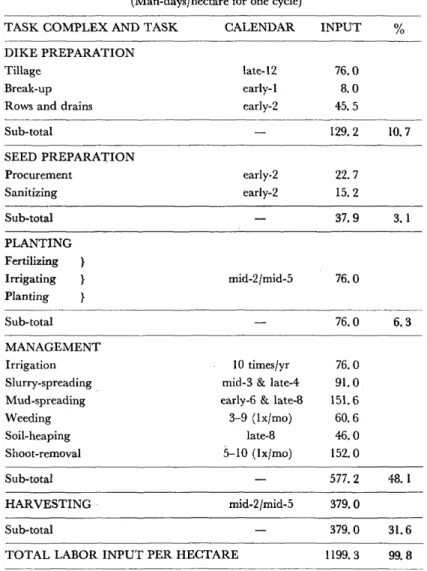
Tilling the dike for planting sugar cane begins in late-December (Table 4).
Generally this heavy task is performed by men of less than 40 years-of-age, and
requires 76 man-days/ha of labor. Some two weeks after tilling the sun-dried
clods of soil are broken-up by the same men or by women of the same age
group. This task consumes a further 8 man-days/ha. Together these three land
Photo 3. Harvesting fish from a household pond in the First Production Team of the Nanshui Brigade. This heavy task is undertaken reciprocally by younger men.
preparation tasks require almost 129 man-days/ha of labor input. Concurrently, one woman procures and prepares the planting stock. This job requires about 23 man-days/ha of dike to be planted.
The three tasks of planting, irrigation (if the soil is too dry) and fertilizing with household waste are performed at the same time, and, in total, require
Photo 4. Spreading pond mud over the sugar cane dike is another arduous task (First Pro- duction Team, Nanshui County).
787
国立民族 学博物館研究報告 10巻 3号
Table 4. Labor Input to the Sugar Cane Sub-system (Man-days/hectare for one cycle)
TASK COMPLEX AND TASK CALENDAR INPUT °A
DIKE PREPARATION Tillage
Break-up Rows and drains
late-12 early-1
early-2
76.0 8.0 45. 5
Sub-total 129.2 10.7
SEED PREPARATION Procurement
Sanitizing
early-2 early-2
22. 7 15. 2
Sub-total 37.9 3. 1
PLANTING Fertilizing 1 Irrigating Planting }
mid-2/mid-5 76.0
Sub-total 76.0 6. 3
MANAGEMENT Irrigation Slurry-spreading Mud-spreading Weeding Soil-heaping Shoot-removal
10 times/yr mid-3 & late-4 early-6 & late-8
3-9 (lx/mo) late-8 5-10 (lx/mo)
76. 0 91.0.
151.6 60. 6
46.0 152.0
Sub-total 577. 2 48. 1
HARVESTING mid-2/mid-5 379.0
Sub-total 379. 0 31.6
TOTAL LABOR INPUT PER HECTARE 1199.3 99.8
76 man-days/ha. This task complex is coordinated with the labor requirement for harvesting of mature cane, which is performed during the same period.
Irrigation and mud-spreading during the growing period are heavy tasks that are performed mainly by men less than 40 years old (Photo 4). Together these tasks absorb 318 man-daysiha.4)
Weeding of sugar cane is done by women in the 20-39 years age group, who provide an aggregate of some 61 days of labor for the task. These same women
4) This figure does not include the 10-12 additional applications of irrigation water in years with a stong autumn drought. These would add a further 76-91 man-days to the labor require-
ment.
788
also devote 46 days/ha to heaping-up the soil around the base of the plants. Each month, from the second soil-heaping until late-October, older women remove the internode shoots from the cane. This requires a total labor input of 152 days/ha.
Harvesting is performed by both men and women. It requires some 379 days/ha of labor input.
Labor Input to the Mulberry Dike
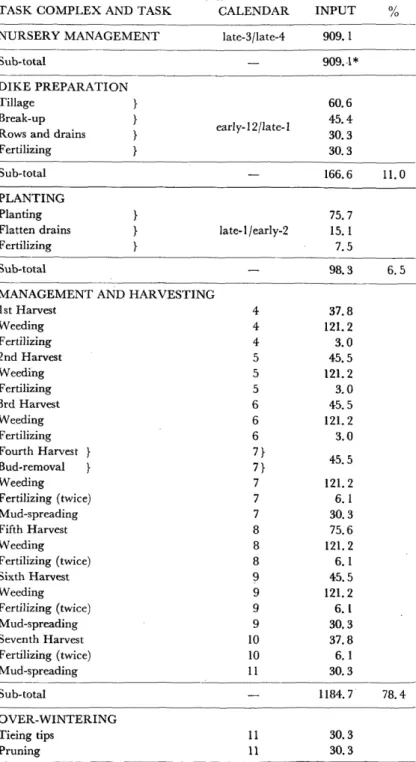
Cultivation of the mulberry dike is the most labor-intensive component of the dike-pond system. With a labor requirement of 1510 man-days/ha/yr, the mulberry dike absorbs almost 44 percent of the total input to the system. Labor requirements remain uniformally high during the period April through September (Fig. 3), when those for leaf harvesting are added to the demands of routine management. During this 6-month period 1110 man-days/ha, or 73 percent of the total labor input to the mulberry component is made (Table 5). A secondary labor peak occurs in January, when the dike is prepared for planting. Only residual labor inputs for tasks not completed in February are made in March.
Most tasks involved in the mulberry nursery are performed by young women, but those requiring expert management, such as pest control, are done by ex- perienced farmers of about 40 years-of-age. Total labor input for the mulberry nursery amounts to about 909 man-days/ha/yr.
Transplanting, levelling the drainage canals and fertilizing with urea are done in February and March by men and women less than 40 years-old. These tasks require nearly 100 man-days/ha of labor. Manual irrigation of the transplanted bushes, which is done concurrently with transplanting, consumes a further 45 man-days/ha of labor.
Management of the mulberry dike during the growing period is undertaken by the same group of people who performed the preceding tasks. Altogether weeding after each of the first six leaf harvests requires slightly in excess of 720 man-days/ha of labor on the better dikes, whereas on those of inferior quality, in terms of the rate of weed infestation, the task requires a considerably higher input. Pest control, if necessary, is performed concurrently with weeding.
Two applications of pond mud slurry and one of relatively dry pond mud are spread over the mulberry dike. They each require 30 man-days of labor input.
The light but frequent work of harvesting mulberry leaves to feed silkworms is performed by young women in their late-teens or early-twenties (Photo 5).
This job is done at least 7 and not infrequently 8 times a year between April and November. Since the size of the harvest varies during the season, labor inputs also vary accordingly, from a low of 38 man-days/ha for the first harvest to a high of 75 for the fifth.
If necessary old mulberry bushes are up-rooted after the final leaf harvest.
国立民族学博物館研究報告 10巻 3号
Table 5. Labor Input to the Mulberry Sub-system (Man-day/hectare for one cycle)
TASK COMPLEX AND TASK CALENDAR INPUT °A
NURSERY MANAGEMENT late-3/late-4 909. 1
Sub-total 909..1*
DIKE PREPARATION Tillage
Break-up Rows and drains Fertilizing
early-12/late-
60. 6 45.4 30.3 30.3
Sub-total 166.6 11.0
PLANTING Planting Flatten drains Fertilizing
late-1/early-2
75. 7 15. 1 7.5
Sub-total 98.3 6. 5
MANAGEMENT AND HARVESTING 1st Harvest
Weeding Fertilizing 2nd Harvest Weeding Fertilizing 3rd Harvest Weeding Fertilizing Fourth Harvest } Bud-removal } Weeding
Fertilizing (twice) Mud-spreading Fifth Harvest Weeding Fertilizing (twice) Sixth Harvest Weeding Fertilizing (twice)
Mud-spreading Seventh Harvest Fertilizing (twice) Mud-spreading
4 4 4 5 5 5 6 6 6 7}
7}
7 7 7 8 8 8 9 9 9 9 10 10 11
37.8 121.2 3.0 45.5 121.2 3.0 45.5 121.2 3.0 45.5 121.2 6. 1 30. 3 75.6 121.2 6. 1 45.5 121.2 6. 1 30.3 37.8 6, 1 30.3
Sub-total 1184.7 78.4
OVER-WINTERING Tieing tips Pruning
11 11
30.3
30.3
TASK COMPLEX AND TASK CALENDAR INPUT 0A
Sub-total 60.6 4.0
REMOVAL FOR REPLANTING 11-12 75.8*
Sub-total 75.8* 99. 9
TOTAL LABOR INPUT PER HECTARE*
*Total labor input assumes a case where neither a nursery is prepared nor old plants removed for replanting; where heavy winter interplanting of vegetables does not occur; that the usual 7 and not the exceptional 8 leaf harvests are taken; and that the dike is of good quality, so that only the minimum weeding inputs are required. Sub-totals denoted by an asterisk are not, therefore, included in the total input.
This job requires 45-75 man-days/ha of labor input. At that time, too, the mulberry dike is prepared for over-wintering and interplanting of vegetables.5) For this the tips of the branches of the younger bushes are tied together. This job consumes 30 man-days/ha. Older bushes are either pruned or have their branches lashed-down. This task is more labor-intensive and requires 30- 76 man-days/ha to perform.
Labor Input to Silkworm-Rearing
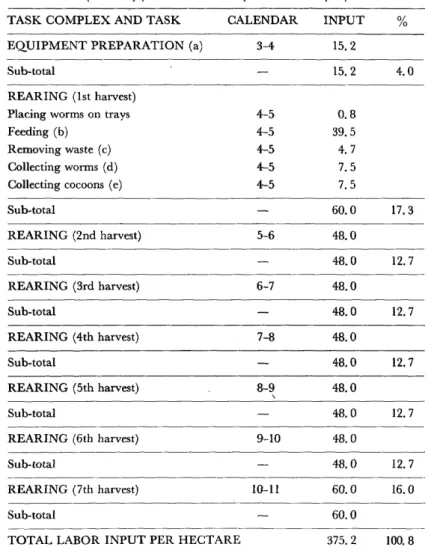
Silkworm-rearing requires the least labor input of any component of the dike-pond system, .with 375 man-days/ha of mulberry/yr, or 11 percent of total input to the system being devoted to it. Further, most of the tasks are light and are performed by a highly-skilled, older and experienced specialist assisted by younger women who are still basically trainees (Photo 6).
Activities are essentially concentrated between April and November, with preparatory tasks being performed in March (Fig. 3). Preparation of the rearing
5) Since the vegetable sub-system is only a relatively minor component of the land use of the small area studied in detail it became, perforce, only a minor topic in the overall research project.
Further, given the small, fragmented, intensively interplanted and frequently changing crop
assemblages on the beds of the crop dikes, it would have been disproportionately time-
consuming to record the detailed input of labor by task for each crop. Moreover, this would
have been impossible without assigning an observer to record the daily jobs done and the time
taken for each on the vegetable dike for an entire year, since none of the informants had any
idea of the vegetable yields per unit area or of the time required to accomplish the various
minute tasks involved. One might have done better by recording labor input by individual
planting bed, but the resultant data would have had little ecological or economic value since
they could not have been reconciled with either the relative distribution of energy and matter
inputs or with labor input per crop or economic rate of return per crop, under conditions of
interplanting.
Bananas, often regarded as a vegetable in this area, are grown along the edge of the mulberry and other dikes. All the tasks involved in their cultivation require a labor input of 1515 man-days/ha/yr. (This figure assumes replanting a new area rather than just the routine
management of established plants.)
国立民族学博物館研究報告 ユ0巻 3号
Photo 5. Seven and sometimes eight times a year women perform the light task of stripping mulberry leaves to feed silkworms (First Production Team, Nanshui Brigade).
shed and equipment, done in March, requires some 15 man-days/ha of mulberry, or 4.0 percent of total silkworm-related labor inputs (Table 6 and Photo 7).
Thereafter the principal labor-consuming task is the daily feeding of the worms during their growth period. This task absorbs about 65 percent of the total labor input per crop. Total labor input rates per harvest vary, ranging from
Photo 6. Young women of the First Production Team, Nanshui Brigade selecting silkworms
for cocoon-spinning.
Photo 7. Between stocking periods an older specialist disinfects then washes the silkworm-rearing
trays in the irrigation canal (First Production Team, Nanshui Brigade).
a high of 60 man-days/ha of mulberry for the first and seventh harvest to 48 for the five others.
LABOR INPUT BY THE FIRST PRODUCTION TEAM, NANSHUI
BRIGADE
By the late-1960s the local level formal administrative system of China had assumed the familiar three-tier form of People's Commune, Production Brigade, and Production Team. Nevertheless, the household remained the smallest single unit of Chinese rural social organization and the one in which the de facto use and management of privately owned resources, such as small garden plots and domestic animals, was vested.
The production team, the basic agricultural production and accounting unit in most communes, generally consists of 20-30 households. Prior to the imple- mentation of the recent rural reforms (vide infra) in it was vested the ownership of all agricultural implements other than those privately owned. Since basic local production decisions are made at this level, the production team is also the smallest unit in the national planning process.
Intermediate is the production brigade, which serves largely as a planning
and administrative unit. It undertakes productive activities too large for the
production team, such as constructing and maintaining drainage and irrigation
systems, or land reclamation and improvement schemes. Brigades also operate
agro-industries, farm machinery repair shops and the like, as well as schools and
国立民族学博物館研究報告 10巻 3号
Table 6. Labor Input to the Silkworm Sub-system (Man-days/hectare of mulberry dike for one cycle)
TASK COMPLEX AND TASK CALENDAR INPUT °A
EQUIPMENT PREPARATION (a) 3-4 15.2
Sub-total 15. 2 4.0
REARING (1st harvest) Placing worms on trays Feeding (b)
Removing waste (c) Collecting worms (d) Collecting cocoons (e)
4-5 4-5 4-5 4-5 4-5
0. 8 39. 5 4. 7 7.5 7. 5
Sub-total 60.0 17.3
REARING (2nd harvest) 5-6 48.0
Sub-total 48.0 12.7
REARING (3rd harvest) 6-7 48.0
Sub-total 48. 0 12.7
REARING (4th harvest) 7-8 48.0
Sub-total 48.0 12.7
REARING (5th harvest) 8-9 48.0
Sub-total 48. 0 12. 7
REARING (6th harvest) 9-10 48. 0
Sub-total 48.0 12. 7
REARING (7th harvest) 10-11 60.0 16.0
Sub-total 60. 0
TOTAL LABOR INPUT PER HECTARE 375. 2 100. 8
(a) This task consists of repairing, cleaning and sanitizing the rearing shed and the equipment; (b) feeding is done 6 times/day and requires some 3.0 hrs/ha each time. Worms of harvests 1 and 7 are fed for 18 days and 2-6 for 13 days; (c) Waste is removed from the rearing trays every second day, i.e., 9 times for harvests 1 and 7 and 7 times for harvests 2-6. Each removal requires a labor input of about 3.0 hrs/ha; (d) includes placement on cocoon spinning trays; (e) includes transporting to Cocoon Purchasing Center.
health stations.
The highest unit in the local organization is the people's commune. It
undertakes activities too large for the other levels and also performs higher order
administrative, economic, social and political functions.
The Leliu Commune labor force of approximately 36,000 persons is organized into 29 brigades and 257 production teams. The latter range in size from 150- 500 members and, although basically comprehensive in organization had, until the recent reforms, specialized groups such as those for fish pond operations, mulberry cultivation, and the like. The labor force is supported by various other specialized teams, including, inter alia, those for physical construction, transport and machinery repair and maintenance. Other teams work in the comple- mentary small-scale manufacturing sector of the commune economy, producing goods for both use within the commune and for sale elsewhere. Special teams composed of children and old people watch for signs of pest infestation in the fields, and implement appropriate control measures.
In this section the operation of the dike-pond system is discussed via an analysis of labor inputs formerly required, under the old administrative system, to operate the area allocated to the First Production Team of the Nanshui Brigade, Leliu Commune, Shunde County.
In terms of land use, the small tract belonging to the First Production Team of the Nanshui Brigade exemplifies the dike-pond system (Fig. 4; Table 7). Of the total of 21.58 ha that belongs to this team, 19.67 ha or 91.14 percent is devoted to the components of the dike-pond system : 9.97 ha (46.2 percent) are in fish ponds, 6.2 ha (28.7 percent) are under sugar cane, 2.84 ha (13.1 percent) are planted to mulberry, and 0.66 ha (3.1 percent), classed as "miscellaneous dikes,"
is under Elephant grass and maize.
Only 1.9 ha (8.8 percent) are not tightly linked to the dike-pond system.
Of this amount 0.92 ha (4.3 percent) is classified as under "dry land" crops (principally vegetables, peanuts, sweet potatoes and maize) ; 0.59 ha (2.7 percent)
Table 7. Land Use of the First Production Team, Nanshui Brigade, Leliu Commune, Shunde County
LAND USE CATEGORY AREA
(ha)
DISTRIBUTION (0/0)
FISH PONDS SUGAR CANE MULBERRY
MISCELLANEOUS DIKES1)
DRY LAND2) PRIVATE PLOTS LOTUS POOL BANANAS
9.97 6.2 2.84 0.66 0.92 0.59 0.26 0. 13
46.2 28. 7
13. 1 3. 1 4. 3 2. 7 1.2 0.6
TOTAL 21.57 99.9*
1) Devoted to Elephant grass and maize production.
2) Under vegetables, peanuts, sweet potatoes and maize.
* Rounding error.
国立民族学博物館研究報告 10巻 3号
Fig 4. Land Utilization by the First Production Team, Nanshui Brigade
is allocated as private plots for household use and is devoted mostly to vegetable production; 0.26 ha (1.2 percent) is a pool for lotus cultivation; and 0.13 ha (0.6 percent) is under bananas.
The population structure and labor force characteristics of the First Pro-
duction Team of the Nanshui Brigade are typical of those of most other teams in
Table 8. Population Characteristics and Labor ,Division in the First Production Team, Nanshui Brigade
AGE GROUP
0-14 15-19 20-24 25-29 30-34 35-39 40-44 45-49 50-54 55-59 60+
TOTAL
TOTAL
100 32 33 29 26 16 12 10 16 9 28 311
°A 32.15
10.28 10.61 9.32 8.36 5.14 3.85 3.21 5.14 2.89 9.00 100.00
NO.
MALE 48 15 16 15 11 6 3 5 7 4 13 143
NO.
FEMALE 52
17 17 14 15 10 9 5 9 5 15 168
WORK PERFORMED
MALE PS, S FP, S, SW
FP, SW 1/
//
//
SC SC OSL //
R
FEMALE
M, RW, PS, S RW, S, SW FP, RW RW, SC
V OW //
M, SC
R //
WORK KEY:
FP =Fish pond, M = Mulberry, OSL =Outside side work, OW= Outside work, PS =Pre- school, R =Retired, RW =Roadwork, S = School, SW =Silkworm, SC =-- Sugar cane, V=
Vegetables.
SOURCE : Unpublished data from the Nanshui Brigade Procurement and Records Office.
Leliu Commune. This medium-size team has a total population of 311 persons (August, 1983), composed of 143 males and 168 females, divided among 58 households (Table 8).
Of this population, 57.64 percent is economically active on a full-time basis, and the dependent population (i.e., pre-schoolers, children still attending school and retired persons) is large, at 42.4 percent, although many such people are engaged part-time in productive activities. The bulk of the directly productive labor is performed by both males and females of 15-49 years-of-age, with the 50-60 years age groups essentially being in transition from full-time labor to retirement.
The 178 full-time workers in the team, which includes 96 females, were, until the rural reforms started, allocated among the sub-systems of the dike-pond system as follows: 42 to mulberry cultivation and sericulture; 31 to sugar cane production; 52 to fish pond activities; and the remaining 53 to brigade and commune industries, transport, administration and other essential activities.
LABOR SUPPLY
Division of Labor
Children younger than 7 years-of-age spend most of their time either at play
in the alleyways of the village, under the supervision of retired persons, or in the
国立民族学博物館研究報告 10巻 3号
Brigade's kindergarten. Such young children generally lack both the funda- mental knowledge and skills as well as the physical strength to undertake even the simplest of production tasks.
Both boys and girls aged 7-15 are in school most of the time, and some boys continue until their nineteenth birthday. But both before and after school hours and during the holidays children from about the age of eight regularly assist in field and pond work and with domestic chores.
They begin their participation in productive labor with the least mentally and physically demanding tasks, such as sweeping-up twigs and leaves blown down by typhoons, for use as domestic fuel, and the collection of fish food and feeding the fish. They are taught the more complicated, but still not too difficult, jobs of monitoring pond water quality via the visual inspection of fish surfacing behavior, to assess dissolved oxygen conditions in the early morning, and after periods of heavy rain to check on pond water levels. They also gradually begin to undertake some of the heavier and more skilled tasks such as weeding, cutting, carrying and drying sugar cane leaves for fuel, picking mulberry leaves and feeding silkworms, and the like.
Tasks such as those are not inherently complex and are usually mastered with little effort after instruction by an adult family member. Thus by the age of
15 a child will normally have performed most of the basic and lighter tasks on many occasions, either filling-in for a sick or absent relative or neighbor, or as a part- time member of a household production unit or, until five years ago, as a member of one of the specialized work groups into which a production team was organized.
Only rarely will persons less than 20 years-of-age have performed the physically demanding tasks involved in routine and annual pond maintenance, mud- spreading; or such relatively skilled tasks as crop fertilization. Only when they become full-time members of the work force are they taught, and do they perform,
•
such tasks regularly.
The physically demanding tasks involved in the fish pond sub-system and the skilled activities demanded by silkworm-rearing are performed mostly by men aged 20 to 39 years. Males 40-49 years old mostly undertake the labor of sugar cane and vegetable cultivation. Most men 50-59 years-of-age generally hand- over the heavy and intensive work involved in the four main sub-systems to the younger males, although they continue to participate during periods of intensive labor demand and during emergencies. Mostly, these men devote themselves to
"sideline" production
, such as fishing and shrimping in the rivers and irrigation
canals (Photo 8), small boat construction or river transport. Although men
officially retire at the age of 60, they invariably continue to engage occasionally
either in the lighter tasks of the main productive activities or in sideline pursuits,
as the household economy warrants. But on any given day many men in their
mid-sixties stay around the village doing such odd jobs as repairing agricultural
or fishing tools, or tending a small stall in the free market along the main alleyway.
Photo 8. An old man shrimping with a stick-held lift-net in an irrigation canal of the First Production Team, Nanshui Brigade.
After leaving school the more skillful young women work in the mulberry and silkworm sub-systems, where they are involved in all the lighter tasks of mulberry cultivation and most of the tasks of silkworm-rearing. Others work at such odd jobs as road maintenance, brick- and tile-making or house-building. Women between the ages of 20 and 49 undertake a considerable proportion of the culti-
Photo 9. Manual irrigation of cowpeas (Vigna sinensis) is performed several times per day
during the autumn drought period (First Production Team, Nanshui Brigade).
国立民族学博物 館研究報告 10巻 3号
vation labor, particularly the lighter tasks (Photo 9), and, to a lesser extent, fish pond work as well as the heavier household chores. With increasing age, women perform lighter fieldwork and household chores, and, although officially pensioned-off at 55, older widows assist generally around their oldest son's house, doing much if not all of the cooking, , light housework and the supervision of the younger children—thereby releasing the mother for field labor—as well as tending small market stalls and doing a myriad of other minor miscellaneous tasks.
The Working Day
The length of the working day, which varies according to season, is 10 hours in spring, summer and autumn and 8 in winter. According to the lunar calendar used by Cantonese farmers, January–March is spring, April–June is summer, July–September is autumn and October–December is winter. A typical daily schedule of work and other activities is given in Table 9.
Team Labor Inputs to the Fish pond
At the level of the production team, with 9.97 ha of fish ponds, the sub-system had a total annual labor demand of 5344 man-days. The annual maintenance task complex required the provision of 2190.2 man-days of labor, or the work of 86 men during the 30-day period in December–January. Routine management tasks of the production team's pond area required the provision of 2710.2 man- days/yr of labor. Thus for the team's ponds this task complex required the full-time labor of 9 persons/yr. Harvesting required 88 man-days.
Team Labor Inputs to the Sugar Cane Dike
The 6.2 ha that the production team had under sugar cane had a total annual labor demand of 7436 man-days. By task complex this required the
Table 9. Typical Schedule of Work and Other Activities
(1) SPRING-SUMMER-AUTUMN 04:00 Rise
04:00-04:30 Prepare feed for fish and stock, check pond 04:3 0-05:00 Eat breakfast at food stall
06:00-11:00 Dike and pond work
11: 00-14:30 Eat lunch at home and rest 14:30-19: 30 Dike and pond work (2) WINTER
07:00 Rise
07:00-07:30 Prepare feed for fish and stock, check pond 07: 30-08:00 Eat breakfast at food stall
08:00-11:30 Dike and pond work 11:30-13:30 Eat lunch at home and rest
13:30-18:00 Dike and pond work
supply of close to 800 days for dike preparation, 235 for seed preparation, 470 for planting, 3750 for management during the growing period, and 2350 for harvest- ing.
Many tasks in the cultivation of sugar cane are undertaken by both men and women working together. Principally these were for planting and harvesting, which, since they were performed at the same season, demanded a large labor force. The team had to muster 470 man-days for planting and 2348 for harvest- ing. During the 3-month period from mid-February to mid-May a total of 2818 man-days of labor was required to perform simultaneously the tasks of planting and harvesting. In other words, a minimum of 31 people had to work full-time on the sugar cane dikes during that period.
The heaviest tasks in sugar cane cultivation are undertaken by men of less than 40 years-of-age, supplemented in times of severe labor demand by younger women. Thus such stronger men were required to supply 471 man-days of labor in the second-half of December to till the sugar cane dike and a further 282 in early-February to construct the planting rows and drains. The heaviest tasks of management during the crop growth cycle are also performed by these same men.
Thus the production team had to recruit their labor exclusively for irrigation and slurry- and mud-spreading. These tasks required 471 and 1504 man-days per annum, respectively. In total, therefore, men in the less than 40 year-old age
category had to supply 2728 man-days/yr for sugar cane cultivation.
The lighter tasks of sugar cane cultivation were performed by women and older and younger males, supplemented as required by the stronger men when they were not required for other, heavier tasks. Thus women mainly provided the almost 50 days of labor needed to break-up the clods after sun-drying.
Preparation of the planting material was usually done entirely by women, who provided 235 days for the purpose. Similarly, soil heaping, weeding and shoot- removal was also done by women who provided an aggregate of 1603 days of labor for these tasks. Thus the women were primarily responsible for providing a total of almost 1890 days of labor for these tasks for each cycle of sugar cane. cultivation.
Team Labor Inputs to the Mulberry Dike
The 2.84 ha of mulberry dike cultivated by the production team had a labor demand of 4289 man-days/yr, or the full-time labor of 14 persons. This assumes that neither a nursery is prepared nor older plants removed for re-planting; that heavy winter interplanting does not occur and therefore that only the tips of the mulberry bushes are tied rather than the plants being lashed down; that 7 rather
than the exceptional 8 leaf harvests are taken; and that the dike is of good quality
so that only minimal labor inputs for weeding are required. Were these ad-
ditional tasks to be performed the annual labor requirement would rise by
1105 man-days/ha to a total of 2615 man-days/ha, or to 7427 for the area that
the Production Team had under mulberry. Correspondingly, the number of
国立民族学博物館研究報 告 10巻 3号