• 検索結果がありません。

Caught in the Web, but Still in the Past : Foraging, Farming and Socioeconomic Relations between the Awa-Guaja and their Neighbors

N/A
N/A
Protected

Academic year: 2021

シェア "Caught in the Web, but Still in the Past : Foraging, Farming and Socioeconomic Relations between the Awa-Guaja and their Neighbors"

Copied!
28
0
0

読み込み中.... (全文を見る)

全文

(1)

Foraging, Farming and Socioeconomic Relations between the Awa‑Guaja and their Neighbors

著者(英) Louis C. Forline

journal or

publication title

Senri Ethnological Studies

volume 94

page range 227‑253

year 2016‑12‑08

URL http://doi.org/10.15021/00008297

(2)

227

Edited by Kazunobu Ikeya and Robert K. Hitchcock

Caught in the Web, but Still in the Past: Foraging, Farming and Socioeconomic Relations between the Awá-Guajá and their Neighbors

Louis C. Forline

University of Nevada

ABSTRACT

Examining Amazonia in hindsight and evaluating recent evidence reveals a rich and complex past that demonstrates a unique dynamic between foragers and farmers. As relations are played out between these groups a number of scenarios unfold. Both parties may be engaged in relations of friendly exchange, tenuous alliances, hostility, or in recent times, forced merger or separation by mainstream society. Similarly, it also becomes difficult to discern differences between foragers and farmers as both include varying degrees of hunting, farming, fishing and gathering. Recently, studies in historical ecology, archaeology, ethnohistory and linguistics help reconstruct a past that explains the present in forager-farmer relations. In this article, the author examines these questions among the Awá-Guajá of the Brazilian Amazon and how they have engaged with their neighbors, the Ka’apor and Tenetehara. The Awá-Guajá came into permanent contact with Brazilian national society in 1973, and were settled into four semi-nucleated communities by Brazil’s Indian Service (FUNAI). As the Awá-Guajá are transitioning to a settled, farming mode of subsistence, there has emerged a compression of evolutionary time as contact has intensified the use of resources, engagements with horticultural groups, and mainstream players. Regional development and lumber activities have also impinged on these groups, inducing a number of individuals to participate in illicit activities. The paper is concluded by examining how each of the four Awá-Guajá communities has embraced contact, by providing a narrative of their experiences and their involvement with different interlocutors.

INTRODUCTION

Since the hallmark symposium “Man the Hunter”, in 1966, research among

hunter-gatherers has taken many new directions. Scholars engaged in studies

among foraging societies revised their positions regarding previous views of

hunting and gathering societies by looking at perspectives on social organization

(3)

and gender roles (Hrdy 2009; Dahlberg 1981; Leacock 1978), evolutionary biology and optimal foraging (Marlowe 2005; Hill and Hurtado 1996) and hunter- gatherer history and variability (Kelly 2013). Further studies also examined hunter-gatherer agency in the face of inter-ethnic contact and engagement with nation States (Layton 2001). Moreover, studies in historical ecology (Posey 1985;

Balée 2013; Rival 2002) have also shed light on past and present hunter-gatherers, and their relations with settled horticulturalist and pastoralist groups (Ikeya 2005).

These studies helped reshape hunter-gatherer research by opening new areas of inquiry.

This article examines hunter-gatherer history and their neighbors focusing on the Awá-Guajá of Maranhão, Brazil. The Awá-Guajá came into permanent contact with Brazilian mainstream society in 1973 and have since been settled into four different communities by Brazil’s Indian Service, FUNAI (Fundação Nacional do Índio). Their history and engagement with neighboring indigenous communities is illustrative of the new directions taken in hunter-gatherer research, but also adds depth to these perspectives by raising new questions, particularly regarding their status as foragers and situating the question of hunting and gathering in the 21

st

century.

First, a brief look is taken at Awá-Guajá ethnohistory. The article then proceeds to examine their engagement with other tribes, Brazilian mainstream society, and the forces of globalization. These issues are examined within the context of historical and political ecology, contact history, and the transition from foraging to farming. As such, Awá-Guajá engagement with neighboring groups and mainstream society is woven into the context of natural resource management and Brazil’s Amazonian development posture. The intensity and types of contact with mainstream players is also explored as are awareness campaigns and their imaging in favor of the Awá-Guajá.

AWÁ-GUAJÁ ETHNOHISTORY

The Awá-Guajá now number approximately 420 persons and reside in the state of Maranhão, Brazil, on the eastern fringes of the Amazon Basin (Figure 1).

Awá-Guajá is one of 42 languages of the Tupí-Guaraní family, the most widespread of the 10 families of the Tupi linguistic stock (Rodrigues 1986).

The Awá-Guajá language pertains to subgroup VIII of the Tupí-Guaraní family, along with Wayãpi, Wayampipuku, Èmèrillon, Zo’é and Ka’apor, languages that are grouped according to phonological history and geographical criteria (in this case, Amazonia’s sententrional region). Similarly, Awá-Guajá can also be grouped typologically with other languages of the same linguistic family according to morpho-syntactic criteria. In this instance, Awá-Guajá shares traits with Parakanã, Suruí, Tenetehara (Tembé and Guajajara), Awá-Canoeiro, Anambé, Mamanayé, Araweté, Xingu Assurini, Kayabí, Apiaká, Amondawa, Kawahib/

Uru-eu-wau-wau and Ka’apor (Dietrich 2010).

(4)

Figure 2 Roasting Giant Armadillo (Priodontes maximus)

Figure 1 The Study Area

(5)

The origins of the Awá-Guajá are obscure, but Gomes (1989) speculates that they probably came from the neighboring state of Pará, between the Moju and Tocantins rivers. Both Gomes (1989, 2012) and Balée (1984, 1994) speculate that during pre-Columbian times the Awá-Guajá formed part of a larger cultural complex together with other Tupí-Guaraní groups of the lower Amazon region, such as the Parakanã, Assurini, Ka’apor, Amanajós, Anambé, and Tenetehara, in addition to other ethnic groups now probably extinct (Gomes 1989: 4). With the onset of Portuguese colonial settlement and expansion in this region, these groups dispersed and steadily became subdivided and fragmented, part and parcel of the large demographic decline experienced by the indigenous groups of Brazil during this period, primarily from introduced diseases and warfare (Hemming 1978, 1987).

Until the early-19

th

century, the Awá-Guajá probably lived in the vicinity of the lower Tocantins river basin and the upper Moju river watershed, both situated in the present Brazilian state of Pará. It is likely that they began to disperse in an easterly direction during the Cabanagem upheaval (1835–1840). This regional civil war pitted Amazonia’s former colonial vassals against the region’s new elite, which had established itself forcefully in the region after Brazil gained its independence in 1822 (Salles 1992). This insurrection spilled over into adjacent indigenous communities as many of the warring contingents consisted of acculturated Indians and mixed-blood peoples (Balée 1994: 34; Cleary 1998).

The Awá-Guajá’s eastward migration toward Maranhão state was also mirrored by the Ka’apor at approximately the same time. There was a series of territorial skirmishes between the two groups, and the Awá-Guajá turned out to be the weaker of the two in these conflicts, as the Ka’apor had a numerical advantage. Hemming (1978: 496) speculated that the Awá-Guajá numbered approximately 2,000 individuals at the advent of European colonization, while the Ka’apor probably had a population of about 3,000.

1)

The Ka’apor established permanent contact with Brazilian nationals in 1928 and, during the 1930s, acquired firearms that rendered the Awá-Guajá even more vulnerable. However, because of their closer proximity to frontier expansion, the Ka’apor suffered a demographic setback in the 1950s and lost territory near the headwaters of the Turiaçu River, in Maranhão, to the Awá-Guajá. FUNAI intervened, and hostilities ceased in 1975, as part of an unwritten policy, Pax Brasiliana, to quell all inter- tribal conflicts. Relations with the Ka’apor are now amicable and there are even marriages between the groups. Nevertheless, the Awá-Guajá defer to the Ka’apor, as this latter group has been historically in a position of power in relation to them.

The Ka’apor’s numerical strength and closer proximity to mainstream players gave them an advantage over the Awá-Guajá. And, in addition to firearms, the Ka’apor were able to acquire other trade goods, such as machetes, knives, and pots and pans – not to mention better medical attention when illnesses and disease assailed their communities.

Before permanent contact was established with the Awá-Guajá, they were

(6)

elusive and avoided other indigenous groups and Brazilian settlers. Travelers in Maranhão occasionally reported sighting the Awá-Guajá, but contact was infrequent and brief (Gomes 1989; Corrêa and Mello 2008). Many accounts of the Awá-Guajá were given by other indigenous groups in addition to settlers and travelers in the Pindaré region of Maranhão. This was the case of a short entry in the Handbook of South American Indians (1949: 135–136) written by Curt Nimuendajú, who travelled to this area in 1912 and obtained a brief account of the Awá-Guajá from the Tembé Indians, and later from the Tenetehara in 1929.

2)

In this account, Nimuendajú was told that the Awá-Guajá were a nomadic people who largely avoided contact with outsiders. They were said to possess a very simple material culture distinguished by their long bows and arrows, a short haircut in the form of an inverted bowl, both among males and females, no facial adornments, and no clothing except for a tucum palm (Astrocaryum vulgare) fiber skirt woven and worn by women. The women also used a sling crafted from the same fiber to carry babies,. Moreover, observers made note of other characteristics such as the absence of agriculture, a foraging mode of subsistence, and a large dependence on the fruit of the babaçu palm (Attalea speciosa). Others also noted that Awá-Guajá dwellings and hunting camps were temporary, makeshift and simple. They also possessed a large number of pets, principally howler monkeys ( Alouatta belzebul) (Beghin 1950). Travelers also pointed out that the Awá-Guajá lived in small social groups of two to four families (Dodt 1939). Nimuendajú noted that the Awá-Guajá and Tembé had similar languages and were able to communicate with each other. The author’s own experience with the Awá-Guajá demonstrated, too, that their language is almost mutually intelligible with that of the Tenetehara, which they claim is easier to comprehend than that of their other neighbors, the Ka’apor.

Lacking agriculture, the Awá-Guajá sometimes stole crops from the Ka’apor and Tenetehara. When caught, they were either killed or beaten (Nimuendajú 1949: 136). Nimuendajú also noted that on one occasion the Ka’apor raided and massacred an Awá-Guajá camp. Ribeiro (1996: 282) also commented that the Ka’apor scapegoated the Awá-Guajá by unloading their hostilities on them, especially after the Ka’apor suffered the bewildering impacts of disease and death from contact with Caucasians.

In another incident, circa 1910–11, the Tembé mentioned spotting a group of Awá-Guajá stealing crops from one of their fields and pursued these individuals.

When the Tembé caught up with this small group, the Awá-Guajá capitulated without struggle, although being armed with bows and arrows. The Tembé brought them back to their village as captives and reported that they all eventually died of intestinal maladies after eating the cooked and seasoned food of their captors (Nimuendajú 1949: 136).

Nimuendajú also listed a host of names that were given to the Awá-Guajá by

other groups. He mentioned that both groups of Tenetehara Indians (Guajajara and

Tembé) referred to the Awá-Guajá as Wazaizara (wazaí, an ornament of small tufts

(7)

of feathers stuck with wax in the hair, plus zara, ‘owner’). For their part, the Amanayé Indians referred to the Awá-Guajá as Aiayé, while the term most often used to refer to them, Guajá, is said to be a Luso-Brazilian corruption of Gwazá.

As for the Awá-Guajá, they refer to themselves as Awá, which means ‘person,’

‘man,’ or ‘people’. The compound name Awá-Guajá has been introduced recently into the literature and in official Indian Service documents, as it embraces both their autonym (Awá) plus the name most frequently employed (Guajá). This term helps distinguish them from other groups using the same ethnonym, while retaining the former name most often cited.

3)

RECENT DEVELOPMENTS

Only after permanent contact was established with the Awá-Guajá, in 1973, did it become evident that these reports by early travelers were limited for lack of sustained interaction. The range of their activities was not known, nor were many aspects of their material culture, social organization or language. Not until recent years did a series of studies emerge, examining the Awá-Guajá’s use of resources (Balée 1994; Forline 1997, 2000, 2008), language (Magalhães 2007), relationship with pets (Cormier 2003), ethnoarchaeology and gender (Hernando and González- Ruibal 2011), and their cosmology and rituals (Garcia 2010).

Although the Awá-Guajá continue under the auspices of FUNAI, other interlocutors were incorporated to assist them in their transition. Since 1999, indigenous health issues have been transferred to FUNASA,

4)

Brazil’s federal agency charged with administering public health. Similarly, indigenous education has been transferred to SEDUC, the state’s secretariat for education, while Brazil’s Indigenous Missionary Council (CIMI) has also been enlisted to assist in language maintenance and bilingual education programs. Linguistic evangelical missionaries from ALEM (Associação Linguísta Evangélica Missionária)

5)

have also been included in language maintenance efforts and, recently, a research team consisting of linguists (Marina Magalhães and Heloísa Salles), a sociocultural anthropologist (Uirá Garcia), and an ecological anthropologist (Louis Forline) has been formed to conduct ongoing studies among the Awá-Guajá and provide consulting services for FUNAI.

6)

The Awá-Guajá were also the subjects of recent campaigns and documentaries to promote public awareness of their present situation in the face of Amazonian development.

7)

Contact with mainstream society became inevitable as Amazonia’s moving

frontier encircled the Awá-Guajá. Land settlement schemes and large development

projects curtailed their mobility and that of other indigenous groups of the eastern

Amazon. Landless settlers from Brazil’s southern region were relocated to the

Amazon and a large-scale mining operation was established in the nearby state of

Pará, having an impact on nearly 40 indigenous groups (Treece 1987). This

mining operation, the Carajás Project, consolidates a number of other economic

ventures, including charcoal production, eucalyptus plantations and timber

(8)

harvesting, among other activities. The minerals from the Carajás mining range are transported along a 500-mile railroad to São Luís, a port town and state capital of Maranhão, from which they are exported. China has recently become Brazil’s largest trading partner and its stepped-up demand for raw materials has engaged the Brazilian government in duplicating this railroad to increase production and exports of Carajás minerals, particularly iron ore. This unbridled growth clearly has an impact on the Awá-Guajá and other groups of the region.

As settlements encroached on the Awá-Guajá and other regional indigenous groups some individuals risked approaching members of the advancing frontier.

This was the case of the first permanent contact established between them and mainstream society, in 1973, when a group of 13 people approached a FUNAI search team near the headwaters of the Turiaçu River. The site of this first encounter later became the first Awá-Guajá settled community and reached a total of 90 individuals until introduced diseases, such as malaria and influenza, killed over 65 percent of this band, reducing it to 25 people by 1980. In the aftermath of this decline the community was left in a state of shock, and took a number of years to recover. These diseases were introduced mostly by members of the Indian Service which handled these first contacts crudely. Many frontier agents contracted by FUNAI are uneducated and poorly trained to handle first encounters, and the Indian Service rarely prepared itself to engage properly with isolated groups of Indians. Although the Awá-Guajá generally perceived that contact with FUNAI had caused infirmities and death, they still approached the Indian agents to navigate their way through this transition period. As such, they were ushered into a settled life subordinated to frontier agents who largely administered their affairs in a paternalistic and authoritarian manner.

As regional development intensified more bands of Awá-Guajá were brought into contact. Later, in 1980 another group of Awá-Guajá were encountered in the vicinity of their present community, Post Awá, located on the Caru Indian Reserve.

In this instance, contact was handled more competently with the aid of

anthropologist Mércio Gomes and members of Brazil’s Indigenist Missionary

Council (CIMI). Although they also suffered some setbacks from introduced

diseases, this encounter was conducted more peaceably and transition to settled

life was cushioned by a better FUNAI crew more experienced and attuned to

health problems. This community was also located closer to the Carajás railroad,

which serves as a conduit to evacuate people in need of medical attention. In

1995, this community divided into two separate groups with the splinter group

forming a new community at Post Tiracambu, also located on the Caru Indian

Reserve near the Carajás railroad. There was no enmity in this fission as the main

reason for the formation of the Tiracambu community was to settle in a better

hunting zone. As it happens, the Post Awá community represents the largest

Awá-Guajá community, with approximately 175 people, and as a result of this

population pressure on resources, a cluster of families decided to relocate to this

new area. These families maintain ties with the Post Awá community and visit one

(9)

another regularly.

A third group of Awá-Guajá was contacted in 1989 in the vicinity of the present-day Juriti outpost. This group is the smallest community among all four villages and has a present population of about 60 people. The Juriti community is located on the Awá Indian Reserve, which links both the Caru and Alto Turiaçu Indian Reserves. Of all three reserves, this was the only one designated solely for the Awá-Guajá. The Alto Turiaçu and Caru reserves were originally demarcated for the Ka’apor and Tenetehara peoples, respectively, yet it was in these areas where the members of the Guajá, Tiracambu and Awá communities were encountered and eventually settled. FUNAI invited members of these communities to relocate to the Awá Indian Reserve and some members accepted this recommendation and were incorporated into the Juriti community. The Awá Indian Reserve was established officially in 2005 by presidential decree, after a long legal battle to establish this area for the Awá-Guajá.

The Awá-Guajá, like other foraging societies worldwide, have also encountered legal challenges in securing land, as critics observe that they would need too much land to maintain their traditional livelihoods. As foraging societies practice differing degrees of nomadism, the land area required to deed them a reserve would be too large when balanced with national interests. This view echoes those of other critics who claim that there is too much land for the small number of Indians remaining in Brazil today (muita terra para pouco índio). As it happens, Brazil’s indigenous population represents less than 1 percent of the country’s total population, unlike other Latin American countries, such as Bolivia and Peru, where indigenous representation is much larger and has a greater impact.

8)

The argument that these small numbers of individuals control too much land area also rests on the assumption that, given their small representation, the country should not give precedence and privilege to such an “insignificant”

number of people – notwithstanding the historical and moral debt that indigenous rights advocates claim that mainstream society has incurred with first nation peoples through historical injustices. From this perspective, indigenous rights are measured not only in terms of national development goals, but also against the rights of other citizens who have also been excluded and disenfranchised from due political attention and socioeconomic programs, including landless and destitute peasants, not to mention recent settlers in the Amazon who were relocated to this region by government land settlement programs and large-scale development projects.

FUNAI estimates that there are approximately 60 uncontacted Awá-Guajá

who have largely avoided members of mainstream society and other indigenous

groups. This group lives primarily by hunting and gathering and is scattered in

small bands on the Arariboia Indian Reserve, southwest of the Caru, Awá and Alto

Turiaçu reserves. Originally, this reserve was set aside for the Tenetehara, and

although there are rarely any encounters between them and the nomadic

Awá-Guajá, the former regularly alerts FUNAI of their presence and has helped

(10)

the Indian Service to contact them. To date, no individuals from this group have been contacted, despite of a number of search expeditions led by the Indian Service.

In some instances, these isolated groups of Awá-Guajá become so scattered and fragmented that they are reduced to just a few individuals. This was the case of Karapiru, an Awá-Guajá man who in 1978 was ambushed by the security personnel of an estate near Porto Franco, Maranhão, on which he was foraging with his family. They were spotted by watchdogs, which alerted the estate’s guards to their presence. What followed was a massacre of nearly the whole group by these henchmen. The lone survivors were Karapiru and his 10 year-old son, Txiramuku, who becoming entangled in a barbed-wire fence, was apprehended by the security personnel and taken to the local FUNAI headquarters. He was identified as an Awá-Guajá and transferred to the Post Guajá community where he lives until this day, married to a Ka’apor woman.

Meanwhile, after this ambush, Karapiru retreated into the forest. For the next 10 years he wandered alone living off the land, occasionally encroaching on farmsteads and absconding with food and equipment. His odyssey took him to the present state of Bahia, roughly 640 kilometers from the spot of the ambush. While living alone in the forest he fine-tuned his skills as a hunter, until he was spotted near the town of Barreirinhas by a road construction crew, in 1988. He was later taken to local FUNAI headquarters who at first mistook him for an isolated member of the Avá-Canoeiro ethnic group. Later, he was flown to FUNAI’s central headquarters in Brasília, to better determine his ethnicity. The Indian Service personnel speculated that he could be Awá-Guajá and called his son, Txiramuku, from whom he had been separated 10 years earlier. After an emotional reencounter for father and son, Karapiru was repatriated to Post Guajá to live with Txiramuku. Later, Karapiru requested to live among the Awá-Guajá of Post Awá and then joined the splinter group that relocated to Tiracambu.

Karapiru, and his relative, Yakarechim, who was later encountered in the state of Minas Gerais, embody the dire circumstances and history that some of the Awá-Guajá and other indigenous groups experienced in the face of Brazil’s colonial history and moving frontier. These groups are remnants of indigenous societies that once thrived as larger groups, possibly engaged in other forms of subsistence and social organization. As groups were encountered, they were either enslaved, killed or absorbed into mainstream society. Still others, like the Awá-Guajá, retreated and scattered into smaller bands, far from their original land.

As Richard Lee and other scholars have pointed out, many of the world’s present

foraging groups now occupy marginal landscapes, having been forced into such

areas by former colonial powers and the nation states that have emerged in their

wake. And, as frequently occurs in colonial history, many such groups are

renamed, merged, or split from their original groups (Ferguson and Whitehead

1999). As more Awá-Guajá are contacted they are repatriated eventually to their

own community, but they reside also in areas where they must share land with

(11)

other ethnic groups, as noted above.

The sharing of Indian Reserves between different ethnic groups has advantages and pitfalls, yet FUNAI opted to create a separate reserve for the Awá-Guajá to enhance their security and neutralize any untoward influence that the Tenetehara or Ka’apor people could have on them. As these two groups were former enemies of the Awá-Guajá past tensions could possibly erupt between these communities, yet the main concern that FUNAI expressed was the influence these groups could bear on the Awá-Guajá, as they are more numerous and have had more experience with mainstream society. The Tenetehara have been in contact with both European colonizers and Brazilian nationals for over two centuries (Gomes 2002) and the Ka’apor established contact with members of Brazilian mainstream society in 1928, as previously observed. As such, these groups have also been immersed in the machinations, vices and corruption of Brazilian frontier society in the Amazon Region and could possibly induce the Awá-Guajá into illicit activities such as logging, mining and prostitution.

Although the Awá-Guajá residing on the Caru and Alto Turiaçu Indian reserves are relatively protected from outside influence and that of their indigenous neighbors, there is little government oversight to control illegal incursions onto indigenous reserves and resultant interactions between these communities. As mentioned earlier, the Awá-Guajá have established fairly amicable relations with their erstwhile indigenous enemies, but still wield less influence in these interactions. All interlocutors engaged with the Awá-Guajá have advocated for more autonomy among them, but this independence from neighboring communities is difficult to control, for a number of reasons.

First, both the Tenetehara and Ka’apor were used by the Indian Service to contact isolated groups of Awá-Guajá and usher them into a settled horticultural life. As a result of this maneuvering the Awá-Guajá were administered by both neighboring indigenous groups and the Brazilian State. Similarly, a number of ethnic Tenetehara and Ka’apor were later employed by the Indian Service, thus influencing the Awá-Guajá from the vantage point of imposing neighbors and also as State agents charged with administering their affairs.

These asymmetrical relationships between the Awá-Guajá and their indigenous brethren have historical roots, mentioned previously, which are examined further below by looking at language and ecology. As all three groups are from the same linguistic family there are a number of similarities which have to be examined from a nuanced perspective that engages all three in their use of natural resources.

Some of the linguistic aspects between the Awá-Guajá and their neighbors are

examined before proceeding to interlink this dynamic with political-social

relationships and regional ecology.

(12)

LINGUISTIC TIES BETWEEN AWÁ-GUAJÁ, KA’APOR AND TENETEHARA

Languages of neighboring speech communities invariably influence one another. Even where these languages are mutually unintelligible, historical and political factors bear on each community’s language, not to mention the ongoing interactions that play out between neighboring groups. In this regard, sociolinguistic factors also impinge on the nature of communication and provide contours to these interactions. As noted previously, Awá-Guajá, Tenetehara and Ka’apor pertain to the Tupí-Guaraní linguistic family. These groups have been in intermittent contact with one another since pre-colonial times, and once contact was established with mainstream Brazilian society interactions between these groups intensified, creating a new sociolinguistic dynamic from both an intra- and an inter-community perspective.

Linguistic evidence from both the past and the present points to a unique dynamic among these communities. Contact history, articulation with the moving frontier and outside interlocutors have influenced each of these languages.

Portuguese, the national language and lingua franca of the region, has also come to bear upon each of these groups, sometimes as a medium through which they communicate with one another. Use of the lingua franca has also become a gauge by which these ethnic groups assess each other’s linguistic competence, self- esteem and degree of assimilation. Historical and linguistic evidence also points to a greater influence emanating from the Tenetehara, as this group is more numerous and their grammar and syntax are more similar to the Awá-Guajá language. For their part, those Awá-Guajá residing in closer proximity to the Ka’apor are also prone to influence from this latter ethnic group. In this case, Ka’apor loan words, phonological influences and meta-linguistic features have a greater influence on the Awá-Guajá language. In all these scenarios, by and large the Awá-Guajá have deferred to these actors, as they have been in a subaltern status in relation to their indigenous neighbors and the Brazilian State. Contact with mainstream society comes directly and indirectly under the influence of FUNAI, CIMI and other missionaries engaged in education and proselytizing. These actors have engaged the Awá-Guajá in general education, language retention, security, and community development.

In view of these developments, Forline & Magalhães (2016) submitted a few speculations regarding the Awá-Guajá language, beginning with their ethnonyms.

Although the name Guajajara suggests possible leads as to the social and linguistic affinities between the Awá-Guajá and the Tenetehara, there is no specific reference to how that name appeared. How this may have occurred is detailed below.

Tenetehara translates as ‘the true humans’ and some speculate that the name

Guajajara may have been used by the Tupinambá Indians to refer to the

Tenetehara (Gomes 2002). For its part, the name Guajajara appeared later, in

colonial times, and translates as “owners of the headdress” and is at present the

(13)

term more frequently used in the academic literature and among the Tenetehara themselves, as well as by regional non-indigenous residents. Alternatively, in a possible morphological analysis, Guaja + jara, would indicate “owners of the Guajá,” suggesting that the Awá-Guajá were incorporated into this group and placed in a subaltern status. There are a number of variants of the word “owner”

in Tupí-Guaraní languages such as yara (the term used by the Awá-Guajá and some other Tupí-Guaraní groups, like the Ka’apor), zara (as noted above, among the Tembé and Tenetehara), hara, and jara. The use of the latter term, jara, was perhaps more prevalent in the Língua Geral [literally, “general or main language”, or Nheengatu (“good speech”)], a language crafted by Jesuit missionaries, once they established themselves in Brazil, as a means of communicating among different ethnic groups. This language was based primarily on Tupí-Guaraní as, by and large, speakers of Tupí-Guaraní languages were the first peoples encountered by Europeans when they arrived in Brazil, in the early-1500s. As mentioned above, Tupí-Guaraní is the most widespread of the Tupian language families and spans the northern and eastern periphery of Brazil, much of Bolivia and Paraguay, and smaller parts of Argentina, Peru and French Guiana. Europeans first thought that all Brazilian Indians spoke the same language and that knowledge of the language could facilitate the work of conquest and religious conversion. Despite the large number of languages in Brazil, Nheengatu became the region’s lingua franca and was authorized by the Portuguese Crown.

The Jesuits developed the Língua Geral in an effort to standardize communications and bring other indigenous groups under their domain – even groups that had no affinity with Tupian languages, such as the Gê, Arawakans, Panoans, Caribans, and others. As a large class of mestiços emerged in the early days of colonialism the dissemination of this language was facilitated and the Língua Geral competed with Portuguese as Brazil’s main language (Rodrigues 1996).

However, its success also led to its decline; the Portuguese Crown eventually deemed the Jesuits’ missionizing enterprise as a “state within a state”, undermining the Crown’s interests. As a result, the Jesuits were eventually ousted from Portugal’s Brazilian domains in 1759, and from Spanish domains in 1767. With this new policy, the Portuguese Crown also made an effort to eradicate Nheengatu and establish Portuguese as the colony’s main language; however, these efforts did not totally erase the Língua Geral from the map, as it is still spoken in some regions of Brazil, such as the Rio Negro. In fact, some indigenous groups in this region have lost their mother tongues and subsequently adopted Nheengatu as a symbol of cultural resistance and indigenous identity (Bessa Freire 2003; Cruz 2011).

Although the Língua Geral was all but removed from Brazil’s linguistic

landscape, many groups incorporated some of its words and expressions into their

languages, including Brazilian Portuguese (Moore et al. 1994). Despite official

efforts to eliminate Nheengatu, after independence it enjoyed a short revival

(14)

among Brazil’s elite (Monteiro 2001). It came to be associated with a romantic nostalgia of a time past in which the Indian became an icon of Brazil’s origins and nation-building (Treece 2000). Given these developments, the Nheengatu spoken in Brazil today does not resemble the Língua Geral of colonial times (Moore et al. 1993).

Contact between Tupí-Guaraní languages and the Língua Geral has been recorded in the Tocantins-Mearim region since the 18

th

Century, including among the Guajajara and Ka’apor. Thus, it is possible that the Awá-Guajá language developed some morphosyntactic features of the Língua Geral, via influence from these languages.

As mentioned above, early reports noted interactions between these three ethnic groups. Nowadays, however, the Awá-Guajá from IR Caru interact more with the Guajajara, whereas the Awá-Guajá from IR Alto Turiaçu have established closer relations with the Ka’apor, since coming into permanent contact with mainstream society.

Some words, as they are pronounced in the Caru and Awá communities, are similar to analogous terms in the Guajajara language, whereas the same items are expressed with other words among the speakers of Alto Turiaçu, without any reference to the geographically closer Ka’apor language. This suggests these are words that were maintained over time among the Awá-Guajá of the latter community, but were substituted by other glosses closer to Guajajara among speakers residing in the Caru and Awá reserves.

Although the Awá-Guajá and Tenetehara use specific terms for ownership, Forline & Magalhães (2016) raised the likelihood that the term ‘Guajajara’ was established during Brazil’s colonial period and used since then, both as a term employed by the Tenetehara and as a name used by outsiders (primarily Luso- Brazilians) to designate this group. No specific mention is made in regard to

“owning” the Awá-Guajá, yet historical circumstances point in this direction. From

both a numerical and political perspective, the Awá-Guajá were always weaker

than the Tenetehara and Ka’apor. As hunter-gatherers, the Awá-Guajá frequently

would raid the horticultural plots of these neighboring groups which, as previously

noted, in turn would retaliate, often apprehending the Awá-Guajá. In other

instances, women and children were kidnapped and incorporated into Tenetehara

and Ka’apor societies. For a number of years the there was an imbalance in

gender ratios in some Awá-Guajá communities, where men outnumbered women

by three to one (Forline 1997). No firm theory can yet explain these demographic

imbalances. Divale and Harris (1976) examined similar situations among

Amazonian groups and claimed that this imbalance was an example of the “male

supremacy complex”, where a premium is placed on males and female infanticide

is frequently encountered; however, other authors also conjectured that the reduced

number of women in some Amazonian societies should be attributed to historical

factors (Beckerman 1991; Forline 2011). Since colonial times women were sought

by both indigenous groups and Europeans to work as servants and concubines,

(15)

thereby destabilizing the gender ratios among Amazonian communities. Moreover, Beckerman (1991) also speculates that gender ratios tipping toward males in many lowland groups could be attributed to blood groups (in that certain clusters of O+

blood groups tend to exhibit slightly higher male gender ratios).

In our case, we are not discussing ownership as slavery, properly speaking, but a weaker form of involuntary servitude. There were no examples of systematic, forced labor or imprisonment as we know it.

9)

Individuals and families were kept within their domain and put to work for their captors. Indeed, among the settled Awá-Guajá newly contacted groups are frequently placed in a subaltern status and given particular responsibilities. Although marginalized in the beginning, they are eventually incorporated into the group, and allowed to marry and partake in privileges after being fully accepted. Nevertheless, their status as Awá-Guajá individuals remains questionable. Personhood is not fully developed as community members will refer to them as Awá aeroã, stating that they are “almost Awá”, or “almost like us, but not quite” (Forline 1997).

Despite the government’s attempts to shield the Awá-Guajá from these other groups and mainstream Brazilian society by establishing a new reserve and administering their affairs separately, some members of the Awá-Guajá community continue to place the Ka’apor and Tenetehara in high esteem. Frequently they visit each other’s communities, and the Awá-Guajá refer to them as “big brothers”. In these encounters, interactions are mixed, yet the Awá-Guajá largely defer to their neighbors and inquire about goods, services and exchanges. As the Tenetehara and Ka’apor have had more access to the outside world, the Awá-Guajá will seek them out for trade goods from the advancing frontier. In exchange, the Awá-Guajá will bring in game, fish and gathered forest products. The Tenetehara and Ka’apor usually get the upper hand in these deals, and often induce the Awá-Guajá to engage in illegal activities such as selling lumber.

The Awá-Guajá related to the author that they can comprehend the Tenetehara and Ka’apor more easily than their neighbors can understand them. No extended study has been conducted on the comparative phonology of these languages, yet one can speculate on a couple of factors that would contribute to this scenario.

Awá-Guajá may have a wider phonological inventory than these sister languages, enabling its speakers to recognize their words and allophones. But the Awá-Guajá language is also more synthetic in that it fuses syllables and has more vowel uniformity with its presence in words, often harmonizing preceding vowels with those in stressed syllables, rendering these expressions incomprehensible to the Tenetehara and Ka’apor. The word for deer, for example, “araphuha” [“arapu’ha”]

in Guajajara, is uttered as “arapaha” [“ara’pha”] in Awá-Guajá making it largely unrecognizable among speakers of the former group as a result of this contraction.

FROM FORAGING TO FARMING

Since the Awá-Guajá came into contact they transitioned to a foraging,

(16)

farming, gathering, and fishing mode of subsistence. The adoption of farming was conducted under FUNAI’s guidance. They quickly embraced shifting cultivation (Figure 2).

When the rainy season sets in the Awá-Guajá begin planting their crops.

Those most cultivated are manioc (bitter and sweet varieties – Manihot esculenta), maize (Zea mays), squash (Cucurbita moschata), rice (Oriza sativa), sweet potatoes (Ipomea batata), yams (Dioscorea sp.) and beans (Phaseolus vulgaris). In this area of Brazil, manioc and rice are commonly intercropped since manioc can withstand extended periods of drought whereas rice thrives in the rainy season (see Anderson 1983). This strategy anticipates the extremes of an extended dry season or a lengthy rainy season, thereby reducing the risk of crop failure. In fact, when the Awá-Guajá began practicing shifting cultivation they experienced some crop failure as the intense rainy season of 1989 flooded all their manioc crop, leaving them vulnerable to food scarcity. FUNAI was able to purchase surplus manioc flour for them which saw them through to the next season.

For its part, FUNAI also prepares its own slash-and-burn fields and cultivates fruit orchards that the Awá-Guajá are free to harvest. In fact, part of FUNAI’s

Figure 3 Clearing Swidden

(17)

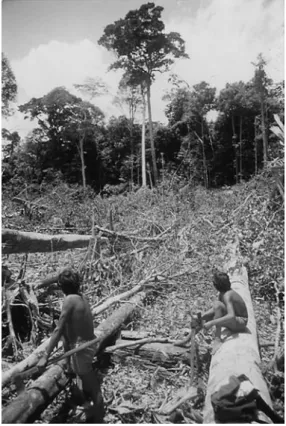
strategy in the early days of contact was to lure the Awá-Guajá by sharing their crops. This led to the Awá-Guajá participating in the slash-and-burn process and learning how to prepare their own horticultural plots. Their conversion to this mode of subsistence did not occur immediately, but once it was adopted they became dependent on shifting cultivation. Despite men spending most of their productive activities in hunting, about 60 percent of Awá-Guajá caloric intake comes from the harvested crops (Figure 3).

Observers have noted that the transition from foraging to farming often saw the narrowing of diet breadth because this change frequently entails abandoning a broad spectrum diet, narrowing the nutrient base to more carbohydrate-dense crops (Keegan 1986). Even if this shift initially expands diet breadth there is a tendency to streamline their food sources to items that are calorically denser, frequently concentrating these resources in an area closer to their basecamp. Although the Awá-Guajá’s transition to farming does not entirely mimic the Neolithic revolution their adoption of shifting cultivation has, in part, followed this path. If their food resources are converted into macro-nutrients the bulk of their diet is based primarily on carbohydrates. Although gathered food from the forest, such as babassu palm nuts (Attalea speciosa), also provides carbohydrates, most starch- rich foods consumed by the Awá-Guajá now come from their crops. In this

Figure 4 Awá man fl etching arrow

(18)

scenario, contact with mainstream society enhanced food security, in addition to the protection they gained by accepting the Indian Service’s attraction and settlement.

The Awá-Guajá shift to semi-nucleated settlements and a mixed subsistence strategy gave them a hedge against the unpredictability of resource availability and the aggressions of the moving frontier. It also shielded them from the hostilities they suffered previously from their indigenous neighbors, the Ka’apor and Tenetehara. Although it appears that they were new to farming, both Gomes and Balée noted that the Awá-Guajá possibly could have been horticulturalists in the past. As such, they could have been forced into a nomadic way of life as their indigenous neighbors and elements of the regional development pushed them away from a settled, horticultural mode of living. Other authors, such as Lévi-Strauss (1950), and Sponsel (1989), pointed out such a possibility for other foraging groups, and speculated that the competitive exclusion among different Amazonian indigenous groups would have pushed weaker groups into the headwater and interfluvial zones of this region. With this backdrop, perhaps a memory of crop use would have persisted among the Awá-Guajá and other current foraging groups

Figure 5 Butchering Brocket Deer at FUNAI post (Mazama gouazoubira)

(19)

of the Amazon. The loss of agriculture might have entailed a series of steps whereby a set of crops was phased out by groups forced to retreat.

At the same time, other authors have noted that elsewhere a symbiotic relationship exists between foragers and farmers. This type of relationship exists between the Efe Pygmies and their Bantu farming neighbors, in which bush meat is traded for farm products. A similar situation transpires between the Maku of the northwest Amazon region and their settled Tukanoan farming neighbors (Epps 2007). Some of these relations may be symbiotic, but still of an uncertain nature.

In both cases, foraging groups may be seasonally employed by the settled farming groups, but may leave spontaneously and return to the forest. They still remain within the orbit of their farming neighbors, but encounters may be brief and steady interaction may be interrupted at any time. Nevertheless, a unique dynamic is set in motion where knowledge and social exchanges transpire and resources are bartered. As a result of these encounters foragers may gain a working knowledge of crops and plant some of their own. Yet they will not sustain yields because they primarily lead a nomadic life. Regardless of this, some crops may be seasonal whereas others sustain themselves for longer periods. Some of these resources, such as fruit trees and manioc, may persist in fallow areas that can be visited frequently by foragers to harvest. These areas also become prime hunting zones as fallowed areas mature into secondary forests and attract game. Thus, both foragers and farmers do not abandon horticultural plots left fallow. Rather, these areas are transformed into a different type of use. Such areas may become disputed by both groups and can create conflict over resource use. Although the concept of ownership is rather weak among these groups of foragers and farmers, resources can give rise to conflict, as noted earlier among the Awá-Guajá and the Tenetehara.

Foraging groups may not fully cultivate crops, but in the wake of interactions with settled groups they become familiar with them, both in terms of nomenclature and use. Domesticates may not always be relied on by foraging groups, but their exchanges with settled groups, whether amicable or hostile, open options for mobile foragers, such as the Awá-Guajá (Figure 4).

That this interchange occurs indicates borrowing is a plausible argument, yet other factors may also contribute to linguistic sharing. For one, these groups may have splintered from one another, creating a new dialect in each community. As families from the same group separate, knowledge may also become fragmented.

Similarly, there may have been an ongoing exchange between foragers and farmers, such that the names persisted despite a breaking of ties.

This situation of the Awá-Guajá parallels some of the social and linguistic

dynamics encountered in the Rio Negro region among the Maku and Tukanoan

groups (Epps 2007). The Maku are primarily hunter-gatherers and eschew

sustained contact with the more settled Tukanoan groups (Pozzobon 1991; Jackson

1983). Occasionally, some Maku would engage in agricultural activities among the

Tukanoans, but would retreat to the forest after they tired of such work. However,

(20)

meat was frequently exchanged for crops and, in the course of these interactions, information was exchanged and mutual cultural influences developed. Regardless that this region is known for its multilingualism, where many groups practice linguistic exogamy, Epps points out that Maku-Tukanoan bilingualism tends to be one-way, inasmuch as Tukanoan groups are not prone to embrace Maku languages.

Mutual exchange among foragers and farmers is also found in other regions, as foragers rarely live in complete isolation (Lee 1993). In many instances, these relations have been characterized as symbiotic in that bush meat and other forest products are exchanged for agricultural crops and labor, as seen among the Mbuti and Efe pygmies and their Bantu neighbors (Bahuchet 1993). From a social perspective, however, this view is contested because the scales usually tip in favor of the more settled groups. Despite such reciprocity, horticulturalists are more established and control trade routes and the flow and exchange of goods and services. Although their influence may be more passive, their numerical strength and region-wide presence draw peripheral groups into their sphere.

Bahuchet et al (1991) have challenged the view that foraging would not be sustainable unless there is some degree of farming involved in the livelihoods of people dwelling in tropical forests. Bailey et al (1989) have argued that foraging alone would not provide adequate returns in these habitats, as there would not be sufficient resources for hunter-gatherers to maintain their livelihoods, given their simple technology and the inaccessibility of certain essential resources. Although tropical forests are rich in biodiversity many animals are nocturnal and arboreal, not to mention that species diversity does not translate into species depth and bounty. In other words, the multitude of species encountered in tropical forest settings also means that there are few representatives of each species in a given area. Game depletion in these areas frequently causes groups to break camp and relocate. Often, too, foragers in the tropics reside in headwater areas and in the interfluvial zones, and so do not have full access to aquatic resources. Given these circumstances, Bailey et al (1989) argue that foragers eventually would have to turn to either farming and/or trading with their horticultural neighbors.

Above, the question posed by Gomes (1989) and Balée (1994) was raised, namely, whether the Awá-Guajá practiced farming in the past. Prior to this, Lévi- Strauss (1950) and Lathrap (1968) noted that many foraging groups encountered in the Amazon region were probably remnants of former settled, horticultural groups. Balée (1992) added that a number of these peoples suffered an

“agricultural regression,” outlining some possible pathways for a loss of

horticulture among certain Amazonian groups. This loss would have entailed

phasing out a series of crops and selectively maintaining fast-growing cultivars,

such as maize, that are easier to manage. It is known that the encroaching Luso-

Brazilian frontier forced many of these groups to disperse, fragmenting their

knowledge of resources that embraced a range of subsistence strategies including

hunting, gathering, farming, and fishing. Knowledge of resource use and

management would have been scattered, and in some instances, lost. Key holders

(21)

of arcane knowledge, such as shamans and plant specialists, would have died and, along with them, so would part of their specialized knowledge of the forest and resource management. Yet Balée (2013) and others also stressed that these groups would have at least maintained a “mental economy” of resource knowledge. In an illustrative work showing the retention of plant names among Amazonian groups, Balée and Moore (1991) demonstrated that the cognates used for plant names among many groups were focused largely on domesticated crops. If a group, such as the Awá-Guajá, is forced to abandon horticultural practices they would at least retain a minimal knowledge, including the referent for each of these resources.

To this claim we should add a few other factors that possibly contributed to the retention of plant names used by the Awá-Guajá. Many FUNAI agents working among the Awá-Guajá and other indigenous peoples of the Amazon have been rotated between different outposts (Figure 5). Along the way, these agents acquire a working knowledge of indigenous languages and circulate it around other FUNAI facilities. Similarly, in Maranhão state, a number of FUNAI agents had worked among the Guajajara and Ka’apor prior to administering Awá-Guajá affairs. Since the Awá-Guajá came into permanent contact with the Indian Service, these interlocutors have engaged them in paternalistic and authoritarian relations.

Some FUNAI agents have also fathered children with indigenous women. The Awá-Guajá defer to FUNAI agents and are enlisted to perform a number of tasks for the outposts, such as gardening, cooking, hunting, and miscellaneous menial tasks – almost reproducing the relations that transpired between them and the Ka’apor and Tenetehara. Most verbal interactions use a pidgin version of Awá-Guajá, but Indian Service personnel share the working experiences they previously had with other indigenous groups and, invariably, vocabulary and other linguistic features are passed on to the Awá-Guajá. Some FUNAI agents have mentioned that they are the ones who actually transmitted the knowledge of plant names and shifting cultivation to the Awá-Guajá.

As pointed out earlier, a number of agents in FUNAI’s regional headquarters in Maranhão are Guajajara (Tenetehara) Indians. They are employed as health agents (nurses and nurse aides), field crew staff at Indian outposts, and administrators. Some FUNAI workers are also married to Guajajara women who reside with their husbands at these outposts and interact with the Awá-Guajá. All told, there is considerable Guajajara influence on the Awá-Guajá, from both sociolinguistic and political perspectives.

CONCLUDING REMARKS

From this historical account of the Awá-Guajá’s engagement with their

neighbors and adaptation to the environment in the Amazon, evidence shows that

in addition to linguistic phylogeny, sociolinguistic factors can also influence

resource nomenclature and use. As colonial and postcolonial encounters dispersed

indigenous groups of the Amazon, group isolation, knowledge fragmentation and

(22)

interethnic fault lines spawned new dialects and also forced a number of groups to alter their lifestyles. The Awá-Guajá knowledge of cultivars probably embraces most of these aspects, but would have originated mostly from sociolinguistic and historical factors. As some indigenous groups were scattered during colonial expansion, others were compressed and merged with other societies (Heckenberger 2005). The Awá-Guajá experienced both of these dynamics, pivoting around their indigenous neighbors in a complex relationship that involved hostility, exchange, subordination, and occasional reciprocity. Later, they were brought into direct contact with them under the auspices and control of the Indian Service. FUNAI set the tone for this new series of interactions, serving as a go-between for some marriages among these groups, and at times passed on linguistic knowledge and resource use from one group to the other.

As emphasized throughout this essay, the Awá-Guajá have a complex history of relations with their Tupí-Guaraní neighbors with implications in the area of resource management, linguistics practices and social complexity. Both the Ka’apor and Guajajara languages have influenced the Awá-Guajá, as have their non-indigenous neighbors and the forces of globalization. Although linguistic affinities are present, contact history with the nation-state also may have influenced the communication between these groups. Notwithstanding efforts by FUNAI and other interlocutors to keep these groups separated, both for security and to minimize their mutual influence, they still engage with each other.

Although the Awá-Guajá are gaining more autonomy, they are still influenced by the Ka’apor, Guajajara, and the outside world. The exchange relations between foragers and farmers, not only in the Amazon region but throughout the world, has a decisive influence on their language and the use of resources. Finally, the resource management regimes that transpire from these relations are also expressed linguistically when foraging societies adopt the language of neighboring horticultural groups.

A number of global processes impinging on the Awá-Guajá and other

indigenous peoples in the Brazilian Amazon region have been pointed out. These

dynamics occur at local, regional and international levels and interplay with each

other to engage the Awá-Guajá and other indigenous peoples. Although the early

period of contact with mainstream society had a negative impact on the

Awá-Guajá, they have rebounded and transitioned into a semi-nucleated way of

life and embraced new subsistence strategies. Brazil’s transition from a military

dictatorship to a democracy expanded awareness about the plight of indigenous

peoples, but the country still remains bound to a political economic agenda that

puts a premium on growth and development. As indigenous peoples have acquired

more rights and privileges other interlocutors have been brought in to advocate for

them and increase their participation and awareness regarding their security and

well-being.

(23)

NOTES

1) Different accounts present conflicting numbers for these populations (see Balée 1994: 43), but it seems likely that the Ka’apor had a numerical advantage over the Awá-Guajá.

2) The Tembé and Tenetehara originally were part of the same ethnic group. The Tembé broke off from the main group and migrated northwards from Maranhão to the state of Pará in the 19

th

century. Nowadays, the group that remained in Maranhão most often refers to itself as Guajajara, while the group that migrated alternates between Guajajara and Tembé.

3) Awá has a number of variants in the Tupí-Guaraní linguistic family and now that a number of Awá-Guajá are more acculturated and gaining bilingual competence in Portuguese, they have applied for governmental assistance programs such as rural pensions, retirement plans, and maternal aid. To do so, they must be incorporated officially into the state’s bureaucratic apparatus and registered as citizens. These measures require birth certificates and other official documents such as identification and voter registration cards. In these instances, they are registered with the surname Guajá.

4) Fundação Nacional de Saúde, specifically administered by SESAI (Secretaria Especial de Saúde Indígena), the agency’s branch responsible for dealing with indigenous health.

5) ALEM is also affiliated with the Summer Institute of Linguistics (SIL) and engages in translations of the Christian Bible to native languages.

6) Since the 1990s FUNAI has been steadily gutted by the federal government and specific responsibilities regarding indigenous affairs have been transferred to other agencies. Charges of internal corruption, mismanagement and lack of oversight spurred the federal government to delegate responsibilities. This overhaul met with both praise and criticism as FUNAI is more accountable for its actions, but Indian policy, in the main, still remains subordinated to the federal government’s strong development posture.

7) BBC aired a documentary in 2010 about the Awá-Guajá in the series The Human Planet.

London based NGO Survival International launched a public awareness campaign in 2012 to support their efforts to secure land. (See URL http://www.survivalinternational.org/awa).

8) In the 2010 national census, Brazilian Indians numbered 869,917 individuals, representing 305 different ethnic groups, speaking 274 distinct languages (IBGE 2010). In all, this represents 0.47 percent of Brazil’s national population.

9) In this context, we are dealing with a concept of ownership from the perspective of a pre-state society. The Awá-Guajá, for example, have a notion of territory and hunting zones (hakwá) but do not adhere to strict rules of control over these areas (see Cormier 2003 and Garcia 2010). Personal property is observed, but is not governed by rigid regulations of inclusion, exclusion, or access. Ownership among indigenous groups of Amazonia has been discussed by other authors as reflecting implications of war and predation (Fausto 2012) and the construction of affinal relations (Viveiros de Castro 2000).

REFERENCES Anderson, A.

1983 The Biology of Orbignya Martiana (Palmae), a Tropical Dry Forest Dominant in Brazil. Doctoral dissertation. Gainesville: University of Florida.

Bahuchet, S.

1993 History of the inhabitants of the central African rain forest: Perspectives from comparative linguistics. In Hladik, C.M., A. Hladik, O.F. Linares, H. Pagezy, A.

Semple, and M. Hadley (eds.) Tropical forests, people, and food: Biocultural

(24)

interactions and applications to development, pp.37–54. Paris: UNESCO and Parthenon.

Bahuchet, S., D. McKey, and I. de Garine

1991 Wild Yams Revisted: Is Independence from agriculture possible for Rainforest Hunter-gatherers? Human Ecology 19(2): 213–243.

Baines, S.

1991 “A FUNAI é que sabe”: A Frente de Atração Waimiri-Atroari. (“It’s FUNAI that knows”: the Waimiri-Atroari attraction front). Belém: CNPq/Museu Paraense Emílio Goeldi.

Balée, W.

1984 The Persistence of Ka’apor Culture. Doctoral dissertation. New York: Columbia University.

1992 People of the Fallow: a historical ecology of foraging in lowland South America.

In Redford, K. and C. Padoch (eds.) Conservation of Neotropical Forests, pp.35–

57. New York: Columbia University Press.

1994 Footprints in the Forest. New York: Columbia University Press.

2013 Cultural Forests of the Amazon: a Historical Ecology of People and Their Landscapes. Tuscaloosa: The University of Alabama Press.

Balée, W. and D. Moore

1991 Similarity and Variation in Five Tupi-Guarani languages (Eastern Amazonia).

Bulletin of the Florida Museum of Natural History (Biological Sciences) 35(4):

209–262.

Bailey, R., G. Head, M. Jenike, B. Owen, R. Rechtman, and E. Zechenter

1989 Hunting and Gathering in Tropical Rain Forests: Is it Possible? American Anthropologist 91(1): 59–82.

Beckerman, S.

1991 A Amazônia estava repleta de gente em 1492? In Walter Neves (ed.), Origens, Adaptações e Diversidade Biológica do Homem Nativo da Amazônia (Origins, adaptations and biological diversity of Amazonian natives), pp.143–159. Belém:

SCT/CNPq/MPEG. Coleção Emília Snethlage.

Beghin, F.

1950 Les Guajá. Correspondence with Darcy Ribeiro. 15 July.

Freire B. and J. Ribamar

2003 Da Língua Geral ao Português: para uma história dos usos sociais das línguas na Amazônia. Doctoral dissertation. Rio de Janeiro, UERJ – Instituto de Letras.

Cabral, A. S. A. C., B. C. Corrêa da Silva, M. M. Magalhães, and R. Julião

2007 Linguistic diffusion in the Tocantins-Mearim Area. In A. S. A. C. Cabral, and A. D.

Rodrigues (eds.) Línguas e culturas Tupí. 1: 357–374. Campinas: Curt Nimuendajú.

Cleary, D.

1998 “Lost Altogether to the Civilised World”: Race and the Cabanagem in Northern Brazil, 1750 to 1850. Comparative Studies in Society and History 40(1): 109–135.

Cormier, L.

2003 Kinship with Monkeys: the Guajá foragers of eastern Amazonia. New York:

Columbia University Press.

Corrêa, M. and M. Januária (eds.)

2008 Querida Heloísa/Dear Heloisa: cartas de campo para Heloisa Alberto Torres (Dear

Heloisa: letters from the field to Heloisa Alberto Torres). Campinas: UNICAMP –

Núcleo de Estudos de Gênero, PAGU.

Figure 2  Roasting Giant Armadillo (Priodontes maximus)Figure 1  The Study Area
Figure 3  Clearing Swidden
Figure 4  Awá man fl etching arrow
Figure 5  Butchering Brocket Deer at FUNAI post (Mazama gouazoubira)

参照

関連したドキュメント

Complex formation is used as a unified approach to derive represen- tations and approximations of the functional response in predator prey relations, mating, and sexual

This paper develops a recursion formula for the conditional moments of the area under the absolute value of Brownian bridge given the local time at 0.. The method of power series

We present sufficient conditions for the existence of solutions to Neu- mann and periodic boundary-value problems for some class of quasilinear ordinary differential equations.. We

Analogs of this theorem were proved by Roitberg for nonregular elliptic boundary- value problems and for general elliptic systems of differential equations, the mod- ified scale of

Then it follows immediately from a suitable version of “Hensel’s Lemma” [cf., e.g., the argument of [4], Lemma 2.1] that S may be obtained, as the notation suggests, as the m A

Definition An embeddable tiled surface is a tiled surface which is actually achieved as the graph of singular leaves of some embedded orientable surface with closed braid

Correspondingly, the limiting sequence of metric spaces has a surpris- ingly simple description as a collection of random real trees (given below) in which certain pairs of

[Mag3] , Painlev´ e-type differential equations for the recurrence coefficients of semi- classical orthogonal polynomials, J. Zaslavsky , Asymptotic expansions of ratios of