Phonetic Analysis of dGudzong Tibetan The Vernacular of Khams Tibetan spoken in the rGyalrong Area
著者(英) Hiroyuki Suzuki
journal or
publication title
Bulletin of the National Museum of Ethnology
volume 35
number 4
page range 617‑653
year 2011‑03‑31
URL http://doi.org/10.15021/00003880
Phonetic Analysis of dGudzong Tibetan The Vernacular of Khams Tibetan spoken
in the rGyalrong Area
Hiroyuki Suzuki*
ギャロン地域のカムチベット語・丹巴県格宗[dGudzong]方言の音声分析 鈴木博之
dGudzong Tibetan is spoken in Danba County, Ganzi Tibetan Auton- omous Prefecture in West Sichuan, China. It belongs to “twenty-four-vil- lages’ patois,” an independent dialect group of Khams Tibetan spoken in the rGyalrong area. Apart from my several linguistic reports, there are no detailed descriptions of this variety of Khams Tibetan. In this paper, the pho- netic analysis of the dGudzong dialect is treated with special attention paid to the synchronic phonological framework of the dGudzong dialect as well as to several remarkable diachronic features through a comparison with Written Tibetan forms. The phonetic analysis is divided into three parts: consonants, vowels and suprasegmentals; the diachronic analysis also mentions typologi- cal characteristics among the Khams Tibetan dialects. At the end of the arti- cle, a list of the basic vocabulary (ca. 1000 words) is added.
中国四川省西部に位置する丹巴県は,チベット文化圏のギャロンと呼ばれる 地域に属する多言語地域である。本稿では,丹巴県に分布するカムチベット語
の1つであるdGudzong方言について,音韻論的枠組みを考慮しつつ音声分析を
行い,加えてチベット語文語形式との比較を通して音対応を考察する。音声分 析は子音・母音・超分節音(声調)に分けて行い,また文語形式との対応関係 については特にカムチベット語諸方言の中での類型的特徴にも触れる。末尾に 基本語彙(約1000語)を付す。
*Université de Provence, Centre national de la recherche scientifigue, Japan Society for the Promotion of Science
Key Words:Tibetan, Khams Tibetan, twenty-four-villages’ patois, rGyalrong, phonetics キーワード:チベット語,カムチベット語,二十四村方言,ギャロン,音声学
1 Introduction 1.1 Background
Danba 丹巴 County, which is the central spiritual place of the rGyalrong region as well as being an ethnic boundary of Tibetan, Qiang and Han Chinese in Ganzi 甘 孜 Tibetan Autonomous Prefecture, western Sichuan, is a multilingual area. Tibet- ans living in Danba speak several languages: Situ-rGyalrong, Geshitsa, the Sichuan variation of Mandarin Chinese, Amdo nomadic Tibetan as well as Khams Tibetan.
The Tibetans in Danba identify themselves as rGyalrong, and their culture, tradi- tions and heritage are also similar to those of other rGyalrong people who speak rGyalrong languages. The architectural heritage treated in Darragon (2005) clearly indicates the common characteristics among the rGyalrong and eastern Khams areas, including Danba.
The Khams Tibetan spoken in Danba is recognised by local Tibetans as a kind of standard variant of the Tibetan language which is comparable to the Derge dia- lect. It is called ershisi cun hua 二十四村話 “twenty-four-villages’ patois.” This variety is spoken in several villages such as Sogpho 梭坡 [Sog-pho], dGudzong 格宗 [dGu-rdzong], sProsnang 中路 [sPro-snang], Yozha 岳扎, Rongbrag 章谷 [Rong-mi Brag-’go / Rong-brag] and Rwatso 水子 [Rwa-tso] as well as Panan 潘安 in Xiaojin 小金 County, which are located at the uppermost region of Daduhe 大渡 河 River.
This vernacular is one of the isolated Khams Tibetan dialects (Suzuki 2006;
2009: 17, named Rongbrag dialect), surrounded by Situ-rGyalrong to the north (the Chuchen variety) and the east (the bTsanlha variety), Geshitsa to the west and Guiqiong to the south. According to local Tibetans, this dialect consists of several idioms, which can be identified by the names of rivers and mountains, namely, Sog- pho, dGudzong, sProsnang and Rwatso. The differences among these idioms are comparatively minor with respect to their grammatical features, but are great with respect to their phonetic features. The speakers of this dialect group use their native dialect only in their own villages, in other villages in Danba they generally use Chi-
1 Introduction 1.1 Backgroud
1.2 Framework of the description 2 Synchronic Description 2.1 Syllable structure 2.2 Consonants 2.3 Vowels
2.4 Tonemes 3 Diachronic Analysis 3.1 Initial
3.2 Rhyme 3.3 Tones
4 Summary and Conclusion
nese (the Sichuan variety of Mandarin) because of the linguistically intricate situa- tion mentioned above.
In previous studies on Tibetan linguistics, there have been several monographs published in China such as Qu (1991), Jiang (2002) and Zhang (2009), but they provide neither information nor data of the varieties spoken in Danba, although many brief introductions to the “twenty-four villages’ patois” have been provided, for instance, in Danba Xianzhi (Sichuansheng Danba Xianzhi Bianzuan Weiyuanhui 1996:
174) and Lin (2006), both presented short descriptions of the “twenty-four-villages’
patois.” However, both were written from the viewpoint of the introduction to the languages spoken in Danba, thus, they mention these vernaculars as standard Tibetan dialects, which is the way the local people consider their dialects. Consequently, only a few linguistic studies have so far been produced. The present author’s works Suzuki (2005a; 2005b; 2007a; 2007b; 2008a; 2008b) provide us with the first preliminary descriptions of the phonetic characteristics, the phonological system and the dialectal characteristics of the four vernaculars: Sogpho, sProsnang, Rongbrag and dGudzong.
1.2 Framework of the description
This paper explores the synchronic phonetic analysis with a basic phonological treatment and diachronic sound changes of dGudzong Tibetan with a remark on its characteristics from both typological and contrastive viewpoints with reference to the Tibetan dialectology.1)
The description in this paper occupies a portion of the Tibetan dialectology, meaning that the description is not simply an object of descriptive linguistics proper, but is done with the object of providing a unified descriptive framework throughout all of my works on the Tibetan dialects. The framework of the description is primarily phonetic, and it is consistent with the author’s description of all the Tibetan dialects (circa 150 dialects at present; cf. Suzuki 2007a: 42–56), in order to avoid any confusions that may occur when one checks only the described forms for comparative study (cf. Zhu 2008: 303; Zhang 2009: 358). The phonetic symbols include the IPA set with some additional phonetic symbols that have been adopted for Sino-Tibetan languages, such as those given in Zhu (2010). These symbols are used for the description of phonemes, and no orthographic conventions are used, as has been done in Tournadre (2005: 24).
In this paper, I have not attempted to apply any particular theory of phonology nor do I discuss the advantages of one specific theory over another. Any theoretical analyses are left for monographs.2) Phonetic variants are also described unless they are simply free-variants of a certain phoneme, and the phonetic characteristics to represent dGudzong Tibetan may be displayed in the description. Phonemes should be primarily identified through the presence of minimal or near minimal pairs, however, there are some phonemes for which minimal pairs have not yet been found.
2 Synchronic Description 2.1 Syllable structure
The most complicated syllable structure can be illustrated as in the following:
CCiGVCC
preinitial C : preaspiration, prenasal, glottal stop and labial obstruent only.
main initial Ci : all the consonants.
glide G : /w/ or /j/ only.
syllable core V : all the vowels.
final C : /p/, /ʔ/, /γ/, /r/, /w/, and /j/; CC : /wʔ/ and /jʔ/ only.3) 2.2 Consonants
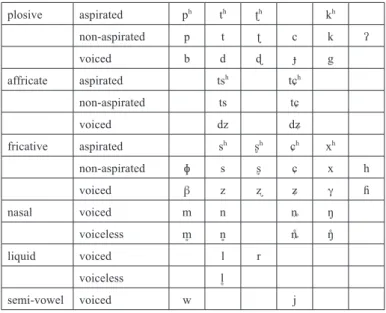
The consonant inventory is displayed below:
Table 1: consonant inventory
plosive aspirated ph th ʈh kh
non-aspirated p t ʈ c k ʔ
voiced b d ɖ ɟ g
affricate aspirated tsh tɕh
non-aspirated ts tɕ
voiced dz dʑ
fricative aspirated sh ʂh ɕh xh
non-aspirated ɸ s ʂ ɕ x h
voiced β z ʐ ʑ γ ɦ
nasal voiced m n ȵ ŋ
voiceless m̥ n̥ ȵ̊ ŋ̊
liquid voiced l r
voiceless l̥
semi-vowel voiced w j
2.2.1 Simplex initials
2.2.1.1 Plosives and affricates
All the plosives and affricates except /c, ɟ, ʔ/ have a three-way dictinction aspirated/
non-aspirated/voiced.
The palatal plosives /c, ɟ/ are included in the consonant inventory, but they do not appear as a simplex (cf. 2.2.2.1 and 2.2.2.6). These sound values may include a
phonetic variant of palatalised velar plosives, but the velar plosive series generally do not include a phonetic variant of palatal plosives. These two series, therefore, are still distintive, but it is supposed that they may merge into velar ones in the near future.
/ph/ /¯pʰɑ ʱgɑ/ ‘father’
/p/ /´paʔ paʔ/ ‘level’
/b/ /´bɯ̃/ ‘wide’
/th/ /¯tʰa ʑuʔ/ ‘cockscomb’
/t/ /´ta ro/ ‘yoghurt’
/d/ /´deː mo/ ‘log’
/ʈh/ /`ʈʰeʔ/ ‘blood’
/ʈ/ /¯ʈo/ ‘hair’
/ɖ/ /´ɖʉ/ ‘wheat’
/kh/ /´kʰa ɦo/ ‘snow’
/k/ /¯kә zi/ ‘barley’
/g/ /´gi ʱga/ ‘teacher’
/ʔ/ /¯ʔa mi/ ‘grandfather’
/tsh/ /´tsʰã ´bɯ liʔ/ ‘dragonfly’
/ts/ /¯tsə̃mbɯ/ ‘wrinkle’
/dz/ /´dzar/ ‘paste’
/tɕh/ /¯tɕʰɯ/ ‘water’
/tɕ/ /¯tɕa bu/ ‘thing’
/dʑ/ /´dʑa mo/ ‘steelyard’
2.2.1.2 Fricatives
The alveolar, retroflex, prepalatal and velar fricative series have a three-way dis- tinction aspirated/non-aspirated/voiced, while the bilabial and glottal fricative series have a two-way distinction aspirated/voiced. The prepalatal series are always pro- nounced with a prepalatal (or alveopalatal) articulation.
/ɸ/ /`ɸoʔ kә/ ‘cover’
/β/ /´βɯ loʔ/ ‘rise’
/sh/ /´sʰi gu/ ‘charcoal’
/s/ /¯sõ sõ/ ‘light’
/z/ /´zi tɕʰә/ ‘dog year’
/ʂh/ /´ʂʰuʔ po ɸe/ ‘cypress’
/ʂ/ /´ȵi ʂɯ/ ‘twenty’
/ʐ/ /´ʐiː ȵĩ/ ‘three days after tomorrow’
/ɕh/ /´ɕʰi ɸe/ ‘tree’
/ɕ/ /´ɕi ɸɛj/ ‘forest’
/ʑ/ /¯tsʰe ʑiʔ/ ‘the first day’
/xh/ /¯xhoʔ/ ‘fold’
/x/ /´xo ʰpo/ ‘torch’
/γ/ /¯γә ɖo/ ‘rain (v)’
/h/ /`hɛ zu/ ‘pepper’
/ɦ/ /´ɦɑ pɯ/ ‘stretch’
The bilabial fricatives /ɸ, β/ rarely appear, and can be distinguished from /p(h),
ɦb/ respectively, e.g.:
/ɸ/-/p/-/ph/ /`ɸoʔ kә/ ‘cover’; /´poʔ/ ‘Tibetan’; /¯shõ pho/ ‘next year’
/β/-/b/ /´βɯ loʔ/ ‘rise’; /¯ɦbɯʔ/ ‘shed’
The velar fricative /γ/ often appears in word-medial position, and it does not alternate with a plosive [g] even in careful speech. /γ/ and /g/ are therefore distinctive.
2.2.1.3 Resonants (nasals, liquids and semi-vowels)
The resonants except /r, w, j/ have a two-way distinction voiced/voiceless. The nasal /ȵ/ is always pronounced as a prepalatal, and the variant of the palatal articulation is not included.
/m/ /´mõ/ ‘cow’
/m̥/ /¯m̥ ɑ/ ‘medicine’
/n/ /´nɑʔ tɕʰwe/ ‘ear’
/n̥/ /¯n̥ɔ/ ‘nose’
/ȵ/ /´ȵo/ ‘fish’
/ȵ̊/ /`ȵ̊ə̃/ ‘heart’
/ŋ/ /¯ŋo/ ‘five’
/ŋ̊/ /´ŋgo ŋ̊iː/ ‘pillow’
/l/ /´la mo/ ‘leaf’
/l̥/ /¯l̥ɛʔ bo/ ‘frost’
/r/ /´rə be/ ‘rabbit’
/w/ /´wo/ ‘fox’
/j/ /´je sho/ ‘last night’
2.2.2 Complex initials
Complex initials can be classified according to the preinitial type. There are six preinitial types: (1) preaspirations, (2) prenasals, (3) labial plosive preinitials, (4) labial fricative/approximant preinitials, (5) glottal stop preinitials and (6) glides.
These features, except the glide, are summarised as follows:
(1) (2) (3) (4) (5)
nasality - + - - -
labiality - -(+) + + -
continuity + + - + -
2.2.2.1 Preaspiration type
Most non-aspirated and voiced consonants can occur preaspirated:
hp ht hʈ hc hk hts htɕ
hsh hs hɕh hɕ hx hl̥
ɦb ɦd ɦɖ ɦɟ ɦg ɦdz ɦdʑ
ɦz ɦʐ ɦʑ
ɦm ɦn ɦȵ ɦŋ ɦl ɦr ɦj
The voicedness of the preaspiration depends on that of the main initial. The preaspiration feature is always phonetically weaker than the main consonant of the initial.
Examples:
/hp/ /¯ʰpej bo/ ‘shoulder’
/ht/ /¯hto/ ‘horse’
/hʈ/ /´leʔ ʰʈәʔ/ ‘bracelet’
/hc/ /´ma hci/ ‘jaw’
/hk/ /¯ʰkɯ mo/ ‘thief’
/hts/ /´ʰtsә wo/ ‘grass’
/htɕ/ /¯htɕi/ ‘tongue’
/hsh/ /¯ʰsʰә/ ‘gold’
/hs/ /¯ʰsɑ̃/ ‘three’
/hɕh/ /¯ʰɕʰa/ ‘be born’
/hɕ/ /´wlɑ ʰɕo/ ‘thigh’
/hx/ /¯sʰa hxɑ̃ ´rɑ̃:/ ‘seed’
/hl̥/ /¯ʰl̥eʔ/ ‘eagle’
/ɦb/ /´ʱbɯʔ ɖe/ ‘leather bellows’
/ɦd/ /¯ɦda wo/ ‘moon’
/ɦɖ/ /´ʱɖaː mo/ ‘sap of pine’
/ɦɟ/ /´ʱɟiʔ ʱdʑɯ/ ‘back’
/ɦg/ /´ʱgɯ/ ‘nine’
/ɦdz/ /´ʱdzãː ji mә/ ‘false’
/ɦdʑ/ /´ʱdʑɯ mo/ ‘intestine’
/ɦz/ /´ʱzo ʱzo/ ‘leaning’
/ɦʐ/ /´ʱʐә/ ‘four’
/ɦʑ/ /´ɦʑi/ ‘exchange’
/ɦm/ /ˆʱmɛj/ ‘low’
/ɦn/ /¯ʱna ɦo/ ‘Mongolian gazelle’
/ɦȵ/ /¯ʱȵә/ ‘two’
/ɦŋ/ /´ɦŋaː mә/ ‘sweet’
/ɦl/ /¯ʱlaʔ po/ ‘brain’
/ɦr/ /´ʱrɑː wo/ ‘cowshed’
/ɦj/ /¯ʱjeʔ/ ‘yak’
2.2.2.2 Prenasal type
All the aspirated and voiced plosives and affricates as well as several continuants can occur prenasalised:
mb nd ɳɖ ŋg ndz ȵdʑ ŋγ
m̥ph n̥th ɳ̊ʈh ŋ̊kh n̥tsh ȵ̊tɕh ŋ̊xh n̥sʰ ȵ̊ɕʰ n̥l̥
The voicedness of the prenasal depends on that of the main initial. Almost all prena- sals are homorganic, but there are also a few heterorganic, labialised prenasals, e.g.:
mg
m̥tsh
The prenasal feature is always phonetically weaker than the main consonant of the initial.
Examples:
/mb/ /´mbɯ leʔ/ ‘worm’
/nd/ /´ndɑ/ ‘read’
/ɳɖ/ /´ɖiː/ ‘rice’
/ŋg/ /´ŋgo/ ‘go’
/ndz/ /´ndzu/ ‘mdzo’
/ȵdʑ/ /´ȵdʑɑʔ xõ/ ‘shoe’
/ŋγ/ /^ ŋγә thә/ ‘bite’
/m̥ph/ /¯m̥pha/ ‘fly’
/n̥th/ /¯n̥thu/ ‘high’
/ɳ̊ʈh/ /¯ɳ̊ʈʰe ʰpo/ ‘gall bladder’
/ŋ̊kh/ /¯ŋ̊kho li/ ‘roof’
/n̥tsh/ /¯n̥tshu/ ‘lake’
/ȵ̊tɕh/ /¯ȵ̊tɕʰɯ ʰkɯ/ ‘mouth’
/ŋ̊xh/ /´jiː ŋ̊xʰõ/ ‘village’
/n̥sʰ/ /¯ʱna mo ¯n̥sʰɯ/ ‘marry’
/ȵ̊ɕʰ/ /´ɖuː ȵ̊ɕʰɑ̃/ ‘dance’
/n̥l̥/ /¯n̥l̥ɑʔ/ ‘shoot’
/mg/ /´mgu, ´ŋgu/4) ‘head’
/m̥tsh/ /¯m̥tsʰa mә/ ‘sweep’
2.2.2.3 Labial plosive type
A limited set of the voiceless plosives and affricates can occur prelabialised:5)
pt pʈh pʈ pk ptsh pts ptɕ
Voiced counterparts are not found. The prelabial plosive is always articulated lightly, and its audibility is very weak. It cannot, however, vary with a prelabial continuant such as a fricative or an approximant in the normal speech, but it is somtimes omitted. Not all of the prelabialised plosives have minimal pairs with non-prelabialised plosives.
Examples:
/pt/ /´ptɑː juʔ/ ‘riddle’
/pʈh/ /¯pʈʰa γaː pʰe/ ‘poplar’
/pʈ/ /´pʈoː ʱɟiʔ/ ‘breast’
/pk/ /¯pkiː/ ‘carry on the back’
/ptsh/ /¯ptsʰeː mo/ ‘broom’
/pts/ /´ptso/ ‘cock’ cf. /´tsә rɯ/ ‘coral’
/ptɕ/ /¯ptɕɯ/ ‘ten’ cf. /´tɕә̃/ ‘house’
2.2.2.4 Labial fricative/approximant type
A labial fricative/approximant can stand before a limited set of consonants6):
ɸt ɸʈ ɸtɕ ɸs ɸl̥
wɖ wg wdʑ wʐ wn wl
The voicedness of the pre-labial continuant depends on that of the main initial. The pre-labial continuant feature is always weaker than the main initial on the phonetic aspect. It does not alternate with pre-labial plosives. It can be distinguished from a preaspiration type without a labial feature.
Examples:
/ɸt/ /`ɸtuː/ ‘swelling’ cf. /ht/ /´sa htuʔ/ ‘dinner’
/ɸʈ/ /¯ɸʈɯ/ ‘wash’
/ɸtɕ/ /¯ɸtɕõ ȵe bo/ ‘December’
/ɸs/ /`ɸsɑ̃/ ‘feed’ cf. /hs/ /¯hsɑ̃/ ‘three’
/ɸl̥/ /`ɸl̥ɑ̃/ ‘clap’ cf. /hl̥/ /¯hl̥eʔ/ ‘eagle’
/wɖ/ /¯ʰpɯ wɖã/ ‘animal’s hair’
/wg/ /¯wgu/ ‘share’ cf. / ɦg/ /´ɦgu/ ‘door’
/wdʑ/ /´wdʑaʔ/ ‘eight’
/wʐ/ /¯wʐɑ/ ‘shave’ cf. /ʱʐ/ /´ʱʐә/ ‘four’
/wn/ /`wnõ ʰtɕә/ ‘swear’
/wl/ /´wlɑ ʰɕo/ ‘thigh’ cf. / ɦl/ /¯ʱla wo/ ‘musk’
2.2.2.5 Glottal stop type
Nasals and approximants can be with a pre-glottal stop:
ʔm ʔn ʔj
Glottal stop is really clear phonetically , and it does not vary with glottal continuants.
It can be distinguished from simplex and preaspiration types.
Examples:
/ʔm/ /`ʔma hl̥ɑʔ/ ‘fall down’ cf. /m/-/ɦm/ /´ma hci/ ‘moustache’
/´ɦmaʔ dʑo/ ‘peacock’
/ʔn/ /´ʔne ʔne/ ‘sharp’ cf. /n/-/ɦn/ /´na ni/ ‘last year’
/¯ʱna mo/ ‘bride’
/ʔj/ /`ʔjaː n̥tʰu/ ‘expand’ cf. /j/-/ɦj/ /¯jaʔ, ¯jaː/ ‘do’
/¯ʱjeʔ/ ‘yak’
No minimal pairs are found only with/without the pre-glottal stop. But the existence of this glottal feature is extremely evident, thus it is described.
2.2.2.6 Glide type
There are many combination patterns including a glide /w/ or /j/:
bw thw tw kw gw tshw tɕhw tɕw shw
sw ʂhw ʂw ɕhw ɕw ʑw xw γw mw
ŋw lw rw
phj pj bj tj ʑj xj nj lj rj
In addition, there are several complex types with both of a preinitial and a glide, consider the following examples:
ɦmw mbw hcw ȵɟw ɸkw hkw ptshw htsw ɦgw
hsw ɦlw ŋ̊khw ɦdʑw ȵdʑw ɦʐw
ptɕj ɦmj
The pronunciation of the glide is clear, and its omission is not accepted. Minimal pairs with/without a glide are not numerous. Examples illustrating the distinction are:
/b/-/mbw/-/bj/ /´rә be/ ‘rabbit’ /´mbweʔ/ ‘be mad’ /´hpaː bje/ ‘leather’
2.3 Vowels
The vowel inventory is displayed below:
i ʉ ɯ u e ɵ ə o ɛ ɔ a ɑ
Each vowel can be articulated oral or nasalised. Short and long vowels are distinc- tive. Only monophthongs can become an element of the syllable.
2.3.1 Normal vowels With articulatory contrast
/i/-/e/ /¯shiː wo/ ‘hail’; /´sheː mo/ ‘nail’
/e/-/ɛ/ /`mejʔ/ ‘eye’; /^ʱmɛj/ ‘low’
/a/-/ɑ/ /¯htɕaʔpa/ ‘excrement’; /`htɕɑʔ/ ‘cut’
/ɑ/-/ɔ/ /^tɕɑʔ/ ‘pull up’; /´tɕɔʔ/ ‘patch’
/ɔ/-/o/ /`khɔwʔ/ ‘needle’; /´mbowʔ/ ‘awl’
/u/-/o/ /¯shu/ ‘tooth’; /¯sho/ ‘earth’
/ɯ/-/ə/ /¯shɯ/ ‘who’; /´shə hpu/ ‘yellow’
/u/-/ʉ/ /´ʱɖuː/ ‘split up’; /´ɖʉ/ ‘wheat’
With length contrast
/i/ /´mi/ ‘fire’; /´niː/ ‘highland barley’
/e/ /¯hteʔ/ ‘tiger’ ; /¯sʰeː mõ/ ‘nail’
/ɛ/ /´lɛ lɛ/ ‘breast’; /´pʈɛː ma/ ‘cliff’
/a/ /¯ʂʰa ɦo/ ‘deer’; /`ŋ̊aː na/ ‘front’
/ɑ/ /¯nɑw/ ‘sky’; /´roː kә `rɑ: wo/ ‘cowshed’
/ɔ/ /¯n̥ɔ/ ‘nose’; not found
/o/ /´ȵdʑo/ ‘rainbow’; /¯ʰtoː/ ‘belly’
/u/ /¯shu/ ‘tooth’; /´pa ɸuː/ ‘knee’
/ɯ/ /¯tɕʰɯ/ ‘water’; /¯ʰkɯː rɯ/ ‘hip’
/ʉ/ /´ɖʉ/ ‘wheat’; not found /ə/ /¯pʈə/ ‘cloud’; /´ʈәː tsә/ ‘seed’
/ɵ/ /´pө te/ ‘noodle’; not found 2.3.2 Nasalised vowels
Except /ʉ/ and /ɵ/, each vowel can be nasalised as in:
/i/ /´jı̃/ ‘be’
/e/ /`n̥tʰẽj/ ‘drink’
/ɛ/ /´ŋ̊kʰɛ̃ ndi/´‘kidney’
/a/ /´ʱgã mbɯ/ ‘box’
/ɑ/ /´rõ mә/ ‘other person’
/ɔ/ /¯tɔ̃/ ‘drag’
/o/ /¯ʰpõ/ ‘government official’
/u/ /`tsʰә jũ/ ‘merchant’
/ɯ/ /´bɯ̃/ ‘wide’
/ə/ /`ȵ̊ə̃/ ‘heart’
2.4 Tonemes
Tone is distinctive in dGudzong Tibetan. It is realised not by an relative pitch height but by a pitch pattern. Four dictinctive tones exist.
A tonal sign is given before each word as follows:
¯: high level [55/44] ´: rising [24/35] ^: rising-falling [132] `: falling [53/42] The tonal pitch value is not uniquely determined, thus /¯/ can be phonetically realised as [55] or [44], /`/ as [53/42] or [52/51], etc. Therefore, the most important feature for the distinction is the pitch pattern (level or contour).
Examples of monosyllabic words:
/¯S/ /¯mu/ ‘to rake’
/´S/ /´mi/ ‘fire’
/^S/ /^ʱmɛj/ ‘low’
/`S/ /`mejʔ/ ‘eye’
At present, there are no minimal pairs which are distinctive only with the difference respect to tone. In this paper, the tonal description reflects the actual pronunciation of native speakers, lest they judge a word as a non-dGudzong vernacular form.7)
In the case of bisyllabic words, the tonal value of the beginning of the second syllable is restricted to two high tone types [55] and [53], except for an atonal syllable.
This means that dGudzong Tibetan has word tone,8) and polysyllabic words also show the same tonal pattern. Bisyllabic words can become as follows:
/¯S1S2/ : main tonal value described as S1[55]S2[55] /´S1S2/ : main tonal value described as S1[24]S2[55] /^S1S2/ : main tonal value described as S1[24]S2[53] /`S1S2/ : main tonal value described as S1[55]S2[53]
Words with more than two syllables also show the same pattern as bisyllabic ones and after the third element no proper tonal value is given (atonal).
Except for pitch tone, suprasegmental features such as a stress and a phonation type are not phonetically evident. Theoretical treatments are not applied any more in this paper.
3 Diachronic Analysis
This section presents a diachronic analysis of the dGudzong dialect through a corre- spondence with Written Tibetan (WrT) forms. I add in the footnotes some explana- tions for remarkable sound changes from the viewpoint of Tibetan dialectology.9)
However, there are some difficulties describing the precise sound change of the dGudzong dialect because of the lack of WrT correspondences in multiple examples,
some of which may originate from obscure non-Tibetan languages, which are not considered here. The analysis is divided into three parts: initial, rhyme, and tone.
3.1 Initial
3.1.1 Development of simple initials 3.1.1.1 WrT obstruents
The general tendency of the diachronic development of obstruents in initial position can be characterised as follows:
• Reflexes of WrT simplex voiceless initials have remained voiceless in dGudzong.
• Reflexes of WrT simplex voiceless fricative initials have become aspirated in dGudzong.
• Reflexes of WrT simplex voiced initials are devoiced in dGudzong.
• Reflexes of devoiced WrT simplex initials are associated with low-tone syllables in dGudzong.
Examples:
/¯ka wo/ ‘pillar’ ka ba /¯sho/ ‘earth’ sa /´poʔ/ ‘Tibetan’ bod /´ʂɯ/ ‘melt’ zhu
A significant articulatory innovation which sets the dGudzong dialect apart from most other Tibetan dialects is the split of the WrT alveopalatal spirants into retroflex series as well as alveopalatals, e.g.:
/¯tɕe ʑi/ ‘field’ ? zhing /´ɕʰi ɸe/ ‘tree’ shing phung /¯ʂʰo/ ‘meat’ sha
/¯ʂʰa ɦo/ ‘deer’ shwa ba /´ʱʐә/ ‘four’ bzhi
As far as the actual data of dGudzong is concerned, the condition of the split is the vocalic quality, alveopalatals are kept in the position preceding the narrow vowels /i/ and /e/.10)
3.1.1.2 WrT sonorants
The WrT sonorants included four nasals (m, n, ny, ng), two liquids (l, r), and two glides (w, y). In the dGudzong dialect, the WrT simplex sonorants are generally kept and realised with a low tone, e.g.:
/´mә / ‘man’ mi /´no/ ‘be sick’ na /´ȵo/ ‘fish’ nya /´ŋo/ ‘I’ nga /´lɑ̃w/ ‘road’ lam /´ro/ ‘goat’ ra /´wo/ ‘fox’ wa /´jõ mә/ ‘light’ yang
3.1.2 Development of complex initials with prefixes
WrT has nasal (m-, ’-) as well as oral (g-, d-, b-, r-, l-, s-) prefixal consonants.
3.1.2.1 With nasal prefix
Almost all the WrT nasal prefixes merged before obstruent root initials (in this case stop/affricates), resulting in homorganic prenasalised consonants in the dGudzong dialect,11) as in:
/´mbɯ leʔ/ ‘worm’ ’bu ? /´ndzә γi/ ‘finger’ mdzu gu /¯ȵ̊tɕhәʔ/ ‘cold’ ’khyags /¯n̥tshu/ ‘lake’ mtsho
I have found only a few words with non-homorganic prenasal elements, some of them are:
/´mgu, ´ŋgu/ ‘head’ mgo /¯m̥tsʰa mә/ ‘sweep’ ’phyag
These examples can be explained with the WrT form, the preinitial m or ’ preceding a labial consonant. The example ‘head’ has a variant of the homorganic prenasalised initial, which means that it is in a transitory stage from the heteror- ganic prenasal to the homorganic one. The heterorganic prenasal will merge into the homorganic one in the near future.
3.1.2.2 With oral prefix
WrT oral prefixes such as g-, d-, b-, r-, l- and s- were lost or developed as preaspi- ration. The prefix b- is associated with a labial preinitial. As far as voicing is concerned, the preinitial elements remained voiced if the root initial was voiced except for the initial nasal with the prefix s- changing into a voiceless nasal as fol- lows:12)
/¯mwoː/ ‘wound’ rma /¯m̥ ɑ/ ‘medicine’ sman
/´nɑʔ tɕʰwe/ ‘ear’ rna chogs /¯n̥ɔ/ ‘nose’ sna
Examples of WrT prefix b- are as follows:
/ptɕ/ /¯ptɕɯ/ ‘ten’ bcu /ɸʈ/ /¯ɸʈɯ/ ‘wash’ bkru /wg/ /¯wgu/ ‘share’ bgo /wdʑ/ /´wdʑaʔ/ ‘eight’ brgyad
3.1.3 Development of complex initials with a glide
There are four WrT glides, -y-, -r-, -l- and -w-. Dialectologically the development of the complex with a glide is very important.
WrT glide -w- (wa zur) has been dropped without compensation:
/¯ʂʰa ɦo/ ‘deer’ shwa ba /´ʰtsә wo/ ‘grass’ rtswa
The palatal glide -y- could combine with labial and velar plosives, as well as with the labial nasal m-. WrT labial plosives co-occurring with the -y- glide were transformed into alveolar affricates with a slight lablial plosive preinitial:13)
/´ptso/ ‘cock’ bya /¯ptsʰe/ ‘open’ phye /´tsә rɯ/ ‘coral’ byu ru /´dzar/ ‘paste’ sbyar
The prelabial plosive has been lost in several examples, but the voiced prela- bial plosive is not attested, so that its lack as in ‘paste’ can be because of the phono- logical restriction.
WrT velar plosives taking the -y- glide were transformed into alveopalatal affricates or palatal plosives:14)
/´dʑo/ ‘Han Chinese’ rgya /¯ʰtɕә ʱmә/ ‘sour’ skyur /`ʰco/ ‘ride (a horse)’ rkya /´ȵɟweʔ mә/ ‘quick’ mgyogs /´ʱɟiʔ ʱdʑɯ/ ‘back’ rgyab
The WrT medial -r- could be added to labial, alveolar, and velar plosives, as well as to the spirants s and h.Considering first the stop-based clusters, we observe all sequences merging as retroflexed plosives:
/`ʈʰeʔ/ ‘blood’ khrag /´ɖʉ/ ‘wheat’ gro
/¯ɸʈɯ/ ‘wash’ bkru /¯ʈɯwʔ/ ‘six’ drug /´ʈә mә/ ‘ask’ dri /´pʈɛː ma/ ‘cliff’ brag ma /´pʈә/ ‘write’ bri
/¯pʈi/ ‘tear up’ dbral
As can be seen, almost all WrT labial plosives with glide r developed as retro- flexes with labial plosive preinitials.
r dropped from the cluster sr-, r leaving the remaining s aspirated or unaspirated:15)
/`sʰweʔ/ ‘life’ srog /¯sʰwo mә/ ‘hard’ sra mo /´saː mo/ ‘soy’ sran ma
The WrT glide -l- could be added to labial and velar plosives, as well as to the spirants s and z.We observe all sequences merging to become a voiced preaspirated alveolar laterals on the stop-based clusters, while sl became a voiceless preaspirated alveolar lateral and zl became a voiced preasirated alveolar plosive:
/¯ʱlõ/ ‘cattle’ glang /¯ʱlaʔ po/ ‘brain’ klad pa /¯wlõ/ ‘take’ blangs /¯ʱdaː wo/ ‘moon’ zla ba /`ʰl̥owʔ/ ‘learn’ slob
3.1.4 Special remarks on the initials
Almost all of characteristic phonemes in the dGudzong dialect such as /ɸ, β, n̥l̥,
ŋ̊xh/ probably have a non-Tibetan origin,16) the source of which is still unobvious.
Among them, /ɸ/ is associated with the WrT ph initial, but it cannot freely change into [ph], as:
/¯ptsa ɸu/ ‘cock’ bya pho /`ɸweʔ/ ‘have shot’ ’phog
Etymologically, the word-medial /ɸ/ is surely associated with WrT ph initial and it is possible to analyse it as a lenition of the aspirated labial plosive, but not all the cases observed in the WrT word-medial ph are realised as a labial fricative, thus we cannot treat [ɸ] as a conditioned variant of /ph/.
Preaspirations preceded by an aspirated initial can be regarded as a special combination, but some of them have a WrT origin: /¯ʰsʰә/ ‘gold’ gser. This type of
sound change is not conditioned.
Resonants preceded by a glottal stop are also noticeable (see 2.2.2.5). This combination is rare and its form is near to WrT, but no correspondence with a glottal stop exists in WrT. For example, the morphemes /ʔjaː/ and /ʔma/17) are related to WrT yar ‘upward’ and mar ‘downward,’ respectively.18)
3.2 Rhyme
3.2.1 WrT open syllables
The quality of WrT vowels in open syllables (including WrT ’ final) was generally not retained in the dGudzong dialect. They developed as in follows:19)
WrT dGudzong
a /o/ /¯sho/ ‘earth’ sa i /ə/ /´rә/ ‘mountain’ ri u /ɯ/ /¯sʰɯ/ ‘who’ su e /i/ /´mi/ ‘fire’ me o /u/ /¯shu/ ‘tooth’ so
The correspondences above are particularly observed in word-final position, while in word-internal position WrT a and o retained their vocalic quality as in:20)
/¯sha ɕʰo/ ‘land’ sa cha /´sho hkõ/ ‘gum’ so ?
There are, naturally, other correspondences in the dGudzong dialect, some of them include a reflex of the glide /w/ and /j/, as in:
/¯ʱmwo/ ‘wound’ rma /´ʱgwә ʑã/ ‘entrance’ sgo ?
3.2.2 WrT closed syllables with nasals
Almost all WrT nasal finals caused the nasalisation of the preceding vowel without losing their segmental phonemic status, but in a case WrT nasal final has been lost as in:
/¯tɕe ʑi/ ‘field’ ? zhing /¯m̥ɑ/ ‘medicine’ sman
The condition of the omission of the final nasal is not explained based on the WrT form.
Vowel quality has developed depending on the final nasal. The main correspondences are displayed as follows:
V\F ng n m a /õ/ /ã/ /ɑ̃/
i /ı̃/ /ı̃/ /ə̃/
u /ɯ̃/ /ã/ /ɯ̃/
e /ẽ/ /ɑ̃/ ? o /õ/ /õ, ɑ̃/ /ɯ̃/
3.2.3 WrT closed syllables with non-nasals
Almost all WrT plosive finals (b, d, g) have developed into glottal stops. The vowel quality does not change when followed by the final WrT d, but changes drastically when followed by the final g.21) Vowel quality has developed depending on the final consonant. The main correspondences are displayed as follows:
V\F g d b
a /(j)eʔ/ /aʔ/ /ɔ(w)ʔ/
i /ejʔ/ ? ? u /ɯ(w)ʔ/ /ɯʔ/ /ɯ(w)/
e ? /əʔ/ ?
o /weʔ/ /oʔ/ /aʔ/ Examples:
/`ʰkaʔ/ ‘voice’ skad /¯mbuʔ/ ‘call’ ’bud
/´poʔ/ ‘Tibetan people’ bod /¯pʰjeʔ/ ‘pig’ phag
/`mejʔ/ ‘eye’ mig22) /¯ʈɯwʔ/ ‘six’ drug23) /`sʰweʔ/ ‘life’ srog
A final b can change to /w/ as in:
/`kʰɔwʔ/ ‘needle’ khab /´saw sɔʔ/ ‘deep’ zab zab
WrT continuants (s, r, l) lost their segmental phonemic status resulting in occasional compensatory lengthening. The vowel quality has developed depending on the final consonant. The main correspondences are displayed as follows:
V\F r l s
a /aː/ ? /iː/
i ? ? ?
u /uː/ /i/ ? e /iː/ /iː/ /iː/
o /oː/ /uː/ /u, o/
Examples:
/´ʈiː/ ‘mule’ drel /´ɖiː/ ‘rice’ ’bras
Several examples show no compensatory lengthening, as in:
/´ma/ ‘butter’ mar /¯ʰsʰә/ ‘gold’ gser /¯ŋ̊kʰu/ ‘boil’ ’khol
3.2.4 Special remarks on the rhymes
There are two vowels /ʉ, ɵ/ which have not explained above. They are seldom related to WrT forms. For example, /´pɵ lʉʔ/ ‘Tibetan dumpling’ has both of the two vowels, but this word is not of a WrT origin.
3.2.5 Summary of the rhyme development
The rhyme development in dGudzong Tibetan presented above can be summarised from the viewpont of the oral forms as follows:24)
open rhyme
short long
dGudzong WrT dGudzong WrT
i -e, -ul, -os iː -er, -el, -as, -es
a -a (word-medially) aː -ar
o -a (word-initially) oː -or
u -o, -ol, -os uː -ur, -ol
ɯ -u
ә -i
nasalised rhyme
dGudzong WrT
ı̃ -ing, -in
ẽ -eng
ã -an, -un
ɑ̃ -en, -on, -am õ -ang, -ong, -on
ɯ̃ -ung, -um, -om
ә̃ -im
checked rhyme
dGudzong WrT
(j)eʔ -ag
ejʔ -ig
weʔ -og
aʔ -ad, -ob
ɔ(w)ʔ -ab (word-finally) aw -ab (word-medially)
oʔ -od
uʔ -ud
ɯ(w)ʔ -ug, -ub
ɯʔ -ud
әʔ -ed
The rhyme forms with no obvious source are omitted.
3.3 Tones
An analysis of tonogenesis is inevitable for understanding the diachronic phonology of Khams Tibetan. As mentioned in the synchronic analysis (2.4), the tone system in dGudzong Tibetan is analysed as a tonal type and a word tone system bacause of the variety of tonal values and of the restriction of the tonal pattern in the second syllable. This method of analysis is different from that taken by most of the previous works dealing with the description of Tibetan dialects such as Huang (1994) and Jiang (2002: 260–283). The result of the analysis of dGudzong Tibetan, therefore, can be only partially shared with such works. For the sake of an effective analysis of the tonogenesis, the analysis below is separated into two cases: monosyllabic words and polysyllabic ones. Nevertheless, only a tendency of the relation between the tonal type and WrT can be indicated.
3.3.1 Monosyllabic words
The genesis of tone from WrT forms is clearly evident on monosyllabic words. The tonal distribution of high and low is associated with the kind of WrT initial as follows:
high (¯ and `): voiceless obstruents (with/without preinitials/glides) and resonants with preinitials
low (´ and ^): voiced resonants, voiced obstruents without preinitials
The split between high and low at the beginning of a word is common to most Khams Tibetan dialects, as indicated by Huang (1994) and Jiang (2002: 268–276).
high tone type low tone type
/¯hteʔ/ ‘tiger’ stag /´tiː/ ‘3rd person singular’ de /¯sho/ ‘earth’ sa /´poʔ/ ‘Tibetan’ bod
/`htõ/ ‘release’ gtong /´so/ ‘eat’ za /`tsho/ ‘salt’ tshwa /^ləwʔ/ ‘sheep’ lug /¯n̥ɔ/ ‘nose’ sna /^kweʔ/ ‘tan’ gog /¯ʱlõ/ ‘ox’ glang /´rə/ ‘mountain’ ri
However, WrT voiced obstruents with preinitials have developed as either high or low tone under conditions which are not clear, as in:25)
/¯ʱdã/ ‘seven’ bdun /´dʑo/ ‘Han Chinese’ rgya /´wdʑaʔ/ ‘eight’ brgyad
While the presence of falling or non-falling tones cannot be associated with the WrT form, they can be associated with vowel length in other dialects. For example, in the Derge (cf. sKal-bzang ’Gyur-med and sKal-bzang dByangs-can 2002: 108) and the mBathang dialects, falling tone appears when the vowel is short, and the non-falling one appears when the vowel is long. Clearly dGudzong Tibetan does not belong to this type.
3.3.2 Polysyllabic words
The tonal pattern of polysyllabic words in the dGudzong dialect can be represented by that described for bisyllabic word (see 2.4). But the relation between the tonal pattern and WrT is less obvious than it is for monosyllabic words. There are several compounds which include two words which /¯tɕʰɯ/ chu ‘water’ (high-level tone) and /´ptso/ bya ‘cock’ (rising tone) show multiple tonal patterns, for example:
/¯tɕʰɯ kʰu/ ‘boiled water’ chu khol /¯tɕʰɯ tsʰã/ ‘hot spring’ chu tshan /´tɕʰɯ ɦləw/ ‘wave’ chu rlabs /´tɕʰɯ meʔ/ ‘pond, well’ chu mig
/´ptsa ʰtɕeʔ/ ‘cock’s excrement’ bya skyag /¯ptsa ɸu/ ‘cock’ bya pho
/¯ptsa mu/ ‘hen’ bya mo
As shown above, the tonogenesis of the polysyllabic word is not the same as that for WrT forms, and needs further study.26)
4 Summary and Conclusion
The sketch of the synchronic phonetic status and its evolution in the dGudzong dialect demonstrates that little known dialects possess a typologically distinctive phonetic characteristics and sound changes in the Tibetan dialects, which are sum- marised as follows:
1. WrT sh/zh partially became retroflexes.
2. WrT Py bacame alveolar affricates.
3. WrT a became /o/.
4. WrT vowels with the final g changed their vocalic quality.
From a typological viewpoint, the characteristics mentioned above are quite rare, especially the fourth feature, that is not shared with any other dialects belong- ing to “twenty-four villages’ patois.”27) This subgroup of Khams Tibetan is charac- terised not only by its distinctive phonological aspects, but also by its unique lexical traits and grammatical features. Further linguistic investigation is to be done in this area.
Notes
1) The content of the section two is based on Suzuki (2007a: 128–133).
The field research was funded mainly by a Grant-in-Aid for Scientific Research of Japan Society for the Promotion of Science (“Linguistic Substratum in Tibet” headed by Yasuhiko Nagano, No.
6102001) and by a Grant-in-Aid for Scientific Research of Japan Society for the Promotion of Sci- ence (“Dialectological Study of the Tibetan Minority Languages in the Tibetan Cultural Area in West Sichuan,” No. 19-250). Many thanks to Xiao Tianyu and A-grong for providing the data for this paper as well as to Xiao Songying and Zla-ba sGrol-ma for coordinating my research in Gezong village, and to You-Jing Lin for giving me many useful comments for this paper. I wish to also thank Lawrence Reid for help in English editing and for assistance in presentation of the data.
2) The phonological description is changeable depending on the position of each scholar. We should note that there are multiple interpretations of phonology. Even in Central Tibetan represented by Lhasa Tibetan, which has been described the most in detail, many systems of its phonology are produced. See Tournadre (1996: 53–54) and Kitamura (1977: 1–2).
3) Among the final consonants, /p/, /γ/, and /r/ rarely appear.
4) As in this example, the consonant cluster /mg/ will merge into a homorganic prenasalised type in the near future.
5) This type, as explained in the section 3 (diachronic analysis), can be associated with WrT labial initials plus glide y or prefix b-. The limited distribution of the prelabialisation in the synchronic status can originate from this that of WrT.
6) Same as the footnote above.
7) This is to avoid the possibility that a form might be considered to have come from some other varieties in “twenty-four-villages’ patois.”
8) Cf. the analysis of Lhasa Tibetan in Kitamura (1977: 1).
9) The data on other Tibetan dialects is also based on my description in order to guarantee an identical phonetic description. Data from previous works will only be used when I have no data from the dialects concerned.
See Qu (1991), Jiang (2002) and Zhang (2009) for detailed informations of the historical study of Tibetan dialects.
10) This type is also found in Sogpho 梭坡 (Suzuki 2005b), Zhongu 熱務溝 (Sun 2003), and some of the dialects spoken in Xiangcheng 鄉城 and Deqin 德欽 counties (Suzuki 2007a). The condition of the split is similar to Zhongu. Other dialects in which almost all WrT alveopalatal spirants trans- formed into retroflexes are: sProsnang 中路, gTorwarong 東旺, rGyalthang 建塘(香格里拉), Byagzhol 霞若, mThachu 塔城, Zhollam 嘎嘎塘, etc.
11) In almost all Khams Tibetan dialects, the same process took place. There are several descriptions that claim that prenasals did not exist before aspirated obstruents, but according to my fieldwork, a slight prenasal element before the aspirated obstruents still exist in many Khams Tibetan dialects (Suzuki 2007a).
12) In almost all Khams Tibetan dialects, the same process took place.
13) This is one of the most characteristic sound changes in “twenty-four-villages’ patois,” and this phe- nomenon is also found in the Tibetan loanwords in nDrapa, a Qiangic language spoken in Daofu 道 孚 and Yajiang 雅江 counties as well as in Zhongu (Sun 2003). In addition, the case of the Khyungpo 瓊波 (sBrachen-Khromtshang 巴青沖倉) dialect, spoken in the eastern area of Baqing 巴青 County, Naqu 那曲 District, Tibet Autonomous Region, is the same as in the “twenty-four-villages’ patois.”
Data from the sBrachen dialect is also cited in Zhang (2009: 316).
Concerning the transformation into alveolar sounds, a correspondence of alveolar fricatives to WrT Py is found in the gTsangtsa 漳扎 and Phyugtsi 樹正 (Jiuzhaigou 九寨溝) dialects as well as the dia- lects spoken in Xiangcheng, Daocheng 稻城 and Muli 木里 counties plus the gTorwarong dialect.
14) The WrT velar with the glide -y- changed into a palatal plosive generally in nomadic varieties of Amdo Tibetan, and it also occurred in some of the Khams Tibetan dialects such as Lhagang 塔公 as well.
15) Many Khams Tibetan dialects underwent the same development of WrT sr- as dGudzong Tibetan, for instance, mBathang 巴塘 and Rangakha 新都橋 dialects as well as the dialects spoken in Xiangcheng County etc.
16) Neighbouring languages such as Geshitsa or Situ-rGyalrong do permit a combination such as /n̥l̥, ŋ̊xh/ in their phonotactics.
17) These are not used alone, the tonal sign is thus not added.
18) The oral form of these two WrT words yar and mar takes a high-tone type in several neighbouring Khams Tibetan dialects such as Sogpho, Lhagang and Rangakha.
19) Almost the same transformation of the vowels in open syllable is also found in the nDappa 稻城 金珠 dialect. Similar sound changes are also observed in dialects spoken in Xiangcheng and Muli, as well as in gTorwarong.
20) A similar phenomenon is observed in the gSerpa 色爾壩 dialect (Sun 2005).
21) This type of sound change is not reported in Qu (1991). But almost the same type as in dGudzong dialect is also found in several vernaculars spoken in Batang 巴塘 such as Sowanang 蘇哇龍 and Dangba 黨巴 (personal communication with sKal-bzang ’Gyur-med 格桑居冕 in Batang 2006), and spoken in Khyungpo (sBrachen).
22) This word must originate from Old Tibetan dmig.
23) This word may not be directly associated with WrT drug because of its oral form with high tone.
24) A multiple sound correspondence between the oral forms and WrT is not rare in dGudzong Tibetan.
Only the main correspondences are mentioned.
25) This is also true in the Derge 德格 and the mBathang dialects (cf. sKal-bzang ’Gyur-med 1985).
Probably it is a quite common phenomenon among Khams Tibetan dialects, but its effect is still uncertain (cf. Jiang 2002: 264–268).
26) I have observed a similar tonal phenomenon in some rGyalrongic languages such as Geshitsa, Lavrung and Situ-rGyalrong. In addition, Wang (2008) reports a similar tonal phenomenon in the bisyllabic word in Guiqiong. These languages are spoken in the neighbouring areas of Danba, thus a mutual linguistic influence can be supposed on the suprasegmental aspect of Tibetan dialects spoken in the rGyalrong area.
27) Among the characteristics listed above, the second and the fourth are shared with the Khyungpo dialect spoken in Baqing, Naqu, T.A.R., i.e. a place far from Danba.
References
Darragon, Frederique
2005 Ximalaya de shenmi gudiao [Mysterious Ancient Towers in Himalayas]. Shenzhen: Shenzhen Baoye Jituan Chubanshe.
Huang, Bufan (黃布凡)
1994 Zangyu fangyan shengdiao de fazhan he fenhua tiaojian [The development of the tone and its split condition in Tibetan dialects]. Minzu Yuwen 3: 1–9.
Jiang, Di (江荻)
2002 Zangyu Yuyinshi Yanjiu [Study of Tibetan Phonetic History]. Beijing: Minzu Chubanshe.
Kitamura, Hajime (北村甫)
1977 Tibetan (Lhasa Dialect). Tokyo: Research Institute for Languages and Cultures of Asia and Africa.
Lin, Junhua (林俊華)
2006 Danbaxian yuyan wenhua ziyuan diaocha [Research on the resources of the language culture in Danba County]. Kangding Minzu Shifan Gaodeng Zhuanke Xuexiao Xuebao 6: 1–3.
sKal-bzang ’Gyur-med (格桑居冕)
1985 Zangyu Batanghua de yuyin fenxi [Phonetic analysis of Tibetan mBathang dialect]. Minzu Yuwen 2: 16–27.
sKal-bzang ’Gyur-med and sKal-bzang dByangs-can (格桑央京)
2002 Zangyu Fangyan Gailun [An Introduction to Tibetan Dialects]. Beijing: Minzu Chubanshe.
Qu, Aitang (瞿靄堂)
1991 Zangyu Yunmu Yanjiu [Study on the Tibetan Rhyme]. Xining: Qinghai Minzu Chubanshe.
Sichuansheng Danba Xianzhi Bianzuan Weiyuanhui (四川省丹巴縣誌編纂委員會) 1996 Danba xianzhi [The Annals of Danba County]. Beijing: Minzu Chubanshe.
Sun, Jackson T.-S. (孫天心)
2003 Phonological profile of Zhongu: A new Tibetan dialect of Northern Sichuan. Language and Linguistics 4(4): 769–836.
2005 Special linguistic features of gSerpa Tibetan. Unpublished manuscript presented at 38th ICSTLL (Xiamen) [Revised edition published as the same title in Linguistics in Tibeto- Burman Area 29(1): 107–126 (2006)].
Suzuki, Hiroyuki (鈴木博之)
2005a Tibet-go Danba-Suopo [Sogpho] hoogen no onsei bunseki [Phonetic analysis of the Danba- Sogpho dialect of Tibetan]. Nidaba 34: 96–104.
2005b Dialectological subgroup of Sogpho (Danba) Tibetan. Unpublished manuscript presented at 11th HLS (Bangkok).
2006 “Jiu-Xiang xian” shang de zangyu fangyan duibi yanjiu [Contrastive study on Tibetan dialects spoken over Jiuzhaigou-ShangriLa line]. Unpublished manuscript presented at 4th Liangan sandi Zangmianyuzu yuyanxue xueshu zhuanti taolunhui (Chengdu).
2007a ﹃川西民族走廊・チベット語方言研究』京都大学博士論文(Étude de la dialectologie
tibétaine dans le couloir ethnique à l’ouest du Sichuan. Doctoral dissertation, Kyoto Univer- sity.)[in Japanese]
2007b 「チベット語中路[sProsnang]方言の/r/を含む子音連続」『東京大学言語学論集』26: 31–47.
(/r/ as a glide of the consonant cluster in sProsnang [Zhonglu] Tibetan. Tokyo University Linguistic Papers 26: 31–47.) [in Japanese]
2008a Historical position of Danba Tibetan among Khams Tibetan dialects. Paper presented at the Workshop on Tibeto-Burman Languages in Sichuan (Taipei) [In: Pre-workshop proceedings 419–439].
2008b 「ギャロン地域のカムチベット語・丹巴県蒲角頂[Rongbrag]方言の音声分析と語彙」
﹃国立民族学博物館研究報告』33(1): 39–80. (Khams Tibetan Rongbrag [Zhanggu] dialect:
phonetic analysis with a wordlist. Bulletin of the National Museum of Ethnology 33(1):
39–80.)[in Japanese]
2009 Introduction to the method of the Tibetan linguistic geography: a case study in the Ethnic Corridor of West Sichuan. Linguistic Substratum in Tibet: New Perspective towards Histori- cal Methodology, 2004–2008 Grant-in-Aid for Scientific Research S Final Research Report (Principal Investigator: Yasuhiko Nagano) Vol. 3: 15–34, National Museum of Echnology.
Tournadre, Nicolas
1996 L’ergativité en tibétain : Approche morphosyntaxique de la langue parlée. Louvain/Paris:
Édition Peeters.
2005 L’aire linguistique tibétaine et ses divers dialects. Lalies 25: 7–56.
Wang, Feng (汪鋒)
2008 A preliminary study of the Qianxi (Ganyang) Guiqiong tonal system and its origin. Paper presented at the Workshop on Tibeto-Burman Languages in Sichuan (Taipei) [In: Pre- workshop proceedings 299–307].
Zhang, Jichuan (張濟川)
2009 Zangyu Cizu Yanjiu: Gudai Zangzu Ruhe Fengfu Fazhan Tamen de Cihui [Study on the Tibetan Word-family: How the Ancient Tibetans Abundantly Developped their Words].
Beijing: Shehuikexue Wenxian Chubanshe.
Zhu, Xiaonong (朱曉農)
2008 Fangfa : Yuyanxue de Linghun. Beijing: Beijing Daxue Chubanshe.
2010 Yuyinxue. Beijing: Shangwu Yinshuguan.
afternoon ´za ro ʱɟɯʔ
again ´jɔː roʔ
age ´lu
agree; consent ´tõ ɖo ´jĩ air; breath ´puʔ alcoholic drink `tɕʰõ
all ´jiʔ tɕʰi γɯ
alone ´mә ʑejʔ
animal; beast ´rә ge
ankle ¯ʰkõ ʰtiʔ
answer; reply ´leː ɕɑʔ
ant ´ʈweː ´moː mo
anus ´rõ ho ma
arm ´lɛː bo
armpit ¯ȵ̊tɕʰõ
arrive ´pa roʔ
ask ´ʈә mә
at present; now ´ʔa to aunt (father’s sister) ¯ʔa ʰtsә autumn and winter ´gɑː nә
awl ´mbowʔ
baby ´ʈʰә γi tʰu tʰu
back ´ʱɟiʔ ʱdʑɯ
backside ¯kɯ ʱdʑoʔ
bad ˆmә ȵiː mә
bald; bare ´ŋgo ʱdu
bamboo ´ɕuː mo
barley ¯kә zi
basket carried
on the back ´se βu
be ´jĩ
be afraid ¯ʰʈeʔ
be angry ¯ʈu ´lõ
be boiling ¯ŋ̊kʰu
be born ¯ʰɕʰa
be broken ´lɑ̃
be called ¯mbuʔ be cooked ¯ptsu be done; accomplish `tʰaː n̥õ
be drunk ´ʱdʑe
be dry `ʰkɑ̃
be full; fill up ´kõ
be hungry ¯ʰʈjɛː
be ill ´no
be like ´ʰtsɑ
be old ´ʱgɑː
be ripe ¯n̥tsʰu be one’s turn ´ȵdʑi
be shy `tʰi
be sleepy ´nõː ziʔ be startled `ʰʈeː be thirsty `kʰo kә
be tired `ʰko
bean flour ´saː mo ptsʰe
bear ´tɑŋ ʱgɑ
bear [fruit] ¯n̥tʰeʔ beautiful ¯ndzeː mә become crazy ´mbweʔ become curved; bent ´kwi kwi
bed ¯ʈʰә
bee ´ʱɖõ mo
beg [for food] ¯ʰtsiː mә
beggar ¯pʈo ma
believe in ´jĩ ɸsɑ̃
belly ¯ʰtoː
belt ´ʰka reʔ
big; large ¯tɕa
bind; tie up ´ʱgeː mә
birch ´tɕe ŋeː pʰe
bird ´pi ʰka
birthday ´nãw ´ʰɕa zә mõ
bite ˆŋγә tʰә / ´ɖaʔ
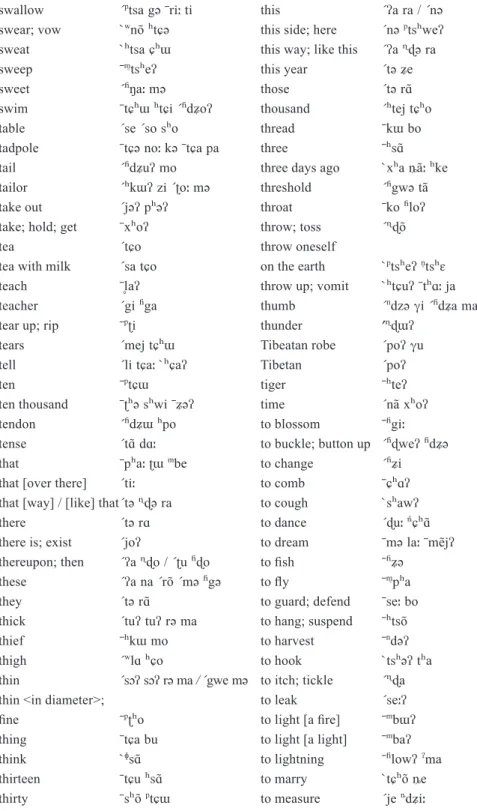
Appendix: Vocabulary of English-dGudzong
The following English-dGudzong vocabulary lists circa 1000 basic lexical items.
The verbal conjugation is not attested except for the verbs with a suppletive paradigm.