Virasoro Hair and Entropy for Axisymmetric Killing Horizons
Author Lin‑Qing Chen, Wan Zhen Chua, Shuwei Liu, Antony J. Speranza, Bruno de S. L. Torres journal or
publication title
Physical Review Letters
volume 125
number 24
page range 241302
year 2020‑12‑11
Publisher American Physical Society.
Rights (C) 2020 American Physical Society.
Author's flag publisher
URL http://id.nii.ac.jp/1394/00001697/
doi: info:doi/10.1103/PhysRevLett.125.241302
Creative Commons Attribution 4.0 International(https://creativecommons.org/licenses/by/4.0/)
Virasoro Hair and Entropy for Axisymmetric Killing Horizons
Lin-Qing Chen , 1,2,3,* Wan Zhen Chua , 2,4, † Shuwei Liu, 2,4, ‡ Antony J. Speranza , 2,§ and Bruno de S. L. Torres 2,4,5,∥
1
Okinawa Institute of Science and Technology, 1919-1 Tancha, Onna-son, Okinawa 904-0495, Japan
2
Perimeter Institute for Theoretical Physics, 31 Caroline Street N, Waterloo, Ontario N2L 2Y5, Canada
3
Centre for Quantum Information and Communication, École polytechnique de Bruxelles, CP 165, Universit´e Libre de Bruxelles,1050 Brussels, Belgium
4
Department of Physics and Astronomy, University of Waterloo, Waterloo, Ontario N2L 3G1, Canada
5
Instituto de Física Teórica, Universidade Estadual Paulista, São Paulo, São Paulo, 01140-070, Brazil
(Received 9 July 2020; revised 10 October 2020; accepted 17 November 2020; published 11 December 2020) We show that the gravitational phase space for the near-horizon region of a bifurcate, axisymmetric Killing horizon in any dimension admits a 2D conformal symmetry algebra with central charges proportional to the area. This extends the construction of Haco et. al. [J. High Energy Phys. 12 (2018) 098] to generic Killing horizons appearing in solutions of Einstein ’ s equations and motivates a holographic description in terms of a 2D conformal field theory. The Cardy entropy in such a field theory agrees with the Bekenstein-Hawking entropy of the horizon, suggesting a microscopic interpretation. A set of appendixes is included in the Supplemental Material that provides examples and further details of the calculations presented in the main text.
DOI: 10.1103/PhysRevLett.125.241302
Introduction. — The Bekenstein-Hawking black hole entropy S BH ¼ A= 4 G [1 – 3] presents a challenge to quan- tum gravity to provide a microscopic explanation. One proposal is that the entropy counts edge degrees of freedom living on the horizon and is controlled by boundary symmetries [4 – 6]. This idea was strikingly realized in Strominger’s derivation of the BTZ black hole entropy, using the Cardy formula for a conformal field theory (CFT) with the Brown-Henneaux central charge [7 – 10]. Much subsequent work has been devoted to generalizing this construction to other contexts.
Carlip in particular demonstrated that the conformal symmetries were not special to AdS 3 black holes; rather, they arise for generic Killing horizons. In all cases, postulating a CFT description led to agreement between the Cardy entropy and S BH [11 – 17]. Although very insightful, certain aspects of Carlip’s construction raised additional questions. The symmetry generators had to satisfy periodicity conditions whose justifications were obscure, and only a single copy of the Virasoro algebra was found, whereas the 2D conformal algebra consists of two copies, Vir R × Vir L [18,19]. The Kerr/CFT correspon- dence [20,21] provided some clarity, by making the
connection between near-horizon symmetries and holo- graphic duality more explicit, allowing intuition from AdS=CFT to be applied. As a by-product, it also motivated a different choice of near-horizon symmetry generators whose periodicities followed from the rotational symmetry of the Kerr black hole, thereby resolving one issue in Carlip ’ s original construction [22,23]. Another significant advance came from Haco, Hawking, Perry, and Strominger (HHPS) [24], who exhibited a full set of Vir R × Vir L symmetries for Kerr black holes of arbitrary nonzero spin.
This work was generalized to Schwarzschild black holes using a different collection of symmetry generators in Ref. [19].
The present work will demonstrate that arbitrary bifur- cate, axisymmetric Killing horizons possess a full set of conformal symmetries, which act on edge degrees of freedom, or “ hairs ” [25,26], on the horizon. We emphasize how these symmetries arise from generic properties of the near-horizon geometry, clarifying the geometric origin of the symmetries and greatly extending the regime of applicability of similar soft hair constructions.
Furthermore, we show that conformal coordinates can always be found which foliate the near-horizon region by locally AdS 3 geometries, giving rise to symmetry vector fields satisfying a Witt R × Witt L algebra in the vicinity of the horizon. The coordinates depend on two free param- eters, α and β , which are related to the CFT temperatures T R , T L using properties of the near-horizon vacuum.
When the symmetries generated by the vector fields are implemented canonically on the gravitational phase space, Published by the American Physical Society under the terms of
the Creative Commons Attribution 4.0 International license.
Further distribution of this work must maintain attribution to
the author(s) and the published article ’ s title, journal citation,
and DOI. Funded by SCOAP
3.
the algebra is extended to Vir R × Vir L , with central charges c R and c L determined in terms of the area and angular momentum of the horizon according to Eqs. (28) and (29).
Imposing a constraint on α and β , motivated by integrability of the charges generating the symmetry, sets the central charges equal to each other and proportional to the horizon area according to Eq. (31). We note that this choice of temperatures is a novel discovery of the present work, and differs from the choice made in Refs. [24,27] for Kerr.
More generally, Eq. (31) applies for any choice of α and β when appropriate Wald-Zoupas terms are used to define the quasilocal charges [28,29]. The Cardy formula [9] with the central charges (31) reproduces the entropy of the horizon, suggesting a dual description in terms of a CFT. This result therefore motivates investigations into holography for arbitrary Killing horizons, including the de Sitter cosmo- logical horizon, and nonrotating and higher dimensional black holes.
Near-horizon expansion. — We are interested in the form of the metric near a bifurcate, axisymmetric Killing horizon in a solution to Einstein ’ s equations in dimension d ≥ 3 . Axisymmetry means that, in addition to the horizon-gen- erating Killing vector χ a , there is a commuting, rotational Killing vector ψ a with closed orbits. Axisymmetric horizons are of interest since, by the rigidity theorems, all black hole solutions are of this form [30 – 33]. In situations where the horizon possesses more than one rotational Killing vector, we simply single out one and proceed with the construction.
The conformal symmetries of the horizon are found by first constructing a system of “ conformal coordinates, ” designed to exhibit a locally AdS 3 factor in the metric when expanded near the bifurcation surface. The asymptotic symmetries of this AdS 3 factor comprise the conformal symmetries of the horizon. We first define Rindler coor- dinates near the bifurcation surface using a construction of Carlip [12], suitably modified to incorporate the additional rotational symmetry. The gradient of χ 2 defines a radial vector,
ρ a ¼ − 1
2κ ∇ a χ 2 ; ð1Þ
where κ is the surface gravity of χ a . On the horizon, ρ a and χ a coincide, but off the horizon, ρ a is independent. The vectors ðχ a ; ψ a ; ρ a Þ mutually commute, and hence can form part of a coordinate basis with coordinates ðt; ϕ ; r Þ. The remaining transverse coordinates are denoted θ A . It is convenient to reparametrize the radial coordinate
x ¼ 1
κ e κr
; ð2Þ
which has the interpretation of proper geodesic distance to the bifurcation surface to leading order near the horizon.
In these coordinates, the near-horizon metric takes on Rindler form,
ds 2 ¼ −κ 2 x 2 dt 2 þ dx 2 þ ψ 2 d ϕ 2 þ q AB d θ A d θ B
− 2 x 2 dtðκ N ϕ d ϕ þ κ N A d θ A Þ þ ; ð3Þ where the dots represent terms at Oðx 2 Þ or higher that do not enter the remainder of the calculation (see Appendix A of Supplemental Material for additional details on this expansion [34]). Except for κ, all coefficients appearing in the above expansion are functions of θ A .
The conformal coordinates are now defined, in analogy to similar constructions in Ref. [24,27], as [38]
w þ ¼ xe αϕþκt ; ð4Þ
w − ¼ xe βϕ−κt ; ð5Þ
y ¼ e ½ðαþβÞ=2ϕ ð6Þ see Appendix B for a concrete realization in the example of de Sitter space and Appendix C for a discussion of the case of Kerr [34].
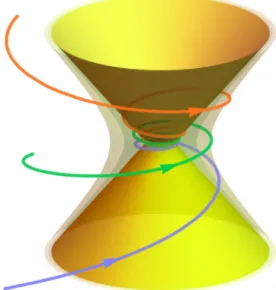
Here, α and β are free parameters that will later be related to the left and right temperatures of the system. Because xe κt and xe −κt are simply the Kruskal coordinates V, U near the bifurcation surface, the future horizon is at w − ¼ 0 and the past horizon is w þ ¼ 0 (see Fig. 1 for a visualization of the conformal coordinates in the near-horizon region).
Because of the periodicity ϕ ∼ ϕ þ 2π , the conformal coordinates must be identified according to
FIG. 1. Plot of the bifurcate Killing horizon (yellow) with three spirals depicting intersections of constant w
þ; w
−. From top to bottom, they correspond to w
þ=w
−¼ ð 5 ; 1 ; 1 = 5 Þ, with the same value of the product w
þw
−. They penetrate into any fixed-x hyperbola, shown in light brown, at the same y. The arrows indicate the direction of increasing y on approaching the bifurcation surface.
241302-2
ðw þ ; w − ; yÞ ∼ ðe 2πα w þ ; e 2πβ w − ; e πðαþβÞ yÞ: ð7Þ The near-horizon expansion in these coordinates becomes
ds 2 ¼ dw þ dw −
y 2 þ 4ψ 2 ðα þ βÞ 2
dy 2
y 2 þ q AB d θ A d θ B
− 2 dy
ðα þ βÞy 3 ½ðβ þ N ϕ Þw − dw þ þ ðα − N ϕ Þw þ dw −
−
w − dw þ
y 2 − w þ dw − y 2
κ N A d θ A þ ð8Þ
up to higher order terms in w þ ; w − . The first line takes the form of a locally AdS 3 metric with a θ A -dependent radius of curvature l ¼ ½ð2jψjÞ=ðα þ βÞ, times a transverse metric.
In intuitive words, the conformal coordinates zoom in on the near-horizon region through the lens of e αϕ , e βϕ attached to the Kruskal coordinate, and bring out the AdS 3 folia explicitly.
These coordinates allow for a straightforward determi- nation of the near-horizon symmetry generators. They are the asymptotic symmetry vectors of the AdS 3 factor in Eq. (8), where asymptotic refers to y → 0 . The vectors are defined as in HHPS [24],
ζ a ε ¼ εðw þ Þ∂ a þ þ 1
2 ε 0 ðw þ Þy ∂ a y ; ð9Þ ξ a ¯ ε ¼ εðw ¯ − Þ∂ a − þ 1
2 ε ¯ 0 ðw − Þy∂ a y ; ð10Þ and one can readily verify that the Lie derivative of the first line of Eq. (8) with respect to these vectors vanishes up to Oðy −3 Þ terms. A priori, εðw þ Þ and εðw ¯ − Þ are arbitrary functions, but in light of the periodicity condition (7), the vector fields are single valued only when εðw þ e 2πα Þ ¼ εðw þ Þe 2πα , ¯ εðw − e 2πβ Þ ¼ εðw ¯ − Þe 2πβ . A basis for such functions is
ε n ðw þ Þ ¼ αðw þ Þ 1þin=α ; ð11Þ ε ¯ n ðw − Þ ¼ −βðw − Þ 1− in= β ; ð12Þ and their corresponding generators will be labeled as ζ a n , ξ a n . The algebra satisfied by these vector fields upon taking Lie brackets is two commuting copies of the Witt algebra:
½ζ m ; ζ n ¼ iðn − mÞζ mþn ; ð13Þ
½ξ m ; ξ n ¼ iðn − mÞξ mþn : ð14Þ The generators are defined in a neighborhood of the bifurcation surface, but oscillate wildly as it is approached.
The ζ a n generators are regular on the future horizon but not the past, and similarly ξ a n are regular at the past horizon but not the future. The zero mode generators ζ a 0 and ξ a 0 are regular everywhere, given by two helical Killing vectors:
ζ a 0 ¼ α α þ β
β
κ χ a þ ψ a
; ð15Þ
ξ a 0 ¼ β α þ β
α
κ χ a − ψ a
: ð16Þ
The expressions (15) lead to the interpretation of α and β in terms of the right and left temperatures. The analog of the Frolov-Thorne vacuum [39] for quantum fields near the bifurcation surface is thermal with respect to the χ a Killing vector. The density matrix is therefore of the form ρ ∼ exp½−ð2π = κÞω χ , where ω χ ¼ − k a χ a is the frequency with respect to χ a for a wave vector k a . Reexpressing it in terms of ζ a 0 , ξ a 0 frequencies via
ω χ ¼ − k a κ
α ζ a 0 þ κ β ξ a 0
¼ κ α ω R þ κ
β ω L ð17Þ shows that ρ ∼ exp½−ð2π = αÞω R − ð2π = βÞω L , allowing us to read off the temperatures ðT R ; T L Þ ¼ ½ðα = 2πÞ;
ðβ=2πÞ as the thermodynamic potentials conjugate to ζ a 0 , ξ a 0 [20].
Central charges.—Having identified the near-horizon symmetry generators (9) and (10), the next step is to implement them on the gravitational phase space. This involves identifying Hamiltonians H n ; H ¯ n that generate the symmetries associated with ζ a n , ξ a n , meaning
δ H n ¼ Ωðδ g ab ; £ ζ
ng ab Þ; ð18Þ where Ω is the symplectic form of the phase space.
Assuming integrable Hamiltonians can be found, their Poisson brackets automatically reproduce the algebra satisfied by the vector fields (14), up to central extensions, fH m ; H n g ¼ − i½ðn − mÞH mþn þ K R ðm; nÞ; ð19Þ f H ¯ m ; H ¯ n g ¼ − i½ðn − mÞ H ¯ mþn þ K L ðm; nÞ: ð20Þ Since the Witt algebra has a unique nontrivial central extension to Virasoro, the central terms in the above expression must be of the form
K R;L ðm; nÞ ¼ c R;L
12 ðm 3 − mÞδ mþn;0 ; ð21Þ where the constants c R;L are the central charges.
Using the covariant phase space formalism and standard Iyer-Wald identities [40 – 43], the right-hand side of Eq. (18) can be expressed on shell as
Ωðδ g ab ; £ ζ
ng ab Þ ¼ Z
∂Σ ðδ Q ζ
n− i ζ
nθÞ; ð22Þ
where the integral is over the boundary of a Cauchy surface
Σ for the exterior region of the Killing horizon. The other
quantities appearing in Eq. (22) are the Noether potential (d − 2 )-form,
Q ζ
n¼ − 1
16πG ϵ a b ∇ a ζ b n ; ð23Þ and the symplectic potential (d − 1 )-form,
θ ¼ 1
16π G ϵ a ð∇ b δg ab − g bc ∇ a δg bc Þ: ð24Þ In these expressions, ϵ denotes the spacetime volume form, with uncontracted indices not displayed.
The zero mode generators ζ a 0 , ξ a 0 are Killing vectors whose corresponding Hamiltonians are
H 0 ¼ α α þ β
βA 8π G þ J H
; ð25Þ
H ¯ 0 ¼ β α þ β
α A 8π G − J H
; ð26Þ
where A is the area of the bifurcation surface B , and J H ≡
Z
B Q ψ ¼ 1 4G
Z
d θ A ffiffiffi p q
jψ jN ϕ ð27Þ
is the angular momentum of the Killing horizon. J H agrees with the total angular momentum J in an asymptotically flat vacuum solution, but generally differs when matter is present outside the horizon [44]. The remaining generators with n ≠ 0 vanish in the Killing horizon background, because the vector fields ζ a n , ξ a −n have an e in ϕ angular dependence, which integrates to zero on the axially symmetric horizon. Of course, the variations of these other generators are nonzero.
The Poisson bracket only involves variations of the Hamiltonians, and hence can be computed directly from Eq. (18). According to Eqs. (19) and (21), the central charge appears as the coefficient of the m 3 term in fH m ; H −m g. Because of the singular limit in the generators ζ a m , the integral that computes the bracket cannot be evaluated directly on the bifurcation surface. Instead, we work on a cutoff surface at constant x and t, and perform the integration before taking the limit x → 0 . The details of this calculation are given in Appendix D of Supplemental Material [34], and results in the central charge
c R ¼ 24 ðα þ βÞ 2
β A 8πG þ J H
: ð28Þ
An analogous calculation for f H ¯ m ; H ¯ −m g yields
c L ¼ 24 ðα þ βÞ 2
αA 8π G − J H
: ð29Þ
Temperature and entropy. — Up to now, we have carried out the full calculation with arbitrary temperatures.
However, experience with asymptotic symmetries in AdS 3 [10] suggests that the left and right central charges should be equal. By equating Eqs. (28) and (29), we arrive at the condition
α − β ¼ 16π GJ H
A ; ð30Þ
which, notably, differs from the choice of temperatures employed by HHPS for Kerr black holes [24,27]. With this constraint, the central charges are proportional to the horizon area:
c R ¼ c L ¼ 3 A
2π Gðα þ βÞ : ð31Þ It is natural to conjecture that the condition (30) arises from imposing appropriate boundary conditions that ensure the charges H n , H ¯ n are integrable.
This conjecture turns out to be correct, as was recently demonstrated in Ref. [29], which carried out a systematic analysis of θ appearing in Eq. (22) pulled back to the future or past horizon. The main point is that the part of θ that can be written as a total variation, −δl , contributes to the Hamiltonians H n ; H ¯ n , and in order for the values computed for H 0 ; H ¯ 0 on the past horizon to agree with their values computed on the future horizon, the expression for l must be the same on each horizon. Furthermore, Ref. [29]
showed that the central charges can be expressed in terms of l and its variation, and since the same quantity is used on the past and future horizon, one can derive that the central charges must be equal. On the other hand, when the charges are integrable, the calculations leading to Eqs. (28) and (29) remain valid, and hence α and β must be chosen to ensure that c R ¼ c L , which produces Eq. (30).
The results of Ref. [29] further allow us to work out the boundary conditions that need to be imposed at the future H þ or past horizon H − to arrive at integrable generators.
(For a derivation that explores alternative boundary con- ditions, see Ref. [45].) One of the conditions is local,
g ab δg ab H ¼
0; ð32Þ while the second condition is a weaker, integrated condition over the transverse θ A directions,
Z
d θ A ffiffiffi p q
jψ jðδ k − kq ab δ g ab þ 2ϖ a χ b δ g ab Þ ¼ 0 ; ð33Þ
where k is the inaffinity [46], defined by χ a ∇ a χ b ¼ kχ b , ϖ b ¼ − q a b n c ∇ a χ c is the Hájí č ek 1-form, n c is an auxiliary transverse null vector to the horizon, and q ab ¼ g ab þ n a χ b þ χ a n b . The variations in this expression are
241302-4
taken holding χ a fixed; see Appendix E for additional details on these quantities and their variations (Supplemental Material [34]).
Since the near-horizon gravitational phase space exhibits Vir R × Vir L symmetry, considerations from holographic duality suggest that its quantum description is given by a 2D CFT. In such a theory, unitarity and modular invariance determines the asymptotic density of states via the Cardy formula. Using the temperatures ðT R ; T L Þ ¼
½ðα=2πÞ; ðβ=2πÞ derived from properties of the Frolov- Thorne vacuum, and central charges (31), the Cardy formula for the canonical ensemble yields an entropy [9,47]
S ¼ π 2
3 ðc R T R þ c L T L Þ ¼ A
4 G ; ð34Þ which agrees with the Bekenstein-Hawking entropy. This therefore motivates an interpretation of the black hole microstates in terms of a dual CFT.
Wald-Zoupas term. — Instead of imposing the boundary conditions (32) and (33), we could instead work with nonintegrable charges that are not conserved due to a loss of symplectic flux from the region outside the horizon. In this case, the Wald-Zoupas procedure gives a suitable definition of the quasilocal charges [28]. This prescription corrects δ H n by a flux contribution, constructed from terms appearing in Eqs. (32) and (33) that the boundary condition would have set to zero. The bracket of the charges must then be modified, in which case the Barnich-Troessaert bracket provides a suitable definition [48]. Doing so shifts the central charges by
Δ c R ¼ −12 ðα þ βÞ 2
ðβ − αÞ A
8πG þ 2 J H
ð35Þ
and Δc L ¼ −Δc R (see Appendix E for details [34]).
Adding these to Eqs. (28) and (29) sets the two central charges equal, and given by Eq. (31), but now with any choice of α and β . Hence, the choice of α − β described in Eq. (30) is also the unique choice which sets the Wald- Zoupas corrections to the central charges to zero.
Additional details of this Wald-Zoupas prescription are given in Ref. [29].
The central charges (31) can be compared to those found by HHPS [24], whose choice of temperatures for the Kerr black hole set α þ β ¼ ðA= 8π GJ H Þ. Substituting this into Eq. (31) reproduces their result c R ¼ c L ¼ 12 J H . Our results are therefore consistent with theirs, although we have demonstrated that once the Wald-Zoupas terms are included, the construction does not appear to rely on any specific choice of temperatures.
Discussion. — The agreement between the horizon entropy and the Cardy formula with central charges (31) suggests that the quantum description of the horizon involves a CFT. A conservative interpretation of this result
is that the presence of the horizon breaks some gauge symmetry of the theory, giving rise to edge degrees of freedom [4 – 6]. The Vir R × Vir L algebra then provides a symmetry principle that constrains the quantization of these edge modes, which is strong enough to determine the asymptotic density of states accounting for the entropy.
This argument holds even if the conformal symmetries are only a subset of the full horizon symmetry algebra. Other horizon symmetries can include additional rotational symmetries, supertranslations, and diffeomorphisms of the bifurcation surface [18,25,26,47,49 – 58], and determin- ing how they interact with the conformal symmetries of this Letter would be an interesting direction to pursue. It is also possible that a slightly different symmetry algebra can be used to fix the entropy; in particular, Ref. [59] showed that the HHPS construction can be modified to produce a Virasoro-Kac-Moody symmetry characteristic of a warped CFT. A straightforward alteration of our construction should demonstrate how to realize warped conformal symmetries on arbitrary axisymmetric Killing horizons.
A more ambitious proposal is that the near-horizon region is holographically dual to a CFT. This is in line with the Kerr/CFT correspondence [20,21], and raises the exciting possibility of producing new interesting examples of holography for a variety of different Killing horizons. In this picture, the expression (31) can be interpreted as determining the horizon area in terms of the temperatures
½ðα=2πÞ; ðβ=2πÞ and the central charge. A rather nontrivial aspect of such a proposed duality, however, is the lack of a decoupling limit for the near-horizon region, due to nonextremality, κ ≠ 0 . The anticipated need for Wald-Zoupas terms in defining integrable charges can be viewed as one indicator of this lack of decoupling, since they imply a loss of symplectic flux from the subregion under consideration. The CFT should therefore be an open quantum system, deformed by an operator coupling it to an auxiliary system describing the far away region. This is quite reminiscent of recent models of black hole evapora- tion in holography [60 – 63], and hence studying the holo- graphic description of Killing horizons may lead to new insights on the black hole information problem.
These results open a number of directions for further
investigation. The parameters α and β were not fully fixed
by the arguments in this Letter; even the condition (30)
does not determine the sum α þ β . With the Wald-Zoupas
terms, any choice of α and β leads to the correct Cardy
entropy, and so it remains to be seen what other physical
requirements fix their value. It may be that any choice is
valid, which has some advantages because it can be used to
ensure 1 ≪ c R;L ≪ H 0 ; H ¯ 0 , which is the regime in which
the Cardy formula is valid. The temperatures used by
HHPS were determined using the hidden conformal sym-
metry of scalar scattering amplitudes in the near region of
Kerr [27], and we are currently investigating its implication
in our construction.
A natural question is whether this construction works for other types of horizons or subregions. With mild modifi- cations, we expect it to work for degenerate Killing horizons with κ ¼ 0 . One could also consider noncompact horizons, such as Rindler space, in which the vector field ψ a does not have closed orbits. In these cases, one could quotient by a finite translation along ψ a , which serves to both regulate the horizon area and impose periodicity conditions on the generators. This should lead to a sensible notion of entropy density following from the Cardy formula. Other possible subregions to consider are cuts of a Killing horizon or more generic null surfaces [54,55,57,58,64], conformal Killing horizons [65], causal diamonds [66], Ryu-Takayanagi surfaces [67,68], and generic subregions [51,52].
We acknowledge Niayesh Afshordi, Glenn Barnich, Venkatesa Chandrasekaran, Luca Ciambelli, St´ephane Detournay, Ted Jacobson, Rob Leigh, Alex Maloney, Dominik Neuenfeld, Lee Smolin, Jie-Qiang Wu, Beni Yoshida, and C´eline Zwikel for helpful discussions, and William Donnelly for comments on a draft of this work. We thank Malcolm Perry for suggesting the question of generalizing the HHPS construction to the cosmological horizon. L.-Q. C. is very grateful to Vyacheslav Lysov for insightful conversations on this theme. We thank Geoffrey Comp`ere and Adrien Fiorucci for providing the SurfaceCharges Mathematica package [21]. We are very grateful to the organizers of the Perimeter Scholars Institute Winter School, where this work was initiated. A. J. S.
thanks the Kavli Institute for Theoretical Physics for hospitality during the Gravitational Holography program.
L.-Q. C. thanks Perimeter Institute for the hospitality.
Research at Perimeter Institute is supported in part by the Government of Canada through the Department of Innovation, Science and Economic Development Canada and by the Province of Ontario through the Ministry of Colleges and Universities. L.-Q. C. thanks Okinawa Institute of Science and Technology for academic visiting funding. B. d S. L. T. thanks IFT-UNESP/ICTP-SAIFR and CAPES for partial financial support. This research was supported in part by the National Science Foundation under Grant No. NSF PHY-1748958.
*
[email protected]
†
[email protected]
‡
[email protected]
§
[email protected]
∥