24
েմ߂ఠᔒᨆᏛឹǶፀ$$/ش⏄ፀ⏕Օԕ⏅⏨35⑰4,⏄'"$/ॷ$"⏅
GNLR¦¡¨m¯$$/ń$⏨35⑰4,⏄aª'"$/⏅
1. Introduction
ǵǵMotivational factors receive its due recognition for playing a significant role in second language ⏃L'⏆
learning and use. Bearing particular relevance to the communicative aspect is the construct of willingness to communicate
⏃WTC⏆
, which was originally conceptualized as a personality-based predisposition to talking in first language
⏃L$⏆communication studies
⏃e.g., McCroskey & Baer, $53-; McCroskey & Richmond, $55"; McCroskey, $55'⏆. In recent year, it has been applied to L ' learning and extensively investigated in the mainstream of its research arena
⏃e.g., MacIntyre, Clément, Dörnyei, & Noels, $553; Yashima, '""'; MacIntyre, Baker, Clément, & Donovan, '"");
MacIntyre & Legatto, '"$$⏆ and is now accepted as an equally relevant but distinct construct with L' learners.
While McCroskey and associates conceptualized WTC as a personality trait, MacIntyre et al.
⏃$553⏆see in L ' WTC situation-specific, transient as well as rather stable, enduring influences, and they reformulate it as a
ŋsituation-basedvariable representing an intention to communicate at a specific time to a specific personŌ
⏃p. --5⏆.
ǵǵAnother affective learner variable of no less importance in considering L' communication is language anxiety,
which seems to pertain directly to L' WTC as well. MacIntyre et al.
⏃$553⏆consider anxiety to be a crucial factor influencing self-confidence, which they posit as the most immediate determinant of L ' WTC along with the desire
EJ´i´¨ª¨E¢¢¦¡ª¡ªTª¦ª¡
Gª°qkIE³ª´['a¦I¡ª¡
qkI ɮܕᓃέɺሂϣсᅎɳȱɀʴ
̌˔̟͉̑˩˺˾̗͋˿ͺː̹ͥͼ̎
k¡^aga
⏈ᩃǶٖǶਏǶ
Abstract
The present study explores the possibilities of employing a dynamic systems
(DS
)approach to the description and explanation of the mechanism of the dynamic interaction between willingness to communicate
(WTC
)and language anxiety in second language
(L2)oral communication. The WTC–anxiety interaction is conceptualized as
DXQLWDU\HQWLW\DQGUHIRUPXODWHGDVDVHOIRUJDQL]LQJV\VWHP 7KH:7&±DQ[LHW\LQWHUDFWLYHÀXFWXDWLRQVDUHVHHQDVtransitioning of attractor states as a result of both the internal and external perturbation of the attractor. In addition to theoretical argument, the present study examines the observation records and on-site interview data obtained from Japanese L2 English learners who were staying in English-speaking countries for a short period of time
(three weeks
)and those for a longer period of time
(more than six months). The DS approach in the examination of the WTC–
anxiety interaction turned out to be both relevant and effective as providing a sound theoretical framework as well as useful conceptual tools. The comparative analysis of the data obtained from the two groups of L2 English learners evidenced the argument based on the DS approach and the abstraction of the four basic attractor states of the WTC–
anxiety dynamic interaction.
keywords: willingness to communicate (
WTC
), anxiety, dynamic systems theory
⏇J¢¦ªª¡L¨Nª´¡Lª¡R¦¡¨m¯¦¨ª´
Ƕেմ߂ఠᔒᨆᗔఠᔒᡙএ
Tokuji NORO 4#
to communicate with a specific person. As with their conceptualization of L ' WTC, the construct of anxiety is also presumed to be situation-specific and transient, fluctuating over time and directly affecting self-confidence and eventually WTC. The dynamic mechanism of anxiety mediating self-confidence and L' WTC that they premise, however, has yet to be examined and delineated with further elaboration before it is fully explicated with empirical evidence.
ǵǵIn examining the interaction between L' WTC and anxiety, the present study turns to dynamic systems ⏃DS⏆
theories for its theoretical rationale. DS theories, originally established to explain mechanisms of change and development in organisms in the natural world, are now considered to be applicable to any kind of science as long as it is to explain phenomena by viewing them as self-organizing dynamic systems with interaction among their components and contributing factors in their change and development. As is detailed below, research with a DS approach has been conducted in second language acquisition
⏃SLA⏆, too, initially starting with such research themes as motivation and learner identity, and gradually widening its theme areas
⏃e.g., De Bot, Lowie, & Verspoor,'""- ; Larsen-Freeman & Cameron, '""3; Dörneyi, MacIntyre, & Henry, '"$-; King, '"$/⏆ .
ǵǵThe present study aims to explore the possibilities of employing a DS approach to the description and
explanation of the interaction between WTC and anxiety in L' oral communication. Based on the rationale formulated in DS theories, the WTC–anxiety interaction is conceptualized as a unitary entity and reformulated as a self-organizing dynamic system, of which the fluctuations are seen as transitioning of attractor states, or relatively stable states that a dynamic system can take at any given time during the self-organizing process. Thus, the interactive fluctuations of WTC and anxiety are seen as a process of transitioning from one attractor state to another. In addition to the theoretical argument, observation records and on-site interview data obtained from the two groups of Japanese L' English learners are analyzed: the short-term stay group
⏃SSG⏆, who stayed in English-speaking countries for a short period of time
⏃three weeks⏆and the long-term stay group
⏃LSG⏆, who stayed for a longer period of time
⏃morethan six months⏆ . The comparative analysis is expcted to provid evidence for the description and explanation of the transitioning process of the attractor states of the WTC
–anxiety interaction in the real-world L' oral communication scenes .
2. Dynamic Interaction between L2 WTC and Anxiety
Dynamic systems approach in SLA paradigm
ǵǵThe dynamic aspects of SLA have become an area of growing interest as more research has been conducted
in DS approaches since the introduction of the approaches into the SLA paradigm. Dörneyi, MacIntyre, and Henry
⏃'"$-⏆
mark one of the most comprehensive research projects along this line, with both theoretical and empirical research offering insightful findings in the SLA motivational dynamics. In so doing, they posit the challenge of the new paradigm as three-fold:
⏃$⏆
modelling nonlinear change
⏃'⏆
observing the operation of the whole system and the interaction of the parts, rather than focusing on specific units within it
⏃)⏆
finding alternatives to conventional quantitative research methodologies that, by and large, relied on statistical procedures to examine linear rather than dynamic relationships
⏃Dörneyi, MacIntyre, and Henry, '"$-, p. '⏆
They see the challenge not in mastering new research skills but rather in transferring DS approaches from the natural sciences to social sciences.
ǵǵThe challenge that Dörneyi, MacIntyre, and Henry ⏃'"$-⏆
posit can be rephrased in the dichotomy of the DS
approaches, that is, mathematical and nonmathematical. The former, most typically adopted in the natural sciences,
A Dynamic Systems Approach to the Interaction Between WTC and Anxiety in L' Oral Communication 4%
predict
ŋthe future state of a system based on its present stateŌ, while the latter, taken in the social sciences, asks for
ŋqualitative descriptions of how the tendencies of the system as a wholemight appearŌ
⏃Lewis & Granic, '""", p.3⏆ . In the description and explanation of the WTC–anxiety interaction that follow, the nonmathematical DS approach is taken, with the above-mentioned three aspects of the challenge in mind.
Dynamic systems approach to the WTC–anxiety interaction
ǵǵIt comes to our intuitive awareness that both WTC and anxiety play crucial roles in L' oral communication as
each can facilitate or inhibit it independently of the other. However, it is also possible that WTC and anxiety mutually interact to amplify or cancel out their effects. When the two mutually interacting constructs are seen as a unitary entity, the very interaction between them is conceptualized as organizing a dynamic system in itself, of which the fluctuations take the form of the synthetic waves of WTC and anxiety. In other words, if WTC and anxiety are seen and analyzed separately as each being a cause–effect variable, it will only contribute to yielding a more or less linear and unidirectional model of the change, of which the validity Dörneyi, MacIntyre, and Henry
⏃'"$-⏆question. By developing a nonlinear, dynamic model, which will make it possible to
ŋobserve the operation of the whole systemand the interaction of the parts,Ō it is expected that L' learnersʼn approach–avoidance conflict and behavior in oral communication scenes will be better explained as the dynamic WTC–anxiety interaction is exemplified in a context- based manner.
ǵǵAn increasing number of research addressing WTC and language anxiety in the motivational dynamics
framework shows the applicability and relevance of the DS approaches in this theme area. The pioneering work by MacIntyre and Legatto
⏃'"$$⏆succeeds in capturing moment-to-moment fluctuations of L ' WTC. Pawlak and Mystkowska-Wiertelak
⏃'"$-⏆investigate L' WTC in paired conversation and identified variables influencing its flux such as the topic, planning time, cooperation and familiarity with the interlocutor, opportunity to express oneʼn s ideas, etc. Specifically addressing language anxiety, Gregersen, Meza, and MacIntyre
⏃'"$+⏆find a strong relationship observed among physiological heart rate data, idiodynamic self-ratings of moment-to-moment changes in anxiety, and other anxiety-related indices. All these can be interpreted to point to the justifiability and adequacy of DS approaches applied to the motivational dynamics with WTC and anxiety. The present study is to introduce another orientation into the existing research paradigm in this direction, that is, conceptualizing of the dynamic interaction between L' WTC and anxiety as a unitary entity and reformulating it as a self-organizing dynamic system with its fluctuations to be approached and explained as transitioning of attractor states.
3. WTC–Interactive Fluctuations as Transitioning of Attractor States
ǵǵIn describing and explaining change in a dynamic system, DS theories postulate the state space, which is the
Figure 1. A topological state space landscape ⏃from Spivey, '""1, as cited in Larsen-Freeman & Cameron, '""3, p. +/⏆
Tokuji NORO 4&
ŋset of all possible states that the system could be inŌ⏃Larsen-Freeman & Cameron,
'""3 , p. +1⏆ . The state space can be visualized with the spatial metaphor of a topological landscape with hills, valleys, and ridges where the system
ŋwanders aroundŌ. Figure $ shows an example of a topological state space landscape.
ǵǵIn the state space landscape, ŋrelatively steady states that the system gravitates towardŌ⏃Keating and Miller,
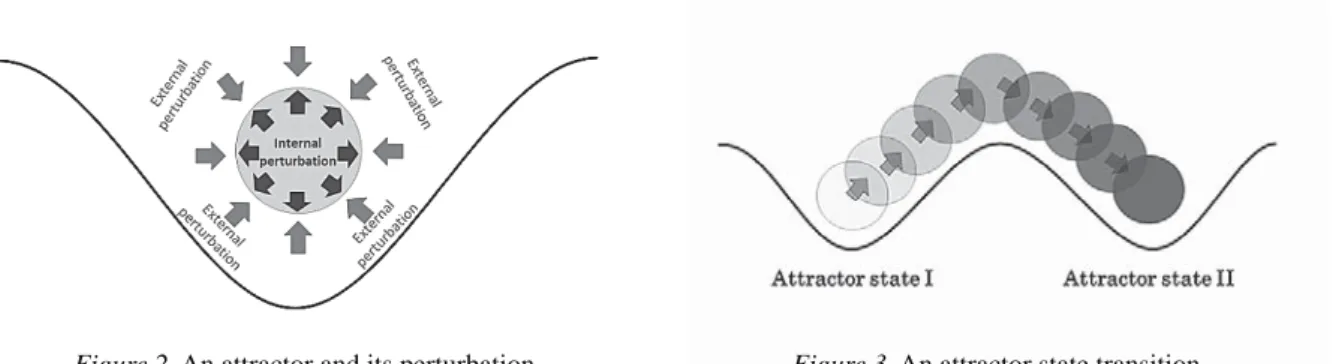
'""", p. )3)⏆ are called attractors. When the system changes, it means that some kind of perturbations
ŋmovethe system out of its current attractor, and it may settle into a new attractorŌ
⏃Keating and Miller, '""", p. )3)⏆. Figure ' shows the schematic model of an attractor and its perturbation, and Figure ) shows that of an attractor state transition of a dynamic system, both developed by the present author
⏃Noro, '"$/⏆.
Analysis of the communication scenes reported by the participants as those causing fluctuations of their WTC and anxiety disclosed some critical scenes where transitioning of their WTC–anxiety attractor states was observed.
Further examination of the critical scenes revealed that the perturbation of the attractor eventually bringing about its transition was accompanied by some typical patterning of the WTC–anxiety interaction together with other concurrent factors presumed to be relevant to the L' oral communication. Thus, the dynamic WTC–anxiety interactive fluctuations can be better described and explained as a process of transitioning from one attractor state to another.
ǵǵPerturbation of the WTC–
anxiety attractor state can be viewed and discussed in terms of the two different types, that is, external and internal, as modeled in Figure '. The external perturbation is caused by those variables outside the self-organizing dynamic system, i.e., the WTC–anxiety interaction. The observation records and interview data obtained from the two groups in the present study suggest the external perturbation caused by variables such as the characteristics of the language used in the communication, topic interest and/or familiarity, interlocutorsʼn attitude and behavior, physical environment of the communication scene, etc. The internal perturbation comes from the inside, that is, the L' learner whose WTC–anxiety interaction is in question. Its possible sources should include coping strategies, L ' proficiency, beliefs and values, and personality. The transitions of the WTC–anxiety attractor states can be reasonably explained as resulting from the interaction of the two types of perturbation.
Three time scales in the self-organizing process of the WTC–anxiety interaction
ǵǵAs explained above, the DS approaches to the description and explanation of the mechanisms of emotional
development premise its self-organization over time. Lewis
⏃'"""⏆proposes the three time scales for emotional development: microdevelopment, mesodevelopment, and macrodevelopment. According to his model, the duration of the microdevelopment is supposed to last for seconds to minutes, while the mesodevelopment for hours to days and the macrodevelopment for months to years. Following his three time scales model of emotional self- organization, the WTC–anxiety interaction could be interpreted as self-organizing in moment-to-moment emotional fluctuation
⏃microdevelopment⏆through hourly, daily, and weekly mood change
⏃mesodevelopment⏆to longer-term, monthly to yearly personality structuring
⏃macrodevelopment⏆.
Figure 2. An attractor and its perturbation Figure 3. An attractor state transition
A Dynamic Systems Approach to the Interaction Between WTC and Anxiety in L' Oral Communication 4(
ǵǵThe on-site interviews with the LSG and SSG learners revealed that the WTC–anxiety attractors exhibited
by the former group were steadier and show less frequent transitions than those by the latter. Among the above- mentioned variables presumed to be causing the internal perturbation, some are interpreted as momentary and situational, while others more or less longer-term and lasting. Thus, the internal perturbation itself might also be better understood in the three different time scales. Also, if the transitions of the WTC–anxiety attractor states result from the interaction of the external and internal perturbation as suggested above, the steadier WTC–anxiety attractor with less frequent transitions that LSG showed can be reasonably explained by the fact that they had gone through the self-organization of the WTC–anxiety interaction longer than SSG.
Four basic WTC–anxiety attractor states
ǵǵCloser examination of the observation records and interview data led to the abstraction of the four basic
attractor states of the WTC–anxiety interaction. Table $ shows the four attractor states with the approach–avoidance conflict with L' communication and the perturbation demand, i.e., the degree of the perturbation required to move out of the attractor.
Table $
Four Basic Attractor States of the WTC–Anxiety Interaction
Attractor state Approach–avoidance conflict with L' communication
Perturbation demand
š
High WTCǵÌǵHigh Anxiety Approach/Avoidance High
Ţ
High WTCǵÌǵLow Anxiety Approach Low
ţ
Low WTCǵÌǵHigh Anxiety Avoidance High
Ť
Low WTCǵÌǵLow Anxiety Non-committal High
As shown in Table $ , Attractor stateŢ and Attractor state ţ are assumed to make a perfect symmetry, while Attractor statešand Attractor state Ť are rather skewed to each other; that is, Attractor stateš , which comprises of high WTC and high anxiety, is expected to take either an approach or avoidance orientation toward L' communication, while Attractor state Ť, comprising of low WTC and low anxiety, is more likely to take a non-committal orientation. The approach/avoidance orientation observed in Attractor statešare actually well represented in the results yielded by the comparative analysis with the LSG and SSG learners. The LSG learners tend to maintain the approach orientation in Attractor stateš , while SSG show avoidance. This is most probably because LSG experienced emotional self-organization relevant to the L' oral communication including the WTC–anxiety interaction through their macrodevelopment.
ǵǵAs for the perturbation demand, both Attractor stateŢand Attractor state ţ are expected to be at a high demand
level, meaning that they are both rather strong attractors requiring major perturbation to move out of. Attractor state
Ť will most likely stay at a low level considering its non-committal orientation toward L' communication, while Attractor state š will be at a mid-to-high level with its bidirectional orientation. The four attractor states above show the extremities of the continuum of the WTC–anxiety interaction, and naturally there should be other attractor states in between, suggesting the variability of the WTC–anxiety interaction.
4. Conclusion
ǵǵThe present study explored the possibilities of employing a DS approach to the description and explanation
of the mechanism of the dynamic interaction between WTC and language anxiety in L' oral communication. The
WTC–anxiety interaction was conceptualized as a unitary entity and reformulated as a self-organizing system. The
WTC–anxiety interactive fluctuations were seen as transitioning of attractor states as a result of both the internal
Tokuji NORO 4*
and external perturbation of the attractor. In addition to the theoretical argument, the present study examined the observation records and on-site interview data obtained from the two groups of the Japanese L' English learners, i.e., the SSG and LSG learners. The DS approach in the examination of the WTC
–anxiety interaction turned out to be both relevant and effective as providing a sound theoretical framework as well as useful conceptual tools. The comparative analysis of the data obtained from the SSG and LSG learners evidenced the argument based on the DS approach and the abstraction of the four basic attractor states of the WTC–anxiety dynamic interaction.
ǵǵThe present study, however, leaves some important theoretical concepts in the DS theories unexamined.
Among others, it did not explicitly discuss repellers, which are states that a dynamic system is not attracted to and needs considerable perturbation to move toward. Trajectories, or sequences of attractor states in the state space, are another that was missed in the discussion. The discussion of repellers and trajectories will not only enrich the description and explanation of the WTC
–anxiety interaction but also help to give psychological reality to the explanation. For future research, in addition to the above-mentioned missed discussion, more empirical data gathering in the real-world L' communicative scenes will add to the explication of the mechanism.
Acknowledgement
The present research was supported in part by a Grant-in-Aid for Scientific Research for 2015–2019 (No.
15K02744
)from the Japan Society for the Promotion of Science.
References
De Bot, K., Lowie, W., & Verspoor, M.
(2005
). Second language acquisition:
An advanced resource book. Abingdon, UK: Routledge.
Dörneyi, Z., MacIntyre, P. D., & Henry, A.
(2015). Motivational dynamics in language learning. Bristol, UK:
Multilingual Matters.
Gregersen, T., Meza, M. D., & MacIntyre, P. D.
(2014). The motion of emotion: Idiodynamic case studies of learners’ foreign language anxiety. Modern Language Journal, 98, 574–588.
Keating, D. P., & Miller, F. K.
(2000
⏆. The dynamics of emotional development: Models, metaphors, and methods.
In M. D. Lewis & I. Granic (Eds), Emotion, development, and self-organization
(pp. 373–392⏆. New York:
Cambridge University Press.
King, J.
(2016
⏆. The dynamic interplay between context and the language learner. Basingstoke, UK: Palgrave Macmillan.
Larsen-Freeman, D., & Cameron, L.
(2008
⏆. Complex systems and applied linguistics. Oxford: Oxford University Press.
Lewis, M. D.
(2000
⏆. Emotional self-organization at three time scales. In M. D. Lewis & I. Granic
(Eds
⏆, Emotion, development, and self-organization
(pp. 37–69
⏆. New York: Cambridge University Press.
Lewis, M. D., & Granic, I.
(2000⏆. Emotion, development, and self-organization: Dynamic systems approaches to emotional development. New York: Cambridge University Press.
MacIntyre, P. D., Baker, S. C., Clément, R., & Donovan, L. A.
(2003
⏆. Talking in order to learn: Willingness to communicate and intensive language programs. Canadian Modern Language Review, 59, 589–607.
MacIntyre, P. D., Clément, R., Dörnyei, Z., & Noels, K. A.
(1998
⏆. Conceptualizing willingness to communicate in a
/$VLWXDWLRQDOPRGHORI/FRQ¿GHQFHDQGDI¿OLDWLRQModern Language Journal, 82, 545–562.MacIntyre, P. D., & Legatto, J. J.
(2011
⏆. A dynamic system approach to willingness to communicate: Developing an idiodynamic method to capture rapidly changing affect. Applied Linguistics, 32, 149–171.
McCroskey, J. C.
(1992⏆. Reliability and validity of the willingness to communicate scale. Communication Quarterly, 40, 16
–25.
McCroskey, J. C., & Baer, J. E.
(1985
⏆. Willingness to communicate: The construct and its measurement. Paper
A Dynamic Systems Approach to the Interaction Between WTC and Anxiety in L' Oral Communication 4,
presented at the annual meeting of the Speech Communication Association, Denver, CO., USA.
McCroskey, J. C., & Richmond, V. P.
⏃$55"⏆. Willingness to communicate: A cognitive view. In M. Booth- Butterfield
⏃Ed.⏆, Communication, cognition and anxiety
⏃pp.$5–)1⏆. Newbury Park, CA: Sage.
Noro, T.
⏃'"$/, April⏆ . The interaction between WTC and anxiety in L ' oral commumication: Investigating their fluctuations as attractors. Poster presented at the '"$/ Annual Conference of the American Association for Applied Linguistics, Orlando, FL., USA.
Pawlak, M., & Mystkowska-Wiertelak, A.
⏃'"$-⏆. Investigating the dynamic nature of L' willingness to communicate. System, 50, $–5.
Yashima, T.
⏃'""'⏆. Willingness to communicate in a second language: The Japanese EFL context. Modern Language Journal, 86, -+–//.
⏃Accepted on August 3, '"$/⏆