Fukushima Medical University
福島県立医科大学 学術機関リポジトリ
This document is downloaded at: 2021-11-08T00:20:21Z
Title Psychiatric Outpatients After the 3.11 Complex Disaster in Fukushima, Japan( 本文 )
Author(s) 堀, 有伸
Citation
Issue Date 2019-03-22
URL http://ir.fmu.ac.jp/dspace/handle/123456789/993
Rights © The Author(s)
DOI
Text Version ETD
1
学 位 論 文
Psychiatric Outpatients After the 3.11 Complex Disaster in Fukushima, Japan
( 福島県における 3.11 複合災害後の 精神科外来の受診動向について )
福島県立医科大学医学部災害医療支援講座(論文博士)
申請者氏名 堀 有伸
2
論 文 内 容 要 旨(和文)
学位論文題名
Psychiatric Outpatients After the 3.11 Complex Disaster in Fukushima, Japan
(福島県における3.11複合災害後の精神科外来の受診動向について)
震災後には気分障害やPTSDなどの不安障害が増加すると考えられている。今回われわれは、福島 県内で精神科・心療内科の外来を標榜していた医療機関77か所に本調査への協力を依頼し、39ヶ所 の医療機関から得たデータについて以下の解析を行った。調査の対象となったのは、2010年、2011 年、2012年のそれぞれで、3月12日からの3か月で、水曜日に受診した全ての新患の患者であった。
それぞれの受診日における新患患者の総数について調査した。その中でも特に、(a)ASD(ICD-10で
F43.0.以下同様)もしくはPTSD(F43.1)と診断された患者数、(b)適応障害(F43.2)と診断された患
者数、(c)うつ病(F32,F33)もしくは他の抑うつ(F38)と診断された患者数についての調査を行った。
その結果、2010~2012年それぞれで、新患総数は771人、1000人、733人であり、(a)が9人、
49人、16人であり、(b)が79人、95人、89人であり、(c)が198人、158人、155人であった。(a) については、2011年に統計的に有意に増加していたことが示されたが、2010年と2011年では差が なかった。(b)については、年間の比較で統計的に有意な差が認められなかった。(c)については、
2011年に統計的に有意に減少していたことが示されたが、2010年と2012年では有意な差を認めな かった。さらに福島県を浜通り・中通り・会津の3つの地域に分けて検討したところ、浜通りの医療 機関では2011年に新患が有意に減少し、2012年には増加していた。中通りでは2011年に増加して いた。会津ではそのような傾向を認めなかった。
世界中の他の災害後に行われた調査では、災害後数年にわたってうつ病もPTSDも増加するとして いるものが多い。それと比較して、今回の調査ではPTSDの受診者の増加期間は1年も持続せず、う つ病の受診者に至っては直後に減少している。この乖離の原因の一つとして、先行研究の多くが質問 紙を用いた調査であり、今回の研究のように実際の受診者数を調べたものではないために、受診せず に自然回復するような症例を含めて高めの評価を行っている可能性が考えられる。もう一つの原因と して、社会的・文化的要因が考えらえる。震災後の福島県では、世界中からの応援を受けて、絆を強 めて放射線の影響がもたらす恐怖に打ち勝って故郷を復興させようという情熱が高まった。このこと は、抑うつやPTSDからの回復に寄与したと推測される。しかしこの状況から懸念される点がある。
躁的な高揚が続くなかで、本来は治療を受けた方が望ましい患者が受診につながっていない可能性が ある。住民に対して、メンタルヘルス対策の重要性を伝えることと、地域において受診しやすい環境 づくりを、さらに継続して行う必要がある。
(Annals of Global Health、2016年9月10日、82巻(5)、798-805)
3
○概要
災害後には多数の精神医学的な研究が行われ、長期間にわたって PTSD(心的外傷後ストレス障害)
やうつ病が増加する傾向が報告されている。そのほとんどが一般人口を対象に質問紙などを用いて各疾 患の有病率を評価したものである。今回の研究では、それらとは異なり、東日本大震災後の福島県内の 精神科外来における実際の受診動向を調査した。福島県内の精神科外来を行っている医療機関に協力を 依頼し、2010・2011・2012年の3月12日からの3か月間で、毎週水曜日(水曜日が休みの場合は火曜 日)に、それぞれの医療機関を初診した患者の総数と、その中の主訴が抑うつもしくは不安で、(a)ASD
(急性ストレス障害)もしくはPTSD、(b)適応障害、(c)うつ病と診断された患者数について回答を求め た。77か所の医療機関に協力を求め、39か所から有効な回答をえた。2010・2011・2012年で初診患者 総数は、771人、1000人、733人だった。(a)の患者数はそれぞれ、9人、49人、16人だった。(b)の患 者数はそれぞれ、79人、95人、89人だった。(c)の患者数はそれぞれ、198人、158人、155人だった。
統計的な評価を行うと、(a)は2011年に2010年と2012年に比べて有意に増加し、2010年と2012年に は有意な差が認められなかった。(b)は、年によって有意な差が認められなかった。(c)は2011年に2010 年と2012年に比べて有意に減少し、2010年と2012年には有意な差が認められなかった。
さらに福島県を浜通り、中通り、会津の 3 つの地域に分けて検討したところ、各地域からの返答率に 有意差は認められなかった。初診患者全体としては、浜通りでは 2011年に減少し、2012 年にはむしろ 増加した。中通りでは2011年に増加していた。会津では、そのような傾向を認めなかった。地域を3つ に分けた上で、さらに疾患毎の分類も行った上での考察も行った。もっとも患者数の多い中通りで新規 患者の総数は、2010年、2011年、2012年のそれぞれで、589人、804人、551人だった。(a)の患者数 はそれぞれ8、39、13人だった。(b)の患者数はそれぞれ、47,69、59人だった。(c)の患者数はそれぞ れ137、113,105人だった。(a)は中通りで2011年に2010年と2012年に比べて有意に増加し、2010 年と 2012 年には有意な差が認められなかった。(b)は、年によって有意な差が認められなかった。(c)は 2011年に2010年と2012年に比べて有意に減少し、2010年と2012年には有意な差が認められなかっ た。中通りでは、疾患毎に新規患者数が変化する傾向が認められた。浜通りで新規患者の総数は、2010
4
年、2011年、2012年のそれぞれで、144 人、137 人、140 人だった。(a)の患者数はそれぞれ 1、7、3 人だった。(b)の患者数はそれぞれ、30人、22人、42人だった。(c)の患者数はそれぞれ、55人、42人、
41人だった。浜通りでは、(a)についてはデータ数が足りないため、さらなる解析を行えなかった。(b)、
(c)については年による有意差を認めなかった。会津では、データ数が少なかったために疾患毎の解析は 行わなかった。
このような傾向が現れる背景として、震災後に全世界からの支援を受けながら「復興」を一丸になっ て目指した福島県内の社会的な状況が関与している可能性を指摘した。いわゆる「前向き」な姿勢は、
震災後2年間、うつ病やPTSDに抑制的に働いたが、震災後、躁病が増加したという報告もある。今後 も一般住民に対して、注意深い精神医学的関与の継続が必要である。
○略語(abbreviation)
ASD: acute stress disorder(急性ストレス障害)
PTSD: posttraumatic stress disorder(心的外傷後ストレス障害)
○Introduction
Posttraumatic stress disorder (PTSD) and clinical depression are central concerns in the field of disaster psychiatry. The prevalence of PTSD1,2 and depression2 commonly increases in the general population following disasters. Studies have also suggested an increased incidence rate of PTSD and depression among evacuees after the Great East Japan Earthquake.3,4 However, both unavailability of psychiatric care and patients’ resistance to treatment have also been reported in
previous disasters.5 The Great East Japan Earthquake and subsequent tsunami, which occurred on March 11, 2011, triggered a series of meltdowns and explosions at the Fukushima Daiichi Nuclear Power Plant. Because of the secondary disasters resulting from the earthquake, this event is best described as the 3.11 Complex Disaster. In addition to the immediate effects of the earthquake and
5
tsunami throughout the northeastern Tohoku region of Japan, the disaster dispersed radioactive contamination in the Fukushima Prefecture. Consequently, many individuals experienced prolonged difficulties in daily living due to the long evacuation period, leading to an increase in mental health problems. Research in 2011 on temporary housing residents of Hirono Town,4 20 km south of the Fukushima Daiichi Nuclear Power plant, revealed that 66.8% of residents were acutely depressive according to the Zung Self-Rating Depression Scale,6 and 53.5% were considered at high risk for PTSD as assessed by the revised Impact of Event Scale.7 The present study surveyed psychiatric institutions regarding the total number of new patients who visited psychiatric outpatient clinics in Fukushima Prefecture 9-12 months before, and 0-3 and 12-15 months after the 3.11 Complex Disaster. This study assessed changes in the numbers of patients diagnosed with acute stress disorder (ASD) or posttraumatic stress disorder (PTSD), adjustment disorder, and a depressive episode or other mood disorder after the 3.11 Complex Disaster. The Ethics Committee of Fukushima Medical University approved this study (No.1352).
○Materials and Methods Study population
At the time of the Great East Japan Earthquake on March 11, 2011, there were 91 psychiatric outpatient clinics (i.e., psychiatric hospitals, psychiatric clinics, and psychiatric outpatient departments at general hospitals) in Fukushima Prefecture. However, five clinics were unable to function after the 3.11 Complex Disaster. Among the 86 remaining outpatient clinics, we invited psychiatrists from 77 clinics who were members of the Fukushima Society of Psychiatry to participate in our survey of new outpatients. All patients who visited psychiatric outpatient clinics in Fukushima Prefecture for the first time on Wednesdays (Tuesday, if Wednesday was a holiday) between March 12 and June 15 (a three-month period) in 2010, 2011, and 2012, were included in this
6
study. A survey questionnaire was sent in 2013 to these 77 clinics. The administrators of the participating clinics provided us with written consent to use their responses as data in the present study.
In addition to the patient who newly consulted the psychiatric institution, a new outpatient may include a patient who consulted the psychiatric institution after a long period of time since his/her previous visit. The judgment of whether such patients should be included as new outpatients was left to the judgment of each psychiatric institution. This was for two reasons: the number of such patients was expected to be small, and we had to reduce the burden of each institution to maximize the number of medical institutions participating in this study.
Survey
Psychiatrists at the 77 clinics were asked to report the number of new patients enrolled at their clinics on the targeted days of each survey period. In addition, we requested the number of patients diagnosed with the following three categories of disorders: (a) ASD or PTSD, (b) adjustment disorder, and (c) depressive episode or other mood disorders. An attending psychiatrist clinically diagnosed each individual in accordance with International Classification of Diseases, 10th edition (ICD-10)8 standards.
Statistical analyses
The data were analyzed in several ways. First, we performed χ2 tests using the observed and expected numbers of new patients diagnosed with each of three categories of disorders (ASD or PTSD, adjustment disorder, and depressive episodes or other mood disorders) across the three years. The χ2 test was complemented by a residual analysis.
Considering that the number of patients in 2011 was significant, clinical interpretation of
7
our data became difficult as this number was expected to be referred as a baseline for change brought about by the disaster. Then, in order to clarify the sequential changes in the total number of new patients during the survey period (2010, 2011, and 2012), we calculated the proportions of the number of patients in each of the three categories of disorders for each year against the total number of patients for that year. Next, in order to ascertain the sequential changes in the number of new patients in each diagnostic category during the survey period, we performed χ2 tests using the
observed and expected number of new patients for each category across the three years. The expected numbers per diagnostic category in each year were calculated by multiplying the total number of patients in that category over three years by the proportion of the total number of new patients for that year and total new patients over three years. Multiple comparisons using exact binomial tests were performed using the observed and expected numbers of patients between 2010 and 2011, 2011 and 2012, and 2010 and 2012 for all categories for which the χ2 tests revealed significant differences between the observed and expected frequencies across the three years. We used the Benjamin and Hochberg method for p-value adjustment in these tests.9
Then, we divided the Fukushima Prefecture into three areas, Hama-dori (coastal and eastern area), Naka-dori (central area), and Aizu (western area) to examine the difference in response proportions from psychiatric institutions in each area. We performed χ2 tests using the numbers of responding and non-responding medical institutions for each area. After confirming that there is no difference in the response rate from each area, we performed χ2 tests using the observed and expected numbers of new patients who visited psychiatric institutions in each area across the three years. The χ2 test was complemented by a residual analysis. For Aizu, we decided not to do any further analysis because the number of patients was small. As for Naka-dori and Hama-dori, we investigated the sequential changes of the number of patients for each disorder during the survey period as we did for the Fukushima Prefecture as a whole. We used js-STAR
8
(http://www.kisnet.or.jp/nappa/software/star/) and R (https://www.r-project.org/) in our analyses.
○Results
Overview of new outpatients
Forty of the 77 psychiatric institutions provided valid responses. One participating clinic was located in the northern Pacific coast area of the Fukushima Prefecture, where the disaster’s effects were severe and almost all psychiatric clinics and hospitals were forced to shut down following the disaster. Because the number of patients who visited this clinic was likely to be affected by the lack of other regional clinics, we excluded patients from this clinic from further analyses. Thus, data from 39 institutions were included in the final analyses.
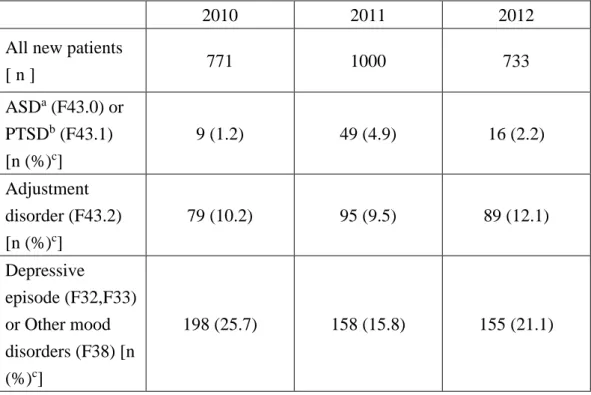
The total number of new outpatients and patients with ASD or PTSD, adjustment disorder, and a depressive episode or other mood disorder are shown in Table 1.
======================
Table 1 here
======================
There were 771, 1000, and 733 new patients in 2010, 2011, and 2012, respectively, in 39 institutions during the survey period. Of these, 9, 49, and 16 patients were diagnosed with ASD or PTSD, respectively. A total of 79, 95, and 89 patients were diagnosed with adjustment disorder in the same time period. Likewise, 198, 158, and 155 patients were diagnosed with depressive episodes or other mood disorders. Of all new outpatients in 2010, the proportion of diagnosis of ASD or PTSD was 1.2%; adjustment disorder, 10.2%; and depressive episode or other mood disorders, 25.7%.
Similarly, for all new outpatients in 2011, the proportions for the three diagnostic categories were 4.9%, 9.5%, and 15.8%, respectively. The proportions in 2012 were 2.2%, 12.1%, and 21.1%, respectively.
9
Sequential changes in the number of new patients diagnosed within each of three categories of disorders
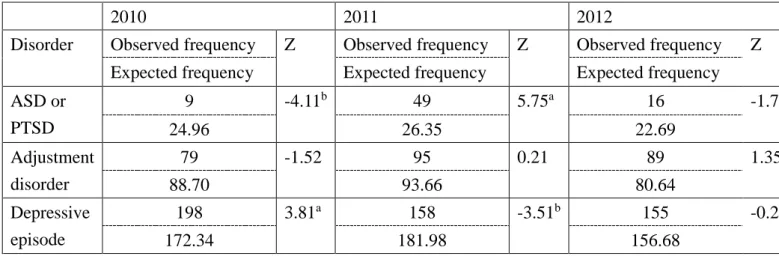
The sequential changes in the number of new outpatients diagnosed within each of the three aforementioned categories of disorders are shown in Table 2.
======================
Table 2 here
======================
A total of 74 patients had ASD or PTSD during the study period, including 9, 49, and 16 patients in 2010, 2011, and 2012, respectively. The expected frequency of patients diagnosed with ASD or PTSD was 24.96, 26.35, and 22.69 patients, respectively.
A total of 263 patients had adjustment disorder during the study period, including 79, 95, and 89 patients in 2010, 2011, and 2012, respectively. The expected frequency of patients diagnosed with adjustment disorder was 88.70, 93.66, and 80.64 patients, respectively.
A total of 511 patients had a depressive episode or other mood disorder during the study period, including 198, 158, and 155 patients in 2010, 2011, and 2012, respectively. The expected frequency of patients diagnosed with a depressive episode or other mood disorder was 172.34, 181.98, and 156.68 patients, respectively.
A χ2 test using the observed and expected frequencies of patients diagnosed within each of the three categories of disorders in 2010, 2011, and 2012 revealed a significant difference (χ2 (4) = 40.58, p < 0.01, Table 2).
The χ2 test was complemented by a residual analysis. The actual number of patients diagnosed with ASD or PTSD in 2011 and diagnosed with a depressive episode in 2010 was significantly higher than the expected number (ASD or PTSD in 2011: Z=5.75, p< 0.05; Depressive episode in 2010: Z=3.81, p< 0.05). The actual number of patients diagnosed with ASD or PTSD in
10
2010 and diagnosed with a depressive episode in 2011 was significantly lower than the expected number (ASD or PTSD in 2010: Z = −4.11, p< 0.05; Depressive episode in 2011: Z=-3.51).
Although the number of patients diagnosed with either ASD/ PTSD or with a depressive episode or other mood disorder in 2011 was significant, that result was difficult to interpret clinically because the number of patients in 2011 was expected to be referred to as a baseline for the change brought about by the disaster. Then, in order to clarify the sequential changes in the number of new patients during the survey period (2010, 2011, and 2012), we calculated the proportions of the number of new patients within each of the three categories of disorders for each year against the total number of patients for that year.
Sequential changes in the number of patients diagnosed with ASD or PTSD
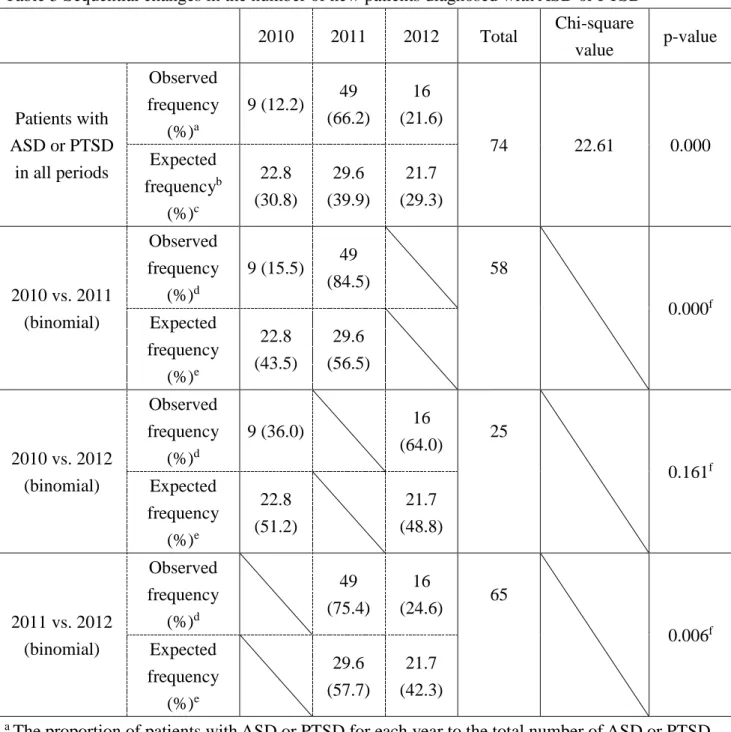
The sequential changes in the number of new outpatients diagnosed with ASD or PTSD are shown in Table 3.
======================
Table 3 here
======================
Seventy-four patients had ASD or PTSD during the three-year study period. Of these, 9 (12.2%), 49 (66.2%), and 16 (21.6%) were new patients in 2010, 2011, and 2012, respectively. As shown in Table 1, there were 771 (30.8%), 1,000 (39.9%), and 733 (29.3%) new patients, respectively (a total of 2,504 patients). The expected frequency of patients with ASD or PTSD was 22.8, 29.6, and 21.7, respectively. χ2 tests revealed a significant difference between the observed and expected frequencies of the three years (χ2 (2) = 22.61, p = 0.000, Table 3).
Due to the statistically significant differences between the observed and expected frequencies for ASD and PTSD, multiple comparisons were made using exact binomial tests with the
11
difference between the ratios of the observed frequency in 2010 and the observed frequency in 2011 and the ratios of the expected frequency in 2010 and the expected frequency in 2011. The similar comparisons were made to examine the difference between the ratios of the observed and expected frequencies in 2010 and 2012, and in 2011 and 2012. In 2010 and 2011, there were 9 and 49 patients with ASD or PTSD, respectively. The ratios of the observed and expected frequencies in 2010 and 2011 were 9 (15.5%):49 (84.5%) and 22.8 (43.5%):29.6 (56.5%), respectively. An exact binomial test between the observed and expected ratios revealed a statistically significant difference (p = 0.000, Table 3), in which the probability of the observed frequency of ASD or PTSD in 2011 to that in 2010 was significantly greater than the probability of the expected frequency in 2011 to that in 2010.
There were 9 and 16 patients with ASD or PTSD in 2010 and 2012, respectively. The ratios of the observed and expected frequencies of 2010 and 2012 were 9 (36.0%):16 (64.0%) and 22.8 (51.2%):21.7 (48.8%), respectively. An exact binomial test between the observed and expected ratios revealed no significance (p = 0.161, Table 3). Thus, there was no significant difference in the ratios of the observed and expected frequencies of 2010 and 2012.
Finally, we compared 2011 and 2012, during which 49 and 16 patients were diagnosed with ASD or PTSD, respectively. The ratios of the observed and expected frequencies were 49 (75.4%):16 (24.6%) and 29.6 (57.7%):21.7 (42.3%), respectively. An exact binomial test between the observed and expected ratios revealed a statistically significant difference (p = 0.006, Table 3), in which the probability of the observed frequency of ASD or PTSD in 2011 to that in 2012 was significantly greater than the probability of the expected frequency in 2011 to that in 2012.
Sequential changes of the number of patients diagnosed with adjustment disorder
The sequential changes in the number of new outpatients diagnosed with adjustment disorder are shown in Table 4.
12
======================
Table 4 here
======================
A total of 263 patients were diagnosed with adjustment disorder during the study period, including 79 (30.0%), 95 (36.1%), and 89 (33.8%) in 2010, 2011, and 2012, respectively. As shown in Table 1, the total number of new patients was 771 (30.8%), 1,000 (39.9%), and 733 (29.3%), respectively. The expected frequency of patients diagnosed with adjustment disorder was 81.0, 105.0, and 77.0, respectively. A χ2 test using the observed and expected frequencies of patients with adjustment disorder in 2010, 2011, and 2012 revealed no significant differences (χ2(2) = 2.885, p = 0.236, Table 4). Therefore, we did not further analyze the data for possible differences in the observed and expected frequencies of patients among 2010, 2011, and 2012.
Sequential changes in the number of patients diagnosed with a depressive episodes or other mood disorder
The sequential changes in the number of new outpatients diagnosed with a depressive episode or other mood disorder are shown in Table 5.
======================
Table 5 here
======================
A total of 511 patients were diagnosed with a depressive episode or other mood disorder during the study period, including 198 (38.8%), 158 (30.9%), and 155 (30.3%) patients in 2010, 2011, and 2012, respectively. The expected frequency of new patients diagnosed with a depressive episode or other mood disorder was 157.3, 204.1, and 149.6 patients, respectively. A χ2 test using the observed and expected frequencies of patients diagnosed with a depressive episode or other mood
13
disorder in 2010, 2011, and 2012 revealed a significant difference (χ2 (2) = 21.12, p = 0.000, Table 5).
Based on this statistically significant finding, we performed multiple comparisons of the observed and expected frequencies between 2010 and 2011, 2011 and 2012, and 2010 and 2012, as performed in the multiple comparisons for ASD or PTSD as described in previous sections.
As a result, an exact binomial test between the observed and expected ratios of 2010 and 2011 revealed a statistically significant difference (p = 0.000, Table 5), in which the probability of the observed frequency of depressive episodes or other mood disorders in 2011 to that in 2010 was significantly smaller than the probability of the expected frequency in 2011 to that in 2010.
In 2010 and 2012, an exact binomial test between the observed and expected ratios revealed no significance (p = 0.071, Table 5). Thus, there was no significant difference in the ratios of the observed and expected frequencies of 2010 and 2012.
Finally, we compared 2011 and 2012, with an exact binomial test between the observed and expected ratios revealing a statistically significant difference (p = 0.015, Table 5), in which the probability of the observed frequency in 2012 to that in 2011 was significantly greater than the probability of the expected frequency in 2012 to that in 2011.
Differences in response proportions of psychiatric institutions in each area
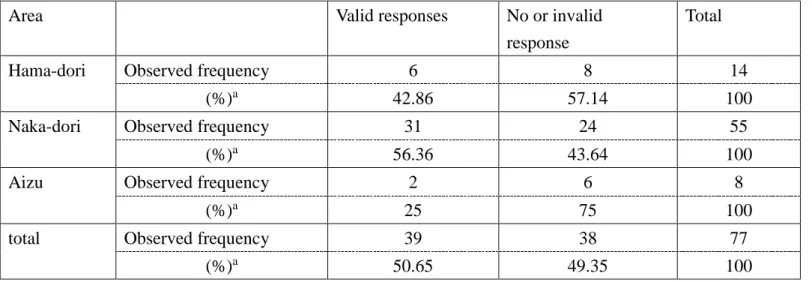
We asked 77 psychiatric institutions in Fukushima for cooperation, among which 14 were located in Hama-dori, 55 in Naka-dori, and eight in Aizu. Thirty-nine institutions provided us valid responses and 38 were not included. The number of included and excluded institutions in Hama-dori, Naka-dori, and Aizu are shown in Table 6.
======================
Table 6 here
======================
14
As shown in Table 6, from the 14 institutions in Hama-dori, we received valid responses from six and eight were excluded in this analysis. From the 55 institutions in Naka-dori, we received valid responses from 31 and 24 were excluded. From the eight institutions in Aizu, we received from two and six were excluded. The expected frequency of institutions to provide valid responses was 7.091 in Hama-dori, 27.857 in Naka-dori, and 4.052 in Aizu, respectively. The expected frequency of institutions to be excluded in this analysis was 6.909 in Hama-dori, 27.143 in Naka-dori, and 3.948 in Aizu, respectively. A χ2 test using the observed and expected frequencies of institutions with valid and invalid responses in each area revealed no significant differences (χ2(2) = 3.164, p = 0.206, Table 6). Therefore, we decided to perform further analyses on hospital visits of psychiatric disorders in each area of Fukushima before and after the disaster.
Sequential changes in the number of new patients who visited psychiatric institutions in each area The sequential changes in the number of new outpatients who visited psychiatric institutions in each area are shown in Table 7.
======================
Table 7 here
======================
A total of 421 patients visited psychiatric institutions in Hama-dori during the study period, including 144, 137, and 140 patients in 2010, 2011, and 2012, respectively. The expected frequency of patients to visit psychiatric institutions in Hama-dori was 129.6, 168.13, and 123.24 patients, respectively.
A total of 1,944 patients visited psychiatric institutions in Naka-dori during the study period, including 589, 804, and 551 patients in 2010, 2011, and 2012, respectively. The expected frequency of patients to visit psychiatric institutions in Naka-dori was 598.6, 776.36, and 569.07
15
patients, respectively.
A total of 139 patients visited psychiatric institutions in Aizu during the study period, including 38, 59, and 42 patients in 2010, 2011, and 2012, respectively. The expected frequency of patients to visit psychiatric institutions in Aizu was 42.8, 55.51, and 40.69 patients, respectively.
A χ2 test using the observed and expected frequencies of patients visiting psychiatric institutions in each area in 2010, 2011, and 2012 revealed a significant difference (χ2 (2) = 12.15, p = 0.016, Table 7).
The χ2 test was complemented by a residual analysis. The actual number of patients who visited psychiatric institutions in Naka-dori in 2011, as well as the number in Hama-dori in 2012, was significantly higher than the expected number (Naka-dori in 2011: Z=2.71, p< 0.05; Hama-dori in 2012: Z=1.97, p< 0.05). However, the actual number of patients who visited psychiatric institutions in Hama-dori in 2011 was significantly lower than the expected number (Z = −3.40, p<
0.05).
Overview of new outpatients in Naka-dori
Thirty-one of the 55 psychiatric institutions in Naka-dori provided valid responses. The total number of new outpatients and patients with ASD or PTSD, adjustment disorder, or a depressive episode or other mood disorder in Naka-dori is shown in Table 8.
======================
Table 8 here
======================
There were 589, 804, and 551 new patients in 2010, 2011, and 2012, respectively, in the 31 institutions in Naka-dori during the survey period. Of these, 8, 39, and 13 patients were diagnosed with ASD or PTSD, respectively. A total of 47, 69, and 59 patients were diagnosed with adjustment
16
disorder in the same time period. Likewise, 137, 113, and 105 patients were diagnosed with a depressive episode or other mood disorder.
Sequential changes in the number of new patients diagnosed within each of three categories of disorders in Naka-dori
The sequential changes in the number of new outpatients diagnosed within each of the three categories of disorders in Naka-dori are shown in Table 9.
======================
Table 9 here
======================
A total of 60 patients were diagnosed with ASD or PTSD during the study period, including 8, 39, and 13 patients in 2010, 2011, and 2012, respectively. The expected frequency of patients diagnosed with ASD or PTSD was 19.53, 22.47, and 18.0 patients, respectively.
A total of 175 patients were diagnosed with adjustment disorder during the study period, including 47, 69, and 59 patients in 2010, 2011, and 2012, respectively. The expected frequency of patients diagnosed with adjustment disorder was 56.95, 65.55, and 52.5 patients, respectively.
A total of 355 patients were diagnosed with a depressive episode or other mood disorder during the study period, including 137, 113, and 105 patients in 2010, 2011, and 2012, respectively.
The expected frequency of patients diagnosed with a depressive episode or other mood disorder was 115.53, 132.97, and 106.5 patients, respectively.
A χ2 test using the observed and expected frequencies of patients diagnosed within each of the three categories of disorders in 2010, 2011, and 2012 in Naka-dori revealed a significant difference (χ2 (4) = 30.08, p < 0.01, Table 9).
The χ2 test was complemented by a residual analysis. The actual number of patients
17
diagnosed with ASD or PTSD in 2011, as well as the number diagnosed with a depressive episode or other mood disorder in 2010, was significantly higher than the expected number (ASD or PTSD in 2011: Z=4.65, p< 0.05; Depressive episode in 2010: Z=3.85, p< 0.05). The actual number of patients diagnosed with ASD or PTSD in 2010, as well as the number diagnosed with a depressive episode or other mood disorder in 2011, was significantly lower than the expected number (ASD or PTSD in 2010: Z = −3.35, p< 0.05; Depressive episode in 2011: Z=−3.47, p< 0.05).
Although the number of patients diagnosed with ASD or PTSD and with a depressive episode or other mood disorder in 2011 was significant, that result was difficult to interpret clinically because the number of patients in 2011 was expected to be referred to as a baseline for the change brought about by the disaster. Then, in order to clarify the sequential changes in the number of new patients during the survey period (2010, 2011, and 2012), we calculated the proportions of the number of new patients within each of the three categories of disorders for each year against the total number of patients for that year in Naka-dori.
Sequential changes in the number of patients diagnosed with ASD or PTSD in Naka-dori
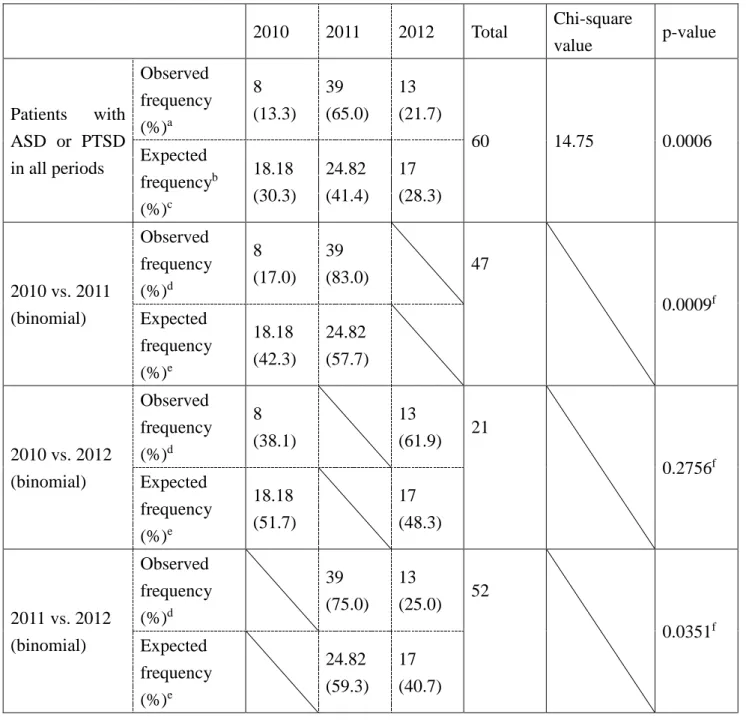
The sequential changes in the number of new outpatients diagnosed with ASD or PTSD in Naka-dori are shown in Table 10.
======================
Table 10 here
======================
Sixty patients had ASD or PTSD during the three-year study period in Naka-dori. Of these, 8 (13.3%), 39 (65.0%), and 13 (21.7%) were new patients in 2010, 2011, and 2012, respectively. As shown in Table 8, there were 589 (30.3%), 804 (41.4%), and 551 (28.3%) new patients, respectively (a total of 1,944 patients). The expected frequency of patients with ASD or PTSD was 18.18, 24.82, and
18
17, respectively. χ2 tests revealed a significant difference between the observed and expected frequencies for the three years (χ2 (2) = 14.75, p = 0.0006, Table 10).
Based on the statistically significant differences for ASD and PTSD, multiple comparisons were made using exact binomial tests with the 2010:2011, 2011:2012, and 2010:2012 ratios of the observed and expected patient frequencies. In 2010 and 2011, there were eight and 39 patients with ASD or PTSD, respectively. The ratio of the observed and expected frequencies in 2010 was 8 (17.0%):39 (83.0%) and 18.18 (42.3%):24.82 (57.7%) in 2011. An exact binomial test between the observed and expected ratios revealed a statistically significant difference (p = 0.0009, Table 10), in which the probability of the observed frequency of ASD or PTSD in 2011 to that in 2010 was significantly greater than the probability of the expected frequency in 2011 to that in 2010.
There were eight and 13 patients with ASD or PTSD in 2010 and 2012, respectively. The ratio of the observed and expected frequencies of 2010 was 8 (38.1%):13 (61.9%) and 18.18 (51.7%):17 (48.3%) in 2012. An exact binomial test between the observed and expected ratios revealed no significance (p = 0.2756, Table 10). Thus, there was no significant difference in the ratios of the observed and expected frequencies of 2010 and 2012.
Finally, we compared 2011 and 2012, during which 39 and 13 patients were diagnosed with ASD or PTSD. The ratio of the observed and expected frequencies in 2011 was 39 (75.0%):13 (25.0%) and 24.82 (59.3%):17 (40.7%) in 2012. An exact binomial test between the observed and expected ratios revealed a statistically significant difference (p = 0.0351, Table 10), in which the probability of the observed frequency of ASD or PTSD in 2011 to that in 2012 was significantly greater than the probability of the expected frequency in 2011 to that in 2012.
Sequential changes of the number of patients diagnosed with adjustment disorder in Naka-dori The sequential changes in the number of new outpatients diagnosed with adjustment
19
disorder in Naka-dori are shown in Table 11.
======================
Table 11 here
======================
A total of 175 patients were diagnosed with adjustment disorder during the study period in Naka-dori, including 47 (26.9%), 69 (39.4%), and 59 (33.7%) in 2010, 2011, and 2012, respectively.
The expected frequency of patients diagnosed with adjustment disorder was 53.0, 72.4 and 49.6, respectively. A χ2 test using the observed and expected frequencies of patients with adjustment disorder in 2010, 2011, and 2012 revealed no significant difference (χ2(2) = 2.626, p = 0.269, Table 11).
Therefore, we did not further analyze the data for possible differences in the observed and expected frequencies of patients with adjustment disorders in 2010, 2011, and 2012.
Sequential changes in the number of patients diagnosed with depressive episodes or other mood disorders in Naka-dori
The sequential changes in the number of new outpatients diagnosed with a depressive episode or other mood disorder in Naka-dori are shown in Table 12.
======================
Table 12 here
======================
A total of 355 patients were diagnosed with a depressive episode or other mood disorder during the study period, including 137 (38.6%), 113 (31.8%), and 105 (29.6%) patients in 2010, 2011, and 2012 in Naka-dori, respectively. The expected frequency of new patients with a depressive episode or other mood disorder was 107.6, 146.8, and 100.6 patients, respectively. A χ2 test using the observed and expected frequencies of these patients in 2010, 2011, and 2012 revealed a significant
20
difference (χ2 (2) = 16.04, p = 0.0003, Table 12).
Based on this statistically significant finding, we performed multiple comparisons of the observed and expected frequencies between 2010 and 2011, 2011 and 2012, and 2010 and 2012, as performed in previous sections.
As a result, an exact binomial test between the observed and expected ratios of 2010 and 2011 revealed a statistically significant difference (p = 0.0003, Table 12), in which the probability of the observed frequency of a depressive episode or other mood disorder in 2011 to that in 2010 was significantly smaller than the probability of the expected frequency in 2011 to that in 2010.
In 2010 and 2012, an exact binomial test between the observed and expected ratios revealed no significance (p = 0.1389, Table 12). Thus, there was no significant difference in the ratios of the observed and expected frequencies of 2010 and 2012.
Finally, we compared 2011 and 2012 using an exact binomial test between the observed and expected ratios revealing a statistically significant difference (p = 0.0408, Table 12). The probability of the observed frequency of a depressive episode or other mood disorder in 2012 to that in 2011 was significantly greater than the probability of the expected frequency in 2012 to that in 2011.
Sequential changes in the number of patients diagnosed within each category in Naka-dori showed the same trend as sequential changes in the number of patients in Fukushima as a whole.
Overview of new outpatients in Hama-dori
Six of the 14 psychiatric institutions in Hama-dori provided valid responses. The total number of new outpatients and patients with ASD or PTSD, adjustment disorder, and a depressive episode or other mood disorder in Hama-dori are shown in Table 13.
======================
Table 13 here
21
======================
There were 144, 137, and 140 new patients in 2010, 2011, and 2012, respectively, in the 6 institutions in Hama-dori during the survey period. Of these, one, seven, and three patients were diagnosed with ASD or PTSD, respectively. A total of 30, 22, and 28 patients were diagnosed with adjustment disorder in the same time period. Likewise, 55, 42, and 41 patients were diagnosed with a depressive episode or other mood disorder.
Sequential changes in the number of new patients diagnosed within each of three categories of disorders in Hama-dori
The sequential changes in the number of new outpatients diagnosed with each of the three categories of disorders in Hama-dori are shown in Table 14.
======================
Table 14 here
======================
A total of 11 patients were diagnosed with ASD or PTSD during the study period, including one, seven, and three patients in 2010, 2011, and 2012, respectively. The expected frequency of patients diagnosed with ASD or PTSD was 4.13, 3.41, and 3.46 patients, respectively.
A total of 80 patients were diagnosed with adjustment disorder during the study period, including 30, 22, and 28 patients in 2010, 2011, and 2012, respectively. The expected frequency of patients diagnosed with adjustment disorder was 30.04, 24.80, and 25.15 patients, respectively.
A total of 138 patients were diagnosed with a depressive episode or other mood disorder during the study period, including 55, 42, and 41 patients in 2010, 2011, and 2012, respectively. The expected frequency of patients diagnosed with a depressive episode or other mood disorder was 51.83, 42.79, and 43.39 patients, respectively.
22
χ2 test using the observed and expected frequencies of patients diagnosed with each of three categories of disorders in 2010, 2011, and 2012 in Hama-dori revealed no significant difference (χ2 (4)
= 7.191, p =0.126, Table 14). However, as seen in Table 14, three of nine expected frequencies in this analysis were smaller than five. The percentage of the number of expected frequencies smaller than 5 was 33.3% which is greater than 20%. Therefore, we calculated p value again by using Fisher’s exact test and got the result of p=0.144, which is not statistically significant either.
Sequential changes in the number of patients diagnosed with ASD or PTSD in Hama-dori
The number of patients diagnosed with ASD or PTSD during the three-year study period in Hama-dori was eleven (i.e., less than 20). Because of the deficiency in data size, we did not test this data any further.
Sequential changes of the number of patients diagnosed with adjustment disorder in Hama-dori The sequential changes in the number of new outpatients diagnosed with adjustment disorder in Hama-dori are shown in Table 15.
======================
Table 15 here
======================
A total of 80 patients were diagnosed with adjustment disorder during the study period in Hama-dori, including 30 (37.5%), 22 (27.5%), and 28 (35.0%) in 2010, 2011, and 2012, respectively.
The expected frequency of patients diagnosed with adjustment disorder was 27.4, 26.3 and 26.6, respectively. A χ2 test using the observed and expected frequencies of patients with adjustment disorder in 2010, 2011, and 2012 revealed no significant difference (χ2(2) = 0.9528, p = 0.621, Table 15). Therefore, we did not further analyze the data.
23
Sequential changes in the number of patients diagnosed with depressive episodes or other mood disorders in Hama-dori
The sequential changes in the number of new outpatients diagnosed with a depressive episode or other mood disorder in Hama-dori are shown in Table 16.
======================
Table 16 here
======================
A total of 138 patients were diagnosed with a depressive episode or other mood disorder during the study period, including 55 (39.9%), 42 (30.4%), and 41 (29.7%) patients in 2010, 2011, and 2012 in Hama-dori, respectively. The expected frequency of new patients with a depressive episode or other mood disorder was 47.2, 44.9, and 45.9 patients, respectively. A χ2 test using the observed and expected frequencies of depressive episode or other mood disorder patients in 2010, 2011, and 2012 revealed no significant difference (χ2 (2) = 1.998, p = 0.3682, Table 16). Therefore, we did not further analyze the data. Sequential changes in the number of patients diagnosed within each category in Hama-dori showed no significant difference.
○Discussion
We obtained data from 39 of 86 psychiatric outpatient clinics (45%) that continued operating after the 3.11 Complex Disaster in the Fukushima Prefecture. Therefore, the results of the present study are nearly representative of the prefecture-wide trends in new outpatients during the observation period.
The earthquake and subsequent tsunami led to the nuclear power plant accident and radioactive contamination of areas around Fukushima in March 2011. As of the end of 2015, there were approximately 99,000 evacuees in the Fukushima Prefecture.10 The prolonged evacuation with
24
a fear of radiation contamination caused significant psychological distress among the residents of Fukushima, which may have resulted in the disaster-related deaths of about 2,000 individuals11 and more than 80 disaster-related suicides as of the end of 2015.12
Immediately after the 3.11 Complex Disaster, people in Fukushima experienced heightened psychological stress, which led to changes in their psychiatric care needs. The present study tracked the increase in these needs as a function of time elapsed after the disaster.
Main findings
Our study compared the number of patients visiting psychiatric outpatient clinics for the first time in 2011 and 2012 in the Fukushima Prefecture following the 3.11 Complex Disaster to the number of new outpatients in the pre-disaster year of 2010. The post-disaster number of new psychiatric patients increased from 771 in 2010 to 1,000 in 2011, but returned to 733 in 2012 (Table 1). Of these new psychiatric patients, the percentage of ASD or PTSD increased in 2011, but returned to pre-disaster levels in 2012 (1.2%, 4.9%, and 2.2% in 2010, 2011, and 2012, respectively) (Table 3).
We found no significant sequential changes in the number of patients diagnosed with adjustment disorder during the survey period (Table 4). The number of patients with depressive episodes or other mood disorders decreased in 2011 and increased slightly in 2012, similar to the numbers in 2010 (Table 5).
This study investigated changes in trends of new outpatients after the 3.11 Complex Disaster. For this reason, we used the number of new patients in 2010 as the pre-disaster baseline.
However, it was first necessary to determine if our 2010 data was appropriate to use as a reference.
For this reason, we tried to compare the number of new psychiatric outpatients in 2010 in the present study with nation-wide data, but were unable to find nation-wide survey data of the number of new patients classified using the ICD-10 categories that could be used as controls in the present
25
study. However, the Japanese Ministry of Health, Labour and Welfare (MHLW) conduct patient surveys every three years. These patient surveys investigate the number of individuals undergoing medical treatment nation-wide for diseases based on ICD-10 categorization on a single day of the year, including new and revisiting patients. The most recent patient survey before the disaster was conducted in 2008. Results in the major categories of ICD-10 such as F3 (mood [affective] disorders) or F4 (neurotic, stress-related and somatoform disorders) have been published, 13 but there are no data concerning subcategories like PTSD, ASD, or adjustment disorder within F4 or of depressive episodes within F3, and there are no data showing other types of depression. The usable data from 2008 revealed that 232,300 patients received psychiatric treatment on the target day, with 80,100 (34.5%) and 49,600 (21.4%) classified as F3 and F4, respectively. The 2010 results in the present study revealed that 25.7% of patients were diagnosed with a depressive episode or another type of depression in F3, compared to the 34.5% of F3 patients in the 2008 survey. Thus, these findings suggest no notable differences. Because there were no data specifically regarding ASD, PTSD, or adjustment disorder in the 2008 patient survey results, we were unable to compare these three items with the results of the present study.
In order to examine the differences among trends of psychiatric disorders in each area in Fukushima, we tested the difference in the response rates from psychiatric facilities in each area. As a result, we recognized no difference in response rate from each region (Table 6), so we decided to perform further analyses. In 2011, the number of patients who visited institutions in the Hama-dori area decreased but the number of patients who visited institutions in Naka-dori increased significantly (Table 7). Hama-dori is the place where the damage of the tsunami was severe and the collapsed nuclear power plant is located. Many residents evacuated from the area and a large number of medical institutions were closed in 2011. We suspect this to be the reason why patients in Hama-dori decreased and patients in Naka-dori increased in 2011. This trend resolved and patients
26
in Hama-dori increased in 2012 (Table 7).
Sequential changes in the number of patients diagnosed with each category in Naka-dori showed the same trend as the sequential changes of patients in Fukushima as a whole (Table 8,9,10,11,12). Also, sequential changes in the number of patients diagnosed within each category in Hama-dori showed no significant difference (Table 13,14,15,16). For Aizu, we could not perform further analyses because the number of patients was small.
Comparison with the study on newly admitted psychiatric inpatients during the same period
In parallel with this study, in 2010, 2011 and 2012, in the psychiatric ward of 30 psychiatric hospitals and general hospitals in the Fukushima Prefecture for 3 months from March 12 to May 11, a study on newly admitted inpatients was conducted. 14 Valid responses were obtained for 604, 610 and 606 patients from 19, 26, and 19 medical institutions, respectively. According to this study, there was no significant difference between diagnostic categories of newly hospitalized patients over 3 years. However, mental states at admission, such as confusional state, manic state, neuroasthenic state, and delirium state increased in 2011, and the depressive state decreased. Such a trend was not confirmed at the statistically significant level for 2012. Conversely the state of confusion increased significantly. Depressive state increased in 2012, but it was not significant. The number of newly hospitalized patients in 2011 significantly increased in Ken-poku (Naka-dori), Soso (Hama-dori) and Iwaki (Hama-dori) districts, which is presumed to have had a large number of residents experiencing psychological stress due to the disaster. On the other hand, the number of new inpatients in Ken-nan (Naka-dori), Aizu and Minami-Aizu districts in 2011 decreased. In 2012, the opposite trend was recognized. Regarding whether radiation fear had an influence on deterioration of mental symptoms leading to hospitalization, "association" and "possible association" increased significantly in 2011 and
"no association" significantly decreased. Conversely, in 2012, “association" and "possible association"
27
decreased significantly, while "no association" significantly increased.
In summary, the number of psychiatric inpatients increased in Hama-dori and Ken-poku (Naka-dori) in 2011. Among these inpatients, excited mental states were noted such as confusional state, manic state and delirium state. In 2012, that trend declined. Our study of this time conducted a survey on psychiatric outpatients, not only to clarify the trends of patients that do not require hospitalization, but to also clarify the trend of patients with ASD and PTSD, which is thought to be more directly reflective of the impact of the disaster more directly.
Comparison with previous studies on post-disaster trends in PTSD and depression
The results of the Fukushima Health Management Survey for 2011 and 2012, a self-administered questionnaire conducted by the Fukushima Prefecture and the Fukushima Medical University that targeted individuals from the mandatory evacuation zone (i.e., a 20 km radius around the Fukushima Daiichi Nuclear Power Plant and other polluted areas), revealed that the frequency of evacuees suspected of having PTSD or depression was high in 2011.15 Moreover, these increases continued into 2012, though a slight decrease was observed in comparison with 2011.
16 The Fukushima Health Management Survey3 revealed that 14.6% of all evacuees in 2011 and 11.9% in 2012 were significantly distressed (defined as scoring over 13 points on the Kessler Screening Scale for Psychological Distress [K6]17), much higher than the 2.9% reported among the Japanese general population.18 In addition, 21.6% and 18.3% of respondents in 2011 and 2012, respectively, showed signs of PTSD (defined as over 44 points on the PTSD Checklist [PCL]19), also much higher than the estimated 1-3% prevalence in the general population in Japan.20 Additionally, a 2011 study on temporary housing residents of Hirono town, 20 km south of the Fukushima Daiichi Nuclear Power Plant, reported that 66.8% of residents were depressive and 53.5% were at high risk for PTSD.4
28
Surveys following disasters worldwide have revealed a continuing trend of increasing prevalence of PTSD or depression in residents two to three years after the disaster.1,2 The prevalence of PTSD and depression among 1,355 residents 30 months after the 2010 Haiti earthquake was 36.75% and 25.98%, respectively.2 In addition, following the Wenchuan earthquake in China, the prevalence of PTSD two months after the disaster was 58.2%, compared to 22.1%, 19.8%, 19.0%, 8.0%, 8, 14, 26, and 44 months later.1 Our survey is consistent with previous studies that reported increased PTSD one year after the disaster, but inconsistent with other studies in that the number of PTSD patients returned to pre-disaster levels two years after the disaster. Additionally, to the best of our knowledge, the decrease in the number of depressed patients we observed one year after the disaster has not been previously reported.
Potential reasons for the inconsistencies with previous findings
The inconsistencies between the present study and previous reports regarding the transient increase in the number of PTSD patients, which returned to pre-disaster levels one year later, as well as the decreased number of depressed patients in the year of the 3.11 Complex Disaster in Fukushima is intriguing. However, there is an important difference between this study and previous reports. While the present study was based upon the numbers of actual clinical visitors, most previous reports are predicated on community surveys based on self-administered questionnaires.
Studies relying on self-administered questionnaires to identify individuals with conditions such as posttraumatic reactions or depression may overestimate the rates of PTSD or major depressive disorders. Surveys which observe sharp increases in post-disaster depression based upon self-administered questionnaires may include individuals with subclinical or even clinically insignificant distress who do not require treatment.
As discussed above, there are three possible explanations for the inconsistency in findings
29
between the present study and previous reports. First, most post-disaster investigations on psychiatric disorders lack data concerning pre-disaster prevalence. Therefore, it is often difficult to establish an appropriate control group for comparison. This issue was raised by a study of Swedish survivors of the Southeast Asian tsunami in 2004.21 Sweden has population registries of healthcare utilization and medical diagnosis for every resident, thereby providing pre-disaster prevalence data.
In that study, the number of patients with mood or anxiety disorders did not increase following the tsunami, although stress-related disorders (including PTSD) and suicide attempts did increase. Thus, assessment of the effects of disasters requires data from pre-disaster periods.
The second possible explanation for the reason why the number of ASD or PTSD patients decreased as early as 2012 is the fact that our study is only limited to new patients. Most previous studies counted the number of PTSD patients who developed the disorder by the previous year, but we did not count in 2012 the number of ASD or PTSD patients who started the disorder in 2011.
However, this explanation cannot show the reason why the number of newly depressed patients decreased in 2011 and increased in 2012.
Our third hypothesis relates to the cultural and social factors. After the 3.11 Complex Disaster, altruistic feelings of unity and nationalistic eagerness for recovery prevailed in Japan, along with worldwide support. Many residents in disaster-stricken areas may have had a heightened sense of purpose to overcome the threat of radiation exposure and to rebuild their hometowns.
Moreover, residents were generally encouraged to express their anger or frustrations concerning the nuclear power plant accident. This situation might have empowered residents suffering from the effects of the 3.11 Complex Disaster. Haglund et al. identified six resilience factors that protect against and aid recovery from posttraumatic stress, including active coping, physical exercise, positive outlook, moral compass, social support, and cognitive flexibility.22 Individuals living in Fukushima after the disaster may have benefitted from active coping styles, moral compasses, and