Concentration on Glass Separatory Funnel Wall of Anionic Surfactants by Ion Association with Methylene Blue
著者 Sanemasa, Isao, Ota, Etsuko, Aoi, Koki, Zheng, Jinzi
雑誌名 Analytical Sciences
巻 18
号 3
ページ 347‑350
発行年 2002‑03
URL http://hdl.handle.net/2298/11005
doi: 10.2116/analsci.18.347
2002 © The Japan Society for Analytical Chemistry
Concentration on Glass Separatory Funnel Wall of Anionic Surfactants by Ion Association with Methylene Blue
Isao Sanemasa,1" Etsuko Oota, Koki Aoi, and Jin-Zi Zheng
Department of Environmental Science, Faculty of Science, Kumamoto University, Kurokami 2-39-1, Kumamoto 860-8555, Japan
(Received September 19,2001; Accepted December 3,2001)
Notes
Anionic surfactants (AS's) have been mostly determined by spectrophotometric methods based on solvent extraction of the colored ion associates of AS with a cationic dye.1"6 Methylene Blue (MB) is one of the most frequently used cationic dyes.
Chloroform is a common solvent for the extraction of the ion associate. The Japanese official text lists the MB-chloroform method for the determination of AS.7 This method, however, is time-consuming and needs a large quantity of chloroform;
moreover, the enrichment factor is two or three at most. Koga et al.5 have recently simplified this official method and attained an enrichment factor of ten.
Although chloroform is a convenient solvent for extraction, its use is becoming regulated and restricted owing to its toxicity and its relatively large solubility in water (a 0.55 ml CHCI3 dissolves in a 100 ml water). It is, therefore, desirable to analyze AS without solvent extraction. The only reports of such an analysis were made by Kamaya et a/.8"10 The ion associate formed between AS and Rhodamine 6G was adsorbed onto the wall of a PTFE vessel by vigorous shaking, followed by dissolving the ion associate with methyl cellosolve.8 They have recently proposed a convenient method and applied it to determine DS in river water using MB as the counterion, a polypropylene container as a vessel, and ethanol as a dissolving solvent.10
It is interesting to study whether or not the MB-AS associate can be adsorbed onto a glass container surface. In this paper, we report that an addition of a small amount of heptane is effective to promote adsorption of the AS-MB associate onto the wall of a glass separatory funnel. It is also found that the adsorption of free MB onto the glass surface can be suppressed to a considerable extent by adding sulfuric acid. The present method can be used to determine AS (DBS or DS) of the 10- jxg/l level in tap and river water samples.
Experimental
Materials and apparatus
All reagents used were of analytical grade commercially available from Wako Pure Chemical Co., and were used as received. Standard sodium salts of linear- dodecylbenzenesulfonate (DBS, F.W. 325.49) and dodecylsulfate (DS, F.W. 265.39) were used as AS's; in both
+ To whom correspondence should be addressed.
E-mail: [email protected]
cases, the standard solution of 10~3 M was diluted to prepare the working solution of 10"5 M (f= 1.004 for DBS and/= 0.983 for DS). An MB solution was prepared by dissolving 0.25 g of MB in 1000 ml of pure water. Heptane was used to promote adsorption of the AS-MB associate onto the separatory funnel wall and ethanol was used to dissolve the associate which had adsorbed on the funnel wall.
Absorbance measurements were made on a Hitachi 100-50 spectrophotometer using glass cells of 10-mm path length.
Standard procedure
Transfer the sample solution of up to 300 ml containing AS of up to ca. 30 p,g into a 500-ml glass separatory funnel. Add 3 ml of a sulfuric acid (1 + 1) solution, 1 ml of heptane, and the MB solution (3 ml per 100 ml sample solution). Shake the funnel by hand vigorously for ca. 30 s to 1 min, allow the funnel to stand for a while. After the foam formed by shaking has completely disappeared (it takes a few minutes), transfer the content into a second 500-ml separatory funnel. Shake the second funnel for ca. 30 s to 1 min (a further addition of heptane is not necessary in this stage, since heptane added to the first funnel is mostly transferred to the second one), allow the funnel to stand for a while and discard the content. Remove a residual MB solution in the bottom of either funnel by pouring a small amount of water directly to the bottom. Rinse the wall of the first funnel with a 10-ml portion of ethanol, wipe off droplets within the stem under the stopcock with a piece of filter paper, transfer the rinsed ethanol to the second funnel, and rinse its wall.
Withdraw the rinsed ethanol from the second funnel after wiping the stem, and measure the absorbance at 657 nm.
Waste solutions were stored in a large separatory funnef and the heptane phase was recovered.
Results and Discussion
Adsorption characteristics
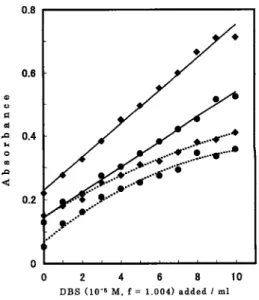
Case I: Varying aliquots of up to 10 ml of the DBS working solution we each added to a separatory funnel containing either 100 or 300 ml of water (the volume of water in this paper refers to that before additions of the AS working and any other solutions) and MB (3 ml per 100 ml water). The funnel was shaken for 30 s. After the content was withdrawn, the funnel was rinsed with a 10-ml portion of ethanol. The result is shown in Fig. 1A.
Case II: One milliliter of heptane was added to water. The
348 ANALYTICAL SCIENCES MARCH 2002, VOL. 18
d od
6 8 10
1.004) added / ml
Fig. 1 Characteristics of DBS adsorption onto glass separatory funnel in the presence of MB. DBS was added to 100 ml (•) or 300 ml (♦) of water. A, Neither heptane nor sulfuric acid was added; B, heptane (1 ml) was added; C, sulfuric acid (3 ml) was added.
0 2 4 6 8 10
DBS (10'5 M, f = 1.004) added / ml