Comparison of numerical methods for 1‑D
hyperbolic‑type problems with free boundary
著者 ファイザル マホロス
著者別表示 Faizal Makhrus journal or
publication title
博士論文本文Full 学位授与番号 13301甲第4315号
学位名 博士(理学)
学位授与年月日 2015‑09‑28
URL http://hdl.handle.net/2297/43828
Dissertation
Comparison of numerical methods for 1-D hyperbolic-type problems with free boundary
1次元双曲型自由境界問題の数値解法の開発と評価
Graduate School of
Natural Science and Technology Kanazawa University
Division of Mathematical and Physical Sciences Course in Computational Science
School registration No.: 1223102012
Abstract
In this research, we study a 1-D hyperbolic-type problem with free bound- ary. We consider a physical model that is the motion of a piece of tape being peeled off from a surface. The graph of the solution shows the shape of the tape, which displays contact angle dynamics at the free boundary (the lo- cation of peeling). Therefore, the second derivative of the solution becomes a delta function which imparts a slight difficulty. Under some assumptions, this problem can be solved numerically by the fixed domain method. Al- though, this method has high accuracy, it cannot be applied in some cases such as a problem where the free boundary point appears or disappears.
Hence, other numerical methods are chosen for solving regularized problem, i.e., the delta function is approximated by a smoothing function. The numer- ical methods are: two types of finite difference methods, the finite element method, and discrete Morse flow. In this paper, the error of the regularized problem compared to the original problem is calculated. Since the choice of the parameter for smoothing function is important for the accuracy, we pro- pose a formula to approximate the optimal parameter in order to minimize the error. This formula is verified by some experiments and we find that it can approximate the optimal parameter. In addition, based on comparisons between the numerical methods, we find that finite difference methods have better performance than the other methods.
Contents
Contents ii
List of Figures iii
1 Introduction 1
2 Physical model of peeling tape problem 4 2.1 Derivation of the original problem . . . 7
3 Fixed domain method 9
3.1 Variable change . . . 10 3.2 Discretization and algorithm . . . 11
4 Numerical methods 14
4.1 Explicit method 1 (spatial central difference + time forward difference) . . . 14 4.2 Explicit method 2 (spatial and time central difference) . . . . 15 4.3 Finite Element Method . . . 16 4.4 Discrete Morse Flow . . . 18
5 Numerical results 21
5.1 Exact solution of the approximated problem . . . 23 5.2 Error in the peeling tape model using smoothed characteristic
functions . . . 25 5.3 Comparisons of solution having different gradient . . . 28
Contents iii
6 Conclusion 44
A Finite element method 45
Acknowledgement 49
References 50
List of Figures
5.1 Exact solution (5.7) . . . 25
5.2 Estimation from above of the total error for explicit method 2 28 5.3 The errors of explicit method 2 for cases 1-6 . . . 29
5.4 The errors of free boundary point of cases 1-6 . . . 30
5.5 The errors of solution for case 1-4 with different gradient with ∆x= 0.000625 . . . 31
5.6 the lower and upper bound of optimal ε for cases 1-4 . . . 32
5.7 The range of constant C for cases 1-4 with different ∆x . . . . 33
5.8 Comparison of smoothed characteristic functions . . . 34
5.9 Error of numerical methods and exact solution of equation (5.7) 36 5.10 Eu atτ = 9 of cases 1-4 . . . 38
5.11 The numerical solutions of case 7 . . . 40
5.12 The numerical solutions of case 8 . . . 40
5.13 The numerical solutions of case 9 . . . 41
5.14 The numerical solutions of case 10 . . . 41
5.15 Error in case 7 at u(2.5,5) . . . 42
Chapter 1 Introduction
In this study, we treat a physical model which can be considered as peeling tape attached to a surface. Imagine that there is a piece of tape pasted to a surface and it is peeled off from its edge smoothly. This model can be described as a stationary point of the following action integral in a suitable function space:
J(u) = Z τ
0
Z
Ω
(1
2|∇u|2− 1
2(ut)2χu>0+Q2
2 χu>0)dxdt, (1.1)
whereuis a scalar function (0, τ)×Ω7→Rwhich represents the shape of the tape, Q is a given positive constant, Ω is a domain in Rd(d ≥1), and χu>0 is a characteristic function of the set {(x, t) : u(x, t) > 0}. The following Euler-Lagrange equation can be derived from functional (1.1) under certain assumptions [2]:
(utt= ∆u in (Ω×(0, τ))∩ {u >0},
|∇u|2 −(ut)2 =Q2 on (Ω×(0, τ))∩∂{u >0}. (1.2) When d= 1, under certain conditions, [4] showed that the existence and the uniqueness of its solutions are obtained locally.
On the other hand, the following equation is equivalent to (1.2) (see Subsection 2.1):
χ{u>0}utt = ∆u− Q2
|Du|Hdb∂{u >0} in Ω×(0, τ), (1.3)
whereHdisd-dimensional Hausdroff measure andDu= ∂u
∂x1, . . . ∂u
∂xd,∂u
∂t
! . On the other hand, we consider the following equation as the approximation of problem (1.3)
χ{u>0}utt = ∆u− Q2
2 (χε)0(u) in Ω×(0, τ), (1.4) where χε(u) is an appropriate smoothing function. Equation (1.4) can be used to model not only the simple case of peeling tape but also more advanced free boundary problems such as water droplet attached to a plane, bubble touched the water surface, and other phenomena [3] [5] [7] [8] with constraints applied.
The motivation behind this research is to solve the original problem (1.3) yet it is difficult. Fortunately, [2] introduced the fixed domain method which solved problem (1.2) in 1D which is equivalent to the original problem (1.3) if the solution is non-negative. Fixed domain method has high accuracy.
However, it is difficult to handle such model where the free boundary point appears or disappears. Therefore, we investigate another numerical methods.
We choose a few numerical methods namely:
1. explicit method 1 (spatial central difference and time forward differ- ence)
2. explicit method 2 (spatial and time central difference) 3. finite element method (FEM)
4. discrete Morse flow (DMF).
We choose explicit method 1 and 2 as they are standard methods. Here, explicit method 2 is a standard finite difference method which can be used to analyze the error of the solution of the regularized problem. We choose FEM as it is widely used to approximate solution of hyperbolic-type prob- lem. DMF is chosen since it is used in many hyperbolic-type problem with constraints. These methods are used to solve the regularized problem (1.4), i.e., the measure is approximated by using smoothed characteristic function.
The second purpose is to investigate how to obtain small error by the selection of the parameter of smoothed characteristic function (ε). Here, we proposed a formula to approximate the appropriate choice of ε (see Section 5.3). The third purpose is to investigate the different kinds of smoothed characteristic function. We consider two types of smoothed characteristic function and compare their influences to the accuracy of the solution in order to get the suitable one (see Section 5.4). The fourth purpose is to compare the numerical methods in order to get the suitable method (see Section 5.5).
The last purpose is to implement more general case such as a model in which the free boundary points attached to a surface are more than one and they appear or vanish during simulation time (see Section 5.6).
In this dissertation, we organize our chapters as: chapter 2 explains the physical model of peeling tape, chapter 3 gives the details of fixed domain method, chapter 4 presents the numerical methods in details, chapter 5 dis- cusses the results of our experiments, and chapter 6 gives the conclusion.
Chapter 2
Physical model of peeling tape problem
This section explains the physical model of peeling tape on a plane. Suppose there is a thin film adhered to a plane and consider this film as our tape. It is peeled off from the plane and starts to expand along the sticked tape. The region where the tape is peeled or adhered is considered as a domain Ω. We assume that the tape has the same tension γ at any places. The shape of the tape is represented by a function u : Ω→R. The value of u is obtained by the stationary point of this model’s energy.
There are two potential energies in this model
E = Z
{u>0}
γ(p
1 +|∇u|2−1)dx+ Z
{u>0}
(γ− q
γ2+ ˜Q2)dx.
Using Taylor expansion we can get E˜ =
Z
{u>0}
γ
2|∇u|2dx+ Z
{u>0}
Q2 2 dx,
where Q2 = ˜Q2/γ. Another energy of this model is kinetic energy
of the tape is
L(u, t) = Z
Ω
γ
2|∇u|2− ρ
2u2tχu>0+Q2 2χu>0
!
dx. (2.1)
The equation of tape evolution within time interval [0, τ] is J(u) =
Z τ 0
Z
Ω
γ
2|∇u|2− ρ
2u2tχu>0+ Q2 2 χu>0
!
dxdt. (2.2)
We choose γ =ρ= 1.
From this energy function, the problem can be derived into Euler-Lagrange equation. Assume that the stationary point of equation (2.2) is sufficiently smooth. Let u be the stationary point of (2.2) and u ∈ C0(Ω×(0, τ)∩ W1,2(Ω, τ)), then u satisfies
∆u−utt = 0 in {u >0}. (2.3) Moreover, if u∈C2(Ω×(0, τ)∩ {u >0}) and∂{u >0} is inC−1, thenu on the boundary satisfies
|∇u|2−u2t =Q2 on ∂{u >0}. (2.4) The proofs of (2.3) and (2.4) can be seen in [2].
The proof of (2.3) is the first variation of (2.2) with test function ϕ ∈ C0∞(Ω×(0, τ)∩ {u >0})
Z t 0
Z
Ω
(∇u∇ϕ−utϕt)dxdt= 0,
that is (2.3). By inner variation, we can obtain (2.4). Now, we consider u ∈ C2(Ω × (0, τ)∩ {u > 0} and it is assumed that the free boundary
∂{u > 0} belongs to C1. For any η ∈ C0∞(Ω×(0, τ);Rn× R) and 0 <
< dist(spt η, ∂(Ω×(0, τ))) such that for small it follows the mapping ψ : Ω ×(0, τ) → Ω×(0, τ) and we define ψ(z) = z +η(z). Here z is a variable of Ω ×R, ie. zj = xj(j = 1, . . . , n) and zn+1 = t. Now, let u(z) =u◦ψ−1(z). Sinceu is stationary point of J it is
d
dJ(u)|=0 = 0.
On the other hand, we calculate J as
J(u) = − Z
Ω×(0,τ)∩{u>0}
h∇hu(Dψ)−1,∇hu(Dψ)−1i|det Dψ|dz.
Here, ∇zf = (fz1, . . . , fzn, fzn−1) and ∇hf = (fz1, . . . , fzn,−fzn−1). h., .i is inner product of Rn+1 and Dψ is Jaccobian matrix of ψ. Therefore,
J(u)−J(u) = Z
Ω×(0,τ)∩{u>0}
h∇hu,∇zui+Q2 ∇z.ηdz
− Z
Ω×(0, τ)∩ {u >0}2∇huDη∇zudz+o().
By the following equation
∇z.(ηh∇hu,∇zui −2hη,∇zui∇hu)
=∇z.ηh∇hu,∇zui −2∇huDη∇zu−2ηhη,∇zui(∆u−utt), we get
d
dJ(u)|=0 = Z
Ω×(0,τ)∩{u>0}
∇z. ηh∇hu,∇zui −2hη,∇zui∇hu+Q2η dz
= Z
Ω×(0,τ)∩∂{u>0}
{(h∇hu,∇zuiη−2hη,∇zui∇hu).ν +Q2hη, νi}dHn.
Here, Hn isn-dimensional Hausdroff measure. In addition, ν is outward unit normal vector with respect to Ω×(0×τ)∩ {u >0}. Since, ∇zu=−ν|∇zu|
then, d
dJ(u)|=0 =− Z
Ω×(0,τ)∩∂{u>0}
(h∇hu,∇zui −Q2)hη, νidHn.
define a smooth function called βε(s). βε(s) ∈ C2(R), βε(s) ≥ 0, and satisfies
βε(s)
= 0 s≤0,
≤2/ε 0< s < εand |βε0(s)| ≤ C ε2,
= 0 ε≤s.
It is also that Rε
0 βεds = 1 and we define Bε Bε(u) =
Z u 0
βε(s)ds−→
ε→0
(1 in{u >0},
0 in Ω×(0, τ)\{u >0}, which is the smoothing characteristic function of χu>0.
We represent energy equation (2.2) Jε(u) =
Z τ 0
Z
Ω
1
2|∇u|2−χu>01
2u2t +Q2 2 Bε(u)
!
dxdt. (2.5) By taking the first variation of (2.5), our problem becomes
∆u−χu>0utt=−Q2
2 βε(u) in Ω×(0, τ), u(x,0) = u0(≥0)
ut=v0
u(x, t)|∂Ω =f(x, t) with f(x,0) =u0 on∂Ω.
(2.6)
We call this as the regularized problem.
2.1 Derivation of the original problem
In this subsection we show the derivation of (1.3) based on [6]. Let QT :=
Ω×(0, τ). We assume u ∈ H2({u > 0})∩C(QT) is solution of (1.2) and satisfies u≥0 and {u >0} ⊂C0,1. By definition,
(utt−∆u)(ϕ) =− Z
QT
{utϕt− ∇u· ∇ϕ}dxdt, (2.7) here utt−∆u is a measure. Sinceu≥0,
χ{u>0}utt (E) =
Z
E∩{u>0}
utt
=utt
E∩ {u >0}
=utt(E),
(2.8)
whereE ⊂QT. Thusχ{u>0}utt =uttis in the measure sense. Then, by using above assumptions, we can calculate
χ{u>0}utt−∆u
(ϕ) =− Z
QT
{utϕt− ∇u· ∇ϕ}dxdt
= Z
{u>0}
(utt−∆u)ϕdxdt− Z
∂{u>0}
|∇u|2−(ut)2
|Du| ϕdHm
=− Z
∂{u>0}
Q2
|Du|ϕdHm
,
(2.9) directly we obtain (1.3).
Chapter 3
Fixed domain method
In this section we explain fixed domain method for peeling tape model. Con- sider problem (1.2)
(uxx−utt = 0 in (Ω×(0, T))∩ {u >0},
(ux)2−(ut)2 =Q2 on (Ω×(0, T))∩∂{u >0}. (3.1) with initial conditions
u(x,0) =
(g(x) in [0, l0], 0 otherwise,
ut(x,0) =
(h(x) in [0, l0], 0 otherwise, and boundary condition
u(0, t) = f(t) t∈(0, T),
where g(x)∈C2([0, l0]), h(x)∈C1([0, l0]), and f(t)∈C2(R),
f(t)>0 and f0(t)≥0 t ∈(0, T), g(x)>0 on [0, l0),
g(0) =f(0), g(l0) = 0, and h(0) = f0(0).
3.1 Variable change
Now, we use fixed domain method to develop the solution during t= [0, T].
Let y be
y= 2x
l(t)−1 x∈(0, l(t)),
where l(t) = sup{x, u(x, t) > 0} is the position of the free boundary point.
We define function ˜u= ˜u(y, t) by
˜
u(y, t) = u(x, t) (y, t)∈(−1,1)×(0, T) and (x, t)∈(0, l0)×(0, T).
By changing the variable, the first equation becomes 0 =uxx(x, t)−utt(x, t)
= ˜uxx(y, t)−u˜tt(y, t)
= ˜uyt(y, t)2(y+ 1)l0(t)
l(t) −u˜yy(y, t)(y+ 1)2l0(t)2 l(t)2 −utt + ˜uy(y, t)(y+ 1)l(t)l00(t)−2l0(t)2
l(t)2 + ˜uyy(y, t) 4 l(t)2.
(3.2)
The second equation turns to
Q2 =ux(l(t), t)2−ut(l(t), t)2
= ˜ux(1, t)2−u˜t(1, t)2
= ˜uy(y, t)2 4
l(t)2−u˜y(y, t)2 −4l0(t)2 l(t)2
!
−u˜t(y, t)
l0(t) = v u u
t1− Ql(t) 2˜uy(1, t)
!2
.
(3.3)
From (3.2) and (3.3) we have
˜
uyy(y, t)
l(t)2 (4−(y+ 1)2l0(t)2) + ˜uyt(y, t)2(y+ 1)l0(t) l(t) +˜uy(y, t)(y+ 1)l(t)l00(t)−2l0(t)2
l(t)2 −utt = 0 l0(t) =
v u u
t1− Ql(t) 2˜uy(1, t)
!2
.
(3.4)
The initial conditions become
˜
u(y,0) =u(x,0) =u l0
2(y+ 1),0
!
=g l0
2(y+ 1)
!
y∈[−1,1],
˜
ut(y,0) = ˜us(y,0)−u˜y(y,0)(y+ 1)l0(0) l0 ,
˜
us(y,0) = l0(0)
2 (y+ 1)g0 l0
2(y+ 1)
!
+e l0
2(y+ 1)
! .
(3.5) Boundary conditions turn to
n
u(−1, t) =˜ f(t),u(1, t) = 0,˜ u˜t(−1, t) =f0(t),u˜t(1, t) = 0. (3.6) Second derivative of l can be represented byl and l0
l0(t)2 = 1− Ql(t) 2˜uy(1, t)
!2
t∈(0, T), d
dtl0(t)2 = 2l0(t)l00(t) = −Q2l(t)(l0(t)˜uy(1, t)−l(t)˜uyt(1, t)) 2˜uy(1, t)3 , l00(t) = Q2l(t)
4˜uy(1, t)3 l(t)
l0(t)u˜yt(1, t)−u˜y(1, t)
!
(3.7)
3.2 Discretization and algorithm
Now, we divide [-1,1] into N equal intervals. The length of each partition is
∆y= 2/N. Then we approximate equation (3.4) as follows
d
dtui(t) =vi(t) i= 1,2, . . . , N −1, d
dtvi(t) = (4−(yi+ 1)2l0(t)2)ui+1(t)−2ui(t) +ui(t) l(t)2∆y2
+ 2(yi + 1)l0(t)(vi+1(t)−vi−1(t)) 2l(t)∆y
−(yi+ 1)(l(t)l00(t)−2l0(t)2)ui+1(t)−ui−1(t) 2l(t)2∆y
i= 1,2, . . . , N −1, l0(t) =
v u u
t1− Ql(t) 2uNy (t)
!2
(3.8)
with initial conditions
ui(0) = g l0
2(yi+ 1)
!
i= 1,2, . . . , N −1, vi(0) = l0(0)
2 (yi+ 1)g0 l0
2(yi+ 1)
!
+e l0
2(yi + 1)
!
i= 1,2, . . . , N −1, l0(0) = l0,
(3.9) and boundary conditions
u0(t) = f(t), uN(t) = 0, v0(t) = f0(t), vN(t) = 0,
(3.10)
where
l00(t) = Q2l(t) 4(uNy (t))3
l(t)
l0(t)vyN(t)−uNy (t)
! , uNy (t) = 3uN(t)−4uN−1(t) +uN−2(t)
2∆y ,
vNy (t) = 3vN(t)−4vN−1(t) +vN−2(t)
2∆y .
(3.11)
We solve equation (3.8) using 4th order Runge Kutta. The algorithm is presented below:
1. given initial conditions ui(0), vi(0),and l(0).
2. for time t= 0,∆t, . . . , τ do
(a) set temporary variable ˜ui =ui(t),v˜i =vi(t), and ˜l =l(t) (b) for n= 1,2,3,4
i. h= ∆t, if n = (1,4) or h= ∆t/2, if n= (2,3) ii. for i= 1, . . . , N
A. Kni =vi(t)h B. ui(t) = ˜ui+Kni C. Hni = d
dtvi(t)h D. vi(t) = ˜vi +Hni iii. Ln=l0(t)h
iv. l(t) = (˜l)i+Ln
v. u0(t) =f(t+h) vi. v0(t) = f0(t+h) (c) for i= 1, . . . , N
i. ui(t+ ∆t) = ˜ui+ 1/6(K1i + 2K2i + 2K3i +K4i) ii. vi(t+ ∆t) = ˜vi+ 1/6(H1i + 2H2i + 2H3i +H4i) (d) l(t+ ∆t) = ˜li+ 1/6(Li1+ 2Li2+ 2Li3+Li4)
(e) u0(t+ ∆t) =f(t+ ∆t) (f) v0(t+ ∆t) = f0(t+ ∆t)
Chapter 4
Numerical methods
4.1 Explicit method 1 (spatial central differ- ence + time forward difference)
We represent equation (1.4) using explicit method withuxx approximated by central differencing. Suppose ut=v then
d
dtui(t) =vi(t), (4.1)
d
dtvi(t) = ui−1(t)−2ui(t) +ui+1(t)
(∆x)2 − Q2
2 (χε)0(ui(t)), if χ{u>0}(xi, t) = 1,
vi(t) = 0, if χ{u>0}(xi, t) = 0,
(4.2) where i= 1, . . . , N −1 and
χ{u>0}(xi, t) =
(1 if max(ui−1ui, ui+1)>0, 0 otherwise.
The initial and boundary conditions areu(0, t) =f(t), u(x,0) =g(x), ut(0, t) = f0(t), and ut(x,0) =h(x). We solve (4.1)-(4.2) using the 4th order Runge- Kutta. The algorithm is presented below
(a) set temporary variable ˜ui =ui(t) and ˜vi =vi(t) (b) for n= 1,2,3,4
i. h= ∆t, if n = (1,4) or h= ∆t/2, if n= (2,3) ii. for i= 1, . . . , N −1
A. Kni =vi(t)h B. ui(t) = ˜ui+Kni C. Hni = d
dtvi(t)h
D. if (max(ui−1, ui, ui+1)>0) thenvi(t) = ˜vi+Hni E. else vi(t) = 0
iii. u0(t) =f(t+h) iv. v0(t) = f0(t+h) (c) for i= 1, . . . , N −1
i. ui(t+ ∆t) = ˜ui+ 1/6(K1i + 2K2i + 2K3i +K4i) ii. vi(t+ ∆t) = ˜vi+ 1/6(H1i + 2H2i + 2H3i +H4i) (d) u0(t+ ∆t) =f(t+ ∆t)
(e) v0(t+ ∆t) = f0(t+ ∆t)
4.2 Explicit method 2 (spatial and time cen- tral difference)
This method utilizes a standard finite difference discretization. We approxi- mate uxx andutt from equation (1.4) using centered differencing. Here, [0, τ] is divided by M equal intervals, 0 =t0 < t1 < . . . < tM =τ.
χ{u>0}(xi, tk)uk+1i −2uki +uk−1i
(∆t)2 = uki+1−2uki +uki−1 (∆x)2 −Q2
2 (χε)0(uki), i= 1, . . . , N −1, and k = 1, . . . , M −1,
(4.3)
where uki =u(xi, tk). Then we calculate the solutions using the following
uk+1i = 2uki −uk−1i + (∆t)2 uki+1−2uki +uki−1 (∆x)2 − Q2
2 (χε)0(uki)
! , if χ{u>0}(xi, tk) = 1,
uk+1i = 0,
if χ{u>0}(xi, tk) = 0.
(4.4)
The boundary conditions are u(0, t) = f(t), u(x,0) = g(x), and ut(x,0) = h(x).
4.3 Finite Element Method
To implement finite element method, we multiply equation (1.4) by any test function ξ ∈C0∞(Ω) and integrate over the space domain
Z
Ω
(χ{u>0}utt−uxx+Q2
2 (χε)0(u))ξdx= 0.
By integration by parts we obtain Z
Ω
(χ{u>0}uttξ+uxξx+Q2
2 (χε)0(u)ξ)dx= 0, ∀ξ∈C0∞(Ω). (4.5) We divide Ω into N intervals and find the approximate solution of (4.5) in the set
Vt={u∈C0( ¯Ω) : u|∂Ω =f(·, t), uis linear on every [xk−1, xk], k= 1, . . . , N} for each time t ∈ (0, τ), where f : ¯Ω×[0, τ] is a given function. Then the approximate solution can be described by u(x, t) = PN
i=0ai(t)ϕi(x) , where ϕi(x) =
1− |x−xi|
∆x
+
, i= 0, . . . , N.
Here the symbol ( )+ implies (f(x) )+ = max(f(x),0). We substitute the approximate solution u to (4.5)
wherer is the residual which comes from the approximated representation of function u. We chooseϕj,j = 1, . . . , N−1, as our test function and rewrite (4.6) as follows:
N
X
i=0
a00i
Z
Ω
χ{u>0}ϕiϕjdx
+
N
X
i=0
ai
Z
Ω
ϕ0iϕ0jdx
+Q2 2
Z
Ω
(χε)0
N
X
i=0
aiϕiϕjdx= 0, j = 1,2,. . . , N-1.
This can be written in vector form Ba00+Aa+ Q2
2 C(a) = p, where a is the column vector with entries a1, . . . , aN−1,
A = 1
∆x
2 −1 0 0 0 · · · 0 0
−1 2 −1 0 0 · · · 0 0 0 −1 2 −1 0 · · · 0 0 ... ... ... ... ... ... . .. ...
0 0 0 0 0 · · · −1 2
and
B = ∆x 6
4 ˜χ(a1) ˜χ(a1) 0 0 0 · · · 0 0
˜
χ(a2) 4 ˜χ(a2) ˜χ(a2) 0 0 · · · 0 0 0 χ(a˜ 3) 4 ˜χ(a3) ˜χ(a3) 0 · · · 0 0 ... ... ... ... ... ... . .. ... 0 0 0 0 0 · · · χ(a˜ N−1) 4 ˜χ(aN−1)
.
Here, ˜χ(ai) = 1,whenever max(ai−1, ai, ai+1) is greater than zero and ˜χ(ai) = 0 otherwise. Here, C is a column vector whose elements are determined by a and p is determined by boundary values.
We approximate a00 using central difference with aki = ai(tk) and ak = (ak1, . . . , akn−1):
Bak+1−2ak+ak−1
(∆t)2 +Aak+ Q2
2 C(ak) =p.
The final form is
Bak+1 = 2Bak−Bak−1−(∆t)2
Aak+Q2
2 C(ak)−p
. (4.7)
We defineak+1i = 0,ifbii= 0 wherebiiis the diagonal element of matrixB at ith row. In general, matrix B is non-symmetric. We can change the position of the known value of ak+1i to the right hand side and adjust the matrix B to be a symmetric matrix. Now, we approximate the solution ak+1 of (4.7) by conjugate gradient method. The algorithm is written below
1. Given initial conditions a00, a10, and a20 which are column matrix. We also choose ω as a small number.
2. For time [n∆t, τ], n = 2, . . . , M do the following (a) Setf lag= 0 and k = 0
(b) while f lag= 0
i. calculate column matrix b = 2Ban−1k −Ban−2k −(∆t)2 Aan−1k +Q2
2 C(an−1k ) +p
!
ii. calculate column matrix o =Bank
iii. calculate decent gradient ∇fk(ank) = b − o, if k = 0, or
∇f(ank) =∇f(ank) +βk−1∇f(ank−1), if k >0, whereβk−1 = − ∇f(ank)TB∇f(ank−1)
∇f(ank−1)TB∇f(ank−1) iv. if |∇f(ank)|< ω setf lag= 1
v. calculate the stepsize α= ∇f(ank).∇f(ank)
∇f(ank)B∇f(ank) vi. ank+1 =an+α∇f(ank) and set k =k+ 1;
(c) an+10 =ank+1. an+10 is the solution at t= (n+ 1)∆t
4.4 Discrete Morse Flow
Let us consider problem (1.4) with u0 as the initial value, v0 as the initial velocity and u1 =u0 + ∆tv0. Now, we determine the time step ∆t =τ /M, where M >0 is a natural number. Then, the approximate solution for the
whereuj(x) = u(x, tj), tj =j∆t(j =k−2, k−1) andK={u∈W1,2(Ω);u= g on ∂Ω}.
We approximateuk as a piecewise linear function, so that the functional’s values are approximated:
Jk(u)≈
N
X
i=1
Z xi
xi−1
|u−2uk−1+uk−2|2
2(∆t)2 χ{u>0}+1
2|∇u|2+Q2 2 χε(u)
dx.
(4.8) We calculate the first term as follows:
Z xi
xi−1
|u−2uk−1+uk−2|2
2(∆t)2 χ{u>0}dx
=
(v2+w2+vw) ∆x
6(∆t)2 ui−1 >0, ui >0, (w2+ (v2)2+wv2)xc−xi
6(∆t)2 ui−1 ≤0, ui >0, ((w2)2+v2+w2v)xc−xi−1
6(∆t)2 ui−1 >0, ui ≤0,
0 otherwise,
where v =|ui−1 −2uk−1i−1 +uk−2i−1|, w =|ui−2uk−1i +uk−2i |, ui−1 =u(xi−1, t), ui =u(xi, t),v2 =v− w−v
ui−ui−1
ui−1,w2 =v2 and xc=xi−1− ∆x ui−ui−1
ui−1. The second term is
1 2
Z xi
xi−1
|∇ui|2dx= (ui+1−ui)2
2∆x ,
and for the third term we have Z xi
xi−1
χε(u)dx
=
∆x umax≥ε, umin ≥ε,
1− ∆x
umin−umax
−umin(umin−ε)
2ε −(ε−umax)
umax≥ε, 0≤umin < ε, umax∆x
2(umax−umin) umax≥ε, umin ≤0,
∆x
2ε (umax+umin) 0≤umax < ε, 0≤umin < ε, u2max∆x
2ε(umax−umin) 0≤umax < ε, umin ≤0,
0 otherwise,
whereumax = max(ui−1, ui) and umin = min(ui−1, ui). We find the minimizer of (4.8) using a non-linear conjugate gradient method. The algorithm is as below
1. Given initial condition u0, u1, and u2 as our initial guess. We choose ω as a small number.
2. For time [n∆t, τ], n = 2, . . . , M do the following (a) a0 =un
(b) Setf lag= 0 and k = 0 (c) while f lag= 0
i. If k = 0 compute gradient gk=∇Jn(ak) ii. Find αk= arg min
α
Jn(ak−αgk).
iii. ak+1 =ak−αkgk iv. set k =k+ 1
v. apply Polak-Ribiere formula to compute βk βk = ∇Jn(ak).(∇Jn(ak)− ∇Jn(ak−1))
|∇Jn(ak−1)|2
vi. Compute conjugate directiong =β ∇J (a )− ∇J (a )
Chapter 5
Numerical results
In this chapter, we explain our experiments and results. There are two problems in our experiments which we need to compare. The first problem is
utt =uxx, in (Ω×(0, τ))∩ {u >0}
(ux)2 −(ut)2 =Q2, on (Ω×(0, τ))∩∂{u >0}
u(0, t) =f(t), u(x,0) =g(x), ut(x,0) =h(x),
(5.1)
approximated by fixed domain method. The second is
χ{u>0}utt=uxx− Q2
2 (χε)0(u), in (Ω×(0, τ)) u(0, t) = f(t),
u(x,0) =g(x), ut(x,0) =h(x),
(5.2)
approximated by two types of finite different method, FEM, and DMF. The initial conditions of our experiments are
l0 = 1
pQ2+f0(0)2 g(x) = max(1− 1
l0x,0), h(x) =
(f0(0) 0< x≤l0, 0 l0 < x, and f(t) are
Case 1 Peeling speed is constant f(t) = at+ 1. The exact solution of this case is u(x, t) = max(1 +t− 1
l0x,0).
Case 2 Peeling speed is increasing f(t) = (at+ 1)2. Case 3 Peeling speed is decreasing f(t) = √
at+ 1.
Case 4 Peeling speed is stopping at some times f(t) = 1 +at+ sin t Case 5 Peeling direction is downward (pasting the tape).
g(x) = max(10− 1 l0
x,0), f(t) =10−at,
h(x) =
(f0(0) 0< x≤l0, 0 l0 < x,
Case 6 Peeling directions are upward and downward (oscillating tape)f(t) = 1 + 0.3 sin t.
Let us introduce some notation. The space domain Ω is divided into N intervals, x < x < . . . < x , then the characteristic function is smoothed
Next, the characteristic function is χ{u>0}(xi, t) =
(1 if max (u(xi−1, t), u(xi, t), u(xi+1, t))>0,
0 otherwise, (5.4)
At last, since we are interested in observing the biggest error of the solutions during time t, we define the error of numerical solutions
Eu = max
i=0,...,N k=0,...,M
|u∗(xi, tk)−uki|, (5.5) where u∗ is the exact solution or fixed domain method solution and uki is numerical solution at xi in timetk.
5.1 Exact solution of the approximated prob- lem
We construct the exact solution of (1.4) for a special case. Let Ω =R, then we describe problem (1.4) as
χ{u>0}utt = ∆u− Q2
2 (χ)0(u) in R×(0, τ). (5.6) Here uε : (0, τ)×R 7→ R is the exact solution of (5.6) and we assume that uε is
uε(x, t) =F(z) z =x−vt,
where v is a constant and 0< v <1, F :R→R; F(0) = 0, F0(0) = 0, F ∈ C1(R). This solution can be considered as peeling tape with a constant peeling speed where the solution is increasing but keeps its shape as shown in 5.1. Therefore we get
χ{F >0}v2F00(z) = F00(z)−Q2
2 (χε)0(F). (5.7) Then, we separateF into three intervals: {F > ε} where the solution F is a linear function, {0< F ≤ε}where the solutionF is quadratic function, and {F = 0}. We assume that the free boundary point position is at z0(F(z0) = 0) and F(zε) = ε as shown in figure 5.1. Then we can construct the exact solution as follows
• if z ∈ {F = 0} therefore F(z) = 0.
• if z ∈ {0< F ≤ε} then
v2F00(z) = F00(z)−Q2 2ε, (1−v2)F00(z) = Q2
2ε, F00(z) = Q2
2ε(1−v2), F0(z) = Q2
2ε(1−v2)z, F(z) = Q2
4ε(1−v2)z2,
(5.8)
• if z ∈ {F > ε}, using
ε= Q2 4ε(1−v2)zε2, zε =−2ε√
1−v2
Q .
F(z) in this interval is
F(z) = F0(zε)(z−zε) +ε,
=− Q2 2ε(1−v2)
2ε√ 1−v2
Q (z−zε) +ε,
=− Q
p1−v2)(z−zε) +ε.
(5.9)
We summarize as follow
F(z) =
− Q
√1−v2(z−zε) +ε z < zε, Q2
4ε(1−v2)z2 zε ≤z < z0,
0, z0 ≤z.
(5.10)
Figure 5.1: Exact solution (5.7)
5.2 Error in the peeling tape model using smoothed characteristic functions
We solve cases 1-6 using explicit method 2 and compare with the exact solution for case 1 and fixed domain method solutions for cases 2-6. The parameters are shown in table 5.1
Q2 Ω a ∆t ∆x
explicit method 2 1 [0,15] 1 0.9∆x varied fixed domain method 1 [-1,1] 1 0.0005625 0.002
Table 5.1: Parameters for explicit method 2 and fixed domain method The comparisons are shown in figure 5.3. From the figures, we can see that the errors of solutions from all cases tend to be small when ∆x is decreasing
withε. They show that small and bigεgive large error and so we analyze this error pattern. Since the precise error is difficult to find, we only approximate it. Here, the error of the explicit method 2 satisfies the inequality
i=0,...,Nmax
k=0,...,M
|u∗(xi, tk)−uki| ≤E1 +E2 (5.11) where
E1 = max
i=0,...,N k=0,...,M
|u∗(xi, tk)−uε(xi, tk)|, E2 = max
i=0,...,N k=0,...,M
|uε(xi, tk)−uki|,
andu∗ is the exact solution of problem (1.2),uεis the exact solution of (1.4), and u is the solution of (4.4). From this inequality we expect to obtain the error pattern.
We calculate the error of finite difference (explicit method 2). We define eki =uε(xi, tk−1)−2uε(xi, tk) +uε(xi, tk+1)
∆t2
− uε(xi−1, tk)−2uε(xi, tk) +uε(xi+1, tk)
∆x2 + Q2
2 (χε)0(uε(xi, tk))
(5.12)
and subtract (5.12) from (5.6) uεtt−uεxx+Q2
2 (χε)0(uε) =uε(xi, tk−1)−2uε(xi, tk) +uε(xi, tk+1)
∆t2
− uε(xi−1, tk)−2uε(xi, tk) +uε(xi+1, tk)
∆x2 + Q2
2 (χε)0(uε(xi, tk))−eki.
Since the error occurs near to z0 andzε at first we calculate forz0 (xi−vtk= 0)
eki ={F(v∆t)−2F(0) +F(−v∆t)}
∆t2 −utt
We want to find the upper bound of the error eki
≤
{F(v∆t)−2F(0) +F(−v∆t)}
∆t2 −utt
+
−{F(−∆x)−2F(0) +F(∆x)}
∆x2 +uxx
≤
−Q2v2 4ε(1−v2)
+
Q2 4ε(1−v2)
. Since 0< v <1 then we have
eki
≤ Q2
2ε(1−v2). (5.13)
In the same way, we can get eki
forzε which is also Q2
2ε(1−v2). Since|eki|is the error of finite differencing, we expect
E2 ∼ gu2∆x
2ε , (5.14)
where gu is the gradient of the solution and g2u = Q2
1−v2. In this experiment we can consider gu is a constant C.
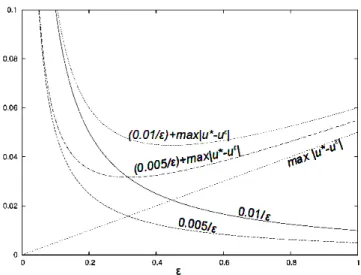
Next, we assume the errorE1 = ˜Cε. Therefore the total error is max
i=0,...,N|u∗(xi, tk)−uki| ≤Cε˜ + C∆x
ε . (5.15)
The graph of this total error can be seen in figure 5.2. In this figure, there are two ∆x: 0.01 and 0.005. When ∆xdecreases, the error also decreases for particular ε. It also shows that when ε is big or small, the error increases.
This is approximately similar to the error pattern in figure 5.3a and serves to justify our results.
Figure 5.2: Estimation from above of the total error for explicit method 2
5.3 Comparisons of solution having different gradient
We are also interested in investigating the choice of ε to get optimal error related to the gradient of the solution near the free boundary point (gu).
The relation between gu and the error is shown in (5.14). The gradient of the solution is approximated by calculating the linear regression of five ui whose values are nearest to the value 0.1. This value is chosen since, based on figure 5.3a-5.3d, when ε = 0.1, they display similar errors for different
∆x.
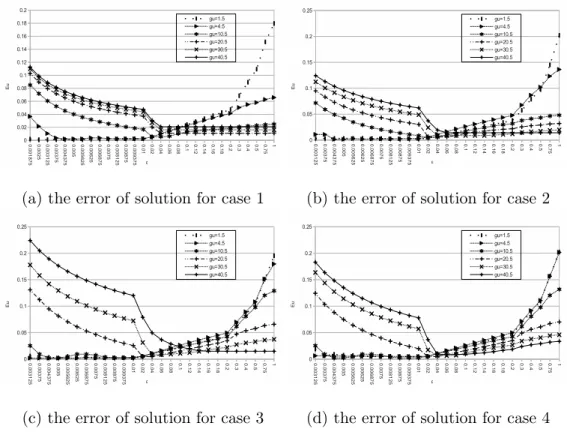
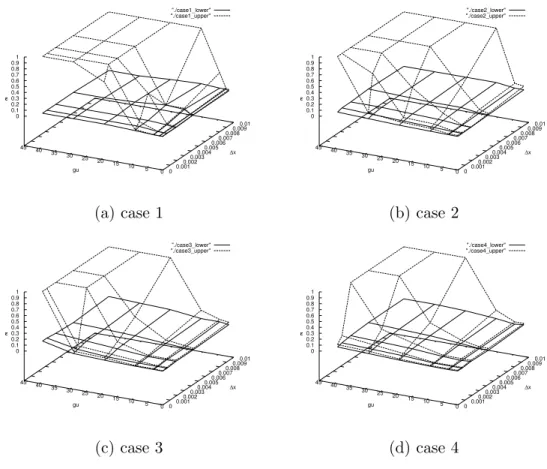
To see the relation between the error of the solutions andgu, we conduct a few experiments using cases 1-4 with differentgu. We choose only cases 1-4 since they are enough to represent different kinds of solutions. We set the gradient of the solution at time τ = 7 to be 1 to 40. The results are shown in figures 5.5 and 5.6. Figure 5.5 shows that the range of optimal ε becomes larger whengu increases. In addition, the figure 5.6 shows that there are two surfaces. The lower surfaces describe the lower bound of the range for the optimal ε. While the upper surfaces describe the upper bound of the range
(a)Eu case 1 at time levelτ=9 (b) Eu case 2 at time level τ=9
(c) Eu case 3 at time level τ=9 (d) Eu case 4 at time level τ=9
(e) Eu case 5 at time level τ=9 (f)Eu case 6 at time level τ=7 Figure 5.3: The errors of explicit method 2 for cases 1-6
(a) El case 1 at time level τ=9 (b)El case 2 at time levelτ=9
(c)El case 3 at time level τ=9 (d)El case 4 at time levelτ=9
(e)El case 5 at time level τ=9 (f)El case 6 at time level τ=7 Figure 5.4: The errors of free boundary point of cases 1-6
figure 5.7. In this figure, each vertical line indicates the range of constant C which applies for the gradient 1 to 40 using specific ∆x. It shows when the constant C is between 0.15-0.16, it satisfies for all cases and ∆x. Therefore, we conclude that the constant C is approximately 0.15-0.16.
(a) the error of solution for case 1 (b) the error of solution for case 2
(c) the error of solution for case 3 (d) the error of solution for case 4 Figure 5.5: The errors of solution for case 1-4 with different gradient with
∆x= 0.000625
0 0.001 0.002 0.003 0.004 0.005 0.006 0.007 0.008 0.009 0.01 5 0
15 10 25 20 35 30 45 40 0 0.1 0.2 0.3 0.4 0.5 0.6 0.7 0.8 0.9 1
ε
"./case1_lower"
"./case1_upper"
∆x
gu ε
(a) case 1
0 0.001 0.002 0.003 0.004 0.005 0.006 0.007 0.008 0.009 0.01 5 0
15 10 25 20 35 30 45 40 0 0.1 0.2 0.3 0.4 0.5 0.6 0.7 0.8 0.9 1
ε
"./case2_lower"
"./case2_upper"
∆x
gu ε
(b) case 2
0 0.001 0.002 0.003 0.004 0.005 0.006 0.007 0.008 0.009 0.01 5 0
15 10 25 20 35 30 45 40 0 0.1 0.2 0.3 0.4 0.5 0.6 0.7 0.8 0.9 1
ε
"./case3_lower"
"./case3_upper"
∆x
gu ε
(c) case 3
0 0.001 0.002 0.003 0.004 0.005 0.006 0.007 0.008 0.009 0.01 5 0
15 10 25 20 35 30 45 40 0 0.1 0.2 0.3 0.4 0.5 0.6 0.7 0.8 0.9 1
ε
"./case4_lower"
"./case4_upper"
∆x
gu ε
(d) case 4
Figure 5.6: the lower and upper bound of optimalε for cases 1-4
Figure 5.7: The range of constant C for cases 1-4 with different ∆x
5.4 Comparisons of smoothing characteristic functions
In this experiment, we compare two smoothed characteristic functions. In particular, (5.3) and
(χε)0(u) =
hu
a 0< u < a,
h a≤u≤ε−a,
h(ε−u)
a ε−a≤u≤ε,
0 otherwise,
(5.17)
where
a= ε
b, h= 1
ε−a,
b is a positive number. Function (5.17) has a smoother transition than (5.3).
We want to know whether smooth transitions influence the accuracy. The goal of this experiment is to get the appropriate smoothed characteristic function.
We apply these two functions in equation (1.4) with parameters Q2 = 1, Ω = [0,15], a= 1, ∆x= 0.005, and ∆t= 0.9∆x and solve using explicit
method 2. The errors of each cases at time level τ = 9 (case 6 uses τ = 7) are shown in figure 5.8. The errors are calculated by
E˜u = max
i=0,...,N k=0,...,M
|u∗i(xi, tk)−(u(5.3))ki| or E˜u = max
i=0,...,N k=0,...,M
|u∗i(xi, tk)−(u(5.17))ki|, (5.18) where u(5.3) and u(5.17) are solutions with smoothed characteristic function (5.3) and (5.17) respectively. In this figure, we can see that the errors of solutions using smoothed characteristic function (5.3) and (5.17) for cases 1-6 are relatively same with an order of 10−3−10−4. Therefore, (5.3) is an adequate smoothed characteristic function.
Figure 5.8: Comparison of smoothed characteristic functions
5.5 Comparisons of numerical methods
To compare numerical methods, we conduct two experiments. The first ex- periment is to numerically solve (5.7) and compare the results with the exact solution (5.10). In order to do this, we consider a case similar to case 1 with