Voices of Hunters on Socialist Modernisation : From a Case Study of the Udehe in the Russian Far East
journal or
publication title
Inner Asia
volume 12
number 1
page range 177‑197
year 2010‑01‑01
URL http://hdl.handle.net/10502/4873
Case Study of the Udehe in the Russian Far East
SHIRO SASAKI
National Museum of Ethnology, Kyoto, Japan [email protected]
ABSTRACT
In this paper I discuss how different the socialist modernisation of the equipment and techniques of indigenous hunters in Siberia and the Russian Far East was from the 'snowmobile revolution' in Finland and Alaska, and what the results of this modernisation were. In this discussion I analyse hunters' performance and narra- tives observed and collected in my field research on the hunting culture of the Udehe, one of the indigenous minorities in the Primor'e region in Russia. As a result, I conclude that socialist modernisation had delocalised the fundamental materials for hunting activities such as fuel, equipment for transportation and weapons. However, the serious techno-economic differentiation that had been observed in the case of the Saami in Finland seldom occurred among the indige- nous hunters, because socialist egalitarian policies and standardisation of products often provided equal access to the modernised equipment. Especially in the case of the Bikin River basin, where I did my field research, differentiation between the Russian and indigenous hunters was not observed. However, the delocalisation of the fundamental equipment and materials thoroughly deprived them of the alterna- tives that consisted of the more traditional and pre-modem equipment and techniques. This factor seriously influenced their social and economic conditions after the collapse of the Soviet Union.
Keywords: hunting, modernisation, narrative, Russian Far East, indigenous people, Udehe, Soviet Union, socialist economy
INTRODUCTION
The purpose of this paper is to describe and analyse the transition from 'tradi- tional' to 'modem' of the hunting equipment and technology of indigenous people in the Russian Far East during the Soviet regime and to reveal how their society and worldview were affected by this change. As it is difficult to conjure a precise image of hunting activities from mere written materials, one must Inner Asia 12 (2010): 177-97
© 2010 Global Oriental
conduct field research and participant observation in order to accumulate prac- tical information from hunters' performance and narrative explanation.
Fundamentally, the study of hunting culture and hunters' society - especially regarding hunting equipment, techniques, organisations, rules and ethics - should be dependent on narrative and non-literary materials.
Hunters' narratives often risk subjective misunderstanding due to inconsis- tent or contradictory explanations. Their performance may lead researchers to inappropriate images of their activities, if researchers do not have exact knowl- edge of their natural environment and historical and political conditions. Despite these dangers, however, hunters' narratives and performance well represent their recognition of nature and of the society in which they have lived from generation to generation. This paper will analyse hunters' narratives and performance in order to clarifY their recognition of the drastic changes in their hunting equipment and technology during the Soviet regime, and to reveal some characteristics of that socialist society.
Hunting equipment and technology (particularly weapons, traps, techniques and transportation) and hunters' organisations, rules and ethics are determined not only by the given natural environment, but also by the influence of state poli- cies concerning the economy and wildlife management. The case of the indigenous people in the Russian Far East is not an exception. Indeed, the case of the Udehel in the present Khabarovsk and Primor'e Region - people who have experienced drastic changes in political and economic conditions during the nineteenth and twentieth centuries - is a typical one.
While the Udehe have experienced some radical and serious changes in their surrounding political and economic conditions since the middle of the nineteenth century, the most prominent change in their hunting activities was the modernisa- tion of the equipment and technology that occurred during the Soviet regime. Old weapons such as spears, bows and arrows were replaced by rifles and shotguns, and hand-rowed dugout boats and dog-sleds were changed to boats with out- board motors and snowmobiles. It can be defined as 'the "snowmobile revolution" in the socialist society'. The 'snowmobile revolution' is a concept that was first presented by Pertti J.Pelto (1973) in the case of the Kolta Saami (Skolt Lapps), reindeer herders in Finland. The use of snowmobiles in Saami reindeer herding and daily life drastically changed the techniques, methods, and equipment of their activities in the 1960s and 1970s, and their society was signif- icantly influenced by this technological change. T. Ingold evaluated the adoption of the snowmobile as one of the main factors contributing to the transformation of the Kolta Saami's reindeer herding from the traditional, intensive, symbiotic herding to extensive 'predatory pastoralism' (Ingold 1976: 29). E.S. Hall and L.
Smith discussed the same kind of problem in the case of the Arctic people in Canada, where the snowmobile was originally invented (Hall 1971 ; Smith 1972).
Pelto and L. Müller-Wille compared the cases of the Canadian Arctic and Finnish Saami (Pelto &Müller-Wille 1972).
The same kinds of changes took place in Soviet Siberia and the Far East.
China
..../r
,r-
\
\\ )
fl
)I
--
jRussia
FIGURE 1. Map of the Russian Far East
- - - Country border -.- boundary of Raion -··-boundary of Krai
Equipment for productive activities and transportation vehicles were modernised and mechanised and, consequently, people's social and human-animal relations drastically changed. However, such changes have long been unknown to, or ignored, by many researchers and they have never been appropriately discussed and evaluated. Though it would be difficult to find the same quality and quantity of information and materials related to the case of the Udehe in the Russian Far East as exist for the Finnish Saarni, because the former had long been hidden by the 'Iron Curtain' during the Cold War, the comparison between these two cases
as representatives of the capitalist and socialist societies will yield some signifi- cant results about the issues of technological modernisation of the indigenous people in Northern Eurasia.
Describing and analysing narratives and performance about the modernisa- tion process of the hunting equipment and technology of the Udehe, I will evaluate the snowmobile revolution in the socialist society and reveal some char- acteristics of Soviet rule over the indigenous peoples in Siberia and the Russian Far East.
THE SNOWMOBILE REVOLUTION AND CHARACTERISTICS OF
THE SOCIALIST POLICY OF THE SOVIET UNION
According to Pelto (1973: 68-9), since the first acceptance of the snowmobile in reindeer herding in 1963, the Kolta Saami's herding quickly became mechanised and wholly dependent on motor vehicles. The snowmobile changed not only their herding techniques, but also their economic and social life. It increased the need for cash and for differentiating active herders (who were able to use the snowmobile when herding) from the other people who dropped out of reindeer herding to take other jobs. In Pelto's words, 'Two main effects of the snowmobile revolution that emerge from my research can be summarized under two general descriptive concepts which I have labeled "de-localization" and "techno- economic differentiation". ' (Pelto 1973: 165). As to the former, Pelto said that the main feature of de-localisation was 'the growth ofdependence on commercially distributed sources of energy' (Pelto 1973: 166). He clarified this by saying 'the local economic system cannot operate unless it is regularly supplied with gaso- line. It is no longer possible to return to a reindeer sled transportation system in the event that gasoline supplies are cut off' (pelto 1973: 167). As will be men- tioned later, the same type of 'de-localisation' occurred with indigenous peoples in the Russian Far East through the modernisation of equipment and technology for hunting and transportation.
As to the 'techno-economic differentiation', Pelto writes as follows:
for any socio-physical environment, adaptation is effective by means of material things - technological inventories - which are the items of equipment that each individual or household must own or have access to in order to accomplish their food-getting and other subsistence activities. The ownership and utilization of these technological items is closely intertwined with the less material aspects of economic systems- occupations,the cash reserves, the distributiveconnections- in terms of which some families and individuals (and other units) are relatively successful in fulfilling their material needs while others experience varying degrees of deprivation.(pelto 1973: 168)
This concept can differentiate between the cases of the Saami reindeer herders and the indigenous hunters in the Russian Far East during the socialist
regime. Since Soviet policy for the economic development of indigenous ethnic minorities in Siberia and the Far East was intended to guarantee equal access for every hunter to modernised technological items, the difference in ownership or access could not be a significant factor of social differentiation. Moreover, the quality of the modernised items made in the Soviet Union was, in general, not as good as those of Western make, except for firearms. As they always experienced some troubles, it was not access to these items that determined the success of hunting, but the ability to repair the items when they malfunctioned. A compar- ison between the cases ofindigenous minorities under a capitalist economy and a socialist economy can lead us to interesting results. The difference in the features of such social differentiation reveals some characteristics of socialist society.
In the case of the indigenous people in the Russian Far East, however, it is not appropriate to assume that 'de-localisation' and 'techno-economic differentia- tion' began at the time of the mid twentieth-century modernisation. Those people have been involved in the large-scale political and economic systems of the East Asian historical world since ancient times, and experienced such phenomena even before the establishment of socialist rule by the Soviet Union. In particular, when they were subject to the direct control of the Qing Dynasty (which was established by the Manchurian people in 1616 and ruled China from 1643 to 1912), they were organised into privileged tribute payers, who were expected to contribute to national fmance with the payment of precious sable fur. Though they were obliged to pay the fur to the dynasty every year, they were afforded a privileged status that was equal to high-ranking bureaucrats in the court in Beijing and rewarded every year with many luxurious Chinese goods, such as silk and cotton clothes, metal ornaments, crops and liquor. As such a ruling system continued for more than 150 years from the end of the seventeenth to the mid nineteenth centuries, the Chinese goods and items were widely distributed in their daily life. Even their religious life was influenced by Chinese and Manchurian beliefs, and they worshipped many gods and sprits of Chinese and Manchurian origin. Though the people had alternatives - more traditional items such as fur and fish-skin clothes, wild meat, fish, berries, wooden and birch-bark wares, and animistic beliefs - their sophisticated lifestyle was wholly dependent on the imported goods and ideas, which vitalised hunting, fishing, gathering and trading activities, increased economic prosperity and differentiated their society into several classes. In other words, elaborated parts of their culture were already de-localised during pre-modem times and the possession of and access to these items determined political and economic status in their society, while the sources of energy, fundamental food materials and equipment for their subsistence were still local.
The Soviet policy of the distribution of modernised equipment and tech- nology for production and transportation caused a change on a deeper level. Even food, clothes, equipment for production (including transportation vehicles) and energy (fuel) had to be purchased from outside the region. As a result, the Soviet government destroyed traditional alternatives in order directly to rule the indige-
nous society and economy through the supply of modernised items. Thus, a com- parison of the level of 'de-localisation' and 'techno-economic differentiation' through those times can also reveal some of the important characteristics of the Soviet Union's socialist policy.
The following section, based on hunters' narratives and performance, will compare traditional and modernised hunting equipment, techniques, organisa- tion and ethical attitude toward animals. It will also discuss the ways in which we should evaluate the snowmobile revolution in the context of a socialist society.
PERFORMANCE AND DISCOURSE OF HUNTERS Traditional' hunting equipment, technique, and social system
It is often problematic to defme 'traditional' hunting techniques and equipment;
however, in the case of the Udehe, it is relatively clear. They often insisted that 'traditional' techniques and equipment were those that had been used before the distribution of modernised equipment such as steel jaw traps, shotguns, rifles, outboard motors and snowmobiles. Traditional equipment included knives, bows and arrows, spears, hunting nets, deer whistles and various kinds of traps; these were made of natural materials such as tree trunks, sticks, birch bark, vine ropes, plant fibres and horsetail hair, which were obtained at or near the hunting place.
Traditional transportation equipment consisted of dugout boats, birch-bark canoes, skis and dog-sleds, which were driven by human, animal and other kinds of natural power. Hunting techniques included chasing, stalking, hiding and waiting. The 'traditional' methods did not require originality; for example, though a trap for hunting sable called adui,which was the favourite trap of this study's informant hunter, is generally recognised by Udehe people as a trap of Chinese origin, it is also recognised as a traditional method. Some deadfall traps, automatic bow-guns, dugout boats, birch-bark canoes and hunting techniques are so widely shared by so many ethnic groups that it is impossible to determine who their inventors were.
Transportation equipment often restricted hunters' locations. As it was heavy work to row up stream and to walk uphill during the snowy winter season, prior to the introduction of motor vehicles people often set up residence near the places of their productive activities. In the case of the U dehe, who live in the Bikin River basin in the Primor' e region of Russia, they often chose their residential locations so as easily to access their fishing and hunting spots and migrated between summer-autunm fishing camps and winter-spring base villages. A summer- autunm fishing camp, which consisted of three-five tents occupied by three-ten families, was usually set up at the location near spawning spots of dog salmon.
Dried dog salmon was one of their staple foods until the 1950s, and their lives were wholly dependent on the result of the fishing for this sort of salmon, which swam from the Okhotsk Sea through the Amur and Ussuri Rivers to the Bikin River. A winter-spring village that consisted of three-five houses was usually
located at the mouth of a tributary that had good places for sable hunting (Startsev 1996: 17-18; Onuki & Sato 2005: 139, 154--6). Sable hunting, as will be described in detail later, played - and still plays - the most significant role in the Udehe's economy. As a result, many small villages, hamlets and camps spread out over the middle section of the Bikin River. An expedition of Russian hunters in 1894 reported that 301 people had lived in thirteen villages (winter-spring base villages) along the river (Patkanov 1906: 92-3).
The techniques and equipment used for trap hunting accurately represent the attitude of the hunters to the game animals.
U dehe hunters used traps and nets mainly for capturing small or middle-sized fur-bearing animals. They did so because traps and nets can capture an animal without inflicting much damage on its fur, while shooting the animal often dam- ages the fur through the penetration of bullets or arrows. Any damage lessens the value of the fur. Indigenous hunters often admit that traditional traps and nets are far superior to modem jaw traps for capturing animals, though contemporary hunters have already lost the knowledge and techniques to set them.
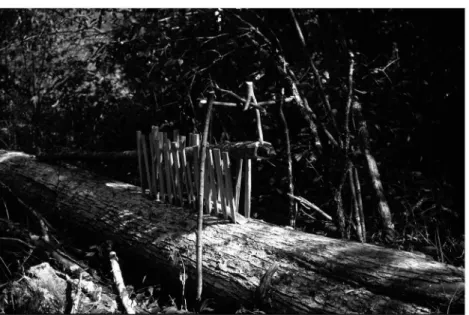
Traditional traps were either of the deadfall type or the snare type. Our informant hunter reconstructed four types of deadfall trap and two types of snare trap to show how he captured many sables in his active days. We visited him in a village on the Bikin River basin, called Krasnyi Yar, in 1995 and 1996, during the Russo-Japanese joint research project on the hunting culture of the Udehe. He was the only person who still knew the techniques for setting traditional traps, and was recognised as the best hunter in the village. Though he was about eighty years old, he was very energetic and vital when he showed us how he had hunted.
His favourite trap was thedui. It was usually set on a tree trunk lying over a brook like a bridge. If there was no suitable bridge, hunters often cut down a tree standing near-by to make the bridge. Sables are fond of passing by such places.
Even when on the ground, sable often run along fallen trees; therefore, it is effec- tive to set traps in such a place. The hunter made two lines of fence to restrict the animal's passage. He hung a heavy log between the fences with a special release mechanism. When a sable walks into the passage and steps on the release, the log falls down and hits the sable.
The hunter insisted that theduiwas far superior to modem j aw traps in many ways. For example, it captured an animal without any damage to its fur, because it could instantly kill the animal. He cut branches off from the log and trunk, and made their surface smooth to ensure they would hit the animal without damaging the fur. Moreover, according to him, this trap could select the game, by control- ling the sensitivity of the release. He said that he could set the release so that it was strong enough to function only when a sable of a certain size passed into the trap. This trap, therefore, did not waste the resources of fur animals.
However, the trap is so large and the fences made of wooden sticks so promi- nent that it seems they would be easily recognised by animals. The hunter answered our questions as follows:
FIGURE 2. A deadfall trap (dui)
The trap should be constructed during the spring so as to make the trap a part of nature. As it was set not to function during the spring and summer, animals had become accustomed to its existence by the autumn. When the hunting season began, the hunter attached the release to the trap so it would drop the log.
He usually set about a hundred dui in his territory when he worked as a pro- fessional hunter. Though it took about an hour to set the trap when he reconstructed the trap for our research, he told us that when he was young it only took about fifteen minutes to construct a set ofdui.He said:
I was young and more energetic in those days. Ahead of time I prepared many sticks for the fences, wood plates and strings for release, and other parts of the trap to in order to make it quickly. I knew the best places for setting duifrom my long experience.
In addition to the dui, our hunter constructed traps of other deadfall types (kafari, langi and hadana) and snare traps (huka), all of which were specialised for capturing sable and other fur-bearing animals. Though I shall not explain details of these traps here, or the techniques for their use, since they have already been described in several articles (Sasaki 2000; 2003), we can conclude from this hunter's explanation that traditional traps were more various and diverse than contemporary traps, and that the best trap was chosen to suit the season, setting point and target. The hunter also showed us how to use a hunting net. Net hunting of sable has a long tradition that can be seen in a document edited at the beginning of the eighteenth century (Yan 1985: 253). When the hunter confirmed that a
sable had gotten into the hollow trunk of a tree, he closed all the holes except for one exit, set a net to cover it, and drove the animal into the net with smoke from burning spruce or pine needles.
Based on the fact that the Udehe had many kinds of traps and methods for sable hunting and that they highly elaborated them to capture certain sorts and sizes of animals in a certain season, we can conclude that sable hunting occupied a special position in their hunting activities. At this point, our informant hunter's narratives and performance can connect with the history of the Udehe.
As has been described in previous articles (Sasaki 2000; 2002; 2003; 2009), the ancestors ofthe indigenous peoples in the southern areas of the Russian Far East, such as the Udehe, Nanai, DIchi and Nivkh, were the main actors in the his- tory of Northeast Asia until 1860, when the Russian Empire acquired the territories of the present Khabarovsk and Primor' e regions. During the seven- teenth century, they contributed to the construction of the Manchurian state (the Qing Dynasty) and the victory in the Qing-Russian war over the territory on the Amur River.3 Though they were included into the ruling system of the Qing Dynasty, they were designated as privileged tribute payers and enjoyed high status and much benefit in Chinese society. When they paid the sable fur, they were rewarded with many Chinese goods and some prestigious rights. As the high demand for sable fur in the imperial court at Beijing pushed up the price of the fur of other animals, tribute payers could take advantage of this in their trading with Chinese merchants. They bought not only silk and cotton clothes, but also metal products, glass beads, earthenware and porcelain, crops, liquor and
FIGURE 3. Hunting net for sable (Susan Geonka)
other products that could not be produced in their areas and that supported the sophistication of their culture. As I mentioned above, 'de-localisation' of sophis- ticated items had already begun in Udehe society under the rule of the pre-modem East Asian dynasty.
Due to their location, the Udehe had especially intimate relations with the Chinese and Manchurians; the fur trade at trading posts was one of their most important economic activities, in addition to hunting and fishing. In this sense, it can be said that sable hunting occupied a special position in their hunting activi- ties. Though it was at the early times of the Soviet regime, our respectful old hunter told us a moving episode:
When I was ten years old, I captured a sable with my own trap for the first time.
When I got back home and showed it to my family,my blind grandfather was so pleased, touched it gently, and said with tears, 'We have a new hunter. He will be able to feed our family.'
This episode well represents the significance of sable fur in Udehe society and indicates that the people ofthe older generation recognised that they could have survived both abundant and scarce times through sable hunting.
When traditional methods and equipment were used, the distance between a hunter and game animals was much closer than it is nowadays. Our informant hunter was the last person to experience bear hunting with spears, and often told us how terrible it had been for him when he participated in it for the first time:
When I was still a young boy,I went bear hunting with elder hunters. But it was so terrible that I only watched the hunting from behind a tree. You assume that hunters hold their spears in this way [author's note: he showed an ordinarypose of holding a spear].But it is a great mistake. They held them in another way [author's note: he showed another pose, in which a hunter sends a spear backward] so as to guarantee sticking the bear's heart and easily get away from the bear's attack ifhe failed to spear it.
Hunting large mammals such as bear, elk, red deer and wild boar was, of course, honourable for hunters. Hunting them with spears and bows and arrows, how- ever, was very dangerous and thrilling. Different from the case of the present hunting with rifles, the success of the hunt was very dependent on how close the hunter could approach the game. If necessary, the hunter had to fight directly with an animal. Not only the physical distance, but also the psychological distance was much closer. Our informant hunter sometimes encountered tigers in the forest. Though this was also terrible, he never shot them, because the tiger was the most respected and sacred animal in the Udehe's forest and it was thought to bring luck to hunters:
Once I met a tiger almost face to face. The distancebetween us was maybe a few metres. My hair stood up from fear and my heart beat so loudly.But I dared to cool myself down and said gently to the tiger,'Odo!' [author's note: Odomeans 'grandfather' in the Udehe language but often implies a tiger.] Please do not get
angry at me. I am not your enemy.I will not hann you. I apologize for disturbing you. So please quietly go away from here.' The tiger went away into the woods without causing any harm. The next day, I caught three red deer at the same place where I met the tiger.
He also taught us a lesson: one should never touch an animal that a tiger had killed or targeted. He told us a story of his friend, who had stolen tiger's game:
Once myoId friend went hunting to his forest.Inthose days we were stillpoor and always hungry. He had to go back home with meat. But then he could not see any animal in the forest for a long time. One day, he discovered a wild boar that had been killed by a tiger. Though it was immoral to touch an animal killed by a tiger, he could not overcome a temptation to take it to his hut. Since that time, he began to find out foot-prints of a tiger, wherever he went. He was followed by the tiger that wanted to take the meat back. Finally he was bothered by a tiger's roar moving around his hut. He threw the boar away to the forest, and hurried back to the village.
A tiger is the most sacred animal for Udehe hunters and a guardian of their forest.
They think that it is so clever that it well understands and remembers a hunter's activities. Therefore, old hunters have taught young fellows never to do anything malicious to it. The poaching of a tiger is still the most immoral crime for the Udehe hunters in the present day.
'Modernized' hunting equipment, techniques, and social system
The 'modernisation' of the hunting equipment, techniques, and social system gradually spread to all the indigenous people in the Russian Far East after their territories were incorporated into the Russian Empire. At fIrst, fIrearms and traps of European types were distributed among them at the expense of their huge debt to merchants and fur traders. However, insofar as motor vehicles and high- performance fIrearms were still not introduced, the techniques, distance to animals and social rules and ethics were not seriously affected. Photos and sketches of dugout boats, birch-bark canoes and dog-sleds taken in the 1950s can be seen in ethnographies published by Soviet ethnologists (Lar'kin 1957: 18;
Smolyak 1987: 109, 114-15; 2001: 112, 124-5). Drastic change actually began in the 1960s and 1970s, at almost the same time as the beginning of the snowmo- bile revolution in Finland, when motor vehicles and good fIrearms became popular among the indigenous hunters.
Hunters who were trained by elder hunters up until the 1950s can still set some of the traditional traps (though they cannot make as many kinds of traps as our informant did), while those who were trained after the 1960s cannot, though they know about some of them. This means that the 1960s was a turning point in the transition from 'traditional' to 'modernised'. Our informant hunter regretted that he could not pass on his techniques and knowledge to the next generation.
This is the main reason why he collaborated with us and enthusiastically showed us his techniques and knowledge for our research.
Modernised hunting equipment consists of steel jaw traps, steel wire for snares, rifles and shotguns. The main weapons changed from bows, arrows, spears and old-fashioned guns to rifles with automatic loading systems and shotguns. The deadfall traps, automatic bow guns and snares made from horsetail hair were also replaced by steel jaw traps and steel wire snares. Automatic bow guns and some kinds of deadfall traps were prohibited by hunting laws and policies for the control of wild resources, since they were recognised as dangerous equipment.
In comparing modem steel jaw traps with traditional deadfall traps as tools for hunting fur-bearing animals, the latter are far superior in the quality of the product. A hunter said:
Yes, we know that deadfall traps(lovushka) are far superior. They can kill an animal instantly without inflicting any damage to its fur, while the jaw trap (kapkan) that captures the animal by biting its paw often permits it to wriggle on the ground and does inflict fur damage. The damage lessens the price of the fur.
But we have to observe the law and nonns. And already no one knows any longer how to construct the traditional traps, except the oldest hunter.
This hunter was a representative of the hunting company that was reorganised from a state enterprise to a joint stock company in 1994, when I interviewed him in my field research in 1995. According to him, hunting laws determined the kinds of weapons, traps and methods that can be used in hunts for specific ani- mals, as well as the seasons, places and targets, and hunters can only use jaw traps and firearms to capture sable. While in general hunters' activities are often restricted by hunting laws, natural resource utilisation laws and wildlife protec- tion, the rules and quotas for sable hunting are the most rigid ones. During the Soviet regime, it was said that sable fur was a strategic product. Though the fol- lowing interview was done in my other field research in northern Yakutia (Eveno-Bytantai district) in 1995, it provides an explanation of a representative of the hunting organisation of the district as an example:
The sable hunting was most strictly controlled by the government during the Soviet regime. The quota was so strict that hunters were not allowed to hunt the sable neither more nor less than the quota. Sables do not live in America, and the sable fur was one of the strategic products that could be exported to America.
Therefore, the Moscow govemment eagerly controlled their resource and hunting.
The situation was the same among the Udehe in Primor'e. The transition from traditional traps to the modernised ones was accelerated by policies of gov- ernments as well as social and economic conditions surrounding the hunters.
According to people's explanations, there was a drastic change in their productive organisations and settlement patterns in the 1950s and 1960s, as was the case with other Siberian indigenous peoples. On the Boon River, for example,
all the people living in small villages scattered along the river basin were gath- ered into one large village called Siain, located on the right bank of the river, in 1957. All the inhabitants moved to present-day Krasnyi Yar in 1961; that village was constructed in 1959 on the left bank of the river and has been a central village of the Bikin River Udehe, because Siain often suffered from floods. At the same time, productive organisations, such as collective farms (kolkhoz), hunting and fishing cooperatives and forest companies were integrated into one state enter- prise called a gospromkhoz [state foraging farm]. According to Russian ethnologist A.F. Startsev, the attempt by the Soviet government to develop agri- cultural lands in Udehe territories in the Primor'e and Khabarovsk regions by organizing the Udehe people into agricultural collective farms during the 1930s- 1950s was, as a result, unsuccessful (Startsev 2000a: 136, 140--41). The government changed its policy to utilise the skills of hunters and gatherers for the effective usage of forest resources, including fur products, and decided to con- struct co-operative or state foraging farms in the 1960s (Startsev 2000a: 126).
The integrated state foraging farm on the Boon River basin (calledgospromkhoz Pozharskii after the name of the district) employed skilful indigenous hunters, gave them the qualification of state hunter (shtatnyi okhotnik) and allotted them hunting territories to produce precious furs such as sable, fox, martin and otter and other hunting products such as meat, hide and soft summer antlers in accor- dance with the state economic plan.
The territories for hunting fur-bearing animals were located on the middle and upper banks ofthe river, while the village ofKrasnyi Yar was constructed at the lowest end of the territory of the indigenous people. It takes one to two days to reach the territories on the middle banks from the village, even on a boat with an outboard motor. It would have been impossible to integrate the people and their productive organisation into one village and one farm ifthey had had only tradi- tional transportation equipment such as dugout boats, birch-bark canoes, dog-sleds and skis. Modernised motor vehicles such as cars, boats with outboard motors and snowmobiles drastically reduced the time it took to go to their hunting territories, and enabled them to enjoy a modernised life with electricity, telephones, public education, western medicine, and various kinds of entertain- ment in the village.
Fundamentally, hunters and their families lived on the salary from the farm during the Soviet regime. Hunters' families lived in houses in the village all year round, growing potatoes and various vegetables in their home gardens, breeding cows and pigs and working at jobs such as village administrator, farm book- keeper, schoolteacher, clinic doctor, village bakery worker, boiler of the village bath, etc. During the Soviet regime, many jobs were created even in the remote villages of the indigenous people so that they would not suffer from unemploy- ment. Hunting was one of the jobs that villagers could undertake (it was one of the honourable jobs in the village), and hunters were employees of the state for- aging farm, as well as the administrators, bookkeepers, engineers, mechanics and machine drivers.
As mentioned earlier, access to modernised equipment such as motor vehi- cles and fIrearms was almost equal among the hunters in the case of the Boon Udehe. These machines were fundamentally owned by the community or the farm. Though some items, such as rifles, shotguns and traps, could be held in per- sonal possession, the difference in their performance was small because they were highly standardised in the socialist way of production. The Soviet had a rule whereby guns and rifles had to be kept in a special storehouse that was walled by steel plates, and it also contained bullets and gunpowder during the off-seasons.
Hunters took them out only during the official hunting seasons. Such a rule is still observed by the Udehe hunters in Krasnyi Yar today.
During the Soviet regime, snowmobiles and boats with outboard motors, which were too expensive to be bought by an individual, were often owned by the state foraging farm (some leader-hunters could individually buy them). Gasoline and oil were also bought by the farm at a price decided by the central govern- ment. It equally provided employed hunters with equipment for transportation to their territory, along with weapons and tools for hunting, in order to accomplish the state plan. Thus, serious techno-economic differentiation was seldom seen among the indigenous hunters during the Soviet regime, in contrast to the case of the snowmobile revolution of the Kolta Saami in Finland. In the Soviet Union, such differentiation was sometimes seen between indigenous and Russian hunters. For example, as Startsev pointed out in the case of the Khor River basin in the Khabarovsk region, some state enterprises often provided Russian hunters with better equipment and territories than local Udehe hunters and, as a result, they earned a better salary. The Udehe hunters often complained of this situation and moved to other organisations to engage in other jobs of higher salary (Startsev 2000a: 130). It is a fact, however, that the egalitarian policy of the Soviet Union contributed to the restriction of differentiation in indigenous society. The case of the people in Krasnyi Yar on the Bikin River basin was a typ- ical one. The state foraging enterprise, gospromkhoz Pozharskii, gave equal access to modernised equipment to all ofits employed hunters, regardless of their ethnic origin. It provided hunters with good rifles and shotguns and even took them to the territories in the upper basin of the Bikin River by helicopter. During the Soviet regime, a helicopter flight cost much less than it does today.4
Land possession by the state and restriction of the movements of people, which were characteristic policies of the Soviet socialist countries, alsode facto protected the right of the indigenous people to hunt in their territories, as long as the integrated state farm followed the appropriate policies on land use and pro- ductive activities. Thegospromkhoz Pozharskii in Krasnyi Yar strictly divided its territory into logging and hunting areas, the latter of which occupied about three- quarters of its territory. The hunting area was further divided into twenty-one territories for sable hunting, which were allotted to professional hunters. The hunting area could be used only for hunting, fIshing, and plant gathering; logging was only permitted for the construction of hunters ' huts and for making fIrewood.
Such farm services and systems made it possible for hunters to accomplish the
state plan and even gave them social and economic power that enabled them to survive the crises that occurred after the collapse of the Soviet Union. As has already been stated in previous papers, the sale of fur products occupied 33 per cent of all the sales of thegospromkhoz Pozharskii in 1991, the last year of the Soviet Union, and the sale of all hunting products occupied more than 70 per cent in that year (Sasaki 1997: 179; 2000: 502). This fact shows that the policies for equal access to modernised equipment and for land use resulted in the accelera- tion of modernisation and the accomplishment of high productivity in the hunting section of the farm that was managed by the indigenous people.
The informant hunter who showed us 'traditional' traps and techniques was one of the hunters that were employed by the farm as a professional hunter. He was allotted a hunting territory, which was located along the Metaheza River, one of the tributaries of the Bikin River, and made every effort to accomplish the state plan of sable-fur production, using all his skills and knowledge. While the state farm put hunters under strict obligation for the production of sable fur, it paid them higher salaries than town dwellers, and sometimes it allowed them to sell other hunting products such as wild meat and medical materials to merchants from the outside. He said:
During the Soviet regime, I often went to the forest in early summer to capture red deer. Their soft summer antlers can be made into a medicine. I cut off the antlers, cleaned, boiled and dried them. I had a special pot to boil them [author's note: he took a pot and showed us how to boil and dry antlers]. Every summer Chinese merchants came here and bought them at good prices.
Though it is already difficult to confmn how many antlers were sold to merchants in one season and how much the sales were for, hunters were able to get additional income beyond the official salary from the farm. Moreover, many villagers, including the informant hunter, engaged in apiculture, and sold honey to the farm or privately sold it in free markets. From his and other hunters' explanations, we can assume that state professional hunters were able to have a comparatively high income, and enjoyed a good life under Soviet economic policy.
On the other hand, the modernisation of equipment and techniques yielded other effects. For example, it enlarged the distance between people and nature.
Just as in the case of the 'snowmobile revolution' of the Saarni in Finland, 'the growth of dependence on commercially distributed sources of energy' (Pelto 1973: 166) is clearly observed also among the indigenous people in the Russian Far East. After modernisation, they could no longer go hunting without gasoline.
They not only used motor vehicles, but also used chain saws to cut down trees to build hunting huts and to make firewood. Their forest life was wholly dependent on commercially distributed sources of energy. At the same time, the Soviet government promoted a modem Russian life style that consisted of pur- chased food materials, European-style clothes, electrical appliances, etc. These items accelerated the de-localisation of their daily life and took them away from the local natural world.
Rifles and other high-performance fIrearms enabled hunters to shoot animals from a far distance and to hunt large, strong animals such as tigers and bears. It became much easier to hunt flying birds and running animals with shotguns. The enlargement of the physical distance between hunters and animals was subse- quently followed by the growth of the psychological distance between them. Old hunters often complained about the attitudes of young hunters, saying that they did not respect animals, spirits and gods in the forest. The story told above of the man who stole the tiger's game could serve as a lesson, while the physical and psychological distance between hunters and animals was still small. Recent young hunters might have fIred their guns to drive the tiger away from their huts.
The new rationale of the young hunters was not only a result of the anti-religious campaign and education by the socialist government, but also of the modernisa- tion of hunting equipment and techniques.
Modernisation even changed sacred places and ritual processes. Even today, many hunters perform a ritual for luck in hunting; they offer food, vodka, and cig- arettes to the spirits and gods that are believed to have the power to control the activities of wild animals and hunting luck before they go out to hunt.Lao batuis one of the famous spirits that is believed by many Udehe hunters to have such powers. Traditionally, a ritual was performed in front of a tree that stood at the entrance of the forest. When small villages or hamlets were spread over the river basins, there were many places for this ritual. After the integration of the popula- tion into one base village, however, ritual places were also integrated. For example, in the case of the Bikin River Udehe, hunters perform the ritual toLao batu at a steep precipice calledSiwantai mia,which is located on the left bank of the river and at a distance of one hour's ride from Krasnyi Yar on a boat with an outboard motor. Other sacred places and ritual spots have been given up and forgotten.
While the younger generation have lost or ignored many factors of the old tra- ditional hunting knowledge, techniques and equipment, they have eagerly learned and utilised some of them that could be used in the given political and economic conditions with the modernised equipment. For example, a middle- aged hunter who was born in the 1940s said:
There are a lot of ways for settingjaw traps in the sable hunting. For example, in the autumn hunting I use a piece of decayed fish or meat as a bait to attract a sable to a trap set in a stump. I not only set it near the trap, but also rub it on the ground to lead the game to the trap by its smell.In the winter hunting one should set a trap, using a habit of the sable, according to which it always runs on his previous foot prints and it likespassing on a fallen tree. When I set a trap in such a place, I cover it with a sheet oftissue and make up the foot print by a dried sable paw not to be noticed by the game.
Though young hunters do not know the traditional dead-fall traps and horse- hair snares, they use the jaw trap on the game animals in combination with the traditional knowledge. Moreover, the ways of setting jaw traps are becoming a
part of their traditional hunting techniques, because they have already been inher- ited from generation to generation. The use of motor vehicles is also in the same situation. They use a boat with an outboard motor in combination with a dugout boat. When they go to the hunting place, they get on the former, while they use the latter to steal up to a spot for the deer hunting.
The socialist policies of equal access to the modernised vehicles and hunting equipment enabled hunters to carry out technical and technological innovation and to enjoy a stable, rich life. In this sense, the 'techno-economic differentiation' did not occur only with the modernisation of hunting equipment during the Soviet regime. At the same time, however, modernisation deprived them of many traditional items and made it impossible for them to go back to a life without the gasoline, rifles and j aw traps that are supplied and controlled by the government.
The 'de-localisation' was obviously observed under modernisation by the socialist government.
CONCLUSION
As a result of the comparison between pre-modem and modem hunting and transportation equipment, along with the analysis of the changes in their social system and spiritual culture, we may draw the following conclusions.
The 'de-localisation' and 'techno-economic differentiation' determined to be results of the 'snowmobile revolution' by Pelto were not limited only to the mid twentieth century in the case of the indigenous peoples in the Russian Far East.
They were already seen under the rule of the pre-modem East Asian dynasties in the eighteenth and nineteenth centuries, though they were limited to the range of the upper-level or sophisticated part of the culture. Costumes were made of Chinese silk and cotton. Imported food materials like flour, rice, liquor, and tobacco occupied an important position in daily, ritual and favourite foods.
Knives, spears, axes, arrowheads and other iron hunting equipment were forged from iron or steel materials from China and Japan. Chinese porcelains and Japanese lacquer wares were used in daily and ritual meals. While these items for the maintenance of sophisticated cultural life, however, were already de- localised before modernisation in the mid-nineteenth century, at the same time people had alternative items made of traditional materials like fish and animal skin for clothing, meat and fish for food, weapons and traps made of locally obtained materials, and birch-bark wares, which enabled them to live without the imported materials and items.
'The "snowmobile revolution" in the socialist society' that occurred in the process of modernisation by Soviet policies in the 1960s extended the 'de- localisation' to the fundamental level of people's daily life. As a result, they lost their traditional alternatives and could not maintain their livelihood, culture, and society without imported materials, energy and social systems. As M.M. Balzer has indicated, the introduction of modem equipment and technology enabled the
government to strengthen the people's 'interdependence with the Soviet economy, shaping a predominantly subsistence orientation into a centralized market one' (Balzer 1999: 134).
Differing from the case of the Kolta Saami, socialist modernisation policies often,defacto, offered people equal access to modem equipment and technology.
When the policies were appropriately carried out, the people could equally enjoy the benefits of modernisation, and serious 'techno-economic differentiation' seldom occurred. Moreover, the Soviet government had some characteristics that were similar to the feudalistic pre-modem East Asian dynasty. Both regimes had policies of the strict division of their territories on the bases of regional units and the restriction of people's movements. Such policies often restricted a majority's immigration to a minority's territory, and factually guaranteed the rights of the latter and vitalised their activities, as in the case of the Bikin River Udehe.5
Hunters' narratives and performance vividly presented the 'traditional' hunting techniques and equipment, their change by the modernisation during the Soviet regime and its influence on hunters' activities. From the stories and per- formance of our respected informant hunter, we could know his pride in his techniques and knowledge inherited from his ancestors, and could learn the essence of the hunting culture of the Udehe people. However, at the same time, they let us know of his regret that he could not have handed over all his knowl- edge and techniques to the next generation. Though he understood that some of his techniques no longer matched with present laws and needs, he was anxious that the great hunting tradition of the Udehe people would be lost in the imme- diate future.
However, hunters of the younger generation did not stick to the old tech- niques. Their performance and explanation told us another pride that, inheriting a portion of traditional techniques and knowledge, they had learned new tech- nology and techniques, with which they had achieved more results than their ancestors had done. Though they respected the knowledge, techniques and per- sonality of our informant hunter, they knew that they could not have survived the severe conditions in the drastic political and economic change during the late socialist and post-socialist epochs, if they had had only the old technology and equipment.
Documents provide us with positivistic materials that support our hypothesis and detection on an issue. But narratives and performance show us another side of the issue that was not written in the documents and the reality that enables us intuitively to understand its essence. While the distribution process of the mod- ernised equipment can be confirmed by written documents, concrete aspects of the change from the traditional items to modernised ones cannot be clarified without direct observation and people's explanation. The issue of the modernisa- tion of the hunters' equipment and techniques and its influence on their social life is a typical case that can be resolved by both the written documents and non- written materials.
NOTES
1The Udehe are one of the indigenous minorities in the North; their population was 1657 in the 2002 census. They live on the tributaries of the Amur and Ussuri Rivers such as the Iman, Bikin, Khor, Anyui and Khungari, and the rivers that flow to the Sea of Japan. As the ethnonym 'udehe' implies, they are the forest people, whose main subsistence activity is hunting in forests.
2His name was Susan Geonka (1916-2003). He was born and grew up in a village located at the mouth of Habagou River, a tributary of the Bikin River. In the 1930s he and his family moved to a village named Laohe to work in a collective farm built there. In his active days, he worked in the integrated enterprise called Gospromkhoz Pozharskii as a professional hunter and hunted various animals in his allotted territory on the Metaheza River. He was an excellent hunter, who had always accomplished the state plan and often received awards from the government, and, at the same time, he was the last hunter actu- ally to use traditional equipment and techniques. With much respect, we often called him 'Odo',which meant 'grandfather'.
3Russian ethnologists L.Ya. Shtemberg and A.M. Zolotarev recorded some legends ofthe Ul'chi and Nivkh people of how their ancestors had defeated the Russian Cossack invaders (Shtemberg 1933: 296; Zolotarev 1939: 14). They were memories of the Qing- Russian war on theAmur River in the mid seventeenth century.
4Helicopter flights were one of the popular supports from the farms and local government to the indigenous people living in deep forests and tundra in the late Soviet regime. As in some researchers' reports (Balzer 1999: 132; Golovnev &Osherenko 1999), I also wit- nessed such activities for people's welfare in Bol'shezemel'skaya tundra in Nenets Autonomous District in1988 and in northern Yakutia in 1994.
5The policies of strict land division and restriction of people's movements, however, sometimes disturbed or destroyed local communities, if the ruling power drastically changed its fundamental policies for land use in a given area. The case of the Iman River Udehe fell into this situation. Their villages and communities were abolished by the poli- cies of forest logging and the construction of hydro-electric stations during the 1960s and 1970s (Startsev 2000b: 428). It can be said that the case of the Bikin River Udehe was an exceptionally benign one in the sense that the Socialist policies continuously protected the rights of indigenous people and enthusiastically encouraged their hunting activities well into the 1980s and 1990s.
REFERENCES
Balzer, M.M. 1999. The Tenacity of Ethnicity: A Siberian Saga in Global Perspective.
Princeton (NI): Princeton University Press.
Golovenev, A.v. and G. Osherenko. 1999. Siberian Survival: The Nenets and Their Story. Ithaca (NY): Cornell University Press.
Hall, E.S. 1971. The 'iron dog' in northemAlaska. Anthropologica (n.s.) 13: 237-54.
Ingold, T. 1976. The Skolt Lapp Today.Cambridge: Cambridge University Press.
Lar'kin, V. 1957. Yd3ZeUl1bl(JfcmopuKo-3mHozpapUtteCKUu OttepKc cepeduHblXIX 6.
do HaUlUXdHeu) [The Udehe (Historical-ethnographical outlines from the mid-