〔論 説〕
Trade and Foreign Direct lnvestment between the EU and the EU Accession Countries of Europe
Yutaka Kurihara
Abstract : This paper examines trade and FDI flow between the current EU mernber countries and the CEE countries seeking entrance into the EU.The approach concentrates on aggtegates determined from observations of bilateral trade and FDI flow evaluated via a gravity model. One important finding is that an increase in FDI from the EU to CEE countries will, in turn, increase exports to the EU and imports from the EU to the CEE countries. Second, the data confirm that FDI increase both imports and exports in the CEE countries. Third, the increase in exports associated with increased FDI is a little larger than the increase in imports. Finally, as EU accession brings greater integration for the CEE countries, the balance of trade between the current EU countries and the CEE countries should show improVement from the standpoint ofthe CEE countries.
1. INTRODUCTION
The expanded EU (European Union) will create a giant single market across 25 states.
It means more freedom, oppo血mity, and access for many people, and a permanent end to the Cold War s divide between Westem and Eastern bloc nations. By increasing competition and opening・markets, the enlargement will also help defeat the welfare−state consensus that dominates Western Europe and that has resulted in many ofits economic troubles.
In October 1999, the European Commission extended the accession negotiations that had started in 1998 with Cyprus, the Czech Republic, Estonia, Hungary, Poland, and Sloveniaby adding additional candidates:Buigaria, Latvia, Lithuanial Malta, Romania,
and SlgvaklaT .Eqch.covnlry will progresfi.: t its gwp. .spegq in implem.enti,ng thg reforms necessary t6 satisfy the copenhagen Crit6ria. for accession. Th. e gxpansion Will benefit
the existing 15 EU countries. Now, 10 of the 12 countries have started concrete negotia;ions for joining the EU.
EU enlargement is likely to have strong effects on foreign direct investment (FDI)
and trade between the present EU and Central and Eastem Europe (CEE), because the fu11 integration of Central European countries into the common rnarket will remove the Current barriers to free trade ofgoods, labor, and capital.
The CEE Countries will attract FDI because they have a large pool of potential customers and possess a relatively・ well−educated labor force that is available at comparatively low costs. FDI will enable these CEE customers to be better/served and to use these 60st advantages. FDI from the EU to CEE is increasing constantly despite the fact that the still present poli・tical and economic instability of the region is prOducing a delay in ihvestmenti.
The EU provides the CEE countries with a huge market for their products. This,
combined with the comparative advantage in labor and skiil−intensive production, is likely to result in increased trade between CEE countries and the current EU countries.
Such trade should bring considerable trade flows ; i. e. intermediate ptoducts will be imported, ・assernbled, and prepared for re−export to the EU as quasi−finished goods.
This paper examines trade and FDI flow between the current EU member countries and the CEE countries seeking entrance into the EU. The approach concentrates on aggregates qetermined from observations ofbilateral trade and FDI flow evaluated via a gravity model. The primary finding is that an・increase in FDI from the EU tq CEE countries wi11, in tum, lncrease exports to the EU and imports丘om the EU to the CEE
Trade and Foreign Direct lnvestment between the EU and the EU Accession Countries ofEurope
countrles.
2. TRADE, FDI, AND ECQNOMIC INTEGRATION
・ln this section,. a general review of・the theory and empirical literature on trade, FDI,
and economic integration is provided.
The 1980s witnessed considerable expansion ofexisting regional agreements (e. . g.,
EU, NAFTA, ASEAN, and MERCOSUR) and the establishMent ofnew・movements
aimed at increasing integration. Such arrangements imply a reduction ofregional barriers tO international trade and investtnent. The primary objective is to increase regional trade and investment, which is expected to boost growth because of larger markets, more competition, and more efficient resource allocation.
During the 1990s, increasing international economic integration was ofgr:eat interest to economists and policy makers. Nevertheless, it has also been feared that competition from low−wage countries could cause increased unemployment ahd de creased real wages oflow−skilled workers in the industrial world and delocalization of these.workers to low−wage countries. New theories in trade and economic geography haye been developed, building on the work of Krugrnan (,1991). The present study focuses on factdrs such as product di・fferentiation, imperfect competition, trade costs; economies of scale, .sunk costs, and immobile factors to explain trade patterns and the location production facili ties.
FDI is defined as any foreign investment that results in foreigners holding a controlling stake in a domestic production unit. Theories ofFDI can・be classified into 丘ve types according to the different methodological backgrounds:1) industrial organization, 2) corporate investment theory, 3) strategic theory, 4) portfolio theory,
and 5) ・ eclectic approaches. The 1980s and 1990s heralded .increases not.only.in trade but also in FDI flow, especially coneentrated in the member nations ofthe OECD.
FDI has attracted a lot ofihterest in recent years, and a large number ofnew theoretical and empirical studies haVe been undertaken. lssues in particular that have attracted interest are ; 1) effects of FDI on technology diffusion, innovation, and economic growth, 2) taxatiop ofmultinational enterprises and policies Promoting FDI, 3) effects of FDI on employment, 4) effe cts ofFDI on indigenous investment, and 5) effects of FDI on ttade patterns, , the tole oftrade policies, and the balan cg ofpayments.
Many Studies have examined the relation between FDI and trade. However, the question ofwhether FDI Substitutes for or gomplements intemation41 trade has not been well inVestigated. Zhang and Hock (1996) analyzed the interdependence oftrade and FDI for China and ASEAN; O Sullivan (1993) and Barry and Bradley (1997)
considered the case oflrelapd, and Pfaffermayr (1996) considered the case ofAustria.
However, there have been few studies Qn EU apPlicant countties.
3. FDI FLOW FROM EU TO CEE COUNTRIES
FDI brings many benefits to both the outflow and inflow cbuntries. Of course, FDI is・ ongoing among industrializing economies. lt is 6ften seen as one of the rpain
macroeconomic mechanisms for stabilizing the volatile prdcess of economic and
political transition and one of the major forms of interaction between Eastl and West.
Since 1989, CEE nations have directed their policies towards foreign investment on the basis of their capital needs and e4pectations concerning the role of FDI in economic.
・development and integration into the world economy, especially with respect to the technology, trade, management skills, and training involved.・
Resu!ts from studies of foreign investment in CEE nations indicate that with the progress in economic and institutional transformation ih the region and on the eve ofEU enlargement there i s still potential for increased FDI. Many studies devote time and space to analysis offoreign firms ・expectations about their delocalization to the East on the one
Trade and Foreign Direct lnvestment between the EU and the EU Accession Countries ofEurope
hand and・about the macroeconomic conditions that lead to accumulation of the FDI fiows on the other. The studies that deal with the former concentrate on the patterns of foreign investment (e. g., Areti, 1999 ; Faucompret, Konings, and Vandenbussche,
1999). The studies examining the latter analyze or test the influence of different components ofthe macroeconomic policy and institutional change on attracting FDI (e.
g., Hunya, 1992 ; Welfens, 1996).
Study findings are sometimes interesting and unexpected. Dmochowski (1995>
argued that in the early 1990s, the Czech Republic had the most favorable investing environment among the CEE nations; this finding was rather surprising. Hamar (1994)
presented the effects ofFDI on the rpacro and micro levels ofeconomic transition. Mann
(1991) emphasized the importance ofFDI in industry restructuring in CEE countries.
This paper analyzes the determinants of FDI flow from the EU to CEE nations and examines the possible interdependencies between FDI and trade flow. To address the issues, 1 first introduce an FDI model to explain FDI flow from EU countries to CEE countrles・ :
ln(FD珂)=αo+α11n(Yi)+α21n(Yj)+α31h(REXij)+α41n(DISTti)+α5Dummy+α61n(T)
where FDIzi denotes FDI from EU country j to CEE country i ; Yi (YD is the GDP of CEE country i (EU country j) ; and REXij is the bilateral real exchange rate bgtween CEE country i and EU covntry j. The GDP variable acts as a proxy for the economic size of the country engaged in FDI and the market size of the country receiving FDI and the real exchange .rate is a proxy for competitiveness. The distance variable, DIST is a proxy for geographical distance between capitals, an important factor in international trade,
since a greater distance implies greater transportation and other costs, which are likely to reduce trade. Dummy is a dupamy variable for a common border. Time trend, T, is also included in the regressions analyzes. cto is a vector with country−specific heterogeneity. Luxembourg is excluded because ofun−availabjlity. The data used in the
Present study are quarterly percentages, which alleviate the problem of instability and co−integration of various time seties, Data from 1993 to 2001 are used because of availability2. CYprus and Malta are omitted because of data un−availability. The data was obtained from IFS and Direction ofTrade StatisticS (IMF). The results are shown in Table 1.
Table 1 FDI Flow from the EU to CEE Nations Variable Coef五ci6nt , .煤│statlstlc
GDP(CEE)
1.65 7.62GDP(EU)
0.85 9.95REX 0.32 8.52
T 0.19 0.75
D豆ST 一1.02 一10。48
Dumlhy (common border) 0.60 7.63
adj, R2−O.94 DW=1.45
G.DP, real exchange rate, distance, and a compaon border are shown to be determinants for FDI flow frorn the EU to CEE couritries. This implies that any growth impetus induced bY EU enlargement will therefore in turn also stimulate FDI flow to CEE countries. The distance and common border variables suggest that closer proximity to the EU corttributes considerably to receiving more FDI from EU nations. This is also the tme for real excharige rate.
4. TRADE FLOW BETWEEN IN CEE NATIONS AND THOSE OF.THE・EU
Dangerfield (2002) describedthe flow oftrade in CEE countries. Gros and Gonciarz
(1996) used gravity models to assgss and forecast trade flows and in modeling thg integration process betwee n CEE countries and the EU. Baldwin (1995) considered mediurh and long−run scenarios for the integration of the CEE countries into the world trading system and ofthe evolution ofpet capita incomes in these countries; Much will depend also on the sPeeq and direction of the EU enlarge皿ent,.and on changes in
Trade and Foreign Direct lnvestmerit between the EU and the EU Accession Countries of Europe
attitudes ofboth sideS toward sensitive products3. Baldwin, Francois, and Portes (1997)
reportgd a disparity between the importance ofthe EU market for CEE exports and the importance ofthe CEE markets for EU exporters. Hamilton and Winters (1992) stressed the importance of agri.culture in the dynamics of changes in the CEE countries comparative advantage. Kaminski et al. (1999) focused on the fole of industrial restructuring on trade flow in Hungary, emphasizing the role ofFDI in reintegrating the nation s economy into world markets through networks of multinational enterprises investing in Hunga可. is皿derlined. Atun脚e,Dj ankov, and Hoekman(1999)ahalyzed the determinants Of intra−industry trade pattems between Eastern・Europe and the EU,
and Fritz and Hoen (1999) analyzed EU trade restrictions itnposed on imports sensitive products from the CEE region.
To investigate trade flow between EU countries and CEE c.ountries, . 1 use a gravity−
type bilateral trade model of EU−CEE trade using aggregate trade data. The sample period and countries included are given in the previous section.
ln(EXP∂=αo+α11n(Yi)+α21n(Yj)+α3正n(REX∂+a41n(DIST,j)+α5Dummy+α61n(T)
+g . (2)
ln(IMPti) = cto + ctiln(Yi) + ct21n(Y.i) + a31n(REXij) + a41n(DISTij) + asDummy +ct61n(T)
+E
@・ (3)
in which EXPi.i (IMPij) denotes exports (imports) ofCEE country i to (from) EU countryj ; Yi (Yj) is the GDP of CEE country i ・ (EU country j) ; REXij is the bilateral real exchange rate between CEE country i・ and EU country j ; DISTij is the distance between CEE country i and EU country j ; and T presents a time trend. Table 2 shows the estimation provided by equation (2) and Table 3 shows those ofequation (3).
table 2 Empirical Model of EU−CEE Trade 1 : CEE Exports to the EU
variable Coe缶cient t−statistic
GDP(CEE)
0.82 5.85GDP(EU)
1.04 20.58REX 0.08 452
T. 0.29 2.55
.DIST 幽0.68 一15.68
Dummy(common border) 0.60 4.58
adj. R2==O.95 DW−1.48
Table 3 Empirical Model of EU−CEE Trade 1 : CEE lmports from the EU variable Coefficient t.statistic
GDP(CEE). 1.09 8.50
GDP(EU)
1.19 29.50REX 一〇.07 一4.52
T 0.22 1.39
DIST
一〇,84 一16.80Dummy(common border) 0.58 20.22
adj. R2−O,90 DW−1.62
The estimated results indicate that, as is the case for GDP, real exchange rate, distance,
and a common border are important determinants ofbilateral trade flow between EU and CEE countries. The .estimated export and import parameters are similar in size,
confirming that the two flows are driven by the same factors. Finally, as in the case・of FDI, any growth impetus induced by EU enlargement will in tm stimulate trade flow between the various EU and CEE countries.
5. FDI AND TRADE FLOW
The question of interdependence between trade and FDI was widely discussed long befbre there was any discussion. 盾?dU enlargement. Some stUdies were ca皿ied out just
Trade and Foreign Direct lnvestment between the EU and the EU Accession Countries of Europe
after collapse of the Berlin Wali, with the aim of investigating the prospects for development in the CEE or transition economies and their integration into the world trading system4.
The impgrtance of interrelations between FDI and trade should be reconsidered today in the context of the integration of the CEE bloc into the world economy. These interrelations are important ; hbwever, few.studies have investigated them in detai15.
Traditional trade theory based on the Heckscher−Ohlin model predicts th¢
substitutability between trade and FDI. New trade theory suggests an.increase in the level of trade when a country hosts large amounts of forei №氏@investment.. Murrell (1991)
showed that, in centrally planned economies, low trade levels can be explained by low FDI instead of by systetnic differences.
Some reports, lik.e UNCTAD Worid lrivestment Report (1994), suggests a multiplicative effect ofFDI on trade. Multinational enterprises from the EU in particular have helped to establish new trade linkages between CEE countries and the EU and the European Free Trade Agreement (EFTA). ln this s.ection, the Granger caUsality test is used to analyze the relation between FDI and trade.
The results are shown in Tables 4 and 51 . In both analyses, 1 included FDI lag in the trade
model because one variable is known to GrangerTcause ano.ther variable ; therefore including lagged values may improve the estimation and enables determination of the direction ofthe causal relation (vqn Aarle and Skuvatowicz, .2002). Both tables suggest both in the case of exports apd.imports that FDI causes trade flow, rather than that trade causes FDI.
Table 4 Cau.sality Tests : Exports
F−statistic Probabllity Export f士om CEE to EU dods not Granger−cause FDI
uom EU to CEE 8&66 0.00
FDI ffom EU to CEE does po重Granger−cause Export
汲盾香@CEE to EU 1.92 0.19
Table 5 Causality Tests : ・imports
F−stat重stic. Prρb耳bility 1mport f士om CEE to EU does not Granger−cause FDI
冾盾香@EU to CEE 93.50 0.OQ.
FDI.丘・血. EU t・CEE.d・・9・・I G囎・←cau6・imp・貰 dom CEE t・耳U
2.5.Q. 厄0.17
These results also tell ・us that FDI・can act as an important integration−enhancing phenomenon. The boost ofFDI flowto CEE・cotmtries that will result from their entrande into the EU will cohtribute to increased trade integration.
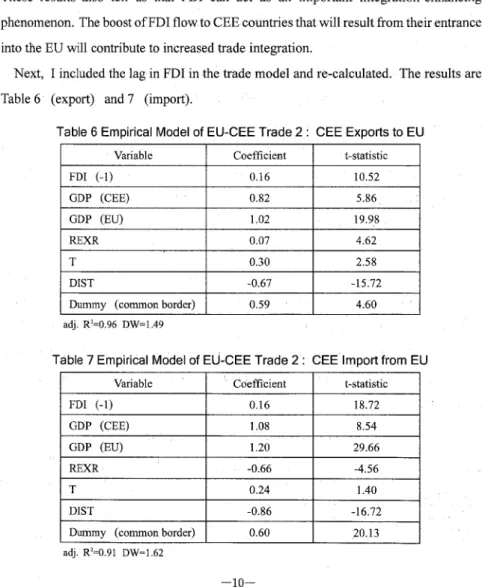
Next, 1 ingluded the lag in FPI in ・th6 trade model and re−calculated.・ The results・ are Table 6 (export) and 7 (import). i
Table 6 Empirical Model of EU−CEE Tia de 2 : CEE Exports to EU variable Coefficient .t.statistic
FDI(一D 0.16 .10.52
GPP(CEE)
0.82. 5.85 −GDP(耳U) LO2 lg.98.
REXR α07. 4.62
F
s 0.30 258
DIST 二〇.67 一15;72
Dum血y(common border) 0,59. . 4」60 一
adj, RI=O,96 DW=1,49
Table 7 EmPiridal Mddel of EU−CEE Trade 2 : CEE lmpbrt from EU variable ,Coe茄cien止 ■ ■
煤│statlst1C
FDI(一1) 0.16 18.72
GDP(CEE)
LO8 8.54GDP(耳U) 1.20 29.66.
二
qEXR.
一〇.66 456T 0.24. 1.40
DIST
一〇.86 一15.72Du田my(comロ10ロ. bor¢er) 0.60 20,.13
adj. R2:=O.91 DW=1.62
Trade and Foreign Direct lnvestment between the EU and the EU Accession Countries of EUrope
Interestingly, the effects of・a 1−percent increase in FDI are roughly the same on exports
・nd imp・質・・Thi・m・an・th・t a ch・・g・i・FDI丘・m th・EU t・th・CEE・・煎i・・i・
essentially balance−of−trade neutral ・and not likely to cause any pressure on exchange rates, other factors being equal.
Finaily, the EU−CEE trade balance scenario presented herein includes the elasticities estimated above. The scenario also assufries that economic growth in the EU and CEE countries will accelerate at a constant annual rate of 3.5 percent while other variables being constant. The results are as follows :
Table 8 Trade Balance to EU (O/o of GDP>
2005. 2007.
Czech R。public. 1.7% L9%
Estonia 1.0% 1.4.%
H㎜gary
0.9% 1.3%Latvia 一〇.8% 一〇,5%
Lithuania 一〇.8% 一〇5%
Poiand 1.8% 2.1%
Slovak 一〇.4% 一〇3%
Slovenia 1.4% 16%
The data predict improvement in trade balarice fot the CEE countties. However, it will be difficult for each CEE country to c4tch up with the GDP per capita in the EU.
6. POLICY IMPLICATION$
Many consider the EU to be a successfu1 example ofregional integrati.on. From this standpoint, enlargement of the EU following completion of the single market 4nd the eStablishment ofthe economic .and monetary union will have an importarit impact on the global economy.
The results of this present study suggest some important policy recommendations.
First,・the data confirm that FDI increase both imports ahd exports in the CEE couhtries.
Second, the increase in exports as.sociated with increased FDI.is a little larger than the increa・e. i・imp・丘・T Acc・・di・g.t・my・al・ul・ti・n・….EU accessig・.b「i gs 9「eate「
integration fbr the CEE countries, the balance oftrade between the current EU countries and the CEE countries should.show improvement f士om the standpoint of the CEE
countrles.
In the early phase of catqhing up with developed countries and higher growth
・・mp・・gd with th・t・fth・m・・t imp・伽t t・ad・p・rtners,廿・d・dr負・it i・n・㎜al・Th…
the economic policy of the.govemment cannot be aimed at reducing the trade deficit withqμt causi戸g macroeconomic imbalances. On the export leve1, especially,
policymakers can use FDI promotion tool..Further liberalization of FDI will benefit national policies fbr CEE coμntries, although the benefits will not be substanlial in the sh.ort_run.
NOTES
l. See Svetlic and Rojec (1994)一 and Lankes and Venables (1996).
2. For Hyngary and Polapd, the sample period starts from 1995.
3, See Roll (1995) and Baldwin (1995).
4, See Murrell (1991,), and Harnilton and Winters (1992).
5, Foreign investors bring their local partners into their global network. The network is thus a very good starting point for developing trade relations (Kaminski, et, al,, 1996).
REFERENCES
Atur・p・n・・C・・ Pjank・v・S・and B・H・・㎞・n(1999)・ D・t・㎜i・・nt・・fl・tra−1ゆ・噂囲・b・tween り
.East andrWest Europe . Morld Bank Discussion Paper l O.
Atumpane, C.,1巧ankov, S. and B, Hoe㎞an(1999), Horizontal and撤ical In甘a−lndustry Trade
Trade and Foreign Direct lnvestment between the EU and the EU Accession Countries ofEurope
between Eastern Europe and the European Unionl . Meltwirtschaftliches Archiv 135,1,62−82,
Azrak, P. and K, Wynne (1995), Protectionism and Japanese Direct Investment in the United States . ノburnal()fPoli(ッModelling 17,3,293L305.
Bahmani−Oskooee, M. andT. Brooks (1999), CointegrationApproachto Estimating BilateralTrade Elasticities between U. S. apd Her Trading Partners . JnternationatEconomic Journal 13,4,119−128.
Baldwin, R.. (1995), The Eastern Enlargement ofthe European Union , European Economic Re iew
39,474−48L
Baldwin, R., Francois, J, and R. Portes (1997), The Costs and Benefils of Eastern Enlargement : The impact on the EU and Central Europe . Economic Policy April, . i27−176.
Bany, .F. and J. Bradley (1997), FDI and Trade: The lrish Host−Country Exberience . Econqmic Journal 107,4,1798−1811.
Broll, U. (1993), Foreign Production and lnternational Hedging in 4 Multinational Firm . Open Economies Review 4.425−432.
,
Broll, U. and J. Wahl (1993), Multinational Firm, Foreign Production and Hedging Behavior . Scottish Journal ofPolitical Economy 40,116−123.
Casario, M, (1996), North American Free Trade Agreement Bilateral Trade Effects . Contemporaiy Economic Policy 14,1,36−47.
Dangerfield, P. (2002), lntegrating the New Europe: What Role (lfany). Does CEFTA have? . In lngham, H. and M, lngham. (ed) EUExpansion to the East, Cheltenham:Edward Elgar, 44−58,
Dmoohowski, J.(1995), Foreign Direct Invest血ent in Central Europe ,Intereconomies, Nov/Dec.
Dunning, J. (1993), Multinational Enterprises and the.Global Economy, Harlow : Addison−Wesley.
Ellingsen, T. and K. Warneryd (1999), Foreign Direct lnvestment and the Politic41 Economy of Protection . Jnternational EcDnomie Review 40,2,357−379.
Faucompret, E., Konings, J. and H. Vandenbussche (1999), The lntegration ofCentral and Eastern Europe in the European Union : Trade and Labor Market Adjustment , Journal of vaorld Trade 33,6,121−145.
Fritz, H. and H.
goen (1999), The,Restrictiveness oftheEuropean Unign s Trade Policy toward Central and Eastem E㎜pe .Frankfurter Jnstitute/br. Transformation Studies bア勧9 P卯εr 9.
Gros, D, and A. Gonciarz (1996), A Note on the Trade Potential of Central and Eastern Europe . Eerropean Journal ofPolitical Economy 12,709−721;
Hamar, J, (1994), Foreign Direct lnvestment and Privatization in Hungary . Acta Oeconomica.
46,1−2,183−212.
Hamilton, C. and L, Winters (1992), OPening up lnternational Trade with Eastern Europe . Economic Poticy April, 79−116,
H・ny・, G・(1992), F・・eig・Di・ect l・…血・nt・nd PriY・ti・ati・・.i・C・・t・al. End E・・t・m E…P・ ・ Communist Economies andEconomic Transformation 4i4,501−511 .
Ibolya, G. (2002), The Design ofthe EU after Enlatgement: Customs Union or Comrnon Market with New Members. ..ノburnal ofEconomic Jntegratわη17,2,243−261.
Jakab, Z. M., Koyacs, M, A. and A, Oszlay (2000), How Far Has Trade lntegration・Advanced?
An Analysis of Actual and Potential Trade of Three /Central and Eastern European Countries . National Bank ofHorngary Morking Paper 2000f1 ,
Kaminski, B., Wang, Z. and.ん.Wlnters(1996),「Export Performance、 in Transition Economies . Economic Policy Octdber, 423−442.
Krqgman,・ ・P. (1991), lnereasing Returns and Ec6nomic Geography . 」ournal ofPolitical Economy
99.3.483−499,
:vl
Krugman, P. and A.・Venqblgs (1995), The Seamless World. A Spatial Model.of lnternational Specialization . NBER urorking Paper 5520.
Lane, S, (1994), The・Pattem ofFo;eign Direct lnvestment and Joint・Ventures in Hungary . Coinmunist Econo〃lies andEcono那ic TranEノわr〃2ation 6,3,341−365.
Lankes・, H, and A. Venables (1996), Foreign Direct lnvestment in Economic Transition: The Changing Pattern Qf lnvestments , Economics ofTransition 4,2,331−347,
Mann, C. (1991), lndustry Restructuring in East−Central Europe : The Challenging and the Role fer Foreign lnvestment . American Economic Revieiv 81,2,181−1 84.
Meyer, K. and C: Pind (1999), . The Slow Growth of Foreign Direct lnvestment in the Soviet Union Successor States , Economics ofTransition 7,・1,201−214.
Murrell, P, i1991), fThe Effects of Multinationals Foreigfi Direct investment on the Level of Eastem European Trade . Economics ofPlanning 24,3,151−160.
O Sullivan, P. (1993), An Assessment of lreland s Export−Led Growth Strategy via Foreign Direct Investment: 1960−1980 . Meltwirtschaftliches Archiv 129,1,!39−158.
Pfaffermayr, M. (1996), Foreign outward Direct lnvestment and Exports.in Austrian Manufacturing : Substitutes or Complements? . Meltwirtschaftliches Archiv 132,3,510−522.
Rollo,J.(1995), EU Enlargement and the World Trade System .European Economic Review 39,467−473.
Svetlicic, M. ≠獅п@M.. Rojec (1994), Foreign
cireet lnvestment and the Transformation of Central European Economies . Management lnternational Review 34 (4), 293−312.
Trade and Foreign Direct lnvestment between the EU and the EU Accession Countries of Europe
UNCTAD (1994) Morld 1加estmentReport.
Van Aarle, B. (1996), The lmpact ofthe Single Market Program on Trade and Foreign Direct lnvestment in the EU .ノ∂urnal〔ゾ〃b〃d Trade 30,6,121−138.
Van Aarle, B. and A, Skuratowicz (2002), Trade and Foreign Direct Investment Flows between the EU and Central and Eastern Europe : Possible Effects of EU Enlargement . in Karadeloglou, P.,
Enlarging the EU, Palgrave: MacMillan,
Welfens, P. (1996), Market−Oriented Systemic Transformations in Eastern Europe, Berlin : Springer Verlag.
Zhang, Z. and O. Hock (1996), Trade lnterdependence and Direct Foreign lnvestment between ASEAN and China , Morld Development 24,1,155−170.