Recently, Mizoguchi (2011), using typicality probability, showed that the skull of Keilor, an Australian Pleistocene individual, resembled those of the Jomon people in Japan more than those of Minatogawa I from Okinawa and Liu- jiang from southern China. However, based on this limited comparison, it is difficult to say that the Australian Pleistocene population is phyloge- netically more similar to the Jomon than to other Late Pleistocene and early Holocene populations in the Asian and Australasian region. In order to increase the robusticity of the statistical compar- isons, and allow for the morphological variation
within Pleistocene Australians (PA), it would be best to include all of the PA crania with adequate preservation. However, phylogenetic compar- isons involving a large proportion of the Aus- tralian sample are complicated by the affects of neurocranial deformation, which may also extend to the orofacial skeleton and basicranium.
The largest sample from Australian Pleis- tocene, Coobool Creek (Brown, 1981, 1989) is potentially ideal for conducting an analysis on the phylogenetic relation between the Pleistocene Australian and the Jomon populations. Unfortu- nately, however, about 40% of the well-preserved
Identifying the Influence of Artificial Neurocranial Deformation on Craniofacial Dimensions
Peter Brown1and Yuji Mizoguchi2
1Department of Palaeoanthropology, CO2, LG 116, University of New England Armidale, NSW 2351, Australia
E-mail: [email protected]
2Department of Anthropology, National Museum of Nature and Science 4–1–1 Amakubo, Tsukuba-shi, Ibaraki 305–0005, Japan
E-mail: [email protected]
Abstract When the normal shape of a neurocranium has been altered by cranial deformation many craniofacial measurements can be affected. But, if those measurements less affected by such deformation are identified, they may then become useful in determining the phylogenetic positions of the populations in which artificial neurocranial deformation had been practiced. Univariate com- parisons in means between undeformed and deformed skull groups in three American Native pop- ulations and the principal component analyses of direct associations between craniofacial measure- ments and the degree of neurocranial deformation showed that some of the craniofacial measure- ments are particularly strongly influenced by neurocranial deformation. As a result of excluding such measurements, five sets of craniofacial measurements relatively free of deformation were ob- tained for the classification of an Australian Pleistocene sample from Coobool Creek. The Maha- lanobis’ D2distances between the undeformed and deformed skull groups in Coobool Creek esti- mated using the five sets of variables are not significantly different from zero. The typicality proba- bilities calculated using the three sets of variables showing the highest probabilities for the null hy- pothesis of D2 show that Keilor, an Australian Pleistocene individual, belongs to the Coobool Creek population, containing both undeformed and deformed individuals, at the typicality proba- bility of 0.62 to 0.80. If the variables significantly or relatively strongly affected by deformation are excluded from the sets of variables to be used, the sets of remaining variables may be used to rea- sonably classify the relevant populations.
Key words : Artificial cranial deformation, American Natives, Coobool Creek, Keilor, Typicality probability
Coobool Creek cranial sample, as well as those from the nearby Pleistocene sites at Kow Swamp and Nacurrie, were artificially deformed during infancy (Brown, 1989, 2010).
Up to the present, many researchers have ex- amined the influence of artificial neurocranial de- formation on other substructures such as the face, cranial base, etc. to clarify real phylogenetic relationships between populations, some of which have the tradition of artificial cranial de- formation (Brown, 1981, 1989; Droessler, 1981;
Anton, 1989; Suzuki et al., 1993; Anton and We- instein, 1999; Rhode and Arriaza, 2006; Arnold et al., 2008), or to understand the role of biome- chanical forces in craniofacial morphogenesis (Schendel et al., 1980; Mizoguchi, 1991;
Cheverud et al., 1992; Kohn et al., 1993, 1995;
Sardi et al., 2006; Pomeroy et al., 2010; Cocilovo et al., 2011). Consequently, some authors report- ed that facial measurements are not or only slightly affected by artificial neurocranial defor- mation (Droessler, 1981; Mizoguchi, 1991; Kohn et al., 1995; Suzuki et al., 1993; Sardi et al., 2006; Pomeroy et al., 2010), while others main- tained that both neurocranial and facial measure- ments are influenced to a considerable extent (Schendel et al., 1980; Anton, 1989; Cheverud et al., 1992; Kohn et al., 1993; Rhode and Arriaza, 2006; Arnold et al., 2008; Cocilovo et al., 2011).
The present study is an attempt to find sets of craniofacial measurements that are either unaf- fected, or only slightly affected, by neurocranial deformation and are therefore suitable for phylo- genetic comparisons. Once identified, these di- mensions will be used to determine biological affinities between Australian terminal Pleistocene or early Holocene populations and other various populations, as well as in future tests of phyloge- netic relationships. For the initial testing of pro- cedures and identification of dimensions influ- enced by neurocranial deformation three relative- ly large samples from the Americas are utilized.
They are larger than the largest of Australian ter- minal Pleistocene and early Holocene samples, i.e., the Coobool Creek sample.
Materials
The data used here are raw measurements of deformed and undeformed skulls reported by MacCurdy (1923), Oetteking (1930), and Droessler (1981). Although these authors listed linear and angular measurements as well as in- dices, the variables analyzed here are only cran- iofacial linear measurements.
MacCurdy (1923) described the characteristics of ancient Peruvians from the highlands north- west of Cuzco. The skeletal remains were col- lected from caverns in several localities, but the “stock is apparently the same as that which left its remains in the caves and chaukallas [dwellings or funeral parlors] of the provinces of Yauyos and Huarochiri in the direction of Lima.”
The number of linear measurements analyzed here is 26 (Table 1). The sample size is 69 for the undeformed skulls and 44 for the deformed skulls in males, and, in females, 40 for the unde- formed and 42 for the deformed.
The materials reported by Oetteking (1930) are derived from the North Pacific coast of North America. They consist of the four series that had been collected by 1913: the undeformed, the Cowichan deformation, the Chinook deforma- tion, and the Koskimo deformation series. The Cowichan and Chinook have the anteroposterior form of deformation, while the Koskimo have the conical form of deformation. The undeformed series is the same one as that used in Mizoguchi (1991), namely, American Natives (the Haida and Salish tribes) from the North Pacific coast. The variables used are 18 craniofacial linear measure- ments (Table 2). The sample size is 44 for the un- deformed, 110 for the Cowichan, 58 for the Chi- nook, and 111 for the Koskimo series in males;
and 25 for the undeformed, 33 for the Cowichan, 26 for the Chinook, and 38 for the Koskimo se- ries in females.
Droessler (1981) examined the patterns of bio- logical variations in American Natives from the Late Woodland and Mississippian periods who lived in the west-central Illinois region from about A.D. 600 to A.D.1300. In the present study,
Table1.Significance tests for the differences in means between the undeformed and deformed skull groups of ancient Peruvians.1 MaleFemale VariableUndeformed skullsDeformed skullsUndeformed skullsDeformed skulls t-valuet-valuet-valuet-value MeannMeannMeannMeann Length179.467 173.4 24 4.96***5.25***169.536170.0 210.370.36 Breadth135.566 133.5 24 1.892.05*130.136128.3 211.351.27 Basi-bregmatic height137.167 136.0 24 0.831.01128.636129.8 210.850.84 Cubic root of capacity111.564 110.3 44 2.08*2.12*106.739106.7 420.010.01 Maximum circumference497.566 481.6 23 5.12***5.68***475.635474.3 210.370.35 Nasion-opisthion arc365.768 365.3 43 0.190.19352.040354.1 410.790.79 Thickness of left parietal4.769 4.5 44 0.991.065.1404.7 421.381.37 Nasion prosthion67.765 68.3 37 0.690.6963.13163.2 370.110.12 Maximum bizygomatic diameter134.858 132.5 35 1.861.85122.929123.5 330.630.62 Minimum frontal diameter92.469 90.0 44 2.90**2.89**87.04087.5 420.580.58 Breadth of orbit (R.)37.167 36.3 42 2.73**2.78**35.23735.4 380.590.59 Height of orbit (R.)34.767 35.3 41 1.561.4633.53834.5 382.31*2.31* Length of nose49.368 49.0 43 0.530.5645.73946.1 400.510.51 Breadth of nose24.268 24.4 42 0.460.4923.33823.8 381.001.00 Basion to sub-nasal point88.168 87.5 43 0.820.8783.73884.0 400.440.44 Breadth between orbits24.369 24.4 42 0.170.1722.23922.8 411.161.16 Basion to prosthion96.666 95.5 37 1.171.2592.23092.5 380.340.34 Basion to akanthion94.368 93.2 43 1.261.3488.73789.1 400.530.52 Basion to nasion99.269 97.8 44 1.771.8993.43993.5 410.040.04 Prosthion to akanthion20.565 20.7 37 0.440.4219.03018.8 380.270.27 Length of palate45.661 45.1 37 1.041.0843.63143.6 360.010.01 Breadth of palate40.753 39.8 27 1.471.5237.72838.1 260.550.55 Prosthion to sub-nasal point19.864 19.8 37 0.000.0018.43118.3 380.250.24 Mean diameter of foramen magnum33.068 32.2 43 1.761.8630.03730.4 420.830.83 Dental arch length52.759 51.8 35 1.481.4550.42849.9 350.730.72 Dental arch breadth64.552 63.1 27 1.781.8959.82960.0 270.200.19 1Data source: MacCurdy (1923). *P0.05; **P0.01; ***P0.001, by a two-tailed test.
Table2.Significance tests for the differences in means between the undeformed and deformed skull groups of American Natives from the North Pacific coast.1 MaleFemale VariableUndeformed skullsDeformed skullsUndeformed skullsDeformed skulls t-valuet-valuet-valuet-value MeannMeannMeannMeann UNDEFORMED vs. COWICHAN Length 180.834169.5 827.48***7.16***168.620161.8 273.41**3.63** Breadth 142.934151.0 815.21***6.15***137.420144.4 273.68***3.92*** Height (ba-b) 134.631131.6 732.31*2.24*128.920126.4 251.351.33 Median-sagittal frontal chord 112.335111.0 871.301.20106.920107.0 290.100.11 Median-sagittal parietal chord 104.23396.5 835.16***4.60***102.22090.8 285.24***5.55*** Median-sagittal occipital chord98.43396.2 761.541.5991.71996.0 252.52*2.55* Cranial base length (n-ba)104.23299.5 734.58***4.94***97.32094.1 253.02**3.05** Length of foramen magnum 35.73034.2 702.68**2.91**34.11933.4 240.970.97 Width of foramen magnum 30.12929.7 700.830.8128.61928.8 240.270.28 Facial length (ba-pr)102.929101.8 681.011.0197.41897.1 210.150.15 Upper facial height (n-pr) 73.63372.8 800.880.9568.81968.7 260.140.13 Bizygomatic breadth141.127142.8 651.011.14129.120133.2 172.33*2.36* Orbital width (mf-ek) 44.33443.5 851.871.7841.12141.9 271.551.55 Orbital height 35.53436.1 851.391.4234.22036.0 273.80***3.68** Nasal width25.43124.2 832.90**2.75**24.11923.7 270.830.81 Nasal height52.13351.9 830.300.3348.21948.9 271.081.09 Maxillo-alveolar length 54.13054.3 780.350.3451.41951.7 260.270.27 Maxillo-alveolar breadth66.13063.8 782.75**2.94**61.51960.3 271.151.10 UNDEFORMED vs. CHINOOK Length 180.834166.7 589.82***9.05***168.620160.9 254.59***4.67*** Breadth 142.934156.2 5810.28***10.65***137.420149.8 257.09***7.33*** Height (ba-b) 134.631128.8 574.11***4.07***128.920121.5 243.55***3.58** Median-sagittal frontal chord 112.335112.6 580.240.23106.920107.1 250.180.18 Median-sagittal parietal chord 104.23391.2 588.13***7.56***102.22087.7 259.26***9.02*** Median-sagittal occipital chord98.43399.1 570.590.5691.71996.7 242.74**2.79* Cranial base length (n-ba)104.23298.6 576.03***6.04***97.32092.9 243.20**3.32** Length of foramen magnum 35.73034.3 572.72**2.83**34.11932.8 242.19*2.12* Width of foramen magnum 30.12930.4 570.690.6328.61929.1 240.850.85 Facial length (ba-pr)102.929101.7 560.991.0397.41897.1 240.190.19 Upper facial height (n-pr) 73.63373.6 560.080.0868.81969.2 250.300.29 Bizygomatic breadth141.127141.4 570.260.25129.120132.6 242.23*2.20* Orbital width (mf-ek) 44.33443.8 571.131.0541.12142.0 251.671.70 Orbital height 35.53436.3 572.16*2.03*34.22036.3 253.85***3.86*** Nasal width25.43124.2 572.76**2.67*24.11922.7 252.57*2.55*
Table2.(continued). MaleFemale VariableUndeformed skullsDeformed skullsUndeformed skullsDeformed skulls t-valuet-valuet-valuet-value MeannMeannMeannMeann UNDEFORMED vs. CHINOOK Nasal height52.13353.4 572.25*2.23*48.21949.6 251.711.81 Maxillo-alveolar length 54.13054.2 520.130.1351.41950.6 250.910.89 Maxillo-alveolar breadth66.13066.5 510.420.4161.51962.9 231.391.33 UNDEFORMED vs. KOSKIMO Length 180.834183.2 1031.811.63168.620174.5 383.71***3.93*** Breadth 142.934139.6 1022.97**3.04**137.420134.0 382.75**2.64* Height (ba-b) 134.631131.9 1012.48*2.14*128.920126.6 361.511.38 Median-sagittal frontal chord 112.335115.1 1042.84**2.66*106.920110.9 383.17**3.30** Median-sagittal parietal chord 104.233105.2 1030.800.65102.22099.8 381.341.39 Median-sagittal occipital chord98.433102.0 1022.61*2.74**91.719100.3 364.88***5.22*** Cranial base length (n-ba)104.232100.6 1014.68***4.37***97.32096.4 360.990.99 Length of foramen magnum 35.73034.5 1022.58*2.61*34.11932.8 362.12*2.13* Width of foramen magnum 30.12929.7 1020.940.8328.61928.4 350.380.38 Facial length (ba-pr)102.929100.9 992.17*2.0297.41898.0 330.480.48 Upper facial height (n-pr) 73.63376.5 1013.14**3.47**68.81973.4 333.76***3.46** Bizygomatic breadth141.127138.4 982.10*2.11*129.120129.8 360.460.45 Orbital width (mf-ek) 44.33444.3 1010.190.1941.12142.4 362.70**2.79* Orbital height 35.53437.6 1015.85***5.68***34.22036.6 364.63***4.72*** Nasal width25.43124.0 1013.72***3.29**24.11923.0 352.12*2.07 Nasal height52.13353.9 1023.08**3.19**48.21950.5 353.45**3.64** Maxillo-alveolar length 54.13054.1 990.020.0251.41951.8 330.350.36 Maxillo-alveolar breadth66.13065.2 971.151.2161.51962.1 320.600.57 1Data source: Oetteking (1930). *P0.05; **P0.01; ***P0.001, by a two-tailed test.
all the data reported by her were simply divided into two groups: the undeformed and deformed skull groups. The number of craniofacial linear measurements is 32 (Table 3). The sample size is 45 for the undeformed group and 113 for the de- formed group in males, and 42 for the unde- formed and 146 for the deformed in females.
Finally, 13 undeformed and 9 deformed male skulls from Coobool Creek as well as Keilor, Co- huna, Lake Nitchie, and Kow Swamp 5 (Brown, 1989, 2001) were used in order to confirm the ef- ficiency of the sets of variables less affected by neurocranial deformation in estimating more reli- able biological distances between samples/indi- viduals.
Previously, Durband (2008) attempted to iden- tify artificially deformed crania at Coobool Creek by comparing individual specimens of Coobool Creek and deformed Melanesian skulls using Mahalanobis’ D2distance and canonical analysis.
However, there is insufficient information on the Melanesian sample that he used as a criterion for regarding a Coobool Creek cranium as artificially deformed. If undeformed Melanesian crania are also taken into consideration in Durband’s scatter diagrams of the canonical variates used as a kind of criterion, it is possible that the diagrams may only show the original difference between the normal Melanesian and the Coobool Creek popu- lations, rather than reveal the difference between undeformed and deformed samples. In the pre- sent study, therefore, we adopted Brown’s (1989) simple criterion based on frontal curvature index for classifying Coobool Creek individuals into undeformed and deformed groups.
The variance/covariance matrices used in esti- mating Mahalanobis’ D2 distances between the Coobool Creek male undeformed and deformed sub-samples and other samples/specimens are mean within-group variance/covariance matrices obtained from 47 Murray Valley and 29 Swan- port Aboriginal males in Australia (Brown, 2001).
Methods
In order to exclude those variables strongly affected by neurocranial deformation from a set of craniofacial linear measurements, two proce- dures were followed. The first was a significance test for the difference in means between de- formed and undeformed groups using Student’s t-test for two means with equal variances and/or Cochran’s approximate significance test (t-test) for two means with different variances (Fisher, 1958; Snedecor and Cochran, 1967).
This was followed by a PCA or principal com- ponent analysis (Lawley and Maxwell, 1963;
Okuno et al., 1971, 1976; Takeuchi and Yanai, 1972) and the succeeding Kaiser’s normal vari- max rotation (Asano, 1971; Okuno et al., 1971) to identify patterns of association between di- mensions. Although these analyses are usually performed under the premise of multivariate nor- mal distribution, one or more variables of ordinal scale for the degree of deformation were added to a set of variables of interval scale, i.e., cranio- facial linear measurements in the present study.
This is a convenient way to find a gross tendency of the covariation between the degree of defor- mation and craniofacial measurements. The rea- sonability of the variables less affected by defor- mation selected in this way are confirmed later by practically testing the null hypothesis of Ma- halanobis’ D2distance (Rao, 1952; Okuno et al., 1976) between undeformed and deformed groups based on such variables.
The degree of neurocranial deformation in MacCurdy (1923) is defined as follows.
0: Not deformed,
1: Slightly or moderately deformed, or 2: Pronouncedly deformed.
In Oetteking (1930), two kinds of deformation are distinguished: Anteroposterior deformation and conical deformation. The degree of deforma- tion is expressed as follows for both of them.
0: Not deformed, or 1: Deformed.
Finally, in Droessler, (1981), four kinds of defor- mation were observed: Frontal flattening,
Table3.Significance tests for the differences in means between the undeformed and deformed skull groups of American Natives from west-central Illinois.1 MaleFemale VariableUndeformed skullsDeformed skullsUndeformed skullsDeformed skulls t-valuet-valuet-valuet-value MeannMeannMeannMeann Glabello-occipital length183.033180.7 1031.711.71172.125173.9 1351.361.77 Minimum frontal breadth94.53793.3 1071.291.3790.82990.5 1350.290.33 Frontal chord114.237112.9 1111.591.59108.833108.9 1410.050.05 Midfacial breadth99.341100.5 1021.411.2996.93395.9 1371.141.16 Internal biorbital breadth (IOB)98.73898.3 1010.580.5695.13294.9 1370.310.29 Subtense to IOB18.63518.7 1000.150.1517.02716.9 1310.190.17 Anterior interorbital breadth20.13219.5 931.471.5719.22919.3 1280.210.21 Orbital breadth, mf (left)42.23542.8 952.04*2.30*41.23041.2 1330.100.10 Orbital height (left)34.43234.5 960.430.4434.03034.2 1340.420.42 Nasal height53.03552.9 980.210.2050.63250.5 1250.210.22 Nasal breadth25.84225.8 980.210.2125.33225.7 1261.071.16 Dacryal chord21.53320.5 882.13*2.17*21.12820.6 1211.051.03 Minimum breadth of nasals9.2338.9 930.890.959.4319.3 1300.420.41 Breadth of nasal bridge60.33960.2 1020.200.2258.43458.7 1330.290.31 Biangular breadth103.729104.6 950.560.6194.13196.5 1152.16*2.24* Breadth of ascending ramus (left)33.64233.9 1070.550.5631.83832.5 1391.451.46 Length of mandible108.832107.4 911.181.24104.529104.3 1120.180.19 Breadth at mental foramen46.53346.5 1020.080.0945.33344.9 1320.740.77 Maximum condylar length (left)21.43521.1 930.720.6918.93219.1 1210.460.43 Malar length, inferior (left)33.14233.5 990.870.8730.23331.7 1252.89**2.74** Malar length, maximum (left)52.64253.8 981.972.03*49.73550.4 1251.291.33 Cheek height (left)23.64424.0 1060.980.9722.33921.8 1391.241.26 Length of occipital condyle (left)26.63526.3 870.630.6224.93124.7 1190.300.30 Breadth of occipital condyle (left)14.53514.1 881.311.2713.93614.0 1230.430.50 Biasterionic breadth107.733107.1 1010.720.69103.825104.3 1310.570.66 Frontal subtense23.03822.1 1082.06*2.19*22.82822.4 1410.710.73 Frontal subtense fraction50.93851.5 1080.941.0146.92848.4 1412.08*2.38* Parietal chord110.538110.9 1080.340.33105.733108.0 1462.40*2.28* Parietal subtense22.63624.3 1093.02**3.03**22.33123.3 1431.98*1.92 Occipital chord101.92899.9 961.591.4498.12498.1 1220.010.01 Mastoid breadth (left)33.24533.8 1111.050.9830.63930.6 1450.120.10 Mastoid length 2 (left)46.24446.6 1110.590.5742.94042.5 1440.600.59 1Data source: Droessler (1981). *P0.05; **P0.01; ***P0.001, by a two-tailed test.
bifrontal flattening, occipital flattening, and lambdoid flattening. The degree of the former three flattening is as follows.
0: Absent, 1: Slight, 2: Medium, or
3: Maximum or marked.
The degree of the last or lambdoid flattening is as follows.
0: Absent, 1 and 2: Slight, 3: Medium, or 4: Marked.
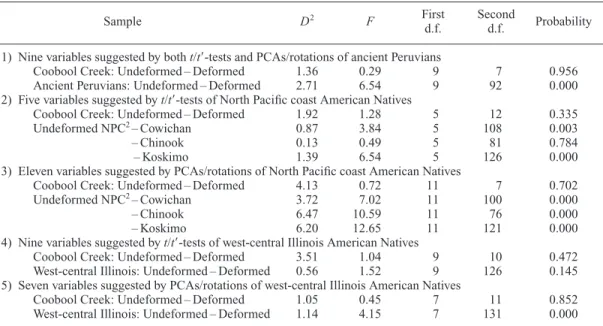
Using the sets of variables suggested to be rel- atively free of deformation by t- and/or t-tests as well as PCAs, Mahalanobis’ D2distance was es- timated between undeformed and deformed groups in each of the three samples from the Americas. The variance/covariance matrix neces- sary for the calculation of D2 distance was ob- tained from the undeformed group of each sam- ple. In practical calculations, however, theoreti- cally impossible estimates, i.e., negative esti- mates of D2distance may be obtained sometimes due mainly to sampling errors because of small sample size. In such a case, the variance/covari- ance matrix was replaced by the matrix recon- structed by excluding minor or trivial PCs, name- ly, by using the reduced number of principal components extracted from the original vari- ance/covariance matrix.
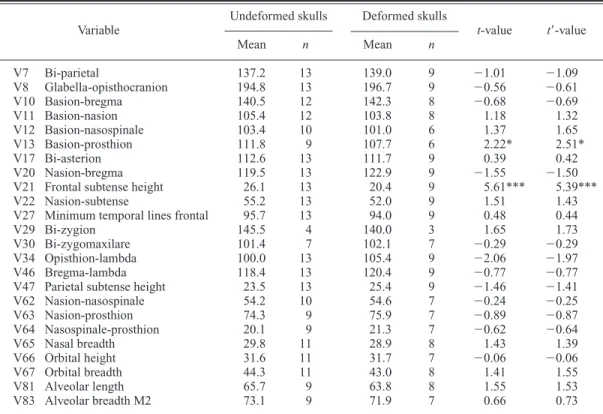
In the next step, variables common to the Coo- bool Creek male sample and the three respective samples were searched. The univariate differ- ences in means between undeformed and de- formed groups were examined also in Coobool Creek using t- and t-tests. In the comparisons based on the sets of variables relatively free of deformation in both Coobool Creek and any of the three samples, D2 distances were estimated using the mean within-group variance/covariance matrices obtained from two Australian Aborigi- nal male samples, Murray Valley and Swanport.
Finally, typicality probabilities of Australian Pleistocene specimens to the Coobool Creek population were estimated using those sets of
variables which show the highest probabilities for the null hypothesis of D2 between the unde- formed and deformed skull groups of Coobool Creek. The method used for estimating typicality probability is Campbell’s (1984) predictive ap- proach. As regards the sample size of a reference sample, the average sample size across variables of the Coobool Creek male sample, containing both undeformed and deformed individuals, was employed in practice under the assumption that it is the real sample size.
Statistical calculations were executed using programs written by Y.M. in FORTRAN:
BSFMD for estimating variances and covari- ances, COMCOV for calculating mean within- group variance/covariance matrices, STSTBT for Student’s t-test and Cochran’s approximate sig- nificance test (t-test), PCAFPP for PCA and Kaiser’s normal varimax rotation, TSTD2 for cal- culating Mahalanobis’ D2distance, and TYPPRB for estimating typicality probability.
The FORTRAN 77 compiler used is FTN77 for personal computers, provided by Salford Software Ltd. To increase efficiency during pro- gramming and calculation, a GUI for program- ming, CPad, provided by “kito,” was used.
Results
The results of Student’s t-tests and Cochran’s t-tests are shown in Table 1 for ancient Peru- vians, in Tables 2 for American Natives from the North Pacific coast, and in Table 3 for American Natives from the west-central Illinois region. The results of PCAs and the rotated solutions for these three samples are separately shown in Ta- bles 4 to 15.
Tables 16 to 18 collectively reveal the lists of variables suggested to be significantly or relative- ly strongly affected by neurocranial deformation through t- and/or t-tests as well as PCAs or the varimax rotations in the three samples. Using these lists, variables relatively free of deforma- tion were determined for each American Native sample. In Table 19, the D2 distances based on such variables relatively free of deformation are
Table4.Principal component analysis of the correlations between the degree of deformation and neurocranial linear measurements of ancient Peruvian males.1 Factor loadingsTotal Variablevariance PC IIIIIIIVVVIVIIVIIIIX(%) Degree of deformation0.22 0.32 0.34 0.13 0.63 0.09 0.22 0.24 0.03 80.16 Length0.72 0.47 0.10 0.13 0.23 0.09 0.07 0.11 0.02 83.77 Breadth0.51 0.48 0.00 0.20 0.29 0.05 0.22 0.11 0.04 68.30 Basi-bregmatic height0.64 0.22 0.13 0.08 0.05 0.04 0.49 0.01 0.07 72.46 Cubic root of capacity0.61 0.62 0.18 0.18 0.16 0.00 0.15 0.12 0.08 89.06 Maximum circumference0.71 0.62 0.07 0.14 0.13 0.10 0.01 0.13 0.02 95.13 Nasion-opisthion arc0.39 0.67 0.31 0.21 0.22 0.15 0.03 0.20 0.04 84.91 Thickness of left parietal0.03 0.20 0.09 0.33 0.30 0.04 0.28 0.32 0.65 85.67 Nasion Prosthion0.61 0.34 0.58 0.08 0.01 0.14 0.02 0.15 0.05 87.74 Maximum bizygomatic diameter0.74 0.09 0.01 0.08 0.01 0.12 0.21 0.00 0.20 65.17 Minimum frontal diameter0.58 0.34 0.05 0.50 0.14 0.17 0.13 0.06 0.16 80.03 Breadth of orbit (R.)0.50 0.15 0.18 0.05 0.48 0.05 0.20 0.31 0.23 73.91 Height of orbit (R.)0.25 0.19 0.47 0.21 0.11 0.35 0.26 0.12 0.27 65.64 Length of nose0.47 0.20 0.33 0.10 0.22 0.37 0.10 0.44 0.12 78.87 Breadth of nose0.46 0.07 0.21 0.55 0.36 0.07 0.03 0.15 0.03 72.40 Basion to sub-nasal point0.68 0.45 0.39 0.13 0.05 0.10 0.20 0.04 0.00 88.68 Breadth between orbits0.27 0.33 0.00 0.72 0.18 0.07 0.05 0.15 0.00 76.31 Basion to prosthion0.74 0.51 0.27 0.01 0.02 0.16 0.06 0.07 0.06 90.89 Basion to akanthion0.70 0.48 0.35 0.05 0.08 0.12 0.19 0.03 0.01 89.48 Basion to nasion0.80 0.20 0.01 0.10 0.21 0.02 0.34 0.05 0.15 87.19 Prosthion to akanthion0.50 0.28 0.61 0.02 0.13 0.20 0.05 0.33 0.27 93.84 Length of palate0.63 0.27 0.18 0.13 0.23 0.31 0.27 0.26 0.02 81.42 Breadth of palate0.57 0.00 0.28 0.03 0.13 0.56 0.13 0.15 0.16 79.58 Prosthion to sub-nasal point0.53 0.36 0.57 0.07 0.08 0.21 0.06 0.27 0.25 92.54 Mean diameter of foramen magnum0.39 0.14 0.17 0.16 0.13 0.29 0.22 0.09 0.38 52.60 Dental arch length0.58 0.33 0.24 0.30 0.15 0.22 0.32 0.25 0.01 82.91 Dental arch breadth0.59 0.05 0.32 0.13 0.31 0.42 0.25 0.20 0.01 84.64 Total contribution (%)31.71 12.78 8.81 5.93 5.45 4.59 4.18 3.79 3.64 80.86 Cumulative proportion (%)31.71 44.49 53.30 59.22 64.67 69.26 73.44 77.23 80.86 80.86 1 Data source: MacCurdy (1923). The sample size for correlation coefficients varies from 67 to 113.
Table5.Rotated solution of the first nine principal components extracted from the correlations between the degree of deformation and neurocranial linear measure- ments of ancient Peruvian males.1 Factor loadings Variable Fac IIIIIIIVVVIVIIVIIIIX Degree of deformation0.05 0.21 0.19 0.10 0.79 0.10 0.09 0.18 0.19 Length0.27 0.71 0.05 0.11 0.35 0.08 0.30 0.09 0.14 Breadth0.09 0.71 0.12 0.11 0.06 0.33 0.14 0.09 0.06 Basi-bregmatic height0.15 0.51 0.21 0.16 0.04 0.07 0.58 0.13 0.10 Cubic root of capacity0.06 0.86 0.16 0.16 0.08 0.17 0.21 0.04 0.14 Maximum circumference0.21 0.84 0.06 0.15 0.30 0.11 0.20 0.05 0.17 Nasion-opisthion arc0.08 0.90 0.08 0.07 0.13 0.07 0.02 0.09 0.04 Thickness of left parietal0.08 0.01 0.03 0.16 0.07 0.02 0.01 0.05 0.90 Nasion prosthion0.27 0.15 0.58 0.04 0.08 0.06 0.16 0.64 0.04 Maximum bizygomatic diameter0.35 0.38 0.11 0.28 0.27 0.33 0.01 0.33 0.06 Minimum frontal diameter0.13 0.39 0.11 0.66 0.40 0.01 0.01 0.14 0.07 Breadth of orbit (R.)0.18 0.04 0.34 0.08 0.69 0.04 0.02 0.31 0.12 Height of orbit (R.)0.05 0.06 0.21 0.15 0.09 0.11 0.18 0.73 0.02 Length of nose0.22 0.14 0.05 0.11 0.03 0.04 0.26 0.80 0.08 Breadth of nose0.21 0.08 0.09 0.72 0.07 0.35 0.09 0.08 0.04 Basion to sub-nasal point0.78 0.09 0.07 0.24 0.15 0.15 0.38 0.06 0.10 Breadth between orbits0.00 0.20 0.06 0.82 0.08 0.05 0.02 0.05 0.18 Basion to prosthion0.85 0.03 0.23 0.12 0.09 0.17 0.25 0.10 0.05 Basion to akanthion0.80 0.08 0.12 0.16 0.16 0.14 0.38 0.08 0.09 Basion to nasion0.47 0.17 0.22 0.25 0.27 0.07 0.52 0.34 0.21 Prosthion to akanthion0.14 0.11 0.94 0.08 0.02 0.04 0.05 0.13 0.02 Length of palate0.82 0.25 0.15 0.04 0.04 0.12 0.19 0.07 0.03 Breadth of palate0.21 0.13 0.00 0.11 0.08 0.80 0.21 0.15 0.06 Prosthion to sub-nasal point0.24 0.09 0.91 0.01 0.04 0.02 0.06 0.17 0.01 Mean diameter of foramen magnum0.07 0.20 0.03 0.09 0.10 0.37 0.53 0.04 0.21 Dental arch length0.82 0.20 0.10 0.15 0.01 0.19 0.18 0.08 0.05 Dental arch breadth0.34 0.19 0.05 0.08 0.03 0.82 0.01 0.07 0.11 1Data source: MacCurdy (1923). The sample size for correlation coefficients varies from 67 to 113.
Table6.Principal component analysis of the correlations between the degree of deformation and neurocranial linear measurements of ancient Peruvian females.1 Factor loadingsTotal Variablevariance PC IIIIIIIVVVIVIIVIIIIX(%) Degree of deformation0.12 0.03 0.01 0.49 0.26 0.42 0.10 0.24 0.19 60.56 Length0.66 0.21 0.41 0.21 0.14 0.16 0.15 0.21 0.19 84.64 Breadth0.49 0.42 0.09 0.26 0.24 0.37 0.09 0.16 0.02 71.96 Basi-bregmatic height0.45 0.39 0.24 0.20 0.34 0.11 0.10 0.07 0.45 79.93 Cubic root of capacity0.78 0.42 0.18 0.10 0.03 0.07 0.25 0.18 0.09 93.91 Maximum circumference0.73 0.28 0.39 0.28 0.08 0.13 0.12 0.16 0.15 92.59 Nasion-opisthion arc0.71 0.28 0.33 0.20 0.04 0.34 0.02 0.03 0.06 85.43 Thickness of left parietal0.18 0.01 0.57 0.34 0.13 0.19 0.06 0.55 0.15 85.02 Nasion prosthion0.48 0.52 0.54 0.06 0.03 0.02 0.35 0.05 0.07 91.89 Maximum bizygomatic diameter0.68 0.02 0.23 0.20 0.02 0.34 0.14 0.24 0.00 74.92 Minimum frontal diameter0.67 0.02 0.14 0.01 0.36 0.23 0.04 0.06 0.27 72.84 Breadth of orbit (R.)0.54 0.17 0.14 0.29 0.10 0.27 0.33 0.29 0.04 70.82 Height of orbit (R.)0.24 0.33 0.16 0.61 0.07 0.32 0.01 0.16 0.15 72.34 Length of nose0.27 0.50 0.03 0.37 0.08 0.25 0.42 0.02 0.20 75.12 Breadth of nose0.29 0.47 0.13 0.20 0.44 0.32 0.12 0.08 0.17 70.52 Basion to sub-nasal point0.63 0.60 0.04 0.09 0.28 0.24 0.08 0.00 0.02 90.16 Breadth between orbits0.50 0.32 0.15 0.02 0.30 0.16 0.40 0.03 0.38 79.65 Basion to prosthion0.68 0.57 0.15 0.01 0.13 0.07 0.05 0.12 0.11 86.05 Basion to akanthion0.63 0.51 0.07 0.08 0.41 0.10 0.02 0.14 0.08 86.50 Basion to nasion0.67 0.06 0.03 0.23 0.49 0.03 0.08 0.10 0.32 87.53 Prosthion to akanthion0.36 0.20 0.75 0.33 0.17 0.24 0.04 0.03 0.11 93.04 Length of palate0.60 0.35 0.22 0.09 0.04 0.33 0.11 0.21 0.16 73.79 Breadth of palate0.71 0.01 0.05 0.13 0.38 0.15 0.09 0.23 0.07 74.83 Prosthion to sub-nasal point0.35 0.19 0.79 0.31 0.09 0.23 0.08 0.04 0.11 95.84 Mean diameter of foramen magnum0.32 0.02 0.15 0.40 0.29 0.07 0.52 0.19 0.09 69.41 Dental arch length0.64 0.30 0.24 0.16 0.24 0.12 0.04 0.14 0.25 73.11 Dental arch breadth0.77 0.21 0.04 0.17 0.26 0.05 0.20 0.25 0.03 83.27 Total contribution (%)31.08 10.94 9.78 6.78 5.95 5.20 4.05 3.47 3.34 80.58 Cumulative proportion (%)31.08 42.01 51.79 58.57 64.52 69.72 73.77 77.24 80.58 80.58 1Data source: MacCurdy (1923). The sample size for correlation coefficients varies from 38 to 82.