Genetic Diversity of Saxifraga acerifolia and S. fortunei Based on Nuclear and Chloroplast Microsatellite Markers
Kana Magota
1,* , Shota Sakaguchi
1, Kensei Akai
2, Yuji Isagi
3, Yoshinori Murai
4and Hiroaki Setoguchi
11
Graduate School of Human and Environmental Studies, Kyoto University, Yoshida Nihonmatsu-cho, Sakyo-ku, Kyoto, Kyoto 606–8501, Japan,
2
Okinawa Churashima Foundation Research Center, Motobu-cho Ishikawa 888, Kunigami-gun, Okinawa 905–0206, Japan
3
Graduate School of Agriculture, Kyoto University, Kitashirakawa Oiwake-cho, Sakyo-ku, Kyoto, Kyoto 606–8502, Japan
4
Department of Botany, National Museum of Nature and Science, Amakubo 4–1–1, Tsukuba, Ibaraki 305–0005, Japan
* E-mail: [email protected] (Received 26 January 2018; accepted 28 March 2018)
Abstract Saxifraga acerifolia is a perennial herb endemic to rock wall surfaces of waterfalls with splashing water located in two gorges in Japan. The unique habitat of this plant caused popu- lation fragmentation and population size contraction leading to a bottleneck effect. This species is designated as an endangered plant: Category II on the Japanese Red List. Based on molecular phy- logenic study, the sister species were Saxifraga fortunei distributed wider range over Japan Archi- pelago. To evaluate their genetic diversity, we developed nuclear and chloroplast microsatellite markers based on the genomic DNA sequence and the reconstructed chloroplast genome sequence of Saxifraga acerifolia. Four polymorphic nuclear markers and seven polymorphic chloroplast markers were obtained. Analyses using the seven chloroplast microsatellite markers, six and 13 haplotypes were detected in Saxifraga acerifolia and S. fortunei, respectively. The lower haplotype diversity in Saxifraga acerifolia would be due to the narrower distribution range compared with S. fortunei and/or the past bottleneck effect of the extant small population.
Key words : chloroplast genome, endangered species, haplotype network, microsatellite, popula- tion genetics, Saxifraga.
Introduction
The genus Saxifraga sect. Irregulares is well characterized by zygomorphic flowers with two elongated petals, whereas other sections have actinomorphic flowers with five isometric petals.
A molecular phylogeny supports the monophyly of this section comprised of approximately 13 species, which ranges from southwestern China to Sakhalin through the Japanese islands (Tkach et al., 2015).
Saxifraga acerifolia Wakabayashi et Satomi is a perennial herb that is confined to two gorges in
Fukui and Ishikawa Prefectures in Japan at an elevation of 500–600 m. This species inhabits rocks in waterfalls with splashing water. The unique growing environment of this plant has led to population fragmentation, that may cause a genetic bottleneck effect on isolated populations.
Due to its very narrow range, Saxifraga acerifo-
lia has been designated as a Category II endan-
gered plant (Ministry of the Environment, 2017)
and as “Critically Endangered” on the regional
Red Lists (Ishikawa Prefecture, 2010; Fukui Pre-
fecture, 2016). Therefore, investigating its
genetic diversity parameters, and evaluating the
genetic differences between the populations in the two gorges, will provide valuable information for its conservation and to understand the popu- lation demography of this endangered plant with a unique habitat.
Based on our molecular phylogenetic study (Magota et al., unpublished), Saxifraga acerifolia forms a clade together with its sister species of S. fortunei, a wide-ranging and common species across the Japanese islands and adjacent regions.
Thus, the phylogenetic relationship can provide an opportunity to compare the genetic diversity levels and spatial genetic structures of these spe- cies with contrasting distribution ranges. To do so, there is a need for development of genetic markers that can be cross-amplified between the species. Here, we report a set of novel nuclear and chloroplast microsatellite (SSR; simple sequence repeat) markers for Saxifraga acerifolia based on its genomic DNA sequence, and detected chloroplast haplotypes to investigate the genetic diversity in S. acerifolia and S. fortunei.
Evaluation of haplotype diversity of the endan- gered Saxifraga acerifolia will provide valuable information to its protection.
Materials and Methods DNA extraction and Ion PGM sequencing
Saxifraga acerifolia leaf material was col- lected from an individual cultivated at Yoshida Campus, Kyoto University, Kyoto, Japan (voucher accession number KYO 00037497, deposited in Kyoto University Herbarium).
Genomic DNA was extracted from dried leaf samples using the cetyl trimethylammonium bro- mide (CTAB) method (Doyle and Doyle, 1987), after washing the leaf powder twice with HEPES buffer (pH=8.0; Setoguchi and Ohba, 1995). A total of 50 ng of DNA was used to construct DNA fragment libraries using the Ion Xpress Plus Fragment Library Kit, following the manu- facturerʼs protocol (Thermo Fisher Scientific, Waltham, MA, USA). Template ion sphere parti- cles were prepared using an Ion PGM Hi-Q OT2 Kit on the Ion OneTouch 2 system (Thermo
Fisher Scientific). The Ion OneTouch ES system was used to enrich template-positive particles.
The particles were run on Ion 318 chips and sequenced using an Ion PGM Sequencer (Thermo Fisher Scientific).
Reconstruction and annotation of the chloroplast genome sequence of Saxifraga acerifolia
A total of 271,064 raw reads (average 190.3 bp) were imported into CLC Genomics Workbench version 7.5.1 software (CLC bio, Aarhus, Den- mark), and 271,063 cleaned reads (average 179.8 bp) were obtained after quality-based trim- ming (quality limit=0.03). The cleaned reads were assembled using MITObim version 1.8 soft- ware (Hahn et al., 2013) with the complete chloro- plast genomic sequence of Sedum sarmentosum (GenBank accession no. NC023085) as the refer- ence. The annotation analysis was performed using the CPGAVAS Anno Genome module (Liu et al., 2012) with a cut-off BLASTN E-value of 1×10
−10. Inverted repeat sequences were detected using REPuter with default parameters (Kurtz et al., 2001). A circular map was obtained using OGDRAW (Lohse et al., 2013).
Development of SSR markers
To develop nuclear SSR markers, we screened microsatellite regions including ≥5 dinucleotide,
≥5 trinucleotide, and ≥4 tetranucleotide repeats, using MSATCOMMANDER (Faircloth, 2008). A total of 421 microsatellite motifs were found:
271 of dinucleotide (5–20 repeats), 127 of trinu- cleotide (5–17 repeats), and 23 of tetranucleotide (4–6 repeats) (Fig. 1), suggesting low genetic diversity. We designed 120 PCR primers using MSATCOMMANDER with the following condi- tions: primer size of 15–30 bp, annealing temper- ature of 57–62°C, GC content of 30–70%, and an expected amplicon size of 50–450 bp.
To develop chloroplast SSR markers, we
screened chloroplast microsatellite regions includ-
ing ≥10 mononucleotide repeats, using MSAT-
COMMANDER, and found 35 loci. We designed
20 PCR primer pairs for these regions using
Primer3 (Rozen and Skaletsky, 2000) with the fol-
lowing conditions: primer size of 18–20 bp, annealing temperature of 58–62°C, GC content of 30–70%, and an expected amplicon size of 100–
400 bp. An M13-tail sequence (5′-CACGACGTT- GTAAAACGAC-3′, 5′-TGTGGAATTGTGAG- CGG-3′, 5′-CTATAGGGCACGCGTGGT-3′, or 5′-CGGAGAGCCGAGAGGTG-3′) was added to all forward primers to construct multiplex sequences, and a PIG-tail sequence (5′-GTTT- CTT-3′) was added to all reverse primers.
We used 16 Saxifraga acerifolia individuals from the two populations to evaluate polymor- phisms of these microsatellite loci. Furthermore, we used 15 Saxifraga fortunei individuals rang- ing across Japan (Table 1) to check the versatility of the designed markers. The total PCR reaction volume was 5 μl, containing approximately 0.5 ng DNA, 2.5 μl of 2× QIAGEN Multiplex PCR Master Mix (Qiagen, Hilden, Germany), 0.01 μM of forward primer, 0.2 μM of reverse primer, and 0.1 μM of fluorescence-labeled M13 primer. The PCR thermal profile was set as follows: an initial denaturation at 95°C for 3 min, followed by 35 cycles of 95°C for 30 s, 58°C for 3 min, 68°C for 1 min, and then a final extension at 68°C for 20 min. Amplified PCR products were loaded onto an ABI 3130xl Genetic Analyzer (Applied
Biosystems, Carlsbad, California, USA), and the fragment length was determined using Gene- Mapper software (Applied Biosystems). To eval- uate the polymorphisms of the markers and the genetic diversity, we calculated the number of alleles per locus, the observed heterozygosity (H
O), the expected heterozygosity (H
E) for the nuclear markers, and the number of alleles per locus and unbiased diversity (uh) for the chloro- plast markers, using GenAlex version 6.503 soft-
Table 1. Localities of Saxifraga fortunei samples used in this study. The geographic information of the two S. acerifolia populations is not shown here, because the species is threatened by illegal digging.
Sampling locality Latitude Longitude 1 Yufutsu, Hokkaido 42°33′49″N 142°12′52″E 2 Tsuruoka, Yamagata 38°31′52″N 139°57′23″E 3 Kimitsu, Chiba 35°06′55″N 139°35′35″E 4 Ina, Nagano 35°32′58″N 138°07′05″E 5 Hakuba, Nagano 36°39′53″N 137°48′50″E 6 Okazaki, Aichi 34°33′17″N 137°14′39″E 7 Sakai, Fukui 36°08′05″N 136°22′30″E 8 Matsuzaka, Mie 34°20′44″N 136°08′52″E 9 Higashimuro, Wakayama 33°40′34″N 135°53′16″E 10 Nantan, Kyoto 35°18′37″N 135°43′00″E 11 Takahama, Fukui 35°18′06″N 135°17′24″E 12 Fukuchiyama, Kyoto 35°15′17″N 135°05′29″E 13 Muroto, Kochi 33°20′26″N 134°07′51″E 14 Koyu, Miyazaki 32°10′24″N 131°16′53″E 15 Yakushima Island, Kagoshima 30°18′17″N 130°34′13″E Fig. 1. Number of microsatellite motifs selected to develop PCR primers on the genome of Saxifraga acerifolia.
107 of 271 dinucleotide repeat, 13 of 127 trinucleotide repeat, and two of 13 tetranucleotide repeat motifs were
selected to develop PCR primers. The vertical line shows the number of microsatellite motifs and the horizontal
line shows the repeat number of microsatellite motifs. The light gray and dark gray bars indicate the number of
all detected microsatellite motifs and the motifs that were selected for developing PCR primers, respectively.
ware (Peakall and Smouse, 2006). Deviations from Hardy-Weinberg equilibrium (HWE) were assessed for each nuclear locus using GenAlex version 6.503. In addition, we detected haplo- types with chloroplast SSR markers, and calcu- lated median joining network of Saxifraga aceri- folia and S. fortunei using NETWORK version 5.0.0.3 (Bandelt et al., 1999).
Results and Discussion
Structure of the chloroplast genome of Saxifraga
acerifolia
The chloroplast genome length reconstructed with MITObim was 151,395 bp (GenBank acces- sion no. AP018459), nearly identical to 150,448 bp of Sedum sarmentosumʼs one. When the cleaned reads were mapped to the assembled genome sequence, the average read depth was 22 across the genome. The nearly complete chloro- plast genome with 941 bp of undetermined sites was composed of an 82,807-bp large single-copy (LSC) region, a 14,844-bp small single-copy (SSC) region, and 53,744 bp of a pair of inverted
Fig. 2. Distribution of genes on the chloroplast genome of Saxifraga acerifolia. The whole genome size of the
chloroplast DNA was estimated to be 151,395 base pairs (bp) with a large single-copy region (85,493 bp),
small single-copy region (17,226 bp), and a pair of inverted repeat regions (48,676 bp). The dark-gray and
light-gray on the inner circle correspond to GC content and AT content, respectively. The positions of poly-
morphic microsatellite loci are indicated with asterisks.
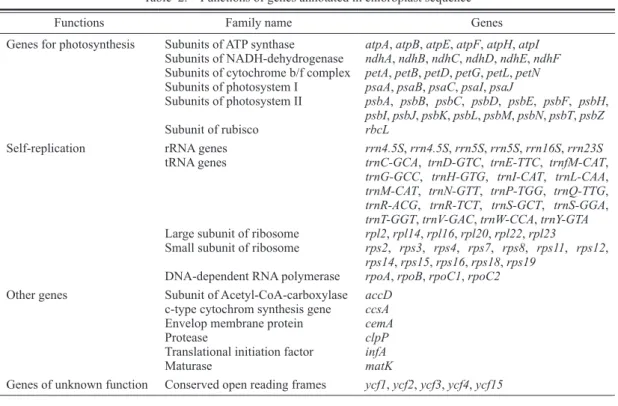
repeat (IR) regions. A total of 132 genes were annotated, including 46 genes for photosynthesis, 67 genes for self-replication, 7 genes for other functions, and 12 genes for unknown functions (Fig. 2, Table 2). The overall GC content was 37.7%, and IRs (42.0%) holds greater GC con- tent than LSC (36.0%) and SSC (31.8%) regions.
Development of nuclear SSR markers and genetic diversity
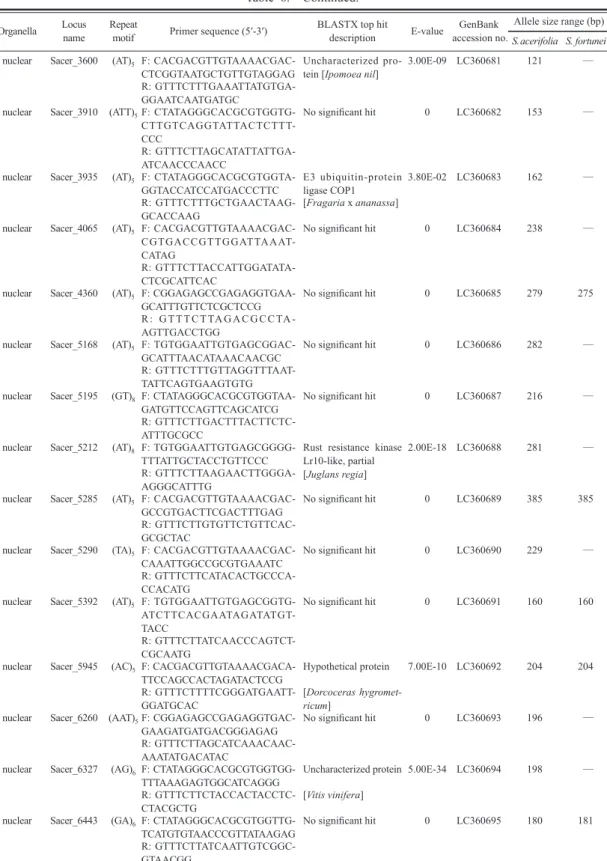
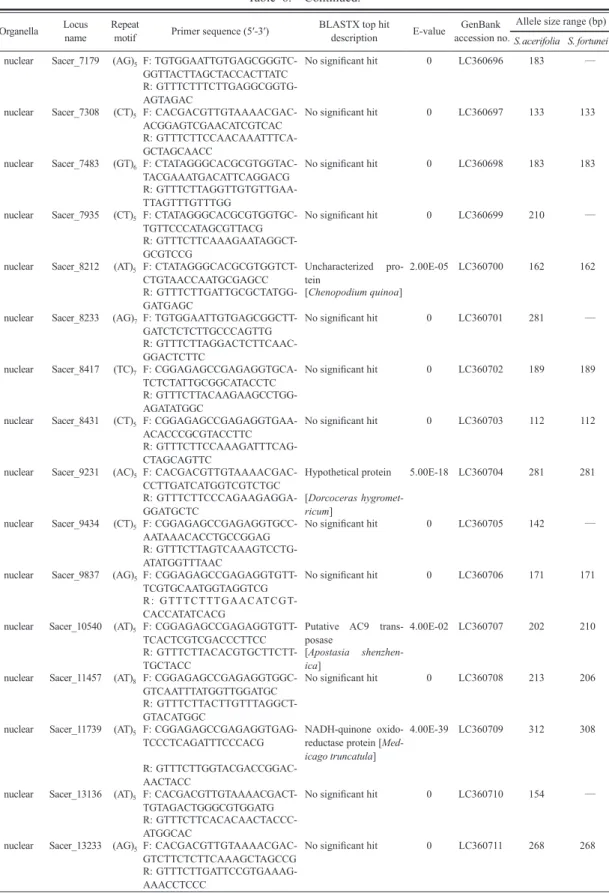
Among the 120 primer pairs tested, 57 showed clear allelic peaks with expected product lengths, 3 of which (Sacer_ 1601, Sacer_9094, and Sacer_13684) were polymorphic (Tables 3, 4, and 6). The number of alleles per locus was two, the H
Oranged from 0.125 to 0.250, and the H
Eranged from 0.219 to 0.500. In Saxifraga fortunei, 33 out of 120 loci were amplified, and two of them (Sacer_10700 and Sacer_13684) were polymor- phic (Tables 3, 4, and 6). One locus (Sacer_13684) was polymorphic in both species, and ten alleles were detected in Saxifraga fortunei, whereas the other locus (Sacer_10700) harbored two alleles. The H
Owas 0.000 and 0.400, and the
H
Ewas 0.124 and 0.862 in the respective loci.
Two loci (Sacer_9094 and Sacer_13684) in Saxi- fraga acerifolia, and two loci (Sacer_10700 and Sacer_13684) in Saxifraga fortunei were deviated from HWE (P<0.05). The significant deviations from HWE in the latter species are likely due to the fact that samples from isolated populations, which would be assigned to independent panmic- tic groups, are combined for the tests.
Development of chloroplast SSR markers and genetic diversity
In Saxifraga acerifolia, 13 of the 20 loci were amplified and 3 of them were polymorphic (Tables 3, 5, and 6). In Saxifraga fortunei, all 13 markers amplified in S. acerifolia showed clear peaks, and 7 of them were polymorphic. Three loci (Sacer_cp4155, Sacer_cp5080, and Sacer_
cp11875) were polymorphic in both species, whereas the other loci (Sacer_cp22861, Sacer_
cp30071, Sacer_cp45966, and Sacer_cp80789) were polymorphic only in Saxifraga fortunei, with two to four alleles (Table 5). Among the seven markers, six were located in intergenic
Table 2. Functions of genes annotated in chloroplast sequence
Functions Family name Genes
Genes for photosynthesis Subunits of ATP synthase atpA, atpB, atpE, atpF, atpH, atpI Subunits of NADH-dehydrogenase ndhA, ndhB, ndhC, ndhD, ndhE, ndhF Subunits of cytochrome b/f complex petA, petB, petD, petG, petL, petN Subunits of photosystem I psaA, psaB, psaC, psaI, psaJ
Subunits of photosystem II psbA, psbB, psbC, psbD, psbE, psbF, psbH, psbI, psbJ, psbK, psbL, psbM, psbN, psbT, psbZ
Subunit of rubisco rbcL
Self-replication rRNA genes rrn4.5S, rrn4.5S, rrn5S, rrn5S, rrn16S, rrn23S
tRNA genes trnC-GCA, trnD-GTC, trnE-TTC, trnfM-CAT,
trnG-GCC, trnH-GTG, trnI-CAT, trnL-CAA, trnM-CAT, trnN-GTT, trnP-TGG, trnQ-TTG, trnR-ACG, trnR-TCT, trnS-GCT, trnS-GGA, trnT-GGT, trnV-GAC, trnW-CCA, trnY-GTA Large subunit of ribosome rpl2, rpl14, rpl16, rpl20, rpl22, rpl23
Small subunit of ribosome rps2, rps3, rps4, rps7, rps8, rps11, rps12, rps14, rps15, rps16, rps18, rps19
DNA-dependent RNA polymerase rpoA, rpoB, rpoC1, rpoC2 Other genes Subunit of Acetyl-CoA-carboxylase accD
c-type cytochrom synthesis gene ccsA Envelop membrane protein cemA
Protease clpP
Translational initiation factor infA
Maturase matK
Genes of unknown function Conserved open reading frames ycf1, ycf2, ycf3, ycf4, ycf15
regions (matK-rps16, rps16-trnQ (TTG), atpA- atpF, psbM-trnD (GTC), rps4-ndhJ, and rpl16- rps3) and the remainder was in an intron (rpoC1). All loci were located in the LSC region (Fig. 2). In Saxifraga acerifolia, the number of alleles ranged from two to three, and uh ranged from 0.233 to 0.675. In Saxifraga fortunei, the number of alleles ranged from two to six, and uh ranged from 0.248 to 0.867 (Table 5).
Saxifraga acerifolia showed polymorphism at
fewer loci than wide-ranging S. fortuei (Table 5), likely owing to population size reduction accom- panied with bottleneck effect(s) over its history that sculptured its current distribution into two gorges. This unique habitat may have also decreased the allelic diversity among and within populations. High rate of successful cross-ampli- fication of chloroplast markers in Saxifraga for- tunei should be attributed to its being a sister taxon of S. acerifolia (Tables 4, 5).
Table 3. Characteristics of four nuclear and seven chloroplast microsatellite markers for Saxifraga acerifolia and S. fortunei
Organella Locus name Repeat-
motif Primer sequence (5′-3′) BLASTX top hit
description E-value GenBank accession no.
nuclear Sacer_1601 (AG)
6F: TGAAGTTGCCAGTGTTACAA-
GCCTATAGGGCACGCGTGGT CRCB domain-containing protein, partial [Cephalotus follicularis]
3.0E-04 LC360662
R: GTTTCTTCCCAAGCACGATAA- TGAAATTGC
nuclear Sacer_9094 (AACG)
5F: TGTGGAATTGTGAGCGGATT-
CGGTCTCTTCGTCCATG
No significant hit0 LC360663 R: GTTTCTTTGGACGGCTGAGA-
TCATGTC
nuclear Sacer_10700 (AT)
5F: CTATAGGGCACGCGTGGTTT-
GGTCTGATGAGTTCCCGG
No significant hit0 LC360664 R: GTTTCTTCAAGCTCTTCTGAC-
ATGACCTG
nuclear Sacer_13684 (AG)
6F: AGACAGAACCAACAGTCAAT-
CGCGGAGAGCCGAGAGGTG Hypothetical protein PENVUL_c176G00998 [Penicillium vulpinum]
2.2 LC360665
R: GTTTCTTAGAGGATCATGAA- GAGAGTGCC
chloroplast Sacer_cp4155 (A)
22F: TGTGGAATTGTGAGCGGTGC-
ATGACCCAATCAAAACA — — LC360649
R: GTTTCTTAGCTGACGGGTTCG- chloroplast Sacer_cp5080 (C)
10TTGA F: CGGAGAGCCGAGAGGTGCGG-
TAGACCGCTCATTGG — — LC360650
R: GTTTCTTCTCGAGCCGTACGA- chloroplast Sacer_cp11875 (A)
10GGAG F: CGGAGAGCCGAGAGGTGAGC-
AATGCCATCGCCTAC — — LC360651
R: GTTTCTTTTGGGGCGATGAAA- chloroplast Sacer_cp22861 (T)
10GAAA F: CTATAGGGCACGCGTGGTTCC-
CGACTTCACCTCGAC — — LC360652
R: GTTTCTTGCTCGGAATTGTGG- chloroplast Sacer_cp30071 (T)
11GTGT F: TGTGGAATTGTGAGCGGTCAA-
ATCGATTCATCGTCCA — — LC360653
R: GTTTCTTTACCCCGAAGGCGG- chloroplast Sacer_cp45966 (A)
10TAGT F: TGTGGAATTGTGAGCGGTGGG-
ACAAACGGGAGTAAA — — LC360654
R: GTTTCTTGCTCAGGATTGCCC- ATTTT
chloroplast Sacer_cp80789 (T)
14F: TGTGGAATTGTGAGCGGTGTG-
AAGCGATGAGTTGGTT — — LC360655
R: GTTTCTTGCTGCCAGCGATGG-
AATA
Chloroplast haplotype network and distribution in Japanese Archipelago
Based on seven chloroplast SSR markers, we
detected six haplotypes in Saxifraga acerifolia and 13 haplotypes in S. fortunei. The relationship of each haplotype was shown in a network (Fig.
Table 4. Genetic diversity of four nuclear markers in Saxifraga acerifolia and S. fortunei. A, number of alleles;
H
O, observed heterozygosity; H
E, expected heterozygosity. *Deviation from Hardy-Weinberg equilibrium (P<0.05).
Locus name
S. acerifolia (n=16) S. fortunei (n=15) Total (n=31) A H
OH
ESize range
(bp) A H
OH
ESize range
(bp) A H
OH
ESize range (bp)
Sacer_1601 2 0.125 0.219 251–253 — — — — 2 0.125 0.219 251–253
Sacer_9094 2 0.125* 0.305 212–220 — — — — 2 0.125 0.305 212–220
Sacer_10700 1 0.000 0.000 256 2 0.000* 0.124 260–264 3 0.000 0.062 256–264 Sacer_13684 2 0.250* 0.500 87–89 10 0.400* 0.862 65–103 10 0.325 0.681 65–103
Average 1.8 0.063 0.256 6.0 0.200 0.493 4.3 0.144 0.317
Table 5. Genetic diversity of seven chloroplast markers in Saxifraga acerifoia and S. fortune. A, number of alleles; uh, unbiased diversity
Locus name Region
S. acerifolia (n=16) S. fortunei (n=15) Total (n=31) A uh Size range
(bp) A uh Size range
(bp) A uh Size range (bp)
Sacer_cp4155 matK-rps16 3 0.675 261–263 6 0.867 250–255 9 0.771 250–263
Sacer_cp5080 rps16-trnQ (TGG) 2 0.233 104–105 2 0.248 100–101 4 0.240 100–105
Sacer_cp11875 atpA-atpF 2 0.400 229–230 3 0.257 229–234 3 0.329 229–234
Sacer_cp22861 rpoC1; Intron 1 0.000 264 3 0.590 264–266 3 0.295 264–266
Sacer_cp30071 psbM-trnD (GTC) 1 0.000 165 3 0.533 164–166 3 0.267 164–166
Sacer_cp45966 rps4-ndhJ 1 0.000 420 4 0.619 417–431 5 0.310 417–431
Sacer_cp80789 rpl16-rps3 1 0.000 301 2 0.248 305–318 3 0.124 301–318
Average Average 1.6 0.187 3.3 0.480 4.3 0.341
Fig. 3. (a) Haplotype network of Saxifraga acerifolia and S. fortunei based on seven chloroplast microsatellite
markers. Six haplotypes (Ha–Hf) are in Saxifraga acerifolia (within dotted line) and 13 haplotypes (H1–H13)
are in S. fortunei (in the shadow). (b) Distribution of Saxifraga acerifolia and S. fortunei in the Japanese
Archipelago. The sampled points are shown as coloured dots suggesting the haplotypes. In Saxifraga acerifolia,
the ratio of each haplotype was shown.
Organella Locus name Repeat
motif Primer sequence (5′-3′) BLASTX top hit
description E-value GenBank accession no.
Allele size range (bp) S. acerifolia S. fortunei nuclear Sacer_327 (CT)5 F: TGTGGAATTGTGAGCGGCCG
GGTTGTGGAGAAGT TTC No significant hit 0 LC360666 247 251 R: GTTTCTTCAGCTAGCAGTTC-
TAATTTGATATCAC
nuclear Sacer_533 (AT)5 F: CGGAGAGCCGAGAGGT-
GCTGCCTACATTTAACCGCCC No significant hit 0 LC360667 322 322 R: GTTTCTTCCTCAGCTCC TCC-
ACCATC
nuclear Sacer_534 (AT)5 F: CTATAGGGCACGCGTGGTCT-
GCCTACATTTAACCGCCC Hypothetical protein
[Beta vulgaris] 2.00E-20 LC360668 431 431 R: GTTTCTTCGGTGAGGTTAG-
TGGTTTGC
nuclear Sacer_712 (AT)5 F: TGTGGAATTGTGAGCGGTC-
ACCGAAAGAGCTGAAATCATG No significant hit 0 LC360669 214 — R: GTTTCTTGCTGGACTTGCG A-
GATTTATAAG
nuclear Sacer_861 (AG)5 F: CGGAGAGCCGAGAGGTGTC-
TGTTATGTATTTAAGAGCCGAG No significant hit 0 LC360670 140 140 R: GTTTCTTGGGATGTACTCTA-
CCCTAGCC
nuclear Sacer_883 (AT)5 F: TGTGGAATTGTGAGCGGAA-
AGCAAGCGATCACCCATG PHD domain-contain- ing protein
[Cephalotus follicularis]
2.00E-28 LC360671 382 382 R: GTTTCTTAGGAAGGAAGT G-
GAGCGAAG
nuclear Sacer_956 (CT)5 F: CGGAGAGCCGAGAGGTGCT- TAACTGACATGAGAAATTTAT- AGAAACC
Uncharacterized protein
[Asparagus officinalis] 2.00E-11 LC360672 233 — R: GTTTCTTTGTGTGAAAGCTT-
GTGACGG
nuclear Sacer_1339 (AG)5 F: CGGAGAGCCGAGAGGTGCC-
AGTAGTTTGACGTTCGGC No significant hit 0 LC360673 235 247 R: GTTTCTTCAAAGCTCGACA-
CTGCTAGC
nuclear Sacer_1571 (AG)5 F: CGGAGAGCCGAGAGGTGA G- CTAGCAGTTCTAAATATTAATT- CAAGC
No significant hit 0 LC360674 147 144
R: GTTTCTTTTGACGCGGTGAG- TAGGATC
nuclear Sacer_2425 (AT)5 F: CACGACGTTGTAAAACGAC- AGCTTGGAAATAGTACAGA- ATGC
No significant hit 0 LC360675 141 —
R: GTTTCTTTGTCGTATCAGTT- TGAAGTTGG
nuclear Sacer_2567 (AT)6 F: CTATAGGGCACGCGTGGTA-
AAGAGGGTGAGAAGTAACGAC No significant hit 0 LC360676 105 — R: GTTTCTTTGTAACGAGTCA G-
GAGGTAAAC
nuclear Sacer_2806 (AG)5 F: CGGAGAGCCGAGAGGTGG T- GATGATGAATATATAGGAGA- ATTTAGGG
No significant hit 0 LC360677 159 159
R: GTTTCTTAGGCAGTTGGTTG- TAAGAAGG
nuclear Sacer_2919 (AG)5 F: CTATAGGGCACGCGTGGTCC-
AAGGAGGGCTAGCTAGTC No significant hit 0 LC360678 124 124 R: GTTTCTTCAAATGCGGCAAC-
CTGGTG
nuclear Sacer_3393 (AG)5 F: TGTGGAATTGTGAGCGGTCA-
AGGACAATTTCTTAGCTAT CTCC No significant hit 0 LC360679 153 — R: GTTTCTTACTTCGTCAACAA-
ACCCTGC
nuclear Sacer_3512 (ATT)5F: CGGAGAGCCGAGAGGTGTC-
ACATAAGCCGTCATAAAGTG No significant hit 0 LC360680 186 — R: GTTTCTTGATTCCCTCGAGC-
ACTTAGTTC
Table 6. Amplified microsatellite markers
Organella Locus name Repeat
motif Primer sequence (5′-3′) BLASTX top hit
description E-value GenBank accession no.
Allele size range (bp) S. acerifolia S. fortunei nuclear Sacer_3600 (AT)5 F: CACGACGTTGTAAAACGAC-
CTCGGTAATGCTGTTGTAGGAG Uncharacterized pro-
tein [Ipomoea nil] 3.00E-09 LC360681 121 — R: GTTTCTTTGAAATTATGTGA-
GGAATCAATGATGC
nuclear Sacer_3910 (ATT)5F: CTATAGGGCACGCGTGGTG- CTTGTCAGGTATTACTCTTT- CCC
No significant hit 0 LC360682 153 —
R: GTTTCTTAGCATATTATTGA- ATCAACCCAACC
nuclear Sacer_3935 (AT)5 F: CTATAGGGCACGCGTGGTA-
GGTACCATCCATGACCCTTC E3 ubiquitin-protein
ligase COP1 3.80E-02 LC360683 162 — R: GTTTCTTTGCTGAACTAAG-
GCACCAAG [Fragaria x ananassa]
nuclear Sacer_4065 (AT)5 F: CACGACGTTGTAAAACGAC- CGTGACCGTTGGATTAAAT- CATAG
No significant hit 0 LC360684 238 —
R: GTTTCTTACCATTGGATATA- CTCGCATTCAC
nuclear Sacer_4360 (AT)5 F: CGGAGAGCCGAGAGGTGAA-
GCATTTGTTCTCGCTCCG No significant hit 0 LC360685 279 275 R : G T T T C T TA G A C G C C TA -
AGTTGACCTGG
nuclear Sacer_5168 (AT)5 F: TGTGGAATTGTGAGCGGAC-
GCATTTAACATAAACAACGC No significant hit 0 LC360686 282 — R: GTTTCTTTGTTAGGTTTAAT-
TATTCAGTGAAGTGTG nuclear Sacer_5195 (GT)8 F: CTATAGGGCACGCGTGGTAA-
GATGTTCCAGTTCAGCATCG No significant hit 0 LC360687 216 — R: GTTTCTTGACTTTACTTCTC-
ATTTGCGCC
nuclear Sacer_5212 (AT)8 F: TGTGGAATTGTGAGCGGGG-
TTTATTGCTACCTGTTCCC Rust resistance kinase Lr10-like, partial [Juglans regia]
2.00E-18 LC360688 281 — R: GTTTCTTAAGAACTTGGGA-
AGGGCATTTG
nuclear Sacer_5285 (AT)5 F: CACGACGTTGTAAAACGAC-
GCCGTGACTTCGACTTTGAG No significant hit 0 LC360689 385 385 R: GTTTCTTGTGTTCTGTTCAC-
GCGCTAC
nuclear Sacer_5290 (TA)5 F: CACGACGTTGTAAAACGA C-
CAAATTGGCCGCGTGAAATC No significant hit 0 LC360690 229 — R: GTTTCTTCATACACTGCCC A-
CCACATG
nuclear Sacer_5392 (AT)5 F: TGTGGAATTGTGAGCGGTG- ATCTTCACGAATAGATATGT- TACC
No significant hit 0 LC360691 160 160
R: GTTTCTTATCAACCCAGTC T- CGCAATG
nuclear Sacer_5945 (AC)5 F: CACGACGTTGTAAAACGACA-
TTCCAGCCACTAGATACT CCG Hypothetical protein 7.00E-10 LC360692 204 204 R: GTTTCTTTTCGGGATGAAT T-
GGATGCAC [Dorcoceras hygromet- ricum]
nuclear Sacer_6260 (AAT)5F: CGGAGAGCCGAGAGGTGAC-
GAAGATGATGACGGGAGAG No significant hit 0 LC360693 196 — R: GTTTCTTAGCATCAAACAAC-
AAATATGACATAC
nuclear Sacer_6327 (AG)6 F: CTATAGGGCACGCGTGGTGG-
TTTAAAGAGTGGCATCAGGG Uncharacterized protein 5.00E-34 LC360694 198 — R: GTTTCTTCTACCACTACCTC-
CTACGCTG [Vitis vinifera]
nuclear Sacer_6443 (GA)6 F: CTATAGGGCACGCGTGGTTG-
TCATGTGTAACCCGTTATAAGAG No significant hit 0 LC360695 180 181 R: GTTTCTTATCAATTGTCGGC-
GTAACGG
Table 6. Continued.
Organella Locus name Repeat
motif Primer sequence (5′-3′) BLASTX top hit
description E-value GenBank accession no.
Allele size range (bp) S. acerifolia S. fortunei nuclear Sacer_7179 (AG)5 F: TGTGGAATTGTGAGCGGGTC-
GGTTACTTAGCTACCACTTATC No significant hit 0 LC360696 183 — R: GTTTCTTTCTTGAGGCGGTG-
AGTAGAC
nuclear Sacer_7308 (CT)5 F: CACGACGTTGTAAAACGAC-
ACGGAGTCGAACATCGTCAC No significant hit 0 LC360697 133 133 R: GTTTCTTCCAACAAATTTCA-
GCTAGCAACC
nuclear Sacer_7483 (GT)6 F: CTATAGGGCACGCGTGGTAC-
TACGAAATGACATTCAGGACG No significant hit 0 LC360698 183 183 R: GTTTCTTAGGTTGTGTTGAA-
TTAGTTTGTTTGG
nuclear Sacer_7935 (CT)5 F: CTATAGGGCACGCGTGGTGC-
TGTTCCCATAGCGTTACG No significant hit 0 LC360699 210 — R: GTTTCTTCAAAGAATAGGCT-
GCGTCCG
nuclear Sacer_8212 (AT)5 F: CTATAGGGCACGCGTGGTCT-
CTGTAACCAATGCGAGCC Uncharacterized pro-
tein 2.00E-05 LC360700 162 162
R: GTTTCTTGATTGCGCTATGG-
GATGAGC [Chenopodium quinoa]
nuclear Sacer_8233 (AG)7 F: TGTGGAATTGTGAGCGGCTT-
GATCTCTCTTGCCCAGTTG No significant hit 0 LC360701 281 — R: GTTTCTTAGGACTCTTCAAC-
GGACTCTTC
nuclear Sacer_8417 (TC)7 F: CGGAGAGCCGAGAGGTGCA-
TCTCTATTGCGGCATACCTC No significant hit 0 LC360702 189 189 R: GTTTCTTACAAGAAGCCTGG-
AGATATGGC
nuclear Sacer_8431 (CT)5 F: CGGAGAGCCGAGAGGTGAA-
ACACCCGCGTACCTTC No significant hit 0 LC360703 112 112 R: GTTTCTTCCAAAGATTTCAG-
CTAGCAGTTC
nuclear Sacer_9231 (AC)5 F: CACGACGTTGTAAAACGAC-
CCTTGATCATGGTCGTCTGC Hypothetical protein 5.00E-18 LC360704 281 281 R: GTTTCTTCCCAGAAGAGGA-
GGATGCTC [Dorcoceras hygromet- ricum]
nuclear Sacer_9434 (CT)5 F: CGGAGAGCCGAGAGGTGCC-
AATAAACACCTGCCGGAG No significant hit 0 LC360705 142 — R: GTTTCTTAGTCAAAGTCCTG-
ATATGGTTTAAC
nuclear Sacer_9837 (AG)5 F: CGGAGAGCCGAGAGGTGTT-
TCGTGCAATGGTAGGTCG No significant hit 0 LC360706 171 171 R: GTTTCTTTGAACATCGT-
CACCATATCACG
nuclear Sacer_10540 (AT)5 F: CGGAGAGCCGAGAGGTGTT-
TCACTCGTCGACCCTTCC Putative AC9 trans-
posase 4.00E-02 LC360707 202 210 R: GTTTCTTACACGTGCTTCTT-
TGCTACC [Apostasia shenzhen- nuclear Sacer_11457 (AT)8 F: CGGAGAGCCGAGAGGTGGC- ica]
GTCAATTTATGGTTGGATGC No significant hit 0 LC360708 213 206 R: GTTTCTTACTTGTTTAGGCT-
GTACATGGC
nuclear Sacer_11739 (AT)5 F: CGGAGAGCCGAGAGGTGAG-
TCCCTCAGATTTCCCACG NADH-quinone oxido- reductase protein [Med- icago truncatula]
4.00E-39 LC360709 312 308
R: GTTTCTTGGTACGACCGGAC- AACTACC
nuclear Sacer_13136 (AT)5 F: CACGACGTTGTAAAACGACT-
TGTAGACTGGGCGTGGATG No significant hit 0 LC360710 154 — R: GTTTCTTCACACAACTACCC-
ATGGCAC
nuclear Sacer_13233 (AG)5 F: CACGACGTTGTAAAACGAC-
GTCTTCTCTTCAAAGCTAGCCG No significant hit 0 LC360711 268 268 R: GTTTCTTGATTCCGTGAAAG-
AAACCTCCC
Table 6. Continued.
3a). In Saxifraga fortunei, two groups among 13 haplotypes were detected: northern group (H1–
H3) and central and southern group (H4–H13) (Fig. 3a, b). These two groups were distinguished by four missing mutation steps in the network.
Saxifraga acerifolia was derived from the miss- ing haplotype between the two group of S. fortu- nei, suggesting the possibility that S. acerifolia might have been diverged from S. fortunei as has been indicated by molecular phylogeny. Another
Organella Locus name Repeat
motif Primer sequence (5′-3′) BLASTX top hit
description E-value GenBank accession no.
Allele size range (bp) S. acerifolia S. fortunei nuclear Sacer_13410 (AT)5 F: CACGACGTTGTAAAACGAC-
CAAGACACAAGGCTAGGCTTG Uncharacterized mito- c h o n d r i a l p r o t e i n AtMg00810-like, partial
1.00E-41 LC360712 251 —
R: GTTTCTTGGGTGTCAATAAA-
TCCAGGAGG [Phoenix dactylifera]
nuclear Sacer_13472 (AT)5 F: TGTGGAATTGTGAGCGGTCA- TGAACACAAACTAAATGA- CAGTC
No significant hit 0 LC360713 139 139
R: GTTTCTTAAGATATGCACAT- TGTTCATTCAC
nuclear Sacer_13541 (AT)6 F: CACGACGTTGTAAAACGAC-
TTCGCATGACAAACTTACTCCC No significant hit 0 LC360714 154 146 R: GTTTCTTGCTCATTAGTCAG-
TTGCCTACG
nuclear Sacer_13615 (AC)5 F: CTATAGGGCACGCGTGGTCC- ATCTTGCACAATTAAATTTATA- ACGTG
Hypothetical protein
[Prunus persica] 5.00E-19 LC360715 82 82 R: GTTTCTTTGGTGGCTCTTTAT-
TTCATGTAAG
nuclear Sacer_13650 (AG)7 F: TGTGGAATTGTGAGCGGAG-
AACAGAGTGAATTTGAAGGG No significant hit 0 LC360716 159 — R: GTTTCTTCTCCAAATTTAGA-
ATTGGTTATATACAGTG nuclear Sacer_14280 (AG)5 F: CACGACGTTGTAAAACGAC-
TGGTGGTAGATCGAAACTTGG No significant hit 0 LC360717 157 — R: GTTTCTTTCATCGTGTTCTTT-
CATTTCATAGC
nuclear Sacer_14931 (CT)5 F: TGTGGAATTGTGAGCGGCTT- AACTGACATGAGAAATTTATA- GAAACC
Uncharacterized pro-
tein 1.00E-13 LC360718 170 170
R: GTTTCTTAGGCACGTATGGA-
CTTGAAAG [Erythranthe guttata]
chloroplast Sacer_cp16184 (T)11 F: CACGACGTTGTAAAACGAC-
CCCGCTTCCATCATCTCT — — LC360656 402 399
R: GTTTCTTTTCGAGGGGGAA- ATGAGA
chloroplast Sacer_cp26106 (T)11 F: CACGACGTTGTAAAACGACT-
TCGTCGACCAACCCTTC — — LC360657 388 389
R: GTTTCTTCGGTCTATACGGG- CACCA
chloroplast Sacer_cp39842 (C)11 F: CACGACGTTGTAAAACGAC-
CCCCTCTTCCAGGTCCAT — — LC360658 302 302
R: GTTTCTTCATGCTTTAGCGC- CTGGT
chloroplast Sacer_cp43270 (A)10 F: CTATAGGGCACGCGTGGTCG-
CTCTAGTGCCCGAAAA — — LC360659 353 351
R: GTTTCTTGCCCCGCTTCAGT- TCATA
chloroplast Sacer_cp52987 (T)10 F: CGGAGAGCCGAGAGGTGAA- TTCGCCCAAGGGTAGC
— — LC360660 332 332
R: GTTTCTTCTGATCCTGGGGT- TTCCA
chloroplast Sacer_cp60664 (A)10 F: CGGAGAGCCGAGAGGTGTT-
TGAATGTGGGGGCTGT — — LC360661 418 415
R: GTTTCTTTCCGATGGATCCG- CTATG