REVISED DECEMBER 21, 2015
Errors were found in one of the trawl catch summaries used to calculate the numbers of fishes reported in Table 2. The table has been corrected, as well as the text pertaining to it in the first paragraph on page 166.
CITATION
Mecklenburg, C.W., and D. Steinke. 2015. Ichthyofaunal baselines in the Pacific Arctic region and RUSALCA study area. Oceanography 28(3):158–189, http://dx.doi.org/
10.5670/oceanog.2015.64.
DOI
http://dx.doi.org/10.5670/oceanog.2015.64
COPYRIGHT
This article has been published in Oceanography, Volume 28, Number 3, a quarterly journal of The Oceanography Society. Copyright 2015 by The Oceanography Society.
All rights reserved.
USAGE
Permission is granted to copy this article for use in teaching and research.
Republication, systematic reproduction, or collective redistribution of any portion of this article by photocopy machine, reposting, or other means is permitted only with the approval of The Oceanography Society. Send all correspondence to: [email protected] or The Oceanography Society, PO Box 1931, Rockville, MD 20849-1931, USA.
O ceanography THE OFFICIAL MAGAZINE OF THE OCEANOGRAPHY SOCIETY
DOWNLOADED FROM HTTP://WWW.TOS.ORG/OCEANOGRAPHY
RUSSIAN-AMERICAN LONG-TERM CENSUS OF THE ARCTIC
Ichthyofaunal Baselines in the
Pacific Arctic Region and RUSALCA Study Area
By Catherine W. Mecklenburg and Dirk Steinke
of users, providing current baselines against which change may be detected.
Our methods, described in earlier papers (Mecklenburg et al., 2007, 2011, 2014), involve study of historical fish collections in museums, sampling by modern inves- tigations including RUSALCA multi- disciplinary expeditions, and review of the ichthyological and fisheries science literature combined with results from DNA barcoding. The basic quest is to determine the geographic distributions and taxonomic identity of the species in the region. This paper highlights some of the positive results of these investigations in the first decade of the program, as well as new and persistent problems identified and needing further investigation. The main purpose is to describe the state of the baseline for the Pacific Arctic.
Following the earlier studies to pro- duce Fishes of Alaska, the compendium that includes Chukchi and Beaufort Sea fishes (Mecklenburg et al., 2002), we continued and expanded examina- tion of specimens in museums around the world (e.g., Mecklenburg et al., 2006;
Mecklenburg and Mecklenburg, 2009) as we participated in the Census of Marine Life, the International Polar Year, RUSALCA, and other efforts to docu- ment biodiversity in the Arctic. Catch records in the literature and museum records were reviewed for accuracy of identifications from our examination of voucher specimens (e.g., Norcross et al., 2013). We focused on museums with
significant collections of Arctic fishes, listed in Mecklenburg et al. (2011, 2014).
The museum work has remained a criti- cal focus of our studies. In this article, a few additional museum catalog numbers (e.g., CAS 228491) are cited. The collec- tion abbreviations are: CAS, California Academy of Sciences, San Francisco;
CMNFI, Canadian Museum of Nature, Gatineau, Quebec; HUMZ, Hokkaido University Museum of Zoology, Hakodate, Japan; UAM, University of Alaska Museum, Fairbanks; and USNM, National Museum of Natural History, Washington, DC. Efforts to accumulate records of fish presence by participation in RUSALCA and other research cruises, and from collections by other programs sent frozen to author Mecklenburg for identification, preservation, and archiving were also outlined previously (Mecklenburg et al., 2007, 2011, 2014).
The RUSALCA used small bottom- fishing otter trawls and beam trawls described in Mecklenburg et al. (2007, 2014) and Norcross et al. (2010). Most of the RUSALCA trawl stations (Figure 1) were west of the International Dateline in Russian waters, and some were north of the 200-mile limit in international waters. The RUSALCA focus on Russian waters is unique. The only other US bot- tom trawl fishing effort in Russian waters of the Chukchi Sea was accomplished by University of Alaska Museum curator James E. Morrow, participating in a multi- disciplinary cruise of R/V Alpha Helix in 1973 (Figure 1). The UAM 1973 collection is unusual in that all specimens caught were saved and archived in the museum;
typically, only a representative sample of voucher specimens is archived. The speci- mens were archived under the names given on the field labels, but identifications were not subsequently verified, and no analysis of the catch was conducted or published.
The analysis, conducted in 2008–2010 by author Mecklenburg, provided a valuable addition to the RUSALCA baseline.
The most recent additions to our data on fish presence and morphology have been gained by participation in the 2013 BACKGROUND
Because of the recent, rapid climate change in the region, the Chukchi Sea and adjacent marine waters of the Pacific- influenced sector of the Arctic Ocean were chosen as the focus of the Russian–
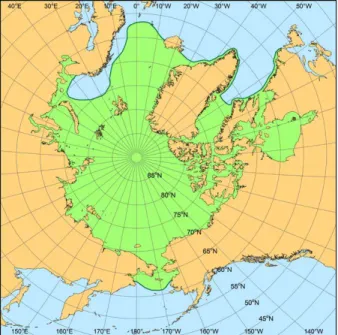
American Long-Term Census of the Arctic (RUSALCA) program. For pur- poses of this synthesis of the ichthyofauna of the region, the Pacific Arctic includes the northern Bering Sea (generally north of St. Matthew Island, about 60°N lati- tude); the East Siberian, Chukchi, and Beaufort Seas; and the adjacent waters of the Arctic Ocean down to about the 1,500-m isobath (Figure 1). When the program started in 2003, relatively few ichthyological investigations had been carried out in the Pacific Arctic, particu- larly north of Bering Strait (about 66°N).
Compared with available knowledge on the fish fauna of warmer waters, the com- position and characteristics of the Pacific Arctic fish fauna and the geographic dis- tributions of the species were poorly known. A compendium and review of the regional fish fauna (Mecklenburg et al., 2002) published shortly before the start of the RUSALCA program provided a valuable early baseline while revealing numerous inadequacies in knowledge and the need for continuing studies. The mission for ichthyological investigations in the RUSALCA program has been to generate and disseminate essential infor- mation on regional marine fish diver- sity and presence to a wide community
ABSTRACT. At the beginning of the Russian–American Long-Term Census of the
Arctic (RUSALCA) program in 2003, the composition and characteristics of the Pacific
Arctic marine fish fauna and distribution of the species were poorly known compared
with knowledge on the fish fauna of warmer waters. The mission for ichthyological
investigations in the RUSALCA program has been to provide information necessary
to construct zoogeographic and taxonomic baselines against which change may be
detected. Our methods have involved examining historical fish collections in museums
and identifying fresh samples secured on RUSALCA scientific expeditions and
those of other programs, and DNA barcoding. This paper presents the first modern,
comprehensive, well-founded inventory of the marine fish species in the Pacific Arctic
region and its subregions; evaluates each species’ zoogeographic pattern, primary
distribution, biotype, and life zone; and highlights some of the positive results of our
investigations in the first decade of the program as well as new and persistent problems
identified that need further investigation.
and 2015 University of Tromsø ichthyo- logical cruises to northeastern Greenland (TUNU-V and TUNU-VI) and identi- fication of specimens collected from the Beaufort Sea in 2011–2014 and provided by the University of Alaska Fairbanks and from the Bering Sea in 2011 provided by the Ted Stevens Marine Research Institute of the National Oceanic and Atmospheric Administration (NOAA), Alaska Fisheries Science Center (AFSC), Juneau, Alaska.
Participation in the TUNU program (Christiansen, 2012; Christiansen et al., 2014) has helped provide the necessary pan-Arctic perspective against which to evaluate the Pacific Arctic species.
To supplement examination of morphology, a significant facet of our methodology has been DNA barcoding, which sequences a standard region of the mitochondrial cytochrome c oxidase 1 gene (COI) (Hebert et al., 2003; Bucklin et al., 2011). Tissue samples were sent to the Biodiversity Institute of Ontario, University of Guelph, Canada, for
barcoding as contributions to the Fish Barcode of Life initiative (Ward et al.
2009). Tissue collection and sequenc- ing followed the protocol described by Steinke et al. (2009a). Sequence data were submitted to the Barcode of Life Data sys- tem (BOLD; http://www.barcodinglife.
org; see Ratnasingham and Hebert [2007]) and to GenBank. Since publica- tion of the barcode library presented in Mecklenburg et al. (2011), tissue sam- pling as part of the RUSALCA effort has expanded to include about 1,550 spec- imens (Figure 2). Reflecting a recent focus on studying relationships of the Pacific Arctic fish fauna to the Atlantic fauna, sampling from the Atlantic Arctic has particularly increased. Participation in the Norwegian TUNU cruises (Christiansen, 2012), as well as donations of tissues from the Zoological Museum of the University of Bergen, added barcodes from northeastern Greenland, around Jan Mayen and Svalbard, and the Barents and Norwegian Seas. The numbers of
barcodes from the Bering, Chukchi, and Beaufort Seas were increased by author Mecklenburg’s study of recent frozen col- lections from the Pacific Arctic as well as donations of tissues from the University of Washington fish collection. To date, we have barcoded 201 species. For the Pacific Arctic—the RUSALCA study area—we have barcoded 101, or 83%, of the 122 marine fish species known to occur in the region.
Specimen and collection data, sequences, specimen images, trace files, and GenBank accessions are provided in the public data sets on BOLD. Links to the data sets are provided in the text.
Neighbor-joining (NJ) analyses and genetic distance calculations were exe- cuted with MEGA version 6.0 (Tamura et al., 2013). The Kimura 2-parameter (K2P) distance metric (Kimura, 1980) was employed for all sequence compar- isons and analyses. Confidence in esti- mated relationships of NJ tree topologies was evaluated by a bootstrap analysis with 1,000 replicates using MEGA version 6.0.
The samples discussed and used in the
FIGURE 1. Map of Pacific Arctic region showing the southern limit of the Arctic region (heavy dashed line) and locations of the RUSALCA 2004, 2009, and 2012 (red dots, n = 54) and University of Alaska Museum 1973 (green diamonds, n = 34) bottom trawling sites.
Some of the 2004 RUSALCA stations were resampled in 2009 and 2012, and having only slightly different geographic coordinates appear as single dots.
FIGURE 2. Collection localities for the 1,550 fish
specimens tissue-sampled and sequenced for
the RUSALCA studies. Sets from other sources
are added as necessary to increase sample
sizes or add species for individual analyses.
NJ trees are drawn from the entire BOLD database (publicly available sequences), including the samples sequenced specif- ically for the RUSALCA program as well as sequences obtained through GenBank.
To understand the distributions of Pacific Arctic marine fishes, it is neces- sary to evaluate them in the context of the entire Arctic region. The circular and mediterranean structure of the Arctic Ocean with its seas requires a holistic approach (Wassmann, 2011). For our purposes, the Arctic region is defined as it pertains for marine fish species, with boundaries determined primarily by the southern limits of distribution of the Arctic species (Figure 3). We count at least 235 marine fish species in this region (Mecklenburg et al., 2011, 2013, and ongoing revision). The ichthyofauna is a combination of species endemic to the Arctic Ocean and its marginal seas and species that primarily inhabit warmer waters but have some presence in the Arctic. Of the total, 65 species occur only in the Pacific sector, 56 occur in both the Atlantic and the Pacific, and 114 are only in the Atlantic Arctic.
The Norwegian and Barents Seas in the Atlantic and the Bering and Chukchi Seas in the Pacific Arctic have been characterized as gateways to the Arctic (e.g., Christiansen et al., 2013) because they allow movement of species from boreal to Arctic regions. The Atlantic gateway is wide open and has been for much of its geological past, whereas the Pacific gateway includes the narrow Bering Strait, which has intermittently posed a barrier to fish movements as the Bering Land Bridge rose and submerged during glacial and interglacial periods (Briggs, 1995; Mecklenburg et al., 2011;
Beszczynska-Möller et al., 2011). The physical environment of the Pacific Arctic has recently been detailed in Grebmeier and Maslowski (2014). The physical rela- tionships of the region to the overall Arctic region, including the pathways of Pacific and Atlantic waters, which influ- ence faunal distributions, are described in Woodgate et al. (2013).
THE PACIFIC ARCTIC ICHTHYOFAUNAL BASELINE No complete lists of fish species with ver- ified presence in the Pacific Arctic region were available prior to the syntheses in Mecklenburg et al. (2011, 2013). The closest in recent times was presented in Mecklenburg et al. (2002), which although focusing on the waters off Alaska also reviewed species presence in the adjacent Russian waters of the Chukchi Sea and the Canadian waters of the Beaufort Sea.
Most lists have narrower regional cover- age or are older and based on relatively sparse data. The list of Chukchi Sea fishes in Andriashev (1952) is useful for mak- ing broad comparisons but only when accounting for misidentifications due to the outdated state of knowledge and conclusions on species presence based on relatively few expeditions. The recent list in Datsky (2015) is largely uncritical, based largely on earlier lists and report- ing documentation for fish presence only in general terms (such as “literature and online databases”), and includes several unsubstantiated claims of species pres- ence and depths, many of them previ- ously corrected in, for instance, the anno- tated list in Mecklenburg et al. (2011).
Several papers report presence in the catches of individual ichthyological or fishery investigations. For instance, Rand
and Logerwell (2011) reported a prelim- inary list of species taken in a NOAA AFSC trawl survey in 2008 in the Alaskan Beaufort Sea, and Lin et al. (2012, 2014) reported trawl catches by the Chinese National Arctic Research Expedition (CHINARE) of 2010 in the northern Bering Sea and Chukchi Sea. The pres- ent paper reports species presence in the entire Pacific Arctic region and its sub- regions from complete reviews of the lit- erature and examination of historical and recent collections.
Only marine species are included in the assessment. Freshwater and anadro- mous fishes are not included because they are not a focus of RUSALCA, which oper- ates in late summer and fall, when sea- running species such as the Pacific sal- mons (Salmoninae) have returned to their natal streams, and conducts sampling in waters farther offshore than the near- shore waters inhabited by amphidromous and anadromous species like the ciscoes and other whitefishes (Coregoninae).
Occasionally, anadromous stickle- backs (Gasterosteidae) and Arctic smelt (Osmerus dentex, Osmeridae), and the basically freshwater pond smelt (Hypomesus olidus, Osmeridae), are caught, but these are incidental. We include pelagic marine species from presence in investigations conducted by
FIGURE 3. The Arctic region,
defined as it pertains for marine
fish species. Arctic marine fish
species are rarely found out-
side of this region, so the
boundary reflects the limits of
distribution of Arctic species
and not the extent to which
boreal species have penetrated
into the region. Modified from
Mecklenburg et al. (2011, 2013)
programs that use pelagic nets, such as the pelagic surveys by NOAA AFSC divi- sions in Seattle, Washington, and Juneau, Alaska, because RUSALCA has used bot- tom trawls only, except for ichthyoplank- ton. Species presence in the ichthyo- plankton is studied by other RUSALCA investigators and will be reported else- where. Larvae of species nonresident in the Chukchi Sea sometimes drift north- ward beyond Bering Strait. Essentially, therefore, the RUSALCA fish diversity studies have focused on adult fishes and on relatively large juveniles, which, if they are of species that develop in the ichthyo- plankton or in the water column, have settled to the bottom.
Presence of Species and Higher Taxa
The simplest measure of biodiversity is the number of species, also called species richness. In all, we count 122 marine spe- cies in the Pacific Arctic (Table 1). This is 52% of the total number of marine spe- cies (235) counted for the entire Arctic region (Mecklenburg et al., 2013, revision in progress). The Table 1 list is accurate according to current knowledge, but the total number likely will change as taxo- nomic studies advance and new species are discovered. A few taxonomic issues among the snailfishes and eelpouts, for instance, are highlighted later in this paper. Species that have been found on continental slopes elsewhere in the Arctic, such as the eelpouts Lycodonus flagellicauda and additional Lycenchelys species, are likely to be found in the Pacific Arctic with retreat of the sea ice and intensified sampling.
The marine fish species of the Pacific Arctic are distributed among 10 orders and 23 families, compared with 19 orders and 44 families represented in the entire Arctic region. The makeup of the orders and families followed here is from the classification in Nelson (2006). Recent studies on the phylogeny and relation- ships of the higher taxa may result in tax- onomists adopting changes (e.g., Smith and Busby, 2014).
The top 10 most speciose families account for 93 (77%) of the species present in the Pacific Arctic region. The sculpins (Cottidae) and eelpouts (Zoarcidae), with 27 and 20 species, respectively, are by far the most speciose families in the region. Snailfishes (Liparidae) are represented by 11 species, and floun- ders (Pleuronectidae), pricklebacks (Stichaeidae), and poachers (Agonidae) by 10 species each. Cods (Gadidae) and lumpsuckers (Cyclopteridae) are repre- sented by five species each, and green- lings (Hexagrammidae) and fathead sculpins (Psychrolutidae) by three spe- cies each. The same families have his- torically had the highest numbers of species in the region. The remaining 13 families are represented by only one or two species (Table 1).
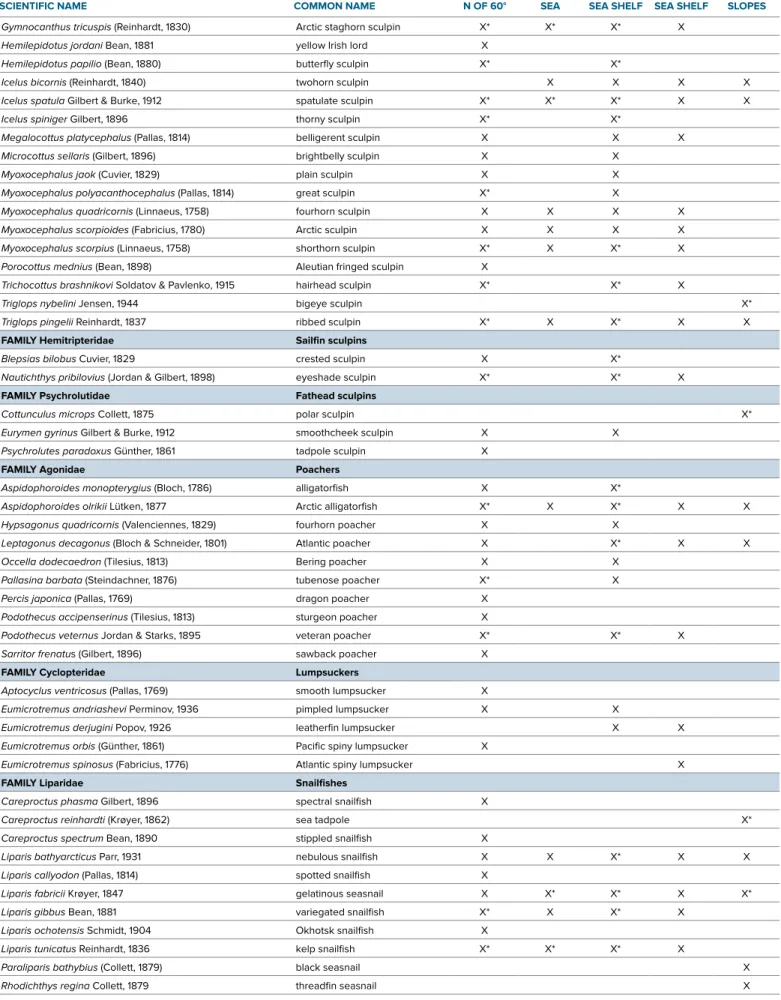
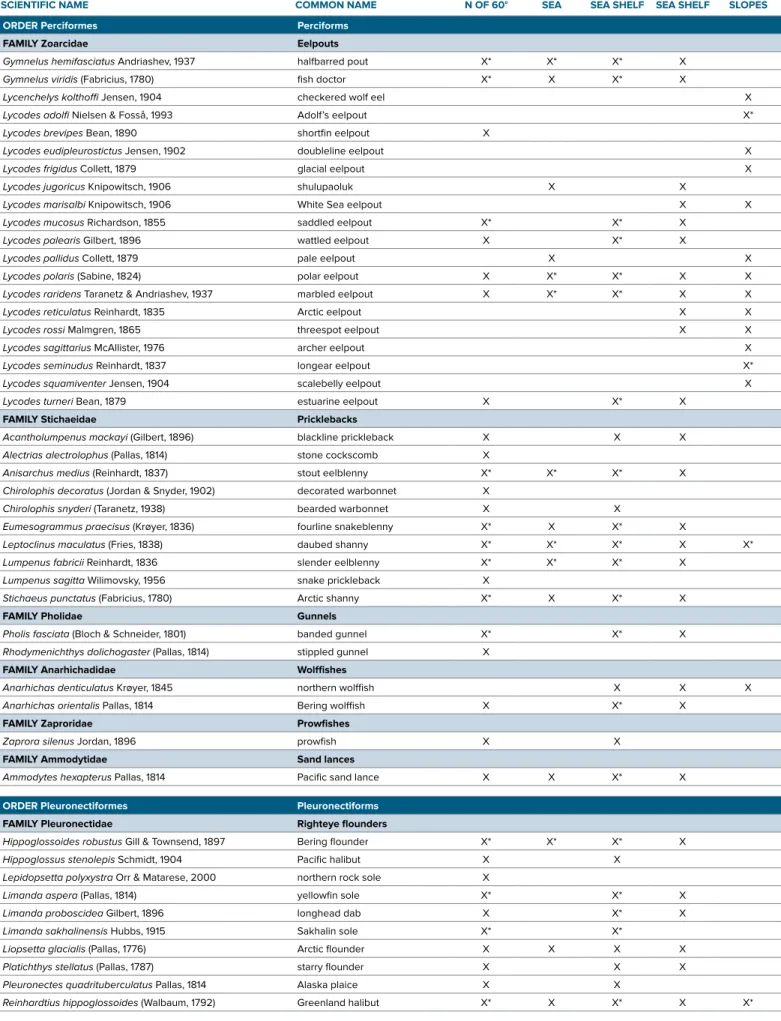
The fish fauna varies with the sub- regions of the Pacific Arctic (Table 1).
The assemblages on the continental shelf of each of the seas differ from each other and from the assemblages in the deeper waters of the adjacent slopes and basins.
When counting species, most authors combine the slope area with the shelf in the Chukchi Sea (e.g., Lin et al., 2014), and this practice combines assemblages.
It makes, for instance, the deepwater spe- cies Lycodes seminudus and Artediellus atlanticus appear to be abundant in the shallow Chukchi Sea (with an aver- age depth of 50 m), whereas they truly are restricted to the deeper waters. To grossly separate the assemblages, there- fore, we show presence in Table 1 for the continental slopes separately from the Chukchi and Beaufort shelves. It should also be noted that for the purpose of counting species, we define Bering Strait, which marks the separation of the Chukchi and Bering Seas, as a line from Cape Dezhneva, Russia, to Cape Prince of Wales, USA. Some authors define the strait as a broader region or do not clearly discriminate between catches north and south of it. For instance, although larvae of masked greenling Hexagrammos octogrammus and gray starsnout Bathyagonus alascanus have
been reported from the Chukchi Sea (Logerwell et al., 2015), NOAA AFSC records show they were caught south of Bering Strait. In Table 1, species caught as adults or juveniles only as far north- ward as Bering Strait, such as salmon shark Lamna ditropis, shortraker rock- fish Sebastes borealis, and Atka mackerel Pleurogrammus monopterygius, are not counted as Chukchi Sea species. Species are not counted as present in a region if their presence is known only from dead specimens, such as beached carcasses.
For each subregion, Table 1 includes only those marine species that have their presence documented by our own sam- pling, voucher specimens in museum collections, or records reported in the lit- erature with adequate supporting infor- mation. The number of marine fish spe- cies documented for the Chukchi Sea shelf is 71 (Table 1, Figure 4). In the adja- cent deeper waters of the continental slope down to about 1,500 m, an addi- tional 34 species are present. The East Siberian Sea shelf, also with 34 species, is relatively depauperate compared with the Chukchi Sea and, indeed, with all other Arctic seas. Christiansen et al. (2013) estimate that the Kara and Laptev Seas have 60 and 50 marine species, respec- tively. The shelf of the Beaufort Sea has 56 species, similar to the Canadian Arctic archipelago with 57 species. The north- ern Bering Sea has the largest number of species in the Pacific Arctic region, with 97. With a total of about 385 species in the Bering Sea overall, there is great potential for expansion of populations northward and an increase in the num- ber of species in the northern Bering Sea and Chukchi Sea.
The RUSALCA bottom trawls, sam- pling in Bering Strait, the Chukchi and East Siberian Seas, and the Chukchi Borderland in 2004, 2009, and 2012, took 54 species (Table 1). The relative abun- dance of the continental shelf species in the RUSALCA trawls fluctuated but did not exhibit any definite temporal trend.
In the RUSALCA surveys, as well as in
other scientific sampling efforts on the
TABLE 1. Marine fish species in subregions of the Pacific Arctic arranged by orders and families. The total number of species is 122. Orders and families follow the classification in Nelson (2006). X’s indicate confirmed presence of species in the subregions from recent ichthyological and fisheries sam- pling or examination of historical collections. Asterisks indicate species taken by the RUSALCA trawl nets in 2004, 2009, or 2012. Authors and dates of publication of the original species descriptions given with the scientific names follow Eschmeyer’s Catalog of Fishes online.
SCIENTIFIC NAME COMMON NAME BERING SEA
N OF 60°
EAST SIBERIAN
SEA CHUKCHI
SEA SHELF BEAUFORT SEA SHELF
ADJACENT ARCTIC SLOPES
ORDER Lamniformes Lamniforms
FAMILY Lamnidae Mackerel sharks
Lamna ditropis Hubbs & Follett, 1947 salmon shark X
ORDER Squaliformes Squaliforms
FAMILY Squalidae Dogfsh sharks
Squalus suckleyi (Girard, 1855) spotted spiny dogfish X X
FAMILY Somniosidae Sleeper sharks
Somniosus pacificus Bigelow & Schroeder, 1944 Pacific sleeper shark X X
ORDER Rajiformes Rajiforms
FAMILY Rajidae Skates
Amblyraja hyperborea (Collett, 1879) Arctic skate X
Bathyraja parmifera (Bean, 1881) Alaska skate X X
ORDER Clupeiformes Clupeiforms
FAMILY Clupeidae Herrings
Clupea pallasii Valenciennes, 1847 Pacific herring X* X X X
ORDER Osmeriformes Osmeriforms
FAMILY Osmeridae Smelts
Mallotus catervarius (Pennant, 1784) Pacific capelin X* X X* X
ORDER Myctophiformes Myctophiforms
FAMILY Myctophidae Lanternfishes
Benthosema glaciale (Reinhardt, 1837) glacier lanternfish X
ORDER Gadiformes Gadiforms
FAMILY Gadidae Cods
Arctogadus glacialis (Peters, 1872) polar cod X X X X*
Boreogadus saida (Lepechin, 1774) Arctic cod X* X* X* X X*
Eleginus gracilis (Tilesius, 1810) saffron cod X* X X* X
Gadus chalcogrammus Pallas, 1814 walleye pollock X* X* X X*
Gadus macrocephalus Tilesius, 1810 Pacific cod X X X
ORDER Scorpaeniformes Scorpaeniforms
FAMILY Scorpaenidae Rockfishes
Sebastes alutus (Gilbert, 1890) Pacific ocean perch X
Sebastes borealis Barsukov, 1970 shortraker rockfish X
FAMILY Hexagrammidae Greenlings
Hexagrammos octogrammus (Pallas, 1814) masked greenling X
Hexagrammos stelleri Tilesius, 1810 whitespotted greenling X* X X
Pleurogrammus monopterygius (Pallas, 1810) Atka mackerel X
FAMILY Cottidae Sculpins
Artediellus atlanticus Jordan & Evermann, 1898 Atlantic hookear sculpin X*
Artediellus camchaticus Gilbert & Burke, 1912 clownfin sculpin X
Artediellus gomojunovi Taranetz, 1933 spinyhook sculpin X
Artediellus ochotensis Gilbert & Burke, 1912 Okhotsk hookear sculpin X
Artediellus pacificus Gilbert, 1896 hookhorn sculpin X
Artediellus scaber Knipowitsch, 1907 hamecon X X* X* X
Enophrys diceraus (Pallas, 1788) antlered sculpin X* X* X
Enophrys lucasi (Jordan & Gilbert, 1898) leister sculpin X
Gymnocanthus galeatus Bean, 1881 armorhead sculpin X
Gymnocanthus pistilliger (Pallas, 1814) threadfin sculpin X
Table continued next page…
SCIENTIFIC NAME COMMON NAME BERING SEA N OF 60°
EAST SIBERIAN
SEA CHUKCHI
SEA SHELF BEAUFORT SEA SHELF
ADJACENT ARCTIC SLOPES
Gymnocanthus tricuspis (Reinhardt, 1830) Arctic staghorn sculpin X* X* X* X
Hemilepidotus jordani Bean, 1881 yellow Irish lord X
Hemilepidotus papilio (Bean, 1880) butterfly sculpin X* X*
Icelus bicornis (Reinhardt, 1840) twohorn sculpin X X X X
Icelus spatula Gilbert & Burke, 1912 spatulate sculpin X* X* X* X X
Icelus spiniger Gilbert, 1896 thorny sculpin X* X*
Megalocottus platycephalus (Pallas, 1814) belligerent sculpin X X X
Microcottus sellaris (Gilbert, 1896) brightbelly sculpin X X
Myoxocephalus jaok (Cuvier, 1829) plain sculpin X X
Myoxocephalus polyacanthocephalus (Pallas, 1814) great sculpin X* X
Myoxocephalus quadricornis (Linnaeus, 1758) fourhorn sculpin X X X X
Myoxocephalus scorpioides (Fabricius, 1780) Arctic sculpin X X X X
Myoxocephalus scorpius (Linnaeus, 1758) shorthorn sculpin X* X X* X
Porocottus mednius (Bean, 1898) Aleutian fringed sculpin X
Trichocottus brashnikovi Soldatov & Pavlenko, 1915 hairhead sculpin X* X* X
Triglops nybelini Jensen, 1944 bigeye sculpin X*
Triglops pingelii Reinhardt, 1837 ribbed sculpin X* X X* X X
FAMILY Hemitripteridae Sailfin sculpins
Blepsias bilobus Cuvier, 1829 crested sculpin X X*
Nautichthys pribilovius (Jordan & Gilbert, 1898) eyeshade sculpin X* X* X
FAMILY Psychrolutidae Fathead sculpins
Cottunculus microps Collett, 1875 polar sculpin X*
Eurymen gyrinus Gilbert & Burke, 1912 smoothcheek sculpin X X
Psychrolutes paradoxus Günther, 1861 tadpole sculpin X
FAMILY Agonidae Poachers
Aspidophoroides monopterygius (Bloch, 1786) alligatorfish X X*
Aspidophoroides olrikii Lütken, 1877 Arctic alligatorfish X* X X* X X
Hypsagonus quadricornis (Valenciennes, 1829) fourhorn poacher X X
Leptagonus decagonus (Bloch & Schneider, 1801) Atlantic poacher X X* X X
Occella dodecaedron (Tilesius, 1813) Bering poacher X X
Pallasina barbata (Steindachner, 1876) tubenose poacher X* X
Percis japonica (Pallas, 1769) dragon poacher X
Podothecus accipenserinus (Tilesius, 1813) sturgeon poacher X
Podothecus veternus Jordan & Starks, 1895 veteran poacher X* X* X
Sarritor frenatus (Gilbert, 1896) sawback poacher X
FAMILY Cyclopteridae Lumpsuckers
Aptocyclus ventricosus (Pallas, 1769) smooth lumpsucker X
Eumicrotremus andriashevi Perminov, 1936 pimpled lumpsucker X X
Eumicrotremus derjugini Popov, 1926 leatherfin lumpsucker X X
Eumicrotremus orbis (Günther, 1861) Pacific spiny lumpsucker X
Eumicrotremus spinosus (Fabricius, 1776) Atlantic spiny lumpsucker X
FAMILY Liparidae Snailfishes
Careproctus phasma Gilbert, 1896 spectral snailfish X
Careproctus reinhardti (Krøyer, 1862) sea tadpole X*
Careproctus spectrum Bean, 1890 stippled snailfish X
Liparis bathyarcticus Parr, 1931 nebulous snailfish X X X* X X
Liparis callyodon (Pallas, 1814) spotted snailfish X
Liparis fabricii Krøyer, 1847 gelatinous seasnail X X* X* X X*
Liparis gibbus Bean, 1881 variegated snailfish X* X X* X
Liparis ochotensis Schmidt, 1904 Okhotsk snailfish X
Liparis tunicatus Reinhardt, 1836 kelp snailfish X* X* X* X
Paraliparis bathybius (Collett, 1879) black seasnail X
Rhodichthys regina Collett, 1879 threadfin seasnail X
TABLE 1. Continued…
Table continued next page…
SCIENTIFIC NAME COMMON NAME BERING SEA N OF 60°
EAST SIBERIAN
SEA CHUKCHI
SEA SHELF BEAUFORT SEA SHELF
ADJACENT ARCTIC SLOPES
ORDER Perciformes Perciforms
FAMILY Zoarcidae Eelpouts
Gymnelus hemifasciatus Andriashev, 1937 halfbarred pout X* X* X* X
Gymnelus viridis (Fabricius, 1780) fish doctor X* X X* X
Lycenchelys kolthoffi Jensen, 1904 checkered wolf eel X
Lycodes adolfi Nielsen & Fosså, 1993 Adolf’s eelpout X*
Lycodes brevipes Bean, 1890 shortfin eelpout X
Lycodes eudipleurostictus Jensen, 1902 doubleline eelpout X
Lycodes frigidus Collett, 1879 glacial eelpout X
Lycodes jugoricus Knipowitsch, 1906 shulupaoluk X X
Lycodes marisalbi Knipowitsch, 1906 White Sea eelpout X X
Lycodes mucosus Richardson, 1855 saddled eelpout X* X* X
Lycodes palearis Gilbert, 1896 wattled eelpout X X* X
Lycodes pallidus Collett, 1879 pale eelpout X X
Lycodes polaris (Sabine, 1824) polar eelpout X X* X* X X
Lycodes raridens Taranetz & Andriashev, 1937 marbled eelpout X X* X* X X
Lycodes reticulatus Reinhardt, 1835 Arctic eelpout X X
Lycodes rossi Malmgren, 1865 threespot eelpout X X
Lycodes sagittarius McAllister, 1976 archer eelpout X
Lycodes seminudus Reinhardt, 1837 longear eelpout X*
Lycodes squamiventer Jensen, 1904 scalebelly eelpout X
Lycodes turneri Bean, 1879 estuarine eelpout X X* X
FAMILY Stichaeidae Pricklebacks
Acantholumpenus mackayi (Gilbert, 1896) blackline prickleback X X X
Alectrias alectrolophus (Pallas, 1814) stone cockscomb X
Anisarchus medius (Reinhardt, 1837) stout eelblenny X* X* X* X
Chirolophis decoratus (Jordan & Snyder, 1902) decorated warbonnet X
Chirolophis snyderi (Taranetz, 1938) bearded warbonnet X X
Eumesogrammus praecisus (Krøyer, 1836) fourline snakeblenny X* X X* X
Leptoclinus maculatus (Fries, 1838) daubed shanny X* X* X* X X*
Lumpenus fabricii Reinhardt, 1836 slender eelblenny X* X* X* X
Lumpenus sagitta Wilimovsky, 1956 snake prickleback X
Stichaeus punctatus (Fabricius, 1780) Arctic shanny X* X X* X
FAMILY Pholidae Gunnels
Pholis fasciata (Bloch & Schneider, 1801) banded gunnel X* X* X
Rhodymenichthys dolichogaster (Pallas, 1814) stippled gunnel X
FAMILY Anarhichadidae Wolffishes
Anarhichas denticulatus Krøyer, 1845 northern wolffish X X X
Anarhichas orientalis Pallas, 1814 Bering wolffish X X* X
FAMILY Zaproridae Prowfishes
Zaprora silenus Jordan, 1896 prowfish X X
FAMILY Ammodytidae Sand lances
Ammodytes hexapterus Pallas, 1814 Pacific sand lance X X X* X
ORDER Pleuronectiformes Pleuronectiforms
FAMILY Pleuronectidae Righteye flounders
Hippoglossoides robustus Gill & Townsend, 1897 Bering flounder X* X* X* X
Hippoglossus stenolepis Schmidt, 1904 Pacific halibut X X
Lepidopsetta polyxystra Orr & Matarese, 2000 northern rock sole X
Limanda aspera (Pallas, 1814) yellowfin sole X* X* X
Limanda proboscidea Gilbert, 1896 longhead dab X X* X
Limanda sakhalinensis Hubbs, 1915 Sakhalin sole X* X*
Liopsetta glacialis (Pallas, 1776) Arctic flounder X X X X
Platichthys stellatus (Pallas, 1787) starry flounder X X X
Pleuronectes quadrituberculatus Pallas, 1814 Alaska plaice X X
Reinhardtius hippoglossoides (Walbaum, 1792) Greenland halibut X* X X* X X*
TABLE 1. Continued…
Chukchi Sea shelf, including the 1973 University of Alaska Museum investi- gation, the same species were the most abundant in most years. In the combined catches for those expeditions (Table 2), the top 10 species were Arctic staghorn sculpin Gymnocanthus tricuspis, Arctic cod Boreogadus saida, slender eelblenny Lumpenus fabricii, shorthorn sculpin Myoxocephalus scorpius, Bering floun- der Hippoglossoides robustus, stout eel- blenny Anisarchus medius, Pacific sand lance Ammodytes hexapterus, hamecon Artediellus scaber, Arctic alligatorfish Aspidophoroides olrikii, and saffron cod Eleginus gracilis. In some years, polar eelpout Lycodes polaris, Arctic shanny Stichaeus punctatus, ribbed sculpin Triglops pingelii, or kelp snailfish Liparis tunicatus were among the top 10. The deepwater species, for instance Adolf’s eelpout Lycodes adolfi, longear eel- pout L. seminudus, and polar sculpin Cottunculus microps, were taken in low numbers, reflecting the small number of tows (three) made in the Chukchi Borderland in 2009, which was the only
one of the RUSALCA cruises to reach the northern deep waters. Similarly, RUSALCA trawled in offshore waters, so nearshore species like threaded sculpin Gymnocanthus pistilliger, bellig- erent sculpin Megalocottus platycephalus, and starry flounder Platichthys stellatus were among the least abundant spe- cies and were taken only in the 1973 UAM trawls, which sampled at a few nearshore locations.
Biotypes and Life Zones
Four biotypes, also called lifestyles or ecological types, are represented among the Pacific Arctic marine fishes: pelagic, cryopelagic, demersal, and benthic (Table 3). Pelagic species move freely in the water column. The most numerous in the RUSALCA and 1973 UAM trawls was Pacific capelin Mallotus catervarius, with an average number of fish caught ranking it in sixteenth place of all spe- cies. The pelagic species would not be expected to be present in great numbers on those expeditions because fishing was done with bottom rather than surface
or midwater trawls. The salmon shark Lamna ditropis was taken only once, by surface trawl in Bering Strait. Glacier lanternfish Benthosema glaciale is known in the region from only a couple of dead and dying specimens washed ashore in a storm at Point Barrow.
The Arctic cod Boreogadus saida and polar cod Arctogadus glacialis are special cases and are variously considered to rep- resent pelagic or demersal biotypes or to be in a special category by themselves, the cryopelagic (ice- associated). However, their habitat varies with depth. Within the shelf area, B. saida is found sparsely among the ice, instead living almost con- stantly in the near-bottom layers where it is exploited by bottom trawling. In the deeper waters over the continental slopes and the central Arctic basins, the fish con- centrate near the surface, at the sea ice.
Observations near Greenland indicate that bottom habitat deeper than 800 m is not suitable for them (Karamushko, 2012). The situation for A. glacialis is similar, except that this species is not as often found on the inner shelf (Aschan et al., 2009). Catches by the RUSALCA otter trawl in the deeper waters of the Chukchi Borderland and nearby slope in 2009 reflect this behavior. The net took 686 B. saida at the shallowest sta- tion (227–236 m), 39 at the intermediate depth (365–370 m), and one at the deep- est station (580–588 m). Four specimens of A. glacialis were taken on the inter- mediate depth station and only two at the deepest station (Mecklenburg et al., 2014).
Demersal species, also called bentho- pelagic species, live on and near the sea- floor but also actively swim in the water column. They typically range more widely than the benthic species and are more often found in schools or other groups; they include spotted spiny dog- fish Squalus suckleyi, walleye pollock Gadus chalcogrammus, Atka mack- erel Pleurogrammus monopterygius, and northern wolffish Anarhichas denticulatus. In the entire circumpolar region encompassing the Arctic Ocean and its marginal seas, the marine fishes
FIGURE 4. Proportions of marine fish species of each major zoogeographic pattern in Pacific Arctic subregions and the Barents Sea. The deep waters of the Arctic continental slopes have the most typically Arctic fish fauna, while the gateway seas, including the northern Bering, Chukchi, and Barents Seas, have the highest proportions of boreal species. None of the widely distributed spe- cies, those that are distributed in the warm waters of two oceans or in the Southern Hemisphere, have entered the Pacific Arctic. A = Arctic, AB = Arctic–boreal, B = boreal, WD = widely distributed.
Data for the Barents Sea are from Christiansen et al. (2013).
are predominantly associated with the seafloor. The situation is no different in the Pacific Arctic region, with 94% (115) of species found on the bottom (benthic) or closely associated with it (demersal).
Benthic species live in close con- tact with the bottom and include spe- cies that burrow in the substrate. Sculpins (Cottidae), eelpouts (Zoarcidae), and flounders (Pleuronectidae) of the Pacific Arctic are almost exclusively benthic.
A few species are difficult to categorize.
For instance, gelatinous seasnail Liparis fabricii, which is typically found in conti- nental shelf waters on the bottom but has been found in midwater far out at sea over depths as great as 2,500 m (Mecklenburg et al., 2007, 2014), is labeled demer- sal here. Greenland halibut Reinhardtius
hippoglossoides is wide-ranging and swims with its ventral surface downward, unlike other flounders, and could be con- sidered demersal rather than benthic.
Checklists of fishes often give mini- mum and maximum depths of occur- rence recorded for each species, but these extremes do not generally reflect the typ- ical life zones of the species and can be misleading. For instance, extreme depths listed for benthic species can be for winter, when the fish move down from the shelf, or for pelagic species can be for bottom depths although the fish were actually caught somewhere in the water column. Minimum depths given as 0 m can be for larvae in the plankton, fish in the intertidal zone or tidepools, or esti- mates for fish taken in beach seines. Some
depths reported may represent misidenti- fications. Table 3 gives life zones as cate- gories of the major biotypes using a sys- tem modified from Parin et al. (2014).
Depths are indicated by prefixes: epi-, 0–200 m; meso-, 200–1,500 m; bathy-, 1,500–3,000 m; and abysso-, deeper than 3,000 m. Shallow-water benthic and demersal fishes are in many cases char- acterized not by the prefix epi- but by the terms littoral, meaning the intertidal zone; sublittoral, the narrow coastal area of the continental shelf; and eulittoral, the offshore shelf zone. In some cases, pelagic fishes are characterized as ner- itic, found mainly on the continental shelf; nerito- oceanic, both over the shelf and in deeper waters; or oceanic. In a few cases, the categories given for species by
RANK SPECIES NUMBER
OF FISH PERCENTAGE (%)
1 Gymnocanthus tricuspis 15,537 40.72
2 Boreogadus saida 6,665 17.47
3 Lumpenus fabricii 4,774 12.51
4 Myoxocephalus scorpius 4,442 11.64
5 Hippoglossoides robustus 1,548 4.06
6 Anisarchus medius 891 2.34
7 Ammodytes hexapterus 678 1.78
8 Artediellus scaber 566 1.48
9 Aspidophoroides olrikii 505 1.32
10 Eleginus gracilis 389 1.02
11 Lycodes polaris 320 0.84
12 Stichaeus punctatus 303 0.79
13 Triglops pingelii 289 0.76
14 Liparis tunicatus 263 0.69
15 Icelus spatula 188 0.49
16 Mallotus catervarius 95 0.25
17 Leptoclinus maculatus 69 0.18
18 Lycodes palearis 63 0.16
19 Limanda aspera 47 0.12
19 Podothecus veternus 47 0.12
20 Gadus chalcogrammus 45 0.12
21 Liparis gibbus 42 0.11
22 Gymnelus hemifasciatus 39 0.10
23 Trichocottus brashnikovi 36 0.09
24 Enophrys diceraus 33 0.09
24 Liparis fabricii 33 0.09
24 Lycodes mucosus 33 0.09
25 Nautichthys pribilovius 32 0.08
26 Lycodes raridens 25 0.07
27 Hemilepidotus papilio 23 0.06
27 Liparis bathyarcticus 23 0.06
TABLE 2. Fishes caught in the northern Bering Sea and Chukchi Sea by the 2004, 2009, and 2012 RUSALCA and 1973 University of Alaska Museum (UAM) bottom trawls, ranked by total numbers of specimens. The UAM expedition was the only one to trawl for fishes in Russian as well as US waters of the Chukchi Sea other than the RUSALCA expeditions. The total fish count is 38,158. Postlarval and juvenile specimens too small to identify with con- fidence are not included.
RANK SPECIES NUMBER
OF FISH PERCENTAGE (%)
28 Limanda sakhalinensis 14 0.04
29 Pholis fasciata 10 0.03
30 Aspidophoroides monopterygius 8 0.02
31 Artediellus atlanticus 7 0.02
31 Icelus spiniger 7 0.02
32 Arctogadus glacialis 6 0.02
32 Eumesogrammus praecisus 6 0.02
32 Limanda proboscidea 6 0.02
33 Hexagrammos stelleri 5 0.01
34 Gymnelus viridis 4 0.01
34 Lycodes adolfi 4 0.01
34 Lycodes seminudus 4 0.01
34 Myoxocephalus quadricornis 4 0.01
34 Reinhardtius hippoglossoides 4 0.01
35 Clupea pallasii 3 0.01
35 Gymnocanthus pistilliger 3 0.01
35 Lycodes turneri 3 0.01
36 Leptagonus decagonus 2 0.01
36 Pleuronectes quadrituberculatus 2 0.01
36 Triglops nybelini 2 0.01
37 Anarhichas orientalis 1 <0.01
37 Blepsias bilobus 1 <0.01
37 Careproctus reinhardti 1 <0.01
37 Cottunculus microps 1 <0.01
37 Hippoglossus stenolepis 1 <0.01
37 Megalocottus platycephalus 1 <0.01
37 Myoxocephalus jaok 1 <0.01
37 Myoxocephalus polyacanthocephalus 1 <0.01
37 Pallasina barbata 1 <0.01
37 Platichthys stellatus 1 <0.01
37 Sebastes borealis 1 <0.01
TABLE 3. Zoogeographic patterns, primary distributions, biotypes, and life zones of marine fishes in the Pacific Arctic region. For zoogeographic pat- terns, A = Arctic, MA = mainly Arctic, A–B = Arctic–boreal, MB = mainly boreal, B = boreal. See definitions for zoogeography, biotypes, and life zones in the text. A few species lack documentation of presence in some seas but are assumed to be circumpolar based on known presence in adjacent seas;
these species are indicated by asterisks in the primary distribution column.
SCIENTIFIC NAME ZOOGEOGRAPHY PRIMARY DISTRIBUTION BIOTYPE LIFE ZONE
Lamnidae
Lamna ditropis B Pacific Pelagic Epipelagic, nerito-oceanic
Squalidae
Squalus suckleyi B Pacific Demersal Epibenthopelagic
Somniosidae
Somniosus pacificus B Pacific Demersal Mesobenthopelagic
Rajidae
Amblyraja hyperborea A Circumpolar Benthic Meso-bathybenthic
Bathyraja parmifera B Pacific Benthic Epi-mesobenthic
Clupeidae
Clupea pallasii A–B Pacific Pelagic Neritic
Osmeridae
Mallotus catervarius A–B Western Pacific–Beaufort; Davis Strait Pelagic Neritic
Myctophidae
Benthosema glaciale A–B Atlantic; rare Pacific Pelagic Mesopelagic
Gadidae
Arctogadus glacialis A Circumpolar Cryopelagic Nerito-oceanic
Boreogadus saida A Circumpolar Cryopelagic Nerito-oceanic
Eleginus gracilis A–B East Siberian–Chukchi; Pacific Demersal Eulittoral
Gadus chalcogrammus MB Amphiboreal Demersal Eulittoral
Gadus macrocephalus A–B Chukchi–western Greenland; Pacific Demersal Eulittoral
Scorpaenidae
Sebastes alutus B Pacific Demersal Epi-mesobenthopelagic
Sebastes borealis B Pacific Demersal Mesobenthopelaic
Hexagrammidae
Hexagrammos octogrammus B Pacific Demersal Littoral
Hexagrammos stelleri MB Pacific Demersal Sublittoral
Pleurogrammus monopterygius B Pacific Demersal Eulittoral
Cottidae
Artediellus atlanticus A–B Eastern Canada–Chukchi; Atlantic Benthic Mesobenthic
Artediellus camchaticus B Western Pacific Benthic Eulittoral
Artediellus gomojunovi B Western Pacific Benthic Eulittoral
Artediellus ochotensis B Western Pacific Benthic Sublittoral
Artediellus pacificus B Pacific Benthic Eulittoral
Artediellus scaber A Siberian seas–western Canada Benthic Sublittoral
Enophrys diceraus MB Pacific Benthic Eulittoral
Enophrys lucasi B Pacific Benthic Sublittoral
Gymnocanthus galeatus B Pacific Benthic Eulittoral
Gymnocanthus pistilliger MB Pacific Benthic Eulittoral
Gymnocanthus tricuspis A Circumpolar Benthic Eulittoral
Hemilepidotus jordani B Pacific Benthic Eulittoral
Hemilepidotus papilio MB Western Pacific Benthic Littoral–sublittoral
Icelus bicornis MA Circumpolar Benthic Eulittoral
Icelus spatula A–B Circumpolar; Pacific & western Atlantic Benthic Eulittoral
Icelus spiniger MB Pacific Benthic Eulittoral
Megalocottus platycephalus MB Western Pacific Benthic Sublittoral
Microcottus sellaris MB Western Pacific Benthic Littoral
Myoxocephalus jaok MB Pacific Benthic Eulittoral
Myoxocephalus polyacanthocephalus B Pacific Benthic Eulittoral
Myoxocephalus quadricornis MA Circumpolar Benthic Littoral
Myoxocephalus scorpioides A East Siberian–western Greenland Benthic Littoral
Myoxocephalus scorpius A–B Circumpolar; Atlantic & Pacific Benthic Eulittoral
Porocottus mednius B Western Pacific Benthic Sublittoral
Trichocottus brashnikovi MB Western Pacific Benthic Sublittoral
Triglops nybelini A Circumpolar* Benthic Mesobenthic
Triglops pingelii A–B Circumpolar; Atlantic & Pacific Benthic Sublittoral
Table continued next page…
SCIENTIFIC NAME ZOOGEOGRAPHY PRIMARY DISTRIBUTION BIOTYPE LIFE ZONE Hemitripteridae
Blepsias bilobus B Pacific Demersal Sublittoral
Nautichthys pribilovius MB Pacific Demersal Eulittoral
Psychrolutidae
Cottunculus microps A–B Circumpolar; Atlantic Benthic Mesobenthic
Eurymen gyrinus MB Western Pacific Benthic Eulittoral
Psychrolutes paradoxus B Pacific Benthic Eulittoral
Agonidae
Aspidophoroides monopterygius MB Amphiboreal Benthic Eulittoral
Aspidophoroides olrikii MA Siberian seas–western Greenland Benthic Eulittoral
Hypsagonus quadricornis B Pacific Benthic Eulittoral
Leptagonus decagonus A–B Nearly circumpolar; Atlantic & Pacific Benthic Eulittoral
Occella dodecaedron B Western Pacific Benthic Sublittoral
Pallasina barbata MB Pacific Demersal Sublittoral
Percis japonica B Western Pacific Benthic Epi-mesobenthic
Podothecus accipenserinus B Pacific Benthic Epi-mesobenthic
Podothecus veternus A–B Western Pacific Benthic Euittoral
Sarritor frenatus B Pacific Benthic Eulittoral
Cyclopteridae
Aptocyclus ventricosus B Pacific Pelagic Epi-mesopelagic
Eumicrotremus andriashevi A–B Pacific Benthic Sublittoral
Eumicrotremus derjugini A Circumpolar* Benthic Eulittoral
Eumicrotremus orbis B Pacific Benthic Eulittoral
Eumicrotremus spinosus MA Eastern Beaufort–Kara; Atlantic Benthic Eulittoral
Liparidae
Careproctus phasma B Pacific Benthic Eulittoral
Careproctus reinhardti A Atlantic & Pacific Benthic Mesobenthic
Careproctus spectrum B Pacific Benthic Eulittoral
Liparis bathyarcticus MA Circumpolar; Pacific & Atlantic Benthic Eulittoral
Liparis callyodon B Pacific Benthic Littoral
Liparis fabricii A Circumpolar Demersal Eulittoral
Liparis gibbus A–B Barents–Chukchi; Pacific Benthic Eulittoral
Liparis ochotensis B Western Pacific Benthic Epi-mesobenthic
Liparis tunicatus A Circumpolar Benthic Sublittoral
Paraliparis bathybius A Circumpolar Demersal Bathybenthopelagic
Rhodichthys regina A Circumpolar Demersal Bathybenthopelagic
Zoarcidae
Gymnelus hemifasciatus A–B Barents–Beaufort; Pacific Benthic Eulittoral
Gymnelus viridis MA Kara–Greenland; Pacific Benthic Eulittoral
Lycenchelys kolthoffi A Eastern Canada–Laptev; Beaufort Benthic Mesobenthic
Lycodes adolfi A Circumpolar* Benthic Mesobenthic
Lycodes brevipes B Pacific Benthic Eulittoral
Lycodes eudipleurostictus A Circumpolar Benthic Mesobenthic
Lycodes frigidus A Circumpolar Benthic Bathybenthic
Lycodes jugoricus A Barents–Boothia Peninsula Benthic Sublittoral
Lycodes marisalbi A Amphi-Arctic Benthic Eulittoral
Lycodes mucosus A Chukchi–western Greenland Benthic Sublittoral
Lycodes palearis MB Pacific Benthic Eulittoral
Lycodes pallidus A Circumpolar* Benthic Epi-meso-bathybenthic
Lycodes polaris A Barents–western Greenland Benthic Eulittoral
Lycodes raridens A–B Pacific Benthic Eulittoral
Lycodes reticulatus A Eastern Canada–Kara; Beaufort Benthic Epi-mesobenthic
Lycodes rossi A Eastern Canada–Laptev; Beaufort Benthic Eulittoral
Lycodes sagittarius A Kara–Laptev; Beaufort Benthic Meso-bathybenthic
Lycodes seminudus A Circumpolar* Benthic Mesobenthic
Lycodes squamiventer A Greenland–Svalbard; Beaufort Benthic Bathybenthic
Lycodes turneri MA Northern Bering & Chukchi Benthic Sublittoral
TABLE 3. Continued…
Table continued next page…
SCIENTIFIC NAME ZOOGEOGRAPHY PRIMARY DISTRIBUTION BIOTYPE LIFE ZONE Stichaeidae
Acantholumpenus mackayi MB Pacific Benthic Sublittoral
Alectrias alectrolophus B Western Pacific Benthic Littoral
Anisarchus medius A–B Circumpolar; Pacific Benthic Eulittoral
Chirolophis decoratus B Pacific Benthic Sublittoral
Chirolophis snyderi MB Pacific Benthic Sublittoral
Eumesogrammus praecisus A–B East Siberian–western Greenland Demersal Eulittoral
Leptoclinus maculatus A–B East Siberian–Barents; Pacific & Atlantic Benthic Eulittoral
Lumpenus fabricii A–B Barents–western Greenland; Pacific Benthic Sublittoral
Lumpenus sagitta B Pacific Benthic Sublittoral
Stichaeus punctatus A–B East Siberian–western Greenland; Pacific Demersal Sublittoral
Pholidae
Pholis fasciata A–B Chukchi–western Greenland; Pacific Benthic Sublittoral
Rhodymenichthys dolichogaster MB Western Pacific Benthic Littoral
Anarhichadidae
Anarhichas denticulatus A–B Chukchi–Barents; Atlantic Demersal Eulittoral
Anarhichas orientalis MB Pacific Demersal Sublittoral
Zaproridae
Zaprora silenus B Pacific Demersal Eulittoral
Ammodytidae
Ammodytes hexapterus A–B East Siberian–Hudson Bay; Pacific Demersal Eulittoral
Pleuronectidae
Hippoglossoides robustus A–B East Siberian–Beaufort; Pacific Benthic Eulittoral
Hippoglossus stenolepis B Pacific Benthic Eulittoral
Lepidopsetta polyxystra B Pacific Benthic Epi-mesobenthic
Limanda aspera MB Pacific Benthic Eulittoral
Limanda proboscidea MB Pacific Benthic Sublittoral
Limanda sakhalinensis MB Western Pacific Benthic Eulittoral
Liopsetta glacialis MA Barents–Beaufort; Pacific Benthic Sublittoral
Platichthys stellatus A–B Chukchi–Beaufort; Pacific Benthic Sublittoral
Pleuronectes quadrituberculatus MB Pacific Benthic Eulittoral
Reinhardtius hippoglossoides A–B Amphi-Arctic–boreal Benthic Mesobenthic
TABLE 3. Continued…
Parin et al. (2014) or other authors are more appropriate for the boreal west- ern Pacific, such as in the Sea of Okhotsk or the Sea of Japan, and categories have been modified to describe occurrence in the Pacific Arctic.
With the greatest area of the Pacific Arctic occupied by the continental shelf, and most (115, or 94%) of the marine fishes being benthic or demersal, the main life zones exploited are the eulittoral (54, or 44%) and the sublittoral (28, or 23%).
The littoral zone in the Arctic is limited, with tidal amplitudes less than 0.1 m in the Chukchi and Beaufort Seas (Huang et al., 2012). Consequently, littoral fish species diversity in the Arctic is very low compared with more southerly lati- tudes. In the Pacific Arctic, only six spe- cies are strictly littoral: masked greenling
Hexagrammos octogrammus, brightbelly sculpin Microcottus sellaris, fourhorn sculpin Myoxocephalus quadricornis, Arctic sculpin M. scorpioides, spotted snailfish Liparis callyodon, and stippled gunnel Rhodymenichthys dolichogaster.
Of those, only M. quadricornis and M. scorpioides are found north of Bering Strait. The seafloor in deep waters of the region is home mostly to meso- and bathybenthic species like the Arctic skate Amblyraja hyperborea and glacial eel- pout Lycodes frigidus, and two bathy- benthopelagic species, the black seasnail Paraliparis bathybius and the threadfin seasnail Rhodichthys regina, move freely above the bottom. Only five pelagic spe- cies inhabit the Pacific Arctic: salmon shark Lamna ditropis near the sur- face both over the shelf and offshore in
oceanic waters; Pacific herring Clupea pallasii and Pacific capelin Mallotus catervarius over the shelf; glacier lantern- fish Benthosema glaciale mainly at 200–1,500 m and rising to near the sur- face at night; and smooth lumpsucker Aptocyclus ventricosus over the shelf and down to about 500 m offshore. Lamna ditropis has reached Bering Strait, while A. ventricosus occurs northward to about the latitude of St. Lawrence Island. The two cryopelagic cods, Boreogadus saida and Arctogadus glacialis, occupy both the neritic and the oceanic life zones.
Zoogeographic Patterns
The species are further categorized
in terms of their distribution accord-
ing to zoogeographic pattern (Table 3),
which is the total geographic range of a
species. The definitions of the zoogeo- graphic patterns pertinent for fish spe- cies in the Arctic region are derived largely from Andriashev (1939), Andriashev and Chernova (1995), Mecklenburg et al. (2011, 2013), and Christiansen et al. (2013):
1. Arctic: distributed and spawning mainly in Arctic waters (0° C or below) and only infrequently found in adja- cent boreal waters. Boreogadus saida, which rarely occurs south of about 60°N in the northern Bering Sea, is a typical indicator species for the Arctic region (Briggs, 1995).
2. Mainly Arctic: commonly distributed in Arctic waters but also occurring in adjacent boreal waters. An example is the Arctic flounder Liopsetta glacialis, found mainly from the Barents Sea eastward to the Beaufort Sea and, infrequently, southward in the Pacific to the southern Bering Sea.
3. Arctic–boreal: distributed in both Arctic and boreal waters and spawning at both subzero and positive tempera- tures. Anisarchus medius, for instance, is common from the seas of the Arctic Ocean to the Sea of Japan, Gulf of Alaska, and Gulf of St. Lawrence.
4. Mainly boreal: characteristic of boreal waters and common also in the bor- der regions of the Arctic. The butterfly sculpin Hemilepidotus papilio is most common from the Sea of Okhotsk and Kuril Islands to the Aleutian Islands and southern Bering Sea, and is fairly common from the Gulf of Anadyr and Norton Sound to the eastern Chukchi Sea. Spawning populations are not known to occur in the Chukchi Sea.
5. Boreal: distributed in boreal waters and spawning at positive temperatures. The Pacific halibut Hippoglossus stenolepis is abundant from the Sea of Japan, the Aleutian Islands, and California to the Bering Sea and has been recorded only rarely, and as small juveniles, from the eastern Chukchi Sea.
6. Widely distributed: species that are common in both boreal and subtrop- ical waters and in the warm waters of
at least two oceans or are known also from the Southern Hemisphere. No widely distributed species have pene- trated into the Arctic region from the Pacific. The nearest is the snubnosed spiny eel Notacanthus chemnitzii, which has reached the Gulf of Alaska off northern British Columbia (Peden, 2002) and is otherwise distributed in the Pacific off Oregon, California, and Japan, in the Atlantic off Greenland, and in the oceans of the Southern Hemisphere; although, it should be noted, populations in the Pacific and Atlantic may be different species (McCusker et al., 2012).
The summaries of the primary dis- tribution of each Pacific Arctic species (Table 3) provide further detail on the zoogeographic patterns. The boreal spe- cies are endemic to the Pacific, includ- ing the Bering Sea. The Arctic species are circumpolar or distributed in some por- tion of the Arctic. For Arctic–boreal spe- cies, the oceans where boreal populations occur are indicated, such as both Pacific and western Atlantic for spatulate sculpin Icelus spatula and Pacific for slender eel- blenny Lumpenus fabricii. Distributions are stated from west to east, as in Barents Sea–Beaufort Sea.
For comparisons, it is convenient to group the Arctic and mainly Arctic and the boreal and mainly boreal patterns.
In the entire Arctic region, with 235 spe- cies, 67 (28.5%) are Arctic, 31 (13.2%) Arctic–boreal, 120 (51.1%) boreal, and 17 (7.2%) widely distributed. The Pacific Arctic by itself has 122 species, with 35 (28.7%) Arctic, 27 (22.1%) Arctic–
boreal, and 60 (49.2%) boreal. The pro- portions of species exhibiting each zoo- geographic pattern in each of the Pacific Arctic subregions (Tables 1 and 3) are included in Figure 4, which also includes one of the Atlantic Arctic gateway seas, the Barents Sea.
Differences are reflected in the pro- portions of species in the various zoo- geographic patterns (Table 3 and Figure 4), with the gateway seas having the largest proportions of boreal species.
The Atlantic gateway, in addition, has a large proportion of widely distributed species, whereas such species are lack- ing in the Pacific gateway. Moving away longitudinally from the gateways, larger numbers of Arctic species and fewer boreal species are found, as in the East Siberian Sea and the Beaufort Sea. The influence of warm waters from the Pacific flowing into the Beaufort Sea is seen in the higher proportion of boreal species in the US Beaufort Sea compared with the lower proportion in the Canadian Beaufort. The Arctic slopes and basins, including those of the Pacific Arctic, retain the most typical Arctic fish fauna with practically no boreal species. All of the Pacific Arctic slope fish species, except for one, occur in both the Pacific and the Atlantic Arctic regions. The one apparent exception is the marbled eelpout Lycodes raridens, which, being a eulittoral spe- cies, is not typically found on the slopes.
Presence of the deepwater species, such as the eelpouts L. adolfi, L. sagittarius, and L. seminudus, on the slopes in both regions may be related to the presence of relatively warm Atlantic water at mid- depths around the Arctic.
ADVANCES AND REMAINING
PROBLEMS IN DETERMINING
THE BIODIVERSITY BASELINE
One challenge to determining the base-
line against which we may assess future
change in the distribution of fishes in the
Arctic has been the unsettled nature of
scientists’ understanding regarding spe-
cies identities. Add differences of opin-
ion stemming from different schools
of thought on the definition of species
(see, e.g., de Queiroz, 2005; Mallet, 2008)
and the significance of different lines of
research to the fact that the Arctic fish
fauna was poorly known to begin with,
and one can see that the problem is com-
pounded and understand why RUSALCA
has invested significant effort in attempt-
ing to resolve the identity of species. With
increased accessibility and sampling
in the region as the sea ice retreats and
nations focus on research in the Arctic,
and with new tools for studying the phy- logenetic relationships of the species including DNA sequencing, researchers have come to a better understanding of the biodiversity baseline.
A review of Arctic fish taxonomy and zoogeography (Mecklenburg et al., 2011) used data from DNA barcoding in addi- tion to morphological characters to sug- gest solutions and highlight problems concerning the identification of species.
The analysis also added further confir- mation of certain previous taxonomic actions. The following examples add fur- ther information to the resolution of some of the problems brought out, and raise additional questions on other taxa.
It is not meant to be an exhaustive treat- ment but to update the earlier review and illustrate the need for continuing study to define the diversity of the Arctic fishes.
Our own data have not added insight on the taxonomy of the few elasmo- branchs that occur in the Pacific Arctic (Table 1), but it should be mentioned that the spotted spiny dogfish Squalus suckleyi of the North Pacific has been resurrected from synonymy in the widely distributed species S. acanthias (Ebert et al., 2010).
The COI sequences of specimens from Honshu and Hokkaido as well as British Columbia and Washington are identical, supporting the wide North Pacific distri- bution of S. suckleyi.
Within the smelts, family Osmeridae, the mounting evidence warrants resur- rection of the Pacific population of capelin
from synonymy in Mallotus villosus, as M. catervarius. The species was origi- nally described from Bering Island and Kamchatka material by Pennant (1784) as Salmo catervarius and by Pallas (1814) as S. socialis. Schultz (1937) redescribed the Pacific population and gave it full species status as M. catervarius. Recent taxonomic usage has favored treatment as a sub- species, M. villlosus catervarius (Walters, 1955; Andriashev and Chernova, 1995;
Parin et al., 2014). The COI sequences of Mallotus specimens from the west- ern Gulf of Alaska to the Bering and Chukchi Seas were found to be identi- cal (Mecklenburg et al., 2011), and the combined sample, including all publicly available sequences (http://dx.doi.org/
10.5883/DS-MALLOT), supported other molecular genetic studies that found highly divergent clades around the Arctic (e.g., Dodson et al., 2007; Præbel et al., 2008). We now have sequences from more regions, including, for M. catervarius (n = 26), the Pacific off Kamchatka and the western Beaufort Sea, summarized in Figure 5. The clade with sample size of 10 includes sequences from eastern Greenland and the Kara Sea and is labeled M. villosus since that spe- cies was originally described by Müller (1776) from Icelandic material. The clade with 30 sequences, labeled Mallotus sp., comprises material from Hudson Bay, the Gulf of St. Lawrence, and waters off Newfoundland, Labrador, and Nova Scotia. Fabricius (1780) used the name
Salmo arcticus for capelin he described from western Greenland, and that name might have been used, as M. arcticus, for the clade of 30, but Fabricius’s name is preoccupied by Pallas’s (1776) Salmo arcticus, now called Thymallus arcticus (grayling) (William N. Eschmeyer, Catalog of Fishes online and pers. comm., June 12, 2015). That aside, we hesitate to identify a name with this clade pending further studies clarifying the relation- ships of the clades. For instance, Dodson et al.’s (2007) analysis revealed four diver- gent Mallotus clades. In our sample, Mallotus villosus and M. catervarius are separated by a genetic distance of 2.7%, Mallotus sp. and M. catervarius by 2.4%, and Mallotus sp. and M. villosus by 3.1%.
More COI sequences are needed, espe- cially from the eastern Beaufort Sea and eastern Arctic of Canada, but altogether the morphological and molecular data suggest a distribution of M. catervarius from the northwestern Pacific, the east- ern Gulf of Alaska, and the Bering Sea to the Laptev and East Siberian Seas and across Arctic Alaska and Canada to Davis Strait. Further studies are needed to determine the details of distribution of M. catervarius and elucidate morpho- logical characters distinguishing it from other Mallotus species. Rumyantsev (1947) and Lindberg and Legeza (1965) described morphological characters they believed distinguished the Pacific and Atlantic populations, although they opted for maintaining them as subspecies whereas Schultz (1937) concluded the differences warranted recognition as sep- arate species. The nomenclature needs further research to determine appropri- ate names for the primarily Atlantic spe- cies. Neotypes will have to be selected, since type material for M. catervarius and M. villosus is lacking.
Among the cods present in the Pacific Arctic, Boreogadus saida exhibits rela- tively little genetic variation despite its broad circumpolar distribution. The bar- code sample (http://dx.doi.org/10.5883/
DS-GADIDS), with numerous sequences from the East Siberian and Chukchi Seas
FIGURE 5. Neighbor-joining tree for COI (mitochondrial cytochrome c oxidase 1 gene) sequences in capelin (Mallotus, family Osmeridae). Triangles indicate the relative number of individuals sampled (height) and sequence divergence (width). Numbers at nodes represent bootstrap values. The num- ber of specimens follows each species name. The scale bar represents Kimura 2-parameter (K2P) dis- tance. The topology shown in this tree supports recognition of three species in Mallotus: M. catervarius primarily in the Pacific, and M. villosus and an unidentified species of Mallotus in the Atlantic.