令和元年度電気関係学会四国⽀部連合⼤会 講演論⽂集 (2019 新居浜⾼専) 2019 SHIKOKU-SECTION JOINT CONVENTION RECORD OF THE INSTITUTES OF ELECTRICAL AND RELATED ENGINEERS (NIIHAMA)
1-22
22
Effect of Data Augmentation with Logistic Map for Convolutional Neural Network Learning
Yuji YAMAUCHI Yuichi MIYATA Yoko UWATE and Yoshifumi NISHIO ( Tokushima University)
1. Introduction
In recent years, the development of machine learning has expanded its application to various fields. In the fashion industry, the Electronic Commerce (EC) market is expand- ing. However, as the EC cannot add value, the used clothing industry can not enter it. Therefore, a lot of data is nec- essary to make the Convolutional Neural Network (CNN) that is a neural network with many layers, showing excel- lent performance especially in the field of image recognition learn, however there is little data about used clothes now.
We have methods of using data of good quality, data aug- mentation and transfer learning among other things when making CNN learn in a small amount of data and perform image recognition.
In this study, we focus on the overfilling of data, and aim to improve the learning accuracy and the test accuracy of the new overfilling method for small image data.
2. Proposed system
In this study, only rotation of the image is used to per- form data augmentation. Therefore, the value obtained from the logistic map is used as the angle of rotation of the image. Among the logistic map, the values used were pure chaos and intermittent chaos, the values obtained from these two. Among the logistic maps, we used values ob- tained from pure chaos and intermittent chaos.
The logistic equation is described as follows:
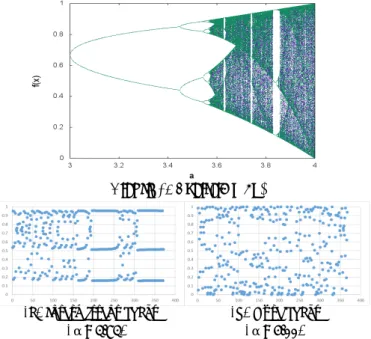
xn+1=αxn(1−xn). (1) Figure 1 shows a logistic map, and Fig. 2 shows a time series diagram of pure chaos and intermittent chaos.
Figure 1: Logistic map.
(a) Intermittent chaos (b) Pure chaos
(α=3.83) (α=4.00)
Figure 2: Time series of intermittent and pure chaos.
CNN used for image recognition consists of input layers, convolutional layers, pooling layers, fully connected layers and output layers.
3. Simulation results
We define as the learning steps = 100. As the first data set, 200 learning images are prepared for each of the 70, 80, and 90’s T-shirts as a total of 600 original data set. We create a data set consisting of 2,400 images, each with the original image added to the augmented data using random numbers, intermittent chaos, and pure chaos. We compare the learning rates and test results obtained these four data sets.
Figure 3 shows the learning accuracy and step on CNN.
Data sets that were augmented by pure chaos reached a 100% learning rate slightly faster than the other data sets.
Table 1 shows the CNN test accuracy learned for each data set. Even in the test accuracy, the data set augmented by pure chaos showed the highest accuracy.
Figure 3: Learning accuracy.
Table 1: Test accuracy.
Test accuracy (%)
Original data 48.8637
Random 52.2727
Intermittent chaos (α=3.83) 51.1364
Pure chaos (α=4) 56.8182
4. Conclusion
In this study, we verified the effect of data augmentation using chaos in learning with a small amount of data. The method using pure chaos showed better results in the both learning rate and test accuracy in the expansion of data by image rotation.
As our future works, we try a method other rotation for converting data when padding data. Further, we check whether it is valid for data composed of different types of images.