I. Introduction
This short note is a part of my research that
focuses on three interrelated issues: land tenure (changes and continuities), land disputes and
A Note on the Interaction between Formal and Indigenous Institutions for
Land Disputes Settlement: The Case of Arsii Oromo, Southern Ethiopia
M
AMOHebo*
Abstract
Dispute over land is one of the major problems people in the study area are currently facing. In this note I will briefl y discuss mechanisms of land dispute resolutions among the Arsii Oromo people of Kokossa district. When disputes over land occur, there are two settings for land dispute settlement. One is the formal (state) structure for dispute settlement while the other is the informal1) (indigenous) institution for dispute settlement. This note focuses
on describing and analyzing these two settings for dispute settlement. First, I briefl y discuss how the two settings for dispute settlement deal with land disputes. Then I make an attempt to illustrate how they interact and what the interaction means to the disputants. I also present a summary of an actual case of land dispute to illustrate how the two settings for dispute settlement work and interact. Finally, I discuss the practice of case ‘borrowing,’ which is one facet of their interaction.
* Graduate School of Asian and African Area Studies, Kyoto University
1) Throughout this note, informal institutions are interchangeably used with indigenous institutions.
mechanisms of land dispute resolution. I have been conducting fi eldwork on these issues among the Arsii Oromo people in Kokossa district, southern Ethiopia, since 1999.
The Arsii Oromo follow a patrilineal descent system and a patrilocal settlement pattern. They practice mixed agriculture. The landscape of the district is dominated by grazing land dotted by enset (Ensete ventricosum) fi elds. But one can easily observe variations in the land use patterns between the southern and northern parts of the district. The southern part of the district predominantly relies on livestock raising and cultivation of enset plant with little involvement in the production of cereal and other crops. The northern part of the district, on the other hand, combines livestock raising and enset cultivation with signifi cant production of crops such as barley, wheat, maize and potatoes. The difference in land use pattern has mainly emerged from
the differences in the agro-ecological settings by which the respective sections of the district have been infl uenced. The southern part of the district has been infl uenced by the enset cultivating Sidama ethnic group while the northern part is more infl uenced by the cereal crops producing Arsii Oromo communities. The information employed in this note has been gathered mainly through ethnographic methods: informal interviews, participant observation and extensive case studies. I kept the use of formal interviews and questionnaires to less sensitive issues after I found out that people were very reluctant to provide information on land tenure and related issues or they just provided ambivalent responses. This is because of the fact that land rights are very contentious political issues in Ethiopia. As a result I have chosen to focus on informal interviews and studies of actual cases of land disputes. I have managed
2) Photo 2 above, shows land use patterns in Kokossa district. The photo on the left hand side shows land use pattern in the northern section of the district with enset crop on the top followed by maize fi eld, then by intentionally enclosed strip of grazing land in the middle and a wheat/barely fi eld at the bottom. The other photo (right) shows the typical land use pattern in the southern part of the district where enset is the main staple and grazing land marks the outskirt of enset fi eld.
to establish a rapport with the local people employing the advantage of being a native speaker of the local language, Afaan Oromo (Oromo language).
II. Categories of Dispute3) Settlement:
The Formal Structures and the Informal Institutions
First a few words on the term ņdisputeʼn as it is being employed among Arsii Oromo. The term
waldhabbii4) is a combination of an adjective wal
(each other) and a verb dhabuu, which means, to miss something, to be unable to fi nd something after some attempts have been made to search for it. Thus, waldabbii can literally be translated as ņto miss one anotherʼn or ņto misunderstand one another.ʼn I couldn’t fi nd any word other than
waldhabbii that could stand for the term ņdisputeʼn
in Afaan Oromo. Consequently, in the subsequent sections when I discuss disputes, I am dealing with what Arsii Oromo farmers express as
waldhabbii in general and waldhabbii lafa (land
dispute), in particular. Thus, if waldhabbii stands for a dispute, the role of dispute settlement institutions is to clear up misunderstandings between the disputants or to let the disputants ņfi nd one another.ʼn
When land disputes between individuals or groups of various sizes occur, it has to be resolved either by the formal structures5) or the
informal institutions for dispute settlement. These categories, however, are not mutually exclusive. Interaction, and sometimes overlaps, is visible between the two settings in the process of dispute settlement. Each of these dispute settlement settings again can be divided into
3) Throughout this note, dispute is interchangeably used with land disputes, while mechanisms of dispute settlement is interchangeably used with mechanisms for land disputes settlement.
4) Waldhabbii should be distinguished from a rather related term wal-loluu, which literally means to fi ght with each other.
Wal-loluu is a combination of wal (each other) and loluu (to fi ght). Its noun form is lola, which means fi ght or war. While wal-loluu implies physical violence, waldhabbii does not necessarily imply so. In short, all wal-loluu are consequences of waldhabbii but not all waldhabbii lead to wal-loluu.
5) Formal structures throughout this note mainly refer to the district administration and peasantsʼn association administration. Fig. 1. Process of dispute settlement
different levels.
Figure 1 depicts how disputes appear before different levels of dispute settlement institutions. Arrows that originate from the land dispute show that one of the disputants takes his/her case either to the formal structures or to the informal institutions. Cases may also go back and forth between the formal and informal structures as the double pointed arrow indicates. The arrow with broken line indicates instances of ņcase borrowingʼn (which will be explained in detail later) by informal institutions from the formal ones.
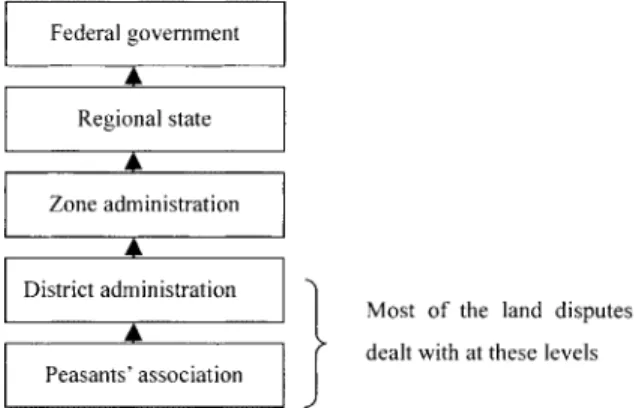
The Formal Dispute Settlement Settings To begin with the formal level, disputes over land rights can be dealt with either by the chairman of the peasantsʼn association (PA hereinafter) or go up to the offi ce of the district administrator. In fact, land disputes can potentially climb up through all the administrative hierarchy shown in fi gure 2. However, land dispute cases rarely go above the
district level, as it is costly to do so, both in terms of money and time. Even when land dispute cases reach the zonal administration or regional state levels, such cases are frequently sent back to the district administration. Consequently, most of the land related disputes that reach the formal structures are dealt with at PA and the district administration levels in that order.
However, neither the PA nor the district administration are judicial structures. They are rather administration structures. The judicial institution at the district level is Mana Murttii
Aana’a (the district court). At the PA level, it is
the Koree Hawaasummaa Seera Murttii Gandaa literally ņThe Village (PA) Social Affairs Courtʼn (it used to be called fi rd shangoo [tribunal council] under the Derg) that deals with civil cases. But disputes over land rights never appear before these conventional judicial structures.
Such a scenario begs for some attention. Why do disputes over land rights fail to appear before the PA social affairs court and the district
court? This has to do with the current status of land in Ethiopia. As stipulated initially in Ethiopia’s land reform of 1975 and reaffi rmed in the constitution of 1994 and then by the Federal Rural Land Administration Proclamation of 1997, land is public property (or state property). By extension, it is the state, not the actual users, the peasants, who have the ultimate legal ownership over the land. Thus, land disputes and issues related to land tenure are currently treated as administrative issues not as legal ones.
The Informal Dispute Settlement Settings At informal level, land disputes can be dealt with by jaarsa biyyaa,6) which literally means
ņelders of the country.ʼn The elders are not a fi xed group of people, as they can be composed of any member of the community. Nor are they necessarily of old age. The term jaarsa, which literally means ņelderly,’ is used more as a symbol here. Among the Oromo, elderly members of the
community are respected for their knowledge of customary laws and are perceived as symbols of wisdom, peace and reconciliation. It is because of this symbolic signifi cance of the elderly that any person who is involved in dispute settlement and reconciliation process is called jaarsa regardless of his actual age.
The jaarsa biyyaa are also of two sorts. One category is what I would like to call volunteer
jaarsa. This kind of jaarsa biyyaa settles
disputes between individuals or groups through its own initiatives. It intervenes either on the spot when and where a dispute occurs or takes the matter up afterwards. The other category is what I call solicited jaarsa. As the name implies, this is jaarsa biyyaa that either of the disputants approaches and solicits to get help to settle the dispute. However, the two categories of jaarsa
biyyaa are not mutually exclusive. Volunteer jaarsa frequently joins dispute settlement
settings of the solicited jaarsa. And also solicited
6) Local people use the term jaarsa and jaarsa biyyaa interchangeably. I also use these terms interchangeably throughout this note.
jaarsa may be invited to join dispute settlement
settings already initiated by volunteer jaarsa. With the above brief overview of the formal and informal settings for land dispute settlements, now let’s consider how these settings for land dispute settlements interact.
III. Dubbii Nutti Kennaa, ȦPlease Lend Us the Case’: The Practice of Case ȦBorrowing’7)
The jaarsa biyyaa (both volunteer and solicited) frequently ņborrowʼn land dispute cases from the formal structures for dispute settlement. This can be done under the following circumstances: (1) when a defendant solicits the jaarsa biyyaa to ņborrowʼn the case from a formal structure; (2)
when the jaarsa biyyaa takes the initiative (without being invited by either of the disputants) to reconcile the disputants by taking the case back from a formal structure and (3) when a formal structure invites (solicits) the jaarsa biyyaa to ņborrowʼn the case and settle it outside the formal
settings.
Now let’s look at each of these circumstances. First, why does a defendant solicit the jaarsa to ņborrowʼn the case from the formal structure so that it could be settled through customary mechanisms? People usually seek the help of jaarsa when they fi nd themselves in an unfavorable position if the case is to be dealt
with by a formal structure. A farmer, who was seeking the intervention of solicited jaarsa in a case already presented to the PA’s chairman, put the rationale for his action as follows.
These days, you can win any case if you go to government offi ces. But you need to have one thing, that is, money. With money you can buy two things that you need to win a case. You either buy [bribe] the daanyaa [an offi cer or a judge] or you can buy [hire] abaayii [those who give false testimony in exchange for money]. When you consider this, it is cheaper to buy land than to go to litigation over land (Name withheld, Haroshifa PA, January 2003).
The interview note above and other similar cases from the fi eld study demonstrate that pursuing a land dispute case through formal means is costly. This is due particularly to the widespread practice of abaayii, we may call them ņprofessionalliarsʼn and that of rampant bribery. In a setting for dispute settlement dominated by bribery and false testimony (abaayii), people could easily be punished for the wrong they never committed or could be deprived of their own property. As one elderly farmer in Bokore PA puts it, “As long as abaayii [false testimony] and
gubboo (bribery) exist, truth will never prevail
in offi ces.” That is why people tend to prefer
7)The word ņborrowingʼn here is not used in the strict sense of the term since cases taken from formal structures may not be returned back to the concerned offi ce if the jaarsa biyyaa manages to settle them.
indigenous institutions for dispute settlement to formal ones.
But why do some people take their cases to formal structure for dispute settlement while others prefer to go to indigenous settings? First, let’s distinguish two ways through which land disputes could appear before the formal setting: (1) a disputant may take his/her case directly to the formal setting (usually fi rst to the PA and then to the district administration); (2) a disputant may take his/her case fi rst to jaarsa biyyaa and then to the formal setting.
Discussions with informants generally indicate that it is individuals with weak grounds for their cases that usually prefer formal settings for dispute settlement to the indigenous ones. These people tend, as one informant puts it, to “buy truth with money.” As a result they directly present their case to the formal setting bypassing the informal ones. This implies the rampancy of abaayii and gubboo in the offi ces that deal with land disputes. Informants are also of the opinion that those individuals who acquired the disputed land through land distribution by formal state structure (usually conducted by PA administration) tend to take their case to the formal dispute settlement mechanisms. This implies also that when the disputants claim customary rights over a plot of land, which in turn implies relatively comparable rights to the land, they tend to take their case to the customary dispute settlement settings. Thus, the discrepancy in the means of land acquisitions is
also one of the factors that infl uence individualsʼn decisions to take their case before either of the dispute settlement settings. That is, there exist plural means of land acquisition, which in turn naturally gives rise to the plurality in mechanisms for land dispute settlement.
Some individuals, however, take their cases directly before the formal structures with a different implicit objective, that is, to “give weight to the matter” as one informant put it. This sort of individual actually hopes that the case will be withdrawn by jaarsa to be settled outside the formal structure. But the fact that the case has already been registered at the formal offi ce allows the plaintiff to put pressure on the defendant. Thus, formal dispute settlement structures are implicitly used as sources of intimidation. The second procedure is to take a land dispute case fi rst before the informal institutions, and if that attempt fails, then to the formal structures. The land dispute that occurred on 23 October 2001 while I was in the study fi eld provides important information in this regard. An informant (who was the plaintiff in this case) put the situation as follows.
I fi rst presented my case to jaarsa biyyaa who were on the spot when the dispute took place. The jaarsa asked both of us [the disputants] to sit down and tell them our problem. I promptly agreed. My opponent [the defendant] was reluctant to positively communicate with jaarsa. He denied that he
sold the grass [grazing rights] on his land to me. Some of the jaarsa were angry since they already knew the source of our problem. In the meantime he [the defendant] walked away leaving all of us where we sat. I was angry and so were the jaarsa who were helping us settle the dispute. The jaarsa ņblessedʼn me for my patience and allowed me to pursue my case in any way I found appropriate [implying the go-ahead given to him to take his case to the formal structure]. On the same day, I presented my case to the PA’s chairman [Bokore PA]. Within hours he [the defendant] begged for the help of the same jaarsa whom he had embarrassed earlier in the day, so that they would take the case out of the PA’s administrative offi ce. The jaarsa begged me to let them take the case from the chairman’s [of the PA] offi ce [the jaarsa needs the consent of the plaintiff in order to be able to ņborrowʼn cases from formal structures]. I did not resist
jaarsa’s request, since my intention from the
beginning was not to pursue the case through formal structure but to force my opponent to accept jaarsa’s effort (Habtuu Worquu, informant, Bokore PA, 2001).
This case is especially important since it reveals several elements that usually manifest in the land dispute settlement processes. We see in this single case an instance of the involvement of both volunteer jaarsa and the solicited ones. Initially, the volunteer jaarsa attempted
to settle the dispute on the spot. The plaintiff instantly agreed to the request of jaarsa, since, he is by custom required to present his case fi rst to the indigenous dispute settlement setting before approaching the formal structure. The defendant, however, made a mistake and failed to take advantage of getting the dispute settled through the informal institution. This happened because he had misjudged the move of the plaintiff in that he did not think that the plaintiff would take the case so soon to the formal setting. When that was not the case, the defendant rushed to beg the help of jaarsa biyyaa, this time the solicited jaarsa. We also observe the implicit objective of the plaintiff to present his case to the formal setting, that is, to scare the defendant and thereby to speed up the settlement of the case. Now let us look at the situations under which the formal structures solicit the informal institutions to take the land dispute case from the formal setting and settle it outside the formal structures. This happens particularly when the formal structures have neither the means to solve the dispute nor the capacity to enforce their decision. This in turn arises from the nature of some land disputes. Sometimes a dispute ceases to be a matter between a few individuals but develops into a dispute between groups.
Good examples are two land disputes cases I witnessed. One was the dispute between two lineages that took place in July 2001 in the then Tulu Gaduuda PA (currently Hebano PA). The other was the land dispute between two “big
men” in February 2003 in Haroshifa PA, which later on culminated in a dispute between a large number of people on each side. Under such circumstances there was a multitude of ņplaintiffsʼn and ņdefendants.ʼn When this is the case, the help of local dispute settlers is indispensable. Thus, in both cases mentioned above, the jaarsa biyyaa from neutral gosa (clans) were invited to help in solving the problem, which they did.
Conclusion/Summary
Land disputes can be settled either through formal (state) structures or through informal (indigenous) institutions. Land dispute cases can also go back and forth between the formal and informal settings. More interestingly, many of the disputes that happen to reach the formal dispute settlement levels come back to the indigenous dispute settlement institutions through the practice of ņcase borrowing.ʼn The fact that there are two settings for land dispute resolution could tell us not only the phenomenon of ņlegal pluralismʼn but also plurality of the means of land acquisition.
The decision on the part of disputants to present their cases to either of the settings for dispute settlement could be based on the advantages or disadvantages they anticipate. But the indigenous institutions seem to counter the unfair advantage that the people who prefer to take their case to the state structures foresee. They do this in two ways: (1) by custom it is
wrong for an Arsii Oromo to take his case to a government offi ce before fi rst presenting his case to jaarsa biyyaa. The indigenous dispute settlers thus make the fi rst attempt to settle the dispute. (2) The indigenous dispute settlement institutions can also take the land dispute cases back from the formal settings through the practice of ņcase borrowing.ʼn
In customary dispute settlement settings, the conventional procedure is (1) dubbii dubachuu (to talk [discuss] about the matter), (2) dubbii fi xuu (to settle the dispute/matter) and (3) araarsuu (to reconcile the disputants). The third component of this procedure is the most important aspect of indigenous settings for dispute settlements. It is one of the major merits of informal dispute settlement settings over the formal ones. But this important component of indigenous settings is totally missing in the formal ones. This renders land disputes settled by formal structures incomplete. When reconciliation of the disputants is not a component of the dispute settlement process, land disputes can only be partially settled. Indeed, several of my case studies suggest that when a land dispute is settled by the formal structures, the loser of the case considers that he just lost a ņbattleʼn not the ņwar’. Such dispute will soon be activated when
the ņright daysʼn come, as local people say. The two settings for dispute settlement interact sometimes positively, at other times negatively. Positive interaction occurs when each seeks the help of the other in order to settle disputes,
while negative interaction is visible when the dispute settled by one setting is reversed by the other, which is particularly the case in the formal structure. This negative interaction not only undermines the role of indigenous institutions for dispute settlements, but also duplicates the dispute settlement process. Thus, it would be advantageous both to the formal structures (which are usually too stretched to deal with all their
ǵ2002 ॷ 9 ȴʰ⏋ኜៜѹ᧑Цȵۊɐʳ ˵Ͳˡͦ͡˽߂ɴˁȲȷ⏋̸́⏃̲˵ ͓ܩ⏋̶ˑ̴͠Ͳ⏆ɴȲȿʳ20 γᏛմץ ɹзࡨল፷ˁድɌɩȦʳ⏏ೣዣɫɻ⏋˪͠ ˽͇˽մɹ̸́॑ɹࡎˁ⏋ࡱఠϟˁ៎ဣ ɴɌɩݬٚɌɛȦ⏏៨ᦚɻ 2002 ॷೢɹᐁᱻ ɴݜɧȦɩȦʳ⏏ ǵ12 1 ȴʰ⏋ᅘμɴȋ̸́ɹ˪͠˽͇ ˽ Pasko sa SugboȍɭȦȩܽʶ८ʦ⏋˪͠˽ ͇˽ខᰴȵވȭɻɍʠɛ⏏̸́ɹᮚຩБɻ ᲞȦɹɞȵ⏋˽˪ˠ̒̊ͻ⏃έ࣎зᓔ⏆ɹ ᢩɌȦࢃǾʢΥಓμ̦ˠͲˁɦȿɩȦʳ⏏Υ ⏋߂ᦲʱɹጓ༐ɲڧঊʦͤ˽̜͞Ͳɻ⏋ᚱ ʦೠՖʶ⏋̸͠˥ᒊɫᓩࢃӉˁсʱ⏋̢̒
areas of responsibility) and to the disputants, if the decisions related to land disputes by the indigenous institutions are fully recognized and respected. Recognizing and strengthening the power of indigenous institutions for dispute settlement would also help alleviate the problems of bribery and false testimony that characterize the formal settings.
˪͠˽͇˽ɹ̶ˑ̴͠Ͳɫࡱఠˁᓒȭʳ
ǵؤǵ࿀ǵࡎ*
̮͓˹ɹ࣒ˁȴȿɩȦʳ⏏॑ɹςҼɐʳᓩ ࢃӉ˱Ͳ̘˽̜ɹɛʠɞ⏏ተȴɴ˓˛˽ɻ ᢩɌȦᱛࢸ࣒ɫᅊʚʶɛɹɞȴʰ⏋ഞೠʦዷ ȷᄹɫᓩˁԗჼɌɩʢȦȦɞʸȩ⏏ ǵɌȴɌ⏋ᇿᶧɹɲȦӉɻᚱϺ০ˁਲ਼ʼɓ⏋ ఠЦմɹᓩࢃӉɴປʏʳɭ⏋ឿ֔ʱɐʳɄ ɭɻوʠɲȦ⏏Ʉɹ 2-3 ॷ⏋̲˵͓ᡉऄɫఠ ЦɹᓩӉඑȵވȭɩȦʳɄɭˁؙɌɩȦ ʳɹɞʸȩȴ⏏ೠɫɫȷɛᓩӉɹкʦˁ Ɍ⏋ᢒႋɹᰑʦᕀɞȿȵʢȹʰʶɛԠሎ ȵ⏋ᰈᑢɴృᓬɴᥔɤɩȦʳ⏏එᏼᑩȵܩ ӯɹࢹॷɛɠɴᇴʛˁӈȴɓ⏋༠ɹᲓᙃڃ ॑ݭɴࢌᥥɐʳɹɞ⏏ɞȵ⏋එʢѵਂɹɻ ɑ⏏ʚɇɴኜˁʢੇʶɵ֪ɫȡʳ⏏ɭʢȴ * ੩ㇺᄢቇᄢቇ㒮ࠕࠫࠕࠕࡈࠞၞ⎇ⓥ⎇ⓥ⑼ȼ⏋߂ᦲʱɹˠͻˤ̢̒˪Ϻ০ȵ឴ʼʶʳخ ᔨਸɻෑʠɩжȦ⏏ ǵɇɩ⏋ȋਃڊ˪͠˽͇˽̮ͻ̘ˑɹɛ ʠХȍɹʱᏨȵވȭ⏋̮ͻ̘ˑᅎɹ̺ ͤ̄Ͳ̜ˁଝɴɌɛϺǾȵȷϯȦ⏋ᠨʢ ȵ˪͠˽͇˽̅Ͳ˫ˁȩɲȴ⏋ዺး⏋ˏ ͦ͜߂ᐏ᯿ȵȋ12 6 ⏃ᩆ⏆ɻോХ ɴȍɭࡺៜɌɛ⏏˓˽͞ͻ͌ɹుᰩ⏋͇͞ ̋Ͳȵᏺʼʳɫȡʳ⏏͌˽͌͠ɹుᰩɻ⏋ ၈ੱɴ༑ɇʶɲȦઝਚˁȦ⏋Ꮔኜɹ༒ˁ ɻȴʳɄɭˁᇿᇕɭɌɩȦʳ⏏ʚɛ⏋ుᰩɭ ȦȩԊؾкᱻˁɭȲɌ⏋ѵਂɹᦹय़ઢˁᲞʠ ʳ৲ւʢȡʳ⏏ుᰩˁᐚȿɛ̶ˑ̴͠Ͳᨆ ɹ͌˽͌͠ɴదઝˁᝠɌ⏋˥͠˽̜ఠਂʢھ ʃˁՕȴɠغȩኛɴɌʭȩɭȦȩɹɞ⏏˓ ˽͞ͻ͌ɹ̯˻͖͞ಪɻ 1 ॷ 354 ɫ⏋߄᭞ ಪɭɹᬠѥɫɻຘॷ 2 ᦼᬚʓɰմɴᦽʞɛ ʠ⏋2002 ॷɹ͇̋͞Ͳ౩ȿɻ 12 6 ɭɲ ʱ⏋˪͠˽͇˽̮ͻ̘ˑɹވȭʳಁೝɭᩂ ɲɤɛ⏏ ǵ˵Ͳˡͦ͡˽߂ɻჼܧʢኜോȵςк ɫȡʳ⏏߂ఠڊɴʢኜၼʦኜᅊȵȼ⏋ ̠́͊ͻմɴɻȋԃɩˁኜɹਉଝɴʪɞɷʚ ɐ⏏ᠡɤɛᐄഗˁᅊʛՏɌʚɓ˃ʭȩȲࢷȷ άɇȦȍɲɰɭᇖɫናʱˁɁʳ⏏ଘܧܩɹ ̸́ɻ̶ˑ̴͠Ͳʍɹ˥͠˽̜ఠШഀɹܩɫ ȡʱ⏋ჼܧʢˡ̜̒͠˪ȵ߂ధˁװʠʳ⏏ Ʉɹʭȩɴˡ̜̒͠˪ᖬȦ˵Ͳˡͦ͡˽ ߂ɫ⏋ȋჿᅓȵ͊Ͳ̠̋ˠɲʰȍɭ̯˻͖ ͞ಪȵ؝ȿԂʶʰʶɩԃХᡙɴɲʳɹɻɲ ɕɞʸȩȴ⏏ ǵ̸́ȵܩჿᇕɴʢЦᇕɴʢ⏋̢͇͞ʭʱ ͊Ͳ̠̋ˠɴᦏȦȴʰɫɻɲȦȴɭᓒȭʰʶ ৢ૯ 1ȁμΏ͈࿐͈ئ́ͼΑ͈ࣛ౪ͬਿ̠ 3 ૽ ͈ฎআ̹̻ ৢ૯ 2 ऒ̥ͣȄπΓέȄͼΑͬ༴̩ζςͺȄ ρΛΩ̩ͬഛঀ ৢ૯ 3ȁΩͼΛίσͅս̹ͦ͘ঞୋ͈ز
ʳ⏏ɭɻȦɤɩʢ⏋ؗ߫ᇕɲᬠѥȵѳ୫ɇʶ ɩȷɛʼȿɫɻɲȦ⏏ȋ͌˽͌͠ɹܤܩˁ˥ ͠˽̜ఠਂȵѢᅭɌɛȍɭȦȩឿʢೣɫ ɻᓬȼ⏏ল፷ᠭീɫᓬʱˁɐʳɭȋ͊Ͳ̋ ̠ˠʦ˽ͻ͡ͻɹ͌˽͌͠ɴʭʳఓ Moro Raids ɫᅘȵঘʶɛȍɭᅵؤؾᯭɹፐȭȵ ᦐɤɩȼʳ⏏ʦɻʱ̸́Ϻɴɭɤɩɻȋ͌˽ ͌͠ɹఓȍɭɌɩʱᐙȵʶɩȦʳɹɫȡ ʳ⏏ɄȩȦɤɛرᇕᔘಕɴ⏋ᦏॷɹ͌˽͠ ͌⏎˪͠˽̍͑Ͳϝȵ֓ʼɤɩ⏋̸́Ϻɻ ͊Ͳ̠̋ˠɴࢹɲʱɭʢ᭝ɲ˓͍ͻ˻ˁ ୃȦɩȦʳ⏏ ǵɌȴɌ⏋ࡸ᭬ɴɻຘȼɹϺȵ̸́Ņ ͊Ͳ̠̋ˠᬚˁȷഀɌɩȦʳ⏏͊Ͳ̠̋ ˠɻ᤹ᦏɲऄɲɹɞ⏏̲˻̦˽ᅠɫɻȋ́ ̸ɭ͊Ͳ̠̋ˠȍȋ̲˵͓ᡉऄɭ͊Ͳ̠̋ˠȍ ɻ̜́̒ɫȡʳ⏏͇˪̝̠̝͡ˁԻȽ̫ͻ ˤͻ̍˙ͻͲɫȡʳ˻͚̲͠ͻ⏋˵Ͳ͊˰ ̲͡ͻ͡⏋ృᓬ⏋͞˻ˠ࣌⏋ᖛЦɲɰ ɻȋ̲˵͓ᡉऄɭ͊Ͳ̠̋ˠȍךɹೣᨆˁ́ ̸॑ɴȲȼ⏏ʚɛ⏋ᢌȴɲྫݭɭᦅܟˁ୫ɦ ͊Ͳ̠̋ˠȴʰ⏋̸́ɴᅊ᳞ᰩڃȵ࣑ȿʰʶ ʳ⏏ఠᔒᯆɫʢ⏋̸́॑ɻ̲˵͓ᡉऄɭ͊Ͳ ̠̋ˠɹᗐᓔɛɠˁᮃʠʳ߂ɹɫȡʱ⏋ ɗɹרᅊɹȼɻ̸́ɴɭɰʚʳ⏏New People’s Army⏃Ԋᅋςᒶɹؙకঌᮃ⏆ɻ ۬ʦᶁᚫˁ͊Ͳ̠̋ˠȴʰʚɑ̸́ऄᨆɹ ྫɴࢌᥥɐʳ⏏Ʉɹʭȩɴ⏋ɲϺʦʢ ɹȵ̸́Ņ͊Ͳ̠̋ˠᬚˁȷϯɤɩȦʳ⏏ ǵɌɛȵɤɩ⏋̸́॑ɴеᒞɐʳኜៜѹ ᧑Цɴɭɤɩʢ⏋͌˽͌͊͠Ͳ̠̋ˠɹ ϟɻ⏋ໆɌɩɻʳȴ᧙ȼɹᅵఠਂɹәɫɻ ɲȦ⏋ɭȦȩʼȿɞ⏏̸́॑ɹᨆɴɻ͐˽ ˪ʢȡʱ⏋ࢸៀฐɲȵʰ͌˽͌͠˱̢͖͊ ̘ˑͻȵࡔܧɐʳ⏏ˏͦ͜߂ᐏ᯿ɴᐚȷ⏋ˠ ˽͍ͻ̢͑॑ᬏʢȋኛ͇̋͞Ͳ౩ȿȍɹ͍̒ ́ͻ˻ˁ߂Ǿᇕɴˏ̴ͻ͡Ɍ⏋॑Ԓɹॶٮˁ ᐣ୫Ɍʭȩɭ֗ɌɩȦʳ⏏ɭɻȦȭ⏋˪͠ ˽͇˽˹ͻ̀ͲɹЦᰩɭɲʶɽ߂ᩄɹ͚ͤ̍ Ͳ̫̓˓⏃ᢑɹπ္ȷ⏆ȵ͍˓Ͳ⏏Ԋɴᰩ ʏɩɄɗଁʱጓɦЦᅊ༎⏋Ɍȴʢ˥͠˽̜ ఠਂɹᰩయɹμɫ⏋͌˽͌͠ɴ͇̋͞Ͳˁ ణɇɓɩȦʳɄɭɴɲʳ⏏ ǵຘ⏋άࢆɹմɹዷȷܩɫʢ⏋ᅊǾɌȦ ᇐᢑȵᶅᩆᖬɹ͚ͤ̍Ͳɴ္ȷȡɁʰʶɩ Ȧȼ⏏ɗɹᢔਢɲᰟಕˁሖʠɲȵʰ⏋͇̋͞ Ͳμɹ͌˽͌͠ɹ៨ϟˁᠧ˃ɫȦʳɭ⏋Ꮴ ɲᆄکȵʼȦɛ⏏ɲɕ˥͠˽̜ఠਂɛɠɻᢩ ˁکʼɑ 12 ՟ȴʰ߂ᰩɌɩȦʳɹȴ⏏ ˪͠˽͇˽ɞȴʰয়းɫɌʬȩ⏋ɭȦȩፐȭ ȵᦐɤɩȼʳ⏏ȋਜɌȼɩʢ⏋˪͠˽͇˽ɻ Υʛ˃ɲɫኛȩȍȋᢩɌȦȿʶɰ⏋ံჿɌ ɩɫʢኛȩȍ⏋ተȴɴਕཧʚʳ᠌ɞ⏏ ǵɗʶɴ⏋̶ˑ̴͠Ͳɹ˪͠˽͇˽˹ͻ̀ Ͳɻ 9 ȴʰ 2 ʚɫ⏏ఠЦɻȼȴʰ༝ȷ ጓɦϺǾˁȦɇʠʭȩɭɌɩȦʳȵ⏋֟ ৢ૯ 4ȁΩȜΞͻ͉ͅຈଌ͈τΙοϋȆΨδͼ Ȫග͈܃ઘ̧ȫ
ഗɻɲȼ⏋ϺǾɻ 9 Ϋȴʰˠ̶ˑ˽ʦڧ ঊɹޖɴȋ˪͠˽͇˽ʚɫȡɭ 100 ȍɲɰ ɭʠȼʱˡͤͲ̋ͻˁȴȿ⏋˪͠˽͇˽ྈ ҺˁࠃʠɩɌʚȩ⏏2 2 ɴˡͲ̚͞͠ˏ (Candelaria) ɭ٧ɽʶʳ͊˵ȵʼʶ⏋ఠЦ ȵিɴ˪͠˽͇˽˹ͻ̀ͲɹᏺᐄˁٚɁʳ ʰɌȦ⏏ɦʚʱ⏋ɄɹᬏȦ˪͠˽͇˽ೝᬚˁ ᓒȭʶɽ⏋12 ՟ȴʰ̮ͻ̘ˑȵވȭʳ ɹɻ߹য়ɲɹɞ⏏ ǵɞȵ⏋лȴᔽɴᘺɠɲȦ⏏̶ˑ̴͠Ͳɹ ̶˝ͻ˪ˡ̜͠˹̀͌ᠶɫਖɑȡɁʰʶʳ ȋᝐˁ༑Ɍ⏋ȷتʃɲȵʰᝓȵΥкɐ ʳ܋፲ȍɭሺሄɌɩȦʳȴʰɞ⏏̶ˑ̴͠ Ͳɹ܋፲⏃༎ኢմɹ 4 ᦼᬚ⏆ɴɻ⏋ȋ ᝓɌɛˡ̜͠˹̀͌ȍˁБᝠɐʳϟȵ ᐚȼ⏏Ёɻ˓˛˽ɹᭇˁ৺ɦ 4 ᦼᬚ⏋৺ᭇ ፲ɫȡʳ⏏ʠɫɛȦɹ༎ኢմɴᗑɌʛɹ ܋፲ȵȡʳɹɭؾ⏋˪͠˽͇˽ɹմɴɻ ᕶըɹ৺ᭇ፲ȵȡʳ⏏ᣛ໘ˁடȭ⏋႞႓ˁଡ Ȧ⏋ਕᯁȴɴናʳಁೝɞ⏏܋፲ɴɗʶʓɰ ɹઝᒶˁឿՏɐϺǾɴ⏋৺ᭇ፲ɻࡔܧɌɲȦ ɹɞʸȩȴ⏏๙ˁᐓɦɄɭɴʭɤɩਕˁན ʠʭȩɭɐʳ͇̋͞Ͳμɹ͌˽͌͠ȵ᤹ᦏɴ Ȧɲȵʰ⏋˥͠˽̜ఠਂɻʼȵ᤹ˁ୷ʱᦐʳ Ʉɭɲȼ⏋лɹ፲ըʢɌɲȦɹɞʸȩȴ⏏ ǵ̶ˑ̴͠ͲϺȴʰɌɽɌɽȋೣϺɹˡ̜ ̒͠˪ఠਂɻଘ᠊⏋০ɞȿ⏏ኽ᧒ɴɭɤɩѵ Жɭɻᅊ༎ɫȡʱ⏋ᕶՕɗɹʢɹɲɹɞȍɭ ᡃɇʶʳ⏏ተȴɴ⏋ಓȲናʱˁɌɩ⏋ ɴ͊˵ɴȼɭȦȩȋ০ȍˁɄɲɓɽ⏋ɗ ʶɲʱɹྃઢˁɩȦʳኽɫȡʳ⏏ؾ ɴ⏋ȋлʢɌɲȦȍɭȦȩ০ʢ߂Ֆɞɭਲ਼ɤ ɩȦʳ⏏৺ᭇ፲ɻਕˁᘺɠመȿʳɛʠɹ⏋Ȧ ʼɽᕶᎴ˹ͻ̀Ͳɞ⏏ೣɹˡ̜̒͠˪ఠ ਂɹᬚɫɻ⏋ࢸᅊɫʢȲʦɦʦ˰ͻ͌ˁଂ િɌ⏋ɗɹȲᩆʦಁᬚˁኜɴɇɇɁʳ⏏߂Ϻ ʢϳූˁ᧫ȿʳ⏏ȵ⏋ఠЦˁΥՏʶɽ⏋ ೣЦɻॷ߂ɹᰰʛЦᐚȷ⏏͇˓̨̘͠ˑ ɭɌɩȋᕶᎴȍణɻȴɲʱᮑɌȦɞȿɴ⏋ ȋ৺ᭇ፲ȍɻȦɦʢઝᡫɴȡʳ⏏ ǵʢɠʸ˃⏋̶ˑ̴͠Ͳɴɞȿ৺ᭇ፲ɲɌ ɴᭇኢȵʦɤɩȼʳʼȿɫɻɲȦ⏏̸́ ɫʢ⏋৺ᭇ፲ɹ 4 ᦼᬚ⏋1 ೣɑɦတˁɭʢɐ 4 ೣᏼɹͦ˗̅˪ɻȡɠɄɠɫʛȴȿʳ⏏͊ ˵ɫɻಁೝᇕɴᠧʞʏȷᓩೆɹ፝ଘȵᠧʚʶ ɩȦʳ⏏ȵ⏋ɗʶɞȿɫȡʳ⏏ɄɄɫɻȋံ ဤȍɻံઝ٢ɲɹȴʢɌʶɲȦ⏋ɭᓒȭɩʛ ɛʱʢɐʳ⏏ ǵ৺ᭇ፲ɹϟɫɻɲȦȵ⏋ࡱఠᇕɲ˪͠ ˽͇˽ྈҺɻȡʳ⏏˽̿˓Ͳɫ͊˵̚ ˤͻ͚͠ (Misa de Gallo) ɭ٧ɽʶʳȋΥᅱᵋ ɹ͊˵ȍɞ⏏12 16 ȴʰ˪͠˽͇˽ʚɫ ɹ 9 ᬚ⏋ 4 ಁץȴʰ 5 ಁץɹᬚ͊˵ȵ ʼʶ⏋9 ᬚᇖֵɌɛѵਂɻᰔȦϟȵʁɭɦ ȴɲȭʰʶʳ⏋ɭȦȩીᓃɫȡʳ⏏ʢɭʢ ɭ⏋μɹ͊˵ɴȴʶɲȦᦅʦྫɹɛ ʠɴࠃʠʰʶɛʢɹɫ⏋ˡ̜̒͠˪ɹఠᒶɴ يʚʶɲȦ˪͠˽͇˽ྈҺɫȡʱ⏋̫̍ˡͲ ɻ̶ˑ̴͠Ͳɞȿɴ᠗ʠɩȦʳɭȦȩ⏏ ǵΥγБմɴɻɰɹࢃʢԃڊɫؒ՞Ɍɛ ȵ⏋Ёɻȋˤͻ͚͠ɴȼϺȍȵ᠌ᰍɴɹ ʖʳʓɰ⏋ѵਕཉȦϺɹϟɫȡʳ⏏ɭȦɤ ɩʢ⏋ˤͻ͚͠ɹफ़ʱᱺ֪ɫɹȿȵϺ ȵՏʳʓɰ⏋ఠЦɻྃڊɴɲʳʰɌȦ⏏ؒ֓ ϺధȵཝɤɩȦʳɻɑɹˤͻ͚͠ɫʢᓩݟȵ ྃڊɴɲʳɹɻ⏋ᦼధמ܌ˁᣳɐ͊˵ɴᮃʚ
ʳॅ߂ɲఠךѵᓔధɴࢪɌ⏋ɗʶəʶॷ 1 ܌ ɞȿɹ͊˵ɞɭᓒȭʶɽ⏋έਲ਼ᡴɫɻɲ Ȧ⏏ᇖሾɤɩɻȦʳȵ⏋ؒ֓ᓔɹࢹɲȦ˪͠ ˽͇˽ྈҺɭȦȭʳɞʸȩ⏏ ǵлȴ৺ᭇ፲ʰɌȦ႞႓ɻଡʼɲȦɹȴɭᓬ ȼɭ⏋Ʉɹ 4 ಁץɹ͊˵ɴȼɞȿɫʢ႞႓ ɍʤɲȦȴ⏋ɭȦȩፐȭʢᓬȦɛ⏏ተȴɴ⏋ ჼБᨊ॑ɹֵʠϺɴɭɤɩɻᗑᆟȴʢɌʶɲ Ȧȵ⏋݀֝ӈᓔɹᦅɴɭɤɩʢؾɞʸ ȩȴ⏏ɗʢɗʢ⏋͊˵ɴήȴʳɹɻȲਜ਼ʛɫ ȡɤɩ႞႓ɫɻɲȦ⏏ɭɴȴȼ⏋ˤͻ͚͠ɴ ȼȴɲȦɴȴȴʼʰɑ⏋ᅊ༎ɻಔຍʭ ʱʢھʃɭූɌʛɴྃɠɩȦʳ⏏̮ͻ̘ˑˁ Ɍʭȩ⏋˥͑ͦ͡ˁᓬȷɴɄȩ⏋˹̴͚̒ Ͳ˫ɴʢ̴˪̢̒˪ɴʢɄȩ⏋ɭʱȡȭɑ ̲ͻ̍ɫᱺɅȩ⏋ᖛɫࢸోɴՏʭȩŔ˪͠ ˽͇˽ɞȴʰ⏏ ǵሁɴȋ̶ˑ̴͠Ͳ⏒ჼБ⏒ڧɌ ɛˡ̜͠˹̀͌ȍɭʚɭʠɩɌʚȦɛȼʢɲ ʳ⏏ɌȴɌ⏋ɗʶɻ̫̍ˡͲɹҹάɴ̶ˑ͠ ̴Ͳˁеᒞɧȿɛឿɞ⏏лʭʱʢʚɑ⏋́ ̸ɫɻᕶՕɹȵᅵϺɲɹɫȡʳ⏏ȋʍȭ⏋ ೣϺˡ̜̒͠˪ɫʢͦ˸͠ˠ⏃ᓩ͇͠ˏ ɴɁʳናʱˁధȭʳధჳɹʭȩɲʢɹ⏆ˁ ሾɤɩȦʳɹ⏱ȍɭѹ᧑ߨɴȴʶ⏋Ʉɠ ʰȵȦɛ⏏˥̨͐ɤɩሾɤɩʳ⏱ɭᏙ ˏ͍͠ˡϺɴᓬȼʭȩɲʢɹɞ⏏ೣɹࡎњ ɫʢ⏋ఠЦɴɤɩȦʶɽͦ˸͠ˠȽʰȦʛ ʳ⏏ɌȴɌ⏋̶ˑ̴͠ͲϺȴʰʛʳɭೣϺ ˡ̜̒͠˪ɲɰлʢሾʰɲȦృؒᓔɴɐȹɲ Ȧɹɞ⏏ ǵࡱఠɴɦȦɩᓒȭɇɓʰʶɛʱ⏋ᕶՕˁʛ ɦʠɛʱɐʳลЦɻȦȵ⏋ៜᘽʦ֪ɹ៎ ࢘ˁɭȲɌɩ⏋ኽȵ̶ˑ̴͠ͲϺˡ̜̒͠˪ ɹࡱఠ៎ˁɌᩄʳɹɻܐᮑɫȡʳ⏏ࡱఠɻ ᇿɴʛȭʳʢɹɫɻɲȦȴʰɞ⏏ᇿɴʛȭ⏋ ᔂɴઢɍʳࡱఠ༎֪ˁᦠɤɩʢ⏋ɗʶʰɹ ֪ɫȡʳ҅Ϻɭኜɭɹɻʛȭʭȩȵɲ Ȧ⏏ɗɹˁՕȴʰɑɌɩ⏋ៜ֪ɞȿɹՕഓ ˁɌɩʢዷᛕɫȡʳ⏏ ǵኽᕶ᤹⏋ఠЦɫןᰱˁʢʰȦ⏋଼ʱᏨɫ ͇͠ˏɭןᒽᵒˁ଼ʱ⏋ോɹؗ᧒ɭ ܕϺѹ᧑ަȵሏʳఠЦއܩɫᔈɞʠɌˁɌ ɛ⏏ɗʶˁʛɛ๘ᎦϺȵȋॾӻༀˁ؝ȿɛ ೣϺˡ̜̒͠˪ȍˁлȴɌʰɹങɴȩʭ ȩɴکȦɛɞɌ⏋ྃઢˁʭȩɌɩȦʳɹ ȵ⏋έਢɲɞȿɫɲȼέخៗɫȡɤɛ⏏ෑጩ ɲៜȦˁɐʶɽ⏋៎࢘ɇʶʳხߏɲᅊ႒ɫ ȡʳɹȵέਢɫȡɤɛ⏏ʚɛ⏋ኽɴɭɤɩл ȴȵ᧓ȩ⏋ɭਲ਼ȭʳᐄᠶȵ⏋کᰍɭʢɇʶɑ ɴᦲʳȋ৳ʰɹγᅠȍȵࡔܧɐʳɭȦȩɄɭ ᕶкȵέخៗɫȡɤɛ⏏ ǵೣɴзʛ⏋ೣˁ༑ɴ᠌Ɍ⏋ೣϺ ɹѵᓔɴཌྷɍɤɩೣɹ͊˵ˁ؝ȿɩȦɛ ɭɌɩʢ⏋ೣϺ˥͠˽̜ఠਂɴɦȦɩ⏋৳ ʰɻȋ˗̅ɫɻɲȦȵ⏋́Ͳ̜ɫʢɲȦȍᐄ ᠶɴ᧒ɌɩɌʚȩɹɞ⏏ȋᡒʠȦɛೣϺɹ ̶˝ͻ˪ˡ̜͠˹̀͌ȍˁິʠʳȵʪȭ ɴ⏋έਲ਼ᡴɇˁឿՏɓʳ—ȡʳȦɻсʱՏɓ ʳ⏏ȋ৳ʰɹγᅠȍɫ༥ᢹɐʳɞȿɲʰȦȦ ɹȴʢɌʶɲȦȵ⏋ჼࡸɹ៎࢘ᓔɻ⏋Υ҅ ɹᔀкɴࢆʳΥ҅ɹᏄኜɭɌɩᐄɌɩȦʳ ɹɫȡʳ⏏ ǵল፷ʢɗȩɞ⏏ȡʳ 1 ᥇ɹࢃȵଁɌ⏋ 100 ॷᬚзʛᐙȵʶɩȷɛɹɻ⏋Ϻر యଯলೳᕶးᄩޅ⏋ɗȩȦɤɛ
ᇕɲ৯ᯱГɴ⏋ࢃᕶ᤹ɹɹʭȩɲʢɹȵ сᅎɌɩȦʳɹɫɻɲȦȴ⏋ɭਲ਼ȭʳݭغȵ ȡʳ⏏ᇕɲឹ܍ȵࢃˁсʱՏɌɛɹɞȵ⏋ ল႒ᕶ᤹ɴлȴȵӈȷɻɍʠʳɹɫȡʳ⏏ ɗʶɻ⏋100 ɹ discipline ɹޖˁʱޙɓɽՕ ȴʳɭȦȩᰖɹɫɻɲȦ⏏Ʉʶȴʰ̶ˑ͠ ̴Ͳɹرᇕɲзࡨল፷ˁயȼɴȡɛɤɩ⏋ ԃкˁʚɭʠɩȦʳлȴɹȵȡʳȴʢɌʶ ɲȦɭȦȩخᔨਸˁᰄɴȲȷ⏋ɗʶˁៜᘽɫ ʰȭʳɄɭȵέخᔨɞɭɌɩʢ⏋ɗɹԒү ɹȴʰʛɩʢࡴɐʳ፝ଘȴʰԃкˁʛ ʳɄɭȵɫȷʶɽ⏋ɭਲ਼ȩ⏏ ǵ͇̋͞Ͳ౩ȿɹ̢͖ͻ˽ȵعᏨˁᣇʼɓ ɛ⏋12 ʢץɴԂʳɭ⏋ኛኢ͐ͻ̝ɻ ɇʰɴၖˁވɐ⏏˪͠˽͇˽մɹᖂߧɭȦȩ ჿᅓɫ⏋ዻᇴ⏋ᇍቐϟИʦϯᦲϟఖȵਸ਼ވɐ ʳ⏏Ϝྲᓃɹᖽတʦၱጭȵᴡʱᯱȼ⏏˪͠ ˽͇˽̮ͻ̘ˑɴ๕ȴɓɲȦ̶͡ͻ̓˭ͻ ˥⏋ᅆȦ̩͌ɹݳ⏋̓ͻ͡Ⴅɹ̍ͻ̀ (queso de bola) ȵঊᰄɴዩʛɇʶɻɍʠʳ⏏ᔂˁ ᭯Ɍɛ͌˽͌͠ߨਸɛɠȵ⏋˹̴͚̒Ͳ˫ ͐ͻ͡ɹ˪͠˽͇˽́ͻ͡ɴȼʱՏɐ⏏ɲ ˃ɭ⏋μܕᏙɹࢩɫʢ॑ɹ˪͠˽͇˽̚ ˱ͤͻ˹͚Ͳȵ᥇ӴˁᑉɤɩȦʳ⏏ ǵ̮ͻ̘ˑˁςҼɐʳʼȿɫʢɲȦኽɻ⏋ಔ ຍɭʼʰɲȦ፯ɹʭȩɲάࢆɴಬʰɐ⏏̓ ͠ͻʢ̦ˠͲʢ˛Ͳ̝ͤ˽˽̘ͤˠʢံ Ȧ⏏ȴʼȦɗȩɴਲ਼ɤɛɹȴ⏋߂ࢃɇ˃ȵኽ ɹ̝ˏɹմɴʢ̦ˠͲɹˁɛȼɇ˃ؼʳɌ ɩȼʶɛ⏏ɴɻዿȴʰᣧȦӵȵྯʶԂʱ⏋ лȴᘺɠመȴɲȦ⏏̸͞˗̢ͻɭ̓ͦ͡ͅͲ ⏃polvoron⏋Ꭼᰖˁܔʠɛ˽̿˓Ͳᘘࡎ⏆ɹ ߂፯ʢᨗɤɩȼʶɛ⏏лɹᕶըʢɓɑ⏋ᖬɭ ʱɰʱɹ̩́ͦͲˁɻȵɌɩᰩʏɩʛʳ⏏ʦ ɻʱлȴࡀɌȦ⏏ʚɞʚɞ৺ᭇ፲ɲɹɴ⏋ɭ ʢਲ਼ȩ⏏ȵ⏋ɄɄɴȦʳᭉʱ⏋ᰳᰩɹኛኢᐚ ȷɫʢȦȦɹɫȡʳ⏏Ʉʶȵተȴɴ̶ˑ̴͠ Ͳ⏋̸́ɫɹ 12 ɲɹɞ⏏ 1 ȁਗৡ߃̩͈ಎ࣭ࠏ͈ 12 ɴԂʳɭˠͻ̠͍Ͳ̜ɫᰴʰʶʳ⏏ 2 ૽́ࢭ႕͈ȶϋΗད̥̹ͬ͐̽ήΛΘȷ μܕᖬɹȦ̸́ɫɻ⏋ȋ̸̒̋ȍӉʦ᧑ఠɹɭ ᓩࢃӉˁιʏʳࢃʢȡʳ⏏
ǵɄɄɻ⏋͞ˠ˽μᨆ˵ͩͲ̠˭ͻ̜ላɹε ᭙Ϋɹᦅɫȡʳ⏏ɰɄʚɫʢᐚȼႥɹε ɴɻ⏋߃ອᅒ႕ɹȵɤɌʱɌɛᅮȵ⏋ܩᯆ ɴᐨᇿฐˁխ˃ɫȦʳ⏏4 ೢ⏋ᮘᴡȵɭ ɰʸȦɩϗ࡚ɹᏺʼʱˁٚɁʳ⏋ϗȷȷɤ ɛ߂ܩɻ࿅Ȧ⏋ᅊȷ႒ɛɠɻ༎ຩˁʱଖ ɐ⏏ɗɌɩϺǾʢᦅᬘೝˁᏺȭ⏋ɠʰʓʰɭ ᅒ˃ʖɴᰑˁՏɐʭȩɴɲʳ⏏ɄɹӴᏝ 6 Ͷ ɴʢؖʉ⏋߂Їϟɹࠃʚʱɞ⏏ ǵϺǾɻɄɹಁೝ⏋ᅒ˃ʖɹᅮˁឿ܌ʱ⏋ᅒ ᯆɴᇿˁӵʰɓ⏋ʼɑȴɲອʢံᱢɴɌɲȦ ʭȩຩˁᨗʳ⏏ɗɌɩ᧟ɴອɹྊʚɤɛፆ ȴʰɴ⏋ᓚᣱɌɩʪȼ⏏ᮒ࡚ɹ՟ʠɴᭇʳ ᮒȵ⏋ɗɹॷɹЇϟԃкˁृزɐʳɹɞ⏏ᰩ ʏɩʳɄɭɞȿȵനɹອႌɛɠʢ⏋Ʉɹ
͞ˠ˽ᦅɹອᅒɭॺɹధǾ
ࢸǵܮǵঔǵψ*
ಁɽȴʱɻӈȴɷɽɲʰɲȦ⏏Ȧɦʢɹʭȩ ɴȽɑȽɑɩȦʳɭ⏋ϺᬚɴȲࣇˁʁɤ ɿɛȴʶʳ⏏ ǵʚɑᅒඨȭմɴ⏋ႚ (thai) ˁ 2 ܌⏋ɗɹ ʚȽʼ (khaat) ˁ 1 ܌ȴȿʳ⏏1 ܌ᇿɹႚȵȿ ɻ̊˓̶̜̒ (thai hut)⏋2 ܌ᇿɻ̊˓̋ ͌ (thai dam) ɭ٧ɽʶʳ⏏ႚȵȿɴɻᅒɹμ ߈ȴʰүɴكȴȩɭ⏋ᅒɹүȴʰμ ߈ɴكȴȩȵȡʳȵ⏋̊˓̶̜̒ɭ̊ ˓̋͌ɭʢɴ⏋ɰɠʰɹˁᅎȦɩʢᖪ Ȧ⏏ʚȽʼɻ⏋ອᅒɹᑖɭดɹكɴ 1 ܌ɑ ɦȴȿʳ⏏ʚɛɗɹᬚɴ⏋ᅮݸʱˁȩ⏏ᔋ షɴɻ⏋ݡᔋ (fun) ɭᔋష (pui) ɹθȵ ᅎȦʰʶʳ⏏ݡᔋɻ⏋ອႌʦႌɹᏎȴʰɦȼ ʰʶʳ⏏ᮒɹᭇʱࠃʠʳմɴᅒԒɫഞೠʦᎨ * ϴᨊ߂߂ˏ˻ˏˏ̶͠ˡܩݖድድዀ ৢ૯ 1ȁᜂ̦̫ ࢸɇȦࡎњɫʢ⏋ອႌɹȦɴીʶɩȦʳ⏏ຐˁၚʦɌ⏋ᔋషɭɐʳɄɭʢȡʳ⏏5 ɴອᅒԒɹᗈБɴዛɌɛ⏋15 ȴʰ 20 ధɫ⏋ᅒඨȭȵɫȷʳዐɴᗈȵᅊᬏɐ ʳ⏏Υᖔɴ⏋ᓚᣱɻᅖਸ⏋ᗈʱɻߨਸ⏋ᅒ ඨȭɻᅖߨɹךաɲɌɴʼʶʳɄɭȵȦ ʭȩɞ⏏ ǵᮒȵמՕɴᭇʱ⏋Პʛɹᅒ˃ʖʚɫံϟɴ ᅒඨȭȵɫȷʶɽ⏋ʁɭʚɑਕɫȡʳ⏏ອ έʦᗈɹഞɴʭɤɩᅒඨȭˁఔඉɌɲ ȿʶɽɲʰɲȦɄɭʢȡʳȴʰɞ⏏1 ॷᬚɹ Їϟˁʼɑȴ 1 Ͷʰɑɫᏺȭɛອႌɛɠ ɻ⏋ອྊʱɴɗʏʱץᇿˁᬖȿɲȵʰ⏋ʦ ʶʦʶɭȡȼʃˁɌɩȦʳ⏏ȋᨙʢɛɽɄʢ ʦʰɑɴɛɞᶏǾɭЇϟˁɄɲɐͩ̊˹̊̍ ɻ⏋Ϻᬚɛɠɭປʏɩɲ˃ɩ̩̊͞˥̨͐ɲ ɹɞʸȩȍ⏋ɭɫʢȦȦɛɁɫȡʳ⏏ ǵᅒඨȭɹ፬ჿɻȦɛɤɩ˹Ͳ̺͡ɞ⏏ᮊ ᗳȵᑢᗛɌɛಁɴᭉʱ⏋Ϻଝɴʭʳ᭑ᗳˁ ȩ⏏ϗ࡚ɴʢсЊȿɇʶʳဌྰᅒ (naa seng) ɭɻᅵɲʱ⏋ε᭙Ϋɹ߃ອᅒ (naa noon) ɴɻ ᮊᗳʦࢀᛚȵࢹɲȦɛʠ⏋᭑ᗳջʦຏᛚջɻ ᅎȦʰʶɲȦ⏏ᅒඨȭሁɴˡ̢ɴʭʳࢀȵ ৢ૯ 2ȁ̪̥̫ͩ͘Ȫஜȫ͂ຠ৾ͤȪ؈ȫ ᗈБсɭೣᅒྈҺɻιɌɩʼʶʳ⏏ ৢ૯ 3ȁന̢͈໓ࠊ ອᅒԒɴɻ⏋̶̫̊ˤ˥ዀˁɻɍʠɭɐʳɇʚɊʚɲปೠȵɇʶɩȦʳ⏏
ʁɰȦݭغɴᦅᚫˁьȩɄɭʢȡʳȽʰȦɞ ɭȦȩ⏏̦̀͊ɴʭʳᰩࢀᬿɴɻ⏋̦̀͊ ʱɹᒘˁᅎȦʳ⏏ ǵ11 ⏋ಓȵ༳Ɍȼɲʱ⏋ᮒ࡚ɹؿɹ ࢸᮒȵɿʰɦȼ⏋͞ˠ˽ɫɻࡸʱɹ࡚፲ ˁᦎȭʳ⏏ዝൎɹؚዲɻ⏋ܩΫ 30 cm ȴʰ 50 cm ዐɹᨆՕˁɫʱʳ⏏ॶܯᇕɲ ؚᩄɻ⏋ϗၥᎨᩂɫ 0.8 t/ha ȴʰ 2 t/ha ɫȡʳ ȵ⏋ɽʰɦȷȵ߂ȷȦ⏏Υᖔɴ⏋ໜाȦɹ жܩᅒ (naa thaam) ɫɻ 3 t/ha ʓɰɭʶʳȵ⏋ ε᭙ΫɹᅒɹؚᩄɻжȦ⏏ɤɛዝɻɷʰ ʶ⏋ᅒμɹൎɹΫɫॵɇʶʳ⏏
ǵᔵዤɴɻ⏋͇˓˱Ͳ̶ˎ̜̒ˡˠ (mai
khong fat khao) ɭ٧ɽʶʳᦅԍˁᅎȦʳ⏏Ʉ
ʶ ɻ⏋50 cm ȴ ʰ 60 cm ɴ Ֆ ʰ ʶ ɛ⏋ ሁ ৹ 3 cm ዐɹᏳȦጭඑ⏃mai bong ɫсʰʶʳ⏆ ˁ 2 ೣ⏋Ꮳɫɦɲȹغʼɓɛʢɹɫȡʳ⏏Ʉ ɹᏣˁዝɴॎȷɦȿ⏋θଝɫጭඑˁ୫ɠ⏋ ዝዥˁܩᯆɴبȷɦȿɩᔵዤɐʳ⏏ᔵዤ⏋ ɤɛͩ͞ɻອႌʦႌɹɭɇʶʳ⏏ ǵᔵዤɇʶɛዝᎨɻ⏋ᰟ᧧⏋عࢃɹዝᎨᢱ ᚁࢸ࣒ (lao khao) ɴᢱᚁɇʶʳ⏏Гմɻᕼɭ ഉɫعᕶᏄᎦɌɩȦɛȵ⏋ᦏɻԊؾɹᏄ Ꭶଘˁ୫ɦȵȦ⏏Ϻɻਖឹɴਝɍɩ ዝᎨˁ୫ɠࢊʱ⏋߂݀ɹᎨʱᏄᎦลɫᏄ Ꭶɐʳ⏏ᏄᎦɹ᭬ɴՏɇʶʳʈɐʚɻ⏋̢ ̜ͩ͠⏋ˏ̯͡⏋̸̊⏋ɹɭɌɩգᅎ ɇʶʳ⏏ɲȲ⏋ɫᅊᅋɇʶʳᎦɹ߂ץɻ ᕶᐌᅎɞȵ⏋ެɐʳݭغɹѝൔɻ⏋͐̍ Ꭶ 1,600-1,700 ˥ͻ̺/kg⏋˗̍͡Ꭶ 2,000 ˥ͻ ̺/kg ɫȡʳ⏃2001 ॷ 9 ჼܧ⏋1 Ꭶ̝͡⏮ 9,215 ˥ͻ̺⏆⏏͞ˠ˽ɹࢃɫɻຘ⏋ອˁ ɤɛཉȦࢭᅎ᫂ (moo neung khao) ɴԓ᪫০ ɹ˸͡ (houat) ˁɹɓɩ͐̍Ꭶˁᙜɐ⏏ɗɌ ɩᙜɌɛɩɹ͐̍ᎦˁጭនɹᎢ (tip khao) ɴ ᇵʱɴ᠋ʠ⏋୭Ӵɫɗɹɵȼʢʱˁઢɍɲ ȵʰʓȲɽʳ⏏ʼɑȴɲᅆʛɭ᱗ʱ⏋Ȧ Ʌɛȭɻ⏋͞ˠ˽షჿɲʰɫɻɹූɌʛɫ ȡʳ⏏ ǵᶅᩆᖬɴɛɲʃȼዝዥˁ৺ɦᬚɴʢ⏋ᅒ ˃ʖɻɇʚɊʚɲਜ਼ʛˁήȭɩȼʶʳ⏏ʚ ɑᅒԒɴȼʳጓೠɻ⏋ᅎೳʦᚩသೳ⏋ป ᔩೠɭɌɩգᅎɇʶʳʓȴ⏋ᰩᅎʦᚫᅎ ɭɲʳʢɹȵ߂ץɫȡʳ⏏ϗၥ̶̫̊ˤ˥ക ৢ૯ 4ȁ࣮ 2 ೣɹጭඑɹᬚɴዝˁɻɇʛ⏋ܩᯆɴبȷɦȿʳ⏏
ˁୖȦɛɽȴʱɹృᅒɴɻ⏋Dipterocarpus ࣚ ɭ Shorea ࣚɹ̶̫̊ˤ˥ዀɹปೠȵ⏋ᅒᯆ⏋ ᅮΫˁکʼɑɇʶɩȦʳ⏏Ʉʶʰɹೠɻ⏋ ሎሁɫάഘɹࢹɲȦปॻˁʢɦɛʠ⏋ᅎೳɭ ɌɩɹգᅎѝғȵᲞȦ⏏ʚɛ⏋Dipterocarpus ࣚɹปॻȴʰɇʶʳปᔩɻ̠Ͳ͇Ͳ ̢͑ͻͲ (namman nyang) ɭ٧ɽʶ⏋ςɴഌ ౩ɹషɭɲʱ⏋Shorea ࣚɹปॻȴʰɇ ʶʳปᔩɻ˥ͻ˹ͻ (khi sii) ɭ٧ɽʶ⏋ςɴ ᖛঈɹອྯʶᬿջɭɇʶ⏋ɭʢɴ߂Ֆɲჼ ᩆؚԂ྇ɫȡʳ⏏ᬖᅒ 50 ॷГΫᐁɛʭȩ ɲإȦອᅒɴɻ⏋Streblus asper⏋Tamarindus indica⏋Azadirachta indica ɲɰȵᅮΫɴʛʰʶ ʳ⏏Ʉʶʰɹμжೠɻ⏋ᚩသೳʦࢃᅨɹᰲ ష⏋ᰩᅎɭɌɩգᅎɇʶʳ⏏ླྀອೝɹᅒԒɴ ᅊȭʳ Marsilea crenata, Limnophila geoffrayi⏋ ᅮΫɹ Kaempferia sp. ɲɰɹᩃᗳɻ⏋Υᖔᇕ ɲᩃᘛ⏋᱗షɭɲʳ⏏
ǵᅒ˃ʖɹٞʱɫკʶʳɻ⏋Ǿɹᰩᅊ ༎ɴ๕ȴɓɲȦ⏏ε᭙Ϋɴঃȵʳঃ߂ɲ߃ອ ᅒ ɻ⏋Esomus metallicus, Anabas testudineus,
Channa striata, Clarias batrachus ɲɰ⏋Υಁᇕ
ອݖʦ⏋ʦȴʰ᧚ΫɌɩȼʳɛɠɴ⏋ ៊ɹзʞଘɞȿɫɲȼᅋᔒଁݭଘʚɫʢ ரњɌɩȦʳ߂ីʓȴ 2001⏏ϺǾɻ⏋ ᰖɹᅊ༎رɴࢪਝɌɛɲྫԍྫˁᅎȦ ɩ⏋ᰈᑢɴྫ֝༎֪ˁȩ⏏ɄɹʭȩɴɌɩ კʶɛɻ⏋္Ȧɛʱ⏋ᙜɌɛʱ⏋˽ͻ̺ɴ Ԃʶɛʱ⏋ᇍᨥɇɓɩᨧ٢ˁɦȿɛʱ⏋ȡʳ Ȧɻ̮ͻ̚ͻ˪ (paa deek) ɭ٧ɽʶʳݾ сʱɴᅎȦʰʶʳ⏏̮ͻ̚ͻ˪ɻ͞ˠ˽ష ჿɴʢ߂Ֆɲᠭ٢షɫȡʱ⏋ɗɹೳషɹݾ ɴɻ⏋ϗ࡚ɹອᅒٞᦇɹܤȴʰɭʶɛʢɹȵ ߫˃ɫᅎȦʰʶʳ⏏ ǵʚɛᅒ˃ʖʦɗɹٞʱɴȦʳ̜ˡ˰⏋̼ ̲⏋ˡ˛͡⏋˗̀͞⏋́͊⏋˱ˠͦ˧⏋͇̊ ͌˹⏋̓͌˧ˏ͠ɲɰɹ֪႒ʢᢵᩂɲ̊Ͳ̮ ˪྇ɞ⏏̜ˡ˰ʱɴɻඑɹӴɴɦȿɛᥢɫ ᱔ˁɌʠʳЇȿ⏋̼̲ʱɴɻ̮̍Ͳ˱⏋ ˡ˛͡ʱɴɻᬏനɹࢸɇɲ˽˱̺̒⏋˗̀ ͞ʱɴɻࢭᅎɹЇȿᐨȵᅎȦʰʶʳ⏏კ ႒ʱɫɻ⏋ࡎњɛɠɞɤɩ߂Ϻɴᢦȿɩɻ ȦɲȦ⏏ᆌʶሾʰɑɹ৳ʰɻ⏋ថɫᣬʱ܌ ʱɲȵʰ⏋ᧉʃɹμɫݛɤɛଯˁɦȹɦȹɭ ৢ૯ 5ȁന͖͈ͭಎ͈́೦ͤ Paa kho ⏃͞˓˧͚ɹЗᬚ⏆ɲɰˁႰȩ⏏
ୁᮮɌɩȼʶʳ⏏̜͐̍͠ˁɦȿɛඑɫɹ́ ͊ʱ⏋ᬏനɹ˽˱̺̒ˁьɤɛ˱ˠͦ˧ ʱ⏋ปॻˁبȼ͇̊͌˹ʱ⏋ปΫɹ̓͌˧ ˏ͠ɹुʱɲɰɫȡʳ⏏ ǵࡎњɛɠȵ⏋Їᅥʠɛკ႒ˁઝɁɴȴ ȴɁ⏋ອႌɹᔘɴώɤɩॠɴɦȼ⏋ࢃ ɫɻທ៊ȵ̊˭̨˱˽ͻ̺ (keng noomai) ɹ ྈҺˁɌɩȦʳ⏏ʚɑ͓ͻ̠Ͳ⏃yaa nang; Tiliacora triandra⏆ɹᗡᘽˁɐʱ࿊Ɍɩຳˁᐈ ʱ⏋ɹݾʦ̜˗ˤ͞˹ɫ٢ˁᠭȭ⏋᱗ ʱ ɦ ȿ ɹ ̮ ̒ ˪ ˡ ̢ ˙ Ͳ⏃phak kanyeng; Limnophila geoffrayi⏆ˁ֓ȭʳ⏏ɗɌɩʶɛ ɩ˹͑˥˹͑˥ɹ̊˭̨˱ɭ⏋ʓ˃ɹʱᅆȦ ˡ̓̍͑⏋̜ˡ̝̼͇̍ɹࡸɭᗐᗂˁɛɤʋ ʱԂʶʳ⏏Ʉʶʰɹೳషɻʛɲ⏋ᅒ˃ʖʦɗ ɹٞʱɹക⏋ᘛܟɫɤɩȷɛʢɹɫȡʳ⏏ ǵᦏॷ⏋Ʉɹʭȩɲ͞ˠ˽ɹȡʱʈʶɛᰟ ಕɹμɴʢ⏋ɇʚɊʚɲȵʛʰʶʳʭ ȩɴɲɤɛ⏏ʚɑɻ⏋̜͞˪̊ͻ (lot toktok, lot thai) ɹࢷԂɫȡʳ⏏ᮒ࡚ɹ՟ʠɻᓚᓜล⏋ ɗʶГɹಁೝɴɻᕶࢃᅎ⏋ಁɴɻᇍᮚล ɹ֪྇ɭɲʱ⏋̜̒˪̜̒˪̜̒˪ɭ ɗɹ˛Ͳ˻Ͳɹਢᯭˁᯱȴɓʳ⏏႕ɴ⏋̜͞ ˪̊ͻɹʸɴᗼˁɦȿɛώʱ႒ɻ⏋ᮒ ɹੲᤉˁᣬቑɐʳڞΥɹϯᦲଝຍɫȡʳ⏏ɗ Ɍɩ⏋߂ៀฐဌྰేɹࢷԂɴʭʳ৯ᯱʢ߂ ȷȦ⏏߂ȷɲໜाȦɹжܩɹɴᭉʰʶʳ ȵ⏋ɄʶɴʭʱອዝϠೝсɭؙؚɹވ֓ȵࡸ ჼɇʶɛ⏏ɌȴɌ⏋ਖɑɌʢᖪȦɄɭɽȴʱ ɫɻɲȦʰɌȦ⏏Ϡೝсˁࠃʠɩȴʰ⏋ˡ͍ ͌˹ɲɰɹࢀᛚȵਸ਼ވɌɛɭȦȩުʢȡʳ⏏ ဌྰᅎອɹգᅎషᩆȵᲞɐȹɩଡȭɑ⏋ਃഀ ɰȲʱᮒ࡚сɹʛɴਃϟɐʳγय़ʢȦ⏏ʚ ɛϗ࡚ɹᬚʢዝȵсЊȿɇʶʳɛʠ⏋ອႌʦ ႌɛɠȵʱɹᅒ˃ʖˁఔ႑ܩɭɌɩգ ᅎɫȷɲȼɲɤɛ⏏ᅒ˃ʖɴԂʰɲȦʭȩᰲ ȦςɴᏣɫɦɲȵʶ⏋ႷȦᅮɫкˁʢɩȡʚ Ɍɲȵʰᗳˁᰩʞອႌɛɠȴʰɻ⏋Ȧʸ˃ɲ έॶέྃȵᓬɄȭɩȷɗȩɫȡʳ⏏ȋͩ̊˹ ̊̍ɻ⏋ࢹǾ֪ȷɻɹʸȦȵ⏋ɲȴɲȴᐁཕ ֟რɹᖪȦ֪ɫȡʱ⏋ȴɦᢧᅋɫȡʳ⏏Ɍ ȴʢᏎɻᔋషɭɲʳɌ⏋ᔀɻᰩᅎɴʢɲʳɹ ɞ⏏ȡʚʱᎲೢɴʼɲȦɫȼʶȍ⏏ᅒ˃ʖ ɹಕ៎ȵ⏋ᎦɞȿɫɲȼɇʚɊʚɲᕶးɹਜ਼ ৢ૯ 6ȁକݱ̹̽ͅઁා
ʛˁɻȽȼʞݭɫȡʱᐚȿʳᭉʱ⏋̊˭̨˱ ˽ͻ̺ɹʭȩɲ͞ˠ˽ˁБᝠɐʳࢃɹ٢ʢ ؝ȿᐙȵʶɩȦȼɄɭɞʸȩɭȦɤɛɭɄʸ ȴ⏏ ֨ȁဥȁȁࡃ ̸ˏͤͻ̜̺̍͑͞˓͜ͻ⏏1997⏏ȋᅋᎦകɭ ອᅒȍإाχᮁ៱⏏ϴᨊ߂ആˏ˻ˏ ድ ́ Ͳ ̊ ͻ ᑂȏ ϟ Ԏ ആ ˏ ˻ ˏ ȑ ে య ݟ⏋ 400-401⏏ ࣬ᅒ౩χ⏏2002⏏ȋ͞ˠ˽ᦅɹܧഀሾᡫŅ˵̫̠ ˭̜̒ላɹ̠͇̀ྫŅȍȏၖय़ᦅȑ46 Extra issue 1: 83-84⏏ ߂ីѵে࣬ᅒ౩χೠؤᅓ᱗˽̒˪˱Ͳ́Ͳ ˵˓̠ͤ˗˽˵˓̺̚͞ͻ˽ ̢͖͇̍͞ͻ⏏ 2001⏏ȋ͞ˠ˽ɹ߃ອᅒɹྫ֝ɭᰖɹᅊ༎رȍ ȏၖय़ᦅȑ45 Extra issue 2: 33-34⏏
Tanaka, K⏏1993. Farmersʼn Perceptions of Rice-Growing Techniques in Laos: “Primitive” or “Thammasat”? Southeast Asian Studies 31(2): 132-140⏏