スポーツ選手インタビューの談話分析:
本物と作り物の談話を比較する
Discourse analysis of authentic and unauthentic athlete interviews
加藤治子 † Haruko KATO
Abstract
When teachers choose materials for their lessons, authenticity is one of the most important features of the chosen text. It is presumed that most of the texts in coursebooks are developed for the sake of the language lessons. They are not authentic texts, in that they have not been produced in real life situations. It is, therefore, debatable whether artificially developed texts are useful for the purpose. In order to explore this problem, I will compare an authentic text with an unauthentic one, produced for language lessons with reference to discourse analysis. Both texts have been taken from interviews with athletes. This study finds that the unauthentic text is very different from the authentic text in discourse features, such as turn taking, discourse markers, grammatical "mistakes" and lexical choices. Nevertheless, it is suggested that both authentic and unauthentic texts should be utilised to develop language awareness in the classroom.
1. Introduction
Language teachers are expected to enable their students to function in real life situations in the target language. When teachers choose materials for their lessons, authenticity is one of the most important features of the chosen text. It is presumed that most of the texts in coursebooks are developed for the sake of the language lessons. They are not authentic texts in that they have not been produced in real life situations. It is, therefore, debatable whether artificially developed texts
† 愛知工業大学基礎教育センター非常勤講師
problem, I will compare an authentic text with an are useful for the purpose. In order to explore this unauthentic one with reference to discourse analysis. I will consider both general and specific linguistic differences in the two texts, paying a particular attention to discourse features, such as discourse markers, grammatical "mistakes" and lexical choices. Both texts have been taken from interviews with athletes. In one interview, secondary school students interviewed a real athlete, Christine Ohuruogu, in a stadium in London. The other text is a scripted interview, presumably
conducted in a recording studio. The coursebook does not state that it is a scripted interview, but the data reveal that it is not a real interview.
2. Research question
What differences, if any, could I expect to find between an authentic example of contemporary spoken English and an example of texts created for educational purposes?
3. Methods
The records of the interviews that are transcribed are called texts here; Text A and Text B. I chose the two texts on the same topic, 'sport', in the hope that it should be clearer to compare discourse features within the same topic.
The lines of the texts have been numbered for the purpose of easy identification in the analysis. I will list the findings that arose from the analysis of the data and compare some of the observed differences between the two texts. The implications of the inclusion or absence of these features in the coursebooks will be discussed further.
3.1 Origin of the texts
Text A is an extract from an interview with an athlete, conducted by a group of students in a middle school in London. It was collected by recording video output from ‘the BBC News School Report online, "Interviewing an Olympic champion" (http://news.bbc.co.uk/2/hi/school_report/8552204.stm) and I transcribed it with the help of a native English speaking colleague of mine. Text B is an excerpt from a
listening exercise in a coursebook: Unit 6.1: Go for gold!, PET Masterclass: Intermediate, Student’s Book (Capel & Nixon, 2003a, p. 32). The full transcripts of Text A and B are to be found in the Appendix. PET Mastercourse is a coursebook that is designed to prepare students for the Cambridge ESOL Preliminary English Test (PET). The material is written specifically to help students to become familiar with the format of the exam and to learn the language and skills relevant to the exam tasks (Capel & Nixon, 2003b, p. 4).
3.2 Speakers
In Text A, S 01 is a male student interviewer, S 02 is a female student interviewer, S 03 is another female student interviewer and S 04 is a female athlete interviewee. In Text B, S 05 is a female interviewer who is the host of a chat show on a radio or TV programme and S 06 is a male athlete interviewee.
4. Comparisons of the discourse features
4.1 Ellipsis
Ellipsis is the absence of a word or words from a structural slot (Yule, 1996, p. 129). Ellipses are pervasive in spoken discourse, but are situational and not random (Carter & McCarthy, 1997, pp. 14-15).
Table 1 shows that some ellipses are notable in Text A: 'athletes ... whatever sport', where "of" is omitted between ‘… athletes …’ and ‘… whatever …’.
'We have ... an indoor 200 metre track, and ... we also
Table 1. Ellipsis
Text A Text B 'athletes (of) whatever sport' [Line 22, S 04] (None) 'we have ...an indoor 200 metre track, and ...
have a hundred-thirty metre straight ...', "track" is
omitted. Both ellipses are common in informal speech. No ellipsis is found in Text B.
4.2 Discourse markers
When texts are not coherent, they do not make sense or they make it difficult for the reader to understand (Halliday & Hassan, 1992). Discourse markers mark boundaries in conversation between one topic and the next (Carter & McCarthy, 1997, pp. 13-14) and the use of discourse markers is one of the key features of spoken English (Huang, 2011, p. 7). Furthermore, Carter and McCarthy (2006) indicate that among all the discourse markers (both discourse markers and linking adjuncts), there are discourse markers which are more common in informal spoken language. Among such discourse markers Carter and McCarthy (2006) mention: single words and miscellaneous items such as
anyway, yeah, cos, fine, good, great, like, now, okay, right / (all) right, so, and, well, then, hey, ah, oh, look, listen, remember, incidentally, meantime, anyhow, and
only, and phrasal or clausal items such as you know, you
see, I mean, as I say, for a start.
Table 2 shows that S 04 seems to wish to use markers to signal responses. For example, 'you know' in Line 97 signals a desire to relate an anecdote. Markers are also used to clarify situations: S 04 uses 'so I mean' in Line 42 and 'I mean', twice in Lines 63 and 64.
Additionally, S 04 seeks to confirm understanding and coherence by using the marker 'you know' three times in Lines 64-65 and 67. I am also interested in the way in which S 04 manages longer stretches of talk, as seen in Lines 61-73. The use of transaction boundary markers, such as 'I mean', 'you know', 'so', 'and', and 'then', are also notable. In Text B, 'Well' is used once in Line 8, by S 06. Regularly occurring markers for completing events such as 'then' and 'eventually' are also observable.
4.3 Fixed expressions
Fixed expressions are pre-formulated or prefabricated, and are important in spoken language for maintaining and stabilising relationships and in reinforcing shared knowledge and social conventions, as well as referring to common cultural understanding (Carter & McCarthy, 1997, p. 15). In addition, some of them are collocationally fixed (Carter & McCarthy, 1997, p. 15). Such useful language is, however, ‘often absent from coursebooks’ (McCarthy, 1991, p. 139).
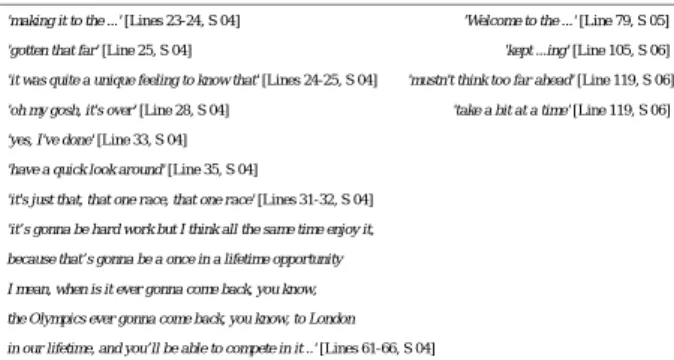
Table 3 shows that there are quite a few fixed expressions used exclusively by S 04, such as 'making it
to the Olympic games', 'gotten that far', 'oh my gosh, it's over', 'yes, I've done', 'have a quick look around', 'it's just that, that one race, that one race' and so on, in Text
A. 'I'd gotten, gotten that far' is notable not only for Table 2. Discourse markers
Text A Text B
'you know' [Line 14, S 04] 'Well' [Line 8, S 06]
'So I mean' [Line 29 S 04] 'T hen', 'eventually' [Line 32, S 06]
'you know' three times [Line 37, S 04] 'Well, ahn' [Line 39, S 04]
'I mean' twice [Lines 40 and 44, S 04]
'you know' twice [Line 41, S 04]
'you know' in [Line 42, S 04]
'so' [Line 42, S 04]
'and' twice [Lines 43 and 45, S 04]
'then' [Line 45, S 04]
Table 3. Fixed expressions
Text A Text B 'making it to the ...' [Lines 23-24, S 04] 'Welcome to the ...' [Line 79, S 05] 'gotten that far' [Line 25, S 04] 'kept ...ing' [Line 105, S 06] 'it was quite a unique feeling to know that' [Lines 24-25, S 04] 'mustn't think too far ahead' [Line 119, S 06] 'oh my gosh, it's over' [Line 28, S 04] 'take a bit at a time' [Line 119, S 06] 'yes, I've done' [Line 33, S 04] 'have a quick look around' [Line 35, S 04]
'it's just that, that one race, that one race' [Lines 31-32, S 04] 'it’s gonna be hard work but I think all the same time enjoy it, because that’s gonna be a once in a lifetime opportunity I mean, when is it ever gonna come back, you know, the Olympics ever gonna come back, you know, to London in our lifetime, and you’ll be able to compete in it ..' [Lines 61-66, S 04]
containing general phrases, but also for being used together with a quite lengthy fixed expression, 'it was
quite a unique feeling to know that', which makes the
statement colloquial. 'It’s gonna be hard work but I think
all the same time enjoy it, because that’s gonna be a once in a lifetime opportunity I mean, when is it ever gonna come back, you know, the Olympics ever gonna come back, you know, to London in our lifetime, and you’ll be able to compete in it ...' by S 04 also contain a
number of fixed expressions; 'it's gonna be', 'that's
gonna be', 'it ever gonna' and 'ever gonna', and the fixed
nature of 'gonna' is further confirmed by the speaker adding a phrasal verb, 'come back'. In Text B, a couple of fixed expressions were found, such as 'kept ...ing',
'mustn't think too far ahead' and 'take a bit at a time'.
4.4 Hedges
Hedges are cautious notes that are expressed regarding how an utterance is to be taken (Yule, 1996, p. 130). They include the use of vague language to personalise or indicate sensitivity, in order to "save face" on the part of the speaker (Carter & McCarthy, 1997, p. 16).
In Table 4, what strikes me first is the frequent use of hedges by S 04, particularly the adverb, 'just', 'I just, I
just' in Line 17 and 'you know' in Line 40 in Text A. 'Yeah, ahaa' also shows hesitation. Hedges occur
commonly when a speaker expresses an opinion about somebody or something (Carter & McCarthy, 1997, p.
16). In Text B, 'sort of' is a hedge. On the other hand, S 06 uses simple starters without hedges, for instance; 'I
was always the slowest ...' in Line 99 and 'but I realized ...' in Lines 99-100.
4.5 Repetition
All conversations contain repetition. Indeed, repetition occurs in all kinds of discourse (McCarthy & Carter, 1994, pp. 144-145).
Table 5 shows that the repetitions, 'I just I just' and
'you know, you know, you know', have their own
significance in Text A. Also, the pattern of 'gonna' in Lines 39-41 tends to be over-repeated, as I discussed earlier. In Text B, no repetition was found.
4.6 Grammatical mistakes
Spoken data frequently contain forms that would be considered ungrammatical in writing (McCarthy, 1991, p. 143). Although such "mistakes" usually go unnoticed in natural speech, it is only when we look at transcripts that we realise how common they are (McCarthy, 1991, p. 143). Speech abounds in verbless clauses, ellipses that would be frowned upon in 'good' writing, lack of concord and omitted relative particles, false starts, slips of the tongue and midstream changes of direction in grammatical structures (McCarthy, 1991, p. 143).
Table 4. Hedges
Text A Text B Repeated use of 'just' [S 04] 'sort of' [Line 87, S 06] 'I just, I just' [Line 17, S 04]
'you know' [Line 19, S 04]
'you know' [Line 40, S 04] 'Yeah, ahaa' [Line 46, S 04]
Table 5. Repetition
Text A Text B 'I just I just' [Line 17, S 04] (None) 'you know, you know, you know' [Line 57, S 04]
As indicated in Table 6, we can see how often utterances are grammatically incomplete by written standards, such as in 'I think the Olympic Games ...', 'To
know that I was one of the many who succeeded in making it to the Olympic games, it was ...'. Most of these
"mistakes" or incomplete sentences would probably go unnoticed in spontaneous talk. S 04 is finding her way into the argument at this point and therefore her speech is characterised by one or two false starts: ‘... it’s, um,
ahn', a discourse marker 'well, ahn', as well as by some
lapses in syntactic ordering, such as 'when ...'. In Text B, on the other hand, no grammatical mistakes are found. Besides, Text B contains almost perfect utterance completion.
5. Discussion
The findings provide examples of discourse
features that are particularly different between the authentic text, Text A, and the coursebook equivalent, Text B. These include the number of discourse markers, ellipses, hedges and repetitions, as well as the number of grammatical "mistakes" or incomplete sentences and the frequency of fixed expressions. As natural conversational data can often seem chaotic because of utterance incompletions and overlaps (McCarthy, 1991, p. 127), the smooth, regular turn taking with no overlaps and false starts exhibited in Text B does not reflect the tempo or the unpredictable nature of natural conversation. Whereas ellipses are pervasive in spoken
discourse (Carter & McCarthy, 1997, pp. 14-15), no ellipses are found in Text B. As Huang (2011, p. 7) says, the use of discourse markers is one of the key features of spoken English. Whereas discourse markers are constantly used by speakers in Text A, they are sparse in Text B. O'Keeffe et al. (2007, p. 182) provide numerous examples from academic and business English contexts and show how features such as vagueness and hedging are socially valued in these situations. Such useful fixed expressions, vague language, and hedges are almost absent from Text B.
6. Limitations
This study is limited to the analysis of two texts. The first problem is that it is impossible to meaningfully generalise data from such small samples. Secondly, investigation into some phonological and phonetic features, such as intonation and accents is beyond the scope of this investigation. Instead, there is a particular concentration on certain aspects of grammar, vocabulary and discourse patterning.
7. Conclusion
The authentic text is filled with hedges, repetitions, false starts and fixed expressions. Learners might not easily interpret the meaning of what is meant because of the many problems present in such an authentic text. In general, the coursebook text does not accurately reflect natural discourse features. After all, the aim of the coursebook text is not to present authentic discourse, but to provide learners with opportunities for meaningful listening and reading in English. Nevertheless, texts that come from genuine sources have many advantages in the Table 6. Grammatical "mistakes"
Text A Text B 'I think the Olympic Games ...' [Line 21, S 04] (Almost none) 'To know that I was one of the many who succeeded in
making it to the Olympic games, it was ...' [Lines 22-25, S 04] 'Well, ahn', '.. it’s, um' [Line 61, S 04]
language classroom. These texts encourage students to notice particular features of the target language, such as grammar orientation (who the message is about and for), lexical phrases, collocations, and text structures, by helping them develop awareness of the sequential relation of clauses, through understanding real and meaningful texts. Language teachers must continue to make use of authentic texts in the classroom.
References
Capel, A. & Nixon, R. (2003a). PET Masterclass:
Intermediate, Student’s Book. Oxford: Oxford
University Press.
Capel, A. & Nixon, R. (2003b). PET Masterclass:
Intermediate, Teacher’s Book. Oxford: Oxford
University Press.
Carter, R. & McCarthy, M. (1997). Exploring spoken
English. Cambridge: Cambridge University Press.
Carter, R. & McCarthy, M. (2006). Cambridge
Grammar of English. Cambridge: Cambridge
University Press.
Halliday, M. A. K. & Hasan, R. (1992). Cohesion in
English. London: Longman Group Limited.
Huang, L. F. (2011). Discourse markers in spoken
English: A corpus study of native speakers and Chinese non-native speakers, Ph. D. thesis,
University of Birmingham.
McCarthy, M. (1991). Discourse analysis for language
teachers. Cambridge: Cambridge University
Press.
McCarthy, M. & Carter, R. (1994). Language as
discourse: Perspectives for language teaching.
Essex: Pearson Education Limited.
O’Keeffe, A., McCarthy, M. & Carter, R. (2007). From
corpus to classroom. Cambridge: Cambridge
University Press.
Yule, G. (1996). Pragmatics. Oxford: Oxford University Press.
Appendix
Text A
1 [S 01] Hello .. We are students from Turin Grove School in
2 Edmonton, North London
3 [S 02] My name’s Chloe 4 [S 03] My name’s Lakia
5 [S 01] My name’s Aziz .. Today we’re here to interview the Olympic 6 gold medalist, Christine Ohuruogu
7 [S 02] Christine is the winner of three gold, and two bronze medals 8 [S 03] She is the current Olympic and Commonwealth champion at
9 400 metres
10 [S 01] We are here to talk to Christine and to find out what it takes 11 to reach the top
12 [S 03] Let’s go and meet her now 13 [S 04] Hi, how are you?
14 [S 01] Fine, thank you .. How are you? 15 [S 04] I’m very well, nice to meet you guys
16 [S 03] What motivated you into becoming an athlete?
17 [S 04] Ah, I just, I just did the work .. I really enjoyed the work .. I 18 know it was hard, but there’s something quite magical about 19 just running and trying to, you know, run as fast as you can
20 [S 02] What was it like to take part in the Beijing Olympics? 21 [S 04] It was .. fantastic .. I think the Olympic Games ... it’s one, 22 it’s one place that athletes whatever sport want to go to .. To 23 know that I was one of the many who succeeded in making it 24 to the Olympic games, it was quite a.., it was quite a unique 25 feeling to know that I’d gotten, gotten that far
26 [S 02] What thoughts were going through your mind when you 27 crossed the finish line?
28 [S 04] Aaah, mm. .. I think I was just like oh my gosh, it’s over, ha 29 ha ha
30 [S 01, 02, 03] [chuckles]
31 [S 04] That’s the one moment you think about all the time, it’s just 32 that, that one race, that one race, so when I finish it’s like 33 yes I’ve done, hahaha ...
34 [S 01] What did you think about the facilities here?
35 [S 04] I think it’s fantastic .. If you have a quick look around,
36 you’ll see that we have ah, an indoor 200 metre track,
37 and ...we also have ah a hundred-thirty metre straight, up 38 there, what we call the .. ah .. spring corridor, just, just kind 39 of behind the glass, behind this we have the cage, where 40 athletes can, you know, some practice their javelin, and they 41 can practice hammer, shot .. Umm, also we have the 400 42 meter track outside .. So I mean, this is, I don’t think I think I 43 think this is one of a kind in Britain.
44 [S 01] Have you leaned anything from taking the piss test like ...? 45 [inaudible]
46 [S 04] Yeah, ahaa, ... it was like very difficult, difficult for me, I 47 think it was, it was, ah, a new system that come in to place, I
48 think, the good thing that’s come out of it is aah that not just 49 me but a lot of athletes have realised that, .. we have to .. 50 take good care when we, you know, with the whereabouts 51 system to tell them, tell them, exactly where we are, where 52 we’re gonna be and if it does change, we have to let them 53 know of the changes .. So, ... in a sense, it’s kind of 54 rubbish, .. that it happened to me, but at the same time, it 55 means that we’re stopping a lot of other athletes from going 56 through the same problem, it was a bit sacrifice to make, ha 57 ha, you know, you know, you know, it’s a good thing, it’s a 58 good thing
59 [S 01] What advice would you give young people training for the 60 Olympics,training for the Olympics?
61 [S 04] Well, ahn, I think they have to .. realise that .. it’s, um, it’s 62 gonna be hard work but I think all the same time enjoy it, 63 because that’s gonna be a once in a lifetime opportunity I 64 mean, when is it ever gonna come back, you know, the 65 Olympics ever gonna come back, you know, to London in 66 our lifetime, and you’ll be able to compete in it .. So I think,
67 you know, I think everyone should just go for the Olympics, 68 just aim for the Olympics and even if you don’t get there, at 69 least you tried .. I think it’s just an amazing opportunity 70 that I mean, it makes my hair stand up, it’s something that 71 you cannot ever imagining doing, and I think if anyone has 72 a chance to go, then just go, ha ha ... find any sport, ha ha, 73 just make sure you can compete for your country in 2012 74 [S 01] It was really nice meeting you, Christine
75 [S 04] Oh, ..
76 [S 01] Thank you for your time
77 [S 04] You, too .. Thank you for coming, thank you guys very
78 much, thank you for coming [shaking hands]
Text B
79 [S 05] Welcome to the Sports Show .. Today, we’re going to find out 80 about an extreme sport and ask one competitor why he takes 81 part .. Dave Clamp, a teacher, and an athlete, oor a 82 tri-athlete, I should say, is with us – welcome, Dave 83 [S 06] Thank you very much
84 [S 05] First, tell us about the triathlon and the Ironman triathlon .. 85 What exactly do they involve?
86 [S 06] Well, the triathlon involves swimming, cycling and running .. 87 It’s like a sort of super athletics
88 [S 05] What distances do you have to cover?
89 [S 06] Well, for the Ironman events, you take the basic distances 90 for the ordinary triathlon and multiply them by two or even 91 three
92 [S 05] Oh, ...
93 [S 06] You swim about four-kilometres, do a 180 kilometre bike 94 ride and run 42 kilometres
95 [S 05] That’s unbelievable 96 [S 06] Ha, hah [laughs]
97 [S 05] Hmm .. How did you get involved? Were you a school 98 sports star?
99 [S 06] Not at all .. I was always the slowest at 100 metres, but I 100 realized I could beat a few people on longer distances .. 101 About 12 years ago, I ran the Paris marathon .. I didn’t do 102 very well and couldn’t walk up or down stairs for a week 103 afterwards
104 [S 05] Ha hah ...
105 [S 06] But I didn’t give up and just kept training on longer and 106 longer distances
107 [S 05] And you’ve achieved some very impressive results, haven’t 108 you?
109 [S 06] I won the Double Ironman in 1999, in twenty-three hours, 110 and I’ve managed fifth place in the World Triple 111 Ultra-Distance Triathlon – that took about 36 hours .. I 112 want to be first next year – so I’m training hard for that 113 [S 05] It must be very difficult knowing you have to swim, cycle 114 and run these distances. aha .. How do you manage? 115 [S 06] It’s all about how you think .. You realize that even though 116 you feel awful, you can keep going .. You get calmer, learn 117 to start slowly and to divide up the race in your mind 118 [S 05] Humm ...
119 [S 06] You mustn’t think too far ahead, but take it a bit at a time 120 [S 05] Humm .. And does this part of your life influence your work 121 as a teacher?
122 [S 06] Yes, definitely .. I’d been training and entering races for 123 years, without doing very well – I didn’t even finish my first 124 Ironman race .. Then eventually, after all the hard work 125 and training, I found myself among the best athletes in the 126 world and that feels very good
127 [S 05] Umm
128 [S 06] I try to use myself as an example to encourage the kids at 129 school to want to work harder .. I can show them real 130 evidence that hard work is worth it