タイトル
Shandong's economy Based on the Tourism
Satellite Account
著者
YU, LIQIAN
引用
北海商科大学論集, 10(1): 39-52
An analysis of direct tourism contribution to Shandong's economy Based on the Tourism Satellite Account
観光サテライトアカウントに基づく山東省経済への直接的観光貢献分析 YU LIQIAN 于 丽茜 要旨 中国が経済保有する観光統計システムを基に観光業の直接貢献度を推定することは非常に困難であ るが、観光サテライトアカウント(TSA)は、近似的な直接貢献度を分析するための有効なアプロー チである。しかしながら、未だに地域TSA(RTSA)を設立する統一的な基準は世界で確立されてい ない。山東省は2008 年に地域 TSA(R-TSA)を構築したが、多額の資金の必要性や人的資源上の 問題から、その後は継続していない。本論文は,TSA のフレームワークに基づき、既存データを用 いて2012 年の山東省経済に対する観光業の直接貢献度を推計したものである。表6 で示した観光の
直接貢献度を計算する基礎となる観光剥離係数(Tourism Stripping Coefficient)を用いて推計した
結果、2012 年の山東省における観光業の直接貢献額は 19 億3666 万元であり、地域 GDP の3.87 %
を占めていることが明らかとなった。
キーワード:観光業の直接貢献、TSA、山東省経済
Abstract
Based on current China's tourism statistics system, it is very hard to estimate tourism's economic contribution. Tourism Satellite Account (TSA) is an effective approach to analyze the direct tourism contribution to a nation or a region. Moreover, there is no unified standard to establish regional TSA (R-TSA) in the world. Shandong province sets up a regional TSA (R-TSA) in 2008. Unfortunately, because it needs large funds and human resources, it is not continuing to compile afterward. This article considers based on the TSA framework and uses the existing data to optimize the calculation method to calculate the direct tourism contribution Shandon in 2012. Table 6 shows the tourism stripping coefficient, which is the basis to calculate the direct tourism contribution. As the result of analysis, it obtained the direct tourism contribution is 1936.66 million yuan, which is 3.87 % of the total GDP in Shandon Province in China.
1. Introduction
According to The Travel & Tourism Competitiveness Report 2019, China's competitiveness is 13th among 140 economies. According to the Ministry of culture and tourism of China's publication 2019, it shows that in 2019, China's tourism revenue is 6.63 trillion yuan, up 11% from a year earlier. At the beginning of 2020, influenced by virus duplicate, tourism suffered a severe loss. However, the first "May Day" holiday after China's epidemic has stabilized, China's domestic tourism revenue reached 35.06 billion yuan. Notably, in 2016, China's 13th Five-year plan, a new tourism model, "all-for-one tourism1" has been proposed. It confirms the leading role of tourism in the new era of China. Unfortunately, China's current tourism economic statistics system cannot fully reflect the tourism contribution to the economy. Tourism Satellite Account (TSA) is a practical and official approach to analyze the direct tourism contribution to a nation or a region. It could realize the international comparison, improve tourism statistics. Because of unevenly distributed tourism activities within a country, the national TSA could not provide enough information to help regional development. Therefore, establishing the RTSA could give tourism an exact position in the economy in a given region.
China has got some results on RTSA. For instance, Jiangsu is the first province-level TSA with meaningful significance, strictly following TSA: RMF2008(Li ,Li and Chen 2004). Moreover, Zhejiang, Guangdong, and Hainan continually attempt to make RTSA. Unfortunately, they are all not entirely enough. Shandong Province also makes much effort to set-up Shandong Tourism Satellite Account 2008 (SDTSA2008) from 2007 to 2011, the first RTSA to complete the ten tables. However, Because of deficiencies in China's statistics system, many required data need a specific investigation. It needs large funds and human resources, which leads it to become a one-off account. After that, the government still uses the tourism revenue and non-monetary index, such as the number of inbound tourists, to reflect tourism's contribution and scale. According to the Shandong statistical yearbook 2019, the tourism revenue in 2018 is 9892.4 million Yuan, which increased by 1.2% than in 2017. Under this background, the use of RTSA to further understand the critical position of tourism in Shandong's economy to strengthen the degree of attention, improve the structure of tourism products, rational allocation of resources, will play an important role in further tapping the potential of Shandong's tourism, promoting the development "all-for-one" tourism.
Based on current China's statistics system, it is impossible to calculate the tourism contribution. Hence, this study's primary purpose is to take advantage of the TSA framework and the secondary data from the input-output table and various tourism surveys to estimate the direct tourism contribution to Shandong's economy in 2012. The direct tourism value-added is an important index
1 All-for-one tourism is a new tourism model that aims to develop a project in partnership with all
to measure tourism contribution based on TSA's requirement. Moreover, this paper uses the existed data to optimize the calculation method for providing an experience for developing RTSA in the future. Furthermore, during the process of obtaining tourism value-added, it shows the deficiencies of China's tourism statistics system.
Firstly, this paper will introduce the development of tourism in Shandong province, and then it will have a simple introduction about China's tourism statistics system. Secondly, the article will introduce the process of calculating direct tourism value-added. Thirdly, it indicated the critical results of the empirical model. The concluding section will also consider the limitation of this paper and the point to study further.
2. The methodology
When TSA's approach is used to analyze tourism's contribution to the economy, a critical step is to define a list of classification of tourism characteristic industries and tourism characteristic products. However, there is no unified framework to develop RTSA. Therefore, to identify Shandong tourism characteristic industries and tourism characteristic products, this paper will take advantage of the Tourism Satellite Account: Recommended methodological framework 2008 (TSA: RMF2008), China's Industrial classification for national economic activities (GB/T 4754-2017), The statistical classification of China tourism industries and related industries 2018 and SDTSA2008.
Concerning the calculation of Direct tourism value-added, firstly, using the secondary data from China's input-output table 2017 (China I-O table 2017), Shandong input-output table 2012 (Shandong I-O table 2012) to determine the total production of each tourism industry in Shandong 2012. Secondly, through the formula, to get the value-added rate of required industries in Shandong 2012. At the same time, after handling the data from SDTSA2008, obtaining the component of tourism consumption in Shandong 2012. Thirdly, combining the value-added rate and tourism consumption to get tourism value-added. Finally, according to this formula:
𝑇𝑜𝑢𝑟𝑖𝑠𝑚 𝑠𝑡𝑟𝑖𝑝𝑝𝑖𝑛𝑔 𝑐𝑜𝑒𝑓𝑓𝑖𝑐𝑖𝑒𝑛𝑡 = 𝑇𝑜𝑢𝑟𝑖𝑠𝑚 𝑣𝑎𝑙𝑢𝑒 𝑎𝑑𝑑𝑒𝑑
𝐼𝑛𝑑𝑢𝑠𝑡𝑟𝑦 𝑣𝑎𝑙𝑢𝑒 𝑎𝑑𝑑𝑒𝑑 to get the tourism stripping
coefficient. And then, the direct tourism value-added would be obtained. Because of the lack of data resource, this paper makes some hypothesis and rearrangement of data to estimate the direct tourism contribution to Shandong's economy in 2012. The methodological procedure would be shown in Figure 1.
Figure 1. The methodological procedure
3. The problem of China's tourism statistics system
The imperfect of China's statistics system is one of the main reasons to obstruct the development of China's tourism satellite account. Chang, Kang, and Li (2005a) introduced that China's tourism statistics system is an integral part of the national economic statistical system, and its development and evolution cannot be separated from the whole of China's statistics development. From 1949 to 1984, China has always adopted the Material Product System (MPS), and China's tourism statistics system is also the product of the planned economy and MPS. Later, China gradually adopted the System of National Account (SNA), and then China's statistics system began to change.
From 1993, it adopts the SNA. GDP has become the core economic index. China's System of National Accounts (2002) is the significant file of this period, formulated based on SNA 1993. This system indicates that China's national economic accounting has successfully transitioned to the international standards adopted by market economy countries. In 2015, The classification of tourism and related industries of China had been published based on the SNA. It accelerates the tourism industry's development, and the statistical scope of tourism and related industries is defined scientifically.
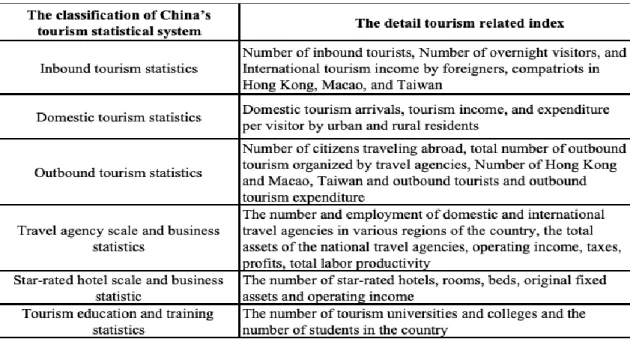
This paper would discuss the problems of China's tourism statistics system concerning the TSA. Table 1 below shows the basic content and the tourism indices of China's tourism statistical system. It is not difficult to notice that most tourism indices in China's statistics system are the
non-monetary indices. These indexes are hard to reflect on the tourism contribution and tourism expenditure component. According to the TSA: RMF 2008, one of TSA's benefits is to reflect the tourism economy from both demand and supply sides. From TSA's perspective, China's tourism statistics system lacks many demand-side indexes. For example, there is no index about outbound tourism consumption. Moreover, the consumption index is too simple, which could not reflect the tourism expenditure composition (Chang et al., 2005). Lacking the required data leads to difficulties in establishing the TSA. Hence, in this paper, to calculate the direct tourism value added based on TSA, it used the SDTSA2008 as the reference to proportion the tourism consumption in different tourism characteristic industries and products.
Table 1. China's tourism statistics system
Source: The yearbook of China tourism statistics.
4. The calculation of direct tourism value-added
4.1 Identify the classification of tourism characteristic industries and tourism characteristic products
Typically, identifying the classification of tourism characteristic industries and tourism characteristic products is the first step to develop TSA. As the content described above, Table 2 shows Shandong's classification of tourism industries and products based on TSA: RMF 2008,China's Industrial classification for national economic activities (GB/T 4754-2017), The statistical classification of China tourism industries and related industries 2018and SDTSA2008. Table 2 also shows the correspondence between the tourism industries and the tourism-related sector of Shandong I-O table 2012.
Table 2. The classification of Shandong Tourism Industries and products
Source:TSA: RMF 2008; China's Industrial classification for national economic activities (GB/T4754-2017); The statistical classification of China tourism industries and related industries 2018and SDTSA2008. Edited by the author.
4.2 The calculation method and process
1) Calculating the value-added of tourism-related industries
Before calculating the value-added rate of tourism industries, it is necessary to obtain data about total production and intermediate input. The formula is shown below:
𝑉𝑎𝑙𝑢𝑒 𝑎𝑑𝑑𝑒𝑑 𝑟𝑎𝑡𝑒 =𝑇𝑜𝑡𝑎𝑙 𝑝𝑟𝑜𝑑𝑢𝑐𝑡𝑖𝑜𝑛 − 𝐼𝑛𝑡𝑒𝑟𝑚𝑒𝑑𝑖𝑎𝑡𝑒 𝑖𝑛𝑝𝑢𝑡 𝑇𝑜𝑡𝑎𝑙 𝑝𝑟𝑜𝑑𝑢𝑐𝑡𝑖𝑜𝑛
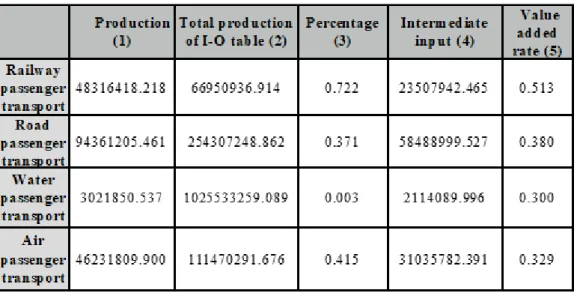
However, the official public basic matrix of Shandong I-O table 2012 only covers 42 industry sectors and 139 commodities. It does not show much detailed information such as Railway passenger transport accommodation, Etc. China I-O table 2017 has a basic industry sector matrix and divided the 42 sectors into 149 commodities. Compared with the China I-O table 2012 with 139 commodities, China I-O table 2017 divided the transport sector into passenger transport and goods transport, which is more suitable for tourism industries' requirements to be more accurate. This paper hypothesizes that the percentage of these four items is the same at the provincial and national levels. Therefore, it used the China I-O table 2017 to calculate partial data, lacking in the Shandong I-O table 2012.
After the calculation, Table 3 shows the value-added rate based on China I-O table 2017, and table 4 shows the value-added rate of the Shandong Tourism Industries in 2012.
Table 3. The value-added rate based on China I-O table 2017 (Unit:10,000 Yuan)
Source: China I-O table 2017
Note: 1. The figure in (1) from table 1.1 of China I-O table 2017 (149 commodities×149 commodities) 2. The figure in (2) from table 3.1 of China I-O table 2017 (70 commodities×60 industries) 3. The figure in (3) = (1) / (2)
Table 4. Value-added rate of Shandong tourism industries in 2012 (Unit:10,000 Yuan)
Source: Shandong I-O table 2012
Note: The total production of railway, road, water, and air passenger transport are calculated through the figures from the Shandong I-O table multiply by the percentage, which is obtained in table 3.
2) Calculating the tourism stripping coefficient
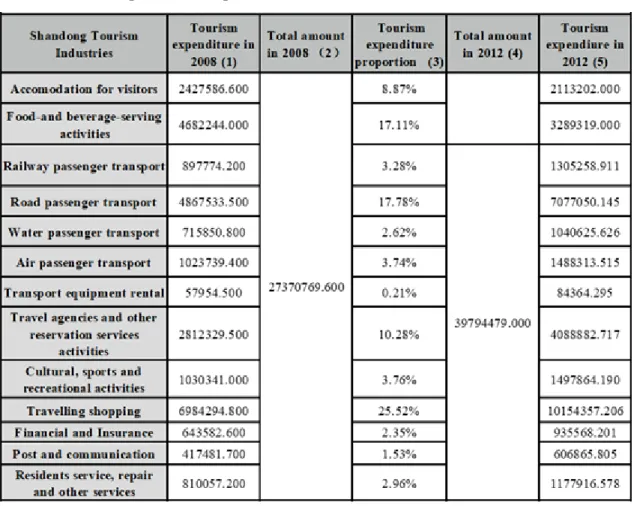
When calculating the tourism stripping coefficient, it needs to allocate the total tourism expenditure according to each industry's proportion. Because Shandong domestic tourism sampling survey is not to investigate every year, and from the previous survey in 2001 has for a long time. Hence, in this paper, the proportion of tourism expenditure based on SDTSA 2008 as the reference.
SDTSA2008, on the whole, more strictly followed the TSA requirements,because the required data was carried out in the specific investigation, which could make the data more accurate. The total amount of tourism expenditure is 27370769.6 in 2008. the percentage of tourism expenditure of each industry has been calculated, and the results are shown in Table 5 column 3. According to the Shandong yearbook 2013, the total tourism expenditure in 2012 is 4519.7 million yuan. The accommodation and food and beverage account for 211.3 million and 328.9 million, the specific figures shown in the Shandong yearbook 2013. Hence, according to the tourism expenditure proportion 2008 to arrange the total tourism amount in 2012, the last column of Table 5 shows the tourism expenditure component in 2012.
Table 5. Tourism expenditure component (Unit:10,000 Yuan)
Source: SDTSA 2008; Shandong year book 2013 Note: 1. Figures in (1) and (2) from SDTSA2008
2. The amount of Accommodation for visitors and food beverage serving activities in 2012 from Shandong year book 2013
3. 39794479 is the total tourism expenditure in 2012 deduct 2113202 and 3289319. 4. The formula of figures in (5):(5) = (4) × (3)
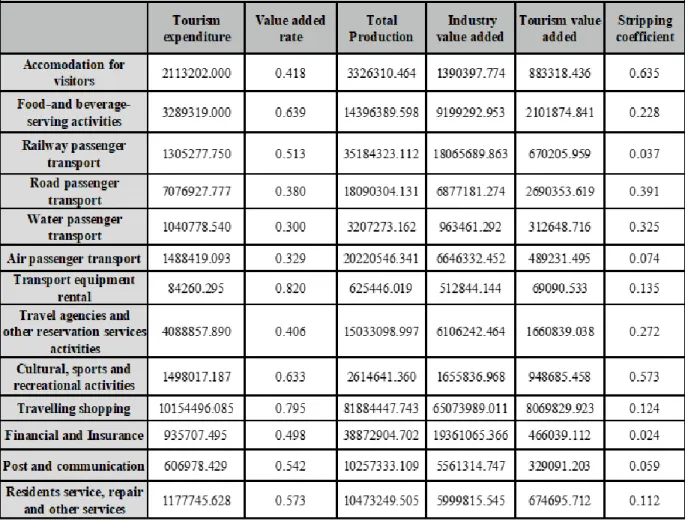
In general, only part of the products of tourism characteristic industries are invested in tourism consumption, so its value-added needs to be stripped out of tourists' consumption according to a certain proportion and included in tourism value-added. The proportion of tourists' consumption in the value-added provided by a tourism characteristic tourism industry is called the tourism stripping coefficient (Li and Li 1999). The tourism stripping coefficient refers to the ratio of the added value created by the tourism expenditure to the industry's value-added (Ge 2010; Xing, Qiang and Wang 2016; Yan and Xiong 2017). The calculation method:
𝐼𝑛𝑑𝑢𝑠𝑡𝑟𝑦 𝑣𝑎𝑙𝑢𝑒 𝑎𝑑𝑑𝑒𝑑 = 𝑇𝑜𝑡𝑎𝑙 𝑝𝑟𝑜𝑑𝑢𝑐𝑡𝑖𝑜𝑛 × 𝑉𝑎𝑙𝑢𝑒 𝑎𝑑𝑑𝑒𝑑 𝑟𝑎𝑡𝑒 𝑇𝑜𝑢𝑟𝑖𝑠𝑚 𝑣𝑎𝑙𝑢𝑒 𝑎𝑑𝑑𝑒𝑑 = 𝑇𝑜𝑢𝑟𝑖𝑠𝑚 𝑒𝑥𝑝𝑒𝑛𝑑𝑖𝑡𝑢𝑟𝑒 × 𝑉𝑎𝑙𝑢𝑒 𝑎𝑑𝑑𝑒𝑑 𝑟𝑎𝑡𝑒
𝑇𝑜𝑢𝑟𝑖𝑠𝑚 𝑠𝑡𝑟𝑖𝑝𝑝𝑖𝑛𝑔 𝑐𝑜𝑒𝑓𝑓𝑖𝑐𝑖𝑒𝑛𝑡 = 𝑇𝑜𝑢𝑟𝑖𝑠𝑚 𝑣𝑎𝑙𝑢𝑒 𝑎𝑑𝑑𝑒𝑑 𝐼𝑛𝑑𝑢𝑠𝑡𝑟𝑦 𝑣𝑎𝑙𝑢𝑒 𝑎𝑑𝑑𝑒𝑑
Therefore, after the calculation, the tourism stripping coefficient shows in table 6. Table 6: The calculation table of tourism stripping coefficient (Unit:10,000 Yuan)
3) Calculation of the direct tourism value-added
Finally, the formula to calculate the tourism value added is
𝐷𝑖𝑟𝑒𝑐𝑡 𝑡𝑜𝑢𝑟𝑖𝑠𝑚 𝑣𝑎𝑙𝑢𝑒 𝑎𝑑𝑑𝑒𝑑 = 𝐼𝑛𝑑𝑢𝑠𝑡𝑟𝑦 𝑉𝑎𝑙𝑢𝑒 𝑎𝑑𝑑𝑒𝑑 × 𝑇𝑜𝑢𝑟𝑖𝑠𝑚 𝑆𝑡𝑟𝑖𝑝𝑝𝑖𝑛𝑔 𝑐𝑜𝑒𝑓𝑓𝑖𝑐𝑖𝑒𝑛𝑡 After the calculation, the total direct tourism value added is 19366609.66 ten thousand Yuan. From the Shandong yearbook 2013, Shandong's total GDP was 50013.24 million Yuan in 2012. Therefore, the direct tourism value-added account for 3.87 % of the total GDP.
4) Analysis of the result
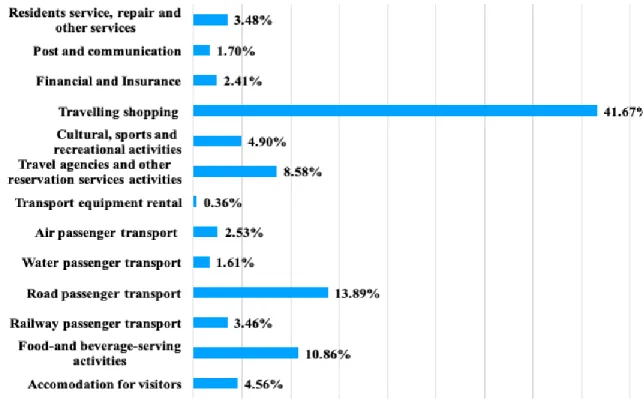
The total direct tourism value-added of Shandong in 2012 is about 1936.66 million yuan, 3.87 % of the total GDP. In 2008, the tourism value added was 1377.97 million Yuan, which accounted for 4.45% of the total GDP. Comparing the result of 2012 and 2008, it decreased by 0.58%. During the process of calculating direct tourism value-added, it identifies 13 tourism characteristic industries in Shandong. Among these industries, the most significant contribution to the direct tourism value added was traveling shopping, which reached 41.67%. The second is road passenger transport activities, contributing 13.89% to the direct tourism value-added. Food and beverage services accounted for 10.86%. Travel agencies and other reservation services activities were accounting for 8.58%. Other industries contributed less than 5%. The industry with the smallest contribution was transport equipment rental, which was only 0.36 percent. The detailed information is shown in figure 2.
5. Conclusion and limitation
Among 13 tourism industries were road passenger transport, which contributed a relatively large proportion. It is possibly related to the development of road transportation in Shandong. Because Shandong province's total highway mileage reached 275600 kilometers, ranking second in China. The highway density reached 175.9 kilometers per 100 square kilometers, ranking third in China. It provides a robust infrastructure for road passenger transport.
On the other hand, road transport is mostly chosen by visitors who take an excursion. This is also certified by the direct tourism value-added of accommodation only accounted for 4.56%, that perhaps because of the most tourists are same-day visitors. Therefore, it is better to formulate a strategy for attracting overnight visitors, which would stimulate the development of other tourism industries at the same time. However, it also needs to consider other accommodation conditions, such as Airbnb, second-home, etc. These emerging types do not include in this paper. It also would be the topic for further study.
Moreover, traveling shopping has the highest tourism value-added among 13 tourism industries, which is a bit of overestimation compared to SDTSA2008. The data for traveling shopping from the wholesale and retail sector in the Shandong I-O table also includes non- tourism shopping. One of the roof reasons is the lack of specific investigation and detailed tourism expenditure about it.
This paper has some limitations that need to be considered in future research. Firstly, when this paper calculates the tourism value-added, the consumption data takes the purchase price as the statistical criterion, while the supply-side data obtained through the input-output table takes the producers' price as the statistical criterion. The difference between the two is mainly tax. Hence, Shandong's total tourism direct tourism value-added in 2012 is about 1936.66 million yuan, which is 3.87% of the total GDP. However, it decreased by 0.58% compared with 2008. The result tends to be more reliable. Further study should focus on unifying the statistical criterion. Secondly, because China's tourism statistics system has a small statistical dimension, most of the data on the demand side are rearranged, and some assumptions are made, which will lead to errors in the results. Thirdly, according to TSA: RMF 2008, establishing TSA's basic structure based on the overall balance of tourism demand and supply in a country's economy. The TSA's purpose is to analyze in detail the demand for tourism goods and services within a country's economy, observe its relationship to related supplies, and describe how these supplies are combined with other economic activities. However, the total balance of tourism demand and supply in a country does not exist in this region. Therefore, the establishment of RTSA also needs to fully consider the region's characteristics and reasonably establish a region-based TSA.
Furthermore, while calculating the tourism contribution, to establish the RTSA, implement the tourism sample survey is the fundamental part. Tourism expenditure composition could obtain through the tourism sample survey. Secondly, using the secondary data from the I-O table, it is necessary to determine how much is consumed due to tourism. Hence, it is necessary to implement specific investigations. Thirdly, the unified standard is essential to make a comparison between regions. Because the provincial I-O table format is the same in China, it might be possible to establish a unified framework. Although this paper has some limitations, it provides the experience for creating the RTSA. The optimization way of increasing the feasibility of establishing RTSA. Also, the shortage of Chinese tourism statistics will increase the difficulty of compiling RTSA. Therefore, TSA's establishment is an excellent opportunity for China to complete and increase the demand side index. TSA data has a high quality, which could imply the importance of tourism in the national economy and benefit from studying tourism. Furthermore, to make the calculation result more accurate, it is necessary to collect more detailed data for further study.
6. Reference In Chinese:
China national bureau of statistics (2017). China's Industrial classification for national economic activities (GB/T4754-2017). Beijing: China national bureau of statistics.
China national bureau of statistics (2018). China national bureau of The statistical classification of China tourism industries and related industries 2018.Beijing: China national bureau statistics. China national bureau of statistics (2019). Input-output tables of China 2017. Beijing: China
Statistics Press.
China national bureau of statistics (2016). The regional input-output tables of China 2012. Beijing: China Statistics Press.
Chang, L., Kang, R., & Li, S, M. (2005a). The comparison of tourism statistics between Word Tourism Organization and China. Statistical Research (7), 24-27.
Chang, L., Kang, R., & Li, S, M. (2005b). The comparison of tourism statistics between Word Tourism Organization and China. Statistical Research (7), 24-27.
Ge, S. R. (2011). The framework of the Kunming Tourism satellite account (2008). Yunnan. Li, M, Y., Li, J., & Chen, J, S. (2004). On some theoretical and practical issues of regional tourism
satellite accounts in China. Tourism Tribune,19 (2),11-15.
Li,J,F.,&Li,M,Y.(1999).On the Calculation of Tourism Industry and Tourist Adding Value. Tourism Tribune,5,16-19.
Liu, Y. (2006). Study on application of tourism satellite account in tourism statistic in China. Journal of Jinan University (philosophy and social science), 28(6), 60-65.
Shandong provincial bureau of statistics., & The National Bureau of Statistics investigation team in Shandong. (2013). Shandong statistical yearbook 2013. Beijing: China Statistics Press. Shandong provincial bureau of statistics., & The National Bureau of Statistics investigation team
in Shandong. (2019). Shandong statistical yearbook 2019. Beijing: China Statistics Press. Xing, L., Qiang F, F.,& Wang, W, J. (2016) The construction and empirical analysis of tourism
satellite account in Yunnan province based on the big tourism industry. Tourism Research,8(3),52-59.
Yan, H, L., &Xiong, H. (2017). Input-output analysis of Tourism economy. Beijing: China Science Publishing.
In English:
United Nations., Commission of the European Communities, Eurostat., World Tourism Organization., & Organization for Economic Co-operation and Development (2010). Tourism Satellite Account: Recommended Methodological Framework 2008. United Nations publication. World Economic Forum. (2019). The Travel & Tourism Competitiveness Report 2019. retrieved