Rice Culture in the Central Plain of Thailand (III)
A Review of Rice Experhnents in Thailand
by
Hayao FUKUI*
Part 1. Technological Problerrls as Causes of Low Yield in Southeast Asia
Rice cultivation in Southeast Asia has a centuries-old history. It is not difficult to imagine that the "region's paddy cultivation techniques have their own merits derived from the farmers' experience and wisdom gained over thousands of years." (\VATABE and KAWAGUCHI, 1968) The most outstanding characteristic of this traditional system of rice cultivation is that "these farmers have been striving to attain a stabilized yield at the expense of increasing yield". (ibid.) Based on observations in northern Thailand, VVATABE states that "In fields with relatively high levels of fertility a distinct method is used, one that helps curb excessive vegetative growth These operations aim to control the capability of rice plants vvithin a certain limit and thus stabilize the rice yield."
(WATABE, 1967)
The nature of this traditional system is more intensively demonstrated by the cha-racteristics of the rice varieties presently under cultivation. For instance: "Over the centuries, photosensitive rice varieties have probably been selected in tropical areas because they could be planted whenever the monsoon rains began, yet they would always mature at a fixed date after the rains had stopped and the floodwater had receded." (MOOMAW and VERGARA, 1964) "Tall and leafy varieties with weak straw" are also considered "suitable for the prevailing agronomic conditions." (PARTHASARATHY, 1967) Not only photo-sensitivity and plant type, but also "the character of indicas in general are the result of natural selection over thousands of years. They have survived inspite of deep water conditions and competition by weeds. " (YAMADA, 1968) The environmental factors to which indicas have adapted are "length of rainy season, depth of water, . poor soil fertility," (TAKAHASHI, 1968) etc.
AKI stated that "the yield per unit area (in Southeast Asia) is less than half that in Japan, but total cost is still less. The ratio of production to cost is said to be greater in this region than in]apan." (AKI,1966) Thus, it can be concluded that "a stabilized yield with little cost is the primary objective of the traditional practices of rice growing
7~3%
in Southeast Asia. Once the above mentioned objective is affirmed and the severe natural conditions are considered, the traditional system of rice cultivation can be regarded as highly rational.
Insufficient food supply for an explosively increasing population means more and more food production is mandatory. The traditional methods of rice cultivation seem unable to match this strong demand because a higher yield per unit area cannot be ex-pected so long as the farmers follow their traditional methods of rice cultivation. The expansion of cultivatable land for paddy use is also limited. A new system of rice cul-tivation whose objective is "a higher yield per unit area" must replace the old one which aims at "a stabilized yield with little cost."
When the technological level of rice cultivation is measured by the yield per unit area, the backwardness of the traditional methods of rice cultivation in Southeast Asia cannot be denied. In this sense it is correct to say that the low yield in Southeast Asia is "a result of poor cultural practices, " (CHANDLER, 1963) or is "caused by the inferior varieties and undeveloped methods of cultivation." (YAMADA, 1968) However, these statements do not necessarily mean that the low yields in Southeast Asia are primarily caused by technological factors.
It is generally agreed that the primary cause of low yields is "the highly unstable water supply," and that "Without improving water control, it is absolutely impossible to achieve a marked increase in the area's rice production." (WATABE and KAWAGUCHI, 1968) In light of the unstable water conditions "rainfall is probably the major concern." (MOOMAW and VERGARA, 1964) Based on the study of yield fluctuation in Cambodia. YASUO reported that "precipitation is greater in the bumper years than in the lean years ... The increase of 100 mm. annual rainfall brought about a yield increase of 0.058 ton per ha. in Kompong Cham Province during the last 15 years." (YASUO, 1966)
Soil also affects the yield level. But "Man often masks these effects by soil manage-ment practices, and it is difficult to evaluate the effect of inherents soil characteristics when cultivated crop yield is used as the criterion." (CHANDLER, 1963) The correlation between yield and soil character is often observable in areas such as in Southeast Asia where the soil management practices have been poorly developed. For instance, "Clay mineral compositions are significantly correlated with the yields" (HATTORI, FURUKAWA and KAWAGUCHI, 1965) in Thailand. In the northern valleys of Thailand, "the yield from single-cropping fields is lower than that of double-cropping fields . the main difference in soil is due to the amount of organic matter and humus contained in the soil, and which is comparatively higher in double-cropping fields " (WATABE, 1967) A more detailed study in the northern valleys of Thailand revealed "significant positive correlation for the exchangeable Mg content, CEC (A), and the available silica content" (KAWAGUCHI and KVUMA, 1969) with the yield.
and VERGARA, 1964) when compared with other environmental factors, "the low average yield in the tropics undoubtedly is partially due to the warm climate the production of dry matter could be less under tropical conditions, because of a less favorable balance between photosynthesis and respiration at high temperature." (CHANDLER, 1963) In recent years the significance of light rather than temperature on yield levels "is becoming increasingly apparent." (MOOMAW and VERGARA, 1964)
RUTTAN et al. analysed the technological and environmental factors involved in the growth of rice production in Thailand and the Philippines and in the yield differential among regions in the two countries. Their conclusion was that: "After the effects of the environmental factors are taken into account, there is little yield increase or yield differential left to be explained by such factors as nevv varieties, better cultural practices or more intensive use of technical inputs ... or by economic and social differences among regions and between Thailand and the Philippines." (RUTTAN, SOOTHIPAN and VENEGAS, 1966) According to them, "the environmental factors under which rice is grown" are "primarily, soil, season, water and weather differentials." (ibid.)
By considering them from two different viewpoints, the importance of the varIOUS environmental factors as causes oflow yields in Southeast Asia can be more clearly under-stood. According to the first viewpoint, the factors considered are the ones that affect the yield differentials from one plot, district, province, region or country to another. According to the second viewpoint, the factors considered are the obstacles to the yield increase presented by more intensive cultivation techniques. Some factors might be very important from the first point of view, but not from the second. For instance, the yield differential among different places depends partially on the differences in soil as the nutrient supplying body. But the significance of the soil's capability as a nutrient source becomes less vital when fertilizers and other soil management practices are utilized. The importance of temperature and solar energy as causes of low yield in the traditional system of rice cultivation has not been ascertained. However, in a more intensive cul-tivation system, which aims at higher yield per unit area, these two factors may become more important. But since the adverse effects, if any, of high temperature, and insufficient solar radiation during the wet season in monsoon Asia can be minimized by improving the varieties, shifting the growing season and utilizing other proper cultural methods, it is thus apparent that soil, temperature and light are not the primary obstacles to yield increase in Southeast Asia.
Rather, it is water which is the most influencial factor in the present low yields and the cause of variations among different localities. And it is water at the same time, that is the primary obstacle to a higher yield level by intensive cultivation. Ifthe water supply is unstable it is impossible to apply most of the other technical innovations. "In order to obtain the fullest results from fertilizer use, it is a prerequisite that irrigation and drainage be controlled." (\VATABE, 1967) \Vhen a stable water supply and chemical
fertilizers are available, the next obstacle to higher yield IS the character of indicas. "They (indicas) offer little hope for substantial yield increases through the use of nitrogen fertilizers or other applied technology because of their susceptibility to lodging." (BEACHELL and JENNINGS, 1964) "The effect of fertilizers could not be expected without breeding new varieties with high fertilizer response." (YAMADA, 1968) "As far as the
indica varieties are used, the increased application of nitrogen causes the marked increase
in the straw weight but a little increase in the yield." (A]IA KEIZAI KENKYUSHO, 1961)
" the primary problem (for nitrogen application) seems to lie in the fact that many
indica varieties of rice overtiller and grow excessively tall when nitrogen is applied at
rates exceeding 40 kg. per hectare, " (CHANDLER, 1963) Therefore, " if yield per ha. is to be raised significantly, it would require increased use of fertilizers for which new varieties are to be bred which are short and stiff strawed to minimize lodging." (PARTHASARATHY, 1967) The yield can be significantly increased only when water control, fertilizer application and improved varieties work in a concerted effort.
Summarizing what has been stated above: first, the traditional system of rice cul-tivation in Southeast Asia should be reoriented toward the objective of "higher yield per unit area." Second, water control is an indispensable precondition to the other technical practices. And finally once the water supply becomes stable, fertilizer applica-tion and varietal improvement take highest priority. Ifthese three innovations would work in a concerted manner, other unfavorable environn1ental factors could be con-quered. The direction for and possibility of yield increase as mentioned above are not unique. This plan would be agreeable to many rice workers concerned with the subject. This picture of the strategy for the yield increase does not mean that the efforts to increase the yield under unstable water conditions, by using the native indica varieties, are futile. The first reason for this is that there are, in fact, many degrees of water stability. For instance, instability of water in deltaic areas means that at the end of the rain season there is a depth fluctuation of from
2
to 5 meters. While in the peripheral part of the deltas water shortage is of greatest concern. Though complete irrigation and drainage of the individual farms is not expected in the near future, it may be possible to control the extremes of flood and drought which have devestated harvests in the past. The second reason is the greater availability of fertilizers because of price changes in fertilizers and paddy value in the favor of farmers. Though water control is not stable enough to allow the application of large amount of fertilizers every year, it is possible to increase the yields by the addition of relatively small amount of fertilizers in some years, though not in every year. The results of "Simple Fertilizer Trials on Rice in the Farmers' Fields" which have been conducted in several countries in south and southeast Asian countries show that substantial yield increase is possible by applying fertilizers to the native varieties. In Thailand, for instance, "The combination ofN and P gave noticiable increase in yields, about 53 percent over the check." (LUSANANDANA, etat.,
1963) Whennative varieties are grown under careful management without fertilizer, the yields are usually better than the national averages of the southeast Asian countries. But if the indigenous soil fertility is not too high, the yields can be further increased by fertilizer application. Though the fertilizer response of indica is limited, soil fertility is so poor that the yield increase is noticiable only by applying a certain amount of fertilizer which does not affect the yields adversely. "Contrary to general belief, photo-sensitive indica
varieties are capable of producing very high yield, if proper cultural practices are adopt-ed." (TAKAHASHI, etat.) 1967) As far as Thailand, where the author had some experience, is concerned the rice farmer does not seem to be under "the continual fear that high soil fertility will reduce his yields." (CHANDLER, 1963)
Thus, environmental conditions, natural and economic, are changing constantly, though not drastically. "As there are no agricultural techniques unrelated to environ-mental conditions" (VVATABE and KAWAGUCHI, 1968), "The method most practical today will not be the most practical one under the new conditions of tomorrow." (VVATABE,
1967) It is the distinct objective of agronomists to establish a new technological pattern of rice cultivation under complete water control. But at the same time, the stabilization and increase of yields under the unfavorable conditions should not be neglected. Basic investigations which will enable the farmer to make use of slight alterations in the environ-mental conditions are vitally needed in order to increase yield. Some people may say that such yield increase under the unstable water supply conditions, using native varieties, will not be significant, and could be attained so easily that no systematic research is needed. But the significance of the fertilizer response of indicas depends on inherent soil fertility where the trial is attempted. Considering the very low national average yields of the southeast Asian countries and the fact that the correlation between yields and soil character is often significant enough to be observed, and considering, as well, the results of numerous fertilizer trials, both at experimental stations and on farmers' fields, which show positive response to fertilizers, we can expect substantial yield increase from fertilizer application alone. A yield increase of 50 percent, that is, a yield increase of from 1.5 to 2.25 tons per ha. may not be "significant" if this is a result of fertilizer trial. But an increase in the national average of from 1.5 to 2.25 tons per ha., (that is from ca. 10 million tons to ca. 15 million tons total paddy production in Thailand) is "significant". And 2.25 tons per ha. is not the limit of indicas. How to raise the yield level, even slightly in each given natural and economic condition is a challenge big enough to be the theme of scientific investigations. "It is disturbing to read paper after paper, ... in which yield data ranging from 1,500 to 3,000 kilograms per hectare is reported and yet no reasons are given for the low yields... Though unquestionably the differ-ences in yield between treatments are highly important, the actual level of production is also extremely relevant." (CHANDLER, 1963) Nevertheless, investigations to establish methods of attaining a yield level of 3,000 kilograms per hectare with minimum cost
7~3%
under the various unfavorable conditions, will and should be continued and developed further.
"Because of poor control of water depth and drainage in the Central Plain of Thailand and the lack of capital among Thai rice farmer for high inputs of fertilizers, and pesticides and fungicides; short statue and high fertilizer consumption varieties will not be very practical at the present time there are many inexpensive and practical ways to im-prove the yield. By improving variety alone a yield increase of15-20% can be attained ... With the low basal rate of16-20-0 of 75-95 kg. per hectare, the return in increase in yield will be from 440 kg. to 750 kg. per hectare." (DASANANDA, 1968) Technological innovation developed under special environmental conditions is not always applicable to other localities with differing conditions.
Some people have attempted to grade the environmental conditions using two or three broad categories, estimating the highest possible yield attainable under each circumstance and presenting the means by which to achieve that target. According to WATABE and KAWAGUCHI there are two broad agricultural categories: (WATABE and KAWAGUCHI, 1968) "(1) A larger part in which there prevail low yielding fields with poor irrigation facilities and (2) that part with high paddy yields thanks to improvement of the physical environment". "A direct cause of low yield" in the first category is "an extremely small number of ears per unit area". "To increase the number of ears, it is necessary to shorten the nursery period practice early planting, to make as shallow planting as possible, and to keep a suitable planting density". "Also, improvement in the methods of harvesting, threshing, and winnowing is required ... " And "a series of such small improvements will make it possible to attain an increase of up to 20% of the current yield." In the second category, "the application of fertilizers is very effective". But "To attain high yields by this method it is necessary to solve some related problems. First, varieties must be improved". "When these (the recommended varieties) are planted and nitrogen is applied at the ratio of60 to 80 kg./ha., a yield of 5 tons/ha. is expected. To attain still high yield ... , it is necessary to introduce some varieties with shorter plant height and leaf length, and stronger lodging and disease resistance. The second problem concerns cultivation method. The period of vegetative growth must be shortened, or vegetative growth restricted ". As referred above, the region was classified into two broad categories. But in the second category, the yield level attainable depended on whether the recommendedindicasor the dwarf varieties were planted. The possible yield by the former, according to WATABE and KAWAGUCHI, is 5 ton/ha.
RUTTAN, et al. (RUTTAN, SOOTHIPAN and VENEGAS, 1966)stated that "A prerequisite for the development of an effective national rice production strategy is to overcome this (institutional) tendency for program fragmentation and obtain some agreement on the factors limiting yield and how these factors can be manipulated to narrow the gap between actual and potential yields. This includes the gap (a) between national or regional
average yields (which rarely exceed 1.5 metric ton/ha.) and the yields being achieved in those provinces, villages, and farms with the highest yields, (about 3.0 metric tons over fairly substantial areas and a 4.0-4.5 metric ton range on individual farms during the wet season), (b) between the yields obtained in the best provinces, villages, and farms and the yields obtained with the same varieties under experimental conditions, and (c) between yields obtained under experimental conditions with the best available varieties and the potential yields that can be achieved by changing the plant type to increase the response of the plant to sunlight, technical inputs, and management (at least 6.0 metric ton range during the wet season). But the factors necessary to narrow the gap (A) "are primarily outside the control of the individual farmer " Although their presentation of the three gaps is almost identical to the ideas ofVVATABE and KAWAGUCHI as referred to before and seems generally acceptable, the last statement needs further examination. The statement is that "the factors which permit a province or region to increase its yield from 1.5 metric ton/ha. in the wet season to the levels currently being achieved in the higher yielding areas of each country are primarily outside the control of the individual farmer." This is an inference based on the analysis of statistical data on rice production in Thailand and the Philippines. And the conclusion of that analysis has been referred on the previous page. High dependency of rice production on environmental factors means such poor technological development that the environmental factors have not yet been masked by cultivation and soil management practices and directly reflect yield levels. But what is responsible for such poor technological development? It is often thought that though rice workers have attempted to present various plans for rice cul-tivation technique for the various environmental conditions, all these attempts have failed because of the very unfavorable environmental factors which were "outside the control of the individual farmer", (ibid.) and whose modification "will have to come primarily from public or semi-public agencies." (ibid.) This, however, is not the case. On the contrary, such poor technological development on farmers' fields merely means that: "New varieties, better cultural practices or more intensive use of technical inputs such as fertilizer and insecticides", (ibid.) all of which have been developed under the good water control condition, cannot be fully practical in areas with less stable water conditions. "It has been more than amply demonstrated that in many instances what is taken as resistance to innovation is merely innovation that is not feasible for want of the means on the part of the farmers to adopt it." (MACASPAC, 1966)
The International Rice Research Institute has been initiating international co-operative experiments since 1963. "The 1964 studies involved 31 trials at 11 different locations in 6 countries. At each location, one or more leading varieties were grown under a standard cultivation procedure (with a fertilizer application of 40 kg./ha. each ofN, P2
05,
and K20)."
(IRRI Annual Report 1964) "In 1964-65, this project was continued at 12 sites in five countries in which co-operative experiment stations and7~3%
farmers tried to obtain maximum rice yields. Each station or farm was free to use all available techniques and one of the best available varieties." (IRRI Annual Report 1965) Based on the results obtained from these trials, TANAKA presented the following four yield levels in conjunction with the cultivation method : (TANAKA, 1966)
(1) The yield obtained by the current farmering methods. (Corresponding to the national average yield, which in tropical countries is around 1.5 tonJha.)
(2) The yield obtained by standard methods. (Corresponding to the results of 1963-1964 experiments, or about 3.5 tons/ha. in the tropics)
(3) The yield obtained by intensive methods with native varieties (Corresponding to the results of 1964-1965 trials, or about 4 tons/ha. in Southeast Asia)
(4) The yield obtained by intensive methods with improved varieties. (Six tons or more per ha. in tropical Asia)
The yield of the second category is more than twice as large as that of current national averages. The intensive cultivation method will bring about significant yield increase only when improved varieties are used.
TANAKA concluded that: "The tropical rice cultivation can be improved if the farmer practices the standard method with proper native varieties. By so doing, the yield of more than 3.5 tonsJha. can be expected. However, proper technical guidance and stabilized paddy price as well as availability of fertilizers and other agricultural chemicals to the farmer are the preconditions. And it goes without saying that water control is prerequisite". (ibid.)
These presentations of the potential yield levels are mainly based on; (a) stability of water supply as the most prominent factor among other environmental factors and (b) potentiality of the indica and the dwarf varieties. When only these two factors are considered in generalizing about the future trend of rice cultivation in tropical Asia, the reasonable conclusions will be more or less those referred to above.
Ifthe direction of rice research is toward the establishment of an optimum system of cultivation for various environmental conditions, then, more detailed classification of the environmental conditions is needed. And this is mainly the task of soil specialists. Stability of water should be graded in nlore refined categories, and other environmental factors should be properly considered. As for the task of the agronomists, not only the potentiality of the indica and dwarf varieties under ideal conditions but also the yielding ability of various indicas, (whose characters vary with much greater range than those of
Japonicas), should be investigated under the various conditions and by different cultivation
methods.
Both soil surveys and various experiments on rice-growing are being continued in Southeast Asia. So far, their efforts do not seem to have resulted in an increase in the national average yield. Many reasons may be supposed for this failure. Among them, those which seem directly related to technological factors are;
(a) Lack of research works itself on either soil and other environmental conditions, or on rice plant themselves, or on both.
(b) Results of multi-purpose soil surveys are not always presented in a form which can be utilized easily and directly by agronomists. The establishment of basic units meaningful to further agronomic studies, is not always taken into account by soil surveyors. Particularly, wet paddy land is often classified into such broad categories that the informa-tion gained by soil surveys does not exceed the common knowledges of the native rice workers.
(c) Indifference of rice researchers to the feasibility of technical innovations. The actual situations of the farmers' fields to which the results of the research are to be applied are often only vaguely understood.
Literatures Quoted in Part I
AJIA KEIZAI KENKYUSHO, 1961. Rice Culture in Asia, Tokyo, Komakikan Shinkan. (in Japanese)
AKI, K., 1966. "A Consideration on the Water Resources Problem," Tonan Ajia Kenkyu (The Southeast Asian Studies), Vol. III, No.4, Kyoto. (in Japanese)
BEACHELL, H. M. and P. R. JENNINGS, 1964. "Need for Modification of Plant Type," The Mineral Nutrition of the Rice Plant, Baltimore: The Johns Hopkins Press.
CHANDLER, R. F. Jr., 1963. "An Analysis of Factors Affecting Rice Yield," I.R.C. Newsletter, Vol.
XII, No.4, Bangkok.
DASANANDA, S., 1968. Rice Production: Technical, Economic and Institutional Considerations. A paper read
at the I.R.C. lIth Session, Tokyo, October 1968. (mimeo.)
HATTORI, T. and H. FURUKAWA and K. KAWAGUCHI, 1965. "A Few Considerations on Clay Minerals of Paddy Soil in Thailand," Tonan Ajia Kenkyu (The Southeast Asian Studies), Vol. III, No.3, Kyoto. (in Japanese)
I.R.R.I., 1964. IRRI Annual Report 1964, Manila. LR.R.L, 1965. IRRI Annual Report 1965, Manila.
KAWAGUCHI, K. and K. KYUMA, 1969. Lowland Rice Soils in Thailand. Kyoto: Kyoto University.
LUSANANDANA, B. et al., 1963. "Simple Fertilizer Trials on Rice in Cultivators' Fields in Thailand," I.R.C. Newsletter, Vol. XII, No.2, Bangkok.
MACASPAC, Isidro S., 1966. The Gap between Agricultural Technology and Application in the Lower Mekong Basin. A paper read at the Seminar on Agricultural Experimentation and Demonstration on Irrigated Land in the Lower Mekong Basin, Laos and Thailand, January, 1966. (mimeo.) MOOMAW, J. C. and B. S. VERGARA, 1964. "The Environment of Tropical Rice Production,"
The Mineral Nutrition of the Rice Plant, Baltimore: The Johns Hopkins Press.
PARTHASARATHY, N., 1967. "Future Trend in the Development on New Varieties of Rice," I.R.C. Newsletter, Vol. XVI, No.3, Bangkok.
RUTTAN, V. W., A. SOOTHIPAN and E. C. VENEGAS, 1966. "Technological and Environmental Fac-tors in the Growth of Rice Production in the Philippines and Thailand," Rur. Ecan. Prob.
7lJ:;3
{j-TAKAHASHI,J.,P. KANCHANOMAI, C. KANAREUGSA and P. KRASAESINDHU, 1967. "Increasing the Yields of Photo-Sensitive Varieties by Modifying their Cultural Practices," LR.C. Newsletter, Vol. XVI, No.2, Bangkok, 1967.
TAKAHASHI, Y., 1968. "On the Physiological Characteristics of Indica Rice," Tonan Ajio no Inasaku
(Rice Cultivation in Southeast Asia), Tokyo: Nippon Sakumotsu Gakkai. (Japanese Association
of Crop Science)
TANAKA, A., 1966. "Rice Culture and its Problems in Southeast Asia," Inasaku Gijutsu Hatten no
Ronri to Hohkoh (Theory and Direction of Technological Progress in Rice Cultivation), edited by the
Institute of Agricultural Research, Tohoku University, Tokyo: Nosangyoson Bunka Kyokai. (in Japanese)
WATABE, T., 1967. Glutinous Rice in Northern Thailand. Kyoto: Kyoto University.
WATABE, T. and K. KAWAGUCHI, 1968. "Increasing the Rice Yield in South and Southeast Asia,"
Asian Survey, Vol. VIII, No. 10, California: University of California.
YAMADA, N., 1968. "Outline of Rice Cultivation in Southeast Asia," Tonan Ajia no Inasaku (Rice
Cultivation in Southeast Asia), Tokyo: Nippon Sakumotsu Gakkai. (Japanese Association of Crop
Science)
YASUO, M., 1966. "Water, Soil and Soil Productivity in Cambodia," Tonan Ajia Kenkyu (The Southeast
Asian Studies), Vol. III, No.4, Kyoto. (in Japanese)
Part II. A Review on Rice Statistics and Fertilizer Experiments in Thailand
This is an attempt to review the statistical data and results of various experiments on rice from the viewpoint of seeking the attainable yield level under the different environ-mental conditions and of discovering the main obstacles to attaining those yields. As most of the reports are mimeographed, their titles which are listed at the end of this part, will serve as a bibliography, though not complete one, of rice research in Thailand.
First, the yield differential among the Regions, Changwat (province), and Amphoe (district) will be reviewed based on statistics and field surveys. Second, the various fertilizer trials on farmers' fields will be discussed. Third, the experiments on fertilizer effect and cultivation method conducted under experimental conditions will be introduced and discussed.
Statistics
"Agricultural Statistics of Thailand" is published annually by the Ministry of Agriculture. It is a compilation of the statistical data collected from various government agencies and is written in both Thai and English. All the statistical data on rice pro-duction found in this edition is derived from the Department of Rice and is also found in the more detailed report, "Annual Report on (year) Rice Production in Thailand", published by the Department of Rice. Publication of the latter is usually delayed three to four years. A short summary and tables are written in English while the rest of this report is in Thai. The data is tabulated using Changwat as a basis. Holding, cultivated,
damaged and harvested areas of paddy lands as well as paddy production of each Changwat can be seen. The ratio of transplanted to broadcast area and the ratio of glutinous to non-glutinous rice area for each Changwat are also available in the same report. The paddy areas damaged by flood, drought, diseases-insects and other natural disasters are expressed in the Changwat basis, too.
In 1963, a census of agriculture was conducted by the National Statistical Office.
The results were published under a different cover for each Changwat. Each volume consisted of26 tables. The number and area of holdings by tenure and size (Table 1) and total area in holdings by land use (Table 4) were expressed by Amphoe while all others were presented for the Changwat as a whole. The statistics on rice were found in the five tables. (Tables 6,7,8,9 and 10) Rice was classified into "non-glutinous tran<;;-planted", "non-glutinous broadcast", "non-glutinous upland" and "glutinous" rice, respectively. And for each type of rice, holdings reported, area planted, area harvested and production were reported by the tenure and size of the holding.
The yield differential among Changwats was graphically presented by RUTTAN,
et at. (RUTTAN, SOOTl-IIPAN and VE:\,EGAS, 1966). They employed the three-year average of from 1961/62 to 1963/64, and graded the total seventy-one Changwats into "high", "med.-high", "lnediuln", "med.-low", and "lenv" yield classes. Each class consisted of 14-15 Changwats. The yield of the "high" yield class was 1.93-3.24 ton/ha. The Changwats belonging to this class are in the nothern Thailand and in some parts of the Central region. The yield of the "low" class was within the range from 0.74 to 1.28 ton/ha. Nine out of the 14 Changwats grouped in this class are situated in the Northeast. According to the "Annual Report on 1964 Rice Production in Thailand" there \'vere four Changwats whose average yields in 1964 exceeded 400 kg. paddy per rai (2.5 ton/ha.).
The area harvested in these four Changwats in 1964 totaled 2,838,164 rai (about 454
X 103 ha.) which corresponds to 7.6 percent of the harvested area of the whole country
In the same year.
The average paddy yield by Amphoe, an administrative unit smaller than Changwat, has not been published. But it is possible to collect data from the Chang\vat or Amphoe rice officers or from the statistics section of the Department of Rice. The map showing the yield per unit of land by Amphoe in Chiang Mai and Larnphun in 1964 was dra\;\'n by WATABE. (\!\1ATABE, 1967) He graded the yield levels into five categories. The highest was "more than 3.0 ton/ha." (ibid.) The map of the same kind for the Central Plain is found in the report of FUKUI, et ai. (FUKUI and TAKAHASHI, 1969). They grouped the Amphoes on the plain into seven categories according to the average yields from 1962 to 1966. The yields of the highest yield class range between 400 to 450 kg. per rai (2.5-2.8 ton/ha.). The highest average yield by Amphoe did not exceed that by Changwat. Apart from these statistical data, available information on rice production in Thaibnd is very limited. As for the rice plant itself, no report on the differences
7~3-~.
In the yield components and the cultivation methods among localities has appeared yet. We can only estimate the actual growth of rice plant, as it is grown by farmers, from the results of a few rice crop surveys. (WATABE, 1965 and 1967; FUKUI and TAKAHASHI, 1969a; MORIYA, 1968). In these survey reports we can find the existence of a great range of yield level and yield components. Analysis of these wide differentials in growth pattern in conjunction with the environmental and varietal factors may contribute to a deeper understanding of the actual situations of farmers' rice cultivation system. It is upon this understanding that technical innovations should be based. Yet we have to be careful, because the selection of the survey area does not always seem to be rationally based on the result of soil and water surveys. So it is not clear to what extent we can generalize about the knowledge obtained from these kinds of surveys covering a certain area. A soil survey project has been conducted by the Land De-velopment Department. Some informations on water regime may be obtainable from the Royal Irrigation Department. But so far, the combined effort to establish agronomic units based on surveys on soil, water and the rice plant itself has not yet succeeded. A proposed classification of the Central Plain into 12 divisions by FUKUI, et at. was based mainly on average yields per Amphoe, and distribution of transplanted and broadcast areas and great soil groups on the plain. (FUKUI and TAKAHASHI, 1969) But this classification is far from the aforementioned "agronomic unit" since the area of each division is too large and the boundaries between them too undependable.
Experitnents on Farll1ers' Fields
"The Simple Fertilizer Trials on Rice in Cultivators' Fields" was started in Thai-land in 1958, following the technique recommended by the International Rice Commis-sion Working Party. The results of the first four years were reported in the LR.C. Newsletter. (LUSANANDANA, et at.) 1963) Summary results of seven years from 1958 to 1964 were mimeographed in Thai. (SUWANWAONG, et ai. 1965) In the first two years of this project, eight treatments were used as follows: check, N, P, K, NP, NK, PK, NPK. Each fertilizing nutrient (N, P as
P206,
K as K20)
was applied at the rate of 75 kg.fha. in the first year and decreased to 37.5 kg./ha. in the second year. From the third year on, the treatments were: check, N l, P, NlP, NzP, NsP, N4P and N4PK. All fertilizingnutrients were applied at the rate of 12.5 kg.fha. for N1 , 25.0 kg.fha. for P and K, and
N1X 2, N1X 3, N1X4 for N2 , Nsand N4 , respectively. Thus the determination of the most
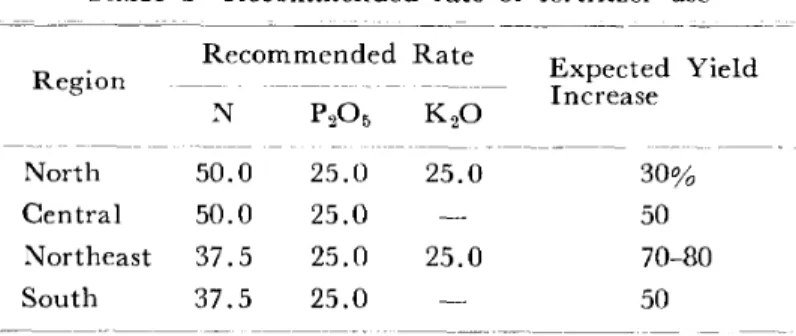
economical return from the 4 different rates of nitrogen was the main emphasis. The recommended rate of fertilizer use (Table I) was presented for each of the four regions based on the results of experiments performed up till 1961.
Averages of all the trials during the five years from 1960 to 1964 are shown in Table 1. The highest average yield of several hundred trials on farmers' fields approximately coincides with the highest average yield of Changwat or Amphoe, that is, about three
Table 1 Recommended rate of fertilizer use Recommended Rate Expected Yield Region - _ .- -Increase N P205 K20 -- - - --_.._ -North 50.0 25.0 25.0 30% Central 50.0 25.0 50 Northeast 37.5 25.0 25.0 70-80 South 37.5 25.0 50
tons per ha. However, it should be remembered that "the results of a considerable number of trials were discarded each year because of drought, flood, attacks by insects and pests, erroneous practices of farmers and so on". (LUSANANDANA, et al., 1963) The number of total trials initiated and those completed were tabulated in Table 2. The fact that four out of ten trials were discarded should be kept in mind when one interpretes the results of the Simple Fertilizer Trials in Thailand.
As shown, the result of the Simple Fertilizer Trials was always reported by region regarding several trials in one region as replication. FUKUI, et ale collected the original data of 118 individual trials conducted in the Central Plain during the period 1960-1965 and rearranged them according to the twelve sub-divisions of the plain which they pro-posed. (FUKUI and TAKAHASHI, 1969) There was some success in attempting to find correlation between the soil characteristics in certain sub-division of the plain and the thus rearranged results of the Simple Fertilizer Trials.
Table 2 Summary Results of "Simple Fertilizer Trials in Farmers' Fields," 1960-1964
Nos. of Check Percentage of Yield Increase Highest
Trials Yield Yield
kg/rai N1 P NIP N2P N3P N4P N4PK kg/ha
Whole 520 312 16.0 24.3 35.2 40.4 44.9 48.1 52.9 2,981 Kingdom Central 208 325 14.1 18.5 28.0 32.3 34.8 39.7 44.6 2,938 Region - - _ . _ - - - ~ - - _ . _ - - - - --- -(SUWANWAONG, et al., 1965)
Table 3 Recovery Rate of "Simple Fertilizer Trials in Farmers' Fields," 1958-1961
Number of Trials - ---~---_._.__. -Year 1958 1959 1960 1961 Sum Completed 61 100 77 110 348 Total 96 150 150 192 588 Percentage of Recovery 64% 67 51 57 59 . _ -(LUSANANDANA, et al., 1963)
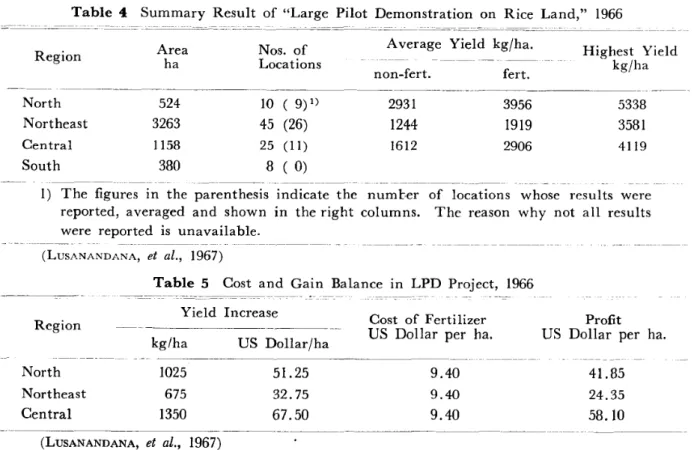
Table 4 Summary Result of "Large Pilot Demonstration on Rice Land," 1966 Region North Northeast Central South - - - --- ._-
-Area Nos. of A verage Yield kgJha. Highest Yield
ha Locations kgJha non-fert. fert. 524 10 ( 9)1) 2931 3956 5338 3263 45 (26) 1244 1919 3581 1158 25 (11 ) 1612 2906 4119 380 8 ( 0)
1) The figures in the parenthesis indicate the number of locations whose results were reported, averaged and shown in the right columns. The reason why not all results were reported is unavailable.
(LuSANANDANA, et al., 1967)
Table 5 Cost and Gain Balance in LPD Project, 1966
Yield Increase
Cost of Fertilizer Profit Region
kg/ha US DollarJha US Dollar per ha. US Dollar per ha. - - ~ - - - -- - - -- - -
-North 1025 51.25 9.40 41.85
Northeast 675 32.75 9.40 24.35
Central 1350 67.50 9.40 58.10
(LUSANANDANA, et al., 1967)
In
1964,
a project called "Large Pilot Demonstration on Rice Land" (LPD) was initiated. In the first year, 183 ha. of farmers' fields were used while in 1967 the total acreage under the project reached 8,731 ha. As a rule, 94.0 kg. per ha. of ammo-ph os(16-20-0), that is, 15.0kg. Nand 18.8 kg. PZ0 5 per ha. was the common dosage of
ferti-lizer throughout the whole country. The results of 1966 trials were mimeographed in English. (LUSANANDANA, 1967) The summarized results by region are shown in Table 3. The average for fertilized plots was about 2, 3 and 4 ton(ha. in the Northeast, Central and North, respectively. The average yield in the North, fouf tons per ha., was also the average for 400-500 ha. in rice lands at nine locations. The profit by fertilizer ap-plication was calculated and is shown in Table 4. In this project, chemicals for controll-ing insects and diseases were given to farmers free of charge. The cost of plant protection was estimated at approximately 6.00-10.00 US dollars. The labor cost for application of fertilizers and other chemicals was not included.
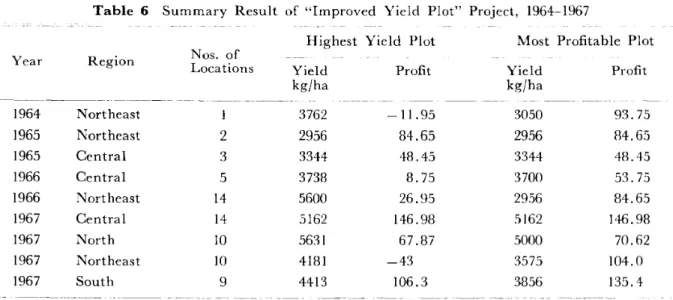
"The Improved Yield Plot" (IYP) program was started in 1964 in close connection to the above referred to LPD project. In the IYP program, various treatments were included. The effect of the application of organic matters such as rice husk, green grass, and city compost was examined. Split application of chemical fertilizers was also tried. The cost of all fertilizers and other chemicals as well as labor costs were taken in to account for profit calculation. Only farmers' fields were used for the studies. The area of one plot was usually several hundreds square meters, much larger than that of conventional experiments at stations. The results up to 1967 were reported in
mimeo-Table 6 Summary Result of "Improved Yield Plot" Project, 1964-1967
Highest Yield Plot Most Profitable Plot
Year Region Nos. of
Locations Yield Profit Yield Profit
kg/ha kg/ha - ~ ~ - - ~ - - ~ - ~ . _ - - - ~ _.._- - - ~ . -1964 Northeast 1 3762 -11.95 3050 93.75 1965 Northeast 2 2956 84.65 2956 84.65 1965 Central 3 3344 48.45 3344 48.45 1966 Central 5 3738 8.75 3700 53.75 1966 Northeast 14 5600 26.95 2956 84.65 1967 Central 14 5162 146.98 5162 146.98 1967 North 10 5631 67.87 5000 70.62 1967 Northeast 10 4181 -43 3575 104.0 1967 South 9 4413 106.3 3856 135.4 (LUSANANDANA, rt al., 1968)
graph. (LUSANANDANA, 1968) It was clearly shown that "the present local varieties can be suitable for a moderately high yield of up to five tons under farmers' conditions". (ibid.) At the same time, if unstable water conditions and economic return from ferti-lizer application are considered, the soundness of present policy of low rate ammo-phos application seems to have been proved by this program. The possibility of greater doses of fertilizer application than the present recommendation, that is, 15.0 and 18.8kg./ha. of Nand PZ0 5 as ammo-phos, respectively, was also suggested by the results of the same
program. The narrovved range within which the optimum rate of fertilizers would be practical for different localities was between 37.5 and 56.3 kg.fha. each of Nand PZ0 5 •
In order to evaluate the potential yield of native varieties used in this project, the highest yield and the yield of the most profitable treatment \vere summarized by region and year. (Table 5). As shown, though a yield of more than 5 tons per ha. can sometimes be obtained by native varieties, it is not a predictable occurence. However, the yield level of 3 tons per ha. seems consistently attainable by fertilizer application. The reason or reasons for this seemingly unstable yield level attainable by fertilizer application, (that is, somewhere between 3 and 5 tons per ha.) are not obvious.
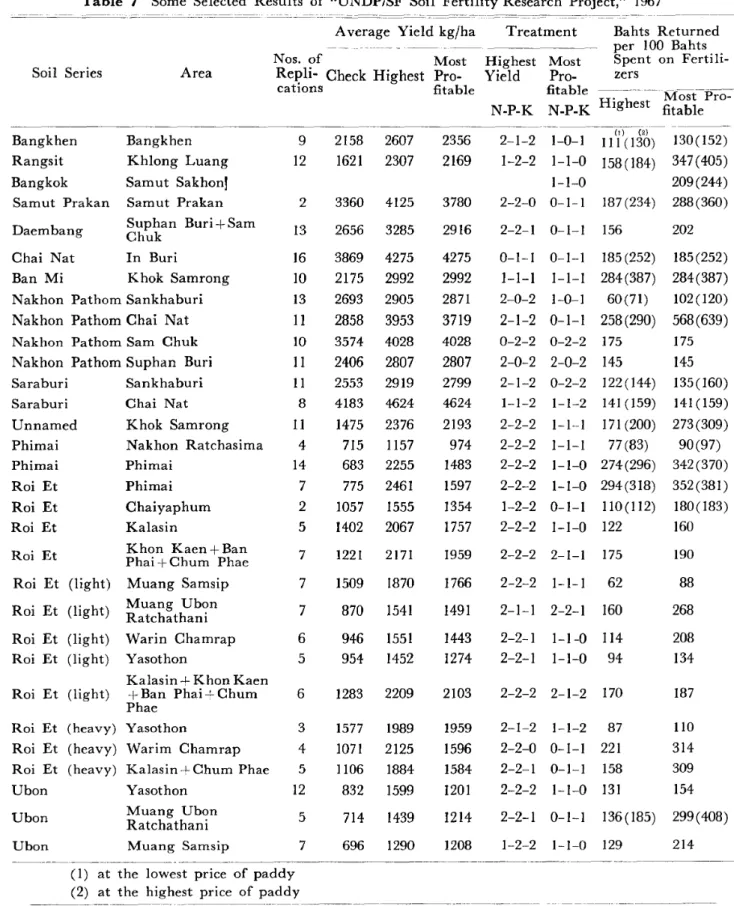
At the end of 1966, the "UNDPjSF Soil Fertility Research Project" started. The results of the first year's field experiments were summarized in Technical Report No.1. The experiments were conducted in the Central and Northeastern regions of Thailand using five crops: maize, cotton, rice, kenaf and cassava. A total of 335 experiments on rice was started and 258 were completed. The recovery rate was 77%' The reasons for loss were drought, insect attacks and/or organizational errors. The climatic con-ditions of 1967 have been described as the driest for 60 years. In this project, the results of the soil survey which was conducted by the Land Development Department was system-atically combined with the agronomic research, for the first time in Thai agriculture history. The farmers' fields were classified according to the soil series. Several field
Table 7 Some Selected Results of "UNDP/SF Soil Fertility Research Project," 1967 '--==="-''--==~
--_._---~=-~---===----~._.-Soil Series Area
A verage Yield kg/ha Treatment Bahts Returned --- - - - ---~ per 100 Bahts Nos. of Most Highest Most Spent on
Fertili-ReJ;lli- Check Highest Pro- Yield Pro- zers
catIOns fitable fit bl
N-P-K
N~P-~
High~-S~-~;b1~Pro-Chai Nat In Buri
Ban Mi Khok Samrong
Nakhon Pathom Sankhaburi Nakhon Pathom Chai Nat Nakhon Pathom Sam Chuk Nakhon Pathom Suphan Buri Saraburi Sankhaburi 2656 3285 2-2-1 0-1-1 156 2-2-2 2-1-2 170 187 130(152) 347(405) 209(244) 288(360) 202 185(252) 284(387) 102(120) 568(639) 175 145 135(160) 141 (159) 273(309) 90(97) 342(370) 352(381) 180(183) 160 88 268 208 134 190 187 (234) 185 (252) 284(387) 60(71) 258(290) 175 145 122 (144) 141 (159) 171(200) 77 (83) 274(296) 294(318) 110(l12) 122 (1) (2) 111(130) 158 (184) 0-1-1 1-1-1 1-0-1 0-1-1 0-2-2 2-0-2 0-2-2 1-1-2 1-1-1 1-1-1 1-1-0 1-1-0 0-1-1 1-1-0 2-2-2 2-1-1 175 2-2-2 1-1-1 62 2-1-1 2-2-1 160 2-2-1 1-1-0 114 2-2-1 1-1-0 94 2-1-2 1-0-1 1-2-2 1-1-0 1-1-0 2-2-0 0-1-1 0-1-1 1-1-1 2-0-2 2-1-2 0-2-2 2-0-2 2-1-2 1-1-2 2-2-2 2-2-2 2-2-2 2-2-2 1-2-2 2-2-2 3780 2916 4275 2992 2871 3719 4028 2807 2799 4624 2193 974 1483 1597 1354 1757 1766 1491 1443 1274 2356 2169 2103 1959 2171 2209 4275 2992 2905 3953 4028 2807 2919 4624 2376 1157 2255 2461 1555 2067 1870 1541 1551 1452 4125 2607 2307 2158 1621 3360 1509 870 946 954 3869 2175 2693 2858 3574 2406 2553 4183 1475 715 683 775 1057 1402 1221 1283 2 6 9 12 13 16 10 13 11 10 11 11 8 11 4 14 7 2 5 7 7 7 6 5 Bangkhen Khlong Luang Samut Sakhon! Samut Prakan Suphan Buri
+
Sam Chuk Chai Nat Khok Samrong Nakhon Ratchasima Phimai Phimai Chaiyaphum KalasinKhon Kaen
+
Ban Phai+Chum Phae Muang Samsip Muang Ubon Ratchathani Warin Chamrap YasothonKalasin
+
Khon Kaen+
Ban Phai+
Chum Phae Roi Et (light) Roi Et (light) Roi Et (light) Roi Et (light) Roi Et (light) Daembang Bangkhen Rangsit Bangkok Samut Prakan Roi Et Saraburi Unnamed Phimai Phimai Roi Et Roi Et Roi Et 714 1439 696 1290 2-2-1 0-1-1 136(185) 299(408) 1-2-2 1-1-0 129 Roi Et Roi Et Roi Et Ubon Ubon Ubon (heavy) Yasothon(heavy) Warim Chamrap (heavy) Ka1asin
+
Chum PhaeYasothon Muang Ubon Ratchathani Muang Samsip 3 4 5 12 5 7 1577 1071 1106 832 1989 2125 1884 1599 1959 1596 1584 1201 1214 1208 2-1-2 2-2-0 2-2-1 2-2-2 1-1-2 0-1-1 0-1-1 1-1-0 87 221 158 131 110 314 309 154 214 (1) at the lowest price of paddy
(2) at the highest price of paddy
experiments at the different sites on one soil series were regarded as replicates. Thus characteristics of soil series were investigated from an agronomic point of view. The experiments on rice were carried out on 14 different soil series. vVhen soil series occurred in distant locations, they were further sub-divided into several geographical areas. Thus the experiments on rice were completed in 31 areas on 14 soil series. There were 2 to 14 completed experiments or replicates in one area. The experimental design employed was a 23
factorial in N, P and K at levels 1 and 2 of each nutrient, taken in pairs, in the absence of the third. These 14 plots, plus 1 unfertilized plot, made up 15 plots for one replication. The rate of fertilizers was 20 and 40 kg./ha. of N (as ammonium sulphate), P206 (as double super-phosphate) and K20 (as potassium chloride) for the levels 1 and 2,
respectively. The size of one plot was 50 square meters for the experiments on rice. The yield data was averaged by area and by soil series. The significance of yield in-crease or dein-crease was examined statistically. The profit calculation was also figured by assuming the maximum and minimum values of the crop in each locality, and by taking into account only the cost of fertilizers.
In order to examine the yield potential under the conditions of this projects, averaged yields by area were picked and tabulated. (Table 6) Though the highest average yield exceeded 4 ton/ha. in four areas, it was much lower in other areas, particularly in the Northeast where the highest yield seldom exceeded 2 ton/ha. In most areas the highest yield plots received the highest level of each nutrient. However, the rate of fertilizers which gave the greatest return in relation to fertilizer cost vvas obviously lower than that which gave the highest yield. These experiments were conducted under normal farming practices, with limited modifications (weed and insect control) in only a few cases and under the exceptionally dry weather condition of 1967. vVhen these points are taken into consideration and the above referred table is examined again, it may be concluded that certain modifications of cultural practices and choice of proper variety must accom-pany the fertilizer application in order to attain higher and still more profitable yield.
ExperiInents at Stations
Rice research in Thailand started with the establishment of the first experimental station at Thanya Buri in 1916. Pre-\Var rice research was done mainly at this station. On the occasion of the FAG officials' visit in July, 1947, a summary of the results of the experimental works on rice up to 1946 was prepared by PHRAYA BHOJAKARA and M. L. YINSAKDI ISRAsENA. As they stated in the report, "the first aim (of their effort at the time of the opening of the Rangsit Station in 1916) was to begin collection and selection of superior quality paddies,... The second aim was to observe local cultural practices and then try to find the means of improving them." To attach greater im-portance to quality rather than to quantity seemed to be the general tendency of rice workers before the \Var. Inferior q uali ty varieties collected from various locali ties were
discarded without examining their yield ability. Yield ability of superior quality varieties was examined under unfertilized conditions. This trend of selection can be explained by the fact that rice land had been rapidly extended in the lower Central Plain where rice was produced as commercial crop for export. However, this does not mean that no experimentation was conducted on the effects of fertilizers and various cultural prac-tices. Effects of animal manure, bone meal, chemical fertilizers and green manure were tested. Unfortunately most of the results of these tests were not very useful because of poor experimental design and careless management of experiments.
In 1935, DR. R. L. PENDLETON started his soil survey work in Thailand. His emphasis was on surveying soil and general agricultural practices. It is known that a private fertilizer firm conducted numerous fertilizer trials to demonstrate fertilizer effectiveness to farmers but no report on this is available now. (HALEY, 1960)
After the War, in 1950, agricultural assistance was initiated in this country by the U.S. Government. One of the first people to come under this porgram was DR. H.H. LOVE, a plant breeder. He started extensive work on rice variety evaluation, selection and hybridization. (LOVE, 1955) A fraction of the results of variety evaluation ex-periments at the stations have been reproduced in Appendix 1. As seen, the average yield of the 5 highest yielders among those tested was 500 kg./rai or about 3 ton/ha. at the Bangkhen station where the soil fertility is much superior to that at the Rangsit sta-tion. Variety evaluation trials were also conducted on farmers' plots. Summary results from 1954 have been tabulated in Appendix 2. Though the yields were different from one locality to another, the averages of the 5 highest yielders were often quite large; the highest was 820 kg./rai or about 5 ton/ha. at Samut Prakan.
In the early 1950's, experiments on fertilizer effect were resumed. Various experi-ments were conducted at newly established rice stations all over the country. The geographical position, soil and climatic conditions of19 Rice Experimental Stations were summarized by the Breeding Division of the Department of Rice. (BREEDING DIVISION) During this period their main interest seems to have been the relative effectiveness of different phosphatic fertilizers. During the period from 1953 to 1967, seven different programs on the efficiency of different phosphate-source fertilizers were carried out. They were:
1953/54 "A comparative study of two phosphatic fertilizers in different regions of Thai-land"; superphosphate and rock phosphate of Christmas Islands were compared at 22 locations in four regions. (TECHNICAL DIVISION, RICE DEPARTMENT a) 1955/56 "The comparison of the effects of various kinds of phosphatic fertilizers";
super-phosphate, hypersuper-phosphate, rock phosphates of Christmas Island and Florida Pebble, Patalung phosphates and bone meal were compared at five stations.
(TECHNICAL DIVISION, RICE DEPARTMENT a)
Thai-land"; superphosphate and hyperphosphate were compared in four regions at 28 loeations in 1955-56 and at 16 locations in 1956-57. (TECHNICAL DIVISION, RICE DEPARTMENT a)
1951/57 "Comparison of the effects of superphosphate and rock phosphate as sources of phosphorus for rice"; t\'Vo phosphatic fertilizers were compared at different rates ofP20:s, N and lime at the Bangkhen station. (KOMES, 1958)
1962/63 "A comparative study on the response of rice to superphosphate and basic slag for acid paddy soil in Thailand"; two kinds of phosphates were compared at the fixed amount of nitrogen and potash at the Bangkhen and Rangsit sta-tions. (SUWANWAONG and SAISOONG, 1964)
1966/68 "A comparative study of the different sources and rates of high and low analysis phosphate fertilizers on rice yield"; five kinds of phosphatic fertilizers, super-, triple super-, and diammonium-phosphates in granulared and powdered forms, were compared at the fixed rate of nitrogen at 8 stations. (JUGSUJINDA, et al.,
1968)
1966/67 "Comparative study of different sources of phosphorus"; superphosphate, basic slag, rock phosphate and hyperphosphate were compared at the fixed rate of nitrogen and potash at 7 stations. (TECHNICAL DIVISION, RICE DEPARTMENT, 1967.)
No statistically significant difference was found among the various phosphatic ferti-lizers compared in these experiments. The yield level attained in these fertilizer ex-periments can be seen in Appendices 3, 4 and 5. Usually the highest average yields by region or station were between 3 and 4 tons per ha. In other words, various phosphatic fertilizers with combinations of nitrogen and potassium increased the yield from 1~2 ton/ha. on check plots to 3-4 tonjha. on the highest yield plot of the best combination of nutrients.
Three experiments on the comparative effects of different nitrogen fertilizers were reported by the Technical Division. Ammonium sulphate and urea were compared at 12 locations in 1957/58. (TECHNICAL DIVISION, RICE DEPARTMENT a) In 1966 and 1967, five kinds of nitrogenous fertilizers (ammonium sulphate, ammonium chloride, urea, ammonium sulphate nitrate and calcium ammonium nitrate) were examined at the rates of 18.25 and 37.5 kg. N/ha. at 6 stations. (SUTHDANI and SUWANWAONG, 1968) In the same year, these four nitrogen sources were examined as top dressing material at 5 stations. (SUTHDANI, 1967) The concentrations of these three trials have been sum-marized in Appendices 6, 7 and 8. In all the experiments no statistically significant difference among the various nitrogenous fertilizers was observed. The yield usually increased with greater amounts of nitrogen and the highest yield reached more or less the saIne level as that in the phosphatic fertilizer experiments referred to on the previous pages. However, the highest yields obtained in the stations located in the Northeast
seldom exceeded 3 tons per ha.
The effect of city compost produced through a fermentation method by the Bangkok Municipality was investigated. (SUWANWAONG and SUTHDANI) The experiment was conducted for several years starting in 1961. City compost was compared to farm yard manure and chemical fertilizers at 12 rice stations. Some results obtained at the sta-tions in the Central Plain have been tabulated in Appendix 9. It was concluded that the application of compost did not cause any harmful effect to the rice plants and increased the yield proportionally to the amount applied. The highest yield thus attained was usually around 3 tons per ha. The effect of compost was also investigated on farmers' fields. Some treatments of the "Simple Fertilizer Trials" and the "Improved Yield Plot" projects included the application of city compost. In any case, adverse effects were not observed and, on the contrary, a yield higher than that usually obtained by chemical fertilizers alone was often attained. However, the balance between cost and gain was unfavorable because of the price of city compost.
From the results of the above referred to fertilizer trials, we might be able to predict the general tendency of yield increase by fertilizer application, although the main ob-jectives of these experiments were always to determine the optimum form of phosphate or nitrogen fertilizers. It seems rather curious that only a few experiments on the effect
of rate and time of nutrient application on the yield and growth of rice plant have been conducted. Investigation toward understanding of the mechanism of yield increase by fertilizer application has been very poor in Thailand. Only one experiment was reported in early 1950's on varietal difference in nitrogen response. (TECHNICAL DIVI-SION, RICE DEPARTMENT a) The average yield of six varieties compared at three stations during 1952-1955 has been tabulated in Appendix 10. Though it was found that growth duration had some correlation with fertilizer response, further study did not follow. More detailed investigations on the effects of fertilizers, particularly nitrogenous fertilizer, on growth of rice plant were initiated in later half of 1960's.
From 1963 on, various experiments using isotopes have been conducted every year as a part of the co-ordinated program of IAEA on the application of isotopes In rice cultivation. Throughout all the experiments of this program in Thailand, only one variety, Nang Mol S-4 which is a medium late, non-glutinous, lowland, indica
variety, was used. The experiments were carried out at the Bangkhen, and/or the Rangsit station, both of which are located in the southern Central Plain. So far the following experiments were carried out:
1963 Time and rate of super-phosphate application. (LUSANANDANA and SUWANWAONG, 1963a)
1963 Residual effects of super-phosphate from vanous methods of placement during the previous year. (LUSANANDANA and SUWANWAONG, 1963b)
nitrogen application. (LUSANANDANA and SUWANWAONG 1964)
1965 Effect of placement methods and interaction between nitrogen and phosphorus fertilizers. (TECHNICAL DIVISION, 1965b)
1965 Efficiency of fertilizer nitrogen and phosphorus as affected by time and rate of their combined application. (TECHNICAL DIVISION, 1965a)
1966 Efficiency of nitrogen utilization from ammonium sulphate using different place-ment methods and its interaction with the utilization of super-phosphate. (LUSANANDANA, et
at.,
1966a)1966 Comparative efficiency of different forms of fertilizer nitrogen. (LUSANANDANA,
et
at.,
1966b)In these experiments, not only the yield but also several yield components were reported. Plants were sampled at different growth stages and the nutrient content was analysed chemically and radioisotopically. The yield levels attained by Nang Mol S-4 with various fertilizer treatments were quite constant throughout experiments at each station, but differed according to whether the experiment was conducted at the Bangkhen or Rangsit station. For an example, the yields of the 1964 experiments con-ducted at both of the stations have been shown in i\ppendix 11. As in many other fertilizer experiments referred to previously, the yield level was 3-4 tons per ha.
The recent trend of fertilizer experiments in Thailand has two main directions; one is to determine the optimum combination and dosage of plant nutrients for native varieties with the least modifications of other cultivation methods. Needless to say, this should be separately determined for each environmental condition and, accordingly, has been carried out mainly in the farmers' fields, as was mentioned on previous pages. The other direction of current rice research is the establishment of a cultivation system for superior native varieties in order to achieve the highest potential yield for those varieties. The main emphasis of the latter direction is to shorten the vegetative growth period by delaying planting time and by improving other cultivation techniques such as split application of nitrogen, proper planting density and nursery bed management. This must be considered in conjunction with the different characteristics of varieties and specific local environmental factors. Both directions were much encouraged by DR. ]. TAKAHASHI, an FAO expert who has been serving in Thailand since 1964. (TAKAHASHI, 1968) Among numerous experiments which were conducted along the latter direction, one example which shows the interaction between varieties and tran-planting time has been shown in Appendix 12. Based on the knowledge obtained through the experimental results on variety, planting time, spacing, rate and time of fertilizer application and other cultural practices, a trial designed to challenge the higher yield by a native variety was undertaken at a relatively large plot of land (3,156 square meter). A recommended variety, Puang Nahk 16, was sown on August 17 and transplanted on September 8 with a spacing of30X 15 em. (three seedlings per hill). Chemical fertilizers
were applied as follows:
Basic dressing;
N 37.5,
P205
112.5
kg.fha.One month after transplanting; N 37.5, P20 li 46.5 kg.(ha.
At I.P.P. stage; N 37.5, P205 46.5 kg.(ha. At flowering stage; N 12.5 kg.(ha.
Harvest took place on 15-18 January, 1967. The yield obtained was 6,256 kg. clean paddy per ha. at 13<yo moisture. Another piece of data indicating the very high yield potentiality of Thai native varieties is the results of a high yield contest among the experiment stations. Appendix 13 shows the yields of the five best stations during 1963-1967. Six tons per ha. is not out of reach for tropical varieties under experimental condition. (BREEDING DIVISION, 1963-1967)
Reviewing the results of the numerous experiments referred to above it may be con-cluded that the yield level attained by using the proper amount of fertilizers under ex-perimental condition is 3 to 4 tons per ha., regardless of varieties used and without alter-ation of the conventional methods of cultivalter-ation. This yield level nearly equals that of the experiments on farmers' fields in most regions. The highest average yield by Amphoe or Changwat is slightly lower than these yield levels. If fertilizer application accompanies other improvements in cultivation techniques including the selection of the native variety, the yield often exceeds 4 tons per ha. and attains the remarkably high level of 6 tons per ha., which is about 4 times greater than the present national average of Thailand. However, we should not neglect the results of those experiments in which the yield failed to reach the expected level. In the experiments on farmers' fields we find many examples of these failures. They can be partly explained by water shortage and(or erroneous practices by farmers. But the possibility that varietal characteristics and various soil properties might be the causes of the failures, should be considered, too. Particularly when the experiments conducted at stations fail in terms of yield increase by fertilizer application, the results cannot simply be discarded but rather, the cause of failure must be clarified. It is common for yield to be increased to 3-4 tons per ha. by simply applying the proper amount of fertilizers to the present native varieties. But this does not necessarily mean that this yield level can be attained by any variety, at any location by anybody. If it cannot be, it should be clearly shown by which varieties, at which location, the yield cannot be raised to the said level.
A
counterplan for these varieties or locations should be presented. When a yield level exceeds 4 tons per ha., the unreliability of yield increase by fertilizer application is much more pronounced.In Appendix 14, the results of an experiment on the interaction between transplanting time and time of nitrogen application has been shown. (KANCHANOMAI, 1969) The
experiment was repeated at the Bangkhen and Rangsit stations for two successive years. The yield level attained in one year was nearly two times higher than that attained in the other. This great difference in- yield level cannot be attributed solely to climatic
factors. The factors affecting yield increase at yield levels higher than 3 tons per ha. are obscure and yet to be clarified. The high yield contest among the experimental stations has been referred as an example which indicates the very high yielding poten-tiality of native varieties. However, the result of this same contest is a good example of the unreliability of yield increase at yield levels higher than 3-4 tons per ha. In Appendix 15, the results obtained at 8 stations in the Central Plain during 1963-1967
have been shown. It can be seen that a yield higher than 4 tons per ha. was obtained only occasionally. (BREEDING DIVISION, 1963-1967)
11any reasons can be supposed for the uncertainty of the fertilizer response of these native varieties. The revie\ver "vants to mention one reason which, although it might not necessarily be attractive to academic researchers, is nonetheless very important from a practical point of view. In several experirnents of the IAEA co-ordinated program in which isotopes were used, the yield levels were rather constant from one year to another irrespective different treatments and the different oLjectives of the experiments. One of the reasons for this constant yield level over several years seems to have been very intensive use of insecticides and fungicides as shown in Appendix 16. It can be said that insect and disease attacks should always be taken into account when native varieties are applied with large quantity of fertilizers, especially nitrogenous fertilizer in deltaic paddy areas such as the Central Plain of Thailand. This is, as is well known, because susceptibility to various diseases becomes greater as a result of the physiological status of rice plant, particularly in relation to a high nitrogen content in tIle plant body. Another reason seems to be that the ecological condition of rice plant population changes drastically as a result of vigorous growth through fertilizer application, and vanous insects seem to avail themselves of this condition. A plant protection scheme for rice plants which are heavily dressed with fertilizers must be immediately established. It
goes without saying that the selection work of superior varieties should be directed toward the selection of superior varieties under fertilizer-applied conditions. And with equal importance resistance to diseases and insect attacks should also be considered.
Literature Reviewed in Part II
BHOJAKARA, P. and Y. S. ISRASENA, 1947. A Compilation of the Results of Experimental Work on Rice. Bangkok: Department of Agriculture. (mimeo.)
BREEDING DIVISION, RICE DEPARTMENT, Summary on Geographical Position, Soil Characteristics and Climatic Conditions of the Various Rice Experimental Stations in Thailand. Bangkok. (mimeo.)
BREEDING DIVISION, RICE DEPARTMENT, 1963-1967. High Yield Contest among Experimental Stations.
Bangkok. (mimeo. in Thai)
DEPARTMENT of RICE, Annual Report on (year) Rice Production in Thailand, (published annually),
Bangkok.
FUKUI, H. and E. TAKAHASHI, 1969a. "Rice Culture in the Central Plain of Thailand -Subdivision of the Central Plain and the Yield Components Survey of 1966-- ," Tonan Ajia Kenkyu (The
7~3%
Southeast Asian Studies), Vol. VI, No.4, Kyoto.
FUKUI, H. and E. TAKAHASHI, 1969b. "Rice Culture III the Central Plain <If Thailand (II) Yield
Components Survey in Saraburi-Ayutthaya Area, 1967," Tonan Ajia Kenkyu (The Southeast Asian
Studies), Vol. VII, No.2, Kyoto.
HALEY, LOUIS E., 1960, Soil Testing, Soil Fertility and Soil Survey tn Thailand. Bangkok: U.S.a.M. III
Thailand. (mimeo.)
JUGSUJINDA, A., S. SUTHDANI and S. SUWANWAONG, 1968. A Comparatioe Study of the Different Sources
and Rates of High and Low Analysis Phosphate Fertilizers on Rice Yield. A paper read at the 11th Session of I.R.C. Working Party on Rice Soils, Water and Fertilizer Practices, Ceylon, Sep-tember, 1968. (mimeo.)
KANCHANOMAI, P., 1969. Personal communication.
KOMES, A., 1958. Comparison of the Effect of Super-phosphate and Rock Plwsphate as Sources of Phosplwrus
for Rice, 1951-1957. Bangkok: Rice Department (mimeo.)
LOVE, H.H., 1955. Report on Rice Investigations, 1950-54. Bangkok: Departments of Agriculture and Rice in cooperation with Agriculture Division of U.S.a.M. in Thailand. (mimeo.)
LUSANANDANA, B., et al., 1963. "Simple Fertilizer Trials on Rice in Cultivators' Fields in Thailand,"
I.R.C. Newsletter, Vol. XII, No.2, Bangkok.
LUSANANDANA, B., et al., 1967. Results of Large Pilot Demonstrations on Rice Lands. Bangkok: Rice Department. (mimeo.)
LUSANANDANA, B.et al., 1968. Investigation on Improved Yield Plot. Bangkok: Rice Department. (mimeo).
LUSANANDANA, B. and S. SUWANWAONG, 1963a. A Study on Time and Rate of Superplwsphate Application
in Rice Cultivation. Bangkok: Rice Department, (mimeo.)
LUSANANDANA, B. and S. SUWANWAONG, 1963b. A Study on Residual Effects of Superplwsphate from
Various Methods of Placement in Rice Cultivation. Bangkok: Rice Department. (mimeo.)
LUSANANDANA, B. and S. SUWANWAONG, 1964. A Study on Efficiency of Fertilizer Nitrogen and Phosplwrus
as Affected by Time and Rate of Nitrogen Application. Bangkok: Rice Department. (mimeo.)
LUSANANDANA, B., P. SANITWONGSE and S. SUWANWAONG, 1966a. The Study on the Efficiency of Nitrogen
Utilization from Ammonium Sulphate in Different Placement Methods and Its Interaction with Uttlization of Superphosphate. Bangkok: Rice Department. (mimeo.)
LUSANANDANA, B., S. SUWANWAONG and P. SANITWONGSE, 1966b. A Study on Comparative Efficiency of
Different Forms of Fertilizer Nitrogen for Rice. Bangkok: Rice Department. (mimeo.)
MINISTRY of AGRICULTURE, Agricultural Statistics of Thailand, (published annually), Bangkok. MORIYA, M., 1968. "On the Productivity of Indica Rice Viewed from the Field Survey," Tonan
Ajia no Inasaku (Rice Cultivation in Southeast Asia), Tokyo: Nippon Sakumotsu Gakkai (Japanese
Association of Crop Science).
RUTTAN, V. W., A. SOOTHIPAN and E. C. VENEGAS, 1966. "Technological and Environmental Factors in the Growth of Rice Production in the Philippines and Thailand," Rur. Econ. Prob., Vol.
III, No.1.
SUTHDANI, S., 1967. A Study on Top Dressing Material of Nitrogen Fertilizer on Rice. Bangkok: Rice Department. (mimeo. in Thai)
bUTHDANI, S. and S. SUWANWAONG, 1968. Comparative Effect of Nitrogen Fertilizer Sources on Rice Yield. A paper read at the 11th Session of I.R.C. Working Party on Rice Soils, Water and Fertilizer