online coverage of
Fukushima triple disaster
By
Saroj Kafle
November(2014( (
Thesis submitted to the Higher Degree Committee of
Ritsumeikan Asia Pacific University in Partial
Fulfillment of the Requirements for the Degree
of Master of Asia Pacific Studies
51113001(Acknowledgements
This thesis would not have been completed without the support of the many people who have guided me throughout this study. First of all, I would like to express my deepest gratitude to my supervisor, Prof. YOSHIDA Kaori, for her continuous support, mentorship, patience and invaluable guidance in every step of my thesis writing.
I sincerely thank Ritsumeikan Asia Pacific University for accepting me as a graduate school student and for providing me this wonderful opportunity to grow academically. I am truly grateful to the APU staff members especially those from the Academic office, Admissions office and Research office who always encourage and provided me assistance whenever the need arises.
I am also thankful to my former company, President YAMASAKI Migaki who helped me in every step through out my study. I cannot forget to say thanks to my seniors from the company.
Last but not the least, I would like to thank my parents, sister, other family members and friends for their unconditional love, support and encouragement which became my inspiration to overcome the odds and complete my master’s degree.
Table of Contents
Acknowledgements ... i
Abstract ... vi
Chapter 1: Introduction ... 1
1.1 Background ... 1
1.2 Statement of the Problem & Research questions ... 5
1.4 Objective & significance of this study ... 6
1.5 The outline of the research ... 7
Chapter 2: Definition of News and News Sources ... 8
2.1 News ... 8
2.2 Online News ... 9
2.3 News sources ... 10
Chapter 3: Literature Review ... 12
3.1 Disaster and the disaster news coverage in online media ... 12
3.2 The triple disaster of Fukushima ... 16
3.3 The Media framing ... 18
I) The economic frame ... 20
II) The Conflict Frames ... 21
III) The Powerlessness Frame / The Attribution of Responsibility ... 22
IV) The Human Impact Frame (Human Interest Frame) ... 23
Introduction of a new frame ... 23
3.4 Studies on news coverage analysis of Fukushima using the concept of
framing ... 25
3.5 Agenda Setting Theory ... 28
CHAPTER 4: Methodology ... 31
4.1 News selection and the analysis procedure ... 32
4.2 Finding Frames ... 33
Types of Frames ... 33
Chapter 5: Result, Findings and Discussions ... 38
5.1 News articles and categories ... 38
Categories of news ... 39
5.2 Research Findings and Discussions ... 40
5.2.1 Dominant Frame(s) ... 42
5.2.2 Implications of dominant frames ... 44
CHAPTER 6: Conclusion ... 47
6.1 Limitation ... 48
6.2 Future Studies ... 49
References ... 51
Appendix ... 57
158 News Articles used and analyzed for the study ... 57
Frames Analysis for Chapter 5 ... 67
List of Figure
Figure 1: Number of news articles………39
Figure 2: News Categories………....40
Figure 3: 4 frames and percentage on each frame………..…...42
List of Table
Abstract
On March 11th, 2011, an earthquake with a magnitude of 9.0 on the Richter scale shook the northeastern coast of Japan which triggered a 14-meter tsunami and destroyed three nuclear reactors which further led to a nuclear radiation leakage in Fukushima Daiichi nuclear power plant. This Fukushima nuclear meltdown reached level 7 emergency in which media from all over the globe watched closely as it progressed. As this meltdown was also linked with the world’s economy, international relations, health and many other aspects of world politics, it was not just regular news.
This nuclear disaster gained an abundance of media attention all over the world and was in every kind of news media. This study examines the coverage of the Fukushima disaster in BBC online, focusing on how the news articles were framed and the implication of dominant framing. Using Neuman’s (1992) framing theory on this qualitative research, 158 articles from BBC online were selected and analyzed to figure out dominant frames and its implications.
Chapter 1: Introduction
1.1 Background
At 2.46 pm on 2011 March 11, an earthquake of 9.0 magnitude with an epicenter 130 kilometers from Fukushima to its North Pacific coast triggered a huge tsunami that engulfed a large portion of Japan. An article published in a website called ‘Eurasia review’1, claimed that the waves of the tsunami was estimated to have reached over 38 meters. Concrete building can standup 4 meters of tsunami but the tsunami that hit Japan on March 11 was way more than those concrete could hold (Kuna, 2011). This tsunami not just destroyed everything that came on its path but also shook the Fukushima nuclear plants causing 3 nuclear facilities to meltdown.
In Fukushima, The nuclear reactor’s vital cooling system stopped responding after the tremor and soon after that the tsunami generated by the earthquake destroyed the emergency backup generators. The control rods were designed to automatically stop nuclear reaction after a quake and shutdown the reactors !!!!!!!!!!!!!!!!!!!!!!!!!!!!!!!!!!!!!!!!!!!!!!!!!!!!!!!!
1!Eurasia Review is an independent Journal that provides a venue for analysts
and experts to disseminate content on a wide-range of subjects.
however, without the power and backup generators functioning, the water inside the reactors stopped circulating. The fuel rod heated the water and further reacted with steam to produce hydrogen gas. The extreme pressure from the gas and chain reactions led the meltdown and reactors 1, 2 and 3 went through similar process damaging the containment chamber. (Buerk, 2012)
Officials desperately filled seawater with boric acid into the reactors to cool down the fuel rod. The meltdown had already destroyed the suspension chamber, which later led to the unwanted discharge of radioactive water in the ocean of Fukushima. Due to overheat of the fuel rod, reactor 4’s storage pool ran out of water causing fire breakouts. Helicopters threw water on the storage pool with the aim to replenish however, could not overcome the problem. A month later, a level 7 emergency was declared for this nuclear meltdown. Power was restored on September 2011 but the debris and radioactive waste remained a headache for the government and TEPCO. The leakage of radioactive water and the unwanted discharge of radioactive materials as well as the contamination due to the nuclear meltdown concerned the globe, and they have to come to the greatest interest of world media as it developed. (Buerk, 2012)
Media from all over the world started extensive coverage on Fukushima nuclear disaster for two specific reasons; ‘the nature of nuclear energy’ and ‘the role of media in times of disasters and crises’. (Lazic, 2013, pp. 19-20). Until 2012 August, 435 operable commercial nuclear reactors in 30 counties supply 12.3% of
global electricity (Schreurs & Yoshida, 2013, p. 2). And some of these nuclear reactors are in earthquake or tsunami prone areas. There was fear of another nuclear crisis from these reactors, which is an important issue or matter of concern for both journalists and news consumers. As for the second reason, media plays a vital role in providing primary information about the emergencies to citizens. This directly or indirectly affects the process of citizens’ decision making or shaping knowledge. (Lazic, 2013, p. 20) Media is the one to provide the information to its audiences as the events happen. These events when presented to the audience can affect their perception and thinking in accordance to the way the media outlets presents its information to the public.
When nuclear emergencies take place, even small, media gives a significant attention to it. Even level 0 nuclear emergencies are given extra attention by media when covering the event. “By looking at the level 0 nuclear emergencies on the INES2, which occurred at the Krsko plant in Slovenia, Perko et al. concluded that regardless of the high level of transparency in society and lower level of emergency, the event still caused high media interest.” (Drafana & Muneo, 2013, p. 1) In the case of Fukushima nuclear meltdown 3it was level 7 emergency and !!!!!!!!!!!!!!!!!!!!!!!!!!!!!!!!!!!!!!!!!!!!!!!!!!!!!!!!
2!!International!Nuclear!Event!Scale!(http://www:ns.iaea.org/tech:
areas/emergency/ines.asp)!
!
3!‘Nuclear Meltdown’ is unofficial term for damaged core of nuclear reactor or
media from all over the globe watched closely as this meltdown took place and as the government was making its every move. This meltdown was not just regular news as this was linked and could be framed with the world’s economy, international relations, health and many other aspects of world politics. This meltdown brought more interest in the news media than the earthquake and tsunami triggered by the earthquake. (Drafana & Muneo, 2013, p. 1)
Online BBC
Online news is one of the most important forms of media in the contemporary media race. This essential form in the present news world was also actively involved in mediating news about Fukushima meltdown. Just like any other international media, BBC online service was also keen to report the nuclear meltdown. Among many news media (reports), this thesis particularly focuses on BBC’s online services because of its dominance in the news outlet segment. By studying BBC’s news articles, news framing4 by International news agencies could be then better understood.
!!!!!!!!!!!!!!!!!!!!!!!!!!!!!!!!!!!!!!!!!!!!!!!!!!!!!!!!!!!!!!!!!!!!!!!!!!!!!!!!!!!!!!!!!!!!!!!!!!!!!!!!!!!!!!!!!!!!!!!!!!!!!!!!!!!!!!!!!!!!!!!!!!!!!!!! !
4!‘Framing’ here means the process of organizing information and constructing
information by using catchy title, text and pictures in a way that makes sense to news agencies and audience.
During the early days of online news revolution, three major online media outlets were involved in Britain: Reuters, news agency sites of the Press Association and third, not surprisingly, was BBC’s online service. Officially launched on 4th November 1997, BBC now maintains 24 hours of news access and updates not just to the UK but also to the world (Allan, 2006, pp. 33-34). BBC, founded by John Reith in early 1920s, was quite unhappy about the American, unregulated commercial radio and Soviet’s controlling system. With his vision of making BBC an “independent British broadcaster to educate, inform and entertain the whole nation, free from political interference and commercial pressure”, BBC maintained its distance on financially dependency from the government (British Broadcasting Corporation (BBC), 1995, p. 1).
1.2 Statement of the Problem & Research questions
The main aim of the study is to identify the most dominant frame(s) in BBC Online News on Fukushima Nuclear Incident when known and unknown sources are involved in the process of news making. This research further aims to find out the implications of dominant frame used in the news.
To discuss the aforementioned statement of problem, this research attempts to answer the following questions.
1. What are the dominantly used frame(s) in BBC Online News on Fukushima nuclear incident?
2. If a particular frame were used dominantly, what would that imply on mindset of BBC’s audiences?
1.4 Objective & significance of this study
This research aims to help better understand the importance of disaster news constructions in international news covered by news outlets outside the country suffered from the disaster. The presentation of international news and its implication in a particular country could be understood through analyzing the news coverage and its particular faming.
This research focuses on the framing used in British online media when presenting disaster news. The researcher believes that this study will not just help learn about the frames used by news organizations but also help future journalists and audience to understand the framing of news in an international organization and motive of online news services. Through this, audiences will have the ability to know how to interpret the news. Moreover, this research will act as a tool to see the trend of news framing and its implications for further study in detail the subject matter.
1.5 The outline of the research
The study has six parts. The first part is Introduction, which covers the basic information including research questions, objectives and significant of the study, the reason behind the topic selection, the statement or research question for the study and its significance.
The second part, ‘News, Online News and Sources,’ explains the important terms crucial to the study giving readers a better understanding of the subject matter. The third part reviews the previous research relevant to the subject matter of this study to identify the missing or new areas of previous studies. This chapter discusses the disaster studies and theories by previous researchers and frame studies on Fukushima nuclear accident. The fourth part, ‘Methodology,’ will introduce instruments and approaches of the study, as well as explaining about the method observation used for the research. The fifth part, ‘News analysis and results’, analyzes the actual news articles of BBC to find out the dominant frame(s). This part will try to find answers to the research questions. The last part, ‘Discussions and Conclusion’, will conclude the research as well as opening up new channels for future studies on a similar subject.
Chapter 2: Definition of News and News Sources
This chapter defines and explains some important terms that will be used throughout the study. The three major terms: News, Online news and News sources are explained in this chapter.
2.1 News
According to Oxford dictionary, news is “Newly received or noteworthy information, especially about recent events.” Helen Fulton (2005) in the book
Narrative and Media introduced the concept of ‘News as Constuct’. A news is not
a news until and unless it is created and given shape. “News is brought into being by the practices of making the news. Whatever appears in a newspaper or TV bulletin, by definition; ‘news’ does not exist somewhere outside the media organizatoin, waiting to be found and brought inside” (Fulton, 2005, pp. 219-20). Therefore, any information can be given the shape of news as per the interest of news agencies. Then the events that will be turned into news are given prority based on the source that they come from (Fulton, 2005, pp. 219-20).
News has existed for very long and no one can deny that. “With the stated or unstated assumption that the mass audience has a peculiar taste for the gruesome, many of those historians trace sensationalism to the penny papers of the 1830s,
which they treat as the first mass-circulation press” (Stephens, A History of News; From the Drum to the Satellite, 1988, p. 1). This is one of the first kind in mass communication or news media. From spoken news media to printed news media and to digital news, news has evolved when it comes to the way of providing information to the audiences.
2.2 Online News
In 1990s, World Wide Web became a mile stone in human evolution as information flow needed no more than a fraction of a second to reach the mass. “Discourse about the potential implication of online technologies and the World Wide Web for the mass media has also had a drastic connotation, rising the specter of radical consequences for the production and consumption of News.” (Boczkowski, 2005, p. 1) This indicates that the technology made it easier for the news production and consumption and that online news has become an inseperable part of life for many people while evolving the way of providing information in a exponential manner.
During 1980s, news agencies pursued for alternatives in technologies such as vidoestex, teletext, audiotex and fax but all were not that influential. In 1995, Yahoo and Netscape started getting successful which gave the news companies prospect for a new market. By 1998, more than 750 daily news went online only
in North America. And by 1999, only two out of 100 large news media remained outside the web in US. (Boczkowski, 2005, p. 52)
2.3 News sources
Many school of thoughts think news as it was created, therefore, is a type of story. Like stories which needs story tellers, news stories also need reporters and news tellers (anchers, Journilist or news outlets), Cartee (2005) also agrees with the term ‘news stories’ as it is routinely used by journalists or academicians. But the online difference between the story and news stories in that the news need sources to become a news. (Cartee, 2005, pp. 156-7)
Herbert J. Gans in his book Deciding What’s the news: A case study of CBS
evening news, NBC nightly news, Newsweek and Time introduced two types of
news sources, the known and the unknowns. “The knowns are the elites and officials sources, namely heads of government, ministers and deputy ministers, official spokesperson usually the public relations practitioners, leaders of NGOs, experts, celebrities and the like.” And the unknowns are orinary people or non-elites who somehow have relations to a certain “news events as eyewitnesses, victims and families of victims.” (Ibrahim, et al. 2011 p. 4). In this regard, Nic Newman (2011) claims that individuals are fuelled up with the existence of powerful networks like Facebook, Twitter and YouTube and are able to share their own ideas which is often challenging traditional news (Newman, 2011, p.
10). He further says that social media have not replaced the professional journalism but it has made difficult to define journalism (Newman, 2011, p. 10). In the recent few years, however, there has been a tremedous rise of using social media as “uknown sources” because they are shared by social media users (Laird, 2012). Research done by Oxford university also shows that there has been an increase in use of the social network as a new news source (Dutton & Blank, 2011, p. 37). Under this circumstance, news agencies have started paying attention to the social networks through which news information is shared among non-elite and non government individuals.
Chapter 3:
Literature Review
This chapter has 5 major sections, the ‘disaster news and coverage in online media’, ‘the triple disaster of Fukushima’, ‘the Media framing’, ‘studies on news coverage analysis of Fukushima using the concept of framing’ and ‘the agenda setting theory’. This section will see previous studies on how the media and audience react to crisis.
3.1 Disaster and the disaster news coverage in online media
Disaster has various meanings in the society and depends on how the word is used. Merton (1961) defined disaster as “…an event, concentrated in time and space in which a society or a relatively self-sufficient subdivision of a society, undergoes severe danger and incurs such losses to its members and physical appurtenances that the social structure is disrupted and the fulfillment of all or some of the essential functions of the society is prevented” (Merton, Nisbet, & Robert, 1961, p. 166). Simply saying, a disaster is an event that creates a huge damage on human, technological and environmental attributes, which leads to social disruption.
Scholars like Oliver-Smith and Hoffman (2002) define disaster as “a process/event combining a potentially destructive agent/force from the natural, modified, or built environment and a population in a socially and economically
produced condition of vulnerability, resulting in a perceived disruption of the customary relative satisfaction of individual and social needs for physical survival, social order, and meaning” (Hoffman & Oliver-Smith, 2002, p. 4). Disasters lead to sudden disruption of everyday life due to the natural or manmade causes. These interruptions often affect the social, economic and political aspects of life that are very important to the society. Disaster events gain attention of media and also affect the daily life for which, the media tend to cover it as they occur.
Joseph Scanlon (2007) claims that “the media hear about the event, try to obtain more information, use their own files to add background to their stories, dispatch reporters and report what they are told by officials” (Scanlon, 2007, p. 77). When a disaster happens, media covers the event including warning, aftermath, and keep updating about ongoing event, which they receive from known sources.
According to Scanlon (2007), media dedicates itself to cover everything about a disaster, including correction of rumors and misinformation. (Scanlon, 2007, p. 77). This is the reason why Scanlon (2007) believes that the media plays a vital role before and after the disaster. As media becomes a medium to convey information during the time of disaster and pre-disaster, for Scanlon (2007) media binds people as one during the time of disaster. When disaster happens, media draws and can draw connections with the future affects to the society and economy and also can relate to an individual’s life. Furthermore, it can help gain sympathy from the audiences or can relate themselves as part of the event, which
binds them as one during the time of crisis.
Many scholars believed that the television as the first choice of media during times of crisis. This is because the television can present audio and video of the disaster in real time with views or opinions from the experts. This captivates most of the audiences who desire for more information about the event (Scanlon, 2007). Television was an effective medium to communication, as it resembled an ancient method of communication: “a person telling other people what has happened” (Stephens, A History Of News; From the Drum to the Satellite, 1988, p. 280). Television news not just conveyed message but also showed the moving image of the events, which was more compelling to people to learn about the event. Audiences trusted the television media because of the images of the events and news anchors who told them the news stories. There was no need to fill in the gaps as the images with the stories were presented, which previous media (newspaper and radio) were unable to do. (Stephens, A History Of News; From the Drum to the Satellite, 1988, p. 285)
For the new generation of news audiences, the news on the television is ‘soda-straw-view of the world’ (Rid, 2007, p. 152) as journalists or news agencies have only limited view through their camera lenses that can be presented to the audiences. This view of events does not give a complete picture of what was happening. Therefore, the desire for that missing information has now led to the need for interactive medium wherein which the television is not capable of. Online news or news on the Internet is one of the good interactive media for
information. Newsreaders not just desire the news but also want to participate in the process of news making. Stuart Allan (2007) gives an example of Times
Magazine, “By offering message boards and forums, as well as by posting the
E-mail addresses of reporters and editors, publications such as ‘Times’ have started an electronic dialogue between journalists and their audiences” (Allan, 2006, p. 15). Sharing information or getting more of the news through Internet is an on growing practice, which now all media accept as a vital part of modern news reporting. Just like Times, other online media began providing the portal for audiences to participate in the news making.
When disaster event occurs, unlike print media, online media are able to reach their audiences immediately. With the online news, that readers’ desire about a particular event are at their fingertips 24 hours a day. News online is interactive as audiences’ opinions get space, which was not possible in the past.
“The mere fact that journalists now have access to areas where there have been floods or earthquakes, or industrial accidents like Chernobyl, has greatly broadened the geographical range of the news about disasters” (Benthal, 1993, p. 27). With the modern technology, journalists have better access to disaster areas. When disaster happens therefore, newsreaders flock over the internet sites to gain information and to share their experience. For example, when World Trade Center was hit by planes in September 11th 2001 and the building collapsed, “eyewitness accounts began to appear on the web. People were desperate to put into words what they had seen, to share their experiences, even when they defied
comprehension” (Allan, 2006, p. 53). Furthermore, the major news sites used these words and videos from the eyewitness and the access to these major news sites were so besieged that the sites became inaccessible in short time (Allan, 2006, p. 56). The example above already shows the importance of disaster news in the daily life and the desire for information through the Internet news media when disaster occurs.
3.2 The triple disaster of Fukushima
As already seen in the previous section the disaster news is important in contemporary news making and for news audiences. Because of the modern technology, the world is shrinking when it comes to information gathering. When an important event happens, it interests the news agencies and becomes news and is reported to the newsreaders. Similarly when disaster happens, news agencies from all over the world focus on the event to provide their audiences with the news. When it comes to nuclear disaster “even minor nuclear emergencies attract significant media coverage” (Drafana & Muneo, 2013, p. 1). Indeed, the nuclear meltdown and radiation leakage in Fukushima caught the media’s attention and the increase in the demand for the news was also seen when triple disaster5 on !!!!!!!!!!!!!!!!!!!!!!!!!!!!!!!!!!!!!!!!!!!!!!!!!!!!!!!!
5 Disaster of Fukushima is also called as triple disaster because of three disasters
that happened all together in March 2011. First, a huge earthquake, which triggered the tsunami as the second disaster and that led to the third disaster, i.e. nuclear meltdown. (Wan & Law, 2014 p. 1)
March 11, 2011 occurred in Japan. The three disasters (earthquake, tsunami and nuclear meltdown) are explained below to understand the effects of the triple disaster.
I.) Earthquake and Tsunami
A 9.0 magnitude on a Richter scale of earthquake struck 70 kilometers off the northeastern cost of Japan. This massive tremor lasted for about 6 minutes and was the largest earthquake to hit Japan since 1900. Numbers of foreshock were felt before the main shock and hundreds of aftershock followed (Arase, 2012). This tremor was so strong that the earthquake “shifted the entire planet 17cm off its axis and it moved the coast of Japan’s main island of Honshu 2.4 meters to the east.” (Arase, 2012, p. 314)
This earthquake further triggered a huge wave of tsunami, which hit the pacific coastline of Northeast Honshu. The tsunami walls reached a height of 40.5 meters in Iwate prefecture and area of 700 km was completely or partially destroyed. This tsunami also destroyed the Fukushima nuclear power plant, which was at the height of 15 meters. (Arase, 2012, pp. 314-315)
II.) Nuclear Meltdown
triggering a huge wall of tsunami which further led to a serious nuclear meltdown releasing large amounts nuclear radiation into the environment.
This Fukushima disaster had three major incidents; one leading to the other and those series of events were reported to the audiences, which were analyzed by various scholars to see the different aspects of news. Most keenly seen aspect of this Fukushima disaster by the news outlets was the nuclear meltdown. Most of these researchers are based on the Framing theory and is introduced below. Some previous studies on Fukushima’s news will also be introduced to understand the framing concepts.
3.3 The Media framing !
Framing is a very important concept to understand and interpret news. Framing helps to not just to comprehend news but also to help identify the intention and the process of news making. However, ‘frame’ and ‘framing’ are two different terms that needs to be clearly distinguished before analyzing any news. Cartee (2005) states that the ‘frame’ and ‘framing’ are not necessarily synonymous. She further claims that the “framing is the process by which a communication source, such as a news organization (or a political leader, public relations officer, political advertising consultant, or news consumer), defines and constructs a political issue or public controversy” (Cartee, 2005, p. 24).
“Frame” on the other hand is the central organization of ideas that give the complete sense to an issue through the use of selection, emphasis, exclusion and
elaboration. (Cartee, 2005, p. 24). Robert M. Entman (1991) claims that news frames helps to establish meaning when interpreting news. Furthermore he says that, frames describes the attributes of news and “reside in the specific properties of the news narrative that encourage those perceiving and thinking about events to develop particular understandings of them. News frames are constructed from and embodied in keywords, metaphors, concepts, symbols.” (Entman, 1991, p. 2) Simply saying, framing is the process of creating events, news or issues whereas frame is just the product which gives meaning to events, news or issues.
Cartee (2005) believes that the media framing research helps examine how news contents influence and affect news consumers once the news is provided to the audience. When frames are used on a political or social event in a certain way, news organizations can present news to the viewers in the manner news agencies want the audience to comprehend (Cartee, 2005, pp. 25-26). Through framing, “the news organizations declare the underlying causes and likely consequences of a problem and establish criteria for evaluating potential remedies of the problem.” (Cartee, 2005, p. 26). Framing can influence the audiences’ perception of the worldview through ‘construction of news.’ “The framing does not predetermine the information an individual will seek but it may shape aspects of the world that the individual experiences either directly or through the news media and is thus central to the process of construction” (Neuman, Just, & Crigler, 1992, p. 61). The framing is very powerful to make individuals see the world in a particular way that news providers wants them to believe and see; although they may not realize it as it might only affect the readers or audiences on a sub-unconscious level.
The construction of news is introduced in the later chapter of news and news creation. Once the news is constructed, framed and provided to the audience or consumers, the same framing can again be used to analyze and understand the news. Neuman et al. (1992 p. 60-77) introduced four generic frames to understand news framing which are explained below:
I) The economic frame
!
The economic frame “reflects the preoccupation with ‘the bottom line’, profit and loss, and wider vales of the culture of capitalism” (Neuman, Just, & Crigler, 1992, p. 63). The media stories often cover the government programs and cost of those programs. When these new objectives are set, the monetary values or issues that lead to economic profit and loss are a major part of the news. The issues that are related to economic profit, loss or any other form of monetary value fall in this category. Neuman (1992) gives the example of Drugs and AIDS with its associated economic consequences or loss. Diseases, disasters and drugs when associated with economy may belong to this frame.
The news associated with the monetary or financial values are often categorized in this frame and the news media “tends to reinforce the dominant capitalist social values and emphasize the abstract and technical aspects of the economy” (Neuman, Just, & Crigler, 1992, p. 62). This frame also helps people to understand the future economic problems that may arise due to the present issues.
II) The Conflict Frames
The conflict frames refer to the way of presenting clashing interpretations from a journalistic view. Moreover, it “fits well with the media’s game interpretation of the political words as an ongoing series of contests, each with a new set of winner and loser” (Neuman, Just, & Crigler, 1992, p. 64). This frame is also often used when ‘horse-race politics’ or two parties are involved in a certain kind of disagreement or events. For conflict frames, Neuman (1992) gives an example of the Second World War, wherein US and Soviet Union were seen as two sets of polarized nations and notions. The two countries have two different agendas however, wanted to place themselves as the winner in the war, which can be understood by using the conflict frame. Furthermore, he also presented civil war and demonstration by civilians against the political power as good examples of conflict frame.
Neuman claims that when media uses conflict frame, it often gives heavy emphasis on one side to depict it, either good or bad side. The news outlets only support one party. Moreover, this bias, he claims, may lead the readers to desire more news about that particular event as the views only see one side of the coin. The desire to know more about the counter part may make audiences demand for the news about that event.
III) The Powerlessness Frame / The Attribution of Responsibility
The powerlessness frame is used by media “to express the dominance of forces over weak individuals or group” (Neuman, Just, & Crigler, 1992, p. 67) however, when reporting this kind of news, media does it from the prospective of third person’s view and is often objective (Neuman, Just, & Crigler, 1992). Neuman et al. (1992) also believes that the government or corporate elites tend to use the dominant power over the powerless citizens which they claim is a good example of powerlessness frame. News articles of events where government and citizens are involved can be analyzed to see if any power exerted on the powerless citizens. Furthermore, they claim that women in interviews (news reporters interviewing women about social issues) tend to say that they are discriminated or dominated most of the time. This kind of interviews can be understood by using powerlessness frames. In other words, who is dominating whom and what kind of power has been forced upon women can be analyzed using this frame.
Neuman et al. (1992) introduced this fame to analyze the news that contains dominance or discrimination. Therefore, when somebody has the power to control others or the dominance is enforced upon certain groups, this frame comes handy in understanding that particular event. The powerful and the dominated groups can be separated to understand events by using this powerlessness frame.
Valkenburg et al. call this powerlessness frame as ‘Attribution of Responsibility’ since, this frame can determine the responsible party and also can predict the
solutions that can be used to overcome the dominance or powerlessness (Valkenburg, Semetko, & Vreese, 1999).
IV) The Human Impact Frame (Human Interest Frame)
The human impact frame “focuses on describing individuals and groups who are likely to be affected by an issue” (Neuman, Just, & Crigler, 1992, p. 69), though it lacks compassion for the people involved. This frame gives emphasis to the victims and effects of the cause of an event or disaster in an individual level. Neuman (1992) claims that the “media emphasize human impact stories as a natural technique to lure in the attention of their audience” (Neuman, Just, & Crigler, 1992, p. 72). A natural disaster or emergency such as plane crash, earthquake, etc. can be good examples of this frame.
Valkenburg argues that this frame includes individual stories and emotional angle in the news. Personalization of the issue also falls in this framing. For this reason, Valkenburg introduced the renamed ‘Human Interest Frame’ to explain this frame (Valkenburg, Semetko, & Vreese, 1999).
Neuman and Valkenburgs’ frames cover almost all-important notions to analyze news, however, fails to answer consequences or the aftermath of a disaster. The death, health suffering, loss of properties in an individual level were covered by other frames but when it comes to the macro scale of viewing disaster, none of the frames could help in the analysis. Therefore, researcher came to a conclusion that all Economic frames, Conflict frame, Human Interest Frame are important but are unable to adequately answer and analyze the disaster and its aftermath. For this reason, the researcher introduces a new frame, which is created by the researcher.
V) The Disaster Consequences Frame
Neuman and Valkenburgs’ frames cover almost all-important notions to analyze news, however, fails to answer consequences or the aftermath of a disaster. The death, health suffering, loss of properties in an individual level were covered by other frames but when it comes to the macro scale of viewing disaster, none of the frame could help in the analysis. Therefore, researcher came to a conclusion that all Economic frames, Conflict frame, Human Interest Frame are important but are unable to adequately answer and analyze the disaster and its aftermath. For this reason, the researcher introduces a new frame, which is created by the researcher. This new fame is called ‘disaster consequences frame’ and covers specifically disaster and the aftermath of a disaster. Death, injury and any sorts of physical
damage on human life due to the events will be considered to belong to this disaster frame. This new tool, when analyzing the online BBC’s news articles to answer the research questions, will come useful as it is specifically designed to analyze and to answer disaster and its aftermaths.
3.4 Studies on news coverage analysis of Fukushima using the concept of
framing
Lazic Dragana and Kaigo Muneo (2013) studied the “U.S. press coverage of Fukushima nuclear power plant accident: frames, sources and news domestications” to find and understand the coverage of Fukushima nuclear disaster from the American media. They selected three major newspapers (The
New York Times, USA Today and the Los Angeles Times) to see the differences in
the presentation of the news. From March to December 16th 2011, the 549 news articles published in those three newspapers were studied to draw the difference in the coverage.
For Lazic Dragana and Kaigo Muneo (2013), “news media not only provide information, they participate in the process of construction and mediating natural, and man-made accident” (Drafana & Muneo, 2013, p. 2). News media not only conveys the news to the consumers but also becomes part of the news itself by presenting it to the audiences. Furthermore, news is presented in such a way that stories about global crisis become localized and makes sense of the events in national or local state, also known as news domestication. The research connects the events of the Japanese earthquake and nuclear crisis with the news from three
different news agencies and tries to focus on the issues that were angled to appeal to the US audiences (Drafana & Muneo, 2013, p. 2).
The authors argue that as the earthquake and its effects were developing, world’s attention was drawn with the help of media. Media around the world were providing the news about the natural (earthquake and tsunami) and man-made disaster (nuclear meltdown) about Japan. Like others, three US based newspapers (The New York Times, USA Today and Los Angeles Times) were also delivering the news regarding the Japanese mishap.
With the help of search terms or keywords like Fukushima plant, radiation fear, radiation, economic consequences, TEPCO and others, news were selected from these three newspapers to analyze frames, sources and domestication to understand the coverage of the Fukushima nuclear power plant accident. To answer their research question, Drafana & Muneo (2013) used the five generic frames introduced by Neuman (1992) and Entman (1993).
This study found out that most of the news stories in The New York Times had Japanese government officials as their source, The Los Angeles Times had Japanese nuclear experts and US experts and academia’s for their source and USA Today relied on very few sources and most of them were US experts, Japanese citizens who were affected by the disaster.
Valkenburg Study6 (2000) were used. Using those questions, Lazic Dragana and Kaigo Muneo (2013) concluded that the “The New York Times applied the conflict Frame the most, while The Los Angeles Times used the risibility frame more, and the USA today exploited the economic consequences frame” (Drafana & Muneo, 2013).
Giannakopoulos (2013) also did a similar study using the questions of Semetko and Valkenburg (2000). This was a comparative study of three newspapers Der
Spiegal, The Japan Times and the Los Angeles Times. Giannakopoulos (2013),
through the study, tried to figure out the most prevalent frames using the five generic frames of Semetko and Valkenburg (2000). 36,16 and 8 articles retrieved from The Japan times, the Los Angeles Times and Der Spiegel, respectively. They found that Los Angeles Times had human interest frame as a dominant frame,
Japan Times was dominated by conflict frame and in Der Spiegel, attribution of
responsibility and conflict frames were dominant. However, the study done by Lazic Dragana, Kaigo Muneo and Thanos Giannakopoulos, Caleron et al. (2014) claims that the human interest frame is most prominent in both of these studies (Calderón, Roses, & Rivera, 2014, p. 69).
Study in Spanish press was done by Bernardo Gómez Calderón, Sergio Roses, Agustín Rivera (2014). The three newspapers, Abc, EL Pais and La Vanguardia were selected for their study. 250 news articles from (115 from EL Pais, 84 from
La Vanguardia and 51 from Abc) newspapers between March and May 2011 were
analyzed for most commonly used frames and to see the differences in frames between those papers. They concluded “that the specific nature of the news event conditions the effectiveness of generic frames, and means that frames also supported in the inductive approach are necessary” (Calderón, Roses, & Rivera, 2014). Furthermore, they also saw that the most commonly used or prominent frames were associated to human interest frame.
These all aforementioned researches show the prominent frames as human interest frame. But the researcher believes that these studies have concluded human interest frames as dominant frames because everything related to disaster were analyzed and put under the same frame even though human interest frame fails to answer the aftermath of a disaster and macro level of death and suffering. To challenge the previous studies and to compare the difference in framing, the new frame (disaster frame) has been introduced by the researcher with which the research believes will also help in understanding the implications of dominant frames if any.
3.5 Agenda Setting Theory
To see the implications, another theory has to be introduced which is agenda setting theory. McCombs, Shaw and Weaver introduced agenda setting theory in 1997 which states that media or press “may not be successful much of the time in telling people what to think, but it is stunningly successful in telling readers what to think about” (McCombs, Shaw, & Weaver, 1997, p. 161). Media can force
people to think about the events, however cannot force audiences on what they should think of. In other words, our reality consists of economy, politics, science and society. Media selects parts and pieces of reality to present to the public called the media agenda. The public sees through the eyes of media and focus on the issue that interests them which is known as the public agenda. A person’s public perception then becomes reality. Meaning, what they see and perceive becomes the reality in the eyes of audience. Agenda setting theory explains how media, through the process of mediating information, generates the audience’s motivations and needs. The audiences seek media for guidance on where they should focus their attention about events, information or aspects of society. Therefore, media does not tell audiences what to think but rather what to think about (McCombs, Shaw, & Weaver, 1997, pp. 160-163).
The previous research done during the 1920s by Lippmann (1992) (Lippmann, 1992) also revealed that media dominate the images of events in the reader’s head. Lippmann (1992) also believed that the readers do not react on the event itself instead, they do react to the pictures that are in their head encrypted by media (Lippmann, 1992). Accepting some elements of Lippmann’s idea, McComb and Shaw introduced their agenda setting theory.
There are two basic assumptions underlying the agenda setting: First, the media does not reflect reality but filter and shape it, and the second, the media concentrates on a few issues and subjects that lead the public to perceive those
issues as more important than other issues (Sanchez, 2002). M. Sanchez claims that the agenda setting is, “as defined in ‘mass media, mass culture’, the process whereby the mass media determine what we think and worry about” (Sanchez, 2002). This means that news that we see or hear is important because the media filters and shapes it as important. Sanchez says that audiences or readers have the power to influence the media (to rise in demand for information about events and express their views), however, the media is the one that is crafting what to think about.
Littlejohn in his book ‘Theories of Human Communications’ claims that there are various factors that affect agenda setting and these factors may be combinations of editors, managers, government officials or other elites. “If the media have close relationship with the elite society, that class will probably affect the media agenda and the public agenda in turn” (Littlejohn, 2002, p. 295). Littlejohn believes that the media can be and usually are the dominant ideologies in the society and the public agendas are permeated by the media to influence the thinking and perception of readers about the event (Littlejohn, 2002, p. 295).
CHAPTER 4: Methodology
This chapter consists of 5 sections. It includes research strategy for the thesis that will be explained first and the later section will define and explain framing which is used for the analysis of news articles. The last section will explain the data analysis to answer the research question.
The purpose of this research is to answer the most commonly used frame(s) in BBC Online News on Fukushima nuclear incident and to figure out the implications on social or economic constructs of the society. For this purpose, this chapter will introduce tools and the method that will be used to analyze actual online news site. This study takes a qualitative approach and for that, two major tools: framing and agenda setting theories will be employed to analyze news. After the framing and agenda setting theory are introduced, the news selection and data collection process and the news analysis procedure will be explained in this chapter.
4.1 News selection and the analysis procedure
This research is developed on the basis of qualitative method. The articles were selected pragmatically using the BBC’s search engine. 216 news articles7 from 2011 March 11 to 2012 March 10 were selected, out of which only 158 relevant articles qualified for the news analysis process.
The 58 articles that did not qualify for the analysis process only had the word Fukushima or nuclear accident or both however, was not related to the subject matter. For example a news article on BBC on 17th of March 2011with the title ‘China suspends nuclear building plans’ was not used as the news just had first sentence mentioning about the Fukushima nuclear disaster. The sentence that was used states “ China has suspended the approval for the new nuclear power stations following the accident at Japan’s Fukushima Daiichi Plant.” After this sentence, there was no Japan or nuclear disaster mentioned in the article. Since the news articles that had only keywords about Fukushima and nuclear accident and was not related to the Fukushima nuclear disaster itself, it was omitted. Similar kinds of articles were also omitted from the research for the data analysis.
To figure out the dominant frame(s) in online BBC, an excel file was created and 6 major columns were designed to see the frequency of statements in the articles that belongs to a particular frame. The articles were read sentence by sentence and !!!!!!!!!!!!!!!!!!!!!!!!!!!!!!!!!!!!!!!!!!!!!!!!!!!!!!!!
whenever the sentence or particular keyword were a possible answer to the questions below, 1 point was added in the respective column it belonged to.
4.2 Finding Frames
There were 6 different columns designed and included Source (known, unknown), Economic Frame, Conflict Frame, and Attribution to Responsibility, Human Interest Frame, and Disaster Frame.
Types of Frames
There are 5 frames that were introduced for this research. The researcher has explained about these frames in the methodology chapter. To figure out which news articles belong to, the following question were used to analyze the news.
To find out which frame a news article would fit in, the following questions were used for each frame by the researcher. The news were then read sentence by sentence to find out the keywords or key phrases and frequency of the answer to the questions below. When any statement was able to answer the question, it was marked as 1 and then placed in the category that it belonged to. To understand this, examples are also given below.
Is the news statement about profit or loss?
Does it contain economic consequences like trade deficits, taxes, pork-barrel legislations, defense spending etc.?
Example: ‘According to some estimates, the devastation caused by Friday's deadly earthquake and subsequent tsunami is expected to cost Japan $180bn (£111bn) in reconstruction and recovery’. (Article published in 15th march 2011, titled; Japan supply chain fears rattle world stock markets, BBC).
Here, keywords like ‘cost in reconstruction and recovery’ also answer the first question about the loss. Japan will have a loss $180 billion which can be seen from the statement.
ii.) The Conflict Frame:
Are winner and loser involved?
Is the statement talking about conflict between individuals, groups or institution or is it about Verses of two powers?
Here keywords like conflict, disagreement, or demonstration were used to analyze this frame.
Is someone or something responsible for the cause or solving the problem?
Example: “Japanese government spokesman Yukio Edano said on Saturday that TEPCO had to be more transparent in the wake of an incident this week in which three workers were exposed to radiation levels 10,000 times higher than normal, suffering burns. "We strongly urge Tepco to provide information to the government more promptly," Mr Edano said. ” (Article published in 27th March 2011, titled; Japan nuclear: Workers evacuated as radiation soars, BBC)
Here TEPCO is responsible for not being transparent wherein which three workers were exposed to radiation. Keywords and phrases like responsibility, problem solving, solution and cause of problem etc. are used when studying the news article for this frame.
iv.) Human Interest frame:
Does the statement bring an individual story or emotional angle? Does the statement personalize an issue?
When a statement has stories of individuals or has known and unknown sources involved in telling his or her personal story that is associated with the event then the statement would fall under this frame.
Example: “In a rare story of survival, an elderly woman and a 16-year-old boy, believed to be her grandson, were found alive in a house in Ishinomaki, Miyagi
prefecture, nine days after the quake, said Japanese media and police.” (Article published on 20th March 2011, titled; Japan: Miyagi prefecture death toll 'may reach 15,000')
This news states that two survivors were found alive even after nine days from the quake. This gives a sense of emotional angle to individual stories.
v.) Disaster frame:
Does the statement talk about death, injuries or disaster consequences on human lives?
The keywords and phrases like death, corps, huge number of injuries, suffering in mass etc. can be used to find out the statement if it falls in this category.
Example: “Police said between 200 and 300 bodies were found in just one ward of the city.
The town of Rikuzentakada, Iwate, was reported as largely destroyed and almost completely submerged. NHK reported that soldiers had found up to 400 bodies there.
NHK reports that in the port of Minamisanriku, Miyagi, the authorities say that about 7,500 people were evacuated to 25 shelters after Friday's quake but they have been unable to contact the town's other 10,000 inhabitants.” (Article published on 12th March 2011, titled Japan earthquake: Explosion at Fukushima
200-300 bodies found, 400 bodies and 7500 evacuations would fall under disaster frame, as they are effects of events in macro level.
While these questions above were used in 158 news articles to see the news articles patterns and the frames that they belong to.
Chapter 5: Result, Findings and Discussions
This chapter provides results and findings of the news analysis. This chapter, through the analysis of news, will try to answer the research question, i.e. the most commonly used frame(s) in BBC Online News on Fukushima nuclear incident and if a particular frame(s) were used dominantly, what would that imply on the mindset of BBC’s audiences?
To answer the first part of the research question, 158 news articles were analyzed, out of which 56 were during the month of March, 26 in April, 16 in May, 9 in June, 14 in April, 11 in August, 7 in September, 1 in October, 4 in November, 6 in December (for the year 2011), 3 in February and 5 in March of 2012.
5.1 News articles and categories
In Figure 8, we can see that the news articles were more during the month of March but there was a dramatic decrease in the news from the first few months of the disaster. The number of articles declined as the time progresses. There was some news articles published as the anniversary of the event approached.
Figure 1: Number of news articles
Categories of news
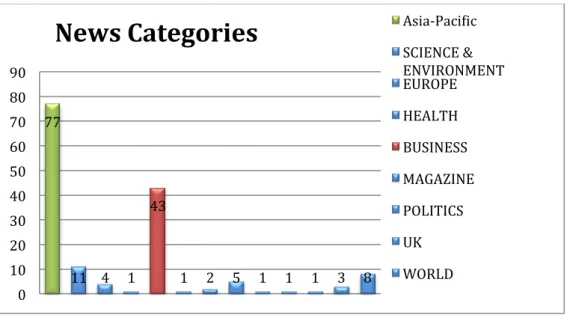
Before analyzing the news for the dominant frames, the news articles were placed according to the categories that they belong to. The figure below shows the categories of news that they were in when news articles were published by BBC online service. 56! 26! 16! 9! 14! 11! 7! 1! 4! 6! 0! 3! 5! 0! 10! 20! 30! 40! 50! 60! Number!of!news!articles! 2011! 2012!
Figure 2: News Categories
Most of the news articles were under the category of Asia-Pacific and Business. 77 news articles were in Asia-Pacific category and 43 were under the category of Business.
5.2 Research Findings and Discussions
This part presents findings to answer the following research question
• What are the most commonly used frame(s) in BBC Online News on Fukushima nuclear incident? If a particular frame is used dominantly, what would that imply on the mindset of BBC’s audiences?
77! 11! 4! 1! 43! 1! 2! 5! 1! 1! 1! 3! 8! 0! 10! 20! 30! 40! 50! 60! 70! 80! 90!
News(Categories((
Asia:PaciRic! SCIENCE!&! ENVIRONMENT! EUROPE! HEALTH! BUSINESS! MAGAZINE! POLITICS! UK! WORLD!Frames occurrence by months
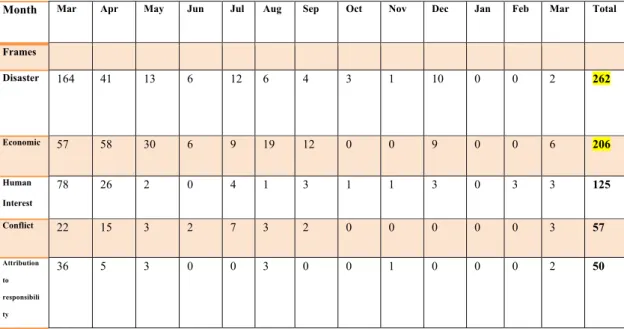
Month Mar Apr May Jun Jul Aug Sep Oct Nov Dec Jan Feb Mar Total Frames Disaster 164 41 13 6 12 6 4 3 1 10 0 0 2 262 Economic 57 58 30 6 9 19 12 0 0 9 0 0 6 206 Human Interest 78 26 2 0 4 1 3 1 1 3 0 3 3 125 Conflict 22 15 3 2 7 3 2 0 0 0 0 0 3 57 Attribution to responsibili ty 36 5 3 0 0 3 0 0 1 0 0 0 2 50
Table 1: Frames and its occurrences by months
From the table above, we can see that most of the news during the first month of disaster was in disaster frame however, Economic frame takes a lead from the second month. Despite that, lead disaster frame has bigger number in total.
Figure 3: 4 frames and percentage on each frame
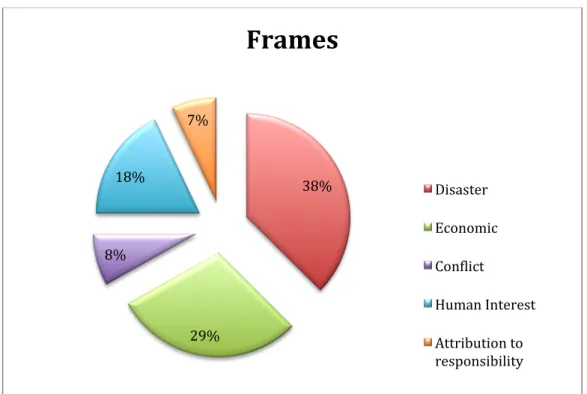
After analyzing all the articles and taking it as a whole, the pie chart above shows that more than 60% is covered by disaster and economic frame, which makes them the frequently used frames in BBC online. In other words, these two frames were dominant frames that were used by BBC online service when presenting audiences the news about the Fukushima nuclear crisis.
5.2.1 Dominant Frame(s)
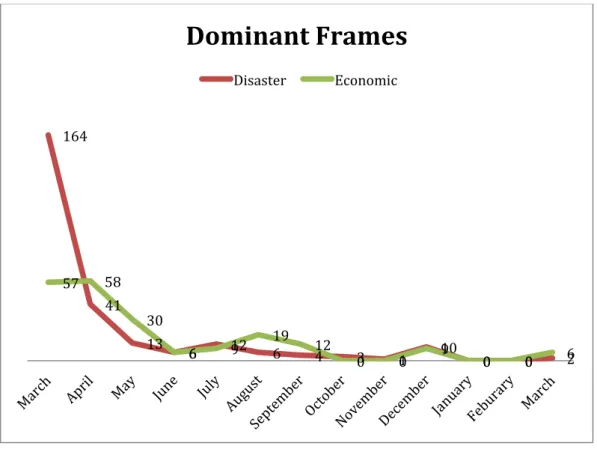
The pie chart above already answered the first question about the dominant frames. The disaster frame and economic frames seem to be more prominent and to understand them better, the researcher used the timeline graph below.
38%! 29%! 8%! 18%! 7%!
Frames(
Disaster! Economic! ConRlict! Human!Interest! Attribution!to! responsibility!Figure 4: Dominant frame timeline
During the first month of disaster, disaster frame has a huge win over other frames however from the month of April, the economic frame takes lead. There are fluctuations during the months of June and November but economic frames takes the lead during the other months. This is the reason why the researcher believes that there were two dominant frames that were used when presenting the Fukushima nuclear crisis by BBC online. These dominant frame implications will be discussed in the section below.
164! 41! 13! 6! 12! 6! 4! 3! 1! 10! 0! 0! 2! 57! 58! 30! 6! 9! 19! 12! 0! 0! 9! 0! 0! 6!
Dominant(Frames(
Disaster! Economic!5.2.2 Implications of dominant frames
The first part of the research question about the dominant frames is answered above however, to see the implications of these dominant frames we have to understand the ‘Agenda setting theory’. As agenda setting states that media does not tell people what to think but tell people what to think about (McCombs, Shaw, & Weaver, 1997, p. 161), media can force people to think about any dominant ideas that they mediate to people.
“Economics can inspire wars and revolutions, it is at the heart of most political struggles, and perhaps most fundamentally, it can play a central role in our understanding of what constitutes a good life. The way we shape our economy will, in turn, shape us” (Lewis, 2013, pp. 15-16). As Economy plays an important role in every political, social and individual life, it is definitely a vein of modern day life. However, authors like Walter Lippmann (1992), Carl Jung (2009), Edward Bernays (2004) and Harold Lasswell (2011) believe that the media encrypts this notion of economy as being important to our world. They have proposed various theories on how media does the encryption of capitalism to its audiences through subliminal8, agenda setting (see methodology chapter), encrypting hidden messages, visual rhetoric or through propaganda9.
!!!!!!!!!!!!!!!!!!!!!!!!!!!!!!!!!!!!!!!!!!!!!!!!!!!!!!!!
8!According to oxford dictionaries “perceived by or affecting someone’s mind without
their being aware of it.”
9 “A working definition of propaganda is the spreading of ideas, information, or rumor for
the purpose of helping or injuring an institution, a cause, or a person.” (Manzaria & Bruck, 2000)
Through this inception of ideas in the messages provided to the audiences by mass media, media exercises “dominant social norms and values that legitimize the social system” (Curran et al. 2005 p.9). Once an idea is mediated through the dominant media, those notions are supported by other institutions, elites, judiciary and schools, which leads to the establishment of new dominant practices. Lippmann (1992) argues that mass media is the tool that is used by elites to rule public without physical pressure. This dominating practice, when enforced upon citizen, becomes a part of daily life and is treated as the social and moral norms. (Curran et al. 2005 pp. 9-10).
“ ‘A newpaper’ ‘is not only collective propagandist and collective agitator; it is also a collective organizer’. Stalin called it ‘the most powerful weapon of our party’ ” (McLuhan, 1964, p. 287). This means that the newspaper media is not just manupulative and campaigner but is also a weapon to mediate the notions that government want the people to follow or believe. Government work with media when new dominant ideas are to be mediated to the public. Through the media, using influencial talks from elites, experts and high level government authorities, dominant ideas are emposed upon the media users. “Government control over broadcasting through ownership, regulation, and partial funding of public broadcasting service poses serious problem of government intrusion and damage to the public sphere” (Herman & McChesney, 1997, p. 5). This means that the !!!!!!!!!!!!!!!!!!!!!!!!!!!!!!!!!!!!!!!!!!!!!!!!!!!!!!!!!!!!!!!!!!!!!!!!!!!!!!!!!!!!!!!!!!!!!!!!!!!!!!!!!!!!!!!!!!!!!!!!!!!!!!!!!!!!!!!!!!!!!!!!!!!!!!!!
government is always behind, by hook or crook, they mediate ideologies in the society to force citizens to think the way they want them to. By doing this, the government can legitimize their ideology and force the society to function in the way they want.
In the case of BBC, disaster frame and the economic frame were dominant. Disaster frame was dominant during the first months however, the economic frame leads other frames after the first month. This could mean that BBC gives more importance to economic aspect of the society and wants to enforce capitalism on the newsreaders.
The initial mission of BBC to be an independent British broadcaster to educate, inform and entertain the whole nation, free from political interference and commercial pressure has also failed since, BBC is mediating capitalism. Economy is important for the society for various regions. If every single audience challenges this concept of capitalism then the global economy may collapse leading to the failure of the governments. For this reason and for sustainable economic growth influenced by the government directly or indirectly, BBC could be mediating capitalism to its audiences.
CHAPTER 6: Conclusion
This research was intended to find out the most commonly used frame(s) in BBC Online News on Fukushima nuclear incident and the implications of dominant frames on social constructs of the society. Through this research, it was found that there were two dominant frames that were commonly used by BBC online. Those two dominant frames (Disaster frame and Economic frame) also had impact on the economic construct of the society.
Researcher came to a conclusion that the news is important part of contemporary globalized information technology based world. There are various sources of news but very few dominate the world of news. These news agencies have their own priority and agendas. Unlike other online news services, BBC not just dominated radio and television but also the online news.
The media plays a vital role in crafting the society and also has a big impact on its audiences. Though this research, the researcher believes that BBC online tends to enforce capitalism to its viewers. Economy for BBC seems to be very important and the idea about capitalism is forced on its viewers through the framing of the news.
Framing of news is very important to provide information to the society. It helps the news providers and newsreaders comprehend news easily and understand the
situation of the world. This research has been successful in finding BBC framing patterns and also has been partially successful in seeing the impact on the newsreaders that the framing is able to create.
This study showed how the foreign news outlets perceive news and certain ideas are encrypted and enforced upon the audiences with the help of framing. The importance of framing and the whole idea of news agencies framing a particular event were presented in this research which helps readers understand the representation in coverage of distance regions, when natural and man-made disasters take place and also the consequences of journalistic practices in the coverage of foreign events through the ongoing framing process in the news outlets.
6.1 Limitation
Due to time constraints, Narratives were not discussed in this paper however, some elements of which have appeared in the analysis section. Similarly, domestication of news was not thoroughly discussed in this study and only some aspects were talked about. This paper only focuses on one particular online news agency therefore, it might create some sort of bias to the online service as a whole.