
立命館学術成果リポジトリ
24
0
0
全文
(2) 立命館言語文化研究 27 巻 4 号. needs to be looked at with wider perspectives and views. Laughter mirrors the essential human acts. Laugher exists in every corner of human activities from daily life to the political scene. In order to understand the phenomenon of laughter comprehensively, its role must be defined through various human, social, and natural science approaches. Henri Bergson s work, Le Rire( Laughter), is known as one of the most impor tant philosophical works in terms of the study of laughter. 3) Bergson points out the difficulty of this subject in philosophical reflection: The greatest thinkers, since Aristotle, have tackled this tiny problem which always eludes under effort, slips, escapes, and readdress es impertinent challenges to philosophical speculation (Bergson 1940, 1). The essence of laughter is too huge an issue for this single article, as its main focus will be to consider laughter as a lens to study the political transformation in African countries. Questions about laughter are related to quite diverse issues. What is laughter? How do we laugh? Who laughs? Why do we laugh? On whom, on what, do we laugh? Who raises laughter? With whom do we laugh? Where and when do we laugh? What are the individual and social functions of laughter and laughableness?(Smadja 2011, 32) Laughter exists as ridiculous and grotesque expressions with language and gesture in the form of rhetoric, derision, irony, farce, satire, and comedy and is recognized across the majors of science, such as psychology, aesthetics, history of literature, sociology, and philosophy(Noguez 2011, 155). In major dictionaries, the concept of laughter is defined as below: Make the spontaneous sounds and movements of the face and body that are the instinctive expressions of lively amusement and sometimes also of derision.(Oxford Dictionaries)4) To express amusement, mirth, pleasure, happiness, and sometimes disrespect or nervousness with a sound or sounds ranging from a loud burst to a series of quiet chuckles.(Webster s dictionary of American English) To express jovial feeling by a movement of the lips and mouth accompanied by rapidly shelled sounds.(Petit Larousse) Vocal and facial expressions that show feelings of pleasure and funniness.(Kojien Japanese dictionary) These definitions show a common characteristic of laughter as perceived or obser ved by − 134 −.
(3) Laughter in Political Transformation in Africa(IWATA). another person through the changing character of the face and voice. According to Bergson, laughter is a specifically human act: There is no comic outside of what is truly human (Bergson 1940, 2). According to French psychiatrist Smadja, Laughter will be prescribed, authorized or prohibited according to the subject, socio-cultural context, purpose of the laughable message, intention, and the emitter(according to age, sex, and social status)(Smadja 2011, 119). A discussion of laughter must focus on its social role, as laughter holds social meanings (Bergson 1940, 6). A character of laughter is transformed according to society, groups, and time. 5) Pleasure is a simple expression. Laughter is an expression of double or contradictory sentiment (Baudelaire 1855, 25). Smadja categorizes laughter as acts in society as below: Expression of individual happiness and psychic security engendered by the social cohesion of the group; Symbolic sanction of deviations and eccentricities constituting a very efficient mode of social control of custom; Mode of avoidance of negative sanction and punishment by the inhibition of aggression of others; Instrument of politeness; Instrument of defense against anxiety; Instrument of social exclusion; Instrument of seduction and emotional quest.(Smadja 2011, 119-120) Bergson describes laughter as a silly action made by unnaturalness : Automatism, stiffness, and lines, that s where a face makes us laugh.(Bergson 1940, 19) In human history, people have lived with laughter and fears. Baudelaire describes the sage person s fear to laugh. So, they laugh while trembling with fear (Baudelaire 1855, 8-9); Laughter is closely tied to physical and moral deterioration(Baudelaire 1855, 11); Laughter comes from the satanic idea of their own superior feeling (Baudelaire 1855, 16). The universal characteristics, factors, and conditions that make laughter are not easy to identify. However, we laugh when we gain some psychological comfort in situations such as a satisfaction of desire, an unexpected pleasant meeting, liberation from a tense situation, an established social custom, and a feeling of superiority. The feeling of superiority seems to be a crucial factor in terms of laughter in political analysis. Superior feeling has been often produced in the political process, whether intentionally or unintentionally. This paper focuses on this key element to understanding laugher in African politics. − 135 −.
(4) 立命館言語文化研究 27 巻 4 号. 2.2 Political meanings of laughter As mentioned above, Charles Baudelaire, French drama writer, argued that the feeling of superiority brings laughter(Baudelaire 1855, 16 and 20). Laughter is much correlated to politics; politics is a human act that induces laughter. The feeling of superiority sometimes can make an individual or group feel comfortable when they look down on others. If politics appears to be a game in pursuit of superiority, then laughter appears to be a tool or by-product of political engagements. Smadja points out the targets of laughter as follows: Foreigner(s)to the group of laughers, Deviant or eccentric in a group, Political power, social order and all established authorities, all institutions, Sexuality, Language.(Smadja 2011, 120-121) He also defines Plato s view of laughter: For Plato, laughter is a pleasure which can be engendered by the perception of ridicule in others. Laughter is mockery, legitimate against the enemy and unfair to our friends (Smadja 2011, 13). Hobbes s Leviathan sets up an argument on laughter and superiority: Sudden glory, is the passion which makes those grimaces called laughter; and is caused either by some sudden act of their own, that pleases them; or by the apprehension of some deformed thing in another, by comparison whereof they suddenly applaud themselves. And it is incident most to them that are conscious of the fewest abilities in themselves; who are forced to keep themselves in their favor, by observing the imperfections of other men. And therefore much Laughter at the defects of others, is a sign of Pusillanimity. For of great minds, one of the proper works is, to help and free others from scorn; and compare themselves only with the most able.(Hobbes 2012, 88) Derisive and serious laughter damages others much more than anger in a sense that laughter might bring symbolic death(Peker 2011, 75-76). Laughter can be observed in the play for symbolic power in Bourdieu s sense(Bourdieu 2001, 281-283 and 286-287)and should be an important subject in political studies. Bergson writes, First of all, laughter is a correction. You laugh to humiliate. It must give a − 136 −.
(5) Laughter in Political Transformation in Africa(IWATA). painful impression to the targeted person. Society revenges by laughter (Bergson 1940, 150). Gauvard agrees that laughter is used as a measure of sanction and pacification in a derisive way (Gauvard 2011, 90). In addition, he says laughter can be used to attack an opponent s honor (Gauvard 2011, 92-93), and if dignity is damaged by derisive laughter, it should be recovered through the revenge of derisive laughter(Gauvard 2011, 94). The laughter of the masses might threaten state order(Gauvard 2011, 97-98 and 104). Also used some contrast effects such as burlesque, parody, and the language of sexuality (strongly devaluing). This set of transformations of the object or practice of derision translates not only into cognitive effects such as surprise, nonsense, incongruity, but also to its net devaluation or symbolic aggression, as well as its social maladjustment. Thus, humans can be mechanized,. objectified,. animalized, and animals become humanized objects, the. infantalized adults and children metamorphosed into adults, male or female transvestites by the inversion process. Ontological or social class change is a major generator of laughter. (Smadja 2011, 121) Laughter is always an expression of emotion. Schaeffer lists the types of emotions related to laughter, such as joy, affection, amusement, good humor, surprise, nervousness, sadness, fear, shame, aggression, victory, taunt, and schadenfreude(Schaeffer 2011, 25-26). John Morreall shows three traditional theories on laughter: the superiority theor y, relief theory, and incongruity theory(Morreall 1987, 5). The superiority theory has been discussed above. In the relief theor y, laughter is made as a release from a stressful situation. In the incongruity theory, the gap between what is expected and what actually happens creates laughter (Morreall 1987, 6). Morreall points out that the theories cannot be recognized as a comprehensive explanation of all phenomena on the issue of laughter. However, each theory explains an important part of laughter(Morreall 1987, 129-133). There is a common process in the three theories examined by Morreall: laughter results in psychological comfort in the social and political contexts. People have been conscious of laughter in religious practice. On the one hand, God, Moses, and Christ never laugh. In Judeo-Christian tradition, laughter is the characteristic of humans and Satan(Steiner 2011, 11). Christ argued on laughter: Alas for you who have plenty to eat now: you shall go hungry. Alas for you who are laughing now: you shall mourn and weep (New Testament Luke 6, 25) . On the other hand, the gods of Olympus laugh. These Gods humorously laugh before smallness, absurdity, suffering, and human illusion(Steiner 2011, 12). In the French language, there is an expression yellow laughter (Rire jaune), which is used to cover fear and disappointment(Steiner 2011, 18). Although it is impossible to examine the idea of laughter in all religions, a trend seems to emerge. On the one hand, monotheistic gods do not laugh. On the other hand, gods in polytheism − 137 −.
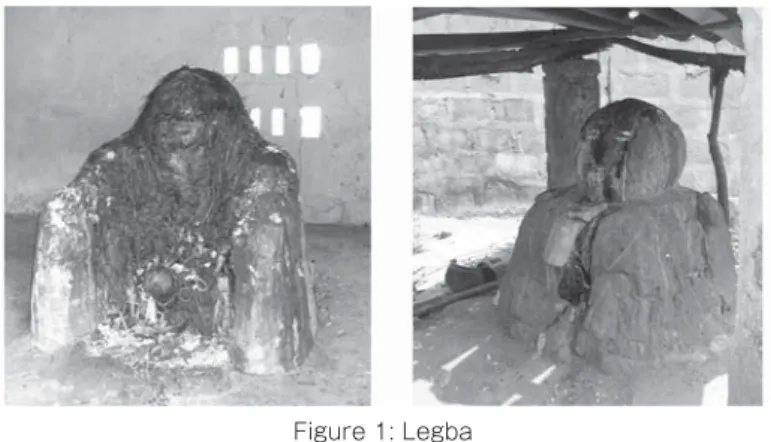
(6) 立命館言語文化研究 27 巻 4 号. are more likely to laugh. Laughter does not only contain a positive sense, but also a negative(cynical)sense. It depends on social, cultural, and temporal contexts. Laughter is found in the game of symbolic struggle, or in a zero-sum game. The act of laughter is produced through communication(s) with other actors. We might recognize that there is laughter where politics is taking place.. 3. Laughter in African Politics This article principally focuses on the superiority theory to understand laughter in African politics. One principle of laughter can be seen as a brief inversion of a power relationship caused by the sudden loss of authority. According to Bourdieu s idea, a radical transfer or reduction of symbolic capital damages symbolic power that had mentally suppressed people s freedom for long time(Bourdieu 2001). A research approach, politics from below (le politique par le bas)has tackled the issue of symbolic struggles or escape, in which people in a weak position have politically survived in their daily life. The politics from below approach had attracted much attention in African political studies in France in the 1980s. This approach focused on the political thing (le politique)that has been repeated in daily activities as politically nuanced tactics or hints. This approach provides a perspective to describe the political involvement of a marginalized people that cannot be observed from the institutional angle(Iwata 2006, 172) . Politics from below can be described as political resistance brought from oppressed people and groups against the state and dominant elite. However, it is not necessarily the approach to fight directly against authoritarian state power, but to escape physically and psychologically from it. Politics from below does not necessarily carry out the justice or anti-state movement, but provides oppressed people with political sur vival tactics. In other words, this is one of the political engagements from outside political society. Politics from below is not only political tactics or behaviors conducted outside the principal political process through election, political party, or interest group, but also a research approach to understand these less formal political activities. 6)In general, jokes relating to politics is just a diversion in daily life rather than the intentional protest against political authority(Herzog 2013, 13). Okazaki points out that the act of laughter does not necessarily mean resistance against state power. Laughter experts, such as clowns, laugh for fun altogether rather than intentionally to criticize the person in power. In fact, it also makes persons in power laugh together(Okazaki 2003, 98). Although some signs of resistance in symbolic struggle might be found, vectors of movements are not collected toward a unique direction, but are conducted in an escape option. Legba in vodun(voodoo)7) practice in the Guinea gulf countries, such as Togo, Benin, and Nigeria, is an example of laughter in traditional custom. Legba represents the holy spirit in vodun practice. Legba might be recognized as a trickster. Although Legba is the protector of the home − 138 −.
(7) Laughter in Political Transformation in Africa(IWATA). and the messenger of the gods, it makes mischief. In vodun practice, the trickster works as an interlocutor between the gods and humans while existing at the border point to another world, such as a door or crossroad. The trickster is a little devil, an impostor in folklore(Ogawa 1985, 9).. Figure 1: Legba Source : Monde Blog(Radio France Internationale)8). Legba usually is described as a troublemaker. Legba does not only create confusion in the human world, but also makes laughter(Smadja 2011, 143). People materialize Legba as a lump of earth at the entrance of a village, house, and market. Legba is powerful enough to enable someone to escape from their death, even deceiving god. However, it can bring all kinds of disasters to humans when it feels bad. 9)Because of its power, people sacrifice to Legba to request their desires (Tanaka 2009, 44-45). Here, the argument turns to the relationship between entertainment and African politics. There are diverse genres in comedy, or laughter as an entertainment, such as one-man theater, pantomime, magic show, stand-up comedy, imitation, and more. Although the entertainment industry remains in the early stage in African countries, comedy entertainment is expected to grow rapidly in the near future10). Still, as in other developing countries, comedians have difficulty earning money in African countries; therefore, very few African comedians can earn only through entertainment activities. They need to earn money from other jobs. In addition, comedians have suffered from product piracy because copyright of media contents is not protected in African countries as it is in the Western world. If African comedians want to live mainly with their enter tainment per formances, they are obligated to play abroad.11) As a result, much of the country s laughter entertainment crosses the borders inside and outside Africa. Radio France International(RFI)broadcasting presents a chronicle gossip program(Chronique de Mamane, around three minutes)called Ver y Ver y Democratic Republic of Gondwana 12) (République Très Très Démocratique du Gondwana) broadcasted by Mamane, a stand-up. comedian from Niger. He grew up in Côte d Ivoire and Cameroon, apart from Niger, and then came to France to seek a doctorate in vegetal ecology at the University of Montpellier. After he completed his doctorate, he became an illegal immigrant(sans papier)because he could not get a job and − 139 −.
(8) 立命館言語文化研究 27 巻 4 号. working permits. He met Frédéric Leclerc, a theater director, and started his career as an actor and comedian. In 2002, he started his own performance series One Mamane Show. He has played in many theater groups and TV programs. He became a famous comedian after he star ted his program on RFI.13) Mamane s satirical program discussed political episodes in a fictitious African country, the Democratic Republic of Gondwana. The show became more popular year after year. RFI s broadcasts are listened to in many countries, especially in French-speaking African countries. Eventually, this program was taken off the air, but the Republic of Gondwana appeared on stage and as a TV show as a short comedy featuring famous African comedians, such as Kader Nemer, Michel Gohou,14)Adama Dahico, and Digbeu Cravate.. Figure 2: Poster for the Festival of Laughter in Democratic Republic of Congo Source: Facebook page of Festival du. 15). Primary cast members of the Gondwana Republic have been touring French-speaking African countries. In their performance on radio and stage, they do not criticize directly by name the heads of state and influential politicians. However, listeners especially living in African countries can easily figure out which African leaders are being laughed off. Members of the Gondwana Republic caricature political leaders and authoritarian governments, responsible persons who have brought huge difficulties and tragedies to the daily life of the African people. Beyond short radio programs, the Gondwana Republic became an entertainment performance group playing comedy-theater outside France,16)but remained in French-speaking countries. Laughter is principally elicited through language. As Bergson writes, Comedy is untranslatable from one language to another (Bergson 1940, 5). The language barrier strongly affects the international activities of African comedy.17) Mamane is known as the foremost African comedian for social and political commentary who has used laughter and a sense of humor to criticize contemporary issues such as globalization, immigration policy, international politics, hypocrisies, African politics, and daily problems.18) − 140 −.
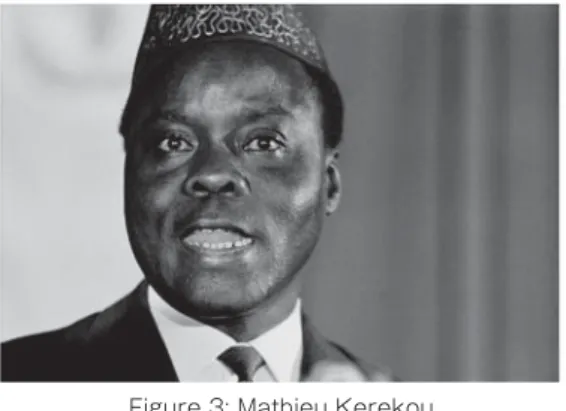
(9) Laughter in Political Transformation in Africa(IWATA). Although African leaders try to make people less sensitive on politics, laughter makes people aware of politically produced problems.19). 4. Laughter during a period of political transformation This section will study political change through laughter in post-colonial histor y through examining case studies on Benin, Togo, and Burkina Faso. Benin is recognized as a successful case of democratization since 1990s, while Togo is recognized as an unsuccessful case. These two cases are contrasted in terms of consequence of democratization. The last case of Burkina Faso is different from the first two. After 27 years of an authoritarian regime led by Blaise Compaore since 1987, he unexpectedly stepped down from power after the insurgency brought by massive popular protests against his attempt at constitutional change to remove the limitation of presidential terms in order to carry out his presidency for life. In the late 1980s, people s dissatisfaction kept increasing due to serious economic recession and bad governance in African countries. The protest movement changed its character from economic requirement to political reform, or in other words, democratization reform. State functions were paralyzed in a storm of strong protest.. 4.1 Benin The French colony of Dahomey achieved its independence as the Republic of Dahomey in 1960. Dahomey had once shown the unstable politics typical of postcolonial African countries. In its first 12 years of independence, Dahomey suffered from political instability through six regime turnovers by military coups and repeated unsuccessful coup attempts. Mathieu Kerekou gained power by coup in 1972, converted his country into a revolutionary regime while adopting MarxismLeninism as the national doctrine in 1974, and denominated the People s Republic of Benin in 1975 in order to attract suppor t from the Soviet Union and Eastern countries. General Kerekou established an authoritarian revolutionary regime under a one-party system led by Parti de la Révolutionnaire Populaire du Bénin(Popular Revolutionary Party of Benin), founded by himself and strictly limiting freedom of expression and association in Beninese society. President Kerekou and President Eyadema of Togo experienced similar circumstances. They both gained power through military coup d état and were from less-developed hinterland regions of their countries. They were from the same generation, born in the early 1930s. However, Kerekou behaved differently in contrast to Eyadema. Eyadema mobilized national treasures to develop his own region in Togo and moved money to his secret bank accounts in European countries. Kerekou did not privilege his region to develop in Benin. As his nickname Chameleon suggests, Kerekou s personality has been mysteriously kept vague(Iroko 2001, 12 and 25). In general, national political leaders try to impress their strongest image on the people in order to dominate them mentally, as well as physically. However, Kerekou s style was different. He − 141 −.
(10) 立命館言語文化研究 27 巻 4 号. kept his image vague as the national leader to let people fear him. Kerekou s property abroad has been rarely reported even after the end of his presidential term. Kerekou did not want power to become super-rich; he loved power for power s sake(Chabi 2013, 40-41).. Figure 3: Mathieu Kerekou Source: Foundation Mathieu Kerekou Facebook20). A national leader who wants to preserve a strong image is unwilling to be material for laughter. On the one hand, President Eyadema has not appeared as a laughter maker. On the other hand, President Kerekou often has appeared as a complicated laughter producer. Kerekou damaged the symbolic capitals of his opponents through his cynical laughter, but his laughter attacks have been addressed to his supporters as well as his opponents. For example: Women s revolutionary section: Mr. President, all revolutionary women of Benin are standing behind you. President Kerekou: I thank you for your renewed trust. You are certainly behind me and will push us into a hole. (Chabi 2013, 101) Furthermore, his ironic laughter has been directed even at himself. Kerekou answered a foreign journalist s question about the suppressive political situation in Benin: Dear Mr. Journalist, I think you misread our constitution of the democratic and popular state of Benin. Nowhere does the Constitution say that the President of Benin is popular. (Chabi 2013, 61) However, this socialist regime failed economically and fiscally after over-distributing financial appeasement to the people and bringing the bloated central government to recruit unnecessarily public officers due to political considerations. Facing financial bankruptcy, the government could no longer pay the salar y of public of ficers. People s dissatisfaction kept increasing. In such − 142 −.
(11) Laughter in Political Transformation in Africa(IWATA). economic failure, the Beninese people spoke of Laxisisme-Béninisme(overindulgence, spelling in French)instead of Marxisme-Leninism(Banégas 2003, 52). Kerekou s regime had kept a close relationship with Eastern countries. The United Kingdom was the symbol of imperialism and colonialism to be defeated. One day, the national newspaper, EHUZU(meaning change in the Fon language), published the headline Massage du Président Kérékou à la Reine d Angleterre ( Massage of President Kerekou to the Queen of the United Kingdom )instead of message. This mistake flustered Kerekou s regime(Chabi 2013, 48)but served as a diversion among the Beninese people, making laughter. In postcolonial Benin, its first 30 years were dominated by suppression through a military and pseudo-revolutionary regime. In the 20 years since the 1990s, Benin has advanced, in a zigzag way, while receiving a positive reputation as the model of democracy in Africa. In the late 1980s, protest movements continued to increase calling for the democratization in Benin. In 1990, President Kerekou had finally accepted the organization of a National Conference (Conférence nationale des forces vives de la nation),21) which was held to offer a national dialogue forum partially transferring the sovereign power from the presidency to the transitional institution. The transitional government set up by the National Conference worked for democratic transition and national reconciliation while changing the political system, including the constitution, in order to set up the coming presidential and legislative election. The election was held as the final step of the democratic transition. In 1991, Nicéphore Soglo, the prime minister of the transitional government, was elected, defeating incumbent President Kerekou at the second round of the presidential election. The Kerekou administration was over through a peacefully organized election after 18 years of a(wouldbe)revolutionary regime that had brought economic bankruptcy. It was the first peaceful regime turnover through election since Benin s independence. However, in 1996, at a second election after democratic transition, Kerekou s victory surprised the world when he defeated Soglo. It was the second peaceful turnover in Benin. In 2006, Benin had its third peaceful turnover, electing Boni Yayi. In Benin, peaceful turnover through election became a more ordinary phenomenon. Since the democratization process started in 1990, Benin has held five Presidential elections and six legislative elections and has had three peaceful regime turnovers without violent suspension of democratization by militar y coup, despite the wavering political developments through some political crises. The successful elections show significant improvement in electoral organization. Their constitution, which was − 143 −. Figure 4: Parody calendar sold during the presidential election campaign in 2006 Source: Bought in Benin by the author (March 2006, in Porto-Novo).
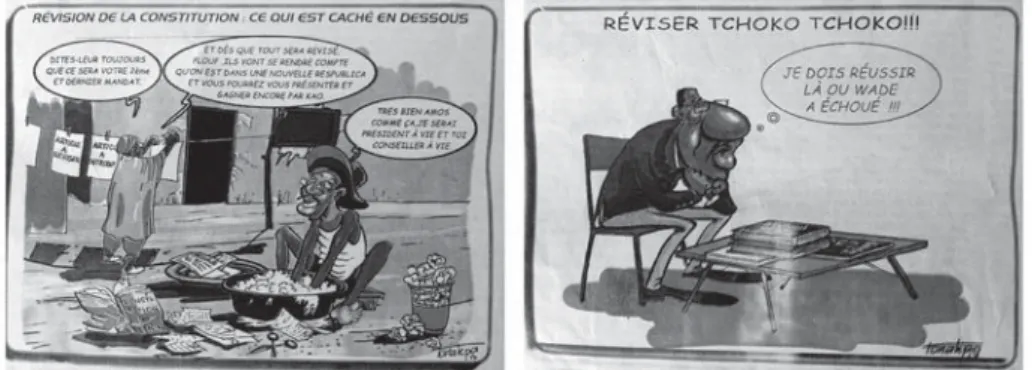
(12) 立命館言語文化研究 27 巻 4 号. stipulated during the transition period in 1990, has been respected by all political forces. The value of democracy has been shared among the people year after year. That is why Benin is still appreciated as the model of democracy in Africa. The calendar pictured above was sold at a newspaper kiosk during the presidential electoral campaign held in 2006. The faces of two presidents after democratization started and principal candidates were collaged onto manual worker s bodies. This calendar created laughter while bringing a satirical message that politicians have been immersed in political games without working seriously for the people. President Kerekou is the sole African leader who peacefully stepped down twice from the presidency. After Kerekou left power in 1991, he learned from his experience to seek pragmatic politics rather than ideological politics. When he returned to power through the election in 1996, donor countries had started to require African countries to practice good governance instead of democratization as a conditionality of foreign aid. President Kerekou gave his speech to the Beninese nation on this fight against corruption that the international community required African countries If you are ready, we are ready (quoted in Chabi 2013, 154). Kerekou spoke ironically. He was confident that the Beninese people were not able to achieve national consensus on a fight against corruption, and that the people would act to satisfy their own personal interests before public interest. Although Benin has dramatically carried out the democratic transition since the organization of its National Conference, the democratization process could not escape from political mannerism during two decades of trials. Democratization did not necessarily bring significant improvement to people s lives as they had expected earlier. People became less interested in the democratization in Benin. As the memory of the National Conference has faded away, even in conference-organizing African countries(e.g., Mali, Niger, Togo, etc.), African leaders are likely to challenge the rule of law. Some African leaders planned to modify their constitutions that were adopted during the democratic transition period through referendums. In general, the constitutions of African. Figure 5: Satirical cartoons on the president s maneuvering constitutional changes Source:. (August 5-6, 2013, Benin). − 144 −.
(13) Laughter in Political Transformation in Africa(IWATA). countries limited the term of the presidency. Many African countries adopted a limit of two terms (five years in a term). These constitutions do not allow heads of state a third term. After ten years of the start of democratization, some presidents have changed their constitutions in suspicious processes to enable current leaders to become, in effect, presidents for life after removing the article stipulating the limitation of presidential terms. Even in Benin, which has kept its positive reputation as the African model of democracy, it is not easy for leaders to reject the temptation of presidency for life. In the last years of the Yayi administration, his constitutional challenge became the political issue. After President Kerekou stepped down from power, eventually respecting the constitution at the end of his second term, Boni Yayi was elected in 2006 in the people s hope that his experience as a banker and his clean image coming from outside of political society. He was re-elected in 2011. After his last term started, he showed his ambition to change the Constitution and was immediately accused by the opposing party and media.22) In Benin, while political developments have been wavering, freedom of expression has been relatively ensured. Under such a political situation, the characteristic of laughter has transformed while mirroring political and social reality and change.. 4.2 Togo Togo achieved its independence in 1960. The first president, Sylvanus Olympio, was assassinated in 1963 by veteran soldiers of French colonial troops led by Etienne Eyadema(later Gnassingbe Eyadema). General Eyadema dominated Togolese politics for almost four decades (1967-2005) . After Eyadema s death from cancer in 2005, Faure Gnassingbe, his son, succeeded to the presidency in a very dubious process.23) Eyadema s authoritarian regime maintained power despite several attempts at coup d état and assassination by his opponents, and democratic transition. Finally, his power was transferred to his son after his death24). In the long authoritarian regime, it became difficult to protest directly against the regime. Even under such an oppressive political system, the meaning of laughter in the society becomes more important and becomes expressed in a more indirect or metaphoric fashion. In Togo, the rituals of personal worship of General Eyadema have been repeatedly held, while this regime has suppressed opponents. In the 1970s, Eyadema imported the authenticité and animation25) from Mobutu s Zaire(Mobutu Sese Seko Kuku Ngbendu wa za Banga)and invited experts of mass games from North Korea. Animation is a performance composed of songs and dances led by the government in order to applaud the national leader. The daily animation practices produce a laughter that is made and forced by the regime. On the one hand, the Eyadema administration kept its dominant influence through military and economic power. On the other hand, this regime made every effort to establish a symbolic base of power to keep mental domination over the Togolese people. Although people seemingly admired General Eyadema, they started to be dissatisfied that the head of state holds all the − 145 −.
(14) 立命館言語文化研究 27 巻 4 号. country s resources in his hands. The above picture book was published and distributed to elementar y schools in order to celebrate the tenth anniversar y of Eyadema s regime and to legitimize his power while mythicizing his personality(Toulabor 1986, 32). The Publication of this book aimed to impress Eyadema s glorious image on students and identify Togolese postcolonial histor y with Eyadema s p e r s o n a l h i s t o r y. H o w e v e r, t h e T o g o l e s e government withdrew all copies at a later time due to the description of the assassination of President Olympio by Eyadema, which presents a bloody. Figure 6: Biographical manga on GeneralPresident Eyadema Source :. image of the father of the nation.. (1976). The acts relating to politics from below in Togo have not directly attacked Eyadema s regime, but gradually have eroded his symbolic capital(in Bourdieu s sense), which had been established through derision and laughter. The Togolese people have laughed at the regime under the gesture of applause with a rhetoric of words. Although these indirect political acts of the masses could not threaten directly Eyadema s regime, they raised questions about the regime in a critical way. During such behaviors from below, derisive expression was set up among people through onomatopoeia and sound effects to create derisive expressions, making him a sexual monster, an animalized being, and feces(Toulabor 1992, 109-114). For example, they give another meaning to the tsala applauding Eyadema in order to emphasize his sexual greed(Toulabor 1992, 115-116). His name Gnassingbé was deformed to Big Monkey (Grand Singe)in the French language in order to mock him(Toulabor 1992, 122-123). His political party, Rassamblement du Peuple Togolais(Rally of Togolese People, RPT),26)in power since 1969, was pronounced Air pété(Smell of gas)(Toulabor 1992, 125). In addition, other derisive expressions were made and spread in people s daily life. The process of democratization was different between Benin and Togo. Democratic transition started with a National Conference in both countries. In Benin, the National Conference agreed to the immunity of President Kerekou for incidents that happened in his 17-year presidency. Therefore, Kerekou could accept decisions of the National Conference even after his resistances and hesitations. In contrast, the Togolese National Conference became the place to accuse Eyadema s regime and attempt to deprive Eyadema and key players in the regime of their property. Such an ungenerous democratization process in Togo affected the politics from below among people. Before the National Conference was held in Togo, activities of the politics from below were conducted invisibly in public places. While democratic transition was going on, such discourses − 146 −.
(15) Laughter in Political Transformation in Africa(IWATA). became radically visible to blame publicly Eyadema and his regime with br utally derisive expressions, even through mass media. It escalated the anger and hate among the people. Such social circumstances made reconciliation difficult for the Togolese people. This brutalization of politics from below made people remember conflicting relationships between the northern and southern regions created during the colonial period. Finally, the Togolese transition was suspended by President Eyadema, who profited from division among opposing parties. In Togo, the democratization process was emasculated and could not carry out significant change in the political framework. After democratization failed, the Togolese people seemed to live in fatalism(Iwata 2002, 18). Togolese people only began to wait for Eyadema s death. People mocked President Eyadema underground while caricaturing his nickname, Baobab, whose character was to root broadly and deeply into the soil(Iwata 2003, 60-61) . However, after 40 years of Eyadema s rule, people only witnessed power succession from father to son after his death. In such political stagnation, the liberalization of laughter has not been seen in Togolese society.. 4.3 Burkina Faso Son Excellence(His Excellency)Gérard Ouedraogo, a famous comedian(humoriste in French)in Burkina Faso, is known for his impersonations(imitation)of President Blaise Compaore, who led Burkina Faso for 27 years since 1987 and was ousted in October 2014. Compaore has been recognized as one of the longest and the strongest African leaders in recent years. He gained power by military coup d état while killing then-President Thomas Sankara, his closest comrade in the revolutionary regime from 1983 to 1987. His regime has been considered stable under authoritarian rule, although human rights abuses and assassinations of opponents and journalists have been reported repeatedly. However, after 27 years, his regime was easily ended through the huge demonstrations against the modification of the constitution which aimed to remove an article limiting the presidential term to ten years(two terms, five years each).27) This time, his attempt to violate the constitution faced severe protests, even from inside his regime. Compaore s closest collaborators abandoned him and created a new opposition party.28) Before this secession, Compaore s influence had been damaged by a riot incident caused by the presidential guard unit(Regimen Special Présidentiel, or RSP)in 2011. The presidential guard had been the elite military unit in the Burkinabe army and the power base of Compaore. Under such tense situations in October 2014, National Assembly members tried forcing the adoption of a proposition to organize constitutional change. These parliamentarians were primarily members of Compaore s party(Congrès pour la démocratie et le progress, or CDP). On October 30, 2014, the day of the National Assembly vote, a protest against the constitutional violation was radicalized. Hundreds of thousands of demonstrators joined in the protests in the capital city, Ouagadougou, and other big cities. Demonstrators started attacking and setting fire to state institutions, such as the National TV broadcast office, and houses of members of parliament and − 147 −.
(16) 立命館言語文化研究 27 巻 4 号. dignities of the Compaore regime, including the National Assembly building itself. However, this demonstrators riot kept its moral focus while selectively attacking symbolic places deeply related to the Compaore regime and avoiding gang acts against ordinary shops. These selective attacks minimized the damage in ordinary people s daily life. Despite the security forces intervention, state authority could not stop this demonstration. President Compaore announced that he had given up the constitutional modification and announced his retirement at the end of his last term programmed in the end of 2015. His speech was broadcast from a private TV station because the National TV station had been occupied by demonstrators. However, this speech was not able to appease the demonstrators, but made them accelerate their actions. Demonstrators began to require the immediate resignation of President Compaore. Finally, the betrayal of a higher presidential guard member triggered the end of the regime after 27 years of authoritarianism. Isaac Zida, second in command of the presidential guard (RSP),29)announced the resignation of President Compaore on TV. President Compaore signed his resignation document and escaped to Côte d Ivoire escorted by French special forces. After this insurgency, Zida took power temporarily and appointed Michel Kafando, former Ambassador to the United Nations, as interim President of the Republic. Then Zida formed the transitional government and appointed himself as prime minister. This transition government aims to carry out reforms after the Compaore regime and hold presidential and legislative elections, scheduled for October 2015. How did this unexpected radical political transformation affect the character of laughter in Burkina Faso? It is quite natural that African comedians prefer to choose a motif of a powerful man like a military leader or president, because everybody knows them and has suffered from them in their country. It enables people to laugh across the country.. Figure 7: His Excellency Mr. Ouedraogo Source:. Gerard Ouedraogo Facebook page30). However, comedians must be very careful to protect themselves when focusing their material on political leaders because freedom of expression has been much limited in many African − 148 −.
(17) Laughter in Political Transformation in Africa(IWATA). countries. When comedians choose a politician as their material of enter tainment, they run the risk of being charged with defamation by state authority. The situation of laughter in a countr y is a barometer of freedom of expression. One exception under Compaore s regime was the country s acceptance of film. Burkina Faso has hosted the Festival Panafricain du Cinéma de Ouagadougou(PanA f r i c a n F e s t i v a l o f C i n e m a , o r F E S P A C O)i n Ouagadougou. President Compaore had to show his. Figure 8: His Excellency Ouedraogo and the author. understanding and tolerance of ar t, unless these. Photographed on August 20, 2014, in. performances directly accused and attacked his regime.. Ouagadougou. In an inter view with me in August 2014, His Excellency Ouedraogo carefully detailed his imitation performance of personalities in power including the President of the Republic. The most important point in his performance is that his imitation should be laughable to the persons who are being imitated. He also tries to let all people attending laugh and not to make any specific person feel bad. Despite very careful preparation, he worried about his first imitation performances of President Compaore. He strongly limits himself not to produce easy laughter that brutally damages someone s dignity through derisive expression. He also takes indispensable measures to protect himself. He tries to show his respect to the imitated person and never chooses socially and physically weak persons as his material of inducing laughter.31) I met His Excellency Ouedraogo again three months after the insurgency of October 2014.32) Before this meeting, when I would watch news reports of the insurgency, I worried about him and whether this brutal political turnover would bring dif ficult situations to him. In the protest movement against President Compaore, he might have been thought as a collaborator of the ancient regime, because he was known as an imitator of President Compaore. Fortunately, my concerns were unfounded. He has tried ver y carefully to keep a distance from the Compaore regime. In conclusion, his moral policy as a comedian has protected himself. In the end of Januar y 2015, he showed a new imitation per formance of the now former President Compaore on the street in Ouagadougou: Former President Compaore(imitated by His Excellency Ouedraogo): [After I left Burkina Faso, I stay in Côte d Ivoire.] I do not feel better, because I have to eat Attiéké 33)every day. According to Ouedraogo, this per formance made audiences explode with laughter. He continues performing imitations of the former president with some new arrangements. − 149 −.
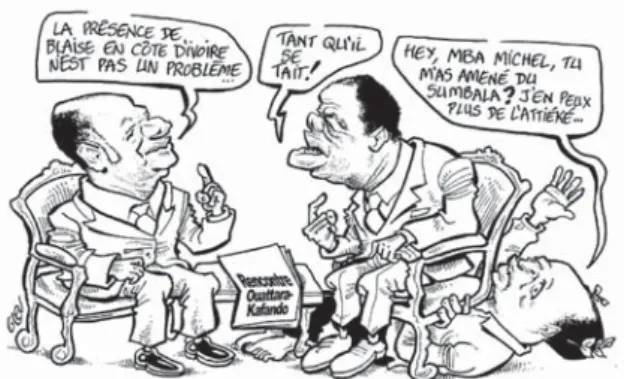
(18) 立命館言語文化研究 27 巻 4 号. Figure 9: Satirical cartoon on the life of former President Compaore after the insurgency , No.1246(August 6-12, 2015)34). Source :. During this inter view, Ouedraogo said he would never have predicted the end of the Compaore regime in such an easy way. Even after the end of the Compaore regime, he tries to keep a healthy distance from political parties not to be recuperated by a specific political force. He prefers being with the people to persons in power.. 5. Conclusion This article reflected on the political transformation in Africa focusing on the concept of laughter. Laughter is too broad and deep a subject. Therefore, it was quite difficult to achieve an adequate understanding on the essential meaning and mechanism of laughter in African politics. Despite limited reflections in this paper, it is significant that politics and laughter have kept close relation in African countries. This paper obser ved political transitions from one-party or militar y regimes to multi-party regimes. In these drastic political changes, characteristics of laughter were af fected significantly. Laughter has an impor tant meaning in the political transformation in African countries. Democratization brought liberalization of laughter in African countries. Failure of democratization gave laughter a more fatalist character. The paper examined perspectives on laughter to understand African politics. This approach focuses on the nonmaterial element more deeply, which builds, affects, and damages political power, outside professional political society or journalism. Politics from below was a noteworthy approach in terms of research on laughter. However, there are big challenges ahead for studying laughter in African politics. First, there is a shortage of research materials. Text-based and audio-visual materials related to laughter have not been sufficiently conserved in African countries. This makes it difficult to compare a current situation of laughter with the past. In addition to a material shortage, challenges exist in terms of the analytical approach and how we can examine the political transformation from the phenomenon of laughter. In addition, the characters of laughter, language barriers, and ethical issues must be taken into consideration. − 150 −.
(19) Laughter in Political Transformation in Africa(IWATA). Reflections conducted in this article are still introductor y trials to understand laughter in African politics. Although it might be a quixotic trial to understand it comprehensively, this subject always keeps attracting us to consider political behavior in Africa. Laughter is a mirror that reflects a social and political situation. However, this mirror reflects images much differently within different times, cultures, political positions, and other elements. It is like a kaleidoscope. Therefore, laughter is quite a rich research subject; but it is also quite difficult to achieve a common understanding of it.. Notes 1)This paper was completed after the author s presentation Laughter in Political Transformation in Africa at sixth European Conference on African Studies(July 8, 2015, Paris). 2)Laughter is also made by physical stimuli, such as tickling. 3)Bergson does not look for common features on forms of the ridiculous, but tries to describe the making method of laughter (Giribone 2010, 18-20, from the Japanese translation). 4)Oxford Dictionaries website, http://www.oxforddictionaries.com/definition/english/laugh,(accessed June 13, 2014). 5)In medieval Europe, laughter was oppressed by the church as a satanic act. Catholic rulers identified laughter with body, mouth, and sexual pleasure. However, laughter gradually has been liberated from oppression by the church(Smadja 2011, 20-21). 6)Although the politics from below approach had strongly influenced African political studies in France in the 1980s, it received strong criticism later that it depended too much on contemporary French thought or philosophical studies using unnecessarily poetic and enigmatic vocabularies and over-evaluated popular political engagements(Iwata 2006, 174). 7)Vodun means gods in the Yoruba language and religious practice and helps people harmonize with invisible power(Culture et tradition du Bénin, Le Guèlèdè, le Vodoun, 68). Vodun in West Africa was the origin of voodoo practices transported from the Caribbean islands through slave trades. Although vodun has metaphysical characteristics such as various gods, spiritual actors, and per formance in trance condition, it is the religious practice related to material objects. People practice, create, modify, and exchange vodun through ritual ceremonies(Tanaka 2009, ii-iii, 3). 8)Monde Blog(Radio France Internationale), http://afro-moderne.mondoblog.org/2014/01/12/le-vodoulegba-un-dieu-singulier-de-la-galaxie-vodou(accessed July 10, 2014). 9)Among Legbas, there is a special spiritual being called Gu(or Gou, Ogu)who is related to metal, especially steel. Gu makes people imagine power and technology from steel. People have respected and feared its power and professions which use steel such as soldier, blacksmith, fisherman, hunter, and barber (Culture et tradition du Bénin, 88). 10)BBC Africa Business Report, Africa s lucrative comedy business, http://www.bbc.com/news/business-32174404?post_id=100000615039028_944133495617143(accessed April 3, 2015). 11)In the activities of African comedians, social media increases its importance in terms of international promotion. A Ugandan female comedian, Kansiime Anne, uses Facebook most successfully(https://www. facebook.com/pages/Kansiime-Anne-Enter tainer/263758240421584)while dif fusing shor t movies through YouTube.. − 151 −.
(20) 立命館言語文化研究 27 巻 4 号 12)See République Très Très Démocratique du Gondwana on Facebook, https://www.facebook.com/ pages/R%C3%A9publique-du-Gondwana/112041662188095, or the RFI website, http://www.r fi.fr/ emission/20150209-securite-de-president-fondateur(accessed February 10, 2015). 13)Blog of Mamane, http://mamane.over-blog.fr/pages/Presengohutation_de_lHumoriste-4567828.html (accessed January 9, 2014). 14) The body (le cadavre)was the one-man comedy theater of Ivorian comedian Michel Gohou, played in Kinshasa on June 9, 2012. https://www.youtube.com/watch?v=-iARGZjnfjo(accessed July 20, 2014). 15)https://www.facebook.com/Festival-du-rire-de-Lubumbashi-409065272523249(accessed April 20, 2013) 16)See Kader Nemer s website, http://www.kadernemer.com/la-republique-tres-tres-democratique-dugondwana(accessed January 12, 2014). 17)However, Mamane plans to perform in English-speaking African countries in the near future. Interview of Mamane, African comedian Mamane on his political satire, the Ver y, Ver y Democratic Republic of Gondwana(updated June 9, 2015), https://www.youtube.com/watch?v=Yo8lUxAmJNk(accessed June 24, 2015). 18)Africulture website, http://www.africultures.com/php/?nav=personne&no=26430(accessed January 9, 2014). 19)Blog of A Komatsri Lola, http://akomatsrilola.blogvie.com/2009/10/07/inter view-de-mamane-%E2%80%93-humouriste-etchoniqueur-sur-rfi(accessed January 8, 2014). 20)https://www.facebook.com/FondationMathieuKerekou?fref=ts(accessed August 7, 2014) 21)About the democratization process through the National Conference, see Iwata(2004). 22)In July 2014, President Yayi announced that he would step down from power at the end of his second (final)term programmed in 2016, respecting the Constitution which limits further presidential terms. 23)President Eyadema passed away as practically the president for life in 2005. His son, Faure Gnassingbé, succeeded to power after his father s death. The constitution stipulated that the president of the National Assembly was next in succession as the interim president in the case of the sudden death or inability of the president. However, at the time of Eyadema s death, the president of the National Assembly was in Paris for his mission and was not allowed to return to Togo. Military forces brutally intervened in a huge protest demonstration against this illegal succession of power. Military intervention caused many casualties and the fleeing of refugees from the country. 24)President Eyadema decided to give his power to Faure more than ten years before his death. Besides Togo, it was in Gabon that the presidency was passed from father to son outside of a monarchy. 25)Animation performances took place with carnival dances and songs in ecstasy(Toulabor 1986, 15 and 193). The Eyadema regime made many special groups of animation and let them compete to promote their loyalty to his regime(Toulabor 1986, 215-220). 26)President Faure Gnassingbe once dissolved the RPT and transformed it into the Union pour la République(Unir, Union for the Republic), incorporating influential opponent politicians in April 2012. President Gnassingbe worried about the unpopularity of the RPT in the people. Jeune Afrique website, Togo: le RPT est mort, l Unir lui succède, http://www.jeuneafrique.com/176500/politique/togo-le-rpt-estmort-l-unir-lui-succ-de(accessed June 11, 2015). 27)Compaore changed the Constitution the first time in 1997 to remove the limitation on the presidential term. However, he received huge protest against constitutional modification, in addition to the assassination of Norbert Zongo. Zongo was a widely famous journalist who had investigated an arbitrary murder caused by François Compaore, the president s younger brother. Compaore had to accept the − 152 −.
(21) Laughter in Political Transformation in Africa(IWATA) reinsertion of the presidential term limitation into the constitution(Article 37)in 2004 to reduce the protest against himself. Article 37 limits the president to two terms(five years in each term), for a total of ten years. After this constitutional change, the presidential election was held under the new Constitution in 2005. Compaore was re-elected. Compaore tried again to remove Article 37 to eternalize his power before the end of his second term in 2015. 28)Former important aide persons established their new opposition party(Mouvement du peuple pour le progrès, or the MPP)against President Compaoré. During the last presidential election of 2010, Compaore promised that he would not remain in power after his last term. However, he tried to modify the constitution to make himself president for life. These close collaborators were disappointed by Compaore s violation of his promise and left from his side(from an interview with an MPP member, August 20, 2014, Ouagadougou). After this secession, no one could persuade Compaore to step down peacefully, respecting the constitution. France, Compaore s supporter for decades, also had urged a peaceful turnover, offering the post of president of Organization Internationale de la Francophone(International Organization of Francophone)in succession of Abdou Diouf, former president of Senegal. After the secession of his most influential allies, Congrès pour la démocratie et le progress(CDP), the dominant party and political machine of Compaore, could no longer keep its influence over the population. 29)On September 16, 2015, the RSP led by General Gilbert Diendere staged a coup d état. The RSP was the strongest elite troop founded under the Compaore regime. The RSP invaded the presidential palace while the Cabinet meeting was held and arrested the president of transition, the prime minister, and other ministers. General Diendere announced the dissolution of the transitional government and the autonomination of the head of state on national television. However, this coup faced strong protests in the country and abroad. People and civil society didn t stop their protests against RSP rule, even when they suffered military attacks. Through intermediaries and pressures from Moro-Naaba, respected king of the Mossi people, heads of state of ECOWAS countries, the African Union, and the international community, General Diendere agreed to return the power to President Kafando and disarm the RSP. 30)https://www.facebook.com/#!/Son-Excellence-Gérard-Ouedraogo-497759470338909(accessed February 10, 2015) 31)Interview with H.E. Gerard Ouedraogo, August 20, 2014, in Ouagadougou, Burkina Faso. 32)Interview with H.E. Gerard Ouedraogo, February 4, 2015, in Ouagadougou. 33)Ivorian daily food prepared from cassava, but unfamiliar to a Burkinabe as a daily food. 34)Website of Journal du Jeudi, http://www.journaldujeudi.com/1246/fs_semaine_archive.htm(accessed August 15, 2015).. [Bibliography] Banégas Richard(2003), La démocratie à pas de caméleon - Transition et imaginaires politiques au Bénin -, Karthala, Paris. Bayart Jean-François et al., eds.(1992), Le politique par le bas en Afrique Noire, Karthala, Paris. Baudelaire Charles(1855, 2012), De l essence du rire, Edition Sillage, Paris. Bergson Henri(1940, 2007), Le Rire, Quadrige - PUF, Paris. Birnbaum Jean ed.,(2011), Pourquoi rire ? Gallimard, Paris. Bourdieu Pierre(2001), Langage et pouvoir symbolique, Seuil, Paris. Carnets de la Fondation Atef Omais(2011), Culture et tradition du Bénin - Le Guèlèdè, le Vodoun -, Editions Sépia, Condé-sur-Noireau.. − 153 −.
(22) 立命館言語文化研究 27 巻 4 号 Chabi Maurice(2013), Il était une fois un caméléon nommé Kérékou, Harmattan, Paris. Gauvard Claude(2011), Rire et dérision dans la résolution des conflits au Moyen Age, in Birnbaum Jean ed., Pourquoi rire ? Gallimard, Paris, pp.89-104. Giribone Jean-Luc(2008), Le rire étrange: Bergoson avec Freud, Editons du Sandre, Paris. Herzog Rudolph(2006), Rire et Résistance - Humour sous le 3e Reich -(translated by Robert Darquenne from German to French text, in 2013), Michalon, Paris. Hobbes Thomas(2012), Leviathan, Clarendon Press, Oxford. Iroko Félix A(2001), Le president Mathieu Kérékou - Un homme hors du commun -, Les Nouvelle Editions du Bénin, Cotonou. Iwata Takuo(2011), Decentralization and Elections in Benin, Insight on Africa(African Studies Association of India, Delhi), Vol.3, No.2, pp.99-116. Iwata Takuo(2010), Decentralization and Political Change in Africa, Koyo Shobo, Kyoto, 182p.(published in Japanese) Iwata Takuo(2009), Reconsideration on Revolutionary Regimes in Africa: Thomas Sankara s Legacy in African Politics, Bulletin of University of Miyazaki -Social Science-, No.19, pp.1-23.(published in Japanese) Iwata Takuo(2006), Politique par le bas and the State in Africa, in Masahisa Kawabata, Takehiko Ochiai ed., Reconsidering the State in Africa, Koyo Shobo, Kyoto, pp.171-194.(published in Japanese) Iwata Takuo(2005), Togo faces Eyadema s death(Eyadema shogun no shi ni yureru Togo), Africa, May 2005, pp.4-10.(published in Japanese) Iwata Takuo(2004), Democratic Transition and Civil Society in Africa, Kokusai Shoin, Tokyo, 325p.(published in Japanese) Iwata Takuo(2003), Aujourd hui de l Eyademaism - Essai de reflextion avec le pouvoir symbolique -, African Studies, Japan Association for African Studies, No.62, pp.57-63.(published in Japanese) Iwata Takuo(2002), Internal crisis in Eyadema s regime(Eyadema taisei no naibu hokai no kiki), Africa, November 2002, pp.14-18.(published in Japanese) Iwata Takuo(2000), La conference nationale souveraine et la democratisation au Togo: du point de vue de la societe civile, Africa Development, CODESRIA(Dakar), Vol. XXV, Nos.3-4, pp.135-160. Kourouma Ahamadou(1998), En attendant le vote des bêtes sauvages, Editions du Seuil, Paris. Mongo-Mboussa Boniface(1998), Entretien avec Ahmadou Kourouma, Africulture, No.12, pp.42-45. Morreall John ed.(1987), The Philosophy of Laughter and Humor, State University of New York Press, Albany. Noguez Dominique(2011), L humeur contre le rire, in Birnbaum Jean ed., Pourquoi rire ? Gallimard, Paris, pp.155-170. Ogawa Ryo(1985), Trickster( Trickster - Engi to shiteno aku no kozo), Kaimeisha, Tokyo.(published in Japanese) Okazaki Akira(2003), Gun and Laughter - Two Liberation Movements in Africa ( Ju to Warai - Aru Futatsu no kaiho undo ), Kanagawa Daigaku Hyoron, No.45, pp.88-97.(published in Japanese) Peker Julia(2011), Rire et transgression, in Birnbaum Jean ed., Pourquoi rire ? Gallimard, Paris, pp.65-76. Saint-Michel Serge, Dominique Fage(1976), Histoire du Togo - Il etait une fois... Eyadéma -, Afrique Biblio Club, Brussels. Schaeffer Jean-Marie(2011), Rire et blaguer, in Birnbaum Jean ed., Pourquoi rire ? Gallimard, Paris, pp.2337. Smadja Eric(2011), Le Rire, Presses universitaires de France, Paris. − 154 −.
(23) Laughter in Political Transformation in Africa(IWATA) Steiner George(2011), Le rire ou le sourire ? in Birnbaum Jean ed., Pourquoi rire ? Gallimard, Paris, pp.1121. Tanaka Masataka(2009), Making Gods( Kami wo tsukuru), Sekai Shisosha, Kyoto.(published in Japanese) Toulabor Comi M(1986), Le Togo sous Eyadéma, Karthala, Paris. Toulabor Comi M(1992), Jeu de mots, jeu de villains. Lexique de la dérision politique au Togo, in Bayart Jean-François et al., eds., Le politique par le bas en Afrique Noire, Karthala, Paris, pp.109-130.. − 155 −.
(24)
(25)
図


+5


関連したドキュメント
All three problems (1*, 2*.1 2*.2) are open; there are conjectures which would provide complete answers to these problems and some partial results supporting these conjectures
Goal of this joint work: Under certain conditions, we prove ( ∗ ) directly [i.e., without applying the theory of noncritical Belyi maps] to compute the constant “C(d, ϵ)”
Note that the Gysin isomorphism [20, Theorem 4.1.1] commutes with any base extension. The assertion follows from induction on the dimension of X by a similar method of Berthelot’s
[Mag3] , Painlev´ e-type differential equations for the recurrence coefficients of semi- classical orthogonal polynomials, J. Zaslavsky , Asymptotic expansions of ratios of
If we find any solution vector x ∗ , for which the optimal solution of the LP is strictly positive, we get a separating hyperplane, thus the lattice is not semi-eutactic and
Failing to provide return transportation or pay for the cost of return transportation upon the end of employment, for an employee who was not a national of the country in which
The fact that Japanese links inclusion and partial inclusion is hardly evidence that the IN/ON continuum is deeply relevant, since functional considerations naturally link the
[r]
