Title
Coral bleaching, rise in sea temperature, and the population of
Acanthaster planci in Okinawa
Author(s)
Arakaki, Yuji; Yamazato, Kiyoshi
Citation
名桜大学総合研究(3): 1-11
Issue Date
2001-03-27
URL
http://hdl.handle.net/20.500.12001/6905
Coral bleaching, rise in sea temperature, and the population of
Acanthaster planci in Okinawa
Yuji Arakaki and Kiyoshi Yamazato
ABSTRACT
Large scale coral bleaching in Japanese waters, extending from the Ryukyus to southern Kyushyu, occurred in 1998 owing to high seawater temperature. In this study, the authors show population fluctuations of Acanthaster planci before and after this bleaching event, and try to explain the reason for these fluctuations in relation to this event. A. planci, a strong coral predator, prefers to prey on acroporid corals. These corals are easily bleached, and most of them died from the bleaching during the last bleaching event. Thus, it is easy to believe that the decrease of A. planci in the year of coral bleaching is due to the lack of acroporid corals as food for this animal. The data of exterminations at Busena Cape, however, show decreases began in mid-June when seawater temperature began to rise, and about three months before the extensive death of acroporid corals. Adult A. planci have a very narrow tolerance range for temperature, and water temperature above 30'C has a very big effect on its behavior. Therefore, one could consider the abnormally high seawater temperature starting in mid-June, 1998, as the immediate cause for the sudden decrease in the number of exterminations at Busena Cape in 1998, and the shortage of food for A. plancidue to the subsequent death of coral from bleaching as a contributing cause.
l
Key Words] Acanthaster planci, Coral bleaching, Population fluctuations, Seawater temperatureINTRODUCTION
Some three decades have passed since global attention was concentrated on the outbreak of A. planci. The first out break of A. planci in Okinawa Island occurred in 1969 in the coast of Onna Village, a part of Okinawa Coastal Quasi-National Park (Yamazato, 1969). Extermination efforts funded by many sources after this initial outbreak were carried out, but the results were insufficient to protect the coral around Okinawa Island from predation by A.
planci (Yamaguchi, 10986). The corals around Okinawa Island have been constantly exposed to A. planci predation.
In Onna Village, extermination efforts were carried out cooperatively by the Japanese government, the Okinawa prefectural government, the Gnna Village office, and the local fishermen's association. Owing to these efforts, the condition of the coral in the area was improving by around 1995. However, a new outbreak occurring in the summer of 1996 devastated the coral community again in the area: The A. planci removed from the area by local fishermen, 210 persons in all in six work days, came to 81,000 individuals, or 28 tons
("Sukuramu",1996). An aggregation of A. planci was found agam m 1997 in an area neighboring site, and it was thought that the aggregation had moved there from the site of the outbreak of the previous year (Arakaki & Yamazato 1998; Arakaki et a1., 2000).
The greatest cora] bleaching occurred in the summer of 1998 (Hasegawa et aI, 1999; Tsuchiya, 1999a; Tsuchiya, 1999b) . The corals inhabiting not only the coast of Okinawa Island but also the coast of almost all islands of the Ryukyu Islands extending southward from Kyushyu caused serious damage (Nakano, 1998; Tsuchiya, 1999b; Yamazato, 1999).
Corals constitute the fundamental infrastructure in the food chain in the low nutrition environment of tropical and subtropical seas, and provide the most diverse eco-system on earth. Many species directly depend on corals. A. planci are one of such species. They prefer to prey on acroporid corals (Birkeland & Lucas, 1990; Nishihira & Yamazato, 1974) . Therefore, the extensive death of corals would affect many organisms inhabiting coral reefs. The effects would be wide-spread, especially for species directly dependent on corals. In this research, the population of A. planci is documented before and after the coral bleaching event of 1998; and the causes of these changes are discussed.
MATERIALS AND METHODS
1.
Extermination of
A. planci
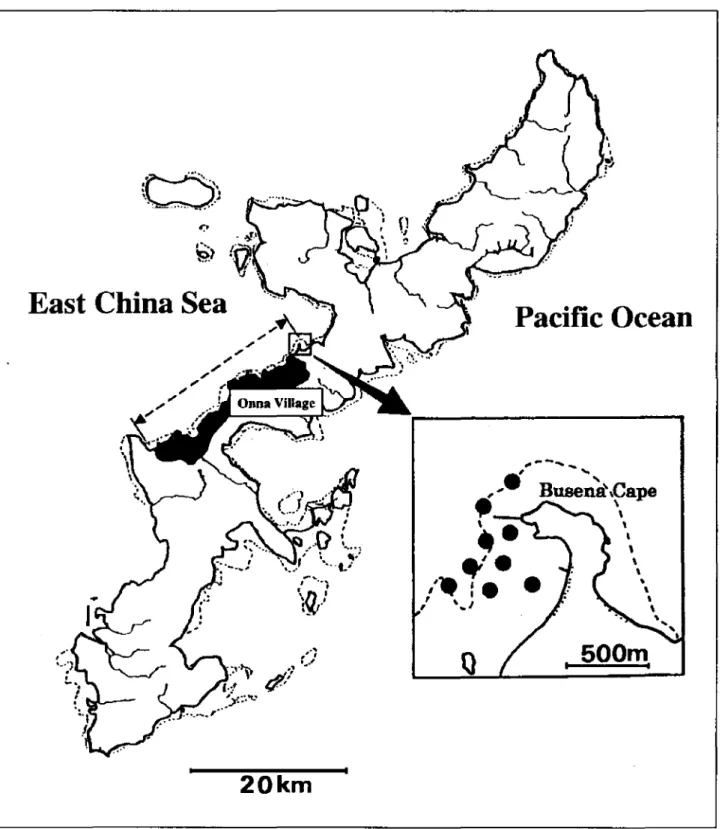
It is expected, if thorough extermination efforts of A. planci are made in a particular area, that the number of exterminated individuals reflect the magnitude of the population of that area. Thus, we considered the number of exterminations as an index of abundance of A. planci. Extermination data were obtained from the extermination project by Onna Village Municipal office and Onna Fishermen's Association conducted along the coast of Okinawa Coastol Quasi-National Park at Onna Village from 1987 to 199B, and another extermination project, conducted monthly by the Okinawa Convention and Visitors Bureau (OCVB), at Busena Cape from May, 1992 to May, 1998 (Fig. 1)
2. Sea surface temperature
Because temperature data were not taken in the two projects, Onna Village and Busena Cape; we used the temperature data of Sesoko Island, about 10 km north of Busena Cape, assuming the sea temperature would not be so much different from that of Busena Cape. Sea surface temperature data were obtained from the coastal observation record at Sesoko Station, Tropical Biosphere Research Center, University of the Ryukyus. The center takes temperature data three days a month (beginning, middle, and last) both in the morning and in the afternoon.
-~
....
,
...
'. ~. J ~. -...--
... - J/,l,". to'
~} , ! '.J'East China Sea
20km
l I I -} .. JPacific Ocean
500m
•
Fig. 1. A map of Okinawa Island with enlarged map of Busena Cape.
The Okinawa Coastal Quasi-National Park at Onna Village where Acanthaster planci was exterminated by local fishermen is indicated by arrow mark "- - -". The spots on the reefs of Busena Cape indicate approximate sites for extermination of A. planci.
RESULTS
1. Exterminations
The number of exterminated A. planci in the Onna Village Project along the coast of the Okinawa Coastal Quasi-National Park ato anna Village, about 3,000 ha., fluctuated approximately between 10,000 and 30,000 during the period from 1987 to 1995 (Fig. 2 and Table 1). However, it reached about 80,000 suddenly in 1996, and about 90,000 in 1997. The sudden increase in exterminations in 1996 reflected the outbreaks of A. planci population in
this year (Arakaki & Yamazato, 1998; Arakaki et a1., 2000). In 1998, the number of exterminated individuals abruptly decreased to 41,100, fewer than half that of 1997's extermination (Fig. 2 and Table 1). On the other hand, the number of exterminated individuals per day per person (Ext/Day/Person) fluctuated nearly in parallel with the number of total exterminations until 1995 (Table 1). The value of Ext/Day/Person for 1996 is more than four times greater than the average, 14.8, whereas values for 1997 and 1998 are much smaller. The value for 1998 is a little more than half that for 1997, paralleling the change in the total number of exterminations (Table 1).
Because the number of exterminated individuals per day per person is a better estimate for the population density .of A. planci than the number of total exterminated individuals, the
larger number of the total exterminated individuals for 1997 and 1998 indicate a bigger effort was exercised for the extermination project in these years. The actual population explosion took place only in 1996, and in 1997 and 1998, A. planci population remained at less than the
level of normal years.
Table 1. Extermination data of Acanthaster planci in Okinawa Coastal Quasi-National Park
at Onna Village. Data source: Onna Village Office and Onna Fishermen's Association. Number of
Exteminations
Year (Ext) Days Persons Ext/Day/Person
1987 29,240 14 378 5.5 1988 10,750 12 240 3.7 1989 29,010 8 200 18.1 1990 14,860 8 192 9.7 1991 15,725 8 208 9.5 1992 16,932 9 210 9.0 1993 16,980 8 214 10.0 1994 31,000 8 200 19.4 1995 20,900 6 196 17.8 1996 81,220 6 210 64.5 1997 88,080 28 481 6.5 1998 41,100 27 384 4.0 Average 32,983 11.8 259.4 14.8
4
-c
o
(IJ ן-m Q..'
>-
...c ctl 0o
en,
...
c l'I)o a..
._,
...
>-~ ctl .- 0E,
......
IV X +-tW x,-" W'+-o
o Z Xl000100
---
100
-
x
90
---I
---Ext90
~ 80 -n - - -- - ""'-Ext/O
ay/P
arson 80~ 70 ---~-~~~~~~~~~---
70
c o .,p 60 - - - -~ ~ ~ ~ ~ ~ ~ 60 ctl c 50 --- 50E
~40
---~---~~~~~~~~~~~~---40
...
Lrl
30 30....
o
20 20~
10
10
o
0 1987 1988 1989 1990 1991 1992 1993 1994 1995 1996 1997 1998Year
Fig. 2. Fluctuation in the number of exterminated Acanthaster planci in Okinawa Coastal Quasi-National Park at Onna Village. The labels "Ext" and "Ext/Day/Person" indicate the total number of exterminated individuals and the number of exterminated individuals per number of days per number of persons, respectively. Data source: Onna Village Office and Onna Fishermen's Association.
The number of exterminated individuals at Busena Cape (i.e., OCVB project), from April of 1992 to the end of 1995, fluctuated on a comparatively small scale, fewer than 300, and suddenly increased in 1996 reaching approximately 1,300, and in April, 1997 reaching a maximum extermination, approximately 1,400 (Fig. 3). In May, 1997, the exterminated individuals suddenly decreased to fewer than half, about 500, of those in April of 1997 and slowly decreased until April of 1998 (Fig. 3). These fluctuations in extermination are similar to the inclination of exterminations in Onna Village (Fig. 2 and Fig. 3). In May of 1998, however, the exterminated individuals suddenly increased again to 635, almost double those in April, and then suddenly decreased in June and steadily decreased until May. 1999 (Fig. 3).
The decrease in extermination at Busena Cape, from May of 1997 to April of 1998, is considered to be due to the extermination conducted in Coastal Quasi-National Park in Onna Village, from June to the end of 1997. since Busena Cape was included in the extermination area.
Because about similar effort was exercised in every monthly extermination program, monthly trend in the number of exterminated individuals roughly indicate a constantly decreasing trend in the population size of A. planci at Busena Cape since the middle of
1997.-1600 1400 l1l s:: .~1200
...,
ll:I .51000a
'"'
2l 800 >< ~ .... 600 oZ
400 200 o 1992 1993 1994 1995 Year 1996 199'1' 1998 1999Fig. 3. Fluctuation in the total number of exterminated Acanthaster planci at Busena Cape's nine extermination sites. Data source: Okinawa Convention and Visitors Bureau, and Okinawa Diving Information Center,
35
- 30P
-Q),..
::l' ~,..
25 CP ~S
~ 20
15
- - - -~- - - ----....-.-.. 96a..m. -96p.m. ---+-97a.m.
--- 97p.m. - 9 8a.m.
~98p.m.Jan. Feb. Mar. Apr. May Jun. Jul. Aug. Sep. Oct. Nov. Dec.
Fig. 4. Fluctuation in sea surface temperature during the year at Sesoko Island.
Sea surface temperature was recorded twice a day, in the morning (a,m.) and in the afternoon (p.m.), three days a month, in the first (F), middle (M), and last (L) 10 days. The lines connect either the morning or afternoon temperature readings, recorded every ten days The numerals in the box indicate the year of the temperature data. Data source: The Sesoko Station, Tropical Biosphere Research Center, University of the Ryukyus.
6
-!
700 600 III 5: o
:a
500 CIl 5:'s
400 Ilol CLl ~ 300 ~ ~.
200 o Z 100a
32 3028
P -'-" Gl26
Ilol ~...
ell 24 IlolGl l:l.22
a
Gl ~ 20 18Jan. Feb. Mar. Apr. May Jun. Jul. Aug. Sep. Oct. Nov. Dec.
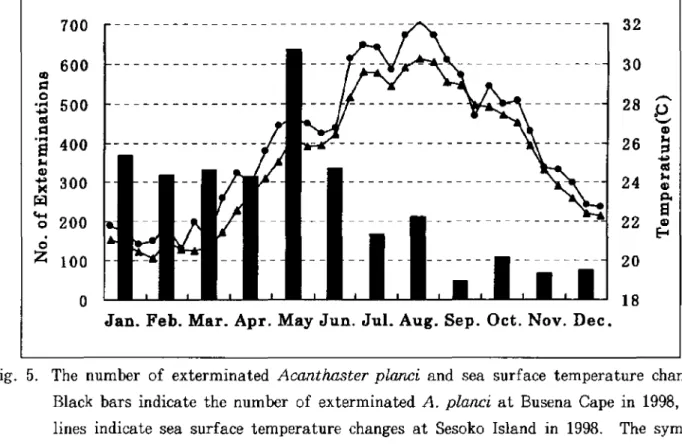
Fig. 5. The number of exterminated Acanthaster planci and sea surface temperature changes. Black bars indicate the number of exterminated A. pla.nci at Busena Cape in 1998, and lines indicate sea surface temperature changes at Sesoko Island in 1998. The symbols .... and • indicate temperature in the morning and in the afternoon, respectively_ Data on A. pla.nci were obtained from the Okinawa Convention and Visitors Bureau, and those on temperature from the Sesoko Station. Tropical Biosphere Research Center, University of the Ryukyus.
2. Sea surface temperature changes and the number of extenninations
Sea surface temperature around Sesoka Island was higher in 1998 than in the previous two years (Fig. 4). The temperature in the afternoon rose abruptly in mid June and reached to higher than 30t in late June, 1998. Then it dropped to a little lower than 30t in late July but rose again soon, and in mid August it reached a maximum temperature of 32.1'C for the year, and never dropped lower than 30t until the beginning of September (Fig. 4). The drastic decrease in extermination in 1998 at Busena Cape started in June. It was the middle of the same month that the sea surface temperature at Sesoko Island rose abruptly in 1998 (Fig. 5).
DISCUSSION
Large scale coral bleaching occurred owing to abnormally high seawater temperature in 1998 (Fujioka, 1999; Kayanne et aI., 1999; Tsuchiya, 1999b, 199ge). Japanese waters affected
by the coral bleaching extended from the Ryukyu archipelago to the south of Kyushyu (Nakano, 1998; Tsuchiya, 1999b; Yamazato, 1999). About 90% of hard corals were dead around Sesoko Island due to the effects of bleaching (Yamazato, 1999). The increase in sea
surface temperature began to be noted at Sesoko Island in mid-June of 1998 with some corals being bleached in the beginning of July and most corals being bleached by late July (Nakano, 1998). Almost all acroporidae corals died by late September (Nakano, 1998). In the shallow moat of the southern part of Okinawa Island, corals bleached in late August, 1998, and most of these corals died in late October, 1998 (Tuschiya, 1999c).
A. planci prefer acroporid corals (Nisihira & Yamazato, 1974). During the coral bleaching of 1998, acroporid corals were seriously affected (Taniguchi et aI., 1999; Kayanne et aI., 1999; Yamazato, 1999; Sugihara et aI., 1999; Shibuno et aI., 1999; Fujioka, 1999), and the rate of mortality of acroporid corals due to bleaching is relatively high (Kayanne et aI., 1999; Yamazato, 1999; Sugihara et aI., 1999; Shibuno et aI., 1999; Fujioka, 1999; Hasegawa et aI., 1999). The decrease in exterminations of A. planci both in Onna Village and at Busena Cape in 1998 is suspected to be due to starvation of the species owing to the dying out of corals which had undergone bleaching. However, a drastic decrease in exterminations at Busena Cape occurred in June of 1998, which was more than one month before the coral bleaching and, moreover, more than three months before the extensive death of corals. Therefore, the immediate cause for the decreased number of exterminations IS probably not due to the starvation of A. planci owing to the death of corals.
The range of temperature tolerance for A. planci depends on their stage of development (Habe et aI., 1989). The range of tolerance for 50% survival was reported to be lOSt to 34"C for larvae, 10.4"C to 34.5t for juveniles, and 12.5"C to 32.5t for adults. The feeding ratio of the species reaches a peak at 31'C for juveniles and at 30'C for adults, and it decreases drastically at temperatures higher than these (Habe et aI., 1989), Since the temperature tolerance of A. planci is narrowly limited, the rise in water temperature should have adversely affected the behavior of A. planci. Therefore, presumably the sudden increase of seawater temperature starting in mid-June, 1998 caused the decrease in the A. planci population and, hence, the decrease in the number of exterminated individuals at Busena Cape, which started in June, 1998.
Yet it is not clear that abnormally high temperature and starvation due to the death of corals in 1998 actually caused a sudden decrease in the A. planci population size. Since there were not any eyewitness reports of A. planci being washed ashore or being found dead in the water in 1998, there is still the possibility that A. planci evaded the high water temperature by removing themselves to deeper waters. Besides, A. planci can survive without food for months (Pearson & Endean, 1969), or for at least half a year (Nakano, personal communication). It is better to regard A. planci as still being alive around Okinawa Island, and there is a possibility that they will return to the coral reefs as the corals around Okinawa Island recover.
-ACKNOWLEDGEMENTS
We gratefully acknowledge the Okinawa Diving Information Center; the Okinawa Convention and Visitors Bureau (Busena Cape branch); the Onna Fishermen's Association; and Onna Village Municipal Office for giving us invaluable data concerning A. planci extermination; and Sesoko Station, Tropical Biosphere Research Center, University of the Ryukyus for giving us data on seawater temperature around Sesoko Island; and Mr. Ota, president of Ocean Diving, at Kouki, Okinawa, who let us know the extermination sites at Busena Cape. We also extend our appreciation to Dr. T. C. Guile, Meio University, Okinawa, for his editorial assistance. This research was supported by funding from the Research Institute for the Subtropics.
REFERENCES
Arakaki, Y., & Yamazato, K. (1998). Okinawa-jima engan ni okeru sango gunshu to onihitode ijyo hasei no eikyo [Coral community and effect of the crown-of-thorns starfish, Acanthaster planci, outbreak around the coast of Okinawa Island]. The Research Institute for Subtropics, Research Report, 1, 1-44 (In Japanese).
Arakaki, Y., Yamazato, K., & Miyara. K. (2000). The crown-of-thorns starfish, Acanthaster planei, outbreak around the coast of Okinawa Island in 1996. Meio Daigaku Sougo Kenkyusho Kiyou, 2, 127-147.
Birkeland, C., and Lucas. J. S. (1990). Acanthaster plaru:i: major management problems of coral reefs. Boca Baton, Florida: CRe Press ..
Fujioka, Y. (1999). Mass destruction of the hermatypic corals during a bleaching event in Ishigaki Island, southwestern Japan. Galaxea, Journal of the Japanese Coral Reef Society, 1, 41-50.
Habe, T.,Yamamoto, G., Nagai, A., Kosaka, M., Ogura, M., Sawamoto, S., Ueno, S., &
Yokochi, S. (1989). Sango sho no hogo ikusei to onihitode yosei no kuj yo ni kansuru kenkyu [Studies on the conservation and management of coral reefs and the control of crown-of-thorns starfish (Acanthaster planci) juveniles). Report of Grant in Aid for Scienttific Research, Minisstry of Education, &ience and Culture, Japan, 1989. School of Marine Science and Technology, Tokai University. (In Japanese).
Hasegawa, H., Ichikawa, K., Kobayashi, M., Kobayashi, T., Hoshino, M., & Mezaki. S. (1999). The mass-bleaching of coral reefs in the Ishigaki Lagoon, 1998. Galaxea, Journal of the Japanese Coral Reef Society 1, 31-39.
Kayanne, H., Harii, S., Yamano, H., Tamura, M., Ide, Y., & Akimoto. F. (1999). Changes in living coral coverage before and after the 1998 bleaching event on the coral reef flats of Ishigaki Island, Ryukyu Islands. Galaxea, Journal of the Japanese Coral Reef &ociety,
I, 73-82. (In Japanese).
Nakano, Y. 1998. 1998 nen natsu ni mirareta daikibo na sango-sho no hakka genshyo. [Large scale coral reef bleaching in the summer of 1998). Tropical Biosphere Research Center
News Letter, 8, 2-4. (In Japanese).
Nishihira, M., & Yamazato, K.. (1974). Human interference with the coral reef community and Acanthaster infection of Okinawa. In Proc. Jnd Int.Coral Reef Symp., I, (pp. 577-590) Brisbane: University of Queensland.
Pearson, R. G., & Endean, R. (1969). A preliminary study of the coral predator Acanthaster planci (L.) (Asteroidea) on the Great Barrier Reef. Department of Harbours and Marine, Queensland, Fisheries Notes, 3, 27-55.
Shibuno, T., Hashimoto. K., Abe, 0., & Takada. Y. (1999). Short-term changes in the structure of a fish community following coral bleaching at Ishigaki Island, Japan. Galaxea, Journal of the Japanese Coral Reef Society, 1, 51-58.
Sugihara, K., Iryu, Y., & Nakamori, T. (1999). Coral bleaching, geological ranges, and adaptation to high sea surface temperatures. Galaxea, Journal of the Japanese Coral Reef Society, I, 89-95.
Sukuramu kunde taiji da [Extermination by scrummage] 0996, Nov. 17). Okinawa Times, morning edition, p. 16. (In Japanese).
Taniguchi, H., Iwao, K.., & Omori, M. (1999). Coral bleaching around Akajima, Okinawa I.
A report of the September 1998 survey. Galaxea, Journal of the Japanese Coral Reef Society, 1, 59-64. (In Japanese with English abstract).
Tsuchiya, M. (1999a). Sango-sho wa ijyou jitai [Coral reefs are in a critical statel Okinawa: Okinawa Marine Press. (In Japanese).
Tsuchiya, M. (1999b). Warning from the coral reefs. Galaxea, Journal of the Japanese Coral Reef Soociety, I, 27-29.
Tsuchiya, M. (1999c). Effect of mass coral bleaching on the community structure of small animals associated with the hermatypic coral Pocillopora damicomis. Galaxea, Journal of the Japanese Coral Reef Society, 1, 65-72.
Yamaguchi, M. (1986). Acanthaster planci infestations of reefs and coral assemblages in Japan: a retrospective analysis of control effects. Coral Reefs, 5, 23-30.
Yamazato, K. (1969). Sango-sho wO shokugai suru onihitode [Acanthaster planci, a coral predator]. Kon-nichi no Ryukyu, 3(J2) , 7-9. (In Japanese).
Yamazato, K. 1999. Coral bleaching in Okinawa, 1980 vs 1998. Galaxea, Journal of the Japanese Coral Reef Society, 1, 83-87.
~~~ere~*=~~f~~~~
••
fimmm·w~~(~~*,OO~·W~)
1998:¥~~
l:t,
~*i.mt1.lt~ll§1:il'J
~t
,~,bn~*:mmJj:--tT
/:to)B1~ht€.::IJ,
B;$:-C1lJB1~0)~~1:tl1if!§JJ
t%ip
~1L1'lfffiim
~'t",&/v1:v).o
0*1iJfJE
1:
,:t"-tT /
:fE31tIlJJW1&'t"
*.::
I::: }- Tfi¢ttO)~fJJ~
ffi
L, .:.
V?Wc:!l'JJ1lJ Jil:
I.§~ E31~t
O)M
il1:~~L ""(
19
<.::
t
f-~Ji...o0 ~F
1)-1
y~ ~ ~Iv-r::JfflitT
るオニ ヒ トデは最 も強力 なサ ンゴ捕食者の一種である。 ミドリイシ類は自化 し易いサ ンゴ類であ り、 その殆 どは白化により死滅 している。これ らより、オニ ヒ トデが餌 としている ミドリイシ類が白化 に より殆 ど死滅することによ り、オニ ヒ トデの餌がな くな りオニ ヒ トデが減少 した と考えることがで き る。 しか し、部瀬名岬におけるオニ ヒ トデ駆除の記録では、オニ ヒ トデ駆除数の減少はミドリイシ類 の大規模 な柴死の約