TUMSAT-OACIS Repository - Tokyo University of Marine Science and Technology (東京海洋大学)
A comparative study of marine accident
investigation agencies
学位名
修士(工学)
学位授与機関
東京海洋大学
学位授与年度
2020
Master’s Thesis
A COMPARATIVE STUDY OF MARINE
ACCIDENT INVESTIGATION AGENCIES
September 2020
Graduate School of Marine Science and Technology
Tokyo University of Marine Science and Technology
Master’s course of Maritime Technology and Logistics
Master’s Thesis
A COMPARATIVE STUDY OF MARINE
ACCIDENT INVESTIGATION AGENCIES
September 2020
Graduate School of Marine Science and Technology
Tokyo University of Marine Science and Technology
Master’s course of Maritime Technology and Logistics
Contents
Abstract ... 1
Acronyms ... 3
Chapter1. Introduction ... 4
1.1 Background ... 4
1.1.1 The purpose and significance of this study ... 4
1.1.2 The related research in recent years ... 5
1.2 Research of this article ... 9
1.2.1 Main research content ... 9
1.2.2 The innovation of this article ... 11
Chapter2. Introduction of maritime investigation institutions of various countries 13 2.1 Information about IMO ... 13
2.1.1 Introduction to IMO ... 13
2.1.2 Internal organization of IMO ... 14
2.1.3 Some important IMO conventions ... 16
2.1.4 Some regulations of IMO concerning the investigation of marine accidents ... 17
2.2 Organizations of marine accident investigation in China ... 18
2.2.1 History ... 18
2.2.2 Structure of MSA ... 20
2.2.3 Maritime Safety Investigation and Water Traffic Accident Investigation ... 23
2.2.4 Some definitions of maritime accident in China ... 26
2.2.5 Accident statistics in China in recent years ... 29
2.3 Organizations of marine accident investigation in Japan ... 32
2.3.1 History ... 32
2.3.2 Structure ... 34
2.3.3 Investigation Process ... 38
2.3.4 Some definitions of maritime accident in Japan ... 44
2.4 Organizations of marine accident investigation in USA ... 49
2.4.1 History ... 50
2.4.2 Structure ... 50
2.4.3 Investigation Process ... 55
2.4.4 Some definitions of maritime accident in USA ... 59
2.4.5 Accident statistics in USA in recent years ... 60
2.5 Organizations of marine accident investigation in UK ... 61
2.5.1 History ... 62
2.5.2 Structure ... 62
2.5.3 Investigation Process ... 66
2.5.4 Some definitions of maritime accident in UK ... 69
2.5.5 Accident statistics in UK in recent years ... 70
Chapter3. Reasons for establishing independent maritime accident investigation agencies in Japan, the USA and the UK ... 72
3.1 JTSB ... 72
3.2 NTSB ... 72
3.3 MAIB ... 73
3.4 Some conclusions ... 73
3.5 Something China can learn from ... 74
Chapter4. Comparison between China MSA and Japan JTSB ... 75
4.1 Establishment and description of government performance measurement form ... 75
4.1.1 Investment ... 77
4.1.2 Internal management ... 78
4.1.3 Learning and training ... 78
4.1.4 Result ... 79
4.2 Relevant data and description of China MSA ... 81
4.3 Relevant data and description of Japan JTSB ... 84
4.4 Score evaluation method ... 87
4.5 Results analysis ... 91
Chapter5. Conclusion ... 95
5.1 Characteristics of marine accident investigation agencies in each country ... 95
5.3 Situation and characteristics of marine accident ... 96
5.4 Results of comparison between China and Japan ... 96
5.5 Some problems in this article ... 97
Acknowledgements ... 98
Abstract
Shipping is the most important way of transporting goods between countries. With the expansion of international trade, the shipping of marine vessels is becoming more and more busy. At the same time, ship accidents will also cause a large number of people, environment, and economic losses. How to prevent accidents from happening again, countries around the world have specialized organizations to investigate accidents, such as Chinese MSA, Japanese JTSB, US NTSB, and UK MAIB. The IMO has also been established internationally to strengthen cooperation among countries, because maintaining maritime transport security requires the efforts of various countries. Different countries have different methods of investigating accidents. Learning from each other can promote the improvement of accident investigation levels.
This article collects the regulations and handling methods for the investigation of marine accidents in China, Japan, the United States, and the United Kingdom, and delves into the reasons for the establishment of independent investigation agencies in Japan, the United States, and the United Kingdom.
It draws some suggestions worth learning for MSA in China. The specific recommendations are as follows:
1) The independent investigation organization makes the investigation process not affected by other organizations or individuals, guarantees the objectivity of the investigation.
2) An independent investigation agency can satisfy the public's need for accident investigation transparency.
After that, we adopted the performance measurement methods of BSC and CAF. We compares the marine accident investigation agencies from the four perspectives of investment, learning and training, internal management, and result, then selects a lot of representative indexes of maritime investigation agencies from the four perspectives, including 6 second-level indexes and 21 third-level indexes. According to the table, the relevant data of the maritime investigation organizations of China and Japan are collected and compared. Through the comparison of this table, we can know the strengths and weaknesses of a maritime accident investigation agencies.
In the comparative study of marine accident investigation agencies, previously only stay subjective and general comparison, and the results are not supported by data and lack of scientific. Our performance measurement form turns the comparative study into an objective and quantitative research process, and the results are clearer and more convincing.
China and Japan scored 61.4 points and 62.2 points in the comparison of the table. Although the total scores of the two countries are close, there are great differences in the evaluation of many indexes. After extracting the indexes which has large difference, it is found that the differences mainly reflect five aspects: investment, transparency, international cooperation and achievement.
1) The investment of MSA in China is very large. The reason may be that the larger MSA in China requires more funds.
3) Japan JTSB is also stronger than China MSA in international cooperation. 4) In the case of casualties, although China has more accidents and fatalities than
Japan, Japan has caused too much economic losses. 5) In terms of achievements, China is better to Japan.
Keyword: Marine accident investigation agency, Marine Safety Administration, Japan Transport Safety Board, Performance measurement
Acronyms
MSA: Marine Safety Administration of China
MLIT: Ministry of Land, Infrastructure, Transport and Tourism JCG: Japan Coast Guard
JTSB: Japan Transport Safety Board JMAT: Japan Marine Accident Tribunal USCG: United States Coast Guard NTSB: National Transport Safety Board FAA: Federal Aviation Administration MCA: Maritime and Coastguard Agency MAIB: Marine Accident Investigation Branch IMO: International Maritime Organization BSC: Balanced Scorecard
Chapter1. Introduction
This chapter introduces the research background and research methods. Previous comparative studies on maritime investigation agencies of various countries are very general, and we find out the original intention of establishing independent investigation agencies in Japan, the United States and the United Kingdom. After that, a comparative table is established to change such comparative studies from subjective to objective, and the form is used to compare the maritime investigation agencies of China and Japan.
1.1 Background
1.1.1 The purpose and significance of this study
Shipping has always been the most important mode of transportation in international trade due to its huge freight volume and cheap transportation costs. Shipping accounts for more than two-thirds of the total international trade. As the scale of world trade further expands, the demand for ships will also increase, and types of ships are also increasing. In recent years, the capacity of the global fleet has increased year by year. At the same time, maritime safety accidents will cause huge economic losses. For example, in 2019, China’s direct economic losses due to maritime traffic accidents have reached 170 million yuan. Every year, maritime traffic accidents cause a lot of casualties. In fact, in many countries the crew is a very dangerous occupation, especially fishing boat crews, in addition, people are becoming more and more aware of environmental protection, and ship accidents can cause very serious pollution, such as oil tanker accidents causing a large amount of oil leakage. How to manage maritime traffic, reduce the occurrence of accidents, reduce the economic and personnel losses caused by accidents, and protect the global environment are of concern to modern society.
In order to ensure the safety of maritime shipping and reduce accidents, various countries have established accident investigation agencies, like Maritime Safety Administration of the people’s Republic of China (MSA), Japan Coast Guard (JCG), Japan Transport Safety Board (JTSB), Japan Marine Accident Tribunal (JMAT), United States Coast Guard (USCG), National Transportation Safety Board (NTSB), Maritime and Coastguard Agency (MCA), Marine Accident Investigation Branch (MAIB). Many international organizations have also been established between countries, the most well-known being the International Maritime Organization (IMO). With the international trade exchanges, the maritime fleet is navigating between various countries, as a result it is not enough to rely on the efforts of one country to reduce marine accidents. All countries in the world need to deepen their understanding and learn from each other and make progress together to improve the safety level of shipping.
In recent years, the MSA of the Ministry of Transport of China communicates with other countries in accident investigations and send maritime investigators to overseas training and study, because China’s investigation and research on maritime accidents are still a long way from developed countries, and the experience of foreign countries can be used in many ways. Every country should draw on the advantages of other
countries and combine with their own actual situation, design the most suitable investigation agency. Institutions in various countries have their own unique features. This article collected some information on the maritime investigation agencies in China, Japan, the United States, and the United Kingdom. We gave a detailed introduction to the maritime investigation agencies in these countries, and pointed out the United Kingdom, the United States, and Japan why those countries establish independent investigation agencies, and finally designed a performance evaluation form, for comparing the differences between China's MSA and Japan's JTSB.
1.1.2 The related research in recent years
1) Comparative study on the structure maritime investigation agencies
There are many comparative studies on the institutional structure of ship accident investigation agencies among countries. In China alone, there are many scholars and MSA employees have done comparative studies between China and other countries' investigation agencies and have provided many valuable opinions on the work of MSA in China.
Maritime Investigator Hu Xichen (2005) [Fu ying haishi diaochaguan moni diaocha peixun “Simulation investigation training for Chinese maritime investigators in UK”](1) led 20 maritime investigators from all over China to the UK for a three-week maritime simulation survey training. It is proposed to first solve the shortage of Chinese maritime investigators, recruit some people with maritime experience and integrate some of the existing investigators to form a full-time maritime investigation team. Zhang Xiaodong (2009) of the Shanghai Maritime Department [Yingguo haishi yu haian jingweishu “Maritime and Coastguard Agency”](2) conducted a deep inspection of the British MCA organization and proposed that in addition to the development of hardware, China's marine accident investigation agencies should also reduce accidents through education and legislation. Wu Yanguo and Song Bingbing of Shandong MSA (2009) [Haishi diaochaguan fu mei moni diaocha peixun zongjie(In Chinese)”Summary of training for maritime investigation officers in the United States” ](3)organized by the MSA of the Ministry of Transport in 2009 for a three-week training. After learning about the work of USCG and NTSB, they claimed it is necessary to establish a maritime safety accident laboratory as soon as possible, speed up the investigation preparation, strengthen the investigation of human factors and expand the team of maritime investigators. Dalian MSA Shang Dexi and Liu Peng (2012) [Zhongwai haishi diaocha duibi ji zhongguo haishi diaocha fazhang jianyi (In Chinese) " Comparison of maritime investigation between China and foreign countries"](4) conducted a survey on the maritime investigation mechanism of the United Kingdom, the United States and Japan, and proposed to strengthen the construction of the Chinese maritime investigation team and separate Administrative investigation and safety investigation, the accident investigation should be graded, and the investigation resources should be concentrated on major accidents. Li Huawen of Guangdong MSA and Liu Jingsheng of Liaoning MSA (2013) [Yingguo haishi diaocha tixi dui woguo de qishi (In Chinese) " Enlightenment from the British Maritime Investigation System"](5) through the
exchange and learning opportunities of MSA, they went to MAIB in the UK for 6 months and have a deep understanding of the British maritime investigation system. It is proposed that the existing MSA investigation in China is conducive to the comprehensive utilization of personnel and equipment, but because the competent authority has the right to determine responsibility, the discovery of the truth of the accident will be restricted under the game of multi-party interests. Guangdong MSA Huang Jie (2016) [Zhongmei liangguo haishi diaocha de bijiao ji jianyi (In Chinese) " Comparison and suggestion of maritime investigation between China and the United States "](6) went to the United States in 2016 to participate in maritime investigation training, learn the American investigation mechanism and experience, and proposed that China's maritime investigation should invite relevant stakeholders to participate in accident investigation and improvement transparency and industrial credibility, and increase the disclosure of accident reports.
These studies indicate that China’s MSA has always maintained communication with foreign advanced maritime investigation agencies. By sending maritime investigators to study abroad, China’s MSA can keep pace with the world’s leading countries, enhance the level of China’s maritime investigations, and enable international maritime navigation safer. The views put forward by these scholars and maritime investigators can reflect the three outstanding problems in China's maritime investigations. First, there are insufficient maritime investigators, and fewer experienced investigators. Second, administrative investigation and safety investigation need to be separated. Third, the transparency of accident investigations needs to be further improved, and the publicity of accident investigations should be increased.
Comparative research on the institutional structure of maritime investigation agencies in the world has already begun. The United Kingdom and the United States are in a leading position in maritime investigations, so their research often focuses on the techniques of some investigations and the improvement of their own internal reflection. South Korea, China, Japan and some other countries have done a lot of research on the comparison of maritime agencies in various countries.
Dane Mellan, Mason Ruffing, Victor Zeng (2009) of NTSB "Improving the quality of accident investigation"(7) in the United States compared the investigation of the Office of Marine Safety of NTSB with the investigations of other agencies, and proposed that the IMO’s definition should be used for the cause factors and increase the focus on security incidents to enhance NTSB’s work. Zhen Song (1999) "A comparative study of practices in China and certain countries"(8) compares the maritime surveys of China, Japan, Germany, the United States and the United Kingdom. It is proposed that because China has a long coastline and a large fleet, the most important thing is not to change the existing maritime investigation agency organization, but to improve and standardize the qualification requirements for maritime investigators within MSA. The Japan Marine Accident Inquiry and Safety Investigation Association(9) (2002) collected and compared the information of the maritime investigation agencies in the United Kingdom, the United States, Finland, Sweden, and the Netherlands, and proposed that the JMAT should notify the relevant flag state and establish an international affairs office in advance after the marine accidnet then the judgment shall be notified to IMO
and the flag state.
2) Research on the current performance measurement of maritime investigation agencies
As early as in various countries in the ancient world, there were evaluation methods for their own officials, but most of the evaluations at that time were more abstract. Since the 1850s, countries around the world have begun to pay more and more attention to the research of performance evaluation and have formulated quantitative and intuitive standards for evaluation. Whether it is a government agency, various management organizations or enterprises, they are gradually exploring the establishment of their own organizations. The organization's performance evaluation has accumulated a lot of evaluation experience in line with the actual situation of various countries and organizations.
The performance evaluation of the government in Europe and the United States can be traced back to 1910, Morris L. Cooke in the "Academic and Industrial Efficiency"(10) research report proposed how to implement the evaluation of university work efficiency. Robert Owen introduced performance appraisal to the industrial sector in England in the 19th century. During World War II, Clarence. E. Ridley and Herbert. A. Simon(11) of the United States published "Technique of Appraising Standards". The book proposed that the assessment needs to cover several aspects (need, cost, effort, Performance, results). In Europe and the United States, it is generally believed that performance indicators have been widely used in enterprises since 1980. At that time, the common use of performance indicators was to understand the school running and profitability of European and American countries. Performance indicators have become an effective tool for the country to evaluate schools and an important means for the country to formulate education policies, allocate school funds and strengthen school management. With the strengthening of the government's cost consciousness and the public's increased awareness of the government's effectiveness, the government performance evaluation activity has become a major political activity that is flourishing. In 1993, the "Government Performance and Results Act" was formally promulgated by the US Congress. This law is a landmark legislation in the performance reform exploration practice of the United Kingdom, the United States, and Japan. Relatively mature stage. But for a period of time after that, it did not receive the attention of the US government. Until 1998, the Clinton government formulated a ten-year plan based on this law, requiring all federal agencies to use performance evaluation technology to formulate strategic plans and the budget link for the coming year.
The performance evaluation methods that have been recognized so far and have been widely used include: Balanced Scorecard (BSC), Key Performance Indicator Method (KPI), 360-degree Feedback Evaluation Method, PDCA performance evaluation method, and Common Assessment Framework ( CAF) etc.
Balanced scorecard: Robert, S Kaplan(12), 1996 and others have developed a comprehensive, systematic, and effective performance evaluation index system that examines corporate management achievements, namely the balanced scorecard. The balanced scorecard system designs various measurement indicators from four angles of
financial indicators, customer satisfaction, internal business processes, and innovation and learning ability, and applies them to the evaluation of management performance. Supervision on progress made in assets, enhancement of future sustainable development capabilities, and maintenance of competitive advantage.
KPI-Key Performance Indication: The KPI-Key Performance Indication is an innovation to the traditional concept of performance evaluation. It is a tactical goal of operability through the layered decomposition of the company’s macro strategic goals. The quantifiable key indicators that reflect and evaluate the business status of the enterprise, through the traction of KPIs, synchronize the personal work goals and functional work goals of employees with the company's strategic development goals. The application of KPI method for assessment will help the integration of enterprise organizational structure, improve enterprise efficiency, streamline unnecessary organizations, unnecessary processes and unnecessary systems.
360-degree feedback: It is called multi-source evaluation or comprehensive evaluation, and people who are closely related to the evaluator, including the evaluator's superiors, colleagues, subordinates, etc., will make anonymous evaluation At the same time, the evaluator also conducts self-evaluation, and then the professional will compare the self-evaluation according to the evaluation of the relevant personnel and want the evaluator to provide feedback to help the evaluator improve its ability level and work performance.
PDCA performance appraisal method: P (plan) refers to formulating plan, D (do) refers to implementation plan, C (check) refers to checking execution results to find out problems, A (action) processes the inspection results, and successful experience is promoted , To sum up the lessons of failure. The above four processes are repeated in cycles, and one cycle ends to solve some problems and achieve a spiral upward. This method focuses on the improvement of information communication and efficiency, and emphasizes communication and commitment, which is conducive to improving the effectiveness of performance evaluation.
Common Assessment Framework (CAF): In 1998, the European Public Administration wanted to establish a common European quality framework for all public sectors as a tool for self-assessment. In 1998 and 1999, the European Foundation for Quality Management, the German Speyer Institute and the European School of Administration completed the initial design of the universal evaluation framework. The framework aims to establish a common management quality assessment framework that is applicable to all public sectors and provides a simple and easy assessment tool for the public sector. CAF is easy to master, simple to operate, and very suitable for the public sector. Using this framework, you can quickly discover the advantages and areas for improvement of the organization. It is very versatile and easy to self-evaluate.
The performance appraisal of maritime institutions is also a kind of performance appraisal of government departments. To objectively evaluate the business performance of various maritime agencies and provide the basis for decision-making for the highest maritime management agencies, around 2002, China began to study and establish a performance measurement system for MSA business work. Since then, many MSA employees and university scholars have conducted research on the performance
measurement system of China's maritime investigation system and have put forward a lot of opinions and opinions to help improve the performance evaluation system of China's maritime system. Nantong MSA Shen Daoming (2002) [Jianli zhishu MSA gongzuo pingjia zhibiao tixi (In Chinese) " Establish the performance measurement system of MSA work directly under "](13) pointed out that it was necessary and feasible for China’s MSA to establish an index evaluation system at that time, and put forward opinions on the selection of feature indexes and weight distribution. Index chart of main features. Nantong MSA Xiong Chunyan (2010) [Haishi xitong jixiao guanli xianzhuang ji gaijin jianyi (In China) " Present situation and improvement suggestions of maritime system performance management"](14) pointed out that China's maritime personnel has been increasing in recent years, and the quality of staff has also become obvious. It is believed that performance evaluation should be used more scientifically, such as: to reduce the influence of subjective factors, use the assessment results for post, salary adjustment and training. Zhang Xin (2017) “Research on Performance Evaluation System Design of Y Maritime Safety Administration”(15) integrates two performance evaluation methods, the balanced scorecard and the common performance evaluation framework of European public organizations. According to the actual situation of Y-MSA, from “public interest, public, business functions, learning and learning The four aspects of "innovation" build an indicator system, which is used in cooperation with YMSA to solve the problems of low business level of Y-MSA, low work quality of employees, low utilization rate of financial funds, and low enthusiasm of cadres. Wang Xiaoyan (2018) of the Beihai Navigation Support Center [Wanshan haishi xitong shiye danwei jixiao kaohe de jianyi (In Chinese) “Suggestions for improving the performance measurement of maritime investigation system”](16) believes that the current MSA performance evaluation has problems such as the difficulty of quantifying the evaluation indicators and the low application of the evaluation results. As a result, deficiencies in work are improved
In European and American countries, maritime agencies belong to the state’s administrative agencies. Starting personnel are managed in accordance with national public officials, and performance evaluations are also conducted in accordance with the relevant national evaluation system. NTSB in the United States has always used an evaluation system to manage the implementation of their strategies, promote active management and staff participation throughout the organization, and help NTSB achieve its goals.(9) By establishing an assessment system, the UK evaluates every person on an annual basis, and finally conducts a general evaluation. According to the advantages and disadvantages, rewards and ups and downs are implemented to fully mobilize the enthusiasm of the staff, improve the scientific of government administration, and enhance the government. Integrity and efficacy.
1.2 Research of this article 1.2.1 Main research content
The first half of the paper is about the basic information about the maritime investigation agencies in China, Japan, the United States and the United Kingdom and the reasons for their establishment. Regarding the information collection of maritime
investigation agencies in various countries, the author consults a large number of documents (including the websites of various countries, introduction materials, articles published by internal employees, and papers written by scholars) to contact maritime organizations of various countries (to the British MAIB and the US NTSB E-mail consultation, application for information disclosure to China MSA through official channels), field visits to relevant staff (visit Japan’s JTSB, face-to-face consultation with some senior Chinese maritime investigators). Although the author's available resources are limited, we try our best to contact all parties to ensure the accuracy and completeness of the information. From the aspects of internal organizational structure, system regulations, investigation procedures, etc., the maritime investigation organizations of China, Japan, the United States, and the United Kingdom are aggregated to provide information support for comparative studies of relevant maritime investigation organizations. Afterwards, the author learned that IMO, in order to reduce the probability of recurrence of the accident, proposed that each country should establish an independent maritime investigation agency to investigate the accident and completely separate the safety investigation from other forms of investigation. For the British MAIB and the US NTSB, it has long been a maritime investigation organization that meets the IMO requirements. The Japanese JTSB also added an investigation of ship accidents to the original railway aviation accident investigation organization, so the author further investigated that before the IMO made the request, the initial reasons for the establishment of the British MAIB, the US NTSB, and the Japan JTSB, then were to find something worth learning from these reasons.
The second half of the paper introduces an evaluation form designed by the author to compare the maritime investigation agencies of various countries. Using this form, the original general comparison can be turned into a specific quantitative comparison. After having a relatively rich understanding of the maritime survey organizations in China, Japan, the United States and the United Kingdom, the author considers to design a performance measurement form that includes 4 first-level indicators, 7 second-level indicators, and 31 third-level indictors. By using that form we make a quantitative comparison about maritime agencies of China and Japan, and the advantages and disadvantages of the maritime investigations in China and Japan are provided to provide research directions for the future development of the maritime investigations of the two countries. The data used in the table, China's data comes from public information such as news and statistical data officially released by China's MSA. Some data such as MSA's 2019 budget and social satisfaction are provided by the author through the official method. Reports and statistics from the JTSB and JCG. Some human resource information and social impacts related to the JTSB are provided by the members of the JTSB. Initially, we planned to collect data from four countries and compare the four countries together. However, due to the impact of the global pneumonia epidemic in 2020, school suspensions and some unit shutdowns, the scope of the research had to be placed on China and Japan. After that, we hope to have the opportunity to continue to improve the performance measurement form, including the allocation of weights, the selection of indexes, the improvement of calculation methods, and the addition of comparison countries. We also hope that others can participate in the continued
development of the study.
1.2.2 The innovation of this article
After looking up the information of maritime investigation agencies of various countries and reading a large number of comparative literatures on maritime investigation agencies, the author found that most scholars simply compare several agencies together to see what other countries own but they do not have in their countries. And then put forward suggestions to establish the same or to change the existing to be the same as other country, many views are not objective. The author believes that everyone should really study in a good place, but they should not blindly think that other countries are good, and there is no need to become the same as other countries. In addition, most of the existing articles have not considered why the United Kingdom established MAIB, the United States established NTSB, and Japan established JTSB. The author’s view is that these organizations were established to solve problems, so we explored the reasons for the establishment of these organizations can find the problems they faced at the time, which is very helpful for us to reflect on ourselves. If there are similar problems, we need to learn how to solve them. If the same problems do not exist, we do not have to waste resources to follow other countries. Therefore, the author went deep into the reasons for the establishment of NTSB, MAIB, and JTSB, hoping to be able to treat the maritime investigation organizations of various countries in a rational and objective manner. To study why the maritime investigation agencies of various countries were established, which has not been done before
Then came a method to quantitatively and objectively compare the maritime investigation agencies of various countries. The existing knowledge of performance measurement is used to compare maritime investigation agencies of various countries. The previous comparative studies of maritime investigation agencies of various countries mostly stayed on the framework of the organization, the investigation process, and the cultivation of talents. In fact, these are not specific enough, but they are compared with each other in appearance, and the conclusions and suggestions are often drawn. It is based on the author's subjective feelings and judgments. It is precisely because these suggestions lack data that the subjectivity is very strong. Both can be said that these suggestions will greatly reduce the occurrence of accidents, and some people will say that this will only waste resources. So many suggestions have not been adopted by the relevant maritime investigation agencies. The author wants to find a way to compare the existing data of different countries' IMO and change the comparative study of IMO from subjective judgment to the comparison of factual data. Through these real data, we can reflect where a country's maritime investigation organization is strong, where it is poor, and after we understand what's good and what's bad, we can see why other countries do well in their poor places, and finally learn from each other's strengths to make up for their weaknesses, which is the right way to improve a maritime investigation organization. The performance measurement form proposed in this paper is designed after combining the two performance measurement methods of BSC and CAF. The BSC evaluates a company from four aspects: financial perspective, customer perspective, internal business process, learning and growth. The evaluation indicators
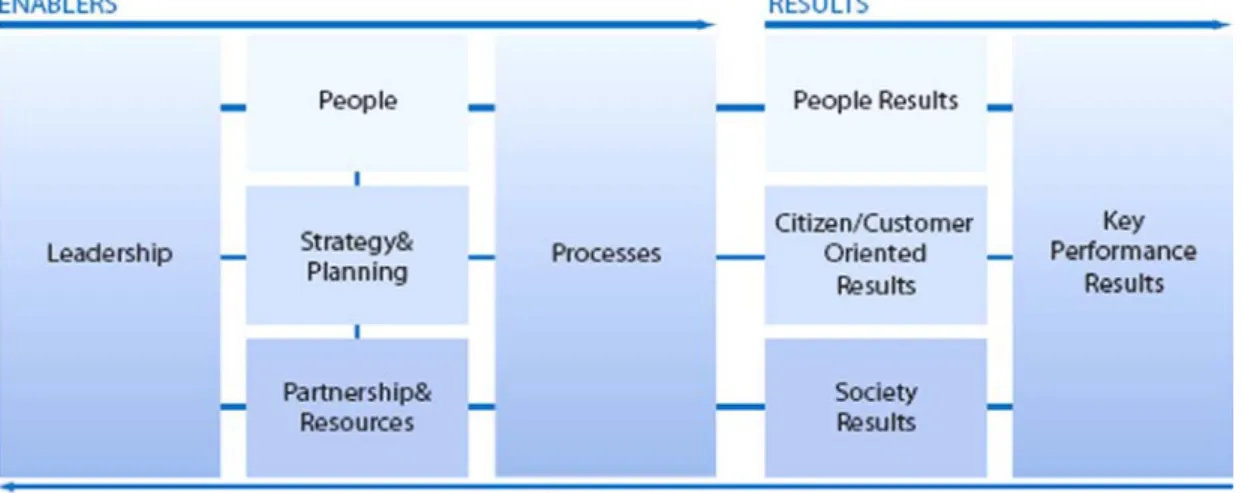
come from the organization strategy, which transforms the organization's mission and strategy into tangible goals and measurement indicators. Compared with other traditional assessment methods, the system not only focuses on performance management and financial aspects, but also pays attention to the future development of an enterprise. However, the BSC is still mainly aimed at enterprises and companies. For government departments such as maritime investigation organizations that do not aim to make profits, they also need to learn from the CAF. In the CAF theory, performance, customer, employee, and social outcome elements are realized through internal management such as leadership, policy or strategy, human resources, partners, and resources, and change management.
Figure 1 The CAF Model
In the end, the performance measurement form designed in this paper uses the four major aspects of finance, internal management, learning and training, and results (customers) given by the BSC on the overall framework. In the selection of evaluation indicators, more consideration is drawn from the CAF, focusing on the use of data that reflects social impact.
Chapter2. Introduction of maritime investigation institutions of
various countries
This chapter introduces the maritime accident investigation of IMO, China, Japan, USA and UK in detail. The content includes the organization of the investigation, the process of the investigation, the relevant provisions of the investigation and so on.
2.1
Information about IMO
2.1.1 Introduction to IMO
In 1948, the United Nations adopted the "Intergovernmental Maritime Consultative Organization IMCO" and the first conference was held in 1949. IMCO was established in 1982, it was renamed the International Maritime Organization IMO. IMO is a specialized agency of the United Nations responsible for the safety of maritime navigation and the prevention of marine pollution from ships. It is headquartered in London, United Kingdom. The main purpose of the organization is to provide shipping technical cooperation opportunities between governments engaged in international trade, encourage countries to promote maritime safety, improve ship navigation efficiency, prevent and control ships to marine pollution to adopt the highest standard of uniform, deal with relevant Legal Issues.
When the IMO was first established, their main goal was to ensure the safety of the sea. By the 1967 Torrey Canyon accident, 120,000 tons of oil had flowed into the sea, causing pollution. In the following years, IMO started to prevent pollution caused by tankers and the discharge of wastewater from the engine room of ships. IMO has also established a system to provide compensation to those who suffer economic losses from pollution.
The rescue system was established in 1970, and the Global Maritime Disaster and Safety System (GMDSS) began to be used in 1988. By 1999, GMDSS has been fully used. For ships that have an accident at sea, the system can automatically send information to the sea Ship safety is greatly guaranteed.
Afterwards, people began to pay attention to the human factors in ships. The 1998 International Safety Management Regulations began to be implemented in all types of ships. The 1997 STCW Treaty entered into force. The right to implement the treaty.
There are currently 174 members of the International Maritime Organization. The governing body of the International Maritime Organization is the Assembly, which is composed of all member states and convenes every two years to discuss the budget of the next year and the technical resolutions and recommendations made by the subsidiary bodies in the previous two years.
There are 40 members of the International Maritime Organization Council, which are divided into three categories: A, B and C. Class A directors are 10 major shipping countries, Class B directors are the 10 countries with the largest maritime trade volume, and Class C directors are 20 regional representatives. The Council enables the executive and important decision-making bodies of the International Maritime Organization to
hold a conference every two years to re-elect the Council and the President. 2.1.2 Internal organization of IMO
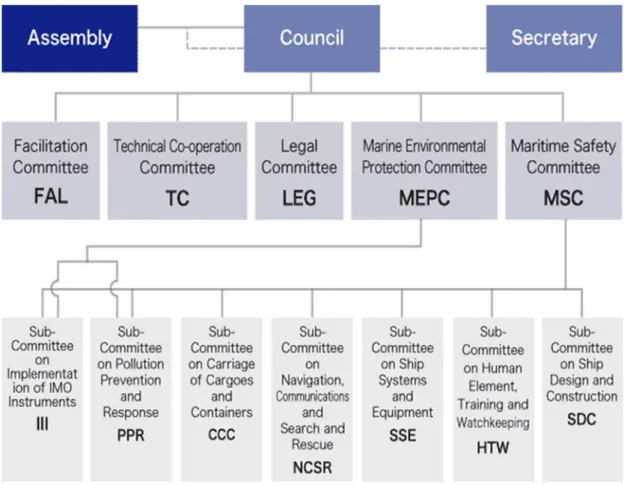
The International Maritime Organization consists of the Assembly, the Council and the five main committees: Maritime Safety Committee (MSC), The Marine Environment Protection Committee (MEPC), Legal Committee, Technical Cooperation Committee, Facilitation Committee. There are also small subsidiary committees to support the main committees.(17)
Assembly: It is the highest administrative organ of the International Maritime Organization. It is composed of member states and meets every two years or according to special needs. The main responsibilities are to approve the work plan, audit the financial budget, and determine the financial arrangements and elect the Council.
Council: The term of office is two years and is elected by the Assembly after each meeting. It is the executive organ of the International Maritime Organization and is responsible to the Assembly under the Assembly. During the closing of the conference, the council is responsible for all the responsibilities of the conference, except for providing advice to the government on maritime safety and marine pollution.
Other functions of the council are:
a) coordinate the activities of the organs of the Organization;
b) consider the draft work program and budget estimates of the Organization and submit them to the Assembly;
c) receive reports and proposals of the Committees and other organs and submit them to the Assembly and Member States, with comments and recommendations as appropriate.
d) appoint the Secretary-General, subject to the approval of the Assembly;
e) enter into agreements or arrangements concerning the relationship of the organization with other organizations, subject to approval by the Assembly.
Maritime Safety Committee (MSC):
The Maritime Safety Committee is the highest technical department of the International Maritime Organization and is composed of all Member States. The functions of the maritime safety organization are: within the jurisdiction of the International Maritime Organization, to assist in the improvement of navigation, vessel structure and equipment, staffing, collision avoidance rules, dangerous goods handling, maritime safety equipment and equipment, hydrological information, nautical records, marine accident investigation , Rescue and other matters that directly affect maritime safety. In addition, it is required to perform the tasks conferred by the IMO Convention or within its scope of work assigned by any international organization to the Maritime Safety Committee. It is also responsible for supporting the General Assembly in drafting and issuing safety recommendations and guidelines.
Marine Environment Protection Committee:
It is composed of all Member States and has the right to consider any matters related to the prevention and control of ship pollution within the organization. The Marine
Environmental Protection Committee adopts and revises the Convention to achieve management.
Subsidiary committee:
Maritime Safety Committee and the Marine Environment Protection Committee cooperate in their work through many subsidiary committees, which are also open to all Member States. The subsidiary committee includes: Sub-Committee on Human Element, Training and Watchkeeping (HTW), Sub-Committee on Implementation of IMO Instruments (III), Sub-Committee on Navigation, Communications and Search and Rescue (NCSR), Sub-Committee on Pollution Prevention and Response (PPR), Sub-Committee on Ship Design and Construction (SDC), Sub-Committee on Ship Systems and Equipment (SSE), Sub-Committee on Carriage of Cargoes and Containers (CCC).
Legal Committee:
It is responsible for handling all legal issues within the scope of the International Maritime Organization and is composed of all member states. It was established in 1967 as a subsidiary body to deal with some legal issues in marine accidents. The Legal Committee is also responsible for tasks assigned by other international organizations and tasks undertaken by the International Maritime Organization.
Technical Cooperation Committee:
Responsible for the implementation of technical cooperation projects within the scope of the International Maritime Organization. Composed of all Member States, it was established in 1969 as a subsidiary body of the Council.
Facilitation Committee:
It was established as a subsidiary organization of the Council in 1972 and became a complete committee in 2008. It is composed of all Member States and is responsible for the work of IMO and related issues related to the convenience of international maritime traffic, and aims to eliminate unnecessary procedures and red tape in international shipping.
Secretariat:
The Maritime Secretariat is composed of the Secretary General and approximately 300 international personnel based in London.
Figure 2 Chart of IMO Organization
2.1.3 Some important IMO conventions
Safety of Life at Sea(SOLAS): It is a unified principle and related rules jointly formulated by all Member States, aimed at enhancing maritime human safety. The Convention applies to ships engaged in international voyages, and provides for the inspection of ships, the inspection of life-saving equipment of cargo ships, the inspection of radio equipment of cargo ships, the inspection of hull machinery and equipment, and inspection certificates.
International Convention for the Prevention of Pollution from Ships (MARPOL): Member States are aware that ships deliberately and deliberately discharge oil and other harmful substances is a serious environmental pollution. The Convention aims to eliminate the intentional discharge of oil and other harmful substances to pollute the environment. The convention includes six phases: the rules for preventing oil pollution, the rules for controlling the pollution of toxic liquid substances in bulk, the rules for preventing the pollution of harmful substances in marine packaging, the rules for preventing the pollution of domestic sewage from ships, the rules for preventing the pollution of garbage by ships, and the rules for preventing air pollution from ships.
Standards of Training, Certification and Watchkeeping for Seafarers (STCW): Mainly used to control the professional and technical qualities and duty behavior of seafarers. The implementation of the Convention promotes the improvement of the quality of seafarers of Member States, guarantees the safety of life and property at sea
and protects the marine environment on a global scale, and effectively controls the impact of human factors on marine accidents Influence and play a positive role. The Convention highlights the importance of the human factor in navigational safety, and stipulates the internationally acceptable minimum standards for crew training, certification and duty.
Load Lines (LL): To guarantee the safety of life and property at sea, the International Maritime Organization formulated uniform principles and standards on the weight limits of ships on international navigation in 1966.
2.1.4 Some regulations of IMO concerning the investigation of marine accidents At the 84th session of the Maritime Safety Committee of the International Maritime Organization, on May 16, 2008, resolution MSC.255(84) adopted the CODE OF THE INTERNATIONAL STANDARDS AND RECOMMENDED PRACTICES FOR A SAFETY INVESTIGATION INTO A MARINE CASUALTY OR MARNE INCIDENT (CASUALTY INVESTIGATION CODE). The first and second parts of the CODE are mandatory provisions and entered into force on January 1, 2010. Part 1 introduces the purpose of passing the rule and the definition of some terms. Part 2 establishes the criteria for the investigation. The third part of the CODE is the International Maritime Organization's recommendations for specific investigation methods for marine accident investigations.
In the first part, the aim of safety investigation is stated: Marine safety investigation
does not seek to apportion blame or determine liability. A marine safety investigation should be separate from, and independent of, any other form investigations (Casualty
Investigation Code 2008).(18)
In the second part, Code defines some terms of safety investigation, for example: a
very serious casualty involving the total loss of the ship or a death or severe damage to the environment (Casualty Investigation Code 2008).(18)
Marine accidents refer to events that are directly related to the operation of the ship and cause the following conditions:
1) the death of, or serious injury to, a person. 2) the loss of a person from a ship.
3) the loss, presumed loss or abandonment of a ship 4) material damage to a ship
5) the stranding or disabling of a ship, or the involvement of a ship in a collision. 6) material damage to marine infrastructure external to a ship, that could
seriously endanger the safety of the ship, another ship or an individual; or 7) severe damage to the environment, or the potential for severe damage to the
environment, brought about by the damage of a ship or ships.
Maritime incidents refer to incidents other than marine accidents that are directly related to the operation of the ship or that would otherwise endanger the ship, its occupants, or any other person or environment if not corrected, but marine incidents do not include intent to harm ships and individuals Or intentional actions and omissions of the environment.
investigation is impartial and objective, and the maritime safety investigation must be able to be carried out without the instruction and interference of any person or organization that may affect the results of the investigation.
Very serious marine accidents refer to marine accidents involving total damage to the ship or death or serious environmental damage. It is required to conduct a safety investigation for each very serious marine accident and submit the investigation report of each very serious marine accident to the International Maritime Organization. When a maritime safety investigation is conducted on a non-very serious maritime accident or maritime incident, and a maritime safety investigation report is made, and the information contained therein can prevent future maritime accident or maritime incident or reduce its severity, the final text Need to submit to the International Maritime Organization.
The investigation report should include the following:
1) A summary of the basic facts of the marine accident or marine incident, and whether it caused death, injury or pollution.
2) The status of the ship country, ship owner, operator, company and classification society listed in the safety management certificate.
3) Any relevant details about the ship's scale and engine, as well as the crew's statement, working procedures and other matters such as working hours on board.
4) Detailed statement of marine accident or marine incident.
5) Analysis and comment on the triggering factors, including any mechanical factors, human factors and organizational factors.
6) Discussion of the results of the maritime safety investigation, including confirmation of safety issues, and conclusions of the maritime safety investigation
7) Where applicable, recommendations aimed at preventing future marine accidents and incidents.
2.2
Organizations of marine accident investigation in China
2.2.1 History
(1) Port supervision and management model (1949-1985)
After the establishment of China in 1949, the Central Government established the Navigation Administration Office in the General Administration of Maritime Transport of the Ministry of Communications to be responsible for the supervision and management of maritime traffic safety. The supervisory authority, under the name of "People's Republic of China Port Supervision", uniformly exercises the functions of marine traffic safety supervision and management. After the reform and opening, various port administration departments that were hit by the Cultural Revolution gradually resumed their safety inspections. In the early 1980s, the Water Safety Supervision Bureau was set up in the Ministry of Communications, the port supervision was set up in major coastal ports, the Yangtze River Navigation Administration Bureau and Heilongjiang Navigation Administration Bureau were established in the Yangtze
River and Heilongjiang, and the provinces, autonomous regions and municipalities directly under the Central Government Or the Shipping Bureau of the Ministry of Communications may set up a port and shipping supervision office or a vehicle and ship supervision office, and set up a port and shipping supervision or vehicle and ship supervision at major ports.
(2) The "Marine Supervision Bureau" management mode (1985-1998)
In 1985, the State Council made a decision to reform the water transportation safety supervision and management system. According to the principle of separation of government and enterprise, A maritime safety supervision and management system in which the central and local divisions of labor are responsible has been established, 14 maritime safety supervision bureaus have been established, and a dual leadership system has been implemented between the Ministry of Communications and the local city government, with the Ministry of Communications as the leading system. The water safety supervision of the Yangtze River, Pearl River and Heilongjiang River is under the unified responsibility of the port and shipping supervision agencies established by the Ministry of Communications; other inland river waters are the responsibility of the port and shipping supervision agencies established by the communications departments of the provinces, autonomous regions and municipalities directly under the Central Government. According to statistics, in addition to Beijing and Tibet, 28 provinces, autonomous regions, and municipalities directly under the Central Government have established water safety supervision agencies, basically forming a water transportation safety layout covering national waters. In 1989, the port management system reform with the separation of government and enterprise as the core was implemented. The central and local port authorities were independent from the port authority. The management system had a major breakthrough. The Safety Supervision Bureau and Ship Supervision were established in the Ministry of Communications. Bureau, the coastal port established the Maritime Safety Supervision Bureau to independently perform its functions, and the local transportation authority has also set up port and shipping supervision and ship inspection agencies accordingly.
(3) "MSA" management mode stage (1998-present)
In 1998, with the approval of the State Council, the People’s Republic of China Port Authority (Safety Supervision Bureau of the Ministry of Communications) and the Ship Inspection Bureau of the People’s Republic of China (Ship Inspection Bureau of the Ministry of Communications) merged to form the MSA of the People’s Republic of China (MSA), which is directly under the Ministry of Communications. Institutions, the coastal waters (including islands) and ports in China, open waters and important inter-provincial navigable inland river trunk lines and ports are classified as centrally managed waters, and the maritime management agency directly under the Ministry of Communications sets up vertical management; Waters such as inland rivers, lakes, and reservoirs are zoned as locally managed waters. The people’s governments of provinces, autonomous regions, and municipalities directly under the Central Government establish local maritime management agencies to implement the management. There are 18 direct maritime agencies in coastal areas and major inter-provincial inland river routes and important ports. While setting up and establishing directly under the
maritime agency, the Ministry of Communications also regulated the names of local management water management agencies. At present, a total of 27 provinces (autonomous regions and municipalities) and a construction corps have established local maritime agencies in the Ministry of Communications. With the establishment of the MSA of the Ministry of Transport and the completion of the reform of the national maritime safety supervision and management system, the maritime safety supervision and management system has covered national waters.
2.2.2 Structure of MSA
The MSA of the People's Republic of China is an administrative agency directly under the Ministry of Transport and implements a vertical management system. It performs administrative management and law enforcement duties such as supervision and management of water traffic safety, inspection and registration of ships and related water facilities, prevention of ship pollution and navigational security. There are 15 direct MSA and 3 maritime support centers in various regions of the country: Shanghai MSA, Tianjin MSA, Liaoning MSA, Hebei MSA, Shandong MSA, Zhejiang MSA, Fujian MSA, Guangdong MSA, Guangxi MSA, Hainan MSA, Yangtze River MSA, Jiangsu MSA , MSA in Heilongjiang, MSA in Shenzhen, MSA in Lianyungang, Beihai Navigation Support Center, Donghai Navigation Support Center, South China Sea Navigation Support Center.
Figure 3 15 Direct MSA and 3 Maritime Support Centers
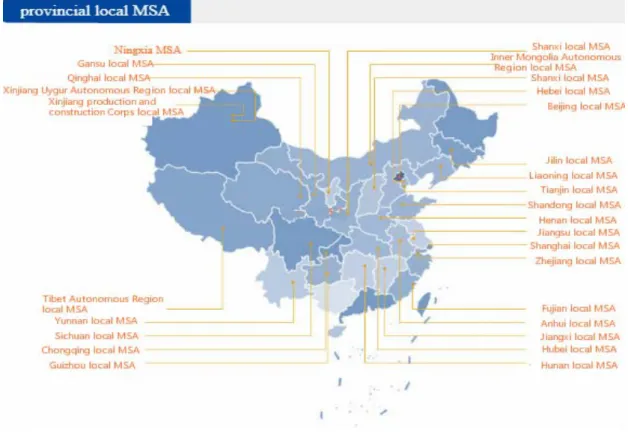
In addition to the MSA directly under the Ministry of Transport, local MSAs were established in 27 provinces, municipalities, autonomous regions, and one production and construction corps in China. Most local MSAs are managed by the local
transportation department.
Figure 4 27 Local MSA
MSA internal departments:(19)
MSA Office: Responsible for organizing and coordinating the daily affairs of the organs of the Bureau, responsible for the management of secretaries, information, files, letters and visits, confidentiality and administrative affairs of the organs.
Policy and Law Office: Organizing the formulation of maritime policies and comprehensive the law of the sea, undertaking maritime legislation planning and coordination; organizing the formulation of technical regulations and rules for the legal inspection of ships and offshore installations; managing the legal work of the national maritime system; guiding the maritime system in accordance with the law, Organize the implementation of law enforcement supervision and inspection; centrally manage the interpretation of maritime regulations.
General Navigation Management Department: manage the navigation order and navigation environment; organize the implementation of water patrol law enforcement and traffic control, maintain water traffic order; be responsible for the planning and management of waterways such as waterways, restricted navigation areas, traffic control areas, anchorages and safe operation areas; Obstruction review and supervision and inspection of water and underwater construction operations; responsible for management of salvage of sunken ships and removal of obstacles; removal of navigation warnings; management of ship reporting system.
Ship Supervision Department: Responsible for ship registration and airworthiness management; manage ship safety inspections and be responsible for the cooperation of port state supervision and cooperation in the Asia-Pacific region; approve the temporary entry of foreign national ships into China's non-open waters, undertake the relevant approval work for port opening to the outside world; Management of relevant procedures in the port; responsible for ship security and anti-piracy work; handling the work of the China Convenient Transportation Committee Office.
Hazardous pipe and anti-pollution department: Responsible for the supervision and management of pollution caused by the safe transportation of ships; responsible for the safety supervision and management of ships carrying dangerous goods and other goods; responsible for container supervision and inspection and management of dangerous goods containers; Safety supervision and management work; supervise and manage the construction of ship oil spill pollution emergency system; participate in the investigation and handling of ship pollution accidents; undertake the work of the ship oil pollution compensation fund committee secretariat.
Ship Inspection and Management Office: manages the inspection and technical supervision of ships, water facilities, shipping cargo containers, marine products, etc.; supervises and administers the statutory inspection and certification of Chinese ships, offshore facilities and foreign national offshore facilities operating in China's coastal areas Work; verify the qualifications of the ship inspection agency and the surveyor and implement supervision and management; undertake the determination of inspection authorization matters; be responsible for the implementation of supervision and management of the establishment of representative offices in China by foreign ship inspection organizations.
Ship Technical Standards Division: undertake the specific work of formulating fishing vessel inspection standards.
Crew Management Office: Responsible for crew management. Organize and formulate the eligibility criteria for crew, pilot and magnetic compass correction personnel; manage the training, examination and certification of crew, pilot and magnetic compass correction personnel; verify the qualifications of the training organizations for crew, pilot and magnetic compass correction personnel and manage Its quality system review; responsible for the management of seafarers’ certificates; responsible for the management of the ship’s minimum safety manning; responsible for the management of seafarer development and seafarer’s professional security, seafarer labor market, etc.; responsible for the qualification approval and supervision of seafarer service organizations and seafarer dispatched organizations .
Safety Management Department: Responsible for the comprehensive management of water transportation safety; comprehensively coordinate and guide the safety production of water transportation; responsible for the supervision and management of
the safety and pollution prevention of shipping companies; responsible for the management of the audit of shipping companies and ship safety management systems; manage and guide the water transportation Investigation, handling, statistical analysis and closing of accidents and pollution accidents; specifically organizing or participating in the investigation and handling of major mega water traffic accidents and pollution accidents; responsible for the reporting and safety investigation of foreign-related marine accidents or incidents; taking the lead in carrying out the whole country Analysis and assessment of the safety situation of water traffic.
Navigational Security Management Office: manage coastal beacons and radio navigation; take charge of seaports port channel surveying and mapping management; manage maritime safety communications; centrally manage traffic system surveying and mapping; organize compilation, publication, and correction of relevant navigation books and materials in China’s sea area ; Organizing and implementing the operation and maintenance of navigation support facilities such as navigation marks and maritime safety communications; responsible for the related affairs of International Search and Rescue Satellite Organization; guiding the relevant business work of various navigation support centers.
Tax collection and inspection department: responsible for the daily collection and management of non-tax revenues such as ship port charges, port construction fees, ship inspection fees and ship oil pollution damage compensation funds; drafting management measures for the collection of maritime non-tax revenues, and responsible for daily supervision and inspection; Undertake the collection and management of entrusted items such as vehicle and vessel use tax; undertake the daily management and statistical analysis of the maritime system fee collection bills.
2.2.3 Maritime Safety Investigation and Water Traffic Accident Investigation
After the 2010 IMO CODE was included in the first and second parts of the SOLAS treaty, the CODE emphasized that the purpose of the investigation of marine accidents is not accountability and punishment and separated from other administrative, civil, criminal and other investigations, China refers to investigations carried out in accordance with this rule as "maritime safety investigations", while administrative investigations carried out in accordance with Chinese laws and regulations on water traffic accidents are referred to as "water traffic accident investigations".(20)
The maritime safety investigation does not exclude, interfere with, or replace the water traffic accident investigation. It is carried out in parallel with the water traffic accident investigation. The maritime safety investigation can obtain evidence of the water traffic accident investigation. Any information of the maritime safety investigation is not provided to the administrative, acting, civil investigation or judicial organs or departments.
1) Maritime Safety Investigation
the IMO CODE of Chinese ships on international voyages, foreign vessels on waters under Chinese jurisdiction, and other accidents that can provide lessons for the shipping industry. China MSA has a full-time maritime safety investigation department (i.e. safety management office) to perform the accident investigation duties required by the IMO accident investigation rules. The MSA of the Ministry of Transport organized training for safety investigators and selected and appointed qualified maritime safety investigators for maritime safety investigations. The maritime safety investigators are divided into three levels: chief investigator, chief investigator and deputy chief investigator. The chief investigator and the deputy chief investigator have one or more of the following technical categories: navigation and collision avoidance rules, causes of marine pollution, flag State certificate of competence, interview techniques, evidence collection and evaluation of human factors.
At present, the Ministry of Transport MSA has actively fulfilled the IMO investigation requirements in terms of investigation forms and investigators through the establishment of maritime safety investigation departments and the establishment of a team of safety investigation officers. But in fact, the maritime safety investigation department (safety management office) within the MSA of the Ministry of Transport is not a full-time safety investigation, but also performs the national waterborne traffic accident administrative investigation; while there is no full-time safety investigation officer in China Safety investigators also assume the responsibility of administrative investigations. There is no obvious classification management mechanism for maritime administrative investigators and safety investigators.
2) Water Traffic Accident Investigation
Water traffic accident investigation is a series of activities carried out in accordance with the law in order to ascertain the cause, process, and extent and scope of damage, determine the nature of the accident, and determine the responsibility of the parties to the accident. . Use surveys, photographs, inquiries, appraisals, inspections and other means to collect evidence, analyze all factors related to the accident, including human factors, and study the details of water traffic accidents. After clarifying the responsibilities of the personnel involved in the accident, the maritime authority will put forward suggestions to strengthen safety management, punish offenders, announce the results of the investigation, and mediate civil disputes caused by the accident.
According to the "Shuishang jiaotong shigu diaocha chuli chengxu zhinan (In Chinese) Guidelines for investigation procedures of water traffic accidents " issued by MSA in 2001, MSA in China investigates and handles water traffic accidents according to the following procedure(21):
1) The maritime agency and its investigating officer pass the "Water Traffic Accident Report" submitted by the shipowner concerned, the records of the ship traffic management center, the reports of the maritime alarm platform and search and rescue center, the notice of the local government, and the news media reports Learned that a ship accident occurred.
2) After receiving the report of the water traffic accident, the maritime authority shall report level by level and, if the ship's safety conditions permit, conduct