INTRODUCTION
Falls cause injuries such as fractures, skin lacerations, bleeding, and head injury, and individuals who have experienced a fall can develop a fear of falling again, leading to reduced mobility and loss of physical fitness. Falls are the leading cause of fatal and nonfatal injuries among the elderly. Prevention of falls is important not only in the community but also in hospitals, because hospital-ized patients could develop more severe medical conditions after falls.
Most previous reports concerning falls in hospitals have been in rehabilitation hospitals or limited - service hospitals (1 - 11). An un-derstanding of the incidence and characteristics of falls in an acute care hospital is important for prevention of falls. Thus, we retro-spectively investigated the incidence and characteristics of falls among hospitalized patients in a university hospital from incident reports by hospital staff during a 6 - month period.
METHODS
This study was conducted at Tokushima University Hospital, a 696 - bed acute care hospital. We collected details of falls among hospitalized patients during admission from incident reports by hospital staff. A retrospective evaluation of 154 consecutive falls was performed during the 6 months from January 1, 2013 to June 30, 2013 by using incident reports and medical records. We in-cluded falls on level ground and falls from beds or chairs.
The following items were investigated : age, sex, number of falls per person, clinical department of patients, location of fall, activity at the time of fall, time of discovery of fall, discovery of fall, and injury sustained from fall. Fall rate is expressed as follows : (Number of patient falls)/(Number of all hospitalized patient days) × 1,000. The Ethics Committee of Tokushima University Hospital approved this study.
RESULTS
There were 154 falls in 135 patients who were hospitalized dur-ing this study period ; 15 patients fell twice, and 1 patient fell five times. The following analyses were carried out based on the data at the time of each fall, and for patients who experienced more than one fall, each fall was counted singly. Of the 154 falls, 95 occurred in males and 59 in females.
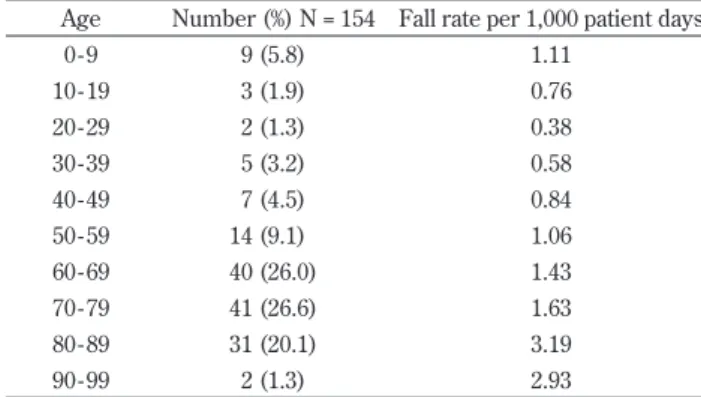
Age of hospitalized patients who fell during admission (Table 1) Mean age was 63.9 (range 0 to 91) years ; 74.0% were! 60 years of age. Fall rate was highest in patients in their 80s fol-lowed by those in those in their 90s and 70s.
Location and activity at the time of fall (Tables 2 and 3) and time of discovery of fall (Figure 1)
Most falls (122 falls, 79.2%) occurred in patient rooms, and most of these (105/122 falls, 86.1%) were at the bedside. The most frequent activity at the time of fall was elimination, including the move for elimination (68/146 excluding infants ; 46.6%). There were 8 infant falls, 6 of which were falls from the bed when their mothers or caregivers lowered the bed rail. The most common time of discovery of fall was 2 : 00 - 2 : 59 AM (14/154 ; 9.1%), fol-lowed by early in the morning.
ORIGINAL
Falls among Hospitalized Patients in an Acute Care Hospital :
Analyses of Incident Reports
Nori Sato1, Naomi Hase2, Akemi Osaka2, Koichi Sairyo3, and Shinsuke Katoh1
1Department of Rehabilitation Medicine, Tokushima University Hospital, Tokushima, Japan,2Department of Nursing, Tokushima University
Hospital, Tokushima, Japan,3Department of Orthopedics, Institute of Biomedical Sciences, Tokushima University Graduate School, Tokushima,
Japan
Abstract : Falls cause injuries such as fractures, skin lacerations, bleeding, and head injury, and could result in more severe medical conditions in hospitalized patients. We retrospectively investigated the incidence and charac-teristics of falls among hospitalized patients in an acute care hospital from incident reports by hospital staff between January and June 2013. There were 154 falls in 135 patients, 2 of which resulted in fracture. The average age of patients who fell was 63.9 (range 0 to 91) years. Many falls occurred at the bedside (68.2%%). Approximately half of all falls were related to elimination (46.6%%). The most common time of discovery of falls was 2 : 00-2 : 59 AM (14/154 ; 9.1%%), followed by early in the morning when patients would actively move. Fall rates in our hospital were 1.39 falls per 1,000 patient days. The department of respiratory medicine and rheumatology had the highest fall rate (3.08 falls per 1,000 patient days), followed by the departments of neurosur-gery and neurology (2.98 falls per 1,000 patient days). This study revealed the characteristics of falls in an acute care hospital, and suggests that their notification in the hospital might help reduce the incidence of falls in hospitalized patients. J. Med. Invest. 65 : 81-84, February, 2018
Keywords : falls, hospitalized patients, acute care hospital, incident report
Received for publication November 21, 2017 ; accepted December 28, 2017.
Address correspondence and reprint requests to Shinsuke Katoh, MD, PhD, Professor, Department of Rehabilitation Medicine, Tokushima University Hospital, 2 - 50 - 1 Kuramoto - cho, Tokushima 770 - 8503, Japan and Fax : +81 - 88 - 633 - 7204.
The Journal of Medical Investigation Vol. 65 2018
81
Fall rate by clinical department (Table 4)
Total fall rates in our hospital were 1.39 falls per 1,000 patient days ; fall rates in each clinical department are shown in Table 4. The department of respiratory medicine and rheumatology had the highest fall rate (3.08 per 1,000 patient days) and the depart-ments of neurosurgery and neurology had the second highest fall rates (2.98 per 1,000 patient days).
Discovery of falls (Tables 5)
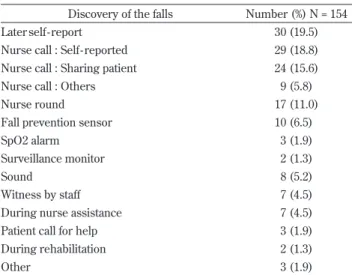
Regarding discovery of falls, 38.3% (59/154) of falls were re-ported by the patients themselves, and about half of these were not reported at the time of the fall. Thirty - three falls (21.4%) were wit-nessed and reported by using the nurse call system by other pa-tients in multiple - occupancy rooms or caregivers attending to the patients. Also, nurses discovered patients who had fallen during the rounds (17/154 ; 11.0%), particularly at night. In some cases, the bedside oxygen saturation monitor or sensor system alerted staff to falls (15/154 ; 9.7%).
Table 1. Age of hospitalized patients who fell during admission Age Number (%) N = 154 Fall rate per 1,000 patient days
0 - 9 9 (5.8) 1.11 10 - 19 3 (1.9) 0.76 20 - 29 2 (1.3) 0.38 30 - 39 5 (3.2) 0.58 40 - 49 7 (4.5) 0.84 50 - 59 14 (9.1) 1.06 60 - 69 40 (26.0) 1.43 70 - 79 41 (26.6) 1.63 80 - 89 31 (20.1) 3.19 90 - 99 2 (1.3) 2.93
Table 2. Location of fall
Location of fall Number (%) N = 154
Patient room ; bedside 105 (68.2)
Patient room ; toilet 9 (5.8)
Patient room ; other 8 (5.2)
Ward toilet 8 (5.2)
Corridor 6 (3.9)
Bathroom 5 (3.2)
Dayroom 3 (1.9)
Other patient room 3 (1.9)
Elevator hall 2 (1.3)
Other 5 (3.2)
Table 3. Activity at the time of falls
Activity at the time of fall Number (%), N = 146* Elimination, including move for the elimination 68 (46.6)
Trying to pick up something 12 (8.2)
Standing up or walking 10 (6.8)
Transfer to wheelchair or bed 7 (4.8)
Taking a shower 6 (4.1)
Having a meal 4 (2.7)
Changing clothes 3 (2.1)
Washing face or brushing teeth 2 (1.4)
Carrying a cup of tea 2 (1.4)
Rehabilitation 1 (0.7)
Unknown 23 (15.8)
Other 8 (5.5)
*Excluding infant falls from beds
Figure 1. Falls by time of discovery
Table 4. Fall rate by clinical departments
Clinical departments Fall rate per 1,000 patient - days
Respiratory medicine and rheumatology 3.08
Neurosurgery 2.98 Neurology 2.98 Otorhinolaryngology 2.63 Digestive surgery 1.63 Psychiatry 1.55 Hematology 1.48 Gastroenterology 1.42
Thoracic and endocrine surgery 1.34
Endocrinology 1.24 Plastic surgery 1.18 Nephrology 1.10 Dermatology 1.09 Orthopedic surgery 1.08 Urology 1.01 Pediatrics 0.99 Ophthalmology 0.91 Oral surgery 0.76 Cardiovascular surgery 0.69 Cardiovascular medicine 0.68
Obstetrics and gynecology 0.10
Oral medicine 0.00
Pediatric surgery 0.00
Radiology 0.00
Anesthesiology 0.00
Emergency 0.00
Examinations and injuries caused by falls (Table 6)
Among 154 falls, 13 falls (8.4%) resulted in the need for some form of investigation including plain radiographs, computed to-mography scan of the head, or blood tests. In total, 50 falls (32.5%) resulted in some type of injury including 3 skin lacerations re-quiring suturing and 2 fractures (supracondylar humeral fracture and metatarsal fracture) in 4 patients.
DISCUSSION
Reported fall rates vary from 2 to 6 falls per 1,000 patient days (1, 3 - 5, 12 - 15), and the present study showed a rate of 1.39 falls per 1,000 patient days in our hospital. Elderly individuals often have muscle weakness and balance disorders and thus a tendency to fall (16), which is consistent with our finding of increasing fall rate with increasing age of patients in our hospital. Exercises such as bal-ance challenge or a higher level of exercises can prevent falls among the elderly (17). Chang et al. reported that the most effective
intervention was a multifactorial fall risk assessment and manage-ment program, and that exercise programs were also effective in reducing the risk of falls (18).
Some previous studies reported that falls often occurred in the patients’ rooms (1, 3, 13 - 14, 19 - 20). In our study, 79.2% of falls occurred in patients’ rooms, and!80% occurred at the bedside. Our study and other reports showed that about half of falls oc-curred around activities related to elimination (2, 19).
The most common time of discovery of falls is different ac-cording to the previous reports (19, 21). In the present study, the most common time for falls was 2 : 00 - 2 : 59 AM, followed closely by the time when patients would actively move on the ward.
The departments of respiratory medicine and rheumatology, neurosurgery, and neurology displayed high rates. Patients in the respiratory medicine and rheumatology department tend to have long term inactivity caused by their illness, such as respiratory dis-eases and connective tissue disdis-eases. Patients in the neurosurgery and neurology departments often have paralysis, muscle weak-ness, gait disturbance, or cognitive dysfunction. The latter are thus assumed to have higher risk of falls and Hitcho et al. reported that neurology services had the highest fall rates (6.12 falls per 1,000 patient days).
Less than 20% of patients who fell in the hospital reported the fall at the time of occurrence. This hesitation to report falls could lead to deterioration of injuries, and we should therefore encour-age patients to report falls and/or injuries immediately.
The limitations of this study are the retrospective study design and that we could not investigate other details such as level of con-sciousness, muscle strength, and medication received. Neverthe-less, our study clarified the characteristics and circumstances of falls in our hospital, and suggests that notifying staff, patients, and patients’ families of these findings could help in reducing the inci-dence of falls in hospitals.
REFERENCES
1. Aranda- Gallardo M, Morales - Asencio JM, Canca- Sanchez JC, Toribio - Montero JC : Circumstances and causes of falls by patients at a Spanish acute care hospital. J Eval Clin Pract 20 : 631 - 637, 2014
2. McKechnie D, Fisher MJ, Pryor J : The characteristics of falls in an inpatient traumatic brain injury rehabilitation setting. J Clin Nurs 25 : 213 - 222, 2016
3. Ueki S, Ikegame K, Kozawa M, Miyamoto J, Mori R, Ogawa H : Risk analysis of falls in patients undergoing allogeneic hematopoietic stem cell transplantation. Clin J Oncol Nurs 18 : 396 -399, 2014
4. Staggs VS, Mion LC, Shorr RI : Consistent differences in medi-cal unit fall rates : implications for research and practice. J Am Geriatr Soc 63 : 983 - 987, 2015
5. Donoghue J, Graham J, Gibbs J, Mitten - Lewis S : Who, where and why : situational and environmental factors contributing to patient falls in the hospital setting. Aust Health Rev 26 : 79 -87, 2003
6. Sherrington C, Whitney JC, Lord SR, Herbert RD, Cumming RG, Close JC : Effective exercise for the prevention of falls : a systematic review and meta- analysis. J Am Geriatr Soc 56 : 2234 - 2243, 2008
7. Moreland JD, Richardson JA, Goldsmith CH, Clase CM : Muscle weakness and falls in older adults : a systematic review and meta- analysis. J Am Geriatr Soc 52 : 1121 - 1129, 2004 8. Shorr RI, Mion LC, Chandler AM, Rosenblatt LC, Lynch D,
Kessler LA : Improving the capture of fall events in hospitals : combining a service for evaluating inpatient falls with an inci-dent report system. J Am Geriatr Soc 56 : 701 - 704, 2008 Table 5. Discovery of falls
Discovery of the falls Number (%) N = 154
Later self - report 30 (19.5)
Nurse call : Self - reported 29 (18.8)
Nurse call : Sharing patient 24 (15.6)
Nurse call : Others 9 (5.8)
Nurse round 17 (11.0)
Fall prevention sensor 10 (6.5)
SpO2 alarm 3 (1.9)
Surveillance monitor 2 (1.3)
Sound 8 (5.2)
Witness by staff 7 (4.5)
During nurse assistance 7 (4.5)
Patient call for help 3 (1.9)
During rehabilitation 2 (1.3)
Other 3 (1.9)
Table 6. Examinations and injuries caused by falls
Number (%) N = 154
Examinations 13 (8.4)
Plain radiography 6 (3.9)
Computed tomography scan of the head 6 (3.9)
Blood examination 1 (0.6)
Injuries
Pain / Swelling / Hematoma / Redness 23 (14.9)
Abrasion / Bleeding 19 (12.3)
Skin laceration (requiring suture)* 3 (1.9)
Disturbance of consciousness 3 (1.9)
Fracture* 2 (1.3)
Hyperpnoea 1 (0.6)
None 104 (67.5)
*1 skin laceration and 1 fracture occurred simultaneously in the same patient.
9. Bloem BR, Hausdorff JM, Visser JE, Giladi N : Falls and freez-ing of gait in Parkinson’s disease : a review of two intercon-nected, episodic phenomena. Mov Disord 19 : 871 - 884, 2004 10. Lohse GR, Leopold SS, Theiler S, Sayre C, Cizik A, Lee MJ :
Systems - based safety intervention : reducing falls with injury and total falls on an orthopaedic ward. J Bone Joint Surg Am 94 : 1217 - 1222, 2012
11. Diccini S, de Pinho PG, da Silva FO : Assessment of risk and incidence of falls in neurosurgical inpatients. Rev Lat Am Enfermagem 16 : 752 - 757, 2008
12. Church S, Robinson TN, Angles EM, Tran ZV, Wallace JI : Postoperative falls in the acute hospital setting : characteristics, risk factors, and outcomes in males. Am J Surg 201 : 197 -202, 2011
13. Vassallo M, Sharma JC, Briggs RS, Allen SC : Characteristics of early fallers on elderly patient rehabilitation wards. Age Ageing 32 : 338 - 342, 2003
14. Pati S, Kumaraswamy VM, Deep A, Chung SS, Plueger M, Kiyota G, Treiman DM : Characteristics of falls in the epilepsy monitoring unit : a retrospective study. Epilepsy Behav 29 : 1 -3, 2013
15. Patman SM, Dennis D, Hill K : The incidence of falls in
inten-sive care survivors. Aust Crit Care 24 : 167 - 174, 2011 16. Abujudeh H, Kaewlai R, Shah B, Thrall J : Characteristics of
falls in a large academic radiology department : occurrence, associated factors, outcomes, and quality improvement strate-gies. AJR Am J Roentgenol 197 : 154 - 159, 2011
17. Hignett S, Sands G, Griffiths P : In - patient falls : what can we learn from incident reports?. Age Ageing 42 : 527 - 531, 2013 18. Chang JT, Morton SC, Rubenstein LZ, Mojica WA, Maglione
M, Suttorp MJ, Roth EA, Shekelle PG : Interventions for the prevention of falls in older adults : systematic review and meta-analysis of randomised clinical trials. BMJ 20 : 328, 2004 19. Hitcho EB, Krauss MJ, Birge S, Claiborne Dunagan W,
Fischer I, Johnson S, Nast PA, Costantinou E, Fraser VJ : Characteristics and circumstances of falls in a hospital set-ting : a prospective analysis. J Gen Intern Med 19 : 732 - 739, 2004
20. Morgan VR, Mathison JH, Rice JC, Clemmer DI : Hospital falls : a persistent problem. Am J Public Health 75 : 775 - 777, 1985
21. Halfon P, Eggli Y, Van Melle G, Vagnair A : Risk of falls for hospitalized patients : a predictive model based on routinely available data. J Clin Epidemiol 54 : 1258 - 1266, 2001