ARTICLE
Production Management Vol.15, No.3-March, 2009The Development
of Training
Program
for Shop Managers
Through
an Academy-industry
Cooperation
Nobutaka Odake Department of Techno-business Administration,
Nagoya Institute of Technology
Abstract:This paper discusses the case study of a training program development project executed through a consortium of a technical university and auto parts industries. The training program of production management, in particular, field technologies, is developed by the consortium. The basic concept is "learn from auto parts industry", aiming to nurture managers of production lines. Partnerships between university and industry are resources for upgrading the quality of workforce and increasing opportunities for innovation and cluster dynamism. The project is called "the tutoring school for shop manager". The goal is to nurture management skills of production through "consciousness on site" and to cultivate individual initiative and creativity. The main goals of the project are to form learning organization, to diffuse incremental innovation and to improve competitiveness.
Keywords: Workforce Development, Shop Manager, Consortium, SMEs
1. INTRODUCTION
This paper is based on action research, discussing and describing the process of program development for shop managers from the viewpoint of industrial cluster and economic development intermediary. The competitiveness of Japanese industry is supported by the competitiveness of small and medium-sized enterprises (SMEs) locally cumulated in certain region. Tokai area is the world's leading industrial area where hierarchy-type industrial organization centers on the automobile industry.
Porter (1990, 1998) developed the "Diamond Model of Competitive Advantage" comprising four factors which he determined would create a competitive advantage for firms. The four corners of the diamond include factor conditions, demand conditions, context for
firm strategy&rivalry, and related and supporting industries. He emphasized the importance of related and supporting industries in encouraging interest in clusters. Cluster companies are linked through buyer-seller relationship, share a common market for the end products, use a common technology or labor force skills, or require similar natural resources. Factor conditions include factors of production such as skilled labor or scientific and technological infrastructure necessary to compete in auto parts industry.
There are a large number of highly skilled workers, artisans and engineers, many of whom will retire in a few years and the condition of Tokai Area is no exception. This causes a shortage of skilled labor and the production process becomes highly capital-intensive,
demanding a significant amount of financial capital. Educational institutions, such as universities and technical college, might play a key role in workforce development. Workforce development is the issue often raised by SMEs. Because competitiveness is increasingly being defined in relation to workers' ability to team and apply new knowledge and skills, interventions that succeed in building skills and providing access to talented workers are critical to the success of clusters.
While forming industry-university-government networks, the formation of industrial clusters promoted the
development of new businesses which will be viable throughout the world, through comprehensively and effectively introducing various kinds of support measures. Also, the strengthening of organizational power is
supported functionally, by providing information necessary in a timely manner for the dynamic operation of networks.
The competitiveness of firm depends not only on strategic aspect and plan but also on production management or technology management such as the
performance of factory or project. At the same time, the competitiveness of cluster which depends on the depth of accumulated technology is important, the core competence depending on production management capability, specifically, on-site management capability in the cluster. The on-site management capability is organizational capability regarding product quality (quality conformance). Fujimoto (2003) classified as superficial competitiveness and deeper-lying competitiveness. The former one is observable from outside, in concrete terms, described as various know-hows which accumulate in organizations such as manpower and time for actual development and production. The latter one is for realizing the former competitiveness, which is deeply lying and supported inside the organization such as know-how and system which the employees cannot often recognize. The capability of manufacturing corresponds with deeper-lying competitiveness, one of the 'factor conditions' in the Diamond Model such as improvement to provide human power.
2. THE DEVELOPMENT OF THE TRAINING
PROGRAM
The transfer of best practices such as Toyota production System (TPS) is emerging as one of the most important and widespread practical management issue in Japan. Intrinsically, just as a firm's distinctive competencies might be difficult to imitate for other firms, its best practice could be difficult to imitate internally. The description of political measure of Ministry of Economy, Trade and Industry (METI) is "Industry-University Collaboration Programs aimed for Strengthening Core Workforce for manufacturing." This program aims to develop the hubs for nurturing core workforce for manufacturing in whole country, intermediaries of industrial cluster and universities in the region by organizing consortium will implement, by offering proposition to the public of the development of training program for technology, skill and know-how demands of manufacturing, financial support for adopted plans.
The project called "the tutoring school for shop manager- was adopted in FY 2005. The basic concept is "learn from auto parts industry"
, aiming to nurture managers of production lines, and the main target of the project is the shop manager class of SMEs. A training program that includes systematized skills is developed through the viewpoints of SMEs and put into execution.
The goal is to nurture management skills of production through "consciousness on site" and to cultivate individual initiative and creativity. By transferring the know-how internalized in big companies to SMEs, this momentum must be carried to regional economic development. Chubu Science and Technology Center (CSTC) cooperated with METI Chubu administrated the project of "Fostering Manager for Production Lines at Small and Medium Sized Auto Parts Producers." There is an increasing need to train existing workers and companies, especially small firms, and find cost-effective ways to upgrade worker skills and improve productivity. The basic concept is:"learn from auto parts industry," and its aim is to nurture core workforce for manufacturing. In FY 2005, 36 plans were adopted. Subsequently, 10 plans as of FY 2006 and 19 plans as of FY 2007 were adopted as well.
2-1 The Organization
The tutoring school for plant (shop) managers is built by a consortium of Nagoya Institute of technology (NIT), Toyota Industries Corporation (TIC), Denso E&TS Training Center Corporation (DTC), and Chubu Science and Technology Center (CSTC). TIC and DTC are major players of a key industry in Tokai area. The consortium is organized in order to accept the project on trust from METI.
The project is called "Tutoring school for plant (shop) managers." The executive advisor of TIC, Isogai is a project coordinator responsible for overseeing the project, and the school principal, one of the program managers, along with some faculty staff of MT as well, are in charge of curriculum development. The productivity growth of manufacturing site leads to the strengthening of competitiveness of regional industries, the school aims shop managers of SME as main target to nurture management ability. By the viewpoint of manufacturing site of SME, the consortium has to develop training program through systematizing, modeling process of skills. Based on the production management and logistics technology such as process technology such as 'Kaizen', 5S, Toyota Production System (TPS) accumulated in big companies, encourage shop managers 'awareness on site', attitude and capability to think and act by themselves. The development of personal skill is also related to organizational capability. Although the slogan is"learn from auto parts industry", the diffusion of the TPS is not the direct purpose; however, the
development of original production system of each firm is aimed1. The accumulation of improved firms leads to flexibility of cluster for new types of needs.
2-2 The Development of the Training Tools
The development of the training tools, especially textbooks and specialized pocket book, was one of the key issues. Several textbooks were developed, such as the pocket-sized basic handbook describing 'one day of a shop manager,' the textbook of apprenticeship, the notebook of awareness, the textbooks of seminar which were edited by the program managers, the faculty staffs of NIT2. The whole program is not discipline-oriented one which depends upon certain academic area but is issue-oriented one, focusing on the issue of on site.
2-3 The Framework of the Program
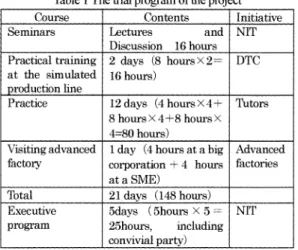
The project was executed during the trial term between the day of enrollment ceremony on October 13, 2006 to graduate ceremony on February 24, 2007, totally in 21 days, 148 hours program (Table 1). The program aims to develop problem finding ability and problem solving ability based on "the management skill" "the strategic capability""the technical capabilities" required for leaders of manufacturing processes.
The goal of the program is to develop leaders who can make logical choices based on sound theoretical understanding through linking classroom lectures and field supervision by tutors. On the other word, acquiring the power of execution by learning the principle of the object, and forming learning organization at the manufacturing site is aimed. The tutors of this program consist of active and retired engineers of TIC and Denso, the parent company of DTC.
The trial program consists of four modules, such as seminar at the university, practical training at the simulated production line, practice supported by tutors at the individual site, the site visiting of the advanced factory of big company and a medium-sized forged precision gears manufacturer, plus executive program which is held at the site of competitive SMEs for which executives of participants companies must participate, totally 5 modules. In this program, it is compulsory for the participants to attend 21 days. It might be difficult for small firms which has below 10 employees to participate in the program.
NIT developed the practical training program in cooperation with members of consortium and tutors, and also pursued the role of coordinator. 16 companies are
divided four groups but each group consists of companies from different category of industries.
Table 1 The trial program of the project
2-5 The Independence of the Program
After the trial period, the project had to be self-sustained by the initiative of NIT. In this case, about 4,500 US $ will be charged for each student, though no admission fee was charged during the trial period. Public university specific problems in the accounting processing still remain.
The way for subscription of students who take the course are through inquiry on internet webpage, repeaters from same companies, introduction from regional bank, local chamber of commerce and industry, as well as various industrial association. By CSTC as an administrative organization being gotten off, the members of consortium after April of 2007, the program is promoted as the project of NIT. Once again, NIT formed a comprehensive alliance with TIC, DTC and opened the advanced technology training program supported by those companies. From the point of financial self-sufficiency, the fixed number of places is increased. Fortunately, the program meets the student quota in fiscal year of 2007. The greatest challenges are the secretariat's functions of the school, securing of the cost or financing and management of tutors. Because the program includes few lecture style classes with the emphasis on practice such as hands on style, and because the number of students is limited, it is not easy to provide the benefits of volume efficiency.
3. DISCUSSION
The project is an integrated program consists of lectures, practical training and practice for improvement on site coached by tutors. The development and implementation
of program is executed in the consortium, and the project towards work force development is a new type of academy-industry cooperation. Innovation means not only being equipped with up-to-date machines but also making appropriate tools or machines for production by SMEs themselves. Shop managers are often the initiators and engines of innovation, ultimately diffusers of innovation to cluster companies. Those kinds of ability or capability are not created from individual skills but from group skills as learning organizations
There are very strong links between academic institutions and industry players in the dynamic clusters, intermediaries 5 such as consortium which provide increasing opportunities for innovation and cluster dynamism. Involving the leaders of key industries who are highly respected is an important point. In this context, building trust among business community such as firms, institutions and organizations is quite important. University could sometimes be very capable in enhancing trust and also could offer a good balance between self-interest and altruism to the community. However, three factors are important in relation to the university: "breadth of involvement"
,"strong base of R&D", and "regional alignment"(Paytas et al. 2004)
The project aims to nurture shop managers of heuristic ability by translating TPS creatively toward continuous improvement and creating new process by themselves. In particular, parts manufacturers single sourcing mainly for a certain big company should be reviewed vis-a-vis external environment and in respect to the whole market The students exchanged visits and discussed mutually with individual issues, which is considered to bring the attitude of viewing each firm from the third firm.. Five disciplines consisting of system thinking, personal mastery, mental model, building shared vision and team learning, are linked to the learning organization (Senge 1990). Trust is the most important issue between tutors and students including their bosses to create learning community.
On the other hand, from the viewpoint of industrial cluster, it is important to involve individuals known to be in possession of personal magnetism, to build trust among participants, firms and stakeholders and to start with areas of common interest such as workforce development The consortium is a type of economic development intermediary in the region. Creating learning organizations in the region could be aimed by the consortium through the project
4. CONCLUSION
This paper discussed about the advanced workforce development program,"tutoring school for shop manager" provided by the consortium of academy-industry cooperation. The sophisticated program has been developed with an academy-industry consortium aiming to create learning organization through the mutual learning process. The program covers seminars, visiting advanced factory, practical training at the simulated production line and practice including consultancy with tutors which covers individual issues of the firms. Some positive results are achieved during the trial program in FY 2006. It might be a major issue in thinking about how to manage the initiative centered by university. Main goal might be to take steps towards learning community in the region
Regional competitiveness sometimes depends on the capability of intermediaries. University is recognized as intermediaries in innovative cluster. Creating partnerships is a key to making regional system highly effective. Building deep relationship with universities, colleges, and technical institutes with the importance of knowledge, innovation, and technical expertise, the connection to higher education and higher levels of technical skills is crucial for establishing competitiveness.
NOTES
1. The project aims not only to develop management skill directly, but create manufacturing heroes on-site of individual firms.
2. MT provides the seminars on 'Production Management','Quality Management','Human Error','Psychology of Awareness''Innovation Management' which have four hours, two times each
References
[1] Fujimoto, Takahiro: Competition on Capability Development, Chuokoron-Shinsha, Inc.(2004) [2] Senge, Peter: The Fifth Discipline -The Art &
Practice of The Learning Organization, Currency Doubleday,(1990)
[3] Paytas, J. P., R. Gradeck and L. Andrews: Universities and the Development of Industrial Clusters, Carnegie Melon University, Center for Economic Development, (2004)
[4] Porter, Michael E.: The Competitive Advantage of Nations, The Free Press, A Division of Macmillan,
Inc., New York.(1990)