Financial Cooperation in East Asia
著者
Kunimune Kozo
権利
Copyrights 日本貿易振興機構(ジェトロ)アジア
経済研究所 / Institute of Developing
Economies, Japan External Trade Organization
(IDE-JETRO) http://www.ide.go.jp
journal or
publication title
IDE Discussion Paper
volume
68
year
2006-08-01
INSTITUTE OF DEVELOPING ECONOMIES
Discussion Papers are preliminary materials circulated
to stimulate discussions and critical comments
Keywords: International Financial Cooperation, East Asia, IMF
JEL classification: F36, O19, O53
* Director, International Economics Studies Group, Development Studies Center,
IDE ([email protected])
DISCUSSION PAPER No. 68
Financial Cooperation in East Asia
Kozo Kunimune*
August 2006
Abstract
This paper addresses the rationale for financial cooperation in East Asia. It begins by giving a brief review of developments after the Asian currency crisis, and argues that enhancing regional financial cooperation both quantitatively and qualitatively will require: (1) upgrading surveillance capabilities in the region, and (2) creating a clear division of labor between regional institutions and the IMF. It also mentions the issue of membership and the background forces that have led to the duplication of similar forums in East Asia. Although the concern over crisis management is the central issue in East Asian financial cooperation, other issues such as exchange rate policy coordination and fostering regional capital markets are discussed as well.
The Institute of Developing Economies (IDE) is a semigovernmental,
nonpartisan, nonprofit research institute, founded in 1958. The Institute
merged with the Japan External Trade Organization (JETRO) on July 1, 1998.
The Institute conducts basic and comprehensive studies on economic and
related affairs in all developing countries and regions, including Asia, Middle
East, Africa, Latin America, Oceania, and Eastern Europe.
The views expressed in this publication are those of the author(s). Publication does not imply endorsement by the Institute of Developing Economies of any of the views expressed.
INSTITUTE OF DEVELOPING ECONOMIES (IDE), JETRO 3-2-2, WAKABA,MIHAMA-KU,CHIBA-SHI
CHIBA 261-8545, JAPAN
Financial Cooperation in East Asia1 Kozo Kunimune
1. Introduction
Momentum for financial cooperation in East Asia has grown since the outbreak of the Asian Currency Crisis in 1997. The proposal by the Japanese government for an Asian Monetary Fund (AMF), which was made in the midst of the crisis, was the first attempt to form a regional institution specializing in crisis management. The AMF failed to materialize, however, due to strong opposition from the United States and the reluctance of some of Asian countries at the time. At present, though, most East Asian countries now agree on the necessity for financial cooperation in the region. As numerous arguments have been raised and discussed, the stance of the U.S. has become more flexible.
Initially, the U.S. opposed the proposal for the AMF out of fear that it would weaken the leverage of the IMF (and hence the U.S.) over the developing countries. However, it now appears that this concern was excessive, and that financial cooperation among East Asian countries will not necessarily run against the national interests of the U.S.
Actually, most of the recent literature argues in favor of regional financial cooperation, not only because it would be helpful for the region itself but also because it would be beneficial for the rest of the world including the United States. This paper reviews the rationale, development, and challenges to East Asian financial cooperation.
Section 2 addresses the rationale for financial cooperation in East Asia. A brief review of developments since the currency crisis is presented in Section 3, where it is also shown that enhancing regional financial cooperation quantitatively and qualitatively will require: (1) upgrading surveillance capability in the region, and (2) creating a clear division of labor between regional institutions and the IMF. These two points are elaborated in Sections 4 and 5. Section 6 discusses the issue of membership and the background forces that have led to a duplication of similar forums in East Asia. Although the concern over crisis management is the central issue in East Asian financial cooperation, other issues such as exchange rate policy coordination and fostering regional capital markets have been raised recently, and these are the focuses of Sections 7 and 8. Finally, Section 9 concludes.
1 This paper is a product of my research project as a visiting scholar at the Sigur Center
for Asian Studies, George Washington University, during 2004-05. I would like to thank Mike M. Mochizuki, former director of the Sigur Center for providing me with the chance to study at the Center. I would also like to thank Ikuko Turner, Debbie Toy, and Hideki Rose for the generous support they provided to me as staff of the Center.
2. Rationale for Financial Cooperation in East Asia
(1) Currency crisis contagion is a regional phenomenonThe most widely shared argument for the desirability of regional financial cooperation in East Asia derives from the fact that contagion from currency crises is a regional phenomenon (Kaminsky and Reinhart, 1999). When a country suffers from a currency crisis, its neighbors become more susceptible to contagion than remote countries. Therefore, helping neighboring countries is not a question of charity but involves self-interest. This in itself is a good reason for the establishment of a regional mechanism of financial cooperation (Ocampo, 2000, Henning, 2002, Wang, 2004, Parkinson, Garton and Dickson 2004). This also explains why neighboring countries offered bilateral support to crisis-hit countries during the recent crisis (Rose, 1999).
(2) Conservation of foreign reserves
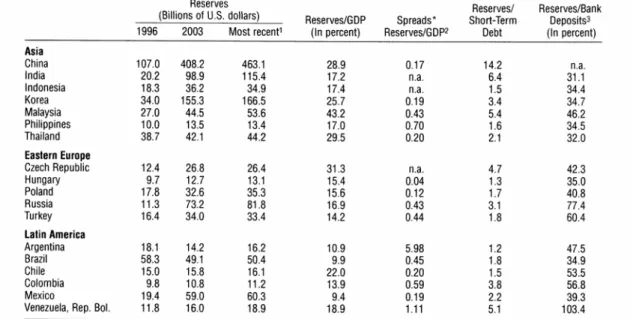
The adequacy of foreign reserves used to be measured by its magnitude relative to import value. It was said that foreign reserves were sufficient if they surpassed three months’ worth of import value. However, this is not true for countries that have liberalized international financial transactions and are exposed to the international financial market. Since the amount and speed of financial transactions surpass those of trade-related transactions, the sufficiency of foreign reserves has to be measured in terms of the amount of international financial transactions. A recent suggestion is that the amount of foreign reserves should be more than, or equivalent to, outstanding short-term foreign debt. Actually, due to a fear of a recurrence of the currency crisis, many East Asian countries have accumulated large foreign reserves that cannot be justified by conventional measurements (Bird and Rajan, 2003, Aizenmen and Marion, 2003). Recent IMF studies find that the pace of reserve accumulation has accelerated even further since 2002 (IMF, 2003b, 20042). Table 1 shows reserves and related ratios for selected countries (reprinted from IMF, 2004).
Table 1. Reserves and Related Ratios for Selected Countries as of End-2003 (Reprinted from IMF, 2004, Table 4.6)
Because the unit cost of holding foreign reserves is the differential between the home and foreign interest rate, possessing extra reserves leads to a proportional increase in total cost. If a regional financial cooperation reduces the necessity of holding extra reserves, member countries can reduce the cost of holding reserves (DRI, 2004). Rajan (2004) estimates the cost of excess reserve holding in the five Asian countries that were most severely affected by the last currency crisis3 (Rajan, 2004, appendix 11.1, pp 255). According to his study, the annual cost measured as a percentage of GDP ranged from 0.3% (the Philippines) to 0.96% (Thailand).
Furthermore, the accumulation of large amounts of foreign reserves in one part of the world can lead to serious problems in other parts of the world. If a country wants to build up reserves, its balance of payments must be in surplus, and this surplus has to be matched by deficits in other countries. Therefore, the accumulation of a large amount of foreign reserves in one part of the world results in balance of payments deficits in other parts of the world, which at worst can cause another currency crisis, and at the least can lead to an increase in the cost of international financing to relevant countries. If the formation of regional financial cooperation casts a damper on the eagerness of East Asian countries to
accumulate reserves, it will help mitigate the world’s economic imbalances. For this reason, East Asian financial cooperation would be not only in the interest of the member countries but in the common interest of the world (Park, 2002, Henning, 2002).
(3) Benefits of competition
Rose (1999) questions the monopolization of crisis management by the IMF, the only international financial institution specializing in international macroeconomic policy issues. He points out that in other fields, there are regional institutions alongside an international one. For example, in the field of security, t the United Nations, an international institution, operates alongside regional institutions such as NATO. Also, in the field of international trade, there is the World Trade Organization (WTO) as well as regional or bilateral free trade agreements (FTAs). In the field of development finance, there is the World Bank and regional financial institutions such as the ADB, IDB, and EDB.
The coexistence of an international institution and several regional institutions in the field of crisis management would be beneficial in terms of competition (Ocampo, 2002, Wang, 2004). A country could receive second opinions from competing institutions over the diagnosis of a crisis as well as appropriate countermeasures. In addition, a small country with no clout among international institutions could still exert a certain influence on a regional institution with a smaller number of member countries (Ocampo, 2000, 2002, Henning, 2002, Parkinson, Garton and Dickson 2004). This would enhance the sense of ”ownership“ of small countries in crisis management and increase the possibility that they would observe prescribed policy recommendations.
However, there is a concern that the competition would end up weakening the IMF’s role and strength in managing financial crises. This is only true if the source of the IMF’s power lies not in its superior ability to analyze the economic situation and make good macroeconomic recommendations, but in its monopolistic status. I am certain that, with its great expertise, the IMF would continue to be an important international institution for managing financial crises even if competing regional institutions came to exist. To the contrary, a competitive environment might lead to an enhancement of the IMF’s ability and efficiency as well as those of the newly formed regional institutions. In addition, there is plenty of room for mutual complementarity between the IMF and regional institutions, as is shown in the next section.
(4) Complementarity with the IMF
A regional fund could have complementarity with the IMF in at least three ways: financially, operationally, and motivationally.
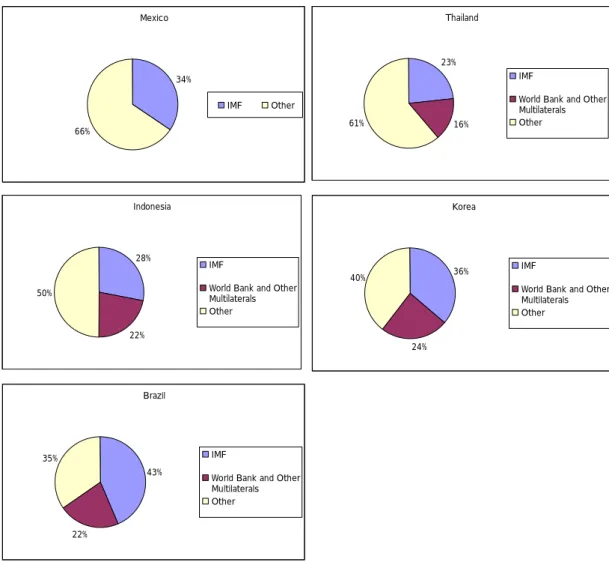
As the magnitude of a currency crisis grows, the amount of funds needed to contain it also grows. During recent crises, the financial capacity of the IMF has not been adequate. Therefore, supplementing IMF program with bilateral financial assistance in crisis management became the norm after the Mexican crisis in 1994/95 (see Figure 1). Consequently, a regional financial cooperation could complement the IMF in raising sufficient funds to help a country experiencing a crisis (Bird and Rajan, 2002, Ocampo, 2002, Henning, 2002, Wang, 2004).
It is expected that a regional institution would be more sensitive to unique regional features and would be capable of making specific prescriptions (Ocampo, 2000, Bird and Rajan, 2002). Also, as long as it were efficiently organized, it would be able to make decisions promptly and act speedily (Ocampo, 2002, Henning, 2002, Parkinson, Garton and Dickson 2004). Therefore, regional financial cooperation could complement the IMF from an operational point of view. The analysis and prescriptions made by the regional institution could be used as additional information by the IMF, and prompt action on the regional level could buy time for more deliberate IMF decision-making. Of course, everything depends on establishing efficient communications between the two institutions and setting up an efficient division of labor.
The fewer the number of members in a credit cooperation, the greater the incentive to each member to monitor the borrower. This is because as the number of members decreases, the share of loss that each individual member risks bearing grows. The same goes for international financial cooperation. A structure of regional financial cooperation, with a smaller number of members than an international one, has an advantage in this regard (Bird and Rajan, 2002). Also, the sense of ”ownership“ of each member is stronger in a regional institution than in an international one. Consequently, regional financial cooperation in Asia could complement the IMF by enhancing the incentives for countries to participate actively. By cooperating with regional institutions, the IMF could count on mutual monitoring among regional countries on top of its own monitoring. At the same time, it could evade the charges that it imposed excessive conditionalities and undermined economic ”sovereignty” if it had good communications with regional institutions in formulating conditionalities.
Table 2 shows the IMF quotas for selected countries. This quota largely determines the member's voting power in the IMF. Also, the amount of financing a member can obtain from the IMF (its access limit) is based on its quota. The ten ASEAN countries combined have only 3.458 per cent of the quotas, while ASEAN+3 has 12.718 per cent. Even if we include Australia and New Zealand, the sum is 14.666 per cent, which is still smaller than
that of the United States. In contrast, EU has 30.346 per cent altogether4, the G7 countries have 46.397 per cent, and the G7 plus EU have 57.15 per cent. There is criticism that the re-distribution of quotas is almost never carried out. And even when it is, it does not reflect countries’ relative economic power properly, since powerful countries are generally reluctant to agree to a reduction of their shares. As a result, countries that have experienced high economic growth tend to be underrepresented5 (Buira, 2003). It seems unlikely that East Asian countries will gain a large share in the IMF any time soon.
(5) Merits in terms of international relations
Our arguments so far have concentrated on the economic aspect alone, but regional financial cooperation has significance in terms of international relations in East Asia as well. It is one of few topics upon which every country in the region can agree without much difficulty. It can foster an atmosphere conducive to building trust among nations (Rose, 1999, Henning, 2002). It goes without saying that peaceful international relations among East Asian countries would be helpful not only for the region but also for the world.
4 Before the expansion of its membership in 2005.
Figure 1. Share of Official Financing in Recent Crisis Resolution Efforts
* “Other” consists mainly of bilateral assistances given by other countries. Source: IMF, 2003a, Lane et al., 1999
Mexico 34% 66% IMF Other Thailand 23% 16% 61% IMF
World Bank and Other Multilaterals Other Indonesia 28% 22% 50% IMF
World Bank and Other Multilaterals Other Korea 36% 24% 40% IMF
World Bank and Other Multilaterals Other Brazil 43% 22% 35% IMF
World Bank and Other Multilaterals Other
Table 2. Share of IMF Quotas of Selected Countries and Regions (%) G7 46.397 UNITED STATES 17.521 JAPAN 6.279 GERMANY 6.135 FRANCE 5.065 UNITED KINGDOM 5.065 ITALY 3.328 CANADA 3.004 G7 + other EU (*) countries 57.15 EU (*) 30.346
G7 + other EU (*) countries - Japan 50.871 ASEAN 3.458 PHILIPPINES 0.415 THAILAND 0.51 SINGAPORE 0.407 BRUNEI DARUSSALAM 0.101 INDONESIA 0.981 MALAYSIA 0.701 CAMBODIA 0.041
LAO PEOPLE'S DEM. REPUBLIC 0.025
VIETNAM 0.155
MYANMAR 0.122
ASEAN+3 12.718
ASEAN+3+Australia and New Zealand 14.666 (*) Before the expansion of its membership in 2005.
Source: International Monetary Fund, Eleventh General Review, 1999
3. Development of Regional Financial Cooperation in East Asia
The Asian currency crisis of 1997/98 created momentum for regional financial cooperation. There were large differences in the sense of crisis between Asian countries and the United States at the early stage of the crisis. Of course, it is no wonder that neighboring countries worry much more than other countries, given that the contagion of a currency crisis is regional in nature. However, in the face of the lukewarm American response to the crisis, some Asian countries, under the initiative of Japan, came up with the idea of setting up an Asian Monetary Fund (AMF). The details were never fixed, because the proposal was abandoned early on due to strong opposition from the U.S. We only have a broad picture, but it is said that: (1) the AMF’s total capitalization would have been 50 to 60 billion dollars at the outset, rising eventually to 100 billion, (2) mutual surveillance by members of their economic conditions would have been conducted by similar mechanisms as the G7, and (3) technical assistance through the dispatch of specialized experts would have been provided to member countries experiencing bad economic situations (Onozuka, 1999).
While the attempt to set up the AMF seems to have ended in failure, a forum called the Manila Framework Group (MFG) was created in November 1997 as a sort of compromise between Asian countries and the U.S. Its members include major East Asian countries, the U.S., Canada, Australia, and New Zealand as well as representatives of the IMF, World Bank, BIS and ADB. Its major task is to enhance surveillance in the region. Although a cooperative financing arrangement (CFA) was agreed to, the terms and amount of the financial assistance which would be provided during a crisis period were not formulated but were to be negotiated on a case-by-case basis, and to be conditional on an agreement between the IMF and the country concerned. It seems that the MFG has now lost the momentum to develop a more formal framework for financial cooperation (Grenville, 2004, Ito and Narita, 2004).
In May 2000, a much more ambitious scheme called the Chiang Mai Initiative (CMI) was announced by the ASEAN+3 finance ministers. It is an attempt to form a network of currency swap agreements between East Asian countries, to be available when the next currency crisis occurs or is poised to occur. Under the initiative, sixteen bilateral swap agreements (BSAs) were newly formulated, and the existing ASEAN swap agreement (ASA) was expanded. As of the end of 2003, all agreements that were initially scheduled had been completed, totaling about 36.5 billion dollars (see Figure 2). Considering that the AMF was expected to have 50 to 60 billion in funds at the initial stage, the total size of the CMI is about half as large as the planned size of the AMF.
Figure 2. Network of Bilateral Swap Arrangements under the Chiang Mai Initiative
Source: Ministry of Finance, Japan, URL: http://www.mof.go.jp/jouhou/kokkin/ChiangMaiInitiative050125.pdf
Although the total size of the CMI seems impressive on the surface, the actual amount that any member country can use is by no means large. Since the CMI is a bundle of bilateral swap agreements, a mere sum of the amount of pledged money does not mean anything beyond illustrating the size of the system. For example, the amount of money pledged to Indonesia bears no connection to the amount of money that Thailand can avail itself of. In contrast, since the AMF was expected to have a pooled fund, the amount of funds available to each member would be related to the total fund size even though some form of ceiling might be applied. In addition to this, only 10% of pledged amount can be disbursed immediately under the CMI scheme, with the rest becoming available only after the country successfully negotiates a program with the IMF. As a result, Thailand can only access 900 million dollars under the present framework in the absence of an IMF agreement (Sussangkarn and Vichyanond, 2004). This would hardly be sufficient to contain a currency crisis as big as the last one6. The bottom line is that, compared to the AMF, (1) the CMI is small in terms of total funds, and (2) the availability of funds to individual member may be far smaller, due to its bilateral nature.
The major reason for the small size of available funds under the CMI is the fear of moral hazard. The issue of moral hazard has been raised in the context of international bailout efforts since the Mexican currency crisis in 1994/95, when the U.S. government pledged a huge amount of money along with the IMF program. Those who criticized the program argued that the assistance provided to the Mexican government ended up being used to repay borrowing from private investors who had lent money recklessly. Opponents also claimed that, since those investors lent the money at high interest rates due to the risk premium, it was unfair for them to evade the consequence of default thanks to the international bailout effort. More importantly, concern was voiced that this kind of bailout would become a bad precedent, and investors would be further inclined to reckless lending in the future. In other words, the opponents feared that the international rescue effort would create moral hazard. In addition, a country’s policy decisions may become unsound if policymakers believe that international assistance will be available if things go wrong. They may become irresponsible and delay critical policy decisions until the situation gets out of control. This is another type of moral hazard problem. Even the IMF has been criticized on these grounds (International Financial Institution Advisory Commission, 2000). It is an even more serious concern in the case of the CMI.
Since there is a danger that policymakers may implement irresponsible policies, the prevention of the problem necessitates that the following: (1) the economic situation of member countries has to be monitored on regular basis, (2) the criteria for which rescue will be provided have to be clear and appropriate, and (3) external interventions that can change economic policies must be enabled. For example, the IMF conducts regular surveys of the economic health of member countries (known as Article IV consultations), and does not provide rescue money without stringent conditions (so-called conditionalities), which are sometimes criticized as being blunt and cruel. The fact is that the CMI does not yet have a rigid mechanism for monitoring, and this is the greatest obstacle preventing it from having sufficient funds.
As for the moral hazard problem related to international investors, strengthening surveillance would be helpful all the same. Disclosing the information acquired by surveillance to the greatest extent possible helps prevent reckless lending. However, other mechanisms are also necessary to mitigate the problem. What is crucial is to ensure that investors cannot take their money back safely, at the cost of international rescue money. To prevent this from happening, a proposal was made for the international community to set up a definite procedure for dealing with countries having difficulty in making external payments, under which all creditors, including private investors, would be prevented from claiming repayment until a reliable work-out plan was formulated. The procedure was called the
private sector involvement (PSI) mechanism. The original proposal assumed that the IMF would act as a coordinator guiding the procedure (Krueger, 2001). If this is the case, the existence of a regional fund that provided financial assistance before the IMF might cause serious problems, since it would open the exit gate for private investors before the PSI procedure began (Parkinson, Garton and Dickson 2004). In the end, however, it proved difficult to form a consensus on how to establish the PSI mechanism, and no mechanism has been established yet. Alternatively, a framework of regional financial cooperation could incorporate PSI mechanisms, although it would seem infeasible unless a permanent specialized institution like the IMF is set up. Provided this, the institution would have to work in close cooperation with the IMF to secure the PSI process.
It is now apparent that enhancing regional financial cooperation quantitatively and qualitatively necessitates: (1) upgrading surveillance capability in the region, including the setting up of a specialized institution for surveillance, and (2) arranging for a clear division of labor between regional institutions and the IMF, including on matters related to PSI. These two points are elaborated in Sections 4 and 5, respectively.
4. A Framework for Solid Surveillance
A simple and clear-cut way to conduct surveillance is to set up specialized institutions like the IMF, although this requires financial and human resources. An alternative way is surveillance conducted by (sometimes multi-layered) meetings of government officials representing each member country, in the way that is done in East Asia at numerous forums including ASEAN+3 and the MFG. Of course, these two methods are not mutually exclusive. In any case, the fact is that there is not yet a specialized regional institution for macroeconomic surveillance in East Asia. Among regional forums, it is said that the MFG is providing the most qualified surveillance at present (Kuroda and Kawai, 2002, Grenville, 2004). But this is mainly because its membership includes international institutions such as the World Bank and IMF, which have expertise in surveillance activities. In other words, the MFG is outsourcing its surveillance activity to the international institutions. This is surely cost effective, but it makes the MFG seem less like a regional forum, which is one reason why some Asian counties prefer ASEAN+3.
An East Asian forum could also outsource surveillance activity to the ADB. This might be much more suitable for a regional forum, since the ADB is a regional institution. Moreover, the ADB has aspirations to play this role as well (de Brouwer 2004). However, since the ADB specializes in development finance, it lacks the expertise of the IMF in conducting macroeconomic surveillance. Therefore, it will have to expand its functions, and
this will mean more money and human resources. Thus, in terms of costs, it may not be very different from setting up an entirely new specialized regional institution for macroeconomic surveillance.
As stated earlier, when the AMF was proposed, mutual surveillance of economic condition among the members was expected to be similar to the mechanism used by the G7. G7 summits are, in fact, the supreme forum in international financial issues, and wield great influence. But if it were not for the IMF and the World Bank, which are largely controlled by the G7 countries through their voting power, the G7 would not be able to wield the influence that it does. In a sense, these international financial institutions play the role of de facto secretariat and implementing agency for the G7, fulfilling their will in issues related to both international finance and aid. They provide high-quality analyses on general economic issues, specific hot issues of the time, and country-specific economic issues, which the G7 countries can make use of. They also formulate policy recommendations for member countries (as well as for non G7 countries) on the G7’s behalf. The IMF is especially useful for G7 countries when it comes to crisis management, enabling them to make a prompt response.
As can be seen from this example, it can be said that the existence of a specialized institution, which plays the role of secretariat and implementing agent, is crucial for regional financial cooperation to succeed. Such an institution, whether an enhanced ADB or newly established one, must come into existence if East Asian countries are really serious about a form of financial cooperation capable of crisis management.
5. The Division of Labor with the IMF
Parkinson, Garton and Dickson (2004) categorized the division of labor between the IMF and regional institutions into five types. The first type is not relevant here, since such a relationship already exists in East Asia. Thus, I will refer to the remaining four types, which are: (1) the IMF acts as the lead crisis manager and the regional fund provides complementary support, (2) the regional fund acts as the lead crisis manager and the IMF provides complementary support, (3) the regional fund provides the initial attempt at resolving a crisis, and the IMF stands by as a lender of second resort, and (4) the IMF provides the initial attempt at resolving a crisis, and the regional fund stands by as a lender of second resort. Under types 1 and 2, both institutions work in the same way, while under types 3 and 4, there is a sequential division of labor between them, with one taking over if the other fails.
Although Parkinson, Garton and Dickson do not issue a definitive judgment, they argue that a system of type 4 seems unrealistic for East Asia, since the IMF will not easily
relinquish its function and, if it does, the regional fund would require enormous courage to take over a rescue attempt that even the IMF was unable to handle. They also noted that the type 3 arrangement might cause some trouble in terms of PSI mechanisms. If the IMF comes to serve as the coordinator in the PSI process, it should be involved in handling the crisis from the very beginning, to make sure that private investors cannot take their money out of the country in anticipation. However, it is too early to worry about this, because the formal process of PSI has not been agreed to yet.
Under the CMI scheme, 10% of the pledged amount is available without an IMF program, but the rest is only available after the country successfully negotiates with the IMF. Thus, it can be said that the CMI in its present state is somewhere between type 1 and 3. As the surveillance mechanism of the CMI develops, the share of the pledged amount available without the IMF is expected to grow, meaning that it will become closer to type 3. If this is the case, East Asian leaders will have to consider incorporating some form of PSI into the CMI process, since proper management of the early stage of crisis is crucial for the success of PSI.
Bird and Rajan (2002) consider a relationship where a regional fund takes first action in crisis management, and argue that this would be beneficial for the IMF as well. First, it would mitigate criticism that the IMF is intrusive, disregards specific regional characteristics, and so on. Second, it would lessen the financial burden on the IMF and release financial resources for other countries. Thus, they maintain, a regional fund could be complementary to the IMF. A sequentially arranged division of labor, with a regional fund acting first and the IMF standing by as the second mover, would suppress excessive competition between them and give full play to the complementarity between them7.
Henning (2002) considers the relationship between the IMF and regional funds from a different point of view. He uses the analogy of the relationship between WTO and regional or bilateral FTAs. The WTO sets criteria on how the individual FTA should be formed, what kind of agreement can be allowed, and what cannot. If an FTA satisfies these conditions, the WTO does not oppose its establishment. Similarly, the conditions for establishing regional funds should be incorporated into the IMF treaty, he argues, and the international community should welcome any regional fund that satisfies the set conditions. His recommendations for appropriate conditions are; (1) the terms of a regional fund must not contradict the obligations that individual countries bear under the IMF treaty, (2) the rules and operational procedures must be transparent, and (3) the terms must include the
7 Bird and Rajan do not neglect to mention that the regional fund should request that
potential borrower maintain healthy financial regulatory systems, and lend at higher interest rates than the market rate in order to avoid moral hazard problems.
principle that financial support will be provided to a country facing a liquidity crisis but not a solvency crisis, (4) at a higher interest rate than the market rate, and (5) with proper conditionalities or in parallel with an IMF program.
In conclusion, it is possible to arrange a consistent and complimentary relationship between the IMF and a regional fund. In actuality, East Asia has developed what has turned out to be a partially sequential division of labor between the IMF and a regional fund, with only a portion of the regional fund being available in the early stage of crisis resolution in the absence of an IMF program. The system seems to be heading toward a full-fledged sequential relationship through an increase in the proportion of fund available in the absence of an IMF program. There is no reason to oppose this movement, but some important steps have to be taken before the regional fund will become truly useful and not harmful. Aside from the surveillance issue, the regional fund should incorporate a PSI mechanism if it hopes to be the first actor in crisis management. Doing this will require establishing a specialized institution that plays the role of secretariat and administers day-to-day operations. Creating an institution would have other advantages as well. First, it is difficult to accumulate experiences if rigid institutions are not in place. Second, the existence of a permanent institution would enable personal exchanges with the IMF and enhance mutual cooperation with it.
6. Range of Membership
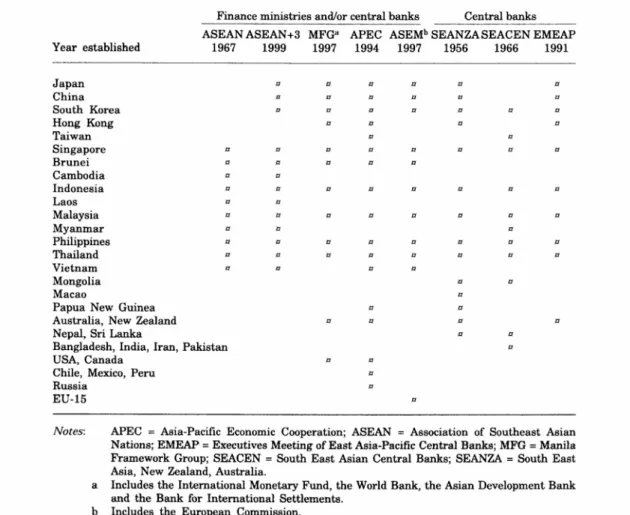
As a result of international political dynamics, the region has suffered from “duplication syndrome” in terms of efforts to form regional forum in all areas. Simply stated, while the United States feels uneasy about growing regionalism in East Asia, some East Asian countries want to create a regional forum without the U.S. (Munakata, 2004). The result of this tug-of-war has been the creation of many similar forums set up with slightly different memberships. This is the case for regional financial cooperation as well. Notably, the MFG includes the United States as a member, whereas ASEAN+3 does not.
Table 3 (reprinted from Kuroda and Kawai, 2002) lists forums that deal with financial cooperation. There are three forums made up of regional central banks, and five forums made up of finance ministries and central banks. While duplication is costly not only financially but also in terms of human resources, we cannot avoid it completely given the presence of a complex international political environment. Looking on the brighter side, one can expect checks and balances between forums if there are overlaps in the matters they concern themselves with (Grenville, 2004). Therefore, we do not necessarily have to confine the number of forums that are dealing with the same issues, but must compare the costs
and benefits resulting from the duplication. It would be helpful for further examination to focus on some of the forces behind the formation of these forums.
(1) The United States and East Asian regionalism
The United States sometimes shows strong concern about East Asian regionalism and, out of fear of losing its influence on East Asian countries, it opposes all plans to establish forum that do not include it. For example, APEC meetings were established with the U.S. as a member, after the proposal to establish the East Asia Economic Caucus (EAEC), which was not expected to include it, was buried. The same is true for the establishment of the MFG and the failed attempt to create the AMF.
Outside the regional forums of central banks (which will be dealt with in the next section), ASEAN, ASEAN+3 and ASEM do not include the U.S. as a member, while the MGF and APEC do. As already noted, the MFG has an advantage in the area of surveillance, and ASEAN+3 has an advantage in terms of its eagerness to develop mutual financial assistance against crisis. It is natural to think that these two forums should be merged or should at least cooperate closely, since they can be mutually complementary. But the fact that they have different memberships, with one including the U.S. and the other excluding it, makes that task difficult. Looking on the bright side, there is a benefit in terms of competition as well as checks and balances.
On one hand, including the United States in a forum makes sense because of the strong economical and political relationship between the U.S. and many East Asian countries. On the other hand, it is also reasonable to exclude the U.S. in consideration of the sense of ownership. Some East Asian countries might feel marginalized in a forum that includes among its members the strongest nation of the world, the United States. This would weaken their commitment to the forum and lessen the usefulness of regional cooperation, which in the final analysis does not contribute to the national interest of the United States. On balance, the duplication of forums seems unavoidable when seen from this perspective.
(2) Forums of central banks
None of the regional forums of central banks include the United States as a member. One reason for this may be the fact that central banks have little to do with international political games. Accordingly, they tend to focus on technical issues such as prudential regulations on commercial banks and the management of payment systems. There is no need for the U.S. to worry about becoming politically isolated in the region if its central bank (i.e. the Federal Reserve) does not join these forums. Moreover, the Federal Reserve might not even want to become involved in a regional forum since it tends to avoid
all restrictions that might interfere with its discretion over US monetary policy.
Forums of central banks suffer little from international political power games, thanks to the technical nature of their cooperation. This is both a strong and a weak point. Lacking political clout, they cannot be the backbone for regional cooperation.
(3) Australia and New Zealand
Whether these two countries should be included in a forum is sometimes made into a matter of debate, although not as much as with the United States. The reason may be emotional as well as political. Some ASEAN countries hope to exclude these countries from an East Asian forum on the ground that they will bring excessive cultural, racial, and linguistic heterogeneity. It is true that a smaller and homogenous membership is an advantage for coming to consensus smoothly, but these two countries are located in East Asia and have close economic relations with other countries within the region. It is fair to say that they should be treated differently from the United States and allowed to join any regional forum.
(4) Power games in Northeast Asia
Some authors express concern about the power games between Japan and China, which may hamper the development of any form of regional cooperation in East Asia (Park, 2002). Frequent outbursts of nationalistic sentiments in China and South Korea over prewar Japanese militarism are seen as stumbling blocks as well. However, these concerns might in fact highlight the importance of developing regional financial cooperation. Because cooperation in the field of economics is easier than in other areas, development here could be a first step toward easing the tension and nurturing an atmosphere for broader cooperation in the region.
Table 3. Regional Forums of Finance Ministries and Central Banks
Source: Kuroda and Kawai (2002), Table 2
7. Exchange Rate Policy Coordination
East Asian financial cooperation is unique in that it has been initiated with the intention to respond to future currency crises (Bhattacharya, 2002). In contrast, the centerpiece of European regional financial cooperation has been the coordination of exchange rate policy , which led eventually to the formation of a single currency, the euro. In Latin America, the Andean Reserve Fund, which has developed into the Latin American Reserve Fund, was formed for the purpose of providing development funds to member countries at low cost (Ito and Narita, 2004).
While crisis management is the main concern in East Asia, cooperation in other fields might be helpful as well. One ambitious attempt would be exchange rate policy coordination. Looking at economic indicators that show the degree of regional integration, East Asia is now comparable to Western Europe in 1970, when its core member countries
committed themselves to forming a monetary union by 1980 (Henning, 2004). While East Asian intra-regional exports reached the level of 47 per cent of total exports in the mid-1990s, those of the six members of the European Community were 48.6 per cent of their total exports in 1970.
Although some Japanese scholars and institutions have aired a proposal for a common basket peg in the region (IIMA, 2004), consensus cannot be expected any time soon. For one thing, some argue that stabilizing the yen-dollar exchange rate would be more useful than coordinating exchange rate policy inside the region, since most of the countries in the region have close economic relations with both Japan and the United States. For another, many countries in the region have already adopted a managed float, and may be reluctant to implement any changes in the regime, which would constrain their discretion in managing exchange rates (Sussangkarn and Vichyanond, 2004).
It seems that the momentum for regional exchange rate policy coordination is not sufficiently mature, and more time and effort will be required before a consensus can be reached. For the time being, this issue should be put aside, to be used perhaps to encourage the future development of regional financial cooperation.
8. Fostering a Regional Capital Market
Another area that has seen some recent developments is the fostering of regional capital markets. It is expected that the development of a capital market will help extend the maturities of financial contracts, and, if securities are traded in local currencies, decrease the degree of currency mismatch. Both the regional central banks and finance ministries have committed themselves to this.
In June 2003, EMEAP, a forum of regional central banks, announced the establishment of the Asian Bond Fund (ABF). Under this system, a portion of the regional foreign exchange reserve has been pooled and invested into a regional security market (the initial amount of the fund is US $1 billion). It is expected, in addition to developing regional capital markets, to allow for the recycling of the region’s foreign exchange reserve as well as the diversification of central bank assets. Some possible drawbacks are: (1) the investments are currently made into dollar-denominated government bonds (though in the next phase, investments will be made into bonds denominated in local currencies), (2) it does not invest in corporate bonds, and (3) it is passively managed by the BIS under a trust account. There is also concern that will have a pro-cyclical nature in the event of a currency crisis, since central banks might cash in the funds and depress asset prices in the region.
I am particularly suspicious of the recycling argument. Considering the regional economy as a whole, the purchase of bonds by central banks using their foreign exchange
reserves means an infusion of foreign currency in the market, which has exactly the same effect as a foreign exchange intervention to appreciate the local currency. To neutralize this effect, central banks have to intervene in the market and buy foreign currency, leading to an accumulation of reserves. Therefore, it seems that they end up either holding more foreign exchange reserves, and/or appreciating the local currency.
Meanwhile, in December 2002 the ASEAN+3 finance ministries announced the Asia Bond Market Initiative (ABMI), and set up six working groups to examine a wide variety of measures for nurturing regional capital markets, including measures to improve the market environment. In May 2004, they set up the Asian Bonds Online Website (ABW), which provides information about infrastructure, law and regulations, and activity in the regional bond markets, as well as developments in the ABMI.
While no objections have been raised to fostering local bond markets traded in local currency, there is concern about establishing regional markets that operates within the international environment, meaning an offshore market, for fear that national authorities will lose control over financial transactions, leading to a potential disturbance of the currency market in a crisis situation (Sussangkarn and Vichyanond, 2004).
9. Conclusion
The experience of the currency crisis in 1997/98 created new momentum for regional financial cooperation in East Asia. Although the first attempt at cooperation --- the proposal for the AMF --- failed, it sparked a wider debate about the issue, and was followed by several attempts such as the formation of the MGF and CMI. Among them, the CMI announced by the ASEAN+3 finance ministries is the leading contender to become a regional fund with a formal mechanism of mutual financial cooperation, while the MGF has an advantage in the area of macroeconomic surveillance activities.
Most of the literature favors the development of regional financial cooperation on the following grounds: (1) the regional nature of crisis contagion, (2) the conservation of foreign reserves, (3) the benefits of competition with the IMF, (4) complementarity with the IMF, and (5) its potential contribution to better international relations within the region. On the other hand, there is also widespread fear of moral hazard, and this is the most serious deterrent that keeps the available fund size under the CMI from growing. There is a pressing need to establish an effective mutual surveillance mechanism for dealing with this problem.
It is also important to organize the division of labor between the IMF and the regional fund as it develops. If the regional fund is expected to take primary responsibility during the early stage of crisis management, it also has to incorporate a mechanism to secure the PSI process. To take advantage of complementarity with the IMF, there should be
strong and enduring communication between the two.
All of the above --- effective surveillance, incorporation of the PSI process, and communication with the IMF --- necessitate the establishment of a permanent specialized institution which plays the role of secretariat as well as an administrator of daily operations. This can be accomplished either by extending the functions of the ADB, or by creating a new institution from scratch.
Although the unique feature of East Asian financial cooperation is that it is motivated mainly by the necessity to prepare for crises, cooperation in other areas will be useful for maintaining and strengthening the momentum. One such area is the coordination of exchange rate policy among countries of the region, but more time will be required to reach any consensus on this issue. It is best to keep it under consideration and continue discussions until the appropriate time comes. Another area is forms of technical assistance or transmission of knowledge that will help strengthen the financial systems of the countries of the region. The ABMI and the ABW, which are driven by ASEAN+3, are good examples. As for fostering capital markets in the region, regional central banks can also play an active role. They established the ABF and used it to invest a part of their foreign reserves into locally issued bonds. Although it has dubious significance for conserving foreign reserves, it will help the regional bond markets develop.
<REFERENCES>
Aizenman, Joshua, and Nancy Marion, 2003, “The High Demand for International Reserves in the Far East: What is Going On?” Journal of the Japanese and International Economies, 17, pp. 370-400.
Bhattacharya, Amar, 2002, “Comment on Yung Chul Park and Daniel Heymann,” in Jan J. Teunissen ed., A Regional Approach to Financial Crisis Prevention: Lessons from Europe and Initiatives in Asia, Latin America and Africa, Forum on Debt and Development (FONDAD): The Hague.
Bird, Graham, and Ramkishen S. Rajan, 2003, “Too Much of a Good Thing? The Adequacy of International Reserves in the Aftermath of Crises,” The World Economy, Vol. 26, pp. 873-91.
---, 2002, “The Evolving Asian Financial Architecture,” Essays In International Economics, No. 226, February.
Buira, Ariel, 2003, “The Govenance of the International Monetary Fund,” in Inge Kaul et al. eds, Providing Global Public Goods, 2003, Oxford University Press.
de Brouwer, Gordon, 2004, “IMF and ADB Perspectives on Regional Aurveillance in East Asia,” in Cordon de Brouwer and Yunjong Wang, eds, Financial Governance in East Asia, Routledge/Curzon: New York.
DRI, 2004, “Toward a Regional Financial Architecture for East Asia,” Danareksa Research Institute.
Grenville, Stephen, 2004, “Policy Dialogue in East Asia: Principles for Success,” in Cordon de Brouwer and Yunjong Wang, eds, Financial Governance in East Asia, Routledge/Curzon: New York.
Henning, C. Randall, 2002, East Asian Financial Cooperation, Policy Analyses in International Economics 68, Institute for International Economics: Washington D.C.
---, 2004, “The Complex Political Economy of Cooperation and Integration,” in Cordon de Brouwer and Yunjong Wang, eds, Financial Governance in East Asia, Routledge/Curzon: New York.
IIMA, 2004, “Research Papers and Policy Recommendations of Toward a Regional Financial Architecture for East Asia,” Institute of International Monetary Affairs. International Financial Institution Advisory Commission, 2000, International Financial
Institutions Reform: Report of the International Financial Advisory Commission, US Congress.
Independent Evaluation Office, July 28.
---, 2003b, World Economic Outlook, September, Washington DC.
---, 2004, Global Financial Stability Report, September, Washington DC.
Ito, Takatoshi, and Koji Narita, 2004, “A Stocktake of Institution for Regional Cooperation,” in Cordon de Brouwer and Yunjong Wang, eds, Financial Governance in East Asia, Routledge/Curzon: New York.
Kaminsky, G., and C. Reinhart, 1999, “On Crises, Contagion and Confusion,” Journal of International Economics 51: 145-68.
Krueger, A., 2001, “International Financial Architecture for 2002: A New Approach to Sovereign Debt Restructuring,” speech at the National Economists’ Club Annual Members.
Kuroda, Haruhiko, and Masayoshi Kawai, 2002, “ Strengthening Regional Financial Cooperation in East Asia,” Pacific Economic Papers 51 (October).
Lane, Timothy, Atish Ghosh, Javier Hamann, Steven Phillips, Marianne Schultze-Ghattas, and Tsidi Tsikata, 1999, IMF-Supported Programs in Indonesia, Korea and Thailand, Occasional Paper No. 178, International Monetary Fund: Washington DC.
Munakata, Naoko, 2004, “Metamorphosis of East Asia: Toward Regional Economic Integration,” mimeo, George Washington University.
Ocampo, Jose Antonio, 2002, “The Role of Regional Institute,” in Jan J. Teunissen ed., A Regional Approach to Financial Crisis Prevention: Lessons from Europe and Initiatives in Asia, Latin America and Africa, Forum on Debt and Development (FONDAD): The Hague.
---, 2000, “Reforming the International Financial Architecture: Consensus and Divergence,” in Deepak Nayyar, ed., New Roles and Functions of the UN and the Bretton Woods Institutions.
Onozuka, M., 1999, “Ajia Tuka Kikin Kohso Houkai no Genin,” mimeo: Keio University. Park, Yung Chul, 2002, “Beyond the Chiang Mai Initiative: Rationale and Need for a
Regional Monetary Arrangement in East Asia,” in Jan J. Teunissen ed., A Regional Approach to Financial Crisis Prevention: Lessons from Europe and Initiatives in Asia, Latin America and Africa, Forum on Debt and Development (FONDAD): The Hague.
Parkinson, Martin, Phil Garton, and Ian Dickson, 2004, “The Role of Regional Financial Arrangements in the International Financial Architecture,” in Cordon de Brouwer and Yunjong Wang, eds, Financial Governance in East Asia, Routledge/Curzon: New York.
Rajan, S. Ramkishen, 2004, “Unilateral, Regional and Multilateral Options for East Asia,” in Cordon de Brouwer and Yunjong Wang, eds, Financial Governance in East Asia, Routledge/Curzon: New York.
Rose, Andrew K., 1999, “Is There a Case for an Asian Monetary Fund?” FRBSF Economic Letter, 99-37; December 17, Federal Reserve Bank of San Francisco. Sussangkarn, Chalongphob, and Pakorn Vichyanond (2004), “Toward a Regional
Financial Architecture for East Asia: Perspectives Based on the Thai Experience,” Thailand Development Research Institute.
Teunissen, Jan Joost, 2002, A Regional Approach to Financial Crisis Prevention: Lessons from Europe and Initiatives in Asia, Latin America and Africa, Forum on Debt and Development (FONDAD): The Hague.
Wang, Yunjong, 2004, “Instruments and Techniques for Financial Cooperation,” in Cordon de Brouwer and Yunjong Wang, eds, Financial Governance in East Asia, Routledge/Curzon: New York.