Platforms and firm capabilities : a study of
emerging global value chains
著者
Ding Ke
権利
Copyrights 日本貿易振興機構(ジェトロ)アジア
経済研究所 / Institute of Developing
Economies, Japan External Trade Organization
(IDE-JETRO) http://www.ide.go.jp
journal or
publication title
IDE Discussion Paper
volume
432
year
2013-11-01
INSTITUTE OF DEVELOPING ECONOMIES
IDE Discussion Papers are preliminary materials circulated
to stimulate discussions and critical comments
Keywords: platform, network effect, emerging economies, value chain governance
JEL classification: L63, O14, O17
* Associate Senior Research Fellow, IDE-JETRO ([email protected])
IDE DISCUSSION PAPER No. 432
Platforms and Firm Capabilities: A
Study of Emerging Global Value
Chains
Ke DING*
November 2013
Abstract
This paper discusses globalization’s impact on production and distribution systems in
emerging economies. On one hand, globalization has resulted in an increasing
number of multinational corporations to adopt a platform strategy for their customers
in emerging markets. On the other hand, developing countries have witnessed the
integration of an increasing number of traditional marketplaces into a powerful
distribution system, characterized as a specialized market system. Consequently, an
unique industrial organization has developed in emerging economies, regarded as
emerging global value chains (EGVCs). They comprise a large number of small
firms together with a small number of large platform providers and display the
“market” type general governance patterns. Firms in EGVCs are more likely to
realize functional upgrading and grow into strong lead firms.
The Institute of Developing Economies (IDE) is a semigovernmental,
nonpartisan, nonprofit research institute, founded in 1958. The Institute
merged with the Japan External Trade Organization (JETRO) on July 1, 1998.
The Institute conducts basic and comprehensive studies on economic and
related affairs in all developing countries and regions, including Asia, the
Middle East, Africa, Latin America, Oceania, and Eastern Europe.
The views expressed in this publication are those of the author(s). Publication does not imply endorsement by the Institute of Developing Economies of any of the views expressed within.
INSTITUTE OF DEVELOPING ECONOMIES (IDE), JETRO 3-2-2, WAKABA,MIHAMA-KU,CHIBA-SHI
CHIBA 261-8545, JAPAN
©2013 by Institute of Developing Economies, JETRO
No part of this publication may be reproduced without the prior permission of the
IDE-JETRO.
1 1. Introduction
This paper discusses the impact of globalization on the production and distribution systems in emerging economies. Up to the 1990s, globalization was undoubtedly dominated by multinational corporations (MNCs). These corporations concentrated on the high value-added segments of value chains, such as research and development (R&D) on core technology and key components as well as branding and marketing activities, while extending their production network to developing countries. On one hand, MNCs manufacture cheaper products using local production resources, while on the other, they sell these products to developed countries and high-end markets in developing countries via their own sales networks. Given their experience with aspects of the production and distribution chain, firms from developing countries can increase growth opportunities by trading with and learning from MNCs (Gereffi 1999; Humphrey and Schmitz 2000, 2002; Gereffi, Humphrey, and Sturgeon 2005)
Since 2000, however, a new type of economic globalization has emerged. An apparent change is that trade between emerging economies has substantially increased. From 2000 to 2010, trade between developing countries accounted for 15%–29% of the world’s total trade volume (United Nations, various years)1. Interestingly, the 2008 global
financial crisis only accelerated this trend.
We argue that this phenomenon reflects the emergence of a new type of global value chain that is primarily characterized by firms in developing countries (with a special emphasis of Chinese firms), without the active participation of MNCs acting as lead firms. In this paper, this phenomenon is referred to as Emerging Global Value Chains
1 The data of developing countries is calculated based on data of world total and developed
countries. Developing countries here are regarded as the rest of the world besides developed countries.
2 (EGVCs)2.
Unlike traditional global value chains, EGVCs primarily constitute countless indigenous local firms, including both suppliers and lead firms. For example, Yiwu, China, holds the world’s largest industrial and commercial cluster of daily necessities, where 70,000 shopkeepers trade with 210,000 merchants from emerging markets each day (Ding 2012). China’s mobile phone industry is characterized by 2000 integrators
and 500 design houses in Shenzhen and Shanghai.3 Nearly half of their products are
sold in emerging markets (Ding and Pan 2013). Similar patterns can be observed in many of China’s industries such as consumer electronics (e.g., MP3 players, DVD players.), automobiles, motorcycles, bicycles and apparels.4
Firms in developing countries face several obstacles to their active participation in international trade and global production. They generally lack core competence in value chain segments such as R&D, design, branding, and marketing. The considerable differences in demand structures between developed and emerging economies make it far more difficult to conduct effective marketing activities in the latter (Karnani 2007).
2 The term of EGVC is originated from the term of “Shanzhai system”. In Ding and Pan
(2013, p.132), Shanzhai system is defined as an industrial system, “which is low-end market oriented and is formed by a large number of loosely connected SMEs and a small number of platform providers who bear huge fixed costs.” This paper further developed this concept as EGVC in the context of GVC theory.
A similar concept concerning EGVC is the National Value Chains (NVCs). This paper uses Emerging Global Value Chains (EGVC), rather than NVCs because of the following reasons. First, although EGVCs are originated from domestic market, they have been already extended to emerging markets. Second, EGVC is still rapidly growing and expanding. The term “emerging” will reflect the unique dynamics of EGVC. For the discussion on NVCs, see the literature review by Navas- Alemán (2006).
3 In developed countries, a mobile phone company as a lead firm generally combines the
functions of integrators and design houses. In China, however, mobile phone companies have been separated into integrators and design houses. We thus treat both integrators and design houses as lead firms in this paper.
4 For the consumer electronics industry, see Ding (2013a); for the automobile industry, see
Marukawa (2007: Chapter 4); for the motorcycle industry, see Ohara (2006) and Fujita (2013); for the bicycle industry, see Watanabe, Zhou, and Komagata (2009); and for the apparel industry, see Ding (2012).
3
This paper’s key research question is thus how these newly emerging firms, despite very poor capabilities, manage to overcome various technological and marketing barriers to rapidly become the key players in EGVCs. The answer to this question will enrich our understanding of globalization and industrial organization, adding to our understanding of industry dynamics in developing countries.
Thus far, EGVC-related studies have been primarily conducted by Japanese research groups that used fieldwork as the research method to collect cases. We base our discussion on empirical evidence provided by these studies. As the following sections demonstrate, these in-depth case studies repeatedly remind us that explaining the profound meaning of EGVCs requires modifications to existing global value chain theories together with development of a new framework.
The remainder of this paper is structured as follows. Section 2 discusses the features and gaps of existing Global Value Chain (GVC) theory and highlights that platform makes a good complementary theory for understanding EGVCs. Sections 3 and 4 discuss the role of technology platforms and market platforms in EGVCs, respectively. Sections 5 and 6 focus on governance and upgrading issues in EGVCs, respectively. Section 7 concludes.
2. Theoretical Framework
2.1 Preconditions of existing global value chain theory
GVC theory is the most influential explanatory paradigm for examining the impacts of trade and production globalization on industrial organization patterns. As Gereffi (1999, p.41) highlights, “‘Globalization’ is much more recent than internationalization because it implies the functional integration and coordination of internationally
4
dispersed activities.” Sharing this common understanding concerning integration and coordination, Gereffi, Humphrey, and Sturgeon (2005), pioneers of the classic GVC literature, distinguish five distinct GVC governance patterns—Market, Modular, Relational, Captive, and Hierarchy. They further identify three significant variables determining how global value chains are governed and change, namely complexity of transactions, ability to codify transactions, and capabilities in the supply-base.
GVC theory has two important preconditions, which accurately describe the real trade situation between developed and developing countries; however, they are gradually being challenged by EGVC emergence.
The first precondition is that the lead firms of GVC are primarily MNCs with strong organizational capabilities to conduct R&D, branding, marketing, and supply chain management. In the EGVC paradigm, however, indigenous local lead firms are key players, despite them being relatively small and having poor capabilities. Fujita (2013, p.6) clearly highlighted that in the context of developing countries, a “lead firm may be constrained by a shortage of capability in its attempt to establish certain types of chain governance.” From this perspective, this study identified two variables, namely “the alignment of relevant capabilities” and “the nature of product/process parameter” that can be used to redefine the five governance patterns proposed by Gereffi, Humphrey, and Sturgeon (2005). Similarly, Marukawa (2013) highlighted that lead firms’ capabilities can be considered as a major difference in value chain governance between Chinese firms and those in developed countries. He further argues that within value chains having Chinese firms as the lead firms, suppliers from developed countries usually have more resources than these Chinese firms. The suppliers thus often must provide various technical and design information to support their Chinese customers.
5
Marukawa (2013) called this type of value chain a “supportive” value chain.
GVC theory’s second precondition is that it mainly targets markets in developed countries. As Gereffi, Humphrey, and Sturgeon (2005, p.99) state, “one of the key findings of valued chain studies is that access to developed country market has become increasingly dependent on participating in global production networks led by firms based in developed countries.” On the contrary, firms in an EGVC aim primarily at emerging markets, in which both demand quality and size are structurally different.
Emerging markets have several distinct traits. First, a large marketing bottleneck exists for emerging-market-oriented businesses. As Karnari (2007, p.91) highlighted, emerging markets are constrained by low-income earning consumers. Because urbanization is less advanced, consumers in emerging markets—with the exception of
the urban poor—are geographically dispersed and culturally heterogeneous.5 Karnani
(2007, p.91) thus argues that the cost of serving markets at “the bottom of the pyramid” can be very high, making profits unlikely, especially for large MNCs. In spite of this situation, existing GVC theory, with production side concentration, lacks a framework to analyze a distribution system.
Second, the demands in emerging markets are changing dynamically. As a result of economic growth, the quality of demands in emerging markets is continuously upgrading. On the other hand, the size of emerging markets expands rapidly. Since markets in developed countries are of relatively stable sizes, GVC theory thus focuses more on the qualitative aspect of demand (complexity of transactions) while avoiding
5 Due to this point, a number of scholars treat emerging markets as long tail markets (Gao
2011; Liu and Luo 2010). We acknowledge that a long tail market does share some qualities of emerging market in some perspectives. However, since the demand in emerging markets is hierarchical, its quality is continuously upgrading, and its size changes rapidly; these two concepts are thus essentially different and should not be confused.
6
deep investigation into the impact of rapid market expansion on industrial organization.
Based on the above two preconditions, GVC theory argues that globalization can help firms from developing countries to upgrade by entering MNCs’ supply chain. To meet the strict quality standards in developed countries, they must frequently exchange knowledge and information with MNCs, and must repeatedly receive instructions from them. Through this dynamic learning process, they will eventually improve their capabilities in various value chain segments (Gereffi 1999).
Regarding this point, however, a theoretical study by Humphrey and Schmitz (2000), as well as empirical studies by Bazan, Luiza, and Navas-Alemán (2004) and Navas-Alemán (2006) have concluded that GVCs have only limited ability to improve firm capabilities. The governance pattern between firms in developing countries and MNCs is mostly captive (known as quasi-hierarchical in some literature). Under captive relations, firms can engage in process upgrading and product upgrading, but functional upgrading remains difficult. Firms in an EGVC, however, can improve capabilities and upgrade various functions, such as R&D, design, branding, and marketing (for details, see following sections). Therefore, a thorough study on EGVC will help us consider the impact of globalization on developing countries firms from a broader perspective.6
2.2 Platform theory
6 Current discussions on functional upgrading in firms from developing countries primarily
focus on design, but lack depth when investigating R&D. This omission reflects the fact that current case studies are concentrated in industries requiring design capabilities such as apparel, shoes, and furniture, while R&D is not as important as in hi-tech industries. On the other hand, most firms from developing countries remain at the technology transfer stage. It is therefore rare for them to undertake costly levels of R&D by themselves. As the case of mobile phones suggests, however, along with the appearance of technology platforms, the technological barriers for firms from developing countries have become progressively lower, although these firms may still only be able to undertake simple and peripheral R&D.
7
We argue that the introduction of platform theory will help resolve the issues related to the limitations of the existing GVC framework, providing a more robust understanding of the nature of EGVCs. In recent years, platform theory has become an advanced research field in industrial organization, strategic management, and innovation theory (Gawer 2009a). In practice, the success of Microsoft, Intel, and Google has inspired an increasing number of MNCs to adopt platform strategy to acquire a dominant market position (Gawer and Cusumano 2002; Cusmano 2011, Chapter 1).
Baldwin and Woodard (2009, p.19) define a platform as “a set of stable components that supports variety and evolvability in a system by constraining the linkages among the other components.” Gawer (2009b, p.57) defined a platform as “building blocks that act as a foundation upon which other firms can develop complimentary products, technologies or services.” Maruyama (2007) defined a platform as “a foundation (lower structure) that defines other layers or components within an industry or a system product and which consists of multiple layers or complementary components.” From these definitions, a platform serves as the most stable part of an industry or system product that can be shared by various platform users and be reused several times.
Existing literature on platform theory concentrates on hi-tech sectors in developed countries. Platform is regarded as a strategy to aid complex product systems (or industry) to continuously respond to dynamic changes and increased variety of demand (Baldwin and Woodard 2009). In contrast, we argue that the EGVC perspective indicates that a platform is meant to primarily resolve the issues related to capability shortages experienced by firms from developing countries. As Ding and Pan (2012) argue, in emerging markets, “the overwhelming majority of the economic actors are countless small merchants, small producers, and their reserve army. These small
8
firms….are not only deficient in production equipment and technological knowledge, but also lack the means of marketing and purchasing. Platforms, in this sense, can precisely complement the poor managerial resources of these firms and reduce the technological and marketing barriers for them.”
Applying platform theory to the real-world case of EGVCs, the role of platforms in complementing the capabilities of firms in developing countries can be categorized into three points.
First, through platform sharing, platform users can reduce fixed costs (Ghosh and Morita 2007, Baldwin and Woodard 2009, p.22). Firms in developing countries generally lack sufficient funds to conduct R&D, design, or marketing because they require considerable initial investments but offer unpredictable returns. Using a platform, firms in developing countries as platform users can enjoy the results of R&D, design, or marketing generated by platform providers while avoiding their own fixed-cost investment.7
Second, a platform’s design architecture can help firms in developing countries handle complicated transactions. Related literature stresses that the platformization of either key components or technology will transform the finished product’s architecture from integral to modular (Baldwin and Woodard 2009, Tatsumoto, Ogawa and Fujimoto 2009). As each component in a modularized product has a standardized interface that facilitates connections, firms in developing countries find it easier to assemble platform and other peripheral components into complicated finished products.
Third, in most cases, platforms generate network effects (direct or indirect network
7 Watanabe (2013a) argues that Chinese firms pursue a common strategy to save R&D and
9
effects).8 This will help firms in developing countries improve capabilities in two ways:
1. The network effect is a mechanism through which network members share information and knowledge, thus forming a learning process that may help them improve capabilities regarding platform use and platform-based complementary innovation.
2. The network effect is a positive feedback mechanism through which network members attract each other, thereby constantly expanding the network size. Therefore, it is likely to help platform users respond to the expanding demand typical of dynamic emerging markets.
The relationships between platforms and GVCs have not been sufficiently discussed so far. Gawer (2009b) classified four types of platforms—internal, supply chain, industry, and multisided. From this typology, we can implicitly determine that the governance pattern for internal platforms is hierarchy, while it is modular, relational, or captive for supply chain platforms. Platform users and providers for industry and multisided platforms may not understand each other; the corresponding governance pattern is thus
estimated to be market.9 In summary, when combining platform theory with GVC
literature, an investigation into the impact of platforms on value chain governance is indispensable.
In keeping with the discussions of Ding and Pan (2012, 2013), this paper distinguishes between technology and market platforms in the context of emerging markets. The following sections provide a detailed analysis of how platforms help firms
8 The author’s understanding of the network effect in this paper is based on Evans (2009,
104-105). However, there is debate as to whether the existence of an indirect network effect is a necessary and sufficient condition to define a two-sided platform or a multisided platform. For details, see Hagiu and Wright (2011).
9 In this paper, we focus on the industry platform and the multisided platform, as the
10 expand and mature within EGVCs.
3. Technology Platforms
3.1 Technology platforms and firm capabilities
From the technological perspective, firms in developing countries have deficient capabilities in the following two aspects:
First, because R&D requires large amounts of both funding and research personnel, which are generally fixed costs, these firms cannot afford the R&D investment necessary for developing key components (Watanabe 2013a).
Second, they lack sufficient abilities to coordinate complicated transaction relationships with key component makers. To retain fundamental functions of finished goods, however, complicated information regarding technology and design must be exchanged between finished goods assemblers and key component makers, and explicit coordination is indispensable.
As suggested by existing studies, technology platforms can resolve the issues regarding the poor technological capabilities of firms in developing countries.
In keeping with the discussions of Gawer and Cusumano (2002), Gawer and Henderson (2007), and Gawer (2009b), Ding and Pan (2013) define a technology platform as a key component or technology within a product or technology system that can be shared by various project teams within a firm, firms within a supply chain, or firms beyond the supply chain but within the same industry. In this paper, we focus on technology platforms shared by various firms beyond the supply chain but within the same industry—the so-called “industry platform” defined by Gawer (2009 b). Typical technology platforms include Intel’s platform that comprises the CPU and chipsets used
11
in personal computers (PCs), baseband IC chipsets used in mobile phones, and engines used in automobiles. The definition of a technology platform implies that firms in developing countries can avoid large R&D investments by sharing the same type of technology platform provided by outside company.
On the other hand, the platformization of a key component causes the change of design architecture, helping firms in developing countries save on explicit coordination costs, which is necessary for maintaining the basic functions of finished goods.
Regarding this point, Tatsumoto, Ogawa, and Fujimoto (2009) investigated Intel’s case. Their study suggested that the architecture of the personal computer have long been quasi-modular. In the 1990s, Intel integrated the CPU and chipsets into a single platform that has fully standardized interfaces towards the outside. As a result of this platfomization, PCs have become completely modular, a change which has progressively lowered technology barriers, enabling firms in developing countries to easily assemble final-form PCs. On the other hand, the internal architecture of Intel’s platform has been completely transformed into integral10.
Technology platforms usually generate direct network effects. When using the same type of technology platform, users can share platform-based R&D results as well as various knowhow or information concerning platform use with each other. The greater the number of platform users, the greater the availability of feedback that can be shared. Firm capabilities regarding platform-based R&D can thus gradually improve during this feedback process.
10 As integral architecture requires firms to effectively coordinate among various component
makers and manage complicated transactions, firms in developing countries find it increasingly difficult to manufacture key component in the PC industry. From the
experience of PC industry, Tatsumoto, Ogawa, and Fujimoto (2009) thus argue that a basic pattern of international division of labor—that firms in developed countries provide the technology platform, while those in developing countries specialize in finished product assembly—has been established.
12 3.2 Technology platforms in China
Sharing key components has been broadly observed throughout China’s manufacturing sectors. If design drawings can be regarded as a technology platform, China’s manufacturing sectors have adopted the platform strategy since the planned economy period. China’s First Ministry of Machines and the Beijing Automobile Industry Corporation (a state-owned enterprise) held a joint meeting in 1975 (Tajima 2003). A total of 47 auto parts and car makers were invited to attend this meeting; they were asked to manufacture a 2t small truck in which they were given the same design drawing derived from a model introduced by the Soviet Union. Clearly, the foundation of technology platform sharing can be traced to some practices conducted under China’s planned economic system.
Thereafter, Ohara (2006) discovered that China’s motorcycle makers are sharing design drawings originally developed by Honda since 1990s. Marukawa (2007) reported various instances of key components sharing: the same type of cathode ray tube (CRT) in China’s television industry, compressors in the air conditioner industry, and engines in the automobile industry. These key components were initially provided by Japanese-funded makers in China, and were gradually provided by Chinese local firms in recent years. Key components sharing made hundreds of lead firms appeared within these industries.
Since 2000, MNCs intentionally began to adopt the technology platform strategy for their Chinese customers, especially in the consumer electronics industry. Ding and Pan (2013) conducted a detailed study on the platform sharing phenomenon in the mobile
13
phone industry.11 They stated that Taiwanese firm Media Tek (MTK) is the most
successful IC provider in China. Concerning feature phones, it acquired the highest market share of 80.5% in China in 2008, and its smartphones segment beat Qualcomm by 2012 to acquire a 50% market share in China.
MTK began developing mobile phone chipsets for their Chinese customers in 2001; however, it soon found local design houses’ abilities to be rather poor. They were incapable of not only conducting some basic R&D activities but also of smoothly integrating an array of peripheral parts and software with MTK’s baseband IC. Therefore, MTK was forced to drastically extend their platform’s coverage. MTK undertook not only the IC and system designs but also part of the software design for the chipset. MTK also integrated the baseband IC and multimedia application processor into a single chipset platform, thus packaging the operating system, various applications (such as an MP3 player and phone camera driver), and sometimes the user interface into its chipset software. However, when MTK began to promote this platform, it still encountered various difficulties. Most local small firms lacked the ability to conduct PCB (Printed Circular Board) hardware design and software design on the basis of the MTK platform. To support them, MTK developed a turnkey solution, which contains the PCB hardware reference design, software source code, and other design notices for a complete mobile phone design. Therefore, design houses that adopted the MTK platform were able to start mass production in a very short timeframe.
During the MTK platform sharing process, strong direct network effects arose. Most Chinese design houses have either directly or indirectly spun off from either ZTE or Motorola China. Moreover, many Chinese web forums facilitate engineers to freely
11 For MP3, DVD player, telephone, set-top box, and video camera industries, see Ding (2013
14
exchange their experiences regarding mobile phone R&D on the basis of MTK platform. Furthermore, China’s mobile phone industry has highly advanced inter-firm labor markets. Job-hopping engineers often bring a software development kit, application software, or other R&D results from their previous employers to their new employer. This resulted in a free information sharing network between design house owners and engineers. The more design houses that adopt the MTK platform, the greater the number platform-based complementary innovation results available for sharing. Through mutual learning boosted by this positive feedback mechanism, design houses have increased capabilities to develop mobile phones based on MTK’s platform.
From the case of mobile phone, however, three limitations of technology platform sharing must be highlighted. First, sharing key components implies that these products share generally similar basic functions, with only a few minor functions being differentiated. Second, because the technology platform has integrated most R&D processes, local firms are only able to accumulate capabilities in a narrow gap not covered by the technology platform—a limitation that has hampered their technological progress.12 Third, as the case of MTK indicated, information and knowledge sharing
conducted through the direct network effect often infringe intellectual property rights.
4. Market Platforms
4.1 Market platforms and firm capabilities
From a marketing perspective, developing countries firms often lack the capabilities to construct their own sales networks and collect demand information because these
12 For example, Longcheer, the leading design house in China, admitted that it has only
accumulated some peripheral technologies (user interface design, noise reduction, etc.) during the process of adopting the MTK platform (Interview with two managers of Longcheer, December 2010).
15
processes require significant investment and repeated coordination. The features of demand in emerging markets further increase these marketing difficulties.
As stated in Section 2, emerging market demand is geographically dispersed and culturally heterogeneous. Although overall demand is large, each consumer’s demand is small. Therefore, small-scale buyers as distributors are in the best position to meet demand in emerging markets, making the realization of economies of scale difficult in emerging markets (Karnari 2007).
Market platforms can resolve the issues related to the marketing capability shortages faced by firms in developing countries. A market platform is a market intermediary having a two-sided market characteristic. Hagiu (2007) classified two types of intermediation strategies—the merchant mode and the two-sided platform mode. In this study, as a corresponding term of the technology platform, we call two-sided
platform a market platform.13 A pure merchant-mode intermediary such as Wal-Mart
purchases goods to be sold to buyers at its own risk. In contrast, in the case of a two-sided platform mode intermediary, the platform owner simply provides a marketplace. Sellers operate shops directly in the marketplace and sell goods to buyers at their own risk. Typical market platforms include shopping malls, e-commerce websites, and trade fairs. In the case of developing countries, China’s specialized market is the most typical market platform.
Similar to technology platforms, market platforms also exhibit a positive feedback mechanism proportional to the number of users, namely the indirect network effect. The
13 When the number of user groups exceeds three, the platform can be called multisided. We
collectively refer to two-sided and multisided platforms as market platforms. The users of a technology platform can be either homogeneous or heterogeneous. For a market platform, however, there must be two or more heterogeneous user groups, such as buyers and sellers (Rochet and Tirole 2003, Gawer 2009b).
16
more sellers making use of the platform, the more intense the competition between them. Competition will lead to increased product differentiation, giving buyers a greater variety of options. As a result, the platform will attract buyer numbers. As buyer numbers increase, the necessary per unit fixed cost for sellers to explore a market decreases, and richer demand information can be obtained. Consequently, the platform will attract an increasing number of sellers.
Due to the above characteristics, a market platform can provide a shared marketing channel for firms in developing countries, helping them respond to the small dispersed demand characteristic of emerging markets. In concrete terms, given the existence of indirect network effects, firms associated with a platform are able to trade directly with the increasing number of dispersed small buyers in emerging markets. These buyers generally have a business base in distribution centers within distant markets, and know their local customers’ needs. By simply transacting or communicating with them, or by examining the demand of trendy goods will facilitate firms to effectively respond to trends in emerging markets. Eventually, based on this rich demand information, the platform-affiliated firm is likely to accumulate capabilities regarding develop various products appropriate to the needs of emerging market consumers.
4.2 China’s specialized market system
The most typical market platforms in contemporary China are specialized markets, which are wholesale markets specializing in the sale of local products and related goods, with scope of broad trade covering the entire country and beyond. Generally, such specialized markets are located in industrial clusters. For example, Changshu China Apparel City, is located in the Changshu apparel cluster; Shenzhen North Huaqiang
17
Market is located in the Shenzhen electronics cluster; Danyang Eyewear Market is located in the Danyang eyewear cluster; and Shaoxing China Textile City is located in the Shaoxing long-fiber fabric cluster14. In recent years, the largest specialized market
in China, called Yiwu China Commodity City (Yiwu Market), has developed in the daily necessities industry. This market has survived intense competition from various markets to become a powerful distribution center. It handles not only local products but also daily necessities made in other industrial clusters across China; its commodities are circulated across most of the globe (Ding 2013b).
In specialized markets, firms have sufficient trade opportunities. Due to indirect network effects, both buyer and seller numbers in a specialized market continuously increase. For example, in 1990, Yiwu Market comprised 8,900 shops and was frequented by 10,000 visitors a day. Annual transaction volume amounted to CNY 600 million. Yiwu commodities were primarily sold to buyers from China’s domestic market. In 2004, the number of daily visitors reached 2,140,000, resulting in the number of shops increase to 42,000. Annual transaction volume amounted to CNY 26.687 billion, making Yiwu the world’s largest marketplace (Ding 2012, Chapter 5). A similar situation can be observed in various other Chinese industries such as apparel and consumer electronics (Ding 2013b).
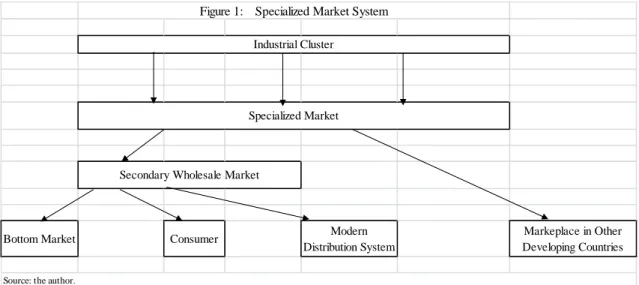
Most specialized market buyers are small merchants operating shops in marketplaces in various cities and counties. Their purchasing activities unite specialized markets; secondary wholesale markets in various cities; bottom markets in counties and towns; and some modern distribution systems, such as supermarkets or e-commerce websites, into a specialized market system (Figure 1). This system plays a crucial role in China’s
14 Similar markets exist for home appliances, metal materials, and the automobile industry.
18
domestic distribution. According to Ding (2013b), the share of the so-called CNY 100 million markets (markets in which transaction volumes exceed CNY 100 million) comprise more than 30% of China’s total domestic sales. Considering the fact that there are 50,000 marketplaces where transaction volumes are below CNY 100 million (no statistical data), the specialized market system is undoubtedly China’s most important domestic distribution system.
Since 2000, globalization has resulted in an increasing number of overseas traditional marketplaces to be integrated into the specialized market system (Figure 1). While many foreign merchants come to China to make purchases, many Chinese merchants have begun travelling to developing countries for trade (Ding 2012, Chapter 6).
With regard to foreign merchants making purchases in China, we use the Yiwu Market as an example. In 2007, nearly 60% of Yiwu Market’s commodities were exported, and 260,000 foreigners visited Yiwu. Some foreign buyers reside permanently in Yiwu, and many resident offices have been established. In 2006 and 2007 alone, the number of foreign resident offices increased from 939 to 1,340. Based on an analysis of Yiwu Foreign Resident Office Yearbook, Ding (2012, Chapter 6) discovered that the daily necessity buyers switching to Yiwu were mainly based in the UAE and Hong Kong previously. Ito (2011) describes a typical case featuring a Kenyan buyer who had long purchased from Dubai but decided to switch to Yiwu.
At the same time, significant number of Chinese merchants began to operate shops in existing overseas markets or established new markets themselves. In Africa, for example, Chinese merchants operated shops in existing markets located as far apart as Ghana and Nigeria in West Africa; Congo in Central Africa; and South Africa, Angola, Zambia, and Malawi in Southern Africa. Moreover, they founded new marketplaces in
19
Ghana, Nigeria, Guinea, Cameron, Namibia, and South Africa (Ding 2012, Chapter 6). This overseas expansion of the specialized market system is not limited to light industrial products such as daily necessities, textiles, and apparel. For example, North Huaqiang Market in Shenzhen comprises seven mobile phone submarkets from which foreign buyers in Guangzhou and Shenzhen often purchase. Moreover, a marketplace selling mobile phones exported from Shenzhen has been established in Dubai (Ding 2013b).
From the perspective of other developing countries, local market integration into the specialized market system is accompanied by an overflow of Chinese industrial goods into their domestic markets—a process which in turn has strongly impacted local
industries.15 For example, Iwasaki (2012) reported that numerous apparel companies
that previously made garments in-house and sold them at Bazar-e Bozorg in Teheran had stopped production, and now visit specialized markets in Yiwu and Guangzhou to purchase garments rather than produce them in-house.
5. EGVC Governance
5.1 Market-based governance in EGVCs 5.1.1 Arm’s-length relationships
Existing studies clearly indicate that EGVCs’ basic governance pattern is that of the market.
The situation of the motorcycle industry as described by Fujita (2013, pp.27−28) is presented as follows:
15 Yoshida (2007) is the first study that reported the impact of Chinese products on various
20
…the strength of the arm’s-length model of Chinese industrial organisation lay in its capacity to achieve low prices. Low entry barriers for both manufacturers and suppliers assisted by de facto standardisation enabled a large number of firms to enter into production of motorcycles and components, spurring intense competition. The benefits of the arm’s-length model also extended to its speed in launching new models.
Returning to the mobile phone industry, as Ding and Pan (2013) highlight, typical arm’s-length relationships have been observed between design houses and the platform provider MTK. Among MTK’s 500 users, only 134 are licensed users. Unlicensed design houses can either acquire MTK chipsets from a Purchasing and Money Platform (PMP, i.e., an electric parts purchasing agent), the North Huaqiang Market, or licensed companies. MTK have taken almost no measures to curb these unlicensed firms. The mobile phone manufacturing process, from development to shipment, exhibits all the features of market-based governance, such as low coordination, speed, and flexibility. International top-brand mobile phone makers, who generally adopt modular governance pattern in GVC, require 6–12 months to develop a new type of mobile phone. Chinese mobile phone makers, however, operating under the “market” governance pattern can develop and manufacture a mobile phone within 55–60 days. On the other hand, the minimum order for each segment of the mobile phone value chain is marginal. Integrators are willing to develop new mobile phone models for minimum orders of only 10,000 units. Since design houses do not need to develop a mould, their minimum PCBA(printed circuit board + assembly) order is much smaller—generally 5, 000, or even 3, 000 at minimum.
21
Arm’s-length relationships are widely seen in EGVCs, not only in motorcycle and mobile phone industries in China but also industries in other developing countries. According to Iwasaki’s (2012) observation of the apparel industry in Iran, before moving to China, merchants Bonak-Dar in Bazar-e Bozorg in Teheran simply sold products from sewing factories directly to retailers and never factored any part in the production process. Cooperation among sewing factories, Bonak-Dar, and retailers was poor, making Tehran’s apparel cluster a lacklustre industry.
5.1.2 A dynamic perspective of market-based governance
As stated above, market-based governance is generally at arm’s-length relationships in EGVCs. On comparing Ito’s (2011) study of 35 buyers of Yiwu Market and Fah’s (2008) survey on 54 narrow fabric firms and 82 shopkeepers that treat narrow fabric in Yiwu Market, however, we find that the content of market-based transactions is much richer than previously considered.
Ito’s (2011) study exhibits the “market” dominant governance pattern. According to Ito (2011), 35 buyers ranked the advantages of Yiwu Market on a scale of 1–5, as variety (4.11), price (4.09), new products (3.77), flexibility (3.71), delivery (3.29), and quality (3.06). For the question why they decided to make their purchases in Yiwu, 34 buyers replied, giving their reasons as price (66), variety (49), quality (23), delivery (21), and new product (17) in terms of importance (using a cumulative score where the most important reason is 3, second important reason, 2; third important reason, 1).
These results indicate that price and variety are the most important factors influencing buyers, instead of quality. This implies that the majority of goods traded in Yiwu have lower value-added and a buyer can easily swap suppliers in terms price. We
22
can thus conclude that market-based transactions are the major governance pattern in Yiwu’s daily necessities industry.16
On the other hand, Fah’s (2008) survey is concerning buyers’ priorities. This study indicates a paradoxical result: despite market-based governance patterns, buyers in Yiwu Market care more for quality than price. Fah (2008, Illustration 9-27) depicts answers from 82 shopkeepers concerning their buyers’ priorities. Degree of importance has been classified into the following categories: “do not know,” “less important,” “important,” and “very important.” In terms of importance (sum of the share of very important or important), the issues for buyers can be ranked as follows: 1: good product quality (more than 95%), 2: punctual delivery (more than 95%), 3: wide variety of products (92%), 4: quick delivery time (90%), 5: flexibility in small and large orders (86%), 6: innovative design capabilities (85%), 7: cheap price (79%), and 8: branded products (56%).
Being consistent with the priorities of buyers, Fah’s (2008) survey indicates that close cooperation exists between firms in Narrow fabric industry in Yiwu. Fah (2008, Illustration 9-17) examines cooperation levels between narrow fabric firms and their domestic and foreign customers, equipment suppliers, competitors, government, and associations. Firms are classified by size into company, factory, and workshop. Degree of cooperation is classified as strong, normal, or no cooperation.
Regarding the relationship with domestic customers, 75% of firms responded that they share strong relationships with their domestic customers, while more than 50% of firms responded that they share strong relationships with their foreign customers. In
16 It is noteworthy that the factor of variety is as important as price for these buyers. Ding,
Gokan, and Zhu (2013) built a New Economic Geography model to explain how variety stimulates the interaction between buyers and sellers.
23
terms of relationships with equipment suppliers, competitors, government, and associations, each type of firm has at least normal relations with each of these partners. In general, the larger the firm, the stronger their cooperation (Fah 2008, Illustration 9-17).
Illustration 9-18 indicates firms’ reasons for cooperating with other firms. Degree of importance has been classified into “do not know,” “less important,” “important,” and “very important.” In terms of the degree of importance, the following reasons have been chosen: “entering new technology fields,” “share/reduce risks and costs,” “establish strategic partnerships,” ”faster time to market,” “know-how transfer,” and “pooled financial resources.” Except for “pooled financial resources,” more than half of the firms, regardless of size, ranked the above mentioned reasons to be important or very important. In general, the larger the firm, the more important they found these reasons.
Although the sample sizes are too small to provide meaningful statistical conclusions, we believe that the qualitative information reflected in these two studies is sufficient to subvert our present general understanding of market-based transactions. This paradoxical phenomenon must be explained from a dynamic perspective.
In concrete terms, as a result of economic growth, consumers in emerging markets often have a favorable expectation on future income. Buyers from emerging markets thus care more for quality than price, even they have to be price-oriented at current stage.
On the other hand, firms in industrial clusters such as Yiwu can contact an increasing number of buyers from emerging markets. This indirect network effect implies that most firms will have increasingly favorable expectations of undertaking demand upgrading and market expansion. In this situation, a firm may initially choose to enter
24
a low-end market and adopt market-based governance. However, because of favorable future business expectations, they may strategically strengthen their relationships with customers at the incipient stage, and adopt a differentiation strategy in the next stage (see Section 6). In contrast, in some industries, such as China’s motorcycle industry and Iran’s apparel industry in which firm growth opportunities are relatively small and future expectations are not as high as those of firms in Yiwu, arm’s-length transaction relationships are likely.
In this sense, in emerging markets, the market platform plays an important role of changing firms’ expectations and stimulating entrepreneurship through drastic market expansion and demand upgrading. This yields a new but effective growth path for firms in developing countries.
5.2 Platforms and low coordination costs
5.2.1 Technology platforms and low coordination costs
Market-based transactions result directly from the platformization of key components and the emergence of the specialized market system.
We earlier discussed the technology platform factor. Here, the relationship between the platformization of key components and value chain governance in EGVCs must be clarified. As the case of PC and mobile phone industries indicated, platformization refers to integrating several key components and some peripheral parts and/or software into a single platform. As a result, the platform’s internal architecture changed to integral, and the architecture of the finished goods became modular. This ensured a product’s fundamental functions while lowering the necessities of explicit coordination when manufacturing finished goods.
25
However, two factors made the chain governance pattern often changed from modular to market in EGVCs. The first factor is informality. Numerous small firms gather in informal sectors in developing countries (Bennett, 2010). As the case of MTK indicated, these firms almost do not pay any license fees to technology platform providers. Except for price information, no any technology or design information are exchanged between them. Typical arm’s-length relationships have thus arisen.
The second factor is the difficulty of changing some industries’ (e.g., home appliances, automobiles, motor cycles) design architecture into complete modular. In these industries, although key components are being shared, other components have not been completely standardized and the information exchanged between platform providers and users has not been well codified as well. The design architectures of finished goods thus remain integral or quasi-modular. Fujita (2013) called this phenomenon “de facto standardization”, highlighting that it must be distinguished from modularization.
Interestingly, although compatibility between key components and other components is not as high as the modularized case, basic functions of finished goods in these industries have been ensured. This is because some fundamental components have been integrated into a single platform, and are adjusted to fully fitted with each other. For example, in China’s television industry, CRT suppliers usually integrate the CRT and deflection yoke into a single platform. In the automobile industry, engine suppliers usually integrate engine and transmission into a single platform (Marukawa 2013, pp.59-60).
Marukawa (2013) argues that the unique pattern of China’s value chain governance cannot be explained within the analytical framework by Gereffi, Humphrey, and Sturgeon (2005). He highlights that in a latecomer country, such as China, foreign
26
suppliers’ capabilities are generally stronger than those of local lead firms. Complicated information flows (not only price, but also technological and design-related information) thus arise from supplier to lead firms. Marukawa (2013) called this a supportive value chain.
We acknowledge that EGVCs often suffer from weak lead firms. However, it remains controversial if technological and design-related information flows exist between supplier and lead firms because all relevant information is integrated into the technology platform, which is often a black box in most cases. If technological and design-related information is transmitted from a platform provider to a lead firm, the lead firm will learn from the platform provider and accumulate the related capabilities. In fact, however, as discussed in Section 3 (also see Section 6), lead firms find it difficult to accumulate capabilities in fields covered by the technology platform itself. In this sense, the general governance pattern in EGVCs still can be explained within the GVC framework, namely the “market”.
5.2.2 Market platforms and low coordination costs
The specialized market system is another important factor that strengthens market-based governance in EGVCs.
First, the specialized market system connects a large quantity of low-end emerging market demand with China’s industrial clusters—a process that lowers the necessary coordination costs for product differentiation and quality control.
Inspired by Humphrey and Schmitz (2002, 2004), Ding and Pan (2013) highlight that the quality of market demand will directly affect the pattern of value chain governance. Consumers in developed countries demand more-differentiated products. To meet their
27
needs, accurate and sophisticated product specifications must be drafted. Achieving such specifications requires stable transaction relationships and sufficient exchange of information concerning product technology and quality control.
On the other hand, in developed countries’ markets, requirements for quality, safety, environmental standards, and other corporate social responsibilities have become increasingly strict, and violators are being severely punished. In this situation, avoiding such risks requires firms to increase supplier and seller controls. In the GVC context, a network or hierarchy type governance is therefore indispensable when making goods for markets in developed countries.
In contrast, the preponderance of low-end demand in emerging markets implies that products are less differentiated and lack accurate and sophisticated specifications. Furthermore, unlike in developed countries, the burdens of quality, safety, environmental standards, and other corporate social responsibilities that firms in developing countries face are much smaller. Therefore, in EGVCs, the coordination costs necessary for product differentiation and quality control are extremely low, and the common governance pattern is more likely to be the market.
Second, local governments play a crucial role in reducing necessary coordination costs for unfamiliar traders to conduct transactions. A large number of potential new buyers and sellers exist within emerging markets. In general, to establish mutual trust, repeated transactions and costly coordination are indispensable. However, if an authoritative third party such as a local government intervenes in the transactions, trust can be established more quickly.
In China, local governments serve as the most important managers of specialized markets. As Ding (2012, p.40) indicated, of the 43 specialized markets in Zhejiang,
28
where specialized markets are the most advanced in China, 38 were established by local governments. This is one substantial difference between specialized markets and markets in other developing countries, such as the Suq.17
As Ding (2011, p.102) highlighted, in specialized markets, the local government strictly punishes sellers who violate the contract and sell fake and/or inferior goods. The local government also actively publishes information on each seller’s credibility to motivate them to improve. For example, in the Yiwu Market, 50,000 shops have had their credibility classified into one of the six ranks. Each shop’s credibility can be verified through PCs installed in the market.
6. Upgrading of Lead firms in EGVCs
In contrast to GVCs, EGVCs offer developing countries more opportunities to foster their own lead firms. Section 6 focuses on the upgrading issues by these lead firms. Because these firms are still in a growth stage, the following analyses are tentative. From our observations, the largest factor behind the upgrading of lead firms in EGVCs is their ability to realize functional upgrading, to lower their reliance on platforms and increase their capabilities in the value chain segments where platform providers previously played critical roles. At the current stage available for observation, this trend is particularly obvious in market platforms.
As indicated by Sonobe and Otsuka’s (2004) study on China’s several industrial clusters, the share of firms’ sales created by specialized markets declines as firms grow larger. This occurs because most of these firms, instead of using the shared sales
17 For the situation in the Suq, in which an authoritative third party is missing, and buyers
and sellers have to engage in complicated clientelization and bargaining to conclude a transaction, see Geertz (1978).
29
channels of specialized markets, have constructed their own sales networks and have built their own brands.
However, more detailed studies revealed that specialized markets have greatly contributed to lead firms’ improvement of their abilities in marketing, design, and branding (Ding 2011, 2012). In marketing, for example, regional groups of merchants, as the main actors in the specialized market system, play an important role in constructing a firm’s own sales network. For example, in 2006, 1,200 firms in Wenzhou, China succeeded in constructing their own sales network. Of the 130,000 sales agents that comprise these sales networks, 100,000 (77%) are external Wenzhou merchants, who act primarily as previous shopkeepers in the specialized market system (Ding 2011, p.95).
The market platform also helps lead firms to improve their design and branding abilities. Ding (2012, Chapter 10) compares three types of Chinese apparel clusters. This study indicates that, compared with export-oriented clusters, the specialized market-based industrial clusters, although low-end market-oriented, are more likely to foster national-level brands. Companies possessing national-level brands appear in nearly one-third of the specialized market-based clusters, a finding attributable to the fact that buyers in low-end markets are small merchants who are design-takers—a status that offers opportunity for local firms to create their own brands.18 On the other
hand, these small merchants directly purchase from the clusters themselves, bringing to the clusters a great deal of information on distant markets. Based on these pieces of rich market information, lead firms in the clusters have adequate opportunities to
18 This point is inspired by Bazan, Luiza, and Lizbeth Navas-Aleman (2004), who argues
that as there are no powerful buyers, firms under market-based governance are more likely to realize functional upgrading.
30
formulate their own brand strategies. Initially, they could only create brand-name products with low added value, which is nearly the same as being undifferentiated. However, some companies survive the intense competition and create national-level brands.
For technology platforms as well, strategies of platform providers directly affect their customers’ upgrading paths. In the mobile phone industry, MTK pursues a strategy of providing their customers with a highly integrated platform that covers a broad scope of R&D activities. It also prevents customers from collaborating in the process of IC chipset design, except for debugging. The growth space available to local firms is correspondingly limited.
In contrast, China’s LCD television industry is dominated by six major firms. M-Star, a Taiwanese company, is the largest LCD IC provider holding 70% of the market share. In contrast with MTK’s strategy, M-Star allows its customers to participate in the process of IC chip design, and even sends R&D teams to every customer’s company for each project, sometimes going to the extent of opening some source codes for these customers. Accordingly, local LCD television makers accumulate capabilities allowing them to later develop more differentiated products.19
7. Conclusion
The emergence of EGVCs is a natural outcome of recent globalization processes. While MNCs increasingly began to adopt a platform strategy for their emerging market customers, more marketplaces in developing countries have been integrated into a powerful distribution system—China’s specialized market system. Consequently, an
31
emerging market-oriented industrial organization, called an emerging global value chain, has appeared. These EGVCs are formed by a large number of small firms together with a small number of large platform providers and display the “market” type general governance pattern.
Lead firms in developing countries generally lack two types of capabilities that limit their growth potential. First, they are unable to bear the high fixed costs necessary for R&D or marketing activities. Second, they find it difficult to conduct explicit coordination required by complicated transactions with global partners. By providing a shared stable component within a system product or industry, a platform can resolve the issues related to these poor capabilities, stimulating local firms to grow into strong lead firms.
Platforms can be classified as either technology platforms or market platforms. Although each type may play different roles in different industries, both types are indispensable to EGVC formation. Technology platform is the only factor enabling firms in developing countries, as lead firms, to enter technology-intensive sectors such as automobiles, motorcycles, PCs and mobile phones. Market platforms, on the other hand, enable firms to respond to the highly dispersed and drastically expanding demand exhibited by emerging markets.20
The internal structure of an EGVC is shown in Figure 2.
In technology platforms, the central box refers to a key component, while the left and right boxes refer to peripheral parts, software, and related R&D activities. Due to the
20 The latter point needs particular attention. Traditional economic analyses usually neglect
the significance of the distribution system upon the production system. To a large extent, this has resulted from the fact that the distribution system in developed countries advanced before the production system. This has made scholars mostly overlook the difficulties faced when marketing in emerging markets.
32
capabilities of platform users to explicit coordination is poor, technology platform providers in EGVCs must not only undertake fundamental R&D but also integrate some peripheral parts, software, and related R&D activities into the platform.
In market platforms, the central box refers to the market platform itself, such as a specialized market21. The left-side box refers to producers in the EGVC, who generally
possess poor marketing capabilities, while that of the right refers to small buyers from emerging markets, who are highly dispersed and price-oriented. Producers and buyers trade directly within the platform.
Direct network effects arise among technology platform users. The positive feedback mechanism of direct network effects allows an increasing number of platform users to exchange knowledge and information, and thus learn from each other. They therefore gradually accumulate platform-based R&D capabilities.
Indirect network effects arise among market platform users. The positive feedback mechanism of indirect network effects allows an increasing number of producers to attract increased numbers of buyers and vice versa. During this process, producers can acquire information and knowledge concerning emerging markets, gradually improving their ability to market in emerging economies.
Generally, EGVCs exhibit the “market” governance pattern. Because technology platform providers expand their R&D activities’ coverage, most of the necessary explicit coordination is conducted within the platform. Coordination costs between technology platform providers and users have therefore been reduced. In market platforms, the market’s ability to enable sellers to meet the demands of its sizeable but low-end users
21 Recently, e-commerce platforms have played an increasingly important role in EGVCs.
Future studies should pay more attention on the role of internet in the development of EGVCs.
33
implies that product specifications have thus become simpler, and the necessary coordination costs between producers and buyers have shown a definite downward trend. On the other hand, market platform providers such as local governments generally play a crucial role in reducing coordination costs, allowing unfamiliar traders to conclude transactions.
An interesting finding is that, at least in market platforms, market-based governance does not necessarily mean pure arm’s-length relations. When the market is rapidly expanding and upgrading, platform users form favorable expectations regarding their future business. They may strategically concentrate on quality and explicit coordination, in spite of the fact that they remain engaged in market-based transactions.
The growth path of firms in EGVCs differs greatly from that of firms in GVCs. In GVCs, firms in developing countries can accumulate capabilities and upgrade by trading with and learning from MNCs. Gereffi (1999) offers an optimistic growth path of these firms from OEM (Original Equipment Manufacturing) to OBM (Original Brand Manufacturing). However, a theoretical study by Humphrey and Schmitz (2000), and empirical studies by Bazan, Luiza, and Navas-Alemán (2004) and Navas-Alemán (2006) have proved that the governance pattern generated between firms in developing countries and MNCs is generally captive (quasi-hierarchical)—a relationship in which firms can realize process and product upgrading, but functional upgrading remains difficult.
In contrast, in EGVCs, functional upgrading has indeed been realized, and strong lead firms have indeed been nurtured. As discussed in Section 6, upgrading at firm level is reflected in the reduced reliance on platform and increased capabilities in value chain segments (branding, marketing, complementary R&D) that platform providers
34
previously predominated. Interestingly, platforms (at least market platforms at current stage) themselves can help lead firms to improve their design and sales abilities by providing information and/or resources.
Two important issues should be investigated in future studies. The first issue concerns upgrading. This paper only discussed upgrading by lead firms. However, at the industry level, upgrading reflects the potential for a developing country’s ability to nurture its own platforms. Existing evidence indicates that market platforms have been nurtured by developing countries themselves, while technology platforms, except for some key components in home appliances industry, are still firmly dominated by firms from developed countries. It is therefore worth investigating whether EGVCs contribute to the formation of a new type of international division of labor, namely one in which firms from developed countries provide technology platforms, while those in developing countries provide market platforms.22
The other important issue is whether the experiences of Chinese firms in EGVCs can be exported to other developing countries. On one hand, China’s huge domestic market, the considerable size of social networks, and the unique role of public sectors must be taken into account. However, most developing countries have one or more similar conditions. The problem arises from the fact that at their current stage, firms from these emerging economies are only able to become buyers within EGVCs. How can these firms develop into strong lead firms? This will be a crucial point for the future study of EGVCs.
22 The company of Spreadtrum in mobile phone industry is an exception. This company was
established by persons who previously studied in USA and has become a main supplier of the mobile phone IC chipset. Up until to now, however, Spreadtrum has merely followed MTK’s strategy.
35 References
In English
Baldwin, Carliss Y., and C.Jason Woodard. 2009. “The Architecture of Platforms: a unified view.”in Platforms, Markets and Innovation, ed. Gawer, Annabelle, pp.19-44. Bazan, Luiza, and Lizbeth Navas-Alemán. 2004. “The Underground Revolution in the Sinos Valley: A Comparison of Upgrading in Global and National Value-chains.” In
36
Local Enterprises in the Global Economy: Issues of Governance and Upgrading, ed. Hubert Schmitz. Cheltenham: Edward Elgar.
Bennett, John. 2010. Informal firms in developing countries: Entrepreneurial stepping stone or consolation prize? Small Business Economics No.34, pp.53-63.
Cusmano, Michael A. 2010. Staying Power: Six Enduring Principles For Managing Strategy& Innovation in an Uncertain World. New York: Oxford University Press. Ding, Ke. 2012. Market Platforms, Industrial Clusters and Small Business Dynamics: Specialized Markets in China, Cheltenham: Edward Elgar.
Ding, Ke, and Jiutang Pan. 2012. “Platforms, Network Effects and Small Business Dynamics in China: Case Study of the Shanzhai Cell Phone Industry.” IDE Discussion Paper, No.302.
Ding, Ke, Toshitaka Gokan and Xiwei Zhu. 2013. “Search, Matching, and Self-Organization of a Marketplace” IDE Discussion Paper, No.396.
Evans, David S. 2009. “How Catalysts Ignite: the Economics of Platform-based Start-ups,” in Platforms, Markets and Innovation, ed. Gawer, Annabelle, Cheltenham and Northampton: Edward Elgar, pp. 99-130.
Fah, Daniel. 2008. Markets, Value Chains and Upgrading in Developing Industrial Clusters: A Case Study of the Narrow Fabric Industry in Yiwu, Zhejiang Province, P.R., Master Thesis, University of Zurich.
Fujita, Mai. 2013. “Exploring the Sources of China’s Challenge to Japan: Models of Industrial Organisation in the Motorcycle Industry”. IDE Discussion Paper, No.419. Gawer, Annabelle. ed. 2009a. Platforms, Markets and Innovation, Cheltenham and Northampton: Edward Elgar.