Inter-industry analysis and monetary policy
evaluations in the Korean flow of funds
accounts
著者
Kim Jiyoung
権利
Copyrights 日本貿易振興機構(ジェトロ)アジア
経済研究所 / Institute of Developing
Economies, Japan External Trade Organization
(IDE-JETRO) http://www.ide.go.jp
journal or
publication title
IDE Discussion Paper
volume
619
year
2016-10
1
INSTITUTE OF DEVELOPING ECONOMIES
IDE Discussion Papers are preliminary materials circulated
to stimulate discussions and critical comments
Keywords: flow-of-funds, asset-liability-matrix, inter-industry, monetary policy JEL classification: E50, C67, E01, G30, L00
*Research Fellow, International Input-Output Analysis Studies Group, Development Studies Center, IDE ([email protected])
IDE DISCUSSION PAPER No. 619
Inter-Industry Analysis and
Monetary Policy Evaluations
in the Korean Flow of Funds Accounts
Jiyoung KIM*
October 2016
Abstract
This study mainly aims to provide an inter-industry analysis through the subdivision of various industries in flow of funds (FOF) accounts. Combined with the Financial Statement Analysis data from 2004 and 2005, the Korean FOF accounts are reconstructed to form “from-whom-to-whom” basis FOF tables, which are composed of 115 institutional sectors and correspond to tables and techniques of input–output (I–O) analysis. First, power of dispersion indices are obtained by applying the I–O analysis method. Most service and IT industries, construction, and light industries in manufacturing are included in the first quadrant group, whereas heavy and chemical industries are placed in the fourth quadrant since their power indices in the asset-oriented system are comparatively smaller than those of other
institutional sectors. Second, investments and savings, which are induced by the central bank, are calculated for
monetary policy evaluations. Industries are bifurcated into two groups to compare their features. The first group refers to industries whose power of dispersion in the asset-oriented system is greater than 1, whereas the second group indicates that their index is less than 1. We found that the net induced investments (NII)–total liabilities ratios of the first group show levels half those of the second group since the former’s induced savings are obviously greater than the latter.
2
The Institute of Developing Economies (IDE) is a semigovernmental,
nonpartisan, nonprofit research institute, founded in 1958. The Institute
merged with the Japan External Trade Organization (JETRO) on July 1,
1998.
The Institute conducts basic and comprehensive studies on economic
and related affairs in all developing countries and regions, including Asia,
the Middle East, Africa, Latin America, Oceania, and Eastern Europe.
The views expressed in this publication are those of the author(s). Publication does not imply endorsement by the Institute of Developing Economies of any of the views expressed within.
INSTITUTE OF DEVELOPING ECONOMIES (IDE), JETRO 3-2-2, WAKABA,MIHAMA-KU,CHIBA-SHI
CHIBA 261-8545, JAPAN
©2016 by Institute of Developing Economies, JETRO
No part of this publication may be reproduced without the prior permission of the IDE-JETRO.
3
Inter-Industry Analysis and Monetary Policy Evaluations
in the Korean Flow of Funds Accounts
Jiyoung Kim
Abstract
This study mainly aims to provide an inter-industry analysis through the subdivision of various industries in flow of funds (FOF) accounts. Combined with the Financial Statement Analysis data from 2004 and 2005, the Korean FOF accounts are reconstructed to form “from-whom-to-whom” basis FOF tables, which are composed of 115 institutional sectors and correspond to tables and techniques of input–output (I–O) analysis. First, power of dispersion indices are obtained by applying the I–O analysis method. Most service and IT industries, construction, and light industries in manufacturing are included in the first quadrant group, whereas heavy and chemical industries are placed in the fourth quadrant since their power indices in the asset-oriented system are comparatively smaller than those of other institutional sectors. Second, investments and savings, which are induced by the central bank, are calculated for monetary policy evaluations. Industries are bifurcated into two groups to compare their features. The first group refers to industries whose power of dispersion in the asset-oriented system is greater than 1, whereas the second group indicates that their index is less than 1. We found that the net induced investments (NII)–total liabilities ratios of the first group show levels half those of the second group since the former’s induced savings are obviously greater than the latter.
Research Fellow, International Input-Output Analysis Studies Group, Development Studies Center, Institute of Developing Economies, JETRO. (e-mail: [email protected])
4
I. Introduction
Flow of funds (FOF) accounts indicate the interrelations between the various institutional sectors of each nation, including overseas sectors, in a systematic and coherent manner. The FOF system adopts a quadruple-entry system proposed by Copeland (1952), wherein each transaction is recorded with a double entry. On the other hand, the input–output (I–O) table, which indicates production in the real economy, is composed of various industries. Transactions of production always involve funds transactions. Klein (2003) indicated a need for the “from-whom-to-whom” basis FOF table’s construction, which corresponds to tables and techniques of I–O analysis. However, it is difficult to link the I–O table and FOF accounts. The economic agents in the I–O table are separated into hundreds of industries. Though the FOF accounts comprise all economic agents in one country, data on only two types of institutional sectors, namely nonfinancial public corporations and nonfinancial private corporations, are announced in the FOF accounts. In other words, most economic agents in the I–O table are aggregated in the FOF accounts.
Numerous studies have explored inter-industry or firm financing, for example, studies by Corbett and Jenkinson (1996), Braun and Larrain (2005), and Marozzi and Cozzucoli (2016). Some previous researches have disaggregated the nonfinancial corporation sector of the FOF accounts into several institutional sectors. Nishiyama (1991) used the balance sheets and income statements of each industry to subdivide nonfinancial corporations in FOF accounts into 37 industries. In this paper, the power indices of 44 institutional sectors are reported. According to this study, using balance sheets and income statement data for each industry, it is possible to generate expanded FOF accounts that indicate the financial transactions of each industry. Kim (2014) examined the division of the nonfinancial private corporations sector into the chaebol sector, which indicates groups of large-scale and family-run management enterprises, and the private corporations (small and middle-scale) sector.
Not only inter-industry analysis of FOF accounts has been intensified but also international money flow analysis has deepened, which corresponds with the international I–O table. Zhang (2005, 2009) built global FOF and estimated multiple-equation models. Tsujimura and Tsujimura (2008) constructed a financial transactions table between multiple countries. Kim and Song (2012) built a flow-of-FX-funds table for Korea based on the balance of payments (BOP), external debt, assets, and international investment position (IIP) tables.
5
There are some preliminary studies that link analysis methods between I–O tables and financial information. Ogawa et al. (2012) attempted to link the unique I–O table of Japan, which is augmented by firm size dimension, with balance sheet conditions. This paper uses Financial Statistics of Corporations data, which is published by the Ministry of Finance. Manabe (2014) estimated a production function with net induced investments (NII), which is computed from the US FOF accounts. This paper adopted an evaluation method using an asset-liability-matrix (ALM), which is derived by Tsujimura and Tsujimura (2006), though many literatures have evaluated monetary and financial policies (Da Hann and Sterken 2006). Tsujimura and Mizoshita (2002a, b) devised the FOF analysis methods by applying I–O analysis methods. Originally, Stone (1966) and Klein (1983) proposed the concept of the Leontief inverse, which is applied to the ALM. Furthermore, Tsujimura and Tsujimura (2006) estimated the induced amount of the supply and demand of funds to analyze the effect of central bank monetary policies, through financial transactions between institutional sectors represented in the Leontief inverse. Adopting this analysis method, Manabe (2009) also tried policy evaluations of public financial institutions using the FOF accounts of Japan.
However, the subdivision of industries was not examined by Manabe (2009). Therefore, only one production function is estimated in this paper, though the I–O table has around 400 industries (for example, in the cases of Korea and Japan). Kim et al. (2016) used a system of multi-sector, multi-factor production functions to derive technological structure transitions associated with cost changes induced by an innovation. Applying this model, production functions of each industry can be estimated using the linked I–O tables. Therefore, it is possible to link the FOF accounts and I–O table by obtaining the expanded FOF accounts, which are subdivided into various industries. Furthermore, productivity changes in every industry caused by monetary or financial policies can be estimated. First, each industry’s NII, which is implemented by the policy authority, is calculated in the expanded FOF accounts. Second, each industry’s productivity changes caused by the monetary or financial policies can be estimated using their NII. In other words, it is possible to combine the expanded FOF accounts and I–O table.
This study mainly aims to conduct an inter-industry analysis through the subdivision of the various industries in the FOF accounts. Using the expanded FOF tables, we examine the central bank’s monetary policy evaluations. Previous studies have indicated that by obtaining the NII of each industry, which is caused by any kind of monetary or financial policy, it is possible to link
6
the I–O table and NII from the FOF accounts. In this study, we will adopt the I–O analysis method, which is applied to the FOF accounts devised by Tsujimura and Mizoshita (2002a, b). Applying the I–O analysis method to the ALM derived from the FOF accounts, Y and Y∗ matrices (ALM of institutional sector-by-institutional sector) are obtained. Using the Leontief inverse matrix, four kinds of indices (power of dispersion index in the liability-oriented system, power of dispersion index in the asset-oriented system, sensitivity of dispersion index in the liability-oriented system, and sensitivity of dispersion index in the asset-oriented system) are estimated. Furthermore, by employing ALM, it is possible to evaluate the effectiveness of a monetary policy by applying the Leontief inverse. In summary, if the expanded FOF accounts, which are separated into various inter-industries, are obtained, (1) a financial transactions table of each inter-industry by inter-industry, which are deeply related to the I–O table, is created; (2) the power index and sensitivity index of each industry are computed; and (3) an analysis method connected to the I–O table and the FOF accounts can be applicable. To subdivide the nonfinancial corporation sector of the FOF accounts into different types of industries, we adopt the Financial Statement Analysis (FSA) data compiled by the Bank of Korea (BOK). Since the FSA data announce annual balance sheets and income statements for each industry, it is possible to create expanded FOF accounts whose institutional sectors are divided into about 100 types of industry. This study aims to (1) analyze various inter-industries from the viewpoint of the FOF accounts, (2) examine policy evaluation methods and suggest monetary market operations, and (3) derive a new analysis tool to link the I–O table and FOF accounts for future works.
This paper contains five sections: The second section describes the data adopted for this analysis and explains the methodologies. The subdivision of industries and analysis results are reported in the third section. In this part, data for 2004 and 2005 are adopted. For future works, we will try to link the 2005 I–O table and the expanded FOF accounts. The reason for the data selection is that the 2005 I–O table is linked to the 2000 I–O table, and the linked I–O tables for 2000–2005 and 2005–2010 will be announced by the BOK in the near future. We need to choose the linked I–O tables to estimate production functions as a next step. Evaluations of BOK’s monetary policies are presented in the fourth section. The conclusions of this paper are presented in the last section.
7
II. Data and Methodology A. Data
To achieve the first purpose of this analysis, the FOF accounts are used. The BOK publishes Korean FOF accounts both quarterly and yearly; these accounts contain (1) financial transactions (flows) and (2) financial assets and liabilities (stocks). Table 1 shows the number of institutional sectors and financial instruments in the Korean FOF accounts in the 1968, 1993, and 2008 Systems of National Accounts (SNA). The FOF account data in the 1993 SNA, which contain 22 institutional sectors and 35 financial instruments, are retroacted to 2002. Furthermore, the 2008 SNA data, which contains 23 institutional sectors and 46 financial instruments, has existed since 2008. We used the FOF accounts of the 1993 SNA to subdivide nonfinancial corporations into each industry since the 1968 SNA data have only nine institutional sectors.
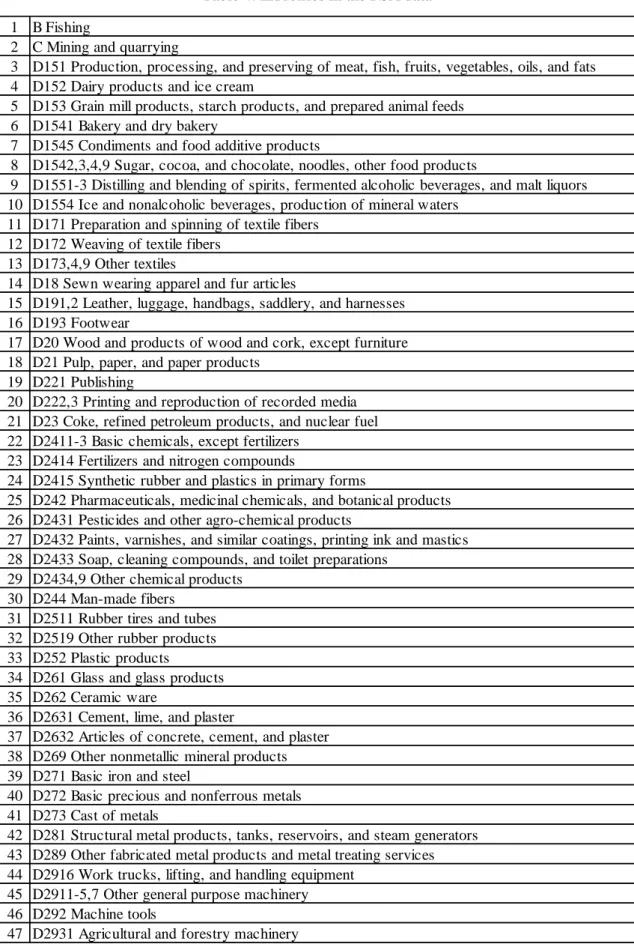
To subdivide the various industries, the FSA data, which is compiled annually by the BOK, is available. Balance sheets and income statements of enterprises are represented by industries in these data. However, the construction of the expanded funds transactions table subdivided into a hundred industries for each year of the FOF data is not a simple task. We adopted data from 2004 and 2005 to expand institutional sectors in the FOF accounts into various industries since it is useful to conduct the analysis with linked I–O tables for future challenges. As a framework for expanding the FOF accounts, seven financial instruments were chosen. Table 2 presents the financial instruments for the correspondence between the FOF accounts and the FSA data. In the FSA data, securities assets have adopted market values since the end of 1997, whereas capital stock in stockholders’ equity takes face value. Since the FOF accounts in the 1993 SNA adopted market values for both assets and liabilities accounts, capital stocks from the FSA data need to be adjusted to reflect market value. Using listed capital stock and total market capitalization by industry group, which are announced by the Korea Exchange (http://eng.krx.co.kr), the capital stock of each industry is adjusted. Institutional sectors for the FOF accounts and industries in the FSA data are represented in Tables 3 and 4. There are 22 institutional sectors in the FOF accounts and 94 industries in the FSA data. We use the term “residual industry” to refer to the results obtained by subtracting all industries in the FSA data from the nonfinancial corporations in the FOF accounts. Since the total amount of financial assets or liabilities in the FSA data are not exactly equal to the total nonfinancial corporations in the FOF accounts, the variable residual industry is inserted in the expanded FOF accounts as a
8
new sector. Therefore, residual industry includes items not included in the FSA data but included in the FOF accounts.
B. Methodology
1. Basic Methodologies for the Asset-Liability-Matrix Model
1) Construction of the Y and Y∗ Tables (Financial Transactions Matrices)
In this analysis, we adopt the I–O analysis method devised by Tsujimura and Mizoshita (2002a, b)1 for the FOF accounts. First of all, the two tables should be constructed for this procedure. The E table is a matrix that represents the fund-employment portfolio of each institutional sector, whereas the R table shows fund-raising in each institutional sector. Figure 1 shows how to construct the R and E tables.
By applying a method widely used in I–O analysis, it is possible to make two types of square matrices, Y and Y∗, using the E and R tables. The Y table is based on a fund-employment portfolio, whereas the Y∗ table is founded on a fund-raising portfolio. Matrix R and the transposed matrix E are substituted for matrices U and V in the I–O analysis to obtain the Y table. Figure 2 demonstrates the correspondence between the I–O table and the FOF accounts. Goods and industries in the I–O table are substituted for financial instruments and institutional sectors.
U ≡ R (1) V ≡ E′ (2)
In the case of fund-employment assumptions, matrix E and transposed matrix R are used to calculate the Y∗ table.
U∗≡ E (3)
V∗≡ R′ (4)
Figure 3 presents tables of funds transactions and coefficients based on the liability approach, whereas Figure 4 shows tables based on the asset approach. The coefficient matrices, B and B∗,
1
For details, refer to Tsujimura and Mizoshita (2002a) in English and Tsujimura and Mizoshita (2002b), pp. 32–43 and pp. 116–129 in Japanese.
9
are constructed from R and E tables by dividing the column sums’ T vector, which consists of the sum of either assets or liabilities, whichever is greater.
bij= R
tj (5)
b𝑖𝑗∗ = E
tj (6)
Likewise, the coefficient matrices D and D∗, which are obtained from E′ and R′ by dividing TE and TR, indicate the sums of the financial instruments. t
j
E represents the sum of assets,
whereas tjE indicates the sum of liabilities for financial instrument j.
dij= E′
tjE (7)
dij∗ = R′
tjR (8)
The m × m (m = number of institutional sectors) coefficient matrices C and C∗ are estimated under the institutional sector portfolio assumption:
C = DB (9) C∗= D∗B∗ (10)
Then, each element of transaction quantity matrices Y and Y∗ are obtained as follows:
𝑦𝑖𝑗 = 𝑐𝑖𝑗𝑡𝑗 (11)
y𝑖𝑗∗ = c
𝑖𝑗∗𝑡𝑗 (12)
where 𝑡𝑗 represents the sum of either assets or liabilities; 𝑦𝑖𝑗 is the amount of funds provided
from the ith institutional sector to the jth institutional sector; and y𝑖𝑗∗ identifies the amount of funds from the jth to the ith institutional sector. In Figures 3 and 4, the Y and Y∗ tables show funds transactions between institutional sectors. The former is founded on the assumption that
10
each institutional sector’s fund-raising portfolio is settled. In contrast, the latter is based on the assumption that the fund-employment portfolio of each institutional sector is fixed.
In this analysis, we created the FOF accounts that are combined with the FSA data. Figure 5 displays the prototype of the expanded Y table whose nonfinancial corporations sector is subdivided into many types of industry for this paper. Therefore, it contains additional blue-colored blocks of information compared with the original Y table, which is not separated into industries.
2) Power of Dispersion Index and Sensitivity of Dispersion Index
Next, we will apply the Leontief inverse to obtain the indices of the power and sensitivity of dispersion to the ALM. The Y table can be expressed as follows in matrix terms, where εY represents excess liabilities:
CTY+εY=TY (13)
Solving each equation for TY yields
TY=(I − C)−1εY (14)
TY=IεY+ CεY+C2εY+C3εY+⋯ (15)
where I denotes the m ☓ m unit matrix and (I − C)−1 is the Leontief inverse matrix. Matrix Γ is expressed as follows: Γ=(I − C)−1=[ γ11 γ12 ⋯ γ1m γ21 ⋮ γ22 ⋮ … ⋱ γ2m⋮ γm1 γm2 … γmm ] (16)
Using γij, it is possible to calculate both indices of the power of dispersion and sensitivity of dispersion in the liability-oriented system. The power of dispersion index, ωjY, and the sensitivity of dispersion index, ziY, are expressed as follows:
11
ωjY= ∑mi=1γij 1 m∑mj=1∑mi=1γij (17) ziY= ∑mj=1γij 1 m∑mi=1∑mj=1γij (18)Based on the same method of Y∗, the power of dispersion index, ωjY∗, and the sensitivity of dispersion index, ziY∗, in the asset-oriented system are also estimated.
The power of dispersion index in the liability-oriented system describes the relative extent to which a unit increase in demand for capital within a given institutional sector is dispersed throughout the total financial system. Meanwhile, the power of dispersion index in the asset-oriented system measures the increase in the final supply to the system of industries in general, driven by a unit increase in the capital supply of a given institutional sector. The sensitivity of dispersion index in the liability-oriented system measures the extent to which a given institutional sector can raise funds, and it is directly or indirectly driven by a unit increase in the final borrowing of all institutional sectors in the system. Meanwhile, the sensitivity of dispersion index in the asset-oriented system describes the extent to which money can be supplied to a given institutional sector, and it is directly or indirectly driven by a unit increase in the final lending for all institutional sectors in the system.
2. Evaluation Method of the Central Bank’s Monetary Policy
In the SNA, the difference between assets and liabilities in the FOF accounts reflects net investments, i.e., the difference between savings and investments, in the real economy. Earlier, the Y and Y∗ tables showing the financial transactions between institutional sectors were calculated. Using the Y and Y∗ tables, Tsujimura and Tsujimura (2006) examined the effectiveness of the central bank’s monetary policies, namely the so-called quantitative easing policy introduced by the Bank of Japan (BOJ). To evaluate this monetary policy, the central bank is treated as an exogenous institutional sector in the Y and Y∗ tables. In this section, we introduce the evaluations method by Tsujimura and Tsujimura (2006); in the next section, we will apply this method to examine the effectiveness of the BOK’s monetary policy.
The previous study estimated the induced amount of fund demand and supply to analyze the effect of the central bank’s monetary policies through the financial transactions between
12
institutional sectors, which are represented in Leontief inverse. According to the preceding section, the Y and Y∗ tables are expressed as follows:
CTY+εY=TY (19)
C∗TY∗
+ρY∗
=TY∗
(20)
First, it is necessary to separate the policy authority sector from the Y and Y∗ tables. Let us denote matrices C𝜋 and C𝜋∗ so that the row and column elements of the central bank are removed from the matrices C and C∗
C𝜋TY+ε
𝜆Y= TY (21)
C𝜋∗TY∗
+ρ𝜆Y=TY∗
(22)
where each element of ε𝜆Y is the sum of excess liabilities (εY) and the liabilities of the central bank (ε𝜋Y). Each element of ρ
𝜆
Y means the sum of excess assets (ρY∗
) and the assets of the central bank (ρ𝜋Y)
ε𝜆Y= ε𝜋Y+εY (23)
ρ𝜆Y= ρ𝜋Y+ρY∗ (24)
ε𝜆Y and ρ 𝜆
Y are expressed as an (m − 1) × 1 vector, since elements of the policy authority are
eliminated from the matrices C and C∗. Solving each equation for TY and TY∗ yields TY= (I − C 𝜋)−1ε𝜆Y (25) TY∗ = (I − C 𝜋 ∗)−1ρ 𝜆 Y (26)
where I denotes the [(m-1) × (m-1)] unit matrix, and (I − C𝜋)−1 and (I − C𝜋∗)−1 are the Leontief inverse matrix. Denote (I − C𝜋)−1 as matrix Γ𝜋 and (I − C𝜋∗)−1 as matrix Γ𝜋∗.
Using the Leontief inverse matrices Γ𝜋 and Γ𝜋∗, it is possible to calculate the amount of
ultimately induced demand and supply of funds. From the nonfinancial economy's point of view, the induced demand for funds can be regarded as gross induced savings (GIS), which represents
13
the amount of new savings required. On the other hand, the induced supply as gross induced investments (GII) shows the ability to increase new investments.
Since the central bank is an exogenous institutional sector in this model, we can calculate the effect of the monetary and financial policies carried out by the central bank. The policy authority can choose among various instruments of monetary and financial policy. For example, the BOK has three methods of monetary policy: open market operations, lending and deposit facilities, and a reserve requirements policy. If open market operations are selected, the BOK may buy and sell monetary stabilization bonds (MSBs) or securities to and from the public and banks. In the case of MSBs issued by the BOK, financial bonds in their liabilities accounts (R table) will rise. In the asset portfolio (E table), the BOK mostly increases foreign exchange holdings. Another example is Japan’s quantitative easing policy. The current account balance increases appeared as liabilities for the BOJ due to its monetary policy. Corresponding to these heightened liabilities, the BOJ intended to increase the amount of Japanese government bonds in their asset portfolio. Let us denote the liabilities held by the policy authority as ε𝜋, which is
an n × 1 vector. In the same regard, an (n × 1) vector, ρ𝜋, represents the policy authority’s
financial instruments. It is necessary to transform επ and ρ𝜋 vectors into (m − 1) × 1 vectors
when using a Leontief inverse. For the transformation, we will adopt (m − 1) × n matrices, D𝜋
and D𝜋∗, which are represented in the row of the policy authority, which is omitted from m × n
matrices D and D∗.
fε= D𝜋ε𝜋 (27)
fρ= D𝜋∗ρ
𝜋 (28)
As ε𝜋 and ρ𝜋 are exogenously given, the induced savings and induced investments are obtained as follows:
ŋS= (I − C𝜋)−1f
ε (29)
ŋI = (I − C𝜋∗)−1f
ρ (30)
where ŋS and ŋI are (m − 1) × 1 vectors. Element ŋSi indicates the induced savings
generated in the ith institutional sector, whereas ŋIi means the induced investments by the ith
14
HS= ∑𝑚−1𝑖=1 ŋSi (31)
HI= ∑𝑚−1ŋIi
𝑖=1 (32)
Finally, we can gain the NII as a monetary and financial policy evaluation indicator by subtracting the GIS from the GII:
HN= HI− HS (33)
The changes in the NII in period t can be calculated as the first difference of HNt:
△ HNt= HNt− HNt−1 (34)
Ⅲ. Subdivision of the FOF Accounts into Types of Industry A. Inter-Industry Liability and Asset Portfolio
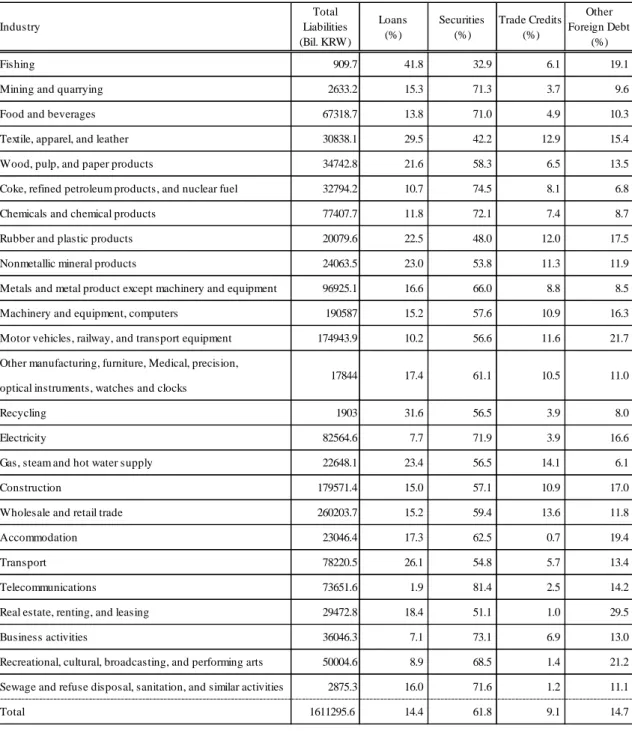
The nonfinancial corporation sector in the FOF accounts will now be subdivided into types of industry. Tables 5 and 6 show the liability portfolio and financial asset portfolio of 25 industries2 in 2005. In Table 5, industries’ liabilities consist of loans, securities, trade credits, and other foreign debts, which mean instruments for fund-raising. The average3 portfolio liabilities consist of is 14.4% loans, 61.8% securities, 9.1% trade credits, and 14.7% other foreign debts. Overall, industries raised more than half of their funds through securities, which is one form of direct financing, except three industries as follows: (1) fishing (41.8% of loans, 32.9% of securities), (2) textiles, apparel, and leather (29.5% of loans, 42.2% of securities), and (3) rubber and plastic products (22.5% of loans, 48.0% of securities) all show fewer securities and more loans than other industries. On the other hand, the telecommunications (81.4%); coke, refined petroleum products and nuclear fuel (74.5%); and business activities (73.1%) industries are mainly dependent on securities. Trade credits for gas, steam, and hot water (14.1%) and wholesale and retail trade (13.6%) are greater than in other industries. On the contrary, accommodation (0.7%) and real estate, renting, and leasing (1.0%) have a low level of trade
2
Some industries are aggregated since there are 94 industries in the expanded FOF accounts in Tables 4 and 5.
3
15
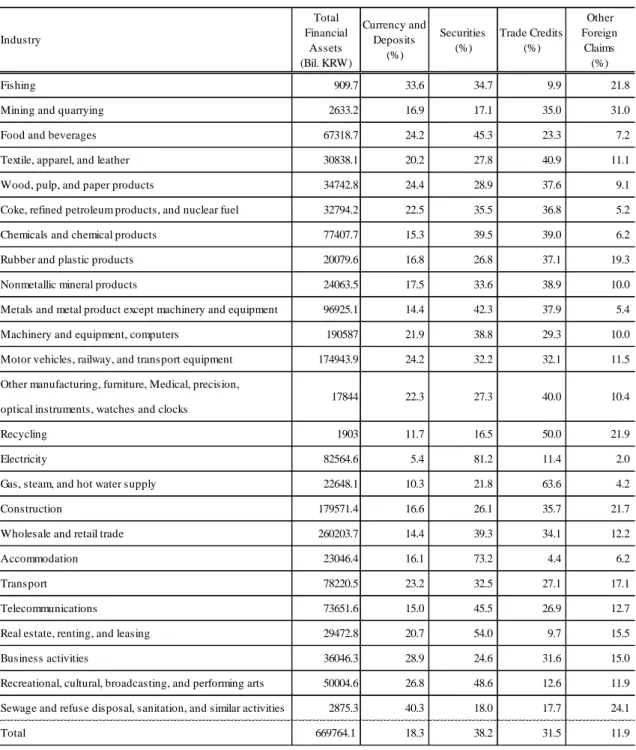
credits. Lastly, real estate, renting, and leasing (29.5%) and motor vehicles, railway, and transport equipment (21.7%) show more fund-raising from overseas sector than other industries. Table 6 demonstrates the inter-industry fund-employment. It is composed of currency and deposits, securities, trade credits, and other foreign claims. The average4 financial asset portfolio contains 18.3% currency and deposits, 38.2% securities, 31.5% trade credits, and 11.9% other foreign claims. Fishing (33.6%), sewage, refuse disposal, sanitation, and similar activities (40.3%) have more currency and deposits than average. In contrast, electricity (5.4% currency and deposits, 81.2% securities) and accommodation (16.1% currency and deposits, 73.2% securities) held more securities than other financial assets. Gas, steam, and hot water (63.6%) and recycling (50.0%) held larger portions of trade credits than other industries. On the other hand, accommodation (4.4%) and real estate, renting, and leasing (9.7%) show small portions of trade credits in common with a liability portfolio. Sewage, refuse disposal, sanitation, and similar activities (24.1%), recycling (21.9%), and construction (21.7%) invested more in foreign countries than other industries. In contrast, electricity (2.0%), gas, steam, and hot water (4.2%) held less foreign claims than the others.
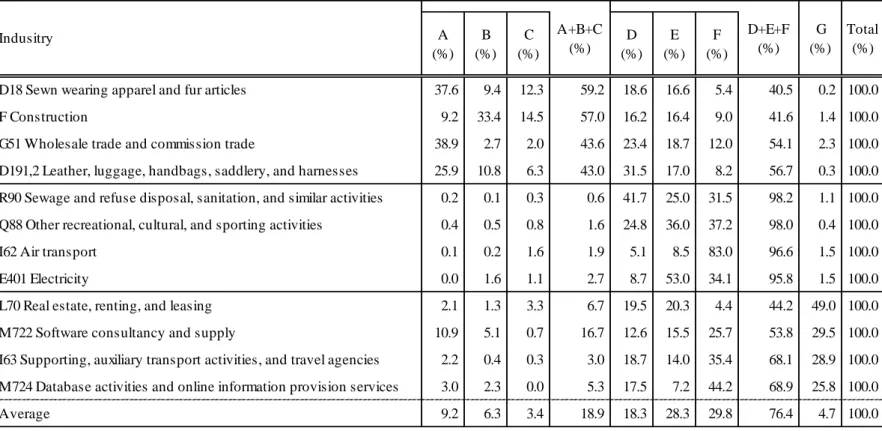
The real assets term is obtained by subtracting total financial assets from total liabilities. Real assets are composed of inventories, tangible assets, and intangible assets in the FSA data. Finished or semi-finished goods, raw materials, and other inventories are included in these inventories. Land, buildings and structures, machinery and equipment, ship vehicles and transportation equipment, construction in progress, and other tangible assets are considered tangible assets. Lastly, intangible assets contain development costs and the like. Table 7 represents the component ratio of real assets. On average,5 the real assets term is composed of 18.9% inventories, 76.4% tangible assets, and 4.7% intangible assets. Each of the top four distinguished industries that show greater than 43% inventories, 95% tangible assets, or 25% intangible assets are listed in this table. First, two manufacturing industries ([1] sewn wearing apparel and fur articles, and [2] leather, luggage, handbags, saddlery, and harnesses), which are related to apparel, are ranked first and fourth in their share of inventories. The largest inventory of these industries is finished or semi-finished goods, since these industries need finished goods, for example, textile products, threads, and yarn to produce clothing. Likewise, most inventories in wholesale trade and commission trade are finished or semi-finished goods, since this industry
4
Residual industry is excluded.
5
16
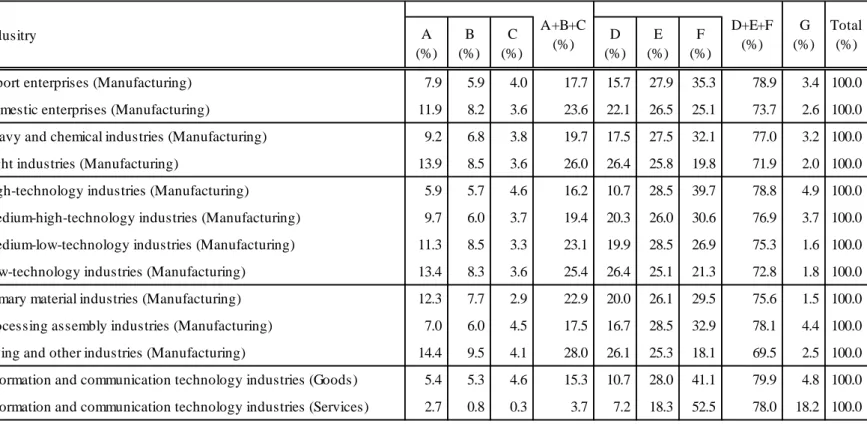
conducts trade rather than manufacture products. On the other hand, the greatest component of construction inventories is the raw materials item, comprising 33.4%. Second, (1) sewage and refuse disposal, sanitation, and similar activities; (2) other recreational, cultural, and sporting activities; (3) air transport; and (4) electricity sectors all demonstrate tangible asset ratios greater than 95%. Of these four industries, air transport in particular shows a tangible asset ratio of 83.0% machinery, transportation equipment, and other. Finally, the four industries of (1) real estate, renting, and leasing; (2) software consultancy and supply; (3) support and auxiliary transport activities, and travel agencies; and (4) database activities and online information provision services all have intangible asset ratios above 25%. This table reflects well the characteristics of each industry. The composition rate of real assets depends on an industry’s features. For example, development costs, one component of intangible assets, are almost a necessity for software and database activity-related industries. To understand the general peculiarities of different industries, composition rates of real assets by type and level are listed in Table 8. Domestic enterprises, light industries, and living and other industries have greater inventories and smaller tangible assets than export enterprises and heavy and chemical industries. Similarly, high- and medium-high-technology industries possess larger portions of tangible assets and lower inventories than low- and medium-low-technology industries. Finally, information and communication technology industries (services) have greater intangible assets than any other industry.
B. Analysis of Financial Transactions and the Power of Dispersion Indices
It is possible to construct a Y table that represents financial transactions and the coefficient C matrix by 115 institutional sectors combined with FSA data. In this subsection, we describe the structure of financial markets using the financial transaction matrix (Y table) and power of dispersion indices calculated from the Leontief inverse matrix. The Y table displays financial transactions on a “from-whom-to-whom” basis, which corresponds to the I–O table. Table 9 shows a fundraising portfolio of total industries. In other words, nonfinancial corporations raised approximately 2051 trillion Korean won from other institutional sectors in 2005. Among this, funds from nonfinancial corporations (19.6%) is the largest. There are four specific industries on average that have larger ratios than the other industries.6 Funds from wholesale trade and commission trade (2.4%), construction (2.3%), semiconductors and other electronic
6
17
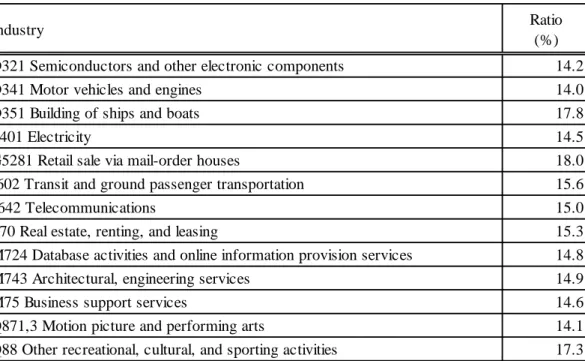
components (1.0%), and electricity (0.9%) to nonfinancial corporations are comparatively larger than for other industries. Among these, only semiconductors and other electronic components are included in manufacturing. Semiconductors are one of Korea’s leading export industries.7 Except fundraising from nonfinancial corporations by themselves, funds from domestically licensed banks (14.3%), the rest of the world (11.3%), households and nonprofit organizations (10.3%), and the general government (10.1%) are remarkable. Since the rest of the world provided more than 10% of the funds, Korean industries have a high level of dependence on foreign funds. Industries highly dependent on foreign funds are listed in Table 10.8 Retail sales via mail-order houses (18.0%) is the highest foreign-fund-dependent industry. Electricity, telecommunications, services, and arts and cultural activities also have high ratios. In manufacturing, only three industries, namely the building of ships and boats (17.8%), semiconductors and other electronic components (14.2%), and motor vehicles and engines (14.0%), are shown in this table. The building of ships and boats, motor vehicles, and engines are categorized as traditional core industries of Korea in the Korea Development Bank (KDB) (2005a). According to the KDB (2005b), the ratio of the electronic components industry9 in Korean manufacturing has increased steadily owing to the development of the semiconductor and other electronic components industry. After 2003, Korean semiconductor firms had driven aggressive investment into facilities and equipment to expand their market power. Domestic demand for semiconductors rose owing to an upswing in the export of mobile phones, MP3 players, and digital televisions. In contrast, investments by foreign competitors were conservative in that period by fall in semiconductor prices. As a result, Korean semiconductor companies could expand their market share in the global market.10
Figures 6 and 7 display the power of dispersion index for each institutional sector in 2004 and 2005. The index baseline is 1, which is used to identify the extent of dispersion. The major benefit of these indices is that they identify the relative position of each institutional sector in a
7
According to market research firm IC Insights, Korea became the world’s second-largest semiconductor manufacturer in 2013.
8
The ratios of industries having more than 14% of funds raised from foreign countries to total liabilities are listed in Table 9.
9
According to the KDB (2005b), there are two groups in the electronic components industries: one is a technology-intensive industry and the other is a labor-intensive industry. Semiconductors and LCDs, which are capital- and technology-intensive industries, are led by large firms with mass production systems. On the other hand, other electronic components are led by labor-intensive industries dominated by small and medium enterprises with small-quantity batch production methods.
10
Korea ranked fourth with the largest share at 10.0% (Korea’s production was recorded as US$39,904 million out of the world total of US$39,8826 million) in global electronic-component production in 2005. Japan ranked first with US$95,604 million, whereas the US and China ranked second (US$61,236 million) and third (US$41,368 million) (source: Reed Electronic Research [2005]).
18
financial market where these institutional sectors are interdependent, either directly or indirectly. The power of dispersion index in the liability-oriented system is displayed in the rows, whereas the columns show the power of dispersion index in the asset-oriented system. Each institutional sector is placed in the four-quadrant graph. For example, households with excess savings are generally located in the second quadrant since they exercise more power over assets and less power over liabilities. Meanwhile, corporations with excess investment are generally displayed in the fourth quadrant since they hold more power over liabilities and less power over assets. In Figures 6 and 7, most institutional sectors other than nonfinancial corporations are located in the second quadrant. Financial auxiliaries and only a few financial institutions are included in the first quadrant. Most nonfinancial corporations are located in the fourth quadrant. However, 27 industries in 2004 and 22 industries in 2005 are sited in the first quadrant, indicating that both of their power indices are greater than 1.
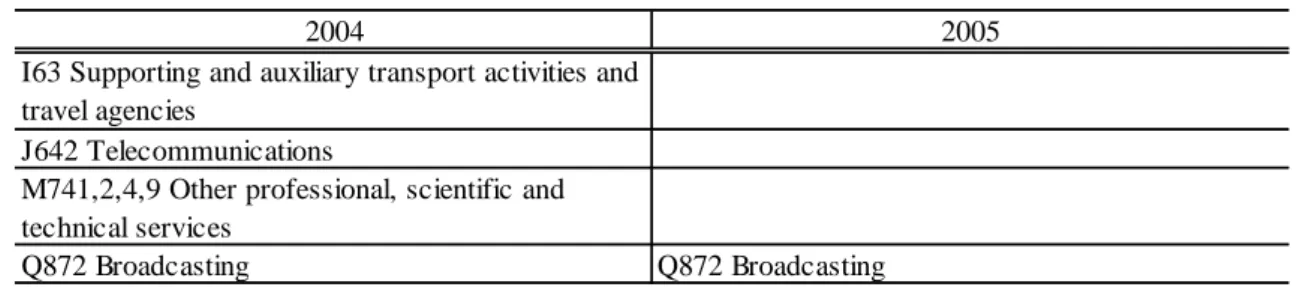
Table 11 lists industries included in the first quadrant in 2004 or 2005. Most service and IT industries, as well as construction industries, are included in the first quadrant group. In manufacturing and light industries, for example, food products, textile fibers and apparel, and glass and ceramics are located in the first quadrant, whereas fishing, mining, and quarrying as well as heavy and chemical industries including metal products and petroleum represent the fourth quadrant, since their power indices of fund-employment are comparatively smaller than those of other institutional sectors. Furthermore, four industries, namely (1) support and auxiliary transport activities and travel agencies, (2) telecommunications, (3) other professional, scientific, and technical services, and (4) broadcasting are included in the third-quadrant group in 2004 as listed in Table 12, which means that both of their power indices are very small. Three industries moved to the fourth-quadrant group in 2005, although broadcasting remained in the third quadrant.
Nishiyama (1991) subdivided Japanese FOF accounts into 37 industries and calculated one type of power of dispersion index. Nishiyama (1991) demonstrated that food products, textile fibers and apparel, pulp, paper, and paper products, publishing and printing, metal products, retail sale, real estate, construction, broadcasting, transport, motion pictures, and recreational activities have relatively smaller indices than other industries in some periods. The results of this paper are not comparable exactly with Nishiyama’s (1991) results, since two types of indices based on liability and asset approaches are obtained for the Korean case. However, we could say that some industries located in the first or third quadrants, for example, most of the
19
service and IT industries, light industries, construction, and broadcasting in Korea, overlap with the smaller Japanese power of dispersion indices’ industries.
Ⅳ. Inter-Industry Monetary Policy Evaluations in the FOF Accounts
In this subsection, each industry’s net investments induced by the BOK in 2004 and 2005 are calculated. Table 13 demonstrates only distinguished industries in NII or changes in NII. First, industries that had greater NII than other industries are listed in this table. Since the NII of some particular industries on a large scale might be larger than others, the fourth and fifth columns display NII divided by its total liabilities, whereas the second and third columns show NII denominated in billions of Korean won. Next, industries in red have negative changes in NII when subtracting NII in 2004 from 2005. In other words, industries in red saw their NII in 2005 shrink as compared with that in the previous year. Consequently, this table shows a distinguished group that includes (1) industries having positive and greater NII than their 15% of total liabilities in either 2004 or 2005 and (2) industries whose NII fell during that one year.
Compared with Table 11, wherein both of their power of dispersion indices are greater than 1, Table 13 exhibits an interesting feature. Most industries that are listed in Table 11 are not included in Table 13.11 In other words, the NII of the first-quadrant industries group is computed comparatively smaller than that of other industries listed in Table 11. Industries whose power of dispersion index in the asset-oriented system is greater than 1 are included in the first quadrant. Table 14 shows GIS, GII, and NII bifurcated by the sign of the power of dispersion index in the asset-oriented system. They are expressed as proportions of GIS, GII, and NII to total liabilities. It is clear that for the GIS–total liabilities ratios of the first group, the index is larger than 1 and mainly includes light industry, and the ratios are obviously smaller than in the second group. Since no significant gap exists between the GII of the two industry groups, the NII–total liabilities ratio of the first group is half that of the second group.
To clarify the distinction between these two groups, let us explain using industry asset portfolios. Table 15 demonstrates the asset–total liabilities ratios of two groups using a Y table, which represents transactions between institutional sectors; the central bank column and row are
11
Only two industries, namely (1) paints, varnishes, and similar coatings, printing ink and mastics, and (2) the building of ships and boats, are duplicated, since the NII of the former industry shrank in this period, whereas the latter industry had a NII-to-total-liabilities ratio greater than 15% in 2005.
20
not removed. The same method of grouping industries is used in Table 14. It is obvious that (1) financial assets, in other words, funds from each group, have inter-industry flows, and (2) excess liabilities show large differences. It is clear that the assets of the first group, which are invested in other nonfinancial corporations and which comprised 30.4% in 2004 and 27.2% in 2005, are greater than those of the second group, which were 16.9% and 16.8%. On the other hand, the second group’s excess liabilities, which run to nearly 60%, are significantly greater than those of the first group. Since excess liabilities are calculated by subtracting total financial assets from total liabilities, substantial excess liabilities imply that the industry has carried out large-scale real investments. There is not much difference between the two groups in other institutional sectors, with the exception of funds supplied to domestically licensed banks from the first group, which edged up to 10.0% in 2004.
V. Concluding Remarks
Expanded FOF accounts, which contain a range of industries, are developed in this paper. Combined with 2004 and 2005 FSA data, the FOF accounts are subdivided into 115 institutional sectors, including 95 types of inter-industries. First, inter-industry analysis of the FOF accounts was examined. Liability and financial asset portfolios and real assets ratios of industries were explained. Domestic enterprises, light industries, and medium-low-technology industries show larger inventories and fewer tangible assets than export enterprises, heavy and chemical industries, and high and medium-high technology industries. Liability portfolios of Korean core industries (semiconductors and other electronic components and the building of ships and boats, motor vehicles, and engines) are more dependent on foreign funds than other manufacturing industries. Power of dispersion indices were then presented, which showed that most service and IT industries, construction, and light industries in manufacturing are included in the first-quadrant group, whereas heavy and chemical industries are placed in the fourth quadrant since their power indices in the asset-oriented system are comparatively smaller than those of other institutional sectors. Second, inter-industry policy evaluations in the FOF accounts are derived in the fourth section. The evaluation results of monetary policies implemented by the central bank are reported. Industries are bifurcated into two groups to compare their features. The first group contains industries whose power of dispersion in the asset-oriented system is
21
greater than 1, whereas the second group contains those whose index is less than 1. We found that the NII–total liabilities ratios of the first group were half those of the second group, since GIS–total liabilities ratios of the former are obviously greater than the latter.
The FOF table has a weakness in that it does not correspond to the I–O table, since it is not subdivided into various industries. Previous researches, for example, Tsujimura and Tsujimura (2006) and Manabe (2009), examined policy evaluations using the FOF accounts that were not separated into industries. In this respect, the main contribution of this study is demonstrating the possibility of constructing “from-whom-to-whom” tables that correspond to the I–O tables and a technical I–O analysis, as Klein (2003) mentioned. Though Nishiyama (1991) tried to build “from-whom-to-whom” tables with 44 institutional sectors including 37 industries and obtained one type of power of dispersion index, this paper aimed to design more detailed tables and calculate two power of dispersion indices based on the liability approach and asset approach to evaluate the central bank’s monetary policy.
There are many possibilities and potentialities to suggest desirable economic policies by applying and extending these analytical methods. For future work, we consider an analysis method to link the I–O table and FOF accounts separated into various types of industries, for example, an estimation of production functions using inter-industry data from the linked I–O table and the NII calculated from the FOF accounts.
It has been shown here that 18 industries showed negative NII changes in 2004 and 2005, for example, fishing, mining and quarrying, certain manufacturing industries, electricity, air transport, support and auxiliary transport activities and travel agencies, and telecommunications. Challenges for the future include estimations of production functions for every industry, including a variable for changes in NII. This work will enable us to analyze how negative or positive changes in each industry’s NII, which are caused by the central bank’s monetary policy, affect the real economy. In addition, policymakers will be able to refer to these estimation and simulation results as indicators to evaluate policies and make decisions for both the financial market and the real economy.
22
◆References◆
Braun, Matias and Borja Larrain (2005) “Finance and the Business Cycle: International, Inter-Industry Evidence,”The Journal of Finance, 3, pp.1097-1128.
Copeland, Morris A. (1952), “A Study of Money flow in the United States, NBER.
Corbett, Jenny and Tim Jenkinson (1996) “The financing of industry, 1970–1989: an international comparison,” Journal of the Japanese and International Economies, 10, pp.71-96.
De Haan, Leo and Elmer Sterken (2006) “The Impact of Monetary Policy on the Financing Behaviour of Firms in the Euro Area and the UK,”European Journal of Finance, 2, 401–420.
Klein, Lawrence Robert (1983) “Models of the Economy as a whole,”Lectures in econometrics, North Holland pp.1-46.
_________ (2003) “Some Potential Linkages for Input-Output Analysis with Flow-of-Funds, ”Economic Systems Research, 15(3), pp.269-277
Kim, Kyung Soo and Eun YeongSong (2012) “Building Flow of FX Funds Table: The Case of Korea,”International Economic Journal, 18(3), pp.37-62. (in Korean) Kim, Jiyoung (2014) “Financial Structure of South Korea's Chaebol and Flow-of-Funds
Analysis, Pan Pacific Association of Input-Output Studies,” the 25th Conference Reports, pp.93-97.
Kim, Jiyoung, Satoshi Nakano and Kazuhiko Nishimura (2016) “Structural Propagation of Productivity Shocks: The Case of Korea,” IDE Discussion Paper, No.552, Institute of Developing Economies, JETRO.
Manabe, Masashi (2009) “Policy Evaluation of Public Insurance Institutions from the View Points of Flow of Funds,” Osaka University Discussion Papers In Economics and Business, No.09-25 (In Japanese)
_________ (2014)“Beikokuno Shikinjunkantoukei -Baransu Keisiki to Seidobumonkanno Matorikusuno Suikei- (The Flow of Funds Accounts in the US -Construction of Balanced Form and Estimation of Inter-institutional Sectors Matrix-),”University of Hyogo Discussion Papers In Simulation Studies, No.4 (in Japanese)
Marozzi, Marco and Paolo Carmelo Cozzucoli (2016) “Inter-industry financial ratio comparison of Japanese and Chinese firms using a permutation based nonparametric method,” Electronic Journal of Applied Statistical Analysis, 9(1), pp.40-57..
23
Nishiyama, Shigeru (1991) “An Interindustry Study of Flow-of-funds Accounts in Japan,”Ehime Economic Journal, 11(2), pp.27-40 (in Japanese)
Ogawa, Kazuo, Elmer Sterken and Ichiro Tokutsu (2012) “Financial Distress and Industry Structure:An Inter-industry Approach to the Lost Decade in Japan,” Economic Systems Research, 24(3), pp.229-249.
Reed Electronics Research (2005), The Yearbook of World Electronics Data 2005, Volume 2 - Americas, Japan, Asia Pacific.
Stone, Richard (1966) “The Social Accounts from a consumer’s point of view,” Review of Income and Wealth, 12(1), pp.1-33.
The Bank of Korea (2001) “Explanation of "Flow of Funds Accounts,” the Bank of Korea. (in Korean)
_________ (2005) “Financial Statement Analysis for 2004,” the Bank of Korea.(in Korean) _________ (2006) “Financial Statement Analysis for 2005,” the Bank of Korea. (in Korean) The Korea Development Bank (2005a) “Industry of Korea for 2005 (1),” the Korea
Development Bank. (in Korean)
_________ (2005b) “Industry of Korea for 2005 (2),” the Korea Development Bank. (in Korean)
Tsujimura, Kazusuke and Masako Mizoshita (2002a) “European Financial Integration in the Perspective of Global Flow of Funds,” KEO Discussion Paper, No.72.
_________ (2002b) Flow-of-Funds Analysis-Basic Technique and Policy Evaluation,” Keio University Publication (in Japanese).
Tsujimura, Kazusuke and Masako Tsujimura (2006) “Does Monetary Policy Work under Zero-Interest-Rate?”Journal of Applied Input-Output Analysis, 11 & 12, pp.49-72. _________ (2008) “International Flow-of-Funds Analysis: Techniques and Applications,” Keio
University Press.
Zhang, Nan (2005) “The Global-Flow-of-Funds Analysis in Theory and Application, Minerva-shobo (in Japanese).
_________(2009) “Re-examination of the Theoretical Model for Global-Flow-of-Funds Analysis,” Journal of Economic Sciences, 12, pp.21-35.
24
Table 1. Flow of Funds Accounts in Korea
Table 2. Correspondence between FOF Accounts and FSA data
1968 SNA 1993 SNA 2008 SNA Institutional Sectors 9 sectors* 18 sectors** 23 sectors Financial Instruments 34 items 35 items 46 items
1975Q1-2005Q4 2002Q4-2013Q4 2008Q4-present (Quarterly/Annual) (Quarterly/Annual) (Quarterly/Annual)
* Five sectors on the BOK website, Economic Statistics System ** Available to extend to 22 sectors
Period
Financial instruments The FOF accounts selected for this study in 1993 SNA
(Assets)
Cash and deposits Insurance & Pension
Reserves Insurance & Pension Reserves n/a Securities other than Shares, (Assets)
Shares & Other Equities, Short-term securities,
Financial Derivatives Long-term securities and Investments (Liabilities)
Current maturities of bonds payable, Bonds payable,
Capital stock (adjusted by market capitalization) Loans, (Liabilities)
Government Loans Short-term borrowings from banking institutions, Current maturities of long-term borrowings, Other short-term borrowings,
Long-term borrowings from banking institutions, Other long-term borrowings
(Assets)
Trade receivables (Liabilities) Trade payables Foreign Exchange Holdings Foreign Exchange Holdings n/a
Call loans and money Call loans and money n/a (Assets)
None-trade accounts and notes receivable, Other quick assets
(Liabilities)
Non-trade accounts and notes payable, Liability provisions,
Other liabilities Other Claims and Debts
Foreign Direct Investment, Other Foreign Claims and Debts, Miscellaneous
The FSA data Currency & Deposits Currency & Deposits
Securities
Loans
25
Table 3. Institutional Sectors in the FOF Accounts
1 Central Bank
2 Domestically Licensed Banks 3 Specialized Banks
4 Other Banks
5 Collectively Managed Trusts
6 Small Loan Financial Companies for Households and Small Businesses 7 Investment Institutions
8 Other Nonbanks
9 Life Insurance Companies 10 Non-Life Insurance Companies 11 Co-operative Society
12 Pension Funds 13 Securities Institutions
14 Credit-Specialized Financial Institutions 15 Public Financial Institutions
16 Other Financial Intermediaries 17 Financial Auxiliaries
18 General Government
19 NonFinancial Public Corporations 20 NonFinancial Private Corporations 21 Households and Nonprofit Organizations 22 Rest of the World
26
Table 4. Industries in the FSA data
1 B Fishing
2 C Mining and quarrying
3 D151 Production, processing, and preserving of meat, fish, fruits, vegetables, oils, and fats 4 D152 Dairy products and ice cream
5 D153 Grain mill products, starch products, and prepared animal feeds 6 D1541 Bakery and dry bakery
7 D1545 Condiments and food additive products
8 D1542,3,4,9 Sugar, cocoa, and chocolate, noodles, other food products
9 D1551-3 Distilling and blending of spirits, fermented alcoholic beverages, and malt liquors 10 D1554 Ice and nonalcoholic beverages, production of mineral waters
11 D171 Preparation and spinning of textile fibers 12 D172 Weaving of textile fibers
13 D173,4,9 Other textiles
14 D18 Sewn wearing apparel and fur articles
15 D191,2 Leather, luggage, handbags, saddlery, and harnesses 16 D193 Footwear
17 D20 Wood and products of wood and cork, except furniture 18 D21 Pulp, paper, and paper products
19 D221 Publishing
20 D222,3 Printing and reproduction of recorded media 21 D23 Coke, refined petroleum products, and nuclear fuel 22 D2411-3 Basic chemicals, except fertilizers
23 D2414 Fertilizers and nitrogen compounds
24 D2415 Synthetic rubber and plastics in primary forms
25 D242 Pharmaceuticals, medicinal chemicals, and botanical products 26 D2431 Pesticides and other agro-chemical products
27 D2432 Paints, varnishes, and similar coatings, printing ink and mastics 28 D2433 Soap, cleaning compounds, and toilet preparations
29 D2434,9 Other chemical products 30 D244 Man-made fibers
31 D2511 Rubber tires and tubes 32 D2519 Other rubber products 33 D252 Plastic products
34 D261 Glass and glass products 35 D262 Ceramic ware
36 D2631 Cement, lime, and plaster
37 D2632 Articles of concrete, cement, and plaster 38 D269 Other nonmetallic mineral products 39 D271 Basic iron and steel
40 D272 Basic precious and nonferrous metals 41 D273 Cast of metals
42 D281 Structural metal products, tanks, reservoirs, and steam generators 43 D289 Other fabricated metal products and metal treating services 44 D2916 Work trucks, lifting, and handling equipment
45 D2911-5,7 Other general purpose machinery 46 D292 Machine tools
27
48 D2933 Machinery for mining, quarrying, and construction 49 D2932,4-6,9 Other special purpose machinery
50 D295 Other domestic appliances 51 D30 Computers and office machinery
52 D311 Electric motors, generators, and transformers 53 D312 Electricity distribution and control apparatuses 54 D313 Insulated wires and cables
55 D314,5,9 Other electrical equipment
56 D321 Semiconductors and other electronic components
57 D322 Television and radio transmitters and apparatuses for line telegraphy
58 D323 TV and radio receivers, sound or video recording or reproducing apparatuses 59 D33 Medical, precision, and optical instruments, watches and clocks
60 D341 Motor vehicles and engines
61 D342,3 Bodies for motor vehicles, trailers, and semitrailers, and parts and accessories 62 D351 Building of ships and boats
63 D352,3,9 Railway locomotives, aircraft, and transport equipment 64 D361 Furniture
65 D369 Other manufacturing 66 D37 Recycling
67 E401 Electricity
68 E402,3 Gas, steam, and hot water supply 69 F Construction
70 G50 Sale of motor vehicles, retail sale of automotive fuel 71 G51 Wholesale trade and commission trade
72 G5211-9 Retail sale in nonspecialized stores except department stores 73 G52111 Department stores
74 G5280 General retail trade except retail sales via mail-order houses 75 G5281 Retail sales via mail-order houses
76 H551 Accommodation
77 I602 Transit and ground passenger transportation 78 I603 Road freight transport
79 I61 Water transport 80 I62 Air transport
81 I63 Supporting, auxiliary transport activities, and travel agencies 82 J642 Telecommunications
83 L70 Real estate, renting, and leasing 84 M722 Software consultancy and supply
85 M724 Database activities and on-line information provision services 86 M721,3,9 Other computer activities
87 M743 Architectural, engineering services 88 M745 Advertising
89 M741,2,4,9 Other professional, scientific, and technical services 90 M75 Business support services
91 Q872 Broadcasting
92 Q871,3 Motion picture and performing arts
93 Q88 Other recreational, cultural, and sporting activities
28
Table 5. Inter-Industry Liability Portfolio in 2005
Fishing 909.7 41.8 32.9 6.1 19.1
Mining and quarrying 2633.2 15.3 71.3 3.7 9.6
Food and beverages 67318.7 13.8 71.0 4.9 10.3
Textile, apparel, and leather 30838.1 29.5 42.2 12.9 15.4
Wood, pulp, and paper products 34742.8 21.6 58.3 6.5 13.5
Coke, refined petroleum products, and nuclear fuel 32794.2 10.7 74.5 8.1 6.8
Chemicals and chemical products 77407.7 11.8 72.1 7.4 8.7
Rubber and plastic products 20079.6 22.5 48.0 12.0 17.5
Nonmetallic mineral products 24063.5 23.0 53.8 11.3 11.9
Metals and metal product except machinery and equipment 96925.1 16.6 66.0 8.8 8.5
Machinery and equipment, computers 190587 15.2 57.6 10.9 16.3
Motor vehicles, railway, and transport equipment 174943.9 10.2 56.6 11.6 21.7
Other manufacturing, furniture, Medical, precision, optical instruments, watches and clocks
Recycling 1903 31.6 56.5 3.9 8.0
Electricity 82564.6 7.7 71.9 3.9 16.6
Gas, steam and hot water supply 22648.1 23.4 56.5 14.1 6.1
Construction 179571.4 15.0 57.1 10.9 17.0
Wholesale and retail trade 260203.7 15.2 59.4 13.6 11.8
Accommodation 23046.4 17.3 62.5 0.7 19.4
Transport 78220.5 26.1 54.8 5.7 13.4
Telecommunications 73651.6 1.9 81.4 2.5 14.2
Real estate, renting, and leasing 29472.8 18.4 51.1 1.0 29.5
Business activities 36046.3 7.1 73.1 6.9 13.0
Recreational, cultural, broadcasting, and performing arts 50004.6 8.9 68.5 1.4 21.2
Sewage and refuse disposal, sanitation, and similar activities 2875.3 16.0 71.6 1.2 11.1
Total 1611295.6 14.4 61.8 9.1 14.7 11.0 Total Liabilities (Bil. KRW) Other Foreign Debt (%) Industry Loans (%) Securities (%) Trade Credits (%) 17844 17.4 61.1 10.5
29
Table 6. Inter-Industry Financial Asset Portfolio in 2005
Fishing 909.7 33.6 34.7 9.9 21.8
Mining and quarrying 2633.2 16.9 17.1 35.0 31.0
Food and beverages 67318.7 24.2 45.3 23.3 7.2
Textile, apparel, and leather 30838.1 20.2 27.8 40.9 11.1
Wood, pulp, and paper products 34742.8 24.4 28.9 37.6 9.1
Coke, refined petroleum products, and nuclear fuel 32794.2 22.5 35.5 36.8 5.2
Chemicals and chemical products 77407.7 15.3 39.5 39.0 6.2
Rubber and plastic products 20079.6 16.8 26.8 37.1 19.3
Nonmetallic mineral products 24063.5 17.5 33.6 38.9 10.0
Metals and metal product except machinery and equipment 96925.1 14.4 42.3 37.9 5.4
Machinery and equipment, computers 190587 21.9 38.8 29.3 10.0
Motor vehicles, railway, and transport equipment 174943.9 24.2 32.2 32.1 11.5
Other manufacturing, furniture, Medical, precision, optical instruments, watches and clocks
Recycling 1903 11.7 16.5 50.0 21.9
Electricity 82564.6 5.4 81.2 11.4 2.0
Gas, steam, and hot water supply 22648.1 10.3 21.8 63.6 4.2
Construction 179571.4 16.6 26.1 35.7 21.7
Wholesale and retail trade 260203.7 14.4 39.3 34.1 12.2
Accommodation 23046.4 16.1 73.2 4.4 6.2
Transport 78220.5 23.2 32.5 27.1 17.1
Telecommunications 73651.6 15.0 45.5 26.9 12.7
Real estate, renting, and leasing 29472.8 20.7 54.0 9.7 15.5
Business activities 36046.3 28.9 24.6 31.6 15.0
Recreational, cultural, broadcasting, and performing arts 50004.6 26.8 48.6 12.6 11.9
Sewage and refuse disposal, sanitation, and similar activities 2875.3 40.3 18.0 17.7 24.1
Total 669764.1 18.3 38.2 31.5 11.9 Other Foreign Claims (%) 17844 22.3 27.3 40.0 10.4 Industry Total Financial Assets (Bil. KRW) Currency and Deposits (%) Securities (%) Trade Credits (%)
30
Table 7. Component Ratio of Real Assets of Distinguished Industries in 2005
A (%) B (%) C (%) D (%) E (%) F (%)
D18 Sewn wearing apparel and fur articles 37.6 9.4 12.3 59.2 18.6 16.6 5.4 40.5 0.2 100.0 F Construction 9.2 33.4 14.5 57.0 16.2 16.4 9.0 41.6 1.4 100.0 G51 Wholesale trade and commission trade 38.9 2.7 2.0 43.6 23.4 18.7 12.0 54.1 2.3 100.0 D191,2 Leather, luggage, handbags, saddlery, and harnesses 25.9 10.8 6.3 43.0 31.5 17.0 8.2 56.7 0.3 100.0 R90 Sewage and refuse disposal, sanitation, and similar activities 0.2 0.1 0.3 0.6 41.7 25.0 31.5 98.2 1.1 100.0 Q88 Other recreational, cultural, and sporting activities 0.4 0.5 0.8 1.6 24.8 36.0 37.2 98.0 0.4 100.0 I62 Air transport 0.1 0.2 1.6 1.9 5.1 8.5 83.0 96.6 1.5 100.0 E401 Electricity 0.0 1.6 1.1 2.7 8.7 53.0 34.1 95.8 1.5 100.0 L70 Real estate, renting, and leasing 2.1 1.3 3.3 6.7 19.5 20.3 4.4 44.2 49.0 100.0 M722 Software consultancy and supply 10.9 5.1 0.7 16.7 12.6 15.5 25.7 53.8 29.5 100.0 I63 Supporting, auxiliary transport activities, and travel agencies 2.2 0.4 0.3 3.0 18.7 14.0 35.4 68.1 28.9 100.0 M724 Database activities and online information provision services 3.0 2.3 0.0 5.3 17.5 7.2 44.2 68.9 25.8 100.0 Average 9.2 6.3 3.4 18.9 18.3 28.3 29.8 76.4 4.7 100.0
* A: Finished or semi-finished goods; B: Raw materials; C: Other inventories; A+B+C: Inventories; D: Land; E: Buildings, structures, construction in progress; F: M achinery, transportation equipment, and others; D+E+F: Tangible assets; G: Intangible assets
Indusitry A+B+C (%) D+E+F (%) G (%) Total (%)
31
Table 8. Composition Rates of Real Assets by Type and Technology Level in 2005
A (%) B (%) C (%) D (%) E (%) F (%)
Export enterprises (Manufacturing) 7.9 5.9 4.0 17.7 15.7 27.9 35.3 78.9 3.4 100.0 Domestic enterprises (Manufacturing) 11.9 8.2 3.6 23.6 22.1 26.5 25.1 73.7 2.6 100.0 Heavy and chemical industries (Manufacturing) 9.2 6.8 3.8 19.7 17.5 27.5 32.1 77.0 3.2 100.0 Light industries (Manufacturing) 13.9 8.5 3.6 26.0 26.4 25.8 19.8 71.9 2.0 100.0 High-technology industries (Manufacturing) 5.9 5.7 4.6 16.2 10.7 28.5 39.7 78.8 4.9 100.0 Medium-high-technology industries (Manufacturing) 9.7 6.0 3.7 19.4 20.3 26.0 30.6 76.9 3.7 100.0 Medium-low-technology industries (Manufacturing) 11.3 8.5 3.3 23.1 19.9 28.5 26.9 75.3 1.6 100.0 Low-technology industries (Manufacturing) 13.4 8.3 3.6 25.4 26.4 25.1 21.3 72.8 1.8 100.0 Primary material industries (Manufacturing) 12.3 7.7 2.9 22.9 20.0 26.1 29.5 75.6 1.5 100.0 Processing assembly industries (Manufacturing) 7.0 6.0 4.5 17.5 16.7 28.5 32.9 78.1 4.4 100.0 Living and other industries (Manufacturing) 14.4 9.5 4.1 28.0 26.1 25.3 18.1 69.5 2.5 100.0 Information and communication technology industries (Goods) 5.4 5.3 4.6 15.3 10.7 28.0 41.1 79.9 4.8 100.0 Information and communication technology industries (Services) 2.7 0.8 0.3 3.7 7.2 18.3 52.5 78.0 18.2 100.0
* A: Finished or semi-finished goods; B: Raw materials; C: Other inventories; A+B+C: Inventories; D: Land; E: Buildings, structures, construction in progress; F: M achinery, transportation equipment, and others; D+E+F: Tangible assets; G: Intangible assets
Indusitry A+B+C (%) D+E+F (%) G (%) Total (%)
32
Table 9. Fundraising Portfolio of Total Industries in 2005
Amount (Bil. KRW) Ratio (%) 12476 0.6 292575 14.3 133441 6.5 47597 2.3 41523 2.0 100937 4.9 88384 4.3 17774 0.9 17271 0.8 115310 5.6 1785 0.1 13778 0.7 25501 1.2 20956 1.0 38892 1.9 25859 1.3 6072 0.3 207298 10.1 402166 19.6 D321 Semiconductors and other electronic components 20296 1.0
E401 Electricity 17866 0.9
F Construction 48183 2.3
G51 Wholesale trade and commission trade 48330 2.4 210624 10.3 230780 11.3 2050999 100.0 General Government
Credit-Specialized Financial Institutions
Households and Nonprofit Organizations Rest of the World
Non–Life Insurance Companies Co-operative Society
Total
Pension Funds Securities Institutions
Credit-Specialized Financial Institutions Public Financial Institutions
Other Financial Intermediaries Financial Auxiliaries
Small Loan Financial Companies for Households and Small Businesses Investment Institutions
Other Nonbanks
Life Insurance Companies Collectively Managed Trusts
Institutional Sectors (From-whom-to industries)
Central Bank
Domestically Licensed Banks Specialized Banks
33
Table 10. Industries Highly Dependent on Foreign Funds
Industry Ratio
(%) D321 Semiconductors and other electronic components 14.2 D341 Motor vehicles and engines 14.0 D351 Building of ships and boats 17.8
E401 Electricity 14.5
G5281 Retail sale via mail-order houses 18.0 I602 Transit and ground passenger transportation 15.6
J642 Telecommunications 15.0
L70 Real estate, renting, and leasing 15.3 M724 Database activities and online information provision services 14.8 M743 Architectural, engineering services 14.9 M75 Business support services 14.6 Q871,3 Motion picture and performing arts 14.1 Q88 Other recreational, cultural, and sporting activities 17.3