Behavioral characteristics of applied general
equilibrium models with variable elasticity of
substitution between varieties from different
sources
著者
Oyamada Kazuhiko
権利
Copyrights 日本貿易振興機構(ジェトロ)アジア
経済研究所 / Institute of Developing
Economies, Japan External Trade Organization
(IDE-JETRO) http://www.ide.go.jp
journal or
publication title
IDE Discussion Paper
volume
740
year
2019-02
INSTITUTE OF DEVELOPING ECONOMIES
IDE Discussion Papers are preliminary materials circulated to stimulate discussions and critical comments
Keywords: variable elasticity of substitution, preference for variety, heterogeneous firms JEL classification: C68, D58, F12, L11
* Research Fellow, Economic Modelling Studies Group, Development Studies Center, IDE-JETRO ([email protected]).
IDE DISCUSSION PAPER No. 740
Behavioral Characteristics of
Applied General Equilibrium Models with Variable Elasticity of Substitution between Varieties from Different Sources
Kazuhiko OYAMADA* February 2019
Abstract
This study explores the behavioral characteristics of the Melitz-type heterogeneous and the Krugman-type homogeneous firm models that endogenize substitution elasticity as an increasing function of the total number of varieties that are available in each destination country/region. Using a case the United States (US) liberalizes imports of manufactured products from China as an example, simulation experiments with a three-region, three-sector applied general equilibrium model of global trade revealed that economic agents comply with more inefficient circumstances when the importer's preference for variety intensifies. Whereas, a more efficient environment enables countries, including those excluded from a free trade agreement, to receive welfare gains when the influence of the total number of varieties to the substitution elasticity becomes strong.
The Institute of Developing Economies (IDE) is a semigovernmental, nonpartisan, nonprofit research institute, founded in 1958. The Institute merged with the Japan External Trade Organization (JETRO) on July 1, 1998.
The Institute conducts basic and comprehensive studies on economic and related affairs in all developing countries and regions, including Asia, the Middle East, Africa, Latin America, Oceania, and Eastern Europe.
The views expressed in this publication are those of the author(s). Publication does not imply endorsement by the Institute of Developing Economies of any of the views expressed within.
INSTITUTE OF DEVELOPING ECONOMIES (IDE), JETRO
3-2-2, WAKABA,MIHAMA-KU,CHIBA-SHI
CHIBA 261-8545, JAPAN
©2019 by Institute of Developing Economies, JETRO
No part of this publication may be reproduced without the prior permission of the IDE-JETRO.
1
Behavioral Characteristics of
Applied General Equilibrium Models with
Variable Elasticity of Substitution between
Varieties from Different Sources
*Kazuhiko OYAMADA†
February 27, 2019
Abstract
This study explores the behavioral characteristics of the Melitz-type heterogeneous and the Krugman-type homogeneous firm models that endogenize substitution elasticity as an increasing function of the total number of varieties that are available in each destination country/region. Using a case the United States (US) liberalizes imports of manufactured products from China as an example, simulation experiments with a three-region, three-sector applied general equilibrium model of global trade revealed that economic agents comply with more inefficient circumstances when the importer's preference for variety intensifies. Whereas, a more efficient environment enables countries, including those excluded from a free trade agreement, to receive welfare gains when the influence of the total number of varieties to the substitution elasticity becomes strong.
Keywords: variable elasticity of substitution, preference for variety, heterogeneous firms JEL Classification Numbers: C68, D58, F12, L11.
* This research project has been supported by JSPS KAKENHI Grant Number JP15K03442, JP15K03497,
and JP16H03616. The original idea of this study was presented by Peter Dixon (Victoria University). The author would like to express deep gratitude for his helpful comments and suggestions.
† Institute of Developing Economies, Japan External Trade Organization (IDE-JETRO): 3-2-2 Wakaba,
Mihama-Ku, Chiba-Shi, Chiba 261-8545, Japan. E-mail: [email protected]. Phone: +81-43-299-9683.
2
1. Introduction
The recent developments in applied general equilibrium (AGE) analysis have enabled us to incorporate the Melitz-type monopolistic competition and heterogeneous firms (Zhai, 2008; Balistreri and Rutherford, 2013; Dixon, Jerie, and Rimmer, 2016; Akgul, Villoria, and Hertel, 2016). As a result, people's attention is now directed at re-estimating the elasticity of substitution between varieties from different sources, as it fits to an estimated value of the Pareto shape parameter for the productivity distribution of firms. In this situation, a controversy arises on the question is the incorporation of endogenous changes in productivity could bring significantly large welfare gains from trade (Balistreri, Hillberry, and Rutherford, 2011; Arkolakis, Costinot, and Rodriguez-Clare, 2012; Melitz and Trefler, 2012; Melitz and Redding, 2013 and 2015). Dixon, et al. (2016) emphasized that the Melitz-type trade specification may not lead to substantial revision of the welfare estimates obtained with models that based on pure competition and the Armington-type specification. However, our previous studies (Oyamada, 2015; Itakura and Oyamada, 2016) suggest that the intensity of importer's preference for variety (PfV), which may be exaggerated in theoretical as well as applied models with the Krugman- and Melitz-type specifications (Ardelean, 2006), plays a significant and central role in determining the magnitude of welfare effects.
Our previous experiments show that endogenous productivity growth among heterogeneous firms that enter the Melitz-type trade specification does not always enhance effectiveness of reductions in trade costs above the level predicted by homogeneous firm models, including not only the Krugman-type but also the Armington-type, in the environment where the PfV is weaker than the level assumed theoretically. The extra adjustment margin (i.e., the set of the intensive-margin effect that appears as a change in the sales quantity per active firm and the supplemental extensive-margin effect as a change in the proportion of active firms) in the Melitz-type heterogeneous firm model works in favor of member countries of a free trade agreement (FTA). On the other hand, if the intensity of importer's PfV is strong, it is unfavorable to non-members. This is primarily because the supplemental extensive-margin effect works stronger than the intensive-margin effect; however, the extra adjustment margin is unfavorable to FTA members and favors non-members if the intensity of the PfV is weak since the intensive-margin effect works stronger than the supplemental extensive-margin effect.1 If we assume weaker intensity of
1 We call the extensive-margin effect related to the changes in the number of firm entries as "fundamental
3
the PfV based on empirical results from Ardelean (2006) to make the analysis more realistic and practical, homogeneous firm models may generate larger welfare gains than heterogeneous firm models.
This study presents an alternative approach to handle the extensive-margin effect, based on the intuition that an additional variety reduces the distance between varieties filling in the gaps between existing varieties. Endogenizing the substitution elasticity between varieties as an increasing function of the total number of varieties that are available in each destination country/region, we explore the behavioral characteristics of the Melitz-type heterogeneous and the Krugman-type homogeneous firm models as we did with the intensity of the PfV. Although the Krugman's original model with monopolistic competition allows changes in demand elasticity (Krugman, 1979), the feature has often been discarded in the process of pursuing simplicity following Krugman (1980). Meanwhile, Feenstra (1994) proposed a model that incorporates new product varieties into a constant elasticity of substitution (CES) aggregate of import prices. Under this specification, the introduction of new or upgraded varieties lowers the international price index through reduction in the markup rate. Arkolakis, Costinot, Donaldson, and Rodoriguez-Clare (2015) introduced variable markups into a model with monopolistic competition and firm-level heterogeneity, and found that gains from trade liberalization predicted by models with variable markups are lower compared to those predicted by models with constant markups. Our approach is consistent with these attempts to incorporate variable markups rooted in the empirical evidence that larger, better performing firms set higher markups.
The remainder of the study is organized as follows. Section 2 presents a brief note on the analytical model used in the study. In Section 3, we perform experimental simulations to clarify the behavioral characteristics of the model and verify the results. Section 4 concludes the study.
2. The Model
In this section, we present an overview of the AGE model with the Melitz- and Krugman-type trade specifications used in the study. The model is calibrated to the GTAP
extensive-margin effect." When we simply use the "extensive-margin effect," it includes only the former under the Krugman-type trade specification, whereas it implies the merger of both fundamental and supplementary effects under the Melitz-type.
4
9.2 Data Base for 2011 (Hertel, 1997) with the author's assumption that the Pareto shape parameter is set to 5.0. The global economy is divided into three countries/regions indexed (source) and (destination), which are linked through trade flows: (r01) the United States (US), (r02) China, and (r03) the Rest of the World (RoW). Commodities and activities that are indexed as and are categorized into (i01) primary industries, (i02) manufacturing, and (i03) services, respectively. The manufacturing sector (i02) is assumed imperfectly competitive with increasing returns to scale (IRTS), while the other two are characterized by constant returns to scale (CRTS). The primary industries (i01) use sector specific factors, such as land and natural resources, in addition to capital, labor, and intermediate goods in the production process. The services sector (i03) provides a fraction of its output as the inter-regional transportation supply.
An important feature of the model is that firms in Sector i02 that exhibit IRTS technology are divided into two segments that respectively assume charge of production and sales. In the production process, firms' production segment collectively determines sector-wide input levels of intermediate goods and primary factors, and the output volume, based on the CRTS technologies. Then, the product is wholesaled to the sales segment. The sales segment consists of many dealers/merchants, those who have market power to determine the marked-up sales price of the commodity in every domestic and international market. The scale economy enters here.
The base model is an AGE model of global trade with the Armington-Krugman-Melitz encompassing (AKME) module introduced in Oyamada (2016) based on Balistreri and Rutherford (2013) and Dixon et al. (2016). The equations that form the Melitz-type trade module are summarized as follows:
∑ 1 ∑ ∑ , (1) 1 ∑ ⁄ ∑ ⁄ , (2) 1 1 1 ⁄ ∑ ⁄ , (3) , (4)
5 , (5) ∑ ∑ , (6) ⁄ , (7) ⁄ , (8) , (9) , (10) and ∑ ∑ , (11) where
is the intermediate input of composite commodity by sector in region ,
is the final demand for commodity in region , is the gross output of sector in region ,
is the domestic (intra-national) trade flow of commodity sold in region , is inter- and intra-regional (not intra-national but inter-national) trade flow of commodity sold by the exporting firms in region to region ,
is the price index for the composite commodities and , is the differentiated sales price for the domestic market ,
is the differentiated sales price for the international market sold by firms in region excluding the transportation margin and import tariff,
is the wholesale price of each product,
∈ 0,1 is the proportion of firms established in region that are able to sell products on the domestic market ,
∈ 0,1 is the proportion of exporting firms in established in region that are able to sell products on the international market ,
6
is the average productivity of exporting firms active on the - link, is the number of firms established in region ,
is the number of firms active on the domestic market , is the number of exporting firms active on the - link,
is the fixed overhead cost of domestic sales necessary to make sales on the market as measured in units of gross output (composite input),
is the fixed overhead cost of international sales necessary to make sales on the - link as measured in units of gross output (composite input),
is the fixed entry cost necessary to establish a firm in region as measured in units of gross output (composite input),
∈ 0,1 is the intensity of the importer's PfV,
1 is the elasticity of substitution between the varieties from different sources,
is the weight parameter that reflects the preference of region for the commodity imported from region ,
is the scaling factor,
is a shape parameter related to productivity such that 1, is the rate of export duty/subsidy,
is the rate of transportation margin, is the import tariff rate, and
is inter-regional transportation supply defined with a regional share parameter as
≡
" " ∑ ∑ ∑ 1 .
is included in Equation (6) if and only if represents the services sector (i03).
Equation (1) is the commodity aggregator for the goods produced by the IRTS sector. For the CRTS sectors, is set to zero in addition to the fact that and are fixed to unity, respectively. Note that this equation implies that sourcing is assumed to take place at the border. The following Equations (2) and (3) are the first-order conditions (FOCs) to minimize the costs of producing composite commodities, which determine the levels of and . Equations (4) and (5) defines the markup prices set by dealers in the IRTS sector. Similar to the case of Equation (1), and are fixed to unity and the expression in the parentheses is abandoned when the production sector exhibits CRTS technology. Equation (6) represents the transformation of the gross output , which determines the level of the wholesale price . The second, third, and fourth terms on the
7
right-hand side of Equation (6) enter if and only if is the IRTS sector, which implies that fractions of are foregone as fixed costs of establish firms and enter markets.
1 when is the CRTS sector. Equations (7) through (11) are only for the IRTS sector. The former four define the proportions of active firms and the average levels of their productivity, respectively. On the other hand, Equation (11) is the zero-profit condition based on the monopolistic competition that determines the number of firms established in region . Once a firm is established in region by paying the fixed entry cost , the firm draws productivity and verifies if its level meets the minimum requirement to enter a market and make sales. The least required level of productivity is such that it covers the fixed overhead cost of operations, or . Those who do not have sufficient levels of productivity become inactive even though they were once established.
In addition to Equations (1) through (11), substitution elasticity for the manufactured product ( i02) is defined as an increasing function of the total number of varieties that are available in the destination country/region :
∑ , (12)
where
is the unit coefficient given by ≡
∑ ,
∈ 0,1 is the parameter that prescribes the influence of the total number of varieties to the substitution elasticity,
0 is the initial level of the elasticity of substitution between varieties, 0 is the initial number of firms active on the domestic market , and 0 is the initial number of exporting firms active on the - link.
When 0, will not change. Notice that now has the suffix because the number of available varieties differs by destination country/region. replaces all that enter Equations (1) to (11).
Then, the module switches the Melitz- and Krugman-type specifications by applying different parameter settings as follows.
Melitz-type Specification: In the Melitz-type specification, the following setting applies,
in addition to Equations (1) through (12): ,
8
Krugman-type Specification: In the Krugman-type specification, the following three
relations apply, in addition to Equations (1) through (6), (11), and (12): 0,
1, and
(∴ 1).
3. Experiments
In this section, we report the results of the simulation experiments performed with the three-region, three-sector AGE model that includes the AKME trade module introduced in Section 2. Assuming that the US (r01) permanently removes tariffs on the manufactured products (i02) imported from China (r02) for example, we examine how the calculated values of selected economic indicators change when the influence of the total number of varieties to the substitution elasticity for the manufacturing sector ( " ") take different values from zero to unity. To highlight the effects of changing the value of " ", we also
consider the case of simultaneously changing the levels of " " for all countries/regions,
and compare the results. The main scenario is expressed by setting the rate of import tariff
" "" "" " 0, which is initially 2.967%.
3.1 Basic Effects
Since the model solves an equilibrium where every kind of adjustment has been completed, it needs to entangle the complex mixture of economic effects into several aspects while interpreting the simulation results. We deal here with the basic effects directly caused by the removal of import tariff levied in a specific trade link (trade in manufactured products from China to the US) and followed by sectoral adjustments.
Once the market price of the manufactured products imported from China declines in the US due to the removal of tariff, the demand for Chinese products relatively increases in the US, so that the wholesale price (producer price) of the manufactured product rises in China. In the US, the increased demand for imports from China partially replaces that for the manufactured substitutes produced domestically, so that the wholesale price plummets in the US. While demand for imports from the RoW also shrinks in the US, China increases imports from the RoW to substitute its expensive domestic products, so that the changing
9
direction of the wholesale price in the RoW is ambiguous. In many cases, the price tends to decrease from its pre-liberalization level.
Based on these changes in the wholesale price in every country/region, the volumes of trade flow on each link can be approximately predicted. The US mainly consumes commodities imported from China, so that demand for goods both domestically produced and imported from the RoW diminishes. Meanwhile, the representative producer in the US expands production for exports to both China and the RoW markets, as a substitute to the relatively expensive Chinese products. For the same reason, producers in the RoW also increase production for exports to China and other countries within the same region. As a result, the effects of the US liberalizing trade for Chinese manufactured products in both international and domestic trade flows are captured in Table 1. The case of the Krugman-type model with " " " " 0, which generates the same results as those obtained by the conventional Armington-type, is chosen to see the basic effects of liberalizing trade for reference. The countries/region on the left of the table correspond to sources while those at the top to destinations. Note that the diagonal parts include both domestic and intra-regional transactions, respectively. The changing rates in those two kinds of transactions are identical in the model.
The removal of protection by the US for China makes it easier for firms in China to make profits because cheaper imported intermediates are now available so that the entry number of firm tends to increase in China. Although it is difficult to predict clearly, the reduced demand in the US for the manufactured commodities produced both in the US and in RoW may lead to reductions in the number of firms entering the countries and regions. Under the Melitz-type trade specification, the proportion of firms that are active on each trade link, including the domestic market, shows changing pattern similar to the case of trade flows as captured by Table 2, except domestic firms operating in China. On the other hand, the impediment to enter the domestic and international markets (cut-off level of productivity) and sales quantity per firm show completely opposite changes to the proportion of active firms (Table 3). This is because there is a definitive rule in the Melitz-type trade specification that a higher/lower level of the cut-off productivity (also average productivity) always decreases/increases the number of varieties and expands/shrinks the sales quantity per firm. This rule can be confirmed differentiating Equations (8) and (10) with respect to :
⁄
0, and
10 0.
Analogous results can be obtained for the case of domestic firms differentiating Equations (7) and (9) with respect to .
3.2 Effects of Changing Values of
and
on the Simulation Results
Next, we observe how the impact of trade liberalization the US has with China on selected economic indicators changes with different values of " " and " " , which
respectively control the intensity of importer’s PfV, and the influence of the total number of varieties to the substitution elasticity. In the experiments, the value of either of those two parameters changes from zero to unity, with the step width of 0.05.2 When
" " is set to
zero, the intensive margin represented by sales quantity per firm, and the extensive margin by the number of (active) firms are accounted for on the same weight. On the other hand, extra valuation on the changes in varieties is added when " " takes a positive value. In many theoretical and applied models, " " is set to unity so the models draw maximum possible valuation from the extensive margin.
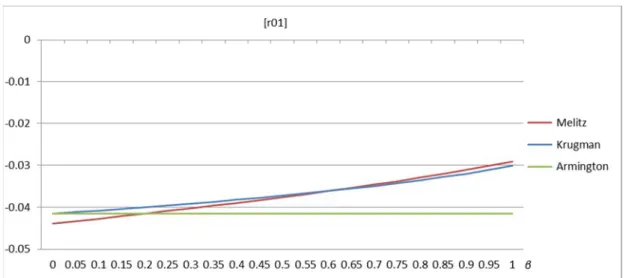
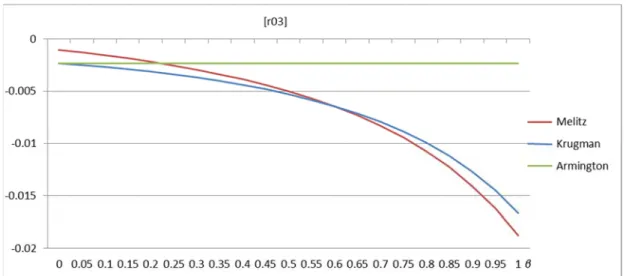
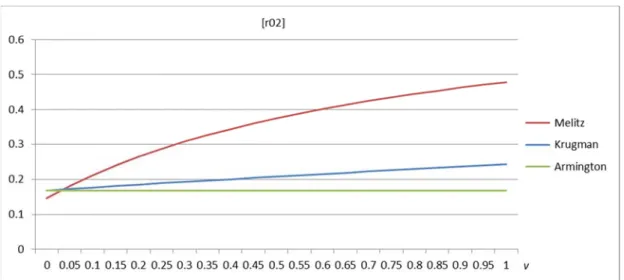
Figures 1 through 6 show the effects of the US liberalizing imports of Chinese manufactured products on regional welfare in each country/region: the US (r01), China (r02), and the RoW (r03). The effects are captured as percentage deviations from the base case. In Figures 1 to 3, the value of " " is changed from zero to unity keeping the value of " " fixed at zero. On the other hand, the value of " " is changed from zero to unity in Figures 4 to 6 keeping the value of " " bound to zero. In each figure, the red, blue, and green lines correspond to the Melitz-, Krugman-, and Armington-type trade specifications, respectively. The Armington lines are presented to show the volumes of basic effects on the terms of trade.
In the figures, welfare changes on the leftmost side, where " " " " 0,
correspond to changes in total consumption quantity. Then, the difference between the blue Krugman and green Armington lines show the magnitude of the fundamental extensive-margin effect that appears as changes in the number of firm entries. Since there is no extra valuation on the changes in varieties, the effects calculated under the Krugman- and Armington-type specification become identical at " " " " 0. In turn, the difference between the red Melitz and blue Krugman lines imply the total volume of the
2 Since no substantial difference was found for the value of
" " set greater than unity, we just focus on
11
supplemental extensive- and intensive-margin effects. The former appears as changes in the proportion of active firms, whereas the latter appears as changes in the sales quantity per active firm. These two types of effects offset each other in the Melitz-type model by the aforementioned rule.
When the value of " " is small and close to zero, the Melitz-type model tends to generate the lowest welfare levels for countries related to trade liberalization, the US and China (Figures 1 and 2), whereas the highest for third countries, the RoW (Figure 3). In turn, when the value of " " is large and close to unity, the Melitz-type generates the highest welfare levels for the countries involved in the trade liberalization, whereas the lowest for countries outside the framework. Thus, welfare effects predicted by the Melitz-type models are more sensitive to changes in the value of " " . This occurs
because in the countries involved, the extra adjustment margin in the Melitz-type model basically yields negative intensive-margin effects in a situation when the cut-off productivity is lowered and poorly productive small-scale firms come into operation, while the fundamental extensive-margin effect, which is more explicit in the Krugman-type model, is always positive when the number of firms entering expands. In Figures 1 and 2, the magnitude of the negative intensive-margin effect surpasses that of the favorable supplemental extensive-margin effect in the interval when the red Melitz line lies below the blue Krugman line, whereas the positive extensive-margin effect outweighs when the red line lies above the blue line. Thus, homogeneous firm models including not only the Krugman but also the Armington types may generate larger welfare gains than the Melitz type of heterogeneous firm models if we assume weaker intensity of the PfV.
Furthermore, when the value of " " is seen shifting from zero to unity, the basic characteristics are essentially similar to the previously seen case of " " for countries involved in trade liberalization, although the shapes of figures are now diminishing (Figures 4 and 5). If we focus on countries excluded from trade liberalization, there is a substantial difference between the cases when the values of " " and " " are respectively
changed (Figure 6). When the PfV intensifies, the US tries to expand imports from China without caring too much about price rise because China now has the most efficient environment to increase varieties (firm entry). Since the increase in imported varieties enables the US to reduce production costs through intermediated transactions more than the level that fully covers the appreciated input prices, based on the forward linkage suggested by Fujita, Krugman, and Venables (2000:242), the US also expands exports to China under the scale economy so as to enable the country to produce more varieties. Consequently, the ties between the US and China strengthen and promote the formation of a trading bloc
12
separated from the RoW. Thus, welfare worsens in the RoW as the value of " "
increases (Figure 3). On the other hand, increasing the value of " " enables smoother
resource relocations led by international trade (let us call this the efficiency-enhancing effect) in the environment with less distortion achieved by the removal of tariffs. Hence, welfare improves in the RoW as the value of " " grows. It must be noted that the impact of the efficiency-enhancing effect is much larger in the Melitz-type model than the Krugman case. Thus, the Melitz-type model consistently generates largest welfare gains for the RoW, regardless of the value of " " (Figure 6). These stories can also be confirmed by the changes in the wholesale prices.
Similar to the case of the welfare effects, Figures 7 through 12 show the effects of the US liberalizing imports of manufactured products from China on the wholesale price in each country/region. In Figures 7 through 9, the value of " " is changed from zero to unity keeping the value of " " fixed at zero, whereas the value of " " is changed from zero to unity in Figures 10 through 12 keeping the value of " " bound to zero. When the value of " " increases, the price tends to rise in China as import demand expands in the US (Figure 8). The reason why the price falls in the US when the Melitz-type specification applies is because the cost-reduction effect mentioned earlier is working substantially through intermediate transactions (Figure 7). In contrast, the cost-reduction effect based on the increase in variety is not sufficient when the Krugman-type specification applies to cover the cost-expansion effect based on the increased price of intermediate inputs caused by the strong PfV. The reason why the price tends to decline in the RoW is largely attributable to the isolation of the region from the trading bloc formed by the US and China (Figure 9). Compared to the case of the PfV, the price falls in all the countries/region, by the efficiency-enhancing effect of smoother substitution, when the value of " " increases (Figures 10 through 12). A point to note is
that the magnitude of price reduction in the US is much larger with the case of changing the value of " " compared to the case of " " (Figures 7 and 10). This brings
significantly larger welfare gains to the US when the value of " " is large, which revert the welfare losses to positive gains (red line in Figure 4 compared to the one in Figure 1).
4. Concluding Remarks
Based on an intuition that an additional variety reduces the distance between varieties filling the gaps in existing varieties, this study explored the behavioral characteristics of the
13
Melitz-type heterogeneous and the Krugman-type homogeneous firm models, which endogenize the substitution elasticity as an increasing function of the total number of varieties that are available in each destination country/region. Choosing the case of the US liberalizing imports of products manufactured in China as an example, simulation experiments with the three-region, three-sector AGE model of global trade revealed the following results.
1. When the PfV intensifies, economic agents pursue increase in variety notwithstanding the surge in prices. For this reason, countries involved in trade liberalization are eager to form a trading bloc so that third countries tend to be in a less advantageous position. This is presented in many theoretical and applied models utilized previously.
2. Smooth adjustment will be possible with endogenous elasticity of substitution, so that the efficiency-enhancing effect of international trade becomes prominent to recover welfare levels in all the countries.
3. In other words, economic agents will comply with circumstances that are more inefficient when the PfV intensifies, whereas environments that are more efficient emerge when the influence of the total number of varieties to the substitution elasticity becomes stronger.
Although the functional form with respect to the endogenous substitution elasticity assumed in this study may affect the present results, the particular diminishing pattern in the welfare effects in countries involved in trade liberalization does not change with the more generalized functions with various settings of parameter values. Further investigation is needed in the future.
An important message we would like to articulate is that it is necessary to pursue a reasonable and agreeable way to determine the value of " " or " ". This is because along with estimating the values of basic elasticity of substitution 0 and the Pareto shape parameter one may control the magnitudes or the directions of economic effects choosing "suitable" values of those parameters to generate "preferable" simulation results.
14
References
Akgul, Z., N. B. Villoria, and T. W. Hertel. "GTAP-HET: Introducing Firm Heterogeneity into the GTAP Model." Journal of Global Economic Analysis. (2016): 1(1), pp. 111-180.
Ardelean, A. "How Strong is the Love of Variety?" Purdue CIBER Working Papers. (2006): 49.
Arkolakis, C., A. Costinot, D. Donaldson, and A. Rodoriguez-Clare. "The Elusive Pro-Competitive Effects of Trade." National Bureau of Economic Research (NBER) Working Paper. (2015): 21370.
Arkolakis, C., A. Costinot, and A. Rodoriguez-Clare. "New Trade Models, Same Old Gains?" American Economic Review. (2012): 102(1), pp. 94-130.
Balistreri, E. J., R. H. Hillberry, and T. F. Rutherford. "Structural Estimation and Solution of International Trade Models with Heterogeneous Firms." Journal of International
Economics. (2011): 83(2), pp. 95-108.
Balistreri, E. J., and T. F. Rutherford. "Computing General Equilibrium Theories of Monopolistic Competition and Heterogeneous Firms." in P. B. Dixon, and D. W. Jorgenson (eds.) Handbook of Computable General Equilibrium Modeling. North Holland: Amsterdam. (2013).
Dixon, P. B., M. Jerie, and M. T. Rimmer. "Modern Trade Theory for CGE Modelling: The Armington, Krugman and Melitz Models." Journal of Global Economic Analysis. (2016): 1(1), pp. 1-110.
Feenstra, R. C. "New Product Varieties and the Measurement of International Prices."
American Economic Review. (1994): 84(1), pp. 157-177.
Fujita, M., P. Krugman, and A. J. Venables. The Spatial Economy. MIT Press: Cambridge. (2000).
Hertel, T. W. (ed.). Global Trade Analysis. Cambridge University Press: Cambridge. (1997).
Itakura, K., and K. Oyamada. "Trade Response of Armington-Krugman-Melitz Encompassing Module in a CGE Model: Case of the Trans- Pacific Partnership Agreement." Paper Presented in 19th Annual Conference on Global Economic Analysis: World Bank. (2016)
Krugman, P. "Increasing Returns, Monopolistic Competition, and International Trade."
Journal of International Economics. (1979): 9, pp. 469-479.
15
American Economic Review. (1980): 70(5), pp. 950-959.
Melitz, M. J., and S. J. Redding. "Firm Heterogeneity and Aggregate Welfare." National Bureau of Economic Research (NBER) Working Paper. (2013): 18919.
Melitz, M. J., and S. J. Redding. "New Trade Models, New Welfare Implications."
American Economic Review. (2015): 105(3), pp. 1105-1146.
Melitz, M. J., and D. Trefler. "Gains from Trade when Firms Matter." Journal of Economic
Perspectives. (2012): 26(2), pp. 91-118.
Oyamada, K. "Simulation Analysis of the EU ELV/RoHS Directives Based on an Applied General Equilibrium Model with Melitz-type Trade Specification." IDE Discussion Paper. (2016): 587.
Oyamada, K. "Behavioral Characteristics of Applied General Equilibrium Models with an Armington-Krugman-Melitz Encompassing Module." IDE Discussion Paper. (2015): 525.
Zhai, F. "Armington Meets Melitz: Introducing Firm Heterogeneity in a Global CGE Model of Trade." ADB Institute Discussion Paper. (2008): 108.
16
Table 1. Percentage Changes in Trade Flows of Manufactured Products (Krugman: " " , " " )
r01 r02 r03
r01 -0.230 2.671 1.217
r02 9.287 0.054 -1.363
r03 -1.427 1.440 0.003
Table 2. Percentage Changes in Proportion of Active Firms (Melitz: " " ,
" " )
r01 r02 r03
r01 -0.474 4.623 2.092
r02 15.294 -0.263 -2.675
r03 -2.472 2.522 0.042
Table 3. Percentage Changes in Sales Quantity per Firm (Melitz: " " ,
" " )
r01 r02 r03
r01 0.095 -0.900 -0.413
r02 -2.806 0.053 0.544
17
Figure 1. Welfare Effects (Percentage Changes, " " , r01)
18
Figure 3. Welfare Effects (Percentage Changes, " " , r03)
19
Figure 5. Welfare Effects (Percentage Changes, " " , r02)
20
Figure 7. Effects on Wholesale Price of Manufactured Products (Percentage Changes, " " , r01)
Figure 8. Effects on Wholesale Price of Manufactured Products (Percentage Changes, " " , r02)
21
Figure 9. Effects on Wholesale Price of Manufactured Products (Percentage Changes, " " , r03)
Figure 10. Effects on Wholesale Price of Manufactured Products (Percentage Changes, " " , r01)
22
Figure 11. Effects on Wholesale Price of Manufactured Products (Percentage Changes, " " , r02)
Figure 12. Effects on Wholesale Price of Manufactured Products (Percentage Changes, " " , r03)