Chapter 6 Economic integration and changes in
industrial location in Vietnam
権利
Copyrights 日本貿易振興機構(ジェトロ)アジア
経済研究所 / Institute of Developing
Economies, Japan External Trade Organization
(IDE-JETRO) http://www.ide.go.jp
journal or
publication title
Spatial Statistics and Industrial Location in
CLMV
page range
1-31
year
2010-03
Kuroiwa ed., Spatial Statistics and Industrial Location in CLMV: An Interim Report, Chosakenkyu Hokokusho, IDE-JETRO, 2010.
Chapter 6
Economic integration and changes in industrial location in Vietnam
Futaba Ishizuka
1. Introduction
Vietnam has been praised for its achievements in economic growth and success in poverty reduction over the last two decades. The incidence of poverty reportedly fell from 58.1% in 1993 to 19.5% in 2004 (VASS [2006, 13]). The country is also considered to have only a moderate level of aggregate economic inequality by international comparisons. As of the early 2000s, Vietnam’s consumption-based Gini coefficient is found to be comparable to that of other countries with similar levels of per capita GDP. The Gini index did increase between 1993 and 2004, but rather slowly, from 0.34 to 0.37 (VASS [2006, 13]). Yet, as the country moves on with its market oriented reforms, the question of inequality has been highlighted in policy and academic discourses. In particular, it is pointed out that socio-economic inequalities between regions (or provinces) are significant and have been widening behind aggregate figures (NCSSH [2001], Mekong Economics [2005], VASS [2006]). Between 1993 and 2004, while real per capita expenditure increased in all regions, it grew fastest in those regions with the highest per capita expenditures and vice versa, resulting in greater regional disparities (VASS [2006, 37]).
2
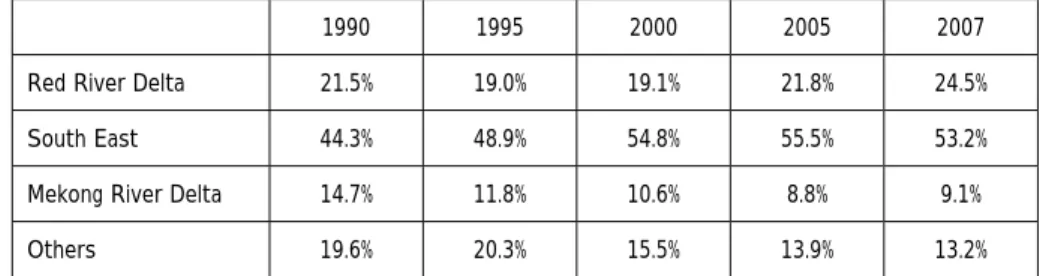
industry within the country1. According to the Statistical Yearbook of Vietnam, of the country’s gross industrial output in 2007, over 50% belongs to the South East region, close to 25% to the Red River Delta, and about 10% to the Mekong River Delta2. All remaining regions share some 10% of the country’s gross industrial output. At a quick glance, the South East increased its share of the total industrial gross output in the 1990s, while the Red River Delta started to gain ground in more recent years.
Table 1. Regional structure of gross industrial output
1990 1995 2000 2005 2007
Red River Delta 21.5% 19.0% 19.1% 21.8% 24.5% South East 44.3% 48.9% 54.8% 55.5% 53.2% Mekong River Delta 14.7% 11.8% 10.6% 8.8% 9.1% Others 19.6% 20.3% 15.5% 13.9% 13.2% Source: Statistical Yearbook 1993, 1999, 2008
Note: 1) The classification of regions follows that of the Statistical Yearbook 2008.
2) The data for 2000, 2005, and 2007 are based on gross industrial output figures at current prices, while the data for 1990 and 1995 are based on those at constant 1989 prices.
How can the government deal with regional disparities is a valid question. In order to offer an answer, it is necessary in the first place to grasp the trend of disparities as well as its background. To that end, this paper is a preparatory endeavor. Regional disparities in industrial activities can essentially be seen as a result of the location decisions of enterprises. While the General Statistics Office (GSO) of Vietnam has conducted one enterprise census (followed by annual enterprise surveys) and two stages of establishment censuses since 2000, sectorally and geographically disaggregated data are not readily
1 Lall and Chakravorty [2005, 47] state that “geographical variation in industrialization is
a primary cause of geographical variation in average income in developing nations”.
2 In this paper, the term “industry” in principle refers to manufacturing industry.
However, the industrial output data from the statistical yearbook cover not only manufacturing but also “mining and quarrying” and “electricity, gas and water supply” industries.
3
available. Therefore, for the moment, we will draw on earlier studies of industrial location and the determinants of enterprises’ location decisions in Vietnam.
The remainder of this paper is structured as follows. The following two sections deal with the country context. Section 2 will outline some major developments in Vietnam’s international economic relations that may affect sub-national location of industry. According to the theory of spatial economics, economic integration is seen as a major driver of changes in industrial location, both between and within countries (Nishikimi [2008]). Section 3, on the other hand, will consider some possible factors affecting geographic distribution of industry in the domestic sphere. In Section 4, existing literature on industrial and firm location will be examined, and Section 5 will briefly summarize the findings and suggest some areas for future research.
2. International context: economic integration
2.1. Expansion of international economic relations
A quick look at the data on trade flows and FDI would suffice to grasp that Vietnam has indeed been rapidly integrating itself into the world economy in the last two decades. The ratio of foreign trade turnover to GDP continues to rise, having reached 168% in 2007, and according to the World Trade Indicators 2008, Vietnam was 14th among all countries regarding this indicator in the 2006-2008 period. The World Investment Prospects Survey 2009-2011, released by the United Nations Conference on Trade and Development (UNCTAD) in July 2009, ranked Vietnam 11th on the list of favorable countries for FDI in the 2009-2011 period3.
4
Figure 1. Foreign trade turnover and foreign direct investment
Source: Statistical Yearbook 1993, 2001, 2008
How has Vietnam expanded its economic relations with the rest of the world? A “multi-directional foreign policy orientation” is one of the pillars of Doi Moi policy. After the collapse of the Eastern bloc, Vietnam quickly embarked on developing foreign relations with major international players such as the US and EU, as well as its neighboring countries. Vietnam normalized relations with China in 1991 and with the US in 1995, and signed a framework agreement with the EU in 1995.
5
On the multilateral front, the first donor conference for Vietnam was organized in 1993, and Vietnam officially resumed credit relations with three international financial institutions: the World Bank, the International Monetary Fund, and the Asia Development Bank in the same year. Vietnam became a full member of the Association of Southeast Asian Nations (ASEAN) and joined the ASEAN Free Trade Agreement (AFTA) in 1995. It also joined the Asia-Pacific Economic Cooperation (APEC) in 1998.
In the 2000s, Vietnam concluded two long and arduous negotiations started in 1995: one was on the Vietnam-US Bilateral Trade Agreement (BTA) and the other on accession to the World Trade Organization (WTO)4. The Vietnam-US BTA was signed in July 2000 and came into force in December 2001. In 2000, the US share of Vietnamese exports was just 5%, but it jumped to nearly 15% in 2002 and 20% in 2003. The US has been the biggest export market for Vietnam since 2002. Vietnam became the 150th member of WTO on 11 January 2007. As a result of WTO accession, Vietnam came to have MFN agreements with 164 countries and regions in the world, of which 149 are WTO members.
In addition, as a member of ASEAN, Vietnam is a signatory to the three “ASEAN+1 FTAs”: the ASEAN-China Framework Agreement on Comprehensive
Economic Cooperation (November 2002) 5, the ASEAN-Korea Framework Agreement on Trade in Goods (effective in June 2007), and the ASEAN-Japan Framework Agreement on
4 These are “modern” trade agreements, in the sense that they include extensive
obligations for signatories related not just to import tariffs and quotas, but also to transparency, dispute settlement, investment, intellectual property rights protection, market access for services, and business facilitation. The negotiation and
implementation processes of these agreements, therefore, involved revision and
development of numerous laws and regulations to comply with the international standards incorporated in these agreements.
5 The Agreement aims to liberalize trade in goods by 2010 between China and the ASEAN
6
Comprehensive Economic Partnership (effective in December 2008). Especially, trade with China has been increasing rapidly in the 2000s. In fact, China has been the largest partner of Vietnam in terms of imports since 2003 and in terms of two-way trade since 20046.
Vietnam also signed an Economic Partnership Agreement with Japan in December 2008. It is reported that Vietnam and the EU agreed to initiate negotiations for a Vietnam-EU FTA in March 20107.
2.2. Physical infrastructure development
Development of transportation infrastructure and resultant reductions in transportation costs is another important element in the acceleration of economic integration and changes in industrial location. The government of Vietnam has attached great importance to the upgrading of the nation’s transport infrastructure. The share of public expenditure on the transport sector within total public expenditure has been increasing since the early 1990s, reaching 17.6% in 2002 (GOV and DWG [2001], SRV and WB [2005]).
Some 80% of Vietnam’s exports and imports are transported by sea. The 2005 Public Expenditure Review (PER) noted a rapid increase in the annual throughput of seaports8, accompanied by improved port productivity and reduced port costs. The report points out that the performance of some of the ports in Vietnam compares very favorably with that of other ports in the region (SRV & WB [2005, 33]). According to the Vietnam Seaport Association, the container throughput of its 49 member ports in 2008 was nearly 5
6 In 2007, the import share of China was 20.3% and its export share was 7.5% (4th largest
of Vietnam’s export markets).
7 “VN-EU khoi dong dam phan Hiep dinh Thuong mai Tu do”, Nguoi Lao Dong Newspaper,
03/03/2010.
8 Vietnam Maritime Administration (Vinamarine) statistics showed that the country’s
cargo throughput in 2008 reached 196.6 million tonnes, 2.7 times more than 1999’s cargo throughput, with annual cargo growth of 13% (“Counting the cost of subpar ports”,
7
million TEUs, of which the ports in the south account for 69%. The Saigon New Port alone handles 41% of the country’s total container volume (more than 2 million TEU), followed by Haiphong Port which handles 0.8 million TEU.
A critical problem for Vietnam’s sea transportation is that the country lacks deepwater seaports that allow large vessels to dock. Only nine of the country’s 266 seaports can be upgraded to handle 3,000 TEU container ships. Cai Lan Port in Quang Ninh province, which opened in 2004 as the first deepwater seaport in the north, can only receive container ships of up to 5,000 TEU9. A series of new deepwater seaport projects are underway, and the first deepwater port in the south, SP-PSA Port in Ba Ria-Vung Tau province, opened in May 2009. The first cargo ship directly linking Vietnam and the US started from SP-PSA Port only days after the facility opened10.
In terms of international road networks, Vietnam has been participating in the Asian Development Bank (ADB)’s program for developing the Greater Mekong Subregion (GMS) Economic Corridors. The country’s three regions, the north, the center, and the south, have been increasingly connected with other countries in the subregion through the development of the North-South, East-West, and Southern Economic Corridors, respectively.
According to a report by Japan Bank for International Cooperation (JBIC), as a result of the opening of an expressway between Nanning and Huu Nghi Quan (part of the North-South Economic Corridor) in December 2005, the travel time between Hanoi and Nanning was shortened from around 7 hours to 5 hours. A regular semiweekly transportation service linking Hanoi and Southern China started in September 2007. Similarly, the completion of the Second Mekong International Bridge (part of the
9 “Cargo challenge: Many obstacles for Vietnam’s shipping industry”, Thoi bao Kinh te Sai
Gon, 01/09/2008).
8
East-West Economic Corridor) in December 2006 shortened the travel time between Hanoi and Bangkok from around 4 days to 3 days. Despite its potential, this route, alongside that linking Ho Chi Minh-Phnom Penh-Bangkok (part of the Southern Economic Corridor), has not yet been much utilized due to high costs. So far, sea transportation remains central in the movement of goods within GMS countries (JBIC [2008, 87-91].
3. Domestic context: some possible factors to influence industrial location
3.1. Central government’s stance on regional development
According to Lall and Chakravorty [2005, 58], in general, studies of industrial location using revealed preferences of firms based on site/region characteristics suggest that the most important criteria for firm location are market access, infrastructure availability, agglomeration economies, state regulations, and the general level of political support. In other words, it is generally assumed that regulatory and political factors can influence enterprises’ location decisions as well as physical conditions such as market access and infrastructure. These criteria may well apply to the location decisions of firms in Vietnam, too. Assuming that physical infrastructure is also mainly provided by the state, the possibility of the government influencing the spatial distribution of industry might not be negligible.
Before embarking on market reforms, the level of concentration of industry in Vietnam was low, which may be partly attributed to its socialist orientation (Thrift and Forbes [1986])11. Under the Doi Moi policy, the government’s stance on regional development has become more nuanced between the need to concentrate the nation’s
9
scarce resources on its growth centers and a desire to contain regional disparities to a certain level. Both of these potentially conflicting orientations can be observed in actual government policies and actions affecting industrial location.
In terms of official policy, investment incentives are granted for investment in remote and disadvantaged areas. More directly, there are reported cases in which the government attempted to intervene in investors’ decisions on investment location in order to redirect them to less endowed regions12. State enterprises are asked to establish factories in rural areas so as to provide employment for local residents. Aside from the question of the appropriateness of such measures, these can be seen as attempts to redress somewhat the imbalances resulting from market-based resource allocation.
In developing infrastructure, the government also seems to have endeavored to meet the needs of both economic hubs and the rest of the country, while the relative emphasis seems to have been shifting somewhat over time. The government’s “key economic zones (KEZs)” policy is one example. At the beginning of the 1990s, two “development triangles”, consisting of Hanoi-Hai Phong-Quang Ninh in the north and Ho Chi Minh City-Bien Hoa (Dong Nai)-Vung Tau in the south, were identified. These areas became the focus of the government’s public investment on major infrastructure. In 1994, another KEZ was established in the central area of Vietnam, covering Thua Thien-Hue, Quang Nam-Danang, and Quang Ngai, with an intention to develop the relatively underdeveloped central area. In 2004, each of the three KEZs was expanded geographically to cover more provinces: the number of provinces in the KEZs increased from 13 to 20. The emphasis in policy towards KEZs also seems to have shifted, from concentrating public investment into these areas to strengthening coordination in
12 Perhaps the most widely known example is the case of the Dung Quat oil refinery
project. See the article “In Vietnam, politics weigh on investment decisions” (Reuters UK, 26/02/2009, http://uk.reuters.com/article/idUKSP36222320090226?sp=true).
10
development planning within each zone. Finally, in 2009, a fourth KEZ was established in the Mekong River Delta, which further obscured the position of these KEZs in national development planning.
Evaluations of government policies for allocating infrastructure among different regions also vary; some criticize that the government disproportionally favors urban centers (Mekong Economics [2005, 12]), while others argue that urban infrastructure is critically underinvested as a consequence of wasteful and unproductive investment in underdeveloped areas (Harvard Vietnam Program [2008,25]).
3.2. Local governments’ impact on regional development
In addition to such policy orientations of the central government, local governments, especially at the provincial level, may play a certain role in influencing the investment environment within their respective administrative boundaries. In Vietnam, under the system of dual subordination, local governments are involved in the implementation of a rather broad range of government policies. In addition, the government has officially adopted a decentralization policy, and the provincial governments have been progressively assigned greater authority in such areas as regulation and supervision of foreign investment and private business operations. Also, an increasing share of the infrastructure budget is spent at the provincial level13.
Regarding differences in public officials’ attitudes towards business, local leaders in the south (Ho Chi Minh City in particular) are conventionally seen as having a greater inclination toward market-oriented reforms compared with their counterparts in the north (Hanoi in particular)14, although such north-south dichotomy has come to be challenged by
13 As of 2002, 55.6% of transport expenditure was attributed to the provinces (SRV and
WB [2005, 36]).
11
closer scrutiny (Gainsborough [2003]). Many provincial governments do seem to be eager to attract foreign and domestic investment. According to GSO data, as of 2007, 55 of the country’s 64 provinces had industrial zones of some sort (GSO 2008)15. In 2005, 32 of the 64 provinces were found to have violated the central government’s regulations by providing extralegal incentives to investors, especially within industrial zones16.
The level of success in attracting investors, however, varies significantly from province to province. Recently, efforts have been made to better understand the strengths and weaknesses of local administrations in improving the business environment and attracting investment, and these studies tend to reveal a substantial variety among provinces, even in implementing policies stipulated by the central government (CIEM [2003], Vu Minh Khuong and Haughton [2003], Nguyen Dinh Cung et al. [2004], Malesky [2005, 2006, 2007, 2008, 2009], WB [2005]).
3.3. Changing composition of industry in terms of ownership
Lall and Chakravorty [2005, 58] note that the basic assumption in the literature on industrial location is that all capital is private capital. On the other hand, they argue that the location logic of state capital is different from that of private capital, and whereas private capital seeks profit-maximizing or efficient locations, state capital location decisions are based also on other considerations, such as equity and security. They test this hypothesis with Indian data from the 1990s.
In Vietnam, as in India, the ownership composition of industry has changed
reforms came from southern leaders...” (Hiebert [1996, 59]).
15 There are different types of industrial zones in Vietnam, including industrial zones,
export processing zones, high-tech zones, economic zones, and industrial clusters (cum cong nghiep). The establishment of these parks is primarily proposed by provincial authorities, although it needs to be approved by the Prime Minister except in the case of small-scale cum cong nghieps.
12
significantly in the last two decades. The state sector continuously reduced its share of the country’s gross industrial output, from 50% in 1995 to 28% in 2007. Until about 2000, only the foreign invested sector increased its share of gross industrial output. On the other hand, the domestic non-state sector, which began to realize its potential under the 1999 Enterprise Law, has been growing even faster in recent years. If the state sector has a different set of criteria in deciding investment location from that of non-state sector (both domestic and foreign), this change in the ownership composition of industry is expected to affect the overall industrial location within the country in one way or another17.
3.4. Changes in sectoral composition of industry
The location pattern of industry may also vary between different sub-sectors. According to Kim [2009, 154], studies on industry localization in a number of developed countries, as well as many developing countries, suggest that relatively low-tech industries, such as textile and apparel, are much more likely to be spatially localized than medium- to high-tech industries, such as electrical machinery.
Vietnam adopted a slogan of “industrialization and modernization” in 1994, under which it aims to transform itself into a basically industrialized country by 2020. Although industry’s share of the country’s GDP increased from 28.9% to 41.5% between 1994 and 2007, Vietnam is still at an early stage of industrialization, characterized by the dominance of labor-intensive industries. Nevertheless, some changes in the sectoral composition of industry can be observed: while the food and beverage sector was dominant in both 1995 and 2007, its share of total gross industrial output has declined, and other
17 It is noteworthy, however, that the major means of SOE restructuring in the 2000s has
been equitization, or transforming state enterprises into joint-stock companies. Some of the equitized SOEs remain in the category of SOE (if the state retains the dominant share), while others have shifted to the category of non-state. Even in the latter situation, the old management has remained in position in many cases.
13
sectors such as fabricated metal products, electrical machinery and apparatus, and rubber and plastic products have increased their respective shares. Such changes can be observed more or less in common in both FDI and domestic economic sectors. The question of whether there are noticeable variations in the location pattern of these industries is worth exploring.
4. Literature review
4.1. Industrial maps
This section will review the existing literature on industrial location and factors influencing industrial location in Vietnam. While it is often mentioned that industrial activities are concentrated in a handful of provinces centering around Ho Chi Minh City in the south and Hanoi in the north, there are a couple of studies showing geographical distribution of industries or enterprises in the form of maps.
One such study is McCarty et al. [2005, 103]. This study uses the data of enterprises in 12 industrial sectors, covering all ownership types, taken from the 2001 Vietnam Industry Census collected by the General Statistics Office (GSO). The number of enterprises dotted on the maps is 4,40218. The authors’ main concern is whether economic clusters exist in the selected sectors. They do find some evidence of economic agglomeration in Vietnam, although they do not yet see clusters emerging “of the kind seen
18 The study notes that the data set excludes household enterprises and farming
households, as well as most small and medium-sized enterprises, which are registered with the provincial level authorities (McCarty et al [2005, 60]). For comparison, in the 2000 Enterprise Census by the GSO (which also excludes household enterprises), there are in total 10,403 enterprises in the manufacturing sector, of which 421 firms are in the textile sub-sector (570 in McCarty et al. [2005]), 580 garment (800), and 388 paper and paper products (513).
14
in countries such as the USA or Japan”. Not surprisingly, industries concentrate around Ho Chi Minh City in the south and around Hanoi to Haiphong in the north, which they see as an evidence for their argument that clustering is more related to access to land and infrastructure (leading to urban markets and ports), rather than to labor or other variables. They also make some observations on differences in distribution patterns among different sectors. The maps show that manufacturing industries such as textiles, garments, and automobiles are more concentrated than commodity production industries such as rice, seafood, and sugar. Within manufacturing industries, light industries such as electronics, garments, and motorcycles are more concentrated than heavy industries such as cement, paper, steel, and textiles. They attribute the differences between light and heavy industries to the ownership structure of each sector: while heavy industries tend to be dominated by SOEs, light industries are participated in more by private and 100% foreign invested enterprises, who are freer to choose plant location on pure economic grounds (although no data is provided to support this argument).
Another set of industrial maps is provided by Le [2008] as part of her analysis of the determinants of FDI location in Vietnam. She uses data on the cumulative FDI stock of disbursed FDI in each province for 1995, 1999 and 2003. The data covers not only FDI in manufacturing sector but also that in other sectors such as construction and services19. The maps demonstrate that the distribution of FDI appears to be highly concentrated in some provinces mainly around Ho Chi Minh City and Hanoi. She emphasizes that the magnitude of FDI concentration is far beyond the level of differences in income, which is normally taken as a proxy for the market size variable. Another outstanding feature is that the areas of FDI concentration spread out over time.
19 According to UNCTAD [2008], while the first foreign investments were directed towards
the oil and gas sector, the manufacturing sector came to account for 45% of registered FDI capital in 1995-2000, and this share reached more than 60% in 2001-2007 (UNCTAD [2008, 10]).
15
4.2. Determinants of sub-national firm location: FDI
The highly uneven spatial distribution of FDI in Vietnam has prompted researchers to explore the key factors behind the location decisions of foreign investors and evaluate the effectiveness of government policies to affect such decisions. There are several studies analyzing the factors affecting the sub-national location decision of foreign investors in Vietnam, most of which are based on revealed preferences of enterprises measured by their actual distribution.
An article by Pham Hoang Mai [2002] is an early attempt in this type of literature. In her analysis, the dependent variables are the provincial allocation of committed FDI flows for the period 1988-98, and the provincial allocation of implemented FDI flows for the period 1991-98. She examined four possible factors influencing the pattern of provincial allocation of FDI: (1) the level of infrastructure development (represented by the average number of telephones per capita); (2) the quality of the labor force (number of middle secondary school pupils per capita); (3) market size (income per capita); and (4) government policies (central government’s tax incentives provided to FDI projects in remote and hardship areas). She concludes that the unequal allocation of FDI inflows between provinces can be attributed to factors (1) to (3), but that central government incentives to attract FDI to disadvantaged areas are not effective. She does not include local government policies and incentives in her analysis as she finds it difficult to quantify such incentives.
Meyer and Nguyen [2005] try to test the proposition that “the more developed market-supporting institutions in a region are, the more likely foreign investors are to invest in that sub-national region” by developing two hypotheses: (1) the more sub-national institutions facilitate access to scarce local resources (proxied by real estate
16
made available in industrial zones), the more FDI the sub-national region receives, and (2) the more state-owned enterprises dominate a sub-national region (proxied by the share of SOE output in the total output of domestic enterprises), the less FDI the region attracts. They use the cumulative number of FDI projects registered up to 2000 and the number of new FDI projects in 2000 as dependent variables. In addition, they include control variables for provincial market size (represented by population), market growth (GDP growth), human capital (number of university teachers per 1,000 inhabitants), wage level (average monthly income of local state sector employees), and infrastructure (volume of passenger traffic of local transport per capita). In estimating the determinants of FDI in 2000, the previous stock of FDI up to 1999 is also used as a control variable. They find that their hypothesis (1) is supported by regression results, while hypothesis (2) is not. Most of the variables (except the wage level) are highly significant in estimating the determinants of cumulative FDI stock, while only the previous stock of FDI and the industrial zones are significant in estimating the determinants of FDI in the latest year.
Vu Thanh Tu Anh et al. [2007] offer an evaluation of the effectiveness of extralegal local incentives in attracting FDI. As mentioned above, 32 out of 64 provinces were found to be providing incentives to investors beyond their jurisdictions between 2001 and 2005. The paper uses registered FDI per capita (2000-2005) and implemented FDI per capita (2000-2004) as the dependent variables. There are five groups of independent variables: (1) education (measured by the number of primary and secondary schools and the number of students per 1,000 inhabitants); (2) wages (average monthly compensation of enterprise workers); (3) structural endowments including infrastructure (availability of airports, deep seaports, and railways, the percentage of communes through which a motorway passes, the percentage of communes connected to the national grid, and the average number of telephones per 1,000 residents), and proximity to major markets (sum
17
of the inverse of the distance from the province to Hanoi and Ho Chi Minh City); (4) extralegal incentives (the number of documents classified as extralegal in the Prime Minister’s Decision No.1387); and (5) investment environment (an average of four indicators: transparency, state-sector bias, proactivity of provincial leadership, and legal institutions from the Provincial Competitiveness Index20). All independent variables except extralegal incentives are significant in one or both of the regressions using different dependent variables.
Finally, the study of Le [2008] recapitulates previous studies on sub-national determinants of FDI distribution in developed countries, developing countries, and Vietnam, and tries to include some independent variables which are not included in the previous studies on Vietnam, namely, agglomeration and geography variables. She uses the VND amount of FDI flows and the number of FDI projects as the dependent variables. Independent variables include: (1) market size (represented by retail sales); (2) labor cost and human capital (the average monthly income of SOE employees and the total number of secondary school students); (3) infrastructure (road length and the number of telephone lines); (4) agglomeration (total industrial output and FDI stock); (5) geography (distance to large urban centers); and (6) market institution (share of non-state industrial output of total industrial output). Provincial population is included as a control variable. Regarding the impact of policies, the study notes that no good proxy for provincial FDI policies was found. The study applies different models for respective dependent variables. It was found that, overall, the results from the two models are similar. In estimating the determinants of FDI inflows, it was found that retail sales, road length, number of telephone lines, geography, and non-state industrial output are insignificant, while the other
18
variables are significant21. In estimating the determinants of FDI project count, all variables except geography are found to be significant. Some variables (population and education) are found to have opposite impacts on FDI flow and on project count. Le thinks that these differences between the results of the two models can be explained by different responses of FDI projects with different sizes22.
There appear to be few studies on sub-national FDI location adopting different approaches. Two studies based on surveys ask investors what location factors are important to them. One is the work of Pham Thi Huyen [2006], which is based on the survey conducted by the Vietnam Development Forum (VDF) on foreign investors’ assessment of Hanoi as an investment location. They sent out a questionnaire to over 100 foreign-invested companies in Hanoi as well as other cities and provinces, and collected 68 valid returns (55 from Hanoi and 13 from other cities and provinces). According to the survey results, local market potential is at the top of the list of important factors in selecting an investment location, followed by partner offers, local FDI attraction policy, and transportation system. Investors are also found to care about the financial and banking system, level of legal compliance, quality of the work force, and supporting industries and services. Compared to the above, factors such as labor cost and corruption level are of lesser importance to the surveyed companies, and the least important among the factors listed is the government’s suggestion. The survey also notes differences among investors of different nationalities. While almost all investors agree that market potential is important and the government’s suggestion is unimportant in choosing location, investors from different origins tend to give different weight to other factors. For instance,
21 More precisely, she estimates the impact of most variables in two forms of log level and
log difference. Some variables are only significant in one of these two forms.
22 According to her interpretation, a larger number of projects implies smaller size, and
small investors are more sensitive to market institutions, infrastructure, and agglomeration effects than large investors.
19
investors from Australia, the US, and EU are highly interested in the availability of supporting industries and services and the level of corruption, while the most important factor for Chinese, Korean, and Taiwanese investors is low cost.
The other survey was conducted by Yeoh et al. [2007]. They interviewed the senior managers of 47 companies in the Vietnam-Singapore Industrial Park (VSIP) in Binh Duong province, which is adjacent to Ho Chi Minh City and is one of the most successful provinces in the country in attracting FDI. The 47 companies, which represented 34% of the committed tenants in VSIP at the time of the interview, included 10 wholly Singapore-owned, 2 joint-venture, and 35 wholly foreign-owned firms. Regarding factors influencing respondents’ decisions to invest in VSIP, the most frequently cited pull factor was the political commitment from the Vietnamese government (highlighted by 80% of the respondents), followed closely by infrastructure facilities and support services of the IP (77%). Other frequently cited factors included investment incentives (64%), access to the domestic market (47%)23, and competitive labor costs (43%). Factors such as access to overseas markets (32%), availability of skilled/educated labor (26%), and presence of major buyers (23%) are also cited, but less frequently. The presence of major competitors (2%), the presence of major suppliers (9%), competitive overheads (13%), and political commitment from the Singaporean government (13%) were not cited by most investors. They also compared the views of the Singaporean-owned and joint venture firms on the one hand with those of the wholly foreign-owned firms on the other. The two groups of investors both emphasize the importance of infrastructure facilities and support services of the IP, but the Singaporean-owned firms and joint ventures attach more importance to competitive labor costs, while the foreign firms tend to highlight access to overseas
23 Of the 47 respondents, 19 targeted the domestic (Vietnam) market, 18 exported mainly
20
markets as the main pull factor.
In addition, there are a couple of case studies on the role of industrial zones in attracting foreign investors, such as Kuchiki [2007] and Mazur et al. [2008]. While the former deals with a successful case and the latter an unsuccessful one, both regard the involvement of a foreign strategic partner in developing IZs as one of the key elements for successfully attracting foreign investment.
4.3. Determinants of sub-national firm location: domestic private enterprises
As mentioned earlier, the domestic private sector in Vietnam has been burgeoning since the initiation of the 1999 Enterprise Law. It is observed, however, that there are marked differences among provinces in terms of performance in private sector development, which researchers have tended to attribute to a number of institutional and physical conditions.
The Central Institute for Economic Management (CIEM) conducted case studies of nine provinces with broadly similar advantages in terms of access to infrastructure and export markets (CIEM [2003]). The number of enterprises registered between January 2000 and July 2003 per 1,000 people ranged from 1.55 in Danang to 0.21 in Bac Giang among the nine case study provinces. Based mainly on interviews with provincial and district level state and private sector stakeholders, they try to identify the strategies employed by the different provincial authorities to improve the business environment, which they then classify into largely positive, mostly positive, mixed, and problematic. For instance, largely positive strategies include “consult with, and commit to, private sector”, and “reforming regulations and work practices”; and mostly positive strategies include “one-door processing of business issues”, “public-private partnerships”, “investment promotion”, and “improving information flows”. On the other hand,
21
strategies such as developing industrial zones and industrial clusters (cum cong nghiep) or establishing development funds are found to have mixed impacts. Finally the report identifies some problematic acts by the provinces such as encouraging particular types of investment or intervening in business decisions.
Nguyen Thi Canh et al. [2004] examine the impact of corporate income tax (CIT) incentives on enterprises’ investment decisions by conducting a survey of 140 domestic private enterprises in Ho Chi Minh City, Binh Duong province, and Tien Giang province24, and of those surveyed, half received CIT incentives. Enterprises were asked to rate each of the 14 possible factors influencing their investment decision by degree of importance. According to the survey results, “good infrastructure” and “good human resources” are the two highest scoring factors, followed by “access to raw materials and intermediate goods”, “access to domestic markets”, “local regulations and laws”, and “treatment by local government officials”. The provision of CIT incentives ranks 7th out of 14 factors, followed by other credit or land-related incentives. The lowest of the 14 factors was “investment location is simply my place of origin/residence”. While the top two factors are largely common to enterprises in the three provinces, in general, factors relating to incentives had a higher rank in Tien Giang, the least developed of the three, than in the other two. The CIT incentive receiving enterprises were also asked whether they would have made the same investment decision even without the CIT incentives that were offered: 84% of those enterprises answered “definitely yes” or “probably yes”.
Arguably the most comprehensive attempt to analyze the factors influencing geographical distribution of domestic private enterprises in Vietnam is the annual Vietnam Provincial Competitiveness Index (PCI) report (Malesky [2005, 2006, 2007, 2008, 2009]). The report starts from the assumption that the highly uneven pattern of private sector
22
development in Vietnam can be understood as the result of a combination of factors, some related to the endowments of a region and some to the performance of provincial governments. While endowments (or structural conditions) are hard to change within a short term, the performance of provincial governments (quality of provincial economic governance) could be improved relatively quickly. Therefore, the report concentrates on analyzing the impact of differences in provincial economic governance on private sector development.
Three dependent variables are selected as the measures of private sector development, namely the number of active private enterprises per 1,000 citizens, private sector investment per capita, and average profit per enterprise. Provincial economic governance is assessed and ranked in ten areas (or sub-indices), namely “entry cost”, “land access and security of tenure”, “transparency and access to information”, “time costs and regulatory compliance”, “informal charges”, “SOE bias (competition environment)”, “proactivity of provincial leadership”, “private sector development services”, “labor training”, and “legal institutions”25. Each sub-index is composed of concrete indicators including both hard data and “perceptions” data26. In order to collect the “perceptions” data, the organizers of the study send questionnaires to firms that were randomly selected from a list of registered private firms supplied by the National Tax Authority, stratified by business age, sector and legal form27.
25 Of the 10 sub-indices, “labor training” and “legal institutions” were introduced from PCI
2006. Also, the “SOE bias” sub-index was dropped in PCI 2009.
26 There were 43 indicators in PCI 2005. The number of indicators increased to 91 in PCI
2009.
27 In the preparation of PCI 2005, the PCI team mailed out 15,400 surveys to addresses
drawn from a list of 108,287 firms in 44 provinces. Consequently, 2,020 responses from firms in 42 provinces were used to construct PCI 2005. From 2006 on, PCI covers all 64 provinces. The response rate has been improving as the PCI project gets wider
recognition. In PCI 2009, 9,890 enterprises responded, with a national response rate of 25%.
23
Proxy variables are used to control for the impact of initial endowments. In PCI 2006, for instance, the report used three proxy variables: the distance from Hanoi or Ho Chi Minh City (representing proximity to market), secondary school graduates as a percentage of the population in 2000 (quality of human capital), and telephones per capita in 1995 (infrastructure). These structural conditions account for 90% of the explained variance in the number of enterprises per 1,000 citizens, 46% of the private investment per capita, and only 7% of the variance in average profit per enterprise (Malesky [2006 83])28. Except for the 2006 and 2007 reports, the controlling variables are slightly different each year. The 2009 report dropped the “human capital” variable, which had been found to offer little explanatory value in previous volumes.
According to PCI 2009, the most critical governance factors for private sector development are “transparency” and “labor quality”. Of the nine sub-indices, those found to have the lowest correlation with private sector outcomes are “land access” and “legal institutions”. The report noted that it is not that these factors are unimportant, but that they are generally problematic across the country, thus leading to low variance across provinces (Malesky [2009, xiv]). The relative importance of sub-indices is supposed to change as provincial practices change. For instance, PCI 2005 found the two most important sub-indices were “entry costs” and “transparency”, while PCI 2006 categorized “entry costs” into the group of “low variance sub-indices” due to the fact that “most provinces have made significant improvements to streamline business registration procedures” (Malesky [2006, 88]). In 2009, the “SOE bias” sub-index was dropped for basically the same reason29.
28 It is worth noting that they deliberately use relatively old data as the measure of
structural conditions to avoid the risk of undervaluing good governance (good provincial leaders may channel the fruits of their good economic governance into infrastructure and human capital) (Malesky [2005, 61-62]).
24
4.4. Comparison
All studies reviewed above except McCarty et al. [2005] focus on enterprises rather than industry, and deal with either the FDI sector or the domestic private sector. All except McCarty et al. [2005] and Yeoh et al. [2007] examine enterprise distribution at the provincial level, due in part to the existence of “a rich data set at provincial level, which is normally not available for countries with the same level of development as Vietnam” (Le [2008, 2]).
Many studies are motivated to assess the effectiveness of government policies to promote investment in certain geographic areas, and also economic governance at the local level. Specifically, the studies examine central and local tax incentives, industrial park development, local government handling of everyday tasks such as business registration and tax inspection, and so on. The findings are more or less common to the studies on FDI and the domestic private sector. With regard to tax incentives, regression analyses by Pham Hoang Mai [2002] and Vu Thanh Tu Anh et al. [2007] resulted in a clear rejection of the effectiveness of central and local investment incentives, whereas questionnaire surveys (Nguyen Thi Canh et al. [2004], Pham Thi Huyen [2006], and Yeoh et al. [2007]) tended to lead to less clear-cut conclusions.
CIEM [2003] and Malesky [2005, 2006, 2007, 2008, 2009] stress the key role played by provincial governance, which is basically supported by Vu Thanh Tu Anh et al. [2007]. The Vietnam Development Report 2006 (WB [2005]) also notes that local government attitudes and decisions can have a decisive impact on business activity, which results in striking contrasts in overall performance between otherwise similar provinces (WB [2005, 136-145]. On the other hand, the report is cautious about efforts to quantify
biased incentives toward LSOEs no longer pose an obstacle to private sector performance” (Malesky [2009, 18]).
25
the impact of different aspects of local economic governance such as PCI. It reminds the readers that some localities such as Binh Duong, Danang, Hanoi, and Ho Chi Minh City do quite better than could be expected solely from their governance indicators, and that if these provinces were removed from the analysis, the relationship between the PCI and business activity would become flatter (WB [2005, 143]).
PCI itself acknowledges the importance of other factors affecting enterprises’ investment decisions, particularly infrastructure. In its latest two volumes, PCI developed an “infrastructure index”, which is divided into sub-indices such as industrial zones, road and transport, utilities, and information and communications technology, to assess the overall quality of infrastructure in each province. Most other studies also agree on the significance of infrastructure, although there are some differences in details. While many of those including survey-based studies focus on transport infrastructure, Pham Hoang Mai [2002] and Le [2008] use telephones per capita as an independent variable, the former finding it significant and the latter insignificant (in her analysis of FDI inflows). Le also found the “road length” variable insignificant in her analysis of FDI inflows.
While access to local markets is another frequently mentioned factor, some examined the impact of provincial market size, while others focused on access to major domestic markets. Pham Hoang Mai [2002] and Meyer and Nguyen [2005] use income per capita and population, respectively, to represent provincial market size, and found this variable significant. Le [2008], on the other hand, uses retail sales as the proxy for local market size, which she found insignificant, reasoning that, given the small size of Vietnamese provinces, provincial market size is not individually significant30. Vu Thanh Tu Anh et al. [2007] and Malesky [2005, 2006, 2007, 2008, 2009] found “proximity to major domestic markets (Hanoi and Ho Chi Minh City)” a significant factor. In a similar
30 She also argues that income per capita used as a proxy for market size may suffer from
26
vein, Le [2002] included the distance to large urban centers (towns with population of 250,000 or more) as the proxy for market access, but found it insignificant.
The impact of labor-related variables, education and wages, is also mixed. Pham Hoang Mai [2002], Meyer and Nguyen [2005] and Vu Thanh Tu Anh et al. [2007] found education or the human capital variable positive and significant. On the other hand, Meyer and Nguyen [2005] found wage level insignificant, while according to Vu Thanh Tu Anh et al. [2007], the impact of labor costs differs for registered and implemented FDI, that is, positive and significant in the analysis of implemented FDI, but negative and insignificant in the analysis of registered FDI. In contrast, the study by Le [2008] found that the labor costs variable was negative and significant in determining both FDI inflows and FDI project count, while the education variable was significant, but had an opposite impact on FDI inflows and on project count.
PCI does not deal with wages, but takes human capital into consideration in two ways. Initially, as part of structural endowments, PCI included the human capital variable proxied by “the secondary school graduates as a percentage of the population in 2000”; however, as mentioned earlier, this variable was dropped in PCI 2009, presumably because of its low explanatory value. On the other hand, “labor training” is included as one of the PCI sub-indices, consisting of such indicators as “quality of general education”, “quality of vocational training”, “quality of labor exchange services”, “number of locally managed vocational schools per 100,000 citizens”, and “number of labor exchange bureaus per 100,000 citizens”. Since the inclusion of this sub-index in PCI 2006, it has been constantly one of the most important sub-indices.
Lastly, the impact of agglomeration is dealt with by Meyer and Nguyen [2005] and Le [2008], and was found significant in both studies.
27
5. Concluding remarks
The aim of this paper was to understand the trend of regional disparities in industrial activities in Vietnam and the factors behind it. We found that few studies deal directly with the subject of industrial location, while more studies are found in the field of firm location factor analysis. The studies of firm location in Vietnam have focused on more or less common factors, while the results of their analyses vary. The differences may be partly attributed to the different models and proxies chosen, and also to some extent the period they focused on. However, many studies do agree on the significance of some of the variables, such as market access and infrastructure. Not all studies include governance and agglomeration in their analyses, but where they do, there seems to be a certain consensus on the significance of these factors too.
As more research accumulates and as more data become available, an increased number of variables come to be included into the analyses of both FDI and the domestic private sector. On the other hand, the overall picture of changes occurring in industrial location has not been made very clear in the existing literature. Industrial maps, like those by McCarty et al. [2005] and Le [2008], are helpful, but the former uses a dataset for just one year and the latter only shows the overall trend of FDI. The next step, therefore, would be to develop maps like those of Le [2008] but covering all ownership categories, and disaggregated by sub-sectors like those of McCarty et al. [2005]. Then we could see more clearly, for instance, whether and to what extent, the north is catching up with the south in industrial development, or how far each industrial concentration has spread. That would in turn enable us to ask more specific questions on industrial location factors, such as what infrastructure, policy, or developments in international relations have brought
28
about such changes.
References
Beresford, Melanie and Dang Phong [2000] Economic Transition in Vietnam, Edward Elgar.
Central Institute for Economic Management (CIEM) [2003] “Comparative Provincial Performance in Private Business Development: Some Preliminary Observations from Nine Provincial Case Studies”, United Nations Development Programme.
Gainsborough, Martin [2003] Changing Political Economy of Vietnam: The Case of Ho
Chi Minh City, RoutledgeCurzon.
Government of Vietnam (GOV) and Donor Working Group (DWG) [2001] “Vietnam: Managing Public Resources Better”, Public Expenditure Review 2000, Vol.2.
Harvard Vietnam Program [2008] “Choosing Success: The Lessons of East and Southeast Asia and Vietnam’s Future: A Policy Framework for Vietnam’s Socioeconomic Development, 2011-2020”, Harvard University.
Hiebert, Murray [1996] Chasing the Tigers: A Portrait of the New Vietnam, Kodansha International.
Japan Bank for International Cooperation (JBIC) [2008] Betonamu no toushi kankyo
(Investment Environment in Vietnam), JBIC. (in Japanese)
Kim, Sukkoo [2008] “Spatial Inequality and Economic Development: Theories, Facts, and Policies”, Michael Spence, Patricia Clarke Annez and Robert M. Buckley eds.
Urbanization and Growth, Ch. 5, 133-166, the World Bank.
Kuchiki, Akifumi [2007] “Agglomeration of Exporting Firms in Industrial Zones in Northern Vietnam: Players and Institutions”, Masatsugu Tsuji, Emanuele Giovannetti, and Mitsuhiro Kagami eds., Industrial Agglomeration and New
Technologies: A Global Perspective, Edward Elgar.
29
Inequality: Theory and Evidence from India”, Review of Development Economics, 9 (1), 47-68.
Le, Thuy Le [2008] Determinants of Foreign Direct Investment at Provincial Level in
Vietnam, VDM Verlag Dr. Muller.
Leproux, Vittorio and Douglas H. Brooks [2004] “Viet Nam: Foreign Direct Investment and Postcrisis Regional Integration”, ERD Working Paper No.56, Asian Development Bank.
Mazur, Eli, David Dapice, and Vu Thanh Tu Anh [2008] “The Chu Lai Open Economic Zone and Rural Development: Central Planning’s Laboratory for Policy and Institutional Innovation”, UNDP Policy Dialogue Paper 2008/2, Hanoi: United Nations Development Programme.
McCarty, Adam, Richard Record, and James Riedel [2005] “Competition and Cooperation: Vietnam”, Akifumi Kuchiki and Masatsugu Tsuji eds. Industrial Clusters in Asia:
Analyses of Their Competition and Cooperation, Ch. 2, 27-108, Palgrave
Macmillan.
Malesky, Edmund [2005, 2006, 2007, 2008, 2009] “The Vietnam Provincial Competitiveness Index (2005, 2006, 2007, 2008, 2009): Measuring Economic Governance for Private Sector Development”, VNCI Policy Paper, Vietnam Competitiveness Initiative.
Mekong Economics [2005] “Vietnam Inequality Report 2005: Assessment and Policy
Choices”, third draft (downloaded from
http://www.mekongeconomics.com/Document/Publications/2005/MKE%20Vietna
m%20Inequality%20Report%202005.pdf, 22/02/2010).
Menon, Jayant and Sharad Bhandari [2006] “The Mekong Region: Foreign Direct Investment”, Asian Development Bank.
Meyer, Klaus E. and Hung Vo Nguyen [2005] “Foreign Investment Strategies and Sub-national Institutions in Emerging Markets: Evidence from Vietnam”,
Journal of Management Studies, 42, 63-93.
30
Report 2001: Doi Moi and Human Development in Viet Nam, Hanoi: The
Political Publishing House.
Nguyen Dinh Cung, Pham Anh Tuan, Bui Van, and David Dapice [2004] “History or Policy: Why Don’t Northern Provinces Grow Faster?”, United Nations Development Programme.
Nguyen Thi Canh, Hoang Tho Phu, Cung Tran Viet, Nick J. Freeman, and David Ray [2004] “An Empirical Study of Corporate Income Tax Investment Incentives for Domestic Companies in Vietnam”, USAID.
Nishikimi, Koji [2008] “Trade, Agglomeration and Growth under Economic Integration: A Survey of Spatial Economic Approaches”, Koji Nishikimi ed. Economics of
East Asian Economic Integration, midterm report, Institute of Developing
Economies.
Pham Hoang Mai [2002] “Regional Economic Development and Foreign Direct Investment Flows in Vietnam, 1988-98”, Journal of Asia Pacific Economy, 7:2, 182-202.
Pham Thi Huyen [2006] “The Nationality Factor in Assessing Hanoi’s Investment Environment”, Kenichi Ohno and Nguyen Van Thuong eds. Business
Environment and Policies of Hanoi, Ch. 2, 23-62, Publishing House of Social
Labour.
Socialist Republic of Vietnam (SRV) and the World Bank (WB) [2005] “Vietnam: Managing Public Expenditure for Poverty Reduction and Growth”, Public Expenditure Review and Integrated Fiduciary Assessment, Vol. 2 (Sectoral Issues).
Thrift, Nigel and Dean Forbes [1986] The Price of War: Urbanization in Vietnam –
1954-1985, London: Allen & Unwin.
United Nations Conference on Trade and Development (UNCTAD) [2008] Investment
Policy Review: Viet Nam, United Nations.
Vietnam Academy of Social Sciences (VASS) [2006] Vietnam Poverty Update Report
31
National Political Publishers.
Vu Minh Khuong and Jonathan Haughton [2003] “The Competitiveness of Vietnam’s Three Largest Cities: A Survey of firms in Hanoi, Haiphong, and Ho Chi Minh City”, PSDP No.17, Mekong Project Development Facility.
Vu Thanh Tu Anh, Le Viet Thai, and Vo Tat Thang [2007] “Provincial Extralegal Investment Incentives in the Context of Decentralisation in Viet Nam: Mutually Beneficial or a Race to the Bottom?”, Policy Dialogue Paper, United Nations Development Programme.
World Bank [2005] Vietnam Development Report 2006: Business, Joint Donor Report to the Vietnam Consultative Group Meeting.
Yeoh, Caroline, Victor Sim, and Wilfred How [2007] “Transborder Industrialization in the Framework of Singapore’s Regionalization Strategy: The Case of Singapore’s Gambit in Vietnam”, Journal of Asia-Pacific Business, Vol. 8 (3), 63-90.