Microflora in the Digestive Tract of Marine
Fish I : General Characterization of the
Isolates from Yellow Tail
著者
SAKATA Taizo, NAKAJI Makoto, KAKIMOTO Daiichi
journal or
publication title
鹿児島大学水産学部紀要=Memoirs of Faculty of
Fisheries Kagoshima University
volume
27
number
1
page range
65-71
別言語のタイトル
海産魚類の消化管内ミクロフローラ I : 養殖ハマ
チから分離した細菌の一般的性状について
URL
http://hdl.handle.net/10232/13113
Microflora in the Digestive Tract of
Marine Fish-I
General Characterization of the Isolates from
Yellow Tail
Taizo Sakata*1, Makoto Nakaji*2
and Daiichi Kakimoto*1Abstract
The bacterial flora in the digestive tract, especially in the intestine, of yellow
tail (Serbia quinqueradiatd) which had been cultured in a commercial fish crawl was
occupied by Vibrio species at the high frequency as compared with that of sea water samples. Intestinal Vibrio species isolated in this experiment were the slight
halo-philic type bacteria which were able to grow well at 37 C and resistant to low pH (pH 4. 5) and bile salts. Most of them were able to hydrolyze chitin but unable to hydrolyze casein, gelatin and starch.
It has been established that the indigenous microflora of the digestive tract
of fish is made up of microorganisms which are entirely different from those of the body surface and gills and that the microflora of fish intestine also differs from gastrointestinal microflora of mammals. Liston" reported that while the gut group Vibrios predominated in the digestive tract, Pseudomonas and
Achro-mobacter were commonly found in the body surface and gills of fish from North Sea. A number of other workers2)~5> supported the occurrence of Vibrios specific
in the digestive tract of marine fishes. Yoshimizu et al.6)7> showed that the
intestinal microflora of salmonids are mainly composed of the genus Aeromonus
and family Enterobacteriacea, if they are living in fresh water, on the other hand the flora are mainly composed of the genus Vibrio when living in sea water.
Recently various problems in nutrition and disease of fish grow up as the
commercial culture of fish has developped. Much attention has been given to
the significance of intestinal microflora for nutrition and immunological systems
of fish as well as mammals. From these aspects it is necessary to obtain the
more information on the characteristics and activities in physiology and ecology of intestinal microflora of fish. This paper describes the characterization of
isolates from the digestive tract of yellow-tail cultured in a commercial fish crawl.
*x Laboratory of Microbiology, Faculty of Fisheries, Kagoshima University.
66 Mem. Fac. Fish., Kagoshima Univ. Vol. 27,No. 1 (1978)
Materials and Methods
Fish studied. Yellow-tail (Seriola quinqueradiata) sampled in this investigation
had been cultured in a commercial fish crawl at Kinko Bay, Kagoshima Prefec
ture. The fishes were fed with minced meat of mackerel or sardine. The fish
samples, which were 2 years of age and 1. 3-2. 0 Kg in body weight, were brou
ght to the laboratory immediately after being captured by fish net.
Bacterial counts. The ventral surface of the fish samples was thoroughly wa
shed by the sanitary cotton impregnated with 70^ alcohol. After open the
ventral surface by a dissecting knife, the digestive tract was taken out and se
parated into stomach, pyloric caeca and intestine. Each part of the digestive
tract was transferred to the mortar and homogenized aseptically.
The homo
genized samples of the digestive tract and sea water samples which obtained
from outer (300 m off) and inner region of the fish crawl, were diluted with
half strength and full strength artificial sea water (ASW) respectively. Viable
bacteria present were enumerated on agar plate by the smear plate method.
Media used and cultural conditions. M-BII medium, which was developped after
modified medium B described by Simidu8) for the isolation of heterotrophs
from marine fish, contained 1.0^ polypeptone (Daigo Eiyo), 0.3^ yeast extract
(Daigo Eiyo) and half strength ASW (Herbst's formmula). The final pH was
adjusted to 7.5 with NaOH. For the bacteria isolated from sea water ZoBell
2216 E medium was employed as a basal medium, in which ASW was used inste
ad of natural sea water.
Enumaration of anaerobic bacteria was made with
the following method.
Each portion (1 ml) of suitable dilutions was added to
test tubes with 20 ml thioglycolate medium (Eiken) which had been held at 45C.
The test tubes were capped with tightly fitting rubber stoppers and mixed
thoroughly by an electric vibrator.
Immediately, inoculated media were trans
ferred into a desiccator with N2 gas and alkaline pyrogallol. BGLB (Nissan)
agar medium was used for examination of sensitivity to gall powder. Inoculated
media were incubated at 25 C for one week aerobically or anaerobically.
Bacteriologicl examination. About 50 bacterial strains were picked up from a
plate of suitable dilution which contained 50-300 colonies.
The isolates were
then purified and maintained on M-BII medium and ZoBell medium for gastroin
testinal bacteria and marine bacteria respectively. The characterizations of iso
lates were ascertained according to the standard methods described by Harrigan
et al.9>. Identification and classification of isolates were based on the scheme of Shewan10) and its modification proposed by Simidu11*. Behavior of isolates for
salts requirement was examined according to the method proposed by Hidaka
and Sakai12).
The abilities to hydrolyze macromolecules were confirmed by
determining the clear zone which was observed on agar plate during incubation.
Test plate for hydrolysis of macromolecules consisted of a basal medium and
(0.75 96), tributyrin (1.0#), starch (0.5 96), chitin (0.5 96) and cellulose (0.5 96
w/v).
Effect of pH and bile salt on bacterial growth. Effect of pH and bile salt on bacterial growth was examined both on agar plate and in liquid medium. In the liquid medium, the bacterial growth was estimated spectrophotometrically by the optical density at 540 nm after incubated at 25 C for 5 days. The turbidity
of culture at pH 4. 5 (initial) or with 0. 5 % taurocholate (Nakarai) was compar
ed with that of basal medium (pH 7.5 and without taurocholate).
Results
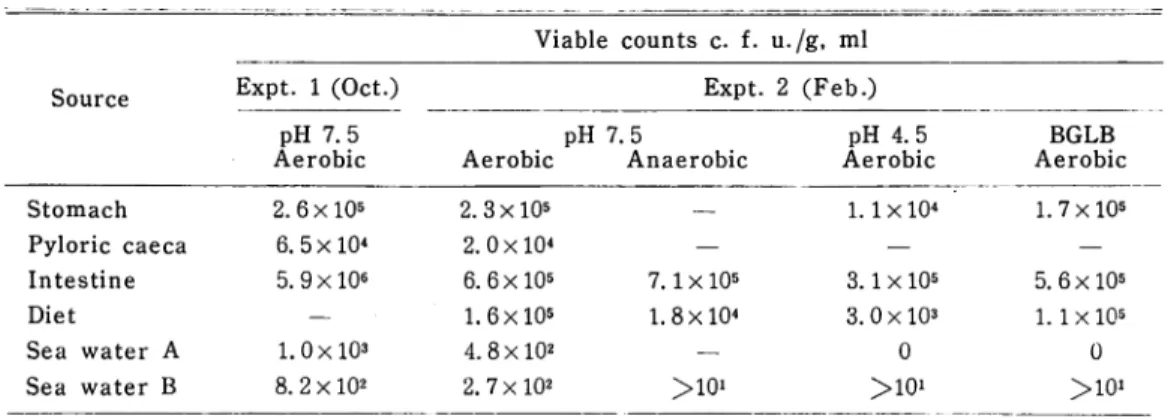
Viable counts in the digestive tract. The viable counts in the digestive tract of yellow-tail and environmental sea water are shown in Table 1. The diges tive tract contained viable aerobes from 6. 5 x 10⁴ to 5.9 xlO6 per gram wet wei ght of samples which consisted of the fish digestive tract and its contents. The highest count was obtained in intestine and the lowest in pyloric caeca. In the case of fish intestine, almost same number of bacteria were able to grow aerobically and anaerobically and the greater part of bacteria was resist ant to low pH (pH 4. 5) and BGLB medium. On the other hand, sea water sam ples contained viable cells from 2. 7 x 10² to 1. OxlO3 which were able to scarcely grow anaerobically, at pH 4.5, or on BGLB medium.
Table 1. Viable Counts in the Digestive Tract and Sea Water
Viable counts c. f. u./s. ml
Source Expt. 1 (Oct.)
pH 7.5 Aerobic Expt. 2 (Feb.) Aerobic pH 7'.5 Anaerobic pH 4.5 Aerobic BGLB Aerobic Stomach 2. 6 x 10⁵ 2.3x10⁵ — 1.1X10⁴ 1.7 x10s Pyloric caeca 6.5x10^ 2.0x10⁴ — — — Intestine 5. 9xlO6 6.6x10⁵ 7.1 x 10⁵ 3.1 x 10⁵ 5.6x10⁵
Diet — 1.6x10⁵ 1.8 xlO4 3.0x10³ 1.1 xlO5
Sea water A 1.0 xlO3 4. 8xlO2 — 0 0
Sea water B 8. 2 x 10² 2. 7 x 10² >10» >10* >io>
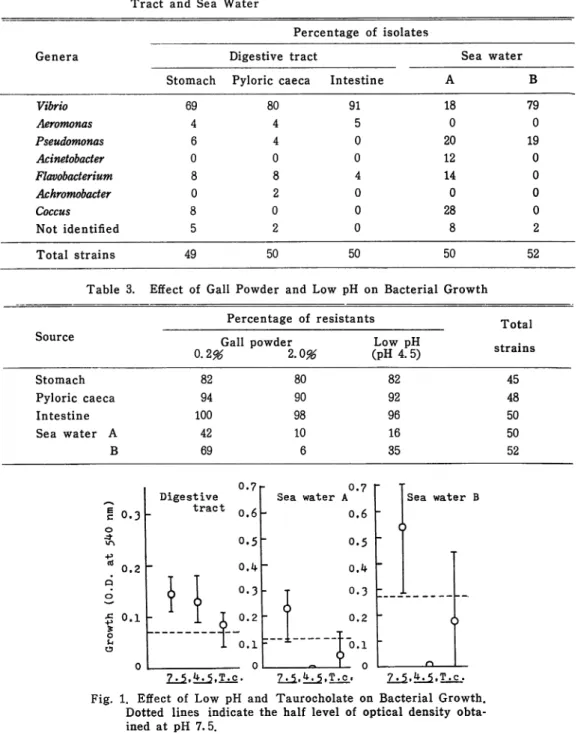
Generic composition of the microflora. As shown in Table 2 the percentage of
Vibrio species in the digestive tract was very high. Especially in intestine 90 % of the isolates were identified as species of Vibrio and the genus Pseudomonas,
Acinetobacter and Flavobacterium were scarcely isolated although they were com monly found in sea water. Sea water sample B which was obtained at the
inner region of a fish crawl, contained higher ratio of Vibrio compared with sea water sample A in which a wide range of species was distributed.
68 Mem. Fac. Fish., Kagoshima Univ. Vol. 27,No. 1 (1978)
Table 2. Generic Composition of Bacterial Flora in the Digestive
Tract and Sea Water
Percentage of isolates
Genera Digestive tract Sea water
Stomach Pyloric caeca Intestine A B
Vibrio 69 80 91 18 79 Aeromonas 4 4 5 0 0 Pseudomonas 6 4 0 20 19 Acinetobacter 0 0 0 12 0 Flavobacterium 8 8 4 14 0 Achromobacter 0 2 0 0 0 Coccus 8 0 0 28 0 Not identified 5 2 0 8 2 Total strains 49 50 50 50 52
Table 3. Effect of Gall Powder and Low pH on Bacterial Growth
Percentage of resistants Total
Source
Gall powder Low pH «train«*
0.2%
2.0%
(pH 4.5)
strains
Stomach Pyloric caeca Intestine Sea water A B 82 94 100 42 7.5.*K5.T.c. 80 90 98 10 7.5.*».5.T.c. 82 92 96 16 35 Sea water B 7.5.fr.5.T.c. 45 48 50 50 52Fig. 1. Effect of Low pH and Taurocholate on Bacterial Growth. Dotted lines indicate the half level of optical density obta
ined at pH 7.5.
containing bile salts (2 % bovine gall powder or 0. 5 % taurocholate) or at low
pH (pH 4.5) was examined. The results in Table 3 and Fig. 1 indicate that
bile salts as compared with those from sea water.
Salts requirement for growth. As shown in Table 4 and Fig. 2, the isolates from the digestive tract had an optimal NaCl concentration for growth be tween 2 and Z% and somewhat lower than that of marine bacteria. A large number of isolates from the digestive tract belonged to the slight halophilic type (H-L) which can grow both in 0. 5 % and 3. 0 % NaCl media. On the other
hand the isolates from sea water belonged to either marine (M) or halophilic
(H-H) type.
Table 4. Bacterial Typing according to the Mineral Requirement
Bacterial type Total O U U I C C M H-H H-L T strains Stomach 6 13 72 9 47 Pyloric caeca 2 6 90 2 50 Intestine 0 4 96 0 50 Sea water A 67 31 0 2 49 B 23 77 0 0 52 Digestive t r a c t 2 3 ^ + 5 6 NaCl cone. ( % )
Fig. 2. Effect of NaCl Concentration on Growth.
Hydrolytic activities of macromolecules. Table 5 shows the results of hydrolytic
activities of various macromolecules.
Intestinal isolates had the activity to hy
drolyze chitin but not to hydrolyze casein, gelatin and starch. On the otherhand the isolates possessing the hydrolytic activity of casein and gelatin from
70 Mem. Fac. Fish., Kagoshima Univ. Vol. 27, No. 1 (1978)
Table 5. Hydrolytic Activities of Isolates on Various High Molecular Compounds
Percentage of positive strains
Compound Digestive tract Sea water
St. P. c. In. A B Casein 4 0 0 64 79 Gelatin 8 2 0 60 79 Alginate 0 0 0 2 56 Tributyrin 92 98 100 86 100 Starch 2 0 0 6 40 Chitin 58 96 100 38 62 Cellulose 0 0 0 0 0 Total strains 50 48 50 50 52 Discussion
Many investigators reported that the genus Vibrio predominate in the intestine
of various marine fishes. For example Liston1* indicated the occurrence of
the gut group Vibrio and Sera et al.3) suggested that indigenous bacterial flora
in the digestive tract of various marine fishes was occupied by a specific Vibrio
group which was uniquely resistant to bile and low pH.
Table 6. Main Characteristics of Dominant Strains from Intestine
Cell from Rod Arginine dihydrolase +
Gram stain - Indole production
-Motility + Nitrate reduction +
Flagellation M V. P. test +
Hugh and Leifson test F M. R. test +
Cytochrome oxidase + Hydrolysis of casein —
Catalase + gelatin -(+)
Growth at 37 C + alginate
-Growth at pH 4.5 + tributyrin +
M, H, T, typing H-L starch
-Sensitivity to 0/129 + chitin +
H2S production (SIM medium) — cellulose —
The present results on yellow tail also indicate that the genus Vibrio is isola
ted at the high percentage (90^) in the intestine of yellow tail.
Common
characteristics of Vibrio species isolated from the intestine are summarized in Table 6. Intestinal Vibrio species can grow at 37 C and at low pH (pH 4.5).
They are slight halophilic type (H-L) and hydrolyze chitin only while do not
casein, gelatin and starch.
These characters agree with those of a specific Vibrio
group from sea bream described by Sera et al.3\
In the aspects of physiology
and nutrition of host fish, it is interesting that the intestinal Vibrio species are
unable to hydrolyze important macromolecules such as casein, gelatin and starch except chitin. Vibrio species with the characters presented above were detected
at relatively high percentage from in diet (mackerel minced meat) and in inner crawl. Intestinal Vibrios are suggested to be derived through food chain from diet
or environmental sea water and colonize in intestine after selected by various
mechanismas. As these selective mechanisms, low pH in stomach or bile salts
and anaerobic condition in intestine should be taken into consideration. Howe
ver it is necessary to examine the selective mechanisms for intestinal micro flora in detail.
References
1) Liston, T. (1957) : The occurrence and distribution of bacterial types on flatfish. J.
gen. Microbiol, 16, 205-216.
2) Okuzumi, M. and S. Horie (1969) : Studies on the bacterial flora in the intestines of various marine fish. Bull. Jap. Soc. Sci. Fish., 35, 93-100.
3) Sera, H. and Y. Ishida (1972) : Bacterial flora in the digestive tracts of marin fish.
ibd. 38, 853-858.
4) Sera, H., Y. Ishida and H. Kadota (1972) : Bacterial flora in the digestive tracts of marine fish—IV. ibd. 38, 859-863.
5) Aiso, K., U. Simidu and K. Hasuo (1968): Microflora in the digestive tract of inshore in Japan. /. gen. Microbiol, 52, 361-364.
6) Yoshimizu, M., T. Kimura and M. Sakai (1976) : Studies on the intestinal microflora of salmonids—V. ibd., 42, 1291-1298.
7) Yoshimizu, M. and T. Kimura (1976) : Study on the intestinal Microflora of salmonids.
Fish Pathol, 10, 243-259.
8) Simidu, U. and K. Hasuo (1968) : An improved medium for the isolation from marine fish. /. gen. Microbiol, 52, 355-360.
9) Harrigan, W. F. and E. M. Margarel (1966) : Laboratory methods in microbiology.
Acad. Press, London, New York.
10) Shewan, J. M., G. Hobbs and W. Hodhkiss (1960) : A determinative scheme for the identification of certain genera of gram-negativr bacteria with special reference to the Pseudomonadaceae. /. appl, Bacteriol, 23, 379-390.
11) Simidu, U. (1974) : Taxonomy of marine bacteria. Marine microbiology Tokyo Univ.
Press, Tokyo.
12) Hidaka, T. and M. Sakai (1968): Comparative observation of the inorganic salt requirements of the marine and terrestrial bacteria. Bull Misaki Marine Biol. Kyoto Univ.,