Title
Sixteen X-chromosomal STRs in two octaplex PCRs in
Japanese population and development of 15-locus
multiplex PCR system
Author(s)
Alternative
Nakamura, Y; Minaguchi, K
Journal
International journal of legal medicine, 124(5):
405-414
URL
http://hdl.handle.net/10130/1979
Sixteen X-chromosomal STRs in two octaplex PCRs in Japanese population and development of 15-locus multiplex PCR system
Nakamura Y, Minaguchi K*
*Address of corresponding author:
Department of Forensic Odontology, Tokyo Dental College, 1-2-2 Masago, Mihama-ku, Chiba City, 261-0011, Japan
Tel.: +81-43-270-3785, Fax: +81-43-270-3788 E-mail: [email protected]
Abstract
X-chromosome STR polymorphisms are a useful tool in the fields of human population genetics and personal identification, and are indispensable in investigating complex kinship or deficiency cases in circumstances where information on mtDNA or Y-chromosome polymorphisms is unavailable. The purpose of study was to construct a multiplex PCR system capable of analyzing a large number of X-STR loci and establish a 16-X-STR database in the Japanese population We developed two octaplex X-STR systems, one including the DXS7424, GATA172D05, HPRTB, DXS8377, GATA31E08, DXS9895, DXS7423 and DXS981 loci and the other the DXS6803, DXS6789, DXS6800, DXS6809, DXS7133, DXS7132, DXS101 and DXS6807 loci, and conducted a population study in 512 Japanese individuals comprising 339 men and 173 women. A 16-locus multiplex system produced unwanted PCR products due to mixture of the DXS9895 primer with the primers of two other loci. However, a 15-locus multiplex system exclusive of the DXS9895 locus did not. The 15-locus multiplex system, amplified the largest number of loci among the X-STR multiplex systems used and afforded a power of discrimination of 0.99999999999997 in women and 0.999999997 in men.
Key words: X-chromosome, STR, Japanese. octaplex PCR, 15-locus multiplex PCR
Introduction
The human X chromosome has been the focus of much research in the fields of population genetics and forensics in recent years [e.g. 1-14]. X-chromosomal STRs (X-STRs) can be used to complement autosomal STRs in paternity testing of female children or maternity testing of male children. They are considerably effective, especially in cases where,Y-chromosomal or mitochondrial DNA polymorphisms are of no use. Autosomal STRs can be also transmitted as haplotypes but their analysis is impossible or difficult, on the other, only X-chromosomal markers may have been transmitted in haplotypes. and may
analyze it For forensic application, however, it is important to collect population data and construct reference databases documenting genetic variation in specific STRs within a given population. Furthermore, an investigator is sometimes faced with only a small amount of DNA to work with or has to determine inheritance of an X-STR haplotype from many individuals. In such cases, it is necessary to keep use of samples or time required for running procedures down to a minimum.
The aim of this study was to construct a multiplex PCR system capable of analyzing a large number of X-STR loci and obtain the allelic frequencies of many X-STR loci in a Japanese population. We believe that these data and the present multiplex system will prove useful in future human population genetic and forensic studies.
Materials and methods
Samples
Genomic DNA was extracted from blood samples obtained from 512 unrelated Japanese individuals (339 men and 173 women). Informed consent was obtained from all donors. This study was approved by the Ethics Committee of Tokyo Dental College. Leukocyte preparations from the blood samples were digested with proteinase K (Sigma-Aldrich) at 55°C overnight, followed by treatment with RNAse at 55°C for 2 hr. DNA was extracted with phenol/chloroform, precipitated with ethanol and resuspended in TE buffer (10 mM Tris-HCl, 1 mM EDTA at pH 7.6).
PCR amplification and typing of X-STRs
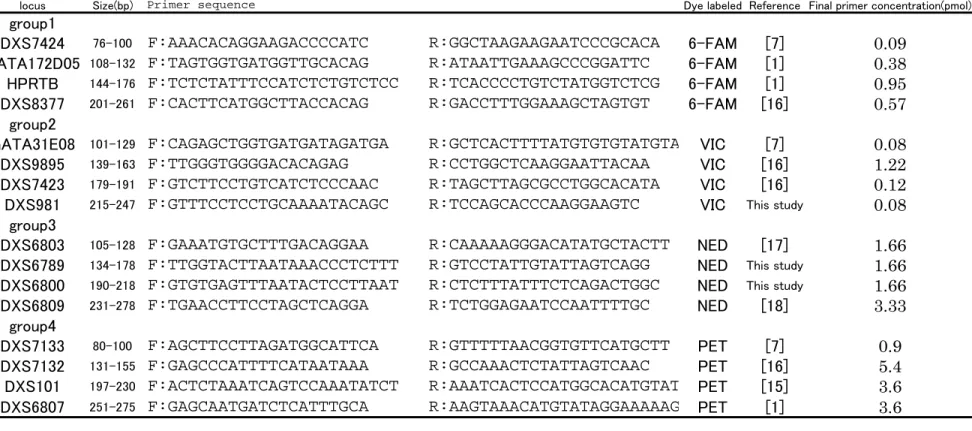
Sixteen X-STR loci (DXS7424, GATA172D05, HPRTB, DXS8377, GATA31E08, DXS9895, DXS7423, DXS981, DXS6803, DXS6789, DXS6800, DXS6809, DXS7133, DXS7132, DXS101 and DXS6807)
were examined for polymorphisms (Fig.1). These loci were divided into 4 groups (groups 1 to 4) according to size of amplified product (Table 1). Group 1, containing DXS7424, GATA172D05, HPRTB and DXS8377, was labeled with 6-FAM; group 2, containing GATA31E08, DXS9895, DXS7423 and DXS981, was labeled with VIC; group 3, containing DXS6803, DXS6789, DXS6800 and DXS6809,was labeled with NED; and group 4, containing DXS7133, DXS7132, DXS101 and DXS6807, was labeled with PET. Multiplex PCR was performed in two single-PCR reactions, each amplifying the combination of two different groups of X-STRs: the combination of groups 1 and 2 (group 1+2), or the combination of groups 3 and 4 (group 3+4). The primer sequences, concentrations used in the multiplex, type of labeled dye and range of amplified fragment sizes are listed in Table 1. New primers were designed for DXS981 and DXS6789 to adjust fragment length in the octaplex PCR. A new primer was also designed for DXS6800 to avoid possible amplification of an extra band in the 15-locus multiplex system (See Results and Discussion sections for further explanation on this point). However, the sequences of the other primers were obtained from previous monographs [1, 7, 15, 16, 17, 18]. Multiplex PCR was performed in a volume of 25 μℓ reaction mix containing: 1~10 ng genomic DNA, 10 mM Tris-HCl at pH 8.3, 50 mM KCl, 2 mM MgCl2, 0.001% gelatin, 200 μM dNTP, 1.5 U AmpliTaq
Gold (Applied Biosystems) and an appropriate volume of each primer (Table 1). The PCR temperature profile for the groups 1+2 multiplex was as follows: 11 min at 95℃ followed by 50 sec at 95℃ and 105 sec at 60℃ for 28 cycles, with a final extension at 60℃ for 30 min. The PCR temperature profile for the groups 3+4 multiplex was as follows: 11 min at 95℃ followed by 50 sec at 95℃ and 105 sec at 58℃ for 28 cycles, with a final extension at 60℃ for 30 min. Twelve μℓ Hi-Di formamide (Applied Biosystems) and 0.5 μℓ GeneScan-500 LIZ internal size standard were added to each PCR product. Electrophoresis was performed using the ABI PRIZM 310 Genetic Analyzer (Applied Biosystems). Fragment sizes were automatically determined using the GeneScan Analysis software 3.1 (Applied Biosystems) and results analyzed using the Genotyper ver. 2.5 (Applied Biosystems). Genotyping was performed by comparing the sequenced samples with the DNA control reference sample 9947A (Applied Biosystems) to validate
the typing protocol for multiplex X-chromosomal STRs [19].
Sequencing analysis
Before employing our dye-labeled multiplex system, we conducted non-labeled multiplex PCR by a method similar to the one described above and compared many samples by electrophoresis in 6% denaturing polyacrylamide gel followed by silver staining. For a comparison with the established allele nomenclature of the targeted X-STRs (http://www.chrx-str.org), several allelic products from all X-STR loci were eluted from the gel, re-amplified by PCR and directly sequenced, or PCR products from hemizygous male participants were directly sequenced. Amplicons were purified with the PureLink PCR purification kit (Invitrogen) according to the manufacturer's instructions. PCR for sequencing was performed using the BigDye Terminator v1.1 Cycle Sequencing Kit (Applied Biosystems). Excessive dye was removed using Performa DTD Gel Filtration Cartridges (EdgeBio) or the BigDye XTerminator Purification Kit (Applied Biosystems). Sequence analysis was performed on an ABI PRISM 3100 automated sequencer (Applied Biosystems).
Statistical analysis
The chromosomal location of the 16 markers was determined by querying the NCBI map viewer. Observed heterozygosity (Hobs) was calculated using female data with the PowerStatsV12 software (http://www.promega.com). Polymorphism information content (PIC), power of discrimination in females (PDf), power of discrimination in males (PDm), and power of exclusion (PE) were also calculated with the PowerStatsV12 software. Linkage disequilibrium and Hardy-Weinberg equilibrium were determined with an exact test using the GENEPOP software (ver. 3.4) (http://genepop.curtin.edu.au).
Results and Discussion
Construction of two octaplex PCR systems and allele designation
We selected 16 X-STR loci distributed over the entire human X chromosome (Fig.1). These loci were selected as they had previously been examined in other populations (http://www.chrx-str.org) and their data might prove useful in further study on X-chromosomal STR polymorphisms. The results of non-labeled quadruplex PCR in groups 1-4 (Table 1) are shown in Fig.S1. We determined the genotypes of approximately 100 samples and the sequences of the common alleles for the 16 targeted X-STRs by this method. The repeat structure and our allele designation were further compared with those described in X-STR org (http://www.chrx-str.org) and other reports [19, 29, 30] to ascertain whether they matched established allele nomenclature.
Next, the forward primer in each group was labeled with 4 types of dye: 6-FAM, VIC, NED and PET for groups 1, 2, 3 and 4, respectively (Table 1). After adjusting the PCR conditions in each group, multiplex PCR of 16 loci was performed. However, 16-locus multiplex PCR produced non-target PCR products which could not be eradicated by adjustment of PCR conditions alone. We had confirmed successful quadruplex PCR in each labeled group (Fig. S1), so we conducted octaplex PCR by combining each group with each one of the other three groups. With some combinations, several unexpected products appeared. However, octaplex PCR on the combination of groups 1 and 2 or groups 3 and 4 produced only the expected products, as shown in Fig. 2. Therefore, we typed many samples by these multiplex PCRs. We also typed control reference sample 9947A to compare our results with those of panel cells. Most of the allele types were identical to those described by Szibor et al. [19] (Table 2). However, instead of 9 repeats as reported earlier, our sequence data and PCR fragment size for DXS6803 of 9947A showed an extra repeat and another incomplete repeat comprising a 12-repeat TCTA motif and 11.3-repeat motif containing TCA, respectively. Because our results matched the actual repeat size and
nomenclature recommended by the ISFG [30], we have shown our results for DXS6803 according to our allele designation in Table 2.
Population studies
We typed 16 X-STR loci (DXS7424, GATA172D05, HPRTB, DXS8377, GATA31Eo8, DXS9895, DXS7423, DXS981, DXS6803, DXS6789, DXS6800, DXS6809, DXS7133, DXS7132, DXS101 and DXS6807) for 339 unrelated male and 173 unrelated female individuals in the Japanese population. No significant differences were observed at the 14 loci (P>0.173), However, Significant differences were observed in allele frequencies between men and women, at DXS6803 and DXS8377 (P<0.0005).so, we show the allele frequency of the man and woman in Table 2 and 3 separately. Statistical parameters obtained from both men and women are also shown in Table 2. The distribution of allelic frequencies in women was not significantly different from the Hardy-Weinberg Equilibrium (P>0.017), except for at DXS6803 and DXS981. Since DXS6803 and DXS981 had alleles with 0.3 and those without 0.3, it is possible that the frequencies and mutation rates in these different types of allele cause disequilibrium at these loci in the Japanese population. Observed heterozygosity in women ranged from 0.933 (DXS6803) to 0.276 (DXS6800). Power of discrimination of the 16 loci ranged from 0.978 (DXS8377) to 0.458 (DXS6800) in females and from 0.897 (DXS8377) to 0.195 (DXS6800) in males. Although the order of the degree of diversity values differed depending on the parameters, many loci, apart from DXS6800 and DXS7133, were fairly informative in the Japanese population. The combined power of discrimination of the 16 loci was 0.999999999999997 in females and 0.9999999992 in males.
Twelve of the 16 loci (DXS7424, GATA172D05, HPRTB, DXS8377, GATA31E08, DXS7423, DXS981, DXS6789, DXS7133, DXS7132, DXS101 and DXS6807) in the present study have been examined in other Japanese populations [7, 24, 25]. The allele frequencies of the present data showed no significant differences to those of these earlier reports (P>0.015). Four other loci—DXS9895,
DXS6803, DXS6800 and DXS6809—have not yet been examined in the Japanese population, so we compared the allelic frequencies of these loci with those in the nearest population, the Korean [2, 21-23]. A significant difference was observed only at DXS7132 (P=0.00019).
Linkage equilibrium analysis
The exact test for linkage equilibrium was performed for all pairs of loci in this study. Although some of the loci are closely linked in physical distance, significant deviation was found only between GATA31E08 and DXS101 (P=0.003), DS8377 and DXS6809 (P=0.006), and DS9895 and DXS6807 (P=0.009), which are not physically closely linked with each other. As no real linkage disequilibrium was expected to exist, it is possible that these associations were the result of the sampling effect. A haplotype cluster comprising DXS6801, DXS6809 and DXS6789 has been reported [31]. Forensic tests for DXS6809 and DXS6789 in African-Americans have also suggested they comprise a haplotype rather than independent loci [32]. However, since the P values do not stand after Bonferroni’s correction (p < 0.0011), this haplotype cluster has not yet been well established. Nevertheless, linkage disequilibrium between DXS101 and DXS7424 has been described [33]. Although recent studies [26, 32, 34, 35] showed no linkage disequilibrium among the loci presented in this study, the high mutation rate of STRs remains to be considered. To allow future comparisons and sample size enlargement, the haplotype frequencies between DXS6803 and DXS6789, DXS7424 and DXS101, and DXS8377 and DXS7423, which are located within 144-794 kbps in physical distance, are shown in Table S1.
Development of single multiplex system
In order to effectively obtain more information and apply X-STR polymorphisms to samples with a limited volume in forensic cases, we determined whether the 16-locus multiplex profile could be
improved upon. As we have already described above, 16-locus multiplex PCR with adjustment of PCR conditions only was unsuccessful due to extra amplification products in the two differently labeled groups. Extra peaks with lengths of 130, 165, 191, 198, 247 and 277 bps appeared in VIC-labeled PCR, and peaks with lengths of 135 and 165 bps and sometimes 107 bps appeared in NED-labeled PCR (Fig.S2). As a result of having investigated the cause of the extra peak,All of the extra peaks in the VIC- and NED-labeled products were found when the DXS9895 primer was used; extra peaks with lengths of 130, 165, 191 and 198 bps in VIC-labeled products and 107, 135 and 165 bps in NED-labeled products appeared with multiplex PCR in combination with DXS9895 and DXS6800, and peaks with lengths of 247 and 277 bps in NED-labeled products appeared in combination with DXS9895 and DXS101 (Figure 3S).
It was recognized that DXS9895 primer and DXS6800 reverse primer had very many similar arrangements in a chromosome ,from a search of NCBI data base.
We performed the investigation that used In-Silico PCR (http://www.genome.ucsc.edu), but the identification of the origin of the extra peak was impossible.
In order to determine the origin of the extra peaks, we tried to sequence 130-, 135-, 165-, 192 and 198-bp bands after re-amplification from the gel. The 130-bp product was successfully sequenced as a single sequence and corresponded to a 136-bp region on chromosome 13. The DXS9895 forward primer and 17 nucleotides of the 3’-side of the DXS6800 forward primer completely matched this region. Because both the sequence of the 105-bp region including the 9895-F primer and the sequence of the 63-bp region including the 6800-F primer were almost identical between DXS9895 and the counterparts on chromosome 13, it was difficult to construct primers outside of these regions in our multiplex system. Sequencing of other bands with sizes of 135, 165, 192 and 198 bps was unsuccessful due to the mixed profile in the sequence electrophoretograms. In the experiments described above, we used the same DXS6800 primer pair as described elsewhere [1]. Under the octaplex PCR conditions described in the materials and method section, the above-mentioned 107-bp product in NED was not amplified.
However, it was amplified in octaplex PCR one year after preparation of the 6800 primer stocks, probably due to degradation of the primer. Therefore, we moved the region amplified by the forward and reverse primers by as many as 16 bps in the 3’-end direction (Table 1). As a result, the DXS6800 forward primer did not match the counterpart on chromosome 9, which resulted in loss of the 107-bp band found in the allelic region of DXS6800. The forward and reverse primers of DXS9895 and DXS6800 have many counterparts on autosomal chromosomes. There is the possibility that these primers will produce unwanted sequences in PCR if the annealing/extension temperature is low. After several trials to improve the electrophoretograms, we concluded that it was very difficult to change the primers of DXS9895 and DXS6800 appropriately under the multiplex PCR conditions described in this paper. Finally, we applied multiplex PCR of the present 15 loci, exclusive of the DXS9895 locus, in a single reaction (Fig.3). This multiplex system produced none of the extra peaks described above and worked well in typing of X-STRs from degraded DNAs extracted from old skeletal remains in our routine forensic cases. It amplified the largest number of loci among the X-STR multiplex systems used and afforded a power of discrimination in the order of 0.99999999999997 in females and 0.999999997 in males in the Japanese population. It is especially useful to be able to inspect a large number of loci over the entire X chromosome in a single PCR reaction when we need to determine whether a part of the X chromosome has been inherited in a complex case.
In conclusion, we developed two kinds of octaplex PCR system for X-STRs and analyzed a large number of individuals in the Japanese population. We then further developed and established a 15-locus multiplex system excluding the DXS9895 locus. The flanking regions of the DXS9895 STR locus have many counterparts on various chromosomes, and produce extra products in combination with DXS6800 or DXS101. The results of this study indicate that care must be taken in constructing X-STR multiplex systems including the DXS9895 locus. Furthermore, the present 15-locus multiplex system obtained viable results from the largest number of X-STR loci, suggesting its potential as a tool for X-STR analysis in forensic cases.
ACKNOWLEDGMENTS
We thank Associate Professor Jeremy Williams, Laboratory of International Dental Information, Tokyo Dental College, for editing the manuscript This research was partially supported by a Ministry of Education, Science, Sports and Culture, Grant-in-Aid for Scientific Research (B) (14370701)
References
1. Edelmann J, Hering S, Michael M et al (2001) 16 X-chromosome STR loci frequency data from a German population. Forensic Sci Int 124:215-218
2. Son JY, Lee YS, Choung CM, Lee SD (2002) Polymorphism of nine X chromosomal STR loci in Koreans. Int J Legal Med. 116:317-321
3. Chen MY, Pu CE (2004) Population data on the X chromosome short tandem repeat loci DXS10011, DXS101, DXS6789, DXS7132, DXS8377, and DXS9895 in Taiwan. Forensic Sci Int 146:65-67
4. Pepinski W, Skawronska M, Niemcunowicz-Janica A, Koc-Zorawska E, Janica J, Soltyszewski I (2005) Polymorphism of four X-chromosomal STRs in a Polish population sample. Forensic Sci Int 151:93-95
5. Moreno MA, Builes JJ, Jaramillo P, Espinal C, Aguirre D, Bravo M (2005) Allele frequency distribution of five X-chromosomal STR loci in an antioquian population sample (Colombia).J Forensic Sci 50:1513-1514
6. Bini C, Ceccardi S, Ferri G et al (2005) Development of a heptaplex PCR system to analyze X-chromosome STR loci from five Italian population samples. A collaborative study. Forensic Sci Int 153:231-236
population study in Japan and application to degraded DNA analysis. Int J Legal Med 120: 303-309 8. Szibor R (2007) X-chromosomal markers: past, present and future. Forensic Sci Int Genet 1:93-99 9. Gomes I, Alves C, Maxzud K et al (2007) Analysis of 10 X-STRs in three African populations. Forensic Sci Int Gene 1:208-211
10. Zalán A, Völgyi A, Jung M, Peterman O, Pamjav H (2007) Hungarian population data of four X-linked markers: DXS8378, DXS7132, HPRTB, and DXS7423. Int J Legal Med 121:74-77.
11. Zarrabeitia MT, Mijares V, Riancho JA (2007) Forensic efficiency of microsatellites and single nucleotide polymorphisms on the X chromosome. Int J Legal Med 121:433-437
12. Tariq MA, Ullah O, Riazuddin SA, Riazuddin S (2008) Allele frequency distribution of 13 X-chromosomal STR loci in Pakistani population. Int J Legal Med 122:525-528
13. Ribeiro Rodrigues EM, Leite FP, Hutz MH, Palha Tde J, Ribeiro dos Santos AK, dos Santos SE (2008) A multiplex PCR for 11 X chromosome STR markers and population data from a Brazilian Amazon Region. Forensic Sci Int Genet 2:154-158
14. Gusmão L, Sánchez-Diz P, Alves C et al (2009) A GEP-ISFG collaborative study on the optimization of an X-STR decaplex: data on 15 Iberian and Latin American populations. Int J Legal Med 123:227-234 15. Edelmann J, Szibor R (2001) DXS101:a highly polymorphic X-linked STR. Int J Legal Med 114:30 1-304
16. Edelmann J, Deichsel D, Hering S, Plate I, Szibor R (2002) Sequence variation and allele nomenclature for the X-linked STRs DXS9895, DXS8378, DXS7132, DXS6800, DXS7133, GATA17205, DXS7423 and DXS8377. Forensic Sci Int 129:99-103
17. Edelmann J, Szibor R (2003) The X-linked STRs DXS7130 and DXS6803. Forensic Sci Int 136:73-75
18. Edelmann J, Deichsel D, Plate I, Kaser M, Szibor R (2003) Validation of the X-chromosomal STR DXS6809. Int J Legal Med 117:241-244
of reliable standards. Forensic Sci Int 138:37-43
20. Huang D, Yu C, Yang R (2003) Development of the X-linked tetrameric microsatellite markers HumDXS6803 and HumDXS9895 for Forensic purpose. Forensic Sci Int 133:246-249
21. Lee HY, Park MJ, Jeong CK et al (2004) Genetic characteristics and population study of 4 X-chromosomal STRs in Koreans: evidence for a null allele at DXS9898. Int J Legal Med 118:355-360 22. Shin KJ, Kwon BK, Lee SS et al (2004) Five highly informative X-chromosomal STRs in Koreans. Int J Legal Med 118:37-40
23. Shin SH, Yu JS, Park SW, Min GS, Chung KW (2005) Genetic analysis of 18 X-linked short tandem repeat markers in Korean population. Forensic Sci Int 147:35-41
24. Tabbada KA, De Ungria MCA, Faustino LP, Athanasiadou D, Stradmann-Bellinghausen B, Schneider PM (2005) Development of a pentaplex X-chromosomal short tandem repeat typing system and population genetic studies. Forensic Sci Int 154:173-180
25. Asamura H, Sakai H, Ota M, Fukushima H (2006) Japanese population data for eight X-STR loci using two new quadruplex systems. Int J Legal Med 120:174-181
26. Hwa HL, Chang YY, Lee JC et al (2009) Thirteen X-chromosomal short tandem repeat loci multiplex data from Taiwanese. Int J Legal Med 123:263-269
27. Zeng X, Rakha A, Li S (2009) Genetic polymorphisms of 10 X-chromosome STR loci in Chinese Daur ethnic minority group. Leg Med 11:152-154
28. Wu W, Hao H, Liu Q, Su Y, Zheng X, Lu D (2009) Allele frequencies of seven X-linked STR loci in Chinese Han population from Zhejiang Province. Forensic Sci Int Genet 4:e41-42
29. Szibor R, Edelmann J, Hering S, Gomes I, Gusmão L (2009) Nomenclature discrepancies in the HPRTB short tandem repeat. Int J Legal Med 123:185-186
30. Bär W, Brinkmann B, Budowle B et al (1997) DNA recommendations. Further report of the DNA Commission of the ISFH regarding the use of short tandem repeat systems. International Society for Forensic Haemogenetics. Int J Legal Med 110:175-176
31.Szibor R, Hering S, Kuhlisch E, Plate I, Demberger S, Krawczak M, Edelmann J (2005) Haplotyping of STR cluster DXS6801–DXS6809–DXS6789 on Xq21 provides a powerful tool for kinship testing. Int J Legal Med 119:363–369
32. Gomes I, Prinz M, Pereira R et al (2007) Genetic analysis of three US population groups using an X-chromosomal STR decaplex. Int J Legal Med 121:198–203
33. Edelmann J, Hering S, Kuhlisch E, Szibor R (2002) Validation of the STR DXS7424 and the linkage situation on the X-chromosome. Forensic Sci Int 125:217–222
34. Pereira R, Gomes I, Amorim A, Gusmão L (2007) Genetic diversity of 10 X chromosome STRs in northern Portugal. Int J Legal Med 121:192-197
35. Nadeem A, Babar ME, Hussain M, Tahir MA (2009) Development of pentaplex PCR and genetic analysis of X chromosomal STRs in Punjabi population of Pakistan. Mol Biol Rep 36:1671-1675
Figure legend
Fig.1 Location of 16 STR loci studied on X-chromosome. Physical localization is given in mega-base pairs.
Fig. 2 Electrophoretic profiles obtained by two octaplex PCRs of X-chromosomal STRs. Group 1 (6-FAM) and group 2 (VIC) were amplified in a single PCR and groups 3 (NED) and 4 (PET) in other single PCRs.
Fig.3 Electrophoretic profiles obtained by 15-locus multiplex PCR. No extra peaks interfered with typing of 15 loci and reliable typing was possible.
Fig. S1 Quadruplex PCR profile in groups 1, 2, 3 and 4, using non-labeled primers and vertical flat-bed electrophoresis. This electrophoretogram was obtained during preliminary experiments, so ARA locus was used instead of DXS981 as largest locus in group 2. Each channel contains sample from different individuals.
Fig. S2 Electrophoretic profiles obtained by 16-locus multiplex PCR. Extra peaks observed in VIC- and NED-labeled PCRs are shown as shaded areas with base pair size indicated.
Fig. S3 Electrophoretic profiles obtained by PCR amplification using primer mixtures for DXS9895 and DXS6800, or DXS9895 and DXS101 loci. Extra peaks of same size as those obtained with 16-locus multiplex observed in VIC- and NED-labeled PCRs are shown as shaded areas with base pair size indicated.
Table 1 Primer sequences in this study.
locus Size(bp) Primer sequence Dye labeled Reference Final primer concentration(pmol)
group1
DXS7424 76-100 F:AAACACAGGAAGACCCCATC R:GGCTAAGAAGAATCCCGCACA 6-FAM [7] 0.09 GATA172D05 108-132 F:TAGTGGTGATGGTTGCACAG R:ATAATTGAAAGCCCGGATTC 6-FAM [1] 0.38 HPRTB 144-176 F:TCTCTATTTCCATCTCTGTCTCC R:TCACCCCTGTCTATGGTCTCG 6-FAM [1] 0.95 DXS8377 201-261 F:CACTTCATGGCTTACCACAG R:GACCTTTGGAAAGCTAGTGT 6-FAM [16] 0.57
group2
GATA31E08 101-129 F:CAGAGCTGGTGATGATAGATGA R:GCTCACTTTTATGTGTGTATGTA VIC [7] 0.08 DXS9895 139-163 F:TTGGGTGGGGACACAGAG R:CCTGGCTCAAGGAATTACAA VIC [16] 1.22 DXS7423 179-191 F:GTCTTCCTGTCATCTCCCAAC R:TAGCTTAGCGCCTGGCACATA VIC [16] 0.12 DXS981 215-247 F:GTTTCCTCCTGCAAAATACAGC R:TCCAGCACCCAAGGAAGTC VIC This study 0.08
group3
DXS6803 105-128 F:GAAATGTGCTTTGACAGGAA R:CAAAAAGGGACATATGCTACTT NED [17] 1.66 DXS6789 134-178 F:TTGGTACTTAATAAACCCTCTTT R:GTCCTATTGTATTAGTCAGG NED This study 1.66
DXS6800 190-218 F:GTGTGAGTTTAATACTCCTTAAT R:CTCTTTATTTCTCAGACTGGC NED This study 1.66
DXS6809 231-278 F:TGAACCTTCCTAGCTCAGGA R:TCTGGAGAATCCAATTTTGC NED [18] 3.33 group4
DXS7133 80-100 F:AGCTTCCTTAGATGGCATTCA R:GTTTTTAACGGTGTTCATGCTT PET [7] 0.9 DXS7132 131-155 F:GAGCCCATTTTCATAATAAA R:GCCAAACTCTATTAGTCAAC PET [16] 5.4 DXS101 197-230 F:ACTCTAAATCAGTCCAAATATCT R:AAATCACTCCATGGCACATGTAT PET [15] 3.6 DXS6807 251-275 F:GAGCAATGATCTCATTTGCA R:AAGTAAACATGTATAGGAAAAAG PET [1] 3.6
Table 2 Allele frequencies in the Japanese population.
Allele DXS7424 GATA172D05 HPRTB DXS8377 GATA31E08 DXS9895 DXS7423 DXS981
6 - 0.085 - - - -7 - 0.003 - - 0.099 - - -8 - 0.112 - - 0.013 - - -9 - 0.057 - - 0.190 - - -10 - 0.393 0.001 - 0.279 - - -10.3 - - - 0.002 11 - 0.280 0.039 - 0.307 - - 0.005 11.3 - - - 0.010 12 0.025 0.070 0.292 - 0.100 0.003 - 0.035 12.3 - - - 0.053 13 0.029 - 0.440 - 0.010 0.250 0.005 0.215 13.3 - - - 0.093 14 0.166 - 0.148 - 0.001 0.294 0.328 0.301 14.3 - - - 0.040 15 0.288 - 0.055 - - 0.239 0.608 0.190 15.3 - - - 0.026 16 0.445 - 0.025 - - 0.190 0.060 0.041 16.3 - - - 0.003 17 0.037 - - - - 0.021 - 0.003 18 0.011 - - - - 0.003 - -41 - - - 0.001 - - - -42 - - - 0.009 - - - -43 - - - 0.031 - - - -44 - - - 0.043 - - - -45 - - - 0.058 - - - -46 - - - 0.105 - - - -47 - - - 0.135 - - - -48 - - - 0.108 - - - -49 - - - 0.156 - - - -50 - - - 0.103 - - - -51 - - - 0.085 - - - -52 - - - 0.055 - - - -53 - - - 0.043 - - - -54 - - - 0.024 - - - -55 - - - 0.024 - - - -56 - - - 0.010 - - - -57 - - - 0.004 - - - -58 - - - 0.003 - - - -NA9947A 14,16 10 15 45,47 11 13,17 14,15 13.3,14.3 P 0.017 0.561 0.339 0.052 0.735 0.324 0.451 0.003 Hobs 58.4 77.1 72.8 88.0 78.3 75.0 53.3 70.5 PDf 0.856 0.884 0.844 0.978 0.906 0.893 0.652 0.935 PDm 0.685 0.738 0.701 0.897 0.775 0.757 0.541 0.813 PE 0.273 0.547 0.473 0.754 0.568 0.510 0.218 0.433 PIC 0.64 0.70 0.64 0.90 0.73 0.71 0.42 0.79
P:Valies of the exact tests for Hardy-Weinbelg equilibrium Hobs:Observed heterozygosity PDf:Power of discrimination in women PDm:Power of discrimination in men PE:Power of Exclusion PIC:Polymorphism information content
Table 2 Allele frequencies in the Japanese population. Allele DXS6803 DXS6789 DXS6800 DXS6809 DXS7133 DXS7132 DXS101 DXS6807 9.0 - - - - 0.700 - - -10.0 0.014 - - - 0.259 - - -10.3 0.006 - - - -11.0 0.165 - - - 0.035 0.003 - 0.370 11.3 0.162 - - - -12.0 0.185 - - - 0.006 0.059 - 0.008 12.3 0.358 - - - -13.0 0.029 0.002 - - - 0.162 - 0.032 13.3 0.067 - - - -14.0 0.003 0.008 - - - 0.380 - 0.367 14.3 0.011 - - - -15.0 - 0.159 - - - 0.286 - 0.193 15.3 0.002 - - - -16.0 - 0.313 0.869 - - 0.096 - 0.029 17.0 - 0.017 - - - 0.013 - 0.002 18.0 - 0.002 - - - -19.0 - 0.024 0.086 - - - - -20.0 - 0.174 0.002 - - - - -21.0 - 0.179 0.006 - - - 0.008 -22.0 - 0.085 0.038 - - - 0.041 -23.0 - 0.036 - - - - 0.131 -24.0 - 0.003 - - - - 0.305 -25.0 - - - 0.198 -26.0 - - - 0.006 - - 0.179 -27.0 - - - 0.087 -28.0 - - - 0.033 -29.0 - - - 0.003 - - 0.014 -30.0 - - - 0.029 - - 0.003 -31.0 - - - 0.149 - - 0.002 -32.0 - - - 0.163 - - - -33.0 - - - 0.309 - - - -34.0 - - - 0.205 - - - -35.0 - - - 0.090 - - - -36.0 - - - 0.038 - - - -37.0 - - - 0.006 - - - -NA9947A 11.3,12 21,22 18,19 31,34 9,10 12 24,26 12,14 P 0.005 0.221 0.158 0.047 0.298 0.807 0.463 0.096 Hobs 93.3 74.7 27.6 77.5 43.6 71.2 77.6 64.8 PDf 0.873 0.933 0.458 0.928 0.636 0.876 0.931 0.857 PDm 0.747 0.805 0.195 0.804 0.421 0.733 0.816 0.686 PE 0.862 0.504 0.054 0.533 0.138 0.447 0.556 0.352 PIC 0.77 0.78 0.26 0.78 0.39 0.68 0.77 0.64
P:Valies of the exact tests for Hardy-Weinbelg equilibrium Hobs:Observed heterozygosity PDf:Power of discrimination in women PDm:Power of discrimination in men PE:Power of Exclusion PIC:Polymorphism information content
Table S1 Haplotype frequencies of DXS7424-DXS101,DXS6789-DXS6809 and DXS7423-DXS8377.
Locus1 Locus2 Frequency Locus1 Locus2 Frequency Locus1 Locus2 Frequency
DXS7424 DXS101 DXS6789 DXS6809 DXS7423 DXS8377 12 25 0.0429 14 33 0.0059 13 50 0.0030 13 22 0.0031 14 34 0.0059 14 43 0.0120 13 23 0.0092 15 30 0.0089 14 44 0.0090 13 24 0.0123 15 31 0.0326 14 45 0.0240 13 25 0.0031 15 32 0.0208 14 46 0.0360 13 26 0.0031 15 33 0.0534 14 47 0.0450 14 22 0.0061 15 34 0.0237 14 48 0.0360 14 23 0.0153 15 35 0.0059 14 49 0.0631 14 24 0.0399 15 36 0.0030 14 50 0.0150 14 25 0.0245 16 26 0.0030 14 51 0.0360 14 26 0.0307 16 29 0.0030 14 52 0.0240 14 27 0.0184 16 30 0.0148 14 53 0.0210 14 28 0.0061 16 31 0.0445 14 54 0.0090 14 29 0.0061 16 32 0.0356 14 55 0.0090 15 21 0.0031 16 33 0.1068 14 56 0.0030 15 22 0.0092 16 34 0.0415 15 41 0.0030 15 23 0.0337 16 35 0.0415 15 42 0.0060 15 24 0.1166 16 36 0.0148 15 43 0.0180 15 25 0.0583 16 37 0.0059 15 44 0.0180 15 26 0.0215 17 31 0.0030 15 45 0.0450 15 27 0.0429 17 32 0.0030 15 46 0.0511 15 28 0.0153 17 33 0.0030 15 47 0.0691 15 29 0.0031 17 34 0.0030 15 48 0.0480 16 21 0.0031 18 32 0.0030 15 49 0.0991 16 22 0.0184 19 31 0.0059 15 50 0.0631 16 23 0.0706 19 32 0.0059 15 51 0.0721 16 24 0.1012 19 33 0.0030 15 52 0.0240 16 25 0.0798 19 34 0.0119 15 53 0.0210 16 26 0.0920 19 35 0.0030 15 54 0.0090 16 27 0.0429 20 26 0.0030 15 55 0.0150 16 28 0.0092 20 30 0.0030 15 56 0.0060 16 29 0.0061 20 31 0.0178 15 57 0.0060 16 30 0.0031 20 32 0.0267 15 58 0.0030 17 23 0.0031 20 33 0.0475 16 45 0.0030 17 24 0.0031 20 34 0.0415 16 46 0.0090 17 25 0.0061 20 35 0.0148 16 47 0.0060 17 26 0.0215 20 36 0.0059 16 48 0.0180 17 27 0.0031 21 31 0.0386 16 49 0.0210 18 23 0.0061 21 32 0.0475 16 50 0.0120 18 24 0.0031 21 33 0.0445 16 51 0.0030 18 26 0.0031 21 34 0.0475 16 52 0.0060 21 35 0.0178 21 36 0.0059 22 29 0.0030 22 30 0.0030 22 31 0.0089 22 32 0.0119 22 33 0.0297 22 34 0.0208 22 35 0.0030 23 31 0.0059 23 32 0.0089 23 33 0.0059 23 34 0.0119 23 35 0.0089
Table S2 Allele frequencies in the Japanese population. Allele
male female male female male female male female male female male female male female male female 6 - - 0.086 0.084 - - - -7 - - 0.003 0.003 - - - - 0.122 0.075 - - - -8 - - 0.095 0.130 - - - - 0.015 0.012 - - - -9 - - 0.053 0.060 - - - - 0.182 0.199 - - - -10 - - 0.377 0.410 - 0.003 - - 0.268 0.286 - - - -10.3 - - - 0.003 -11 - - 0.309 0.250 0.047 0.033 - - 0.310 0.307 - - - 0.010 11.3 - - - 0.015 0.003 12 0.019 0.030 0.077 0.063 0.311 0.272 - - 0.098 0.102 0.003 0.003 - - 0.031 0.039 12.3 - - - 0.037 0.068 13 0.031 0.027 - - 0.417 0.459 - - 0.006 0.015 0.257 0.244 0.003 0.006 0.178 0.248 13.3 - - - 0.105 0.077 14 0.150 0.181 - - 0.154 0.139 - - - 0.003 0.295 0.293 0.345 0.308 0.311 0.284 14.3 - - - 0.046 0.032 15 0.309 0.268 - - 0.050 0.062 - - - - 0.239 0.238 0.578 0.636 0.200 0.174 15.3 - - - 0.015 0.035 16 0.441 0.449 - - 0.021 0.033 - - - - 0.180 0.201 0.074 0.050 0.055 0.023 16.3 - - - 0.003 -17 0.038 0.036 - - - 0.021 0.021 - - - 0.006 18 0.013 0.009 - - - 0.006 - - - - -41 - - - 0.003 - - - -42 - - - 0.006 0.012 - - - -43 - - - 0.030 0.033 - - - -44 - - - 0.027 0.060 - - - -45 - - - 0.071 0.045 - - - -46 - - - 0.095 0.114 - - - -47 - - - 0.119 0.151 - - - -48 - - - 0.101 0.114 - - - -49 - - - 0.193 0.117 - - - -50 - - - 0.092 0.114 - - - -51 - - - 0.110 0.060 - - - -52 - - - 0.050 0.060 - - - -53 - - - 0.042 0.045 - - - -54 - - - 0.018 0.030 - - - -55 - - - 0.024 0.024 - - - -56 - - - 0.009 0.012 - - - -57 - - - 0.006 0.003 - - - -58 - - - 0.003 0.003 - - - -DXS9895 DXS7423 DXS981 DXS7424 GATA172D05 HPRTB DXS8377 GATA31E08
TableS2 Allele frequencies in the Japanese population. Allele
male female male female male female male female male female male female male female male female
9.0 - - - 0.725 0.673 - - - -10.0 0.018 0.009 - - - 0.231 0.288 - - - -10.3 0.012 - - - -11.0 0.132 0.199 - - - 0.036 0.033 0.006 - - - 0.380 0.358 11.3 0.198 0.126 - - - -12.0 0.147 0.224 - - - 0.006 0.006 0.074 0.044 - - 0.015 -12.3 0.413 0.301 - - - -13.0 0.015 0.043 - 0.003 - - - 0.163 0.159 - - 0.033 0.031 13.3 0.063 0.071 - - - -14.0 - 0.006 0.012 0.003 - - - 0.414 0.344 - - 0.368 0.365 14.3 0.003 0.018 - - - -15.0 - - 0.148 0.170 - - - 0.231 0.347 - - 0.180 0.208 15.3 - 0.003 - - - -16.0 - - 0.312 0.315 0.894 0.844 - - - - 0.098 0.094 - - 0.024 0.035 17.0 - - 0.012 0.022 - - - 0.015 0.012 - - - 0.003 18.0 - - 0.003 - - - -19.0 - - 0.030 0.019 0.074 0.098 - - - -20.0 - - 0.160 0.188 - 0.003 - - - -21.0 - - 0.202 0.154 0.003 0.009 - - - 0.006 0.009 - -22.0 - - 0.080 0.090 0.029 0.046 - - - 0.042 0.040 - -23.0 - - 0.042 0.031 - - - 0.146 0.115 - -24.0 - - - 0.006 - - - 0.286 0.326 - -25.0 - - - 0.199 0.196 - -26.0 - - - 0.006 0.006 - - - - 0.167 0.193 - -27.0 - - - 0.104 0.068 - -28.0 - - - 0.033 0.034 - -29.0 - - - 0.006 - - - 0.015 0.012 - -30.0 - - - 0.030 0.028 - - - - 0.003 0.003 - -31.0 - - - 0.157 0.141 - - - 0.003 - -32.0 - - - 0.163 0.163 - - - -33.0 - - - 0.302 0.316 - - - -34.0 - - - 0.207 0.203 - - - -35.0 - - - 0.095 0.084 - - - -36.0 - - - 0.030 0.047 - - - -37.0 - - - 0.006 0.006 - - - -DXS101 DXS6807 DXS6803 DXS6789 DXS6800 DXS6809 DXS7133 DXS7132