SPECTRAL PROPERTIES OF
SCHR\"ODINGER
OPERATORS ONPERIODIC DISCRETE GRAPHS
EVGENYKOROTYAEVAND NATALIASABUROVA
ABSTRACT. We considerSchr\"odinger operators with periodic potentialsonperiodicdiscrete
graphs. It is known that thespectrum ofthe Schr\"odinger operatorconsistsofanabsolutely
continuouspart (a unionofafinite numberofnon-degenerated bands) plusafinitenumberof
flatbands,i.e.,eigenvaluesof infinite multiplicity. We present results about spectral properties
of theoperators: 1) estimates of the Lebesguemeasureof thespectrumin termsofgeometric
parametersof the graph, which become identities forsomeclassof graphs; 2) spectral analysis
of the Schr\"odinger operators on loop graphs, defined in our paper; 3) the existence and
positionsof maximal number offlat bands forspecific graphs.
1. INTRODUCTION
We consider Laplace operators and Schr\"odinger operators with periodic potentials
on
$\mathbb{Z}^{d_{-}}$periodic discrete graphs, $d\geq 2$. Schr\"odinger operators on periodic graphs and their spectra
often appear in the applied physical science. There
are
a lot of papers and books on thespectrum of discrete Laplacians on finite and infinite graphs (see [BK12], [Ch97], [CDS95],
[CDGT88], [P12] and references therein). There are results about spectral properties of
dis-crete Schr\"odinger operators on specific $\mathbb{Z}^{d}$
-periodic graphs. Schr\"odinger operators with
de-creasing potentials on the lattice $\mathbb{Z}^{d}$
are considered by Boutet de Monvel-Sahbani [BS99],
Isozaki-Korotyaev [IK12], Rosenblum-Solomjak $[RoS09]$ and
see
references therein. Ando[A12] considers the inversespectraltheory for the discreteSchr\"odinger operators with finitely
supported potentials on the hexagonal lattice. Gieseker-Kn\"orrer-Trubowitz [GKT93]
con-sider Schr\"odinger operators with periodic potentials on the lattice $\mathbb{Z}^{2}$
, the simplest example
of $\mathbb{Z}^{2}$
-periodic graphs. They study its Bloch variety and its integrated density of states.
Korotyaev-Kutsenko [KK10] $-[KK10b]$ study the spectra ofthe discrete Schr\"odinger
opera-tors on graphene nano-tubes and nano-ribbons in external fields.
1.1. The definition of Schr\"odinger operators on periodic graphs. Let $\Gamma=(V, \mathcal{E})$ be a
connected graph, possibly having loops and multiple edges, where $V$ is the set ofits vertices
and$\mathcal{E}$
is thesetof itsunorientededges. Thegraphs under considerationareembeddedinto$\mathbb{R}^{d}.$
An edge connectingvertices$u$ and$v$ from $V$ willbe denoted astheunordered pair $(u, v)_{e}\in \mathcal{E}$
andis saidtobe incidentto the vertices. Vertices$u,$$v\in V$will becalled adjacentand denoted
by $u\sim v$, if $(u, v)_{e}\in \mathcal{E}$. We define the degree $x_{v}=\deg v$ ofthe vertex $v\in V$ asthe number
of all its incident edgesfrom $\mathcal{E}$ (here
a loop is counted twice). Belowwe consider locally finite
$\mathbb{Z}^{d}$
-periodic graphs $\Gamma$, i.e., graphs satisfying the followingconditions:
1) the number
of
verticesfrom
$V$ in any bounded domain $\subset \mathbb{R}^{d}$isfinite;
2) the degree
of
each vertex isfinite;Date: March 30,2014.
3) $\Gamma$
has the periods (a basis) $a_{1}$,. . .,$a_{d}$ in
$\mathbb{R}^{d}$
, such that $\Gamma$ is invariant under translations
through the vectors $a_{1}$, $\cdots$,$a_{d}$:
$\Gamma+a_{s}=\Gamma, \forall s\in \mathbb{N}_{d}=\{1, . . . , d\}.$
In the space $\mathbb{R}^{d}$
we consider a coordinate system with the origin at some point $O$. The
coordinate axesof thissystemaredirected alongthevectors $a_{1}$,. .. ,$a_{d}$. Belowthe coordinates
of all vertices of$\Gamma$ will be expressed in this coordinate system. From the definition it follows
that
a
$\mathbb{Z}^{d}$-periodicgraph$\Gamma$ isinvariant under translationsthrough any integer vector
$m$in the
basis $a_{1}$, . . . ,$a_{d}$:
$\Gamma+m=\Gamma, \forall m\in \mathbb{Z}^{d}.$
Let $\ell^{2}(V)$ be the Hilbert space of all square summable functions $f$ : $Varrow \mathbb{C}$, equipped with
the norm
$\Vert f\Vert_{\ell^{2}(V)}^{2}=\sum_{v\in V}|f(v)|^{2}<\infty.$
We define the self-adjoint Laplacian (or the Laplace operator) $\triangle$ on $f\in\ell^{2}(V)$ by
$( \Delta f)(v)=\sum_{(v,u)_{e}\in \mathcal{E}}(f(v)-f(u)) , v\in V$. (1.1)
We recall basic facts about the spectrum for both finite and periodic graphs (see [Me94],
[M91], [M92], [MW89]): the point $0$ belongs to the spectrum $\sigma(\triangle)$ containning in $[0, 2x_{+}],$
i. e.,
$0\in\sigma(\triangle)\subset[0, 2x_{+}]$, where $x_{+}= \sup_{v\in V}\deg v<\infty$. (1.2)
We consider the Schr\"odinger operator $H$ acting on the Hilbert space $\ell^{2}(V)$ and given by
$H=\triangle+Q$, (1.3)
$(Qf)(v)=Q(v)f(v) , \forall v\in V$, (1.4)
wherewe
assume
that the potential $Q$ is real valued andsatisfies$Q(v+a_{s})=Q(v) , \forall(v, s)\in V\cross \mathbb{N}_{d}.$
1.2. The definitions of fundamental graphs and edge indices. In order to define the
Floquet-Bloch decomposition (1.11) of Schr\"odinger operators we need to introduce two
ori-ented edges $(u, v)$ and $(v, u)$ for each unoriented edge $(u, v)_{e}\in \mathcal{E}$: the oriented edge starting
at $u\in V$ and ending at $v\in V$ will be denoted
as
the ordered pair $(u, v)$. We denote the setof all oriented edges by $\mathcal{A}.$
We define the
fundamental
graph $\Gamma_{f}=(V_{f}, \mathcal{E}_{f})$ of the periodic graph $\Gamma$ as a graph on thesurface $\mathbb{R}^{d}/\mathbb{Z}^{d}$ by
$\Gamma_{f}=\Gamma/\mathbb{Z}^{d}\subset \mathbb{R}^{d}/\mathbb{Z}^{d}$. (1.5)
In the literature the fundamental graph is also called the quotient graph. The fundamental
graph $\Gamma_{f}$ has the vertex set $V_{f}$, the set $\mathcal{E}_{f}$ of unoriented edges and the set $\mathcal{A}_{f}$ of oriented
edges, which are finite. Denote by $v_{1}$, .
.
. ,$v_{\nu}$ the vertices of $V_{f}$, where $\nu<\infty$ is the numberofvertices of$\Gamma_{f}$. We identify them with the vertices of$V$ from the set $[0, 1)^{d}$ by
$V_{f}=[0, 1)^{d}\cap V=\{v_{1}, v_{2}, . . . , v_{\nu}\}$, (1.6)
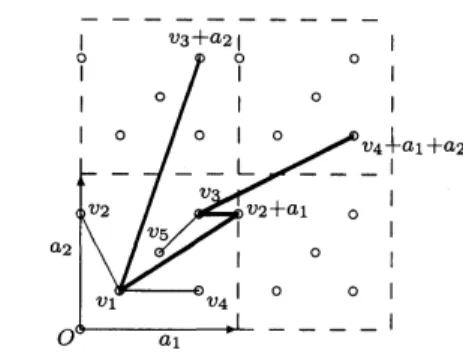
see Fig.1. Due to (1.6) for any $v\in V$ the following unique representation holds true:
In other words, each vertex $v$
can
be represented uniquely as the sum of an integer part $[v]\in \mathbb{Z}^{d}$ and a fractional part $\tilde{v}$that is a vertex ofthe fundamental graph $\Gamma_{f}$. We introduce
an edge index, which is important to study the spectrumof Schr\"odinger operatorson periodic
graphs. Foranyorientededge $e=(u, v)\in \mathcal{A}$we define the edge “‘index”’ $\tau(e)$ astheinteger
vector by
$\tau(e)=[v]-[u]\in \mathbb{Z}^{d}$, (1.8)
where due to (1.7) we have
$u=[u]+\tilde{u}, v=[v]+\tilde{v}, [u], [v]\in \mathbb{Z}^{d}, \tilde{u}, vV_{f}.$
If $e=(u, v)$ is an oriented edge of the graph $\Gamma$, then by the
definition of the fundamental graph there is an oriented edge $\tilde{e}=(\tilde{u},\tilde{v})$ on $\Gamma_{f}$. For the edge $\tilde{e}\in \mathcal{A}_{f}$ we define the edge
index$\tau(e)$ by
$\tau(\tilde{e})=\tau(e)$. (1.9)
In other words, edge indices of the fundamental graph $\Gamma_{f}$ are induced by edge indices of the
periodic graph $\Gamma$. In a fixed
coordinate system the index of the fundamental graph edge is
uniquely determined by (1.9), since
we
have$\tau(e+m)=\tau(e) , \forall(e, m)\in \mathcal{A}\cross \mathbb{Z}^{d}.$
But generally speaking, the edge indices depend on the choice of the coordinate origin $O$
and the choiceof the basis $a_{1}$, . . . ,$a_{d}$. Edges with nonzero indices will be called bridges (see
Fig.1). Theyare important todescribethe spectrumofthe Schr\"odinger operator. The bridges
provide the connectivity of the periodic graph and the removal of all bridges disconnects the
graph into infinitely many connected components. The set of all bridges of the fundamental
graph $\Gamma_{f}$ we denote by$\mathcal{B}_{f}.$
FIGURE 1. Agraph $\Gamma$with$v=5$, only edgesofthe fundamental graph
$\Gamma_{f}$ areshown;the bridges $(v_{1}, v_{2}+a_{1})$, $(v_{1}, v_{3}+a_{2})$, $(v_{3}, v_{2}+a_{1})$, $(v_{3}, v_{4}+a_{1}+a_{2})$ of$\Gamma_{f}$ aremarked by bold.
1.3. Floquet decomposition of Schr\"odinger operators. Recall that the fundamental
graph $\Gamma_{f}=(V_{f}, \mathcal{E}_{f})$ has the finite vertex set $V_{f}=\{v_{1}, . . . , v_{\nu}\}\subset[0, 1)^{d}$. Dueto this notation,
we
can
denote the potential $Q$ on the fundamental graph$\Gamma_{f}$ byThe Schr\"odinger operator $H=\triangle+Q$
on
$\ell^{2}(V)$ has the standard decomposition intoa
constant fiber direct integral
$\ell^{2}(V)=\frac{1}{(2\pi)^{d}}\int_{T^{d}}^{\oplus}\ell^{2}(V_{f})d\theta, UHU^{-1}=\frac{1}{(2\pi)^{d}}\int_{T^{d}}^{\oplus}H(\theta)d\theta$, (1.11)
for some unitary operator $U$. Here $\ell^{2}(V_{f})=\mathbb{C}^{\nu}$ is the fiber space and $H(\theta)$ is the Floquet
$\nu\cross\nu$ (fiber) matrix and $\theta\in \mathbb{T}^{d}=\mathbb{R}^{d}/(2\pi \mathbb{Z})^{d}$ is the quasimomentum.
Note that the decomposition of discrete Schr\"odinger operators on periodic graphs into a constant fiber direct integral (1.11) (without an exact form of fiber operators) was discussed
by Higuchi-Shirai [HS04], Rabinovich-Roch [RR07], Higuchi-Nomura [HN09]. In particular, theyprovethatthespectrumofSchr\"odinger operators consistsofanabsolutelycontinuouspart
and afinite number of flat bands (i.e., eigenvalues with infinite multiplicity). The absolutely continuous spectrum consists of a finite number of intervals (spectral bands) separated by gaps.
Theorem 1.1. i) The Schr\"odingeroperator$H=\triangle+Q$ actingon$\ell^{2}(V)$ has the decomposition
into a constant
fiber
direct integral (1.11), where the Floquet (fiber) matrzx $H(\theta)$ is given by$H(\theta)=\triangle(\theta)+q, q=diag(q_{1}, \ldots, q_{\nu}) , \forall\theta\in \mathbb{T}^{d}$. (1.12)
The Floquet matrix$\Delta(\theta)=\{\triangle_{jk}(\theta)\}_{j,k=1}^{\nu}$
for
the Laplacian $\Delta$ is given by$\triangle_{jk}(\theta)=x_{j}\delta_{jk}-\{\begin{array}{ll}\sum_{e=(v_{j},v_{k})\in A_{f}}e^{i\langle\tau(e),\theta\rangle}, if (v_{j}, v_{k})\in \mathcal{A}_{f}0, if (v_{j}, v_{k})\not\in \mathcal{A}_{f}\end{array}$ (1.13)
where $x_{j}$ is the degree
of
$v_{j},$ $\delta_{jk}$ is the Kronecker delta and $\langle\cdot,$ $\rangle$ denotes the standard innerproduct in$\mathbb{R}^{d}.$
ii) Let $H^{(1)}(\theta)$ be a Floquet matrix
for
$H$defined
by (1.12), (1.13) in another coordinatesystem with an origin $O_{1}$. Then the matrices $H^{(1)}(\theta)$ and $H(\theta)$ are unitarily equivalent
for
all $\theta\in \mathbb{T}^{d}.$
iii) The entry $\Delta_{jk}$
of
the Floquet matrix$\triangle$
$=\{\Delta_{jk}(\cdot)\}_{j,k=1}^{\nu}$ is constant
iff
there is nobridge $(v_{j}, v_{k})\in \mathcal{A}_{f}.$
iv) The Floquet matrix $\triangle$ has at least
one non-constant
entw
$\triangle_{jk}$for
some$j\leq k.$Remark. 1) The identity (1.13) for the Floquet (fiber) operator is new. It is important to
study spectral properties ofSchr\"odinger operators actingon graphs.
2) Badanin-Korotyaev-Saburova [BKS13] deriveddifferentspectral propertiesofnormalized
Laplacianson $\mathbb{Z}^{2}$
-periodic graphs.
2. MAIN RESULTS
Theorem 1.1andstandard arguments (seeTheoremXIII.85 in [RS78]) describe thespectrum
of the Schr\"odinger operator $H=\triangle+Q$. Each Floquet matrix $H(\theta)$,$\theta\in \mathbb{T}^{d}$
, has $v$
eigenvalues $\lambda_{n}(\theta)$, $n\in \mathbb{N}_{\nu}$, which are labeled in increasing order (counting multiplicities) by
Since $H(\theta)$ is self-adjoint and analytic in $\theta\in \mathbb{T}^{d}$
, each $\lambda_{n}$ $n\in \mathbb{N}_{\nu}$, is a real and piecewise
analytic function on the torus $\mathbb{T}^{d}$
anddefines a dispersion relation. Definethe spectral bands
$\sigma_{n}(H)$ by
$\sigma_{n}(H)=[\lambda_{n}^{-}, \lambda_{n}^{+}]=\lambda_{n}(\mathbb{T}^{d}) , n\in \mathbb{N}_{v}$. (2.2)
Sy and Sunada [SS92] show that the lower point of the spectrum $\sigma(H)$ of the operator $H$is
$\lambda_{1}(0)$, i.e., $\lambda_{1}(0)=\lambda_{1}^{-}$. Thus, the spectrum of the operator $H$ on the graph $\Gamma$
is given by
$\sigma(H)=\bigcup_{\theta\in T^{d}}\sigma(H(\theta))=\bigcup_{n=1}^{\nu}\sigma_{n}(H)$. (2.3)
Note that if $\lambda_{n}$ $=C_{n}=$ const on some set $\mathscr{R}\subset \mathbb{T}^{d}$ of positive Lebesgue measure, then the
operator $H$on $\Gamma$ has the eigenvalue
$C_{n}$ with infinite multiplicity. We call $C_{n}a$
flat
band. Eachflat band is generated byfinitely supportedeigenfunction, see [HN09]. Thus, the spectrum of
the Schr\"odinger operator $H$on the periodic graph $\Gamma$ has the
form
$\sigma(H)=\sigma_{ac}(H)\cup\sigma_{fb}(H)$. (2.4)
Here $\sigma_{ac}(H)$ is the absolutely continuous spectrum, which is a union of non-degenerated
intervals, and $\sigma_{fb}(H)$ is theset of all flat bands (eigenvalues ofinfinite multiplicity). An open
interval between two neighboring non-degenerated spectral bands is called a spectralgap.
The eigenvalues of the Floquet matrix $\triangle(\theta)$ for the Laplacian $\triangle$
will be denoted by $\lambda_{n}^{0}(\theta)$,
$n\in \mathbb{N}_{\nu}$. The spectral bands for theLaplacian $\sigma_{n}^{0}=\sigma_{n}(\triangle)$,$n\in \mathbb{N}_{\nu}$, have the form
$\sigma_{n}^{0}=\sigma_{n}(\triangle)=[\lambda_{n}^{0-}, \lambda_{n}^{0+}]=\lambda_{n}^{0}(\mathbb{T}^{d})$. (2.5)
Theorem 2.1. Let the Schr\"odinger operator$H=\triangle+Q$ act on$\ell^{2}(V)$. Then
i) The
first
spectral band $\sigma_{1}(H)=[\lambda_{1}^{-}, \lambda_{1}^{+}]$ is non-degenerated, i. e., $\lambda_{1}^{-}<\lambda_{1}^{+}.$ii) The Lebesgue measure $|\sigma(H)|$
of
the spectrumof
the Schr\"odinger operator$H$satisfies
$| \sigma(H)|\leq\sum_{n=1}^{\nu}|\sigma_{n}(H)|\leq 2\beta$, (2.6)
where $\beta$ is the number
of fundamental
graph bridges. Moreover,if
in thespectrum$\sigma(H)$ thereexist $s$ spectralgaps $\gamma_{1}(H)$, . . . ,$\gamma_{s}(H)$, then thefollowing estimates hold true:
$\sum_{n=1}^{s}|\gamma_{n}(H)|\geq\lambda_{\nu}^{+}-\lambda_{1}^{-}-2\beta\geq C_{0}-2\beta$,
(2.7)
$C_{0}= \max\{\lambda_{\nu}^{0+}-q. , q. -2x_{+}\}, q. =\max_{n}q_{n}-\min_{n}q_{n}.$
The estimates (2.6) and the
first
estimate in (2.7) become identitiesfor
some classesof
graphs,see (2.14).
Remark. 1) The total length ofspectralbands depends essentiallyon the numberof bridges on the fundamentalgraph $\Gamma_{f}$. Ifweremovethecoordinatesystem, thenthenumberof bridges
on $\Gamma_{f}$ is changed in general. In order to get the best estimate in (2.6)
we
have to choose acoordinate system in which the number $\beta$ is minimal.
2) If$q.$ $>2x+$ ($q$
.
is large enough), then $C_{0}=q.$ $-2x+\cdot$ If $q.$ $<\lambda_{\nu}^{0+}$ ($q$
.
is small enough),then$C_{0}=\lambda$ $q..$
We consider theSchr\"odinger operator $H_{t}=\triangle+tQ$, where thepotential $Q$is”generic”’ and $t\in \mathbb{R}$ is the couplingconstant. We discuss spectral bands of$H_{t}$ for $t$ large enough.
Theorem 2.2. Let the Schr\"odinger operator $H_{t}=\Delta+tQ$, where the potential $Q$
satisfies
$q_{j}\neq q_{k}$for
all $j,$$k\in \mathbb{N}_{\nu},$ $j\neq k$, and the real coupling constant $t$ is large enough. Withoutloss
of
generality we assume that $q_{1}<q_{2}<\ldots<q_{\nu}$. Then each eigenvalue $\lambda_{n}(\theta, t)$of
thecorresponding Floquet matrix $H_{t}(\theta)$ and each spectral band$\sigma_{n}(H_{t})$, $n\in \mathbb{N}_{\nu}$, satisfy
$\lambda_{n}(\theta, t)=tq_{n}+\triangle_{nn}(\theta)-\frac{1}{t}\sum_{j\neq n}^{\nu}\frac{|\triangle_{jn}(\theta)|^{2}}{q_{j}-q_{n}}j=1+\frac{O(1)}{t^{2}}$,
(2.8)
$|\sigma_{n}(H_{t})|=|\triangle_{nn}(\mathbb{T}^{d})|+O(1/t)$
as $tarrow\infty$, uniformly in $\theta\in \mathbb{T}^{d}$. Inparticular, we have
$|\sigma(H_{t})|=C+O(1/t)$, where $C= \sum_{n=1}^{\nu}|\triangle_{nn}(\mathbb{T}^{d})|$ (2.9)
and$C>0$,
if
there are bridge-loops on $\Gamma_{f}$ and $C=0$if
thereare no
bridge-loops on $\Gamma_{f}.$Remark. Asymptotics (2.8) yield that asmall change of the potential gives that all spectral
bands of the Schr\"odinger operator $H_{t}$ become open for $t$ large enough, i.e., the spectrum of
$H_{t}$ is absolutely continuous.
Definition ofLoop Graphs. i) A periodic graph $\Gamma$ is called a loop graph ifall bridges of
some fundamental graph $\Gamma_{f}$ are loops. This graph $\Gamma_{f}$ is called a loop
fundamental
graph.ii) A loop graph $\Gamma$
is called precise if $\cos\langle\tau(e)$, $\theta_{0}\rangle=-1$ for all bridges $e\in \mathcal{B}_{f}$ and
some
$\theta_{0}\in \mathbb{T}^{d}$, where $\tau(e)\in \mathbb{Z}^{d}$ is the index ofa bridge $e$ of$\Gamma_{f}$. This point $\theta_{0}$ is called a precise
quasimomentum ofthe loop graph $\Gamma.$
The class of all precise loop graphs is large enough. The simplest example ofprecise loop
graphs is the lattice graph$\mathbb{L}^{d}=(V, \mathcal{E})$, where the vertex set and the edgeset are given by
$V=\mathbb{Z}^{d}, \mathcal{E}=\{(m, m+a_{1}), . . . , (m, m+a_{d}), \forall m\in \mathbb{Z}^{d}\}$, (2.10)
and $a_{1}$,. . .,$a_{d}$ is the standard orthonormal basis. The
“
minimal” fundamental graph $\mathbb{L}_{f}^{d}$ of
the lattice$\mathbb{L}^{d}$
consistsofonevertex$v=0$and$d$unorientededge-loops$(v, v)$. All bridgesof$\mathbb{L}_{f}^{d}$
are loops and their indices have the form $\pm a_{1},$$\pm a_{2}$,. . .
$,$
$\pm a_{d}$. Thus, for the quasimomentum $\theta_{0}=(\pi, \ldots, \pi)\in \mathbb{T}^{d}$ we have $\cos\langle\tau(e)$, $\theta_{0}\rangle=-1$ for all bridges $e\in \mathbb{L}_{f}^{d}$ and the graph
$\mathbb{L}^{d}$
is a precise loop graph. It is known that the spectrum ofthe Laplacian $\triangle$ on $\mathbb{L}^{d}$
has the form
$\sigma(\triangle)=\sigma_{ac}(\triangle)=[0, 4d].$
We consider perturbations ofloop graphs and precise loop graphs. A simple example of a
precise loop graph $\Gamma_{*}$ obtained by perturbations of the square lattice
$\mathbb{L}^{2}$
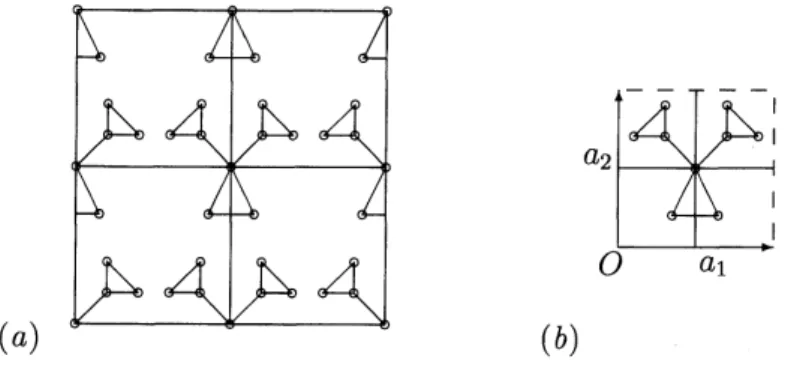
isgiven in Fig.2$a.$
Proposition 2.3. i) There exists a loop graph, which is notprecise (see Fig.3).
ii) Let$\Gamma=(\mathcal{E}, V)$ be a loop graph and let $\Gamma’=(\mathcal{E}’, V’)\subset \mathbb{R}^{d}$ be any connected
finite
graphsuch thatits diameter is small enough. We takesomepoint$v\in V$ andsomepoint$v’\in V’$. We
jointthe graph$\Gamma’$ with eachpoint
from
the vertex set$v+\mathbb{Z}^{d}$, identifying the vertex$v’$ witheachvertex
of
$v+\mathbb{Z}^{d}$. Then the obtained graph $\Gamma_{*}$ is a loop graph. Moreover,if
$\Gamma$ isprecise, then $\Gamma_{*}$ is also precise and the precise quasimomentum $\theta_{0}$of
$\Gamma$ is also a precise quasimomentumof
$\Gamma_{*}.$Remark. Applyingthis procedure tothe obtained loop graph$\Gamma_{*}$ andtoanother connected
finite graph $\Gamma_{1}$ we obtain a new loop graph $\Gamma_{**}$ and so on. Thus, from one loop graph we
(b)
FIGURE 2. a) Precise loop graph $\Gamma_{*)}$ b) thefundamental graph $\Gamma_{*f}.$
$v a_{1} v$ (b)
FIGURE 3. a) Triangularlattice $T$; b) thefundamentalgraph$T_{f}.$
Wenow describe bands for precise loop periodic graphs.
Theorem 2.4. i) Let the Schr\"odinger operator $H=\triangle+Q$ act on a loop graph $\Gamma$. Then
spectral bands $\sigma_{n}=\sigma_{n}(H)=[\lambda_{\overline{n}}, \lambda_{n}^{+}]$ satisfy
$\lambda_{n}^{-}=\lambda_{n}(0) , \forall n\in \mathbb{N}_{\nu}$. (2.11)
ii) Let, in addition, $\Gamma$
be precise with aprecise quasimomentum $\theta_{0}\in \mathbb{T}^{d}$. Then
$\sigma_{n}=[\lambda_{n}^{-}, \lambda_{n}^{+}]=[\lambda_{n}(0), \lambda_{n}(\theta_{0})], \forall n\in \mathbb{N}_{\nu}$, (2.12) $\sum_{n=1}^{\nu}|\sigma_{n}|=2\beta$, (2.13)
where $\beta$ is the number
of
bridge-loops on the loopfundamental
graph $\Gamma_{f}$. In particular,if
allbridges
of
$\Gamma_{f}$ have theform
$(v_{k}, v_{k})$for
some vertex$v_{k}\in V_{f}$, then$| \sigma(H)|=\sum_{n=1}^{\nu}|\sigma_{n}|=2\beta$. (2.14)
Remark. 1) Dueto (2.13), thetotal lengthofallspectral bandsofthe Schr\"odinger operators
$H=\triangle+Q$ on precise loop graphs does not depend on the potential $Q.$
2) The numberof theloopfundamental graph bridgescan beany integer, then due to (2.14)
the Lebesgue
measure
$|\sigma(H)|$ of the spectrum of$H$ (on the specific graphs) can be arbitrary3) $\lambda_{\overline{n}},$ $n\in \mathbb{N}_{\nu}$, are the eigenvalues of the Schr\"odinger operator $H(O)$ defined by (1.12),
(1.13) on the fundamental graph $\Gamma_{f}$. The identities (2.12) are similar to the
case
ofN-periodic Jacobi matrices on the lattice $\mathbb{Z}$
(and for Hill operators). The spectrum of these
operators is absolutely continuous and is a union of spectral bands, separated by gaps. The
endpointsof the bands are the so-called $2N$-periodic eigenvalues.
No weformulate someresults about thepossible number of flat bands ofSchr\"odinger oper-ators.
Proposition 2.5. Let a
fundamental
graph $\Gamma_{f}$of
a periodic graph $\Gamma$ have $\nu\geq 2$ verticesand have no bridge-loops. Then the number
of
degenerated spectral bands (flat bands)of
theSchr\"odinger operator$H$ on $\Gamma$ does not exceed $\nu-2$. Moreover, there exists$\mathbb{Z}^{d}$-periodic graph
$\Gamma$ (for $d=2$
see
Fig.4), such that the spectrumof
the Laplacian $\triangle$ on $\Gamma$has exactly 2 open separated spectral bands $\sigma_{1}(\triangle)$ and $\sigma_{\nu}(\Delta)$ and between them, in the gap, $\nu-2$
flat
bands$\sigma_{2}(\triangle)=\ldots=\sigma_{\nu-1}(\triangle)$.
(b)
(c) $0 \frac{11+\wedge 89\fbox{Error::0x0000}}{2}\frac{\prime,\sigma_{1_{I}}0,\sigma_{2}0=\{1\}_{I}\sigma_{31}^{0}}{\frac{11- \pi 89}{2}3\fbox{Error::0x0000}}$
FIGURE 4. a)$\mathbb{Z}^{2}$-periodicgraph$\Gamma$; b) thefundamental graph
$\Gamma_{f}$; only 2unoriented loops
in the vertex$v_{\nu}$ arebridges; c) thespectrumof the Laplacian $(\nu=3)$.
Remark. There is
an
open problem: does there exist a $\mathbb{Z}^{d}$-periodic graphwith any $\nu\geq 2$vertices in the fundamental graph such that the spectrum of the Laplacian on $\Gamma$
has only 1 spectral band and $\nu-1$ flat bands, counting multiplicity?
Acknowledgments. Various parts of this paperwerewritten during Evgeny Korotyaev’s stay in the
Math-ematical Institute of Tsukuba University, Japan and Mittag-Leffler Institute, Sweden. He is grateful to the
institutes for the hospitality. His study was partly supported by The Ministry ofeducation and science of
Russian Federation, project 07.09.2012 No 8501 and the RFFI grant “Spectral and asymptotic methods for
studyingofthe differentialoperators” No 11-01-00458.
REFERENCES
[A12] Ando, K. Inverse scattering theory for discrete Schr\"odinger operatorson the hexagonal lattice, Ann.
HenriPoincar\’e, 14 (2013), 347-383.
[BKS13] Badanin A.; Korotyaev, E.; Saburova, N. Laplacianson $\mathbb{Z}^{2}$-periodic discrete graphs, preprint
2013.
[BK12] Berkolaiko, G.; Kuchment, P. Introduction to Quantum Graphs, Mathematical Surveys and
Mono-graphs, V. 1S6 AMS, 2012.
[BS99] BoutetdeMonvel, A.; Sahbani, J. Onthe spectralpropertiesof discrete Schr6dingeroperators : (The
multi-dimensionalcase), ReviewinMath. Phys., 11 (1999), 1061-1078.
[Ch97] Chung, F. Spectral graph theory, AMS, Providence, Rhode. Island, 1997.
(CDS95] Cvetkovic, D.;Doob,M.;Sachs,H. Spectra of graphs. Theory and applications. Third edition. Johann
(CDGT88] Cvetkovic, D.; Doob, M.; Gutman, I.; Torga\v{s}ev, A. Recent results in thetheoryof graph spectra.
Annals of Discrete Mathematics, 36. North-Holland PublishingCo., Amsterdam, 1988.
[GKT93] Gieseker, D.; Kn\"orrer, H.; nubowitz, E. The geometry of algebraic Fermi curves. Perspectives in
Mathematics, 14. AcademicPress, Inc., Boston, MA, 1993.
[HS04] Higuchi, Y.; Shirai, T. Some spectral and geometric properties for infinite graphs, AMS Contemp.
Math. 347 (2004),29-56.
[HN09] Higuchi,Y.;Nomura, Y.Spectralstructure of the Laplacianon acoveringgraph.EuropeanJ.Combin.
30 (2009), no.2, 570-585.
[IK12] Isozaki, H.; Korotyaev, E. Inverseproblems,traceformulae for discreteSchr\"odinger operators,Annales
Henri Poincare, 13 (2012),no4, 751-788.
[KK10] Korotyaev, E.;$Kutsenk_{0_{\rangle}}$ A. Zigzag nanoribbons in external electric fields, Asympt. Anal. 66 (2010),
no. 3-4, 187-206.
[KK10a] Korotyaev, E.; Kutsenko, A. Zigzag nanoribbons in external electric and magnetic fields. Int. J.
Comput. Sci. Math. 3 (2010), no. 1-2, 168-191.
[KK10b] Korotyaev, E.;Kutsenko, A.Zigzagand armchairnanotubesinexternalfields,DifferentialEquations:
Advancesin Mathematics Research, Volume 10 (2010)NovaScience Publishers, Inc. 273-302.
[Me94] Merris, R. Laplacian matrices of graphs: asurvey, Linear algebra and its applications, 197-198(1994),
143-176.
[M91] Mohar, B. Some relations betweenanalytic andgeometric propertiesofinfinite graphs,Discrete
math-ematics95 (1991), 193-219.
[M92] Mohar, B. Laplaceeigenvaluesofgraphs: asurvey, Discrete mathematics 109 (1992), 171-183.
[MWS9] Mohar, B., Woess, W. A surveyon spectra of infinite graphs, Bull. London Math. Soc., 21 (1989),
209-234.
[P12] Post, O. Spectralanalysisongraph-likespaces. Lecture Notes inMathematics, 2039. Springer,
Heidel-berg, 2012.
[RR07] Rabinovich, V. S.; Roch, S. Essential spectra of difference operatorson $Z^{n}$-periodic graphs. J. Phys.
A40 (2007), no.33, 10109-10128.
[RS78] Reed, M.; Simon, B. Methods ofmodern mathematical physics, Vol.IV, Analysis of operators,
Aca-demic Press,NewYork, 1978.
[RoS09] Rosenblum, G.; Solomjak, M. On thespectral estimatesfor the Schr\"odinger operator on$Z^{d},$ d$\geq 3,$
Problems inMathematical Analysis, No. 41, J. Math. Sci. N. Y. 159 (2009), No. 2,241-263.
[SS92] Sy,P.W.I Sunada, T. DiscreteSchr\"odinger operatoronagraph, NagoyaMath. J. 125(1992), 141-150.
MATHEMATICAL PHYSICS DEPARTMENT, FACULTY 0F PHYSICS, ULIANOVSKAYA 2, ST. PETERSBURG
STATE UNIVERSITY, ST. PETERSBURG, 198904, RUSSIA, [email protected],
DEPARTMENT0F MATHEMATICAL ANALYSIS, ALGEBRA AND GEOMETRY, INSTITUTE 0F MATHEMATICS,
INFORMATIONAND SPACE TECHNOLOGIES, URITSKOGO ST. 68, NORTHERN (ARCTIC) FEDERAL