READING ENDO-TRIVIAL MODULES FROM THE BRAUER TREE
CAROLINE LASSUEUR
ABSTRACT. This note is a survey of$a$ collaboration with G. Malle and E. Schulte [18]
and reports onrecent results towards a classificationof simple endo-trivial modules for finite quasi-simple groups, as well as the use ofcharacter theoretic methods for ende trivial modules. This is thesummary ofa talk held at the RIMS Symposium Research on Finite Groups and their Representations, Vertex Operator Algebras, and Algebraic Combinatorics, March 2014,
1. INTRODUCTION
Throughout, unless otherwisestated,
we
let$p$bea
prime number, $k$bean
algebraicallyclosed field ofcharacteristic$p>0,$ $G$ be a finite group such that$p||G|$, and let $mod (kG)$
denote the category offinitelygenerated left $kG$-modules. We let $(K, \mathcal{O}, k)$ be asplitting $p$-modular system for $G$ and its subgroups.
A $kG$-module $M\in mod (kG)$ is termed endo-trivial if the $k$-endomorphism ring of $M$
satisfies the condition$End_{k}(M)\cong M^{*}\otimes_{k}M\cong k\oplus($proj) as $kG$-modules and where (proj)
denotes
a
projective summand. $(In$ other words, $End_{k}(M)$ is trivial is the stable modulecategory.)
Basic Facts 1.1. Let $M\in mod(kG)$ be an endo-trivial $kG$-module. Then:
$(a)\dim_{k}(M)\equiv\pm 1$ $($mod $|G|_{p})$
if
$p>2$ and $\dim_{k}(M)\equiv\pm 1$ $($mod $\frac{1}{2}|G|_{p})$if
$p=2$;(b) $M\cong M_{0}\oplus(proj)$, where $M_{0}$ is the unique indecomposable endo-trivial direct
sum-mand
of
$M$;(c)
if
$H\leq G$, then$M|_{H}$ isendo-trivial
andif
moreover$H$ contains aSylow$p$-subgroupof
$G$, then $M$ is endo-trivialif
and onlyif
$M|_{H}$ is endo-trivial.Thanks to Basic Fact (b), the set $T(G)$ of isomorphism classes of indecomposable
endo-trivial modules becomes an abelian group for the law: $[M]+[N]$ $:=[(M\otimes_{k}N)_{0}]$. The zero element is $[k]$ and $-[M]=[M^{*}].$
1.1. Simple endo-trivial modules. Arecent result of Robinson’s [23] states that when-ever the Sylow $p$-subgroups of
a
finite group $G$are
neither cyclicnor
quaternion, thenany simple endo-trivial $kG$-module is either simple endo-trivial for aquasi-simple normal
subgroup,
or
induced froma
1-dimensional module of a strongly $p$-embedded subgroupof $G$. This leads to the natural problem of classifying simple endo-trivial modules for
quasi-simple groups treated hereafter. In fact the existence of such modules seems to restrict even further the structure of the group.
2010 Mathematics Subject Classification. Primary $20C20$; Secondary $20C30,$ $20C33,$ $20C34.$
Key words and phrases. Simple endo-trivialmodules, Brauertrees, quasi-simplegroups.
Conjecture 1.2. Let $G$ be a
finite
quasi-simple group with afaithful
simple endo trivialmodule. Then the Sylow$p$-subgroups
of
$G$ have$p$-rank at most 2.As amatter of fact in all examples described below, the Sylow$1\succ$subgroups
are
eitherhomocyclic of rank at most 2, extraspecial of order $p^{3}$ with $p\leq 11$,
or
dihedral. Asa
consequence of
our
classificationswe
obtain:Theorem 1.3. Conjecture 1.2 holds in all
of
the following cases: (a)if
$p=2,$(b)
if
$G/Z(G)$ is an alternating group,(c)
if
$G/Z(G)$ is a sporadic group,(d)
if
$G/Z(G)$ is a groupof
Lie type and$p$ is its defining characteristic, and(e)
if
$G/Z(G)$ is an exceptional groupof
Lie type.Remark 1.4. Traditionally endo-trivial moduleshave been studied through the description of the structure of the group$T(G)$, and, apriori, the classification problem of endo-trivial modules is equivalent to describing the structure of the group $T(G)$. This structure has been computed by Carlson, Mazza, Nakano, Th\’evenaz and coauthors for several classes offinite groups, such
as
for examle p–groups, $p$-solublegroups,
symmetricand alternatinggroups, groups of Lie type in defining characteristic. Nonetheless, we emphasise that the knowledge of the structure of the group $T(G)$ often relies on Green correspondence,
hence does not give an explicit description of indecomposable endo-trivial modules in general. This is the main reason that prevented us from using previously known results on endo-trivial modules in the forthcoming classifications. See Section 5.
2. CHARACTER THEORY FOR ENDO-TRIVIAL MODULES
The newfeature of the approach used in [18, 17, 19] is that it mainly relies oncharacter theoretic methods. This is made possible through the following generalisation ofalifting result due to Alperin [1] from the case ofp–groups to arbitrary finite groups, which may be of independent interest:
Theorem 2.1 ([18, Thm. 1.3]). Let $(K, \mathcal{O}, k)$ be
a
splitting $p$-modular system and let $V$be an endo-trivial $kG$-module. Then $V$
lifts
to an endo-trivial $\mathcal{O}G$-lattice.This leads to the following criterion to detect endo-trivial modules from their ordinary characters:
Lemma 2.2. Let $V$ be a $kG$-module which is
liftable
to a simple $\mathbb{C}G$-module with char-acter$\chi$, say.
If
$V$ isendo-trivial
then $|\chi(g)|=1$for
all$p$-singular elements $g\in G.$Proof.
By assumption $\chi\overline{\chi}\equiv 1+\psi(mod p)$, where $\psi$ is the character of a p–projectivemodule. Thus, $\psi(g)=0$ for all p–singular elements $g\in G$. The claim follows. $\square$
Now it is well-known thatatrivialsource $kG$-module$M$lifts uniquely to atrivial
source
$\mathcal{O}G$-lattice $\hat{M}$
. Denote by $\chi_{\hat{M}}$ the corresponding ordinarycharacter. Sothat trivial
source
endo-trivial modules can be detected from their characters
as
follows.Theorem 2.3 ([17], Thm. 2.2). Let $M$ be an indecomposable trivial
source
$kG$-module(with dimension prime to $p$). Then $M$ is endo-trivial
if
and onlyif
$\chi_{\hat{M}}(x)=1$for
allREADING ENDO-TRIVIAL MODULES FROM THE BRAUER TREE
In fact this theorem
ensues
froma
result of Green, Landrock and Scott, stating that the character $\chi_{\hat{M}}$ of a trivial source $kG$-module takes non-negative integer values onp-elements $x\in G$, which
are moreover
positive if and only if the element $x$ belongs to avertex of$M.$
Remark 2.4. When the normal $p$-rank of the group $G$ is greater than 1, then the class of
an indecomposable endo-trivial $kG$-module lies in the torsion subgroup $TT(G)$ if and only if $M$ is a trivial
source
module. Thus assuming the Sylow$p$-subgroups of $G$ are neither
cyclic, nor semi-dihedral, nor generalised quaternion, then Theorem
2.3
tellsus the group$TT(G)$ is a function of the character table of the group $G.$
For groups of Lie type, more character-theoretic criteria for endo-trivial modules can be found in [18, Sec. 6].
3. CYCLIC
BLOCKSWe start by describing simple endo-trivial modules lying in blocks of cyclic defect. The following result applies to arbitrary finite groups, not only quasi-simple groups.
Let $G$ be a finite group with a non-trivial cyclic Sylow
$p$-subgroup $P\cong C_{p^{n}},$ $n\in \mathbb{N}.$
Let $Z$ denote the unique subgroup of order
$p$ of$G$ and let $H$ $:=N_{G}(Z)$. For a$p$-block $B$
of $kG$, let $e_{B}$ denote its inertial index, and let $e=|N_{G}(P)$ : $C_{G}(P)|$ denote the inertial
index of the principal block. Call an edge of the Brauer tree $\sigma(B)$ of$B$ a
leaf
if it is anend edge, and call
a
leaf non-exceptional if the exceptional vertexdoes not sit at its end. Theorem 3.1 ([18, Lem. 3.2, Cor. 3.3, Thm 3.7]). Let $G$ be as above such that $e>1.$Let $B$ be a$p$-block
of
$kG$ containing an endo-trivial $kG$-module. Then: (a) $e_{B}=e$;(b) the number
of
$p$-blocksof
$kG$ containing (simple) endo-trivial modules is exactly$\frac{1}{e}|H/[H:H]|_{p’}$;
(c) a simple $kB$-module $S$ is endo-trivial
if
and onlyif
$S$ labels a non-exceptionalleaf
of
the Brauer tree $\sigma(B)$of
B.Proof
(Sketch). Part (a) follows by Bessenrodt’s theorem [2, Thm. 2.3] on the position of endo-trivial modules in the Auslander-Reiten quiver of $kG$: they lie at the end. Part (b)is aconsequence of (a) together with Mazza andTh\’evenaz’ theorem [21, Thm. 3.2] onthe structure of the group $T(G)$ for groups$G$ with cyclic Sylow$p$-subgroups. For part (c), let $S$ be a simple $kB$-module and let $f(S)$ denote its $kH$-Green correspondent. First, again
by Bessenrodt’stheorem [2, Thm. 2.3], $S$ is endo-trivial if and only if$S$ lies at the end of
the stable Auslander-Reiten quiver $\Gamma_{s}(B)\cong(\mathbb{Z}/e\mathbb{Z})A_{p^{n}-1}$ of B. But this happens if and
only if$f(S)$ lies at the end of the stable Auslander-Reitenquiver $\Gamma_{s}(b)\cong(\mathbb{Z}/e\mathbb{Z})A_{p^{n}-1}$ of
the$kH$-Brauer correspondent$b$of$B$ if and only if the length of$f(S)$ belongs to $\{1, p^{n}-1\}$
if and only if $S$ corresponds to a non-exceptional leaf of the Brauer tree of $B$, where the
last equivalence follows from a result of $HiB$ and Lux [13, Lem. 4.4.12]. $\square$
In the case of cyclic Sylow $p$-subgroups, the group $T(G)$ is finite. Obviously the
sub-group $T_{0}(G)\leq T(G)$ consisting of the indecomposable endo-trivial modules lying in the
principal block is generated by the first syzygy $[\Omega(k)]$ and has order $2e$. Then,
modules
with $\Omega(k)$allows us
torecover
all indecomposable endo-trivial modules. Thisyields:
Corollary 3.2. Let $G$ be a
finite
group with a non-trivial cyclic Sylow$p$-subgroup, and
assume
$e\neq 1$. Then the groupof
endo-trivial modules$T(G)$ is generated by the classesof
syzygy modules
of
simple $kG$-modules.4. SIMPLE ENDO-TRIVIAL MODULES FOR QUASI-SIMPLE GROUPS.
We now go through several families of quasi-simple groups and give a classification of simple endo-trivial modules in these cases, proving Theorem
1.3
as a
by-product.4.1. Covering groups of alternating groups. We start with covering groups of al-ternating groups, for which the results rely on intrinsic combinatorics, the Murnagham-Nakayam rule and results of Erdmann [9] and Henke [11].
Theorem 4.1 ([18, Thm. 4.9]). Let $V$ be a
faithful
simple $kG$-modulefor
some
coveringgroup$G$
of
$\mathfrak{A}_{n}$ with$n \geq\max\{p$,5$\}$. Then$V$ is endo-trivialif
and onlyif
$V$ is a constituentof
the simple modulefor
the corresponding covering groupof
$\mathfrak{S}_{n}$ indexed by $\lambda\vdash n$, whereone
of:
(1) $G=\mathfrak{A}_{n},$ $5\leq p+2\leq n<2p$ and$\lambda=(p+1,1^{n-p-1})$ (cydic defect);
(2) $G=\mathfrak{A}_{n},$ $p>2,$ $n=2p+1$ and$\lambda=(p+1,1^{p})$;
(3) $G=\mathfrak{A}_{n},$ $p>2,$ $n=3p-1$ and $\lambda=(2p-1,p)$;
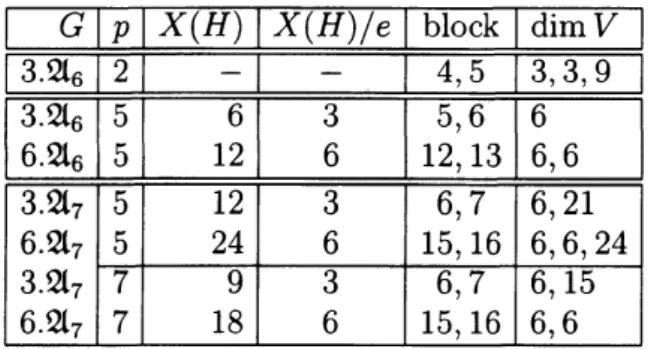
(4) $n=6$,7, $|Z(G)|\geq 3$ and $(G,p, V)$ are as in Table 1;
(5) $G=\tilde{\mathfrak{A}}_{5}\cong SL_{2}(5)$, $p=3$ and $dim_{k}V=2$; or
(6) $G=\tilde{\mathfrak{A}}_{n},$
$5\leq p\leq n\leq p+3$ and $\lambda$ is as
follows
(cyclic defect): (i) $\lambda=((p+1)/2, (p-1)/2)$ when $n=p$;(ii) $\lambda=(p+1)$ or $\lambda=((p+1)/2, (p-1)/2,1)$ when $n=p+1$; (iii) $\lambda=(p+2)$ (two non-isomorphic modules) and,
for
$p>5,$$\lambda=((p+1)/2, (p-1)/2,2)$ (two non-isomorphic modules) when $n=p+2$;
(iv) $\lambda=(p+2,1)$ (two non-isomorphic modules) and,
for
$p>5,$$\lambda=((p+1)/2, (p-1)/2,2,1)$ (two non-isomorphic modules) when $n=p+3.$
TABLE 1. Faithfulcyclic blocks containing
a
simple endo-trivial module $V$ $in3.\mathfrak{A}_{6}, 3.\mathfrak{A}_{7}, 6.\mathfrak{A}_{6}and6.\mathfrak{A}_{7}$READING ENDO-TRIVIAL MODULES FROM THE BRAUER TREE
4.2. Groups of Lie type in defining characteristic. For groups of Lie type in their defining characteristic, simple endo-trivial modules are also extremely rare.
Theorem 4.2 ([18, Thm. 5.2]). Let $G$ be a
finite
quasi-simple groupof
Lie type incharacteristic$p>0$. Let $V$ be a simple
faithful
$kG$-module, where$k$ is algebraically closedof
characteristic$p$. Then $V$ is endo-trivialif
and onlyif
oneof
(1) $p\geq 5,$ $G=SL_{2}(p)$ and $\dim V=p-1$; or
(2) $p=2,$ $G=SL_{3}(2)$ and $\dim V=3.$
If$G=SL_{2}(p)$and$\dim_{k}V=p-1$, thenfor$P\in Sy1_{p}(G)$ (cyclic), $V|_{P}$ is indecomposable,
and up to isomorphism there is aunique indecomposable $kP$-module of dimension$p-1,$
namely $\Omega(k)$. Therefore we must have $V|_{P}\cong\Omega(k)$, which is endo-trivial, whence so is
V. For $G=SL_{3}(2)\cong L_{2}(7)$
see
the next subsection.Otherwise, we may
assume
that $V$ isa
non-trivial simple $kH$-module, where $H$ is a group of simply connected type such that $G=H/Z$ for some central subgroup $Z\leq H.$By Steinberg’s tensor product theorem the simple $kH$-modules are tensor products of
Frobenius twists of$p$-restricted highest weight modules, and it is easy to prove that a
tensor product oftwo modules is endo-trivial if and only if both factors
are.
Now twists of the Steinberg module have dimension divisible by $p$, hence are not endo-trivial. Allother $p$-restricted highest weight modules have dimension less than $|G|_{p}-1$, unless
we
are in one of the exceptional case, sothat they cannot be endo-trivial by the dimensional criteria.
4.3. The groups $SL_{2}(q)$ and $L_{2}(q)$ in cross-characteristic. For $G=SL_{2}(q)$, $q=p^{n},$
$p$ a prime, $k$ ofcharacteristic $\ell\neq p$ dividing the order of $G$. If $\ell\neq 2$ the classification of
simple endo-trivial modules follows from Theorem 3.1.
Proposition 4.3 ([18, Prop. 3.8]). Let $G=SL_{2}(q)$, $q=p^{n}$ with $p$ a prime. Let $V$ be
a non-trivial simple $kG$-module, where $k$ is algebraically closed
of
characteristic $\ell\neq p.$Then $V$ is endo-trivial
if
and onlyif
oneof:
(1) $2\neq\ell|q-1$ and $V$ lies in an $\ell$-block
of full defect
and inertial index 2 (cyclicdefect);
(2) $p\neq 2\neq\ell|q+1$ and $V$ lies in the non-principal $\ell$
-block
of full defect
and inertial index 2 (cyclic defect);(3) $3=\ell|q+1,$ $|G|_{\ell}=3$ and$V$ lies in the principal$\ell$
-block (cyclic defect).
Moreover,
if
$\ell=2,$ $q\equiv-1$ (mod4) and $V$ lies in the principal $\ell$-block, then $V$ isendo-trivial as a $kL_{2}(q)$-module, but not as a $kG$-module.
For the exceptional covering groups of$L_{2}(9)\cong \mathfrak{A}_{6}$ see Theorem 4.1. For the principal
block modules of$L_{2}(q)$, it is well-known that they
are
trivialsource
modules and easy tocheck that the corresponding characters take value 1 on 2-elements, hence theyare endo-trivial by Theorem 2.3. Clearly these modules are not endo-trivial as $kSL_{2}(q)$-modules since $O_{2’}(G)=Z(G)$ acts trivially.
4.4. Characteristic 2.
Theorem 4.4 ([18, Thm. 6.7]). Let $G$ be a
finite
quasi-simple group. Then $G$ has anon-trivial simple endo-trivial $kG$-module $V$ over a
field
of
characteristic 2if
and onlyif
oneof:
(a) $G=L_{2}(q)$ with $7\leq q\equiv 3$ (mod4) and$\dim(V)=(q-1)/2$; or
(b) $G=3.\mathfrak{A}_{6}$ and$\dim(V)\in\{3$,
9
$\}.$In particular, Conjecture 1.2 holds
for
the prime 2.The proof of this result goes through the possibilities for$G$accordingto the classification
of finite simple groups. The exceptions in the statement of the Theorem are given by Theorem
4.3
and 4.1. All other irreducible characters of finite quasi-simple groupsare
discarded
as
follows. If $G$ is alternating, the claim is Theorem 4.1, and if $G$ is sporadicit is Theorem 4.8 below. If $G$ is of Lie type in defining characteristic
see
Theorem 4.2.If $G$ is an exceptional group of Lie type in odd characteristic, the claim will follow from
Section 4.5. Thus it remains to deal with classical groups of Lie typein odd characteristic. In this
case
$G$ has wild representation type, so that the group $T(G)$ hasno
2-torsion andit follows that
no
self-dual simple $kG$-modulecan
be endo-trivial. If$\chi\neq 1$ isa
unipotentcharacter of $G$ whose reduction modulo 2 is irreducible, then $V$ is self-dual. Thus only
non-unipotent characters could lead to endo-trivial modules. In all types these characters can be discarded by acloser examination of the Lusztig’s series in which they lie.
4.5. Exceptional groups of Lie type. Throughout this subsection
we assume
the groups of Lie typeare
definedover
a field of characteristic $p$ and weassume
the field $k$ is ofcharacteristic $\ell\neq p$ dividing the order ofthe considered group.To beginwith, forthe fivefamilies ofsmall rank exceptionalgroups of Lie type, that is,
$2B_{2}(2^{2f+1})$, $2G_{2}(3^{2f+1})$, $2F_{4}(2^{2f+1})$, $G_{2}(q)$ and $3D_{4}(q)$, complete ordinary character tables
are available, making it relatively easy to find the candidate characters for simple endo-trivial modules.
Theorem 4.5 ([18, Thm. 6.8]). Let $G$ be a covering group
of
oneof
the simple groups$2B_{2}(2^{2f+1})$ (with $f\geq$ 1), $2G_{2}(3^{2f+1})$ (with $f\geq$ 1), $G_{2}(q)$ (with $q\geq 3$), $3D_{4}(q)$,
or
$2F_{4}(2^{2f+1})$ (with $f\geq 1$). Let $\ell\neq p$ denote a prime divisor
of
$|G|$ and $P\in Sy1_{\ell}(G)$.If
there exists a non-trivial simple endo-trivial$kG$-module then $P$ is cyclic.In the
cases
of the previous theorem, the simple endo-trivial $kG$-modules for primes $\ell$such that $P$ is cyclic are classified in [18] in Table 2 and Table 3. Againthey can be read
from the known Brauer trees.
Turning to the exceptional groups of rank at least four (for which
no
complete generic character tables are available) for unipotent characters we obtain the following:Proposition 4.6 ([18, Prop. 6.9], [17]). Let$G=G(q)$ be a
finite
simple exceptional groupof
Lie type in characteristic$p$of
rank at least4
and $\ell\neq p$ a primefor
which the Sylow$\ell$
-subgroups
of
$G$ are non-cyclic. Then $\chi\in Irr(G)$ is the characterof
a simple unipotent endo-trivial $kG$-moduleif
and onlyif
$G=F_{4}(2)$, $\ell=5$ and $\chi=F_{4}^{II}[1]$ (notation is thatof
[7,\S 13
In this
case
most unipotent characters are discarded by the usual degree criteria or Theorem 2.3. This leads to:Theorem 4.7 ([18, Prop. 6.9], [17]). Let $G$ be a quasi-simple exceptional group
of
Lietype in characteristic$p$, and$\ell\neq p$ a prime such that Sylow $\ell$
-subgroups
of
$G$ have $\ell$-rankat least 3. Then $G$ does not have
faithful
simple endo-trivial $kG$-modules over afield
$k$of
READING ENDO-TRIVIAL MODULES FROM THE BRAUER TREE
4.6.
Covering groups of sporadic simple groups. For sporadic groups simple endo-trivial modulesremain ararephenomenon, although the following results shows that theydo
occur
for groups whose Sylow$p$-subgroups are either elementary abelian of rank 2or
extra-special of order $p^{3}$ and exponent $p.$
Theorem 4.8 ([18, Thm. 7.1], [17]). Let $G$ be a quasi-simple group such that $G/Z(G)$ is
sporadic simple. Let$V$ be a
faithful
simple endo-trivial$kG$-module, where$k$ is algebraicallyclosed
of
characteristic$p$, with $p$ dividing $|G|$. Let $P$ be a Sylow$p$-subgroupof
G. Thenone
of
the following holds: (1) $|P|=p$ and $V$ lies in a$p$-block $B$
of
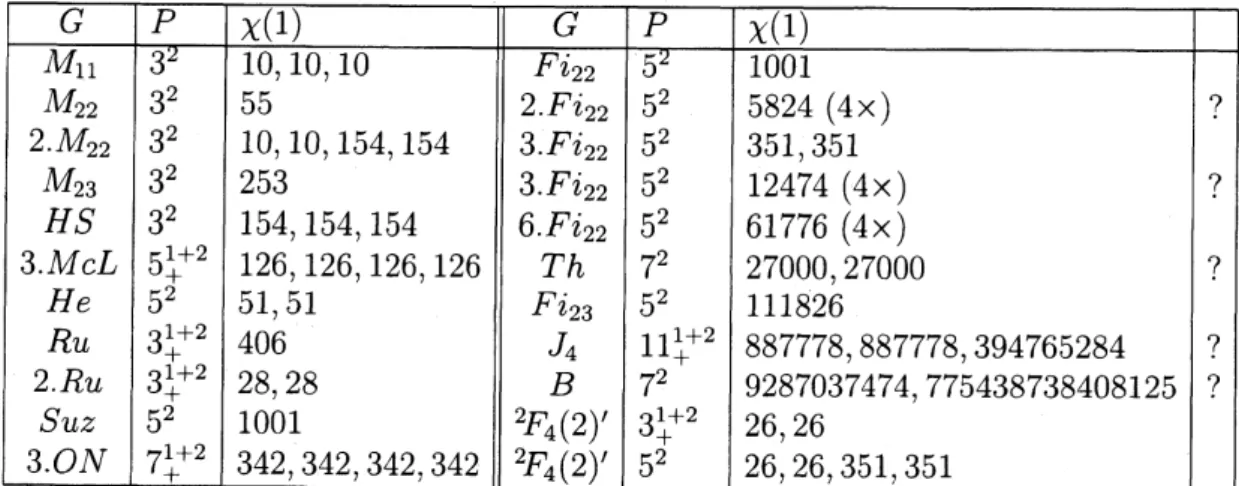
$kG$ as listed in [18, Table 7] ; $or$(2) $(G, P, \dim V)$
are
as in Table2.
Conversely, all modules listed in Table 2 are endo-trivial exceptpossibly
for
those marked by a “?” in the last column.TABLE 2. Candidate characters in sporadic groups
In the cyclic Sylow case, a complete description of the simple endo-trivial modules can be read directly from the Brauer trees of cyclic blocks using Theorem 3.1 and [13].
(Excepting one block of 2.$B$ in characteristic 47 and five blocks of $M$ in
various charac-teristics, for which the Brauer trees are not known completely as ofyet.) The results are collected in [18, Table 7].
Now if we
assume
$p^{2}$ divides $|G|$. Using the dimensionand character degree criteria (Basic Facts 1.1, Lemma 2.2, Theorem 2.3), the known ordinary character tables and decomposition matrices of the quasi-simple sporadic groups (see [8, 14, 10]) we obtain the list of candidate characters $\chi\in Irr(G)$ stated in Table 2. Excepting the cases marked by
$a$ “?”’ in the last column, one can prove that the corresponding modules are endo-trivial
using
one
of the following arguments:(i) $\chi\otimes\chi^{*}$ has one trivial constituent and one constituent of defect
zero;
(ii) there is a subgroup $H\leq G$ containing a Sylow $p$-subgroup of $G$ and $\chi|_{H}$ has a
unique trivial constituent, and all other constituents are ofdefect zero;
(iv)
for
the pairs $(G, \chi(1))=(^{2}F_{4}(2)’,$ $351$) computations with MAGMA [20].In the
case
of $J_{4}$ and $B$, it is not known whether these characters remain irreduciblemodulo$p.$
Remark 4.9. Infactmostof the simple modules listed in Table2 aretrivial
source
modules. For instance this is obviousas
soon
as a
$character\backslash$ satisfies condition (ii) above. Asa
consequence, these modules provide
us
with example of torsion endo-trivial module, that is modules whose class lies in the torsion subgroup $TT(G)<T(G)$ . In [17, 19], it will be shown that any quasi-simple sporadic group admitting a simple endo-trivial module also has exoticendo-trivial modules, in thesense
that $G$ has torsion endo-trivial moduleswhose dimension is not
one.
Remark 4.10. endo-triviality is in general not preserved by Morita equivalences. Cyclic blocks of sporadic groups provide us with many counter-examples. For instance the Janko group $J_{1}$ has four 3-blocks with isomorphic Brauer trees, that is, isomorphic
as
pointed graphs equipped with a planar embedding. Hence the four blocks
are
Morita equivalent (see [13, pp. 69-70]). However, only two of these blocks contain simple endo-trivial modules.5. DISCARDING THE EXISTENCE OF SIMPLE ENDO-TRIVIAL MODULES VIA
AuSLANDER-REITEN THEORY
Previous work on endo-trivial modules for different classes of quasi-simple groups $G$
was
concerned with the determination ofthe group $T(G)$ of endo-trivial modules. Thisincludes results
on groups
with cyclic Sylow subgroups [21], the symmetric and alternating groups [4, 6], and groups of Lie type in their defining characteristic [5].Nevertheless there are three main obstructions to apply these results to
answer
the question of finding the simple endo-trivial modules. First, the aforementioned articles do not treat covering groups. Second, they determine the structure of$T(G)$ but not theindecomposable endo-trivial modulesthemselves, in that their description involves Green correspondence, which is not explicit and notoriously difficult to determine. Third,
even
in the simplest
cases
where $T(G)=\langle\Omega(k)\rangle\cong \mathbb{Z}$ (where $\Omega$is the Heller operator), it is not clear whether any of the modules $\Omega^{n}(k)$ for $n\in \mathbb{Z}$
can
be simple.In the latter case,
we
give hereone
possible approach via the stable Auslander-Reiten quiver$\Gamma_{s}(kG)$of$kG$, which could have enabledustousethe structure the known structureof the group $T(G)$ to discard the existence of simple endo-trivial modules. This
was
suggested
a
fortiori by S. Koshitani.Proposition 5.1. Let $G$ be a
finite
group and $B_{0}$ be the principal blockof
$kG$. Assume$B_{0}$ has wild representation type and $G$
satisfies
the following conditions:(i) each $AR$-component
of
type $\mathbb{Z}A_{\infty}$of
$\Gamma_{s}(B_{0})$ contains at most one simple module;(ii) $T(G)\cong \mathbb{Z}.$
Then $G$ does not have non-trivial simple endo-trivial modules.
Proof.
The condition $T(G)\cong \mathbb{Z}$ implies thatan
indecomposable endo-trivial $kG$-moduleis isomorphic to a syzygy module $\Omega^{n}(k)$ for
some
$n\in \mathbb{Z}$, and thus lies in $B_{0}$. MoreoverREADING ENDO-TRIVIAL MODULES FROM THE BRAUER TREE
$\Gamma_{S}(\Omega(k))$, both isomorphic to $\mathbb{Z}A_{\infty}$
as
$B_{0}$ is a wild block. By assumption (i), the trivialmodule $k$ is the unique simple module in$\Gamma_{s}(k)$. If$\Gamma_{s}(\Omega(k))$ contains a simple endo-trivial
module $S$, then $S=\Omega^{2n+1}(k)$ for some $n\in \mathbb{Z}$. Therefore $S^{*}=\Omega^{-2n-1}(k)$ is also simple
and lies in $\Gamma_{s}(\Omega(k))$, which contradicts assumption (i). The claim follows. $\square$
Going back to quasi-simple groups and related groups this yields the following results. Theorem 5.2. Let$G$ be a
finite
groupof
oneof
the following types:(a) $G$ is a perfect group
of
Lie typedefined
over afield
of
characteristic$p$ and $G$ isnot
of
type $A_{1}(p)(p>2)$, $2A_{2}(p)$, $A_{2}(p)$, $B_{2}(p)(p\geq 5)$, $G_{2}(p)(p\geq 7)$, $2B_{2}(2^{a+\frac{1}{2}})$$(a\geq 0)$
or
$\mathfrak{B}_{2}(3^{a+\frac{1}{2}})(a\geq 0)$;(b) $p=2$ and $G=\mathfrak{S}_{n}$ is a symmetric group such that $n\geq 6,\cdot$
(c) $G=\mathfrak{A}_{n}$ is an alternating group such that$n\geq 8$
if
$p=2$, orsuch that$3p\leq n<p^{2}$or$p^{2}+p\leq n$
if
$p\geq 3.$Then $G$ does not have non-trivial simple endo-trivial modules.
Theclaim isadirect consequenceof Proposition 5.1. Indeed, by [5] and [6, 4] any group of type (a), (b) or (c) is such that $T(G)\cong \mathbb{Z}$. Moreoverby [15, 16] and [24, Thm. 6] these
groups also satisfy condition (i) of Proposition 5.1.
Acknowledgments. The author gratefully acknowledges financial support by ERC Ad-vanced Grant
291512
andSNF
Fellowship for Prospective ResearchersPBELP2-143516
at the time of the research presented in this survey. In addition, the author would like to thank Prof. Shigeo Koshitani and Dr. Moeko Takahashi for an invitation to visit Chiba University in March 2014 supported by the Japan Society for Promotion ofScience (JSPS), Grant-in-Aid for JSPS-Fellows 24.2274.
REFERENCES
[1] J. L. ALPERIN, Lifting endotrivial modules. J. Group Theory 4 (2001), 1-2.
[2] C. BESSENRODT, Endotrivialmodules and theAuslander-Reitenquiver. Pp.317-326in: Represen-tation Theory ofFinite Groups and Finite-Dimensional Algebras (Bielefeld, 1991), Progr. Math., 95, Birkh\’auser, Basel, 1991.
[3] J. CARLSON, Endotrivial modules. Pp. 99-111 in: Recent Developments in Lie Algebras, Groups and Representation Theory. Proc. Sympos. Pure Math., Providence, RI, 2012.
[4] J. CARLSON, D, HEMMER, N. MAZZA, The group of endotrivial modules for the symmetric and alternatinggroups. Proc. Edinb. Math. Soc. 53 (2010), 83-95.
[5] J. CARLSON, N. MAZZA, D. NAKANO, Endotrivial modulesfor finitegroups ofLie type. J. Reine Angew. Math. 595 (2006), 93-119.
[6] J. CARLSON, N. MAZZA, D. NAKANO, Endotrivial modules for the symmetric and alternating groups. Proc. Edinb. Math. Soc. (2). 52 (2009), 45-66.
[7] R. CARTER, Finite Groups ofLie type: Conjugacy Classes and Complex Characters. Wiley,
Chich-ester, 1985.
[8] J H. CONWAY, R.T. CURTIS, S.P. NORTON, R.A. PARKER, R.A. WILSON, Atlas of Finite Groups. ClarendonPress, Oxford, 1985.
[9] K. ERDMANN, Young modules for symmetric groups. J. Aust. Math. Soc. 71 (2001), 201-210. [10] THE GAP GROUP, GAP –Groups, Algorithms, and Programming, Version 4.4; 2004, http:
$//www$.gap-system.org.
[12] P. N. HOFFMAN, J. F. HUMPHREYS, Projective Representations
of
the Symmetric Groups. Q-Functions andShifted
Tableaux. Oxford Science Publications. The Clarendon Press, Oxford Uni-versity Press, New York, 1992.[13] G. HISS, K. Lux, Brauer Trees ofSporadic Groups. Oxford SciencePublications. The Clarendon Press, OxfordUniversity Press, New York, 1989.
[14] C. JANSEN, K. Lux, R. PARKER, R. WILSON, An Atlas ofBrauer Characters. Oxford Science Publications. The Clarendon Press, Oxford University Press, NewYork, 1995.
[15] S. KAWATA, G. O. MICHLER, AND K. UNO, Onsimplemodules in theAuslander-Reiten
compo-nents of finite groups. Math. Z. 234 (2000), 375-398.
[16] S. KAWATA, G. O. MICHLER, ANDK. UNO,OnAuslander-Reitencomponentsand simple modules
for finite groupsofLie type. Osaka J. Math. 38 (2001), 21-26.
[17] C. LASSUEUR, G. MALLE, Simple endotrivial modules for the linear, unitary and exceptional groups. Preprint (2014).
[1S] C. LASSUEUR, G. MALLE, E. SCHULTE, Simple endotrivial modules for quasi-simple groups. J. reine angew. Math., DOI: 10.1515/crelle-20l3-0l00.
[19] C. LASSUEUR, N. MAZZA, Endotrivial modules for the sporadicgroupsand their covers. Preprint (2014).
[20] MAGMA V2.12-14, The computational Algebra Group, School of Mathematics and Statistics, University ofSydney. http:$//$magma.maths.usyd. edu.$au/magma/.$
[21] N. MAZZA, J. TH\’EVENAZ, Endotrivial modules in the cyclic case. Arch. Math. (Basel) 89 (2007), 497-503.
[22] E. SCHULTE, Simple Endotrivial Modulesfor Finite Simple Groups. Diplomarbeit, TU Kaisers-lautern, 2012.
[23] G. ROBINSON, Onsimpleendotrivial modules. Bull. Lond. Math. Soc. 43 (2011), 712-716. [24] K. UNO, Simple modules inthe Auslander-Reitenquivers offinite group algebras. Pp. 83-97 in:
Surikaisekikenkyusho KokyurokuNo. 1149,2000.Representation theory of finitegroupsand related topics (Japanese) (Kyoto, 1998).
FB MATHEMATIK, TU KAISERSLAUTERN, POSTFACH 3049, 67653 KAISERSLAUTERN, GERMANY.