JOHNSON HOMOMORPHISMS
AS FIBERING OBSTRUCTIONS OF
HOMOLOGICALLY
FIBERED KNOTS
HIROSHI
GODA
AND
TAKUYA
SAKASAI
1.
INTRODUCTION
Let
$\Sigma_{g,1}$be
a
compact
connected oriented surface of
genus
$g\geq 1$
with
one
boundary
component.
We
denote its mapping
class group
by
$M_{g,1}$
. It
is
the
group of
all
isotopy
classes
of diffeomorphisms of
$\Sigma_{g,1}$which fix the
boundary pointwise.
The
action
of
$\mathcal{M}_{g,1}$on
$H_{1}(\Sigma_{g,1})\cong \mathbb{Z}^{2g}$gives
a
representation
$\sigma_{2}:\Lambda 4_{g,1}arrow Sp(2g;\mathbb{Z})$
,
which
is
the first
step
to investigate the structure of
$\mathcal{M}_{g,1}$. The kernel
$\mathcal{I}_{g,1}$of this
repre-sentation is
called the Torelli group. In his
study
of
$\mathcal{I}_{g,1}$,
Johnson
[13]
defined
a
homo-morphism
$\tau_{1}:\mathcal{I}_{g,1}arrow\wedge^{3}H_{1}(\Sigma_{g,1})$
and
proved
that it is surjective. Furthermore, Johnson [14] and Morita [18]
generalized
it to
a
series
of
homomorphisms
$\{\tau_{k}\}_{k\geq 1}$such
that
$\tau_{k}$is
defined
on
the
kernel of
$\tau_{k-1}$,
say
$\mathcal{M}_{g,1}[k+1]$
, and the target of
$\tau_{k}$is
a
finitely generated free abelian
group
for each
$k$.
Morita
[19] introduced
a submodule
$\text{り_{}g,1}(k)$of the target and showed that the image
of
$\tau_{k}$is
included
in
$\text{り_{}g,1}(k)$.
The
homomorphism
$\tau_{k}:M_{g,1}[k+1]arrow b_{g,1}(k)$
is
now
called
the k-th
Johnson
homomorphism. For
$k\geq 2$
, it is known that
$\tau_{k}$is
not
surjective [18, 19]. In the study of the mapping class
group,
it
has been
an
important
problem
to
determine
the cokernel
$\text{り_{}g,1}(k)/Image\tau_{k}$
and its topological meaning.
On
the
other
hand,
the
monoid
$C_{g,1}$of
homology cylinders is known to
be
an
enlargement
of
$\mathcal{M}_{g,1}$.
Garoufalidis-Levine
[6] extended
$\tau_{k}$
to
$C_{g,1}$together with its filtration
$\{C_{g,1}[k]\}_{k\geq 1}$
and
showed
that the extended
Johnson
homomorphism
$\tilde{\tau}_{k}:C_{g,1}[k+1]arrow \text{り_{}g,1}(k)$
is surjective. For the
detail,
see
Section
2.
In
our
previous
papers [7, 8],
we
defined
a
class
of
knots
called homologically
fibered
knots, in which
fibered
knots
are
included.
This extension
corresponds
to that
of
$\mathcal{M}_{g,1}$to
$C_{g,1}$
.
In fact, the
complement
of
a
homologically fibered knot includes
a
homology
cylinder
as a
complementary sutured manifold, while the complement
of a
fibered knot includes
a
product
sutured
manifold.
In
this paper,
we use
the
cokernels
of Johnson
homomorphisms
as
fibering obstructions
of homologically fibered knots. More
precisely,
we
confirm
that
there
exist totally
13
non-fibered
homologically
fibered
knots
with 12 crossings, where this fact
was
first
shown
by
Friedl-Kim
[4], by computing
$\tilde{\tau}_{2}$in
the setting mentioned in
Section 3.
The
authors
are
partially
supported
by
KAKENHI
(No.
21540071
and No.
21740044),
Ministry
of
Education,
Science, Sports
and
Technology, Japan.
2. JOHNSON
HOMOMORPHISMS
AND
HOMOLOGY
CYLINDERS
Take
a
basepoint
$p$of
$\Sigma_{g,1}$on
the
boundary.
The
fundamental group
$\pi_{1}(\Sigma_{g,1})$of the
surface
$\Sigma_{g,1}$is
a
free
group
of
rank
$2g$
.
We take
a
basis
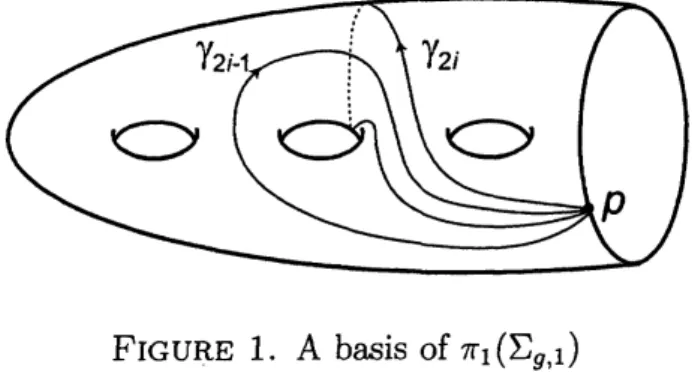
$\langle\gamma_{1},$$\gamma_{2},$$\ldots,$$\gamma_{2g}\rangle$
of
$\pi_{1}(\Sigma_{g,1})$as
in
Figure 1.
FIGURE
1. A basis of
$\pi_{1}(\Sigma_{g,1})$For
a group
$G$
,
the
lower
central series of
$G$
is defined
by
$\Gamma^{1}(G)$$:=G$
and
$\Gamma^{k}(G)=$
$[G, \Gamma^{k-1}(G)]$
for
$k\geq 2$
. Here
we use
the
notation
$[a, b]$ $:=aba^{-1}b^{-1}$
.
For
simplicity,
we
put
$\Gamma^{i}=\Gamma^{i}(\pi_{1}(\Sigma_{g,1}))$.
The mapping
class group
$\mathcal{M}_{g,1}$acts naturally
on
$\Gamma^{1}=\pi_{1}(\Sigma_{g,1})$.
By
a
theorem of
Dehn-Nielsen,
the induced
representation
$\mathcal{M}_{g,1}arrow$Aut
$\Gamma^{1}$is injective. Through
this
embedding,
$\mathcal{M}_{g,1}$
acts
on
the k-th
nilpotent
quotient
$N_{k}$ $:=\Gamma^{1}/\Gamma^{k}$of
$\Gamma^{1}$
and
we
have
a
representation
$\sigma_{k}$
:
$\mathcal{M}_{g,1}arrow$Aut
$N_{k}$$(k=2,3, \ldots)$
.
When
$k=2$
,
we
have
$N_{2}=H_{1}(\Sigma_{g,1})\cong \mathbb{Z}^{2g}$
,
so that
$\sigma_{2}:\mathcal{M}_{g,1}arrow$GL
$(2g, \mathbb{Z})$.
It is known
$\mathcal{M}_{g,1}[1]=\mathcal{M}_{g,1}and\mathcal{M}_{g,1}[k]:=Ker\sigma_{k}fork\geq 2Bydefinition,\mathcal{M}_{g,1}[2]isthatImage\sigma_{2}=Sp(2g, \mathbb{Z}).Theserepresentations$
.
$yie1dafi1trationof\mathcal{M}_{g’ 1}theT_{ore}mdefinedby$
group
$\mathcal{I}_{g,1}$.
Let
us
recall the definition of Johnson
homomorphisms.
We
simply write
$H$
for
$H_{1}(\Sigma_{g,1})$.
Andreadakis
[1]
showed
that
there
exists
an
exact
sequence
$1arrow Hom(H, \mathcal{L}_{k})arrow$
Aut
$N_{k+1}arrow$
Aut
$N_{k}arrow 1$
,
where
$\mathcal{L}_{k}$is the degree
$k$part
of
the
free Lie
algebra generated by
$H$
.
Therefore if
we
restrict
$\sigma_{k+2}$to
$\mathcal{M}_{g,1}[k+1]$
,
we
obtain
a
homomorphism
$\tau_{k}:=\sigma_{k+2}|_{\mathcal{M}_{g,1}[k+1]}:\mathcal{M}_{g,1}[k+1]arrow Hom(H, \mathcal{L}_{k+1})$
$(k=1,2, \ldots)$
.
More
specifically,
the
homomorphism
$\tau_{k}$is given
as
follows. Let
$f\in \mathcal{M}_{g,1}[k+1]$
.
We
write
$f_{m}$for
the
automorphism
of
$N_{m}$
induced
by
$f$
.
Since
$f_{k+1}=$
id by
definition,
we
have
$f_{k+2}(x)x^{-1}\in\Gamma^{k+1}/\Gamma^{k+2}$
for each
$x\in N_{k+2}$
.
It
is known
that
$\Gamma^{k+1}/\Gamma^{k+2}$is naturally
isomorphic
to
$\mathcal{L}_{k+1}$. Hence we
can
define a
map
$\varphi_{f}$:
$N_{k+2}arrow \mathcal{L}_{k+1}$by
$\varphi_{f}(x)=f_{k+2}(x)x^{-1}$
.
By
the
centrality
of
$\mathcal{L}_{k+1}$,
we
can
see
that
$\varphi_{f}$is
a
homomorphism.
Since
$\mathcal{L}_{k+1}$is abelian,
$\varphi_{f}$
induces
a
homomorphism
$\overline{\varphi}_{f}$:
$Harrow \mathcal{L}_{k+1}$
.
Then
we
define
$\tau_{k}$:
$\mathcal{M}_{g,1}[k+1]arrow$
$Hom(H, \mathcal{L}_{k+1})\cong H^{*}\otimes \mathcal{L}_{k+1}\cong H\otimes \mathcal{L}_{k+1}$
by
$\tau_{k}(f)=\overline{\varphi}_{f}$,
where
we use
the natural
isomorphism
$H\cong H^{*}$
by
Poincar\’e
duality
(we
identify
$\gamma_{2i-1}\in H$
with
$-\gamma_{2i}^{*}\in H^{*}$and
k-th Johnson homomorphism. Morita studied this
homomorphism in [19]
and
proved
the
following.
Theorem 2.1
(Morita [19,
Corollary
3.2]).
Let
$\text{り_{}g,1}(k)$be the kemel
of
the
bmcket
map
$H\otimes \mathcal{L}_{k+1}arrow \mathcal{L}_{k+2}$
given
by
$(w,\xi)\mapsto[w, \xi]$
for
$w\in H$
and
$\xi\in \mathcal{L}_{k+1}$. Then
the image
of
$\tau_{k}$
:
$\mathcal{M}_{g,1}[k+1]arrow H\otimes \mathcal{L}_{k+1}$
is
included
in
$\text{り_{}g,1}(k)$,
so
that
we may
write
$\tau_{k}$:
$\mathcal{M}_{g,1}[k+1]arrow$
$\text{り_{}g,1}(k)$
.
Johnson
[13]
showed that
$\tau_{1}:\mathcal{M}_{g,1}[2]arrow$り g,l (1)
$\cong\wedge^{3}H$is surjective,
where
り
g,l(l)
$\cong$$\wedge^{3}H$
is
embedded
in
$H\otimes \mathcal{L}_{2}=H\otimes\wedge^{2}H$
by
$x\wedge y\wedge z\mapsto x\otimes(y\wedge z)+y\otimes(z\wedge x)+z\wedge(x\wedge y)$
for
$x,$ $y,$
$z\in H$
.
However, it is
known that
$\tau_{k}:\mathcal{M}_{g,1}[k+1]arrow \text{り_{}g,1}(k)$
is not surjective
for
$k\geq 2$
.
(see
Morita
[18, 19]). In
Section
4,
we
will
discuss
more
about
the homomorphism
$\tau_{2}$
.
Next,
we
recall the definition of
homology cylinders.
We
refer to
Goussarov
[9],
Habiro
[11],
Garoufalidis-Levine
[6] and
Levine
[15]
for
their origin.
Definition
2.2.
A homology
cylinder
$(M, i_{+}, i_{-})$
over
$\Sigma_{g,1}$consists of
a
compact
oriented
3-manifold
$M$
with two embeddings
$i_{+},$ $i_{-}$:
$\Sigma_{g,1}\mapsto\partial l1t$such that:
(i)
$i+$
is orientation-preserving and
$i_{-}$is orientation-reversing;
(ii)
$\partial M=i_{+}(\Sigma_{g,1})\cup i_{-}(\Sigma_{g,1})$
and
$i_{+}(\Sigma_{g,1})\cap i_{-}(\Sigma_{g,1})=i_{+}(\partial\Sigma_{g,1})=i_{-}(\partial\Sigma_{g,1})$
;
(iii)
$i_{+}|_{\partial\Sigma_{g,1}}=i_{-}|_{\partial\Sigma_{g,1}}$;
and
(iv)
$i_{+},$$i_{-}:H_{*}(\Sigma_{g,1})arrow H_{*}(M)$
are
isomorphisms.
Two homology
cylinders
$(\Lambda_{i}\Gamma, i_{+}, i_{-})$and
$(N, j+, j_{-})$
over
$\Sigma_{g,1}$are
said to
be
isomorphic
if
there
exists
an
orientation-preserving diffeomorphism
$f$
:
$Marrow N$
$j_{+}\underline{\simeq}=foi+$
satisfiring
and
$j_{-}=foi_{-}$
. We
denote by
$C_{g,1}$the set
of
all isomorphism
classes of
homology cylinders
over
$\Sigma_{g,1}$.
We define a
product operation
on
$C_{g,1}$by
$(1II, i_{+}, i_{-})\cdot(N,j_{+},j_{-})$
$:=(M \bigcup_{i_{-}\circ(j+)^{-1}}N, i_{+},j_{-})$
for
$(M, i_{+}, i_{-}),$
$(N,j+,j_{-})\in C_{g,1}$
,
so
that
$C_{g_{\rangle}1}$becomes
a
monoid. The unit is given by
$(\Sigma_{g,1}\cross[0,1], id \cross 1, id \cross 0)$
,
where collars
of
$i_{+}(\Sigma_{g,1})=$
$($id
$\cross 1)(\Sigma_{g,1})$and
$i_{-}(\Sigma_{g,1})=$
$($
id
$\cross 0)(\Sigma_{g,1})$are
stretched half-way along
$(\partial\Sigma_{g,1})\cross[0,1]$so
that
$i_{+}(\partial\Sigma_{g,1})=i_{-}(\partial\Sigma_{g,1})$.
Example
2.3.
The mapping class
group
$\mathcal{M}_{g,1}$can
be embedded in
$C_{g,1}$by
assigning to
$[\varphi]\in\Lambda t_{g,1}$
a
homology cylinder
$(\Sigma_{g,1}\cross[0,1], id\cross 1, \varphi\cross 0)$
with the
same
treatment of the boundary
as
above.
Johnson
homomorphisms
were
extended
by
Garoufalidis-Levine
[6]
as
follows.
Given
$(M, i_{+}, i_{-})\in C_{g,1}$
,
we
consider
the
homomorphisms
$i\pm,*$
:
$\pi_{1}(\Sigma_{g,1})arrow\pi_{1}(M)$
,
where
we
share
a
basepoint taken
on
$\partial i_{+}(\Sigma_{g,1})=\partial i_{-}(\Sigma_{g,1})$. Since
$i\pm$induce homology
iso-morphisms, it
follows from Stallings
[21]
that
they
induce isomorphisms
$i_{\pm,k}$:
$N_{k}arrow$
$\pi_{1}(M)/\Gamma^{k}(\pi_{1}(M))$
.
Define
a
map
$\tilde{\sigma}_{k}:C_{g,1}arrow$Aut
$N_{k}$by
$\tilde{\sigma}_{k}(M, i_{+}, i_{-})=(i_{+,k})^{-1}\circ i_{-,k}\in$
Aut
$N_{k}$and it turns out to be
a
homomorphism. The restriction of
$\tilde{\sigma}_{k}$to
$\mathcal{M}_{g,1}$coincides
with
the homomorphism
$\sigma_{k}$defined
before.
When
$k=2$
,
we can
check that the image
of
Set
$C_{g,1}[1]=C_{g,1}$
and
$C_{g,1}[k]=Ker\tilde{\sigma}_{k}$
for
$k\geq 2$
.
By
the
same
construction
as
$\mathcal{M}_{g,1}$,
we
obtain
a
homomorphism
$\tilde{\tau}_{k}:C_{g,1}[k+1]arrow H\otimes \mathcal{L}_{k+1}$
,
which extends
$\tau_{k}$.
It
can
be
shown that
Image
$\tilde{\tau}_{k}\subset \text{り_{}g,1}(k)$. Moreover the
following
holds:
Theorem 2.4
(Garoufalidis-Levine [6, Proposition
2.5], Habegger [10]).
For
any
$k\geq 2$
,
Image
$\tilde{\tau}_{k}=\text{り_{}g,1}(k)$.
Consequently,
we
see
that the cokernel
$\text{り_{}g,1}(k)/Image\tau_{k}$
for
$k\geq 2$
is
a
product
obstruc-tion
for homology
cylinders.
Note that the first Johnson
homomorphism
$\tilde{\tau}_{1}$:
$C_{g,1}[2]arrow$
$\text{り_{}g,1}(1)\cong\wedge^{3}H$
has
the
same
image
as
$\tau_{1}$.
3. HOMOLOGICALLY
FIBERED
KNOTS
Here
we
recall
the
definition of
homologically
fibered
knots,
which enable
us
to
encode
the
theory
of
homology cylinders to knot theory.
For
a
knot
$K$
in
$S^{3}$and
a Seifert
surface
$\overline{R}$of
$K$
,
we
set
$R$
$:=\overline{R}\cap E(K)$
,
where
$E(K)=\overline{S^{3}-N(K)}$
is the
complement
of
a
regular neighborhood
$N(K)$
of
$K$
.
Then
$(M_{R}, \gamma)$
$:=(\overline{E(K)-N(R)}, \overline{\partial E(K)-N(\partial R)})$
defines
a
sutured manifold [5]. We call
it
the
complementaw
sutured
manifold
for
$R$
.
The
boundary
of
$M_{R}$
is
divided into
two parts
along
$K$
,
so
that
we
may
regard
$M_{R}$
as a
cobordism between
two copies
of
$R$
.
Definition
3.1 ([7]).
A
knot
$K$
in
$S^{3}$is called
a
homologically
fibered
knot if it
has
the
following
properties
which
are
equivalent to
each other:
(a)
The
Alexander
polynomial
$\triangle_{K}(t)$of
$K$
is
monic
(i.e.
the leading
coefficient
is
$\pm 1$)
and
its degree is equal to twice the
genus
$g=g(K)$
of
$K$
;
(b)
For any
minimal
genus Seifert surface
$R$
of
$K$
,
its
Seifert
matrix
is
invertible
over
$\mathbb{Z}$
;
and
(c)
The
complementary
sutured manifold
$(M_{R}, \gamma)$
is
a
homology
cobordism
over
$R$
.
Therefore,
if
we
fix
an
identification
$i$:
$\Sigma_{g,1}arrow R\underline{\simeq}$of
$\Sigma_{g,1}$with
a
minimal
genus
Seifert
sur-face
$R$
of
a
homogically
fibered
knot,
we
obtain
a
homology cylinder
$(M_{R}, i_{+}, i_{-})$
.
It is well
known that
fibered
knots satisfy the above conditions. They
define
homology cylinders
with the product cobordism
$\Sigma_{g,1}\cross[0,1]$
.
The
following proposition is
an
analogue
of the
well-known fact
that
a fibered
knot
determines
a
mapping class,
called
the monodromy,
uniquely
up to
conjugation.
Proposition
3.2
([8]).
Let
$R_{1}$and
$R_{2}$be (maybe parallel) minimal
genus
Seifert surfaces
of
a
homologically
fibered
knot
of
genus
$g$.
For any
identification
$i$and
$j$of
$\Sigma_{g,1}$with
$R_{1}$and
$R_{2}$,
there
exists
another
homology cylinder
$N\in C_{g,1}$
such
that
$(M_{R_{1}}, i_{+}, i_{-})\cdot N=N\cdot(M_{R_{2}},j+,j_{-})$
holds
as
elements
of
$C_{g,1}$.
Now let
us
discuss how
we
can
apply
Johnson
homomorphisms
to homologically
fibered
knots.
We
here
focus
on
(non-)fiberedness of
homologically
fibered knots.
Let
$K$
be
a
homologically
fibered knot
of genus
$g$with
a
minimal genus Seifert surface
$R$
.
We
fix
an
identification
$i$:
$\Sigma_{g,1}arrow\underline{\simeq}R$,
so
that
we
obtain
a
homology cylinder
$M_{R}=(M_{R}, i_{+}, i_{-})\in$
$M_{R}=[\varphi]\in\Lambda t_{g,1}$
.
In particular,
$M_{R}\cdot[\varphi]^{-1}$is in
the
kernel of
all
$\tilde{\tau}_{k}$.
In
the
case
where
$K$
is
not fibered,
there may
exist
some
$k\geq 2$
such
that
no
mapping
classes
$[\psi]\in M_{g,1}$
satis
$\mathfrak{h}rM_{R}\cdot[\psi]^{-1}\in Ker\tilde{\tau}_{k}$.
Remark 3.3.
Since
Image
$\tilde{\sigma}_{2}=$Image
$\sigma_{2}=$
Sp
$(2g, \mathbb{Z})$and Image
$\tilde{\tau}_{1}=$Image
$\tau_{1}=\wedge^{3}H$
as
mentioned
in
Section
2,
there
always exists
a
mapping
class
$[\varphi]\in \mathcal{M}_{g,1}$for
a
homology
cylinder
$M\in C_{g,1}$
such
that
$M\cdot[\varphi]^{-1}\in C_{g,1}[3]$
.
Consequently
we
may
regard the
cokernels of the Johnson
homomorphisms
$\tilde{\tau}_{k}(k\geq 2)$as
step-by-step fibering
obstructions
for homologically
fibered
knots.
In the
following sections,
we
exhibit
some
computations.
Recall that all homologically
fibered
knots
are
fibered among
prime
knots with
$\leq 11$
crossings.
On
the
other
hand,
it
was
first shown
by
$\mathbb{R}iedl$-Kim
[4] that there
are
13 non-fibered
homologically
fibered
knots
with
12
crossings.
They
are
$12_{n}P$
with
$P=0057$
,
0210,
0214, 0258, 0279, 0382,
0394,
0464, 0483, 0535, 0650,
0801,
0815,
where
we
follow
the notation
of
[3]. The
knots
$12_{n}$0210 and
$12_{n}0214$
are
of genus
3, and
the
others
are
of
genus
2. We
can
find several data
of the homology
cylinders corresponding
to the above 13 knots
in
[8].
We will
see
that
non-fiberedness of all the
13
knots
can
be
detected
by
$\tilde{\tau}_{2}$.
4.
THE
SECOND
JOHNSON
HOMOMORPHISM
In this
section,
we
recall
a
useful
graphical description
of the module
$\text{り_{}g,1}(k)$due to
Levine and
use
it to describe the cokernel of
$\tau_{2}:\mathcal{M}_{g,1}[3]arrow$り
9,1 (2).
Let
$\mathcal{A}_{k}^{t}$be the abelian group
generated by
unitrivalent trees with
$\bullet$$k+2$
univalent
vertices
labeled
by
elements of
$H$
,
$\bullet$
a
cyclic
order of edges around each trivalent vertex
modulo AS-, IHX-relations and linearity of labels. We
define a
map
$\eta_{k}$:
$\mathcal{A}_{k}^{t}arrow H\otimes \mathcal{L}_{k+1}$by
$\eta_{k}(T):=\sum_{v}c_{v}\otimes T_{v}$
for
a
labeled
tree
$T$
and extend it linearly to the
whole
of
$A_{k}^{t}$,
where the
sum
is
taken
over
all
univalent
vertices
of
$T$
,
and
for each univalent vertex
$v,$
$c_{t}$denotes
the label
of
$v$and
$T_{v}$denotes the rooted
labeled
planar
binary
tree obtained from
$T$
by removing
the
label
$c_{v}$and considering
$v$to be
an
unlabeled
root, which
can
be
regarded
as
an
element
of
$\mathcal{L}_{k+1}$by
a standard
method.
It
is easily
checked
that Image
$\eta_{k}\subset b_{g,1}(k)$
.
Moreover
$\eta_{k}\otimes \mathbb{Q}$
:
$\mathcal{A}_{k}^{t}$CD
$\mathbb{Q}arrow \text{り_{}g,1}(k)\otimes \mathbb{Q}$is
an
isomorphism
(see
Garoufalidis-Levine
[6]
and
Levine
[15]
for
example).
To
obtain
a
graphical description
of
$\text{り_{}g,1}(k)$as a
$\mathbb{Z}$-module,
we
need
more
information. Levine
[17]
gave
a
complete
description
of
$\text{り_{}g,1}(2)$and
a
number
of
observations for
higher
degrees. Here
we
only
recall his
description
of
$\text{り_{}g,1}(2)$.
The module
$\mathcal{A}_{2}^{t}$is generated by graphs
of
the
form
$T(x, y, z, w):=$
with
$x,$ $y,$ $z,$
$w\in H$
.
We have
$\eta_{2}(T(x, y, z, w))=x\otimes[y, [z, w]]+y\otimes[[z, w], x]+z\otimes[w, [x, y]]+w\otimes[[x, y], z]$
.
Let
$\tilde{A}_{2}^{t}$be
the
module obtained from
$\mathcal{A}_{2}^{t}$by adding
generators
$Y(x, y):=$
$x$ $y$
with
$x,$
$y\in H$
and
relations
$Y(x, y)=-Y(y, x)$
,
$T(x, y, x, y)=2Y(x, y)$ .
We
can
extend
the homomorphism
$\eta_{2}$to
$\tilde{\eta}_{2}$:
$\tilde{\mathcal{A}}_{2}^{t}arrow \text{り_{}g,1}(2)$by setting
$\tilde{\eta}_{2}(Y(x, y))=x\otimes[y, [x, y]]+y\otimes[x, [y, x]]$
.
Levine
[17,
Section
2]
showed
that
$\tilde{\eta}_{2}$is
an
isomorphism.
Hereafter
we
identify
$\tilde{A}_{2}^{t}$with
$b_{g,1}(2)$
by
$\tilde{\eta}_{2}$.
Example
4.1. Let
$T_{c}\in \mathcal{M}_{g,1}[3]$be
the
(right-handed)
Dehn-twist map
along
the
bound-ing simple
closed
curve
$c$of genus
$h$as
depicted in
Figure 2.
FIGURE 2.
Bounding simple
closed
curve
$c$of genus
$h$Then
$\tau_{2}(T_{c})$,
which
was
originally computed by
Morita
[18], is given in terms
of
graphs
by
$\tau_{2}(T_{c})=-\sum_{1\leq i<j\leq h}T(\gamma_{2i-1}, \gamma_{2i},\gamma_{2j-1}, \gamma_{2j})-\sum_{k=1}^{h}Y(\gamma_{2k-1}, \gamma_{2k})$
.
By using the above computational result,
Morita
showed that the cokernel
り
g,1 (2)
$/$Image
$\tau_{2}$is
a
2-torsion group. After
that,
Yokomizo
determined
the
cokernel
as
follows.
Theorem
4.2
(Yokomizo
[22]).
The cokemel
$\text{り_{}g,1}(2)/Image\tau_{2}$
is
a
$(g-1)(2g+1)-$
dimensional
$(\mathbb{Z}/2\mathbb{Z})$-vector space and
a
basis
is given by
$Y(\gamma_{2i-1}, \gamma_{2j-1})$
,
$Y(\gamma_{2i-1}, \gamma_{2j})$,
$Y(\gamma_{2i}, \gamma_{2j-1})$,
$Y(\gamma_{2i}, \gamma_{2j})$$(1\leq i<j\leq g)$
,
$T(\gamma_{2k-1}, \gamma_{2k+1}, \gamma_{2k}, \gamma_{2k+2})$$(1\leq k\leq g-1)$
.
Remark 4.3.
(1)
Yokomizo also
gave an
explicit
description
of
Image
$\tau_{2}$,
which
we
omit
here, in
the
same
paper.
(2)
In the
above
cited papers
of Morita
and
Yokomizo,
they
use a
group
$\overline{T}\subset H\otimes \mathcal{L}_{3}$5. RECIPE
FOR
COMPUTATION
The following is the
recipe
of
our
computation
for
13 non-fibered
homologically
fibered
knots
with
12
crossings.
We
also give
some
technical comments.
Let
$K$
be
the
knot
$12_{n}P$
with
$P=$
0057,0210,
.
. .
,
0815.
It is known that
$K$
has
a
unique minimal
genus Seifert surface
$R_{P}$.
In [8],
we fixed an identification
$i:\Sigma_{g,1}arrow R_{P}\underline{\simeq}$and
gave a
presentation
(called
an admissible
presentation)
for
$\pi_{1}(M_{R_{P}})$
of the homology
cylinder
$M_{P};=(M_{R_{P}}, i_{+}, i_{-})\in C_{g,1}$
.
Our
computation
starts
from
here.
1. Compute
$\tilde{\sigma}_{4}(M_{P})\in$Aut
$N_{4}$.
Recall
that
an
element of
$N_{4}$is
written in
a
normal
form using the Hall basis
(see
Sims
[20]
for
example).
We associate
a
normal
form
with variables to each
generator
of the admissible
presentation
and substitute
it
to
the
relations of the presentation, which yields
an
algebraic equation.
Stallings’
theorem says
that
this
equation
has
a
unique solution,
from
which
$\tilde{\sigma}_{4}(M_{P})$is
obtained.
2. Find
a
mapping
class
$f\in \mathcal{M}_{g,1}$such
that
$M_{P}\cdot f\in C_{g,1}[3]$
.
For
that,
we first find
a
mapping class
$f_{1}\in \mathcal{M}_{g,1}$such
that
$M_{P}\cdot f_{1}\in C_{g,1}[2]$
,
which is done by finding
a
lift of
$\tilde{\sigma}_{2}(M_{P})\in$Sp
$(2g, \mathbb{Z})$to
$\mathcal{M}_{g,1}$.
We
can use
arguments
of Birman
[2] and
Hua-Reiner
[12]
to
find
such
a lift.
Next
we find a
mapping
cla.ss
$f_{2}\in \mathcal{I}_{g,1}$such
that
$M_{P}\cdot f_{1}\cdot f_{2}\in C_{g,1}[3]$
,
which is not
difficult
(use
Johnson
$s$computation
in
[13]
$)$.
Put
$f=f_{1}\cdot f_{2}$
.
3.
Compute
$\tilde{\tau}_{2}(M_{P}\cdot f)\in \text{り_{}g,1}(2)$and
project
it onto
$\text{り_{}g,1}(2)/Image\tau_{2}$
.
While the
resulting
value itself
depends
on a choice
of
$f$
,
whether the value is projected
trivially
on
$\text{り_{}g,1}(2)/$Image
$\tau_{2}$or
not
is
independent
of the choice. If this value
is
non-trivial,
we
can
conclude that
$K$
is
not
fibered.
6.
COMPUTATIONAL
RESULTS
Here
we exhibit
our
computational
results,
following the
recipe
in
Section 5. For
each
knot
we
are
considering,
we
give
an admissible
presentation
of
$\pi_{1}(M_{P})$
,
the
action
$\tilde{\sigma}_{4}(M_{P})\in$
Aut
$N_{4}$of
$M_{P}$
on
$N_{4}$and
an
example
of
a
pair
$f_{1}\in \mathcal{M}_{g,1}$and
$f_{2}\in \mathcal{I}_{g,1}$such
that
$M_{P}\cdot f_{1}\in C_{g,1}[2]$
and
$M_{P}\cdot f_{1}\cdot f_{2}\in C_{g,1}[3]$
.
Then
we
give
the value of
$\tilde{\tau}_{2}(M_{P}\cdot f_{1}\cdot f_{2})$in
$\text{り_{}g,1}(2)$and project it
on
$\text{り_{}g,1}(2)/$Image
$\tau_{2}$.
Let
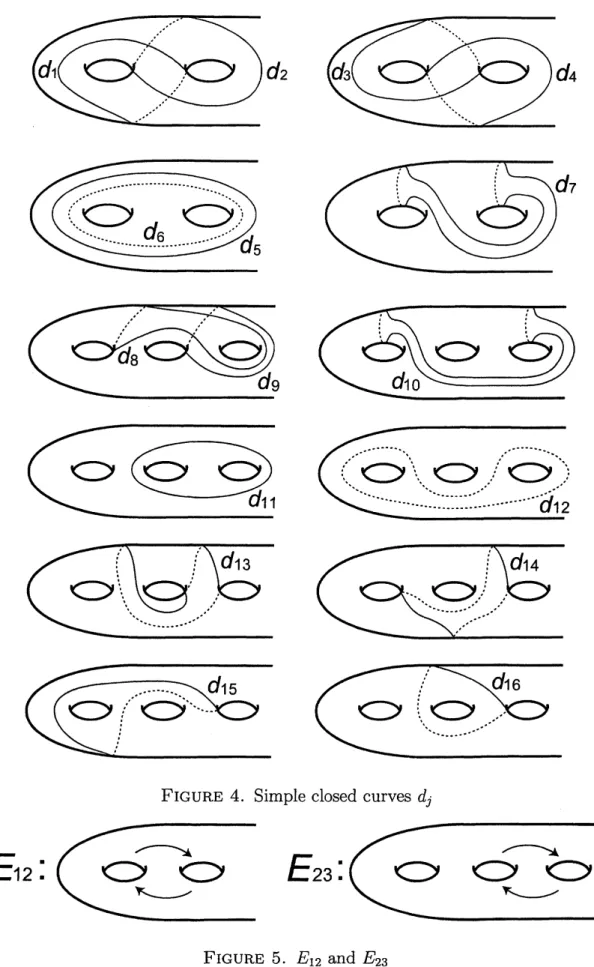
$T_{i}(1\leq i\leq 8)$
and
$S_{j}(1\leq j\leq 16)$
denote
the Dehn twist
maps
along the simple
closed
curves
$c_{i}$and
$d_{j}$in
Figure
3
and 4 respectively, where
we
regard
$\Sigma_{2,1}$as
a
subsurface
of
$\Sigma_{3,1}$. The
mapping
classes
$E_{12}$and
$E_{23}$exchange
the
handles
by rotating
clockwise
as
in
Figure
5. We
also
use a
mapping
class
$U$
whose action
on
$\pi_{1}(\Sigma_{3,1})$is given by
$U:\gamma_{1}\mapsto\gamma_{1}\gamma_{5}\gamma_{1}^{-1}$
,
$\gamma_{2}\mapsto\gamma_{1}\gamma_{6}\gamma_{1}^{-1}$,
$\gamma_{3}\mapsto\gamma_{1}[\gamma_{6}, \gamma_{5}]\gamma_{3}[\gamma_{5}, \gamma_{6}]\gamma_{1}^{-1}$,
$\gamma_{4}\mapsto\gamma_{1}[\gamma_{6}, \gamma_{5}]\gamma_{4}[\gamma_{5}, \gamma_{6}]\gamma_{1}^{-1}$
,
$\gamma_{5}\mapsto\gamma_{1}$
,
$\gamma_{6}\mapsto[\gamma_{6}, \gamma_{5}][\gamma_{4}, \gamma_{3}]\gamma_{2}$.
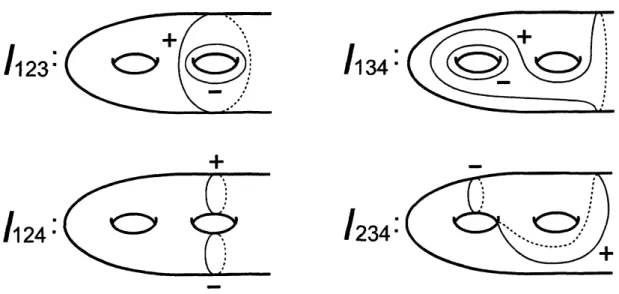
Figure
6 defines
the mapping
classes
$I_{123},$ $I_{124},$ $I_{134}$and
$I_{234}$in
$\mathcal{I}_{2,1}$,
where
$+$
in
the figure
means
a
positive (right-handed)
Dehn
twist
and
-means a
negative
one.
$I_{ijk}$is
chosen
so
that
it
satisfies
$\tau_{1}(I_{ijk})=\gamma_{i}\wedge\gamma_{j}\wedge\gamma_{k}\in\wedge^{3}H$.
Similarly,
we
use
$I_{125},$ $I_{246},$ $\ldots\in \mathcal{I}_{3,1}$in
the
case
when
$P=0210$ ,
0214, although the
precise
definition
is
omitted. We
can
easily
calculate
the value
$\tilde{\tau_{1}}(M_{P}\cdot f_{1})$from
$f_{2}\in \mathcal{I}_{g,1}$.
FIGURE
3.
Simple
closed
curves
$c_{\dot{\eta}}$$12_{n}$
0057
An admissible
presentation
of
$\pi_{1}(M_{0258})$
:
$z_{1}z_{5}z_{6}^{-1}$
,
$z_{1}z_{2}z_{3}z_{4}$,
$z_{3}z_{9}^{-1}z_{5}^{-1}$,
$z_{7}z_{4}z_{8}^{-1}$,
$z_{8}z_{10^{Z}6}$,
$z_{2}z_{5}z_{7}^{-1}z_{5}^{-1}$,
$i_{-}(\gamma_{1})z_{1}^{-1}z_{5}^{-1}$
,
$i_{-}(\gamma_{2})z_{2}$,
$i_{-}(\gamma_{3})z_{4}z_{8}z_{7}z_{5}^{-1}$,
$i_{-}(\gamma_{4})z_{4}$,
$i_{+}(\gamma_{1})z_{5}^{-1}$
,
$i_{+}(\gamma_{2})z_{9}^{-1}z_{6}^{-1}$,
$i_{+}(\gamma_{3})z_{6}z_{4}z_{7}z_{5}^{-1}z_{3}^{-1}z_{5}z_{6}^{-1}$,
$i_{+}(\gamma_{4})z_{1}z_{2}^{-1}z_{1}^{-1}$.
The
action
of
$M_{0057}$
on
$N_{4}$:
$\gamma_{1}\mapsto[\gamma_{4}, [\gamma_{3}, \gamma_{4}]]^{2}[\gamma_{4}, [\gamma_{2}, \gamma_{4}]]^{-4}[\gamma_{4}, [\gamma_{1}, \gamma_{4}]]^{-2}[\gamma_{3}, [\gamma_{3},\gamma_{4}]][\gamma_{3}, [\gamma_{2}, \gamma_{4}]]^{-2}[\gamma_{3}, [\gamma_{1}, \gamma_{4}]]^{-1}$
$[\gamma_{3}, [\gamma_{1}, \gamma_{3}]][\gamma_{2}, [\gamma_{3}, \gamma_{4}]][\gamma_{2}, [\gamma_{2}, \gamma_{4}]]^{-1}[\gamma_{2}, [\gamma_{1}, \gamma_{3}]]^{-3}[\gamma_{2}, [\gamma_{1}, \gamma_{2}]]^{2}[\gamma_{1}, [\gamma_{3}, \gamma_{4}]]^{-1}$
$[\gamma_{1}, [\gamma_{2}, \gamma_{4}]]^{3}[\gamma_{1}, [\gamma_{2}, \gamma_{3}]]^{3}[\gamma_{1}, [\gamma_{1},\gamma_{4}]][\gamma_{1}, [\gamma_{1}, \gamma_{2}]]$
$[\gamma_{3}, \gamma_{4}]^{-1}[\gamma_{2}, \gamma_{4}]^{2}[\gamma_{1}, \gamma_{4}][\gamma_{1}, \gamma_{3}]^{-1}[\gamma_{1}, \gamma_{2}]^{3}\gamma_{3}^{-1}\gamma_{2}^{2}\gamma_{1}$
,
$\gamma_{2}\mapsto[\gamma_{4}, [\gamma_{3}, \gamma_{4}]]^{2}[\gamma_{4}, [\gamma_{2}, \gamma_{4}]]^{-4}[\gamma_{4}, [\gamma_{1}, \gamma_{4}]]^{-1}[\gamma_{2}, [\gamma_{3}, \gamma_{4}]]^{2}$
$[\gamma_{2}, [\gamma_{2}, \gamma_{4}]]^{-3}[\gamma_{2}, [\gamma_{1}, \gamma_{4}]]^{-1}[\gamma_{1}, [\gamma_{2}, \gamma_{4}]][\gamma_{3}, \gamma_{4}]^{-1}[\gamma_{2}, \gamma_{4}]^{2}\gamma_{4}^{-1}$
,
$\gamma_{3}\mapsto[\gamma_{4}, [\gamma_{3}, \gamma_{4}]]^{4}[\gamma_{4}, [\gamma_{2}, \gamma_{4}]]^{-8}[\gamma_{4}, [\gamma_{1}, \gamma_{4}]]^{-4}[\gamma_{2}, [\gamma_{3},\gamma_{4}]]^{3}[\gamma_{2}, [\gamma_{2}, \gamma_{4}]]^{-4}[\gamma_{2)}[\gamma_{1}, \gamma_{4}]]^{-1}$
$[\gamma_{2}, [\gamma_{1}, \gamma_{2}]][\gamma_{1}, [\gamma_{2}, \gamma_{4}]]^{2}[\gamma_{3}, \gamma_{4}]^{-2}[\gamma_{2}, \gamma_{4}]^{4}[\gamma_{1}, \gamma_{4}]^{2}[\gamma_{1}, \gamma_{2}]^{2}\gamma_{2}^{2}\gamma_{1}$
,
$\gamma_{4}\mapsto\gamma_{4}\gamma_{2}$
.
$f_{1}=T_{4}\cdot T_{2}\cdot S_{1}^{-1}\cdot T_{5}^{-1}\cdot S_{2}\cdot T_{1}$
$f_{2}=I_{234}\cdot I_{124}$
$\tilde{\tau}_{2}(M_{0057}\cdot f_{1}\cdot f_{2})=-T(\gamma_{1}, \gamma_{4}, \gamma_{3}, \gamma_{4})+T(\gamma_{1}, \gamma_{4}, \gamma_{2}, \gamma_{4})+T(\gamma_{1}, \gamma_{2},\gamma_{2}, \gamma_{4})$
$+Y(\gamma_{1}, \gamma_{2})+Y(\gamma_{1}, \gamma_{4})$
$\mapsto Y(\gamma_{2}, \gamma_{4})\neq 0\in \text{り_{}g,1}(2)/$
Image
$\tau_{2}$.
$12_{n}$
0258
An admissible
presentation
of
$\pi_{1}(M_{0258})$
:
$i_{-}(\gamma_{1})z_{7}z_{6}z^{\frac{z}{7}1},i_{-}(\gamma_{2})z_{7}z_{6}z^{\frac{7}{5}1}z_{4}z_{6}^{-1}z_{7}^{-1}z_{1}z_{2}z_{3}z_{41}z_{2}z_{4}z_{6}^{-1}z_{7}^{-1},zz_{6}z_{5},$
,
$i_{-}(\gamma_{3})z_{1}z_{2}^{2}z_{4}^{2}z_{6}^{-1}z_{7}^{-1}$,
$i_{-}(\gamma_{4})z_{1}z_{2}^{2}z_{1}^{-2}$,
$i_{+}(\gamma_{1})z_{7}^{-1}$
,
$i_{+}(\gamma_{2})z_{6^{Z}4}$,
$i_{+}(\gamma_{3})z_{2}z_{1}^{-1}z_{4}$,
$i_{+}(\gamma_{4})z_{2}z_{1}^{-2}$.
FIGURE 4.
Simple
closed
curves
$d_{j}$$+$
FIGURE
6.
Mapping
classes
$I_{ijk}$in
$\mathcal{I}_{2,1}$$\gamma_{1}\mapsto[\gamma_{4}, [\gamma_{3}, \gamma_{4}]]^{-3}[\gamma_{4}, [\gamma_{2}, \gamma_{4}]][\gamma_{3}, [\gamma_{3}, \gamma_{4}]]^{4}[\gamma_{3}, [\gamma_{2}, \gamma_{4}]]^{-2}[\gamma_{3}, [\gamma_{2}, \gamma_{3}]][\gamma_{3}, [\gamma_{1}, \gamma_{4}]]^{-4}$
$[\gamma_{3}, [\gamma_{1}, \gamma_{3}]]^{5}[\gamma_{2}, [\gamma_{2}, \gamma_{4}]][\gamma_{2}, [\gamma_{2}, \gamma_{3}]]^{-1}[\gamma_{2}, [\gamma_{1}, \gamma_{4}]][\gamma_{2}, [\gamma_{1}, \gamma_{3}]]^{-2}[\gamma_{1}, [\gamma_{3}, \gamma_{4}]]^{4}$
$[\gamma_{1}, [\gamma_{2}, \gamma_{4}]]^{-3}[\gamma_{1}, [\gamma_{2}, \gamma_{3}]]^{4}[\gamma_{1}, [\gamma_{1}, \gamma_{4}]][\gamma_{1}, [\gamma_{1}, \gamma_{3}]]^{-1}$
$[\gamma_{3}, \gamma_{4}]^{-2}[\gamma_{1}, \gamma_{4}]^{2}[\gamma_{1}, \gamma_{3}]^{-3}[\gamma_{1}, \gamma_{2}]\gamma_{4}^{2}\gamma_{3}^{-3}\gamma_{2}^{2}\gamma_{1}^{-1}$
,
$\gamma_{2}\mapsto[\gamma_{4}, [\gamma_{2}, \gamma_{4}]]^{-3}[\gamma_{4}, [\gamma_{1}, \gamma_{4}]]^{3}[\gamma_{3}, [\gamma_{2}, \gamma_{4}]]^{6}[\gamma_{3}, [\gamma_{2}, \gamma_{3}]]^{-3}[\gamma_{3}, [\gamma_{1}, \gamma_{4}]]^{-6}[\gamma_{3}, [\gamma_{1}, \gamma_{3}]]^{3}$
$[\gamma_{2}, [\gamma_{3}, \gamma_{4}]]^{-2}[\gamma_{2}, [\gamma_{2}, \gamma_{4}]]^{-4}[\gamma_{2}, [\gamma_{2}, \gamma_{3}]]^{6}[\gamma_{2}, [\gamma_{1}, \gamma_{4}]]^{2}[\gamma_{2}, [\gamma_{1}, \gamma_{3}]]^{-3}[\gamma_{1}, [\gamma_{3}, \gamma_{4}]]^{2}$
$[\gamma_{1}, [\gamma_{2}, \gamma_{4}]]^{4}[\gamma_{1}, [\gamma_{2}, \gamma_{3}]]^{-6}[\gamma_{1}, [\gamma_{1}, \gamma_{4}]]^{-2}[\gamma_{1}, [\gamma_{1}, \gamma_{3}]]^{3}$
$[\gamma_{2}, \gamma_{4}]^{2}[\gamma_{2)}\gamma_{3}]^{-3}[\gamma_{1}, \gamma_{4}]^{-2}[\gamma_{1}, \gamma_{3}]^{3}\gamma_{2}\gamma_{1}^{-1}$
,
$\gamma_{3}\mapsto[\gamma_{4}, [\gamma_{3}, \gamma_{4}]]^{-1}[\gamma_{4}, [\gamma_{2}, \gamma_{4}]]^{-3}[\gamma_{4}, [\gamma_{1},\gamma_{4}]]^{3}[\gamma_{3}, [\gamma_{3}, \gamma_{4}]][\gamma_{3}, [\gamma_{2}, \gamma_{4}]]^{7}[\gamma_{3}, [\gamma_{2}, \gamma_{3}]]^{-4}$
$[\gamma_{3}, [\gamma_{1}, \gamma_{4}]]^{-7}[\gamma_{3}, [\gamma_{1}, \gamma_{3}]]^{4}[\gamma_{2}, [\gamma_{3}, \gamma_{4}]]^{-4}[\gamma_{2}, [\gamma_{2},\gamma_{4}]]^{-3}[\gamma_{2}, [\gamma_{2}, \gamma_{3}]]^{5}[\gamma_{2}, [\gamma_{1}, \gamma_{4}]]^{2}$
$[\gamma_{2}, [\gamma_{1}, \gamma_{3}]]^{-3}[\gamma_{1}, [\gamma_{3}, \gamma_{4}]]^{4}[\gamma_{1}, [\gamma_{2}, \gamma_{4}]]^{3}[\gamma_{1}, [\gamma_{2}, \gamma_{3}]]^{-5}[\gamma_{1}, [\gamma_{1}, \gamma_{4}]]^{-2}[\gamma_{1}, [\gamma_{1}, \gamma_{3}]]^{3}$
$[\gamma_{3}, \gamma_{4}][\gamma_{2}, \gamma_{4}][\gamma_{2}, \gamma_{3}]^{-2}[\gamma_{1}, \gamma_{4}]^{-1}[\gamma_{1}, \gamma_{3}]^{2}\gamma_{4}\gamma_{3}^{-1}\gamma_{2}\gamma_{1}^{-1}$
,
$\gamma_{4}\mapsto[\gamma_{4}, [\gamma_{3}, \gamma_{4}]]^{-35}[\gamma_{4)}[\gamma_{2}, \gamma_{4}]]^{9}[\gamma_{4}, [\gamma_{1)}\gamma_{4}]]^{-9}[\gamma_{3}, [\gamma_{3}, \gamma_{4}]]^{26}[\gamma_{3}, [\gamma_{2}, \gamma_{4}]]^{-25}[\gamma_{3}, [\gamma_{2}, \gamma_{3}]]^{17}$
$[\gamma_{3}, [\gamma_{1}, \gamma_{4}]]^{25}[\gamma_{3}, [\gamma_{1}, \gamma_{3}]]^{-17}[\gamma_{2}, [\gamma_{3},\gamma_{4}]]^{13}[\gamma_{2}, [\gamma_{2}, \gamma_{4}]]^{2}[\gamma_{2}, [\gamma_{2}, \gamma_{3}]]^{-2}[\gamma_{2}, [\gamma_{1}, \gamma_{4}]]^{-19}$
$[\gamma_{2}, [\gamma_{1}, \gamma_{3}]]^{23}[\gamma_{2}, [\gamma_{1}, \gamma_{2}]]^{-s}[\gamma_{1}, [\gamma_{3}, \gamma_{4}]]^{-13}[\gamma_{1}, [\gamma_{2}, \gamma_{4}]]^{13}[\gamma_{1}, [\gamma_{2}, \gamma_{3}]]^{-16}[\gamma_{1}, [\gamma_{1}, \gamma_{4}]]^{4}$
$[\gamma_{1}, [\gamma_{1}, \gamma_{3}]]^{-5}[\gamma_{1}, [\gamma_{1}, \gamma_{2}]]^{4}$
$[\gamma_{3}, \gamma_{4}]^{-10}[\gamma_{2}, \gamma_{4}]^{2}[\gamma_{2}, \gamma_{3}]^{-3}[\gamma_{1}, \gamma_{4}]^{-2}[\gamma_{1}, \gamma_{3}]^{3}[\gamma_{1}, \gamma_{2}]^{-3}\gamma_{4}^{5}\gamma_{3}^{-6}\gamma_{2}^{3}\gamma_{1}^{-3}$
.
$f_{1}=T_{5}^{-4}\cdot S_{7}^{2}\cdot T_{1}\cdot T_{4}^{-1}\cdot S_{4}\cdot T_{5}^{-1}$
$\tilde{\tau}_{2}(M_{0258}\cdot f_{1}\cdot f_{2})=-T(\gamma_{1}, \gamma_{4}, \gamma_{2}, \gamma_{4})-2T(\gamma_{1}, \gamma_{3}, \gamma_{3}, \gamma_{4})+2T(\gamma_{1}, \gamma_{3}, \gamma_{2}, \gamma_{4})$
$-2T(\gamma_{1}, \gamma_{3}, \gamma_{2}, \gamma_{3})-T(\gamma_{1}, \gamma_{3}, \gamma_{1}, \gamma_{4})+T(\gamma_{1}, \gamma_{2}, \gamma_{3}, \gamma_{4})$
$+T(\gamma_{1}, \gamma_{2}, \gamma_{2}, \gamma_{3})-T(\gamma_{1}, \gamma_{2}, \gamma_{1}, \gamma_{3})+2T(\gamma_{2}, \gamma_{3}, \gamma_{3}, \gamma_{4})$
$-T(\gamma_{2}, \gamma_{3}, \gamma_{2}, \gamma_{4})+Y(\gamma_{1}, \gamma_{4})+2Y(\gamma_{1}, \gamma_{3})-Y(\gamma_{1}, \gamma_{2})$
$+Y(\gamma_{2}, \gamma_{4})+2Y(\gamma_{2}, \gamma_{3})+5Y(\gamma_{3}, \gamma_{4})$
$\mapsto Y(\gamma_{1}, \gamma_{3})+Y(\gamma_{1}, \gamma_{4})+Y(\gamma_{2}, \gamma_{3})\neq 0\in \text{り_{}g,1}(2)/$
Image
$\tau_{2}$.
$12_{n}$
0279
An admissible
presentation
of
$\pi_{1}(M_{0279})$
:
$z_{1}z_{2}z_{4}$
,
$z_{1}z_{3}^{-1}z_{2}z_{9}^{-1}$,
$z_{5}z_{8}^{-1}z_{6}^{-1}$,
$z_{6}z_{7}z_{8}z_{9}$,
$z_{2}^{-1}z_{3}z_{2}z_{5}^{-1}$,
$i_{-}(\gamma_{1})z_{5}z_{8}z_{2}z_{9}^{-1}z_{5}^{-1}$
,
$i_{-}(\gamma_{2})z_{5}z_{6}^{-1}z_{5}^{-1}$,
$i_{-}(\gamma_{3})z_{9}^{-1}z_{6}^{-1}z_{5}^{-1}$,
$i_{-}(\gamma_{4})z_{2}^{-1}z_{3^{Z}1^{Z_{2}^{2}}}$,
$i_{+}(\gamma_{1})z_{5}z_{2}z_{9}^{-1}z_{5}^{-1}$
,
$i_{+}(\gamma_{2})z_{5}z_{9}z_{6}^{-1}$,
$i_{+}(\gamma_{3})z_{2}^{-1}z_{6}^{-1}$,
$i_{+}(\gamma_{4})z_{2}^{-1}z_{1}z_{2}^{2}$.
The
action
of
$M_{0279}$
on
$N_{4}$:
$\gamma_{1}\mapsto[\gamma_{4}, [\gamma_{1}, \gamma_{4}]]^{-1}[\gamma_{3}, \gamma_{4}][\gamma_{1}, \gamma_{3}]\gamma_{4}\gamma_{3}\gamma_{1}^{2}$
,
$\gamma_{2}\mapsto[\gamma_{4}, [\gamma_{3}, \gamma_{4}]]^{-2}[\gamma_{4}, [\gamma_{1}, \gamma_{4}]]^{-1}[\gamma_{3}, [\gamma_{3}, \gamma_{4}]]^{-1}[\gamma_{3}, [\gamma_{2}, \gamma_{4}]]^{-1}[\gamma_{3}, [\gamma_{2}, \gamma_{3}]]^{-1}[\gamma_{3}, [\gamma_{1}, \gamma_{4}]]^{-1}$
$[\gamma_{2}, [\gamma_{3}, \gamma_{4}]]^{2}[\gamma_{2}, [\gamma_{1}, \gamma_{4}]][\gamma_{1}, [\gamma_{3}, \gamma_{4}]]^{-1}[\gamma_{1}, [\gamma_{2}, \gamma_{4}]]^{-1}[\gamma_{1}, [\gamma_{2}, \gamma_{3}]]^{-1}[\gamma_{1}, [\gamma_{1}, \gamma_{4}]]^{-3}$
$[\gamma_{1}, [\gamma_{1}, \gamma_{2}]][\gamma_{3}, \gamma_{4}][\gamma_{2}, \gamma_{3}][\gamma_{1}, \gamma_{4}]^{2}[\gamma_{1}, \gamma_{2}]^{-1}\gamma_{4}^{-1}\gamma_{2}$
,
$\gamma_{3}\mapsto[\gamma_{4}, [\gamma_{3}, \gamma_{4}]]^{-2}[\gamma_{4}, [\gamma_{2}, \gamma_{4}]]^{2}[\gamma_{4)}[\gamma_{1}, \gamma_{4}]]^{-2}[\gamma_{3}, [\gamma_{3}, \gamma_{4}]]^{-1}[\gamma_{3}, [\gamma_{2}, \gamma_{4}]]^{-1}[\gamma_{3}, [\gamma_{2}, \gamma_{3}]]^{-1}$
$[\gamma_{3}, [\gamma_{1}, \gamma_{4}]]^{-1}[\gamma_{2}, [\gamma_{3}, \gamma_{4}]]^{2}[\gamma_{2}, [\gamma_{1}, \gamma_{4}]]^{2}[\gamma_{1}, [\gamma_{3}, \gamma_{4}]]^{-1}[\gamma_{1}, [\gamma_{2}, \gamma_{4}]]^{-1}[\gamma_{1}, [\gamma_{2}, \gamma_{3}]]^{-1}$
$[\gamma_{1}, [\gamma_{1}, \gamma_{4}]]^{-4}[\gamma_{1}, [\gamma_{1}, \gamma_{2}]][\gamma_{3}, \gamma_{4}][\gamma_{2}, \gamma_{4}]^{-1}[\gamma_{2}, \gamma_{3}][\gamma_{1}, \gamma_{4}]^{3}[\gamma_{1}, \gamma_{2}]^{-1}\gamma_{4}^{-2}\gamma_{2}$
,
$\gamma_{4}\mapsto[\gamma_{4}, [\gamma_{3}, \gamma_{4}]]^{2}[\gamma_{4}, [\gamma_{2}, \gamma_{4}]]^{-2}[\gamma_{4}, [\gamma_{1}, \gamma_{4}]]^{-5}[\gamma_{3}, [\gamma_{2}, \gamma_{4}]]^{-3}[\gamma_{3}, [\gamma_{1}, \gamma_{4}]]^{-1}[\gamma_{2}, [\gamma_{3}, \gamma_{4}]]^{2}$
$[\gamma_{2}, [\gamma_{2}, \gamma_{4}]][\gamma_{2}, [\gamma_{2}, \gamma_{3}]][\gamma_{2}, [\gamma_{1}, \gamma_{4}]][\gamma_{1}, [\gamma_{1}, \gamma_{4}]]^{2}$
$[\gamma_{3}, \gamma_{4}][\gamma_{2}, \gamma_{4}]^{-1}[\gamma_{2}, \gamma_{3}]^{-1}[\gamma_{1}, \gamma_{4}]^{-2}\gamma_{4}^{3}\gamma_{3}\gamma_{2}^{-1}\gamma_{1}$
.
$f_{1}=S_{5}^{-1}\cdot T_{5}^{2}\cdot T_{1}^{-1}\cdot S_{1}^{2}\cdot E_{12}\cdot T_{1}^{-2}\cdot T_{5}^{-2}\cdot T_{1}\cdot T_{2}\cdot T_{1}\cdot T_{4}\cdot T_{5}\cdot T_{4}$
$f_{2}=I_{134}^{-1}\cdot I_{234}^{-1}\cdot I_{124}^{-1}$
$\tilde{\tau}_{2}(M_{0279}\cdot f_{1}\cdot f_{2})=2T(\gamma_{1}, \gamma_{4}, \gamma_{3}, \gamma_{4})+T(\gamma_{1}, \gamma_{2}, \gamma_{2}, \gamma_{4})+T(\gamma_{1}, \gamma_{2}, \gamma_{1}, \gamma_{4})$
$+T(\gamma_{2}, \gamma_{4}, \gamma_{3}, \gamma_{4})-Y(\gamma_{1}, \gamma_{2})+2Y(\gamma_{3}, \gamma_{4})$
$\mapsto Y(\gamma_{1}, \gamma_{4})\neq 0\in \text{り_{}g,1}(2)/$
Image
$\tau_{2}$.
$12_{n}$
0382
An admissible
presentation
of
$\pi_{1}(M_{0382})$
:
$i_{-}(\gamma_{1})z_{2}z_{1}^{-1}z_{3}z_{2}^{-1}$
,
$i_{-}(\gamma_{2})z_{2}z_{3}^{-1}z_{2}z_{1}^{-2}z_{4}z_{2}^{-1}$,
$i_{-}(\gamma_{3})z_{4}^{-1}z_{1}^{-1}z_{4}z_{2}^{-1}$,
$i_{-}(\gamma_{4})z_{2}^{2}z_{1}^{-1}z_{4}$,
$i_{+}(\gamma_{1})z_{3}z_{2}^{-1}$
,
$i_{+}(\gamma_{2})z_{2}z_{1}^{-2}z_{4}z_{1}^{-1}$,
$i_{+}(\gamma_{3})z_{1}^{-1}$,
$i_{+}(\gamma_{4})z_{4}z_{2}z_{1}^{-1}z_{4}$.
The action
of
$M_{0382}$
on
$N_{4}$:
$\gamma_{1}\mapsto[\gamma_{4}, [\gamma_{3}, \gamma_{4}]]^{-2}[\gamma_{4}, [\gamma_{1}, \gamma_{4}]][\gamma_{3}, [\gamma_{3}, \gamma_{4}]]^{-2}[\gamma_{3)}[\gamma_{2}, \gamma_{3}]][\gamma_{3}, [\gamma_{1}, \gamma_{4}]]^{4}[\gamma_{3)}[\gamma_{1}, \gamma_{3}]]^{10}$
$[\gamma_{2}, [\gamma_{3}, \gamma_{4}]]^{-1}[\gamma_{2}, [\gamma_{2}, \gamma_{3}]]^{-1}[\gamma_{2}, [\gamma_{1}, \gamma_{4}]]^{-2}[\gamma_{2}, [\gamma_{1}, \gamma_{3}]]^{-8}[\gamma_{2}, [\gamma_{1}, \gamma_{2}]][\gamma_{1}, [\gamma_{3}, \gamma_{4}]]^{-2}$
$\gamma_{2}\mapsto[\gamma_{3},$ $[\gamma_{2},$$\gamma_{4}]]^{-8}[\gamma_{3},$ $[\gamma_{2},$$\gamma_{3}]]^{-13}[\gamma_{2},$$[\gamma_{3},$$\gamma_{4}]]^{5}[\gamma_{2},$ $[\gamma_{2},$$\gamma_{4}]]^{3}[\gamma_{2},$$[\gamma_{2},$$\gamma_{3}]]^{13}$ $[\gamma_{3},$$\gamma_{4}]^{2}[\gamma_{2},$$\gamma_{4}]^{-2}[\gamma_{2},$$\gamma_{3}]^{-8}\gamma_{4}\gamma_{3}^{4}\gamma_{2}^{-1}\gamma_{1)}^{-1}$
$\gamma_{3}\mapsto$ $[\gamma_{4},$ $[\gamma_{3},$$\gamma_{4}]]^{-1}[\gamma_{3},$ $[\gamma_{3},$$\gamma_{4}]]^{-6}[\gamma_{3},$ $[\gamma_{2},$$\gamma_{4}]]^{-13}[\gamma_{3},$ $[\gamma_{2},$$\gamma_{3}]]^{-35}[\gamma_{2},$$[\gamma_{3},$$\gamma_{4}]]^{13}[\gamma_{2},$$[\gamma_{2},$$\gamma_{4}]]^{3}$ $[\gamma_{2)}[\gamma_{2},$$\gamma_{3}]]^{22}[\gamma_{3},$$\gamma_{4}][\gamma_{2},$$\gamma_{4}]^{-2}[\gamma_{2},$$\gamma_{3}]^{-13}\gamma_{4}\gamma_{3}^{6}\gamma_{2}^{-2}$
,
$\gamma_{4}\mapsto[\gamma_{4}, [\gamma_{3}, \gamma_{4}]]^{-5}[\gamma_{4}, [\gamma_{2}, \gamma_{4}]][\gamma_{3}, [\gamma_{3}, \gamma_{4}]]^{-14}[\gamma_{3}, [\gamma_{2}, \gamma_{4}]]^{7}[\gamma_{3}, [\gamma_{2}, \gamma_{3}]]^{2}4[\gamma_{2}, [\gamma_{3}, \gamma_{4}]]^{-4}$
$[\gamma_{2}, [\gamma_{2}, \gamma_{3}]]^{-2}[\gamma_{3}, \gamma_{4}]^{6}[\gamma_{2}, \gamma_{4}]^{-1}[\gamma_{2}, \gamma_{3}]^{-4}\gamma_{4}^{-1}\gamma_{3}^{-7}\gamma_{2}^{3}$
.
$f_{1}=T_{2}\cdot T_{5}^{2}\cdot T_{3}\cdot S_{4}\cdot T_{1}^{-1}\cdot T_{5}^{-6}$
$f_{2}=I_{234}\cdot I_{123}$
$\tilde{\tau}_{2}(M_{0382}\cdot f_{1}\cdot f_{2})=-T(\gamma_{1}, \gamma_{2}, \gamma_{3}, \gamma_{4})+T(\gamma_{2},\gamma_{3}, \gamma_{3}, \gamma_{4})-Y(\gamma_{1},\gamma_{2})+2Y(\gamma_{2}, \gamma_{3})$
$\mapsto Y(\gamma_{2}, \gamma_{3})\neq 0\in \text{り_{}g,1}(2)/Image\tau_{2}$
.
$12_{n}$
0394
An admissible
presentation
of
$\pi_{1}(M_{0394})$
:
$i_{-}(\gamma_{1})z_{1}^{-1}z_{2}^{-1}z_{3}$
,
$i_{-}(\gamma_{2})z_{3}^{-1}z_{4}z_{2}z_{3}z_{2}^{-1}z_{1}$,
$i_{-}(\gamma_{3})z_{4}z_{2}z_{3}z_{2}^{-1}z_{1}$,
$i_{-}(\gamma_{4})z_{4}$,
$i_{+}(\gamma_{1})z_{2}^{-1}z_{3}$
,
$i_{+}(\gamma_{2})z_{3}^{-1}z_{1}z_{3}^{-1}z_{4}z_{2}z_{3}z_{2}^{-1}$,
$i_{+}(\gamma_{3})z_{2}z_{3}z_{2}^{-1}$,
$i_{+}(\gamma_{4})z_{2}z_{4}$.
The
action
of
$M_{0394}$
on
$N_{4}$:
$\gamma_{1}\mapsto[\gamma_{3}, [\gamma_{2}, \gamma_{4}]]^{2}[\gamma_{3}, [\gamma_{2}, \gamma_{3}]]^{-2}[\gamma_{3}, [\gamma_{1}, \gamma_{4}]]^{-1}[\gamma_{3}, [\gamma_{1}, \gamma_{3}]]^{-2}[\gamma_{2}, [\gamma_{3}, \gamma_{4}]]^{-2}[\gamma_{2}, [\gamma_{2}, \gamma_{4}]]$
$[\gamma_{2}, [\gamma_{2}, \gamma_{3}]]^{-1}[\gamma_{2}, [\gamma_{1}, \gamma_{4}]]^{-1}[\gamma_{2}, [\gamma_{1}, \gamma_{3}]][\gamma_{2}, [\gamma_{1}, \gamma_{2}]][\gamma_{1}, [\gamma_{3}, \gamma_{4}]][\gamma_{1}, [\gamma_{2}, \gamma_{3}]]^{-1}$
$[\gamma_{2}, \gamma_{4}]^{-1}[\gamma_{2}, \gamma_{3}][\gamma_{1}, \gamma_{4}][\gamma_{1}, \gamma_{2}]^{-1}\gamma_{4}\gamma_{3}^{-2}\gamma_{2}^{-1}\gamma_{1}^{2}$
,
$\gamma_{2}\mapsto[\gamma_{4}, [\gamma_{3}, \gamma_{4}]]^{-1}[\gamma_{4}, [\gamma_{2}, \gamma_{4}]]^{-1}[\gamma_{3}, [\gamma_{3}, \gamma_{4}]]^{2}[\gamma_{3}, [\gamma_{2}, \gamma_{4}]][\gamma_{3}, [\gamma_{1}, \gamma_{4}]][\gamma_{3}, [\gamma_{1}, \gamma_{3}]]$
$[\gamma_{2}, [\gamma_{3}, \gamma_{4}]]^{2}[\gamma_{2}, [\gamma_{1}, \gamma_{3}]]^{-1}[\gamma_{1}, [\gamma_{3}, \gamma_{4}]]^{-2}[\gamma_{1}, [\gamma_{2}, \gamma_{4}]]^{-1}[\gamma_{1}, [\gamma_{2}, \gamma_{3}]][\gamma_{1}, [\gamma_{1}, \gamma_{3}]]^{3}$
$[\gamma_{1}, [\gamma_{1}, \gamma_{2}]][\gamma_{3}, \gamma_{4}][\gamma_{2}, \gamma_{4}][\gamma_{1}, \gamma_{3}]^{-2}[\gamma_{1}, \gamma_{2}]^{-1}\gamma_{3}\gamma_{2}$
,
$\gamma_{3}\mapsto[\gamma_{4}, [\gamma_{3}, \gamma_{4}]]^{-1}[\gamma_{4}, [\gamma_{2}, \gamma_{4}]]^{-1}[\gamma_{3}, [\gamma_{3}, \gamma_{4}]]^{2}[\gamma_{3}, [\gamma_{2}, \gamma_{4}]][\gamma_{3}, [\gamma_{2}, \gamma_{3}]][\gamma_{3}, [\gamma_{1}, \gamma_{4}]]$
$[\gamma_{3}, [\gamma_{1}, \gamma_{3}]][\gamma_{2}, [\gamma_{3}, \gamma_{4}]]^{2}[\gamma_{2}, [\gamma_{1},\gamma_{3}]]^{-2}[\gamma_{1}, [\gamma_{3}, \gamma_{4}]]^{-2}[\gamma_{1}, [\gamma_{2}, \gamma_{4}]]^{-1}[\gamma_{1}, [\gamma_{2}, \gamma_{3}]]$
$[\gamma_{1}, [\gamma_{1}, \gamma_{3}]]^{4}[\gamma_{1}, [\gamma_{1}, \gamma_{2}]][\gamma_{3}, \gamma_{4}][\gamma_{2}, \gamma_{4}][\gamma_{2}, \gamma_{3}][\gamma_{1}, \gamma_{3}]^{-3}[\gamma_{1}, \gamma_{2}]^{-1}\gamma_{3}^{2}\gamma_{2}$
,
$\gamma_{4}\mapsto[\gamma_{3}, [\gamma_{1}, \gamma_{4}]][\gamma_{3}, [\gamma_{1}, \gamma_{3}]]^{-2}[\gamma_{1}, [\gamma_{3}, \gamma_{4}]]^{-1}[\gamma_{1}, [\gamma_{1}, \gamma_{3}]]^{-1}[\gamma_{1}, \gamma_{3}]\gamma_{4}\gamma_{3}^{-1}\gamma_{1}$
.
$f_{1}=S_{7}\cdot T_{1}^{-2}\cdot T_{4}^{-1}\cdot S_{5}^{-1}\cdot T_{2}\cdot T_{5}^{2}$
$f_{2}=I_{234}^{-1}\cdot I_{123}^{-1}$
$\tilde{\tau}_{2}(\Lambda I_{0394}\cdot f_{1}\cdot f_{2})=-T(\gamma_{1}, \gamma_{3}, \gamma_{3}, \gamma_{4})+T(\gamma_{1}, \gamma_{2}, \gamma_{3}, \gamma_{4})+T(\gamma_{1}, \gamma_{2}, \gamma_{2}, \gamma_{3})$
$+T(\gamma_{2}, \gamma_{3}, \gamma_{3}, \gamma_{4})+Y(\gamma_{1}, \gamma_{2})+2Y(\gamma_{3}, \gamma_{4})$
$\mapsto Y(\gamma_{1}, \gamma_{3})\neq 0\in \text{り_{}g,1}(2)/Image\tau_{2}$
.
An admissible
presentation
of
$\pi_{1}(M_{0464})$
:
$z_{1}z_{2}z_{6}z_{7}$
,
$z_{2}z_{9}z_{7}$,
$z_{3}z_{4}z_{5}z_{10}^{-1}$,
$Z_{4}Z_{5}Z_{8}$,
$z_{1}z_{2}z_{3}^{-1}z_{2}^{-1}$,
$z_{8}z_{6}z_{8}^{-1}z_{9}^{-1}$,
$i_{-}(\gamma_{1})z_{2}z_{10}z_{5}^{-1}z_{9}^{-1}z_{2}^{-1}$
,
$i_{-}(\gamma_{2})z_{2}z_{10}z_{5}^{-1}z_{3}^{-1}z_{2}^{-1}$,
$i_{-}(\gamma_{3})z_{2}z_{8}^{-1}z_{2}^{-1}$,
$i_{-}(\gamma_{4})z_{2}z_{1}$,
$i_{+}(\gamma_{1})z_{2}z_{9}^{-1}z_{2}^{-1}$
,
$i_{+}(\gamma_{2})z_{2}z_{5}^{-1}z_{2}^{-1}$,
$i_{+}(\gamma_{3})z_{1}^{-1}z_{8}^{-1}z_{9}^{-1}z_{2}^{-1_{Z_{1}}}$,
$i_{+}(\gamma_{4})z_{1}^{-1}z_{7}^{-1}z_{1}$.
The action of
$M_{0464}$
on
$N_{4}$:
$\gamma_{1}\mapsto[\gamma_{4}, [\gamma_{1}, \gamma_{4}]][\gamma_{3}, [\gamma_{2}, \gamma_{4}]][\gamma_{3}, [\gamma_{1}, \gamma_{4}]]^{3}[\gamma_{3}, [\gamma_{1}, \gamma_{3}]][\gamma_{2}, [\gamma_{1}, \gamma_{4}]][\gamma_{2}, [\gamma_{1}, \gamma_{3}]]$
$[\gamma_{1}, [\gamma_{3}, \gamma_{4}]]^{-1}[\gamma_{3}, \gamma_{4}][\gamma_{2}, \gamma_{4}][\gamma_{2}, \gamma_{3}][\gamma_{1}, \gamma_{4}][\gamma_{1}, \gamma_{3}][\gamma_{1}, \gamma_{2}]\gamma_{4}\gamma_{3}\gamma_{2}\gamma_{1}$
,
$\gamma_{2}\mapsto[\gamma_{4}, [\gamma_{1}, \gamma_{4}]]^{2}[\gamma_{3}, [\gamma_{2}, \gamma_{4}]][\gamma_{3}, [\gamma_{1}, \gamma_{4}]]^{3}[\gamma_{3}, [\gamma_{1}, \gamma_{3}]]^{2}[\gamma_{1}, [\gamma_{3}, \gamma_{4}]]^{-2}[\gamma_{1}, [\gamma_{1}, \gamma_{4}]]$
$[\gamma_{1}, [\gamma_{1}, \gamma_{3}]][\gamma_{3}, \gamma_{4}][\gamma_{2}, \gamma_{4}][\gamma_{2}, \gamma_{3}][\gamma_{1}, \gamma_{4}]^{-1}[\gamma_{1}, \gamma_{3}]^{-1}\gamma_{4}\gamma_{3}\gamma_{2}$
,
$\gamma_{3}\mapsto[\gamma_{4}, [\gamma_{1}, \gamma_{4}]][\gamma_{3}, [\gamma_{1}, \gamma_{4}]][\gamma_{3}, [\gamma_{1}, \gamma_{3}]][\gamma_{1}, [\gamma_{3}, \gamma_{4}]]^{-1}[\gamma_{1}, [\gamma_{1}, \gamma_{4}]][\gamma_{1}, [\gamma_{1}, \gamma_{3}]]$
$[\gamma_{3}, \gamma_{4}][\gamma_{1}, \gamma_{4}]^{-1}[\gamma_{1}, \gamma_{3}]^{-1}\gamma_{4}\gamma_{3}$
,
$\gamma_{4}\mapsto[\gamma_{3}, [\gamma_{1}, \gamma_{3}]]^{-1}[\gamma_{1}, [\gamma_{1}, \gamma_{4}]]^{-1}[\gamma_{1}, [\gamma_{1}, \gamma_{3}]]^{-1}[\gamma_{1}, \gamma_{4}][\gamma_{1}, \gamma_{3}]\gamma_{4}\gamma_{1}$
.
$f_{1}=S_{5}^{-1}\cdot T_{2}\cdot T_{5}\cdot S_{4}\cdot T_{4}$
$f_{2}=1$
$\tilde{\tau}_{2}(M_{0464}\cdot f_{1}\cdot f_{2})=-T(\gamma_{1}, \gamma_{3}, \gamma_{1}, \gamma_{4})-Y(\gamma_{1}, \gamma_{3})-Y(\gamma_{1}, \gamma_{4})$
$\mapsto Y(\gamma_{1}, \gamma_{3})+Y(\gamma_{1}, \gamma_{4})\neq 0\in \text{
り_{}g,1}(2)/$
Image
$\tau_{2}$.
$12_{n}$
0483
An admissible
presentation
of
$\pi_{1}(M_{0483})$
:
$z_{8}^{-1}z_{1}z_{4}z_{9}z_{4}^{-1}$
,
$z_{5}z_{6}z_{7}^{-1}z_{6}^{-1}z_{8}$,
$z_{2}z_{3}z_{2}^{-1}z_{1)}$ $z_{3}^{-1}z_{2}z_{3}z_{5}^{-1}$,
$z_{4}z_{9}^{-1}z_{4}^{-1}z_{3}$,
$i_{-}(\gamma_{1})z_{1}z_{2}^{-1}z_{1}^{-1}$
,
$i_{-}(\gamma_{2})z_{1}z_{4}^{-1}z_{8}^{-1}$,
$i_{-}(\gamma_{3})z_{6}^{-1}$,
$i_{-}(\gamma_{4})z_{6}^{-1}z_{3}$,
$i_{+}(\gamma_{1})z_{4}^{-1}z_{2}^{-1}$
,
$i_{+}(\gamma_{2})z_{4}^{-1}$,
$i_{+}(\gamma_{3})z_{5}z_{6}^{-1}z_{8}$,
$t_{+}(\gamma_{4})z_{8}^{-1}z_{3}$.
The action of
$M_{0483}$
on
$N_{4}$:
$\gamma_{1}\mapsto[\gamma_{2}, [\gamma_{2}, \gamma_{4}]]^{-1}[\gamma_{2}, [\gamma_{1}, \gamma_{2}]][\gamma_{1}, [\gamma_{2}, \gamma_{4}]][\gamma_{2}, \gamma_{4}][\gamma_{1}, \gamma_{4}]^{-1}[\gamma_{1}, \gamma_{2}]^{-1}\gamma_{2}^{-1}\gamma_{1}$
,
$\gamma_{2}\mapsto[\gamma_{4}, [\gamma_{1}, \gamma_{4}]][\gamma_{2}, [\gamma_{1}, \gamma_{4}]][\gamma_{1}, [\gamma_{1}, \gamma_{4}]]^{-1}[\gamma_{2}, \gamma_{4}]^{-2}[\gamma_{1}, \gamma_{4}]\gamma_{4}^{-1}\gamma_{2}$
,
$\gamma_{3}\mapsto[\gamma_{3}, [\gamma_{2}, \gamma_{4}]][\gamma_{3)}[\gamma_{1}, \gamma_{4}]]^{-1}[\gamma_{2}, [\gamma_{1}, \gamma_{3}]]^{-1}[\gamma_{2)}[\gamma_{1}, \gamma_{2}]][\gamma_{1)}[\gamma_{2}, \gamma_{3}]]$
$[\gamma_{1}, \gamma_{2}]^{-1}\gamma_{3}\gamma_{2}^{-1}\gamma_{1}$
,
$\gamma_{4}\mapsto[\gamma_{4}, [\gamma_{2}, \gamma_{4}]][\gamma_{4}, [\gamma_{1}, \gamma_{4}]]^{-1}[\gamma_{3}, [\gamma_{2}, \gamma_{4}]][\gamma_{3}, [\gamma_{1}, \gamma_{4}]]^{-1}[\gamma_{2}, [\gamma_{1}, \gamma_{4}]]^{-2}[\gamma_{2}, [\gamma_{1}, \gamma_{3}]]^{-1}$
$[\gamma_{2}, [\gamma_{1}, \gamma_{2}]][\gamma_{1}, [\gamma_{2}, \gamma_{4}]][\gamma_{1}, [\gamma_{2}, \gamma_{3}]][\gamma_{1}, [\gamma_{1}, \gamma_{4}]][\gamma_{2}, \gamma_{4}][\gamma_{1}, \gamma_{4}]^{-1}[\gamma_{1}, \gamma_{2}]^{-1}\gamma_{4}\gamma_{3}\gamma_{2}^{-1}\gamma_{1}$
.
$f_{1}=S_{3}\cdot T_{4}^{-1}\cdot S_{5}^{-1}\cdot T_{2}^{-1}\cdot T_{1}^{-1}$
$f_{2}=I_{134}\cdot I_{234}^{-1}$
$\tilde{\tau}_{2}(M_{0483}\cdot f_{1}\cdot f_{2})=T(\gamma_{1}, \gamma_{4}, \gamma_{3}, \gamma_{4})-T(\gamma_{2}, \gamma_{4}, \gamma_{3}, \gamma_{4})+Y(\gamma_{3}, \gamma_{4})$
$\mapsto Y(\gamma_{1}, \gamma_{4})+Y(\gamma_{2}, \gamma_{4})\neq 0\in \text{り_{}g,1}(2)/Image\tau_{2}$
.
An admissible
presentation
of
$\pi_{1}(M_{0535})$
:
$i_{-}(\gamma_{1})z_{10}^{-1},i_{-}(\gamma_{2})z_{0}^{\frac{z}{1}1}z^{\frac{z}{1}1}z_{3}^{-1}z_{1}^{-1}z_{10},i_{-}(\gamma_{3})z^{\frac{z}{7}1}z^{\frac{3}{1}1}z_{10},i_{-}(\gamma_{4})z_{6}z^{\frac{2-}{3}1}z_{7}z_{1}z_{2}z_{3},z_{2}z_{6}z_{7104}^{-1-1}z_{5}z_{8}^{-1}z_{7},z_{1}z_{10}z_{92}zz_{2}^{-1}z_{4}^{-1},z_{2}z_{6}^{-1}z^{1}z_{5}^{-1}$
,
$i_{+}(\gamma_{1})z_{7}^{-1}z_{9}$
,
$i_{+}(\gamma_{2})z_{7}^{-1}z_{1}^{-1}z_{3}^{-1}z_{10}z_{7}$,
$t_{+}(\gamma_{3})z_{7}^{-1}z_{3}z_{10}z_{7}$,
$i_{+}(\gamma_{4})z_{7}^{-1}z_{6}z_{3}^{-1}z_{7}$.
The action of
$M_{0535}$
on
$N_{4}$:
$\gamma_{1}\mapsto[\gamma_{4}, [\gamma_{3}, \gamma_{4}]]^{2}[\gamma_{4}, [\gamma_{1}, \gamma_{4}]]^{-1}[\gamma_{3}, [\gamma_{3}, \gamma_{4}]][\gamma_{3}, [\gamma_{2}, \gamma_{4}]][\gamma_{3}, [\gamma_{1}, \gamma_{3}]]^{-1}[\gamma_{2}, [\gamma_{3}, \gamma_{4}]]$
$[\gamma_{2}, [\gamma_{2}, \gamma_{4}]]^{3}[\gamma_{2}, [\gamma_{1}, \gamma_{4}]]^{2}[\gamma_{2}, [\gamma_{1}, \gamma_{3}]]^{-1}[\gamma_{2}, [\gamma_{1}, \gamma_{2}]]^{-1}[\gamma_{1}, [\gamma_{3}, \gamma_{4}]]^{2}[\gamma_{1}, [\gamma_{2}, \gamma_{4}]]^{-1}$
$[\gamma_{1}, [\gamma_{1}, \gamma_{3}]]^{-1}[\gamma_{3}, \gamma_{4}]^{-1}[\gamma_{2}, \gamma_{4}]^{-2}[\gamma_{1}, \gamma_{3}][\gamma_{1}, \gamma_{2}]\gamma_{4}\gamma_{1}$
,
$\gamma_{2}\mapsto[\gamma_{4}, [\gamma_{2}, \gamma_{4}]]^{-4}[\gamma_{4}, [\gamma_{1}, \gamma_{4}]]^{2}[\gamma_{3}, [\gamma_{3}, \gamma_{4}]]^{-1}[\gamma_{3}, [\gamma_{2}, \gamma_{4}]][\gamma_{3}, [\gamma_{1}, \gamma_{4}]]^{6}[\gamma_{3}, [\gamma_{1}, \gamma_{3}]]$
$[\gamma_{2}, [\gamma_{3}, \gamma_{4}]]^{-2}[\gamma_{2}, [\gamma_{2}, \gamma_{4}]]^{-3}[\gamma_{2}, [\gamma_{1}, \gamma_{4}]]^{13}[\gamma_{2}, [\gamma_{1}, \gamma_{3}]]^{6}[\gamma_{2}, [\gamma_{1}, \gamma_{2}]]^{4}[\gamma_{1}, [\gamma_{3}, \gamma_{4}]]^{-6}$
$[\gamma_{1}, [\gamma_{2}, \gamma_{4}]]^{-14}[\gamma_{1}, [\gamma_{2}, \gamma_{3}]]^{-3}[\gamma_{1}, [\gamma_{1}, \gamma_{4}]][\gamma_{1}, [\gamma_{1}, \gamma_{3}]]^{3}[\gamma_{1}, [\gamma_{1}, \gamma_{2}]]^{4}$
$[\gamma_{3}, \gamma_{4}]^{3}[\gamma_{2}, \gamma_{4}]^{3}[\gamma_{2}, \gamma_{3}][\gamma_{1}, \gamma_{4}]^{3}[\gamma_{1}, \gamma_{3}][\gamma_{1}, \gamma_{2}]^{2}\gamma_{4}^{3}\gamma_{3}\gamma_{2}^{2}\gamma_{1}^{3}$
,
$\gamma_{3}\mapsto[\gamma_{4}, [\gamma_{3}, \gamma_{4}]]^{-3}[\gamma_{4}, [\gamma_{2}, \gamma_{4}]]^{-3}[\gamma_{4}, [\gamma_{1}, \gamma_{4}]]^{-3}[\gamma_{3}, [\gamma_{3}, \gamma_{4}]]^{-1}[\gamma_{3}, [\gamma_{2}, \gamma_{4}]]^{-1}[\gamma_{3}, [\gamma_{1}, \gamma_{4}]]$
$[\gamma_{3}, [\gamma_{1}, \gamma_{3}]][\gamma_{2}, [\gamma_{3}, \gamma_{4}]]^{-1}[\gamma_{2}, [\gamma_{2}, \gamma_{4}]]^{-4}[\gamma_{2}, [\gamma_{1}, \gamma_{4}]]^{-2}[\gamma_{2}, [\gamma_{1}, \gamma_{3}]][\gamma_{2}, [\gamma_{1}, \gamma_{2}]]$
$[\gamma_{1}, [\gamma_{3}, \gamma_{4}]]^{-4}[\gamma_{1}, [\gamma_{2}, \gamma_{4}]]^{-3}[\gamma_{1}, [\gamma_{1}, \gamma_{4}]]^{-4}[\gamma_{1}, [\gamma_{1}, \gamma_{3}]]^{2}[\gamma_{1}, [\gamma_{1}, \gamma_{2}]]$
$[\gamma_{3}, \gamma_{4}][\gamma_{2}, \gamma_{4}]^{3}[\gamma_{1}, \gamma_{4}]^{3}[\gamma_{1}, \gamma_{3}]^{-1}[\gamma_{1}, \gamma_{2}]^{-1}\gamma_{4}^{-2}\gamma_{1}^{-1}$
,
$\gamma_{4}\mapsto[\gamma_{4}, [\gamma_{3}, \gamma_{4}]]^{5}[\gamma_{4}, [\gamma_{2}, \gamma_{4}]]^{-6}[\gamma_{4}, [\gamma_{1}, \gamma_{4}]]^{-1}[\gamma_{3}, [\gamma_{2}, \gamma_{4}]]^{-1}[\gamma_{3}, [\gamma_{1}, \gamma_{4}]]^{3}[\gamma_{2}, [\gamma_{2}, \gamma_{4}]]^{2}$
$[\gamma_{2}, [\gamma_{1}, \gamma_{4}]]^{10}[\gamma_{2}, [\gamma_{1}, \gamma_{3}]]^{2}[\gamma_{1}, [\gamma_{3}, \gamma_{4}]]^{-2}[\gamma_{1}, [\gamma_{2}, \gamma_{4}]]^{-9}[\gamma_{1}, [\gamma_{2}, \gamma_{3}]]^{-2}[\gamma_{1}, [\gamma_{1}, \gamma_{4}]]$
$[\gamma_{1}, [\gamma_{1}, \gamma_{2}]][\gamma_{3}, \gamma_{4}]^{2}[\gamma_{2}, \gamma_{4}]^{-2}[\gamma_{1}, \gamma_{3}][\gamma_{1},\gamma_{2}]^{2}\gamma_{4}^{4}\gamma_{3}\gamma_{2}\gamma_{1}^{2}$
.
$f_{1}=S_{3}\cdot T_{2}^{2}\cdot T_{4}\cdot S_{2}\cdot T_{1}^{-1}\cdot T_{2}^{-2}\cdot T_{5}^{2}\cdot T_{4}^{-1}\cdot T_{5}^{-1}$
$f_{2}=I_{124}^{-2}$
.
$I_{134}^{-1}$$\tilde{\tau}_{2}(M_{0535}\cdot f_{1}\cdot f_{2})=-3T(\gamma_{1},\gamma_{4}, \gamma_{3}, \gamma_{4})-3T(\gamma_{1}, \gamma_{4}, \gamma_{2}, \gamma_{4})-T(\gamma_{1}, \gamma_{2}, \gamma_{3}, \gamma_{4})$
$-T(\gamma_{1}, \gamma_{2},\gamma_{1}, \gamma_{4})-T(\gamma_{2}, \gamma_{4}, \gamma_{3}, \gamma_{4})$
$-5Y(\gamma_{1}, \gamma_{4})-2Y(\gamma_{1}, \gamma_{2})-2Y(\gamma_{2}, \gamma_{4})$
$12_{n}$
0650
An
admissible
presentation
of
$\pi_{1}(M_{0650})$
:
$z_{2}z_{3}z_{1}^{-1_{Z_{4}Z_{1}}}$
,
$z_{2}z_{6}z_{8}^{-1}z_{6}^{-1}z_{11}^{-1}$,
$z_{1}z_{5}^{-1}z_{1}^{-1}z_{4}$,
$z_{3}z_{6}z_{9}^{-1}z_{6}^{-1}$,
$z_{9}z_{8}^{-1}z_{7}z_{8}$,
$z_{8}z_{7}z_{10}^{-1}z_{7}^{-1}$,
$z_{10}z_{6}^{-1}z_{11}z_{6}$
,
$i_{-}(\gamma_{1})z_{2}z_{6}^{-1}z_{2}^{-1}$,
$i_{-}(\gamma_{2})z_{2}z_{7}z_{6}^{-1}z_{2}^{-1}$,
$i_{-}(\gamma_{3})z_{6}z_{8}z_{6}^{-1}z_{2}^{-1}$,
$i_{-}(\gamma_{4})z_{2}z_{3}z_{1}^{-1}$,
$i_{+}(\gamma_{1})z_{11}z_{6}^{-1}z_{2}^{-1}$
,
$i_{+}(\gamma_{2})z_{2}z_{3}^{-1}z_{2}^{-1}$,
$i_{+}(\gamma_{3})z_{1}z_{6}z_{8}z_{6}^{-1}$,
$i_{+}(\gamma_{4})z_{1}^{-1}$.
The action of
$M_{0650}$
on
$N_{4}$:
$\gamma_{1}\mapsto[\gamma_{4}, [\gamma_{2}, \gamma_{4}]]^{-1}[\gamma_{3}, [\gamma_{2}, \gamma_{4}]]^{-2}[\gamma_{3}, [\gamma_{2)}\gamma_{3}]]^{-1}[\gamma_{3}, [\gamma_{1}, \gamma_{4}]][\gamma_{2_{7}}[\gamma_{3}, \gamma_{4}]]$
$[\gamma_{3}, \gamma_{4}][\gamma_{1}, \gamma_{4}][\gamma_{1}, \gamma_{3}]\gamma_{4}\gamma_{3}\gamma_{1}$
,
$\gamma_{2}\mapsto[\gamma_{4}, [\gamma_{2}, \gamma_{4}]]^{-2}[\gamma_{3}, [\gamma_{2}, \gamma_{4}]]^{-2}[\gamma_{3}, [\gamma_{2}, \gamma_{3}]]^{-2}[\gamma_{3}, [\gamma_{1}, \gamma_{4}]][\gamma_{2}, [\gamma_{3}, \gamma_{4}]]^{2}[\gamma_{2}, [\gamma_{1}, \gamma_{4}]]$
$[\gamma_{2}, [\gamma_{1}, \gamma_{3}]][\gamma_{3}, \gamma_{4}][\gamma_{2}, \gamma_{4}]^{2}[\gamma_{2}, \gamma_{3}]^{2}[\gamma_{1}, \gamma_{4}][\gamma_{1}, \gamma_{3}]\gamma_{4}\gamma_{3}\gamma_{2}\gamma_{1}$
,
$\gamma_{3}\mapsto[\gamma_{4}, [\gamma_{2}, \gamma_{4}]][\gamma_{3}, [\gamma_{2}, \gamma_{4}]][\gamma_{3}, [\gamma_{2}, \gamma_{3}]][\gamma_{2}, [\gamma_{3}, \gamma_{4}]]^{-1}[\gamma_{3}, \gamma_{4}][\gamma_{2}, \gamma_{4}]^{-1}[\gamma_{2}, \gamma_{3}]^{-1}\gamma_{4}\gamma_{3}$
,
$\gamma_{4}\mapsto[\gamma_{3}, [\gamma_{2}, \gamma_{3}]][\gamma_{2}, \gamma_{4}]^{-1}[\gamma_{2}, \gamma_{3}]^{-1}\gamma_{4}\gamma_{2}^{-1}$
.
$f_{1}=T_{2}^{-1}\cdot S_{7}\cdot S_{4}\cdot T_{1}^{-1}\cdot T_{5}^{-1}$
$f_{2}=I_{123}$
$\tilde{\tau}_{2}(M_{0650}\cdot f_{1}\cdot f_{2})=-T(\gamma_{1}, \gamma_{2}, \gamma_{3}, \gamma_{4})-T(\gamma_{1}, \gamma_{2}, \gamma_{3}, \gamma_{4})-T(\gamma_{1}, \gamma_{2}, \gamma_{2}, \gamma_{3})$
$-Y(\gamma_{1}, \gamma_{2})-Y(\gamma_{2},\gamma_{4})$
$\mapsto Y(\gamma_{2}, \gamma_{3})+Y(\gamma_{2}, \gamma_{4})\neq 0\in \text{
り_{}g,1}(2)/$
Image
$\tau_{2}$.
$12_{n}$
0801
An
admissible
presentation
of
$\pi_{1}(M_{0801})$
:
$z_{1}^{-1}z_{6}z_{7}z_{8}^{-1}z_{9}^{-1}$
,
$z_{3}z_{4}z_{9}z_{6}^{-1}$,
$Z_{2}Z_{4}Z_{5}$,
$z_{2}z_{6}z_{7}^{-1}z_{6}^{-1}$,
$z_{2}z_{3}^{-1}z_{2}^{-1}z_{1}$,
$i_{-}(\gamma_{1})z_{6}z_{7}z_{8}^{-1}z_{6}$
,
$i_{-}(\gamma_{2})z_{1}z_{2}z_{8}z_{7}^{-1}z_{6}^{-1}$,
$i_{-}(\gamma_{3})z_{9}z_{6}^{-1}z_{2}^{-1}$,
$i_{-}(\gamma_{4})z_{5}^{-1}z_{9}^{-1}z_{5}^{-1}$,
$i_{+}(\gamma_{1})z_{6}z_{9}$
,
$i_{+}(\gamma_{2})z_{6}z_{2}z_{6}z_{9}^{-1}z_{6}^{-1}$,
$i_{+}(\gamma_{3})z_{5}z_{9}z_{6}^{-1}$,
$i_{+}(\gamma_{4})z_{4}z_{9}^{-1}z_{5}^{-1}$.
The
action of
$M_{0801}$
on
$N_{4}$:
$\gamma_{1}\mapsto[\gamma_{4}, [\gamma_{3}, \gamma_{4}]]^{-7}[\gamma_{4}, [\gamma_{2}, \gamma_{4}]]^{-9}[\gamma_{3}, [\gamma_{3}, \gamma_{4}]]^{-7}[\gamma_{3}, [\gamma_{2}, \gamma_{4}]]^{-20}[\gamma_{3}, [\gamma_{2}, \gamma_{3}]]^{-20}[\gamma_{2}, [\gamma_{3}, \gamma_{4}]]^{7}$
$[\gamma_{2}, [\gamma_{2}, \gamma_{4}]]^{-13}[\gamma_{2}, [\gamma_{2}, \gamma_{3}]]^{-17}[\gamma_{2}, [\gamma_{1}, \gamma_{4}]]^{-1}[\gamma_{2}, [\gamma_{1}, \gamma_{2}]]^{4}[\gamma_{1}, [\gamma_{2}, \gamma_{4}]]$
$[\gamma_{3}, \gamma_{4}]^{4}[\gamma_{2}, \gamma_{4}]^{6}[\gamma_{2}, \gamma_{3}]^{8}[\gamma_{1}, \gamma_{2}]^{-2}\gamma_{4}^{-2}\gamma_{3}^{-3}\gamma_{2}^{-1}$
,
$\gamma_{2}\mapsto[\gamma_{4}, [\gamma_{2}, \gamma_{4}]]^{-1}[\gamma_{3}, [\gamma_{2)}\gamma_{4}]]^{-4}[\gamma_{3}, [\gamma_{2}, \gamma_{3}]][\gamma_{2}, [\gamma_{3}, \gamma_{4}]]^{3}[\gamma_{2}, [\gamma_{2}, \gamma_{4}]]^{6}[\gamma_{2}, [\gamma_{2}, \gamma_{3}]]^{8}$
$[\gamma_{2}, [\gamma_{1}, \gamma_{4}]]^{4}[\gamma_{2}, [\gamma_{1}, \gamma_{3}]]^{5}[\gamma_{2}, [\gamma_{1}, \gamma_{2}]]^{-1}[\gamma_{1}, [\gamma_{2}, \gamma_{4}]]^{-4}[\gamma_{1}, [\gamma_{2}, \gamma_{3}]]^{-5}$
$[\gamma_{2}, \gamma_{4}]^{-3}[\gamma_{2}, \gamma_{3}]^{-3}[\gamma_{1}, \gamma_{2}]^{2}\gamma_{4}\gamma_{3}^{2}\gamma_{2}^{2}$
,
$\gamma_{3}\mapsto[\gamma_{4}, [\gamma_{2}, \gamma_{4}]][\gamma_{3}, [\gamma_{2}, \gamma_{4}]]^{2}[\gamma_{3}, [\gamma_{2}, \gamma_{3}]]^{3}[\gamma_{2}, [\gamma_{3}, \gamma_{4}]]^{-1}[\gamma_{2}, [\gamma_{2)}\gamma_{4}]]^{3}[\gamma_{2}, [\gamma_{2}, \gamma_{3}]]^{5}$
$[\gamma_{2}, [\gamma_{1}, \gamma_{2}]]^{-1}[\gamma_{2}, \gamma_{4}]^{-1}[\gamma_{2}, \gamma_{3}]^{-2}\gamma_{2}^{-1}$
,
$\gamma_{4}\mapsto[\gamma_{4}, [\gamma_{3}, \gamma_{4}]]^{7}[\gamma_{4}, [\gamma_{2}, \gamma_{4}]]^{-1}[\gamma_{4}, [\gamma_{1}, \gamma_{4}]]^{2}[\gamma_{3}, [\gamma_{3}, \gamma_{4}]]^{3}[\gamma_{3}, [\gamma_{2}, \gamma_{4}]]^{3}[\gamma_{3}, [\gamma_{2}, \gamma_{3}]]^{4}$
$[\gamma_{3}, [\gamma_{1}, \gamma_{4}]]^{8}[\gamma_{3}, [\gamma_{1}, \gamma_{3}]]^{5}[\gamma_{2}, [\gamma_{3}, \gamma_{4}]]^{-3}[\gamma_{2}, [\gamma_{2}, \gamma_{4}]][\gamma_{2}, [\gamma_{2}, \gamma_{3}]]^{2}[\gamma_{2}, [\gamma_{1}, \gamma_{4}]]^{14}$
$[\gamma_{2}, [\gamma_{1}, \gamma_{3}]]^{18}[\gamma_{2}, [\gamma_{1}, \gamma_{2}]]^{5}[\gamma_{1}, [\gamma_{3}, \gamma_{4}]]^{-5}[\gamma_{1}, [\gamma_{2}, \gamma_{4}]]^{-13}[\gamma_{1}, [\gamma_{2}, \gamma_{3}]]^{-15}[\gamma_{1}, [\gamma_{1}, \gamma_{2}]]$