64
Quantum
Mechanics Based on Non-Hermitian
Hamiltonians
Carl M. Bender*
Blackett Laboratory, Imperial College, London SW7 2BZ,
UK
October 16,
2004
Abstract
Aphysicaltheory of quantummechanicscanbebasedonacomplexHamiltonian that is
not Hermitian butinsteadsatisfies the physical condition ofspace-timereflectionsymmetry
($P\mathcal{T}$symmetry). Thus,there areinfinitelymany newHamiltonians that one can construct
that might explain experimental data. One would think that anon-HermitianHamiltonian
wouldgiveaquantumtheorythat violatesunitarity. However,if$P\mathcal{T}$symmetry is not broken,
it is possible to use aphysical symmetryof the Hamiltonianto constructaninner product
whose associated norm is positivedefinite. This construction is general and worksfor any
$P\mathcal{T}$-symmetric Hamiltonian. The dynamics is governed by
unitary time evolution. This
formulation does not conflict with the requirements of conventional quantum mechanics.
There aremany possible observable and experimentalconsequences ofextending quantum
mechanics into the complex domain,both in particle physicsandinsolid statephysics.
1
Introduction
In this paper wediscuss analternative astandard axiom ofquantum mechanics; namely, that
theHamiltonian$H$, which incorporates thesymm etriesandspecifiesthedynamicsofaquantum
theory, must be Hermitian: $H=H\dagger$
.
(The symbol \dagger represents Dirac Hermitian conjugation;that is, transposeandcomplex conjugate.) It iscommonly believed that the Hamiltonian must
be Herm itian in orderto
ensure
that theenergyspectrum (the eigenvaluesof theHamiltonian)isreal and that the time evolution ofthetheoryisunitary (probabilityis conservedintime). This
axiom is sufficient to guarantee these desired properties, but
we
argue that it is not necessary.Webelieve that the condition of Hermiticityis
a
mathematicalrequirement whosephysicalbasisis somewhat obscure. We demonstrate that the more physical alternative axiom of space-time
reflectionsymmetry ($P\mathcal{T}$symmetry),$H=H^{P\mathcal{T}}$, allows for the possibility of
non-Hermitianand
complexHamiltonians but still leads to a consistent theory of quantummechanics.
We also showthat because$P\mathcal{T}$symmetry isanalternative toHermiticity
itis
now
possible toconstruct infinitely many newHarniltonians that wouldhavebeen rejectedin thepast because
they are not Hermitian. An example of such
a
Hamiltonian is $H=p^{2}+ix^{3}$.
It should beemphasized that we do not regard Hermiticity
as
wrong. Rather, $P\mathcal{T}$ symmetry offers thepossibility of studying
new
and interestingquantumtheories.Letusrecallthepropertiesofthespacereflection(parity) operator$P$and the time-reflection
operator$\mathcal{T}$. Theparity operator$P$
is linear and has the effect$parrow-p$and$xarrow-x$
.
Thetime-reversal operator $\mathcal{T}$ is antilinear and has the
effect $parrow– p,$ $\arrow x$, and $\mathrm{i}arrow-\mathrm{i}$
.
Notethat $\mathcal{T}$’Permanent address: Department ofPhysics, Washington University, St. Louis,MO 63130,USA.
changesthlesign of2 because, like theparityoperator, itpreservesthefundamentalcommutation
relationof quantummechanics, $[x,p]=\mathrm{i}$, known asthe Heisenberg
algebra.l
It iseasy to construct infinitely many Hamiltonians that arenot Hermitian but do possess
$P\mathcal{T}$symmetry. For example, consider the one-parameter familyofHamiltonians
$H=p^{2}+x^{2}(\mathrm{i}x)^{\epsilon}$ ($\epsilon$real). (1)
While $H$ in (1) is not symm etric under $P$ or $\mathcal{T}$ separately, it is invariant under their
com-binedoperation. We say that such Hamiltonians possess space time reflection symmetry. Other
Ham iltonians having $P\mathcal{T}$ symmetryare$H=p^{2}+x^{4}(\mathrm{i}x)^{\epsilon},$ $H=p^{2}+x^{6}(\mathrm{i}x)^{\epsilon}$, andso on $[2].2$
The$P\mathcal{T}$-symmetric Hamiltonians consideredhere, which for simplicity
are
also symmetric,is larger thanandincludes real symmetric Hermitians because anyreal symmetric Hamiltonian
is automatically $P\mathcal{T}$-symmetric. For example, consider the real symm etric Hamiltonian $H=$
$p^{2}+x^{2}+2x$
.
This Hamiltonianis time reversalsymmetric, but according to the usual definitionof space reflection for which $\arrow-\,$ this Hamiltoniam appears not to have $P\mathcal{T}$ symmetry.
However, the parity operator is defined only up to unitary equivalence. In this example, the
Hamiltonian has the form $H=p^{2}+(x+1)^{2}$ - 1 and it is evident that $H$ is $P\mathcal{T}$ symmetric,
provided that the parity operator perform $\mathrm{s}$ a space reflection about the point $x=-1$ rather
than$x=0$. See Ref. [1] for theconstruction of the relevant parityoperator.
In 1998 it was discovered that with properly defined boundary conditions thespectrum of
the Hamiltonian $H$ in (1) is real andpositive when $\epsilon\geq 0[3]$
.
The spectrum is partly real andpartly complex when $\epsilon<0$
.
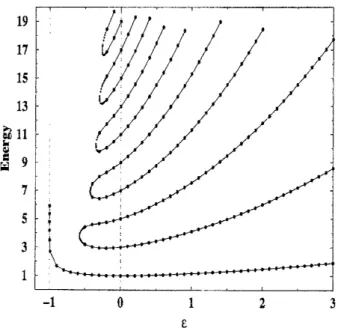
The eigenvalues have been computed numerically to very highprecision, and therealeigenvalues
are
plottedas
functions of$\epsilon$ in Fig. 1.We say that the $P\mathcal{T}$ symmetry ofaHam iltonian $H$ is unbroken if allofthe eigenfunctions
of$H$
are
simultaneously eigenfunctions of$P\mathcal{T}^{3}$. It iseasy to show that if the $P\mathcal{T}$symmetry ofa Ham iltonian $H$ is unbroken, then the spectrumof$H$ isreal. The proofisshort and goes as
folows: AssumethataHamiltonian$H$possesses PTsymmetry (that is,that $H$
comm
utes withthePToperator), and that if$\phi$isaneigenstateof$H$with eigenvalue$E$, then it issimultaneously
an
eigenstate of$P\mathcal{T}$with eigenvalue $\lambda$:$H\phi=E\phi$ and 7’7 $$=\lambda\phi$
.
(2)We beginby showing that the eigenvalue A is
a
pure phase. Multiplying$P\mathcal{T}\phi=\lambda\phi$on theleft by $P\mathcal{T}$and usingthe fact that $P$ and $\mathcal{T}$commute and that $P^{2}=\mathcal{P}=1$ weconclude that
$\phi=\lambda^{*}\lambda\phi$ and thus $\lambda=e^{i\alpha}$ for
some
real $\alpha$.
Next,we
introduce the convention that is usedthroughout this paper. Without loss of generalitywereplacethe eigenstate$\phi$ by $e^{-i\alpha/2}\phi$so that
its eigenvalue undertheoperator $P\mathcal{T}$is unity:
$P\mathcal{T}\phi=\phi$
.
(3)1The Heisenberg-Weyl algebraisarealthree-dimensionalLie algebrawhose generators satisfythecommutation
relations $[e\iota, e_{2}]=e_{3},$ $[e_{1}, e\mathrm{s}]=[e_{2}, e\mathrm{s}]=0$. To recover the Heisenberg comrnutation relationswe set $e_{1}=$
$\mathrm{i}(\hslash)^{-1/2}p$, e2$=\mathrm{i}(\hslash)^{-1/2}x$,and$e_{3}=\mathrm{i}$
.
2Theseclasses of Hamiltoniansare alldiffererbt. For example,theHamiltonian obtainedby continuing$H$in(1)
along the path$\epsilon$: $0arrow 8$hasadifferent spectrum bom the Hamiltonianobtainedbycontinuing$H=p^{2}+x^{6}\langle ix)^{\epsilon}$
along the path$\epsilon$: $0\prec 4$. Thisis becausethe boundary conditionsontheeigenfunctionsaredifferent.
$31\mathrm{f}$anequationpossessesadiscretesymmetry,thesolutiontothisequation need mat exhibitthatsymmetry. For
example, thedifferential equation$\ddot{y}(t)=y(t)$issymmetricunder the discrete time reversalsymmetry$tarrow-t$. The
solutions$y(t)=e^{t}$ and$y(t$}$\cdot=e^{-\ell}$ do not exhibitthis timereversal symmetry while the solution$y(t)=$ cash(t)
is timereversal symmetric. Thesame is true ofa system whoseHarniltonian is $P\mathcal{T}$symmetric. Even if the
Schr\"odinger equation and the corresponding boundary conditions are PT symmetric, the wavefunction that solves the Schr\"odlnger eqA.ation boundary value problem may not be symmetric under space-time refiection.
Whenthesolutionexhibits$P\mathcal{T}$symmetry,wesay that thePTsymmetryis unbrokenand if the solutiondoes not
ee
Next, we multiply the eigenvalue equation $H\phi=E\phi$ on the left by$P\mathcal{T}$and use the fact that
$[P\mathcal{T}, H]=0$ to obtain $E\phi=E^{*}\phi$
.
Hence, $E=E^{*}$ and the eigenvalue$E$ is real.The crucial assumption in this argument is that $\phi$ is simultaneously an eigenstate of $H$
and $P\mathcal{T}$
.
In quantum mechanics ifa linear operator $X$ commutes with the Hamiltonian $H$,then the eigenstates of$H$
are
also eigenstates of$X$.
However,we
emphasize that the operatorPT is not linear (it is antilinear) and thus we must make the extra assumption that the $P\mathcal{T}$
symmetry of$H$ isunbroken; that is, that $\phi$ issimultaneously
an
eigenstate of$H$and$P\mathcal{T}$.
Thisextra assumption is montrivial because it is not easy to determine a priori whether the $P\mathcal{T}$
symmetry of
a
particularHamiltonian$H$ is brokenor umbroken. For the Hamiltonian$H$ in (1)the PT symmetry is unbroken vhen $\epsilon\geq 0$ and it is broken when $\epsilon<0$
.
The conventionalHermitianHamiltonian forthe quantum mechanicalharm onic oscilJator liesat theboundaryof
the unbrokenand the brokenregimes. Dorey et
at.
proved rigorously that thespectrum of$H$in (1) is real and positive [4] in theregion $\epsilon\geq 0$
.
Many other$P\mathcal{T}$-symmetric Hamiltonians forwhichspace-timereflection symmetry is not broken have been investigated, and the spectra of
tlese Ham iltonians havealso been shownto be real and positive [5],
It is useful to show that a given non-Hermitian $P\mathcal{T}$-symrnetric Hamiltonian operator has
a positive real spectrum, but the urgent question that must be answered is whether such
a
Hamiltonian defines a physical theory ofquantum mechanics. By a physical theory we mean
that there is a Hilbert space of state vectors and that this Hilbert space has an innerproduct
19 17 15 13 $\mathrm{u}’ 11\triangleright$ $\#\mathrm{h}$ $\mathrm{R}\mathrm{r}$ 9 7 5 3 1 $\epsilon$
Figure 1: Energy levels of the Hamiltonian$H=p^{2}+x^{2}(\mathrm{i}x)^{\epsilon}$
as
a functionofthe parameter $\epsilon$.There
are
three regions: When$\epsilon\geq 0$, the spectrum is real and positive and the energy levelsrise with increasing $\epsilon$
.
The lower bound of this region, $\epsilon=0$, correspondsto the harmonic
oscillator, whoseenergy levels are $E_{n}=2n+1$
.
When $-1<\epsilon<0$, thereare a finite numberof real positive eigenvalues and
an
infinite number of complex comjugate pairs ofeigenvalues.As $\epsilon$ decreases from 0 to -1, the nunber
ofreal eigenvalues decreases; when $6\leq-0.57793$
,
theonly real eigenvalue is the ground-state energy.
As
$\epsilon$ approaches $-1^{+}$, the ground-state energywith a positive norm. In the theory ofquantum mechanics we interpret the norm ofa state
as a probability and this probabilitymust be positive. Furthermore,
we
must show that thetime evolution ofthe theory is unitary. This
means
thatas
a state vector evolves in timetheprobabilitydoesnot leakaway.
It is not obvious whethera Hamiltomian such
as
$H$ in (1) gives rise to aconsistent quantumtheory. Indeed, while early investigations of this Ham iltonian have shown that the spectrumis
entirely real and positive when $\epsilon\geq 0$, it appeared that one inevitably encountered the
severe
problem of dealing with Hilbert spaces endowed with indefinite metrics [6]. We will identify
here a new symmetry that a1J$P\mathcal{T}$-symmetric Ham iltonianshaving
an
unbroken$P\mathcal{T}$-symmetrypossess. We denote the operator representing this symmetry by $\mathrm{C}$
because the properties of
this operator resemble those of the charge conjugation operator in particle physics. This will
allow
us
to introduceaninner product structure associated with$\mathrm{C}P\mathcal{T}$conjugationforwhich thenormsofquantumstates
are
positivedefinite. We willseethat$\mathrm{C}P\mathcal{T}$symmetryisanalternativeto the conventional Hermiticity requirement; it introduces the
new
concept of a dynamicallydetermined innerproduct (one that isdeftnedby theHam iltonianitself). Asaconsequence,
we
will extend theHamiltonian and its eigenstatesinto the complexdomain
so
that the associatedeigenvalues
are
real and the underlyingdynam ics isunitary.2
Construction
of
the
C
Operator
We begin by summarizing the mathematical properties of the solution to the Sturm-Liouville
differential equationeigenvalueproblem
$-\phi_{n}’’(x)+x^{2}(\mathrm{i}x)^{\epsilon}\phi_{n}(x)=E_{n}\phi_{n}(x)$ (4)
associated with the Ham iltonian $H$ in (i). The differential equation (4) must be imposed
on
an
infinite contour 1n the complex-x plane. For large $|x|$ this contour lies in wedges that areplaced symmetrically with respect to the imaginary-z axis [3]. The boundary conditions
on
the eigenfunctions are that $\phi(x)$ $arrow 0$ exponentially rapidly as $|x|arrow\infty$ on the contour. For
$0\leq\epsilon<2$, thecontour may be taken to be the realaxis,
When $\epsilon\geq 0$, the Hamiltonian has an unbroken $P\mathcal{T}$ symmetry. Thus, the eigenfunctions $\phi_{n}(x)$ are simultaneously eigenstates of the$P\mathcal{T}$operator: $P\mathcal{T}\phi_{n}(x)=\lambda_{n}\phi_{n}(x)$
.
Aswe
arguedabove, A$n$ isa purephase and, without loss of generality, for each$n$ this phase
can
be absorbedinto $\phi_{n}(x)$ by amultiplicative rescalingso that the
new
eigenvalue is unity:$P\mathcal{T}\phi_{n}(x)=\phi_{n}^{*}(-x)=\phi_{n}(x)$
.
(5)There is strongevidencethat, whenproperly normalized, the eigenfunctions$\phi_{n}(x)$ are
com-plete. Thecoordinate-spacestatement of completeness (forreal$ andy) reads
$\sum_{n}(-1)^{n}\phi_{n}(x)\phi_{n}(y)=\delta(x-y)$
.
(6)Thisisanontrivialresult that has been verified numerically toextremelyhighaccuracy (twenty
decimalplaces) $[7, 8]$
.
The unusual factor of$(-\mathrm{l})^{}$ in thesumdoes not appear inconventionalquantum mechanics. The presence of this factor is explained in the following discussion of
orthonormality [see (8)].
Aproblem associated withnon-Hermitian$P\mathcal{T}$-symmetric Hamiltonians arises because there
seems
to bea natural wayto definethe inner product of two functions $f(x)$ and$g(x)$:68
where $P\mathcal{T}f(x)=[f(-x)]^{*}$ and the integral is taken over the contour described above in the
complex-x plane. The apparent advantage of this inner product is that the associated
norm
$(f, f)$isindependentof the overallphaseof$f(x)$and is cormerved in time. Phase independence is
desired because in quantum mechanics one
uses
a spaceof raysto represent quantummechanicalstates. Withrespect to this innerproduct the eigenfunctions $\phi_{m}(x)$ and $\phi_{n}(x)$ of$H$ in (1) are
orthogonal for$n\neq m$. However, when$m=n$ the
norm
is not positive:$(\phi_{m}, \phi_{n})=(-1)^{n}\delta_{mn}$
.
(8)This result is apparentlytrue for all values of$\epsilon$ in (4) and it has been verified numerically to
extremely high precision, Because the
norms
ofthe eigenfunctions alternate in sign, the Hilbertspace metric associated with the $P\mathcal{T}$ innerproduct $(\cdot, \cdot)$ is indefinite. Thissplit signature (sign
alternation) is a generic feature ofthe $P\mathcal{T}$inner product. Extensive numerical
calculations
verify that theformula in (8) holds for all $\epsilon\geq 0$
.
Despite the nonpositivity of the innerproduct,weproceedwith the usual analysis that
one
wouldperformfor any Sturm-Liouville problemof the form $H\phi_{n}=E_{n}\phi_{n}$
.
First, we use (8) toverify that (6) is therepresentation ofthe unityoperator, That is, weverify that
$\oint dy\delta(x-y)\delta(y-z)=$C5(r$-z$). (9)
Second, we reconstruct the parityoperator $P$in terms of the eigenstates. The parity operator
in positionspaceis $P(x, y)=\delta(x+y)$, soffom (6)
we
get$P(x, y)= \sum_{n}(-1)^{n}\phi_{n}(x)\phi_{n}(-y)$, (10)
By virtue of(8) the square of the parity operator isunity: $P^{2}=1$
.
Third,
we
reconstruct the Hamiltoniam$H$ in coordinatespace:$H(x, y)= \sum_{n}(-1)^{n}E_{n}\phi_{n}(x)\phi_{n}(y)$
.
(11)Using (6) - (8) it iseasy to see that this Hamiltomian satisfies $H\phi_{n}(x)$ $=E_{n}\phi_{n}\{x$). Fourth,
we
construct the coordinate-space Green’s function$G(x,y)$:
$G(x, y)= \sum_{n}(-1)^{n}\frac{1}{E_{n}}\phi_{n}(x)\phi_{n}(y)$
.
(12)The Green’s functionis the functionalinverse of theHam iltonian; that is, $G$satisfies
$\int dyH(x, y)G(y, z)=[-\frac{d^{2}}{dx^{2}}+x^{2}(\mathrm{i}x)^{\epsilon}]G(x, z)=\delta(x-z)$
.
(13)Whilethe time independent Schr\"odinger equation (4) cannot be solved analytically, the
differ-entialequationfor$G(x, z)$ in (13) canbe solved exactly andin closedform [8]. Thetechnique is
to considerthe
case
$0<\epsilon<2$so
that we maytreat $x$as
real and then to decompose the$x$axisintotwo regions,$x>z$ and$x<z$. We
carz
solve thedifferentialequation ineachof these regionsin term $\mathrm{s}$ of Bessel functions. Then, using this coordinate-space
representation of the Green’s
inverses of the energy eigenvalues). To do so we set $y=$ in $G(x,y)$ and
use
(8) to integrateover $x$. For all $\epsilon>0$ weobtain [8]
$\sum_{n}\frac{1}{E_{n}}=[1+\frac{\cos(\frac{3\epsilon\pi}{2\epsilon+\mathrm{S}})\sin(\frac{\pi}{4+\epsilon})}{\cos(\frac{\epsilon\pi}{4+2\epsilon})\sin(\frac{3\pi}{4+\epsilon})}]\frac{\Gamma(\frac{1}{4+\epsilon})\Gamma(\frac{2}{4+\epsilon})\Gamma(\frac{\epsilon}{4+e})}{(4+\epsilon)^{\frac{4+2\epsilon}{4+\epsilon}}\Gamma(\frac{1+\epsilon}{4+e})\Gamma(\frac{2+\epsilon}{4+\epsilon})}$
.
(14)Having presented these general Sturm-Liouville constructions,
we
discuss the question ofwhethera$P\mathcal{T}$-symm etric Hamiltoniandefinesaphysically viablequantummechanicsorwhether
it merely provides an intriguing Sturm-Liouville eigenvalue problem. The apparent difficulty
with form ulating a quantum theory is that the vector space of quantum states is spannedby
energy eigenstates, of which half have
norm
+1 and half havenorm
-1. Becausethe normofthe states carriesa probabilistic interpretation instandard quantum theory, theexistenceofan
indefinite metric in (8)
seems
to bea serious obstacle.Thesituation here1n which half of the energyeigenstateshave positive normandhalf have
negative norm is analogous to the problem that Dirac encountered in form ulating the spinor
wave
equation in relativistic quantum theory [9]. Following Dirac’s approach,we
attack theproblemof
an
indefinite normby findinga
physicalinterpretationforthe negativenormstates.We claim that in any theory having an unbroken $P\mathcal{T}$symmetry there exists a symmetry of
the Hamiltonian connected with the fact that there are equal numbers of positive-norm and
negative-norm states. To describe thissymmetry
we
constructa
linear operator denoted by$\mathrm{C}$andrepresented in position spaceas asum
over
the energyeigenstates ofthe Hamiltonian [10]:$\mathrm{C}(x, y)=\sum_{n}\phi_{n}(x)\phi_{n}(y)$. (15)
As stated earlier, the properties of this
new
operator $\mathrm{C}$ are nearly identical to those of thecharge conjugation operator in quantum field theory. For example, we can use equations (6)
-(S) to verifythat the squareof$\mathrm{C}$ is unity $(C^{2}=1)$:
$\oint dyC(x,y)C(y, z)=\delta(x-z)$
.
(16)Thus, the eigenvalues of$C$ are 81. Also,$\mathrm{C}$ commutes with the Hamiltonian$H$
.
Therefore, since$C$ islinear, the eigenstates of$H$ have definite values ofC. Specifically, if the energy eigenstates
$\mathrm{s}\mathrm{a}\mathrm{t}\mathrm{i}\mathrm{s}\theta(8)$, then
we
have $\mathrm{C}\phi_{n}=(-1)^{n}\phi_{n}$ because$C \phi_{n}(x)=\int dyC(x,y)\phi_{n}(y)=\sum_{m}\phi_{m}(x)\int dy\phi_{m}(y)\phi_{n}(y)$
.
We then
use
$\int dy\phi_{m}(y)\phi_{n}(y)=(\phi_{m}, \phi_{n})$ according toour
convention. We conclude that $C$ isthe operatorthat represents the measurement of the signature of the$P\mathcal{T}$ norm ofa state.
The operators $P$ and $C$ are distinct square roots ofthe unity operator $\delta(x-y\rangle$
.
That is,while$P^{2}=1$ and$C^{2}=1,$ $P$and$C$arenot identical. Indeed, the parity operator$P$ isreal,while
$\mathrm{C}$ is$\mathrm{c}\mathrm{o}\mathrm{m}\mathrm{p}1\mathrm{e}\mathrm{x}^{4}$
.
Furtherm ore, these two operators do notcommute:
(CP)$(x, y)= \sum_{n}\phi_{n}(x)\phi_{n}(-y)$ but (PC)$(x, y)= \sum_{n}\phi_{n}(-x$
}
$\phi_{n}(y),$(17) $4\mathrm{T}\mathrm{h}\mathrm{e}$parityoperator incoordinate space is explicitlyreal$P(x,y)=\delta(x+y)j$theoperator$C(x,y)$iscomplexbecause it isasumof products of complex functions,as weseein(15). Thecomplexityof the$C$operatorcanbe
70
which shows that $\mathrm{C}P=(P\mathrm{C})^{*}$
.
However, $C$ doescommute with$P\mathcal{T}$.
Finally, having obtained the operator $\mathrm{C}$ we define a
new
inner product structure havingpositive
definite
signatureby$\langle f|g\rangle\equiv l_{\mathrm{C}}^{dx}[CP\mathcal{T}f(x)]g(x)$
.
(18)Like the $P\mathcal{T}$inner product (7), this innerproduct is phase independentand conserved intime.
Thisisbecause thetime evolutionoperator,just as in ordinary quantummechanics,is$e^{iHt}$
.
Thefact that $H$ commutes with the $P\mathcal{T}$ andthe $CP\mathcal{T}$operators implies that both inner products,
(7) and (18), remain time independent as the states evolve in time. However, unlike (7), the
inner product (18) is positive definite because $C$ contributes -1 when it acts on states with
negative$P\mathcal{T}$ norm. In terms of the$\mathrm{C}P\mathcal{T}$ conjugate, the completenesscondition (4) reads
$\sum_{n}\phi_{n}(x)[CP\mathcal{T}\phi_{n}(y)]=\mathit{5}(x-y)$
.
(19)Unlike the inner product of conventional quantum mechanics, the $\mathrm{C}P\mathcal{T}$ inner product (19) is
dynamically deterrreined; it dependsimplicitly
on
the choiceofHam iltonian.Theoperator$C$doesnot existas adistinctentityinconventional quantummechanics. Indeed,
ifweallow the parameter$\epsilon$in (1) to tendtozero, the operator$C$ in this limit becomes identical
to$P$
.
Thus,in this limit the$\mathrm{C}P\mathcal{T}$operator becomes$\mathcal{T}$, which is just complex conjugation. Asaconsequence, theinnerproduct (18) definedwithrespect to the$CP\mathcal{T}$conjugationreducesto the
complexconjugate innerproduct ofconventional quantum mechanicswhen$\epsilonarrow 0$
.
Similarly,inthis limit (19) reducesto the usualstatement ofcompleteness $\sum_{n}\acute{\varphi}_{n}(x)\phi_{n}^{*}(y)=\delta(x-y)$
.
The $CP\mathcal{T}$inner-product (18) is independent of the choice ofintegration contour $\mathrm{C}$ so long
as $\mathrm{C}$ lies inside the asymptotic wedges associated with the boundary conditionsfor the
Sturm-Liouvilleproblem (2). Pathindependencefollows fromCauchy’s theorem andtheanalyticityof
theintegrand. In conventional quantummechanics, wherethe innerproduct is $fdxf^{*}(x)g(x)$,
theintegralmust be takenalongthereal axis and the path of the integration cannot be deformed
into thecomplex plane because the integrand is not
analytic.s
ThePTinnerproduct (7) shareswith (i8) the advantage of analyticity and path independence, but suffers from nonpositivity.
We find itsurprising that apositive-definitemetric can be constructed using $\mathrm{C}P\mathcal{T}$conjugation
without disturbingthe path independence of the inner-product integral,
Finally,weexplain why$P\mathcal{T}$-symmetrictheoriesareunitary. Tim$\mathrm{e}$evolutionis determined by
theoperator $e^{-iHt}$, whether the theory isexpressed in termsofa$P\mathcal{T}$-symmetric Hamiltonianor
just an ordinaryHermitian Hamiltonian. To establish theglobal unitarity ofa theory
we
mustshow that as a state vector evolves its
norm
does not change in time. If$\psi_{0}(x)$ isa
prescribedinitial
wave
function belonging to the Hilbertspace spannedby theenergy eigenstates, then itevolves into the state $\psi_{t}(x)$at time$t$ according to
$\psi_{t}(x)=e^{-\mathrm{i}Ht}\psi_{0}(x)$
.
With respect to the$CP\mathcal{T}$innerproduct defined in (18), the
norm
of the vector $\psi_{t}(x)$ does notchange in time,
$\langle\psi_{t}|\psi_{t}\rangle=\langle\psi_{0}|\psi_{0}\rangle$,
$\epsilon$
Note that ifafunctionsatisfiesa linearorciinarydifferentialequation,then the function is analytic wherever
the coefficient functions of thedifferential equation areanalytic. TheSchr\"odingerequation (4) islinear and its
coefficientsareanalyticexceptforabranch cut atthe origin;this branch cutcanbe takentorunuptheimaginary
axis. Wechoosethe integration contourfor theinnerproduct(8)sothat itdoes notcrossthe positiveimaginary
because the Ham iltonian $H$ commutes with the $CP\mathcal{T}$ operator. Establishing unitarity at a
local level is more difficult. Here,
we
must show that in coordinate space, there exists a localprobability density that satisfies a continuity equation
so
that the probability does not leakaway. This is asubtle result because theprobability current flows about in the complex plane
rather than along the real axis
as
in conventional Hermitian quantummechanics, Preliminarynumerical studies indeed indicate that the continuityequationisfulfilled [14].
3
Illustrative
Example:
A
$2\cross 2$Matrix Hamiltonian
Wewillnow illustrate the above resultsconcerning$P\mathcal{T}$-symmetricquantummechanics inavery
simple context. To do so
we
will consider systems characterized by finite dirnensional matrixHam iltonians. Infinite-dim ensionalsystems the $P,$ $\mathcal{T}$, and$\mathrm{C}$ operatorsappear, but there is
no
analogue oftheboundaryconditions associated with coordinate-space Schr\"odinger equations.
Let
us
consider the $2\cross 2$matrix Hamiltonian$H=(\begin{array}{ll}re^{i\theta} ss re^{-i\theta}\end{array})$ , (20)
where the three parameters$r,$ $s$, and$\theta$
are
real. This Ham iltonian is not Hermitian in theusualsense, but it is $P\mathcal{T}$symmetric, where theparity operator isgiven by [15]
$P=(\begin{array}{ll}0 11 0\end{array})$ (21)
and$\mathcal{T}$performs complex conjugation.
There are two parametric regions for this Hamiltonian, When $s^{2}<r^{2}\sin^{2}\theta$, the energy
eigenvalues form
a
complex conjugate pair, This isthe regionofbroken$P\mathcal{T}$ symmetry. Ontheotherhand, if$s^{2}\geq r^{2}\sin^{2}\theta$, then the eigenvalues$\epsilon\pm=r\cos\theta\pm\sqrt{s^{2}-r^{2}\sin^{2}\theta}$
are
real. Thisisthe region of unbrokenPT symmetry. In the unbroken region the simultaneous eigenstates of
the operators $H$andPT
are
givenby$| \epsilon_{+}\rangle=\frac{1}{\sqrt{2\cos\alpha}}(\begin{array}{l}e^{\dot{\mathrm{z}}\alpha}/2e^{-i\alpha/2}\end{array})$ aanndd $|\epsilon_{-}$) $= \frac{\mathrm{i}}{\sqrt{2\cos\alpha}}(\begin{array}{l}e^{-i\alpha}/2\backslash -e^{i\alpha/2}\end{array})$, (22)
wherewe set $\sin\alpha=(r/s)\sin\theta$. It iseasilyverified that $(\epsilon\pm, \epsilon\pm)=\pm 1$ and that $(\epsilon\pm,\epsilon_{\mp})=0$,
recallingthat $(u, v)=(P\mathcal{T}u)\cdot v$
.
Therefore,with respecttothe$P\mathcal{T}$inner product, the resultingvector space spanned by energy eigenstates has a metric of signature ($+,$$-\rangle$
.
The condition$s^{2}>r^{2}\sin^{2}\theta$
ensures
that $P\mathcal{T}$ symmetry is not broken. If this condition is violated, the states(22) are nolongereigenstates of$P\mathcal{T}$because czbecomes $\mathrm{i}\mathrm{m}\mathrm{a}\mathrm{g}\mathrm{i}\mathrm{n}\mathrm{a}\mathrm{r}\mathrm{y}^{6}$.
Next,
we
construct theoperator $C$:$C= \frac{1}{\cos\alpha}$
(
$\mathrm{i}\mathrm{s}\mathrm{i}\mathrm{n}\alpha$
$-\mathrm{i}\mathrm{s}\mathrm{i}\mathrm{n}\alpha$
).
(23)
Notethat $\mathrm{C}$ is distinct from $H$and $\prime \mathrm{p}$ and has the key property that
$C|\epsilon_{\pm}\rangle=\pm|\epsilon_{\pm}\rangle$
.
(24)The operator $\mathrm{C}$ commutes with $H$ and satisfies $\mathrm{C}^{2}=1$
.
Theeigenvaluesof$\mathrm{C}$
are
precisely thesigns of the$P\mathcal{T}$normsofthe corresponding eigenstates.
$\epsilon$
72
Using theoperator$\mathrm{C}$
we
construct the newinnerproductstructure
$\langle u|v\rangle=(CP\mathcal{T}u)\cdot v$
.
(25)This innerproductis positive definite because $\langle\epsilon\pm|\epsilon\pm\rangle=1$
.
Thus, the $\mathrm{t}\mathrm{w}\mathrm{o}rightarrow \mathrm{d}\mathrm{i}\mathrm{m}\mathrm{e}\mathrm{n}\mathrm{s}\mathrm{i}\mathrm{o}\mathrm{n}\mathrm{a}\mathrm{l}$Hilbertspacespanned by $|\epsilon\pm\rangle$,withinnerproduct$\langle\cdot|\cdot\rangle$, has
a
Herm itianstructure withsignature $(+,$$+\rangle$.
Let us demonstrate that the$\mathrm{C}P\mathcal{T}$
norm
of any vector is positive. We choose the arbitraryvector$\psi=(\begin{array}{l}ab\end{array})$, where$a$ and $b$areany complex numbers. Then$\mathcal{T}\psi=(\begin{array}{l}ab^{*}\end{array}),$ $P\mathcal{T}\psi=(_{a}^{b}:)$, and
$\mathrm{C}P\mathcal{T}\psi=\frac{1}{\cos\alpha}(\begin{array}{ll}a^{*}+ib^{*} \mathrm{s}\mathrm{j}\mathrm{n}\alpha b^{*}-\iota a^{*} \mathrm{s}\mathrm{i}\mathrm{n}\alpha\end{array}).$ Thus, $\langle\psi|\psi\rangle=(CP\mathcal{T}\psi)\cdot\psi=$ $\frac{1}{\cos\alpha}[a^{*}a+b^{*}b+i(b^{*}b-a^{*}a)\sin\alpha]$
.
Nowlet $a=x+\mathrm{i}y$ and $b=u+\mathrm{i}v$, where $x,$ $y,u,$ and$v$
are
real$.$ Then$\langle\psi|\psi\rangle=\frac{1}{\cos\alpha}$
(
$x^{2}+v^{2}+2xv\sin\alpha$ $+y^{2}+u^{2}-2yu\sin\alpha$),
(26)which isexpiicitlypositive and vanishesonlyif$x=y=u=v=0$
.
Recalling that $\langle$$u|$ denotes the$CP\mathcal{T}$-conjugateof $|u\rangle$, thecompleteness conditionreads
$|\epsilon_{+}\rangle\langle\epsilon_{+}|+|\epsilon_{-}\rangle\langle\epsilon_{-}|=(\begin{array}{ll}1 00 1\end{array})$
.
(27)Furthermore,usingthe$\mathrm{C}P\mathcal{T}$conjugate (gg$|$,we canexpress$\mathrm{C}$in theform$C=|\epsilon_{+}\rangle$$(\epsilon_{+}|-|\epsilon_{-}\rangle\langle\epsilon_{-}|$,
as
opposed to therepresentationin (15), whichuses
the PTconjugate.An observable in thistheoryisrepresentedby
a
linearoperator $A$that satisfies the equation$\mathrm{C}P\mathcal{T}ACP\mathcal{T}=A^{\mathrm{T}}$, where$A^{\mathrm{T}}$
isthetransposeof$A$
.
If$\mathrm{C}\mathcal{P}\mathcal{T}$symmetry isunbroken, theeigenval-ues
of$A$are
real. Theoperator$\mathrm{C}$satisfiesthis requirement, and hence it is an observable. For
the two-state system, ifweset $\theta=0$, then the Hamiltonian (20) becomes Hermitian. However,
the operator $\mathrm{C}$
then reduces to the parity operator $P$. As
a
consequence, the above conditionsatisfied byanoperatorreducesto the standard condition of Hermiticity,namely, that $H=H^{*}$
.
This is whythe hidden symmetry $C$ was not noticed previously. The operator$\mathrm{C}$ emerges
only
whenweextenda realsymmetricHamiltonianinto the complex domain.
We have calculated the$\mathrm{C}$operatorin many kinds of quantum mechanical and quantum
field
theoretic models. Foran$x^{2}+\mathrm{i}x^{3}$potential,$C$
can
beobtained fromthesummation in (15) usingperturbativemethods [11]. For
an
$x^{2}-x^{4}$potential , $C$can
becalculatedusingnonperturbativeWKB methods [12]. Quantum field theoretic calculations of$\mathrm{C}$
are
reportedin Ref. [13].
4
Applications and
Possible Observable
Consequences
We have described here
an
alternative to the axiom ofHermiticityin quantum mechanics. Inquantum field theory, Hermiticity,
Lorentz
invariance, anda
positive spectrumare
crucial forestabIishing$CP\mathcal{T}$
invariance
[16]. Here, we haveestablished the converse ofthe$CP\mathcal{T}$ theorem
in the followinglimited sense: We
assume
that the Hamiltonian possessesspace-timereflectionsymm etry, and that this symm etry is not broken. $\mathrm{R}\mathrm{o}\mathrm{m}$ these assumptions, we
know that the
spectrumisrealand positive and we construct
an
operator$\mathrm{C}$ that islike the charge conjugation
operator. Quantum states in this theory havepositivenormswith respectto $\mathrm{C}P\mathcal{T}$conjugation.
Ineffect,wereplacethe mathematical condition ofHerm iticitybythe physicalconditionof
space-time and charge-conjugation symmetry. Thesesymmetries
ensure
therealityofthespectrumofthe Hamiltonian in complexquantum theories.
Could non-Herm itian, $P\mathcal{T}$-symmetric Ham iltonians be
used to describeexperimentally
ob-servable phenomena?
Non-Hermitian
Hamiltonians have already been used to describehard spheres is describedbyanon-Hermitian Hamiltonian [17]. Wufound that theground-state
energy ofthis system isreal andconjecturedthat all of theenergylevelswerereal. In1992,
Hol-lowood showedthat
even
though the Hamiltomianofa complexToda lattice is non-Hermitian,the energylevels are real [18]. Non-Hermitian Hamiltonians ofthe form $H=p^{2}+\mathrm{i}x^{3}$ arise in
various Reggeon fieldtheory models that exhibit real positivespectra [19]. These cubic
Hamil-tonians also arise in thestudyofthe Lee Yangedge singularity [20]. Ineach ofthese casesthe
fact that a non-Hermitian Hamiltonianhad a real spectrumappeared mysterious at the time,
but
now
theexplanationis simple: In each ofthesecasesthemop-HermitianHamiltonian is$P\mathcal{T}-$symmetric. Thatis, the Hamiltonian in each
case
is constructedso
that the position operator$x$or the field operator $\phi$is always multipliedby$\mathrm{i}$
.
An experimental signal of
a
complexHamiltonianmight befoundin thecontext of condensedmatter physics. Consider thecomplexcrystal lattice whose potentialis givenby $V(x)=\mathrm{i}\sin x$
.
While the Hamiltonian$H=p^{2}+i\sin x$ is not Hermitian, it is $P\mathcal{T}$-symmetric, and all of the
energy bandsare real. However, at theedgeofthebands thewavefunctionof
a
particle in sucha
lattice is always bosonic ($2\pi$-periodic) and, unlike the case ofordinary crystal lattices, thewave
function isnever
fermionic ($4\pi$-periodic) [21]. Direct observation ofsucha bandstructurewould give unambiguous evidence ofa$P\mathcal{T}$-symmetricHamiltonian.
There are many opportunities for the use ofnon-Hermitian Hamiltonians in the study of
quantum field theory. For example, ascalar quantum fieldtheory withacubic self-interaction
describedby theLagrangian $L= \frac{1}{2}(\nabla\varphi)^{2}+\frac{1}{2}m^{2}\varphi^{2}+g\varphi^{3}$ isphysically unacceptable because the
energy spectrum is not bounded below. However, the cubic scaiar quantumfield theory that
correspondsto $H$in (1) with $\epsilon=1$ is given by the Lagrangian density $\mathcal{L}=\frac{1}{2}(\nabla\varphi)^{2}+\frac{1}{2}m^{2}\varphi^{2}+$
$\mathrm{i}g\varphi^{3}$
.
This is a new, physically acceptable quantum field theory. Moreover, the theory thatcorresponds to $H$ in (1) with $\epsilon=2$ isdescribedby theLagrangian density
$\mathcal{L}=\frac{1}{2}(\nabla\varphi)^{2}+\frac{1}{2}m^{2}\varphi^{2}-\frac{1}{4}g\varphi^{4}$
.
(28)What is remarkable about this “wrong-sign” fteld theory is that, in addition to the energy
spectrumbeingrealand positive, theone point Green’sfunction(the
vacuum
expectation valueof the field $\varphi$) is
nonzero
[22]. Furthermore, the field theory isrenorm
alizable, and in fourdimensions is asymptoticalJy free (and thus nontrivial) [23]. Based on these features of the
theory,
we
believethat the theorymay providea useful setting to describe the dynamicsof theHiggs sector in the standard model.
Other fieldtheory models whose Hamiltonians
are
non-Hermitian and $P\mathcal{T}$-symmetric havealso been studied. For example, $P\mathcal{T}$-symmetric electrodynamics is particularly interesting
be-cause
itisasymptotically free(unlike ordinary electrodynamics) andbecause the direction of theCasimirforceis thenegative of that inordinary electrodynamics [24]. Thistheoryis remarkable
because it
can
determine itsown
coupling constant. Supersymmetric $P\mathcal{T}$-symm etric quantumfield theories have also beenstudied [25].
These$P\mathcal{T}$-symmetricquantum theories exhibit unexpected phenomena. For example, when
$g$ issufficiently small,the $-g\varphi^{4}$ theorydescribedbythe Lagrangian (28) possessesbound states
(theconventional$g\varphi^{4}$theorydoes not because thepotentialisrepulsive). Boundstates
occur
forall dimensions $0\leq D<3[26]$, but for purposesofillustrationwedescribe thebound states in
thecontext of one-dimensional quantum fieldtheory (quantum mechanics). Fortheconventional
anharmonicoscillator, which is describedby the Hamiltonian
$H= \frac{1}{2}p^{2}+\frac{1}{2}m^{2}x^{2}+\frac{1}{4}gx^{4}$ $(g>0)$, (29)
the small-y Rayleigh-Schr6dinger perturbation series for the$k\mathrm{t}\mathrm{h}$energy level$E_{k}$ is
74
where$\nu=g/(4m^{3})$
.
Therenormalizeimass$M$is defined asthe firstexcitationabovethegroundstate: $M\equiv E_{1}-E_{0}\sim m[1+3\nu+\mathrm{O}(\nu^{2})]$
as
$\nuarrow 0^{+}$.
To determineif thetwo-particle stateisbound, weexamine the secondexcitation above the
ground stateusing (30), We define
$B_{2}\equiv E\mathit{2}$ $-E_{0}\sim m[2+9\nu+\mathrm{O}(\nu^{2})]$ $(\nuarrow 0^{+})$
.
(31)If$B_{2}<2M$,thenatwo-particleboundstate exists and the(negative) bin dingenergyis$B_{2}-2M$.
If$B_{2}>2M$, then the second excitation above the
vacuum
is interpreted as an unboundtwo-particlestate. We
see
ffom (31) that in the smalI-coupling region, whereperturbation theoryis valid, the conventional anharmonic oscillator does not possess a bound state. Indeed, using
WKB, variationalmethods,
or
numericalcalculations, onecan
showthat there isnotwo-particlebound state foranyvalue of$g>0$
.
Because there isno boundstate the$gx^{4}$interaction maybeconsidered to represent a repulsive$\mathrm{f}o\mathrm{r}\mathrm{c}\mathrm{e}.7$
We obtainthe perturbation series for the man-Hermitian,$P\mathcal{T}$-symmetric Hamiltonian
$H= \frac{1}{2}p^{2}+\frac{1}{2}m^{2}x^{2}-\frac{1}{4}gx^{4}$ $(g>0)$, (32)
from theperturbation series for the conventional anharmonic oscillator by replacing $\nu$ with$-\nu$
.
While the conventional anharmonic oscillator does not possess
a
two particle boundstate, the$P\mathcal{T}$-symmetric oscillator does possess such astate. We
measure
thebindingenergy of this statein un its of the renormalizedmass $M$ and we define the dimensionless binding energy $\Delta_{2}$ by
$A_{2}$ $\equiv\frac{B_{2}-2M}{M}\sim-3\nu+\mathrm{O}(\nu^{2})$ $(\nuarrow 0^{+})$
.
(33)Thisbound statedisappearswhen$\nu$increasesbeyond$\nu=$ 0.0465.
. ..
As$\nu$continuestoincrease,A2
reachesa
maximum of0.427at $\nu=0.13$ and thenapproaches thevalue 0.28 as $\nuarrow\infty$.In the $P\mathcal{T}$-symmetric anharmonic oscillator, there
are
not only two-particlebound states
for smallcoupling constant but also A-particle bound states for all $k\geq 2$
.
The dimensionlessbindingenergiesare
$\Delta_{k}\equiv(B_{k}-kM)/M\sim-3k(k-1)\nu/2+0(\nu^{2})$ ($\nuarrow 0+\rangle$. (34)
Thekey feature of this equation is that the coefficient of$\nu$ is negative. Sincethe dimensionless
bindingenergy becom es negative
as
$\iota/$ increases from 0, there isa $k$-particle boundstate. Thehigher multiparticlebound states
cease
to be bound for smaller values of &; starting with thethree-particle bound state, the binding energy of these states becomes positive as $\nu$ increases
past 0.039, 0.034, 0.030, and0.027.
For anyvalue of$\nu$there
are
alwaysa
finite number of bound states andaninfinite numberof unbound states. The number of bound states decreases withincreasing $\nu$ until there are
no
bound states at all. There isarange of$\nu$for which thereareonlytwo- and three particlebound
states. This situationis analogous to the physical world in which
one
observes only states oftwo and three bound quarks. Inthis rangeof$\nu$ ifonehas
an
initial state containinga
numberofparticles (renormalized masses). theseparticles willclumptogether into bound states, releasing
7Ingeneral, arepulsiveforcein aquantumfieldtheoryisrepreseuted byanenergydependence in which the
energy ofatwo-particlestate decreases with separation. Theconventional anharmonic oscillator Hamiltonian
corresponds toa fieldtheory inonespac -time dimension, wherethere cannot beanyspatial dependence. Inthis
casethe repulsivenatureof theforceis understood tomeanthat theenergy$B_{2}$neededto create twoParticlesat
energy in the process. Depending on $\nu$, the final state will consist either of two- or of
three-particlebound states, whichever is energeticallyfavored. Also, there is
a
specialvalue of$\nu$ forwhichtwo- and three-particle bound states
can
exist in thermodynamicequilibrium.How doesa$g\varphi^{3}$theorycomparewitha$g\varphi^{4}\mathrm{t}\mathrm{h}\mathrm{e}\mathrm{o}\mathrm{r}\mathrm{y}^{7}$A$g\varphi^{3}$ theoryhasanattractive force. The
bound statesthat ariseas
a
consequence ofthis forcecan
befoundby using theBethe-Salpeterequation. However, the $g\varphi^{3}$ fieldtheory is unacceptablebecause the spectrum is not bounded
below. Ifwereplace9by $\mathrm{i}g$, the spectrum becomes real and positive, butnowtheforce becomes
repulsiveandthereare noboundstates. The
same
istrue foratwo-scalar theory withinteractionofthe form $\mathrm{i}g\varphi^{2}\chi$
.
This latter theoryis amacceptablemodel of scalarelectrodynam $\mathrm{i}\mathrm{c}\mathrm{s}$, but hasnoanalog of positronium.
5
Concluding
Remarks
We have argued in this paper that there is an alternative to the axiom of standard quantum
mechanics that the Hamiltonian must be Hermitian. We have shown that the axiom of
Her-miticity maybereplaced by the
more
physical condition of$P\mathcal{T}$(space-time reflection) symmetry.Space-time reflection symm etryis distinct
&om
the condition ofHermiticity,so
it is possible toconsidernew kinds ofquantum theories, such
as
quantum field theories whose self-interactionpotentials
are
$ig\varphi^{3}$ or $-g\varphi^{4}$.
Such theories have previously been thought to bemathemati-callyandphysically unacceptable because thespectrum mightnot be real and because thetime
evolution might not be unitary.
Thesenewkindsof theories canbethought ofasextensions ofordinaryquantum mechanics
intothecomplex plane; thatis, continuations of real symmetric Hamiltonianstocompiex
Hamil-tonians. The idea ofanalyticallycontinuing
a
Hamiltonianwas
first discussed in1952by Dyson,who arguedheuristicallythat perturbationtheoryforquantumelectrodynamicsisdivergent [27].
Dyson’sargument involvesrotatingthe electriccharge$e$into the complexplane$earrow \mathrm{i}e$
.
Appliedto the quantum anharm onic oscillator, whose Hamiltonian is given in (29), Dyson’s argument
would go as follows: If thecouplingconstant $g$ is continuedin the complex-y planeto $-g$, then
thepotential isnolonger boundedbelov,so the resultingtheoryhasnoground state. Thus, the
ground-stateenergy $E0(g)$ hasan abrupttransitionat $g=0$
.
Ifwe represent$E_{0}(g)$ as a seriesinpowersof$g$, thisseries must havea zeroradim ofconvergencebecause$E0(g)$ hasasingularity at
$g=0$ in the complex-coupling-constant plane. Hence, theperturbationseries must diverge for all$g\neq 0$
.
While the perturbation series does indeed diverge, this heuristic argument is flawedbecause the $\mathrm{s}\mathrm{p}\mathrm{e}\mathrm{c}\mathrm{t}^{r}\mathrm{u}\mathrm{m}$ of the Hamiltonian (32) that is obtained remains ambiguous until the
boundaryconditions that the wave functions must satisfyarespecified. The spectrum depends
cruciallyon how this Hamiltonian with
a
negative coupling constant is obtained.Therearetwo waysto obtain the Hamiltonian (32). First,
one can
substitute $g=|g|e^{\mathrm{i}\theta}$ intothe Hamiltonian (29) and rotate fiiom $\theta=0$ to $\theta=\pi$
.
Under this rotation, the ground-stateenergy$E_{0}(g)$ becomes complex. Evidently, $E_{0}(g)$ is real and positivewhen$g>0$ and complex
when$g<08$. Second, one can obtain (32) asa limit of the Ham iltonian
$H= \frac{1}{2}p^{2}+\frac{1}{2}m^{2}x^{2}+\frac{1}{4}gx^{2}(\mathrm{i}x)^{\epsilon}$ $(g>0)$ (35)
as $\epsilon$ : $0arrow 2$. The spectrum of this Hamiltonian is real, positive, and discrete. The spectrum
of the limitingHamiltonian (32) obtained in this manner 1s similar in structure to that of the
Hamiltonian in (29).
8Rotatingfrom$\theta=0$to $\theta=-\pi$,weobtain thesameHamiltonianasin (32)butthe spectrum is the complex
76
HowcantheHam iltonian(32)possess two differentspectra? Theanswerlies intheboundary
conditions satisfied by the
wave
functions $\phi_{n}(x)$.
Inthefirst case, in which$\theta=\arg g$ isrotatedin thecomplex-g planefrom 0to$\pi,$ $\psi_{n}(x)$vanishesin thecomplex-r plane
as
$|x|arrow\infty$insidethewedges $-\pi/3<\arg x<0$ and $-4\pi/3<\arg x<-\pi$
.
Inthe second case, in which the exponent$\epsilon$ ranges from 0 to 2, $\phi_{n}(x)$ vanishes in the complex-z plane
as
$|x|arrow\infty$ inside the wedges$-\pi/3<\arg x<0$ and $-\pi<\arg x<-2\pi/3$. In this second
case
the boundary conditions holdin wedges that are symmetric with respect to the imaginary axis; these boundary conditions
enforce thePT symmetryof$H$ andareresponsiblefor the realityofthe energyspectrum.
Apart from thespectra, there is another striking difference between the two theories
corre-spondingto$H$in (32). Theone-point Green’sfunction$G_{1}(g)$ is definedastheexpectation value
of the operator$x$ in the ground-state
wave
function$\phi_{0}(x)$,$G_{1}(g)=\langle 0|x|0$
}
$/ \langle 0|0\rangle\equiv\int_{C}dxx\psi_{0}^{2}(x)/\int_{C}dx\psi_{0}^{2}(x)$, (36)where $C$ is a contour that lies 01 the asymptotic wedges described above. The value of$G_{1}(g)$
for$H$ in (32) dependson the limiting process by which
we
obtain$H$.
Ifwe
substitute$g=g_{0}e^{\iota\theta}$into the Hamiitonian (29) and rotate from $\theta=0$ to $\theta=\pi$, we find that $G_{1}(g)=0$ for all $g$
on the semicircle in the complex-g plane. Thus, this rotation in the $g$ plane preserves parity
symmetry $(xarrow-x)$
.
However, ifwedefine$H$ in (32) by using the Hamiltonian in (35) and byallowing$\epsilon$ to go from 0 to 2, wefind that $G_{1}(g)\neq 0$
.
Indeed, $G_{1}(g)\neq 0$for all values of$\epsilon>0$.
Thus, in thistheory$P\mathcal{T}$symmetry (reflectionabout theimaginary axis, $xarrow-x”$) is
preserved,
butparity symmetryispermanently broken. This
means
thatone
mightbe ableto describe thedynamicsoftheHiggs sectorbyusing a $-g\varphi^{4}$ quantum field theory,
Acknowledgement
I thank the Theoretical Physics Group at Imperial College for its hospitality and the $\mathrm{U}.\mathrm{K}$
.
Engineering and Physical Sciences Research Council, the JohnSimon Guggenheim Foundation,
and the$\mathrm{U}.8$. Department of Energy for financialsupport.
References
[1] C. M. Bender, P. N. Meisinger, and Q. Wang, J. Phys. A: Math. Gem. 36, 1029 (2003).
[2] C. M. Bender, S. Boettcher, and P. N. Meisinger, J. Math, Phys. 40,
2201
(1999).[3] C. M. Bender andS.Boettcher, Phys. Rev.Lett. 80, 5243 (1998).In thisreference thereis
anextendeddiscussion of the wedges in thecomplex-z planeand thecontour along which
thedifferential equation (4) is solved. Seeespecially Fig. 2 in this reference.
[4] P. Dorey, C. Dunning andR. Tateo, J. Phys. A 34, L391 (2001); ibid. A34, 5679 (2001).
[5] G. Levai and M. Znojil, J. Phys. A 33,
7165
(2000); C. M. Bender, G. V. Dunne,P. N. Meisinger,andM. Simsek, Phys.Lett. A281, 311 (2001); B. Bagchi andC. Quesne,
Phys. Lett.A300, 18 (2002\rangle ; D. T. Trinh, PhDThesis,University ofNiceSophia Antipolis
(2002), andreferences therein.
[6] A. Mostafazadeh, J. Math. Phys. 43, 205 (2002); ibid. 43, 2814 (2002); ibid. 43,
G. S. Japaridze, J. Phys. A 35,
1709
(2002); M. Znojil, Preprint (math-ph/0104012);A. Ramirez and B. Mielnik, WorkingPaper2002.
[7] C. M. Bender,S.Boettcher, andV. M. Savage, J. Math.Phys.41, 6381 (2000); C. M.
Ben-der, S. Boettcher, P. N. Meisinger, and Q. Wamg, Phys. Lett. A 302, 286 (2002).
[8] G. A. Mezincescu, J. Phys. A: Math. Gem, 33, 4911 (2000); C. M. Benderand Q. Wang,
J. Phys. A 34, 3325 (2001).
[9] P. A. M. Dirac, Proc. R. Soc. London A180, 1 (1942).
[10] C. M. Bender, D. C. Brody, and H. F. Jones, Phys. Rev. Lett. 89, 270401 (2002) and
Am. J. Phys. 71, 1095 (2003).
[11] C. M. Bender, P. N. Meisinger, and Q. Wang, J. Phys, A: Math. Gen. 36, 1973 (2003);
C. M. Bender, J. Brod, A. T. Refig, and M. E. Reuter, J. Phys. A: Math, Gen.
3710139-I0165 (2004).
[12] C. M. Bender andH. F. Jones, Phys. Lett. A 328, 102 (2004).
[13] C. M. Bender, D. C.Brody,and H.F. Jones, hep-th/0402011 andPhys. Rev.D70,025001
(2004).
[14] C. M. Bender, P. N. Meisinger, and Q. Wang, manuscript in preparation.
[15] C. M. Bender, M. V. Berry and A. Mandilara, J. Phys. A 35, L467 (2002).
[16] R. F. Streater and A. S. Wightman, PCT, Spin& Statistics, and all that (Benjamin, New
York, 1964).
[17] T. T. Wu, Phys. Rev. 115, 1390 (1959).
[18] T. Hollowood, Nucl. Phys. B384,523 (1992).
[19] H. D. I. Abarbanel, J. D. Bronzam, R. L. Sugar, and A. R. White, Phys. Rep. 21, li9
(1975); R. Brower, M. Furman, and M. Moshe, Phys. Lett. B76,213 (1978); B. Harms,
S. Jones, andC.-ITan, Nucl. Phys. 171392 (1980) andPhys. Lett. B91B, 291 (1980).
[20] M. E. Fisher, Phys. Rev. Lett, 40, 1610 (1978); J. L. Cardy, ibid. 54, 1345 (1985);
J. L. Cardy and G. Mussardo, Phys. Lett. B225,275 (1989); A. B. Zam olodchikov,
Nucl. Phys. B348,619 (1991).
[21] C. M. Bender, G. V. Dunne, and P. N. Meisinger,Phys. Lett. A 252, 272 (1999).
[22] C. M. Bender, P. Meisinger, and H. Yang, Phys. Rev. D63, 45001 (2001).
[23] C. M. Bender, K. A. Milton, andV. M. Savage, Phys. Rev. D62, 85001 (2000).
[24] C. M. Bender and K. A. Milton, J. Phys. A: Math. Gem. 32, L87 (1999).
[25] C. M. Bender and K. A. Milton, Phys. Rev. D57, 3595 (i998).
[26] C. M. Bender, S. Boettcher, H. F. Jones, P. N. Meisinger, and M. Simsek, Phys. Lett. A
291,