Assemblies and Physical Properties of
Functional Organic Molecules Based on
Bis-Urea, Bithiazole, and Crown Ether
Frameworks
著者
YUAN GUOHAO
学位授与機関
Tohoku University
学位授与番号
11301甲第19258号
Doctoral Thesis
Thesis Title
Studies on Hydrogen-Bonding Supramolecular
Assemblies and Physical Properties of
Functional Organic Molecules Based on Bis-Urea,
Bithiazole, and Crown Ether Frameworks
Department of Applied Chemistry
Graduate school of Engineering,
TOHOKU UNIVERSITY
GUOHAO YUAN
Advi sing Profess or
at Tohoku Uni v. Professor Tom oyuki Akut agawa Research Advi sor
at Tohoku Uni v. Assis tant P rofessor Norihis a Hoshino Dissertation Committ ee Members Nam e marked wi th “○” is the Chief Examiner
○ P rof. Tomoyuki Akut agawa
1 P rof. M as aya Mit suish i 2 P rof. Takashi Kyot ani 3 P rof. It aru Honm a 4
1
Table of contents
§1. General Introduction
1-1. Hydrogen bonds and supramolecular assemblies 1-2. Phase of hydrogen-bonding assembly
1-2-1. Isomerism
1-2-2. Structural transition by the outer stimuli 1-2-3. Solid and liquid crystal
1-3. Functions of hydrogen-bonding molecular assembly 1-3-1. Selective sorption property
1-3-2. Proton conductivity 1-3-3. Ionic conductivity
1-4. Exploration and development of supramolecular materials 1-5. Research purpose of this thesis
1-6. References
§2. Reversible Channel-Layer Structural Transformation of Hydrogen-Bonding
Bis-Urea Macrocycle
2-1. Introduction
2-2. Experimental section
2-2-1. Preparation of host-guest complexes 2-2-2. Physical measurement
2
2-3-1. Formation and crystal structures of 1•(Guest)x Complex 2-3-2. Structural transformation of 1 after Guest Desorption 2-3-3. Sorption property of vacant structure
2-4. Conclusion 2-5. Reference
§3. Highly Proton Conducting Hydrogen-Bonding [(H2PO4
−)(H3PO4)]
∞Networks
supported by 2,2’-Diamino-bithiazolium in Crystals
3-1. Introduction
3-2. Experimental section
3-2-1. Physical measurements
3-2-2. Preparation of the acid-base salts 3-3-3. Crystal structural determination 3-3. Results and Discussion
3-3-1. Molecular design and crystal polymorph 3-3-2. Thermal property and H2O sorption behavior
3-3-3. Crystal structures and hydrogen-bonding networks 3-3-4. Bulk and single crystal proton conductivity
3-3-5. Hydrogen-bonding connectivity and σH+
3-4. Conclusion 3-5. Reference
3
§4. Hydrogen-Bonding Ionic Channel of Dibenzo[18]crown-6 Derivative in
Ferroelectric Liquid Crystalline Domain
4-1. Introduction
4-2. Experimental section
4-2-1. General and physical measurements. 4-2-2. Preparation of crown ether 1 and 3BC. 4-2-3. Preparation of ion-doped and mixed crystals 4-3. Results and Discussion
4-3-1. Molecular assemblies and phase transition behavior of 1 4-3-2. Formation of ion-capturing M+•(1)•X− salts
4-3-3. Ionic conductivity of ion-capturing M+•(1)•X− salts
4-3-4. Phase separated Colh phase between ionic channel 1 and ferroelectric 3BC
4-3-5. Ferroelectricity of (1)x(3BC)1-x.
4-3-6. Ferroelectricity of ion doped (3BC)0.9[(M+)x•(1)0.1•(X−)x]
4-4. Conclusion 4-5. Reference
4
5
1-1. Hydrogen bonds and supramolecular assemblies
A wide range of molecular assembly structures, such as single crystal, plastic crystal, liquid crystal, organogels and so on, have been typically constructed by weak intermolecular interactions with wide variation of the bonding energy, including electrostatic, hydrogen-bonding, charge-transfer, van der Waals, π- π stacking, hydrophobic interactions, etc. Among them, hydrogen-bonding one has been observed in many assembly structures from biological systems to organic electronics.1 Hydrogen bond forms intermolecular interaction between the molecule containing polar X-H bonds called “H-bond donor” and non-bonding electron pairs on atom Y as well as delocalization of the electrons from the lone-pair π orbital called “H-bond acceptor” (Xδ--H δ+···Y δ-, where X and Y were electronegative atoms such as N, O, F, Cl, etc).
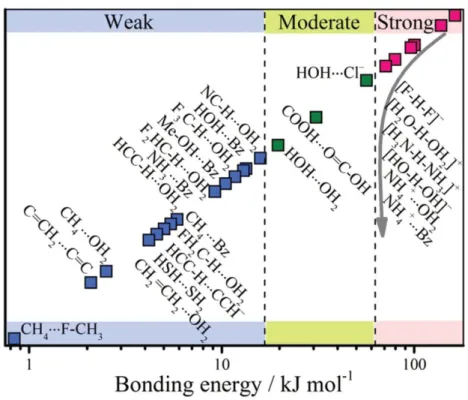
A large number of hydrogen-bonding interactions exist in a wide range of energy scale (5~20 kJmol -1) and also bonding geometry.2 Hydrogen-bonding donor molecule has acidic property, while hydrogen-bonding acceptor one has basic property.3 Typical energy of the hydrogen-bonding interactions are ranging from approximately 0.2 to 100 kJ mol-1.2 Hence, both the rigidity and directionality of hydrogen-bonding interaction are lower than those of the coordination and/or covalent bonds, which enable us to design the extended molecular frameworks through the non-covalent interaction. In general, the strength of the hydrogen-bonding interaction depends on the electronegativity of the atoms, and can be classified into three types of “weak”, “strong”, and “moderate” ones (Table 1.1 and Figure 1.1).4-6 The hydrogen-bonding length decreased in the strong interaction, while the directionality of the moderate and weak hydrogen-bonding interactions are much lower than that of the strong one. Highly directional and strong hydrogen-bonding interaction has been often observed in many types of supramolecular systems. Therefore, from the perspective of a rational design, highly directional and strong hydrogen-bonding interactions are useful to design the extended molecular assembly networks using the self-assembling
6 process of the hydrogen-bonding organic molecules.
Table 1.1. Strong, moderate, and weak hydrogen-bonding interactions (by a classification of Jeffery).
7
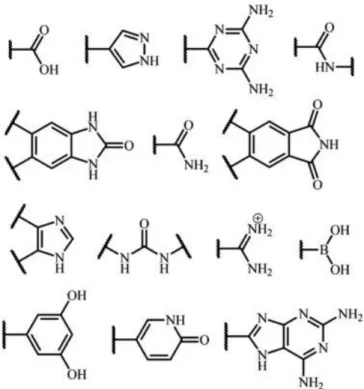
Hydrogen–bonding organic framework (HOF) are defined as a framework connected by the intermolecular hydrogen-bonding interactions between the organic molecules, which can be further assembled by the other weak intermolecular interactions such as the C-H···π, van der Waals, dipole-dipole, halogen-bonding, cation···π interactions, and so on. Many kinds of molecular structures have been applied for fabricating the hydrogen-bonding molecular assemblies (Figure 1.2), for instance, aromatic carboxylic acid, pyrazole, 2,4-diaminotrizaine, amid, benzimidazolone, imide, imidazole, amidinium, boron acid, resorcinol, pyridine, 2,6-diaminopurine, and so on. These hydrogen-bonding molecules can form different assembly structures, according to the number of interaction sites. Depending on the functional hydrogen-bonding groups, the hydrogen-hydrogen-bonding interaction can be classified into two types of homo-synthons and hetro-synthons, respectively. Homo-synthon contains the identical functional hydrogen-bonding groups, and they are often deemed as ‘self-association motifs’. Typical example of the homo-synthons has been observed in dimer of carboxylic acids or amides. On the contrary, the hetero-synthon contains the non-identical functional hydrogen-bonding groups, which also exhibit a molecular complemental interaction. Typical example of the hydrogen-bonding hetero-synthon ranging in the energy from strong to medium strength are often confirmed in (carboxylic acid)(amide) dimers, (carboxylic acid)(aromatic nitrogen), and (phenol)(aromatic nitrogen), and so on. Though the linear hydrogen-bonding interaction has been commonly observed in cases of the proton acceptor bearing more than one lone pair or the proton donor bearing one hydrogen-bonding hydrogen atoms, forming a three-centre (“bifurcated”) or four-centre (“trifurcated”) interactions in crystals.
8
Figure 1.2. Various types of organic functional groups for hydrogen-bonding units. 6
Through utilization for a suitable interaction, the hydrogen-bonding interaction can be assembled from 0D, 1D, 2D, to 3D assembly structures (Figure 1.3). For instance, the common example of the 0D structure is maleic carboxylate and benzoic acid dimer, while typical example of 1D linear hydrogen-bonding chain has been constructed by paracetamol (PCA) and 1,2-bis(4-pyridyl)ethane (BPEth) through the N-H···O and N-H···N hydrogen-bonding interactions, respectively (Figure 1.3a).7 The 2D hydrogen-bonding network has been observed in a sheet-like molecular assembly such as diboronic acid derivative, in which each molecule interact with six neighbours hydrogen-bonding sites (Figure 1.3b).8 For the 3D hydrogen-bonding network, Wang and co-workers reposted a 3D hydrogen-hydrogen-bonding organic framework (HOF5), which was constructed from an organic linker of 4,4’,4’’’-tetra(2,4-diamino-1,3,5-triazin-6-yl)tetraphenylethene and the neighbouring organic linkers via 20 N-H···N hydrogen-bonding interaction between the DAT motifs (2,4-diaminotriazinyl group) (Figure 1.3c).9 Compared with metal organic
9
frameworks (MOFs) and covalent organic frameworks (COFs), HOFs are fabricated by the self-assembling process through the non-covalent hydrogen-bonding building units via weaker intermolecular interactions than those of MOF and COF.
Figure 1.3. Hydrogen-bonding self-assemblies and its diverse dimensionality. a) 1D assembly of PCA and BPEth,7 b) 2D assembly of diboronic acid derivative, 8 and c) 3D assembly of HOF5.9
10
1-2. Isomerism and phases of hydrogen-bonding assemble
1-2-1 Isomerism
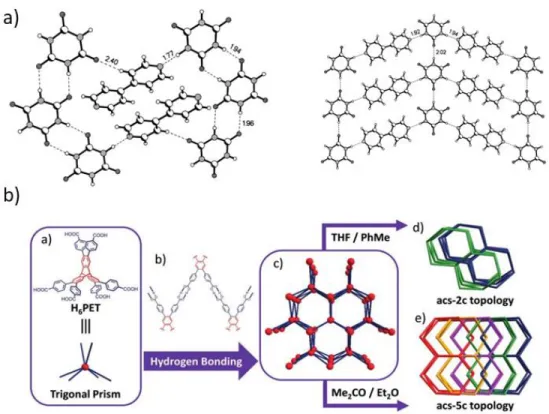
Isomerism is defined as “the existence of more than one type of network for the same molecular building blocks and therefore related to structural isomerism at the molecular level”.10 Isomerism has been commonly observed phenomenon, and play an important role in the crystal engineering. For instance, carboxylate can form 0D dimer and 1D “head-to-tail” infinite chain. On the contrary, the related 2D network structure, composing in the same nodes, has been reported by Rat et al, where the two kinds of hydrogen-bonding layers of cyanuric acid (CA) and 4,4’-bipyridyl (BP) was aligned in parallel direction in the crystal (Figure 1.4 a).11 Both of the two networks formed the cavities in the layer, while the size is different to each other due to the distinct hydrogen-bonding network. In case of 3D type isomerism, Li et al. reported two kinds of interpenetrated hydrogen-bonding frameworks, using a trigonal prismatic building block (H6PET); one is a two-fold interpenetrated structure of PETHOF-1 and the another is a five-fold interpenetrated one of PETHOF-2 (Figure 1.4 b).12
11
Figure 1.4. Isomerism of a) 2D layer structures of CA and BP 11 and b) 3D interpenetrated structures of PETHOF-1 and PETHOF-2.12
Isomerism of the supramolecular assembly also has a relationship with physical and chemical properties due to a different molecular assembly structure. The structural phase transition between the different isomers can be induced by the outer external stimuli such as photo, thermal, guest sorption, etc. In addition, these structural transformations are accompanied with a change in the porosity, affecting the energy band structure and also other physical properties. Therefore, the monitoring in the structural transition of the isomers enable us to design the distinct and multifunctional materials.
1-2-2 Solid and liquid crystal
Phase transition has been commonly observed phenomenon, which is a transformation of the thermodynamic system from one stable state to another one according to the G. The molecular assembly
12
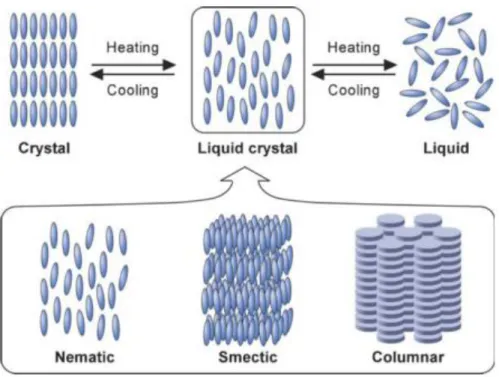
state of each phase can be simply classified into solid, liquid crystal, and isotropic liquid, differing by the degree of the molecular order in the condensed phase. In solid, each molecule is highly ordered and aligned regularly with positional and orientational ordering. On the contrary, intermediate liquid crystal phase between solid and liquid ones can show a unique property with long-range anisotropic ordering with highly fluidic behaviour. Depending on the arrangement of liquid crystal molecules, liquid crystalline phases have been classified as nematic, smectic, and columnar phases (Figure 1.5).13 Rod-like molecules usually formed the nematic and/or smectic phases, while disk-like molecules tend to form columnar phase. In liquid, the intermolecular interaction is short-range with the disordered thermal motion, resulting in highly fluidity and isotropic optical property. Therefore, the difference in the molecular order determine the physical properties and application in the material science.
13
Crystal engineering is defined as “the understanding of intermolecular interactions in the context of crystal packing and in the utilization of such understanding in the designing new solids with desired physical and chemical properties”.14 In solid, the arrangement of each molecule is highly ordered and a study on the crystal structure can provide a useful insight into the intermolecular interaction between the building synthons, which also help us to predict and control the molecular arrangement. On the contrary, the relationship between the molecular arrangement and physical properties is one of the useful designing strategies for the functional solid materials.
Moreover, the dynamic motion of molecules in the solid state provides new idea for developing in the functional materials. The supramolecular cation of a m-fluoroanilinium+ and crown-ether formed dynamic structure in the metal – coordination π-planar molecule of [Ni(dmit)2]-, where the polar cation showed the flip-flop rotation under the external electric field and also indicated the ferroelectric response (Figure 1.6).15
Figure 1.6. Dynamic 180o flip-flop motion in crystalline state and temperature-dependent dielectric constant of (m-fluoroanilinium+)(dibenzo[18]crown-6)[Ni(dmit)2].15
14
The study on molecular assembly structure in liquid crystal state is usually more difficult due to no exact structural data, whereas liquid crystalline state has a great potential for the development of functional materials based on their dynamic and partially ordered assembly states, to fabricate ferroelectrics, ionic conductor, and so on. Because the magnitude of intermolecular interaction in liquid crystal is lower than those in solid state, the molecular motion is much easily activated and designed form the viewpoint of supramolecular chemistry. For instance, hydrogen-bonding
N,N’,N’’-tri(tetradecyl)-1,2,3-benzentricrboxamide (3BC) has a simple molecular structure and shows a liquid crystal state of discotic hexagonal columnar (Colh) phase (Figure 1.7).16 The application of electric field along the columnar direction resulted in the spontaneous polarization due to the parallel arrangement of the intermolecular amid-type hydrogen-bonding interaction, which induced the ferroelectric P-E hysteresis loop.
15
Figure 1.7. POM image of Colh phase, illustration of ferroelectric dipole inversion along the 1D amide-type polar hydrogen-bonding network, and 1D -stacking of 3BC and corresponding ferroelectric P-E hysteresis curve.16
16
1-3. Functions of hydrogen-bonding molecular assemblies
1-3-1 Selective sorption property and hydrogen-bonding porous material
The development of selective molecular sorption materials is an important subject not only in academic research but also in industry. The separation technology is a key element in the production of purification and selection, which usually accounted a large amount of product costs.17 Porous materials such as zeolite, activated carbon, carbon molecular sieves have been widely used for the selective sorption materials, and played an important role in our life.
Figure 1.8. Illustration of ethylene gas purification based on porous material.18
The selective molecular adsorption has been achieved by matching size, shape, and binding preferences of the guest molecules for the host framework. The kinetic separation with respect to the size and shape of the sorption molecules required both the rigid and periodic structures with uniform pores. On the contrary, the thermodynamic guest separation with respect to the binding preference is originated in the host-guest intermolecular interaction such as van der Waals, hydrogen bond, and π-π interactions, at the preferred molecular binding sites. Among these, hydrogen-bonding interaction is one of the most widely applied non-covalent intermolecular interaction, due to its mediate strength and diverse synthons. Therefore, selection of the suitable functional group enables us to design the controllable host-guest
17
interaction and high selectivity for the molecular adsorption. The host and guest molecules are easily separated to each other and reversibly activated to reproduce. For instance, Wang et al. reported a 2,4-diamio-triazine (DAT)-derived HOF of (TDTTB)·(H2O)2·3(DMSO) (HOF-9) containing un-bounded amine groups, exhibiting highly selective reorganization for pyridine (Py) over BTX aromatic compounds (BTX refers benzene, toluene and o-, m-, and p-xylene) (Figure 1.9).19 Pyridines were occupied at the pore space through the effective host-guest hydrogen-bonding interactions between Py and the amine groups of TDTTB, inducing a selectivity binding Py molecule.
Figure 1.9. Crystal structure of HOF-9 and selective Py sorption. a) Packing diagram of HOF-9 viewed along the a axis, showing the 1D pores. b) Scheme illustration of HOF-9, and c) hydrogen-bonding interaction between Py and HOF-9.19
18
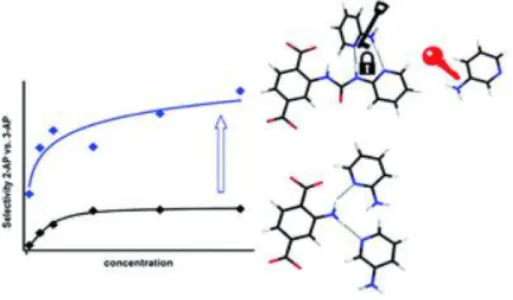
On the contrary, the hydrogen-bonding motif affects the molecular selectivity. Wittmann and co-workers reported the two kinds of MOFs; MIL-101 bearing 2-pydidyl urea (URPy) groups with hydrogen-bonding donor-donor-acceptor (DDA) patterns and MIL-101-NH2 bearing amino groups with a single donor (D) pattern (Figure 1.10).20 Compared with the single D site, the selectivity of 2-aminopyridine (2-AP) and 3-aminopydridine (3-(2-AP) of MIL-101 was five factor enhanced for the DDA pattern. 2-AP could be adsorbed at the URPy groups via double hydrogen-bonding interactions, while 3-AP was equally attracted by a single hydrogen-bonding interaction. The arrangements of the former double-bonding for 2-AP was much effective approximately 30 kJ mol-1 in contrast with the single-bonding one for 3-AP. Therefore, the introducing the multiple hydrogen-bonding interaction motifs enhanced the selectivity foe targeted guest molecules via the key-and-lock principle of supramolecular chemistry.
Figure 1.10. Illustration of the different sorption behaviour between MIL-101 and MIL-101-NH2.20
Microporous materials such as zeolite, MOF, and COFs had the rigid channels and/or pores. Hydrogen-bonding porous materials usually have lower thermal stability and easily collapses during the
19
guest absorption-desorption process.21 On the contrary, these HOF had structural flexibility to provide a possible next-generation sorption materials.
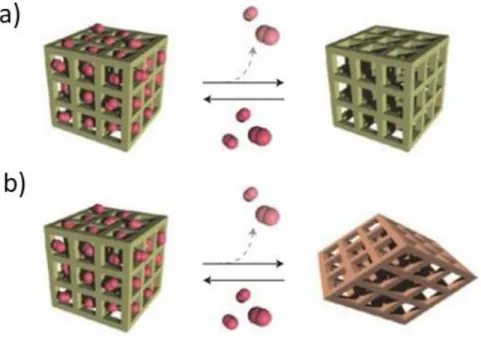
As a development of porous material, the porosity of materials classified two types of conventional porosity and soft porosity.22 The first conventional porosity was observed in the rigid materials such as zeolite, where the original pores were maintained before and after the guest sorption. The latter soft porosity indicates both the flexible and dynamics, where reversible sorption behaviour was observed in the existence of the external stimuli.23 Kitagawa characterized these dynamic processes as either guest-induced crystal to amorphous transformations, in which the framework collapses on guest removal. The guest-induced crystal-to-crystal transformations, in which removal of the guests induces a structural change with retaining crystallinity. For instance, flexible coordination framework can be rotated around a single bond, stretched around connector, and linked to form bond formation and cleavage, or undergo slip and glide motions.24
Figure 1.11. Illustration of two different types of sorption materials. a) Conventional rigid pore and b) flexible pore.24
20
Recently, there has been interested in pure organic porous systems. In contrast with MOFs, COFs, and other inorganic materials, HOFs can also achieve diverse functions by organic synthesis of the hydrogen-bonding ligands and its self-assembly process. In the absence of metal, pure organic framework shows a good performance from the viewpoint of environmentally friendly and structural diversity. For instance, organic molecular system such as pillararenes and bis-urea macrocycles can form 1D channel-type pore, showing intrinsic and conventional porosity.25-26 The introduction of functional groups such as proton transportation and gas separation has a potential to form multi-functionality.27 Dimeric pillar[5]arene derivate, reported by Hou and co-workers, was a fist example of the synthetic water-wire-based proton channels, where the protons can be transported though water in the pillar[5]arene backbones.28
However, fabrication of the soft organic porous materials is rarely reported at present. One typical example has been reported by Wang and co-workers, where the 3D hydrogen-bonding framework (HOF-5 and HOF-(HOF-5a) with different pore volume indicated the different selectivity for guest molecules with high flexibility (Figure 1.12).9 In contrast with the ionic interaction, the hydrogen-bonding interaction has much lower binding energy, which increases the flexibility of hydrogen-bonding framework and easily collapsed the assembly structures. Therefore, the development of soft hydrogen-bonding molecular sorption framework is still in a challenging research target, where a balance between the structural strength and flexibility is one of the key point to form suitable synthons and structural design.
21
Figure 1.12. Flexible HOF-5 and HOF-5a and guest inclusion into HOF-5a.9
1-3-2 Proton conductivity
Proton transport has been commonly observed phenomenon in biological system due to dominate the energy conversion in living cell. For instance, the maintenance and alteration of intracellular pH for initiation of specific cellular events depends on the proton transportation.29 On the contrary, the proton transport also plays an important role in fuel cell application. As the increasing in problems about urban air, energy security, and climate change, the development of high performance fuel cell devices has been attracted much attention recently (Figure 1.13a).30 The ability of proton conductor directly associated with the performance of fuel cell devices. Therefore, a development of high-performance proton conductor and a understanding in the proton transport mechanism are quite essential point of view to be solved becoming urgent. Many kinds of inorganic and organic materials have been utilized as proton conductors. For
22
instance, organic polymer of Nafion (Figure 1.13b), a ionic polymer with sulfonate groups, has been the most widely utilized proton conducting organic material due to its excellent thermal and mechanical stability and high proton conductivity around 0.2 S cm-1.
Figure 1.13. a) Illustration of fuel cell and b) molecular strutrue of Nafion.
Proton transport behaviour is closely associated with the hydrogen-bonding structures. There have been reported in two typical mechanisms to explain the proton transport: Vehicle-type and Grotthuss-type proton transport (Figure 1.14a).31 In the former Vehicle-type mechanism, proton conduction occurred on the diffusion and migration of the proton carriers.32 In the latter Grotthuss-type mechanism, the proton transport along hydrogen-bonding chain occurred at hopping and/or tunnelling processes of the proton transport from one to the nearest-neighbouring sites.33 A large number of researches has been reported to clarify the proton conducting mechanism. Gui and co-workers reported a robust inorganic coordination polymer of (NH4)3[Zr(H2/3PO4)3)], consisting of the 1D hydrogen-bonding chain of acid-base pairs (N-H···O-P), which lead to a stable and good proton conductivity of 1.45×10⁻³ S cm-1 (Figure 1.14b).34 The first-principles and quantum molecular dynamics simulation visualized the unique proton transport pathway involving efficient proton exchange between NH4+ and phosphate pairs. This result indicated that it is essential to consider the hydrogen-bonding fluctuations as well as the structure of hydrogen-bonding
23 networks.
Figure 1.14. a) Mechanism of proton transport.31 b) Proton transport in the (NH4)3[Zr(H2/3PO4)3)].34
Depending on the method of generate the carriers, the proton conductors could be classified into two types, one is the inherent type and the other is post loading one. In the latter post loading type, proton carriers such as water and acidic proton of imidazole were encapsulated into pore materials such as MOF, COF, and polymer, and so on, which proton conductivity was reached at quite high around 10-1 S cm-1, similar to that of Nafion, has been recently fabricated to work even under the low-temperature and high-humidity conditions. For instance, Yang has reported a proton conductive system based on MOF with the 1D channel, where high-density acidic sulfonic acid groups were arranged on the channel surfaces for suitable proton conduction. The proton conduction pathways mediated by water molecules increased the magnitude of proton conductivity up to 1.27×10⁻¹ S cm-1 at 100 % RH and 80 oC (Figure 1.15a).35 In the former inherent type, the concentration of proton carrier was fixed. Steininger and co-workers utilized poly(vinyl phosphoric acid) (PVPA) based proton conductor with a conductivity of 10-3 S cm-1 at150 oC under relatively dry condition (Figure 1.15b).36 The relatively weak intermolecular interactions between
24
the host and proton carrier lead to a higher proton conducting environment in post loading type. The loss on proton carrier under harsh working condition reduced the stability of the material and limited the application for fuel cell. Therefore, it is still challenging research targets to develop an appropriate molecular system both possessing in high proton conductivity and high chemical stability.
Figure 1.15. a) Post loading type prootn condutor based on MOF using water carrier.35 b) Intrinsic proton conductor based on PVPA, relying protons on the synthesized phosphoric acid. 36
The performance of proton conductor is also highly associated with assembly structures of the materials. The highest proton conductivity has been observed in ionic liquid, liquid crystal, plastic crystal and other soft materials, in which weak and/or intermediate magnitude of hydrogen-bonding interactions played a significant role. For instance, ionic liquid of [dema][TfO] exhibits rather high proton conductivity up to 50 S cm-1 at150 oC and showed high value of 10 S cm-1 even at room temperature.37 On the contrary, the development of crystalline proton conductor has been attracted much attention due to suitable hydrogen-boding design and clarification of conduction mechanism and designing strategy of high proton conductor. The uniform hydrogen-bonding network structure increased the proton conductivity, which has been systematically examined in the hydrogen-bonding frameworks of (Haloanilinium)(H2PO4)
25 crystals (Figure 1.16). 38
Figure 1.16. Illustration of hydrogen-bonding framework in (Haloanilinium)(H2PO4) crystals and its proton conductivity. 38
1-3-3 Ionic conductivity
Ionic transportation has been also commonly observed phenomenon in various kinds of fields such as secondary batteries and biological system. One of the most important applications of the ionic conductors is a utilization in the electrolytes in secondary battery applications. Ions can transport through the electrolyte with maintaining the total charge balance, where the electrical energy can be generated in the external electronic circuit. At present, gel electrolytes have been widely utilized in commercial batteries due to their high ionic conductivity up to 10-3 S cm-1 at room temperature. However, the intrinsic drawback process (solvent is slowly evaporated) becomes one of the big malfunction problem. To overcome this, the development of solvent-free solid electrolyte has been progressed. The use of liquid crystalline self-assembled materials is one of such promising candidates for the development of solvent-free electrolytes. The segmental motions in the molecular scale endows the ions with enhanced the magnitude of transport, and the ordered structures on the nanometre scale imparts mechanical strength.39 There have been some liquid crystalline molecules reported so far in the real application of secondary battery. For instance, the
26
2D layered molecular assembly of the mixture of carbonate derivate and lithium salts is successfully system as an electrolyte in lithium-ion batteries, where the reversible charge-discharge processes for both the positive and negative electrode materials has been successfully achieved (Figure 1.17).40
Figure 1.17. Schematic illustration of the application of liquid crystalline ion conducting materials in lithium-ion battery. a) Molecular structure, and b) construction of lithium battery cell.40
One challenging research target to develop new ionic conductor is to improve the conductivity. The liquid crystalline materials have viscous and dynamic molecular assembly. Therefore, the diffusion of ionic salts plays an important role to increase the conductivity, where the ionic conductivity was improved from 10-5 to 10-4 S cm-1 by the addition of propylene carbonate (PC) into the zwitterionic liquid crystal and lithium bis(trifluoromethylsulfonyl)imide (LiTFSI). The incorporating PC worked as a polar additive to enhance the dissociation of LiTFSi by the aid of the ion-dipole interaction (Figure 1.18).41
27
Figure 1.18. Illustration of ionic conductivity enhanced by the self-assembly of a zwitterionic liquid crystal.41
Another challenging research target is selective ionic transport. Several types of the 1D channels have been construct for the selective transport system. The combination of crown-ethers bearing mesogenic groups has been particular utilized for fabricating the ion-selective transport channels based on the selective metal complexation behaviour. 18-diaza-crown-ether derivative bearing p-cyanobiphenyl decylalkoxy chains and its ion adducts showed the enantiotropic liquid crystalline phase, displaying a nematic mesophase. In this system, the improvement in the ionic conductivity was achieved ten times using Li+ ions instead of much larger K+ one due to the smaller activation energy to dissociate M+ -crown-ether electronic interaction (Figure 1.19).42
28
Figure 1.19. a) Structure of functional macrocycle and b) the ionic conduction pathway through the cavity of crown-ethers.42
29
1-4. Exploration and development of supramolecular materials
Supramolecular chemistry enable us to develop bulk functional materials such as MOF, COF, HOF, organogels, and biological materials for medical applications. It is worth noted that the supramolecular assemblies are a straightforward useful technique to design the functional materials such as porous material, self-healing material, ionic conducting material, optical material, and so on. The molecular design is essential in the range from nanoscale, microscale, to macroscopic level.43 For instance, the hydrogen-bonding interaction can directly associated with the nanoscale and macroscopic molecular assembly structures and its physical properties. On the contrary, it is also important to consider that the control in the formation of particular molecular assembly and physical property are still in a challenging research targets in the field of supramolecular chemistry and crystal engineering. An exploring of the synergy effect in the non-covalent weak intermolecular interactions has been traditionally considered in the self-assembly process by the use of the external fields. Another important research is a combination of supramolecular chemistry and biological one. 44
To design the functionality, single function in material is not enough to use under the complicated conditions. Therefore, the development of multi-functional material has a potential to design future functional materials, where different multi physical properties such as electrical, magnetic, optical properties coexisted to each other to response the outer stimuli.
Considering the above discussion, a functional supramolecular material is related with the design of molecular structure to determine the molecular assembly structure and/or phase transition behavior. Therefore, the study on the relationship between the molecular structure, molecular assembly, and physical properties is one of the important point of view for supramolecular chemistry to fabricate new molecular systems, as well as promising in materials scientists to consider the incorporation of ‘supramolecular’ tools to help them for the achievement of new materials. I also hope my work on
30
supramolecular materials and discovery of new phenomena could contribute to the exploration and development of the next generation material chemistry.
31
1-5. Research purpose of this thesis
Control in molecular arrangement in the assemblies plays an important role to develop functional molecular materials with useful chemical and physical performances. For instance, physical materials including ferroelectricity and ionic conductivity has been reported, where subtle change in the molecular structure was able to result in different assembly arrangements and further affected the physical properties significantly. On the contrary, it is generally difficult to control and predict the molecular arrangement in precise, and the molecular assembly structure has been affected by a large number of intermolecular interactions. For instance, the hydrogen-bonding assemblies have various types of intermolecular interaction at –OH, -NH2, -CN, -F sites, where the number, direction, and strength of the hydrogen-bonding groups are able to affect the molecular assembly structures. In addition, the molecular assembly condition during the growth and crystallization processes played an essential role to form polymorph and different physical properties. Therefore, study on the control in molecular arrangement has attracted much attention in the material science fields such as crystal engineering and supramolecular chemistry. Furthermore, the development of functionally chemical and physical materials based on dynamic supramolecular assemblies is under expectation to examine much more.
In the present thesis, I tried to attempt for fabricating the functional organic supramolecular materials with highly designable molecular structure and control in the molecular assembly. In addition, the correlation between the physical properties and molecular arrangement was evaluated in detail to help me further improve the material performance.
In Chapter 2, a research entitled in “Reversible Channel-Layer Structural Transformation of Hydrogen-Bonding Bis-Urea Macrocycle” was carried out. One-dimensional (1D) tubular channel has been utilized for various applications such as selective ionic transportation. Since the 1D transport system has both the directionality and anisotropy, artificial channel has been attracted much attention. A large
32
number of synthetic approaches have been reported in fabrications of artificial 1D channels based on polymeric, hydrogen-bonding, macrocyclic, van der Waals molecules. On the contrary, the magnitude of hydrogen-bonding interaction is suitable for utilization of a reversible structural transformation by the outer stimuli, such as pressure, photo-irradiation, guest molecular sorption, and so on. The reversible structural transformation is an important for sensing and memory applications. However, it’s difficult to control the structural transformation in precision to design functional physical application. Therefore, I focused on a kind of hydrogen-bonding bis-urea macrocycle derivative, which can form diverse molecular assembly structures according to the external stimuli such as thermal treatment and guest molecules. Through clarifying the relationship between structural arrangement and external stimuli, I tried to control the structural transformation between the structural isomers, and providing strategies for future multi-functional molecular sorption materials based on dynamic molecular assemblies.
In Chapter 3, research entitled in “Highly Proton Conducting Hydrogen-Bonding [(H2PO4−)(H3PO4)]∞ Networks supported by 2,2’-Diamino-bithiazolium in Crystals” was carried out. Highly proton conducting martials have been attracted much attention for the potential applications such as fuel cell and sensor devices. There are many approaches to design high proton conducting systems with hydrous and anhydrous system. Anhydrous and intrinsic conducting system without water is important material working under the wide temperature range and low humidity environment. Recently, organic acid-base crystalline salts become one of the candidate for designing highly proton conducting system. Design of suitable hydrogen-boding network can clarify the mechanism and a strategy of high proton conductivity. For instance, anisotropic conducting pathway was observed in the layered hydrogen-bonding molecular system, while uniform hydrogen-bonding network was able to increase the proton conductivity significantly. Therefore, proton-accepting 2,2’-Diamino-4,4-bithiazolium (2,4-DABT) and is structural isomer 2,2’-Diamino-5,5-bithiazolium (2,5-DABT) were utilized to synthesize organic acid-base
33
crystalline conductor mixed with proton-donating phosphoric acid. Diverse high-quality single crystals were obtained containing a variety of hydrogen-bonding frameworks under related crystallization conditions. The relationship between hydrogen-bonding networks and proton conductivity was evaluated, providing insight for designing hydrogen-bonding network structure to form super-protonic conductors in the anhydrous organic acid-base salts.
In chapter 4, research entitled in “Hydrogen-Bonding Ionic Channel of Dibenzo[18]crown-6 Derivative in Ferroelectric Liquid Crystalline Domain” was carried out. A large number of studies on liquid crystalline and ionic conductive materials has been reported, whereas a material design of highly ionic conductive liquid crystal is one of the hard tasks even in columnar liquid crystal especially in relatively large size potassium cation. I focused on dibenzo[18]crown-6-ether derivative bearing alkylamide chains (crown ether 1) as a candidate of liquid crystalline ionic conductor. Due to the effective bonding interaction at terminal –N-H···O= sites of long alkylamide chains, the hydrogen-bonding molecule 1 was expected to form the 1D columnar liquid crystal phase. Diverse kinds of alkali metal ions were tried to complex with crown ether 1 to study the effect on the phase transition behaviour and ionic conductivity. Crown ether 1 was mixed with liquid crystalline N,N’,N’’-tris(tetradecyl)-1,3,5-benzenetricrboxamide (3BC), which show ferroelectric response to external electric fields. A new kind of multi-functional material combining with ionic conductivity and ferroelectric response was one of my research target in the present thesis.
Finally, I summarized a strategy for constructing the hydrogen-bonding functional molecular assembly and to clarify the mechanism, which will help us to develop further next-generation functional molecular materials.
34
1-6. References
1. Głowacki, E. D.; Irimia-Vladu, M.; Bauer, S.; Sariciftci, N. S., Hydrogen-Bonds in Molecular Solids – from Biological Systems to Organic Electronics. Journal of Materials Chemistry B 2013, 1, 3742. 2. Aakeröy, C. B.; Panikkattu, S.; Chopade, P. D.; Desper, J., Competing Hydrogen-Bond and Halogen-Bond Donors in Crystal Engineering. CrystEngComm 2013, 15, 3125-3136.
3. Aakeröy, C. B.; Seddon, K. R., The Hydrogen Bond and Crystal Engineering. Chemical Society
Reviews 1993, 22, 397-407.
4. Steiner, T., The Hydrogen Bond in the Solid State. Angewandte Chemie International Edition 2002,
41, 48-76.
5. MacLeod, J. M.; Rosei, F., Directed Assembly of Nanostructures. Comprehensive Nanoscience
and Technology 2011, 3, 13-68.
6. Lin, R. B.; He, Y.; Li, P.; Wang, H.; Zhou, W.; Chen, B., Multifunctional Porous Hydrogen-Bonded Organic Framework Materials. Chem Soc Rev 2019, 48, 1362-1389.
7. Hutchins, K. M., Functional Materials Based on Molecules with Hydrogen-Bonding Ability: Applications to Drug Co-Crystals and Polymer Complexes. R Soc Open Sci 2018, 5, 180564.
8. Maly, K. E.; Maris, T.; Wuest, J. D., Two-Dimensional Hydrogen-Bonded Networks in Crystals of Diboronic Acids. CrystEngComm 2006.
9. Wang, H.; Li, B.; Wu, H.; Hu, T. L.; Yao, Z.; Zhou, W.; Xiang, S.; Chen, B., A Flexible Microporous Hydrogen-Bonded Organic Framework for Gas Sorption and Separation. J Am Chem Soc 2015, 137, 9963-70.
10. Moulton, B.; Zaworotko, M. J., From Molecules to Crystal Engineering: Supramolecular Isomerism and Polymorphism in Network Solids. Chemical Reviews 2001, 101, 1629-1658.
35
11. Ranganathan, A.; Pedireddi, V. R.; Sanjayan, G.; Ganesh, K. N.; Rao, C. N. R., Sensitive Dependence of the Hydrogen-Bonded Assemblies in Cyanuric Acid–4,4′-Bipyridyl Adducts on the Solvent and the Structure of the Parent Acid. Journal of Molecular Structure 2000, 522, 87-94.
12. Li, P.; Li, P.; Ryder, M. R.; Liu, Z.; Stern, C. L.; Farha, O. K.; Stoddart, J. F., Interpenetration Isomerism in Triptycene-Based Hydrogen-Bonded Organic Frameworks. Angew Chem Int Ed Engl 2019,
58, 1664-1669.
13. Kato, T.; Hirai, Y.; Nakaso, S.; Moriyama, M., Liquid-Crystalline Physical Gels. Chem Soc Rev 2007, 36, 1857-67.
14. Desiraju, G. R., Crystal Engineering : The Design of Organic Solids; Elsevier: Amsterdam; New York, 1989.
15. Akutagawa, T.; Koshinaka, H.; Sato, D.; Takeda, S.; Noro, S.-I.; Takahashi, H.; Kumai, R.; Tokura, Y.; Nakamura, T., Ferroelectricity and Polarity Control in Solid-State Flip-Flop Supramolecular Rotators.
Nature Materials 2009, 8, 342.
16. Shishido, Y.; Anetai, H.; Takeda, T.; Hoshino, N.; Noro, S.-i.; Nakamura, T.; Akutagawa, T., Molecular Assembly and Ferroelectric Response of Benzenecarboxamides Bearing Multiple −Conhc14h29 Chains. The Journal of Physical Chemistry C 2014, 118, 21204-21214.
17. Van de Voorde, B.; Bueken, B.; Denayer, J.; De Vos, D., Adsorptive Separation on Metal-Organic Frameworks in the Liquid Phase. Chem Soc Rev 2014, 43, 5766-88.
18. Qazvini, O. T.; Babarao, R.; Shi, Z. L.; Zhang, Y. B.; Telfer, S. G., A Robust Ethane-Trapping Metal-Organic Framework with a High Capacity for Ethylene Purification. J Am Chem Soc 2019, 141, 5014-5020.
36
19. Wang, H.; Wu, H.; Kan, J.; Chang, G.; Yao, Z.; Li, B.; Zhou, W.; Xiang, S.; Cong-Gui Zhao, J.; Chen, B., A Microporous Hydrogen-Bonded Organic Framework with Amine Sites for Selective Recognition of Small Molecules. Journal of Materials Chemistry A 2017, 5, 8292-8296.
20. Wittmann, T.; Tschense, C. B. L.; Zappe, L.; Koschnick, C.; Siegel, R.; Stäglich, R.; Lotsch, B. V.; Senker, J., Selective Host–Guest Interactions in Metal–Organic Frameworks Via Multiple Hydrogen Bond Donor–Acceptor Recognition Sites. Journal of Materials Chemistry A 2019, 7, 10379-10388. 21. Dewal, M. B.; Lufaso, M. W.; Hughes, A. D.; Samuel, S. A.; Pellechia, P.; Shimizu, L. S., Absorption Properties of a Porous Organic Crystalline Apohost Formed by a Self-Assembled Bis-Urea Macrocycle. Chemistry of Materials 2006, 18, 4855-4864.
22. Barbour, L. J., Crystal Porosity and the Burden of Proof. Chem Commun (Camb) 2006, 1163-8. 23. Roy, K.; Wibowo, A. C.; Pellechia, P. J.; Ma, S.; Geer, M. F.; Shimizu, L. S., Absorption of Hydrogen Bond Donors by Pyridyl Bis-Urea Crystals. Chemistry of Materials 2012, 24, 4773-4781. 24. Kitagawa, S.; Kitaura, R.; Noro, S., Functional Porous Coordination Polymers. Angew Chem Int
Ed Engl 2004, 43, 2334-75.
25. Jie, K.; Zhou, Y.; Li, E.; Li, Z.; Zhao, R.; Huang, F., Reversible Iodine Capture by Nonporous Pillar[6]Arene Crystals. J Am Chem Soc 2017, 139, 15320-15323.
26. Shimizu, L. S.; Salpage, S. R.; Korous, A. A., Functional Materials from Self-Assembled Bis-Urea Macrocycles. Acc Chem Res 2014, 47, 2116-27.
27. Xue, M.; Yang, Y.; Chi, X.; Zhang, Z.; Huang, F., Pillararenes, a New Class of Macrocycles for Supramolecular Chemistry. Acc Chem Res 2012, 45, 1294-308.
28. Si, W.; Chen, L.; Hu, X. B.; Tang, G.; Chen, Z.; Hou, J. L.; Li, Z. T., Selective Artificial Transmembrane Channels for Protons by Formation of Water Wires. Angew Chem Int Ed Engl 2011, 50, 12564-8.
37
29. Ives, H. E.; Rector, F. C., Jr., Proton Transport and Cell Function. J Clin Invest 1984, 73, 285-90. 30. Asensio, J. A.; Sanchez, E. M.; Gomez-Romero, P., Proton-Conducting Membranes Based on Benzimidazole Polymers for High-Temperature Pem Fuel Cells. A Chemical Quest. Chem Soc Rev 2010,
39, 3210-39.
31. Ueki, T.; Watanabe, M., Macromolecules in Ionic Liquids: Progress, Challenges, and Opportunities. Macromolecules 2008, 41, 3739-3749.
32. Zuo, Z.; Fu, Y.; Manthiram, A., Novel Blend Membranes Based on Acid-Base Interactions for Fuel Cells. Polymers 2012, 4, 1627-1644.
33. Miyake, T.; Rolandi, M., Grotthuss Mechanisms: From Proton Transport in Proton Wires to Bioprotonic Devices. J Phys Condens Matter 2016, 28, 023001.
34. Gui, D., et al., Unique Proton Transportation Pathway in a Robust Inorganic Coordination Polymer Leading to Intrinsically High and Sustainable Anhydrous Proton Conductivity. J Am Chem Soc 2018, 140, 6146-6155.
35. Yang, F.; Xu, G.; Dou, Y.; Wang, B.; Zhang, H.; Wu, H.; Zhou, W.; Li, J.-R.; Chen, B., A Flexible Metal–Organic Framework with a High Density of Sulfonic Acid Sites for Proton Conduction. Nature
Energy 2017, 2, 877-883.
36. Steininger, H.; Schuster, M.; Kreuer, K. D.; Kaltbeitzel, A.; Bingol, B.; Meyer, W. H.; Schauff, S.; Brunklaus, G.; Maier, J.; Spiess, H. W., Intermediate Temperature Proton Conductors for Pem Fuel Cells Based on Phosphonic Acid as Protogenic Group: A Progress Report. Phys Chem Chem Phys 2007, 9, 1764-73.
37. Lee, S.-Y.; Ogawa, A.; Kanno, M.; Nakamoto, H.; Yasuda, T.; Watanabe, M., Nonhumidified Intermediate Temperature Fuel Cells Using Protic Ionic Liquids. Journal of the American Chemical
38
38. Yoshii, Y.; Hoshino, N.; Takeda, T.; Akutagawa, T., Protonic Conductivity and Hydrogen Bonds in (Haloanilinium)(H2po4) Crystals. The Journal of Physical Chemistry C 2015, 119, 20845-20854. 39. Cho, B.-K., Nanostructured Organic Electrolytes. RSC Adv. 2014, 4, 395-405.
40. Sakuda, J.; Hosono, E.; Yoshio, M.; Ichikawa, T.; Matsumoto, T.; Ohno, H.; Zhou, H.; Kato, T., Liquid-Crystalline Electrolytes for Lithium-Ion Batteries: Ordered Assemblies of a Mesogen-Containing Carbonate and a Lithium Salt. Advanced Functional Materials 2015, 25, 1206-1212.
41. Soberats, B.; Yoshio, M.; Ichikawa, T.; Ohno, H.; Kato, T., Zwitterionic Liquid Crystals as 1d and 3d Lithium Ion Transport Media. Journal of Materials Chemistry A 2015, 3, 11232-11238.
42. Conejo-Rodríguez, V.; Cuerva, C.; Schmidt, R.; Bardají, M.; Espinet, P., Li+ and K+ Ionic Conductivity in Ionic Nematic Liquid Crystals Based on 18-Diaza-Crown Ether Substituted with Six Decylalkoxy-P-Cyanobiphenyl Chains. Journal of Materials Chemistry C 2019, 7, 663-672.
43. Amabilino, D. B.; Smith, D. K.; Steed, J. W., Supramolecular Materials. Chem Soc Rev 2017, 46, 2404-2420.
44. Stupp, S. I.; Palmer, L. C., Supramolecular Chemistry and Self-Assembly in Organic Materials Design. Chemistry of Materials 2013, 26, 507-518.
39
§2. Reversible Channel-Layer Structural Transformation of
Hydrogen-Bonding Bis-Urea Macrocycle
40
2-1. Introduction
One-dimensional (1D) tubular channel has been utilized for the ion and/or molecular transport environment, where a coupled Na+-K+ ionic transports has been observed in biological molecular assembly structure.1–3 Since the 1D transport system has both the directionality and anisotropy, artificial ionic channel has been attracted much attention to fabricate passive and gated ionic transport system.4–6 A large numbers of synthetic approaches has been reported in fabrications of artificial 1D channels based on amphiphilic, polymeric, hydrogen-bonding, macrocyclic, van der Waals molecules.7–15 One simple and well-known low-molecular weight van der Waals crystal of tris(o-phenylenedioxy)cyclotriphosphazene (TPP) derivatives has been reported to form the 1D channel, where weak van der Waals interaction constructed the 1D channel in the closet-packing crystal structure.16–18 Since the energy of van der Waals interaction is quite low magnitude around 1~2 kJmol-1, van der Waals molecular assembly is easily dissociated by the outer stimuli such as temperature and ultrasonic energy.19 On the contrary, the hydrogen-bonding interaction with a range from 5 to 20 kJmol-1 has an adequate magnitude of energy range to control an association-dissociation process of the molecular assemblies using the outer stimuli.20– 28 For instance, complimentary base pairs in DNA and the secondary structures of proteins play an important role to fabricate the biological molecular assemblies, where the controllable hydrogen-bonding interactions have been utilized for the repair and reconstruction of the molecular assembly structures. 29– 31
Hydrogen-bonding interaction has been typically utilized for fabricating a 1D molecular tubular assembly. For instance, a simple benzene derivative of isophthalic acid can form a O-H•••O= hydrogen-bonding hexamer-ring assembly, and an introduction of one –CONH14H29 chain at 5-position generate a 1D tubular molecular assembly by the aid of inter-hexamer N-H•••O= amide-type hydrogen-bonding interaction along the -stacking direction of the hexamer-rings.32–35 Polypeptide derivatives also form the
41
1D tubular channel through the intermolecular N-H•••O= hydrogen-bonding interaction.36 These intermolecular hydrogen-bonding assemblies can be easily controlled in the association – dissociation process by the application of outer stimuli such as thermal and ultrasonic energies due to a suitable magnitude of the association energy for constructing and repairing the structures.37
Bis-urea macrocycle (1) has two hydrogen-bonding –NH-CO-NH- sites within a molecule, which can form the 1D tubular hydrogen-bonding molecular assembly by the aid of N-H•••O= hydrogen-bonding interactions.38–40 The single crystal X-ray structural analysis of 1•(AcOH) revealed a formation of the 1D tubular molecular assembly, and dimeric (AcOH)2 was introduced into the inside environment of the 1D channel to form a 1:1 host – guest complex. It should be noted that the reversible adsorption – desorption process of inner AcOH was observed in keeping in the 1D tubular channe.l39 A diameter of the vacant 1D channel around 1 nm enable to form the complex of 1-(2-cyclohexenone), where a photo-dimerization reaction has been tried inside the 1D channel.38
The magnitude of hydrogen-bonding interaction energy is suitable for a reversible structural transformation by the outer stimuli such as temperature, pressure, and molecular adsorption.21–28 Although the formations of host-guest complexes of 1 with AcOH has been structurally identified to form the hydrogen-bonding 1D channel, 39 other guest molecules with a variation of size, shape, and intermolecular interaction have been insufficiently examined form the viewpoint of the structural diversity for hydrogen-bonding network structures. Herein, I tried to fabricate the 1•(guest) complexes with a guest molecule of dichloroacetic acid (Cl2AcOH), pyrrole (Pyrr), pyridine (Py), and 3,4-difluoroaniline (F2Ani), 1,2-diaminoethane (EDA), 1,3-diaminopropane (ProDA), 1,5-diaminopentane (PenDA), and 1,7-diaminoheptane (HepDA) (Scheme 2.1). The molecular assembly structures, thermal properties, guest adsorption-desorption behaviors, and structural transformation were evaluated in the molecular assemblies of 1•(guest) complexes. A reversible structural transformation between the hydrogen-bonding
42
1D channel and 2D layer can be observed by the outer stimuli of thermal energy and guest adsorption-desorption processes.
Scheme 2.1. Molecular structures of host 1 and various guests.
2-2. Experimental section
2-2-1. Preparation of host-guest complexes.
Preparation of 1 was carried out by the condensation reaction of triazinanone and 4,4’ Oxybis (benzyl bromide) in dry THF according to the literature method.39 Anal. Calc. for C30H28N4O4 C 70.85, H 5.55, N 11.02; Found C 70.57, H 5.53, N 11.01. 1H NMR (400 MHz, DMSO-d6) δ 7.20 (8H, d), 6.89 (8H, d), 6.57 (4H, t), 4.20 (8H, d), 0.98 (8H, s) ppm. The host-guest molecular single crystals were obtained by the recrystallization of 1 from the corresponding solvents for Cl2AcOH, EDA, Pyrr, Py and F2Ani.
43
2-2-2. Physical measurement
General. Commercially available chemical reagents and solvents were used without further purification. The measurement of infrared (IR, 400-4000 cm−1) spectra was carried out on KBr pellets using a Thermo Fisher Scientific Nicolet 6700 spectrophotometer with a resolution of 4 cm−1. Thermogravimetric (TG) analysis was conducted using a Rigaku Thermo plus TG8120 thermal analysis station with an Al2O3 reference and a heating and cooling rate of 5 Kmin-1 under nitrogen. The host desorption from the 1•(guest) complexes was achieved by a heating of the corresponding crystals up to the guest desorption temperature based on the TG measurements. The re-adsorption process of the guest-free 1D channel of 1 was carried out in a sealed vial with a saturated vapour of the corresponding guest molecules at 300 K.
Crystal structure determination. Temperature dependent crystallographic data (Table 2.1) were collected using a Rigaku RAPID-II diffractometer equipped with a rotating anode, fitted with a multilayer confocal optic, using Cu K ( = 1.54187 Å) radiation from a graphite monochromator. Structural refinements were carried out using the full-matrix least-squares method on F2. Calculations were performed using Crystal Structure software packages. All parameters were refined using anisotropic temperature factors, except for those of the hydrogen atoms. Temperature dependent powder X-ray diffraction (PXRD) was measured by Rigaku SmartLab using Cu K ( = 1.54187 Å) radiation.
44
Table 2.1. Crystal Data, Data Collection, and Reduction Parameters.
1 1•(Cl2AcOH)2 1•(EDA)0.5 1•(Pyrr)2
Chemical formula C30H28N4O4 C17H16Cl2N2O4 C31H32N5O4 C19H18N3O2
Formula weight 508.58 383.23 538.62 320.37 Space group P21/c (#14) P21/n (#14) C2/c (#15) P21/c (#14) a, Å 12.0988(5) 10.3456(3) 23.7482(5) 10.8480(5) b, Å 12.7145(4) 9.7229(3) 13.0069(2) 18.3430(7) c, Å 8.7498(4) 17.5018(6) 18.3050(4) 8.8461(5) , deg - - - - , deg 103.930(3) 102.705(2) 99.2231(13) 107.097(3) , deg - - - - V, Å3 1306.40(9) 1717.39(10) 5581.14(19) 1682.45(13) Z 2 4 8 4 T, K 150 150 100 100 Dcalc, g∙cm-3 1.293 1.482 1.282 1.265 , cm-1 7.089 36.305 7.018 6.778 Reflections measured 14532 18822 30865 18810 Independent reflections 2360 3103 5044 3072 Reflections used 2360 3103 5044 3072 Rint 0.0426 0.0548 0.0383 0.0441 R1 a 0.0449 0.0493 0.0582 0.0467 Rall 0.0628 0.0551 0.0762 0.0554 Rw(F2) a 0.1497 0.1459 0.1752 0.1338 GOF 1.152 1.102 1.033 1.091
45
a R1 = ||Fo| - |Fc|| / |Fo| and Rw = ((|Fo| - |Fc|)2 / Fo2)1/2.
1•(Py)4 (1)•(F2Ani)2
Chemical formula C25H24N4O2 C21H19N3O2F2
Formula weight 412.49 766.79 Space group P21/c (#14) P-1 (#2) a, Å 13.4340(3) 9.1348(4) b, Å 17.9711(3) 10.9902(7) c, Å 9.00051(16) 11.0534(5) , deg - 73.962(3) , deg 97.6976(8) 66.6113(19) , deg - 66.908(2) V, Å3 2153.35(7) 927.29(8) Z 4 2 T, K 100 100 Dcalc, g∙cm-3 1.272 1.373 , cm-1 6.627 8.688 Reflections measured 24056 10007 Independent reflections 3918 3324 Reflections used 3918 3324 Rint 0.0366 0.0623 R1 a 0.0505 0.1191 Rall 0.0606 0.1522 Rw(F2) a 0.1435 0.3805
46
GOF 1.074 1.200
a R1 = ||Fo| - |Fc|| / |Fo| and Rw = ((|Fo| - |Fc|)2 / Fo2)1/2.
Sorption measurements. The adsorption and desorption isotherms for CO2 at 195 K and N2 at 77 K were measured with a BELSORP-Mini II automatic volumetric adsorption apparatus (BEL Japan, Inc.). Before the measurements, powder of 1•(AcOH) was heated at 393 K under a reduced pressure (<10-2 Pa) to remove all AcOH and surface-attached H2O molecules.
47
2-3. Results and Discussion
2-3-1. Formation and crystal structures of 1•(Guest)x Complex
Formation of 1•(Guest)x Complex. Bis-urea macrocyclic (1) itself forms the hydrogen-bonding 1D
tubular channel through the multiple N-H•••O= hydrogen-bonding interactions, where dimeric (AcOH)2 was introduced into the inside environment of the 1D tubular channel to form a 1:1 host-guest complex of 1•(AcOH). Herein, the crystal structures of the guest-filled and guest-free 1D channels are defined as S1 and S1’, respectively. I also obtained a various type of host-guest complexes of 1•(guest)x for Cl2AcOH, Pyrr, Py, F2Ani, and EDA by simple recrystallization from the corresponding guest solution. The formula of single crystals 1•(guest)x based on the X-ray crystal structural analyses were 1•(Cl2AcOH)2, 1•(Pyrr)2, 1•(Py)4, 1•(EDA)0.5, 1•(F2Ani)2, and 1•(EDA)0.5, whereas those of 1•(ProDA)2.5, 1•(PenDA)2.5, and 1•(HepDA)2.5 were obtained by the TG measurements (Figures 2.1a and 2.1b). Thermal stability of 1•(guest)x crystals depended on the magnitude of host-guest intermolecular interaction. Much lower intermolecular hydrogen-bonding interaction of 1 than the magnitude of host-guest one indicated the crystal melting or decomposition before the thermally induced guest desorption process. However, all the 1•(guest)x crystals showed the guest desorption process due to the weak host-guest intermolecular interaction.
Relatively high thermal stabilities up to 370 K were observed in guests of THF and Cl2AcOH, whereas a rapid weight-loss around 295 K was confirmed in a TG diagram of 1•(Py)4 due to quite weak host-guest
48
intermolecular interaction. On the contrary, gradual weight-losses around 320 K were observed in the heating process of 1•(AcOH), 1•(Pyrr)2, and 1•(EDA)0.5. Based on the guest desorption behaviors, the magnitude of intermolecular host-guest interaction increases in the order of THF, Cl2AcOH, AcOH ~ Pyrr, and Py. The magnitude of weight-loss for these host-guest complexes was consistent with the desorption of guest molecule. Diaminoalkane derivatives (NH2CnH2n+1NH2) with a different chain length of n = 2, 3, 5, and 7 indicated the different thermal stability in heating processes of the TG measurements (Figure 2.1b). The weight-loss of 27.2 % at 350 K was consistent with a formula of 1•(ProDA)2.5, whereas the formula of 1•(PenDA)2.5 and 1•(HepDA)2.5 were accordance with the magnitude of weight-loss of 34.7 and 41.2 % at 400 K, respectively. Although the single crystal X-ray structural analysis indicated a formula of 1•(EDA)0.5, the TG measurement supported the crystal 1:1 stoichiometry of 1•(EDA). Since the guest desorption of 1•(EDA), 1•(PenDA)2, and 1•(HepDA)2 started around 300 K, the thermal stability and magnitude of host-guest interaction of ProDA was approximately 50 K larger than those of EDA, PenDA, and HepDA. The phase transition behavior of 1•(guest)x crystals was not confirmed in the DSC measurements at the temperature range from 150 K to the guest desorption temperature, suggesting the static guest molecules within the crystals.
49
Figure 2.1. Thermal stability of the host-guest crystals 1•(guest)x. a) TG diagrams of 1•(AcOH), 1•(Cl2AcOH)2, 1•(Py)4, 1•(Pyrr)2, and 1•(THF)2. b) TG diagrams of 1•(EDA), 1•(ProDA)2.5, 1•(PenDA)2.5, and 1•(HepDA)2.5.
Crystal Structures. Much bulky Cl2AcOH than AcOH formed a host-guest complex of 1•(Cl2AcOH)2 by the recrystallization from Cl2AcOH solution. Figures 2.2a and 2.2b show the unit cells of 1•(Cl2AcOH)2 viewed along the a and b axis, respectively. Bulky Cl2AcOH in 1•(Cl2AcOH)2 did not form the hydrogen-bonding dimer and the 1D channel (Figure 2.2c). Although the van der Waals volumes of dimeric (AcOH)2 and Cl2AcOH were observed at 75.7 and 70.9 Å3, respectively, bulky guest of Cl2AcOH was not inserted into the macrocyclic pore of 1 and also 1D channel. Large size Cl2AcOH molecule existed at the upper and lower space on the macrocycle pore of 1, where the –COOH group of
50
Cl2AcOH formed the hydrogen-bonding interactions with dO-O = 2.519(3) and dN-O = 2.904(3) Å at urea units of 1. The herring-born arrangement of 1 was observed within the bc plane, and there was no effective intermolecular interaction between molecules 1 (Figure 2.2b). Much higher thermal stability of 1•(Cl2AcOH)2 than that of 1•(AcOH) was due to the formation of intermolecular host-guest hydrogen-bonding interaction and 85 K higher boiling point than that of AcOH.
Figure 2.2. Crystal structure of 1•(Cl2AcOH)2. Unit cells viewed a) along the a axis and b) along the b axis. c) CPK representations of Cl2AcOH (left) and (AcOH)2 dimer (right).
51
Crystal structure of host-guest complex of 1•(Py)4 was different from that of 1•(Cl2AcOH)2. Figures 2.3a and 2.3b show the unit cells of 1•(Py)4 viewed along the c and a axis, respectively. Each molecule 1 was arranged in the bc plane n through the 2D N-H•••O= hydrogen-bonding interactions with the nitrogen ~ oxygen (N~O) distance (dN-O) of 2.830(1) and 2.9330(1) Å. Therefore, the 2D hydrogen-bonding layer of 1 was confirmed in crystal 1•(Py)4, which was different form the 1D channel of 1•(AcOH). The dipole moment of guest Py molecules in the anti-parallel arrangement was canceled to each other with a filling in the 2D layer in the bc plane. The 2D layer of 1•(Py)2 was elongated along the a axis, and further two Py molecules were sandwiched between the host-guest 2D layers. The CPK representations of the unit cells (Py was omitted in Figures) viewed along the c and a axis revealed the formation of the 1D channel (right figures of Figures 2.3a and 2.3b). There was no effective intermolecular interaction for guest Py molecules, which lowered the thermal stability of 1•(Py)4 as shown in the TG measurement (Figure 2.1a) and indicated a rapid Py desorption around 300 K.
52
Figure 2.3. Crystal structure of 1•(Py)4. Unit cells viewed a) along the c axis and b) along the a axis. Right figures were the CPK representations of the unit cells. Hydrogen atoms were omitted for clarify.
53
Similar hydrogen-bonding 2D layer was observed in host-guest 1•(Pyrr)2 complex (Figure 2.4). Two molar of Pyrr were observed in the 2D layer similar to that of 1•(Py)4. However, there was no further interlayer Pyrr molecules. In the 2D hydrogen-bonding layer in 1•(Pyrr)2, the dN-O distances of 2.877(2) and 2.909(2) Å were similar to those in 1•(Py)4, suggesting the formation of similar 2D layer. Much larger guest molecule of F2Ani than Pyrr and Py also formed the 2D layer in 1•(F2Ani)2 (Figure 2.5), where the hydrogen-bonding interactions of dN-O = 2.82(1) and 2.93(1) Å connected molecules 1 within the ab plane. It should be noted that the 2D layer in 1•(F2Ani)2 became much uniform than those of 1•(Py)4 and 1•(Pyrr)2 due to the parallel orientation of the macrocycles 1. Polar F2Ani molecules formed the anti-parallel -dimer with an average − distance of 3.41 Å (Figure 2.5c), which were inserted into the 2D layer. The 2D layer was elongated along the c axis without the effective intermolecular interaction. The -planar guests such Py, Pyrr, and F2Ani formed the N-H•••O= hydrogen-bonding 2D layer instead of the 1D channel for guest of AcOH.
54
Figure 2.5. Crystal structure of 1 •(F2Ani)2. Unit cells viewed a) along the c axis, b) along the a axis, and c) − stacking of F2Ani.
Although the van der Waals volume (VvdW) of EDA molecule (VvdW ~ 65.7 Å3) is almost the same to that of (AcOH)2 dimer (VvdW ~ 75.7 Å3), the 1D channel is not observed in 1•(EDA)0.5. Figures 2.6a and 2.6b show the unit cells of 1•(EDA)0.5 viewed along the a and c axis, respectively. The EDA molecule on the inversion center was sandwiched by two macrocycles 1 at upper and lower side (Figure 2.6a) in the
55
absence of effective intermolecular interaction around EDA molecule, which was consistent with the low thermal stability of 1•(EDA)0.5 in the TG measurement (Figure 2.1b). Two upper and lower molecules 1 were connected by the intermolecular N-H•••O= hydrogen-bonding interactions with dN-O = 2.829(2) and 2.894(1) Å, and each dimer was further connected by the N-H•••O= hydrogen-bonding interaction along the c axis with dN-O =2.830(2) and 2.881(2) Å, forming the 2D dimeric layer. The monomeric 2D layers in 1•(Py)4, 1•(Pyrr)2, and 1•(F2Ani)2 were different from that of dimeric 2D layer in 1•(EDA)0.5.
Figure 2.6. Crystal structure of 1•(EDA)0.5. Unit cells viewed a) along the a axis and b) along the c axis. Hydrogen atoms were omitted for clarify.
![Figure 1.6. Dynamic 180 o flip-flop motion in crystalline state and temperature-dependent dielectric constant of (m-fluoroanilinium + )(dibenzo[18]crown-6)[Ni(dmit) 2 ]](https://thumb-ap.123doks.com/thumbv2/123deta/5897585.1048961/16.918.122.791.640.973/figure-dynamic-crystalline-temperature-dependent-dielectric-constant-fluoroanilinium.webp)