GENERATORS AND RELATIONS FOR THE MAPPING
CLASS GROUP OF THE
HANDLEBODY
OF GENUS 2SUSUMU HIROSE Department of Mathematics Fuculty of Science and Engineering
Saga University
INTRODUCTION
A handlebody ofgenus$g,$ $H_{g}$, is anorientable 3-manifold, which is constructed ffoma
3-ball with attaching$g1$-handles. Let $D_{\dot{i}}ff^{+}(H)g$ be thegroup oforientationpreserving diffeomorphisms on $H_{g},$ $\mathcal{H}_{g}$ be a groupwhich consists of isotopy classesof
$D_{\dot{i}}ff^{+}(H)g$
.
The groups $\mathcal{H}_{g}$are
interesting objects because of their relationships with Heegaardsplittings of3-manifolds and outer automorphism group offree groups. In this paper, we give a presentation of$\mathcal{H}_{2}$
.
Before we state this presentation, we set notations usedthere. We indicate an element of$Diff^{+}(H_{g})$ by figure like left hand side of Figure 1,
in this figure, the left hand side figure denotes an element given in the right hand side figure.
The $\mathrm{s}\mathrm{y}\mathrm{m}\mathrm{b}_{\mathrm{o}1}\Leftrightarrow \mathrm{m}\mathrm{e}\mathrm{a}\mathrm{n}\mathrm{s}$ commute with. If $L,$$M,$$N$ are any
elements of$\mathcal{H}_{g}$, a relation
$L\Leftrightarrow M,$ $N$ means that $LM=ML,$ $LN=NL$
.
In this paper,we
consider that thegroup $\mathcal{H}_{g}$ acting on $H_{g}$ from the right.
Theorem 1. Leta, $b,$ $c,$ $d,$ $t,$ $e,$ $f$ be the elements
of
$\pi_{0}(Diff^{+}(H_{2}))$ by the elementsof
$D_{\dot{i}}ff^{+}(H2)$ indicated in Figure 2. The group $\pi_{0}(Diff^{+}(H_{2}))$ admits a presentation with generators a, $b,$ $c,$ $d,$ $t,$ $e,$ $f$ and defining relations,–
$\pi-\mathrm{r}\mathrm{o}\mathrm{t}\mathrm{a}\mathrm{t}\mathrm{i}\mathrm{o}\mathrm{R}$ along the
indicated axis FIGURE 1 $\alpha$ $\mathrm{b}$ $\mathrm{c}$ $\tau$ $\mathrm{e}$ FIGURE 2
$e^{2}=f^{2}=1$, $fbfb^{-1}fb=ca^{-1}de,$$aba^{-}1b^{-}1=d^{22}c$, $dad^{-1}=d^{2_{C}2}a^{-},$$d1b-1d-1=d^{2}cb2$, $t-1bt=ba,$ $ftf=C-1,$$e=fd-1fd$, $c\Leftrightarrow a,$$b,$$d$, $e\Leftrightarrow a,$$b,$ $c,$$d,t,$$f$, $t\Leftrightarrow a,$$c,$$d$, $f\Leftrightarrow a^{-1}t,$ $d^{2}$
.
Contents are asfollows: insection 1, weset notations, and reviewmethod, by Brown,
to get a presentation of a group which act simplicially on a simply connected
CW-complex, and introduce a simply connected $\mathrm{C}\mathrm{W}$-complex where $\mathcal{H}_{2}$ acts. In section 2,
we obtain a presentation of subgroups of $H_{2}$ which is used to prove Theorem 1. In
section 3,
we
prove Theorem 1. In section 4,we
check this presentation by showingthat there is
a
surjection from $\mathcal{H}_{2}$ to $SL(2, \mathbb{Z})$ and injectionwhich is the inverse of thissurjection.
1. PRELIMINARIES
In this section,
we
set notations and review tools used in this paper.1. Notations. Let $X$ be any oriented manifold, and $K_{1},$
$\ldots$ ,$K_{n},$$K_{n+1}$ be subsets of
X. We introduce
a
notationas
follows,$Diff^{+}(X, K_{1}, \ldots, K_{n},rel(K_{n+1}))=$
.
For abbreviation,
we
denote $Diff^{+}(X, K_{1}, \ldots , K_{n}, rel(\emptyset))$ by $Diff^{+}(x, K_{1}, \ldots, K_{n})$,by $Diff^{+}(X)$
.
The set $D_{\dot{i}}ff^{+}(X, K_{1}, \ldots, K_{n}, rel(K_{n+}1))$ has a natural groupstruc-ture. In this paper, we consider that the group $D_{\dot{i}}ff^{+}(X, K_{1}, \ldots, K_{n}, rel(K_{n+}1))$ acts
on$X$fromtheright, thatis, for elements$\varphi_{1}$ and$\varphi_{2}$of$Diff^{+}(X, K_{1}, \ldots, K_{n}, rel(K_{n+}1))$,
$\varphi_{1}\varphi_{2}$ means that apply $\varphi_{1}$ first, and apply $\varphi_{2}$
.
The group $\pi_{0}(D_{\dot{i}}ff^{+}(X,$$K_{1},$$\ldots,$$K_{n}$,
$rel(K_{n+1})))$ consistsof the isotopy classesof$D_{\dot{i}}ff^{+}(X, K_{1}, \ldots, K_{n}, rel(Kn+1))$ and its
group law is induced from that of $Diff^{+}(X, K_{1}, \ldots, K_{n}, rel(K_{n}+1))$
.
Especially, wedenote $\pi_{0}(Diff^{+}(H_{g}))$ by $\mathcal{H}_{g}$
.
In this paper, we give apresentation of$\mathcal{H}_{2}$.
We denoteby $<a_{1},$ $\ldots.’ a_{n}|>\mathrm{a}.\mathrm{f}\mathrm{r}\mathrm{e}\mathrm{e}$ group generated by $a_{1},$ $\ldots,$$a_{n}$
.
2. Brown’s method [Br]. Let $G$ be a group, and $X$ be a simply connected
CW-complex on which $G$ acts as cellular homeomorphisms. We call this $X$ as simply
con-nected G-CW-complex. In this paper, we regard the action of $G$ as a right action. There is a method introduced by Brown [Br] to get a presentation of $G$ from asimply connected $G- \mathrm{C}\mathrm{w}_{-}\mathrm{C}\mathrm{o}\mathrm{m}_{\mathrm{P}}1\mathrm{e}\mathrm{X}$
.
In this subsection,we
review this method.At first, we need to introduce some notations and terminologies. For any
CW-complex $C$, a $0$-cell of $C$ is called a vertex. A 1-cell of $C$ with an orientation is called an edge. Any edge $e$ has an initial vertex $o(e)$ and a final vertex $t(e)$
.
The notation $\overline{e}$ denote the edgecorresponding to the same 1-cell as $e$ and whose orientationis oppositeto $e$
.
$V(C)$ denote the set of vertices of $C,$ $\Sigma(C)$ denote the set of 1-cells of $C$, and$E(C)$ denote the set of edges of $C$
.
Rom here to the end of this subsection, $X$ denote a $G- \mathrm{C}\mathrm{w}_{-}\mathrm{C}\mathrm{o}\mathrm{m}_{\mathrm{P}}1\mathrm{e}\mathrm{X}$
.
A 1-cell $\sigma$of $X$ is called inverted ifthere is an element $g$ of $G$ such that $\sigma g=\sigma$ and
reverse
theorientation of$\sigma$
.
The notation $\tilde{\Sigma}^{-}$denote thesetofinverted 1-cellsof$X$, and $\tilde{\Sigma}^{+}$
denote the set of non-inverted 1-cells of$X$
.
A simply conected $\mathrm{C}\mathrm{W}$-complex which consists of $0$-cells and 1-cells is called a tree. A subtree $T$ of$X$ is $\mathrm{c}\mathrm{a}\mathrm{l}\mathrm{l},\mathrm{e}\mathrm{d}$ a treeof
reprsentatives if $V(T)$ is the set ofrepresentatives of$V(X)/G$, and each element of$\Sigma(T)$ is an elementof $\tilde{\Sigma}^{+}$
.
A tree ofrepresentatives of$X$ is a ‘fundamental domain’ of the action of$G$ on
X. We can give an orientation for each element of $\tilde{\Sigma}^{+}$
the action of $G$
.
A subset $P$ of $E(X)$ given in the above manner, is called $\mathit{0}\dot{n}entat\dot{i}on$of $X$. Let $E^{+}$ be the set of representations of $P/G$ such that for each
$e\in E^{+}o(e)$ is
an
element of$E^{+}$ and for each 1-cell of$T$given proper orientation is anelement of$E^{+}$
.
Let $\Sigma^{+}$ be the set of 1-cells of $X$
which correspond to the elements of $E^{+}$
.
Let $E^{-}$be the set ofrepresentatives of$\Sigma^{+}/G\sim$ with
an
orientation such that for each$e\in E^{-}$,
$o(e)\in V(T)$
.
Let $\Sigma^{-}$ be the set of 1-cells of$X$ which correspond to theelementsof$E^{-}$
For each $e\in E^{+},$ $t(e)$ may not be an element of $V(T)$, but there is
one
and only one element of$V(T)$ in the orbit of$t(e)$ by the action of $G$.
We denote this vertexby $w(e)$.
Bythe definition of$w(e)$, there is at least one and not unique element $g_{e}$ of$G$such that $w(e)g_{e}=t(e)$. When $e\in E(T)$, we choose $g_{e}=1$. For any $g\in c_{t(e),ggg_{e}}e-1\in G_{w(e)}$
.
Hence, we can define isomorphism $c_{e}$ from $G_{t(e)}$ to $G_{w(e)}$ by $c_{e}(g)=g_{e}gg_{e}^{-1}$.
Anyelement of$G_{e}$ preserve$t(e)$, so we can naturally consider $G_{e}$ as asubgroup of$G_{t(e)}$
.
Wecan define in the natural way the injection from $G_{e}$ to $G_{w(e)}$, we denote this injection
also by $c_{e}$
.
For the sake of giving the presentation, we need to present $g_{e}gg_{e}^{-1}$ as anelement of $G_{t(e)}$ for each generator of $G_{e}$.
Each edge $\epsilon$ of $X$, such that $o(\epsilon)\in V(T)$, fall into the following three cases: (1) $\epsilon$
corresponds to a 1-cell in $\tilde{\Sigma}^{+}$
and there is an element $e\in E^{+}$, and an element $g\in G$
such that $eg=\epsilon,$ (2) $\epsilon$ corresponds to a 1-cell in
$\tilde{\Sigma}^{+}$
and there is an element $e\in E^{+}$,
and an element $g\in G$ such that $\overline{e}g=\epsilon,$ (3) $\epsilon$ corresponds to a 1-cell in
$\tilde{\Sigma}^{-}$
In these cases, $\epsilon$ is
as
indicated in the following figures.(1) $\phi \mathrm{t}\mathrm{J}\overline{\mathrm{e}R\prime-\epsilon}(4)@4*$ $(h\in G_{v}, e\in E+)$
(2) $\Lambda r\mathrm{J}\overline{\mathrm{e}}\mathrm{t}^{\overline{\mathrm{e}}^{1}}\mathit{4}_{\iota^{-}}-\epsilon 0\mathfrak{l}\mathrm{e}\tau_{7^{\overline{\mathrm{e}}}}|*$ $(h\in G_{w}, e\in E+)$
(3) $\wedge’\overline{\mathrm{e}^{\chi\underline{-}}\epsilon}’\iota)\mathrm{x}f_{(}$ ($h\in G_{v},$ $t\in E^{-},$ $t\in G_{\sigma}$ reverse the orientation of $\sigma$)
We can consider $\epsilon$ as a bridge between $T$ and $Tg$ for
some
$g\in G$.
The above figure indicates the way how to give this $g$ for each $\epsilon$.
In (1), $g=g_{e}h$, in (2), $g=g_{e}^{-1}h$,in (3), $g=th.$ Let $\alpha$ be a colsed path in $X$ such that whose base point
$V(T)$
.
We choosean
element $g_{\alpha}$ of $G$as
follows. This path isa sequence
of edges$e_{12n}^{\prime_{e\cdots e}}\prime\prime$
.
The firstone
$e_{1}’$ isan
edge such that $o(e_{1})/=v_{0}\in V(T)$,we can
obtainelements $v_{1}\in V(T),$ $g_{1}\in G$ such that $v_{1}g_{1}=t(e_{1})/$ in the above
manner.
The initialvertex of $e_{2}=e_{2}’g_{1}^{-}1$ is $v_{1}\in V(T)$
.
Hence, in thesame
way, wecan
obtain elements$v_{2}\in V(T),$ $g_{2}\in G$ such that $v_{2}g_{2}=t(e_{2})$
.
Thismeans
$t(e_{2}’)=v_{2}g_{2}g_{1}$.
We continuethis construction successively for other $e_{3}’’,$$e_{4},$ $\ldots$ and $e_{n}’$, then
we can
get a sequence$g_{1},g_{2},$$\ldots g_{n}$ of elements of $G$ such that $v_{n}gn\ldots g_{2}g_{1}=t(e_{n}’)$
.
In our situation,$\alpha$ is a
loop,
so
$v_{n}=v_{0}$.
Hence, $g_{\alpha}=g_{n}\cdots g_{2}g_{1}$ isa
element of $G_{v_{\mathrm{O}}}$.
Let$\hat{G}=()*v\in V^{*}(T)^{c_{v}}$
$(*c_{\sigma})*\sigma\in\Sigma-(*e\in E+<\hat{g}_{\epsilon}>)$
.
In the above construction, $g_{i}$ is aproduct of$g_{e},$ $t\in G_{\sigma}$ and
$h\in G_{v}$
.
The element $\hat{g}_{i}$ of$\hat{G}$ is given $\mathrm{h}\mathrm{o}\mathrm{m}g_{i}$ with replacing $g_{e}$ with $\hat{g}_{e}$
.
Let $F$ be theset ofrepresentatives of 2-cells of X modulo $\mathrm{G}$ such that, for each $\tau\in F,$ $\partial\tau$gothrough
$V(T)$
.
In the above way, we construct $\hat{g}_{\partial\tau}$.
By the following theorem,we
can obtain a presentation of$G$.
Theorem [Br]. In the above situation, $G$ is presented as$\hat{G}$
with the following relations:
(1)
for
$e\in E(T),\hat{g}_{e}=1$,(2)
for
each $e\in E^{+}$ and $g\in G_{e},\hat{g}_{e}i_{e}(g)\hat{g}_{e}^{-}1=c_{e}(g)$, where $i_{e}$:
$G_{e}arrow G_{o(e)}$ is theindusion and$c_{e}$ : $G_{e}arrow G_{w(e)}$ is the injection given above,
(3)
for
each $e\in E^{-}$ and$g\in G_{e},$ $i_{e}(g)=j_{e}(g)$, where $i_{e}$ : $G_{e^{\mathrm{e}}}arrow Go(e),$ $j_{e}$:
$G_{e}\mathrm{c}arrow G_{\sigma}$are inclusions,
(4)
for
each $\tau\in F,\hat{g}_{\partial\tau}=g_{\partial\tau}$.
$\square$3. The disk complex [Jo]. In this subsection, we introduce simply connected
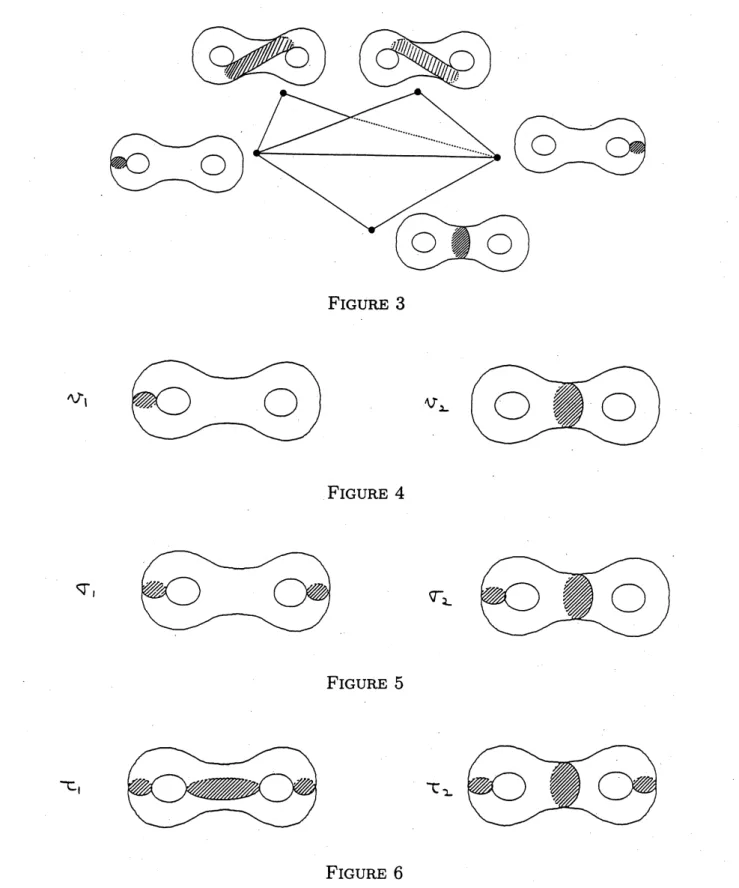
CW-complex, where the group $\mathcal{H}_{2}$ acts simplicially.
The disk complex $\Delta(H_{2})$ of $H_{2}$ is the simplicial complex whose $m$-simplices are
iso-topy classes of $(m+1)$-tuples $(D_{0}, D_{1}, \ldots, D_{m})$ of essential and pairwise non-isotopic
disjoint disks. In $H_{2}$, there is no
more
than three disks which definea
simplex. Hence,$\Delta(H_{2})$ is a 2-dimensional simp\‘iicial complex. By some cut and paste argument,
we
FIGURE 3 $\mathrm{A}f_{1}$ $\mathrm{u}_{\mathrm{L}}$ FIGURE 4 $\nabla_{1}$ $T_{\mathrm{L}}$ FIGURE 5 $\tau_{\mathrm{I}}$ $- \mathrm{c}_{\mathrm{L}}$ FIGURE 6
manifold, because, for each edges, there are more than three faces emanating from this
$\Theta_{-}$
.
FIGURE 7
FIGURE 8
(1) the set of representatives of $V(H_{2})/\mathcal{H}_{2}$ consists of two elements $v_{1}$ and $v_{2}$ (see
Figure 4),
(2) the set of representatives of 1-cells of$\Delta(H_{2})$ modulo$\mathcal{H}_{2}$ consists of two elements
$\sigma_{1},$ $\sigma_{2}$, one of them $\sigma_{1}$ is inverted and the other $\sigma_{2}$ is non-inverted (see Figure
5),
(3) theset ofrepresentatives of2-cells of$\Delta(H_{2})$ mod $\mathcal{H}_{2}$ consists of 2-elements $\tau_{1},$$\tau_{2}$
(see Figure 6).
Here,
we
make a choice. Let a tree of representatives $T$ be the subcomplex of $\Delta(H_{2})$which consists of$\sigma_{2},$ $v_{1}$ and $v_{2}$
.
Let $e_{1}$ be anedge which is $\sigma_{1}$ withorientation given inFigure 7, $e_{2}$ be an edge which is $\sigma_{2}$ with orientation from $v_{1}$ to $v_{2}$
.
We set $E^{+}=\{e_{2}\}$,$\Sigma^{+}=\{\sigma_{2}\},$ $E^{-}=\{e_{1}\}$ and $\Sigma^{-}=\{\sigma_{1}\}$
.
Since $t(e_{2})\in V(T)$, we choose $g_{e_{1}}=1$ and$w(e_{2})=t(e_{2})$
.
In the next section, we give presentations for $G_{v_{1}},$ $G_{v_{2}}$ and $G_{\sigma_{1}}$, sets ofgenerators for $G_{e_{1}}$ and $G_{e_{2}}$
.
2. SUBGROUPS OF $\mathcal{H}_{2}$
In thissection, we will give presentations for the groups which we use to give a pre-sentation for $\mathcal{H}_{2}$
.
Let $D_{1},$ $D_{2},$ $D_{3}$ be disks properly embeddedin $H_{2}$ indicated in Figure$\mathrm{c}_{1}$
$c_{L}$
FIGURE 9
8. With these notations, $G_{v_{1}}=\pi_{0}(D\dot{i}ff^{+}(H_{2}, D1)),$ $G_{v}2=\pi_{0}(D\dot{i}ff^{+}(H_{2}, D_{3})),$ $c_{\sigma_{1}}=$
$\pi_{0}(D_{\dot{i}}ff^{+}(H_{2}, D_{1}\cup D2)),$$G_{6_{1}}=\pi 0(D\dot{i}ff^{+}(H2, D1, D_{2}))$ and
$G_{e_{2}}=\pi_{0}(Diff^{+}(H_{2,1}D$,
$D_{3}))$
.
Proposition1. Leta,$b,$$c_{1},$ $C_{2},$$d,$$t1,$$t_{2}$ be the elements
of
$\pi_{0}(D\dot{i}ff^{+}(H_{2,1}D\cup D2))$ givenin Figure 9 This group admits a presentation with generators a,$b,$$c_{1},$$C_{2},$$d,$$t1,$$t_{2}$, and
defining relations, $t_{1}^{222}=t_{2}=b,$$d=1,$$dt_{1}d=t_{2},$ $dc_{1}d=c_{2}$ $t_{1}^{-1}$at$1=t_{2}^{-1}at_{2^{-}}-b-1-a1C_{1}^{-}c22-2$, $t_{1}\Leftrightarrow t_{2}$, $a\Leftrightarrow c_{1},$$c_{2},$$d$, $b\Leftrightarrow c_{1},$ $c_{2},$$d$, $c_{1}\Leftrightarrow c_{2}$ $t_{1},$ $t_{2}\Leftrightarrow b,$ $c_{1},$$c_{2}$
.
$\square$A $\mathrm{b}$ $\mathrm{c}$ $\iota$ $T$ $\mathrm{e}$ FIGURE 10 $=_{-}\iota$ $\mathrm{e}_{\iota}$ $\mathrm{T}_{1}$ X$\iota$ -k; $\mathrm{Y}$ FIGURE 11
10. Thisgroup admits a presentation with generatorsa,$b,$ $c,$$d,$$t,$$e$ anddefining relations,
$aba^{-1}b^{-1}=d^{2}c^{2},$ $dad^{-1}=aba^{-1}b-1da^{-1},bd-1=ab^{-1-1}a$,
$e^{2}=1,$ $t^{-1}bt=ba$,
$e\Leftrightarrow a,$$b,$ $c,$ $d,$ $t,$ $t\Leftrightarrow a,$$c,$$d$,
$c\Leftrightarrow a,$$b,$$d$
.
Proposition 3. Let $e_{1},$ $e_{2},$ $t_{1},$ $t_{2},$ $r$ be the elements
of
$\pi \mathrm{o}(Diff^{+}(H2, D3))$ given inFigure 11. This group admits a presentation with generators above 6 elements and defining relations,
$e_{1}^{2}=e_{2}^{-2},$$r^{2}=1,rt_{1}r=t_{2}$,
$re_{1}r=e_{2}^{-1}$, $e_{1}\Leftrightarrow t_{1},e_{2},t_{2}$, $e_{2}\Leftrightarrow t_{1},t_{2}$, $t_{1}\Leftrightarrow t_{2}$
$\square$
Proposition 4. The group $\pi_{0}(Diff^{+}(H2, D1, D_{2}))$ is generated by $e_{1},$ $e_{2},$ $t_{1},$ $t_{2},$ $t_{3}$
given in Figure 11. $\square$
Proposition 5. The group $\pi_{0}(Diff^{+}(H2, D1, D_{3}))$ is generated by$e_{1},$ $e_{2},$ $t_{1},$ $t_{2}$ given
in Figure 11. $\square$
3. A PRESENTATION FOR $\mathcal{H}_{2}$
Let $\hat{G}=G_{v_{1}}*G_{v_{2}}*G_{\sigma_{1}}*<\hat{g}_{e_{2}}>$
.
We put suffix $\alpha,$ $\beta,$ $\gamma,$ $\delta,$ $\epsilon$ for each element of$c_{v_{1}},$ $c_{v_{2}},$ $c_{\sigma_{1}},$ $G_{e_{1}},$ $G_{e_{2}}$ respectively. For example, $a\in G_{v_{1}}$ is denoted by $a_{\alpha},$ $t_{1}\in G_{\sigma_{1}}$
is denoted by $t_{1,\gamma}$ and so on. Following the theorem by Brown,
we
give a presentationfor $\mathcal{H}_{2}$
.
Theedge$e_{2}$ is inthetree$T$, hence, (1)means
$\hat{g}_{e_{2}}=1$.
Sincewe
choose $g_{e_{2}}=1$,$c_{e_{2}}$ : $G_{e_{2}}arrow G_{w(e_{2})}$ is a natural inclusion. Since $o(e_{2})=v_{1},$ $w(e_{2})=t(e_{2})=v_{2},$ $(2)$
means, for each $g\in G_{e_{2}},$ $i_{e_{2}}(g)=j_{e_{2}}(g)$, where $i_{e_{2}}$ : $G_{e_{2}}arrow G_{v_{1}},$ $j_{e_{2}}$ : $G_{e_{2}}arrow G_{v_{2}}$
are
inclusions. We get the following relations:
$e_{1,\beta}=e_{1,\delta}=d_{\alpha},$ $e_{2,\beta}=e_{2,\delta}=e_{\alpha}d_{\alpha}^{-1}$, $t_{1,\beta}=t_{1},\delta=c_{\alpha}^{-1},$ $t_{2,\beta\alpha}=t_{2,\delta}=t$
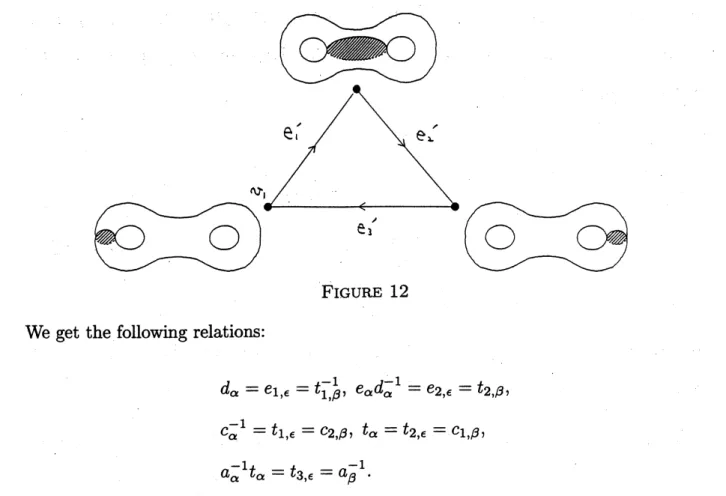
FIGURE 12 We get the following relations:
$d_{\alpha}=e_{1,\epsilon}=t_{1,\beta}^{-1},$ $e\alpha d_{\alpha}^{-1}=e2,\epsilon t2=,\beta$,
$c_{\alpha}^{-1}=t_{1,\epsilon}=c_{2,\beta},$ $t_{\alpha}=t_{2,\epsilon 1,\beta}=C$, $a_{\alpha}^{-1}t_{\alpha}=t_{3,\epsilon}=a^{-1}\beta$
.
To get the relations induced by (4),
we
need to give a presentation of$g_{\partial\tau_{1}}$ and $g_{\partial\tau_{2}}$.Let $e_{1}^{\prime/;},$$e_{2},$ $e_{3}$ be the edgesof
$\partial\tau_{1}$ indicatedinFigure 12. We choose asequence$g_{1},$ $g_{2},$ $g_{3}$
of the elements of$\mathcal{H}_{2}$ corresponding to these edges. The element $d_{\gamma}$ of$G_{\sigma_{1}}$ satisfies $v_{1}d_{\gamma}$ $=t(e_{1})$, and $b_{\alpha}\in G_{v_{1}}$ satisfies $eb_{\alpha}=e_{1}’$, therefore,
we
choose $g_{1}=d_{\gamma}b_{\alpha}$.
The element$b_{\alpha}^{-1}$ of$G_{v_{1}}$ satisfies $eb_{\alpha}^{-1}=e_{2}’g_{1}-1$, therefore, we choose $g_{2}=d_{\gamma}b_{\alpha}^{-1}$
.
The element $b_{\alpha}$ of$G_{v_{1}}$ satisfies $eb_{\alpha}=e_{2}’(g_{2}g1)-1$, therefore,
we
choose $g_{3}=d_{\gamma}b_{\alpha}$.
The element $g_{3}g_{2}g_{1}$ isin $G_{v}$, namely
we can
check $g_{3}g_{2}g_{1}=c_{\alpha}a_{\alpha}^{-1}d_{\alpha}e_{\alpha}$.
Hence we get the following relation:$d_{\gamma}b_{\alpha\gamma}db_{\alpha\gamma\alpha}^{-}1db\alpha=c_{\alpha\alpha}a^{-1}de\alpha$
.
Let $e_{1}$”, $e_{2}$”, $e_{3}$
” be the edges of$\partial\tau_{2}$ indicated in Figure 13. By the same manner,
we get the following relation:
$d_{\gamma}=r_{\beta}^{-1}$
.
FIGURE 13
Tietzetransformations [MKS;
\S 1.5]
to thispresentation, thenweobtain thepresentationgiven in Theorem 1.
4. THE SURJECTION FROM $\mathcal{H}_{2}$ TO $GL(2, \mathbb{Z})$
There is a natural surjection from $\mathcal{H}_{2}$ to the outer automorphism group of the
free group ofrank 2, Out$(F_{2})$, which is defined by the action of the elements of
$\mathcal{H}_{2}$ on the
fundamentalgroup of the handle body of genus 2. For the sake of check thepresentation
given in Theorem 1, we show this result with using this presentation. The group
Out$(F_{2})$ is naturally identified with $GL(2, \mathbb{Z})$ (see [MKS; p.169]). The group $GL(2, \mathbb{Z})$
is generated by $R_{1},$ $R_{2},$ $R_{3}$:
$R_{1}=,$
$R_{2}=,$
$R_{3}=$
,and the following is the set of relations between them which defines $GL(2, \mathbb{Z})$:
$R_{1}^{2}=R^{2}2=R^{2}3=E$,
$(R_{1}R_{2})^{3}=(R1R3)^{2}=Z$, $Z^{2}=E$,
where
(see [CM; Chapter 7]).
A homomorphism $\psi$ from $\mathcal{H}_{2}$ to $GL(2, \mathbb{Z})$ defines by:
$a,$$c,t\mapsto E$,
$b\mapsto R_{1}R_{3}R_{2}R_{1}$, $d-R_{3}$,
$e-R_{1}R_{3}R_{1}R_{3}(=^{z)},$ $f\mapsto R_{1}R_{3}R1R_{3}R_{1}$,
isa naturalsurjection. Ahomomorphism $\phi$from$GL(2, \mathbb{Z})$ to$\mathcal{H}_{2}$definedby considering
natural identification of (once punctured torus) $\cross[0,1]$ with $H_{2}$ :
$R_{1}\mapsto fe$,
$R_{2}\mapsto d^{-1}ac^{-}1fbf$, $R_{3}-d^{-1}aC^{-1}$,
is
a
injection and satisfies.$\psi\circ\emptyset=idcL(2,\mathbb{Z})$.
The above two factsare
verified by usingthe representation of$\mathcal{H}_{2}$ given
as
aTheorem 1.Problem. A injection $\phi$ from $GL(2, \mathbb{Z})$ to $\mathcal{H}_{2}$ , which satisfies
$\psi\circ\emptyset=id_{GL(2},\mathbb{Z}$) is not
unique. Is it unique up to conjugation ?
REFERENCES
[Bi] J.S. Birman, Mapping class groups and their rerationships to braid groups, Comm. Pure Appl. Math. 22 (1969), 213-238.
[Br] K.S. Brown, Presentations
for
groups
actingon
simply-connected complexes,Jour. Pure and Appl. Alg. 32 (1984), 1-10.
[CM] H.S.M. CoxeterandW.O.J.Moser, Generatorsand rerations
for
discretegroups, Ergebnisse dermathematik
und ihrer grenzgebiete, band 14, Springer, 1972.[Ha] A.E. Hatcher, A proof
of
the Smale Conjecture, $Diff(S^{3})\simeq O(4)$, Ann. of[J] K. Johannson, Topology and combinatorics
of
3-manifolds, Lecture notes in math. 1599, Springer, 1995.[K] R.Kramer, The twistgroup
of
an orientable cube-with-two-handles is not finitelygenerated, preprint.
[MKS] W. Magnus, A. Karras, D. Solitar, Combinatorial group theory, Interscience,
New York, 1966.
[S] S. Suzuki, On homeomorphisms
of
a 3-dimensional handlebody, Canad. J. Math.29 (1977), 111-124.
DEPARTMENT OF MATHEMATICS FACULTY oF SCIENCE AND ENGINEERING SAGA UNIVERSITY
SAGA, 840 JAPAN